Web3

Home Web3 Page 115

Solana network boosts block capacity by 20% to enhance performance

0
Solana network boosts block capacity by 20% to enhance performance


Solana developers have increased the network’s block limit from 50 million to 60 million compute units (CUs), marking a move to support higher transaction volumes and improve overall performance.

Helius Labs CEO Mert Mumtaz announced the update on July 23, representing a 20% expansion in block capacity.

According to Mumtaz, compute units on Solana function like fuel for a vehicle, as each transaction consumes a certain number of CUs depending on its complexity. For instance, a basic token transfer uses fewer CUs than a multi-swap operation across decentralized exchanges.

This upgrade is part of a broader effort to address execution constraints observed during periods of high network activity. Solana raised the CU limit to 50 million in June as a precautionary step to prevent disruptions.

Following the success of that implementation, developers moved forward with the second phase of lifting the cap to 60 million CUs.

Expanding Solana blocks

Meanwhile, Mumtaz revealed that the team aims to eventually double the block capacity to 120 million CUs.

He explained that the increase would allow developers to build more expressive applications and reduce transaction fees, especially as demand grows.

Brennan Watt, Vice President of Core Engineering at Anza, has already confirmed that he has merged a Solana Improvement Document (SIMD-0286) proposing a further increase to 100 million CUs. This reflects the network’s ongoing push to accommodate higher transaction volumes and enhance user experience.

When asked whether Solana’s block capacity might eventually become uncapped, Watt noted that core developers continue to debate the issue.

According to him, while unlimited execution could enhance flexibility, it also raises concerns about potential abuse. Therefore, he noted that “execution needs to be bound to protect from abuse.”

Watt added that static analysis or metering may become more useful if the network shifts toward asynchronous execution models.

The update comes as Solana’s price recently hit a five-month high of over $200, fueled by institutional interest and rising adoption in corporate treasuries. However, as of press time, SOL has pulled back to $187 amid a broader market correction affecting major altcoins


Source link

Trump’s Crypto Working Group Set to Deliver Report—What Experts Expect To See – Decrypt

0
Trump’s Crypto Working Group Set to Deliver Report—What Experts Expect To See – Decrypt


In brief

Trump’s crypto task force will release its 180-day report on July 30, Bo Hines, the group’s executive director, said Wednesday.
The report is expected to outline stablecoin oversight, token classification, and enforcement reforms following the GENIUS and CLARITY Acts, Decrypt was told.
Experts say it may propose building a Bitcoin reserve using seized assets, while ruling out a retail CBDC.

President Donald Trump’s crypto task force has finished its 180-day review of digital asset policy and will release the report publicly on July 30, capping a six-month window by President Donald Trump’s newly formed digital assets task force.

“America is now leading the way on digital asset policy,” Bo Hines, executive director of the Presidential Working Group on Digital Asset Markets, tweeted on Wednesday.

“With the GENIUS and CLARITY Acts now law, the President’s Working Group report is expected to tie everything together, right from token classification and stablecoin oversight to market integrity, digital asset taxation, and, most importantly, enforcement clarity,” CA Sonu Jain, chief risk and compliance officer at 9Point Capital, told Decrypt.

Following through on campaign promises to make America “the crypto capital of the world,” President Donald Trump signed his first executive order in January, establishing the Presidential Working Group on Digital Asset Markets, just three days after his inauguration.

The group was tasked with delivering a set of recommendations on digital asset regulation, including the feasibility of a “strategic national digital assets stockpile.”

The working group includes top officials from the Treasury, SEC, CFTC, DOJ, and other federal agencies, led by “AI and crypto czar” David Sacks and managed by Hines.


The most “intriguing element” may be the Bitcoin reserve mandate, experts suggest. 

The administration is expected to take a “pragmatic approach: steering clear of retail CBDCs due to privacy and trust concerns, promoting USD-pegged stablecoins with clearer regulations while focusing on international cooperation,” Monica Jasuja, chief expansion and innovation officer at Emerging Payments Association Asia, told Decrypt.

“This isn’t necessarily about the U.S. buying Bitcoin on the open market, but rather exploring the feasibility of establishing a federal crypto reserve, potentially drawing from seized digital assets already in government custody,” Jasuja said. 

If included in the report, that could mark the beginning of a “more structured and secure sovereign approach to crypto exposure” without directly competing in volatile markets, she added.

The executive order required agencies to identify existing digital asset regulations within 30 days, recommend changes within 60 days, and consolidate their findings into a 180-day report that included legislative and regulatory proposals.

“It would be great if the working group could identify and recommend one or more ways for the U.S. government to build a Bitcoin stockpile without using fresh taxpayers’ funds,” Pranav Agarwal, independent director at Jetking Infotrain India, told Decrypt.

The “real test,” said Jasuja, is whether the report delivers “regulatory clarity” and if “done right,” will position the U.S. as a “global leader in digital finance infrastructure.”

Daily Debrief Newsletter

Start every day with the top news stories right now, plus original features, a podcast, videos and more.


Source link

Are Things Getting Too Frothy for Ethereum, XRP and Other Top Altcoins? – Decrypt

0
Are Things Getting Too Frothy for Ethereum, XRP and Other Top Altcoins? – Decrypt


In brief

Altcoins are falling hard Wednesday following a recent surge in prices for Ethereum, XRP, and more.
Glassnode reports that altcoin open interest hit a new all-time high, skyrocketing since the start of July.
That growth in derivatives trading may result in more volatility, which could explain the dip.

The recent crypto market euphoria hit a speed bump on Wednesday, as top altcoins like Ethereum, XRP, Solana, and Dogecoin fell, with some showing sizable drops. And the broader market dive has resulted in a growing pile of long positions getting liquidated amid concerns about frothy conditions for traders.

Altcoins have been surging in July, with XRP hitting a new all-time high mark last week—breaking a seven-year record—while Ethereum and Solana reached six-month highs in recent days. The Binance-linked BNB just hit a new all-time high price of $808 earlier Wednesday, before the market began to turn.

But now most of the market is showing red over the past day, with XRP now the biggest loser in the top 10 coins, falling nearly 10% over the past day to a current price of $3.22. It remains up nearly 8% over the last week.

Meanwhile, Dogecoin has fallen nearly 9% to $0.241 and Solana has dipped 7% to $188. Ethereum’s 3% fall on the day to $3,586 is relatively modest by comparison, while Bitcoin hasn’t budged much at all, sliding just 1% to $117,810.


Myriad users don’t expect a quick rebound for Ethereum, either, giving ETH just a 20% chance of bouncing to above $4,000 by the end of July 25. (Disclosure: Myriad is a product of Decrypt’s parent company, Dastan.)

Ethereum, however, is leading the list of daily liquidations, showing just how much traders were betting on the price of ETH to continue rising after last week’s massive gains. More than $605 million worth of positions have been wiped out over the last day, per data from CoinGlass.

Over $129 million worth of Ethereum positions have been liquidated over the past 24 hours, led by longs at nearly $104 million. XRP is next on the list for liquidations at $63.4 million, followed by the usual leader, Bitcoin, at $62.5 million.

Is altcoin season over already, or just getting started? Ethereum, XRP, and other top cryptocurrencies had recently outgained Bitcoin—which itself surged to new all-time highs earlier this month—with Glassnode noting a $216 billion boost to the collective market cap of altcoins over the last two weeks, as of early Wednesday.

“This is one of the largest USD-denominated upswings in the aggregate altcoin market cap, which adds further evidence to the presence of an ongoing altseason impulse,” analysts wrote.

That buzz has led to a boost in derivatives market trading, with collective altcoin open interest surging from $26 billion to a new record of about $45 billion since the start of July—including new highs for Ethereum and XRP.

That kind of surge suggests a level of froth around the altcoin market and can lead to increased volatility, which could explain why the markets are seeing sudden swings in either direction.

“This rapid growth suggests an acceleration in speculative positioning and a rising degree of market froth,” Glassnode analysts wrote. “Elevated leverage can both magnify gains and exacerbate losses, introducing greater reflexivity and making the market more vulnerable to volatility shocks.”

We may be seeing one of those shocks in action Wednesday, given the sharp drops for altcoins that were recently very hot. But one crypto executive told Decrypt that he believes it won’t mark the end of the bull market.

“What we’re seeing right now is a little more complicated than ‘What goes up must come down,’” said Mike Cahill, CEO of blockchain infrastructure firm Douro Labs. “Of course, after Bitcoin’s newest all-time high, there’s definitely going to be a market correction as a result of profit-taking and increased selling pressure.”

“On top of that, stalled U.S.-China trade talks and new speculation around the Fed’s policy changes are definitely impacting the market,” he added. “Overall, what we’re seeing is a small dip; I expect the crypto bull market to continue strongly at the very least through the end of 2025.”

Daily Debrief Newsletter

Start every day with the top news stories right now, plus original features, a podcast, videos and more.


Source link

Lessons from Nvidia: Why Early Bets on Compute Pay Off Big

0
Lessons from Nvidia: Why Early Bets on Compute Pay Off Big


Imagine this. Back in 2016, Nvidia launched its Pascal architecture. The GTX 10 series GPUs quickly became the foundation for gaming, data centers, and eventually artificial intelligence. At that time, Nvidia’s stock traded around $20 to $30. Few could have predicted that the company would rise to become the powerhouse behind AI’s explosion.

By early 2024, Nvidia’s market capitalization passed $3 trillion. In July 2025, it hit $4 trillion, becoming the most valuable public company in the world. Investors who put $1,000 into Nvidia stock in 2016 saw returns well over 2,000%. Some turned modest investments into six-figure or even seven-figure portfolios.

Of course, this growth did not come without fear. In early 2025, Nvidia lost nearly $600 billion in value in a single day after market fears about AI competition. But the stock bounced back fast. Its dominance in compute infrastructure remained too strong to ignore. That is the power of owning the rails of a technological revolution. And today, Spheron and its token $SPON aim to do the same for decentralized AI and compute.

Why Nvidia’s Story Still Matters

Nvidia made one of the greatest pivots in tech history. In 2016, most people thought of Nvidia as just a gaming chip company. But internally, the company saw something more. It realized that GPUs were not just for gaming but were perfect for artificial intelligence training and inference.

This move changed the entire trajectory of the company. Nvidia’s revenue grew from $5 billion in 2016 to over $130 billion in 2025. Its software stack, especially CUDA, helped it lock in developers. It built deep partnerships with Amazon, Microsoft, Google, and dozens of AI startups. It took calculated risks and bet big on a future that no one else could clearly see.

Today, those who missed that opportunity still feel the sting. But a new opportunity has emerged. The next great wave of compute is coming. It won’t be centralized this time. It will be decentralized. And it will be powered by Spheron.

Enter Spheron and $SPON

Spheron is building the world’s largest decentralized compute infrastructure. Unlike centralized cloud providers, Spheron taps into underutilized GPU and CPU power from around the world. From idle gaming rigs in homes to high-performance machines in data centers, all that power flows into a global mesh that supports AI, machine learning, agentic apps, and more.

And what powers it all? The $SPON token.

Unlike many Web3 projects that launch tokens first and build products later, Spheron flipped the script. It built the products first. Then it proved the demand. Then it launched the token.

At the time of writing, Spheron has already crossed $11.5 million in annual recurring revenue, all before the $SPON token has even launched. Now, just imagine the momentum once $SPON goes live.

A Massive Market Is Opening

The global AI compute market is projected to be worth over $1 trillion by 2030. The demand is growing fast. Training and running AI models need massive amounts of GPU compute. But centralized players like AWS, Azure, and Google Cloud are expensive, slow to scale, and prone to censorship and outages.

This is where Spheron steps in. It gives developers, startups, and AI projects an affordable, censorship-resistant, and decentralized compute stack. With 44,000 active nodes, 8,300+ GPUs, and nearly 600,000+ CPUs contributing compute from 176 regions, Spheron is already running at scale.

Every transaction in this network flows through $SPON. Whether you are leasing GPUs, staking to earn, paying for inference, or deploying an AI agent, $SPON sits at the center.

Why You Don’t Want to Miss This Time

Back in 2016, Nvidia wasn’t cool. It wasn’t hyped. But it had traction. It had a product. And it had a vision.

Today, Spheron is at the same point. It has product-market fit. It has traction. It has over 100 projects building on top of it. KlippyAI, Skynet, and Aquanode are all live. And the demand for compute continues to rise.

With $SPON, you are not buying into an idea. You are buying into an operating ecosystem. From day one, you can use it, stake it, earn from it, and govern with it. There is no need to wait years to see the utility. It is live now. Spheron’s goal is clear. It wants to power the next 1,000 AI-native and Web3-native applications. It wants to decentralize the cloud. And it wants to give ownership of the compute layer back to the community.

How Spheron Wins

Spheron’s design is simple but powerful. It lets anyone in the world contribute compute. If you have a GPU or CPU, you can plug in through Fizz Nodes with nothing more than a Gmail login. If you run a data center, you can join through Supernoderz for high-throughput jobs.

Compute providers stake $SPON to secure the network and earn more rewards. Developers and users pay in $SPON. As more people deploy AI models, videos, and agents, demand for compute rises. That increases the demand for $SPON. And as fees flow through the system, Spheron uses a portion of them to buy back $SPON, reducing supply and increasing value for holders.

This is a real flywheel. And it’s already spinning.

There is something powerful about being early. Not just financially, but emotionally. You get to be part of a story before the world writes its headlines. Most people miss these moments. They are too late, too doubtful, or too distracted. But a few recognize the signal. They understand when a system moves from “idea” to “infrastructure.”

Spheron is not a whitepaper project. It is not a token-first hype machine. It is infrastructure. It is revenue-generating. It is battle-tested. And it is opening the door for you to participate.

What Happens Next?

After TGE, Spheron plans to launch an upgraded staking system, real-time earnings dashboards, GPU lending, and an agent marketplace where autonomous AI agents can be bought, sold, or deployed permissionlessly.

The world has never had an open, global compute layer built like this. But now, with $SPON, every developer, creator, and hardware owner can participate.

Imagine building the AI economy not just from San Francisco or Singapore, but from your bedroom. Imagine agents running around the world, powered by your GPU. And imagine getting paid for it.

This is what permissionless AI compute looks like.

Final Thoughts

Nvidia’s story changed the world. But it also left many behind. Those who saw the potential early and acted won big. Those who waited paid the price.

Now, in 2025, you are being handed a second chance. The world is shifting. AI is exploding. Compute is the new oil. And Spheron is building the pipeline. $SPON is your access key.

The question is, will you miss it again? Or will you be early this time?

Because the future is not just being built. It is being distributed. And those who hold $SPON might just be the ones who own it.


Source link

Meet the Ecosystem: 100+ AI, Compute, and Web3 Projects on Spheron

0
Meet the Ecosystem: 100+ AI, Compute, and Web3 Projects on Spheron


The crypto world rarely sees a project with real traction before its token launches. In most cases, teams release a whitepaper, generate hype through airdrops, and hope to ship later. But Spheron is flipping this model. It already has over 100 projects integrating with its infrastructure, before the $SPON token even hits the market.

This is not normal. And it’s not luck. It’s the result of years of infrastructure building, early product-market fit, and a deep understanding of what AI and Web3 developers actually need.

The Beginning: Spheron’s Foundational Years

Spheron’s journey started long before AI went mainstream in crypto. Back when most DePIN (Decentralized Physical Infrastructure Network) projects were still theoretical, Spheron was building a decentralized infrastructure stack that would make deploying compute as easy as clicking a button.

Originally, the team focused on decentralizing web hosting and dev tools. This gave them deep experience in orchestration, developer experience, and cloud replacement. As the demand for AI infrastructure exploded in late 2023 and early 2024, Spheron had already built the pipes to scale compute across a distributed network. All they needed to do was plug in GPUs.

So they did.

In 2024, Spheron launched its decentralized GPU marketplace. It onboarded over 44,000 nodes, with more than 8,300 GPUs and 600,000+ CPUs from across 176 regions. These numbers weren’t inflated. They reflected real users, real hardware.

By the time 2025 rolled around, Spheron had grown its revenue to $10M ARR, all before launching its token. Most protocols hope to hit those numbers years after launch. Spheron did it as a bootstrapped infra network.

A Network Built for the Agent Economy

Spheron didn’t stop with GPU infrastructure. It realized early that autonomous agents would drive the next evolution of the internet. These AI-powered entities can reason, act, and learn on behalf of users and businesses. These agents need three things to thrive:

Scalable compute

Data to reason on

Verifiable, permissionless environments to operate in

Spheron quietly built all three layers. It started with GPU compute, added storage and data partners, and developed platforms like KlippyAI (text-to-video), Skynet (no-code AI agents), **Supernoderz (**Node-as-a-service), and Aquanode (agent-native inference infra).

More importantly, Spheron didn’t gate any of this. Developers didn’t need to request access or apply for API keys. Everything is permissionless. If you have a model or agent to run, you could launch it on Spheron instantly and pay with fiat or crypto.

This open design led to a flywheel effect. Projects building agents or AI tools started integrating with Spheron because it was the only infra that could scale without gatekeeping or high costs. As more agents went live, demand for compute surged. And Spheron scaled supply through its Fizz Nodes.

This ecosystem model is now attracting over 100 projects across AI, data, storage, verification, and more—all building on top of Spheron ahead of the token launch.

Who’s Integrating with Spheron?
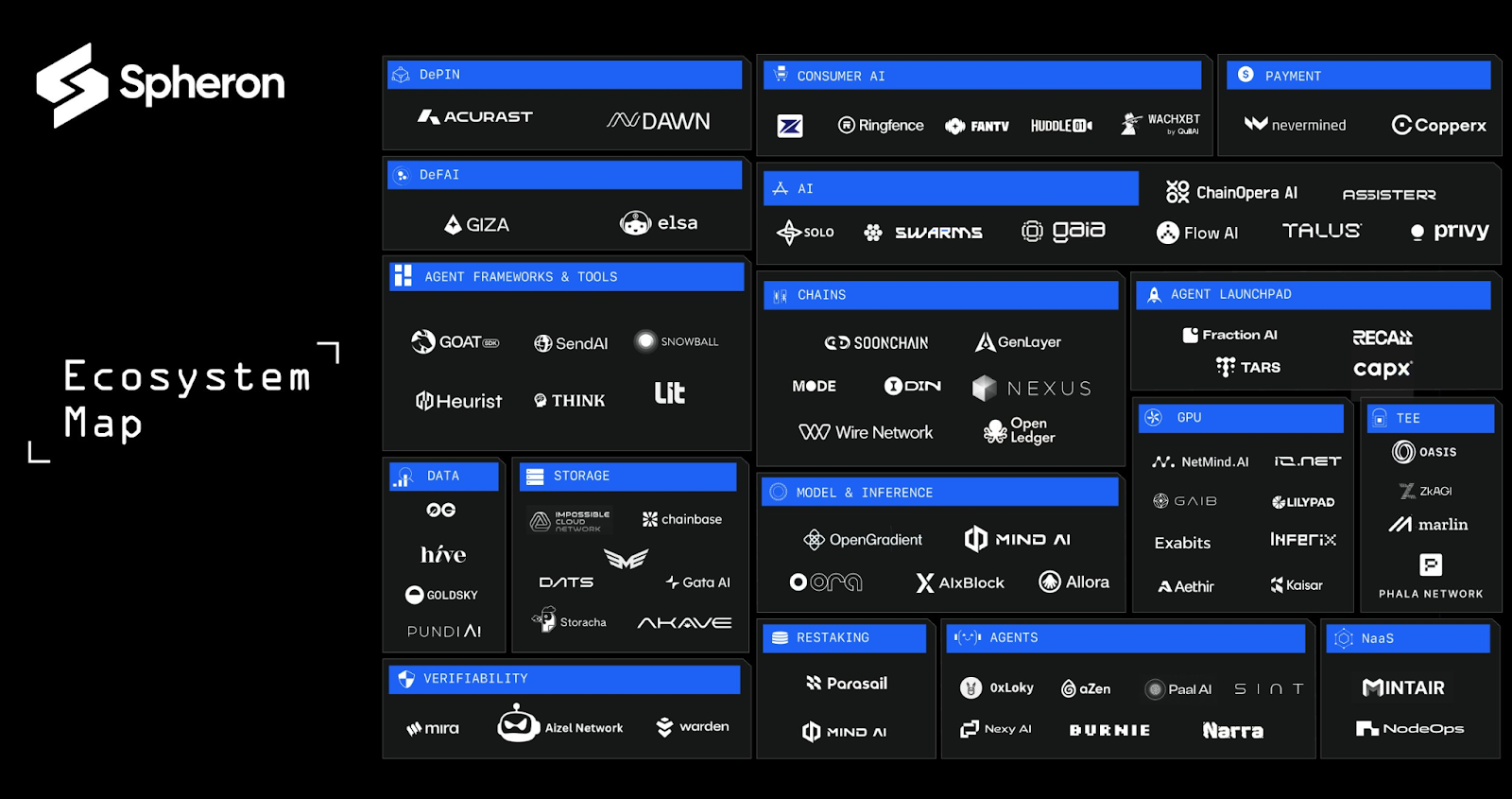
From foundational compute partners like IO.NET, NetMind, Aethir, and Lilypad to AI agent networks like Loky, Narralayer, and Sinthive, Spheron is becoming the base layer for autonomous systems.

The list of partners spans every layer of the AI and Web3 stack, from GPU providers to agent launchpads:

GPU Providers

Trusted Execution Environments (TEE)

Restaking Middleware

Agent Launchpads

Agent Networks

0xLoky AI – Agent discovery and deployment

Azen Protocol – Autonomous economic agents

PaalMind – AI chatbot network

SINT – Own, train, and evolve autonomous AI agents

NexyAI – AI-native search and discovery

Burnie – Fun, chaotic agent layer

Narra Layer – Narrative-driven AI agents

Node-as-a-Service (NaaS)

Mintair – Node deployment infra

NodeOps – Infra as code for validators

Data

Storage

Verifiability:

The $SPON Flywheel

At the heart of it all is the $SPON token, which is scheduled to launch in Q3 2025. But unlike most tokens, $SPON isn’t launching into a vacuum. It already has multiple live integrations and a growing user base.

Here’s how $SPON drives the flywheel:

Payments: Developers and users pay for compute, storage, and inference with $SPON.

Staking: Node providers stake $SPON to join and earn higher-tier rewards.

Governance: $SPON holders shape the network’s future—pricing, features, and policy.

Buyback & Build: A portion of fees goes into buying back $SPON from the market, creating deflationary pressure.

As more agents run on Spheron, demand for compute increases. That drives more token utility, more staking, and more integrations. It’s a positive feedback loop that gets stronger over time.

Why It’s Happening Before the Token

The reason over 100 projects are integrating now, pre-TGE, is simple: Spheron works.

Unlike speculative projects that promise future utility, Spheron delivers real services today. AI teams can run models, store data, launch agents, and verify outputs, all in a decentralized and permissionless way.

Also, they’re early. By integrating now, these projects get access to compute resources before demand skyrockets. They can shape the roadmap, influence the protocol, and get exposure through the growing Spheron community.

And it’s not just smaller startups. Spheron is already working with established leaders like Gensyn, Kuzco, Gradient, and Sentient, proving that enterprises trust this stack.

Looking Forward

Spheron is not another cloud alternative. It is the decentralized backbone of AI and Web3.

As the world shifts toward autonomous agents, decentralized intelligence, and distributed infrastructure, the need for permissionless, verifiable compute will explode. Centralized clouds can’t serve that need—they’re too expensive, too closed, and too slow to evolve.

Spheron was born to solve this. It’s fast, decentralized, global, and already adopted. $SPON isn’t a bet on hype, it’s a claim on real usage, real revenue, and the future of AI.

Over 100 projects already see it. The question is—do you?



Source link

Japan’s Kitabo Joins Growing List of Asian Firms Turning to Bitcoin Amid Financial Strain – Decrypt

0
Japan’s Kitabo Joins Growing List of Asian Firms Turning to Bitcoin Amid Financial Strain – Decrypt


In brief

Kitabo Co., a century-old Japanese textile firm, plans to buy Bitcoin worth ¥800 million (approx. $5.4 million).
The move aligns with a broader trend in Asia, where traditional firms like Metaplanet are adopting Bitcoin to hedge against monetary debasement.
Kitabo will acquire the digital asset via dollar-cost averaging and may lend holdings to generate yield, it said.

A century-old Japanese textile company has become the latest financially battered firm to turn to Bitcoin as a treasury asset, announcing plans to purchase up to $5.4 million (800 million yen) in crypto to stabilize its bottom line after years of losses and muted cash flow.

Kitabo Co., Ltd., a Tokyo Stock Exchange-listed textile manufacturer that produces synthetic fibers and industrial materials, announced in a statement on Tuesday that it will begin gradually acquiring Bitcoin using dollar-cost averaging starting this month. 

The move marks the company’s full-scale entry into the “cryptocurrency and real-world asset business,” it said.

Kitabo is now among a growing roster of Asian corporations adopting Bitcoin treasury strategies, as traditional companies increasingly view the digital asset as a hedge against monetary debasement and a foundation for international business operations.

“To add Bitcoin to its balance sheet is a powerful testament to this trend’s expansion beyond the tech sector,” HashKey Group chief analyst Jeffrey Ding told Decrypt.

Kitabo Co. reported a 24.7% year-over-year increase in revenue for fiscal 2025, but still ended the year with a net loss of $379,357 (¥55.8 million) and negative operating cash flow of $52,348 (¥7.7 million). 

This followed an even steeper loss of $785,000 (¥115.6 million) in fiscal 2024, when the company relied on one-time gains to offset weak core performance. 

Hoping to shore up those losses, Kitabo plans to acquire Bitcoin through domestic crypto exchanges using funds raised from its Fourth Series of Stock Acquisition Rights. 


The company also intends to use the crypto for “cross-border services, including partnerships with various overseas businesses,” positioning Bitcoin as a “foundational asset for promoting diverse business strategies.”

Kitabo Co. plans to generate yield on its Bitcoin holdings by lending portions to crypto lending companies for stable returns, it said.

While the trend is barely new, industry experts view the move as indicative of a broader corporate awakening to Bitcoin’s potential as a treasury asset. 

“Historically, cash and cash equivalents formed the bulk of corporate treasuries,” Zakhil Suresh CMT, founder & CEO at crypto asset manager BitSave, told Decrypt. “But now, more and more companies are waking up to the idea that cash is no longer safe.”

“This isn’t about chasing returns—it’s about protecting the purchasing power of the company in a world of constant monetary expansion,” Suresh added.

The corporate Bitcoin adoption trend has gained momentum across Asia, with Metaplanet leading the charge as Japan’s most prominent corporate Bitcoin holder. With 16,352 BTC worth approximately $1.95 billion, Metaplanet ranks seventh globally, according to Bitcoin Treasuries data.

Kitabo Co. is trading at $1.52 (¥237.00) per Google Finance data, up 0.85% on the day and more than 100% from its 52-week low.

Daily Debrief Newsletter

Start every day with the top news stories right now, plus original features, a podcast, videos and more.


Source link

Tesla’s Retro Diner Opens in Los Angeles with Burgers, Big Screens and Angry Neighbors – Decrypt

0
Tesla’s Retro Diner Opens in Los Angeles with Burgers, Big Screens and Angry Neighbors – Decrypt


In brief

Tesla opened a retro-style diner in Hollywood with EV-only parking, rooftop dining, and massive LED screens playing movie clips.
While an Optimus robot serves popcorn, the kitchen is still human-run.
While Tesla fans praised the experience, some locals raised concerns about traffic, noise, and the diner’s impact on the neighborhood.

Tesla’s long-awaited retro-style diner finally opened over the weekend in Los Angeles, and yes, there’s rollerskating waitstaff, rooftop seating, and a humanoid robot handing out popcorn. No, you can’t pay in Dogecoin, yet.

Located near the iconic Paramount Studios, the two-story fever dream sits atop a Supercharger hub with 80 EV-only parking spaces.

Part midcentury nostalgia trip, part Muskovite experiment, the diner has seating for 250 people and features two, drive-in-movie-sized LED screens that play curated 30-minute movie and TV show clips (meant to match the average Tesla charging time).

The menu offers comfort food classics rebranded for the megawatt crowd.


The diner also featured an Optimus, Tesla’s in-development humanoid robot, which was handing out popcorn to guests like an escapee from CES. Kitchen operations, however, were human-led under chef Eric Greenspan.

Musk first proposed opening a Tesla-themed restaurant in January 2018. Throngs of people have shown up, and there was a two-hour wait for lunch on Tuesday.

“It was a fantastic opening,” the diner’s manager, Bill Chait, told Decrypt.

Tesla Optimus robot serving popcorn. Image: Jason Nelson/Decrypt

The menu firmly adheres to the Americana tradition, featuring “Tesla Burger” cheeseburgers, hot dogs, fried chicken and waffles, fries, cinnamon rolls, and biscuits and gravy. There’s plenty of Tesla-branded merchandise, too.

The diner is cashless and currently does not accept any crypto despite Tesla CEO Elon Musk’s professed love of Dogecoin.

Reactions were mixed on prices, if not the food. “It was good but expensive,” said one diner. Another added, “We came last night and wanted to come back for more.”

The flashy venue straddles an industrial zone and a residential neighborhood, and, with all the hubbub plus the fact that the place is open 24/7, not all the locals were thrilled. “It doesn’t go with the neighborhood at all,” one passerby said. “It’s just more gentrification.”

Tesla Diner Waitstaff and Tesla Cars. Image: Jason Nelson/Decrypt

The influx of traffic has caused headaches, with strip mall congestion and near-accidents as rubberneckers slow to take in the spectacle.

Two 66-foot-tall LED screens didn’t help, one of which now blocks views from nearby apartment balconies owned by South Park Group, Inc.

South Park Group did not respond to requests for comment by Decrypt.

Tesla cars beneath an LED screen. Image: Jason Nelson/Decrypt

Tesla cars beneath an LED screen. Image: Jason Nelson/Decrypt“A lot of our tenants have complained about the screens,” a groundskeeper admitted. “It would have been better if they only had the one screen so tenants could enjoy the ambience.”

Well, the traffic will surely die down as more locations open up—something Musk has suggested might occur.

“If our retro-futuristic diner turns out well, which I think it will, Tesla will establish these in major cities around the world, as well as at Supercharger sites on long-distance routes,” he wrote on X.

Because nothing says “sustainable future” like a Tesla Burger at 3 a.m. and a 66-foot screen utterly obliterating your view of the world.

Daily Debrief Newsletter

Start every day with the top news stories right now, plus original features, a podcast, videos and more.


Source link

London Gang Convicted of Kidnapping Barber They Thought Was a Bitcoin Billionaire—He Wasn’t – Decrypt

0
London Gang Convicted of Kidnapping Barber They Thought Was a Bitcoin Billionaire—He Wasn’t – Decrypt


In brief

Four people in London were convicted for kidnapping a Belgian barber after he boasted online about a crypto fortune he didn’t actually have.

The gang ambushed him with weapons, but after discovering his wallet held only $9, they extorted $2,700 from his bank instead.

The case highlights rising “wrench attacks,” where criminals physically target people flaunting crypto wealth on social media.

A London court has convicted four people in the botched kidnapping and wrench attack of a Belgian barber. The group lured him to London with promises of luxury and companionship after he made out that he was sitting on a Bitcoin fortune.

But to their surprise, when his attackers demanded he give them access to his funds, the victim revealed he had just over $9 (£6.71) in his crypto wallet. Stunned, the kidnappers lowered their demand to $67,000 (about £50,000), then eventually settled for $2,700 (or £2,000) from his bank account.

The victim, Quentin Cepeljac, was abducted in May 2023 after being lured to the U.K. He was attacked, held overnight, and later released after his captors learned he had no significant crypto holdings, according to a report from The Times.

One of the attackers, Davina Raaymakers, had befriended Cepeljac on social media weeks earlier. After he claimed to be a successful crypto dealer, she invited him to London and offered what she described as a luxury flat.

Instead, she led him to a bedsit in Shepherd’s Bush, where three men, including her boyfriend, were already waiting. They then ambushed Cepeljac, held a machete to his neck and a knife to his leg, and demanded access to his crypto wallet.

After they realized he had no significant crypto holdings, they settled for cash from his bank account and let him go.


The paper reported all four defendants admitted to blackmail and identified Isleworth Crown as the venue. Although court records remain unavailable, the paper says police met Cepeljac at St. Pancras and used phone and Airbnb data to identify the suspects.

Decrypt has filed FOI requests to verify the charges, pleas, and sentencing details.

Crypto ‘flex culture’ and wrench attacks

The case has become part of a wider trend known as “wrench attacks,” where perceived crypto holders are extorted through physical force. These attacks target people directly, bypassing digital security.

In a similar case, a TikTok crypto influencer in France was kidnapped and held for ransom, only to be released after his attackers discovered he was broke. The gang had tracked him based on social media posts and believed in his supposed wealth.

“Flex culture in crypto is perilous: Criminals target holders just like they would if you posted an Instagram Story showing a luxury watch by the pool,” Eyal Gruper, founder and CEO of self-custodial Bitcoin recovery platform RITREK, told Decrypt.

Flex culture, derived from the slang term “flexing,” refers to the act of showing off wealth, status, or possessions, often to impress others.

“Opportunists lurk in the same channels you use, following industry insiders’ feeds and monitoring conference hashtags to spot anyone worth coercing,” Gruper said.

In crypto, this includes flaunting wallet balances, NFT purchases, profitable trades, or high-profile travel to industry events.

Still, some see the focus on flex culture as misplaced.

“Flex culture isn’t unique to crypto, it exists across industries,” Callum Mitchell-Clark, co-founder of tokenized basket management protocol Alvara, told Decrypt.

Mitchell-Clark argues pointing to flex culture misses the point and risks deflecting responsibility from perpetrators.

“Blaming it for violent crime shifts attention away from the real issue: the criminals,” he said. “Violence is a choice, not a consequence of visibility, and we shouldn’t excuse it by pointing fingers at victims.”

Daily Debrief Newsletter

Start every day with the top news stories right now, plus original features, a podcast, videos and more.


Source link

Solana Clinches 5-Month High, Where to From Here? – Decrypt

0
Solana Clinches 5-Month High, Where to From Here? – Decrypt


In brief

Solana reached $200, its highest in five months, alongside a $1.5 billion rise in open interest over three days.
Options data signals growing investor caution, with implied volatility and 30-day skew both spiking.
Upcoming macro events—including Fed remarks, jobless claims, and a rate decision—may test the rally.

Solana climbed to a five-month high on Monday, drawing renewed attention to Layer 1 blockchains and signaling a potential shift in crypto market sentiment for altcoins.

Solana briefly touched $200 during early Asian trading, extending a 50% rally over the past month. It has since fallen below the $200 tag to $197, CoinGecko data shows.

The native token’s growing market strength, further reflected in its $1.5 billion uptick in open interest over the past three days, hints at a substantial influx of capital, according to some.

Solana traders appear to be preparing for a “turbulent month,” Sean Dawson, Head of Research at options trading platform Derive, told Decrypt. 

He pointed to a growing gap between the 30-day realized and implied volatilities as the primary reason. The implied volatility, which tracks the future expectations of options traders, has more than tripled from 4% to 14%. 

In other words, the recent jump in implied volatility and widening skew suggest traders have repositioned for a potentially bullish breakout.


Traders are now also paying more for bullish call options relative to bearish put options than they were a few days ago.

Despite the prevailing short-term focus on Ethereum, where that digital asset has sparked a 60% rally in just 30 days, Dawson projects a positive outlook for the broader Layer-1 landscape over the next six months. 

He anticipates L1s emerging as the “winner,” citing developments like “Trump’s big beautiful bill and GENIUS Act,” along with aggressive institutional adoption of Ethereum.

Dawson expects Solana to be a significant beneficiary within that context,  due to its “high beta” and surging on-chain activity from the resurgence in “meme coin trading.” 

Still, the long-term outlook and sustained bullish trajectory depend heavily on favorable monetary conditions. 

Those include Thursday’s jobless report and the July 30 CPI print, which could offer clues on the U.S.’s fight with ongoing inflation.

Should labor market softness continue and inflation tick down, Dawson concludes, “risk assets like crypto could soar sooner than expected.”

Daily Debrief Newsletter

Start every day with the top news stories right now, plus original features, a podcast, videos and more.


Source link

Ring Users Report Mysterious Logins—Amazon Blames Backend Bug – Decrypt

0
Ring Users Report Mysterious Logins—Amazon Blames Backend Bug – Decrypt


In brief

Thousands of Ring users reported suspicious May 28 logins, raising fears of a widespread hack.
Amazon said the issue was caused by a backend bug that incorrectly displayed login dates and device names.
Users remain skeptical, especially as Ring recently reintroduced law enforcement access through a new Axon partnership.

Amazon’s Ring cameras went viral, and for all the wrong reasons, as users flooded TikTok, Reddit, and X with reports of suspicious logins to their accounts.

Screenshots posted online showed unknown devices accessing user accounts, fueling concerns about a potential breach in Amazon’s home security network. All of the mysterious breaches occurred on May 28, 2025.

Ring denied that a hack had taken place, and in a status update, blamed the issue on a backend update.

“We are aware of an issue where information is displaying inaccurately in Control Center,” it said. “This is the result of a backend update, and we’re working to resolve this. We have no reason to believe this is the result of unauthorized access to customer accounts.”

Ring said the devices shown were simply ones users had logged in with before.

“The devices customers see on the Authorized Client Devices page were used to log in to the customer Ring account at some point in time,” a Ring spokesperson told Decrypt.


“They may include devices they no longer own, devices for users whose customers shared login information with, and browser logins,” they said.

Naturally, that explanation didn’t fly. Social media users pushed back on Ring’s claims, saying the devices listed were ones they’d never owned.

“Some people in the comments are saying it could have been a software update that re-recognized any old devices you had, but that doesn’t make sense because one of the devices listed was a Chromebook, which I’ve never owned,” one Reddit user posted.

“OMG! I have six unknown devices that logged in on May 28, 2025,” another said. “Two of them logged in at 5:56 AM, and the other four at 6:57 AM. One is an iPhone 6!! Definitely not my phone, and nobody I know has a phone this old. Weird.”

“Absolute bollocks with your ‘bug,’ I don’t even know Derbhille, or is she anyway associated with our ring camera or family?” a X user wrote. “Just admit you’ve been hacked and you are gonna amend this.”

Skeptics pointed out that the timing was suspicious. Ring founder Jamie Siminoff returned as CEO on July 17, a day before the mysterious logins began appearing on user accounts.

According to a report by Business Insider, Siminoff aims to return to Ring’s original mission to “make neighborhoods safer.” Part of that strategy reportedly includes reversing Amazon-imposed limits on police access to camera footage.

Regardless, if you have a Ring device, it’s easy enough to secure. Check the app’s Control Center for unfamiliar devices, reset passwords, and enable two-factor authentication and end-to-end encryption.

Generally Intelligent Newsletter

A weekly AI journey narrated by Gen, a generative AI model.


Source link

Popular Posts

My Favorites

Gemini Launches Australian Arm — What That Means for Crypto Adoption...

0
Gemini, a cryptocurrency exchange company based in the United States and started by two twin brothers, Cameron and Tyler Winklevoss, has made a...