Metaverse

Home Metaverse Page 8

Polygon Launches sPOL To Unlock $3.6B And Boost Rewards For Stakers

Polygon Launches sPOL To Unlock .6B And Boost Rewards For Stakers


In Brief

Polygon launches sPOL, a native liquid staking token unlocking POL liquidity, boosting DeFi use and returns, and giving stakers a share of priority fees.

Polygon Launches sPOL To Unlock $3.6B And Boost Rewards For Stakers

Polygon, an Ethereum Layer 2 scaling platform, has introduced a native liquid staking token known as sPOL, aimed at increasing capital efficiency within its ecosystem and improving returns for token holders. The launch is positioned as an important development in the network’s staking infrastructure, particularly given the scale of currently locked assets. 

More than 3.6 billion POL tokens are staked across the network, yet only an estimated 4–5% of that supply is considered liquid and actively utilized in decentralized finance (DeFi) applications. This imbalance has highlighted a large pool of underutilized capital.

The introduction of sPOL is intended to address this inefficiency by enabling stakers to unlock the value of their staked POL without forfeiting staking rewards. As a native liquid staking token developed by Polygon Labs, sPOL allows users to maintain staking positions while simultaneously deploying their assets in DeFi protocols. In addition to standard staking rewards, participants are also eligible to receive a share of priority transaction fees generated on the network, potentially enhancing overall yield.

The token has undergone security audits conducted by ChainSecurity and Certora, and its launch has been supported by initial liquidity measures. Polygon has allocated 10 million POL from its treasury to seed liquidity on the first day, with plans to increase this figure to a total of 100 million over time. Liquidity pools for sPOL are already active on Uniswap V4, ensuring immediate accessibility and avoiding delays often associated with market-driven liquidity formation.

Expanding Staking Efficiency And Network Incentives

This development coincides with broader efforts by Polygon to revise how priority fees are distributed. A recent proposal aims to direct a larger portion of these fees toward POL stakers, aligning incentives between network participants and validators. The introduction of sPOL is presented as part of this wider initiative to ensure that economic value generated by network activity is more effectively shared with those contributing to its operation.

From a functional perspective, sPOL is designed to integrate seamlessly with existing staking mechanisms. Users who are already staking POL can migrate their positions into sPOL through the Polygon staking portal without interruption to rewards. New staking deposits automatically generate sPOL tokens in return. The token initially maintains a one-to-one exchange rate with POL, which increases over time as rewards accumulate, meaning the value per token rises rather than the token balance itself.

Once obtained, sPOL can be freely utilized across DeFi applications, including liquidity provision and collateralization, while retaining underlying staking benefits. Holders also have the option to redeem sPOL for the original POL plus accrued rewards at any time.

The launch reflects Polygon’s response to a fragmented liquid staking landscape, where third-party solutions have historically imposed fees ranging from 5% to 16%. Compared to Ethereum, where approximately 30% of staked ETH is liquid, Polygon’s lower adoption rate has underscored the need for a more integrated and cost-efficient alternative.

Disclaimer

In line with the Trust Project guidelines, please note that the information provided on this page is not intended to be and should not be interpreted as legal, tax, investment, financial, or any other form of advice. It is important to only invest what you can afford to lose and to seek independent financial advice if you have any doubts. For further information, we suggest referring to the terms and conditions as well as the help and support pages provided by the issuer or advertiser. MetaversePost is committed to accurate, unbiased reporting, but market conditions are subject to change without notice.

About The Author


Alisa, a dedicated journalist at the MPost, specializes in crypto, AI, investments, and the expansive realm of Web3. With a keen eye for emerging trends and technologies, she delivers comprehensive coverage to inform and engage readers in the ever-evolving landscape of digital finance.

More articles


Alisa, a dedicated journalist at the MPost, specializes in crypto, AI, investments, and the expansive realm of Web3. With a keen eye for emerging trends and technologies, she delivers comprehensive coverage to inform and engage readers in the ever-evolving landscape of digital finance.


More articles


Source link

The Dark Side of Nanotechnology: Could Microscopic Swarms Erase Billions? | Metaverse Planet

The Dark Side of Nanotechnology: Could Microscopic Swarms Erase Billions? | Metaverse Planet


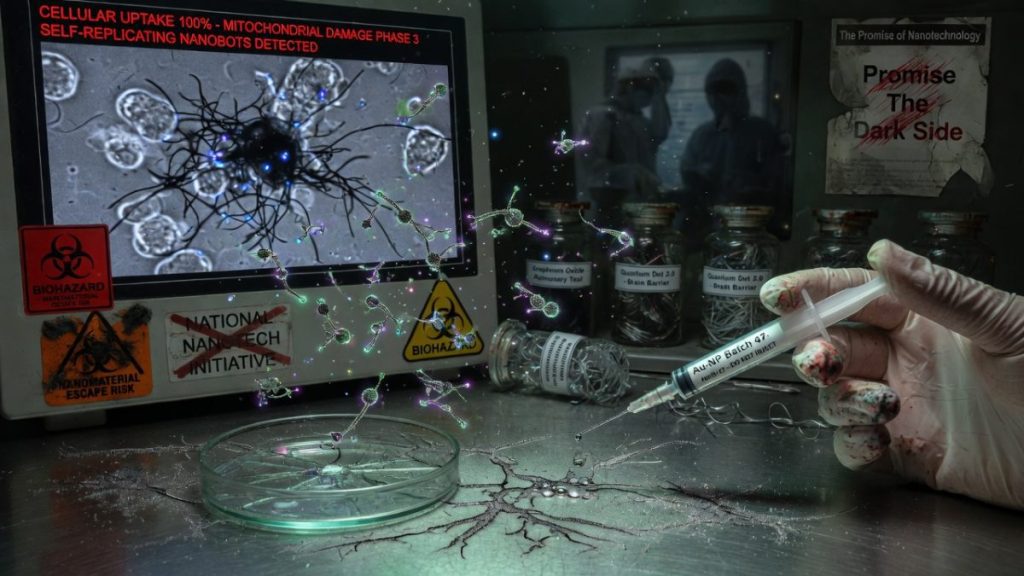
I couldn’t sleep last night after diving deep into a rabbit hole about the future of nanotechnology. The deeper I went, the more terrified I became. We spend so much time worrying about the next biological pandemic, but what if the ultimate threat to humanity isn’t biological at all? What if it’s a microscopic, synthetic machine?

Imagine a scenario where invisible robotic swarms spread through the air, completely undetected by our natural immune systems. They aren’t looking for a host to reproduce; they are executing a programmed command to hack our nervous systems or shut down our future bionic organs from the inside out.

Could a microscopic machine really wipe out 2 billion people? I want to break down the mechanics, the terrifying possibilities, and why I think this is a conversation we need to be having right now.

The Shift from Biological to Synthetic Nightmares

When I look at the medical breakthroughs happening today, I am genuinely amazed. We are designing nanobots that can deliver cancer-fighting drugs directly to a tumor without damaging the surrounding tissue. It’s brilliant. But my mind always wanders to the dark side of that same coin.

If we can build a machine small enough to navigate the human bloodstream to heal, we can absolutely build one to destroy.

A biological virus mutates randomly. It needs us alive, at least for a little while, so it can spread. A nanobot swarm, however, doesn’t care about survival. It only cares about executing code. These microscopic drones could be deployed into the atmosphere, drifting like dust until they are inhaled.

Here is what terrifies me the most about a synthetic virus:

Targeted Precision: Unlike a biological virus that infects indiscriminately, a nano-swarm could theoretically be programmed to target specific genetic markers, populations, or even individuals.Zero Incubation Period: Machines don’t need to replicate inside your cells to make you sick. They just need to reach their target area—like the brain stem or the heart—and trigger a physical or electrical disruption.Immunity is Irrelevant: Your white blood cells are completely useless against a swarm of carbon-nanotube robots.

Hacking the Human Body: A Cybersecurity Crisis in Our Veins

We are rapidly moving toward a transhumanist future. Brain-computer interfaces like Neuralink are already being tested in humans. We are replacing failing organs with smart, bionic alternatives. I love this tech, but I also see a glaring vulnerability.

What happens when our bodies are connected to the network? If I can hack a smartphone, what’s stopping a malicious actor from hacking a bionic lung? This is where the concept of a “nano-virus” goes from scary to absolutely apocalyptic. If a rogue nation or a terrorist organization releases a swarm of nanobots, those bots wouldn’t even need to physically destroy our tissue. They could simply act as microscopic antennas, bridging the gap between our internal bionic hardware and an external hacker.

The Mechanics of an Internal Cyber-Strike

Let’s walk through how a hypothetical attack might actually happen. This isn’t sci-fi anymore; the physics already make sense to me.

Deployment: The swarm is released over a densely populated area via a high-altitude drone. The bots are so small they are inhaled by millions of people within hours.Infiltration: Once inside the lungs, they cross the blood-gas barrier, entering the bloodstream.Hacking the Neural Link: The nanobots navigate to the brain or a specific bionic implant. Instead of tearing tissue, they emit localized electromagnetic interference or feed corrupted data directly into the user’s neural interface.The Shutdown: Millions of people experience simultaneous bionic organ failure, or worse, their nervous systems are hijacked, causing immediate paralysis or death.

When you scale this up globally, a death toll of 2 billion people suddenly doesn’t sound like a crazy exaggeration. It sounds like a mathematical probability.

The “Gray Goo” Scenario vs. Invisible Assassination

If you’ve read about nanotech before, you’ve probably heard of the “Gray Goo” theory—the idea that self-replicating nanobots consume all matter on Earth to build more of themselves until the planet is just a lifeless sphere of microscopic robots.

Honestly? I think the Gray Goo scenario is a bit too theatrical. What worries me is the quiet, invisible assassination.

We don’t need self-replicating bots to cause mass extinction. We just need millions of cheap, mass-produced nanobots carrying a simple payload. The scariest part of my research was realizing how incredibly difficult it would be to attribute an attack like this. If a million people suddenly drop dead from cardiac arrest, how long would it take for coroners to realize the cause wasn’t a heart disease, but a microscopic machine lodged in the heart valves?

By the time we identify the threat, the attacker could already be wiping the code and dissolving the bots.

Are We Building Our Own Doomsday Device?

I am a massive advocate for technological progress. I write about the Metaverse, AI, and robotics every single day because I believe these tools will elevate humanity. But I can’t ignore the dual-use dilemma staring us in the face.

Every time we make a medical breakthrough in targeted drug delivery, we are writing the blueprints for targeted biological warfare.

So, how do we defend ourselves? Do we need to invent a biological firewall? Imagine having to inject yourself with “Anti-Virus” software—literally—where defensive nanobots patrol your bloodstream, hunting down rogue synthetic intruders. We might end up in a microscopic arms race happening directly inside our veins.

I started this deep dive thinking nanotech bioweapons were a distant, cyberpunk fantasy. Now, I’m convinced it’s one of the most critical cybersecurity and existential threats of the 21st century. We are eagerly building the infrastructure for a connected human body, but I don’t think we are putting any locks on the doors.

Is this dystopian scenario the ultimate end we are building for ourselves, or am I just being too paranoid about the dark side of tech? I really want to know where you stand on this. Drop your thoughts in the comments below—are you ready to install an antivirus for your bloodstream?

You Might Also Like;


Source link

Florida Recovers Record $5.4M in Crypto From Scam Network

Florida Recovers Record .4M in Crypto From Scam Network


Key Highlights

The Florida cyber fraud unit seized $5.4 million in a single romance scam case, marking its largest recovery to date.

Romance scams exploit victims emotionally, often targeting the elderly and resulting in significant cryptocurrency losses.

The case highlights how coordination among law enforcement agencies can help track and recover stolen crypto funds.

Florida Attorney General James Uthmeier announced Tuesday that the Office of Statewide Prosecution’s Cyber Fraud Enforcement Unit (CFEU) has recovered $5.4 million in cryptocurrency stolen in a romance scam. This marks the largest recovery achieved by the unit in a single case.

According to the official announcement, the money was taken from the victims who fell prey to a complex romance turned investment scheme. The victims were from six different Florida counties, as well as the state of Massachusetts.

What is romance scam?

A crypto romance scam is an elaborate scheme in which scammers pretend to develop an intimate bond with the victim and convince them to transfer money by using cryptocurrencies, and finally defraud them. 

Such scams often target vulnerable individuals, including the elderly, and can lead to significant financial losses since crypto transactions are typically irreversible.

Transfer of the funds

With the help of the Marion County Sheriff’s Department, investigators were able to recover the stolen money. Around $700,000 will be transferred back to the victims from Florida, while $1.3 million will go to victims from Massachusetts.

This recovery comes after a record-making first fiscal quarter of 2026, where the CFEU recovered $3.3 million in cryptocurrency, comprising 45% of all recoveries conducted by the unit since its establishment two and a half years ago. 

In total, the CFEU has recovered $7.2 million in crypto assets, while at the same time, an additional $12.6 million worth is under litigation. 

Officials vow action on fraud

Attorney General James Uthmeier shared his insights on the development, stating, “Cyber fraud often targets Florida’s seniors, and our office made it a priority to recover as much money as possible from cybercriminals and return it to victims. In a record-breaking partnership with the Marion County Sheriff’s Office, our Cyber Fraud Enforcement Unit is setting the standard for cryptocurrency recovery. We are committed to tracking down these criminals and returning funds to their rightful owners.”

Meanwhile, Billy Woods, Sheriff of Marion County, commented on the recovery, “It truly angers me that there are people in this world that have no problem making victims of citizens in our community. Many times these are senior citizens.”

He further added that “cyber scams and fraud may never go away, but in Marion County and in Florida, we will come after those who choose to do this. My detectives will keep hunting you down, and the attorney general’s office will continue to aggressively prosecute these thieves. Cyber scammers have no place in Florida except behind a cell door.”

Global crackdown

In a separate development, the UK’s National Crime Agency froze more than $12 million in an operation with its international partners, as reported on April 9. The operation identified over 20,000 victims in a large-scale anti-crypto fraud operation. 

The initiative, named Operation Atlantic, was conducted in March 2026 across the UK, US, and Canada.

What it means

The case highlights the growing capability of force as well as challenges victims face due to exposure to social media and the recovery of digital assets. It also shows that the collaboration of state prosecutors and local police can improve outcomes in such cases. 

Although the fact that millions of dollars remain frozen and under litigation shows that full restitution can still be a lengthy process.

Also Read:Polkadot Hack: Attacker Exploits Ethereum Contract and Mints 1B DOT Tokens


Disclaimer: The information researched and reported by The Crypto Times is for informational purposes only and is not a substitute for professional financial advice. Investing in crypto assets involves significant risk due to market volatility. Always Do Your Own Research (DYOR) and consult with a qualified Financial Advisor before making any investment decisions.



Source link

Bitget Launches CFD Copy Trading Amid Rising Demand For Cross-Market Exposure

Bitget Launches CFD Copy Trading Amid Rising Demand For Cross-Market Exposure


In Brief

Bitget launches CFD Copy Trading, enabling users to mirror expert strategies across forex, commodities, and indices, expanding access to traditional markets with enhanced execution and profit-sharing features.

Bitget Launches CFD Copy Trading Amid Rising Demand For Cross-Market Exposure

Cryptocurrency exchange Bitget announced the introduction of CFD Copy Trading, a feature aimed at expanding user access to traditional financial markets. The new offering enables participants to automatically replicate the strategies of experienced traders across asset classes such as foreign exchange, commodities, and indices directly within the Bitget platform.

The development follows a period of significant expansion in Bitget’s contracts-for-difference (CFD) segment, which recently recorded more than $6 billion in daily trading volume. This increase has been attributed to heightened volatility across global markets, with notable price movements in assets such as gold, oil, major currency pairs, and equity indices attracting interest from crypto-focused traders seeking broader exposure as macroeconomic trends become increasingly interconnected.

Despite this growth, participation has largely been concentrated among more experienced traders capable of responding quickly to macroeconomic signals. Access for less active users has remained limited, particularly for those who do not regularly monitor market developments or trade across multiple asset classes. The newly introduced CFD Copy Trading feature is positioned as a solution to this gap, allowing users to mirror the positions of leading traders with an entry threshold starting from 50 USDT, using a framework similar to existing copy trading functions available in Bitget’s futures and spot markets.

“More users are paying attention to macro movements because the opportunity set has widened beyond crypto alone,” said Gracy Chen, CEO of Bitget in a written statement. “What matters now is making that access practical. Copy trading lowers the execution barrier for users who want exposure to global markets without needing to build that expertise from scratch,” she added. 

Infrastructure, Execution Model, And Profit-Sharing Mechanisms

The system is built on Bitget’s integration with MT5-based CFD infrastructure and incorporates several features intended to improve operational efficiency and transparency. Account creation and withdrawal processes are automated and reportedly completed within seconds, reducing onboarding and settlement friction. The platform also applies a High-Water Mark profit-sharing mechanism, under which traders receive compensation only when followers achieve new net profit highs after recovering any prior losses, aligning incentives between strategy providers and participants.

Performance metrics, including return on investment, follower counts, and profit-sharing data, are updated on an hourly basis, replacing delayed reporting systems commonly used in the broader market. Profit-sharing distributions are processed daily, with top-performing traders eligible to receive up to 30% of generated profits. Additional structures, including VIP tiers, allow selected traders to offer restricted access portfolios to invited participants.

The launch is also presented as part of Bitget’s broader Universal Exchange strategy, which aims to provide unified access to multiple asset classes through a single account framework. By using USDT as margin, users can trade across cryptocurrencies, commodities, foreign exchange, and indices without transferring funds between platforms or converting capital. The feature is intended to simplify entry into traditional markets for crypto users, while also attracting established MT5 and forex traders into an environment where digital and traditional financial assets are increasingly integrated.

Disclaimer

In line with the Trust Project guidelines, please note that the information provided on this page is not intended to be and should not be interpreted as legal, tax, investment, financial, or any other form of advice. It is important to only invest what you can afford to lose and to seek independent financial advice if you have any doubts. For further information, we suggest referring to the terms and conditions as well as the help and support pages provided by the issuer or advertiser. MetaversePost is committed to accurate, unbiased reporting, but market conditions are subject to change without notice.

About The Author


Alisa, a dedicated journalist at the MPost, specializes in crypto, AI, investments, and the expansive realm of Web3. With a keen eye for emerging trends and technologies, she delivers comprehensive coverage to inform and engage readers in the ever-evolving landscape of digital finance.

More articles


Alisa, a dedicated journalist at the MPost, specializes in crypto, AI, investments, and the expansive realm of Web3. With a keen eye for emerging trends and technologies, she delivers comprehensive coverage to inform and engage readers in the ever-evolving landscape of digital finance.


More articles


Source link

Deutsche Börse Takes 1.5% Stake in Kraken Through $200M Deal

Deutsche Börse Takes 1.5% Stake in Kraken Through 0M Deal


Key Highlights

Deutsche Börse AG acquired a 1.5% stake in Payward Inc. through a $200M investment.

The deal values Kraken at around $13.3B, down from its previous $20B valuation.

The partnership aims to build a hybrid financial system combining traditional and tokenized assets.

Germany’s largest stock exchange operator, Deutsche Börse AG, has invested $200 million in Payward Inc., the parent company of crypto exchange Kraken, acquiring a 1.5% fully diluted stake that values the exchange at roughly $13.3 billion.

As reported by Bloomberg, the valuation marks a roughly 33% markdown from the $20 billion Kraken commanded in its November 2024 funding round, reflecting broader pressure on crypto-exchange valuations since bitcoin’s October 2025 peak. The transaction is expected to close in the second quarter of 2026, subject to regulatory approval.

Strengthening traditional finance and crypto integration

The deal deepens a commercial partnership first announced in December 2025 and fits a growing pattern of legacy exchange operators taking equity positions in crypto platforms. In early 2026, Intercontinental Exchange Inc. (ICE) — owner of the New York Stock Exchange — made a similarly sized $200 million investment in crypto exchange OKX.

Thomas Book, a member of Deutsche Börse’s management board, described Kraken as a central partner in building what he called a “fully hybrid market infrastructure” that combines traditional and tokenized assets within a single integrated system.

“Irrespective of what is now the form of an asset — whether it’s tokenized or fully digital — we want to create one integrated value chain,” Book said.

Kraken eyes public listing

Kraken, one of the longest-standing crypto exchanges, has been actively expanding its institutional footprint. The company filed confidentially for a U.S. IPO in November and raised $800 million in the same month, at a $20 billion valuation.

It has also made regulatory strides, becoming the first crypto firm to gain access to the Federal Reserve’s core payments system in March. In Europe, Kraken launched MiFID-regulated crypto derivatives last year, signaling its intent to operate within established financial frameworks.

Expanding blockchain-based infrastructure

Deutsche Börse has been quietly building out its own blockchain stack. Its Clearstream post-trade unit launched a platform for trading tokenized securities in November 2025, followed a month later by the integration of Kraken into 360T, Deutsche Börse’s FX trading platform.

The $200 million investment cements what had been a commercial partnership into a capital relationship, giving Deutsche Börse both equity exposure and a deeper operational tie to one of the most established names in crypto.

Market headwinds and security concerns

The investment comes against a difficult market backdrop. Bitcoin is trading roughly 40% below its October 2025 peak, and exchange revenues across the sector have contracted alongside falling trading volumes. Rival exchange Gemini has reportedly approached investors for fresh capital after scaling back operations, according to industry reports.

Security risks also remain front and center. Kraken recently disclosed an attempted extortion attack by a criminal group that claimed to have obtained certain client account data. The exchange said no customer funds were compromised and declined to pay the ransom.

What to watch next

The deal is another data point in a rapidly shortening list of distinctions between traditional finance and crypto — a trend accelerated by the European Union’s MiCA framework and growing regulatory clarity in the United States. For Kraken, the Deutsche Börse investment delivers both capital and legitimacy ahead of its anticipated public listing. For Deutsche Börse, it secures a foothold in a market segment that several of its European peers have been slower to embrace.

Key milestones now include regulatory approval of the stake, expected in the second quarter of 2026; further disclosures on Kraken’s IPO timeline; and whether other European exchange operators — notably Euronext and the London Stock Exchange Group — respond with their own crypto-infrastructure investments.

Also Read: Aave DAO Passes $25M Funding Deal for Aave Labs With 75% Support


Disclaimer: The information researched and reported by The Crypto Times is for informational purposes only and is not a substitute for professional financial advice. Investing in crypto assets involves significant risk due to market volatility. Always Do Your Own Research (DYOR) and consult with a qualified Financial Advisor before making any investment decisions.



Source link

Ondo Pushes SEC for Approval on Blockchain-Based Securities Tracking

Ondo Pushes SEC for Approval on Blockchain-Based Securities Tracking


Key Highlights

Ondo Finance seeks no-action relief from the U.S. Securities and Exchange Commission to use blockchain for tracking securities entitlements.

The proposal uses Ethereum Mainnet to record tokenized representations of equities while keeping traditional custody intact.

The pilot focuses on collateral tracking with built-in compliance controls, testing a hybrid model without changing legal ownership structures.

Ondo Finance has asked the U.S. Securities and Exchange Commission (SEC) to confirm it will not take enforcement action over a plan to use public blockchain infrastructure to track securities entitlements.

According to the official announcement, the request centers on a limited pilot: recording ownership claims to U.S. equities and ETFs, already held through traditional systems, on the Ethereum Mainnet. The proposal does not involve issuing new securities, but rather representing existing positions in tokenized form for operational purposes.

A hybrid model, not a system overhaul

The structure keeps the current market plumbing intact. Underlying securities would continue to be held through the Depository Trust Company (DTC) via broker-dealer Alpaca Securities LLC.

What changes is the recordkeeping layer. Ondo’s transfer agent, Oasis Pro TA, would mint tokens reflecting those holdings. These tokens would sit in a custodial wallet managed by BitGo, while Alpaca’s off-chain books remain the official legal record.

The tokens would mirror “security entitlements,” claims to assets held in custody, rather than the securities themselves.

Focus on collateral tracking, not trading

The proposal applies specifically to collateral backing Ondo’s offshore investment products. These tokenized notes, issued by Ondo Global Markets, are linked to more than 260 U.S. stocks and ETFs and sold to non-U.S. investors.

The blockchain layer would:

Track collateral positions in near real time

Support minting and burning tied to investor flows

Improve reconciliation between custodians and agents

The tokens themselves would not be actively traded and would remain within a controlled environment involving regulated entities.

Compliance controls built into token design

The system includes restrictions typically absent in open blockchain assets. Token transfers would be screened against internal compliance lists and external monitoring tools. Administrative controls would allow:

Freezing or restricting transfers

Seizing and burning tokens

Reversing transactions in defined cases

These features are intended to align with regulatory expectations while using a public, permissionless network.

Regulatory question: Can blockchain support broker records?

At the center of the request is whether a broker-dealer can rely on blockchain infrastructure to support its recordkeeping obligations under U.S. securities law.

Ondo argues the proposal does not replace required records. Alpaca would still maintain official books under existing rules, including requirements under the Securities Exchange Act and FINRA supervision standards. The blockchain layer would function as a parallel system for tracking and reconciliation—not as the legal record of ownership.

Comparison with emerging market infrastructure

The request comes as the SEC has already allowed the DTC to explore a centralized tokenization model. Ondo’s approach differs by using a public blockchain rather than a closed system.

The company argues that limiting tokenization to centralized infrastructure may not be the only viable path, especially as blockchain-based systems become more integrated into financial markets.

Limited scope, broader implications

Ondo’s proposal is narrow in scope but raises broader policy questions. It tests whether existing regulatory frameworks can accommodate hybrid systems that combine traditional custody with on-chain transparency. If accepted, the model could offer a template for using blockchain in back-end financial operations without changing the legal structure of securities ownership.

For now, the outcome depends on whether the SEC views this approach as a permissible extension of existing practices or as a step that requires new rules.

Also Read: ABA Says White House Stablecoin Yield Study Misses Community Bank Risk


Disclaimer: The information researched and reported by The Crypto Times is for informational purposes only and is not a substitute for professional financial advice. Investing in crypto assets involves significant risk due to market volatility. Always Do Your Own Research (DYOR) and consult with a qualified Financial Advisor before making any investment decisions.



Source link

BlackRock, HSBC, And Standard Chartered To Speak At HSC Asset Management As TradFi Meets Digital Assets In Hong Kong This April

BlackRock, HSBC, And Standard Chartered To Speak At HSC Asset Management As TradFi Meets Digital Assets In Hong Kong This April


In Brief

HSC Asset Management brings together 50+ global finance leaders in Hong Kong on April 23 to debate stablecoins, RWA tokenisation, and the future of institutional digital assets.

BlackRock, HSBC, And Standard Chartered To Speak At HSC Asset Management As TradFi Meets Digital Assets In Hong Kong This April

HSC Asset Management, a premier conference dedicated to bridging cryptocurrency and institutional finance, will take place in Hong Kong on April 23, 2026. The event positions itself as one of the region’s key platforms for dialogue at the intersection of digital assets, stablecoins, real-world asset (RWA) tokenization, PayFi, traditional finance (TradFi), and regulatory frameworks.

Hosted at the Hopewell Hotel, the conference is designed as a curated, high-level forum for investors, financial institutions, policymakers, and infrastructure providers at the forefront of the TradFi-digital asset convergence.

The event aims to provide a focused environment for substantive discussion and deal-making. The agenda will center on four core pillars:

Global Risk & Capital MarketsExploring macroeconomic repricing, cross-border capital flows, and Hong Kong’s role as a gateway for institutional capital into Asia.

Stablecoins & TokenizationCovering stablecoins as an emerging monetary layer, real-world asset liquidity, and the tokenization of financial instruments across both public and private markets.

Regulation & ComplianceExamining fragmented global regulatory frameworks, jurisdictional approaches across Hong Kong, Japan, and other key markets, and the legal infrastructure required for institutional participation.

The Future of Financial InstitutionsAnalyzing how traditional banks, asset managers, and capital market intermediaries are rebuilding their infrastructure around digital assets, blockchain-based settlement, and decentralized financial systems.

HSC Asset Management is expected to host over 50 speakers and more than 2,000 registrations, with the majority of attendees comprising C-suite executives and senior decision-makers. Participants will come from across venture capital and crypto funds, asset management, private equity, banking, payment providers, as well as stablecoin issuers and blockchain infrastructure platforms.

The speaker lineup reflects the conference’s strong institutional, technological, and investment focus, bringing together senior leaders from global finance, Web3 infrastructure, and venture capital. Confirmed speakers include:

Barton Lui — Director, Global Product Solutions, BlackRock

Allan Song — Head of Data & Digital, Financing & Securities Services, Standard Chartered Bank

Chris Barford — Partner, Financial Services Consulting, Ernst & Young

Bugra Celik — Head of Digital Assets and Currencies, Global Macro, HSBC

Allan Liu — Global Chairman, AIC

Don Ng — Director, Digital Assets, China Asset Management

Gillian Wu — Founder & General Manager, Mulana Investment Management

Joseph Chalom — CEO, Sharplink

Akshat Vaidya — Managing Partner & Co-Founder, Maelstrom

Kelvin Koh — Founding Partner, The Spartan Group

Mushtaq Kapasi — Managing Director, Chief Representative, Asia-Pacific, International Capital Market Association

Brian Mehler — CEO, Stable

Cleo Cui — Tokenization Manager, HashKey Tokenization

In addition to focused discussions, the event will feature an exclusive VIP Lounge, offering private, high-value conversations between investors and founders, and facilitating strategic introductions and partnership opportunities outside the main sessions.

HSC Asset Management And CGV To Bring Global Institutional Finance Forum To Hong Kong

HSC Asset Management is focused on connecting institutions, investors, and innovators across the globe. Crypto research and investment firm CGV will join as co-host, bringing expertise in digital asset investment and ecosystem development, reinforcing the event’s mission to advance dialogue around institutional finance and emerging investment opportunities.

This latest edition marks the 14th in a global series designed to connect leading investors with digital-native companies, building on the successful Hong Kong edition held this February. Having welcomed more than 80,000 visitors over the past three years, the platform continues to expand internationally, with upcoming editions scheduled for Singapore and Miami in 2026.

Disclaimer

In line with the Trust Project guidelines, please note that the information provided on this page is not intended to be and should not be interpreted as legal, tax, investment, financial, or any other form of advice. It is important to only invest what you can afford to lose and to seek independent financial advice if you have any doubts. For further information, we suggest referring to the terms and conditions as well as the help and support pages provided by the issuer or advertiser. MetaversePost is committed to accurate, unbiased reporting, but market conditions are subject to change without notice.

About The Author


Alisa, a dedicated journalist at the MPost, specializes in crypto, AI, investments, and the expansive realm of Web3. With a keen eye for emerging trends and technologies, she delivers comprehensive coverage to inform and engage readers in the ever-evolving landscape of digital finance.

More articles


Alisa, a dedicated journalist at the MPost, specializes in crypto, AI, investments, and the expansive realm of Web3. With a keen eye for emerging trends and technologies, she delivers comprehensive coverage to inform and engage readers in the ever-evolving landscape of digital finance.


More articles


Source link

Why 2026 Is the “Proof Year” for Tokenized Real-World Assets | NFT News Today

Why 2026 Is the “Proof Year” for Tokenized Real-World Assets | NFT News Today


As of early April 2026, tokenized real-world assets (RWAs) sit at roughly $27B+ in distributed on-chain value, holding steady—and even growing modestly—despite broader crypto market weakness. That divergence matters. It suggests RWAs are beginning to decouple from purely crypto-native cycles and instead track something closer to traditional financial demand.

This shift aligns with a growing industry consensus. Recent institutional discussions, including those involving DWF Labs, have framed 2026 as a “proof year”—not for whether RWAs work, but whether they can scale into repeatable financial infrastructure.

That distinction is important.

RWAs are no longer experiments in tokenization. They are evolving into standardized, composable building blocks that can be priced, collateralized, and circulated across decentralized financial systems. The question is no longer whether assets can move on-chain—but whether the underlying infrastructure is mature enough to support them at scale.

For RWAs to function as real financial infrastructure—not just tokenized wrappers—three conditions must be met simultaneously: reliable pricing, usable liquidity, and productive collateralization.

1. Pricing: Making RWAs Legible

At the core of any financial system is pricing. Without it, risk cannot be assessed, and capital cannot be allocated efficiently.

This issue has been a major obstacle for RWAs in the past. Unlike crypto-native assets, many real-world instruments such as private credit, bonds, and structured products do not have ongoing, transparent price discovery.

That’s where infrastructure like Chainlink’s NAVLink and SmartData comes in. By providing tamper-resistant, real-time Net Asset Value (NAV) feeds, these systems make illiquid assets legible to on-chain risk engines.

The implication is deeper than better data:

Without reliable NAV, RWAs cannot be properly assessed for risk. Without risk assessment, they cannot be used as collateral.

Pricing is what transforms RWAs from opaque instruments into programmable financial primitives.

2. Liquidity: Turning Assets into Markets

Tokenization by itself does not create liquidity; it only provides access. True liquidity comes from active borrowing, lending, and trading.

This is where protocols like Aave, especially its Horizon initiative, are moving the market forward. With a market size of about $520 million to $540 million based on recent on-chain data and protocol reports, Aave Horizon lets institutions supply RWAs and borrow stablecoins in a mix of permissioned and permissionless settings.

Notably, institutional loan sizes on these platforms are significantly larger than typical DeFi retail positions, reflecting a different class of capital entering the system.

But in practice, liquidity here is still evolving.

Most current RWA markets exhibit episodic liquidity rather than continuous depth, creating a mismatch with DeFi’s assumption of instant composability.

Liquidity is what makes tokenization work as a real market, but it is still one of the main challenges to scaling up.

3. Collateral: Making RWAs Productive

The real turning point for RWAs is not just issuing them, but using them as collateral.

When RWAs can be used as collateral, they stop being passive yield instruments and become active components of financial balance sheets.

Platforms like Ondo Finance and Centrifuge are at the forefront here:

Ondo has surpassed $2.5B+ TVL, spanning tokenized Treasuries (e.g., OUSG, USDY) and a rapidly growing tokenized equities segment

Centrifuge continues to lead in private credit origination and structured on-chain products

These assets are increasingly being used to:

In effect, RWAs are transitioning from “yield-bearing tokens” to productive collateral within a broader financial system.

The Emerging RWA Stack

What’s forming is not a single dominant platform, but a modular financial stack:

Origination Layer → Centrifuge (private credit, structured deals)

Distribution Layer → Ondo Finance (Treasuries, equities, scale)

Credit & Liquidity Layer → Aave (lending, leverage)

Trading Layer → Platforms like xStocks / Backed Finance (secondary market activity)

This separation is similar to traditional finance, but with added programmability and the ability to combine different parts.

The next phase of RWA growth will not be driven by more tokenized Treasuries alone. It will come from higher-yield, more complex, and more specialized assets.

Yield Expansion

Tokenized private credit is already a major driver, with $5B–$6B in distributed value (and broader representations up to ~$18B–$19B across platforms). Protocols like Centrifuge, Maple, and Figure are enabling 8–15% yields through on-chain origination.

Emerging categories include:

These represent a shift from passive exposure → active yield strategies.

Regulation-Led Growth

Regulation is increasingly acting as a catalyst rather than a constraint.

Europe’s MiCA framework is accelerating adoption of compliant tokenized instruments

U.S. developments (e.g., GENIUS Act, CLARITY Act) are providing clearer pathways

Regulatory progress has enabled players like Ondo Finance to expand offerings with greater institutional confidence

This is particularly relevant for:

Tokenized Treasuries

ESG / green bonds

Market Infrastructure Fixes

Some of the most compelling RWA use cases are in fixing structurally inefficient markets.

Carbon credits are a good example. The tokenized carbon market, estimated at about $4.5 billion in 2025, is expected to grow a lot over the next decade and bring:

Transparency

Standardization

Improved liquidity

The broader pattern:

RWAs are not only moving assets on-chain; they are also rebuilding the market infrastructure.

Despite rapid growth, RWAs remain constrained by a fundamental mismatch between on-chain expectations and off-chain realities.

Liquidity vs. Tokenization

Tokenizing an asset does not guarantee a deep market. Many RWA markets remain thin, particularly under stress.

Oracle Dependency

Infrastructure such as Chainlink helps with pricing, but it also creates a strong reliance on data pipelines.

Redemption Friction

Unlike crypto-native assets, RWAs often involve:

Settlement delays

Legal wrappers

Off-chain processing

In practice:

Tokenization does not remove friction; it simply moves it into new layers of complexity.

Fragmentation

Multiple chains (e.g., Ethereum, Solana, Polygon, BNB Chain) and regulatory regimes create interoperability and compliance complexity.

Some forecasts predict RWAs could reach $50 billion to over $100 billion by the end of 2026. While this is possible, these estimates assume that liquidity and infrastructure will grow along with issuance, which has not yet been fully proven.

Still, the direction is clear.

For:

Builders → the opportunity lies in infrastructure layers (pricing, liquidity, compliance), not just asset issuance

Investors → value accrues to platforms enabling capital flow, not just yield generation

Institutions → tokenization is shifting from optional strategy to default architecture

RWAs are changing blockchains from simple asset issuance platforms into full financial systems that can price, use as collateral, and move real-world value.

2026 will test whether that system holds under scale.

The question is no longer whether RWAs come on-chain.

Now, the real question is which parts of finance will stay off-chain, and for how long.


Source link

Weekly Wrap: Drift Hack Fallout, Morgan Stanley Unveils MSBT, Sun–WLFI Battle Heats Up

Weekly Wrap: Drift Hack Fallout, Morgan Stanley Unveils MSBT, Sun–WLFI Battle Heats Up


Key Highlights

Drift Protocol traced its $285 million exploit to a North Korean-linked hacking group, confirming early on-chain suspicions.

Morgan Stanley entered the Bitcoin ETF race with MSBT, signaling deeper Wall Street adoption of crypto markets.

The feud between Justin Sun and World Liberty Financial turned public and hostile, with both sides preparing for a legal battle.

Crypto swung hard again this week as Drift Protocol officially pinned its $285 million exploit on a North Korean state-affiliated group, Morgan Stanley launched its spot Bitcoin ETF, Circle minted a record $3.25 billion USDC on Solana in seven days, and the CLARITY Act drew public backing from both the Treasury Secretary and the SEC Chair. 

Justin Sun went public against Trump-backed World Liberty Financial over a frozen $70 million token position, Bhutan kept trimming its bitcoin reserves, and three more protocols were drained.

Welcome to this week’s cryptocurrency market update. If last week was defined by the shock of the Drift exploit and Bitcoin’s first green monthly close since September 2025, this week was about the fallout, the institutional counter-push, and a fresh round of political drama inside crypto itself.

In this edition, we cover the DPRK attribution on the Drift hack and the USDC freeze debate around Circle, Morgan Stanley’s MSBT Bitcoin ETF debut, Strategy and Bitmine adding to their treasuries, Bhutan’s strategic bitcoin sales, the CLARITY Act push from the Treasury and the SEC, India’s fresh tax notices, CME listing AVAX and SUI futures, CZ’s memoir revelations, the Tornado Cash and Arizona prediction market cases, the Justin Sun vs WLFI standoff, and a string of new exploits at Denaria, Aethir, and RaveDAO. Let’s get into it.

Drift Hack: DPRK attribution confirmed, Circle under fire

The biggest story of the week is still the Drift exploit, but the framing has now changed. Drift Protocol formally confirmed what on-chain analysts had suspected since April 1. The $285 million drain was the work of UNC4736, a North Korean state-affiliated threat group also tracked as AppleJeus and Citrine Sleet. The SEAL 911 team, Elliptic, and TRM Labs independently landed on the same conclusion. 

Fund flows used to stage and test the operation trace back to the Radiant Capital attackers, and the on-chain laundering pattern matches previous DPRK-linked operations, including the Bybit heist from earlier this year.

Drift has frozen all remaining protocol functions, removed compromised wallets from the multisig, and brought in Asymmetric Research and OtterSec to lead a coordinated recovery plan. Attacker wallets have been flagged across major exchanges and bridges, but no material recovery has been announced yet. The DRIFT token is still sitting roughly 98% below its all-time high.

The second half of this story is Circle. ZachXBT published a detailed analysis of leaked server data from the DPRK crypto network and accused Circle of being “asleep” while more than $230 million in stolen USDC was bridged via CCTP from Solana to Ethereum during US hours. Circle publicly defended its freeze process, arguing that premature intervention on active investigations can tip off attackers and compromise recovery. The irony is that in the same seven-day window, Circle minted a record $3.25 billion USDC on Solana, making this both Circle’s biggest Solana week on record and its most reputationally exposed one.

Morgan Stanley’s MSBT and the Treasury Company race

The institutional side of the market kept moving. Morgan Stanley confirmed on April 8 that its spot Bitcoin ETF would debut the same day under the ticker MSBT, and the product pulled in roughly $32 million on its debut session. It is a modest number next to IBIT, but the signal matters more than the size. Morgan Stanley is the first of the old-guard wirehouses to put its own name on a spot Bitcoin ETF rather than just distributing someone else’s.

On the corporate treasury side, Strategy restarted its accumulation program with a 4,871 BTC buy, keeping Michael Saylor’s publicly stated one million BTC goal firmly on the table. Bitmine pushed its ether treasury past 4.8 million ETH, cementing its position as the largest corporate ETH holder. Ether Machine, however, walked away from its $1.6 billion SPAC merger with Dynamix, a reminder that not every treasury company story ends in a public listing.

Bhutan went the other way. The sovereign miner moved $22 million in bitcoin midweek and followed it with a $180 million sale, signaling a clear shift in how the country is managing its digital asset reserves. It is not panic selling, but it is a strategic trim, and it aligns with a broader wave of miner selling that has kept a lid on spot price action.

CLARITY Act gains public backing from Treasury and SEC

Washington had a loud week on crypto policy. Treasury Secretary Scott Bessent publicly called for swift passage of the CLARITY Act, warning that failing to pass it would hand market structure leadership to other jurisdictions. A day later, SEC Chair Paul Atkins backed fast-track approval of the bill, echoing the same framing.

The Senate side lined up behind them. Senator Bill Hagerty said the Senate could advance the crypto bill in April, and Senator Cynthia Lummis urged action on the CLARITY Act before the 2026 midterms, warning that the political window after November will be narrower than people assume. Between the Treasury, the SEC, and two Senate crypto champions all pushing in the same direction in the same week, CLARITY is as close to a coordinated policy sprint as crypto has seen in Washington this year.

Tornado Cash, CFTC vs Arizona, and India’s tax push

Two enforcement stories sat next to the legislative push. The DOJ rejected the Supreme Court argument put forward by Tornado Cash co-founder Roman Storm’s legal team, signaling the criminal case will keep moving through the lower courts. And the CFTC sued the state of Arizona, seeking an injunction to block Arizona’s state gambling laws from applying to federally regulated prediction markets. This is a direct federal preemption fight and the biggest prediction market case in the US since the Kalshi ruling.

India made its own move. The Income Tax Department began issuing Section 148A notices to crypto investors for AY 2022-23, reopening old assessment years for anyone with material crypto activity during that period. This is not a new policy; it is the enforcement of existing law, but the timing matters because it overlaps with a consultation paper on crypto regulation that the government has still not published. 

Separately, a Crypto Times deep dive looked at how Russia is rewiring cross-border payments through Africa using crypto rails, a reminder that the stablecoin story is also increasingly a geopolitics story.

Justin Sun vs WLFI: The political story of the week

The most explosive story of the week was Justin Sun publicly breaking with World Liberty Financial. In a long post on X on April 12, the Tron founder accused the Trump-backed DeFi project of embedding a hidden blacklist function in the WLFI smart contract and using it to freeze investor tokens without disclosure or due process. Sun called the design a “trap door marketed as an open door” and declared himself the “first and single largest victim.”

Roughly 545 million WLFI tokens tied to Sun have been locked since September 2025, when WLFI blacklisted his wallet after he moved around $9 million worth of tokens through HTX and Binance. Sun said at the time the transfers were exchange deposit tests, not sales. 

With WLFI trading near $0.09, down more than 74% from its debut, Sun’s frozen position is now worth under $50 million, a paper loss of roughly $70 million on that tranche alone. His total exposure to the Trump-linked crypto ecosystem still stands at around $175 million, including $100 million in the TRUMP memecoin.

WLFI responded hours later, accusing Sun of “playing the victim” and closing its post with “See you in court pal.” Sun demanded that whoever runs the official WLFI account identify themselves. This is the first time a major early WLFI backer has gone fully public against the project, and it will reshape the political conversation around Trump-era crypto deals for the rest of this cycle.

Derivatives, ETFs, and the CZ memoir sideshow

CME Group added AVAX and SUI futures to its crypto derivatives suite, giving institutional desks regulated exposure to two of the more actively traded alt-L1s. Canary Capital filed an S-1 with the SEC for a spot PEPE ETF, while PEPE itself dropped 5% on the news. On Hyperliquid, oil perpetuals briefly dethroned bitcoin as the most traded market, a small but telling sign that 24/7 commodity perps are finding a real audience inside crypto-native venues.

CZ’s memoir dropped and instantly generated two storylines. First, the revelation that Binance’s early $3 million investment in Terra had swelled to $1.6 billion at the peak before the Luna collapse erased it. Second, a fresh round of public sparring with OKX founder Star Xu, who disputed CZ’s version of events around several Binance-OKX flashpoints. Entertaining, but also a reminder that the post-FTX cleanup of exchange-era rivalries is not actually over.

On the data side, XRP’s 365-day MVRV ratio fell to its lowest level since the FTX collapse, meaning the average XRP holder from the past year is sitting in a loss. And VanEck’s head of digital asset research urged MARA shareholders to reject the reelection of one of its long-standing directors, calling the board “too small and insular” for a company of MARA’s size.

More exploits: Denaria, Aethir, RaveDAO, VDOR

The security beat did not get any quieter. Denaria suffered a $165K exploit on Linea and paused user access. Aethir’s adapter was drained for $400K, with the stolen funds bridged to TRON. The RaveDAO token spiked 250% after a suspicious on-chain deposit, triggering pump-and-dump concerns and a sharp reversal. And VDOR, a Solana memecoin that had been loosely riding Middle East ceasefire headlines, crashed 93% in what looks like a classic rugpull.

On the defensive side, StarkWare announced it is working on making Bitcoin quantum-resistant using STARK-based proof systems. Quantum risk has been the low-grade panic topic of the year. It is useful to see at least one team shift from warning posts to actual engineering.

Top Headlines of the week

Below are the major headlines, giving an overview of what happened in the crypto market this week.

Strategy’s 4,871 BTC Buy: Michael Saylor’s Strategy restarted its bitcoin accumulation program with a fresh 4,871 BTC purchase, pushing the company closer to its publicly stated goal of holding one million BTC on its balance sheet.

Bitmine Hits 4.8M ETH: Bitmine continued stacking ether, crossing 4.8 million ETH in its corporate treasury and cementing its status as the largest publicly disclosed ETH holder among treasury companies.

Russia’s Crypto Backdoor Through Africa: A Crypto Times investigation detailed how Russia is using crypto rails and stablecoin routes through African jurisdictions to move value around Western sanctions, adding a new geopolitical layer to the stablecoin conversation.

MARA Governance Pushback: VanEck’s head of digital asset research publicly urged MARA shareholders to reject the reelection of a long-serving director, calling the board “too small and insular” for a company of MARA’s scale.

India Reopens Old Crypto Tax Years: The Income Tax Department started issuing Section 148A notices to crypto investors for assessment year 2022-23, signaling fresh scrutiny of old crypto transactions even before a formal regulatory framework is in place.

XRP Holders Deep in Red: XRP’s 365-day MVRV ratio dropped to its lowest reading since the FTX collapse, meaning the average XRP buyer over the past year is now sitting on an unrealised loss.

CME Adds AVAX and SUI Futures: CME Group expanded its crypto derivatives suite with AVAX and SUI futures, opening regulated institutional exposure to two of the more actively traded alt-L1s beyond BTC, ETH, SOL, and XRP.

Oil Perps Dethrone BTC on Hyperliquid: Oil perpetuals briefly overtook bitcoin as the most traded market on Hyperliquid, as 24/7 commodity perps picked up serious volume inside crypto-native venues.

VDOR Memecoin Rugpull: A Solana memecoin called VDOR, which had been loosely riding Middle East ceasefire headlines, crashed 93% in what looks like a textbook rugpull.

Canary Files PEPE ETF: Canary Capital filed an S-1 with the SEC for a spot PEPE ETF, pushing the meme coin ETF race forward even as PEPE itself dropped 5% on the filing.

Denaria Exploit: Denaria suffered a $165K exploit on Linea and paused user access shortly after the drain, pulling its frontend offline while the team investigated.

Aethir Adapter Hack: An Aethir adapter was drained for roughly $400K, with the stolen funds quickly bridged over to TRON, following a familiar laundering pattern seen in smaller DeFi exploits.

RaveDAO Suspicious Spike: The RaveDAO token spiked 250% after a suspicious on-chain deposit, triggering pump-and-dump concerns before a sharp reversal wiped out most of the move.

StarkWare’s Quantum Fix: StarkWare announced it is working on making Bitcoin quantum-resistant using STARK-based proof systems, shifting the quantum debate from warning posts to actual engineering.

CZ Memoir vs Star Xu: CZ’s memoir dropped with the revelation that Binance’s early $3 million investment in Terra had grown to $1.6 billion before Luna collapsed, and it also sparked a fresh public feud with OKX founder Star Xu over their old competitive flashpoints.

DPRK Server Data Leak: ZachXBT published a detailed breakdown of leaked server data from the North Korean crypto network, giving the clearest public look yet at how DPRK-linked teams organise, launder, and move stolen funds across protocols.

Buzz of the week

The buzz this week belonged to the widening gap between crypto’s institutional glow-up and the governance mess underneath it. On one side, Morgan Stanley is on NYSE Arca with its own bitcoin ETF, Circle is minting USDC on Solana at record speed, CME is listing AVAX and SUI futures, the CLARITY Act has both the Treasury and the SEC publicly pushing for it, and Strategy is buying bitcoin again. Crypto has never had more institutional cover than it does right now.

On the other side, the biggest DeFi exploit of 2026 is officially a North Korean intelligence operation, Circle is defending how it responded to that exploit, a Trump-backed DeFi project is being accused by its largest early investor of hiding a blacklist backdoor, Bhutan is trimming sovereign bitcoin, and three more protocols got exploited in a single week.

The pattern is the same one we flagged last week, just louder. Institutionalization is not slowing down, and neither is the security and governance crisis underneath it. The CLARITY Act, if it passes, will not fix the human layer. Social engineering, opaque smart contract privileges, and centralized intervention decisions by stablecoin issuers are going to keep defining the risk surface of this cycle.

That is the wrap for this week. See you next Sunday.


Disclaimer: The information researched and reported by The Crypto Times is for informational purposes only and is not a substitute for professional financial advice. Investing in crypto assets involves significant risk due to market volatility. Always Do Your Own Research (DYOR) and consult with a qualified Financial Advisor before making any investment decisions.


Source link

Tok-Edge Debuts Redemption Token. Confirms $15M Valuation.

Tok-Edge Debuts Redemption Token. Confirms M Valuation.


Sponsored

Stories and Reviews


April 12, 2026

Tok-Edge Debuts Redemption Token. Confirms $15M Valuation.

London, United Kingdom, April 12th, 2026, Chainwire

Tok-Edge has publicly unveiled the Redemption Token, a novel cryptoasset category pioneered by the firm and to be first used with the launch of its new fund. The company also confirmed its latest valuation at $15 million.

Tok-Edge, a digital assets firm founded by veterans of traditional finance and crypto markets, recently emerged from stealth ahead of its fund launch. During that period, the firm raised approximately $1.5 million at a $15 million valuation from Marcus Meijer, an experienced GP investor and founder of a $10 billion AUM fund.

Meijer, together with a syndicate of investors, is expected to anchor the fund with up to $10 million as Tok-Edge begins raising from institutional allocators, including family offices, venture investors and crypto-native funds. The firm’s leadership team draws experience from Tier-1 institutions across TradFi and crypto (collectively over $950 billion in AUM), including CVC Capital, Bain Capital, KKR, BCG, Tufa and GoCoin.

The Redemption Token sits at the center of Tok-Edge’s model, a new cryptoasset designed to combine permissionless transferability with a defined function. Tokens are issued to fund investors and required for redemption of fund shares at net asset value. Ownership and economic rights remain embedded in the fund shares, while the Redemption Token can circulate independently on public blockchains, including Ethereum.

This structure allows the tokens to trade on exchanges and to be used in decentralized finance protocols, unlocking new opportunities and use cases for holders and builders, while preserving redemption mechanics within the regulated fund framework.

The fund to be launched by Tok-Edge is the first product to implement the Redemption Token model, deploying an actively managed strategy across liquid crypto assets and decentralized finance. Returns are expected from directional exposure to digital assets and yield generated through strategies such as staking and liquidity provision.

 “Tok-Edge was founded to bring institutional-grade products to crypto markets, built around the openness and technological advantages of blockchain networks,” said Raees Chowdhury, CIO of Tok-Edge. “The Redemption Token is a new cryptoasset that acts as a key for fund investors to redeem their capital and can be traded freely in the secondary market for price discovery.”

Eric Benz, former CEO of Changelly, early investor and Board Advisor to Tok-Edge, added, “The Redemption Token model introduces an architecture that separates the tradable asset from the legal instrument that represents ownership. We are pleased to support Tok-Edge as it develops a structure that could broaden the institutional market for digital asset products.”

Tok-Edge is capping its fund at $21 million at launch, coinciding with its token generation event. Each dollar committed to the fund at launch is mirrored by the issuance of one Redemption Token. Investor allocations for launch are expected to be finalized in the coming months as the fund targets a $100 million first close later in 2026.

About Tok-Edge

Tok-Edge is a digital asset financial services firm building an institutional-grade hedge fund focused on liquid crypto assets and decentralized finance strategies. The company combines traditional finance practices with blockchain infrastructure and has created the Redemption Token, a new category of cryptoasset.

Contact

Investor Relations[email protected]

Disclaimer

In line with the Trust Project guidelines, please note that the information provided on this page is not intended to be and should not be interpreted as legal, tax, investment, financial, or any other form of advice. It is important to only invest what you can afford to lose and to seek independent financial advice if you have any doubts. For further information, we suggest referring to the terms and conditions as well as the help and support pages provided by the issuer or advertiser. MetaversePost is committed to accurate, unbiased reporting, but market conditions are subject to change without notice.

About The Author


Chainwire is the top blockchain and cryptocurrency newswire, distributing press releases, and maximizing crypto news coverage.

More articles


Chainwire is the top blockchain and cryptocurrency newswire, distributing press releases, and maximizing crypto news coverage.


Source link

Popular Posts

My Favorites

Memecoins Are Financial Nihilism — And That’s the Point

0
Key Highlights Memecoins represent financial nihilism, not failed investing—users knowingly trade chaos instead of promises. Coins like Dogecoin, Shiba Inu, PEPE, BONK, and FLOKI thrive...