HTC, a Taiwanese tech firm has launched “Viverse Create,” a new platform that lets people build virtual worlds and games without needing any coding skills. The tool is part of HTC’s Viverse metaverse, and it allows users to create multiplayer experiences that work on VR headsets, mobile phones, and computers.
As a long-standing player in the virtual reality space, HTC’s earlier Vive series headsets and the Viveport platform set the stage for its metaverse efforts. With Viverse Create, HTC is expanding its focus to include easy-to-use tools for anyone interested in creating virtual spaces, even if they have no technical background.
What makes Viverse Create different is its simplicity. Users don’t need any coding knowledge to design their virtual worlds. In addition, they can easily share what they create through a secure link, making it simple for others to access without needing extra software or complicated setups.
Andranik Aslanyan, head of growth at HTC Viverse, highlighted how user-friendly the platform is, saying:
Gone are the days of keeping your creations locked in your own virtual world. With Viverse Create, we’re giving creators the tools to create any world and share it with their friends, parents – even their grandparents – to experience with one simple, secure, joinable link.
Also Read: Sandbox launches ‘Rise of the Memecoins’ VoxEdit Contest
It wasn’t that long ago (end of May 2024 at Build) when GPT-4o was released. In the era of AI everything evolves fast and now our applications can already utilize GPT-4o from Azure OpenAI Services. And that’s not all, as GPT-4o mini was announced for testing using the AI Playground at the end of July. And now, just a few weeks later, you can already deploy the GPT-4o mini base model for your use. This means you can use GPT-4o mini utilizing it’s API in your own application. Regions where this is available are limited today (East US and Sweden Central for standard & global standard deployments), but you can expect the list grow quite soon.
You can also test (early access preview) the latest version of GPT-4o ( 2024-08-06) in the AI Studio Playground. What’s new in this release is that GPT-4o is smarter (enhanced ability to support complex structured outputs) and output token amount maximum has been increased from 4k to 16k. When testing the model in the early access Playground, keep in the mind that it is currently limited to 10 requests per minute and you don’t have API access to that yet. For the API, deploy 2024-05-13 model version of GPT-4o.
If you want to try it out, go to the Playground with this link.
Why GPT-4o mini is a big thing?
Basically, it is the model you should start using instead of GPT-3.5 Turbo. GPT-4o mini is smarter, faster, cheaper and it has a larger context (128k tokens) it can be used with. That is roughly 80,000 words in English. Look at the current pricing:
That is quite impressive improvement on the price. If you are still using the plain GPT-4, I suggest you switch to GPT-4o or GPT-4o mini as soon as possible, if models meet your needs. As always, make sure all features & feature combinations you need are tested before flipping the new model onto existing systems. If something doesn’t work yet with 4o-versions, then consider GPT-4 Turbo. Comparing GPT-4o to GPT-4 Turbo there has been big improvements on multilingual capabilities.
I want also to highlight two features that were also highlighted in the announcement by Microsoft.
Enhanced Vision Input: Leverage the power of GPT-4o mini to process images and videos, enabling applications such as visual recognition, scene understanding, and multimedia content analysis.
Comprehensive Text Output: Generate detailed and contextually accurate text outputs from visual inputs, making it easier to create reports, summaries, and detailed analyses.
O in GPT-4o stands for omni, which means these models are multimodal and understand both text and images as input. There isn’t yet support for video, and they don’t generate images or videos. But I want to emphasize that they don’t do that yet. We have already seen demos of those in action (in Build 2024), but they aren’t available publicly. Yet.🤞
On top of all these, GPT-4o mini is in public preview for continuous fine-tuning, so it is possible to create your specialized version of the model.
I was testing out switching from GPT-4o to GPT-4o mini when utilizing a few features, and it had no issues. So if you have already updated to GPT-4o the step to GPT-4o mini should be straight-forward.
What I tested with GPT-4o and GPT4-o mini? Tools (functions) and Vision. What is cool about the vision models, that (just like 4 Turbo with vision) these don’t require Azure Vision Services. It is all built onto the model itself.
The latest GA API is 2024-06-01 at the moment, and there is 2024-07-01-preview also available. The call URI is just like before. For example https://youraoaiservice.openai.azure.com/openai/deployments/gpt-4o-mini/chat/completions?api-version=2024-06-01
Using gpt-4o-mini with vision was easily tested with a quick sample
Then I did a bit more complex test with both GPT-4o and GPT-4o mini, embedding the image onto the call with base64 encoding and asking the output return a specific JSON. The prompt I used is “Inspect received product and find out what it is (product name with brand and type), condition (is it damaged, missing parts, approved) and description that contains information what is damaged, missing, noteworthy and also information what might have happened during delivery. Create a JSON output that includes ProductName, Quantity, Condition and Description )“
“message”: {
“content”: ““`json\n{\n \”ProductName\”: \”Xbox Series X 1 TB SSD\”,\n \”Quantity\”: 1,\n \”Condition\”: \”Approved\”,\n \”Description\”: \”The product is in good condition with no visible damage. All parts appear to be included. The box shows minimal signs of wear, suggesting it was handled carefully during delivery. There are no noteworthy issues.\”\n}\n“`”,
“role”: “assistant”
}
GPT-4o result:
“content”: ““`json\n{\n \”ProductName\”: \”Xbox Series X\”,\n \”Brand\”: \”Microsoft\”,\n \”Type\”: \”Gaming Console\”,\n \”Quantity\”: 1,\n \”Condition\”: \”Approved\”,\n \”Description\”: \”The product is an Xbox Series X gaming console by Microsoft. The packaging appears to be in good condition with no visible signs of damage or tampering. There are no missing parts indicated from the packaging. The box is intact and there are no noticeable dents, tears, or other damage that would suggest mishandling during delivery.\”\n}\n“`”,
It can be seen, is that they do have slight differences, but as we know the results are rarely the same. GPT-4o added more properties than I requested originally and it didn’t include the 1TB SSD version information. Is that critical? It would depend on your needs – I wouldn’t rely models to discover product names exactly, but instead the result would be used to retrieve the product name from product lists. To help that, prompt could include more properties models need to extract from the picture. GPT-4o also provided a longer description.
I was also testing GPT-4o-mini with a picture containing my (very poor) handwriting. It performed at the same level as GPT-4 Turbo with Vision did. There is a one catch row in my “grocery list” handwriting picture. The prompt used really simple describe and summarize this image, please.
What the last line says is gardening equipment. Just like GPT-4 Turbo with Vision, GPT-4o mini understood that row being gambling equipment. Occasionally models get this right, but overall it does provide an incorrect result quite often for that.
When testing this one out with GPT-4o it immediately returned the right result for all rows, understanding it correctly being gardening equipment. I run the test four times, and it resulted the right interpretation each time. Now, that makes the full GPt-4o model the winner! If there is a need accurate image understanding that should cope with less ideal images, I would choose the full GPT-4o for that.
I did try GPT-4o image understanding with a Finnish handwritten list that has even more worse handwriting than the English note. It did cause issues for the model, so in case the plan is to use this to analyze handwritten feedbacks in other languages than English, test it very well with a lot of materials.
But it was not bad for the mini-model! Thinking its the price and speed, it is good to think which model would be more useful in your scenarios.
Is GPT-4o or GPT-4o mini better for you?
There isn’t a clear answer for this one – it depends on your needs. If you need higher accuracy in image understanding and better “smartness” for the model, then GPT-4o will be possibly a better choice. When analyzing larger texts and making conclusions and so forth, GPT-4o (as the big brother) should provide you with better responses. If you have a need for faster responses and expect higher volumes then start the testing with GPT-4o mini.
I would try these both models in various cases, to see if GPT-4o mini is smart enough. This is due to speed and price – and you can also think that it uses less energy as it is smaller (and thus more efficient) than GPT-4o. Switching between models can be as easy as changing the URL and the key, if you have both models deployed.
Sharing is Caring! #CommunityRocks
Aiheeseen liittyy
Published by Vesa Nopanen
Vesa “Vesku” Nopanen, Principal Consultant and Microsoft MVP (M365 and AI Platform) working on Future Work at Sulava.
I work, blog and speak about Future Work : AI, Microsoft 365, Copilot, Microsoft Mesh, Metaverse, and other services & platforms in the cloud connecting digital and physical and people together.
I have about 30 years of experience in IT business on multiple industries, domains, and roles.
View all posts by Vesa Nopanen
The nation’s leading dog wellness franchise, Dogtopia, is revolutionizing dog daycare with their innovative Virtual Daycare. The award-winning pet care provider partnered with Obsess to launch their virtual experience, an interactive tool for pet parents to learn more about their services and how they can help dogs live long, healthy and happy lives.
Users are met with a friendly avatar at the entrance of their virtual daycare, introducing how to navigate the experience and the immersive features available: a scavenger hunt game, dog trivia quiz, multimedia educational content and more.
“Dogtopia is committed to staying at the forefront of innovation to ensure the best experience for all dogs and their families,” said Neil Gill, President and CEO of Dogtopia. “We are thrilled to introduce this cutting-edge virtual world and provide parents with a modern, immersive way to explore our wellness offerings and choose Dogtopia with confidence.”
Ready, Set, Playtime: Gamification for the Pet Care Industry
Dogtopia included on-brand gamification elements in their virtual world to engage users and incentivize loyalty. Fetch the dog treats for your furry friends in a custom scavenger hunt game or complete the dog trivia quiz to win an exclusive offer from Dogtopia—a free month of daycare from the biggest and most trusted name in the dog daycare game.
Discover Dogtopia Pet Care & Wellness Services
Dogtopia’s virtual world serves as an immersive branding tool, engaging pet parents with educational content around their brand and services, to drive appointment bookings and highlight the Dogtopia difference.
The services-based company packed their virtual experience with entertaining media that teaches users about their daycare, boarding, grooming and spa offerings—from interactive playscapes to a photo album of dogs at IRL local events, there is no shortage of educational content in the experience. The brand even included real footage of one of their daycare facilities to demonstrate on-site security measures and how their team operates.
The virtual experience also aims to increase brand awareness, educating visitors around their mission, including their philanthropic Dogtopia Foundation, and why parents should trust the provider with their beloved pet.
Lining the walls of the lobby are posters and informational hotspots, where the pet care provider highlights their commitment to safety, education/training and total pet wellness. When users click on a hotspot, they are met with branded video content to show how they address each mission statement. Brand mascot, Scruffy, also makes an appearance on the lobby walls to remind the team of why they do what they do—for the love of dog.
Digital Innovation in Pet Retail
In addition to the virtual tour of the dog daycare, Dogtopia’s Virtual World enables visitors to shop pet products in the experience. From dog bowls and leashes to specialty shampoo, shoppers can purchase at-home items for both dogs and parents throughout the experience. By integrating their e-commerce shop with the virtual world, pet parents are able to seamlessly purchase items from Dogtopia Shop directly in the virtual experience.
Dogtopia’s virtual world is more than just a novel addition to their trusted services; the innovative initiative represents a leap forward for the pet care industry, setting a new standard for how pet service providers can educate pet owners and immerse users into their brand world, regardless of their physical location.
To learn more about how to create your own virtual brand world, email us at contact@obsessvr.com or book a demo.
You probably have heard the terms Enterprise Data Protection (EDP) and Commercia Data Protection (CDP) within the framework of Copilot. The distinction between them was not very clear and resulted in a bit of confusion and questions about what the difference is and what it meant to have EDP over CDP.
Microsoft has just improved its documentation about this, in conjunction with their recent announcement that Enterprise Data Protection is on its way to being integrated into Microsoft Copilot for users who sign in using Microsoft Entra (= Microsoft / Office 365 users). This will improve data security, privacy, and compliance when using Microsoft Copilot.
When logged in with a Microsoft Entra account, Microsoft Copilot will provide EDP features: all the security, privacy, and compliance measures previously available solely in Copilot for Microsoft 365 will now extend to all prompts (entered by users) and responses (Copilot generated content) within Microsoft Copilot. With EDP, prompts and responses are protected by the same contractual terms and commitments for customer emails in Exchange and files in SharePoint.
What EDP brings to Microsoft Copilot, when used with Microsoft Entra account:
Your data is secure: Your data is protected with encryption, at rest and in transit, rigorous physical security controls, and data isolation between tenants.
Your data is private: Microsoft won’t use your data except as you instruct. Microsoft commits to privacy, and it includes support for GDPR, ISO/IEC 27018, and the Data Protection Addendum.
Copilot adheres to your established access controls and policies: It upholds your existing identity model and permissions, inherits sensitivity labels, abides by your data retention, audit, eDiscovery, advanced Microsoft Purview capabilities, and conforms to your administrative configurations.
Protection against AI security risks: safeguarded against AI-focused risks such as harmful content and prompt injections.
Your data isn’t used to train foundation models: Just like in Commercial Data Protection, prompts and responses are not used to train foundation models.
In a nutshell comparing Enterprise Data Protection to Commercial Data Protection, EDP adds compliance, governance, access control and policies that extends also to prompts and responses.
Microsoft Copilot for Microsoft 365 runs on the ISO 27018 certified Microsoft 365 platform. Microsoft Copilot will start rolling out to the same platform in the second half of September 2024, for users signed in with a Microsoft Entra account.
Remember that Microsoft Copilot and Copilot for Microsoft 365 are different tools despite the fact that you use them very often from a user interface where you can access both by selecting web or work. You can use Microsoft Copilot via http://www.microsoft.com/copilot, in Microsoft Edge (web browser), the Microsoft 365 app, and on mobile apps.
Microsoft Copilot is used to discover information from the web, and Copilot for Microsoft 365 is the work-tab and discovers information from your work Outlook, SharePoint, OneDrive, Teams, and so on.
If you are using Copilot mobile app with EntraID, you will be redirected to the Microsoft 365 mobile app beginning mid-September.
What about web queries?
When Copilot discovers information from the web, it sends queries to Bing search service. These are treated the same way by both Copilots. Copilot condenses your prompt into key terms, sends them through a secure connection, and disconnects them from your user and tenant identities. Just like before, these queries are not shared with advertisers and are not used to train foundation large language models (LLMs).
Bing’s search operations are separate from Microsoft 365, abiding by different data practices as outlined in the Microsoft Services Agreement and Microsoft Privacy Statement. In this arrangement, Microsoft independently manages data control and adheres to relevant legal and regulatory responsibilities. This method aligns with other optional Bing-based connected experiences.
The following information is not included in the generated query sent to the Bing Search service:
The user’s entire prompt, unless the prompt is short (for example, “local weather”)
Entire files uploaded into Copilot
Entire web pages or PDFs summarized by Copilot in Edge
Any identifying information based on the user’s Microsoft Entra ID (for example, username, domain, or tenant ID)
Conclusion
In today’s digital landscape, data protection is paramount. Microsoft Copilot, when integrated with Enterprise Data Protection (EDP) and a Microsoft Entra account, offers enhanced security, privacy, and compliance measures that are crucial for safeguarding sensitive information.
Key Takeaways:
Enhanced Security: Ensures that your data is protected with encryption, rigorous physical security controls, and data isolation between tenants.
Privacy Commitment: Microsoft commits to privacy, supporting GDPR, ISO/IEC 27018, and the Data Protection Addendum. Your data is used only as you instruct.
Adherence to Policies: Copilot adheres to your established compliance, governance and policies.
Protection Against AI Risks: Safeguards against AI-focused risks such as harmful content and prompt injections.
No Data Usage for Training: Prompts and responses are not used to train foundation models, ensuring your data will stay private.
Information sources and read more:
Sharing is Caring! #CommunityRocks
Aiheeseen liittyy
Published by Vesa Nopanen
Vesa “Vesku” Nopanen, Principal Consultant and Microsoft MVP (M365 and AI Platform) working on Future Work at Sulava.
I work, blog and speak about Future Work : AI, Microsoft 365, Copilot, Microsoft Mesh, Metaverse, and other services & platforms in the cloud connecting digital and physical and people together.
I have about 30 years of experience in IT business on multiple industries, domains, and roles.
View all posts by Vesa Nopanen
Summer is generally a slow time for OpenSim, and virtual worlds in general, as people spend more time outside and on vacation and educational projects go on break.
The total number of active users went down by more than 3,700, to 43,001.
DigiWorldz, for example, lost 1,220 actives this month, according to its stats reports, as well as 21 regions.
In addition, several grids did not report any stats this month, including German Grid, which had 235 actives last month, German World Grid, which previously reported 623, and The City, which reported 265 actives in July.
But the total land area of OpenSim’s public grids rose by nearly 1,494 region equivalents this month, and OpenSim grids registered a total of 1,545 new users.
We are now tracking a total of 2,675 public grids, of which 311 are active and 244 published their statistics this month. If you have a stats page that we’re not tracking, please email me at maria@hypergridbusiness.com — that way, your grid will be mentioned in this report every month, for additional visibility with both search engines and users.
This month, OSgrid was the largest grid by land area, with 33,203 standard region equivalents, while Wolf Territories Grid was the most active, with 6,733 unique logins over the past 30 days.
OpenSim land area for Aug 2024. (Hypergrid Business data.).
Our stats do not include most of the grids running on DreamGrid, a free easy-to-use version OpenSim, since these tend to be private grids.
OpenSim is a free, open-source, virtual world platform, that’s similar to Second Life and allows people with no technical skills to quickly and cheaply create virtual worlds and teleport to other virtual worlds. Those with technical skills can run OpenSim worlds on their servers for free using either DreamGrid, the official OpenSim installer for those who are more technically inclined, or any other distribution, while commercial hosting starts at less than $5 a region.
A list of OpenSim hosting providers is here. Download the recommended Firestorm viewer here and find out where to get content for your OpenSim world or region here.
Hypergrid Business newsletter is now available
Every month on the 15th — right after the stats report comes out — we will be sending out a newsletter with all the OpenSim news from the previous month. You can subscribe here or fill out the form below.
When it comes to general-purpose social grids, especially closed grids, the rule of thumb is the busier the better. People looking to make new friends look for grids that already have the most users. Merchants looking to sell content will go to the grids with the most potential customers. Event organizers looking for the biggest audience — you get the idea.
Top 25 most popular grids this month:
Wolf Territories Grid: 6,733 active users
OSgrid: 4,844 active users
GBG World: 2,295 active users
Vida Dupla: 1,987 active users
Alternate Metaverse: 1,885 active users
Darkheart’s Playground: 1,723 active users
WaterSplash: 1,447 active users
AviWorlds: 1,068 active users
AviVerse AlterEgo: 1,002 active users
DigiWorldz: 943 active users
Trianon World: 937 active users
Neverworld: 897 active users
Littlefield: 822 active users
Party Destination Grid: 796 active users
Moonrose: 774 active users
Astralia: 763 active users
Craft World: 723 active users
AvatarLife: 717 active users
Herederos Grid: 578 active users
Groovy Verse: 547 active users
Virtual Vista Metaverse: 494 active users
ZetaWorlds: 476 active users
Kitely: 460 active users
Gentle Fire Grid: 448 active users
DreamNation: 342 active users
The biggest change on this list was the addition of Virtual Vista Metaverse, a new grid in our database, which had a strong launch.
Online marketplaces for OpenSim content
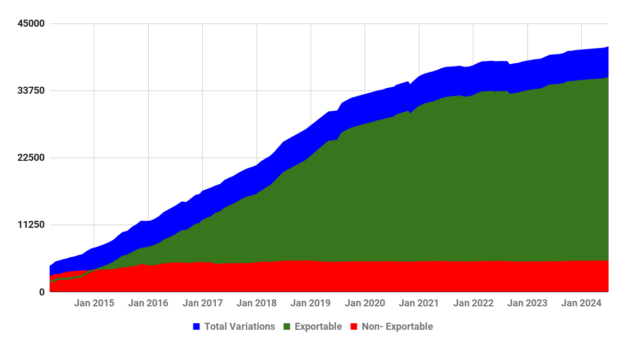
There are currently 20,965 product listings in Kitely Market containing 41,073 product variations, 35,835 of which are exportable.
Kitely Market has delivered orders to 628 OpenSim grids to date.
(Data courtesy Kitely.)
As you can see in the above chart, nearly all the growth in Kitely Market has been in content that can be exported to other grids — that is the green area on the graph. The red area, of non-exportable content, has stayed level for the past eight years.
The Kitely Market is the largest collection of legal content available in OpenSim. It is accessible to both hypergrid-enabled and closed, private grids. The instructions for how to configure the Kitely Market for closed grids are here.
Kitely has recently upgraded its version of OpenSim to allow for faster start-up times and better compatibility with scripts imported from Second Life.
Kitely is also continuing its $90 sale on Mega Worlds.
New grids
I didn’t add any new grids to the database this month.
If you know of any public grid that we’re missing, please email me at maria@hypergridbusiness.com.
Suspended grids
The following 11 grids were marked suspended this month: Butschiland, Butschiland, Destiny Grid, Fire and Ice Grid, Galactic Virtual, IMA Metaverse Depot, KoolPheller Estates, The Public World, Tropical Isle, UCI Mondego vLab, and Virtual RBM.
If they don’t reappear online again soon, they will be marked as closed in future reports.
Sometimes, a grid changes its login URI or website address — if that’s the case, email me and let me know and I’ll update my database.
Top 40 grids by land area
All region counts on this list are, whenever available, in terms of standard region equivalents. Active user counts include hypergrid visitors whenever possible.
Many school, company, or personal grids do not publish their numbers.
The raw data for this month’s report is here. A list of all active grids is here. And here is a list of all the hypergrid-enabled grids and their hypergrid addresses, sorted by popularity. This is very useful if you are creating a hyperport.
You can see all the historical OpenSim statistics here, including polls and surveys, dating all the way back to 2009.
OSgrid: 33,203 regions
Wolf Territories Grid: 29,276 regions
Simation Grid: 25,408 regions
Kitely: 18,246 regions
ZetaWorlds: 12,980 regions
Alternate Metaverse: 10,605 regions
Groovy Verse: 8,334 regions
Discovery Grid: 4,945 regions
DigiWorldz: 3,506 regions
Virtual Vista Metaverse: 3,269 regions
CandM World: 1,849 regions
Tag Grid: 1,464 regions
Shoalwater Bay: 1,072 regions
Friends Grid: 1,040 regions
ArtDestiny: 961 regions
GBG World: 957 regions
Virtual Worlds Grid: 914 regions
AviWorlds: 809 regions
Kinky Haven: 669 regions
Craft World: 630 regions
AvatarLife: 586 regions
Littlefield: 513 regions
GorGrid: 430 regions
Furry World: 373 regions
Virtual Worlds Zone: 364 regions
Neverworld: 318 regions
Nemesis 3D: 305 regions
EdMondo: 300 regions
DreamNation: 284 regions
WestWorld Grid: 274 regions
Darkheart’s Playground: 244 regions
Open Virtual Worlds: 229 regions
Japan Open Grid: 197 regions
Kater and Friends: 191 regions
Counter Earth: 183 regions
MisFitz Grid: 175 regions
Adreans-World: 172 regions
GerGrid: 141 regions
XTalent: 138 regions
Outworldz: 127 regions
Do you know of any other grids that are open to the public but that we don’t have in our database? Email me at maria@hypergridbusiness.com.
Hypergrid Business editor and publisher Maria Korolov is a science fiction novelist. During the day, Maria Korolov is an award-winning freelance technology journalist who covers artificial intelligence, cybersecurity and enterprise virtual reality. See her Amazon author page here and follow her on Twitter, Facebook, or LinkedIn, and check out her latest videos on the Maria Korolov YouTube channel. Email her at maria@hypergridbusiness.com. Her first virtual world novella, Krim Times, made the Amazon best-seller list in its category. Her second novella, The Lost King of Krim, is out now. She is also the publisher of MetaStellar, a new online magazine of speculative fiction.
In the ever-evolving landscape of digital advertising, brands and retailers are continuously looking for ways to capture new audiences—and Roblox is amping up the advertising game with immersive ads on their platform. With nearly 80 million daily active users, the gaming platform is prime real estate to get more eyeballs. Roblox, a platform known for its user-generated games and social interactions, offers a unique canvas for advertisers seeking to captivate younger, tech-savvy audiences.
Immersive Marketing Capabilities on Roblox
Branded Roblox experiences are revolutionizing the way companies engage with younger generations, and immersive advertising functionality enables them to extend their reach across virtual spaces by directly integrating ads into the experience. Blending seamlessly into the gaming environment, advertisers are able to reach new audiences without disrupting gaming flow and connect new, highly-engaged users to their brand experience.
Roblox’s ad system supports 3 formats:
Video ads – where advertisers can serve up to 30 seconds of video content for users to watch in-experience, videos can be both click-to-play or set to autoplay
Image ads – insert static, non-clickable images within the 3D space; think of a virtual, in-game billboard for Roblox brand experiences
Portal ads – a static, non-clickable image with a door to teleport users into an advertiser’s brand experience, driving discoverability and engagement at scale
Brands and retailers can opt for always-on engagement, creating evergreen content to market an evolving brand world, or campaign focused creatives that entice users to explore themed experiences or events—allowing brands to experiment and find innovative ways to capture their audience’s attention.
Each ad format allows for highly targeted advertising, ensuring that the ads are relevant to the audience and enhancing the chances of engagement. Ad content is dynamic and specific to the user—if a user is ineligible to see ads, ad units will default to display the Roblox logo.
amika on Roblox: Virtual Advertising
Haircare brand, amika, debuted their Roblox brand collaboration with Obsess, a colorful playscape embodying the brand’s commitment to inclusion, responsibility and sustainability. The amikaverse is a community-centric extension of the brand’s purpose filled with custom branded mini-games and exclusive UGCs that empower self-expression. To drive traffic to the experience, amika included immersive ads in Roblox, pushing new users to the amikaverse through the use of portal ads. By teleporting users to their virtual world with portal ads, amika was able to scale their discoverability and maximize their reach on the platform.
Natively placed ads in the immersive environment allows advertisers to strengthen their Roblox brand partnerships by building brand affinity with leaned-in audiences across the platform, connecting new users to their brand experiences and building their brand on Roblox.
To learn more about how Obsess can help you extend your brand on Roblox, email us at contact@obsessvr.com or book a demo.
Those who have been using Copilot in Teams actively on chats and channels, have very likely hit this issue when Copilot doesn’t seem to understand when asked about messages in a specific time frame that was further in history. For example, asking Copilot to summarize key action items from last week worked without issues, but asking that for something that was more than a month ago provided mixed results as it sometimes seemed to work and sometimes didn’t.
In fact, Copilot’s “sense of time” in chats and channels was limited to the last 30 days of data in Copilot in Teams chats and channels.
Before this rollout, when users asked Copilot about a long time period (such as “Summarize the key action items from March”), Copilot was limited to the last 30 days of data.
Check out M365 Admin Center Message center, with message id MC801583 and public roadmap.
Message center states also other improvements Copilot in Teams is getting: Improvements to how Copilot in Teams understands and responds to time-related queries in chat and channels. With this rollout, Copilot will provide more precise and relevant responses to prompts such as “yesterday,” “last week,” and “last month.”
How is this change going to be seen in action when using Copilot in Teams? Looking at Message center’s photos there will be two key changes:
Improved sense of time
Simplified timestamp for indicating the timeframe
This update should roll out during this month (August 2024). Targeted release tenants may already have it or get it soon and general availability will be rolling during mid-August to the end of August. This will only affect people who has Copilot for Microsoft 365 -license. The update will be affecting all clients: Desktop, Mac, New Teams Web version and Teams mobile apps.
I needed to try this one early summer in the demo environment to see the impact of this change. Using Copilot side panel for channel conversation thread in Teams.
The chats and channels Copilot provided an answer that included data from December – January, but it the end date was at the end of May. It was at the end of May, when the thread had the last messages. The answer contained only information during December-January messages, so Copilot understood the timeframe already. The reason for this may be that the conversation thread is not too long and thus can be included easily to the language model. However, the result Copilot provided wasn’t fully complete.
Doing the same mid-August, we can see the timestamp has been simplified. This time the result includes all messages and their key tasks.
Sharing is Caring! #CommunityRocks
Aiheeseen liittyy
Published by Vesa Nopanen
Vesa “Vesku” Nopanen, Principal Consultant and Microsoft MVP (M365 and AI Platform) working on Future Work at Sulava.
I work, blog and speak about Future Work : AI, Microsoft 365, Copilot, Microsoft Mesh, Metaverse, and other services & platforms in the cloud connecting digital and physical and people together.
I have about 30 years of experience in IT business on multiple industries, domains, and roles.
View all posts by Vesa Nopanen
Gamification can be leveraged to uplevel a brand’s marketing strategy—creating engaging, novelty experiences that captivate the end user. The use of game design elements, in traditionally non-gaming contexts, creates an interactive experience that is unique and memorable. Immersive, gamified experiences have been proven to boost shopper engagement, increase time spent with your brand and deepen consumer relationships with your products and services.
By tapping into the psychological principles of gamification, like competition, achievement and recognition, brands and retailers can captivate shoppers with custom branded experiences. Custom gamification as a marketing strategy enables brands and retailers to retain customer loyalty and increase retention, gain robust consumer insights and increase brand education.
Customer Loyalty and Retention
Brands and retailers can utilize custom mini-games to simultaneously create memorable brand experiences, and encourage customers to return and engage with your brand more often. Using game-like rewards and challenges can incentivize long-term engagement and retention by tapping into consumers’ natural drive for competition, achievement and recognition.
Korean beauty brand, Laneige, incorporated gaming elements into their Virtual World prompting users to discover numerous products, the brand’s scientific background and marketing campaign assets. The featured Scavenger Hunt game encouraged users to explore the experience in order to find hidden icons, leading to a reward upon completion: a 5-piece gift with purchase.
Gain Consumer Insights
Gamification methods, such as product recommendation quizzes, provide rich zero-party data by capturing direct feedback from customers, offering detailed insights into their preferences, needs and behaviors that can fine-tune your marketing and product development strategy.
Obsess brand partner, Olaplex, utilized branded quizzes to gain zero-party data in their Virtual Salon with their Hair Diagnostic questionnaire; the interactive quiz provided users with a curated hair regimen full of the brand’s products, based on their answers. By filling out the questionnaire, consumers are providing the brand with data they otherwise would not have, allowing Olaplex to capture in-depth information on what their audience is looking for.
Immersive gamified experiences also enable brands to capture robust first-party data such as in-scene behavior. Brands are able to access information such as which product displays are the most appealing, and what their most popular offerings are based on how shoppers engage with different products and pages.
Increased Brand Education
Immersing shoppers into your virtual world helps with brand education and recall. Virtual stores and experiences are a unique and memorable forum for you to host educational content around your brand’s story and offerings. Including custom gamification, such as interactive quizzes and games, simplifies complex product details and campaigns, and turns them into engaging experiences that help your customers retain key information about your brand.
For example, in honor of J.Crew’s 40th anniversary the classic American fashion retailer partnered with Obsess to release a Virtual Beach House. The immersive flagship experience showcased the brand’s products in classic J.Crew print-themed rooms, and commemorated the brand’s heritage with exclusive content and custom gamification such as the Catalog Cover Pop Quiz where users were encouraged to test their J.Crew knowledge. The fashion brand later refreshed their Virtual World to celebrate their holiday campaign, aligning with their marketing calendar.
Gamification is a powerful brand marketing tool that brands and retailers can use to uplevel their strategy. Explore gamification in Obsess-powered experiences and learn how innovative brands like yours can deploy gamification tactics into your marketing strategy. To talk to one of our specialists, email us at contact@obsessvr.com or book a demo.
Metaverse land prices have fallen nearly 95% from their peak values, according to a CoinGecko report.
In 2024, the cost of metaverse lands ranged between 0.08 ETH and 1.88 ETH, representing an average 72% drop from their all-time high. Over the years, the price drops compared to their peaks were 34% from 2023 and 55% from 2022.
Among the various metaverse projects, Sandbox has experienced the most notable decline. Its average floor price fell from 2.86 ETH in 2021 to 0.13 ETH in 2024, marking a 95% decrease.
Conversely, NFT Worlds, which rebranded to TOPIA Worlds in 2023 under the larger Hytopia brand, showed relative resilience. Despite a 65% drop from peak to bottom, its floor price decline was less severe compared to others.
Other NFT collections with significant drawdowns are NFT Worlds (-45%), Otherdeed (-85%), and Decentraland (-89%).
The report highlights an “interesting trend” in Somnium Space, an open and social virtual reality (VR) world built on the Ethereum blockchain. Its peak average floor price was observed in 2023 at 0.98 ETH, up from 0.57 ETH in 2022.
This increase coincided with the release of the Somnium VR1, a high-end VR headset, and significant development announcements.
Days of high prices
During the last stretch of the bull market in 2022, NFT Worlds commanded the highest prices, with an average floor price of 3.29 ETH and an all-time high of 13.5 ETH in March 2022.
Otherdeed, from Yuga Labs’ metaverse Otherside, followed with an average price of 1.98 ETH and a peak of 5 ETH in May 2022. Sandbox and Decentraland also saw high valuations, with average floor prices of 1.91 ETH and 1.73 ETH, respectively.
The surge in prices in 2022 corresponded with record-high interest in the metaverse. Google search trends for the term ‘Metaverse’ peaked in January 2022, reflecting a 106% increase from 2021 and mirroring the heightened interest in digital real estate and Web3 technologies during the bull market.
CoinGecko’s methodology involved examining the prices of selected metaverse lands in ETH from Jan. 1, 2021, to June 25. The metaverse lands analyzed included Otherdeeds, Sandbox, Decentraland, Somnium Space, Voxels, Worldwide Webb, NFT Worlds, and Topia Worlds.
The Volumetric Media Interoperability EG seeks to build understanding around volumetric media and draft a charter for a “Volumetric Media Interoperability” Domain Working Group. Opportunities for more immersive services are increasing as volume capturing and rendering devices become more readily available. As a result, more technologies are being developed to address the requirements for compressing, storing, and delivering volumetric media. Multiple SDOs (e.g. 5G-MAG, 3GPP, MPEG, VFA, SVTA, DVB, SBTVD, etc.) have established isolated focus or study groups to solve issues affecting volumetric media services. Because of the wide-spread interest and isolated initiatives, the volumetric media ecosystem is becoming fragmented.
In brief-Trump's executive orders direct the inclusion of crypto in 401(k) plans and bar debanking of crypto-related initiatives.
Nearly $300 million in short positions...