Published: November 13, 2024 at 11:05 am Updated: November 13, 2024 at 11:05 am
by Ana
Edited and fact-checked:
November 13, 2024 at 11:05 am
To improve your local-language experience, sometimes we employ an auto-translation plugin. Please note auto-translation may not be accurate, so read original article for precise information.
In Brief
Coinbase has acquired the Utopia Labs team to accelerate the development of on-chain payment solutions for Coinbase Wallet.
Company operating a cryptocurrency exchange platform, Coinbase announced its acquisition of the team from Utopia Labs, a cryptocurrency payment provider and stablecoin onramp/offramp.
The Utopia Labs team will join Coinbase’s Layer 2 network, Base, to help accelerate the development of on-chain payment solutions within Coinbase Wallet, a self-custody wallet that allows users full control over their cryptocurrency. This means the private keys, which are crucial for ownership of the cryptocurrencies, are securely stored on the user’s mobile device rather than with a centralized exchange.
The team brings extensive experience in building on-chain payment products, and Coinbase aims to leverage this expertise to further its mission of providing low-cost, fast, and globally accessible payments.
In Q2 2024, stablecoins saw $8.5 trillion in transaction volume across 1.1 billion transactions, highlighting the growing importance of improving user experiences in the space. Jesse Pollak, creator of Base and Head of Protocols at Coinbase, emphasized the collaboration’s goal of creating a future where on-chain payments improve the daily lives of individuals and businesses worldwide.
Base: What Is It?
Base is an Ethereum Layer 2 blockchain developed by Coinbase, designed to provide a secure, cost-effective, and developer-friendly environment for building on-chain applications. Built using the OP Stack in collaboration with Optimism, Base is incubated within Coinbase, leveraging the company’s extensive experience in crypto product development. The network is intended to progressively decentralize over time, and currently, there are no plans to issue a new native token for the network.
Recently, Base introduced permissionless fault proofs to enhance the decentralization of the network and reduce the risk of centralized control. These fault proofs are modeled after a similar implementation on Optimism’s OP Mainnet. Both networks are part of the Superchain ecosystem, alongside other projects like Zora, Mode, and Fraxtal.
Disclaimer
In line with the Trust Project guidelines, please note that the information provided on this page is not intended to be and should not be interpreted as legal, tax, investment, financial, or any other form of advice. It is important to only invest what you can afford to lose and to seek independent financial advice if you have any doubts. For further information, we suggest referring to the terms and conditions as well as the help and support pages provided by the issuer or advertiser. MetaversePost is committed to accurate, unbiased reporting, but market conditions are subject to change without notice.
About The Author
Alisa, a dedicated journalist at the MPost, specializes in cryptocurrency, zero-knowledge proofs, investments, and the expansive realm of Web3. With a keen eye for emerging trends and technologies, she delivers comprehensive coverage to inform and engage readers in the ever-evolving landscape of digital finance.
More articles
Alisa Davidson
Alisa, a dedicated journalist at the MPost, specializes in cryptocurrency, zero-knowledge proofs, investments, and the expansive realm of Web3. With a keen eye for emerging trends and technologies, she delivers comprehensive coverage to inform and engage readers in the ever-evolving landscape of digital finance.
In today’s fast-paced digital world, businesses constantly seek innovative ways to engage their customers. One of the most exciting developments in this area is virtual reality (VR). Hiring a top VR app development company can help your business leverage this technology effectively. Whether you want to create immersive experiences for your customers or streamline internal processes, a professional VR development team can make it happen. This blog explores the key benefits of partnering with a leading VR app development company and how it can transform your business.
Understanding VR and Its Importance
Virtual reality immerses users in a computer-generated environment, allowing them to interact with 3D worlds using specialized devices like VR headsets. This technology has applications across various industries, including gaming, education, healthcare, and real estate. As businesses explore VR’s potential, hiring a skilled VR app development company becomes crucial.
Enhanced User Engagement
One of the primary advantages of VR technology is its ability to engage users more effectively than traditional methods. A top VR app development company knows how to create interactive and immersive experiences that capture users’ attention. By employing engaging storytelling techniques and realistic simulations, businesses can enhance user satisfaction and drive higher engagement levels.
Interactive Marketing Campaigns
Incorporating VR into your marketing strategy can elevate your brand. A skilled development team can help create VR experiences that showcase products in an innovative way. Imagine allowing customers to virtually try on clothes or explore a new car model before making a purchase. Such experiences create memorable interactions that resonate with customers.
Improved Customer Understanding
VR technology allows businesses to gather valuable insights into customer behavior. By observing how users interact with VR environments, companies can understand preferences and pain points better. This data can inform product development and marketing strategies, leading to more tailored offerings.
Cost Efficiency in Training and Development
Training employees can be expensive and time-consuming. A top app development company specializing in VR can develop training programs that simulate real-life scenarios. This approach allows employees to practice skills without the risks associated with traditional training methods.
Safe Learning Environment
VR training provides a safe environment for employees to make mistakes and learn from them. For instance, healthcare professionals can practice surgical procedures in a simulated environment before performing them on actual patients. This not only reduces training costs but also enhances employee confidence.
Increased Retention Rates
Studies show that learners retain information better when they engage in interactive training. VR experiences cater to different learning styles, ensuring employees grasp complex concepts. By investing in VR training solutions, companies can increase retention rates and reduce the time required for training.
Boosting Creativity and Innovation
Creativity fuels innovation, and VR technology serves as a powerful tool to foster creativity. A VR app development company can create virtual spaces where teams brainstorm ideas without limitations. This immersive environment encourages out-of-the-box thinking and collaboration.
Collaborative Virtual Spaces
Teams can collaborate in a shared virtual environment, regardless of their physical locations. This capability opens up new possibilities for remote teams and global collaborations. By harnessing VR, businesses can break down geographical barriers and bring together diverse talents to innovate.
Prototyping and Visualization
For businesses involved in product design, VR allows for rapid prototyping and visualization. Designers can create 3D models and immerse themselves in virtual prototypes. This process facilitates real-time feedback and iterative design, ultimately leading to better products.
Competitive Advantage
In a crowded marketplace, staying ahead of the competition is essential. By embracing VR technology, businesses can differentiate themselves and create unique value propositions. Partnering with a top VR app development company allows businesses to innovate faster and more effectively than competitors who stick to traditional methods.
Unique Customer Experiences
Offering VR experiences sets businesses apart. Customers appreciate innovative solutions that enhance their experiences. Whether it’s an engaging product demonstration or an interactive tour, businesses that invest in VR gain a competitive edge.
Brand Loyalty and Trust
Engaging customers through VR creates lasting impressions. When customers have memorable interactions with a brand, they are more likely to return and recommend it to others. Investing in VR can foster brand loyalty and build trust among customers.
Customization and Scalability
Every business is unique, and VR solutions should reflect that. A top app development company understands the importance of tailoring solutions to meet specific business needs. They can develop custom VR applications that align with your goals and objectives.
Tailored Solutions
Working with a specialized VR app development company ensures you receive solutions that address your business’s unique challenges. The team collaborates with you to understand your requirements and deliver a product that meets those needs.
Future-Proofing Your Business
As technology evolves, so do customer expectations. Investing in a flexible VR solution allows your business to adapt to changing demands. A top VR app development company will ensure your application remains relevant and scalable, accommodating future enhancements and updates.
Increased Return on Investment (ROI)
While investing in VR development may seem significant initially, the long-term benefits can lead to substantial returns. By enhancing user engagement, improving training efficiency, and differentiating your brand, VR solutions can drive profitability.
Measuring Success
A reliable VR app development company will help you establish metrics to evaluate your investment’s success. Analyzing user engagement, training outcomes, and sales data allows businesses to quantify the benefits of VR solutions.
Cost-Effective Marketing
When businesses utilize VR for marketing, they often see higher conversion rates. Interactive campaigns create a buzz, leading to increased brand awareness and customer acquisition. The ability to showcase products in an immersive manner can significantly boost sales.
Conclusion
Hiring a top VR app development company opens doors to numerous benefits for your business. From enhancing user engagement to fostering creativity and innovation, the advantages of VR technology are immense. As businesses seek to stay ahead in a competitive landscape, investing in VR solutions becomes a strategic move.
At Vegavid Technology, we understand the potential of VR and offer tailored development services to help your business thrive. By partnering with a leading top android app development company, you can unlock the full potential of VR technology and elevate your business to new heights. Embrace the future today and watch your business transform!
Latin Nights at the OpenSim World Fair. (Image courtesy Kimm Starr.)
The OpenSim Worlds Fair is set to launch on March 1, 2025, and will celebrate innovation, creativity, art, technology, fashion, and education in OpenSim.
This event, a year in the making, will unite the OpenSim community under one roof, showcasing the talents and achievements that define our world.
With nearly two decades of immersive experience in virtual worlds, the organizers, Cooper Swizzle, Koshari Mahana, Kimm Starr, and entertainment coordinator Rosa Alekseev, are passionate about elevating events throughout the hypergrid. Their dedication to fostering creativity and innovation ensures that this fair will be a memorable experience for all attendees, showcasing the best of what the hypergrid has to offer.
The fair will be held on the Wolf Territories grid, owned by Lone Wolf, and is designed to bring together individuals from diverse backgrounds and interests within the virtual community.
The OpenSim Worlds Fair will feature at least 17 themed stages, showcasing a variety of genres including rock and roll, Motown, Latin, and retro. This diverse selection of stages is designed to keep attendees entertained while they party and connect with others, with each theme curated to align with the performers and DJs. A special acknowledgment goes to Rosa Alekseev for her tireless dedication and exceptional efforts in organizing the entertainment for the fair.
Motown stage at the OpenSim World Fair. (Image courtesy Kimm Starr.)
Offering 72 parcels for exhibitors, we still have a few spaces available for those eager to showcase their work, talents, and creativity at this event. While full region-sized parcels are now gone, we have smaller parcels ready for participants looking to make their mark.
A handful of free exhibition spaces remain, providing a platform to share your vision and innovation. This is your chance to be part of a celebration that champions progress and fosters cultural exchange across the hypergrid.
“On October 23, 2024, Thirza Ember’s Hypergrid Safari tour made a stop at the Worlds Fair, drawing attendees eager to experience the energy and creativity taking shape. Participants were treated to an exclusive sneak peek of the fairgrounds, exploring exhibits and immersive installations.
“Looks amazing and the grid seems rock solid,” said James Atlloud.
“It has Second Life quality,” said Forest Azure.
“You’ve all done a fantastic job. I’m looking forward to March,” said Lavia LLavine.
In a Hypergrid Safari Facebook Post, Star Ravenhurst wrote: “While some builds are still in progress, many are already completed, and the preview we received left us truly excited for what’s to come. This event promises to be a must-see, filled with fun, innovation, and excitement—mark your calendars because you won’t want to miss it.”
For more information, contact one of our hosts, dive into the fun on our Discord community, visit our website, or email the organizers at OpenSimWorldsFair@gmail.com. Be a part of the OpenSim Worlds Fair and help us bring the hypergrid closer together while celebrating the boundless creativity and ingenuity that define this extraordinary virtual landscape.
Published: November 12, 2024 at 9:00 am Updated: November 12, 2024 at 3:10 am
by Ana
Edited and fact-checked:
November 12, 2024 at 9:00 am
To improve your local-language experience, sometimes we employ an auto-translation plugin. Please note auto-translation may not be accurate, so read original article for precise information.
In Brief
Civic launches Auth, a single sign-on platform that provides users with access to a comprehensive suite of identity management tools.
Provider of identity management solutions, Civic announced the launch of Civic Auth, a single sign-on platform designed to serve as an entry point to Web3. This solution provides users with access to a comprehensive suite of identity management tools.
“By introducing Civic Auth, we’re helping developers meet people where they are in their Web3 journey and creating familiar experiences for everyone from Web3 novices to experts,” said JP Bedoya, Chief Product Officer at Civic, in a written statement. “Users are able to benefit from a single, unified identity solution that can meet various verification requirements across the Web3 ecosystem. Now, applications can serve their users with a flexible identity platform that will allow them to easily zip around the ecosystem,” he added.
With Civic Auth, users can connect their existing wallets or simply sign in with their email, passkey, or Google account. If a user does not bring their own wallet, one will be automatically created for them. This user-friendly process reduces friction and simplifies onboarding for those new to Web3. By using abstracted wallets, Civic Auth allows more individuals to enjoy the benefits of blockchain technology without the complexity of managing private keys themselves.
Once a user’s wallet is connected, Civic can verify their identity and government-issued ID, which can then be used for purposes such as preventing Sybil attacks or ensuring compliance with Anti-Money Laundering (AML) regulations. Developers can also take advantage of privacy-preserving features, such as on-chain gating and credential proofs in smart contract executions, to enhance security. Additionally, developers can easily re-verify a user’s identity at login, denying access to those who do not pass identity verification.
Combating fraud, cheating, and spam has been a constant challenge in the digital space, with new attack methods emerging regularly. To address this, Civic’s identity solutions use tokenized identity to secure an application’s environment, offering comprehensive protection without requiring the integration of multiple vendors.
Having issued over 925,000 Civic Passes and established itself as a trusted partner for many startups, Civic has positioned itself as a leading platform for Web3 identity management.
Civic: What Is It?
This project provides a comprehensive solution for managing digital identity on a verifiable internet, giving individuals control over their identities in a private, blockchain-compatible manner. Through its main offering, Civic Pass, the company offers business clients a streamlined tool for permissioning, allowing secure access to on-chain assets.
Additionally, Civic.me is available for consumers to manage their identity, digital presence, and reputation. Civic‘s goal is to become a globally trusted on-chain identity solution, aiming for widespread, daily use. The company was established in 2015 by Vinny Lingham and Jonathan Smith.
Disclaimer
In line with the Trust Project guidelines, please note that the information provided on this page is not intended to be and should not be interpreted as legal, tax, investment, financial, or any other form of advice. It is important to only invest what you can afford to lose and to seek independent financial advice if you have any doubts. For further information, we suggest referring to the terms and conditions as well as the help and support pages provided by the issuer or advertiser. MetaversePost is committed to accurate, unbiased reporting, but market conditions are subject to change without notice.
About The Author
Alisa, a dedicated journalist at the MPost, specializes in cryptocurrency, zero-knowledge proofs, investments, and the expansive realm of Web3. With a keen eye for emerging trends and technologies, she delivers comprehensive coverage to inform and engage readers in the ever-evolving landscape of digital finance.
More articles
Alisa Davidson
Alisa, a dedicated journalist at the MPost, specializes in cryptocurrency, zero-knowledge proofs, investments, and the expansive realm of Web3. With a keen eye for emerging trends and technologies, she delivers comprehensive coverage to inform and engage readers in the ever-evolving landscape of digital finance.
Bitcoin (BTC), the world’s largest cryptocurrency, achieved another milestone today, reaching an all-time high of $89,517. Here’s an update on the latest market movements.
After a series of impressive gains, Bitcoin has continued its upward trajectory, much to the delight of its investors. Early this morning around 2:00 AM, BTC surged again, setting a new record. Currently trading at approximately $89,000, Bitcoin has appreciated by around 30% over the past week.
Strong Performance Across the Market
A review of CoinMarketCap data reveals that the top 10 cryptocurrencies by volume are experiencing notable value increases. Ethereum (ETH) is now trading at $3,350, Solana (SOL) at $220, Binance Coin (BNB) at $653, and Dogecoin (DOGE) at $0.38. Additionally, Ripple (XRP) stands at $0.60, Cardano (ADA) at $0.58, and Shiba Inu (SHIB) at $0.000028.
Dogecoin Leads the Pack
The week’s top performer is DOGE, which has surged by 145%—the highest gain among major altcoins. This rapid rise is thought to be partly due to the recent U.S. elections, which have fueled interest in this Elon Musk-backed altcoin.
With the current bullish momentum, the crypto market remains vibrant, with Bitcoin’s performance serving as a catalyst for broader gains.
You May Also Like
Follow us on TWITTER (X) and be instantly informed about the latest developments…
Having had the privilege of using the new chat and channels experience in Microsoft Teams for several months, I am excited to share my insights and reflections. This update has changed the way I communicate and use Teams, and it’s poised to make a significant impact on how we all work together. Everyone will be upgraded to the new experience, but choosing to keep chats and channels together is optional. Users can easily switch to keep them separate, while enjoying the benefits of new features like upgraded filters, sections, @mentions, and more!
Microsoft published information about the upcoming feature early before the release, so organizations and people can get ready to prepare for the change. This new experience is now rolling to the public preview and targeted release!
In this article, I will delve into some of the features and functionalities of this new experience, explaining what makes it a game-changer for me. From enhanced organization to an improved user interface, there are numerous reasons why this is a good leap forward for Teams. Read on as I explore the nuances of this update and highlight why it stands out as an enhancement in our digital workspace.
The Evolution of Teams A Unified and Customizable Experience Flexibility and features Key features overview Filters on top How about separate views for chats and channels? My Teams View Conclusion and useful tips Learn more from Microsoft sources
Over the past year, the Teams platform has evolved significantly to meet the demand for faster, simpler, and smarter solutions in the AI-powered workplace. Microsoft has implemented several improvements, such as the New Teams (twice as fast as the old client) and adding new features to both Teams Core and Teams Premium, including voice isolation, intelligent recap, custom emojis, Loop-components to chats and channels, co-editable code blocks, and many many others. The latest significant upcoming addition is the New Chat and Channels Experience, which is designed to simplify and streamline collaboration within Teams, the digital hub for work.
One of the most striking features of the new chat and channels experience is its ability to bring all your conversations—whether in chats, teams, or channels—into one unified view. This integration is a game-changer (to me, but experience varies), allowing me to stay on top of all my communications without having to switch contexts between chats-teams-channels constantly. The new interface also offers customization options that should have been there years ago: options that enable you to tailor your Teams to suit your preferences such as grouping chats & channels to sections you name and define. The redesigned chat and channels experience also adds other tools than just custom sections, it adds persistent filters, GoTo, and a new @mentions view. These features help me to stay up to date about what’s new and what’s important in Teams.
Starting with the new experience is straightforward, thanks to a self-service, guided onboarding flow that helps you discover and configure the new features according to your preferences. Whether you prefer to keep chats and channels combined or separate, the new interface allows you to make these adjustments easily, by yourselves.
Are you a heavy mobile user? The new chat and channels experience is designed to work seamlessly on desktop, web, iOS, and Android, ensuring that you can access and manage your communications efficiently, no matter how you use Teams. Settings like combined or separate view, or message previews, can be different on your mobile and desktop app. In this way, you can customize each how you like it, even with different settings. For example, I use the persistent , global, Unread filter in Teams mobile app, but in the desktop app I use Unread filtering in sections.
What’s in the new experience:
Unified view for chats, teams, and channels
Favorites section for prioritizing important conversations
Customization options for grouping chats and channels into sections
Persistent filters
@mentions view
Settings to control the experience
When you get the new experience, you are greeted by Teams with a dialogue telling about the new experience. You can skip this one by selecting Do it later, or just Get Started with the new exp.
If you choose to Get Started, then you will notice that you don’t have Chats and Teams on the App bar anymore. Just Chats. Under it, you have a combined view of chats, teams, and channels together. You can also find @Mentions (the new view showing all messages you have been at mentioned), Discover (the recent channel messages pick, this is not a new one – it has been there in the Teams for some time) and of course the Copilot.
From the top of this screen, you can go to Customize view. It takes you to Settings / Chats and channels. In there you can choose if you want to keep chats and channels combined (ie: all these are under the Chat) or separate (separate left rail apps for Chats and Teams, just like before). You can also tune the experience by showing (or not) message previews (I have this one off, to save space) and message time stamps (I have also this one off). You also have the old settings we had before in this tab: Hide inactive channels (I have it on), message density (comfy for me) and Suggested replied (on for me). You can also change settings in mobile Teams.
Now the best part: customizing sections. It is possible to create up to 50 sections.
It is possible to add, edit and remove sections and move chats and channels to any section you like. It is not just favorites anymore (it will be on top) but you can use any grouping that makes sense to you. For example, projects, customers, teams, company channels, etc. Basically: you organize your chats and channels to topics/context and projects.
You can also collapse sections, so you see only the name of the section and you need to click it open if you want to drill onto it. When there are new messages in the section’s channels or chats the section name will be bolded.
How about sorting sections? Just drag and drop!
Each section has its own … menu, and you can define from it how you want the section sorting to behave.
Custom means that you can drag and drop chats & channels in the section to any order you prefer. Most recent shows chats and channels with recent activities on the top (ie: the order is changing). What I use: Unread only. This automatically hides all chats and channels that don’t have new messages and those with unread messages are shown in the most recent order. And if I want to see the rest of the conversations, I just click See read.
There are also filters on the top of the view.
In there you can quickly choose to show only Unread chats & channels. It hides all sections that don’t have any unread conversations. This is the most compact view, and I use this one on Mobile Teams. On desktop I prefer to have all sections visible, so I can see its contents quickly (with one click).
Other options are to show only Chats (hiding channels) or Channels (hiding chats). It is possible to select to show just meetings and muted conversations.
@ Mentions view is also a great one. It shows all messages where you have been @mentioned, and when you click the message open it opens on the side pane.
And there is also the magnifying glass icon on top of the view, next to the new message icon. With the search, it is quick to find sections that contain chats and channels matching what I am searching for, and when I press See read, I see those chats and channels that match the search. As most of my work happens in custom sections, I rarely need to use this search filter.
What also helps with navigation is the new Goto shortcut Ctrl+G (Cmd+G). This opens the top box for searching, making it easy to discover and jump to any channel or chat you are looking for.
When using the separate Chat and Teams views, you can still use filters and the @mentions view to triage and organize you list with custom sections, as well as the new message and go to commands navigate quickly across conversations in chats or channels
You can opt in to show only Channels or you can go with the “old way” Teams and Channels.
I have the following settings: combined view and showing unread messages selected for each section. My key sections are favorites (this and that that I want to access easily), Copilot and AI (a lot of work and ideation happens here), Copilot Customers, MVP (Microsoft MVP related chats and channels both internal and shared channels) and Metaverse and Mesh is one of custom sections as well. Everything else is under Chat and Channel sections.
As most of activities happen in Copilot and AI, I have placed these sections to the top. However, despite Metaverse and Mesh being at the bottom of this snip, they stand out whenever there is any activity in channels and chats because I tend to have this “Teamsbox zero” situation with the new experience. If there are messages I need to process later, I have two options: mark as unread (for a short period of time) or add message & task to To Do. I use To Do quite often, but occasionally marking unread is fast and does the job. I have grown a habit I don’t like to see unread messages in my Teams. I know it is not possible for everyone, but I also decided to do a lot of prioritizations, and adding messages as tasks. What I wish Teams had: snoozing a message & notification, just like in Outlook I can snooze an email. Yes, I can do a Flow that notifies me about that message, but it is not the same. Perhaps, one day, we get the snooze action. Fingers crossed!
The new chat and channels experience in Microsoft Teams is a significant step forward in enhancing my digital workspace. With its unified interface, customizable options, and other tools, it is set to take the next step on the way we collaborate and communicate.
I have been using this new experience since that private preview came available, and I have noticed that I prefer the new “smooth” streamlined version of Teams. I have my filters set to show only Unread messages and created sections that work the needs I have currently. This changed the way I use Teams, and combining chats & channels was quite a natural step – work is done on both, and people use chats & group chats a lot. It was just a logical decision to combine the view. Teams are there, so I can choose to go to the team view and work on it like before when I need to.
I used to miss an easy way to get to the team from the combined chats and channels view, but I just found out that there is an easy way to do it!
💡Tip: If you hover mouse cursor over the channel avatar (channel picture), it opens the channel card which has a link to the team. Note: if you hover over the channel name, the channel card doesn’t appear.
Link takes you to the team’s Channels-tab
What I also noticed and learned when using the new combined chats and channel’s view: it is important to use a good team picture. Team picture is used as channel avatar. For me, visuals help to associate the channel with a team, so I know already from the avatar to which team (or to which product, customer or project) the channel belongs to. For example, using the customer logo as a team picture helps to identify which customer team the CAS (Copilot Adoption Service) or General channel belongs to. 💡Tip: use the possibility to change General channel’s name to something more descriptive, as it helps to associate the context with the channel more quickly, especially when using this new combined view experience. Nothing is more confusing than a list of 10-20 General-channels, that don’t have team pictures set.. Channel naming and team pictures are now in a higher priority, than before! Not that they were not very important before, but now it is a good idea to make sure channel stands out from others with he same context. For example, with Project Management channel, it might be a good idea to include project name (or a short version of that) in the beginning of the channel name. Describe the channel name so, that it can be used without the team context. If you have a standing out team picture in use, then having just the name Project Management can work out well.
This new view and use experience is a big change for a lot of people. The old Teams is changing to something different, yet in the core it is the same Teams. Plan how you communicate and train employees about this new view. It is a powerful one, but not everyone wants to use their time and capacity to learn it from day one.
Remember: your teams didn’t disappear anywhere – the focus is just on chats and channels, flattening the structure. You can navigate to teams and manage them just like before. Nothing in the base structure has changed: these are teams and teams have owners, members and different types of channels: standard, shared and private.
Stay tuned – I will be writing more about this new experience!
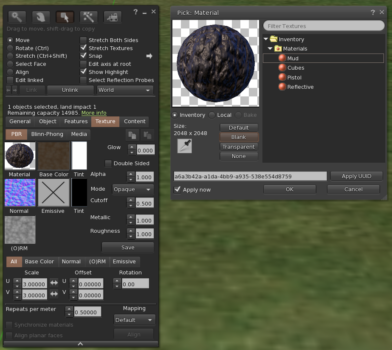
Kitely has added support for physically based rendering (PBR) materials in both its virtual worlds and on the Kitely Market, the company announced this week. The update also includes support for textures up to 2,048 by 2,048 pixels in size.
PBR materials allow for more realistic textures by simulating how light interacts with different surfaces, such as mud or metal, creating the appearance of raised and lowered areas with realistic light reflection.
(Image courtesy Kitely.)
The feature requires Firestorm 7.1.11 or newer to use.
Kitely is one of the first grids to support PBR materials, having ported the features from the upcoming OpenSim 0.9.3 release into their current OpenSim 0.9.2.2-based system.
“PBR isn’t yet supported in all OpenSim grids,” said Oren Hurvitz, Kitely co-founder and VP of R&D, in the announcement. “This is a feature that will be part of OpenSim 0.9.3, but that version of OpenSim isn’t finished yet so many grids — including Kitely — are still using the latest stable release, which is OpenSim 0.9.2.2. The reason that Kitely can support PBR now is that we ported the PBR features from OpenSim 0.9.3 into our version of OpenSim.”
The Kitely Market has been updated to accommodate the new feature, with the “Textures” category renamed to “Textures and Materials.” Merchants are advised to mention PBR usage in their product descriptions since items using PBR materials may not display correctly on grids that don’t support the feature. Alternatively, merchants can include regular textures as a fallback to ensure their products look okay on all grids.
“Kitely Market is the main marketplace serving the hypergrid so we decided to support the latest graphics options from OpenSim 0.9.3 even before they have been officially released,” Kitely CEO Ilan Tochner told Hypergrid Business.
The update also brings support for reflection probes through LSL scripting, with new PRIM_REFLECTION_PROBE parameters added to GetPrimParams and SetPrimParams functions.
PRB makes reflections seem more realistic. (Image courtesy Kitely.)
While PBR materials can technically be used for terrain textures, Kitely reports encountering several issues during testing. World maps will show objects using PBR materials but display only the basic color texture, not other PBR properties like normal maps or roughness. PBR terrain textures are not currently displayed in world maps.
For content creators, Kitely has added a new “Materials” folder to user inventories for storing PBR materials.
Creators interested in learning more about creating PBR materials refer to Second Life’s documentation on the subject.
Hypergrid Business editor and publisher Maria Korolov is a science fiction novelist. During the day, Maria Korolov is an award-winning freelance technology journalist who covers artificial intelligence, cybersecurity and enterprise virtual reality. See her Amazon author page here and follow her on Twitter, Facebook, or LinkedIn, and check out her latest videos on the Maria Korolov YouTube channel. Email her at maria@hypergridbusiness.com. Her first virtual world novella, Krim Times, made the Amazon best-seller list in its category. Her second novella, The Lost King of Krim, is out now. She is also the publisher of MetaStellar, a new online magazine of speculative fiction.
Published: November 08, 2024 at 3:00 pm Updated: November 08, 2024 at 7:39 am
by Ana
Edited and fact-checked:
November 08, 2024 at 3:00 pm
To improve your local-language experience, sometimes we employ an auto-translation plugin. Please note auto-translation may not be accurate, so read original article for precise information.
In Brief
N3TWORK Studios introduced a new ecosystem alongside its game Legendary Heroes Unchained on the Base network, allowing users to engage as players, creators, and digital asset owners.
Blockchain gaming studio N3TWORK Studios introduced a new ecosystem along with its game Legendary Heroes Unchained (LHU) on the Base Ethereum layer 2 network. Through the release of Epoch 1, N3TWORK Studios aims to transform the gaming experience by allowing players to engage not only as players but also as active creators and digital asset owners. By merging immersive, strategy-driven gameplay with authentic digital ownership, LHU establishes a fresh benchmark for what on-chain gaming can achieve.
“Legendary Heroes: Unchained’s first Epoch is a fundamental shift in gaming — where players can now truly own and shape their digital destiny,” said Julius Hong, Executive Producer at N3TWORK Studios, to MPost. “Our decentralized NFT heroes with extensible metadata are the building blocks for not just creating a game, but a platform where every player can transform from gamer to creator, forging their own legends in an ever-evolving digital realm. Early adopters don’t just play the game — they’ll help influence its future,” he added.
LHU offers players an onchain gaming experience that extends far beyond simple asset collection, empowering them with extensive customization and ownership options that allow for a highly individualized experience. Players can personalize heroes and lands with unique stats, attributes, and visual elements, creating an experience that reflects their own playstyle and preferences. As the game evolves through different Epochs, players will be able to integrate their assets into personal narratives and potentially even external games, creating connections that extend beyond the boundaries of a single experience.
At LHU’s core are digital assets like heroes and land, forming a flexible and open framework that enables players to create, evolve, and redefine their digital worlds. This framework supports a diverse range of experiences—players can develop their heroes, establish guilds, and build empires, all while retaining ownership of the assets they’ve cultivated. With assets that transcend the LHU ecosystem, players can bring their creations beyond the game, experiencing a blend of creative freedom and ownership that distinguishes LHU from traditional gaming.
In order to foster community-driven innovation, N3TWORK Studios is also making parts of its software open-source, allowing the community to build on its digital framework and contribute to the ongoing development of LHU with their own creations. LHU is not only crafted as a distinct gaming experience but also serves as the first title within the broader Legendary Ecosystem. In this ecosystem, players enjoy true and verifiable ownership of their heroes and lands—assets that will continue to grow in functionality and value as the game’s roadmap progresses.
Legendary Heroes Unchained To Offer Players No-Download, Web And Mobile Premier Gaming Experience
LHU has launched its Epoch 1 on November 7th for Loyalty Pass Holders, with public access opening 24 hours later. Developed using Unity WebGL, LHU is a no-download Hero Collector RPG that provides an innovative and seamless experience for both Desktop Web and Mobile users. The game is designed to be safe, secure, and incredibly easy to use, with support from Coinbase Smart Wallet, Reown (formerly WalletConnect), and FortePay. These Web3 tools facilitate smooth and secure payment transactions, handling both cryptocurrency and fiat conversions effortlessly.
“In the future, we see every digital asset as a gameplay primitive that can be used and combined to create new experiences,” said Neil Young, Chairman at N3TWORK Studios, in a written statement. “With that vision, we have set out to create The Legendary Ecosystem, where play, collaboration, and ownership extend beyond the boundaries of what you have come to expect in games. Legendary Heroes Unchained uses these digital objects to create what will be the first of many experiences crafted for and with players and creators,” he concluded.
Disclaimer
In line with the Trust Project guidelines, please note that the information provided on this page is not intended to be and should not be interpreted as legal, tax, investment, financial, or any other form of advice. It is important to only invest what you can afford to lose and to seek independent financial advice if you have any doubts. For further information, we suggest referring to the terms and conditions as well as the help and support pages provided by the issuer or advertiser. MetaversePost is committed to accurate, unbiased reporting, but market conditions are subject to change without notice.
About The Author
Alisa, a dedicated journalist at the MPost, specializes in cryptocurrency, zero-knowledge proofs, investments, and the expansive realm of Web3. With a keen eye for emerging trends and technologies, she delivers comprehensive coverage to inform and engage readers in the ever-evolving landscape of digital finance.
More articles
Alisa Davidson
Alisa, a dedicated journalist at the MPost, specializes in cryptocurrency, zero-knowledge proofs, investments, and the expansive realm of Web3. With a keen eye for emerging trends and technologies, she delivers comprehensive coverage to inform and engage readers in the ever-evolving landscape of digital finance.
Published: November 08, 2024 at 10:24 am Updated: November 08, 2024 at 10:24 am
To improve your local-language experience, sometimes we employ an auto-translation plugin. Please note auto-translation may not be accurate, so read original article for precise information.
XLink, a protocol integrating BTC into the growing decentralized finance (DeFi) economy, recently announced the release of its whitepaper detailing a completely unique approach to the blockchain’s interoperability with other ecosystems.
The protocol seeks to mitigate some of the most pressing bottlenecks hampering Bitcoin-based DeFi’s growth — more popularly known as BTCFi — using its propriety framework called “Bitcoin-Centric Chain Abstraction.”
As things stand, BTC’s fledgling economy has a total value locked (TVL) of $2.23 billion — over 22 times what it was during January 2023.
Total funds locked across various BTC protocols (source: Defillama)
The whitepaper outlines XLink‘s evolution from a simple cross-chain bridge within the Bitcoin-DeFi platform ALEX to overcoming some of the digital asset’s limitations (such as its limited smart contract capabilities).
What is ‘Bitcoin-Centric Chain Abstraction?’
XLink’s core innovation stems from its Bitcoin-Centric Chain Abstraction framework, which allows BTC holders to interact with different networks using only their Bitcoin wallets — thus bypassing the need to manage multiple storage solutions or possess extensive knowledge of crypto-related jargon.
Technically speaking, the abstraction layer is supported by an Intent-Based Routing Engine, which automatically translates user intentions into executable workflows across different networks.
Rather than requiring users to understand the complexities of cross-chain transactions, the system allows them to specify their desired outcomes, with the protocol handling all technical implementation details automatically.
Technical architecture and security measures
According to the whitepaper, XLink’s revamped digital architecture brings forth a host of notable security features, including a ‘Direct Event Validation’ mechanism that differs from traditional bridging solutions.
Instead of relying on external validators, the protocol validates Bitcoin events within its own framework, potentially reducing the risk of errors and external manipulations that can occur in conventional systems.
The protocol’s security infrastructure is further strengthened by institutional-grade Multi-Party Computation (MPC) wallets. Developed in partnership with established custody technology providers Cobo and Fireblocks, they require multiple signatures for transaction approvals, adding an additional layer of security for users’ assets.
Additionally, disaster recovery solutions have also been provided through a partnership with Coincover, addressing concerns related to untimely outages or operational disruptions.
Lastly, to maintain a high level of decentralization and security, XLink has deployed a validator network that combines both signing and non-signing validators. This hybrid approach establishes a two-layer security model that prevents any sort of network takeover attempts while also encouraging community participation when it comes to bolstering network security.
Exploring XLink’s governance operations
XLink’s operations are currently being overseen by XLinkDAO, a decentralized autonomous organization (DAO) ensuring non-localized governance (via distributed stakeholder participation).
Their long-term collaboration with ALEX Lab Foundation has facilitated the integration of the Bitcoin Oracle — a cross-chain messaging and consensus layer that enables secure communication between off-chain computation engines on Bitcoin — into their respective digital frameworks.
For institutional users, XLink has positioned itself as a bridge facilitating seamless participation in the Bitcoin economy. The protocol’s infrastructure specifically caters to the needs of family offices, pension funds, and high-net-worth individuals seeking secure exposure to BTCFi.
Strategic Partnerships and Technology Integration
Earlier this month, XLink announced that it had worked with NEAR Protocol to leverage its propriety ‘Chain Signatures’ technology, enabling smart contracts to execute transactions across multiple blockchains while simultaneously enhancing the platform’s throughput and confirmation rates.
Not only that, the NEAR Protocol integration also improves the efficiency of XLink’s aforementioned Bitcoin Oracle while also signaling a shift from traditional “lock-and-mint” mechanisms to more efficient account-based routing for cross-chain asset transfers.
As a result, users can have a more streamlined experience, particularly when it comes to interacting with L2 smart contracts (since all they have to do is use a Bitcoin wallet for managing their transactions).
Finally, XLink’s integration with prominent ecosystems, including Stacks and Core Chain, aims to create a more cohesive DeFi landscape where users can leverage the strengths of multiple networks while maintaining Bitcoin as their primary asset.
Looking ahead, it will be interesting to see how BTCFi continues to mature and how XLink’s Bitcoin-Centric Chain Abstraction paves the way for future blockchain interoperability solutions. Interesting times ahead!
Disclaimer
In line with the Trust Project guidelines, please note that the information provided on this page is not intended to be and should not be interpreted as legal, tax, investment, financial, or any other form of advice. It is important to only invest what you can afford to lose and to seek independent financial advice if you have any doubts. For further information, we suggest referring to the terms and conditions as well as the help and support pages provided by the issuer or advertiser. MetaversePost is committed to accurate, unbiased reporting, but market conditions are subject to change without notice.
About The Author
Gregory, a digital nomad hailing from Poland, is not only a financial analyst but also a valuable contributor to various online magazines. With a wealth of experience in the financial industry, his insights and expertise have earned him recognition in numerous publications. Utilising his spare time effectively, Gregory is currently dedicated to writing a book about cryptocurrency and blockchain.
More articles
Gregory, a digital nomad hailing from Poland, is not only a financial analyst but also a valuable contributor to various online magazines. With a wealth of experience in the financial industry, his insights and expertise have earned him recognition in numerous publications. Utilising his spare time effectively, Gregory is currently dedicated to writing a book about cryptocurrency and blockchain.
Donald Trump’s election victory has sparked optimistic predictions about Bitcoin (BTC). Some analysts suggest that BTC could rise by approximately 1900% over the next four years, potentially reaching $1.5 million. But what supports this forecast?
The recent U.S. election results, which led to Donald Trump’s victory, have drawn significant attention from cryptocurrency investors. Following the outcome, Bitcoin (BTC) hit a new record high, with market sentiment showing an uptick.
Some believe that this could mark the beginning of a new era for Bitcoin’s price. Since Trump has won the presidency for a second time, analysts are now speculating that BTC could indeed reach $1.5 million by 2028. What underpins this bold thesis?
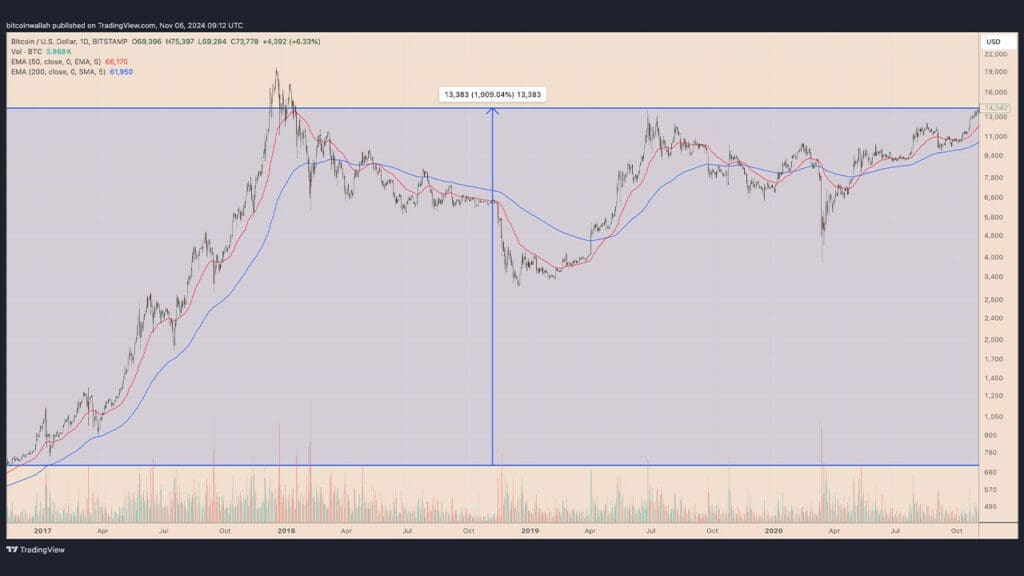
BTC experienced a 1900% increase during Donald Trump’s first presidential term. The chart reveals how BTC’s price surged by over 1900% between 2016 and 2020. Using this historical performance as a reference, analysts believe BTC has the potential to hit $1.5 million.
Considering today’s market dynamics, such a figure may appear ambitious. However, it’s not entirely implausible.
For BTC to reach $1.5 million, its market cap would need to grow to about $28.5 trillion. As governments continue printing money and our lives transition further into the digital realm, this scenario could become a reality. It remains to be seen how BTC’s price will evolve as we approach 2028.
You May Also Like
Follow us on TWITTER (X) and be instantly informed about the latest developments…
Key Highlights
Scammers are sending fake Trezor and Ledger letters, tricking users into giving up recovery phrases and risking their crypto funds.
Mac users face...