Metaverse

Home Metaverse Page 18

Crypto Meets Telecom: The Real Story Behind Decentralized Wireless Networks | NFT News Today

Crypto Meets Telecom: The Real Story Behind Decentralized Wireless Networks | NFT News Today


Most people assume their phone connects to a distant cell tower owned by a telecom giant. That’s still true in most cases—but it’s no longer the full picture.

In some situations, part of your connection may already be handled by a device inside a nearby home or business. You wouldn’t notice it, and your phone wouldn’t behave any differently. The shift is happening quietly, at the infrastructure level rather than the user experience.

What makes this change notable is not just the technology, but how these networks are being built. Instead of relying entirely on centralized ownership, some systems now use blockchain-based incentives to coordinate participation and expansion.

What’s actually changing (and what isn’t)

It’s important to be precise. These networks are not replacing telecom providers.

Your phone still depends on established infrastructure for:

Providers like T-Mobile remain essential to how mobile service functions at scale.

What’s changing is the access layer—the part of the network that connects your device to the internet.

Instead of relying entirely on large towers, networks can now offload traffic to:

Nearby WiFi

Locally deployed hotspots

Smaller, distributed wireless devices

This reduces strain on traditional infrastructure and improves efficiency, particularly in dense areas.

Where blockchain fits into this model

While the connection itself still runs on telecom infrastructure, blockchain plays a different role behind the scenes.

Projects like Helium Mobile use token-based systems to coordinate participation. People can install small wireless devices—often called hotspots—that provide coverage in their area.

The network then:

Tracks how much traffic those devices handle

Verifies that they are providing real, usable coverage

Distributes rewards automatically based on contribution

This removes the need for a single company to deploy and manage every piece of infrastructure. Instead, growth happens through participation, with incentives aligned through software.

The key distinction is simple. Telecom moves the data. Blockchain coordinates the network.

How this works in practice

From a user’s perspective, nothing changes. Your phone continues to connect automatically to the best available option.

If a compatible hotspot is nearby, your device may route data through it. If not, it will use WiFi. When neither option is available, it falls back to a traditional carrier network.

This hybrid model ensures reliability while reducing reliance on expensive, centralized infrastructure.

For the network, this approach lowers operating costs. For participants running hotspots, it creates an opportunity to earn based on real usage rather than speculative activity.

Why this model is gaining attention

Telecom infrastructure is expensive and slow to expand. Building towers requires significant capital, regulatory approval, and long deployment timelines. That makes it difficult to justify investment in lower-density or underserved areas.

A distributed approach changes how networks grow. Smaller devices are cheaper, easier to install, and can be deployed incrementally. Coverage improves as more participants join, rather than relying on large-scale rollouts.

Blockchain-based incentives play a role here by making coordination possible at scale. Instead of contracts and centralized management, rewards are handled programmatically, based on measurable contribution.

This is one of the clearest examples of crypto being applied to a real-world system where incentives directly influence physical infrastructure.

Real-world usage: what users are actually seeing

For most users, the experience is straightforward. People switching to lower-cost plans often report little difference in day-to-day performance. Streaming, messaging, and browsing behave normally, with fallback to traditional networks when needed.

For small business owners, installing a hotspot introduces a new kind of participation. A device placed in a high-traffic location can generate ongoing rewards as nearby users connect.

In underserved areas, the model offers a different path to improved coverage. Instead of waiting for large telecom providers to expand infrastructure, communities can contribute to network growth themselves.

This does not eliminate reliance on traditional carriers, but it can reduce gaps and improve local connectivity.

A broader shift beyond one network

Helium is part of a wider category known as decentralized physical infrastructure.

Projects like Pollen Mobile are exploring community-operated cellular networks with a focus on user control.

XNET is focused on high-density environments, where distributed WiFi and 5G systems can integrate with existing carriers.

Meanwhile, Andrena is working on enabling people to share and monetize residential internet capacity.

Across these efforts, the common thread is clear: infrastructure is becoming more distributed, while coordination is increasingly handled through token-based systems.

The benefits, without overstating the case

Lower costs are the most visible outcome. Many users can reduce their monthly bills while maintaining similar service levels.

There is also an opportunity for individuals to earn from hosting infrastructure. While earnings depend heavily on location and network usage, the model introduces a new way to participate in network expansion.

Coverage can improve more quickly in areas where traditional investment is slow, as deployment no longer depends entirely on large corporations.

At the same time, these benefits depend on participation. Without sufficient density of devices, the advantages are limited.

The constraints that still matter

This model is still developing, and several constraints remain.

Coverage is uneven and tied closely to how many devices are deployed in a given area. Urban environments tend to perform better than rural ones.

Regulation remains a limiting factor. Wireless spectrum is tightly controlled, and projects must operate within those boundaries.

Most importantly, these systems are still hybrid. Traditional carriers remain essential for reliability and scale.

Token-based incentives also introduce variability. Rewards can change over time based on network usage and broader market conditions.

The technical risks behind token-incentivized networks

While decentralized wireless networks are gaining traction, the model introduces technical challenges that don’t exist in traditional telecom systems.

One of the most important is verification. These networks rely on software to confirm that a hotspot is actually providing useful coverage. In many systems, this is done through mechanisms like Proof of Coverage, where devices validate each other’s presence and activity. The difficulty is ensuring that this data reflects real-world conditions and hasn’t been manipulated.

This leads to a second issue: Sybil attacks. Because participation is open, a single operator could deploy multiple devices in close proximity or simulate activity in order to earn disproportionate rewards. Preventing this requires increasingly sophisticated validation systems, including location checks, signal triangulation, and behavioral analysis. Even then, enforcement is an ongoing challenge.

Another area of concern is oracle reliability. These networks depend on external data—such as location, usage, and signal quality—to distribute rewards accurately. If that data is inaccurate or gamed, the incentive system can become misaligned, rewarding activity that doesn’t meaningfully improve the network.

Governance also becomes more complex in token-based systems. Decisions about reward structures, network parameters, and upgrades are often influenced by token holders. That can create tension between long-term network performance and short-term financial incentives, particularly if governance participation is concentrated.

These challenges don’t invalidate the model, but they do highlight an important point. Coordinating physical infrastructure through open participation is significantly harder than coordinating purely digital systems. The success of these networks depends on how well they can align incentives with real-world performance over time.

What this means for crypto

For years, one of the biggest criticisms of crypto has been the lack of clear, practical use cases.

Decentralized wireless networks offer a different narrative. Instead of focusing on purely digital applications, they tie blockchain directly to physical infrastructure—where incentives influence real-world deployment.

This does not mean the model is complete or without risk. But it does show how crypto can be applied in a way that aligns economic incentives with tangible outcomes.

The takeaway

Your phone still depends on telecom infrastructure, and that isn’t changing anytime soon. What is changing is how parts of that infrastructure are built and who participates in it.

Some of your data may already be passing through devices installed by people nearby, reducing reliance on distant towers without replacing them entirely.

Blockchain’s role in this shift is not to power the connection itself, but to coordinate the network behind it—tracking usage, rewarding contributors, and enabling decentralized growth.

It’s a subtle change, but an important one. Over time, it could reshape not just how networks are built, but who owns them and who benefits from their expansion.



Source link

Jeff Bezos is Building Asteroid Defense Weapons to Save Earth | Metaverse Planet

Jeff Bezos is Building Asteroid Defense Weapons to Save Earth | Metaverse Planet


Hey everyone, Ugu here. Welcome back to my tech radar. When I usually sit down to write about the billionaire space race, the conversation inevitably revolves around Elon Musk colonizing Mars or Jeff Bezos building massive space stations. But today, I stumbled across a development that sounds like it was ripped straight out of a Michael Bay movie script.

Forget space tourism for a minute. Blue Origin has just announced they are actively developing orbital defense weapons to protect Earth from rogue asteroids.

I’ve spent hours digging into the technical blueprints of this announcement, and honestly, it’s both terrifying and deeply fascinating. Let’s break down exactly what Bezos’s team is building, how it works, and why the defense of our entire planet might soon be in the hands of private aerospace companies.

The “NEO Hunter” Mission: Earth’s New Shield

Let’s address the elephant in the room first: Blue Origin is making a massive leap here. Their New Glenn rocket has only reached orbit a couple of times, and their highly anticipated lunar lander is still years away from touching the Moon. Yet, they are already looking at planetary defense.

In a surprisingly ambitious collaboration with NASA’s Jet Propulsion Laboratory (JPL), Blue Origin unveiled the Near-Earth Object (NEO) Hunter concept.

This isn’t just a theoretical whitepaper. The goal is to physically test different planetary defense techniques against actual asteroids that could pose a threat to Earth. We all cheered when NASA successfully crashed a probe into an asteroid during the 2022 DART mission, but Bezos’s team thinks we need a much more versatile arsenal.

Two Ways to Punch an Asteroid

The NEO Hunter mission doesn’t rely on a single solution. When I looked at their operational plans, I saw they are developing two entirely distinct methods for neutralizing a space rock.

The Sci-Fi Approach: The Ion Beam. This is exactly what it sounds like. Instead of smashing into the asteroid, the spacecraft will fire a highly concentrated particle beam at the target. Over time, the continuous push of this ion beam will gently alter the asteroid’s trajectory, steering it away from Earth. It’s elegant, clean, and incredibly futuristic.The Brute Force Approach: Robust Kinetic Disruption. If the subtle approach doesn’t work, Blue Origin is ready to bring the hammer down. Inspired directly by NASA’s DART mission, this involves accelerating a spacecraft to immense speeds and ramming it directly into the asteroid to physically knock it off course.

The Tech Behind the Mission: Enter the Blue Ring

You might be wondering how they actually plan to get these defense systems out into deep space. The answer is a piece of hardware I’ve been tracking for a while: the Blue Ring.

Blue Ring isn’t a rocket; it’s a highly versatile orbital platform designed to transport, refuel, and host other spacecraft. Think of it as a massive, flying Swiss Army knife.

For the NEO Hunter mission, the Blue Ring won’t just blindly fly toward a rock. The plan is to have it deploy a swarm of CubeSats (tiny, highly advanced satellites) when it arrives at the target. These mini-scouts will swarm the asteroid, analyzing its mass, density, and structural integrity.

Based on the data these CubeSats feed back, the mission commanders will decide which weapon to use. If the asteroid is a solid chunk of iron, the kinetic impactor might be best. If it’s a loose pile of space rubble that might shatter dangerously, the gentle push of the ion beam is the smarter play. I absolutely love this tactical, data-driven approach.

Where Are We on the Timeline?

This isn’t decades away. The hardware is already being tested.

The Blue Ring platform recently passed critical structural load tests at NASA’s Marshall Space Flight Center. We actually saw a prototype of this platform fly during the maiden launch of the massive New Glenn rocket back in 2025.

While the exact launch date for the asteroid-hunting mission is still under wraps, Blue Origin has officially stated that the very first operational Blue Ring mission is happening this year (2026). They are moving fast.

You Can’t Shoot What You Can’t See: NASA’s Crucial Role

While Blue Origin is building the weapons, NASA is building the radar.

There is a massive problem with asteroids: many of them are pitch black and incredibly hard to spot against the dark void of space. To solve this, NASA is rapidly developing the NEO Surveyor mission.

This is a specialized space telescope explicitly designed to hunt down potentially hazardous comets and asteroids that are sneaking up on Earth.

How it works: Instead of looking for visible light, the NEO Surveyor uses highly sensitive infrared detectors. Even the darkest space rocks heat up when they get close to the Sun, and this telescope will spot their thermal glow.The Irony: Here is the funny part about the modern space industry—NASA’s NEO Surveyor is scheduled to launch in 2027 aboard a SpaceX Falcon 9 rocket.

So, we have SpaceX launching the radar system that will find the targets, and Blue Origin building the interceptors that will neutralize them. The billionaire space race has literally evolved into building Earth’s planetary defense grid.

My Final Thoughts

When I step back and look at this, I can’t help but feel a mix of awe and slight unease. Defending our planet from an extinction-level event used to be the exclusive domain of international governments and sci-fi writers. Now, private corporations are actively drafting the blueprints.

It proves that the commercial space sector is maturing far beyond just launching internet satellites and wealthy tourists. We are entering an era where private infrastructure might be the only thing standing between us and the fate of the dinosaurs.

I’m incredibly curious to hear your take on this shift in power. Would you trust private companies like Blue Origin and SpaceX to handle Earth’s planetary defense, or do you believe this is a responsibility that should strictly remain in the hands of governments and NASA? Drop your thoughts in the comments, let’s debate this!

You Might Also Like;


Source link

Google’s TurboQuant: The Algorithm Changing AI Memory Forever | Metaverse Planet

Google’s TurboQuant: The Algorithm Changing AI Memory Forever | Metaverse Planet


If you have ever tried running a large language model locally on your own computer, you already know the immediate, painful reality: these things will aggressively devour every single gigabyte of RAM you own. I’ve spent countless hours trying to optimize local AI setups, and the memory bottleneck is always the wall you hit.

But when I was reading through Google’s latest research blog this morning, I actually sat up in my chair. Google has just quietly announced a new compression technology called TurboQuant, and it fundamentally changes the math on how artificial intelligence consumes hardware.

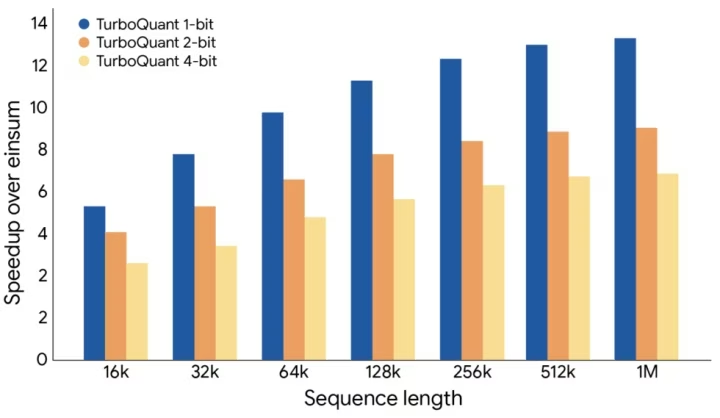
We are talking about 6 times less memory usage and 8 times faster processing speeds—all without making the AI “dumber.” I hate throwing around the word “revolution,” but this is exactly the kind of breakthrough we need to take AI out of massive, expensive server farms and put it directly into our pockets. Let’s break down exactly what Google just pulled off.

The Bottleneck We’ve All Been Ignoring: The KV Cache

To understand why TurboQuant is such a big deal, we have to talk about how AI actually “remembers” your conversation.

Large Language Models (LLMs) don’t read words like we do; they convert concepts into high-dimensional vectors (massive strings of numbers). To avoid recalculating the meaning of every word every single time you ask a follow-up question, the AI uses something called a Key-Value (KV) cache. Think of the KV cache as the AI’s digital cheat sheet.

Here is the problem:

As your conversation gets longer, that cheat sheet gets massive.These vectors contain hundreds or thousands of parameters.Storing them requires a ridiculous amount of high-speed memory.

Historically, developers have tried to fix this using a method called quantization—which basically means squeezing the data into a lower resolution. It saves space, but the nasty side effect is that the AI starts hallucinating or giving lower-quality answers. It was always a forced compromise. Until now.

Enter TurboQuant: How Google Did the Impossible

According to their initial tests, Google’s TurboQuant completely bypasses this compromise. It shrinks the model’s memory footprint dramatically without degrading the quality of its output.

How did they do it? They split the compression process into two incredibly clever steps.

Step 1: PolarQuant and the Geometry of Language

The first phase is a system they call PolarQuant, and the logic behind it is brilliant.

Normally, AI vectors are plotted using standard Cartesian (XYZ) coordinates. But PolarQuant takes those heavy, complex coordinates and translates them into polar coordinates. Instead of tracking a massive grid, every vector is suddenly represented by just two simple pieces of information:

Radius: The strength or magnitude of the data.Angle: The semantic direction (the actual meaning) of the data.

Google used a perfect analogy for this: Traditional XYZ mapping is like telling someone, “Walk 3 blocks East, then 4 blocks North.” PolarQuant changes the instruction to, “Turn 37 degrees and walk 5 blocks.” It is a shorter, cleaner, and vastly more efficient way to store the exact same destination.

Step 2: The “QJL” Safety Net

Of course, aggressively compressing data like this usually creates slight deviations or “glitches” in the AI’s understanding. To fix this, Google implemented a second layer called the Quantized Johnson-Lindenstrauss (QJL) method.

Don’t let the complex name intimidate you. Essentially, QJL acts as a microscopic error-correction layer. It uses just a single bit (+1 or -1) to represent and tweak the vectors, ensuring that the critical semantic relationships between words aren’t lost in the compression. It makes sure the AI’s “attention” mechanism stays dead-on accurate.

Real-World Testing: No Retraining Required

Concepts are great, but the actual benchmark numbers are what really blew my mind. Google didn’t just test this in a vacuum; they ran TurboQuant on popular open-weight models like Gemma and Mistral.

Here are the hard facts from their tests:

6x Memory Reduction: The KV cache memory requirement dropped by a factor of six.3-Bit Compression: It can compress the cache down to just 3 bits per parameter.Zero Retraining: This is huge for developers. You can apply TurboQuant to existing models without having to spend millions of dollars retraining them from scratch.Blazing Speed: When tested on an Nvidia H100 GPU, the 4-bit TurboQuant performed attention calculations 8 times faster than traditional 32-bit uncompressed keys.

Why I Think This is the Key to Mobile AI

While it’s easy to look at this and think about how much money cloud providers will save on server costs, I look at TurboQuant and see the future of the smartphone.

Right now, to get ChatGPT-level intelligence, your phone has to send your data to a cloud server, wait for the massive computers to do the thinking, and ping the answer back to you. It requires an internet connection, it drains battery, and it poses massive privacy concerns.

With algorithms like TurboQuant, the hardware limitations of mobile devices suddenly don’t look so intimidating. If we can compress the memory footprint by 6x and speed up the processing by 8x, running a hyper-intelligent, fully private AI natively on your smartphone isn’t a pipe dream anymore. It is imminent.

I honestly believe we are moving toward a world where the most powerful AI isn’t sitting in a data center, but resting right in your pocket.

So, I’m curious to hear your take on this. If algorithms like TurboQuant make it possible to run incredibly smart AI entirely offline on your smartphone, would you finally ditch the cloud-based apps for the sake of total privacy? Let me know your thoughts down below!

You Might Also Like;


Source link

Amazon Enters the Cute Humanoid Robot Race | Metaverse Planet

Amazon Enters the Cute Humanoid Robot Race | Metaverse Planet


When I opened my feed this morning, I honestly had to do a double-take. We are so used to seeing intimidating, metallic, back-flipping humanoid robots that look like they belong in a sci-fi action movie. But today, the narrative completely shifted. Amazon has officially acquired Fauna Robotics, a startup that specializes not in industrial titans, but in child-sized, ultra-adorable personal robots.

As I dug into the details of this acquisition, I realized this isn’t just another tech giant swallowing a smaller company. It is a massive statement about how robots will actually integrate into our living rooms. Let me walk you through why this move is an absolute game-changer, and why I think the future of robotics just got a whole lot friendlier.

The Friendly Face of the Future

If you haven’t heard of Fauna Robotics before today, I don’t blame you. Founded recently by a brilliant team of ex-Meta and Google engineers, this New York-based startup quietly built something genuinely different. While the financial details of the acquisition remain under wraps, an Amazon spokesperson confirmed that they are fully backing Fauna’s vision.

The entire 50-person Fauna team is now packing their bags to join Amazon’s New York office. But what exactly did Amazon buy? They bought the psychology of approachability. They bought Sprout.

Meet “Sprout”: The Anti-Terminator

Sprout is Fauna’s flagship creation, and looking at it is like looking at a friendly cartoon character brought to life in the physical world. Here is what makes Sprout stand out in a sea of cold metal:

Bite-Sized Dimensions: It stands at just about 1.05 meters (around 3.5 feet) tall.Lightweight Build: Weighing in at only 22.7 kg (50 lbs), it is physically non-threatening.Approachable Design: Sprout is engineered specifically to be friendly. It doesn’t look like a machine built to lift heavy boxes; it looks like a buddy.Developer-Friendly: Beyond its cute exterior, it serves as an accessible, open platform for software developers to build upon.

When I look at Sprout, I don’t see a factory worker. I see a home companion. And that is exactly where Amazon wants to go.

Amazon’s Long Game in Robotics

To understand why Amazon wants a cute humanoid, we have to look at their track record. I’ve been following Amazon’s robotics investments for years, and they rarely make a move without a decade-long master plan in mind.

The Warehouse Era (2012): It all started when they bought Kiva Systems for $775 million. That move essentially birthed Amazon Robotics and automated their massive fulfillment centers.Recent Expansions: Just recently, they scooped up the Swiss-based firm Rivr, further proving their hunger for advanced robotic capabilities.The Smart Home Push (2021): Remember Astro? Amazon’s $1,600 invite-only personal robot. Astro was essentially an Alexa on wheels with a screen. It was a fascinating experiment, but it lacked physical utility. It couldn’t grab a cup of coffee or open a door.

By bringing Fauna Robotics into the fold, Amazon is bridging the gap. They are combining the physical capability of a humanoid with the consumer-friendly approach they tried to pioneer with Astro.

A Very Crowded (and Heavy) Arena

Amazon is stepping into a gladiator arena, but they are bringing a completely different weapon. The humanoid robot market is currently exploding, but most of the heavy hitters are focused on industrial, adult-sized labor replacements.

Look at the current landscape:

Tesla (Optimus): Focused on factory automation and eventual general-purpose tasks.Figure AI & 1X: Building incredibly capable, adult-sized robots meant to solve labor shortages.Boston Dynamics: The kings of athletic, dynamic machines (Atlas) that still terrify half the internet.Apptronik, Agility Robotics, and Unitree: All building phenomenal tech, but mostly geared towards B2B (business-to-business) logistics and heavy lifting.

Amazon’s acquisition of Fauna is a hard pivot to B2C (business-to-consumer). While Elon Musk wants Optimus in factories first, it seems Amazon wants Sprout greeting your kids when they come home from school.

My Take: Why “Cute” is the Ultimate Strategy

As I was researching this, a thought hit me: Cute is the ultimate Trojan horse for smart home adoption. Let’s be real. If a 6-foot-tall, faceless metal machine walks into my kitchen, my instinct is to leave the house. We are psychologically hardwired to be wary of things that look strong and unpredictable. But a 3.5-foot robot that looks like it stepped out of a Pixar movie? We immediately let our guard down.

I firmly believe that the biggest hurdle for personal robots isn’t the battery life or the AI—it is trust. By acquiring a company that specializes in “approachable” robotics, Amazon is bypassing the uncanny valley. They know that if we are going to let cameras and microphones roam freely around our bedrooms and living rooms, the vessel carrying them needs to feel like a pet, not a security guard.

This acquisition shows me that Amazon isn’t just thinking about how robots move; they are thinking about how robots make us feel. And in the consumer tech world, feeling is everything.

So, I have to ask you: How do you feel about this shift? If Amazon starts selling Sprout on their homepage next to Kindles and Echos, would you feel comfortable letting a child-sized humanoid robot wander around your home, or does the idea still creep you out? Let me know what you think!

You Might Also Like;


Source link

Wall Street Meets Blockchain: Nasdaq’s Bold Step Into Tokenized Equities

Wall Street Meets Blockchain: Nasdaq’s Bold Step Into Tokenized Equities


In Brief

Nasdaq’s SEC-approved pilot to trade tokenized equities alongside traditional shares marks a major step toward integrating blockchain into mainstream financial markets, promising faster, 24/7 trading and settlement while raising regulatory and market structure challenges.

Wall Street Meets Blockchain: Nasdaq’s Bold Step Into Tokenized Equities

The financial infrastructure of the world is stepping towards a blockchain-dominated future with Nasdaq proceeding with various plans to roll out tokenized trading in stock, a change that is quickly gaining momentum in both the traditional finance and the crypto sector. This week, in a groundbreaking move, the U.S. Securities and Exchange Commission gave approval to a pilot structure, under which selected equities would be listed on the same exchange and traded in both their conventional and tokenized forms, marking, perhaps, one of the most pronounced institutional affirmations to date of asset tokenization.

Wall Street Meets Blockchain: Nasdaq’s Bold Step Into Tokenized Equities

Source: X

This approval is a significant advancement in the chronicles of Wall Street, where blockchain technology has long been debated as a theoretical improvement of market infrastructure, which has rarely been applied at scale. Nasdaq now has regulatory support and a tangible rollout plan in place to determine whether tokenization can help fundamentally redefine the trade, settlement, and access of equities on a global scale.

What Tokenized Stock Trading Actually Means

The tokenized stocks are electronic emulations of the conventional shares issued and exchanged on blockchain infrastructure. In the proposed model by Nasdaq, these tokens will not be used in place of regular shares but will coexist with the regular shares, with investors having the choice of trading either type of share without difficulty. More importantly, the two versions will be similar in terms of price, ticker, and rights of legal ownership, meaning that the token holders will enjoy equal ownership privileges to the traditional shareholders.

This two-sided trading structure is created in such a way that it will not fragment the market. Nasdaq plans to remove price variation and preserve market integrity by having tokenized and traditional shares listed on the same order book. The system will also be based on the familiar infrastructure, including the Depository Trust Company, to settle the gap between the legacy finance and blockchain infrastructure.

The initiative is a hybrid at the most basic level, as it does not fully change the existing framework, instead combining the efficiency of blockchain with the regulatory protection of the conventional markets.

Why Nasdaq is Making the Move Now

The move by Nasdaq into tokenized equities is part of a wider adoption across the industry of digitalizing real-world assets. During the last year, tokenization has developed into a niche concept of crypto, becoming a key strategic focus of financial institutions. The equity market across the globe is worth more than one hundred and twenty-five trillion US dollars, a figure that is making many consider it the right place to be modernized using blockchain technology.

Timing is also closely associated with regulatory developments. Recent directions of the U.S. regulators elucidated the fact that most crypto assets are not subject to securities laws, but tokenized stocks and bonds are squarely classified as securities, which offers a better illustration of experimentation. This transparency has resulted in freebies such as Nasdaq getting creative without causing any legal ambiguity.

Meanwhile, competition is increasing. Other key participants, such as the parent company of the New York Stock Exchange and international exchanges in Europe, are in the process of developing their own tokenization platforms. Pilot of Nasdaq can be regarded, thus, as an innovation activity as well as a strategic step to maintain leadership in the fast-changing market.

The Role of Crypto-Native Infrastructure

One of the elements of Nasdaq’s tokenization strategy is its partnership with crypto-native exchanges, including Kraken, which will presumably contribute to issuing tokenized equities to more global users. This collaboration underscores the increasing overlap of conventional financial institutions and digital asset companies, which has risen at an enhanced pace over the previous years.

Wall Street Meets Blockchain: Nasdaq’s Bold Step Into Tokenized Equities

Source: X

Cryptocurrency exchanges come with an accompanying user base that is used to 24/7 trading, instant settlement, and borderless access, and it is often something that traditional stock markets could not historically provide. Through this infrastructure, Nasdaq is in a position to expand its market beyond the traditional market hours and geographical boundaries.

This overlap is also indicative of a more fundamental change: blockchain is not being used on the edges of financial services anymore, but its very center.

The Promise of 24/7 Markets and Faster Settlement

The possibility of continuous trading of the tokenized stocks can be listed among the most convincing benefits of tokenized stocks. As compared to conventional stock markets that are fixed in time, blockchain-based markets have the potential to facilitate twenty-four-hour trading. This change would completely change the market dynamics, and investors will be able to respond to the global events in real time as opposed to waiting until the exchanges open.

Besides long trading hours, tokenization will guarantee a shorter settlement time. Traditional equity trades take days to be completed because of the clearing and reconciliation. The systems built with blockchain technology can facilitate near-instant settlement, lower the risk of counterparty, and enhance capital efficiency.

These advantages are not mere in theory. Already, industry-wide projects to create settlement systems based on blockchain are in progress, and it is possible that the pilot project of Nasdaq may be a component of a far more significant change in the financial infrastructure. 

The Challenges and Concerns

There are obstacles even to tokenized stock trading despite its potential. The surveillance of the market and the controls are one of the main issues. It is necessary to have a solid monitoring system and stringent compliance mechanisms in order to ensure that tokenized and traditional shares behave identically and are perfectly aligned in terms of price and behavior.

Questions also arise concerning accessibility. The first pilot will be restricted to qualified individuals, and that is, the retail investors will not necessarily gain the immediate benefit of the new system. This gradual implementation process is indicative of a risk-averse strategy, which enables regulators and market participants to assess risks and expand access at the same time.

There is another problem in the wider question of trust. Efforts to have tokenized equities in the crypto industry have been criticized before because they do not offer ownership rights or regulatory support. These issues are being mitigated by the model of Nasdaq, which aims to make tokenized shares as legit as genuine ones, yet the doubts remain.

Disclaimer

In line with the Trust Project guidelines, please note that the information provided on this page is not intended to be and should not be interpreted as legal, tax, investment, financial, or any other form of advice. It is important to only invest what you can afford to lose and to seek independent financial advice if you have any doubts. For further information, we suggest referring to the terms and conditions as well as the help and support pages provided by the issuer or advertiser. MetaversePost is committed to accurate, unbiased reporting, but market conditions are subject to change without notice.

About The Author


Alisa, a dedicated journalist at the MPost, specializes in cryptocurrency, zero-knowledge proofs, investments, and the expansive realm of Web3. With a keen eye for emerging trends and technologies, she delivers comprehensive coverage to inform and engage readers in the ever-evolving landscape of digital finance.

More articles


Alisa, a dedicated journalist at the MPost, specializes in cryptocurrency, zero-knowledge proofs, investments, and the expansive realm of Web3. With a keen eye for emerging trends and technologies, she delivers comprehensive coverage to inform and engage readers in the ever-evolving landscape of digital finance.


More articles


Source link

Digital Fences: When Nature Meets the Digital Frontier | Metaverse Planet

Digital Fences: When Nature Meets the Digital Frontier | Metaverse Planet


I honestly couldn’t believe my eyes when I first came across this! 🤯 I thought I’d seen everything in the tech world, but I never expected to be researching this. Imagine playing a real-life farming simulator, where you control an entire herd of animals from the comfort of your smartphone. Norwegian engineers have made this a reality, and I find it both absolutely fascinating and a little bit wild to see how nature is becoming so completely digital. I knew AgriTech was growing, but this is a whole new level. Let’s dive into how these solar-powered GPS collars are rewriting the rules of the pasture.

The Magic and Logic of the Collar: A Deeper Look

When you first hear “virtual fence,” it sounds like something straight out of a sci-fi movie. But the tech behind it is surprisingly straightforward and incredibly effective. Norwegian engineers, leaders in both innovation and ethical farming practices, have developed a system of robust, solar-powered GPS collars. These aren’t just trackers; they are active management tools that create an entire digital infrastructure around an animal.

So, how does it actually work? I’ll break it down for you:

The GPS and Solar Heart

Each cow gets fitted with one of these smart collars. It has a high-precision GPS unit and a durable battery. But the genius part is that it recharges via a built-in solar panel. This is critical because it means no one is chasing down cows in a huge pasture to swap out batteries, making it truly set-and-forget for months at a time. The device constantly knows its location relative to a set of coordinates stored in its memory.

Your Smartphone, Your Control Panel

The farmer accesses a corresponding app on their smartphone or tablet. This is where the real fun begins. You are presented with a satellite map of your entire property. Instead of unrolling spools of wire, digging post holes, and battling over erratic terrain, you simply draw the borders of your “fence” directly onto the screen with your finger. These digital coordinates are then transmitted to the collars, defining the forbidden zones. I’ve tried this in demo apps, and it feels exactly like a video game.

The Gentle Nudge: How it Communicates

Here is where the behavior-based design comes in, and I think this part is quite clever. A traditional physical fence relies on a physical impact (like barbed wire) or an immediate painful shock (electric fence). These digital collars use a progressive deterrent system designed to teach the animal.

1. The Warning Signal (Beep): When a cow wanders too close to the boundary line drawn in the app, the collar starts to emit a series of audible beeps. This is the “You’re pushing it” phase.2. The Corrective Signal (Vibration/Pulse): If the animal ignores the beeps and attempts to cross the digital line, the collar delivers a mild corrective pulse or vibration, similar to an electric shock collar but more sophisticated. This pulse is uncomfortable but not harmful, and it instantly stops once the animal turns back.

I find it absolutely wild how a farmer can draw a new fence in minutes. But the feature that I just love, the one that makes me scratch my head and wonder “what a time to be alive,” is the return route. When it’s time for the animals to move from one pasture to another, or to head back to the barn for milking, the farmer doesn’t need a herding dog. They just draw a route on the map, and the whole herd will follow that path, guided by the beeps, until they are safely inside the new boundary. The animals learn the system so quickly that they eventually respond to the beeps before they ever get pulsed.

Why This is a Total Game-Changer (And Why You Should Care)

This technology isn’t just a cool gimmick. It has profound implications for the environment, for animal welfare, and for the entire economics of farming. By removing the physical barrier, we’re unlocking new ways to manage the land.

1. Rotational Grazing Made Dead Simple: This is a huge environmental benefit. To have healthy soil and a vibrant ecosystem, animals shouldn’t just stand on one patch of grass until it’s dead. Rotational grazing—moving a herd between small paddocks to let the grass rest—is a proven technique to improve soil health, increase carbon sequestration, and reduce greenhouse gas emissions. Doing this with physical fences requires immense labor and expense. With digital collars, a farmer can change the paddock size, shape, and location daily with a few swipes.2. Extreme Cost Savings: Let’s be real: physical fencing is astronomically expensive. There’s the cost of the materials (wood, wire, labor, machinery) and the constant battle of maintenance—fixing broken posts, patching holes, and clearing brush. Digital fences are a one-time capital expense for the collars and the software license. They eliminate the vast majority of physical infrastructure and the labor needed to manage it.3. Improved Animal Welfare and Safety: I’ve read a lot of discussion around this, and many argue it can be much better for the animals. There’s no risk of entanglement, injury from barbed wire, or being trapped. The animals have a more natural range, and the gradual warning signal is less stressful than a sudden, painful electric shock. Plus, they can access areas where you’d never be able to put a physical fence, like a heavily forested area or a steep slope, which could offer better natural protection.4. Remote Management (aka “Beach Farming”): A farmer can manage their whole herd from anywhere in the world. They can be on a business trip, a family vacation, or just warm inside their house, and move their cows with a tap. I find it absolutely crazy that a farmer could be on a beach and move their entire herd to a new pasture. This kind of efficiency could fundamentally change the life of a farmer.

The Ethical Quandary: A Personal Reality Check

But I can’t write this and not reflect on the other side of the coin. While I am completely blown away by the technology, I have to admit that a part of my brain finds it all a little bit creepy. I’m torn. On one hand, I love the efficiency and the potential environmental gains. On the other hand, I find it absolutely fascinating but also a little bit wild how nature is becoming so completely digital.

I think about the philosophical shift. We are transforming nature from a physical space we share with animals to a purely spatial dataset we manage from a screen. We are digitizing the entire world, piece by piece. Are we turning animals into simple stimulus-response machines in a decentralized, automated system? What happens if the GPS fails? What happens if the power grid goes down? Are we losing a crucial connection to the land and the animals by managing them like pixels on a map?

The AgriTech Convergence: Another Step into the Metaverse

When I think about the broader picture, this tech is not just about farming. It’s about spatial computing and the Internet of Things (IoT) merging with the physical world. This is the very essence of what “Metaverse Planet” is about—how digital environments and tools are redefining reality. We are creating a spatial layer over the farm, and these cows are the first automated agents navigating it. In the future, we might have autonomous tractors, AI-driven crop monitoring, and automated herding, all operating on a massive, connected digital infrastructure. It’s a step towards a decentralized, automated agricultural system.

So, where do you stand? In a future where everything can be digitized, from our social lives to our finance, is managing a whole herd of animals from your phone the ultimate dream of efficiency, or does it push the boundaries of control too far and turn our physical world into a simplified simulation? I really wonder, and I want to hear your unfiltered thoughts. Drop them in the comments!

You Might Also Like;


Source link

Monument Bank to Tokenize £250 Million on Public Blockchain

Monument Bank to Tokenize £250 Million on Public Blockchain


Key Highlights

Monument Bank targets £250 million in tokenized retail deposits in the first rollout phase

Deposits will remain fully backed in GBP and protected under UK regulatory safeguards

Built on Midnight, the system promises privacy-preserving, compliant on-chain banking

Monument Bank said it plans to tokenize up to 250 million pounds ($335 million) of retail customer deposits on the Midnight network, in what it described as the first such move by a U.K.-regulated bank on a public blockchain.

The London-based challenger bank said the deposits will remain interest-bearing, fully backed, and redeemable one-for-one in pounds sterling, while continuing to be covered under the U.K.’s Financial Services Compensation Scheme (FSCS).

Retail Deposits, Public Chain, Full Protection

The structure puts three elements together that rarely align: retail customers, regulated bank deposits, and public blockchain infrastructure.

Unlike earlier tokenization experiments that focused on institutional clients or permissioned systems, Monument is pushing this model toward mass-affluent retail users, starting with customers holding between £50,000 and £5 million in investable assets.

The bank said it currently serves over 100,000 customers and holds around £7 billion in deposits, giving the rollout a meaningful base beyond a pilot test.

Phase One Mirrors Savings, Next Comes Tokenized Investments

In the first phase, Monument will mirror customer savings balances on Midnight’s blockchain, effectively turning deposits into tokenized representations without changing their underlying structure.

The roadmap goes further:

Phase 2: Tokenized investment products (private markets, commodities)

Phase 3: Lending against tokenized holdings داخل the Monument app

This positions the initiative as a full-stack tokenized banking model, not just a deposit experiment.

Midnight’s Privacy Model Targets Compliance Gap

The system runs on Midnight, a privacy-focused blockchain developed by Shielded Technologies, a company linked to Cardano creator Input Output.

Monument said transaction data will remain visible only to the bank and its customers, addressing one of the biggest barriers for banks using public chains — balancing transparency with regulatory confidentiality requirements.

Beyond Monument: Banking-as-a-Service Play Emerges

The announcement also signals a broader strategy beyond Monument’s own balance sheet.

Affiliate Monument Technology plans to extend the same tokenized deposit infrastructure through its Banking-as-a-Service (BaaS) platform, potentially allowing other financial institutions to adopt the model.

This shifts the story from a single-bank rollout to a possible industry template for tokenized deposits.

Why This Matters

Most tokenization efforts have stayed within closed systems or institutional pilots.

Monument’s approach tests whether:

Retail deposits can move on-chain

Without losing regulatory protection

While remaining interest-bearing and fully redeemable


Disclaimer: The information researched and reported by The Crypto Times is for informational purposes only and is not a substitute for professional financial advice. Investing in crypto assets involves significant risk due to market volatility. Always Do Your Own Research (DYOR) and consult with a qualified Financial Advisor before making any investment decisions.


Source link

Powering the AI Revolution: OpenAI’s Bold Move into Fusion Energy | Metaverse Planet

Powering the AI Revolution: OpenAI’s Bold Move into Fusion Energy | Metaverse Planet


Hey everyone, Ugu here. If you’ve been watching the rapid explosion of artificial intelligence as closely as I have, you probably know there’s a massive, silent challenge brewing behind the scenes. It’s not about coding or algorithms—it’s about raw electricity.

Running massive language models takes an unbelievable amount of power, and the tech giants are desperately searching for clean, infinite energy sources. Now, it looks like OpenAI is ready to make a massive leap straight into the realm of sci-fi.

I just read the latest reports from Axios, and I have to tell you, this blew my mind: OpenAI is currently in talks to purchase massive amounts of fusion energy from Helion Energy. Let’s break down exactly what this means, why it’s a game-changer, and how it actually works.

The Ultimate Power Play: OpenAI and Helion

We aren’t talking about throwing a few solar panels on the roof of a data center here. If this early-stage agreement goes through, OpenAI is securing a massive slice of the future energy grid.

Here is what the numbers look like:

The Deal: OpenAI would purchase 12.5% of Helion’s total energy output.The 2030 Goal: This translates to a staggering 5 gigawatts of electricity annually.The 2035 Goal: By the next decade, that number scales up to an eye-watering 50 gigawatts.

To put that into perspective, 1 gigawatt is roughly enough to power a mid-sized city. OpenAI is preparing for an era where AI doesn’t just need a plug; it needs its own dedicated power grid. Interestingly, OpenAI isn’t alone in this bet. Microsoft (OpenAI’s biggest partner) has already committed to buying energy from Helion starting in 2028.

The Sam Altman Connection

There is a fascinating layer of corporate drama here, too. If the name Helion sounds familiar, it’s because Sam Altman, the CEO of OpenAI, has been a major financial backer of the fusion startup.

However, to keep things clean and avoid conflicts of interest during these massive energy negotiations, Altman recently announced that he has stepped down from his position as chairman of Helion’s board. It’s a smart move that shows just how seriously both companies are taking this potential partnership.

Why Helion is Different: Ditching the Steam Turbine

When I usually think of nuclear energy—even experimental fusion—I picture a massive, incredibly complex facility that basically just boils water. Most traditional fusion concepts use magnetic confinement to create intense heat, which then turns water into steam to spin a giant turbine. Honestly? That always felt a bit archaic to me. We’re building miniature suns just to run a fancy steam engine?

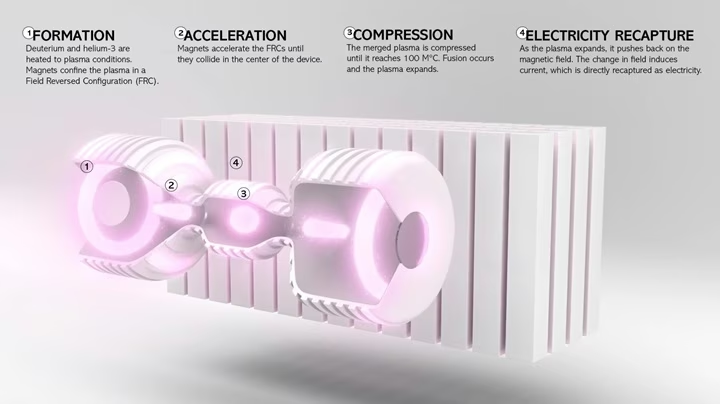
Helion is taking a completely different, revolutionary approach. They are skipping the steam turbine entirely. Here is how their futuristic tech actually works:

The Hourglass Reactor: Helion uses a unique, hourglass-shaped reactor.The Fuel: They inject a mix of deuterium and helium-3 into both ends of the reactor, turning it into plasma.The Collision: These plasmas are accelerated to 1 million miles per hour and smashed together in the center.Direct Conversion: The resulting collision reaches unimaginable temperatures, triggering a fusion reaction. But instead of boiling water, the energy released interacts directly with the reactor’s magnetic fields to generate electricity instantly.

It is elegant, incredibly high-tech, and if they can scale it, it will change the world.

The Race Against Time (and Temperature)

Scaling this technology is where the real challenge lies. Helion isn’t just trying to build one working machine; they are trying to build an entire infrastructure from scratch.

Every single Helion reactor is designed to produce 50 megawatts of electricity. If you do the math on OpenAI’s energy demands, Helion needs to build:

800 reactors by 2030.An additional 7,200 reactors by 2035.

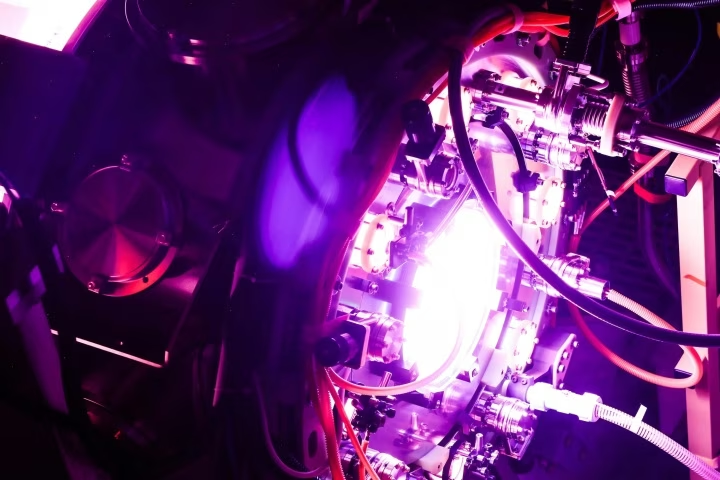
That is a monumental manufacturing challenge. But Helion is making serious progress with their Polaris prototype. In February, they announced that their plasma reached 150 million degrees Celsius.

For context, the core of our Sun is about 15 million degrees. Helion is already running ten times hotter than the Sun! However, to achieve full commercial operation, they need to hit the magic number of 200 million degrees. If they manage to pull this off and get commercial fusion reactors online before 2030, they will completely eclipse their rivals in the energy sector.

My Final Thoughts

I’ve been writing about tech for a long time, and a lot of “breakthroughs” end up being just hype. But watching AI companies realize they need to literally invest in creating artificial stars just to power their servers is a humbling reminder of how fast our world is changing. The synergy between advanced AI and infinite clean energy feels like the true beginning of the future.

What do you guys think? Do you believe Helion can actually build thousands of commercial fusion reactors in just a few years, or is this timeline a bit too optimistic? Drop your thoughts in the comments below, I’d love to hear your take!

You Might Also Like;


Source link

From Chatbots To Commerce: Why Meta AI Is Dominating Tech Conversations

From Chatbots To Commerce: Why Meta AI Is Dominating Tech Conversations


In Brief

Meta has rapidly embedded AI across its apps, turning Meta AI into a widely used, personalized ecosystem that drives automation, commerce, and engagement while sparking major privacy and societal concerns.

From Chatbots To Commerce: Why Meta AI Is Dominating Tech Conversations

The aggressive expansion of artificial intelligence at Meta has, in a short period of time, turned its ecosystem into one of the most powerful things with AI in the world, and this has taken over the tech discussions of the world. 

In recent months, Meta AI has flooded trending conversations on such social media as Facebook, Instagram, and WhatsApp, motivated by a mix of colossal product launches, provocative strategic choices, and more visible real-world uses. What was initially a background service has since become the mainstay of the identity of Meta, and is generating excitement as well as criticism throughout the industry.

From Chatbots To Commerce: Why Meta AI Is Dominating Tech Conversations

Source: X

At the center of this trend is the fact that Meta decided to introduce AI into the foundation of its suite of apps, and it is inevitable for billions of users. The company has successfully reduced AI to a mass-market product overnight after attracting an audience of more than 3 billion users already on Meta platforms. In contrast to standalone AI tools, the Meta AI is distributed where the users already spend their time, which provides it with an immediate distribution advantage that the competitors find difficult to replicate.

The Product: What Meta AI Actually Is

Meta AI is not an individual product but a system of AI-enhanced features that are combined throughout Facebook, Instagram, Messenger, and WhatsApp. The assistant was developed using the LLaMa family of large language models built on Meta and is created to handle a general variety of tasks, such as answering questions, image generation, chatting, and automation of work patterns.

Its features have also grown much larger in 2026, past basic chatbot usage into something more akin to a full digital assistant integrated into social experiences. Users can now communicate with Meta AI within chats, feeds, and even commerce sites, and it does not seem like an instrument anymore, but rather an overlay that supports the entire ecosystem.

Personalization is one of the most outstanding upgrades. Now, meta AI is able to remember contextual memory on the interaction of users, enabling it to adjust responses according to preference, behavior, and previous conversations. This makes it more adaptive, and it has also been exposed to privacy and data use concerns. 

The Features Driving the Hype

One of the main reasons why Meta AI is becoming the talk of the day is due to the increasing nature of its features, especially its application to the real world. In early 2026, Meta launched AI-assisted features in Facebook Marketplace that automatically create listings, create product descriptions, and even automatically respond to buyers. These aspects address the daily areas of friction in online commerce where AI becomes a useful productivity instrument, and not something novel.

In addition to trade, Meta is also advancing AI in the field of advertising. The company is striving towards creating ads and targeting that is fully automated, wherein businesses just have to key in on objectives and budgets, and AI will take care of all matters. This degree of automation may essentially transform digital marketing to a point where the manual management of campaigns is eliminated.

In-house, Meta has been working on more sophisticated AI agents that are able to accomplish intricate and multi-step functions on their own. The fact that it has acquired AI agent platforms and technologies is a sign that it is heading towards agentic AI systems that are capable of functioning independently, which can redefine the interaction between users and software. 

The Infrastructure Behind the Scenes

One more key reason behind the trend of Meta AI is the magnitude of investment behind it. The corporation is putting billions of dollars into AI infrastructure, including information centers, in-house chips, and clouds. The intensity of this expansion and rivalry in the resources, including GPUs and energy, can be characterized by the latest multi-billion-dollar deal to buy AI computing capacity.

Meta is also building their own AI chips in order to make less use of external vendors and manage long-term expenses. The strategy of vertical integration is reflective of actions of other tech giants, but the scale and urgency make it unique. 

From Chatbots To Commerce: Why Meta AI Is Dominating Tech Conversations

Source: X

It is not only about performance these investments are about survival in an AI-first tech world. The infrastructure race has been one of the key battles in the industry, and Meta is making itself a leader.

The Viral Factor: Why It’s Everywhere

The trend of becoming popular in discussions by the Meta AI is not only technical, but it is also cultural. The company has managed to make AI an actual, daily experience for users. It could be imagining pictures in chat rooms, helping to share posts, or automation, but Meta AI is constantly communicating with its users in a way that seems real and alive.

This visibility has been increased by the introduction of AI assistants on platforms. Meta has recently started rolling out its AI-assisted support systems worldwide, and it is now fully integrated in the main user experiences, such as account management and customer support.

Meanwhile, AI experiments by Meta, such as AI-only social platforms and agent-based networks, have become viral owing to novelty and unpredictability. The projects confuse human and machine interaction, which creates an interest in the future of online spaces.

The Controversy and Criticism

The emergence of Meta AI has not been developed without resistance, despite its traction. Issues such as privacy, data gathering, and influence by the algorithms are the focal point of the discussion. The introduction of memory-based personalization, which is a very potent tool, has heightened the concern regarding the extent to which user information is being tracked and archived.

Moreover, the aggressive move of Meta towards AI has also had internal implications. News of the so-called mass layoffs to increase AI-based efficiency has elicited a discussion on how automation affects society.

The dangers of excessive automation are also criticized by some, especially in content moderation, advertising, and interpersonal communication. The issue of accountability and transparency is becoming more pressing as AI acquires the duties of making decisions.

The Strategic Pivot: From Metaverse to AI

Probably the reason that Meta AI is on a trend is the overall strategic move of the company. Only a few years back, Meta was deeply preoccupied with the development of the metaverse, where it was spending billions of dollars on virtual reality and immersive experiences. In the current times, the story is different.

Today, AI is becoming the primary growth driver of Meta, where the company focuses resources and effort on generative models, automation, and intelligent systems. This shift is part of a broader shift in the industry, in which AI has turned into the central point of contention and innovation.

The change is not only technological, but also the redefinition of the identity of Meta. Making itself an AI-first company, Meta is trying to remain viable in the rapidly changing digital environment where traditional social media concepts are becoming less dominant.

Disclaimer

In line with the Trust Project guidelines, please note that the information provided on this page is not intended to be and should not be interpreted as legal, tax, investment, financial, or any other form of advice. It is important to only invest what you can afford to lose and to seek independent financial advice if you have any doubts. For further information, we suggest referring to the terms and conditions as well as the help and support pages provided by the issuer or advertiser. MetaversePost is committed to accurate, unbiased reporting, but market conditions are subject to change without notice.

About The Author


Alisa, a dedicated journalist at the MPost, specializes in cryptocurrency, zero-knowledge proofs, investments, and the expansive realm of Web3. With a keen eye for emerging trends and technologies, she delivers comprehensive coverage to inform and engage readers in the ever-evolving landscape of digital finance.

More articles


Alisa, a dedicated journalist at the MPost, specializes in cryptocurrency, zero-knowledge proofs, investments, and the expansive realm of Web3. With a keen eye for emerging trends and technologies, she delivers comprehensive coverage to inform and engage readers in the ever-evolving landscape of digital finance.


More articles


Source link

Bitcoin Hits Rare Two-Block Reorg: Foundry USA Mines Seven in a Row

Bitcoin Hits Rare Two-Block Reorg: Foundry USA Mines Seven in a Row


Key Highlights

The Bitcoin network briefly split into competing chains when AntPool + ViaBTC and Foundry USA mined parallel blocks 941,881 and 941,882 nearly simultaneously due to propagation delays.

Foundry USA mined seven consecutive blocks (from height 941,879 to 941,885), accumulating more proof-of-work and orphaning the rival chain under Nakamoto consensus. No attack or failure occurred.

The network stabilized instantly with zero impact on transactions, security, or price ($71,000). The event underscores probabilistic finality, the rarity of multi-block reorgs, and the role of hashrate concentration (30% for Foundry) in normal mining dynamics.

On March 23, 2026, the Bitcoin blockchain underwent a rare two-block reorganization at height 941,880—highlighting the competitive and probabilistic nature of its proof-of-work consensus. The incident began when competing mining pools briefly split the network into two parallel chains of equal length. 

AntPool mined block 941,881, which ViaBTC extended with block 941,882. Simultaneously, Foundry USA produced its own versions of blocks 941,881 and 941,882, creating a fork.

Foundry USA then extended its chain by mining blocks 941,883 through 941,885, ultimately producing seven consecutive blocks from height 941,879 to 941,885.

This longer chain accumulated more proof-of-work, becoming the canonical ledger under Nakamoto consensus. As a result, AntPool and ViaBTC’s blocks were orphaned and discarded as stale, a normal resolution rather than an attack or failure.

Bitcoin developer and observer @0xB10C documented the event with a detailed diagram, noting the timestamps were separated by mere seconds due to network propagation delays. 

Single-block reorgs occur regularly, but two-block reorgs are uncommon, reflecting Foundry’s substantial hashrate share—often around 30% or more—which increases the probability of such streaks.

The network stabilized quickly with no impact on transactions, security, or Bitcoin’s price (trading near $71,000). Experts emphasized that this demonstrates Bitcoin’s robustness: nodes always follow the chain with the most cumulative work, and deeper confirmations grow exponentially more secure. While some community members raised concerns about mining centralization and potential “selfish mining,” analysts described it as expected dynamics in a decentralized system, not malice.

The event serves as a reminder that Bitcoin prioritizes probabilistic finality over instant immutability, reinforcing the importance of waiting for multiple confirmations on high-value transfers.

Also read: Bitcoin Reserves Near Record Lows While ETFs Stage 2026 Comeback


Disclaimer: The information researched and reported by The Crypto Times is for informational purposes only and is not a substitute for professional financial advice. Investing in crypto assets involves significant risk due to market volatility. Always Do Your Own Research (DYOR) and consult with a qualified Financial Advisor before making any investment decisions.


Source link

Popular Posts

My Favorites