Metaverse

Home Metaverse Page 151

Bitcoin Core Emphasizes User Freedom, Rejects Auto-Updates, Supports Spam Filters And Paid Transactions

Bitcoin Core Emphasizes User Freedom, Rejects Auto-Updates, Supports Spam Filters And Paid Transactions


In Brief

Bitcoin Core’s latest statement emphasizes user freedom in software choice and policy implementation, urges against mandatory updates to avoid perceived enforcement, and supports moderate spam filters and paid transactions like inscriptions.
Bitcoin Core Emphasizes User Freedom, Rejects Auto-Updates, Supports Spam Filters And Paid Transactions

Bitcoin Core development team released a statement outlining the relationship between its software development and the network’s transaction relay policy, noting that Bitcoin functions as a user-defined network in which individuals retain the freedom to select and run any software they prefer—whether fully-validating or otherwise—and to establish their own operating policies. The statement clarified that contributors to Bitcoin Core do not determine these user decisions. This principle is demonstrated through Bitcoin Core’s long-standing approach of not supporting automatic software updates, ensuring that no single party can impose changes across the network. Instead, updates are only adopted voluntarily by users, preserving software diversity as a key mechanism for preventing centralized control.

In a recent update, Bitcoin Core developers stated that their focus remains on ensuring the software performs reliably and efficiently in its core functions—namely, validating and relaying blocks and transactions within the Bitcoin peer-to-peer network. This is aimed at supporting Bitcoin’s operation as a decentralized digital currency. On the topic of transaction relay, the developers noted that while the implementation may involve denial-of-service protection and fee assessment policies, it does not extend to censoring transactions that consistently demonstrate economic relevance and are regularly included in blocks. The objectives behind transaction relay include improving the ability to anticipate which transactions are likely to be mined—supporting functions such as fee estimation and fee adjustment—enhancing the speed of block propagation to limit latency advantages for large mining entities, and ensuring that miners can access fee-paying transactions without depending on private submission channels that could compromise decentralization.

Deliberate Non-Relay Of Miner-Valid Transactions Risks Undermining Network Efficiency And Communication Integrity

Knowingly choosing not to relay transactions that miners are likely to include in blocks may push users toward alternative communication methods, which could undermine the intended benefits of the transaction relay process. While transaction acceptance rules have previously been used to discourage inefficient uses of block space during periods of low cost, such approaches are only effective when both users and miners are content with the alternatives. If an economically viable application emerges that conflicts with existing policy rules, miners and users can collaborate directly to bypass such restrictions. This dynamic is a key feature of Bitcoin’s resistance to censorship. Furthermore, other node implementations that utilize preferential peering have demonstrated that bypassing most network filters is relatively straightforward. Given these factors, it may be more effective for Bitcoin node software to focus on accurately reflecting which transactions are likely to be included in upcoming blocks, rather than attempting to limit activity between willing participants that poses no technical risk.

This perspective does not promote or support the use of Bitcoin for non-financial data storage, but rather acknowledges that, as a censorship-resistant protocol, Bitcoin is likely to be applied in ways that are not universally supported. While this interpretation is not shared by all participants in the network, it is based on the belief that such an approach serves the broader interests of Bitcoin and its user base. Development decisions will continue to be guided by careful evaluation, with transaction acceptance policies shaped to support the long-term functionality of the network and align with the practical incentives of miners. These considerations include maintaining upgrade compatibility, supporting efficient block construction, and mitigating risks such as denial-of-service vulnerabilities.

Bitcoin Core functions as the initial open-source implementation of the Bitcoin protocol, acting as both a reference client and a fully validating node. It is responsible for verifying transactions, preserving the integrity of the blockchain ledger, and offering integrated wallet features. The development of the software is managed through a collaborative process, with maintainers reviewing and coordinating code submissions. This structure ensures that the software adheres to consensus rules while contributing to the overall decentralization and security of the Bitcoin network.

Disclaimer

In line with the Trust Project guidelines, please note that the information provided on this page is not intended to be and should not be interpreted as legal, tax, investment, financial, or any other form of advice. It is important to only invest what you can afford to lose and to seek independent financial advice if you have any doubts. For further information, we suggest referring to the terms and conditions as well as the help and support pages provided by the issuer or advertiser. MetaversePost is committed to accurate, unbiased reporting, but market conditions are subject to change without notice.

About The Author


Alisa, a dedicated journalist at the MPost, specializes in cryptocurrency, zero-knowledge proofs, investments, and the expansive realm of Web3. With a keen eye for emerging trends and technologies, she delivers comprehensive coverage to inform and engage readers in the ever-evolving landscape of digital finance.

More articles


Alisa Davidson


Alisa, a dedicated journalist at the MPost, specializes in cryptocurrency, zero-knowledge proofs, investments, and the expansive realm of Web3. With a keen eye for emerging trends and technologies, she delivers comprehensive coverage to inform and engage readers in the ever-evolving landscape of digital finance.


More articles


Source link

How MEET48 $IDOL Airdrop Is Taking the Crypto World by Storm | NFT News Today

How MEET48 $IDOL Airdrop Is Taking the Crypto World by Storm | NFT News Today


The MEET48 $IDOL airdrop has launched by opening its eligibility check page on June 9, 2025, and attracting massive attention from the crypto community with its unique blend of AI technology and idol entertainment. With over 3 million registered users and 537,000 peak daily active users, MEET48’s innovative approach to merging blockchain technology with entertainment content has created unprecedented engagement levels in the Web3 space.

Key Takeaways

The $IDOL airdrop eligibility check went live on June 9, 2025, following a snapshot taken on May 21, 2025, covering ecosystem participants, Mars Protocol users, and NFT holders

MEET48 raised $100 million at a fully diluted valuation in April 2025, backed by prominent investors including Fosun Group co-founder Liang Xinjun and HashKey Capital

The platform achieved 537,000 peak daily active users and generated over 31.54 million transactions in just 30 days, ranking first on DappBay Social

Token holders can participate in WIPA voting, the world’s first blockchain-based idol selection system, though using unvested tokens forfeits future unlocks

The airdrop features a 50/50 vesting schedule with half unlocked immediately at TGE and the remaining portion vesting linearly over six months

What Makes MEET48 Different from Other Crypto Projects

MEET48 stands out as the world’s first AI-Agent and AIUGC fan economy ecosystem focused specifically on entertainment. Unlike traditional crypto projects that focus purely on financial applications, MEET48 integrates AI large models with Web3 technology to create immersive idol entertainment experiences.

What truly sets MEET48 apart is its focus on Generation Z through AIGC content – Animation, IDOL, GAME, and Comics. By targeting younger audiences with entertainment content they already consume, MEET48 creates a natural bridge for Web3 mass adoption.

The Comprehensive $IDOL Airdrop Structure

The airdrop program covers an extensive range of participants within the MEET48 ecosystem. Eligible users include:

Those who’ve interacted with the MEET48 ecosystem

Partner community members

Special contributors to the platform

Active Mars Protocol users

Content creators on the platform

Winners of “The Mars Audition for Best3 AI-MEME”

Holders of MEET48 ecosystem NFTs

Users can check their eligibility through multiple methods – wallet address, email, or account ID – making the process accessible regardless of how they initially engaged with the platform. The claiming window opens immediately after the Token Generation Event and remains available for 14 days, after which unclaimed tokens expire automatically.

AI-Powered Entertainment Features

MEET48’s ecosystem provides users with cutting-edge AI-powered entertainment tools that allow people to interact with digital idols. The platform enables one-click AI Idol-Agent creation, lets users to develop virtual idols capable of chatting, live streaming, and performing virtually.

The AIGC technology efficiently generates AI images, text, songs, and dance content, while AIShowBOX serves as an exclusive creation tool supporting 3D character customization and intelligent choreography. These features represent a significant leap forward in democratizing content creation within the entertainment industry.

How MEET48 $IDOL Airdrop Is Taking the Crypto World by Storm

The rise of MEET48 can be attributed to serveral factors that have captured the crypto community’s attention.

First, the platform’s selection for the BNB Chain MVB Season 8 Accelerator Program which has a selection rate of less than 1% from thousands of applications also validates its technical excellence and market potential.

The impressive performance metrics speak volumes about user engagement. During the MEET48 GIPR2 voting event, the platform reached 537,000 daily active users worldwide which is the equivalent to 11 times the full capacity of Tokyo Dome. Additionally, the platform processed over 31.54 million transactions in just 30 days and consistently ranks first on DappBay Social.

MEET48’s strategic partnership with SNH48 GROUP brings access to a fan base of over 30 million users, with 15% being global fans. This existing audience provides immediate utility for the $IDOL token through the WIPA voting system, creating real demand beyond speculation.

Token Utility Through WIPA Voting System

The primary use case for $IDOL tokens centers on participation in “The 1st Web3.0 All-Community Annual Idol Popularity Audition & Ceremony (WIPA).” This event represents the first attempt to introduce blockchain mechanisms into idol selection systems.

WIPA officially launches in June 2025, with final voting closing on August 2, 2025. The results will be announced at the WIPA annual finals performance and awards ceremony at AsiaWorld-Expo Arena in Hong Kong.

However, participants should carefully consider their voting strategy. Using unvested tokens for voting results in permanent forfeiture of future linear unlocks for those specific tokens. This mechanism encourages thoughtful participation rather than speculative voting behavior.

Upcoming Ecosystem Expansions and Mars Protocol

Mars Protocol will serve as MEET48’s MEME cultivation and launch platform. As the first AI idol platform in the OPBNB ecosystem, Mars Protocol integrates “Idol-Meme + AI-Agent” technology to create new entertainment experiences.

Several major platforms within the MEET48 ecosystem are preparing for launch:

MEET48 Metaverse: An AI-Agent graphic social base

AI-Audition: A large-scale leisure social blockchain game

Monopoli Fi: A chain-based monopoly game

All these platforms will utilize the unified $IDOL governance token for community incentives and governance, creating multiple utility streams for token holders.

Institutional Backing and Regulatory Compliance

The April 2025 funding round that raised MEET48’s valuation to $100 million attracted top-tier investors. Led by Liang Xinjun (co-founder of Fosun Group), Hash Global, and HashKey Capital, the round also included participation from Animoca Brands, Infinity Labs, Promontory, and Oak Grove Ventures.

These funds support team development and AI product creation, including expanding virtual idol AI Idol-Agents, AIShowBOX creation tools, and the Mars Protocol platform. The caliber of investors demonstrates confidence in MEET48’s long-term vision.

In May 2025, MEET48 obtained the Anjouan International Cryptocurrency License, establishing regulatory compliance for building a transparent Web3 idol ecosystem. This licensing provides additional credibility and security for participants in the airdrop program.

Maximizing Your Airdrop Participation

To make the most of the $IDOL airdrop opportunity, I recommend following these steps:

First, check your eligibility immediately due to the 14-day claiming window after TGE. Missing this deadline means you will forfeit your entire allocation.

Second, fully understand the vesting schedule. With 50% available immediately and 50% vesting linearly over six months (starting six months post-TGE), you’ll need to plan your token utilization strategy accordingly.

Third, carefully decide between holding tokens for long-term value versus participating in WIPA voting. Voting with unvested tokens permanently forfeits future unlocks.

Finally, keep up to date with upcoming platform launches and ecosystem developments. Each new platform integration increases the utility and potential value of $IDOL tokens.

Critical Dates and Deadlines

Mark these important dates in your calendar to ensure you don’t miss crucial opportunities:

Snapshot completion: May 21, 2025, at 16:00 UTC (already completed)

Airdrop check page launch: June 9, 2025, at 3:00 UTC (now live)

Token Generation Event: Date to be announced

Claiming deadline: 14 days after TGE

WIPA voting closes: August 2, 2025

WIPA finals: August 2, 2025, at AsiaWorld-Expo Arena, Hong Kong

Future Outlook and Market Position

MEET48’s combination of AI, entertainment content and blockchain infrastructure puts it in a unique position in the Web3 landscape. 702,000 unique wallets during major events shows real user interest that goes beyond crypto speculation.

Regular international events with MEET48 idol groups – from TOKEN2049 Singapore to WebX 2024 – proves MEET48’s real world presence. Performances in Hong Kong, Dubai, Japan, Singapore and Thailand expands the ecosystem’s global reach.

AI powered content creation tools with blockchain governance creates a sustainable ecosystem where users actively participate in shaping the future of the platform. This addresses the common criticism of many crypto projects lacking real world utility.

Conclusion

The MEET48 $IDOL airdrop represents more than just another token distribution – it’s an entry point into a comprehensive entertainment ecosystem that merges AI technology with blockchain governance. With strong institutional backing, impressive user metrics, and innovative features that appeal to Generation Z, MEET48 has created a blueprint for successful Web3 entertainment platforms.

537,000 peak daily active users peak daily active users and 31 million transactions in 30 days shows real user engagement rarely seen in crypto projects. With regulatory compliance and a clear roadmap for expansion, MEET48 is an opportunity to be part of the future of decentralized entertainment.

As the crypto world continues to search for projects with real utility and sustainable user bases, MEET48’s approach to combining entertainment, AI, and blockchain technology provides a compelling model. The $IDOL airdrop serves as both a reward for early supporters and an invitation to shape the future of Web3 entertainment.

Frequently Asked Questions

Here are some frequently asked questions about this topic:

How do I check if I’m eligible for the MEET48 $IDOL airdrop?

You can check your eligibility on the airdrop page that went live on June 9, 2025, at 3:00 UTC. Simply log in using your wallet address, email, or account ID to see your claimable amount. The eligibility check process is straightforward and accessible through multiple authentication methods.

What happens if I don’t claim my $IDOL tokens within 14 days of the Token Generation Event?

If you don’t claim your tokens within 14 days after the Token Generation Event (TGE), your eligibility will automatically expire and you’ll forfeit your entire allocation. There’s no way to recover unclaimed tokens after this deadline, so it’s crucial to claim them promptly.

Can I use my unvested $IDOL tokens for WIPA voting, and what are the consequences?

Yes, you can use unvested tokens for WIPA voting, but doing so means you’ll permanently forfeit the right to future linear unlocks of those specific tokens. This is an irreversible decision, so carefully consider whether immediate voting participation is worth giving up future token unlocks.

What is the vesting schedule for the $IDOL airdrop tokens?

The $IDOL airdrop follows a 50/50 vesting schedule. Half (50%) of your allocation unlocks immediately at the Token Generation Event, while the remaining 50% vests linearly over six months, starting six months after TGE. This means you’ll receive gradual unlocks of the second half between months 6-12.

Who qualifies for the MEET48 $IDOL airdrop based on the May 21, 2025 snapshot?

Eligible participants include: users who interacted with the MEET48 ecosystem, partner community members, special contributors, active Mars Protocol users, content creators, top 3 winners of “The Mars Audition for Best3 AI-MEME,” and holders of MEET48 ecosystem NFTs. The snapshot was taken on May 21, 2025, at 16:00 UTC.


Source link

Beyond Pay by Phone: Crypto and Other Payment Methods Not on Gamstop for Birmingham Players | NFT News Today

Beyond Pay by Phone: Crypto and Other Payment Methods Not on Gamstop for Birmingham Players | NFT News Today


Gambling is one of the most popular forms of entertainment among Birmingham players. However, problem gambling has had a tight grip on the UK. According to a survey by the NHS, there are more than 400,000 problem gamblers, and among them, only 3% receive adequate help. To combat this growing issue, the UKGC introduced Gamstop — a self-exclusion scheme that has proved beneficial for many.

Despite its value, Gamstop is notably restrictive. This has led Birmingham-based gamblers to seek out casinos without this self-exclusion system. These platforms — often licensed in Curacao, Malta, or Gibraltar — offer a freer iGaming experience. Many of them now also support cryptocurrencies, giving players more control, faster transactions, and enhanced privacy.

Why Is Phone Bill Payments Not Available For Gamstop Users?

Phone bill payments are not available for punters who are registered under Gamstop. It is a payment gateway, but Gamstop sites in the UK follow the standards of Great Britain. It means that all casinos with Gamstop must operate under strict rules, which the phone bill payment option seems to bypass. This is done to prevent fraud and irresponsible gambling practices.

On the other hand, for non GamStop casinos UK, working with looser rules is the motto which is avoided by phone bill payments. However, there remain tons of other payment options alternative to Pay by Mobile not on Gamstop, many of which are similar to Pay By Phone in terms of their structure and convenience.

Alternatives To Phone Bill Payments for Birmingham Gamblers

When it comes to gambling as a Gamstop-registered user, one must seek alternatives in terms of payment methods. Several options are available, but their effectiveness can depend on location and platform-specific rules. Here are the most popular alternatives:

Debit / Credit Cards

If a punter gambled at a virtual casino before registering under Gamstop, they would be familiar with debit or credit card payments. These remain one of the most convenient ways to fund an account. Common options include Visa, MasterCard, and American Express.

To use a card, a player simply visits the payment section of the casino, selects the card method, enters the details, and proceeds. A major advantage of Visa and MasterCard is that they also allow for withdrawals, eliminating the need for multiple payout options.

Cryptocurrencies

Cryptocurrencies are a more modern method of payment and have not been around as long as casinos ohne OASIS have been. However, punters are considering this for good reasons. Bitcoin is the most popular cryptocurrency for a Gamstop user and is viewed as a strong alternative to Pay By Phone. Bitcoin is considered one of the safest methods and an alternative to Phone Bill Payments. It also skips all restrictions and checks and is fast, supporting both deposits and withdrawals. 

Crypto Wallets as Gateways

To facilitate crypto payments, players often use wallets like MetaMask, Trust Wallet, or Ledger. These wallets provide direct access to blockchain-powered casinos and enhance user control and privacy.

Unlike traditional e-wallets or card processors, crypto wallets are decentralized and not bound to institutional limitations, making them ideal for players seeking quick and unrestricted deposits and withdrawals.

E-Wallets

Gamblers might question the validity of e-wallets as an approved payment method for GamStop customers since Pay By Phone is unavailable to such punters. This is because this option is considered not only as an e-wallet but also as the host of other e-wallets in the market. Every casino platform runs on its own set of rules and regulations.

Thus, there are multiple e-wallet options even for Gamstop users. Skrill is available for customers from a wide range of areas. Before selecting an e-wallet from the payment section of an online casino, one must confirm that its service is available to customers from that region.

Phone bill payment is definitely a much-loved mode of transaction but it comes with its own set of pros and cons. Besides remaining unfit in the UKGC-licensed casinos with Gamstop, its functionality is also complicated by credit cards. Phone bill allows credit card functionality which is extremely cumbersome. Other e-wallets also provide a range of benefits to compete against Phone bill payments.

Conclusion

Finding an offshore casino with Phone bill payments is very tricky. Gamstop consumers are not allowed to deposit via Pay By Phone as casinos with Gamstop are licensed under the UKGC. Pay By Phone only works with sites that are UKGC-approved. Most non-Gamstop sites hold offshore licenses, and Pay By Phone does not work for them. For Gamstop users, other e-wallets like Neteller and Skrill are available at UKGC casinos. They are instant in terms of deposits and withdrawals and at par with Pay By Phone. 


Source link

Sparkball Brings Esports and Blockchain Together with a Fresh Spin on Competitive Gaming | NFT News Today

Sparkball Brings Esports and Blockchain Together with a Fresh Spin on Competitive Gaming | NFT News Today


Sparkball, a new 4v4 sports brawler, has launched on the Somnia blockchain, introducing on-chain wagers, and AI battles, and support from some big-name esports teams. It’s a notable moment in the evolution of blockchain gaming—less about hype, more about real gameplay.

Key Takeaways

Sparkball combines team-based combat and sports mechanics in a 4v4 format.

The game integrates blockchain features like secure wagering and automated prize distribution via the Somnia network.

AI vs AI matches offer passive gameplay experiences and betting opportunities.

Major esports teams, including G2, Cloud9, and Fnatic, participated in tournaments.

Players can access the game for free during Steam Next Fest (June 9–16, 2025), no crypto required.

A Fast-Paced Hybrid with Familiar Roots

Sparkball fuses the intensity of arena combat with the strategic coordination of team sports. Developed by industry veterans from Riot Games, Blizzard, and EA Sports, the game invites comparisons to titles like League of Legends and Rocket League—though it aims to carve out its own niche.

Matches are built around scoring goals while simultaneously battling opponents, requiring both reflexes and teamwork. Competitive integrity is a clear focus, with matchmaking and skill balance baked into the design.

Blockchain Without the Buzzwords

While blockchain often raises eyebrows, Sparkball’s use of it is relatively grounded. By partnering with Somnia, a Layer 1 network optimized for games, the developers aim to improve speed, transparency, and player identity tracking without forcing crypto on users.

Players can ignore the blockchain entirely and still enjoy the full-core gameplay. However, for those interested, features such as on-chain wagering and real-time rewards are available through optional Web3 integration.

Source: Sparkball

AI Battles & Blockchain Powered Prize Distribution

What sets Sparkball apart from other multiplayer games is its experimentation with automation. AI vs AI matches allow players to watch, bet, or just let the system run, turning the game into a continuous viewing experience, even without player input.

Furthermore, Sparkball uses blockchain infrastructure to support transparent, tamper-resistant prize distribution. This approach streamlines payouts while also laying the groundwork for scalable, trust-based, and competitive events.

Esports Teams Get Involved

Back in 2023, Cloud9, G2, and Fnatic fielded official teams for Sparkball’s Ascension Invitational, signaling early competitive interest. Their participation in that tournament, including branded rosters and gameplay showcases, helped validate Sparkball’s potential as an esports title.

While the extent of their ongoing involvement in 2025 isn’t fully detailed, these early alignments suggest that traditional esports organizations are open to exploring blockchain-based formats—especially those rooted in skill-based play.

How to Get Started

For those curious, Sparkball will be available free during Steam Next Fest, June 9–16, 2025. No crypto, no wallet—just download and play.

The onboarding process includes tutorials and casual modes, and matchmaking ensures that beginners won’t be thrown into the deep end. Blockchain features remain entirely optional.

A Step Forward, Not a Revolution

Sparkball doesn’t claim to reinvent gaming. Instead, it suggests that blockchain might have a place in gaming after all—if it’s handled with care. Rather than relying on speculative tokens or NFT economies, it applies Web3 tools to real-world problems, such as prize automation, identity persistence, and secure wagering.

Of course, challenges remain. Regulatory issues around betting, player resistance to blockchain, and the game’s ability to keep users engaged after initial launch will all factor into its long-term success.

Frequently Asked Questions

Here are some frequently asked questions about this topic:

Do I need cryptocurrency to play Sparkball?

No. You can access core gameplay features without using cryptocurrency. Only optional features like wagering and blockchain tournaments require a connected wallet.

What is the role of blockchain in Sparkball?

Blockchain powers specific features like secure betting, automated rewards, and identity verification. It’s used behind the scenes rather than being front-and-center.

How do AI vs AI matches work?

These are computer-controlled battles that run continuously. Players can observe the matches and optionally place wagers on outcomes, turning them into a passive gaming experience.


Source link

MAS Clarifies Regulatory Regime For Digital Token Service Providers, Addressing Industry Concerns

MAS Clarifies Regulatory Regime For Digital Token Service Providers, Addressing Industry Concerns


In Brief

MAS clarified that starting June 30 local digital token service providers offering services to customers outside Singapore must obtain a license or stop operating, while providers of utility and governance tokens remain exempt from licensing requirements.

MAS Clarifies Regulatory Regime For Digital Token Service Providers, Addressing Industry Concerns

The Monetary Authority of Singapore (MAS) has provided clarification on the scope of its Digital Token Service Providers (DTSPs) regulatory framework. Beginning 30th June 2025, DTSPs that offer services exclusively to customers outside Singapore involving digital payment tokens and tokens linked to capital market products will be required to obtain a license. 

MAS has established stringent criteria for licensing and generally does not grant licenses for such business models, citing heightened money laundering risks and the challenge of effective supervision when the primary regulated activities occur outside Singapore. DTSPs operating without a license under these conditions will be required to discontinue their regulated activities.

Service providers dealing with digital payment tokens or tokens related to capital market products who serve customers within Singapore are already regulated, and there will be no changes to the scope of their permitted activities. These licensed providers may also extend their services to clients outside Singapore.

Additionally, providers of services related to other types of tokens, such as utility or governance tokens, are not subject to licensing or regulation under the current framework and therefore are unaffected by these requirements.

Furthermore, due to the increased risks associated with the specific conditions described, existing Digital Token Service Providers (DTSPs) that serve only customers outside Singapore will be required to discontinue this activity once the regime takes effect on 30th June 2025. MAS has maintained a consistent stance on this matter since its initial response to the public consultation on 14th February 2022, as well as in subsequent statements issued on 4th October 2024 and 30th May 2025.

The authority has also contacted entities that may be impacted by the DTSP regulations, based on available information, to clarify the policy and discuss plans for an orderly cessation of their activities. The agency noted that, according to the information it has, only a very small number of such providers exist.

Singapore Orders Local Crypto Firms To Cease Overseas Activity By June 30 

The clarification was issued following widespread concern after the agency mandated that local digital token service providers must cease offering services to overseas markets by the June 30 deadline.

MAS emphasized that no transitional arrangements will be granted for local DTSPs operating abroad. Any company, individual, or partnership incorporated in Singapore that provides digital token services outside the country must either stop these operations or obtain a license once the DTSP regulations take effect at the end of June. According to Section 137 of the Financial Services and Markets (FSM) Act, businesses based in Singapore are considered to be operating domestically and are therefore required to be licensed, even if overseas token-related activities are not their primary line of business. 

Entities found in violation of these rules may face fines up to 250,000 Singapore dollars (approximately $200,000) and imprisonment for up to three years, as initially outlined.

The agency now has clarified that providers offering services related solely to utility and governance tokens are exempt from these regulations and are not required to seek a license.

Disclaimer

In line with the Trust Project guidelines, please note that the information provided on this page is not intended to be and should not be interpreted as legal, tax, investment, financial, or any other form of advice. It is important to only invest what you can afford to lose and to seek independent financial advice if you have any doubts. For further information, we suggest referring to the terms and conditions as well as the help and support pages provided by the issuer or advertiser. MetaversePost is committed to accurate, unbiased reporting, but market conditions are subject to change without notice.

About The Author


Alisa, a dedicated journalist at the MPost, specializes in cryptocurrency, zero-knowledge proofs, investments, and the expansive realm of Web3. With a keen eye for emerging trends and technologies, she delivers comprehensive coverage to inform and engage readers in the ever-evolving landscape of digital finance.

More articles


Alisa Davidson


Alisa, a dedicated journalist at the MPost, specializes in cryptocurrency, zero-knowledge proofs, investments, and the expansive realm of Web3. With a keen eye for emerging trends and technologies, she delivers comprehensive coverage to inform and engage readers in the ever-evolving landscape of digital finance.


More articles


Source link

Anthropic Unveils Claude Gov: Specialized AI Models Developed For US National Security Use

Anthropic Unveils Claude Gov: Specialized AI Models Developed For US National Security Use


In Brief

Anthropic has launched Claude Gov, a specialized version of its AI models tailored for US national security use, designed to operate in classified environments while meeting strict safety and operational standards.

Anthropic Unveils Claude Gov: Specialized AI Models Developed For US National Security Use

AI research organization focused on safety and alignment, Anthropic announced that it has launched a specialized version of its Claude language models, Claude Gov, developed specifically for use by US national security entities. These models are currently in operation within top-tier national security agencies, with access restricted to users working within classified government settings.

The Claude Gov models were developed in response to direct input from US government stakeholders, with the goal of meeting specific national security requirements. These models underwent the same comprehensive safety evaluations as other Claude versions, ensuring alignment with responsible AI practices. 

Claude Gov: Optimized AI Performance For Key Government Needs 

Designed for a range of government functions, they support activities such as intelligence analysis, strategic planning, and threat assessment. Claude Gov models demonstrate increased capabilities in areas critical to national security, including processing classified information, interpreting defense and intelligence materials, understanding relevant languages and dialects, and analyzing complex cybersecurity data.

This development reflects an ongoing effort to provide AI solutions that align with the specific requirements of US national security operations, with models specifically designed to function within the constraints and sensitivities of classified environments while upholding principles of safety and responsible use.

Anthropic specializes in the development of AI models with a focus on safety, interpretability, and controllability, prioritizing ethical considerations throughout the design process. Its main offering, Claude, is a suite of large language models (LLMs) intended for use in natural language understanding, programming, and advanced reasoning tasks. 

Recently, the company made its AI-assisted coding tool, Claude Code, available to users on the Pro and Max subscription tiers, allowing integration and usage directly within terminal-based environments.

Disclaimer

In line with the Trust Project guidelines, please note that the information provided on this page is not intended to be and should not be interpreted as legal, tax, investment, financial, or any other form of advice. It is important to only invest what you can afford to lose and to seek independent financial advice if you have any doubts. For further information, we suggest referring to the terms and conditions as well as the help and support pages provided by the issuer or advertiser. MetaversePost is committed to accurate, unbiased reporting, but market conditions are subject to change without notice.

About The Author


Alisa, a dedicated journalist at the MPost, specializes in cryptocurrency, zero-knowledge proofs, investments, and the expansive realm of Web3. With a keen eye for emerging trends and technologies, she delivers comprehensive coverage to inform and engage readers in the ever-evolving landscape of digital finance.

More articles


Alisa Davidson


Alisa, a dedicated journalist at the MPost, specializes in cryptocurrency, zero-knowledge proofs, investments, and the expansive realm of Web3. With a keen eye for emerging trends and technologies, she delivers comprehensive coverage to inform and engage readers in the ever-evolving landscape of digital finance.


More articles


Source link

EigenLayer Rolls Out Redistribution Feature, Allowing AVSs To Repurpose And Distribute Slashed Funds

EigenLayer Rolls Out Redistribution Feature, Allowing AVSs To Repurpose And Distribute Slashed Funds


In Brief

EigenLayer introduced its redistribution functionality on the Holesky, Sepolia, and Hoodi Ethereum testnets, with a mainnet deployment expected in late June or July.

EigenLayer Rolls Out Redistribution Feature, Allowing AVSs To Repurpose And Distribute Slashed Funds Instead Of Burning Them

Ethereum-based restaking protocol EigenLayer introduced its redistribution functionality on the Holesky, Sepolia, and Hoodi Ethereum testnets, with a mainnet deployment expected in late June or July.

The platform enables users to restake their ETH or liquid staking derivatives—including assets such as stETH, rETH, or frxETH—to help secure additional decentralized infrastructures known as Actively Validated Services, or AVSs. 

The redistribution process refers to the allocation of supplementary rewards generated by these AVSs to the restakers. These rewards, often issued in the native tokens of the respective AVSs like EIGEN, are distributed in addition to the regular Ethereum staking yields. This approach encourages broader participation in supporting decentralized networks, while allowing restakers to derive increased utility and potential returns from their existing staked holdings.

AVSs will have the ability to redirect slashed funds rather than permanently removing them from circulation through burning. This adjustment broadens the functional scope of slashing mechanisms within EigenLayer by allowing these assets to be redistributed under certain conditions, such as in response to a breach of protocol terms or operational changes like liquidations or reimbursements. This development is intended to increase the flexibility of AVS design by shifting from purely punitive measures to a more strategic framework, where slashed funds can be utilized to support objectives such as compensating affected users or incentivizing consistent performance from Operators.

AVSs are now able to initiate Redistributing OperatorSets on the testnet to evaluate the updated slashing and redistribution capabilities. These OperatorSets largely resemble previous versions introduced earlier in the year, with the primary change being the integration of a new parameter that designates a redistribution recipient during the slashing process.

Redistribution Is Opt-In For AVSs And Operators, Supports Multiple Asset Types

The redistribution mechanism is entirely opt-in for both AVSs and Operators. To activate this functionality, AVSs must establish new OperatorSets configured for redistribution, after which Operators may choose to participate by allocating to these sets and accepting their terms, including the associated slashing conditions. Stakers retain the option to delegate to Operators within these redistributable sets; however, it is ultimately the Operators who decide which AVSs to support.

This implementation supports the redistribution of all non-ETH assets, including liquid staking tokens, EIGEN, USDC, and AVS-native tokens. Native ETH is not supported for redistribution at this stage.

In order to maintain protocol consistency, the redistributable status of an OperatorSet must be defined at the time of its creation. This ensures that the redistribution property remains fixed, providing clear and predictable terms for both Stakers and Operators throughout the lifecycle of the OperatorSet.

Eigen Labs has finalized the core functionality of its protocol and is now entering a stage focused on broadening the potential of services that operate on verifiable commitments. Ongoing development efforts will include the release of additional code, deployment templates, and interoperability standards to support service launches across various blockchain networks. 

Disclaimer

In line with the Trust Project guidelines, please note that the information provided on this page is not intended to be and should not be interpreted as legal, tax, investment, financial, or any other form of advice. It is important to only invest what you can afford to lose and to seek independent financial advice if you have any doubts. For further information, we suggest referring to the terms and conditions as well as the help and support pages provided by the issuer or advertiser. MetaversePost is committed to accurate, unbiased reporting, but market conditions are subject to change without notice.

About The Author


Alisa, a dedicated journalist at the MPost, specializes in cryptocurrency, zero-knowledge proofs, investments, and the expansive realm of Web3. With a keen eye for emerging trends and technologies, she delivers comprehensive coverage to inform and engage readers in the ever-evolving landscape of digital finance.

More articles

Alisa Davidson


Alisa, a dedicated journalist at the MPost, specializes in cryptocurrency, zero-knowledge proofs, investments, and the expansive realm of Web3. With a keen eye for emerging trends and technologies, she delivers comprehensive coverage to inform and engage readers in the ever-evolving landscape of digital finance.


More articles


Source link

First Week Of June:  Binance Academy And Solana Spark Global Blockchain Growth

First Week Of June:  Binance Academy And Solana Spark Global Blockchain Growth


In Brief

In June 2025, major crypto partnerships across regulatory collaboration, education, payment solutions, trading enhancements, and marketing campaigns are driving innovation, market expansion, and adoption in key global regions.

First Week Of June:  Binance Academy And Solana Spark Global Blockchain Growth

June 2025 sees major crypto partnerships shaping the industry’s future, from Solana’s regulatory alliance in Dubai and Bitget’s educational initiatives to Binance Academy’s blockchain push in Pakistan. These collaborations highlight innovation, market expansion, and education as key drivers in crypto’s evolving global landscape.

Solana Foundation Teams Up with Dubai’s VARA for Regulatory Collaboration

The Solana Foundation just teamed up with Dubai’s Virtual Assets Regulatory Authority (VARA) in a big move signaling closer ties between blockchain projects and regulators in the UAE. Signed by Solana president Lily Liu and VARA CEO Matthew White, their new partnership focuses on four key areas: regulatory education, talent development, the Solana Economic Zone, and data sharing.

Dubai is doubling down on crypto — not by waiting around, but by working hand-in-hand with major blockchain players to shape rules that support innovation and oversight. This approach stands out compared to more hostile regulatory stances elsewhere.

For Solana, this deal isn’t just about compliance — it’s a gateway to a rapidly growing Middle Eastern market and a way to boost support for builders on its platform. Plus, it could set the blueprint for other blockchain-regulator partnerships worldwide.

As Dubai positions itself as a global crypto hotspot, collaborations like this show the future of crypto regulation might be less about crackdown and more about cooperation — a win for both innovation and trust.

RedotPay Joins Forces with Circle Payment Network to Expand Services

RedotPay, a global crypto payment fintech, has partnered with Circle to bring Circle Payments Network (CPN) to Brazil. This move lets RedotPay users send crypto that’s instantly converted to Brazilian Real (BRL) and deposited directly into local bank accounts.

RedotPay blends blockchain with traditional finance to make cross-border payments faster, cheaper, and more accessible—especially for underbanked communities. By tapping into CPN’s global network and real-time settlements, RedotPay cuts down the usual multi-day wait for international transfers.

The new “Send Crypto, Receive BRL” feature launches with subsidized fees, aiming to remove friction in crypto-to-fiat payments. This rollout follows RedotPay’s recent $40 million Series A funding round, fueling its mission to expand global crypto payment solutions.

Users can access the Brazil payment corridor through RedotPay’s app, available on iOS and Android, marking a big step toward greater financial inclusion in Latin America.

Bitget and University of Zurich Launch Scholarship Program for Blockchain Students

Bitget, a leading crypto exchange and Web3 company, has partnered with the University of Zurich’s Blockchain Center (UZH BCC) to sponsor the 6th edition of the International Summer School—Deep Dive into Blockchain 2025. 

This collaboration offers scholarships and career opportunities to blockchain-curious students worldwide, marking a strong step in Bitget’s $10 million Blockchain4Youth (B4Y) initiative aimed at expanding access to high-impact blockchain education.

The Deep Dive into Blockchain program is a three-week immersive course exploring blockchain from academic, technological, legal, and economic angles. Bitget will fund scholarships for up to 10 students covering tuition, accommodation, transportation in Zurich, academic materials, and cultural activities—removing financial barriers so students can focus fully on learning.

Dr. Claudio J. Tessone, UZH Blockchain Center’s chairman, highlighted the partnership as a shared commitment to fostering innovation and global talent in Web3. Bitget COO Vugar Usi Zade emphasized the importance of cross-disciplinary education and giving future leaders tools to build responsibly and leave a positive legacy.

The 2025 program will also feature a masterclass by Zade, creating a direct link between industry and academia. Bitget’s involvement goes beyond funding—it’s a strategic move to shape blockchain’s future by empowering the next generation of innovators and thinkers.

Bitget and Kronos Research Join Forces to Elevate Trading Liquidity and Efficiency

Bitget is stepping up its game with a new partnership alongside Kronos Research, a leading quantitative trading firm, to enhance liquidity and improve trading conditions for its users—especially institutional clients. By bringing Kronos’s sophisticated algorithmic strategies on board, Bitget aims to tighten bid-ask spreads and boost market depth across key trading pairs, ensuring smoother, more cost-effective execution for large orders.

This collaboration means less slippage and more reliable price stability for traders, whether they’re retail users or big institutions. Kronos’s expertise will help power deeper liquidity not only in spot markets but also in contract trading, expanding the range of assets supported with smarter, algorithm-driven liquidity solutions.

Bitget CEO Gracy Chen sees this as a major leap forward in providing top-tier trading services that meet institutional demands. Kronos CEO Hank Huang praised Bitget’s tech infrastructure, saying it’s a perfect match to deploy advanced liquidity strategies at scale.

As Bitget zeroes in on institutional growth in 2025, this partnership builds on recent innovations like crypto lending and unified accounts, designed to give traders more flexibility and efficiency. With a growing network of over 1,000 institutional partners, Bitget is reinforcing its position as a go-to platform for both retail and institutional crypto trading.

FLOKI Teams Up with New to The Street for High-Impact Ad Campaign

FLOKI has kicked off a major partnership with New to The Street, launching a three-month multi-platform ad campaign to boost awareness of its crypto ecosystem. A big focus will be on the upcoming MMORPG Valhalla, showcased in interviews on major outlets like Fox Business and Bloomberg TV.

The campaign also features commercial spots and eye-catching digital billboards in Times Square, maximizing FLOKI’s visibility. According to Vince Caruso, founder of New to The Street, this effort puts FLOKI front and center on a national stage, reaching a broad financial audience.

FLOKI will headline two monthly TV interviews, potentially reaching over 219 million U.S. households. The campaign’s peak visibility will be at the Reuters 42nd Street Billboard, with ads running 20 times every hour—building hype for Valhalla’s June 30th launch.

By making crypto and asset tokenization more accessible, this campaign aims to connect everyday users with real-world utility and drive broader adoption.

IG Joins Forces with Uphold to Launch Crypto Trading in the UK

IG Group, a leading UK online investing platform, has become the first UK-listed company to offer crypto trading, allowing customers to buy, sell, and hold cryptocurrencies directly on its platform. This move comes amid growing competition as crypto exchanges like Crypto.com and Kraken expand into traditional financial products, such as stocks and CFDs, challenging established brokers.

Now, IG users can trade a wide range of crypto assets—from major coins like Bitcoin and Ethereum to smaller tokens—alongside stocks, indices, ETFs, FX, commodities, and derivatives—all in one place. This integrated approach offers a smoother experience without juggling multiple platforms.

Michael Healy, IG’s UK Managing Director, called it a “huge moment” for both IG and UK crypto adoption, emphasizing the importance of regulated, transparent crypto trading. The launch aligns with the UK government’s ongoing plans for a crypto regulatory framework.

Powered by Uphold, which handles transaction execution and pricing, IG’s crypto service is fully integrated into its existing platform and the IG Invest app. Uphold CEO Simon McLoughlin highlighted the partnership’s role in expanding crypto access to a broader audience, bridging traditional and digital finance.

Binance Academy Partners with Pakistan’s Ministry of IT to Boost Blockchain Education

Binance Academy and Pakistan’s Ministry of IT and Telecom have teamed up to expand blockchain education nationwide. This partnership targets 300 educators and aims to reach 80,000 students across 20 universities by 2026, fostering a new generation of blockchain professionals in Pakistan.

Building on the Global University Outreach Program—a worldwide initiative led by Binance Academy and the Blockchain & AI Technology Center—this collaboration focuses on integrating blockchain into university curricula. Educators will receive specialized training and resources to equip students with relevant skills, preparing them to contribute to both local and global tech industries.

Bader Al Kalooti of Binance emphasized the importance of skill-building in unlocking blockchain’s potential, while Minister Shaza Fatima Khawaja highlighted the initiative’s alignment with Pakistan’s digital transformation goals and the vision of Prime Minister Shehbaz Sharif. She praised the program for positioning Pakistan as a hub for blockchain talent.

Since 2022, Binance Academy has already trained over 3,000 students in Pakistan. This latest partnership reinforces Binance’s commitment to fostering innovation and a secure, well-regulated blockchain ecosystem in the country, supporting economic growth and digital empowerment.

Disclaimer

In line with the Trust Project guidelines, please note that the information provided on this page is not intended to be and should not be interpreted as legal, tax, investment, financial, or any other form of advice. It is important to only invest what you can afford to lose and to seek independent financial advice if you have any doubts. For further information, we suggest referring to the terms and conditions as well as the help and support pages provided by the issuer or advertiser. MetaversePost is committed to accurate, unbiased reporting, but market conditions are subject to change without notice.

About The Author


Alisa, a dedicated journalist at the MPost, specializes in cryptocurrency, zero-knowledge proofs, investments, and the expansive realm of Web3. With a keen eye for emerging trends and technologies, she delivers comprehensive coverage to inform and engage readers in the ever-evolving landscape of digital finance.

More articles


Alisa Davidson


Alisa, a dedicated journalist at the MPost, specializes in cryptocurrency, zero-knowledge proofs, investments, and the expansive realm of Web3. With a keen eye for emerging trends and technologies, she delivers comprehensive coverage to inform and engage readers in the ever-evolving landscape of digital finance.


More articles


Source link

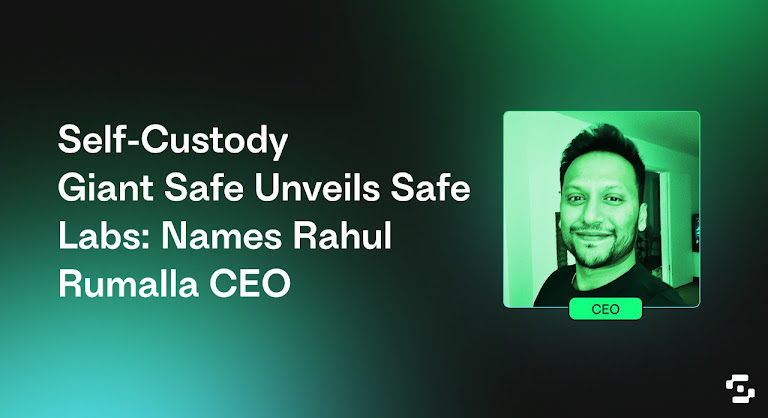
Self-Custody Giant Safe Unveils Safe Labs: Names Rahul Rumalla CEO

Self-Custody Giant Safe Unveils Safe Labs: Names Rahul Rumalla CEO


In Brief

Safe Ecosystem Foundation has launched Safe Labs, a fully-owned subsidiary led by Rahul Rumalla, to develop enterprise-grade self-custodial solutions and advance Safe Smart Accounts for institutional Web3 applications.

Self-Custody Giant Safe Unveils Safe Labs: Names Rahul Rumalla CEO

Safe Ecosystem Foundation today announced the formation of Safe Labs, a commercial, fully-owned subsidiary dedicated to building enterprise-grade self-custodial solutions. Rahul Rumalla, previously Chief Product Officer at the Safe development studio Core Contributors, has been appointed CEO to drive the Safe Lab’s strategic growth. 

This strategic evolution enables Safe Labs to focus on transforming Safe Smart Accounts into an enterprise-grade platform supporting business-focused self-custody use cases ranging from wallet-as-a-service infrastructure to deeply integrated workflows. The goal is to empower teams building institutional Web3 applications or requiring high-assurance digital asset management to leverage Safe Smart Accounts as their foundation. 

“The future of Web3 depends on giving users absolute confidence in their digital sovereignty. With Safe Labs, we’re building the infrastructure to make that possible—enterprise-grade, secure, and intuitive by design.”, said Lukas Schor, co-founder of Safe project and president of the Safe Ecosystem Foundation. “Rahul’s track record in product innovation and business growth makes him the ideal person to lead this next chapter, one focused on enterprise-grade compliance and security embedded into every layer of Safe technology, forging a new era of effortless, unassailable self-custody.” 

Rahul Rumalla, who joined the Safe ecosystem in July 2024 as Vice President of Product & Engineering, brings over 15 years of leadership experience in engineering and product strategy, having previously founded Web3 companies Paperchain and Otterspace and served as Director of Engineering & Product at SoundCloud. “Ethereum will host trillion-dollar economies powered by Safe. We achieve this by delivering enterprise-grade products that remain accessible to everyone. This is our challenge, our vision, and our ambition” said Rumalla. 

This move comes on the back of Safe crushing significant growth milestones, including recently surpassing $1 trillion in total volume processed (TVP) and facilitating nearly 2% of all Ethereum transactions as of May 2025. Safe{Wallet} has also seen explosive growth on L2s with over $10B in monthly transaction volume coming from Base and Arbitrum alone. 

About Safe 

Safe (previously Gnosis Safe) is an onchain asset custody protocol, securing ~$60 Billion in assets today. Released as on open source software stack by the Safe Ecosystem Foundation, it is establishing a universal ‘smart account standard for secure custody of digital assets, data, and identity. Safe is built for the mission to unlock digital ownership for everyone in web3,

including DAOs, enterprises, retail, and institutional users 

Website, Twitter, Discord, Blog, GitHub, Docs 

About the Safe Ecosystem Foundation, Zug, Switzerland 

The mission of the Safe Ecosystem Foundation is to support the development of Safe, to strengthen Safe technology and to promote the Safe Ecosystem. The Safe Ecosystem is a non-profit organisation based in Zug, Switzerland, that helps educate people about Safe smart accounts and promotes Safe technology through the provision of grants and other forms of funding. 

Legal Disclaimer 

This is not an offer to sell or a solicitation of an offer to purchase any SAFE tokens and is not an offering, advertisement, solicitation, confirmation, statement, or any financial promotion that can be construed as an invitation or inducement to engage in any investment activity or similar. 

The Safe Ecosystem Foundation makes no representations, warranties and/or covenants with respect to the Safe Technology (or any implementations of the Safe{Wallet} and/or Safe Smart Accounts) or any program (Grants, Hackathons and/or any other forms of funding) run by the Safe Ecosystem Foundation. You should not rely on the content herein for advice of any kind, including legal, investment, financial, tax, or other professional advice, and such content is not a substitute for advice from a qualified professional.

Disclaimer

In line with the Trust Project guidelines, please note that the information provided on this page is not intended to be and should not be interpreted as legal, tax, investment, financial, or any other form of advice. It is important to only invest what you can afford to lose and to seek independent financial advice if you have any doubts. For further information, we suggest referring to the terms and conditions as well as the help and support pages provided by the issuer or advertiser. MetaversePost is committed to accurate, unbiased reporting, but market conditions are subject to change without notice.

About The Author


Gregory, a digital nomad hailing from Poland, is not only a financial analyst but also a valuable contributor to various online magazines. With a wealth of experience in the financial industry, his insights and expertise have earned him recognition in numerous publications. Utilising his spare time effectively, Gregory is currently dedicated to writing a book about cryptocurrency and blockchain.

More articles


Gregory, a digital nomad hailing from Poland, is not only a financial analyst but also a valuable contributor to various online magazines. With a wealth of experience in the financial industry, his insights and expertise have earned him recognition in numerous publications. Utilising his spare time effectively, Gregory is currently dedicated to writing a book about cryptocurrency and blockchain.


Source link

Inside the Hedera Hashgraph Wallet NFT Scam: How Users Are Being Exploited | NFT News Today

Inside the Hedera Hashgraph Wallet NFT Scam: How Users Are Being Exploited | NFT News Today


Cybercriminals are exploiting Hedera Hashgraph wallets through advanced NFT airdrop scams that trick users into revealing their wallet credentials. These attacks utilise the memo field in airdropped tokens to distribute phishing links, resulting in significant financial losses for unsuspecting victims.

Key Takeaways

Scammers send unsolicited NFTs with phishing URLs embedded in memo fields to steal wallet credentials

Victims lose complete control of their wallets after entering seed phrases on fake websites

The FBI reported a surge in these attacks, including a June 2024 campaign using compromised Hedera marketing emails

Address poisoning techniques trick users into sending funds to attacker-controlled wallets

Users should never click unsolicited links or share seed phrases, regardless of how legitimate they appear

Understanding the Hedera Hashgraph Wallet NFT Scam

The Hedera Hashgraph wallet NFT scam represents a growing threat in the cryptocurrency ecosystem. Attackers are using the airdrop feature, originally designed for legitimate marketing purposes, to distribute malicious NFTs with phishing links. These scams target non-custodial wallet users who may not be familiar with security best practices. The attacks are getting more sophisticated with criminals using multiple channels and tactics to reach and impact more users.

How Cybercriminals Execute the NFT Phishing Airdrop Attack

The attack process follows a calculated sequence designed to appear legitimate while extracting sensitive information from victims:

Initial Contact Through Unsolicited Airdrops

Attackers begin by sending NFTs or tokens directly to users’ wallets without permission. These airdrops often mimic popular projects or create urgency and excitement by promising rewards.

Phishing Links Hidden in Memo Fields

Each airdropped token contains a memo field with embedded URLs. These messages typically claim users must act quickly to claim rewards, participate in exclusive events, or verify their wallet ownership. The URLs lead to phishing websites that are designed to closely resemble legitimate platforms.

Credential Harvesting Through Fake Interfaces

Once users click the malicious link, they encounter convincing replicas of official websites or decentralized applications. These sites prompt users to connect their wallets or enter critical information including:

Fund Extraction and Wallet Compromise

After obtaining credentials, attackers gain complete control over victims’ wallets. They systematically drain all cryptocurrency holdings, often within minutes of gaining access. Some sophisticated operations maintain access to monitor future deposits and steal those funds as well.

Technical Vulnerabilities Exploited by Scammers

Understanding the technical part of these scams can help users identify and avoid these threats:

Memo Fishing Links in Hedra Wallet

The memo field functionality is useful for legitimate transactions but lacks filtering mechanism. Attackers exploit this by embedding malicious URLs that bypass standard security measures. Users often trust these messages, especially when they appear to originate from recognized projects.

Wallet Connection Protocol Weaknesses

Standard wallet connection process requires users to approve interactions with decentralized applications. Malicious dApps exploit this by asking for excessive permissions or redirecting credential entry to attacker controlled servers.

Address Spoofing and Poisoning Attacks

Criminals create wallet addresses visually similar to legitimate ones, differing by only a few characters. They then conduct small transactions to populate users’ transaction histories with these poisoned addresses. When users copy addresses from their history for future transactions, they inadvertently send funds to attacker wallets.

Recent Incidents and Financial Impact

The scope and severity of these attacks have escalated dramatically throughout 2024:

June 2024 Hedera Marketing Email Compromise

A particularly damaging incident occurred when attackers compromised official Hedera marketing channels. They distributed phishing links through what looked like legitimate email communications. This breach demonstrated that threats can emerge from traditionally trusted sources.

FBI Warnings and Industry Response

Law enforcement agencies, including the FBI, have issued multiple warnings about the surge in NFT-related scams targeting Hedera users. Cybersecurity firms report millions of dollars in losses, with individual victims losing entire portfolio values in single attacks.

Protecting Your Hedera Wallet from NFT Scams

Implementing robust security practices significantly reduces vulnerability to these attacks:

Essential Security Measures

Users must adopt a zero-trust approach when dealing with unexpected airdrops or communications:

Ignore all unsolicited NFT airdrops and token transfers

Verify URLs independently before interacting with any platform

Store seed phrases offline in secure physical locations

Use hardware wallets for significant cryptocurrency holdings

Enable all available security features including two-factor authentication

Verification Best Practices

Before engaging with any airdrop or promotional offer, users should:

Cross-reference announcements through official project channels

Check domain names carefully for subtle misspellings

Confirm wallet addresses through multiple sources

Test transactions with minimal amounts first

Monitor wallet activity regularly for unauthorized access

Response to Suspected Compromise

If users suspect their wallet security has been breached:

Transfer remaining funds to a new wallet immediately

Revoke all wallet connections and permissions

Report the incident to relevant authorities and platforms

Document all transaction details for potential recovery efforts

Create new wallets with enhanced security measures

Conclusion

The Hedera Hashgraph wallet NFT scam combines technical exploitation with psychological manipulation. As scammers use more sophisticated tactics, users must apply comprehensive security practices. The financial loss these scams cause is a reminder of the importance of education and proactive measures.

By understanding attack vectors, recognizing warning signs and following security best practices, users can reduce their exposure. The decentralized nature of the crypto space puts security responsibility on individual users so awareness and caution is key to protecting digital assets.Never seed or private keys are requested by legitimate projects. When you see unexpected opportunities or urgent calls to action, skepticism is your best defense against financial loss. Inform, verify and security over rewards to keep control of your crypto.

The Hedera Hashgraph wallet NFT scam combines technical exploitation with psychological manipulation. As scammers use more sophisticated tactics, users must apply comprehensive security practices. The financial loss these scams cause is a reminder of the importance of education and proactive measures.

By understanding attack vectors, recognizing warning signs and following security best practices, users can reduce their exposure. The decentralized nature of the crypto space puts security responsibility on individual users so awareness and caution is key to protecting digital assets. Never are seed or private keys requested by legitimate projects. When you see unexpected opportunities or urgent calls to action, scepticism is your best defence against financial loss. Inform, verify, and secure your crypto rewards to maintain control.

Frequently Asked Questions

Here are some frequently asked questions about this topic:

What makes Hedera wallets particularly vulnerable to NFT scams?

Hedera wallets aren’t inherently more vulnerable than others, but the platform’s growing popularity and the memo field feature create opportunities for scammers. The ability to send tokens with embedded messages directly to any wallet address provides attackers with a direct communication channel to potential victims.

Can I recover funds stolen through an NFT scam?

Recovery proves extremely difficult due to blockchain’s immutable nature. While law enforcement agencies investigate major cases, most stolen funds remain unrecoverable. Prevention through security awareness remains the most effective protection.

Should I disable NFT functionality in my wallet?

Rather than disabling features, users should maintain heightened awareness about unsolicited airdrops. Legitimate projects announce airdrops through official channels before distribution. Any unexpected NFT should be treated with extreme caution.

How can I verify if an airdrop is legitimate?

Legitimate airdrops follow predictable patterns including official announcements, community verification, and transparent distribution methods. Users should verify through multiple official sources and never provide sensitive information to claim airdrops.

What should I do with suspicious NFTs already in my wallet?

Suspicious NFTs should remain untouched. Interacting with them, including attempting to sell or transfer them, may trigger malicious smart contracts. Most wallets allow users to hide unwanted tokens without interaction.


Source link

Popular Posts

My Favorites