AI-based DApps accounted for 19% of on-chain activity in 2025. The user count has risen to 4.5 million, while funding has surpassed $1.39 billion.
According to the blockchain analytics platform DappRadar, artificial intelligence activity on blockchains has nearly doubled since the beginning of the year. More funds and users are turning to this trending technology.
DappRadar reported that so far in 2025, AI-related on-chain activity has increased by 86%, with approximately 4.5 million daily unique active wallets involved in AI-centric decentralized applications (DApps).
AI Approaches the Web3 Throne
The increase in daily users has boosted the market share of AI applications from 9% at the start of the year to 19%. This figure places it just behind blockchain gaming, which stands at 20%.
DappRadar analyst Sara Gherghelas stated that the growth in AI is “not just a matter of hype” but reflects a “structural shift” in how users interact with decentralized applications.
“Whether through DeFi assistants, social agents, or autonomous gaming companions, AI agents are becoming a new on-chain interface layer.”
In a forecast made in May, DappRadar predicted that the use of AI agents—programs that can transact and act independently on the blockchain—would soon surpass gaming, which has traditionally dominated the DApp ecosystem.
Investment in AI Agents Increased by Over 9%
According to Gherghelas’s report, AI agent projects have raised a total of $1.39 billion so far in 2025. This represents a 9.4% increase compared to 2024.
While Gherghelas acknowledged that this amount is low compared to AI investments in companies like OpenAI, she noted that “investments in the AI agents space are now catching up to or surpassing other Web3 verticals like blockchain gaming.”
“In the Web3 world, investors increasingly see AI agents as a new building block. This building block has the potential to fundamentally change how users interact with protocols, navigate DApps, or automate their personal finance strategies.”
Gherghelas said that 2025 could be the first year that AI agents attract more capital than all other Web3 verticals.
AI Users Are Increasing Worldwide
Data collected by DappRadar between January and June shows that the majority of traceable AI DApp users are located in Europe, accounting for 26% of all interactions.
The largest group, at 33%, consists of users whose location could not be determined or who use anonymous sources like VPNs. Asia follows closely behind Europe at 22%, with North America trailing at 15.8%.
Gherghelas said the global distribution shows that “AI agents are not a local phenomenon.”
“Whether it’s a DeFi agent managing transactions in Asia, a social agent representing users in Europe, or gaming companions interacting with players in North America, the demand is both diverse and increasingly cross-continental,” she added.
You Might Also Like;
Follow us on TWITTER (X) and be instantly informed about the latest developments…
Runway, the artificial intelligence startup focused on text-to-video generation, is now entering the world of video games. The company will soon allow its own AI models to be used for game development.
Runway, the AI startup that has achieved remarkable success in text-to-video generation and has even secured deals with Hollywood giants, has made a groundbreaking move. The company has announced its entry into the video game world. So, what exactly is Runway aiming for?
According to a statement by Runway CEO Cristobal Valenzuela, the company will announce a brand-new game next week. This game, created entirely with artificial intelligence, will be available for anyone to play. Moreover, Runway isn’t stopping there. Everyone will be able to develop their own AI-powered game.
A shared image from Runway’s new game.
However, Runway’s real bombshell move is the plan to open its AI models to both amateur and professional game developers. Anyone who wishes can use Runway’s AI models to develop their own game. This will turn a new page in the world of video games. Cristobal Valenzuela believes this initiative will increase the speed of game studios.
But can AI-generated series, films, and even games deliver the desired quality? If you’re wondering about the answer to that question, take a look at the series titled “House of David” on Prime Video. The technologies belonging to Runway were actively used in this show.
You Might Also Like;
Follow us on TWITTER (X) and be instantly informed about the latest developments…
While countless different sites that allow you to talk with artificial intelligence are now available, some stand out with much larger datasets than others. This means your conversations will be more detailed and the quality of your work will be higher.
Artificial intelligence, which we can call the latest marvel of the tech world, is no longer just a part of science fiction films; it’s at the very center of our daily lives. This technology, once accessible only to large corporations or scientists, is now at our fingertips through our smartphones and computers. Best of all, many of these services are completely free.
So, with so many options, which one should you try for a conversation? In this article, we’ve brought together the most popular and useful free applications that allow you to chat with AI.
Free AI-Powered Chat Applications
ChatGPT
Gemini
Copilot
Poe
Perplexity
Claude
Hugging Face
You.com
ChatGPT
When it comes to chatting with AI, the first name that comes to mind is undoubtedly ChatGPT. Developed by OpenAI, this model can converse with users in a remarkably natural and fluent language. Its free version is quite sufficient for daily use. You can use it for a wide range of tasks, from writing articles and drafting emails to simplifying complex topics and writing code.
Pricing: No, the basic version is free. It comes with a paid subscription called ChatGPT Plus, which offers more advanced models, faster response times, and additional features (like advanced data analysis).
Image Generation: Yes. Free users can also generate images using text commands.
Video Generation: You can generate video with OpenAI’s “Sora” model, but it is not possible to generate it by chatting directly within ChatGPT.
Gemini
Powered by Google’s robust search engine infrastructure, Gemini is a strong contender for providing instant access to the most up-to-date information. Its ability to pull data from the internet in real-time makes it an ideal choice for getting information about current events and research. It is also highly successful at generating creative text and creating content in different formats.
Pricing: No, the basic version is free. The Pro model of Gemini can be used for free up to a certain limit, while unlimited use requires a paid subscription.
Image Generation: Yes. Thanks to Google’s “Imagen 4” model, it can generate images from text for free.
Video Generation: Yes. While it is possible to generate video through Gemini, it requires a paid subscription.
Copilot
Integrated with Microsoft’s Bing search engine, Copilot initially stood out by providing sources for the answers it gave. This feature is a great advantage for users who want to verify the accuracy of the information, although most other modern tools now offer the same feature. Still, many users prefer Copilot for its source reliability.
Pricing: No, it is largely free. Standard use of Copilot is free. A paid version, Copilot Pro, is also available, offering benefits like faster performance and priority access.
Image Generation: Yes. Thanks to its DALL-E 3 integration, it can generate extremely high-quality images for free.
Video Generation: No. Currently, Copilot does not have a text-to-video generation feature.
Poe
For those who want to try different AI models under one roof, this is a fantastic platform. Poe hosts various AI bots, including ChatGPT, Gemini, and Claude. This allows you to ask the same question to different bots and get answers from various perspectives.
Pricing: Both yes and no. The platform offers a limited number of free daily messages to try many different AI models. When this limit is reached, you must either wait or switch to a paid subscription.
Image Generation: Yes. You can generate images using bots on the platform like StableDiffusion and Playground-v2. This usage is also included in your daily free limit.
Video Generation: No. There is currently no AI model on the Poe platform that generates video.
Perplexity
Positioned more as an “answer engine” than a chatbot, Perplexity provides direct, cited answers to your questions. It is very useful for academic research or for learning about a topic in depth.
Pricing: No. You can use the basic search features for free. There are hourly limits for using more advanced models and features like file uploads. Unlimited use requires a Perplexity Pro subscription.
Image Generation: Yes. The Pro (paid) version has a feature to generate images from text commands.
Video Generation: No. Perplexity does not have a video generation feature.
Claude
Developed by Anthropic, a company focused on AI safety and ethics, Claude is particularly successful at analyzing and summarizing long texts. You can directly upload PDFs or other documents to the application to ask questions about the content, get summaries, or have it analyze the text.
Pricing: No. It offers a limited number of free uses through its website and mobile app. When you reach your limit, you need to wait for a while or upgrade to the Claude Pro subscription for higher limits and the most advanced models.
Image Generation: No. Claude’s primary capability is understanding and generating text; it does not have image generation capabilities.
Video Generation: No. It does not have a video generation feature.
Hugging Face
This is not a single chat application but a giant community and platform where you can try thousands of different AI models. Here, you can discover more niche and experimental chatbots that you might not find in other applications. If you want to take a deeper dive into the world of AI and compare the capabilities of different models, Hugging Face offers the perfect playground.
Pricing: No. Trying the thousands of models and demos (Spaces) on the platform is completely free. More professional services for developers may be paid, but it is free for the end-user.
Image Generation: Yes. You can try many different text-to-image models like Stable Diffusion on the platform for free.
Video Generation: Yes. It is possible to find and try some experimental models on the platform that generate video from text or images, but these are typically short and low-resolution.
You.com
You.com is an innovative platform that combines a traditional search engine with an AI chat. When you perform a search, it presents an AI chat window that directly answers your question, alongside standard web results. Its “Smart Modes” allow you to switch between AI tools focused on specific tasks (e.g., writing code or creating images).
Pricing: No. The basic search and chat features are free, but there are daily limits for features like image generation and using the most advanced AI models. Unlimited use requires a YouPro subscription.
Image Generation: Yes. You can generate a limited number of images for free. Unlimited generation is included in the paid plan.
Video Generation: No. You.com does not currently offer a video generation service.
Frequently Asked Questions
Are AI Chat Applications Safe?
These applications are generally safe, but it’s wise to be cautious. The developer companies (like Google, Microsoft, and OpenAI) take various security measures to protect your data. Therefore, it is best to never share highly sensitive personal information such as your national ID number, address, passwords, or financial details in these chats.
What is the Best Mobile Chatbot?
The “best” one varies from person to person because everyone’s needs are different. However, a few applications stand out for mobile use. ChatGPT, Microsoft Copilot, and Gemini all have excellent mobile apps for both iOS and Android. With their user-friendly interfaces, voice command features, and good integration with your phone, they will certainly meet your needs.
Is a Membership Required to Talk to AI?
Generally, a paid membership (subscription) is not required, but you will need to create a free account (register). Using the basic and highly capable versions offered by major platforms like ChatGPT, Gemini, and Copilot is completely free. You just need to create a simple account with your email address to save your chat history and personalize your settings.
Follow us on TWITTER (X) and be instantly informed about the latest developments…
NFTs have experienced an incredible surge in recent years. At one point, they even surpassed Bitcoin in popularity, becoming one of the most talked-about concepts worldwide. 2021 was the golden year for NFTs, with total sales reaching $25 billion, a remarkable increase from just $95 million the year before. Throughout this story, Ethereum was the prevalent blockchain used for NFTs. While Ethereum continues to be the common blockchain for NFTs, a revolutionary development for both NFTs and Bitcoin has occurred in recent months. This development has made it possible to efficiently and effectively create NFTs on the Bitcoin network.
Bitcoin NFTs are not a new phenomenon. On the contrary, Bitcoin NFTs were being produced even before NFTs became widely known. On the Counterparty platform, visual assets could be tokenized. Counterparty was built on Bitcoin.
Furthermore, the Colored Coins project, which included Ethereum founder Vitalik Buterin during its whitepaper preparation, is also known as a progenitor of NFTs. Thanks to Colored Coins, unique assets could be stored with “satoshi,” the smallest unit of Bitcoin. This allowed documents requiring registration in membership and contract sectors to be stored on the Bitcoin mainnet. However, these initiatives did not achieve the desired efficiency, and at that time, Bitcoin was not suitable for such uses.
As time progressed, Bitcoin also evolved technologically. Developments in the last five years, such as SegWit, Lightning Network, and Taproot, paved the way for Bitcoin to exist in various use cases beyond being just an electronic cash system. The recently much-discussed Ordinal NFTs are a fruit of this process.
What Are Ordinals?
In January, Bitcoin developer and software engineer Casey Rodarmor launched the Ordinals protocol, which enables the creation of NFTs on the Bitcoin network. While some enthusiastically welcomed Ordinals, others argued that it posed a threat to Bitcoin. As time went on, Ordinals became better understood and garnered significant support.
Ordinal NFTs, and seemingly what will henceforth be known as Bitcoin NFTs, are created by attaching data to satoshis, the smallest units of Bitcoin. As is known, Bitcoin consists of small units called satoshi or sats. 1 Bitcoin is made up of 100 million satoshis. With the Ordinals protocol, it’s possible to attach data to each of these units. This creates a new type of digital asset, which its developer calls an “Inscription.”
What’s the Difference from Known NFTs?
The difference between these NFTs and the NFTs we know on Ethereum is this: NFTs on Ethereum and many other blockchains require data to be stored off-chain. To explain with an example, the image associated with an NFT you own is not stored within the blockchain itself but on IPFS, a decentralized file storage system. This situation has been one of the biggest question marks regarding NFTs until now. Off-chain data storage raised a question of trust. With Ordinal NFTs, however, all data is written directly onto the chain.
Ordinals NFT Data Is Completely On-Chain
According to Casey Rodarmor, the developer of Ordinals, inscriptions are digital artifacts, unlike the vast majority of NFTs. At this point, Rodarmor claims that existing NFTs are not in the class of digital artifacts because they are stored off-chain, reside on centralized chains, and carry backdoor vulnerabilities. According to him, inscriptions are true digital artifacts because they are located on the oldest, most decentralized, and secure blockchain in the world.
Ordinals Craze Increased Block Sizes
After the Ordinals protocol was implemented, a large number of NFTs began to be created on the Bitcoin network. Significant amounts of collection sales were carried out. These transactions substantially increased the size of Bitcoin blocks and caused the number of pending transactions in the memory pool (mempool) to multiply.
The chart below shows the number of transactions waiting for confirmation in the memory pool. The left side of the graph shows the period before the Ordinals craze began, while the middle shows the period when NFTs were launched one after another.
Bitcoin’s block sizes remained under 1.5 MB for years. After the emergence of Bitcoin NFTs, blocks between 2 MB and 2.5 MB were produced. A few blocks even approached 4 MB in size. The chart below shows the change in block sizes over time. The surge seen on the right side of the graph is entirely due to Ordinals NFTs.
There Are Already NFTs Sold for Tens of Thousands of Dollars
Among the many NFT collections produced on the Bitcoin network so far, Bitcoin Rocks, Taproot Wizards, and Ordinal Punks have stood out. Some NFTs from these collections have already sold for tens of thousands of dollars.
You Might Also Like;
Follow us on TWITTER (X) and be instantly informed about the latest developments…
Xiaomi has unveiled a brand-new model in its headphone category, the “Open Headphones Pro.” These open-design headphones boast a highly ambitious five-driver audio architecture, developed in collaboration with Harman. They are set to capture the interest of audiophiles with both their design and technical specifications.
The Chinese tech giant Xiaomi has officially introduced its next-generation open headphone model, the “Open Headphones Pro.” Developed in partnership with Harman, these headphones stand out with their structure that brings together five different drivers. The model prioritizes both comfort and performance in daily use and is quite assertive in terms of material quality and durability. Additionally, it’s equipped with special technologies that minimize sound leakage and AI-powered smart features.
The Xiaomi Open Headphones Pro model is priced at approximately $138. Its open design offers a practical option for those who want to listen to music in daily life without losing contact with their surroundings. With its smart features, it also promises a functional experience while commuting or traveling.
Would you like to know more about its AI features or compare it with other open headphones?
You Might Also Like;
Follow us on TWITTER (X) and be instantly informed about the latest developments…
Google has announced “Doppl,” a brand-new application that lets you create a digital version of yourself and virtually try on clothes using your phone. Doppl is powered by artificial intelligence.
Google, one of the leading companies in AI, recently unveiled this new application called “Doppl.” Released experimentally for iOS and Android in the US, the app simply allows you to see how different types of clothing would look on you, thanks to the support of artificial intelligence.
Google has actually introduced similar virtual try-on features before. However, Doppl has a major difference: it directly creates an animated version of you, and you try on the desired clothes on this digital avatar. This provides much more realistic insights. You can add a photo of any outfit you like and try it on yourself.
Using Doppl is quite straightforward. First, you upload a full-body photo to the application. After this, your digital version is created. Then, you add images of the clothes you want to try on. With the help of artificial intelligence, these clothes are tried on your digital self. Not only photos, but it can also generate short videos showing how they might look on you in real life, giving you a better idea. The type of clothing doesn’t matter; every kind of item, from dresses to T-shirts, can be tried on. Even better, you don’t need official product photos. For example, if you’re shopping in a store and you like an outfit, you can simply open your phone’s camera and add a photo of the clothing to Doppl. The app immediately lets you try it on yourself. This could be very useful, especially in stores with long fitting room queues. Furthermore, you can even use a screenshot of any outfit you see on social media.
It’s also worth noting that you can save and share the generated visuals. The app is built upon Google’s recently introduced shopping features. Of course, it currently has some flaws and isn’t perfect. However, once these issues are resolved, it could be a revolutionary product for shopping. For now, it’s only available experimentally in the US, with no information about its widespread release.
You Might Also Like;
Follow us on TWITTER (X) and be instantly informed about the latest developments…
Published: June 27, 2025 at 11:55 am Updated: June 27, 2025 at 11:55 am
To improve your local-language experience, sometimes we employ an auto-translation plugin. Please note auto-translation may not be accurate, so read original article for precise information.
In Brief
Top crypto influencers and Telegram groups are preparing for the Degen Lab public presale, hailed as the best crypto presale of 2025, showcasing strategy and timing.
Top crypto influencers are getting in early. Telegram groups are lighting up with high-volume interest. The Degen Lab public presale is officially live—and it’s already being hailed as the best crypto presale of 2025.
Welcome to Degen Lab — where meme culture meets real technology, and outsized gains are no longer a matter of luck, but of strategy and timing.
This isn’t just hype. This is a rapidly accelerating opportunity at the heart of crypto’s meme revolution—and if you’re reading this now, you’re still early. But not for long.
What Is Degen Lab?
Degen Lab is an all-in-one meme coin launch platform—designed for creators, crypto enthusiasts, and digital trendsetters who want to build and scale viral tokens without needing to write a single line of code.
Whether you’re a seasoned developer, a crypto content creator, or a meme lover with a strong idea and a following, Degen Lab gives you the tools to build, launch, and promote a token with the click of a button.
Powerful Features Behind the Platform
Degen Lab doesn’t just simplify token creation—it supercharges it with a complete suite of tools:
Built-In Hype Engine – Trend boards, influencer integrations, and viral boosts for immediate visibility
Community Voting – Platform users vote on what gets spotlighted, creating organic momentum
Why Degen Lab Is Gaining Attention
In an industry saturated with broken promises and low-utility tokens, Degen Lab offers something different: a meme token factory that works. It’s a creator-driven, utility-powered platform ready to redefine how viral tokens are launched and scaled.
You can:
Create viral tokens in seconds
Participate in tokens launched by others
Leverage community hype and shared momentum
And at the center of it all is $DEGEN—the token that powers the entire ecosystem.
A Bold Vision for 2025
Degen Lab’s goal is to become the leading launchpad for meme tokens globally. As more tokens go live through the platform, demand for $DEGEN increases—creating a virtuous cycle of growth, visibility, and long-term value.
This is not a short-term play. It’s the foundation for the next generation of viral Web3 projects.
Presale Now Live — With Massive Early Demand
The Degen Lab presale is open, and the response has been immediate and intense.
Tokenomics – Designed for sustainability and scalability
Community – Growing rapidly and organically across all major platforms
Momentum – Early buyers already positioning for substantial upside
Every token launched via Degen Lab brings new utility and demand to $DEGEN. That means increased scarcity, expanding use cases, and long-term upside for early adopters.
Why You Should Buy Now
By joining the presale today, you’re securing:
Access to pre-public sale pricing
Early access to platform features
Priority positioning in future token launches
Exclusive benefits, upgrades, and bonuses for early holders
The earliest adopters will be grandfathered into high-utility drops, exclusive beta features, and long-term platform rewards.
Final Warning: This Is Your 100x Window
The presale has only just begun—but word is spreading fast. Participation is climbing. And with each new wave of awareness, the opportunity narrows.
This is your moment to position yourself ahead of the next big crypto narrative.
Degen Lab is not just a token. It’s a platform. A movement. A meme ecosystem in the making.
The most viral presale of 2025 has started. Will you watch from the sidelines—or lead from the front?
Join Degen Lab now. Before the rest of the world catches up.
JOIN THE PRESALE BEFORE IT’S TOO LATE ➜🐦 Twitter: @degenlab_ai💬 Telegram: t.me/degenlabofficial
Disclaimer
In line with the Trust Project guidelines, please note that the information provided on this page is not intended to be and should not be interpreted as legal, tax, investment, financial, or any other form of advice. It is important to only invest what you can afford to lose and to seek independent financial advice if you have any doubts. For further information, we suggest referring to the terms and conditions as well as the help and support pages provided by the issuer or advertiser. MetaversePost is committed to accurate, unbiased reporting, but market conditions are subject to change without notice.
About The Author
Gregory, a digital nomad hailing from Poland, is not only a financial analyst but also a valuable contributor to various online magazines. With a wealth of experience in the financial industry, his insights and expertise have earned him recognition in numerous publications. Utilising his spare time effectively, Gregory is currently dedicated to writing a book about cryptocurrency and blockchain.
More articles
Gregory, a digital nomad hailing from Poland, is not only a financial analyst but also a valuable contributor to various online magazines. With a wealth of experience in the financial industry, his insights and expertise have earned him recognition in numerous publications. Utilising his spare time effectively, Gregory is currently dedicated to writing a book about cryptocurrency and blockchain.
Artificial intelligence (AI) has become a groundbreaking technology, accessible to everyone. While we’ve seen disaster scenarios about AI taking over the world in sci-fi movies for years, in 2025, AI is helping with homework, creating effective resumes, and even suggesting what to cook for dinner. While these are lighthearted examples, major global companies are now using AI technology, leading to thousands of layoffs. Work projects that used to take days or even weeks are now delivered perfectly in just a few minutes with the help of AI. Here are 5 AI websites that can help you complete 100 hours of work in 10 minutes.
1. Scribe
Scribe is an AI tool that provides great convenience by automating time-consuming documentation processes. As a user performs an action, Scribe records these steps in the background, then generates a professional guide with screenshots. These guides are used in various fields, from training documents to internal company workflows. They are often preferred for speeding up technical teams’ processes, enabling support teams to respond faster, or providing guides to customers. Scribe requires no coding knowledge and automatically recognizes and simply documents user actions, making it indispensable for both individual users and teams.
Is Scribe AI free? You can use Scribe AI for free. For professional use, it costs $23 for individuals. If you want to purchase it for a group, it’s $59 for five users.
2. Perplexity AI
Perplexity AI goes beyond classic search engines, offering an AI-powered information search engine that provides fast, accurate, and sourced answers to users. This AI tool understands questions in natural language. Perplexity AI simultaneously scans numerous reliable sources, delivering meaningful and referenced responses. It can be used across a wide range of information, from academic research to current news. By providing direct links to sources, this AI tool ensures a transparent and reliable information retrieval experience. Thanks to its self-learning algorithms, it offers more accurate answers over time, saving considerable time for researchers, students, and content creators.
Is Perplexity AI free? You can perform unlimited searches for free. There is a limit of 5 “Pro” searches per day. Monthly subscriptions are available for $20, or an annual subscription for $200.
3. Napkin
Napkin is an AI-powered thought organization method that helps keep ideas from scattering. Users can quickly add their thoughts and notes, and the tool builds a large idea map by establishing connections between these notes. Napkin’s powerful AI infrastructure analyzes your notes and provides supporting functions like grouping, suggesting, or content development by establishing relationships between them. It is widely used in creative writing, strategic planning, personal development, and content creation. It reduces mental clutter, offering a clearer thinking environment, and also allows users to track how ideas evolve over time.
Is Napkin AI free? Approximately 500 credits can be used for free weekly. You can get 10,000 credits for $9 per month or 30,000 credits for $22.
4. Zapier AI
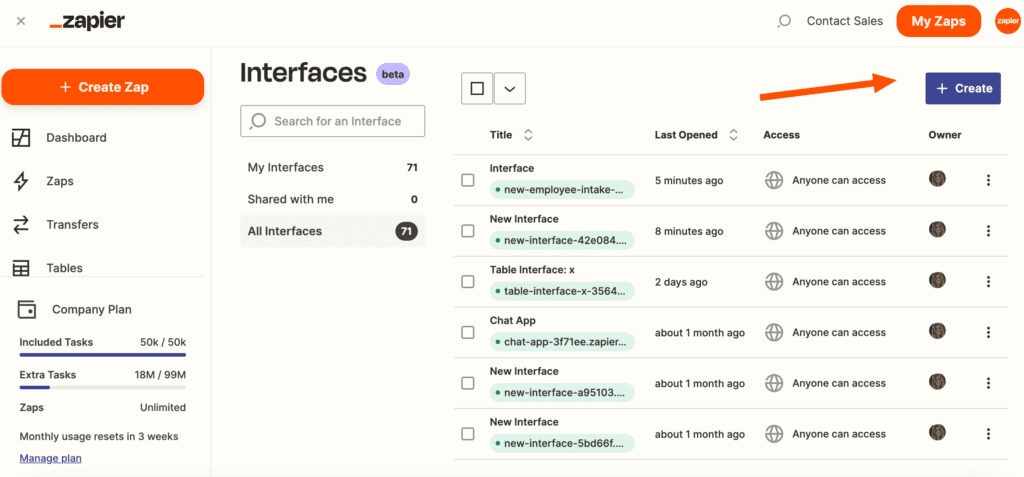
Zapier connects hundreds of different applications, automating manual tasks. This AI makes automations intelligent and intuitive. While traditional automations are typically based on rules and triggers, the AI-powered version understands natural language commands from the user and suggests or creates the most suitable workflow itself. For example, it can understand and implement a request like “Save new emails to Google Sheets and send me a summary email every evening” in a single line. In the business world, it minimizes repetitive tasks, allowing employees to focus on more creative and strategic areas. It is preferred by a wide range of users, from entrepreneurs to corporate team managers.
Is Zapier AI free? You can use Zapier AI for free, and you can also access a professional version for $20 per month.
5. Pictory
Pictory is an AI-based video production tool that automatically converts long text content or blog posts into short, engaging videos. It provides great convenience for content creators, digital marketers, and social media users. The user simply inputs text, an article, or a URL, and Pictory analyzes this content to create a video supported by appropriate images, videos, subtitles, and voiceovers. The video creation process requires no technical knowledge; professional videos can be produced in minutes thanks to its user-friendly interface. It also offers advanced features like brand-specific video styles, automatic subtitle addition, and social media-friendly cropping. Pictory thus provides a time-saving and effective solution for anyone looking to make their content more accessible and visual.
Is Pictory AI free? There is a 14-day free trial period. For $19 per month, you get 200 minutes of video production and access to royalty-free stock content. For $39 per month, you get 600 minutes of usage, a larger stock library, 5 brand kits, and 120 minutes of AI voiceovers.
You Might Also Like;
Follow us on TWITTER (X) and be instantly informed about the latest developments…
Published: June 27, 2025 at 10:20 am Updated: June 27, 2025 at 10:05 am
by Ana
Edited and fact-checked:
June 27, 2025 at 10:20 am
To improve your local-language experience, sometimes we employ an auto-translation plugin. Please note auto-translation may not be accurate, so read original article for precise information.
In Brief
Ethereum may halve its block time from 12 to 6 seconds in the proposed EIP-7782 upgrade, aiming to boost transaction speed and network efficiency, though the change presents technical and operational challenges.
What can you do in six seconds? Publish an Ethereum block – at least that’s if core developer Barnabé Monnot’s proposal is implemented. The idea, incorporated into EIP-7782, could potentially make it into the upcoming Glamsterdam upgrade scheduled for 2026. If implemented, it would supercharge Ethereum’s block speed which currently averages 12 seconds – but the idea is not without its controversies.
Making Ethereum Go Faster
It’s rare for a blockchain network to adjust its block times. Other aspects of consensus are often tinkered with, most notably in Ethereum’s case when it switched from Proof-of-Work to Proof-of-Stake, but block times tend to be set in stone. Bitcoin’s has averaged 10 minutes ever since the genesis block was mined in 2009, and Ethereum’s has never shifted either.
Newer smart contract chains tend to produce blocks much more quickly, however, with Cardano’s standing at 20 seconds; Binance Smart Chain at 3 seconds; and Solana just 0.4. If Ethereum were to halve its block times, the benefits are naturally faster transactions and effectively more throughput, providing a shortcut to scaling Ethereum. It’s a major change, however, that would radically alter Ethereum’s architecture.
Barnabe’s Big Idea
In his EIP-7782 proposal laying out the case for faster blocks, Barnabé Monnot explains: “Shorter slot times make Ethereum a better confirmation engine, which is arguably one of its main value propositions for apps and rollups settling on Ethereum L1.” Beneficiaries of this change, he notes, include network users, dapps, interoperable protocols, stakers, and node operators.
One of the most obvious advantages of moving to six-second blocks, the Ethereum developer believes, is “more efficient [onchain] exchanges as prices can be updated more frequently. Users therefore enjoy lower trading fees and Ethereum mainnet will attract deeper liquidity and more users, which has many positive side effects.”
It would, in effect, allow Ethereum to gain ground on the faster smart contract chains that have launched in recent years. In the process, it would bring users back to Ethereum from the L2s and non-EVM L1s that have stolen market share from it.
One industry figure who’s in favor of the move is DWF Labs Managing Partner Andrei Grachev, who says, “Shorter block times could change the rhythm of Ethereum’s economy. Faster confirmations affect everything from user experience to settlement pricing. It is the kind of low-level change that can compound into major efficiency gains over time.”
A Delicate Balancing Act
The case for speeding up Ethereum’s block times looks to be a compelling one. But there are always trade-offs that must be factored in. The change would make increased demands on validators, some of which may struggle to keep pace, while infra costs could rise to accommodate the additional bandwidth, pricing some validators out altogether.
Staking rewards would naturally be affected by the change, which Barnabé Monnot acknowledges, writing that “stakers would receive smaller rewards more frequently, including block rewards, which lowers the variability of the rewards overall.” As he points out, though, “Lower variance removes some incentive to pool funds, [resulting in] a better setup for solo stakers and home operators.”
The proposal must also be considered in the context of the other changes the Glamsterdam hard fork is addressing, including gas optimization. Simultaneously implementing a number of complex protocol changes while halving block times is a major change that will force the entire Ethereum ecosystem to effectively double the pace. Will RPCs, oracles, validators, and other onchain infra be able to keep up or will the network temporarily grind to a halt?
There’s plenty of time and testnets on which to work through these challenges, should EIP-7782 get off the ground. Whatever the case, Ethereum’s core developers are going to be burning the midnight oil in the coming months as Glamsterdam takes shape.
Disclaimer
In line with the Trust Project guidelines, please note that the information provided on this page is not intended to be and should not be interpreted as legal, tax, investment, financial, or any other form of advice. It is important to only invest what you can afford to lose and to seek independent financial advice if you have any doubts. For further information, we suggest referring to the terms and conditions as well as the help and support pages provided by the issuer or advertiser. MetaversePost is committed to accurate, unbiased reporting, but market conditions are subject to change without notice.
About The Author
Alisa, a dedicated journalist at the MPost, specializes in cryptocurrency, zero-knowledge proofs, investments, and the expansive realm of Web3. With a keen eye for emerging trends and technologies, she delivers comprehensive coverage to inform and engage readers in the ever-evolving landscape of digital finance.
More articles
Alisa Davidson
Alisa, a dedicated journalist at the MPost, specializes in cryptocurrency, zero-knowledge proofs, investments, and the expansive realm of Web3. With a keen eye for emerging trends and technologies, she delivers comprehensive coverage to inform and engage readers in the ever-evolving landscape of digital finance.
Published: June 27, 2025 at 10:10 am Updated: June 27, 2025 at 9:56 am
by Ana
Edited and fact-checked:
June 27, 2025 at 10:10 am
To improve your local-language experience, sometimes we employ an auto-translation plugin. Please note auto-translation may not be accurate, so read original article for precise information.
In Brief
Binance Research reports that despite recent geopolitical-driven volatility, market sentiment has turned positive as Bitcoin rebounded strongly, traditional assets remained resilient, and investors await clearer signals for a potential altcoin rotation.
Devision of the cryptocurrency exchange Binance responsible for market analysis, Binance Research issued its latest Weekly Insights report, offering a summary of market developments over the previous week.
The report notes that recent geopolitical tensions over the weekend caused notable disruptions across digital asset markets. However, a subsequent de-escalation and ceasefire contributed to a rebound in both traditional financial instruments and Bitcoin, with both sectors ending the week on a positive note despite heightened weekend volatility.
During the peak of the uncertainty, Bitcoin saw a sharp decline of approximately 8.5%, dropping from around $106,000 on Saturday to a low of $98,000 by Monday. It then rebounded strongly, closing the week at $107,000, surpassing the $100,000 level once more. Ethereum followed a comparable path but encountered steeper losses and a more limited recovery. It fell by roughly 17%, moving from $2,560 on Saturday to a low of $2,130 on Monday, eventually ending the week slightly lower at $2,480. While Bitcoin’s swift recovery reinforced its perception as a potential hedge asset during geopolitical stress, Ethereum’s more subdued response indicated its comparatively limited role in that context.
The report also highlights uncertainty surrounding Bitcoin’s ability to maintain its momentum, though the recovery could reflect broader market expectations for a continued upward trend. In light of Bitcoin reaching a new all-time high and maintaining dominance, questions have arisen about the timing of a potential altcoin season. The analysis suggests that although gains from Bitcoin may eventually flow into altcoins, a clear external catalyst may be necessary to unify capital allocation and drive a coordinated shift across the broader digital asset market.
Although cryptocurrency markets reacted sharply to developments over the weekend due to their continuous trading nature, traditional equity markets, which do not operate around the clock, were largely insulated from this volatility. The S&P 500 exhibited minimal fluctuations and concluded the week with a 2.56% gain. This performance, despite ongoing geopolitical uncertainties, suggests a generally optimistic sentiment among market participants. In terms of broader asset relationships, cross-asset correlations showed little change compared to the previous week. Bitcoin maintained a modest positive correlation with both the S&P 500 and the US Dollar Index (DXY), while exhibiting a slight negative correlation with gold.
Macro Outlook: Pressure Builds On Federal Reserve Policy Direction
Following the Federal Reserve’s recent decision to keep interest rates steady within the 4.25–4.50% range, US President Donald Trump expressed dissatisfaction with Chair Jerome Powell’s approach, implying that leadership changes could occur before the end of Jerome Powell’s term. In subsequent testimony before the House Financial Services Committee, Jerome Powell reaffirmed a cautious stance, indicating that further economic developments would guide future decisions.
Meanwhile, two Federal Reserve officials appointed during Donald Trump’s administration, Michelle Bowman and Christopher Waller, adopted a more flexible tone, suggesting that rate cuts could be considered as early as July in light of moderating inflation and signs of strain in the labor market. Nonetheless, Jerome Powell and several other policymakers continue to advocate for patience until the effects of recent trade policy developments become more apparent.
Market Sentiment Improves Amid Easing Geopolitical Tensions And Rising Global Liquidity
Binance Research highlights that looking forward, the notable rebound observed following a weekend marked by geopolitical developments reflects a generally positive market sentiment. Despite the Federal Reserve maintaining a cautious stance, investor outlook appears to be improving amid signs of easing geopolitical stress and continued accommodative signals from other central banks. With global liquidity on the rise, attention remains on whether and when altcoins might gain broader traction and begin to draw attention and market share away from Bitcoin, which is increasingly being viewed as a potential macroeconomic hedge.
Disclaimer
In line with the Trust Project guidelines, please note that the information provided on this page is not intended to be and should not be interpreted as legal, tax, investment, financial, or any other form of advice. It is important to only invest what you can afford to lose and to seek independent financial advice if you have any doubts. For further information, we suggest referring to the terms and conditions as well as the help and support pages provided by the issuer or advertiser. MetaversePost is committed to accurate, unbiased reporting, but market conditions are subject to change without notice.
About The Author
Alisa, a dedicated journalist at the MPost, specializes in cryptocurrency, zero-knowledge proofs, investments, and the expansive realm of Web3. With a keen eye for emerging trends and technologies, she delivers comprehensive coverage to inform and engage readers in the ever-evolving landscape of digital finance.
More articles
Alisa Davidson
Alisa, a dedicated journalist at the MPost, specializes in cryptocurrency, zero-knowledge proofs, investments, and the expansive realm of Web3. With a keen eye for emerging trends and technologies, she delivers comprehensive coverage to inform and engage readers in the ever-evolving landscape of digital finance.