Metaverse

Home Metaverse Page 140

Taiko Hosts Second Based Rollup Summit In Cannes: Preconfirmations Are Key, Horizontal Scaling Is Ethereum’s Path Forward

Taiko Hosts Second Based Rollup Summit In Cannes: Preconfirmations Are Key, Horizontal Scaling Is Ethereum’s Path Forward


In Brief

Taiko’s second Based Rollup Summit in Cannes brought together industry leaders to explore Ethereum scalability, preconfirmations, booster rollups, and strategies for mainstream adoption without compromising decentralization.
Taiko Hosts Second Based Rollup Summit In Cannes, Exploring The Future Of Ethereum Scalability

Based rollup scaling project Taiko has organized the second Based Rollup Summit in Cannes, held concurrently with EthCC Cannes 2025, maintaining the ongoing dialogue on the future of Ethereum scalability. The event brought together developers, industry figures, and technology experts to examine current progress in based rollup solutions, explore the role of preconfirmations, and assess the broader developments influencing Ethereum’s next phase.

Joaquin Mendes, Chief Operating Officer at Taiko, began the summit by discussing preconfirmations, highlighting their presence in routine interactions. He illustrated how these mechanisms function and their significance in enhancing the efficiency and responsiveness of the Taiko network. His remarks provided context for the role of based preconfirmations in improving the scalability of Ethereum.

Shiv Sankar, Chief Executive Officer of Boundless, spoke about the priorities within the zero-knowledge domain, focusing on practical application rather than competing technologies. He pointed out that the key challenge lies not within the Web3 space but in addressing competition from major established technology companies. Sankar underlined the importance of identifying user needs and delivering solutions that provide tangible value, noting that user spending and revenue serve as meaningful indicators of what is genuinely important to end users.

Alon Muroch, Chief Executive Officer of SSV Network, presented the Universal Registry Contract (URC) and described how SSV is simplifying validator access to based rollup infrastructure. He noted the growing significance of Layer 2 networks in transaction volume, suggesting this shift offers new potential for both validators and rollup systems. By integrating the URC directly into their client software, SSV has removed common registration hurdles, making participation more accessible across different validator sizes.

In a separate segment, Daniel Wang, Chief Executive Officer of Taiko, addressed a structural consideration regarding Ethereum’s design and the role of based preconfirmations. He explained that while Taiko aims to reduce block times from 12 seconds to below 2, achieving such speeds directly on Ethereum is not feasible without undermining decentralization. With a validator set exceeding one million participants, reaching consensus in sub-second intervals would demand either a reduction in validator numbers or the use of significantly more powerful hardware, both of which would contradict Ethereum’s foundational principles of inclusivity and decentralization.

Speakers Highlight Path To Scalable Ethereum Adoption 

Speakers at the summit discussed measurable indicators of progress, emphasizing real-world adoption and sustainable economic models. A shared view emerged that a benchmark would be the deployment of a based rollup utilizing preconfirmations and Layer 1 proposers, with at least 20% of the stake actively participating. Additional goals included lowering transaction costs and enhancing overall usability.

Tomasz K. Stanczak, Co-Executive Director at the Ethereum Foundation, shared insights into the broader strategy for achieving widespread adoption. He explained that the approach does not prioritize direct user engagement, as end users are expected to interact with blockchain technology through interfaces provided by large institutions. The core objective, he noted, is to ensure that blockchain infrastructure remains central while supporting enterprises in addressing regulatory challenges.

Marek Olszewski, Chief Executive Officer of Celo, brought attention to the need for Ethereum to better position itself for institutional and mainstream adoption. He questioned whether the current user base aligns with Ethereum’s long-term goals and highlighted the importance of distinguishing Ethereum from competing platforms by reinforcing its role as a yield-generating network.

Justin Drake, a researcher at the Ethereum Foundation, emphasised the limitations of vertical scaling for Ethereum, stating that future scalability must rely on horizontal expansion. He pointed out that even increases in computational capacity would not be sufficient, reinforcing the necessity of a broader scaling approach.

Brecht Devos, Co-founder and Chief Technology Officer at Taiko, introduced the idea of booster rollups, outlining how this approach contrasts with conventional scaling methods. He explained that while most activity and smart contracts remain on Layer 1, each rollup can establish a direct connection to that base layer. This architecture enables Layer 2 networks to access Layer 1 smart contracts seamlessly, supporting scalability while preserving composability across layers.

Can Blockchain Match The Scale Of Internet Platforms Without Compromising Decentralization?

The event concluded with a broader discussion on the meaning of blockchain scalability, featuring contributions from Kyle Rojas of Avail, Gustavo from OpenZeppelin, and Harry Gao of Luban. The dialogue centered on whether blockchain infrastructure can match the scale and usability of mainstream internet platforms. Participants agreed that true scalability involves reaching global capacity without compromising essential features such as decentralization, resistance to censorship, and system integrity. Rather than simply pursuing higher transaction throughput, the focus remains on developing infrastructure that can support worldwide adoption without sacrificing core blockchain principles.

In addition to technical exploration, the summit included interactive elements, such as gaming experiences powered by Taiko’s technology, offering a practical demonstration of how blockchain can merge utility with engagement. The concepts of preconfirmations and booster rollups presented throughout the event reflect ongoing efforts to scale Ethereum in a way that upholds its foundational values while addressing the demands of global usage.

Disclaimer

In line with the Trust Project guidelines, please note that the information provided on this page is not intended to be and should not be interpreted as legal, tax, investment, financial, or any other form of advice. It is important to only invest what you can afford to lose and to seek independent financial advice if you have any doubts. For further information, we suggest referring to the terms and conditions as well as the help and support pages provided by the issuer or advertiser. MetaversePost is committed to accurate, unbiased reporting, but market conditions are subject to change without notice.

About The Author


Alisa, a dedicated journalist at the MPost, specializes in cryptocurrency, zero-knowledge proofs, investments, and the expansive realm of Web3. With a keen eye for emerging trends and technologies, she delivers comprehensive coverage to inform and engage readers in the ever-evolving landscape of digital finance.

More articles


Alisa Davidson


Alisa, a dedicated journalist at the MPost, specializes in cryptocurrency, zero-knowledge proofs, investments, and the expansive realm of Web3. With a keen eye for emerging trends and technologies, she delivers comprehensive coverage to inform and engage readers in the ever-evolving landscape of digital finance.


More articles


Source link

What I Wish I Knew Before Investing in NFTs | NFT News Today

What I  Wish I Knew Before Investing in NFTs | NFT News Today


Blockchain collectibles looked like an instant wealth machine in 2021, yet four years later I’m still suffering from gas fee scars, Discord dramas, and ledgers full of lessons. The reflections below explain what actually matters and what painfully doesn’t so newcomers and veterans alike can avoid repeating my most expensive mistakes.

Key Takeaways

Hype peaks hide thin liquidity and brutal drawdowns; volume is down 98 % since January 2022.

Gas, platform cuts, and failed mints routinely add 30‑200 % on top of a “sticker price.”

Hardware wallets and revoked approvals save more ETH than lucky flips ever will.

Stories, provenance, and genuine communities preserve value long after price charts fade red.

Winning in NFTs feels less like day‑trading and more like slow, conviction‑driven collecting.

The Hype vs. Reality

I minted my first JPEG the week after Beeple’s $69 million sale. Twitter feeds screamed that every drop was “life‑changing.” Reality checked me quickly. Monthly volume on OpenSea has slipped from a $5 billion frenzy in January 2022 to about $81 million in May 2025. That 98 % plunge means today’s buyer faces tighter spreads, fewer bidders, and projects competing for slivers of attention.

One haunting reminder is Pixelmon. In February 2022 the team pulled in $70 million promising a “AAA blockchain game.” Reveal day showed crude Pokémon knock‑offs; floors imploded by 60 % faster than I could list mine. The episode taught me that glossy trailers don’t equal product progress and that liquidity disappears the moment euphoria fades.

Lesson: Treat parabolic charts as fireworks pretty, loud, and gone in seconds.

Hidden Costs and Fees

My first mint cost 0.08 ETH. The transaction actually drained 0.27 ETH because gas fees spiked mid‑block, OpenSea’s commission clipped 2.5 %, and the transfer to cold storage added another fee. Worse, a failed attempt the same hour burned gas even though it reverted.

High‑profile examples dwarf my incident. Yuga Labs’ Otherside land sale torched over $176 million in gas within three hours, with some buyers paying 5 ETH per transaction. Around 1,600 ETH also vaporized through failed mints that night.

Today, I anticipate a surcharge on the Ethereum mainnet; expect to spend up to twice the advertised price during congested periods. Alternatives like Polygon or Tezos help, but blue‑chip projects still cling to mainnet prestige. Timing mints for off‑peak hours, pre‑signing limit orders, and topping wallets with extra ETH have saved me from forced liquidations.

Due Diligence and Research

Rug pulls wore many disguises in 2022. Frosties vanished with $1.3 million; Pixel Pets impersonated Bored Ape adjacent brands; even fake ApeCoin airdrops lured veterans. My early approach skimming Discord and chasing influencer tweets proved reckless.

Now I follow a checklist:

Smart‑contract review: I can’t audit code like a Solidity dev, but I read scam‑check threads and pay for a quick CertiK or Hacken summary when stakes are high.

Team verification: LinkedIn pages and past GitHub repos show whether founders shipped before. Pseudonyms are fine; zero track record isn’t.

Holder distribution: Nansen dashboards reveal if ten wallets own half the supply—usually a sign of future price manipulation.

Volume quality: Dune charts expose wash trading. Genuine interest shows steady unique buyers, not the same wallets ping‑ponging tokens.

Spending an hour here has spared me months of grief later.

Understanding Wallets and Security

February 2022 hardened my security posture. A phishing signature on OpenSea drained 254 high‑value NFTs from 32 users in minutes; Ledger’s Connect kit hack two years later reinforced that hardware alone isn’t a silver bullet. I escaped both events by pure luck, but friends didn’t.

Current routine:

Separate wallets for minting, holding, and trading; the hot wallet never holds grails.

Revoke permissions weekly via Revoke.cash; unlimited approvals are silent assassins.

Bookmark official links; I type them manually rather than trusting Discord pop‑ups.

Treat unsolicited airdrops as malware; I hide them, never interact.

Security feels boring until a supposed “free mint” costs a CryptoPunk.

What Makes an NFT Valuable

Early 2021 me believed rarity traits alone pumped floors. Experience flipped that notion. Value comes from overlapping factors:

Provenance & scarcity: On‑chain generative art like Chromie Squiggles embodies code as art. Supply stayed fixed at 10,000, and floors climbed from 6 ETH to about 17 ETH within six months because collectors trust Art Blocks’ curation and chain permanence.

Cultural relevance: Beeple’s Everydays collage condensed 13 years of daily output; it held meaning beyond token ID #.

Brand extensions: Pudgy Penguins entered Walmart with plush toys and sledded past bear‑market blues. Physical reach widened mindshare and drove new collectors back to NFTs.

A static image seldom justifies price. Storytelling, IP execution, and the sense you’re owning a cultural artifact carry much heavier weight.

Emotional Investing

Charts trigger dopamine. More than 80 % of U.S. crypto holders admit FOMO‑buying; I’m part of that statistic. In 2022 I panic‑bought a Cool Cat at 11 ETH because Twitter said “game launch next week.” Two months later the CEO left, Cooltopia stalled, and my Cat hovers near 1 ETH today.

To curb impulses, I pre‑define a quarterly NFT budget. Any purchase above 0.5 ETH waits 24 hours. I also log reasons before buying; if “looks cool” or “friend pumped it” top the list, I pass. Data reveals that tempering excitement beats “gut feeling” nine times out of ten.

Art Appreciation vs. Speculation

Traditional art collectors visit galleries and discuss brushwork. NFT flippers watch floor bots. Straddling those cultures proved tricky. My rarest gain came from appreciating art, not chasing yield: a QQL mint pass by Tyler Hobbs and Dandelion Wist. I loved Hobbs’ generative aesthetic, held through a 50 % drawdown, and eventually sold one output for 15 ETH. Meanwhile, a short‑lived meme collection I “aped” collapsed to zero.

Takeaway: Buy pieces you’d display even if price hits rock bottom. Genuine enthusiasm sustains patience during liquidity droughts.

Community Matters

Silent Discords signal trouble. Doodles, once a darling, sparked a revolt when founders declared they were “building a media company” and told complainers to “floor it and GTFO.” Floor slid 25 % within days, and chat channels resembled tumbleweeds.

Pudgy Penguins offered the opposite blueprint. Holder‐generated GIFs amassed 28.9 billion views, founder Luca Netz shares toy royalties with licensees, and AMAs feel open rather than choreographed. I spent hours in their “Huddle,” sensed organic energy, and bought a Penguin at 3 ETH. That decision aged well even through market carnage.

Gauge community health by:

Founder presence in voice chats.

Constructive criticism tolerated, not banned.

Real‑world partnerships that bring non‑crypto eyeballs.

Projects without pulse rarely resurrect.

Utility and Roadmaps Can Be Misleading

Whitepapers promise moons; treasuries fund disappointment. Cool Cats teased a play‑to‑earn empire, then shelved it. Doodles hyped Pharrell Williams partnerships, pivoted away from NFTs, and left holders puzzled. Pixelmon’s “open‑world game” morphed into a meme.

I now consider roadmaps to be marketing slides rather than binding contracts. Teams that deliver quietly, like RektGuy shipping merch and Art Blocks refining curation, earn my ETH. Actions speak louder than pastel gradient timelines.

Patience and the Long Game

Bear markets buffet weak hands. OpenSea’s active user count, however, sits near a three‑year high despite slashed dollar volumes, hinting at a core collector base still building. Generative art keeps attracting museums; real‑world‑asset NFTs tokenize property deeds and concert tickets.

My horizon shifted from weeks to half a decade. I’d rather compound social capital inside a resilient community than chase the next 10 x flip. Setting low time preference transforms volatility from stressor to opportunity.

Final Thoughts

NFTs didn’t break me; my preconceived notions did. Hype persuaded me that everyone wins, fees were trivial, and security was plug‑and‑play. Hard experience rewrote those beliefs. Careful research, wallet hygiene, affinity for the art, and a patient outlook now govern every purchase. If you enter with similar guardrails, NFTs can still offer meaningful, if risky, ownership experiences. Skip them, and you’ll learn the same lessons the pricey way just like I did.

Frequently Asked Questions

Here are some frequently asked questions about this topic:

Why did NFT trading volume crash after 2021?

The 2021 boom mixed cheap money, celebrity hype, and blurry expectations. As macro liquidity tightened and many projects failed to ship, buyers vanished, cutting monthly OpenSea volume by about 98 %.

How much extra should I budget for gas and fees?

On Ethereum mainnet I now assume the real cost lands 30‑200 % above the list price. Gas spikes, platform cuts, and the risk of failed mints all add up fast.

Are hardware wallets still safe after the Ledger‑connect hack?

Yes—if you pair them with strict habits. Keep high‑value NFTs in a vault wallet, revoke old approvals weekly, and never sign blind signatures popped up by a browser.

What signals a potential “rug pull”?

Anonymous founders with no past builds, lopsided whale wallets, and volume that looks like wash trades top my danger list. If the Discord bans basic questions, I walk away.

Do roadmaps matter at all?

They’re marketing slides, not contracts. I focus on teams that deliver small updates on schedule; silence after a fund‑raise usually predicts trouble.

How do I pick NFTs that might hold value?

I look for clear provenance, cultural weight, and real IP growth. Chromie Squiggles, Beeple pieces, and Pudgy Penguins toys each tick those boxes.

What’s the best way to control FOMO?

I set a hard quarterly NFT allowance and force a 24‑hour cooling period on buys above 0.5 ETH. Logging my purchase reasons in plain text also exposes wishful thinking.

Should I chase utility tokens or pure art?

I buy art I’d gladly display even at zero price, then layer in utility plays I understand. Empty utility promises age poorly, while genuine artistry ages well.

How big a role does community play in price stability?

A huge one. Active, respectful Discords with founder presence and off‑chain collaborations cushion floors when wider markets sag. Dead chats precede deep slides.

What time horizon makes sense for an NFT portfolio?

I think in three‑to‑five‑year cycles. Projects building through the bear phase can shine later, but that patience only works if the art or story already speaks to me.

Can free mints be safe?

Sometimes, but I treat any unsolicited drop as malware. I hide unknown tokens and interact only after I’ve vetted the smart contract link.

Bottom line—are NFTs still worth it?

Yes, if you treat them as high‑risk collectibles, secure them properly, and buy pieces you believe in. Enter for fast flips and you’re likely paying for someone else’s exit.


Source link

IDO Launchpad CoinTerminal Adds $15,000 Lottery Incentive to All Refundable Sales

IDO Launchpad CoinTerminal Adds ,000 Lottery Incentive to All Refundable Sales


In Brief

CoinTerminal has introduced a $15,000 lottery for all refundable sales, rewarding participant engagement while enabling risk-free pre-sale participation.

IDO Launchpad CoinTerminal Adds $15,000 Lottery Incentive to All Refundable Sales

Emerging IDO launchpad focused on broadening access to early-stage projects, CoinTerminal introduced a $15,000 lottery tied to its refundable sales. The prize structure awards $10,000 to one winner and $2,500 each to two additional participants. To ensure transparent and provable randomness, the lottery will be conducted using Chainlink VRF technology, with the entire process verifiable on-chain. This initiative recognizes the engagement and trust of participants in CoinTerminal’s open-access platform.

Distinct from other IDO platforms that use lotteries to limit Web3 investment access, CoinTerminal’s refundable sales model allows users to participate in pre-sales without financial risk. Investors have the option to keep the tokens they acquire or receive a full refund within a defined timeframe, typically 24 hours after the Token Generation Event, without any restrictions. All participants, including those who choose to claim refunds, are automatically entered into the lottery.

“CoinTerminal is about breaking barriers, not building them,” said Founder Hatu Sheikh in a written statement. “This lottery represents a heartfelt thank you to our loyal and growing community, and enhances the appeal of one of our defining features – refundable sales. By integrating Chainlink VRF, users can have confidence in every single draw, knowing that the results are fully verifiable on-chain,” he added.

CoinTerminal: Inclusive Web3 Launchpad Raising Over $20M By Expanding Early-Stage Crypto Investment Access

CoinTerminal operates as an inclusive Web3 launchpad focused on expanding opportunities for early-stage cryptocurrency investments. Differentiating itself from many competitors, it does not require staking or native token ownership for participation, allowing users to join pre-sales freely. The platform has facilitated investment opportunities alongside prominent entities such as Binance Labs, Samsung NEXT, Animoca Brands, and Arthur Hayes.

Since its inception, CoinTerminal has supported the launch of numerous Web3 token projects by enabling investor access without requiring the purchase or holding of a native token or mandatory staking. The platform’s refundable sales approach mitigates risk for participants, helping to build trust in early-stage investments. In the second quarter, CoinTerminal experienced strong sales volumes and substantial ticket sizes, driven by its open-access model and a consistent flow of project launches. To date, over 620,000 investors have engaged in sales on the platform, involving $2.2 billion in connected assets and raising more than $20 million.

Disclaimer

In line with the Trust Project guidelines, please note that the information provided on this page is not intended to be and should not be interpreted as legal, tax, investment, financial, or any other form of advice. It is important to only invest what you can afford to lose and to seek independent financial advice if you have any doubts. For further information, we suggest referring to the terms and conditions as well as the help and support pages provided by the issuer or advertiser. MetaversePost is committed to accurate, unbiased reporting, but market conditions are subject to change without notice.

About The Author


Alisa, a dedicated journalist at the MPost, specializes in cryptocurrency, zero-knowledge proofs, investments, and the expansive realm of Web3. With a keen eye for emerging trends and technologies, she delivers comprehensive coverage to inform and engage readers in the ever-evolving landscape of digital finance.

More articles



Alisa Davidson


Alisa, a dedicated journalist at the MPost, specializes in cryptocurrency, zero-knowledge proofs, investments, and the expansive realm of Web3. With a keen eye for emerging trends and technologies, she delivers comprehensive coverage to inform and engage readers in the ever-evolving landscape of digital finance.


More articles


Source link

What To Expect From The AI Industry In The Second Half Of 2025

What To Expect From The AI Industry In The Second Half Of 2025


In Brief

In just six months, the AI industry in 2025 has transformed from a tech arms race into a global power struggle—blending breakthroughs, billion-dollar bets, political shakeups, and rising questions about control, trust, and the road to AGI.

Ai

What a year, and it’s only June. The AI industry exploded in 2025. In the first six months alone, we’ve seen world leaders fund half-trillion-dollar infrastructure plans, religious figures weigh in on AI’s moral limits, and every major tech company pushes out new models like it’s a race. And that’s because it kind of is.

ChatGPT got smarter. Gemini made up a lot of its lag. Claude flexed long-range reasoning. And DeepSeek threw the whole industry off balance with a $6 million shock model.

Regulators got involved. Copyright lawsuits escalated. Education systems had a hard time keeping up. And perhaps most telling of all: for the first time, AI went from the shiny new object to something schools, courts, and presidents are actively trying to control.

Now, as we head into the second half of the year, the question becomes: what’s next?

What Happened in the First Half of 2025

To understand where AI is going, we have to look at how far it’s come , and in 2025, that’s far. OpenAI launched a couple of new models: GPT-4.1, o3, and o4-mini. Google countered with Gemini 2.5 Pro and its long-awaited “AI Mode” for Search, while Anthropic delivered the Claude 4 series with extended memory and tool-use capabilities.

Then came DeepSeek R1, a model built in China that matched top-tier reasoning performance at a fraction of the cost. Its reported $6 million price tag (despite questions around the true GPU bill) shocked the entire industry and even had Trump calling it a national wake-up call.

Trump has made AI a political pillar. His administration launched the $500 billion Stargate Project to build U.S.-based AI supercomputers, mandated AI education in K-12 schools, and fired the U.S. Copyright Office director a day after she released a report favoring human creators over model trainers.

Meanwhile, the industry’s biggest players kept moving fast. Meta is offering up to $100 million to poach OpenAI researchers. Disney joined the copyright wars. OpenAI and Jony Ive are building a “screenless” AI device. And Pope Leo XIV is warning that AI risks devaluing human dignity.

Where Does That Bring Us Now?

Halfway through 2025, the AI industry is entering a new phase. The list of model launches, infrastructure announcements, and government interventions has clarified two things:

The AI race is no longer just about who builds the smartest chatbot. Every major company is trying to lock in users, developers, and governments with proprietary models, companion tools, and regulatory influence.

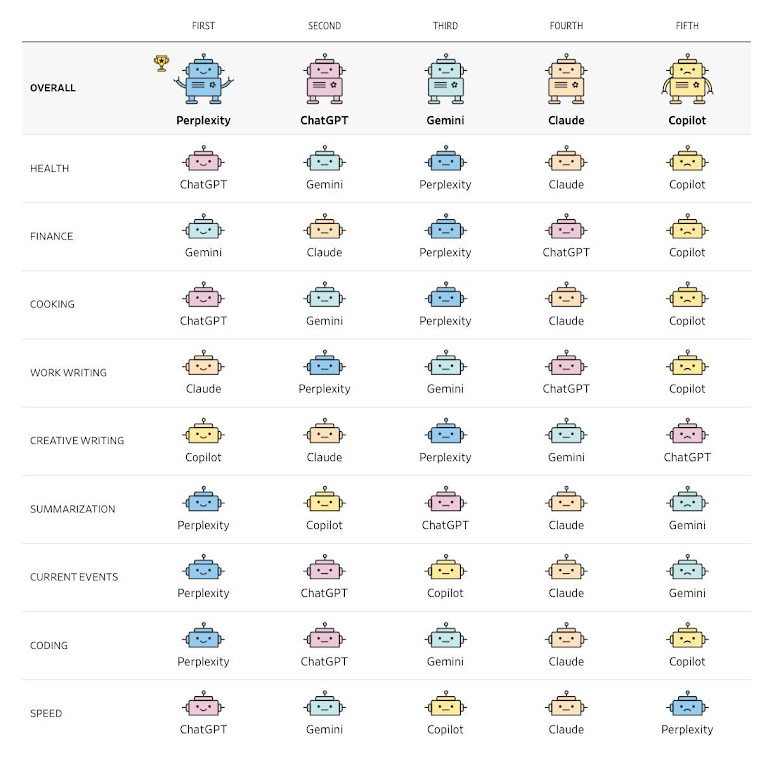
The best chatbots in different areas, tested by Wall Street Journal.

The best chatbots in different areas, tested by Wall Street Journal.

The stakes are getting more serious. What used to be a bunch of experiments and chatbot mishaps has escalated into geopolitical competition, trillion-dollar ambitions, and real societal tradeoffs.

Will the next wave of models be safe, open, and fair? Or will they be optimized for control and profit? Can governments regulate AI without falling behind China or killing innovation? And what happens when we start offloading real decision-making to AI agents, not just tasks?

The Most Important Trends This Year

Before we get to the specific launches, it’s important to look at the macro trends for the AI world in the second half of the year:

Multimodal Everything

Text-only is not enough anymore. The dominant players are racing to roll out systems that understand and generate not just text, but images, video, audio, and code. Google’s Gemini, OpenAI’s Operator, and Amazon’s Nova suite are all converging toward AI that can handle multiple formats in a single flow. Expect the second half of 2025 to be filled with “multimodal-native” experiences, AI tools that feel less like chatbots and more like creative, perceptive collaborators.

Closed vs. Open Gets Political

The fight over open-source AI is heating up. Meta and Mistral continue to champion open releases, while OpenAI and Google double down on closed systems. The Copyright Office report, Trump’s firing of its director, and the growing list of lawsuits, including Disney vs. Midjourney, make it clear: AI IP battles are political, cultural, and global.

AI Agents Rise

2023 and 2024 were the years of AI assistants. Now, we’re starting to see the rise of agents: models that don’t just answer, but act. Claude 4’s long context, Operator’s autonomous API use, and Google’s Flow agent tools all hint at a world where AI can reason, decide, and operate semi-independently, without always asking permission. This will be a defining debate in the next six months: how much autonomy is too much?

Talent Wars & Infrastructure

Zuckerberg is offering $100 million contracts to AI researchers. Nvidia is building billion-dollar compute hubs. Governments are investing in national AI infrastructure. Behind every big model release is a bigger power play for people and compute. Don’t be surprised if the biggest AI story of late 2025 isn’t a product, but a defection, a lawsuit, or a new chip.

The Trust Cliff Is Real

AI is accelerating, but public trust is flatlining. The Edelman Trust Barometer shows trust in AI firms has dropped from 50% to 35% in five years. Add in deepfake laws, spiritual rebukes from the Vatican, and ongoing hallucination issues, and it’s clear: the industry is under a microscope.

What’s Actually Coming in the Second Half of 2025

It’s easy to forget how much real product is still scheduled for release. The second half of 2025 is packed with high-stakes launches that will either confirm the momentum of key players, or reshuffle the leaderboard.

Grok 4 – xAI

Elon Musk’s team is set to release Grok 4 sometime after July 4. The new version is rumored to make major significant progress in reasoning and programming, targeting the developer market with upgraded coding capabilities. After Grok 3’s surprisingly strong reception, this could be the model that cements xAI as a serious contender in the LLM race.

R2 – DeepSeek

The follow-up to DeepSeek’s headline-grabbing R1 is delayed, but still expected this year. With GPU shortages in China and pressure to outdo a model that reportedly cost just $6 million to train (on paper), all eyes are on whether R2 can keep up with Western giants like OpenAI and Anthropic, or even out-perform them.

Nova Family – Amazon

Amazon is expanding its Nova suite to more than just text and image models. Late 2025 will bring Nova’s speech-to-speech and multimodal-to-multimodal capabilities, signaling Amazon’s full entry into next-gen conversational AI. If Operator is OpenAI’s shot at a native AI interface, Nova is Amazon’s, and it’s built to scale with Alexa and AWS.

Claude 4 Extensions – Anthropic

Anthropic dropped Claude 4 Opus and Sonnet in May, but that wasn’t the end. The second half of 2025 is expected to bring expanded tool use, API integration, and maybe even an early Claude 5 preview. With Claude dominating long-context reasoning, this next wave could cement its status as the go-to “agent” model.

o5 and Operator Expansion – OpenAI

After releasing GPT-4.5, then o1, o3, and o4-mini, OpenAI is likely to push out o5 later this year, potentially focusing on deeper reasoning and reduced hallucination. Meanwhile, Operator, OpenAI’s flagship native assistant, may expand globally and beyond Pro-only users. It’s a strategic move toward owning the interface layer of AI, not just the model.

Veo 3 and Flow Tools – Google

Google’s Veo 3 (text-to-video with audio) launched in May, but more Flow and Gemini extensions are on the way. Think tighter agent integrations, more polished video generation, and ongoing battles over whether Google’s AI search features are helpful, or just disruptive.

Magistral & Devstral – Mistral AI

Europe’s open-source champion is gaining steam. Mistral’s June releases included reasoning-capable Magistral models and Devstral for coding. Follow-ups and developer-centric tools are expected by year-end, with the goal of making open models just as powerful (and more transparent) than closed alternatives.

Will We See AGI in 2025?

It’s the question that looms over every model release and every executive quote: are we nearing AGI? The industry doesn’t even agree on what AGI means. Is it passing a test, matching human reasoning, or something else entirely? But that hasn’t stopped the speculation.

Sam Altman has said he expects “something that feels like AGI” sooner than most people think. Google researchers hint that Gemini agents are already capable of multi-step planning. And Musk, never one to shy away from bold claims, insists Grok is closing in fast.

But here’s the truth: none of the major labs have demonstrated general intelligence. Yet. What we’re seeing is fast progress in narrow capabilities: better memory, longer context, smarter reasoning, more accurate coding, and increasingly autonomous tools. It’s impressive. But it’s not human-level cognition.

What’s likely is this: by the end of 2025, we’ll see models that feel a lot closer to AGI. They’ll hold multi-hour conversations, solve complex tasks across domains, and act more like agents than chatbots. But true general intelligence? That may still be a few breakthroughs away.

Disclaimer

In line with the Trust Project guidelines, please note that the information provided on this page is not intended to be and should not be interpreted as legal, tax, investment, financial, or any other form of advice. It is important to only invest what you can afford to lose and to seek independent financial advice if you have any doubts. For further information, we suggest referring to the terms and conditions as well as the help and support pages provided by the issuer or advertiser. MetaversePost is committed to accurate, unbiased reporting, but market conditions are subject to change without notice.

About The Author


Alisa, a dedicated journalist at the MPost, specializes in cryptocurrency, zero-knowledge proofs, investments, and the expansive realm of Web3. With a keen eye for emerging trends and technologies, she delivers comprehensive coverage to inform and engage readers in the ever-evolving landscape of digital finance.

More articles


Alisa Davidson


Alisa, a dedicated journalist at the MPost, specializes in cryptocurrency, zero-knowledge proofs, investments, and the expansive realm of Web3. With a keen eye for emerging trends and technologies, she delivers comprehensive coverage to inform and engage readers in the ever-evolving landscape of digital finance.


More articles


Source link

Binance Research: Early Crypto Treasury Strategies Show Mixed Results, Stablecoins Surpass $250B And DEXs Gain Market Share In June

Binance Research: Early Crypto Treasury Strategies Show Mixed Results, Stablecoins Surpass 0B And DEXs Gain Market Share In June


In Brief

Binance Research’s July 2025 report highlights that despite geopolitical volatility and a modest 2.62% market cap increase in June, Bitcoin strengthened its dominance amid altcoin declines, while strong ETF inflows supported market stability.

Binance Research: Early Crypto Treasury Strategies Show Mixed Results, Stablecoins Surpass $250B And DEXs Gain Market Share In June

Market analysis division of the cryptocurrency exchange Binance, Binance Research released its Monthly Market Report for July 2025. The analysis notes that in June, the total cryptocurrency market capitalization grew modestly by 2.62%, despite high volatility driven mainly by geopolitical tensions in the Middle East. Concerns about potential disruptions to global energy supplies and regional instability negatively affected asset prices, with Bitcoin notably dropping below the US$100,000 mark. 

However, as tensions eased, market confidence improved, leading to a stabilization of prices. In a challenging macroeconomic environment, Bitcoin showed resilience by strengthening its market position and increasing its dominance to 65%, the highest since early 2021, as investors adopted a risk-averse approach favoring Bitcoin’s perceived stability and liquidity. 

Meanwhile, altcoins continued to decline. The report also highlights continued strong inflows into cryptocurrency ETFs, reflecting strong institutional demand and growing confidence in the sector’s long-term prospects. These inflows have contributed to market liquidity and stability, supporting steady market conditions despite recent volatility.

The market showed recovery in April and May, but the escalation of geopolitical tensions in the Middle East this month triggered widespread risk-averse behavior. Following the Geneva talks in May, the US-China trade conflict entered a temporary pause, marked by tariff reductions and lifted retaliatory measures, culminating in a signed trade agreement by late June, which signaled a reduction in short-term trade uncertainty. 

The World Equity Market Economic Uncertainty Index (WLEMUINDXD), used as an indicator of market uncertainty, surged due to the Middle East tensions but remained below the levels seen during April’s trade disputes. The US technology sector demonstrated more resilience than Bitcoin, with the Nasdaq-100 experiencing only a 1.3% decline between June 12 and 20 before rebounding after a ceasefire and closing June with a 5.5% gain. In contrast, the cryptocurrency market acted as a high-beta risk amplifier, reacting more sharply to geopolitical developments. Bitcoin dropped more than 11%, falling from around $110,316 on June 9 to approximately $98,000 on June 23, before recovering to close June at $107,167. Despite a modest 1.3% gain for the month, Bitcoin’s risk and reward profile underperformed compared to the Nasdaq. 

This indicates that distant geopolitical conflicts have limited direct effects on U.S. tech and consumer stocks unless they escalate into a global energy crisis. The higher proportion of retail and speculative investors in cryptocurrency markets, combined with leveraged derivatives, contributes to increased volatility—more than $1.5 billion in long positions were liquidated on June 22, marking the largest three-day liquidation event since February. Despite the ongoing volatility, institutional interest remains strong, with Bitcoin and Ethereum ETFs recording net inflows of $4.49 billion and $1.16 billion, respectively. This dynamic underscores a growing divide between short-term traders and long-term investors, reinforcing cryptocurrency’s appeal as a long-term investment option.

Public Markets Assess The Sustainability Of Crypto-Linked Treasury Strategies

MicroStrategy and Japan’s Metaplanet remain prominent examples of publicly traded companies that adopted crypto-linked treasury strategies early on. Their notable returns since implementing these approaches have likely spurred interest among other firms aiming to replicate their apparent success. More recently, however, newer companies such as Sharplink, SRM Entertainment, and Nano Labs, which have allocated funds to cryptocurrencies like ETH, TRX, and BNB, have not yet demonstrated comparable long-term results beyond initial market enthusiasm. A similar pattern is observed in Bitcoin mining and hardware stocks, where early entrants like Riot Platforms, which shifted to a mining strategy in 2017, still trade below their historical peaks, highlighting that early adoption does not guarantee sustained shareholder value.

In contrast, Circle, a stablecoin issuer that went public in June, has quickly emerged as one of the better-performing fintech IPOs in recent times. Compared to more speculative treasury adopters, Circle’s performance has shown greater stability, likely reflecting stronger market confidence in its fundamental business model rather than solely its cryptocurrency asset holdings. Meanwhile, cryptocurrency exchange platforms such as Robinhood and Coinbase continue to attract steady investor interest, with Robinhood achieving record highs and Coinbase nearing its previous peak. Robinhood’s acquisition of Bitstamp further illustrates how traditional finance firms are willing to invest in established cryptocurrency infrastructure, indicating a deepening involvement in the cryptocurrency ecosystem beyond treasury-related strategies.

While adding cryptocurrency exposure has often led to short-term stock price increases, the uneven performance across sectors—from early mining ventures to newer treasury allocations—raises important questions about the sustainability of this trend. The key uncertainty is whether public markets will continue to reward crypto-linked balance sheet strategies or if the current enthusiasm represents a temporary phase. For many investors, this period constitutes their initial meaningful exposure to digital assets through public equities. With a growing pipeline of potential crypto-related listings, this trend of exposure may continue, broadening the presence of digital assets in public markets. The coming quarters will likely provide greater clarity on whether cryptocurrency integration becomes a lasting paradigm or remains a short-lived market phenomenon.

Stablecoins Cross $250B Mark, While CEX-DEX Ratio Reaches ATH 

Binance Research reports that the stablecoin supply surpassed $250 billion for the first time in June, with on-chain transaction volumes exceeding those of the same period last year by more than $7.5 trillion. This achievement coincides with the US Senate’s passage of the GENIUS Act, which has boosted optimism among investors and corporations by suggesting that clearer regulations could drive increased institutional and payment-related demand. Stablecoins are increasingly regarded as a key gateway for cryptocurrency’s broader adoption in mainstream finance. 

Additionally, the report notes that the ratio of decentralized exchange (DEX) to centralized exchange (CEX) spot trade volume reached a record 27.9% in June. PancakeSwap, among the DEX platforms, experienced the largest market share increase, rising from 16% in April to 42% in June, likely benefiting from its Infinity upgrade, which improved trading speed, reduced costs, and enhanced liquidity efficiency.

Disclaimer

In line with the Trust Project guidelines, please note that the information provided on this page is not intended to be and should not be interpreted as legal, tax, investment, financial, or any other form of advice. It is important to only invest what you can afford to lose and to seek independent financial advice if you have any doubts. For further information, we suggest referring to the terms and conditions as well as the help and support pages provided by the issuer or advertiser. MetaversePost is committed to accurate, unbiased reporting, but market conditions are subject to change without notice.

About The Author


Alisa, a dedicated journalist at the MPost, specializes in cryptocurrency, zero-knowledge proofs, investments, and the expansive realm of Web3. With a keen eye for emerging trends and technologies, she delivers comprehensive coverage to inform and engage readers in the ever-evolving landscape of digital finance.

More articles


Alisa Davidson


Alisa, a dedicated journalist at the MPost, specializes in cryptocurrency, zero-knowledge proofs, investments, and the expansive realm of Web3. With a keen eye for emerging trends and technologies, she delivers comprehensive coverage to inform and engage readers in the ever-evolving landscape of digital finance.


More articles



Source link

Chainwire Expands To 25 Regional PR Packages, Delivering Localized Crypto PR At Global Scale

Chainwire Expands To 25 Regional PR Packages, Delivering Localized Crypto PR At Global Scale


In Brief

Chainwire has expanded its global reach by launching 25 region-specific PR packages, enabling Web3 projects to distribute professionally translated press releases with guaranteed placement on leading crypto media outlets.

Chainwire Expands To 25 Regional PR Packages, Delivering Localized Crypto PR At Global Scale

Press release distribution platform focused on cryptocurrency and Web3 projects, Chainwire expanded its operations through the introduction of 25 region-specific public relations packages. This development allows Web3 organizations to distribute translated press releases to leading crypto media outlets in designated regions, with confirmed placement and real-time performance tracking. 

With partnerships now established with over 100 regional crypto-focused media platforms, Chainwire has built what it describes as the most comprehensive native-language PR network in the industry. The move reflects an effort to enhance the effectiveness of global communication strategies in the Web3 sector by enabling more targeted, localized outreach that moves beyond primarily US-focused campaigns.

“The crypto media landscape is increasingly regional, and the ability to communicate locally has gone from optional to essential,” said Alon Keren, CMO of Chainwire, in a written statement. “With this expansion, we’re giving teams one-click access to trusted outlets in every major market,” he added.

Global Localized Distribution For The Crypto Industry

Chainwire’s regional public relations packages are structured to include human translation conducted by professionals with crypto industry expertise, along with confirmed editorial placement on multiple high-profile crypto-focused news platforms within the designated market. 

Unlike conventional newswire services that may translate and publish content on their own sites or within general financial sections, Chainwire emphasizes direct distribution to crypto-native media outlets, ensuring relevance and targeted visibility. These packages support content syndication across homepage feeds, indexing by search engines, and integration with news aggregation services. The geographic scope of the expansion now facilitates comprehensive public relations campaigns across numerous key regions. 

In the Asia-Pacific area, supported markets include China, Japan, South Korea, Vietnam, Thailand, Indonesia, India, and Taiwan. In Europe, the offering extends to Germany, France, Italy, Spain, Turkey, the Netherlands, Poland, Romania, Bulgaria, and the Nordic countries. In the Middle East and North Africa, coverage includes the UAE, Israel, and Arabic-speaking nations within the MENA and GCC regions. Across the Americas, supported areas include the United States, Canada, Mexico, Brazil, and Spanish-speaking Latin America. Additional regional packages are available for Russia, Ukraine, and Kazakhstan. Leading media organizations within these regions are already integrating Chainwire’s infrastructure as a foundational component for executing regionally focused cryptocurrency communication strategies.

“Investing.com reaches a global audience with real-time financial and crypto news, tools, and data, and Chainwire’s infrastructure enables fast, accurate delivery across our various language editions,” said Yoav Raif, Director of Sales and Business Development at Investing.com, in a written statement. “Their crypto-native localization capabilities complement our global reach,” he added.

“Turkey has one of the highest crypto adoption rates in the world, and demand for timely, credible Web3 news is growing rapidly,” said Yusuf Numanoğlu, Founder of Bitcoin Sistemi, in a written statement. “Chainwire gives global projects a direct channel to reach Turkish crypto users with localized content delivered through trusted media — a crucial edge in such a fast-moving market,” he added.

“Localized messaging isn’t a nice-to-have in Korea; it’s a necessity,” said Ethan Choi, Chief Strategy Officer at BlockMedia, in a written statement. “Chainwire bridges that gap with native content published directly to Korean crypto readers,” he added.

Disclaimer

In line with the Trust Project guidelines, please note that the information provided on this page is not intended to be and should not be interpreted as legal, tax, investment, financial, or any other form of advice. It is important to only invest what you can afford to lose and to seek independent financial advice if you have any doubts. For further information, we suggest referring to the terms and conditions as well as the help and support pages provided by the issuer or advertiser. MetaversePost is committed to accurate, unbiased reporting, but market conditions are subject to change without notice.

About The Author


Alisa, a dedicated journalist at the MPost, specializes in cryptocurrency, zero-knowledge proofs, investments, and the expansive realm of Web3. With a keen eye for emerging trends and technologies, she delivers comprehensive coverage to inform and engage readers in the ever-evolving landscape of digital finance.

More articles


Alisa Davidson


Alisa, a dedicated journalist at the MPost, specializes in cryptocurrency, zero-knowledge proofs, investments, and the expansive realm of Web3. With a keen eye for emerging trends and technologies, she delivers comprehensive coverage to inform and engage readers in the ever-evolving landscape of digital finance.


More articles



Source link

Gate Launches xStocks Trading Platform, Bridging Crypto And Global Capital Markets

Gate Launches xStocks Trading Platform, Bridging Crypto And Global Capital Markets


In Brief

Gate has launched xStocks, the world’s first futures and spot trading section for fully collateralized tokenized US stocks, enabling global users to trade these assets with cryptocurrencies like USDT without KYC, bridging traditional finance and crypto markets.

Gate Launches xStocks Trading Platform, Bridging Crypto And Global Capital Markets

Cryptocurrency exchange Gate introduced the xStocks trading section, which includes both spot and futures markets. The launch features eight tokenized stocks, such as COINX, NVDAX, CRCLX, AAPLX, METAX, HOODX, TSLAX, and GOOGLX, allowing users worldwide to trade these tokenized stocks using cryptocurrency assets like USDT. Additionally, Gate Alpha has added support for xStocks, listing MSTRx, CRCLx, SPYx, NVDAx, TSLAx, and AAPLx, thereby broadening users’ access to on-chain assets and offering more strategic trading opportunities. 

This development expands investment options for cryptocurrency users and represents a significant step toward integrating cryptocurrency finance with traditional financial markets. Gate is the first platform to offer a futures market for tokenized stocks, creating a comprehensive trading ecosystem at the intersection of digital and conventional finance.

Gate’s xStocks trading section utilizes a compliant, asset-backed tokenization framework in which all tokens are fully collateralized and correspond to publicly traded US stocks. These tokens are transferable and interoperable across various blockchains and ecosystems. Unlike conventional brokers that often require regional accounts, extensive KYC procedures, and fiat currency settlements, Gate’s tokenized stock services are accessible worldwide without KYC requirements, enabling users to invest with USDT and other cryptocurrencies. This borderless approach reduces barriers for international participants, facilitating seamless cross-border capital flows and global portfolio diversification. Additionally, the platform offers round-the-clock trading, fractional ownership, and on-chain liquidity, overcoming traditional limitations related to trading hours and regulations, and providing a flexible, decentralized investment environment that bridges traditional finance and decentralized finance (DeFi).

World’s First Futures Market For Tokenized Stocks Sets New Standards In Derivatives Trading

Gate has become the first platform worldwide to introduce a futures market for tokenized stocks, allowing users to utilize leverage and implement two-way trading strategies on US stocks, all priced in USDT, thereby enabling more flexible risk and return management. The trading infrastructure has been comprehensively enhanced to support this launch, including improvements to matching engines, pricing models, and risk control mechanisms. Designed specifically to accommodate the liquidity characteristics of US stocks and the trading behaviors of crypto-native users, the system offers high responsiveness, strong integration, and a seamless experience across both spot and futures markets.

Gate’s move into tokenized stocks marks a notable step in its ongoing effort to bridge traditional finance with emerging digital assets. By developing infrastructure tailored for traditional assets within a crypto-native environment, Gate is reshaping how investors engage with global financial markets. The company’s leadership has emphasized its goal of creating a global, borderless investment platform that broadens access to financial opportunities worldwide. In 2025, Gate completed a major rebranding and consolidated its online presence under Gate.com, reflecting a renewed focus on its global growth strategy. The platform currently holds a top position in spot trading volume worldwide and maintains strong performance in derivatives, liquidity, and user engagement. As the financial sector continues to evolve through digital innovation, Gate’s introduction of tokenized stocks serves as an example of how decentralized technologies can integrate with traditional markets, advancing the platform’s mission to become a leading next-generation cryptocurrency exchange.

Disclaimer

In line with the Trust Project guidelines, please note that the information provided on this page is not intended to be and should not be interpreted as legal, tax, investment, financial, or any other form of advice. It is important to only invest what you can afford to lose and to seek independent financial advice if you have any doubts. For further information, we suggest referring to the terms and conditions as well as the help and support pages provided by the issuer or advertiser. MetaversePost is committed to accurate, unbiased reporting, but market conditions are subject to change without notice.

About The Author


Alisa, a dedicated journalist at the MPost, specializes in cryptocurrency, zero-knowledge proofs, investments, and the expansive realm of Web3. With a keen eye for emerging trends and technologies, she delivers comprehensive coverage to inform and engage readers in the ever-evolving landscape of digital finance.

More articles


Alisa Davidson


Alisa, a dedicated journalist at the MPost, specializes in cryptocurrency, zero-knowledge proofs, investments, and the expansive realm of Web3. With a keen eye for emerging trends and technologies, she delivers comprehensive coverage to inform and engage readers in the ever-evolving landscape of digital finance.


More articles



Source link

SCOR on Sweet Drops ‘Flappy Racquet’ Featuring Top Tennis Pros for Wimbledon | NFT News Today

SCOR on Sweet Drops ‘Flappy Racquet’ Featuring Top Tennis Pros for Wimbledon | NFT News Today


Just in time for Wimbledon, Web3 platform Sweet has launched Flappy Racquet, the latest title in its SCOR on Sweet mini-app ecosystem. It lets fans take control of animated tennis pros and compete for real-world rewards. Available now on Telegram, web, and mobile, the game blends arcade-style action with athlete star power and digital perks.

Key Takeaways

Sweet’s Flappy Racquet mini-game launches during Wimbledon, adding tennis-themed arcade fun to the tournament buzz.

It features animated versions of top players including Aryna Sabalenka, Nick Kyrgios, Naomi Osaka, and others, each with unique power-ups.

Players collect Gems, convertible to $SCOR tokens once live, redeemable for rewards like signed gear and meet-and-greets.

Built-in partnership with Winners Alliance to boost athlete visibility and offer new digital engagement for fans.

From the Court to Your Screen

Inspired by the viral Flappy Bird, Flappy Racquet swaps birds for rackets as players tap their way through obstacles using tennis pro avatars. The simple, addictive gameplay challenges players to stay in motion while collecting Gems tied to performance and real-world rewards.

The roster includes stars like Aryna Sabalenka, 2023 Wimbledon champ Marketa Vondrousova, and Nick Kyrgios, known for his showmanship on grass. Each avatar brings special in-game perks when owned by a user, making who you play with part of your strategy.

Source: Sweet & Winners Alliance

Timed with Wimbledon, the launch gives fans a new way to stay connected with the tournament—and their favorite players—even when they’re off the court.

Furthermore, Gems earned in-game will be convertible to $SCOR tokens once live, unlocking access to Sweet’s marketplace of rewards, upgrades, and collectibles.

Players can play Flappy Racquet via SCOR on Sweet, alongside other games and features tied to upcoming athlete activations.

Real Rewards, Real Players

The game is backed by Winners Alliance, a global platform that represents group commercial rights for athletes and works with organizations like the Professional Tennis Players Association (PTPA). Their partnership with Sweet opens up new ways for players to benefit from their likeness—and for fans to interact with them in meaningful ways.

“Our mission has always been to put athletes first, and this collaboration helps us create new value for both players and fans,” said Manny Redruello, VP of Games at Winners Alliance. He noted that SCOR is designed to “celebrate the individual talents of the world’s best tennis players” while driving new visibility and opportunity across the sport.

Sweet CEO Tom Mizzone echoed that sentiment, describing Flappy Racquet as “a mash-up of nostalgia, athlete IP, and real rewards.” He added, “Whether you’re a tennis diehard or just someone who loves a good challenge, this one’s going to hit.”

Sweet’s broader approach is all about building connections between fans and athletes—not just through likes or follows, but through gameplay, rewards, and unique experiences.


Source link

10 Security Risks You Need To Know When Using AI For Work

10 Security Risks You Need To Know When Using AI For Work


In Brief

By mid-2025, AI is deeply embedded in workplace operations, but widespread use—especially through unsecured tools—has significantly increased cybersecurity risks, prompting urgent calls for better data governance, access controls, and AI-specific security policies.

10 Security Risks You Need To Know When Using AI For Work

By mid‑2025, artificial intelligence is no longer a futuristic concept in the workplace. It’s embedded in daily workflows across marketing, legal, engineering, customer support, HR, and more. AI models now assist with drafting documents, generating reports, coding, and even automating internal chat support. But as reliance on AI grows, so does the risk landscape.

A report by Cybersecurity Ventures projects global cybercrime costs to reach $10.5 trillion by 2025, reflecting a 38 % annual increase in AI-related breaches compared to the previous year. That same source estimates around 64 % of enterprise teams use generative AI in some capacity, while only 21 % of these organizations have formal data handling policies in place.

These numbers are not just industry buzz—they point to growing exposure at scale. With most teams still relying on public or free-tier AI tools, the need for AI security awareness is pressing.

Below are the 10 critical security risks that teams encounter when using AI at work. Each section explains the nature of the risk, how it operates, why it poses danger, and where it most commonly appears. These threats are already affecting real organizations in 2025.

Input Leakage Through Prompts

One of the most frequent security gaps begins at the first step: the prompt itself. Across marketing, HR, legal, and customer service departments, employees often paste sensitive documents, client emails, or internal code into AI tools to draft responses quickly. While this feels efficient, most platforms store at least some of this data on backend servers, where it may be logged, indexed, or used to improve models. According to a 2025 report by Varonis, 99% of companies admitted to sharing confidential or customer data with AI services without applying internal security controls..

When company data enters third-party platforms, it’s often exposed to retention policies and staff access many firms don’t fully control. Even “private” modes can store fragments for debugging. This raises legal risks—especially under GDPR, HIPAA, and similar laws. To reduce exposure, companies now use filters to remove sensitive data before sending it to AI tools and set clearer rules on what can be shared.

Hidden Data Storage in AI Logs

Many AI services keep detailed records of user prompts and outputs, even after the user deletes them. The 2025 Thales Data Threat Report noted that 45% of organizations experienced security incidents involving lingering data in AI logs.

This is especially critical in sectors like finance, law, and healthcare, where even a temporary record of names, account details, or medical histories can violate compliance agreements. Some companies assume removing data on the front end is enough; in reality, backend systems often store copies for days or weeks, especially when used for optimization or training.

Teams looking to avoid this pitfall are increasingly turning to enterprise plans with strict data retention agreements and implementing tools that confirm backend deletion, rather than relying on vague dashboard toggles that say “delete history.”

Model Drift Through Learning on Sensitive Data

Unlike traditional software, many AI platforms improve their responses by learning from user input. That means a prompt containing unique legal language, customer strategy, or proprietary code could affect future outputs given to unrelated users. The Stanford AI Index 2025 found a 56% year-over-year increase in reported cases where company-specific data inadvertently surfaced in outputs elsewhere.

In industries where the competitive edge depends on IP, even small leaks can damage revenue and reputation. Because learning happens automatically unless specifically disabled, many companies are now requiring local deployments or isolated models that do not retain user data or learn from sensitive inputs.

AI-Generated Phishing and Fraud

AI has made phishing attacks faster, more convincing, and much harder to detect. In 2025, DMARC reported a 4000% surge in AI-generated phishing campaigns, many of which used authentic internal language patterns harvested from leaked or public company data. According to Hoxhunt, voice-based deepfake scams rose by 15% this year, with average damages per attack nearing $4.88 million.

These attacks often mimic executive speech patterns and communication styles so precisely that traditional security training no longer stops them. To protect themselves, companies are expanding voice verification tools, enforcing secondary confirmation channels for high-risk approvals, and training staff to flag suspicious language, even when it looks polished and error-free.

Weak Control Over Private APIs

In the rush to deploy new tools, many teams connect AI models to systems like dashboards or CRMs using APIs with minimal protection. These integrations often miss key practices such as token rotation, rate limits, or user-specific permissions. If a token leaks—or is guessed—attackers can siphon off data or manipulate connected systems before anyone notices.

This risk is not theoretical. A recent Akamai study found that 84% of security experts reported an API security incident over the past year. And nearly half of organizations have seen data breaches because API tokens were exposed. In one case, researchers found over 18,000 exposed API secrets in public repositories.

Because these API bridges run quietly in the background, companies often spot breaches only after odd behavior in analytics or customer records. To stop this, leading firms are tightening controls by enforcing short token lifespans, running regular penetration tests on AI-connected endpoints, and keeping detailed audit logs of all API activity.

Shadow AI Adoption in Teams

By 2025, unsanctioned AI use—known as “Shadow AI”—has become widespread. A Zluri study found that 80% of enterprise AI usage happens through tools not approved by IT departments.

Employees often turn to downloadable browser extensions, low-code generators, or public AI chatbots to meet immediate needs. These tools may send internal data to unverified servers, lack encryption, or collect usage logs hidden from the organization. Without visibility into what data is shared, companies cannot enforce compliance or maintain control.

To combat this, many firms now deploy internal monitoring solutions that flag unknown services. They also maintain curated lists of approved AI tools and require employees to engage only via sanctioned channels that accompany secure environments.

Prompt Injection and Manipulated Templates

Prompt injection occurs when someone embeds harmful instructions into shared prompt templates or external inputs—hidden within legitimate text. For example, a prompt designed to “summarize the latest client email” might be altered to extract entire thread histories or reveal confidential content unintentionally. The OWASP 2025 GenAI Security Top 10 lists prompt injection as a leading vulnerability, warning that user-supplied inputs—especially when combined with external data—can easily override system instructions and bypass safeguards.

Organizations that rely on internal prompt libraries without proper oversight risk cascading problems: unwanted data exposure, misleading outputs, or corrupted workflows. This issue often arises in knowledge-management systems and automated customer or legal responses built on prompt templates. To combat the threat, experts recommend applying a layered governance process: centrally vet all prompt templates before deployment, sanitize external inputs where possible, and test prompts within isolated environments to ensure no hidden instructions slip through.

Compliance Issues From Unverified Outputs

Generative AI often delivers polished text—yet these outputs may be incomplete, inaccurate, or even non-compliant with regulations. This is especially dangerous in finance, legal, or healthcare sectors, where minor errors or misleading language can lead to fines or liability.

According to ISACA’s 2025 survey, 83% of businesses report generative AI in daily use, but only 31% have formal internal AI policies. Alarmingly, 64% of professionals expressed serious concern about misuse—yet just 18% of organizations invest in protection measures like deepfake detection or compliance reviews.

Because AI models don’t understand legal nuance, many companies now mandate human compliance or legal review of any AI-generated content before public use. That step ensures claims meet regulatory standards and avoid misleading clients or users.

Third-Party Plugin Risks

Many AI platforms offer third-party plugins that connect to email, calendars, databases, and other systems. These plugins often lack rigorous security reviews, and a 2025 Check Point Research AI Security Report found that 1 in every 80 AI prompts carried a high risk of leaking sensitive data—some of that risk originates from plugin-assisted interactions. Check Point also warns that unauthorized AI tools and misconfigured integrations are among the top emerging threats to enterprise data integrity.

When installed without review, plugins can access your prompt inputs, outputs, and associated credentials. They may send that information to external servers outside corporate oversight, sometimes without encryption or proper access logging.

Several firms now require plugin vetting before deployment, only allow whitelisted plugins, and monitor data transfers linked to active AI integrations to ensure no data leaves controlled environments.

Many organizations rely on shared AI accounts without user-specific permissions, making it impossible to track who submitted which prompts or accessed which outputs. A 2025 Varonis report analyzing 1,000 cloud environments found that 98 % of companies had unverified or unauthorized AI apps in use, and 88 % maintained ghost users with lingering access to sensitive systems (source). These findings highlight that nearly all firms face governance gaps that can lead to untraceable data leaks.

When individual access isn’t tracked, internal data misuse—whether accidental or malicious—often goes unnoticed for extended periods. Shared credentials blur responsibility and complicate incident response when breaches occur. To address this, companies are shifting to AI platforms that enforce granular permissions, prompt-level activity logs, and user attribution. This level of control makes it possible to detect unusual behavior, revoke inactive or unauthorized access promptly, and trace any data activity back to a specific individual.

What to Do Now

Look at how your teams actually use AI every day. Map out which tools handle private data and see who can access them. Set clear rules for what can be shared with AI systems and build a simple checklist: rotate API tokens, remove unused plugins, and confirm that any tool storing data has real deletion options. Most breaches happen because companies assume “someone else is watching.” In reality, security starts with the small steps you take today.

Disclaimer

In line with the Trust Project guidelines, please note that the information provided on this page is not intended to be and should not be interpreted as legal, tax, investment, financial, or any other form of advice. It is important to only invest what you can afford to lose and to seek independent financial advice if you have any doubts. For further information, we suggest referring to the terms and conditions as well as the help and support pages provided by the issuer or advertiser. MetaversePost is committed to accurate, unbiased reporting, but market conditions are subject to change without notice.

About The Author


Alisa, a dedicated journalist at the MPost, specializes in cryptocurrency, zero-knowledge proofs, investments, and the expansive realm of Web3. With a keen eye for emerging trends and technologies, she delivers comprehensive coverage to inform and engage readers in the ever-evolving landscape of digital finance.

More articles


Alisa Davidson


Alisa, a dedicated journalist at the MPost, specializes in cryptocurrency, zero-knowledge proofs, investments, and the expansive realm of Web3. With a keen eye for emerging trends and technologies, she delivers comprehensive coverage to inform and engage readers in the ever-evolving landscape of digital finance.


More articles


Source link

All Speakers at Hack Seasons Cannes 2025: The Full Lineup

All Speakers at Hack Seasons Cannes 2025: The Full Lineup


In Brief

Hack Seasons has established itself as the true brainport of the Web3 world, a place where founders, developers, and investors come not just to network, but to set the agenda for the industry’s future.

All Speakers at Hack Seasons Cannes 2025: The Full Lineup

Hack Seasons has established itself as the true brainport of the Web3 world, a place where founders, developers, and investors come not just to network, but to set the agenda for the industry’s future. Every edition is known for its consistently top-tier speaker lineups and panels that go beyond hype, delivering real substance and insight. 

This summer’s Hack Seasons Cannes continues that tradition, drawing more than 70 leading voices from across blockchain, AI, and DeFi to the iconic Hôtel Barrière Le Majestic. 

Main Stage: Thought Leaders and Industry Visionaries

The Main Stage at Hack Seasons Cannes will open with a panel on venture capital trends, moderated by Mickey Hardy, President & Chairman of Arcadia. Joining him are Casper Johansen, Co-founder of Spartan Group, Ian Xu, Vice President at Foresight Ventures, and Zurab Kazhiloti, Founding Partner of Bitscale VC. This session will set the tone for a day of high-level discussions about the future of investment in Web3.

The conversation then shifts to the future of AI and AI agents. Tomer Sharoni, CEO of Addressable, will moderate a panel featuring Tom Trowbridge (Fluence), Mathieu Baudet (Linera), Clara Tsao (Filecoin), and Kamesh (Openledger), who will explore strategies for thriving in the new AI era.

A fireside chat will bring together Declan Fox, Head of Linea, and Tomasz, Co-executive Director of the Ethereum Foundation, for an in-depth discussion on the evolution of blockchain infrastructure.

The focus then turns to real-world asset tokenization. Josh Kriger (Edge of Show) will moderate a panel with Kristal Gruevski (Zivoe), Matt Blumberg (Ondo), Laura Vidiella (Vaneck), and Chris Yin (Plume), examining why tokenization is no longer optional for the industry.

Martin ‘Mr TON’ Masser, Head of Growth at TON, will lead a discussion on multichain interoperability with Ahmet Ozcan (ODOS), Sergej Kunz (1inch), Victor Ji (Manta), and Prabal Banerjee (Avail), highlighting the challenges and opportunities in designing for a multichain future.

In the afternoon, Nikita Sachdev (LunaPR) will moderate a panel on “what’s still worth building,” with insights from Nenter Chow (Bitmart), Akshat Vaidya (Maelstrom), and Ryan Kim (Hashed). This will be followed by a DeFi-focused session led by Francesco Andreolí (Metamask), featuring Ash V. Khatibi (Sonic), Michael Mogren (SwapKit), Lorena (Lista DAO), and Mike Silagadze (Etherfi), who will discuss scaling what actually works in DeFi.

The Main Stage will conclude with keynotes from Alexandre Belling (Linea), Head of Cryptography, and Alena Shmalko (TON Foundation), Director of Ecosystem Success, both recognized for their leadership in cryptography and ecosystem growth.

Tech Stage: Deep Dives and Developer-Focused Content

The Tech Stage at Hack Seasons Cannes will open with a session on RWA tokenization, moderated by Bora from Celestia. Panelists include Mark Trang (D3), Arthur Firstov (Mercuryo), Austin Ballard (Offchain Labs), and Ossie Amir (Wormhole), who will discuss practical approaches to tokenizing real-world assets.

Jay Z (NEAR AI) will lead a discussion on trustless AI, joined by Deli Gong (Automata), Juan Bruce (SuperNet), Teana Baker-Taylor (VeniceAI), and Devansh Mehta (Ethereum Foundation), exploring how to build AI systems that don’t require trust.

A panel on developer infrastructure will be moderated by Pauline Barnades (Wormhole), with contributions from Henri Lieutaud (Starknet), Grigore Roșu (Pi Squared), dcbuilder.eth (Worldcoin), and Martin Eckardt (Ava Labs), focusing on infrastructure that developers actually use.

Key technical keynotes will be delivered by Alon Muroch (SSV Labs), who will present on Ethereum unification, and Ramkumar (Openledger), who will introduce the blockchain built for specialized AI.

Cross-chain DeFi will be explored by Daosasha (1inch) alongside Amrit Kumar (AltLayer), Solange Gueiros (Chainlink), Amir Forouzani (Puffer), and Marco Monaco (TAC), discussing how to win users and volume in a fragmented ecosystem.

The session “Building AI That Lets the Chain Think for Itself” will be moderated by Moz (Akindo) and feature Tom Trowbridge (Fluence), Anthony Simonet Boulogne (iExec), Igor Lessio (ElizaOS), and Lane (NEAR), delving into the next generation of on-chain AI.

Workshops will be led by Inder Singh (D3) and Daniil Romazanov (Reactive Network), while Francis Otshudi (iExec) will provide a closing keynote. The day will wrap up with a panel on prediction markets, moderated by Alex Mukhin, featuring Will Robinson (Alliance Foundation) and David Christopher (Bankless).

Disclaimer

In line with the Trust Project guidelines, please note that the information provided on this page is not intended to be and should not be interpreted as legal, tax, investment, financial, or any other form of advice. It is important to only invest what you can afford to lose and to seek independent financial advice if you have any doubts. For further information, we suggest referring to the terms and conditions as well as the help and support pages provided by the issuer or advertiser. MetaversePost is committed to accurate, unbiased reporting, but market conditions are subject to change without notice.

About The Author


Victoria is a writer on a variety of technology topics including Web3.0, AI and cryptocurrencies. Her extensive experience allows her to write insightful articles for the wider audience.

More articles


Victoria d’Este


Victoria is a writer on a variety of technology topics including Web3.0, AI and cryptocurrencies. Her extensive experience allows her to write insightful articles for the wider audience.


Source link

Popular Posts

My Favorites