Metaverse

Home Metaverse Page 132

Hedra Launches Live Avatars With LiveKit, Delivering Real-Time AI Characters At Ultra-Low Latency And Cost

Hedra Launches Live Avatars With LiveKit, Delivering Real-Time AI Characters At Ultra-Low Latency And Cost


In Brief

Hedra has launched Live Avatars, a real-time AI-driven avatar solution developed with LiveKit, offering lifelike digital characters for use across media, education, customer service, and gaming at a cost-efficient price point.

Hedra Launches Live Avatars With LiveKit, Delivering Real-Time AI Characters At Ultra-Low Latency And Cost

Multimodal artificial intelligence platform Hedra has introduced a new offering called Hedra Live Avatars, developed in partnership with LiveKit, an open-source framework for real-time media application development. This joint initiative presents what is positioned as one of the most advanced streaming avatar models currently available.

LiveKit, which is based on the WebRTC protocol, provides infrastructure for scalable and low-latency transmission of video, audio, and data. This makes it suitable for real-time digital communication across a wide range of applications.

Hedra Live Avatars enable the creation of digital characters capable of participating in live, two-way interactions. The technology supports use cases in several sectors. In the content production and social media space, it can be used to generate virtual hosts or animated personas for platforms such as YouTube, TikTok, and Instagram, offering an alternative to traditional video production methods at a lower cost. In commercial and marketing contexts, companies can implement AI-driven brand representatives or customer support avatars, combining facial animation and movement tracking to deliver realistic engagement.

The educational and training sectors can also leverage these avatars to facilitate interactive lessons with lifelike instructor avatars that use natural gestures and facial expressions to support better knowledge retention. For gaming and virtual reality, the platform’s flexible rendering capabilities allow for the efficient generation of non-player characters in various visual styles, streamlining the development process for immersive environments.

Why Hedra Live Avatars Are Setting A New Standard In Real-Time AI Animation

Utilizing the global infrastructure provided by LiveKit, Hedra Live Avatars can operate with latency under 100 milliseconds, enabling real-time responsiveness essential for live broadcasts, remote meetings, and digital learning environments.

Hedra’s system integrates with major large language models and text-to-speech technologies, including those developed by Google and OpenAI. This compatibility allows users to configure custom avatars using different voice and language tools to meet varied communication requirements.

The platform also supports multiple aesthetic formats, ranging from realistic human likenesses to stylized or artistic designs, all of which can be created from a single static image. This broad range of output options is intended to meet diverse creative and professional needs.

At a rate of five cents per minute, the service is priced to be more accessible than many comparable alternatives. The model is designed to reduce the cost of deploying sophisticated AI-driven avatars, making it a viable solution for both small-scale users and larger organizations.

Hedra is a technology platform driven by artificial intelligence that facilitates the creation of detailed and expressive digital avatars. These avatars can represent human characters, animals, or stylized forms, generated by merging a single uploaded image with synthesized speech. At the core of the system is the proprietary Character‑3 omnimodal model, which unifies video, audio, movement, and emotional expression into a single framework. This allows the platform to generate synchronized speech and motion in natural language, producing lifelike talking avatars without the need for customized or industry-specific configurations.

Disclaimer

In line with the Trust Project guidelines, please note that the information provided on this page is not intended to be and should not be interpreted as legal, tax, investment, financial, or any other form of advice. It is important to only invest what you can afford to lose and to seek independent financial advice if you have any doubts. For further information, we suggest referring to the terms and conditions as well as the help and support pages provided by the issuer or advertiser. MetaversePost is committed to accurate, unbiased reporting, but market conditions are subject to change without notice.

About The Author


Alisa, a dedicated journalist at the MPost, specializes in cryptocurrency, zero-knowledge proofs, investments, and the expansive realm of Web3. With a keen eye for emerging trends and technologies, she delivers comprehensive coverage to inform and engage readers in the ever-evolving landscape of digital finance.

More articles


Alisa Davidson


Alisa, a dedicated journalist at the MPost, specializes in cryptocurrency, zero-knowledge proofs, investments, and the expansive realm of Web3. With a keen eye for emerging trends and technologies, she delivers comprehensive coverage to inform and engage readers in the ever-evolving landscape of digital finance.


More articles


Source link

ListaDAO’s Vision for Everyday DeFi: Simpler, Safer, and Ready for Everyone

ListaDAO’s Vision for Everyday DeFi: Simpler, Safer, and Ready for Everyone


In Brief

Kay Zhao, Marketing Lead at Lista DAO, discussed DeFi’s obstacles and how Lista is addressing them through simplicity, product-market fit, and user-centric innovation.

At Hack Seasons Cannes, Kay Zhao, Marketing Lead at Lista DAO, shared a candid and refreshing take on what’s still holding DeFi back,  and how Lista is working to remove those obstacles with simplicity, product-market fit, and real user-centric innovation. From removing barriers to onboarding to launching high-yield, high-demand lending products, Lista is quickly becoming a first stop for DeFi newcomers and power users alike.

Why DeFi Still Feels Distant, And How Lista Is Changing That

“A lot of people still don’t know what DeFi is. And even when you explain it, they might not use it. And even if they use it, they might not stick around,” Kay admitted. For Lista, this is more than a UX problem—it’s an ecosystem challenge.

To address it, the team focuses on education and accessibility. “We run campaigns on outlets like Cointelegraph, host boost camps, and partner with wallets like Binance Wallet to make things one-click easy. If you want to stake BNB for 18% APY, just open the wallet, tap, and you’re done.”

This ease of use, Zhao explained, is critical to getting first-time users into DeFi—and keeping them there. “Once users feel supported and understand the value, they stick around.”

How Lista Lending Hit $1B TVL by Listening to Users

Lista’s approach to innovation isn’t driven by hype—it’s driven by data and demand. Lista Lending, one of the protocol’s core products, recently crossed $1 billion in TVL just two months after launch.

“Most lending TVL on other chains makes up 50% of total value. But on BNB Chain, it’s only 20–30%,” said Zhao. “We saw the gap, and we filled it.”

From there, they built a lending protocol tailored to real user needs: better rates, higher LTV, and reliable liquidity. “Our looped BNB vault is at 93% utilization, above our 90% target. That tells you the product is working, it’s not just hype.”

Who’s Lista For? 

With three core pillars, CDP, Lista Lending, and Liquid Staking, Lista’s ecosystem offers something for every type of DeFi user.

“If you’re a long-term BTC holder, you can use our CDP to borrow without selling,” Zhao explained. “If you’re after passive yield, our liquid BNB staking offers up to 18% APY, with strategies to loop that further.”

More conservative users can integrate with partners like Pendle for defensive strategies, while aggressive yield farmers can explore up to 100x looped positions. “We don’t necessarily recommend going that high,” she smiled, “but we give users the tools. You’re in control.”

Your First Stop in DeFi, Cross-Chain and Beyond

Zhao’s long-term vision for Lista DAO is bold and inclusive: “We want to be the first stop for anyone entering DeFi, whether they’re in the industry or not.”

This means simplicity, security, and accessibility. “We want people to feel safe, get high yield, and enjoy an easy-to-use platform.”

Looking ahead, Lista plans to expand beyond its current focus on BNB Chain and Ethereum, pushing toward a cross-chain future that brings its offerings to even more users. “Wherever you are, we want you to feel comfortable accessing DeFi through Lista.”

A Gateway, Not a Walled Garden

In a space that often feels complex and exclusionary, Lista DAO is building something refreshingly simple: a platform for everyone, from curious newcomers to DeFi natives, backed by real demand, real yields, and a human touch.

“Users shouldn’t have to choose between simplicity and performance,” Zhao concluded. “At Lista, they get both.”

Disclaimer

In line with the Trust Project guidelines, please note that the information provided on this page is not intended to be and should not be interpreted as legal, tax, investment, financial, or any other form of advice. It is important to only invest what you can afford to lose and to seek independent financial advice if you have any doubts. For further information, we suggest referring to the terms and conditions as well as the help and support pages provided by the issuer or advertiser. MetaversePost is committed to accurate, unbiased reporting, but market conditions are subject to change without notice.

About The Author


Victoria is a writer on a variety of technology topics including Web3.0, AI and cryptocurrencies. Her extensive experience allows her to write insightful articles for the wider audience.

More articles


Victoria d’Este


Victoria is a writer on a variety of technology topics including Web3.0, AI and cryptocurrencies. Her extensive experience allows her to write insightful articles for the wider audience.


Source link

A $7.8M stealth CryptoPunks acquisition signals renewed whale interest in NFTs amid Ethereum’s rally and a resurgent market. | NFT News Today

A .8M stealth CryptoPunks acquisition signals renewed whale interest in NFTs amid Ethereum’s rally and a resurgent market. | NFT News Today


A mysterious $7.8 million purchase of 45 CryptoPunks NFTs has reignited speculation about big-money players quietly reentering the NFT market. The buyer—a newly created wallet with no prior trading history—executed the entire acquisition within minutes, sparking a dramatic rise in floor prices and renewed momentum across top Ethereum-based collections.

Key Takeaways

A stealth $7.8M CryptoPunks buy hints at major players quietly reentering the NFT arena.

The purchase pushed the floor of CryptoPunks up 20% overnight.

Ethereum’s rally past $3,770 is restoring NFT momentum and investor confidence.

Trading volume and market capitalization have surged, echoing behavior seen in the early stages of past bull cycles.

This wasn’t hype or airdrop-driven—just strategic conviction in blue-chip NFTs.

What Is Stealth Accumulation by Major Players?

In crypto markets, stealth accumulation refers to large-scale, quiet purchases made by high-net-worth individuals, funds, or DAOs without triggering public attention or dramatic price shifts. These moves are often executed through new wallets and avoid promotional noise, aiming to build exposure before prices climb.

In this case, the wallet address “0x1bb351…” appeared with no trading history, executed a swift $7.8M sweep of 45 CryptoPunks, and then became inactive. The lack of ties to known collectors suggests a calculated market entry—possibly by an institution or deep-pocketed investor.

The simplicity of the execution—one wallet, one burst of buys—suggests this could have been the move of a single individual. But even if that’s the case, the scale, speed, and strategic precision signal institutional-level intent. In crypto, one wallet can still represent fund-backed capital or sophisticated private investment.

To me, this feels like a textbook example of strategic whale behavior. I’ve watched enough market cycles to recognize when deep pockets are moving quietly.

Ethereum’s Rally Sets the Stage

This activity didn’t happen in isolation. Ethereum’s 50% rally over the past few weeks—pushing it past $3,770—has energized NFT markets. When ETH gains momentum, so do NFTs, which are typically priced in ETH and heavily influenced by its purchasing power.

Ethereum-based NFT volume is now clocking over $107 million per week—a 62% increase from the previous week, according to CryptoSlam. As ETH surged, the NFT market began showing signs of renewed activity. But the CryptoPunks sweep accelerated that shift.

Floor prices for CryptoPunks jumped nearly 20% in under 24 hours, hitting 47.5 ETH. Over 135 Punk sales followed in rapid succession. The broader NFT market cap crossed $6.3 billion—nearly doubling in just a few weeks.

And it wasn’t just CryptoPunks. Moonbirds, Pudgy Penguins, and even Bitcoin- and Polygon-based collections saw increased activity.

Source: CryptoPunks

Why CryptoPunks, and Why Now?

CryptoPunks are more than just NFTs—they’re considered digital artifacts in the Web3 space. As one of the earliest collections minted directly on Ethereum, they carry historical importance, visual distinctiveness, and proven market liquidity. That makes them ideal targets for long-term holds by institutions or whales betting on a broader market rebound.

I’ve always considered CryptoPunks the ‘Bitcoin’ of NFTs—not flashy, just foundational. This move reinforces that perception.

Interestingly, there was no news-driven reason for the purchase—no airdrop, no teaser campaign, no roadmap release. Instead, the move appears to be a vote of confidence. The buyer didn’t just grab a few Punks—they grabbed dozens, suggesting they saw value while others were distracted.

The timing also comes after Yuga Labs divested the CryptoPunks IP—a quiet but meaningful change that some collectors interpret as a reset moment for the collection’s governance and future. But even that wasn’t the primary driver. The move appears centered on legacy value and scarcity potential.

Ripple Effects Across the NFT Ecosystem

The impact was immediate. As CryptoPunks surged, the rest of the market followed. Daily NFT trading volume jumped to $41.4 million, while collections like Pudgy Penguins saw triple-digit volume spikes. Analysts believe the whale’s move served as both a confidence signal and a catalyst for market reactivation.

Ethereum’s strength made this shift possible—but the whale’s precise timing amplified the effect. By acting before headlines emerged, they gained early positioning and influenced market sentiment. Now, all eyes are on what happens next: additional whale entries, DAO activity, or the return of institutional NFT funds.

Conclusion

The $7.8 million CryptoPunks purchase may not have been just a flashy buy—but a message. It aligned with ETH’s rally, rising market optimism, and the psychology of blue-chip NFTs.

If I had to bet, I’d say this isn’t an isolated move. It’s a signal that smart money is testing the waters again.

Whether this marks the start of a broader bull run or a temporary uplift, one thing is clear: blue-chip NFTs like CryptoPunks are once again being considered strategic digital assets.

And someone, somewhere, is quietly betting big.


Source link

AGI Is Coming, But How Soon?

AGI Is Coming, But How Soon?


AGI is everywhere. Some say it’s five years away, others call it a fantasy. Most people can’t even agree on what it means. Still, the question lingers: how close are we really?

The answer depends on how you define it. To some, AGI is a system that can do anything a human can do. To others, it’s just a model that can solve a broad set of problems without needing retraining.

Either way, something has changed. Previously, AI was just writing emails and drawing pictures. But now, it’s reasoning, planning, and using tools by itself. That shift is why so many people are starting to take AGI more seriously than ever before.

Where We Are Right Now

The AI models we have today aren’t AGI, but they’re getting closer to something that looks like it. At least in some ways.

Models like GPT-4, Claude 3, and Gemini 1.5 can hold long conversations, follow complex instructions, and use external tools like browsers or Python sandboxes. Some can even reflect on their own outputs or revise earlier steps, a primitive form of planning or self-correction.

In tests, these systems now outperform most humans on bar exams, math olympiads, and SATs. They still struggle with consistency, abstract reasoning, and physical interaction. But their capabilities are growing fast, especially in reasoning, memory, and tool use.

OpenAI’s Sam Altman has called GPT-4 a “mildly embarrassing” step toward something far more powerful. Anthropic claims Claude 3 is approaching “early graduate student” levels in some areas. DeepMind, Meta, and xAI are all working on new models they believe could be game-changing.

So, we don’t have AGI today. But we’re not in the same place we were even 18 months ago.

The Different Possible Paths to AGI

Barely anyone can even agree on what AGI is. There’s no single roadmap to AGI. But most of the debate breaks down into three broad scenarios:

More of the Same

Some experts believe we’ll get to AGI by simply scaling up current models, making them bigger, faster, and trained on better data. The idea is that we’re already on the right path, and it’s just a matter of time (and compute). This is often called the “scaling hypothesis.” People like Ilya Sutskever and others at OpenAI have expressed cautious belief in this approach.

Smarter Architecture

Others think we’ll need entirely new model designs. Maybe something that mimics how humans reason, plan, or learn over time. This could mean hybrid systems that mix deep learning with symbolic reasoning, memory modules, or decision trees. Think of it as teaching models to “think” instead of just predict.

Multi-Agent Systems or Tool-Use

Some argue AGI won’t be a single model at all, but a network of AIs that collaborate, reason, and act together, maybe across different platforms, each with its own specialization. Others think the key is giving models access to tools like search engines, calculators, or robotics, letting them extend their abilities beyond text prediction.

Each path has trade-offs. Scaling is simple but runs into hardware and data limits. New architectures might work better but are unproven. And multi-agent systems raise new questions about coordination and control.

How Close Are We Currently?

We’re closer than ever, but still not quite there. Today’s top models like GPT-4o, Claude 3, Gemini 1.5, and LLaMA 3 are more capable, multimodal, and generally useful than anything before them. They can write code, pass difficult exams, solve reasoning puzzles, and hold long conversations. But they’re still missing key traits we’d expect from something truly “general.”

They don’t really understand the world. They can sound smart, but often hallucinate facts or fail simple logic tests. That’s because they work by predicting patterns in data, not by building a real model of the world.

They struggle with long-term memory and planning. Most current AI models operate moment-to-moment. They can’t set goals, reflect deeply, or reliably work on tasks that take days or weeks.

They’re inconsistent. Ask the same model the same question twice, and you might get two very different answers. That’s not how reliable intelligence should behave.

They lack agency. A human can notice a problem, come up with a plan, and act on it. AI still waits for prompts. It doesn’t act unless we tell it to.

That said, the gap is shrinking. These models are improving in reasoning, memory, and tool-use. Some can now run simulations, learn from feedback, and self-correct. Those are abilities that were once thought to be years away.

So we’re in a strange in-between moment. AI is clearly powerful and becoming more useful by the month. But no one believes we’ve actually cracked AGI just yet.

Where Do We Go From Here?

If we keep moving at this pace, the question is simply how and when we’ll reach AGI. As Sam Altman put it, “We may not even know what AGI looks like until we’re already using it.”

That uncertainty is what makes this moment both exciting and dangerous. We could be one paper away from a breakthrough, or decades off, chasing dead ends. As Yann LeCun (Meta’s chief AI scientist) points out, current models are still missing “a basic understanding of how the world works.” Meanwhile, Demis Hassabis (DeepMind CEO) says we’re “getting close to something very powerful,” but it will require responsibility, cooperation, and time.

So how close are we? No one can say for sure. But if progress holds, AGI may not be a sci-fi concept for that much longer.

Closer Than We Think?

AGI isn’t here yet. But something is clearly shifting. The systems we’re building today can already do things that were unthinkable even just a year ago, from coding full apps to generating movie scripts to guiding scientific research.

Yoshua Bengio, a Turing Award winner, warned that current AI models are already showing “emergent properties” that researchers didn’t anticipate. Anthropic’s co-founders have written about “sharp left turns”, the idea that future models could suddenly gain unexpected capabilities during training. And OpenAI board member Helen Toner said it plainly: “We don’t know how fast things are moving.

Some experts still say we’re decades away. Others think we’re one surprise away from the tipping point. No one knows for sure. But one thing is becoming clear: the question is no longer if AGI is possible, it’s how prepared are we for when it arrives?

Because whether AGI changes everything, or quietly slips into the tools we use, the choices we make now will shape how it impacts the world.

The post AGI Is Coming, But How Soon? appeared first on Metaverse Post.


Source link

PancakeSwap Launches Infinity Upgrade On Base, Expanding DeFi Infrastructure And User Flexibility

PancakeSwap Launches Infinity Upgrade On Base, Expanding DeFi Infrastructure And User Flexibility


In Brief

PancakeSwap has launched its upgraded Infinity platform on Base, introducing advanced liquidity models, dynamic fee mechanisms, and gas-efficient infrastructure to enhance DeFi trading and development.

PancakeSwap Launches Infinity Upgrade On Base, Expanding DeFi Infrastructure And User Flexibility

Decentralized exchange (DEX), PancakeSwap announced the launch of PancakeSwap Infinity on Base, an Ethereum Layer 2 network experiencing rapid growth. This latest iteration introduces a significant upgrade to the DEX infrastructure, designed to accommodate a broad spectrum of decentralized finance (DeFi) users.

PancakeSwap Infinity incorporates a range of new functionalities, including support for two types of liquidity pools and programmable smart contract features. The platform allows for dynamic fee structures through the use of “Hooks,” an integrated smart contract mechanism, while incorporating gas-optimization tools aimed at minimizing transaction costs. The open-source nature of the platform also encourages further development and customization by third-party builders.

Liquidity providers on Base can now choose between two models. The Concentrated Liquidity Automated Market Maker (CLAMM) enables participants to allocate liquidity within defined price ranges, optimizing capital efficiency and reducing slippage. Alternatively, the Liquidity Book Automated Market Maker (LBAMM) offers a more streamlined trading experience by using a bin-based structure that allows for trades without immediate price shifts.

The release of PancakeSwap Infinity marks a continued effort to provide adaptable and efficient infrastructure for users and developers operating within the DeFi ecosystem.

Flexible Fee Mechanism Enabled By Customizable Hooks

PancakeSwap has implemented a dynamic fee mechanism using a smart contract module known as a Hook, which adjusts trading fees in response to market conditions. In periods of low volatility, fees remain minimal to support efficient and cost-effective trading. During heightened market activity, fees increase to help mitigate risks such as arbitrage, offering additional protection for liquidity providers.

Hooks are modular, customizable smart contracts that enable the creation of specialized features within liquidity pools and trading systems. These modules can be programmed to introduce a variety of mechanisms, including trading incentives, reward structures, and automated liquidity management strategies.

The PancakeSwap Infinity upgrade is open-source and available on the Base network, allowing developers to utilize Hooks to build and refine decentralized finance applications. Additionally, participation in the CAKE Emission Program offers potential rewards for both developers and liquidity providers contributing to the ecosystem’s growth. Technical resources such as the project’s GitHub repository, whitepaper, and documentation are available to support ongoing development efforts.

One of the core improvements introduced with PancakeSwap Infinity involves enhanced infrastructure aimed at reducing gas costs, aligning well with the BASE network’s emphasis on cost-efficient transactions. The use of a Singleton Contract Architecture lowers the expense of creating new pools by as much as 99%. Additionally, native token swaps on the platform consume approximately 50% less gas for ETH-based trades compared to traditional ERC-20 token transactions. The integration of the ERC-6909 token standard further minimizes the cost of frequent contract interactions, collectively contributing to a more efficient DeFi experience for both traders and liquidity providers.

Beyond infrastructure, PancakeSwap Infinity also incorporates a Universal Router designed to optimize trade execution. This system automatically identifies and utilizes the most efficient trading paths across PancakeSwap v2, v3, and Infinity pools. Regardless of where liquidity is concentrated, trades are executed with minimal slippage and lower gas consumption, ensuring cost-effective transactions across the platform.

Disclaimer

In line with the Trust Project guidelines, please note that the information provided on this page is not intended to be and should not be interpreted as legal, tax, investment, financial, or any other form of advice. It is important to only invest what you can afford to lose and to seek independent financial advice if you have any doubts. For further information, we suggest referring to the terms and conditions as well as the help and support pages provided by the issuer or advertiser. MetaversePost is committed to accurate, unbiased reporting, but market conditions are subject to change without notice.

About The Author


Alisa, a dedicated journalist at the MPost, specializes in cryptocurrency, zero-knowledge proofs, investments, and the expansive realm of Web3. With a keen eye for emerging trends and technologies, she delivers comprehensive coverage to inform and engage readers in the ever-evolving landscape of digital finance.

More articles


Alisa Davidson


Alisa, a dedicated journalist at the MPost, specializes in cryptocurrency, zero-knowledge proofs, investments, and the expansive realm of Web3. With a keen eye for emerging trends and technologies, she delivers comprehensive coverage to inform and engage readers in the ever-evolving landscape of digital finance.


More articles


Source link

Maestro Advances Native Ordinals And Runes Indexer On ICP To Power Bitcoin DeFi

Maestro Advances Native Ordinals And Runes Indexer On ICP To Power Bitcoin DeFi


In Brief

Maestro has received a grant from the DFINITY Foundation to develop a native Bitcoin indexer for the ICP, enabling real-time access to Ordinals and Runes data and advancing decentralized finance infrastructure on Bitcoin.

Maestro Advances Native Ordinals And Runes Indexer On ICP To Power Bitcoin DeFi

Bitcoin decentralized finance (DeFi) infrastructure provider, Maestro announced that it received a grant from the DFINITY Foundation to develop a high-performance, native Bitcoin metaprotocol indexer tailored for the Internet Computer Protocol (ICP). 

The project aims to enhance ICP’s existing Bitcoin integration by enabling real-time access to Ordinals and Runes data via an enterprise-grade canister. Introduced in 2023, ICP’s Bitcoin integration—based on Chain Fusion technology—has positioned the platform as a key player in the Bitcoin smart contracts space, supporting applications such as Liquidium, Omnity, and Odin.fun. 

Maestro’s indexer will support validation of Bitcoin-native assets, including Ordinals and Runes, within ICP canisters. Designed for resilience, the indexer incorporates features like mempool-awareness and safeguards against blockchain reorganizations to ensure timely and accurate data delivery. 

The first deployment of this technology will be within Liquidium, currently the largest Bitcoin lending protocol, which plans to use the indexer to power a cross-chain loan product. This solution will allow users to lock BTC on Bitcoin’s base layer and access USDT on Ethereum, without relying on token wrapping or third-party bridges.

“Maestro is thrilled to be building a custom ICP canister for Bitcoin Ordinals and Runes indexing,” said Maestro Co-Founder and CEO Marvin Bertin to Mpost. “Our enterprise-grade Bitcoin infrastructure will enable developers to accurately monitor and validate Ordinals and Runes activity both on-chain and at the mempool level. This positions ICP at the forefront of Bitcoin DeFi innovation, unlocking entirely new categories of applications that combine Bitcoin’s liquidity with ICP’s contract and cross-chain capabilities through Chain Fusion technology. For users, it means access to safe and powerful DeFi solutions on Bitcoin,” he added.

Maestro Expands To ICP With Open-Source Bitcoin Indexer, Enhancing Native DeFi Infrastructure And Chain Fusion Capabilities

Maestro’s infrastructure, currently utilized by over a thousand developers across more than 200 applications, will now be extended to the ICP ecosystem. The new indexer will be released as open-source software, providing developers with a transparent and adaptable resource for building native Bitcoin-based applications, including those in DeFi and gaming.

Through direct integration with Bitcoin’s protocol, Maestro’s system is designed to offer secure and consistent access to Bitcoin-related data within the ICP environment. This integration enables the development of new application types that merge Bitcoin’s liquidity with ICP’s smart contract and cross-chain features supported by Chain Fusion technology.

“Maestro’s native indexer adds a valuable piece of infrastructure for the growing Bitcoin DeFi ecosystem on the Internet Computer,” said Lomesh Dutta, VP of Growth at the DFINITY Foundation, in a written statement. “Now we’re able to provide developers with direct, trustless access to Ordinals and Runes data, further enabling the massive wave of innovation that relies on Chain Fusion’s unique ability to interact with Bitcoin without bridges or intermediaries,” he added.

The initiative marks a significant development in advancing Bitcoin-native capabilities. Leveraging Maestro’s technological infrastructure, the ICP further reinforces its role within the expanding Bitcoin decentralized finance landscape.

Disclaimer

In line with the Trust Project guidelines, please note that the information provided on this page is not intended to be and should not be interpreted as legal, tax, investment, financial, or any other form of advice. It is important to only invest what you can afford to lose and to seek independent financial advice if you have any doubts. For further information, we suggest referring to the terms and conditions as well as the help and support pages provided by the issuer or advertiser. MetaversePost is committed to accurate, unbiased reporting, but market conditions are subject to change without notice.

About The Author


Alisa, a dedicated journalist at the MPost, specializes in cryptocurrency, zero-knowledge proofs, investments, and the expansive realm of Web3. With a keen eye for emerging trends and technologies, she delivers comprehensive coverage to inform and engage readers in the ever-evolving landscape of digital finance.

More articles


Alisa Davidson


Alisa, a dedicated journalist at the MPost, specializes in cryptocurrency, zero-knowledge proofs, investments, and the expansive realm of Web3. With a keen eye for emerging trends and technologies, she delivers comprehensive coverage to inform and engage readers in the ever-evolving landscape of digital finance.


More articles


Source link

Gate Unveils AI Bot Pro: AI-powered Bot Trading Upgraded, Leading The Smart Trading Frontier

Gate Unveils AI Bot Pro: AI-powered Bot Trading Upgraded, Leading The Smart Trading Frontier


In Brief

Gate has launched AI Bot Pro, an advanced AI-powered trading solution designed to improve strategy execution, increase transparency, and offer automated, risk-aware trading across volatile crypto markets.

Gate Unveils AI Bot Pro: AI-powered Bot Trading Upgraded, Leading The Smart Trading Frontier

Cryptocurrency exchange, Gate introduced AI Bot Pro, an AI-powered trading tool designed to surpass traditional quantitative bots. This new solution offers enhanced strategies, greater transparency, and customized features, aiming to help users navigate volatile markets and achieve consistent returns.

Cryptocurrency markets are known for their fast fluctuations, which often result in emotionally driven investment decisions such as chasing gains or selling during downturns. Many existing trading bots face challenges including limited strategy diversity, reliance on outdated information, and insufficient risk management. AI Bot Pro is developed to address these issues by providing an advanced AI-based system that increases transparency and builds user confidence through clear strategy insights and improved performance.

Gate’s trading bots are automated tools designed specifically for the cryptocurrency market, supporting a variety of strategies including spot and futures grid, Martingale, dollar-cost averaging, arbitrage, CTA, and signal-based approaches. These bots operate across more than 3,000 trading pairs, including major cryptocurrencies like Bitcoin and Ethereum, as well as various altcoins and new tokens. Offering AI-driven, no-code, continuous execution, Gate’s bots have collectively generated over $500 million in profits. AI Bot Pro enhances this suite by focusing on automated strategy implementation combined with intelligent risk controls to provide efficient, secure, and user-friendly trading outcomes.

AI Bot Pro: Overview Of Core Features

AI Bot Pro incorporates an advanced Smart Strategy Selection system driven by artificial intelligence. It analyzes multiple timeframes and historical data to create unique decision-making models that identify market conditions in real time and adjust strategy allocations accordingly. The tool currently supports cryptocurrencies such as Bitcoin, Ethereum, and Solana, with models specifically designed to reflect the distinct market behavior of each asset. The AI technology aims to deliver more consistent returns and reduce losses by accurately identifying price turning points and optimizing trade entry and exit timing. Its strategies emphasize high-probability opportunities combined with integrated risk management to maintain lower drawdowns and more stable performance compared to human decision-making.

The strategy consists of three core models: 

Strategy TypeRange-Bound Arbitrage (Live)Trend-Following (Coming Soon)Reverse Spread Lock-in (Coming Soon)Market ScenarioPrice oscillating within a range (e.g., BTC consolidation)Clear market trends (especially bullish)Reversal signals in downward marketsMarket FocusFuturesSpot/FuturesFuturesCore LogicIdentify range highs/lows; frequent long/short tradesDetect trend initiation; dynamic position sizing; double return from holding + trendMonitor reversal signals; lock in micro-spread with risk controlReturn ProfileStable mid-to-long-term with low riskHigh return potential; risk-controlledDowntrend-friendly; stable arbitrage; controlled drawdownTarget UsersConservative/NeutralAggressive/Trend TradersArbitrage-focused/Risk-sensitive

The AI-driven range-bound arbitrage strategy has demonstrated superior performance compared to passive holding for assets such as Bitcoin, Ethereum, and Solana. Backtesting results and real-time yield data indicate that this approach generates consistent profits through frequent trades and maintains strong returns even during periods of low market volatility.

AI Bot Pro features a multi-dimensional evaluation approach that goes beyond just annualized returns by incorporating an “excess return” metric, which measures the additional gains achieved compared to passive holding under similar market conditions. This allows users to better understand the true effectiveness of a strategy. Additional factors such as the number of users, assets under management, and documented performance examples further assist in making informed and objective decisions.

Enhancing User Experience And Best Practices For Using AI Bot Pro Effectively

AI Bot Pro represents an advancement in both artificial intelligence capabilities and user interaction. Its system architecture integrates large-scale AI models with rule-based logic engines, trained on a dataset of over 100,000 historical trades to enable efficient trend recognition and fast order execution. The AI component continuously refines its strategy implementation and enhances the accuracy of key trading functions such as take-profit and stop-loss triggers, resulting in a system designed to be responsive and risk-aware.

From a usability perspective, the interface is designed for simplicity. Strategies can be launched in two steps, making the process accessible to new users, while more experienced traders have the option to customize parameters such as stop-loss and take-profit ratios for greater flexibility. Despite its automated nature, the system offers full visibility and user control. Capital movements, profit and loss heatmaps, and trade logs can all be tracked in real time, allowing users to monitor strategy performance throughout the entire trading lifecycle. A visual “Profit Calendar,” currently in development, is intended to provide daily performance insights, including win rates and return patterns.

Unlike conventional copy-trading platforms that charge management or performance fees, AI Bot Pro follows a zero-fee model. This approach is based on a user-focused philosophy that aims to lower entry barriers and reduce the financial risks typically associated with trial-and-error in automated trading.

While AI Bot Pro utilizes sophisticated algorithms and extensive historical data, it does not function as a blockchain oracle. Users are advised to be aware of its limitations. Common pitfalls such as strategy overfitting, excessive leverage, and emotionally driven decisions should be avoided. Effective risk management practices—such as diversifying across multiple strategies, periodically rebalancing portfolios, setting dynamic stop-loss levels, and assessing performance based on excess returns rather than headline yield—can contribute to more sustainable outcomes. Trend-based strategies are recommended to be reviewed semi-annually.

Gate provides structured learning support tailored to various experience levels. New users may begin with small-scale, single-strategy deployments, intermediate users can diversify using a balanced mix of range-bound and trend-following strategies, while advanced users can customize setups and integrate external signals to refine their trading approach.

AI Bot Pro is positioned as more than a tool; it reflects a shift in the broader landscape of algorithmic trading. Previously accessible mainly to institutional participants, advanced strategies are now available to a wider audience. By offering AI-powered tools with transparent mechanisms, the platform contributes to a more open and efficient cryptocurrency trading environment. Future plans for AI Bot Pro include expanding its range of supported strategies and tokens, enhancing the precision of AI-driven market analysis, and continuing to evolve the system into a comprehensive engine for intelligent, autonomous portfolio growth.

Disclaimer

In line with the Trust Project guidelines, please note that the information provided on this page is not intended to be and should not be interpreted as legal, tax, investment, financial, or any other form of advice. It is important to only invest what you can afford to lose and to seek independent financial advice if you have any doubts. For further information, we suggest referring to the terms and conditions as well as the help and support pages provided by the issuer or advertiser. MetaversePost is committed to accurate, unbiased reporting, but market conditions are subject to change without notice.

About The Author


Alisa, a dedicated journalist at the MPost, specializes in cryptocurrency, zero-knowledge proofs, investments, and the expansive realm of Web3. With a keen eye for emerging trends and technologies, she delivers comprehensive coverage to inform and engage readers in the ever-evolving landscape of digital finance.

More articles


Alisa Davidson


Alisa, a dedicated journalist at the MPost, specializes in cryptocurrency, zero-knowledge proofs, investments, and the expansive realm of Web3. With a keen eye for emerging trends and technologies, she delivers comprehensive coverage to inform and engage readers in the ever-evolving landscape of digital finance.


More articles


Source link

Post-Breakout Blues? BTC Stalls at $120K While ETH Rallies and TON Keeps Climbing

Post-Breakout Blues? BTC Stalls at 0K While ETH Rallies and TON Keeps Climbing


In Brief

Bitcoin drifts near $119.5K, Ethereum races toward $4K on ETF and network momentum, and Toncoin steadily climbs past $3.30 on quiet ecosystem growth.

Post-Breakout Blues? BTC Stalls at $120K While ETH Rallies and TON Keeps Climbing

Bitcoin (BTC)

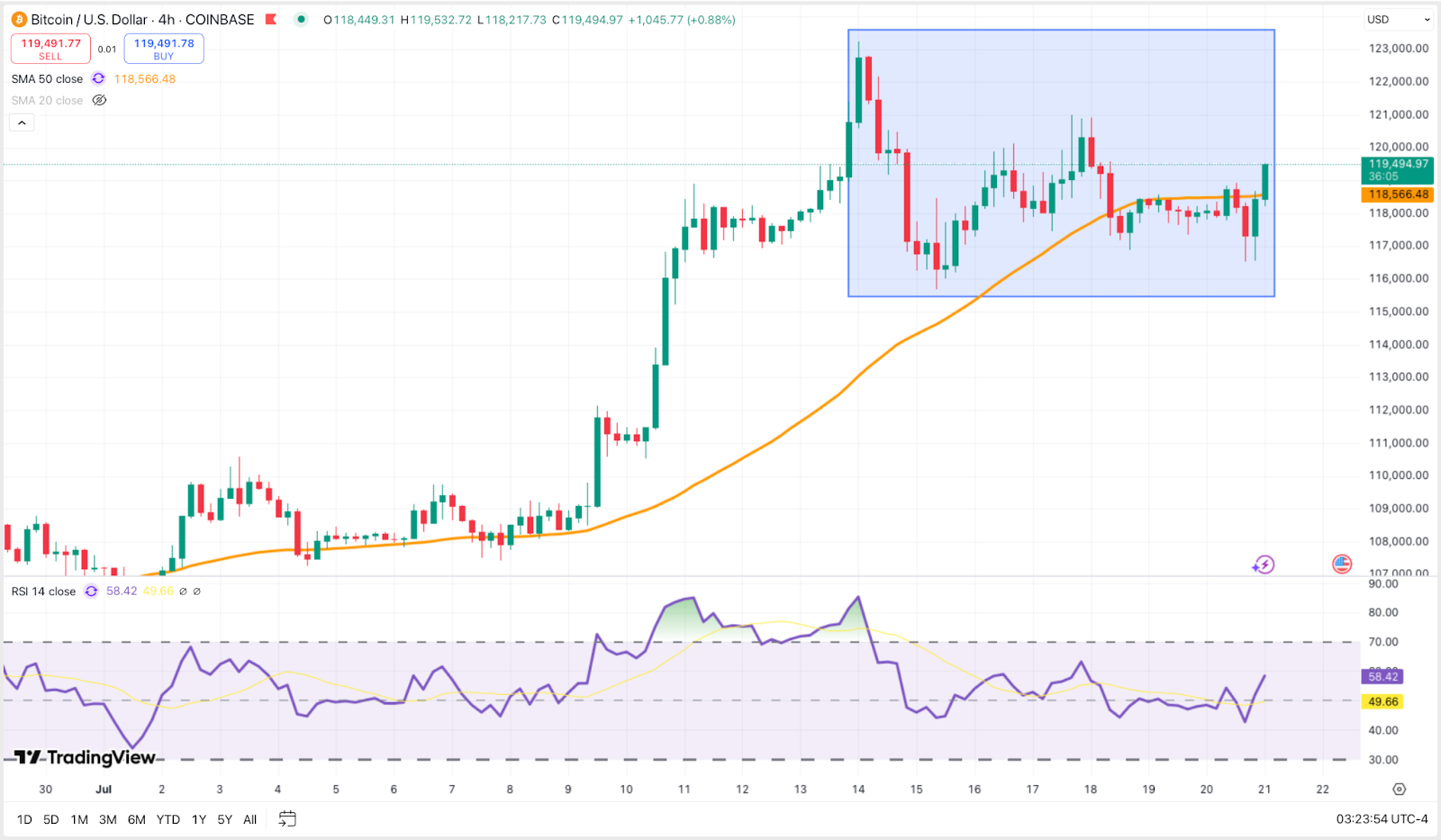
As you may remember, last week Bitcoin hit a fresh all-time high – 120K – and now, a week down the line, it’s just kind of pacing in circles. Price-wise, BTC’s been doing laps between ~$115K and ~$122K, currently hanging around $119,500. That breakout feeling is clearly faded. It’s acting like someone who climbed Everest, took a selfie at the top, and is now slowly descending with sore calves.

Bitcoin consolidates just below $120K, showing hesitation after a breakout week.

BTC/USD 4H Chart, Coinbase. Source: TradingView

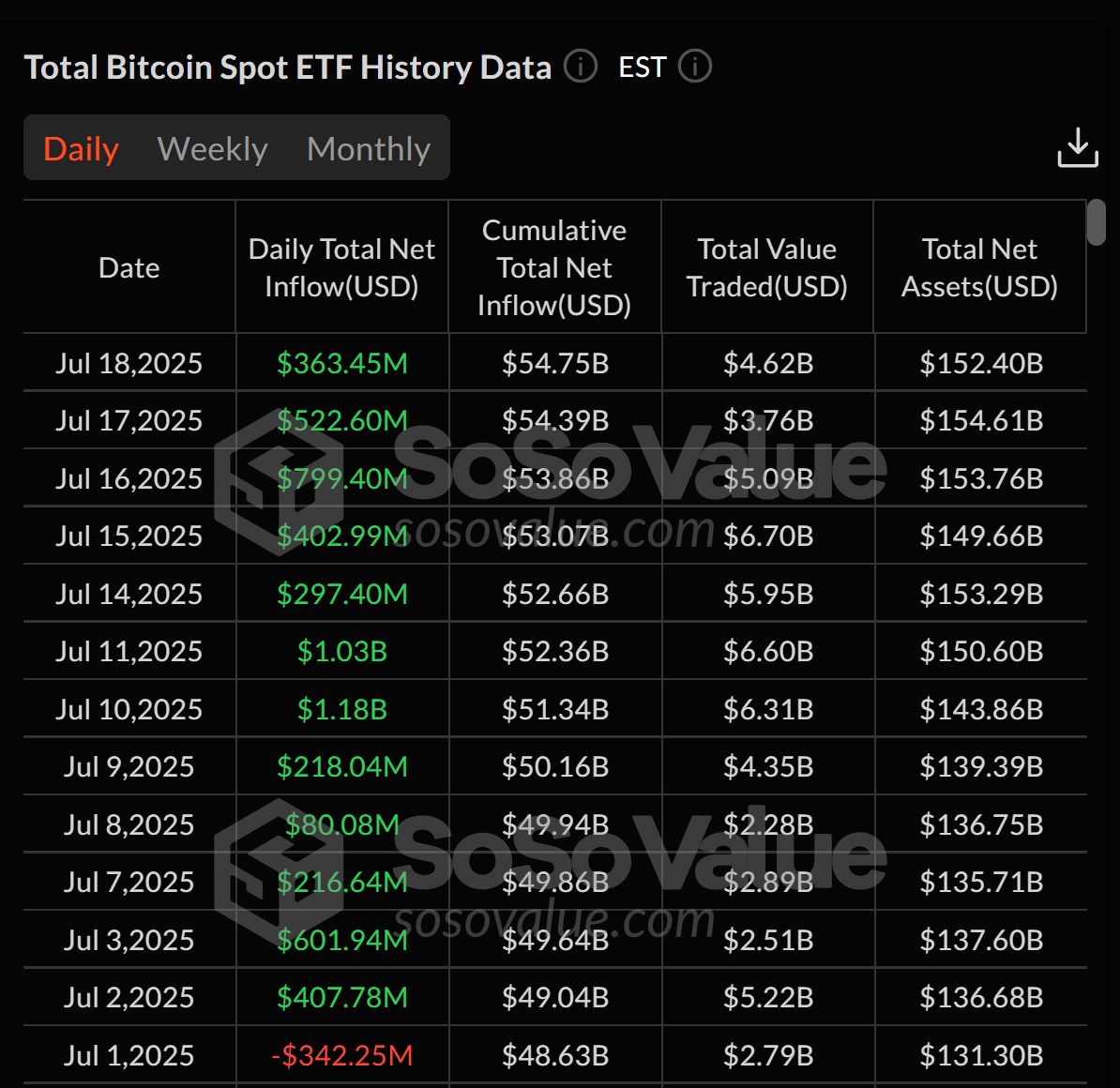
Which actually makes sense. After all, BTC’s come a long way fast, and now it’s brushing up against heavy resistance at $120K like it’s unsure whether to punch through or take a breather. Some of the tension is narrative-based. On the bullish side, you’ve got twelve straight days of ETF inflows – over $6.6 billion pouring in 

Bitcoin ETFs record a $6.6B inflow streak, reinforcing strong institutional interest.

Spot Bitcoin ETFs see 12-day inflow streak. Source: SoSoValue

Also, there’s been news about Trump actually signing a crypto bill (the GENIUS Act), which, regardless of what’s in it, marks a very real shift in tone from the U.S. government.

Tom Emmer

But then – just when vibes were getting too cozy – an ancient Bitcoin whale from the Satoshi era woke up and shuffled nearly $10B worth of BTC. Not sold, just moved, but it still rattled the cage. 

Onchain Lens 

And there was a spicy rumor that the UK is prepping to sell off $7B in seized Bitcoin (possibly exaggerated, but hey, the market doesn’t like nuance), so now wonder that $120K breakout feels a little heavy.

Susie Violet Ward

So, right now BTC’s taking a moment and cooling off. The structure still looks bullish – RSI’s neutral, moving averages are fine, macro’s not freaking out – but it’s like the market’s waiting for a new excuse to care.

Ethereum (ETH) 

Now, ETH didn’t seem to get the memo about “taking it slow.” After clearing $3,400 earlier this week, it’s been climbing with almost embarrassing enthusiasm, now up around $3,800 and flirting with the idea of $4K.

Ethereum climbs steadily toward $4K, outperforming amid Bitcoin's pause.

ETH/USD 4H Chart, Coinbase. Source: TradingView

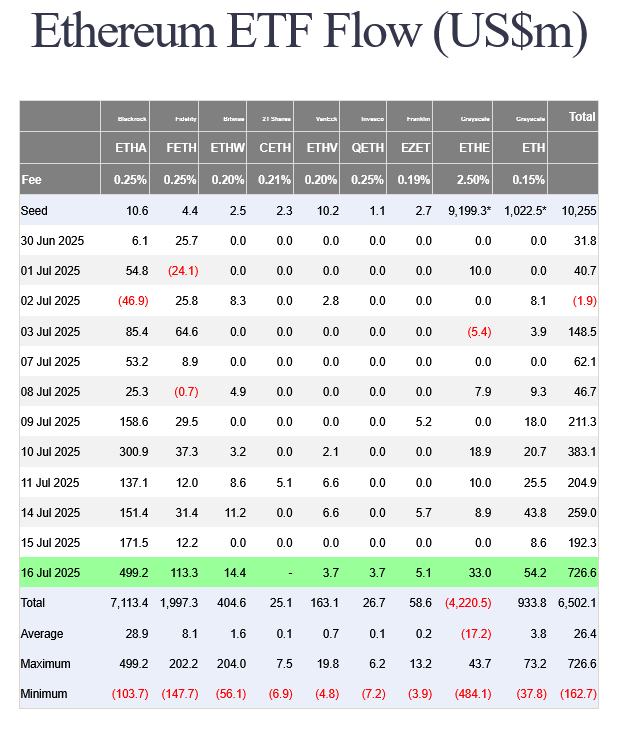
And it’s got some real teasons for that. Spot ETH ETFs finally hit their stride, with one day alone seeing $727 million in inflows. 

Ether ETFs draw $727M in a single day, fueling Ethereum’s upside momentum.

Spot Ether ETFs witnessed net inflows of almost $727 million on Wednesday. Source: Farside Investors.

Most importantly, there were some big treasury moves – for one, Sharplink dropped a $6B ETH-heavy plan, which added fuel to the rally. 

Lookonchain

And overall Ethereum is finally getting love as more than just tech – it’s turning into an institutional asset class. BlackRock likes it, Fidelity likes it, Even Nasdaq wants to enable ETF staking. Meanwhile, Wall Street is clearly warming up.

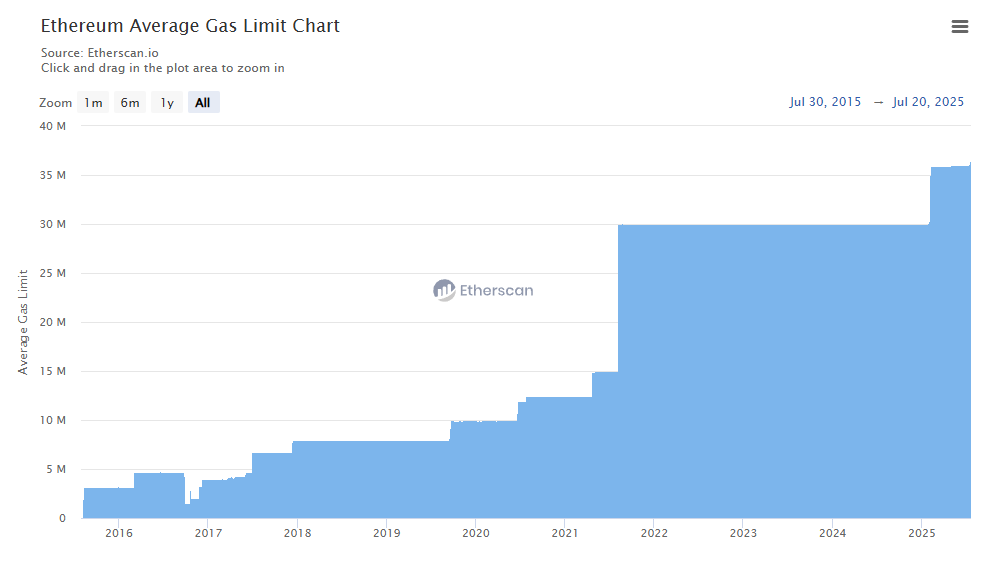
Ethereum validators support a gas limit hike to 45M, advancing network throughput ahead of Fusaka.

Average Ethereum gas limits over time. Source: Etherscan

On the network side, validators are backing a gas limit bump to 45 million, and the Fusaka upgrade (coming this November) is set to improve throughput and validator efficiency. All that scaling momentum is, once again, making Ethereum look like a solid long-term hold for  institutionals.

So while BTC takes a breather, ETH is convincing the crowd the show’s still going. Unless BTC dumps hard, ETH probably tags $4K soon – and if things really get wild, maybe more. But let’s not jinx it.

Toncoin (TON)

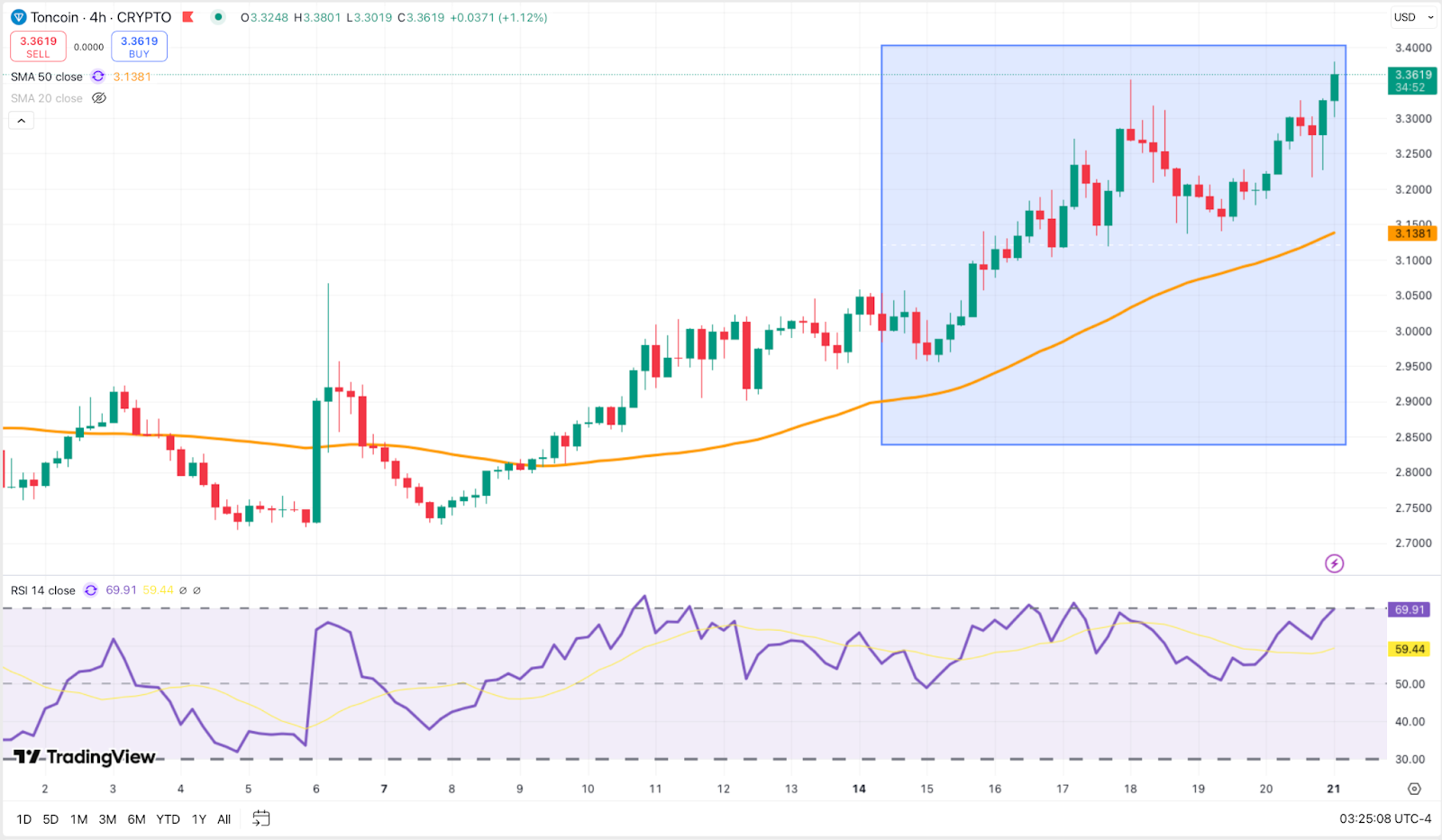
TON, meanwhile, seems to be running its own playbook entirely. TON’s price has just been casually climbing from $2.85 to $3.36, showing consistent higher lows and overall good vibes.

Toncoin trends upward with higher lows, maintaining steady gains above $3.30.

TON/USD 4H Chart. Source: TradingView

Now, let’s be clear up front: nothing in the TON news cycle this week screams “price catalyst.” There was no ETF filing, no giant partnership announcement, no surprise listing on a major US exchange. But still – something has been brewing.

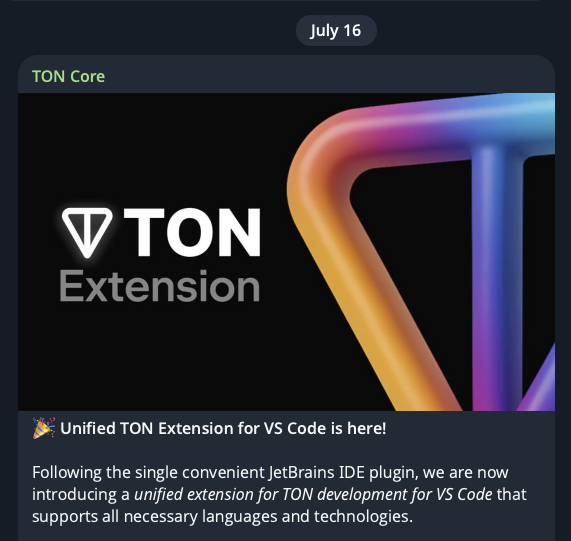
There’s been some launches in the ecosystem, and also a Visual Studio Code extension from TON Core. Sure, it makes dev work on TON smoother and lowers the barrier to building, but it’s a slow-burn developer story, not a trading one.

Post-Breakout Blues? BTC Stalls at $120K While ETH Rallies and TON Keeps Climbing

Source: @toncorepublic

Also, Telegram – TON’s spiritual mothership – also started registering an official presence in Russia this week. That matters in the regulatory chess game and hints at Telegram preparing for deeper integrations or monetization strategies that could loop back to TON. 

Post-Breakout Blues? BTC Stalls at $120K While ETH Rallies and TON Keeps Climbing

Source: Roskomnadzor

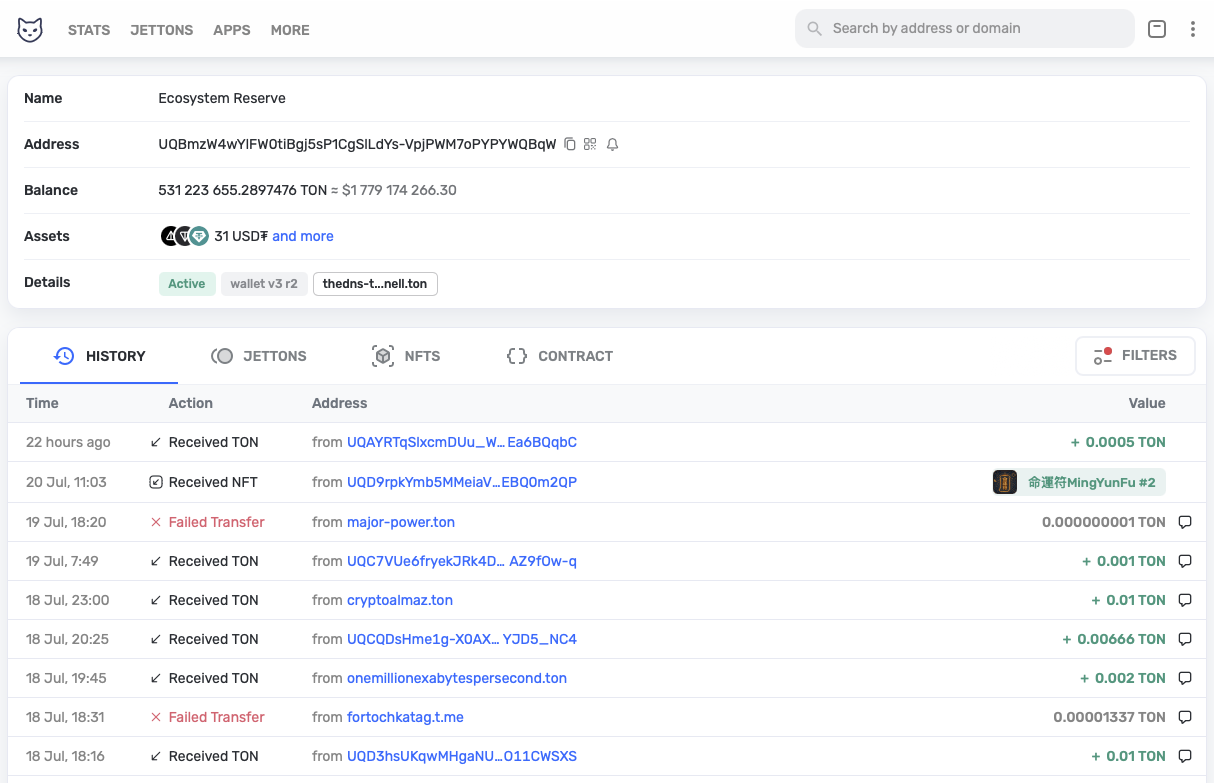
But erhaps most eyebrow-raising headline was that the TON Ecosystem Reserve, which holds over $1.7 billion in TON, moved funds for the first time in years. It was just a test transaction, but in a space this small, that kind of movement doesn’t go unnoticed. It sparked speculation about whether big things – grants, incentives, or deployments – might be on the horizon.

Post-Breakout Blues? BTC Stalls at $120K While ETH Rallies and TON Keeps Climbing

Source: Tronscan

And let’s not forget: TON just tapped into Ethereum DeFi via Tac mainnet. It’s starting to straddle two worlds – Telegram-native and EVM-compatible. Even if the headlines aren’t as loud, the fundamentals are stacking up fast.

So, no single piece of news was enough to send TON flying, but together, they’ve created a sense of quiet momentum, which is reflected in the charts. Price has climbed from around $2.85 to above $3.30 this week, steadily and without drama. Right now RSI is peaking, but the MAs are still showing support. 

Where It Feels Like We’re Heading

So here we are. The all-time highs have been hit, the confetti’s already on the floor, and the market’s catching its breath. On the surface, nothing’s broken – macro conditions are relatively supportive. Spot ETF inflows remain strong, with institutions still showing up. Inflation data is softening. 

If Bitcoin can finally punch through $120,000 with real volume and stay above it, that could re-ignite risk appetite across the board. In that case, Ethereum looks well-positioned to accelerate – likely pushing through $4K – and TON, with its quiet momentum, may continue climbing in its own independent rhythm.

On the other hand, if Bitcoin stalls again, we may be looking at a few more weeks of sideways chop – a time for the market to digest gains, shake out weak hands, and wait for the next strong catalyst.

Either way, the key takeaway is this: the market is clearly awake. 

Disclaimer

In line with the Trust Project guidelines, please note that the information provided on this page is not intended to be and should not be interpreted as legal, tax, investment, financial, or any other form of advice. It is important to only invest what you can afford to lose and to seek independent financial advice if you have any doubts. For further information, we suggest referring to the terms and conditions as well as the help and support pages provided by the issuer or advertiser. MetaversePost is committed to accurate, unbiased reporting, but market conditions are subject to change without notice.

About The Author


Victoria is a writer on a variety of technology topics including Web3.0, AI and cryptocurrencies. Her extensive experience allows her to write insightful articles for the wider audience.

More articles


Victoria d’Este


Victoria is a writer on a variety of technology topics including Web3.0, AI and cryptocurrencies. Her extensive experience allows her to write insightful articles for the wider audience.


Source link

BitGo Submits Confidential Draft Registration Statement To SEC For Proposed IPO

BitGo Submits Confidential Draft Registration Statement To SEC For Proposed IPO


In Brief

BitGo Holdings has confidentially filed for a US IPO as it expands its global digital asset custody services, following strong public listings from crypto and fintech firms amid renewed investor interest in capital markets.

BitGo Submits Confidential Draft Registration Statement To SEC For Proposed IPO

BitGo Holdings, a firm specializing in trust and security services for digital assets, announced that it has confidentially submitted a draft registration statement on Form S-1 to the US Securities and Exchange Commission (SEC) in connection with a planned initial public offering of its Class A common stock. 

The specific details regarding the number of shares to be offered and the pricing parameters for the proposed IPO have not yet been finalized. The company indicated that the offering is anticipated to proceed following the completion of the SEC’s review process and will be contingent upon prevailing market conditions and other relevant factors.

BitGo, established in 2013 and based in the United States, operates as a digital asset security and custody platform known for introducing multi-signature wallet technology. The company provides a suite of institutional-grade services that includes regulated custody, access to trading, staking solutions, and settlement infrastructure. It currently supports over 1,300 digital assets and is responsible for securing approximately 8% of global Bitcoin transaction volume, with a client base exceeding 1,500 institutional entities across more than 90 countries. 

In a recent development, BitGo’s European division, BitGo Europe, has obtained authorization under the Markets in Crypto-Assets Regulation framework from Germany’s Federal Financial Supervisory Authority (BaFin), allowing it to offer services throughout the European Union.

Capital Markets Rebound Signals Investor Appetite As Crypto And Fintech Firms See Successful Public Listings

Recent activity in capital markets has included a number of successful public listings by companies across various sectors, among them those traditionally considered higher risk such as cryptocurrency and fintech. This trend suggests renewed investor interest and a possible recovery in capital markets. 

One prominent example is Circle Internet Group, the company behind the USDC stablecoin, which conducted its initial public offering on the New York Stock Exchange in June 2025. The IPO generated approximately $1.05 billion in proceeds and established a valuation of roughly $6.9 billion, with the company’s shares rising by more than 160% on the first day of trading. 

Additional recent listings include Galaxy Digital, which transitioned to the Nasdaq in May 2025, and eToro, which also launched its Nasdaq debut, achieving a market valuation of approximately $5.6 billion.

Disclaimer

In line with the Trust Project guidelines, please note that the information provided on this page is not intended to be and should not be interpreted as legal, tax, investment, financial, or any other form of advice. It is important to only invest what you can afford to lose and to seek independent financial advice if you have any doubts. For further information, we suggest referring to the terms and conditions as well as the help and support pages provided by the issuer or advertiser. MetaversePost is committed to accurate, unbiased reporting, but market conditions are subject to change without notice.

About The Author


Alisa, a dedicated journalist at the MPost, specializes in cryptocurrency, zero-knowledge proofs, investments, and the expansive realm of Web3. With a keen eye for emerging trends and technologies, she delivers comprehensive coverage to inform and engage readers in the ever-evolving landscape of digital finance.

More articles

Alisa Davidson


Alisa, a dedicated journalist at the MPost, specializes in cryptocurrency, zero-knowledge proofs, investments, and the expansive realm of Web3. With a keen eye for emerging trends and technologies, she delivers comprehensive coverage to inform and engage readers in the ever-evolving landscape of digital finance.


More articles


Source link

Cracking the Code of Web3 Growth with Addressable’s Wallet Intelligence

Cracking the Code of Web3 Growth with Addressable’s Wallet Intelligence


In Brief

Addressable analyzes 1.8 billion wallets, helping Web3 teams identify real users and scale with data-driven marketing, focusing on wallet-based targeting and stablecoin payments.

Cracking the Code of Web3 Growth with Addressable’s Wallet Intelligence

Addressable tracks and analyzes over 1.8 billion wallets, shedding light on user behavior in a space built on anonymity. In this interview, CEO and Co-Founder Tomer Sharoni explains how the company helps Web3 teams cut through the noise, identify real users, and scale with data-driven marketing. From wallet-based targeting to the rise of stablecoin payments, Tomer offers a sharp look at the future of crypto growth.

Can you please share your journey into Web3?

The journey into Web3 started as a hobby. The three co-founders: Asaf, Tomer, and myself come from backgrounds in big data and cybersecurity. We worked in both the public and private sectors in Israel for nearly 20 years.

Crypto was a shared passion for years. Asaf was writing university research on it, I was trading, and even built mining rigs to mine Bitcoin early on. Tomer, in his previous roles, collaborated with law enforcement to trace fraudsters and attackers through their crypto activity. By 2021, we could see how quickly the space was growing and decided to dive in. In mid-2022, we left our jobs and made Addressable a full-time venture.

As data professionals, we knew that anonymity in crypto posed a real challenge. Businesses and communities had no clear way of knowing who they were working with or how to retain them. After six months of market research, we discovered the biggest pain point was user retention, specifically, understanding which users were there for the long run and which were just chasing incentives. So, we created Addressable as a user platform for Web3, which is a kind of user database.

Using our big data experience, we built a system that can identify patterns among wallets, such as who stays, who buys, and who just extracts value and leaves. That’s how Addressable began.

What are the core use cases Addressable is solving for Web3 growth teams today, and how have they evolved over the past year?

Web3 growth teams still rely on outdated playbooks. Many projects create hype before even launching a product. Marketing usually revolves around community building, KOLs, and PR. But this excitement doesn’t always translate to real business outcomes.

A major issue is that teams can’t distinguish between users who are truly interested in their product and those who are just there for airdrops or rewards. Incentives can create short-term engagement but don’t build long-term relationships. Our challenge, and our solution, is helping businesses identify the signal from the noise. We help teams understand who their real users are and how to acquire and retain them based on product fit, not just incentives.

How does Addressable’s wallet-based advertising engine differ from traditional Web2 targeting solutions?

In crypto, users can stay anonymous while still paying you. That’s a huge advantage, but it also makes follow-up communication difficult.

At Addressable, we’ve built a simple, streamlined system to help businesses capture more users similar to the ones who’ve already transacted with them. We also help them retain those users using retargeting and multi-channel communication.

We started with acquisition: for example, if you’re a DeFi protocol, we help you target people who recently spent money on similar platforms. But over the past year, we’ve expanded to retention. We’ve created a tool called “User Radar”—a kind of CRM for Web3 that allows businesses to track wallet interactions on their sites and re-engage users with customized messaging based on behavior.

What types of brands (DeFi, gaming, NFTs) are best suited for Addressable’s growth suite, and how do the use cases differ?

Our tools work best for businesses that are already generating some revenue and want to grow and retain users. We see strong success across verticals like centralized and decentralized exchanges, wallets, casinos, games, lending protocols, and anyone accepting crypto payments.

Recently, many new businesses have come to us asking if we can help them target users who want to pay with stablecoins, for things like flights or vacations. The answer is yes. We can identify and retarget those users with crypto-specific messaging. Often, businesses don’t want to put crypto messaging in front of everyone, just the crypto-relevant audience. That’s exactly what we help them do.

How does Addressable’s platform help campaigns distinguish between whales, active users, and dormant wallets?

Our system classifies every wallet using many characteristics. We can identify stakers, gamers, highly active users, and dormant ones, like those who’ve been inactive for three months. We have a database of 1.8 billion wallets, each tagged accordingly. So if you want to filter for DAO voters or users who bought specific assets with stablecoins in the past month, that’s all possible.

What recent product updates have had the most impact on campaign performance or client experience?

We’ve added support for Reddit ads, Twitter ads, and programmatic platforms. On top of these, we built a DMP (Data Management Platform) to target specific wallets using ad IDs like Twitter or Reddit handles.

One of the biggest boosts came from dynamic optimization. Our pixel and SDK, on the client’s site or app, track user actions. The system then automatically optimizes ad targeting by learning which parts of the audience actually convert. It adds lookalikes of high-converting users and drops underperformers. We run this optimization daily.

What’s the most misunderstood aspect of performance marketing in Web3 today?

Unlike buying shoes online, crypto conversions take time. People do research and read content, and they need several touchpoints before trusting a brand enough to deposit funds.

So we created a two-step funnel: First, we measure cost per wallet to bring users to your site. Then, we track how much it costs to convert them, whether through a deposit or transaction. This full-funnel view helps clients understand the real cost per conversion and optimize accordingly.

What trends are you seeing as Web3 growth teams shift budgets from community incentives to paid ads?

The industry is maturing. With Bitcoin at all-time highs and major crypto legislation in progress, there’s more serious investment and adoption happening. Today’s players aren’t just speculative token projects; they’re real fintechs and retailers integrating crypto into their operations.

That’s where Addressable fits in best. We’re not as useful for the early-stage community-building phase. However, once a company wants to scale beyond its initial superfans, it needs mass marketing, data-driven, targeted, and aimed at users most likely to convert.

Does Addressable see wallet identity replacing the cookie in the next 12–18 months?

Wallets are important, but not the only identity layer. People have multiple wallets and use centralized exchanges, such as GitHub, Twitter, and more. We’re seeing a diversification of IDs across crypto.

Our CRM approach connects all these IDs, wallets, social logins, and exchange IDs, so businesses can engage users more effectively. Wallets are critical, but they’re just one piece of the puzzle.

Which Web3 verticals, like infrastructure, social, DePIN, or stablecoins, are currently showing the strongest ad performance?

The best use case for crypto is money. Payments with stablecoins and investments in tokenized real-world assets are exploding. The stablecoin market is growing fast, and it is expected to double from $200B to $400B in a year. We’re seeing adoption from banks, governments, and businesses.

Around this growth, a whole ecosystem of APIs, trading platforms, and payment infrastructure is emerging, allowing anyone to become a fintech with a few API calls.

Finally, what can Web2 marketers learn from wallet-based advertising in Web3?

Web3 is innovative, and many of its ideas will trickle into Web2. Concepts like building a community of superfans, incentivizing early adopters, and launching products with authenticity rather than polish are valuable lessons.

Web3 users expect brands to be transparent and real. They want a human connection. Web2 marketers can adopt this by letting users have a stronger voice, be more involved, and humanize their brands from the start.

Disclaimer

In line with the Trust Project guidelines, please note that the information provided on this page is not intended to be and should not be interpreted as legal, tax, investment, financial, or any other form of advice. It is important to only invest what you can afford to lose and to seek independent financial advice if you have any doubts. For further information, we suggest referring to the terms and conditions as well as the help and support pages provided by the issuer or advertiser. MetaversePost is committed to accurate, unbiased reporting, but market conditions are subject to change without notice.

About The Author


Victoria is a writer on a variety of technology topics including Web3.0, AI and cryptocurrencies. Her extensive experience allows her to write insightful articles for the wider audience.

More articles


Victoria d’Este


Victoria is a writer on a variety of technology topics including Web3.0, AI and cryptocurrencies. Her extensive experience allows her to write insightful articles for the wider audience.


Source link

Popular Posts

My Favorites