The NFT market may not dominate headlines like it once did, but it’s far from fading into obscurity. In early August 2025, several NFT collections recorded noticeable changes in transaction volume and buyer activity across major chains.
Using recent market data from CryptoSlam, we’ve broken down the top-performing NFT collections of the first week of August. From a Polygon-based breakout to renewed interest in Ethereum blue-chips, the market shows both resilience and surprising twists.
Key Takeaways
Multichain is real: Polygon and Mythos-based projects now compete with Ethereum blue-chips.
Big names aren’t dead: Despite short-term dips, CryptoPunks and BAYC still drive major volume.
Community is sticky: Pudgy Penguins shows the strength of consistent branding and engagement.
Utility and activity matter: Collections like Courtyard and DMarket show volume doesn’t just come from hype.
Courtyard (Polygon) Leads the Charge
Courtyard lets users trade tokenized real-world collectibles—like cards and sneakers—via NFTs backed by vault-stored items. Its simple fiat checkout and gas-free experience have made it popular with both crypto and non-crypto users.
Courtyard, a Polygon-based project, topped the charts with over $12.8 million in sales and more than 166,000 transactions. That’s a 66% spike in activity, driven by over 10,700 unique buyers — many likely dipping their toes into NFTs for the first time.
Ethereum OGs: Mixed Signals from CryptoPunks and BAYC
CryptoPunks, launched in 2017, is one of the original Ethereum NFT collections and often viewed as the digital collectible equivalent of fine art.
Despite a steep 65% drop in sales volume this week, CryptoPunks remains a powerhouse.
With only 34 transactions and 18 buyers, it’s clear the current market is driven more by big, occasional trades than a flurry of daily activity. Still, there’s energy under the surface: floor prices recently climbed back above $200K, boosted by a sweeping buy of 45 Punks and talk of institutional players.
Meanwhile, Bored Ape Yacht Club (BAYC), launched in 2021 by Yuga Labs, staged a solid comeback — jumping over 60% in sales volume to hit $5.78 million. Holders don’t just get NFTs; they gain access to exclusive social events, commercial rights, and the cultural cachet that still clings to those cartoon apes.
Pudgy Penguins Hold Steady
Pudgy Penguins is a community-driven collection of 8,888 cartoon penguin avatars known for its strong brand, real-world toy line, and lighthearted aesthetic.
Despite a slight dip in sales, the Penguins held their own, staying in the top five with nearly $5 million in volume. With 96 transactions and 57 buyers, they remain one of Ethereum’s most actively traded grassroots communities.
What Pudgy Penguins may lack in flash, they make up for in staying power. Their blend of physical toys, Web3 integrations, and steady social presence has carved out a lasting spot in NFT culture — no hype cycle needed.
DMarket: Quiet Growth on Mythos
DMarket is a blockchain-powered marketplace for trading in-game items from traditional titles like CS2, Dota 2, Rust, and Team Fortress 2. It operates independently of the games themselves, using blockchain tech to enhance transaction security and item provenance.
While not a household name in NFT circles, DMarket (built on the Mythos chain) posted impressive numbers: $4.73 million in volume, nearly 170,000 transactions, and over 14,000 buyers. These aren’t speculative trades — they reflect real activity from real gamers.
As NFTs evolve beyond profile pictures and pixel art, ecosystems like DMarket point toward a practical future. It’s not just about owning something rare anymore — it’s about owning something you can actually use.
Published: August 07, 2025 at 10:20 am Updated: August 07, 2025 at 10:20 am
by Ana
Edited and fact-checked:
August 07, 2025 at 10:20 am
To improve your local-language experience, sometimes we employ an auto-translation plugin. Please note auto-translation may not be accurate, so read original article for precise information.
In Brief
A NIST-led red-teaming exercise at CAMLIS, evaluated vulnerabilities in advanced AI systems, assessing risks like misinformation, data leaks, and emotional manipulation.
The National Institute of Standards and Technology (NIST) completed a report on the safety of the advanced AI models near the end of the Joe Biden administration, but the document was not published following the transition to the Donald Trump administration. Although the report was designed to assist organizations in evaluating their AI systems, it was among several NIST-authored AI documents withheld from release due to potential conflicts with the policy direction of the new administration.
Prior to taking office, President Donald Trump indicated his intent to revoke Biden-era executive orders related to AI. Since the transition, the administration has redirected expert focus away from areas such as algorithmic bias and fairness in AI. The AI Action Plan released in July specifically calls for revisions to NIST’s AI Risk Management Framework, recommending the removal of references to misinformation, Diversity, Equity, and Inclusion (DEI), and climate change.
At the same time, the AI Action Plan includes a proposal that resembles the objectives of the unpublished report. It directs multiple federal agencies, including NIST, to organize a coordinated AI hackathon initiative aimed at testing AI systems for transparency, functionality, user control, and potential security vulnerabilities.
NIST-Led Red Teaming Exercise Probes AI System Risks Using ARIA Framework At CAMLIS Conference
The red-teaming exercise was conducted under the Assessing Risks and Impacts of AI (ARIA) program by the NIST, in partnership with Humane Intelligence, a company that focuses on evaluating AI systems. This initiative was held during the Conference on Applied Machine Learning in Information Security (CAMLIS), where participants explored the vulnerabilities of a range of advanced AI technologies.
The CAMLIS Red Teaming report documents the assessment of various AI tools, including Meta’s Llama, an open-source large language model (LLM); Anote, a platform for developing and refining AI models; a security system from Robust Intelligence, which has since been acquired by CISCO; and Synthesia’s AI avatar generation platform. Representatives from each organization contributed to the red-teaming activities.
Participants utilized the NIST AI 600-1 framework to analyze the tools in question. This framework outlines multiple risk areas, such as the potential for AI to produce false information or cybersecurity threats, disclose private or sensitive data, or foster emotional dependency between users and AI systems.
Unreleased AI Red Teaming Report Reveals Model Vulnerabilities, Sparks Concerns Over Political Suppression And Missed Research Insights
The research team found several methods to circumvent the intended safeguards of the tools under evaluation, leading to outputs that included misinformation, exposure of private information, and assistance in forming cyberattack strategies. According to the report, some aspects of the NIST framework proved more applicable than others. It also noted that certain risk categories lacked the clarity necessary for practical use.
Individuals familiar with the red-teaming initiative expressed that the findings from the exercise could have offered valuable insights to the broader AI research and development community. One participant, Alice Qian Zhang, a doctoral candidate at Carnegie Mellon University, noted that publicly sharing the report might have helped clarify how the NIST risk framework functions when applied in real-world testing environments. She also highlighted that direct interaction with the developers of the tools during the assessment added value to the experience.
Another contributor, who chose to remain anonymous, indicated that the exercise uncovered specific prompting techniques—using languages such as Russian, Gujarati, Marathi, and Telugu—that were particularly successful in eliciting prohibited outputs from models like Llama, including instructions related to joining extremist groups. This individual suggested that the decision not to release the report may reflect a broader shift away from areas perceived as linked to diversity, equity, and inclusion ahead of the incoming administration.
Some participants speculated that the report’s omission may also stem from a heightened governmental focus on high-stakes risks—such as the potential use of AI systems in developing weapons of mass destruction—and a parallel effort to strengthen ties with major technology companies. One red team participant anonymously remarked that political considerations likely played a role in withholding the report and that the exercise contained insights of ongoing scientific relevance.
Disclaimer
In line with the Trust Project guidelines, please note that the information provided on this page is not intended to be and should not be interpreted as legal, tax, investment, financial, or any other form of advice. It is important to only invest what you can afford to lose and to seek independent financial advice if you have any doubts. For further information, we suggest referring to the terms and conditions as well as the help and support pages provided by the issuer or advertiser. MetaversePost is committed to accurate, unbiased reporting, but market conditions are subject to change without notice.
About The Author
Alisa, a dedicated journalist at the MPost, specializes in cryptocurrency, zero-knowledge proofs, investments, and the expansive realm of Web3. With a keen eye for emerging trends and technologies, she delivers comprehensive coverage to inform and engage readers in the ever-evolving landscape of digital finance.
More articles
Alisa Davidson
Alisa, a dedicated journalist at the MPost, specializes in cryptocurrency, zero-knowledge proofs, investments, and the expansive realm of Web3. With a keen eye for emerging trends and technologies, she delivers comprehensive coverage to inform and engage readers in the ever-evolving landscape of digital finance.
Published: August 07, 2025 at 10:00 am Updated: August 07, 2025 at 5:40 am
by Ana
Edited and fact-checked:
August 07, 2025 at 10:00 am
To improve your local-language experience, sometimes we employ an auto-translation plugin. Please note auto-translation may not be accurate, so read original article for precise information.
In Brief
Coral Protocol’s multi-agent system outperformed Microsoft-backed Magnetic-UI by 34% on the GAIA Benchmark, demonstrating that intelligent orchestration of smaller models can rival or surpass traditional large-scale AI approaches.
Decentralized infrastructure for collaborative AI, Coral Protocol reported that its multi-agent system outperformed Microsoft-supported Magnetic-UI by 34% on the GAIA Benchmark—an unprecedented result that suggests horizontal scaling may offer a more effective approach than expanding model parameters. The protocol’s system leverages intelligent orchestration across multiple agents, rather than focusing solely on increasing model size.
This performance marked the highest verified score on the GAIA Benchmark using mini agents, supporting NVIDIA’s premise that well-coordinated smaller models could play a key role in the future of AI. The outcome, according to Coral’s developers, reflects a conceptual shift in how AI scalability is approached rather than a pure increase in system power.
As an open protocol, Coral facilitates the expansion of AI capabilities by enabling coordination between specialized agents globally, instead of relying on centralized general models. Its architecture allows for parallel, secure interaction among agents, enhancing the functionality of language models of all sizes in tasks requiring advanced reasoning, planning, and problem-solving.
“This breakthrough marks a turning point in AI infrastructure,” said Coral CTO Caelum Forder in a written statement. “It’s proof that horizontal scaling isn’t just possible—it’s practical, and Coral is the most effective way to do it. The Internet of Agents is now a working reality. If you are an agent developer, just Coralise it. If you are an application developer, build it better for less using our infrastructure,” he added.
Coral Tops GAIA Benchmark, Validates Power Of Small Models In Advanced Agentic Systems
Amid increasing competition to develop advanced agentic systems, much of the focus has remained on scaling up models to manage growing task complexity. Coral’s recent performance challenges this prevailing approach, aligning with findings from a recent NVIDIA study suggesting that smaller systems can deliver high performance without compromising speed, security, or efficiency. The GAIA Benchmark, a comprehensive evaluation suite for advanced AI, is designed to assess how well systems handle real-world tasks that would typically demand substantial time and skill from human experts. Comprising 450 complex prompts that test research, analytical, and reasoning capabilities, the benchmark serves as a key industry metric for evaluating the effectiveness of general-purpose large language model (LLM) agents.
Coral’s GAIA Agent System, used in the benchmark test, is based on the Coral Protocol and draws from the design principles of CAMEL’s OWL. It incorporates specialized agents to carry out a range of tasks including research, analysis, critique, planning, and web navigation, all of which communicate through Coral’s MCP server infrastructure.
Leading the GAIA Benchmark rankings for smaller models indicates Coral’s potential to extend the functionality of AI systems via a graph-based structure. This result suggests that high-performing, lightweight agents can be created using smaller models—facilitating broader data handling, smoother ecosystem integration, and enhanced inter-agent communication.
“The role of small models in agentic systems has been undersold to date, but the tides are starting to turn,” said Caelum Forder. “We have proven that such models can scale beyond their previously known limits and outcompete the incumbents. I’m confident they have a central role to play in the future of agentic AI,” he concluded.
Disclaimer
In line with the Trust Project guidelines, please note that the information provided on this page is not intended to be and should not be interpreted as legal, tax, investment, financial, or any other form of advice. It is important to only invest what you can afford to lose and to seek independent financial advice if you have any doubts. For further information, we suggest referring to the terms and conditions as well as the help and support pages provided by the issuer or advertiser. MetaversePost is committed to accurate, unbiased reporting, but market conditions are subject to change without notice.
About The Author
Alisa, a dedicated journalist at the MPost, specializes in cryptocurrency, zero-knowledge proofs, investments, and the expansive realm of Web3. With a keen eye for emerging trends and technologies, she delivers comprehensive coverage to inform and engage readers in the ever-evolving landscape of digital finance.
More articles
Alisa Davidson
Alisa, a dedicated journalist at the MPost, specializes in cryptocurrency, zero-knowledge proofs, investments, and the expansive realm of Web3. With a keen eye for emerging trends and technologies, she delivers comprehensive coverage to inform and engage readers in the ever-evolving landscape of digital finance.
Published: August 07, 2025 at 9:55 am Updated: August 07, 2025 at 9:55 am
by Ana
Edited and fact-checked:
August 07, 2025 at 9:55 am
To improve your local-language experience, sometimes we employ an auto-translation plugin. Please note auto-translation may not be accurate, so read original article for precise information.
In Brief
Despite managing over 40 million domains and partnering with giants like Google, Fred Hsu founded D3 to fill Web3’s naming void with a programmable, finance-driven domain system bridging Web2 and Web3.
Despite overseeing more than 40 million domains and collaborating with industry leaders like Google and Verisign, Fred Hsu saw a critical gap in Web3: the absence of a legally authoritative naming system. This realization sparked the creation of D3, a platform that reimagines domains as dynamic, programmable assets driving the emerging DomainFi economy. Under Hsu’s leadership, D3 aims to unify Web2 and Web3 domains, unlocking new financial possibilities like fractional ownership, yield generation, and cross-chain interoperability.
Could you please introduce yourself and share a bit about your journey into Web3?
Absolutely. I’ve been in the domain industry for about 25 years. Historically, I’ve managed around 40 million domains through my first company. From early on, I understood the massive economic value locked inside DNS infrastructure. I started D3 to redefine what domains could be, not just as static digital real estate, but as programmable, composable assets.
What is the fundamental insight that led to the creation of D3? How does it redefine the role of domains in the digital economy?
The fundamental insight came from realizing that Web3 had no legally authoritative naming system. After managing over 40 million domains at Oversee and seeing billions in revenue generated with partners like Google, Yahoo, and Verisign, I understood the massive economic value locked in DNS infrastructure. But Web3 and Web2 domains existed in separate silos, limiting their full potential.
D3 redefines domains from static digital real estate into programmable, composable assets. We’re turning the $340B+ domain industry into the backbone of a new DomainFi economy where domains can generate yield, be fractionalized, serve as collateral, and power cross-chain identity—all while maintaining their legal authority and global interoperability.
In your view, what is the primary function of a domain in the 21st century: identity, asset, infrastructure—or something else entirely?
All three, unified. Domains are the convergence layer of the digital economy. They’re identity because they provide human-readable, verifiable names across chains and applications. They’re assets because they generate real cash flow through renewals, leasing, and monetization—similar to commercial real estate but global and digital. They’re infrastructure because they’re the root layer that connects billions of users to applications, websites, and services.
But more fundamentally, domains are becoming programmable reputation systems—they carry metadata, enable trust, and will serve as the passport system for AI agents and cross-chain interactions.
What systemic limitations in the existing domain industry does D3 aim to overcome? Why is now the right time to do so?
The biggest limitations are illiquidity and fragmentation. Today, premium domain deals take 4-8 weeks with brokers skimming 20-30%. There’s no fractional ownership, no programmatic lending, and no composability with DeFi protocols. Web2 domains and Web3 naming systems exist in separate worlds.
Now is the right time because we have the infrastructure—mature smart contract platforms, DeFi primitives, and institutional appetite for real-world assets. The 2026 gTLD application round creates a once-in-a-generation opportunity to launch blockchain-native TLDs that are natively programmable from day one.
What new types of digital products or services become possible through composable domain rights?
Instant domain finance revolutionizes the way domains are bought and managed by enabling Amazon-style checkout for whole or fractional purchases, leasing, or financing with transactions completing in under a minute and fees kept below 5%. Domains evolve into programmable passports for AI agents, providing verifiable and human-readable identities that function seamlessly across multiple blockchains and applications.
Additionally, communities gain the power to launch and govern their own top-level domains (TLDs), such as .shib or .pirate, supported by on-chain treasuries that oversee renewals and policy enforcement. This system also introduces a cross-chain reputation framework, creating a single canonical identity that resolves uniformly across .sol, .base, .com, and traditional domains, effectively eliminating the silo problem.
Furthermore, token holders benefit from diverse revenue streams by collecting pro-rata earnings from domain parking, leasing, and sales in real time, thereby creating a dynamic and participatory economic ecosystem around domain ownership.
In ways can tokenized domains participate in DeFi protocols—for example, in collateralized lending, staking, or revenue-sharing structures?
Once domains are tokenized through DOMA-enabled registrars, they seamlessly integrate with DeFi infrastructure, enabling a range of financial opportunities. Owners can use their domains, such as Chat.com, as collateral to borrow stablecoins instantly, with loans backed by verifiable DNS ownership. Token holders benefit from revenue sharing, receiving pro-rata earnings from domain monetization, including parking yields ranging from 20% to 40% annually—distributed daily or monthly.
Premium domains like Hockey.com can be fractionalized, allowing smaller investors to participate while providing liquidity to current owners. Additionally, domain tokens can be staked in liquidity pools or used in governance to earn protocol rewards through yield farming. Central to this system is authoritative tokenization, which ensures that ownership is anchored in actual DNS registries rather than mere wrappers or copies, preserving authenticity and value.
How does D3 ensure compliance with ICANN policies while introducing blockchain-based domain functionality?
We operate within the existing DNS ecosystem as a legitimate registrar with proven infrastructure. Our team includes veterans from ICANN, GoDaddy, and major registry operators who understand the regulatory landscape.
We’re not replacing DNS—we’re enhancing it. Domains remain fully compliant with ICANN policies while gaining programmable features through tokenization. We work with established registries and maintain the legal chain of title that makes domains valuable in the first place.
For blockchain-native TLDs in the 2026 round, we’re applying through proper ICANN channels with the infrastructure and compliance track record required.
How does D3 support developers looking to integrate domain-based functionality into their dApps or marketplaces?
We’re building the Stripe of domains—protocol-first infrastructure that powers domain assets across all chains. Our DOMA protocol provides APIs and SDKs for:
Fractionalization: Creation of fungible tokens to facilitate price discovery & sales
DeFi primitives: Integrate domain collateral into lending protocols
Identity solutions: Create wallets and apps that use DNS for cross-chain identity
Marketplace integration: Build domain trading platforms with instant settlement
Developer tools: Access live pricing oracles, lease yield data, and domain metadata
We’re the rails, not the storefront—enabling builders to create the next generation of domain-powered applications.
What are some of the novel use cases you’ve seen emerge from builders leveraging Doma’s permission-based smart contract framework?
Although the space is still in its early stages, promising developments are already emerging. Companies are beginning to explore domain treasury management, seeking to transform their domain portfolios from illiquid holdings into yield-generating assets. Institutional yield products are also advancing, exemplified by Plume’s integration of DomainFi into their Nest Protocol, which enables tokenized domains to produce institutional-grade returns.
Meanwhile, fan identity infrastructure is gaining traction, with OneFootball leveraging .football domains as a foundational identity system for its community of over 180 million monthly active users.
What role does D3 envision for domain-based assets in multi-chain ecosystems, particularly with regard to interoperability and asset portability?
Domains solve the canonical identity problem across chains. We envision DNS as the universal resolver that connects all blockchain naming systems .sol, .base, .eth, traditional .com—under one unified system.
With partnerships like Solana Foundation (for .SOL and .SOLANA TLDs), Base, and Avalanche (for .AVAX TLD), we’re creating native interoperability. Your domain becomes your universal passport that works across every chain and application, eliminating silos and fragmentation.
DOMA protocol is chain-agnostic, so domain assets can move between Solana, L2s, and other networks while maintaining their DNS authority and legal standing.
What is D3’s long-term vision for DomainFi? How might it influence the future of web infrastructure or digital finance?
If D3 wins, the Internet in 2030 will look like a borderless nation where identity, ownership, payments, agentic communications, and reputation are rooted in DNS and interoperable across every chain and app.
DomainFi becomes the infrastructure layer for the next internet, where every digital interaction is anchored to verifiable, programmable identity. AI agents use domains as their passports. DeFi protocols use domains as prime collateral. DAOs govern their own TLDs as on-chain nations.
We’re not just tokenizing domains, we’re creating the foundation for a new digital economy where the internet’s naming layer becomes its financial and identity layer.
Could you please share the roadmap of D3?
By 2025, the DOMA protocol is set to launch its mainnet, marking the debut of the first fractional domain sales alongside live pricing oracles and comprehensive domain market data—effectively creating a Bloomberg Terminal for domains.
In 2026, the ecosystem aims to drive significant participation in the gTLD application round, empowering DAOs and blockchain communities to launch their own top-level domains, while achieving full DeFi integration with leading protocols for lending, yield farming, and liquidity provision.
Looking ahead to 2027 through 2030, the vision includes universal cross-chain and interoperable Web2 and Web3 identity resolution, scalable AI agent identity infrastructure, and institutional adoption of domains as a core real-world asset (RWA) class, culminating in a complete transformation of domain transactions from weeks-long brokered deals into instant, programmable commerce.
The roadmap is about building the rails that power the next generation of internet infrastructure—making domains as liquid and programmable as any DeFi asset while maintaining their unique position as the legally recognized, globally interoperable foundation of digital identity.
Disclaimer
In line with the Trust Project guidelines, please note that the information provided on this page is not intended to be and should not be interpreted as legal, tax, investment, financial, or any other form of advice. It is important to only invest what you can afford to lose and to seek independent financial advice if you have any doubts. For further information, we suggest referring to the terms and conditions as well as the help and support pages provided by the issuer or advertiser. MetaversePost is committed to accurate, unbiased reporting, but market conditions are subject to change without notice.
About The Author
Victoria is a writer on a variety of technology topics including Web3.0, AI and cryptocurrencies. Her extensive experience allows her to write insightful articles for the wider audience.
More articles
Victoria d’Este
Victoria is a writer on a variety of technology topics including Web3.0, AI and cryptocurrencies. Her extensive experience allows her to write insightful articles for the wider audience.
Published: August 07, 2025 at 5:19 am Updated: August 07, 2025 at 5:20 am
To improve your local-language experience, sometimes we employ an auto-translation plugin. Please note auto-translation may not be accurate, so read original article for precise information.
In Brief
MEXC’s July 2025 report highlights record-breaking token performance driven by AI and Web3 projects, with 255 new listings, a surge in user activity, and $25M raised via Launchpad, reinforcing its role as a leading platform for early-stage digital asset trading.
MEXC, a leading global cryptocurrency exchange, has released its comprehensive July 2025 Market Performance Report, highlighting exceptional token performance fueled by AI infrastructure adoption and diversified sector growth. The report underscores MEXC’s continued expansion as a premier destination for high-potential token launches and reinforces its commitment to delivering substantial returns for early-stage investors.
July Listings Add 255 New Tokens with Strong Market Performance
MEXC expanded its offerings with 255 new token listings in July, representing a 23.79% increase from June. This growth contributed to a 17.93% rise in trading participants and a 37.74% increase in trading volume from newly listed tokens.
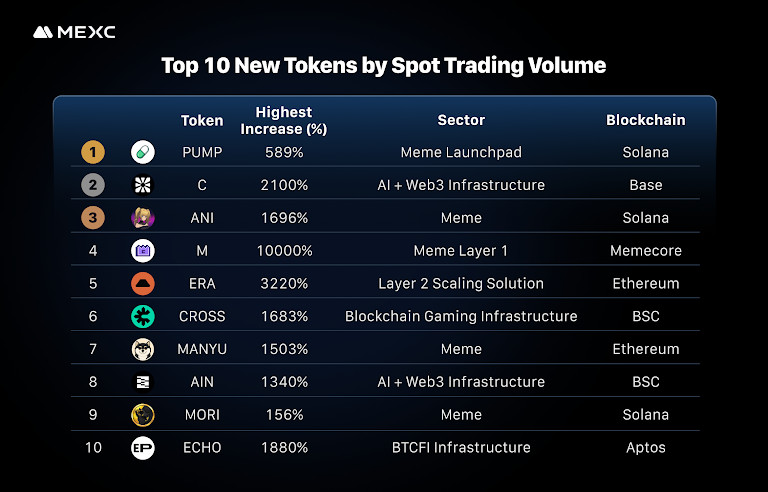
The newly listed tokens demonstrated significant price appreciation, with the top 10 performers averaging 9,085% gains – a 3.3x increase over June’s average. Among the most actively traded tokens, the average highest returns reached 2,417%, led by ERA (+3,220%), C (+2,100%), and PUMP (+589%).
AI and Web3 Projects Lead July’s Top Performers
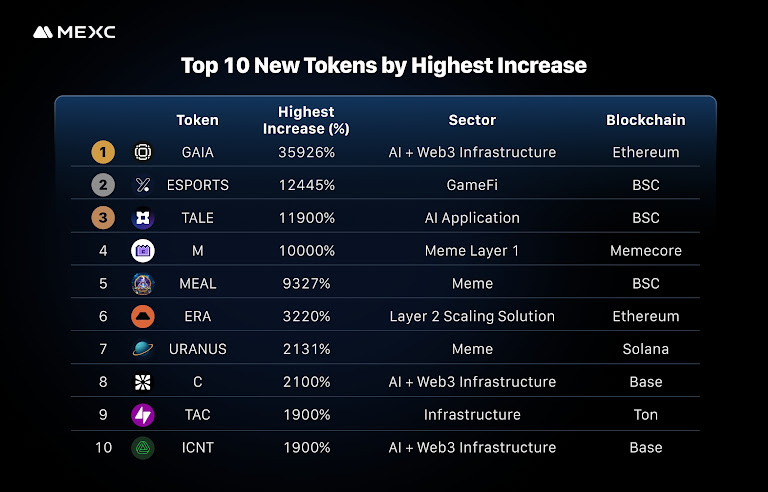
In July, AI and Web3 infrastructure projects dominated price performance rankings. Notable gains included:
GAIA: +35,926%
ESPORTS: +12,445%
TALE: +11,900%
M: +10,000%
Meanwhile, meme projects continued to drive high liquidity, particularly on Solana, while infrastructure development remained concentrated on Ethereum, Base, and BSC. This diversification pattern indicates maturing market dynamics where both speculative assets and utility-driven projects attract significant capital allocation, positioning MEXC as the preferred launch venue for projects across the risk-return spectrum.
MEXC Launchpad Facilitates $25M in Funding Across Five Projects, Attracts 50,000+ Participants in July
In July, MEXC Launchpad supported five projects in raising a combined $25 million, with over 50,000 users participating. The PUMP launch demonstrated strong demand, selling out with 10,075 successful subscriptions.
The platform’s engagement programs also scaled:
Airdrop+ hosted 108 events, up from previous months.
Launchpool ran three concurrent campaigns as usual.
Together, these initiatives drew participation from more than 79,000 users, serving as both a discovery tool for new assets and a retention mechanism for MEXC’s ecosystem.
July 2025 demonstrated MEXC’s continued evolution as the primary infrastructure for early-stage digital asset discovery and trading. The month’s exceptional performance metrics—anchored by record-setting individual token gains and sustained platform growth—reinforce the exchange’s strategic positioning at the convergence of institutional-grade project curation and retail accessibility, driving measurable expansion across its 40+ million user ecosystem.
About MEXC
Founded in 2018, MEXC is committed to being “Your Easiest Way to Crypto”. Serving over 40 million users across 170+ countries, MEXC is known for its broad selection of trending tokens, frequent airdrop opportunities, and low trading fees. Our user-friendly platform is designed to support both new traders and experienced investors, offering secure and efficient access to digital assets. MEXC prioritizes simplicity and innovation, making crypto trading more accessible and rewarding.
For more information, visit: MEXC Website|X|Telegram|How to Sign Up on MEXC
For media inquiries, please contact the MEXC PR Team: [email protected]
Source
Disclaimer
In line with the Trust Project guidelines, please note that the information provided on this page is not intended to be and should not be interpreted as legal, tax, investment, financial, or any other form of advice. It is important to only invest what you can afford to lose and to seek independent financial advice if you have any doubts. For further information, we suggest referring to the terms and conditions as well as the help and support pages provided by the issuer or advertiser. MetaversePost is committed to accurate, unbiased reporting, but market conditions are subject to change without notice.
About The Author
Gregory, a digital nomad hailing from Poland, is not only a financial analyst but also a valuable contributor to various online magazines. With a wealth of experience in the financial industry, his insights and expertise have earned him recognition in numerous publications. Utilising his spare time effectively, Gregory is currently dedicated to writing a book about cryptocurrency and blockchain.
More articles
Gregory, a digital nomad hailing from Poland, is not only a financial analyst but also a valuable contributor to various online magazines. With a wealth of experience in the financial industry, his insights and expertise have earned him recognition in numerous publications. Utilising his spare time effectively, Gregory is currently dedicated to writing a book about cryptocurrency and blockchain.
Published: August 06, 2025 at 10:28 am Updated: August 06, 2025 at 10:28 am
by Ana
Edited and fact-checked:
August 06, 2025 at 10:28 am
To improve your local-language experience, sometimes we employ an auto-translation plugin. Please note auto-translation may not be accurate, so read original article for precise information.
In Brief
Gate has launched Gate Alpha Points, a dynamic loyalty program rewarding trading, referrals, and special tasks with points redeemable for exclusive crypto project access, trading benefits, and enhanced analytics.
Cryptocurrency exchange Gate announced that it has introduced Gate Alpha Points — an innovative loyalty program designed to transform how active traders are rewarded. The initiative allows users to earn tangible benefits for every action they take on the platform. Points are awarded for trading activity, inviting new participants, and completing special tasks, offering not just bonuses but real access to exclusive features and privileges within the Gate ecosystem.
The program is designed to reward both day‑to‑day trading and participation in special initiatives. For every 200 USDT in trading volume within the Gate Alpha zone, users earn one point. Participation in the referral program can bring up to 100 points for each new trader who completes their first transaction. Gate Alpha Points are not static — the program is regularly updated with new tasks, campaigns, and earning mechanics, ensuring it stays both profitable and relevant.
Gate Alpha Points: Benefits And Earning Strategies
The main value of Gate Alpha Points lies in their practical use. Accumulated points can be redeemed to join exclusive token generation events (TGEs), gain priority access to new projects, and participate in airdrops unavailable to the general public. Points can also be exchanged for guaranteed allocations or the right to participate in private rounds, making them a powerful tool for early entry into promising crypto projects. In addition, users with an active points balance enjoy enhanced trading conditions, including reduced fees and special zero‑fee trading periods.
In order to maximize point accumulation, Gate recommends a strategic approach: active trading in the Gate Alpha zone, participating in contests and campaigns, sharing referral links, and attracting new users. The recent Points Carnivalcampaign, featuring a $1 million prize pool, clearly demonstrated how traders can quickly and profitably grow their balances by engaging in platform activities.
Gate Alpha Points also grant access to enhanced analytics. Users gain not only tokens but also valuable project insights, analytical reports, and opportunities to interact with development teams — helping them make more informed investment decisions. Gate’s focus extends beyond rewards to fostering financial literacy and long‑term user engagement.
Gate Is Building A Next‑Generation Ecosystem
Point management is fully integrated into the Gate mobile app, allowing users to track their balance, view earning history, and redeem points for privileges directly in the Rewards section. The interface is intuitive, and functionality is continuously expanding, with the platform committed to delivering a simple, transparent user experience.
Gate Alpha Points are more than a loyalty program — they represent the next step in the evolution of the Gate ecosystem, uniting activity, engagement, and rewards into a single value model. Gate continues to develop infrastructure where every user feels part of something greater — a community focused on growth, innovation, and real benefits.
Disclaimer
In line with the Trust Project guidelines, please note that the information provided on this page is not intended to be and should not be interpreted as legal, tax, investment, financial, or any other form of advice. It is important to only invest what you can afford to lose and to seek independent financial advice if you have any doubts. For further information, we suggest referring to the terms and conditions as well as the help and support pages provided by the issuer or advertiser. MetaversePost is committed to accurate, unbiased reporting, but market conditions are subject to change without notice.
About The Author
Alisa, a dedicated journalist at the MPost, specializes in cryptocurrency, zero-knowledge proofs, investments, and the expansive realm of Web3. With a keen eye for emerging trends and technologies, she delivers comprehensive coverage to inform and engage readers in the ever-evolving landscape of digital finance.
More articles
Alisa Davidson
Alisa, a dedicated journalist at the MPost, specializes in cryptocurrency, zero-knowledge proofs, investments, and the expansive realm of Web3. With a keen eye for emerging trends and technologies, she delivers comprehensive coverage to inform and engage readers in the ever-evolving landscape of digital finance.
Published: August 06, 2025 at 9:24 am Updated: August 06, 2025 at 9:24 am
by Ana
Edited and fact-checked:
August 06, 2025 at 9:24 am
To improve your local-language experience, sometimes we employ an auto-translation plugin. Please note auto-translation may not be accurate, so read original article for precise information.
In Brief
Steven Pu argued that Ethereum should scale by improving its Layer 1 rather than relying on centralized Layer 2 solutions, which he believes undermine decentralization and could ultimately threaten the network’s long‑term viability.
Co‑founder of the EVM‑compatible blockDAG Layer 1 platform Taraxa, Steven Pu published a post on a social media platform X, claiming that Layer 2 networks are undermining the core principles of cryptocurrency, specifically its decentralized and trustless nature.
Steven Pu stated that a decentralized network performs three fundamental functions: determining which transactions are included in a block, establishing how transactions are ordered within a block and how blocks themselves are sequenced, and ensuring that transactions are executed correctly. He argued that Layer 2 solutions provide no guarantees for transaction inclusion or ordering, as these decisions are based on pending transactions in mempools, which are not recorded on‑chain. This means that any errors or dishonest behavior in inclusion or ordering cannot be detected or contested. Furthermore, he claimed that because Layer 2 systems operate through centralized sequencers, there is effectively no assurance in these areas.
The Taraxa co‑founder also asserted that without reliable guarantees on inclusion and ordering—both of which precede execution—any assurances on execution itself are meaningless, likening it to “garbage in, garbage out.” He further contended that in the case of optimistic rollups, execution is only weakly secured, relying on what he described as an impractical seven‑day challenge period. He warned that if a single transaction error affecting thousands of subsequent transactions were successfully challenged after such a delay, it would cause disruption.
In Steven Pu’s view, attempts to “decentralize” Layer 2 networks by introducing a truly decentralized network of sequencers would effectively convert them into Layer 1 networks. He suggested that those arguing otherwise are essentially acknowledging that Layer 2 systems would eventually evolve into Layer 1 platforms, potentially replacing the very Layer 1 they were designed to scale.
“L2s are fundamentally centralized; transactions on L2s have no inclusion or ordering guarantees, and often—such as in the case of optimistic rollups—not even execution correctness or fairness assurances,” Steven Pu told Mpost. “The only way to build a decentralized network is the way L1s are built. So for L2s to become decentralized, they would need to become L1s, which defeats the whole purpose of having L2s in the first place,” he added.
Ethereum Scalability Should Focus On Layer 1 Improvements Over Centralized Layer 2 Solutions, Says Steven Pu
Steven Pu further argued that the correct path to scalability for Ethereum is to improve the scalability of the Ethereum mainnet itself, noting that numerous next‑generation Layer 1 consensus models already exist and could serve as references. While recognizing that Ethereum developers may be cautious due to the network’s total value locked approaching $100 billion, he urged them to shift focus toward enhancing the Ethereum Layer 1 directly and to move away from what he described as parasitic, centralized Layer 2 solutions.
When asked by Mpost asked about the most viable methods for scaling Ethereum at the Layer 1 level without undermining its security and decentralization, and how these methods measure up against the Layer 2 strategies currently in use, he outlined his perspective in detail:
“There are many next‑generation architectures that have already been on mainnet for years and could help improve Ethereum’s performance. For example, the blockDAG architecture can be used to scale Ethereum’s throughput by hundreds of times without sacrificing any security or decentralization guarantees — this is already implemented in the form of Taraxa. In addition, Ethereum could adopt state sharding, creating sub‑networks for different applications with fast bridging between them for occasional cross‑shard settlements, reducing the need for every application to operate on a single shard,” Steven Pu explained to Mpost.
“These two approaches, along with many other possibilities, can deliver scalability without compromising decentralization or security guarantees, unlike today’s L2s,” he added.
Continued Layer 2 Adoption Could Undermine Ethereum’s Decentralization And Long‑Term Viability
In remarks to Mpost, Steven Pu also addressed the question of what potential long‑term consequences might arise for Ethereum’s ecosystem, user confidence, and the overarching vision of a trustless blockchain infrastructure if the adoption of Layer 2 solutions continues to follow its current trajectory. He elaborated on his perspective, outlining the implications such a path could have on the network’s foundational principles and future development.
According to his assessment, Layer 2 solutions are likely to persist in diverting attention, liquidity, and practical applications away from Ethereum and other genuinely decentralized Layer 1 networks, a trend he believes could ultimately erode the fundamental principles upon which the cryptocurrency ecosystem is built.
“These platforms become centralized entities that are subject to the control of a small development team, can be readily targeted by malicious actors, and can be easily censored by governments — essentially replicating the kind of centralized infrastructure that existed before the advent of cryptocurrency,” he said.
“Alternatively, L2s may choose to decentralize and effectively transform into L1s themselves, in which case they would supplant Ethereum, as there is no need for a separate L1 when operating one independently. Either way, the current trajectory of L2s poses risks to the broader crypto ecosystem, and particularly to Ethereum,” he concluded.
Disclaimer
In line with the Trust Project guidelines, please note that the information provided on this page is not intended to be and should not be interpreted as legal, tax, investment, financial, or any other form of advice. It is important to only invest what you can afford to lose and to seek independent financial advice if you have any doubts. For further information, we suggest referring to the terms and conditions as well as the help and support pages provided by the issuer or advertiser. MetaversePost is committed to accurate, unbiased reporting, but market conditions are subject to change without notice.
About The Author
Alisa, a dedicated journalist at the MPost, specializes in cryptocurrency, zero-knowledge proofs, investments, and the expansive realm of Web3. With a keen eye for emerging trends and technologies, she delivers comprehensive coverage to inform and engage readers in the ever-evolving landscape of digital finance.
More articles
Alisa Davidson
Alisa, a dedicated journalist at the MPost, specializes in cryptocurrency, zero-knowledge proofs, investments, and the expansive realm of Web3. With a keen eye for emerging trends and technologies, she delivers comprehensive coverage to inform and engage readers in the ever-evolving landscape of digital finance.
Published: August 06, 2025 at 3:28 am Updated: August 06, 2025 at 3:28 am
by Ana
Edited and fact-checked:
August 06, 2025 at 3:28 am
To improve your local-language experience, sometimes we employ an auto-translation plugin. Please note auto-translation may not be accurate, so read original article for precise information.
In Brief
Superagency refers to AI transforming tasks from one person to a team, understanding and anticipating needs. It’s happening faster than most people realize, transforming AI into a creative partner, remembering style and workflow.
(Image generated with Sogni AI)
So you’ve probably been hearing “Superagency” thrown around a lot lately, especially after McKinsey’s deep dive into it. But honestly, what does that even mean for those of us actually making stuff?
Here’s how McKinsey breaks it down: Superagency happens when AI stops being just another tool and starts transforming what one person can do into what an entire team used to accomplish. We’re talking about AI that doesn’t just automate the boring stuff; it actually gets better at understanding how you think, remembering what you’re trying to achieve, and starting to anticipate what you’ll need next.
And you know what? Something’s definitely shifting. I’ve been watching these AI tools evolve, and they’re starting to actually get us. Instead of that frustrating cycle where you get something decent and then have to start over for tiny changes, we’re seeing tools that remember your style, understand your workflow, and respond more like a creative partner.
That’s Superagency happening right in front of us. And it’s moving way faster than most people realize.
This new wave of AI tools feels different. There’s this moment, and you’ll know it when you hit it, where you stop wrestling with the interface and start having an actual conversation with the software. You say, “make this more dramatic,” and somehow it knows exactly what you mean. Not just technically, but creatively.
For creators like us, this opens up new possibilities. Less time fighting with prompts that don’t work, more time actually exploring wild ideas. Instead of typing the same instructions fifteen different ways, you can iterate and refine like you’re working with someone who actually understands what you’re going for.
3 Models That Showcase What’s Possible
Let me walk you through three models that are already out there reshaping how we create. These represent different approaches to the same core idea: AI that understands creative intent.
Flux Kontext – Intelligent Visual Editing
You know that thing where you’re trying to explain a visual change to someone and you end up sketching on napkins or waving your hands around? Flux Kontext just… gets it. No napkins required.
Here’s what makes it interesting: Flux Kontext doesn’t just work with text prompts. You can show it an image—any image—and then tell it what you want different. It understands the mood, the style, the composition, all of it. And then it makes the change while keeping everything else intact.
You can treat images like rough drafts and edit them with words instead of diving into complex software. An interior designer uploads a photo of her client’s living room and says, “Replace that sofa with a mid-century walnut daybed, and make the lighting warmer, like morning light.” Kontext generates exactly what she needs. What used to take multiple client meetings and revision rounds now happens in seconds.
Wan 2.2 FLF2V – Smart Animation via Keyframes
Anyone who’s tried animating knows the challenge. Your first frame looks amazing. Your last frame looks amazing. But those frames in between? That’s where things get complex, buried under motion curves and timing adjustments.
Wan 2.2 handles that complexity for you.
You give it your start point and your end point, and it figures out everything in the middle. Smooth, natural motion that actually makes sense. The kind of movement that would traditionally take weeks to hand-animate.
This means you can focus on the story beats, the moments that actually matter, instead of getting lost in technical details. You sketch your concept, define where it starts and ends, and watch cinematic sequences come to life.
I know this small animation studio that used to outsource everything because the time investment was intense. Now they handle it all in-house, and their creative director actually enjoys the animation process again. That’s saying something.
Hunyuan3D-2 – Text-to-3D Asset Generation
3D creation has traditionally required significant technical knowledge. Complex software, steep learning curves, and results that often don’t match your vision. Hunyuan3D-2 approaches this differently.
You describe what you want in plain English, and you get a professional-quality 3D asset with textures, ready to drop into Unity or Blender. No modeling experience required. No texture painting workflows. No spending weeks learning specialized software.
This opens up 3D creation to a much broader audience. Game developers, VR creators, product designers, anyone who’s been limited by technical complexity can now create professional assets.
This indie developer I know was spending 60% of his budget on 3D assets. Now he describes what he needs and gets exactly that, often better than what he could afford before. His game looks like it has an AAA budget, but it’s just him and Hunyuan3D-2.
What Does All This Actually Mean
These tools represent different approaches to creation. They understand context, remember your intentions, and respond to natural language. They’re creative partners that happen to be made of code.
The gap between having an idea and seeing it realized keeps getting smaller. And honestly? It’s about time.
What’s happening here is that we’re getting tools that compress years of technical learning into natural conversations.
Think about it this way: before, you had to learn the tool’s language. Now the tool is learning your language.
Sogni AI is bringing these capabilities together in one place, but what gets me excited is the philosophy behind it. Rather than building another walled garden, it’s about making these tools accessible to all creators, regardless of how technical they are.
How This Changes Everything About Work
The real shift isn’t in any single tool. It’s in how they’re changing our entire workflow.
Before, you’d have an idea, then spend time learning how to execute it technically. Now you can go straight from idea to iteration. All that time you used to spend fighting with software? You can now use it to refine your creative vision.
It’s like the difference between having to build your own hammer every time you want to hang a picture, versus having tools that adapt to whatever you’re trying to build.
We’re Just Getting Started
What gets me most excited is knowing we’re still at the beginning. Every month brings new capabilities and new ways to compress the time between having an idea and seeing it come to life.
For creators who embrace this shift, the future is about directing machines that understand creativity. Not automation, amplification.
The question isn’t “can AI do this for me?” anymore. It’s “Can AI understand what I’m trying to achieve?” And more and more, when you work with these tools, the answer feels like a definite yes.
We’re living through this moment when technology is finally adapting to us, instead of the other way around. And honestly? It was about time.
Disclaimer
In line with the Trust Project guidelines, please note that the information provided on this page is not intended to be and should not be interpreted as legal, tax, investment, financial, or any other form of advice. It is important to only invest what you can afford to lose and to seek independent financial advice if you have any doubts. For further information, we suggest referring to the terms and conditions as well as the help and support pages provided by the issuer or advertiser. MetaversePost is committed to accurate, unbiased reporting, but market conditions are subject to change without notice.
About The Author
Victoria is a writer on a variety of technology topics including Web3.0, AI and cryptocurrencies. Her extensive experience allows her to write insightful articles for the wider audience.
More articles
Victoria d’Este
Victoria is a writer on a variety of technology topics including Web3.0, AI and cryptocurrencies. Her extensive experience allows her to write insightful articles for the wider audience.
Published: August 05, 2025 at 11:00 am Updated: August 04, 2025 at 10:43 am
by Ana
Edited and fact-checked:
August 05, 2025 at 11:00 am
To improve your local-language experience, sometimes we employ an auto-translation plugin. Please note auto-translation may not be accurate, so read original article for precise information.
In Brief
JPMorgan is exploring crypto-backed loans and stablecoin offerings, signaling a major shift in traditional banking’s embrace of digital assets.
JPMorgan Chase, the largest bank in the United States, is reportedly considering offering loans backed by cryptocurrencies such as Bitcoin and Ether, a move that could mark a significant shift in traditional banking’s relationship with digital assets.
According to sources cited by the Financial Times, the bank is evaluating the feasibility of rolling out this service by 2026. If implemented, it would be a milestone moment for the adoption of crypto within the legacy financial system.
This development aligns with JPMorgan’s growing interest in stablecoins and the broader crypto ecosystem. While CEO Jamie Dimon has historically voiced skepticism toward Bitcoin, recent comments suggest a more nuanced stance, especially in light of increasing institutional interest and evolving regulatory clarity.
A New Approach to Digital Asset Lending
JPMorgan’s potential crypto-backed loan program reflects a broader recalibration of its approach to digital assets. The bank is reportedly exploring how to issue loans using cryptocurrencies as collateral. Unlike previous considerations where crypto was used only for net worth evaluations, JPMorgan is now moving toward direct lending based on the value of crypto holdings.
Although these plans are still in the works and may change, the sources reported that the bank’s first round of crypto lending could happen as early as next year. However, one of the potential technical issues will be how the bank may deal with collateral in the event of default. Because JPMorgan does not currently custody crypto assets, it will likely need to work with a third-party custodian.
Dimon Changes Stance on Crypto
CEO Jamie Dimon has made a dramatic pivot from where he’s been in the past. In 2017, Dimon famously called Bitcoin a “fraud” and said he’d fire anyone who traded it. In the years since, he continued down that path by calling crypto a “scam” and a “waste of time.” He has also acknowledged, however, a few times, that blockchain technology is valuable.
In recent remarks, Dimon struck a different and more balanced tone. Speaking on CNBC, Dimon said while he personally remains unconvinced by Bitcoin, he believes in “stablecoins” and the underlying blockchain-related infrastructure. He said JPMorgan will be involved in the stablecoin space because, “It’s what the customer wants… not what we want.”
Dimon has also gone on record defending the rights of individuals to buy Bitcoin, likening it to defending the right to smoke even if one personally disapproves. Although JPMorgan won’t custody Bitcoin, it will permit clients to purchase it, a sign of growing institutional flexibility.
The Stablecoin Push
JPMorgan’s growing interest in stablecoins comes on the heels of the recently passed GENIUS Act, which provides a regulatory framework for stablecoins in the U.S. Dimon noted that the bank will eventually offer its own stablecoin, adding legitimacy to an industry long in search of validation from Wall Street giants.
Dimon stated that “stablecoins may offer advantages over traditional cash,” particularly in areas like near-instant payments. However, despite increasing enthusiasm, JPMorgan strategists led by Teresa Ho cautioned that projections of a $2 trillion stablecoin market by 2028 are “a little bit optimistic.”
The team acknowledged that the conditions surrounding stablecoins are still developing, even though adoption continues to grow. Currently, stablecoins account for less than 1% of global money movement; there are still significant regulatory and technical challenges to overcome before they can be more widely used.
Legal Hurdles and Regulatory Shifts
The primary challenge for banks like JPMorgan to facilitate crypto-backed loans, specifically, the secure borrowing and lending of cryptocurrencies, is legal enforceability. Cryptocurrencies are not tangible assets and using crypto as collateral raises the issue of how to secure a valid claim in case of default.
However, legislative changes are smoothing the path. In 2022, amendments were made to the U.S. Uniform Commercial Code (UCC) to allow for legally secure treatment of digital assets as collateral. About 30 states have adopted these changes so far, including New York, where JPMorgan is based.
The state senate approved the updated UCC in June and is still awaiting the Governor’s final approval. These regulatory improvements and the GENIUS Act contribute to a more favorable landscape for financial institutions exploring crypto implementation.
Institutional Integration and Market Impact
If JPMorgan goes ahead, and offers crypto lending, it could pave the way for other major institutions to enter the fray. The fallout of this establishment could be profound, paving the way to college campuses that finally promote legitimizing crypto as a collateral system, as well as expanding its overall use as money within traditional finance.
However, challenges remain. Crypto volatility presents inherent risk for any lending, and there is also the compliance component for banks regarding anti-money laundering (AML) and counter-terrorist financing (CTF).
The Coinbase Partnership Making the News
In a move to bridge the gap between traditional finance and digital assets, JPMorgan has partnered with crypto exchange Coinbase. Beginning this fall, Chase credit card holders will be able to purchase crypto directly on Coinbase. By 2026, JPMorgan customers will even be able to redeem their Chase Ultimate Rewards Points for USDC, a stablecoin issued by Circle.
Coinbase called it “the first major rewards program redeemable for crypto” and noted that Chase customers will also have the ability to link their credit card accounts to Coinbase and use their crypto balances. This is a meaningful, new path to make the sale of crypto more mainstream for consumers.
Competing With DeFi
While JPMorgan is planning to venture into crypto lending, it will be in direct competition with decentralized finance (DeFi) platforms, which can easily be considered the best way of crypto lending. As stated by Sergej Kunz, co-founder of 1inch, what’s interesting is that DeFi has everything in their favor with lower fees and was able to offer more collateral options.
Kunz pointed out, DeFi protocols we are building today will optimize for efficiency and cost, making the lending protocol more competitive than what traditional banks can currently offer. However, JPMorgan’s venture will also help to attract a more conservative customer to crypto that wants to access it in the way that seems safer to them i.e. a regulated financial institution.
Broader Industry Trends
JPMorgan’s exploration of crypto reflects an industry-wide trend. Competitors, like Citigroup and Bank of America, have shown interest in launching their own stablecoins and enhancing the crypto services they offer. These events indicate that Wall Street is leaving its crypto skepticism behind, and taking some steps forward with caution.
The bank’s move into crypto-backed loans and issuance of stablecoins demonstrates this move. With the advantage of legislation and increasing consumer interest, financial institutions are now pushing to identify their positions in the digital asset economy.
JPMorgan’s Crypto Journey Continues
JPMorgan’s ambitions to offer crypto-backed loans and develop a stablecoin highlight a momentous shift in the bank’s attitude towards digital assets. There are still hurdles ahead—from custody logistics to legal and regulatory challenges—but the upside is too big to ignore.
As a financial system continues to change, a shift in the future of finance may just have begun with established financial institutions like JPMorgan adopting crypto. A future where digital assets are not just used alongside the traditional finance industry but where those digital assets are part of the traditional finance industry. Whether out of customer demand, competitive pressure, or regulatory clarity, JPMorgan’s entrance into the world of crypto is a symbolic watershed moment for the future of finance.
Disclaimer
In line with the Trust Project guidelines, please note that the information provided on this page is not intended to be and should not be interpreted as legal, tax, investment, financial, or any other form of advice. It is important to only invest what you can afford to lose and to seek independent financial advice if you have any doubts. For further information, we suggest referring to the terms and conditions as well as the help and support pages provided by the issuer or advertiser. MetaversePost is committed to accurate, unbiased reporting, but market conditions are subject to change without notice.
About The Author
Alisa, a dedicated journalist at the MPost, specializes in cryptocurrency, zero-knowledge proofs, investments, and the expansive realm of Web3. With a keen eye for emerging trends and technologies, she delivers comprehensive coverage to inform and engage readers in the ever-evolving landscape of digital finance.
More articles
Alisa Davidson
Alisa, a dedicated journalist at the MPost, specializes in cryptocurrency, zero-knowledge proofs, investments, and the expansive realm of Web3. With a keen eye for emerging trends and technologies, she delivers comprehensive coverage to inform and engage readers in the ever-evolving landscape of digital finance.
Blockchain gaming is on the verge of a global explosion, and China is right at the heart of it. With over 600 million gamers and a $45 billion gaming industry, China’s next big wave is Web3 gaming—and Shrapnel aims to be a key player.
Key Takeaways
Shrapnel migrated its blockchain economy from Avalanche to GalaChain in July 2025.
The global Web3 gaming market may grow from $31.5B in 2024 to $183B by 2034.
New tokenomics tie revenue to SHRAP token buybacks, enhancing liquidity and value.
Community rewards, including Bridge Badge NFTs and influencer incentives, target Chinese user adoption.
Why Shrapnel Switched to GalaChain
Shrapnel’s decision to move from Avalanche to GalaChain isn’t about faster transactions or lower fees. It’s about something far more critical: legal access to China’s digital asset market.
For years, foreign blockchain networks have been effectively blocked from participating in China’s NFT and digital asset ecosystem. That barrier is controlled by the Trusted Copyright Chain (TCC)—China’s official, government-approved blockchain for registering and trading licensed digital assets.
Operated under the National Press and Publication Administration, the TCC ensures every asset is timestamped, registered, and settled within China’s regulatory framework.
GalaChain’s partnership with the TCC changes the equation. It creates a compliant bridge for projects like Shrapnel, allowing them to legally operate in China’s digital space while still participating in the broader Web3 economy.
This isn’t just a technical migration; it’s a strategic alignment with China’s digital infrastructure. For Shrapnel, it’s the only viable path to reach over 600 million players in a way that satisfies both innovation and regulation.
Tokenomics: A Tactical Adjustment, Not a Revolution
One of the more interesting pieces of this move is how Shrapnel is tweaking its tokenomics. They’re planning to use a portion of their China revenue—10% to be exact—to buy back their own SHRAP tokens. It’s a familiar playbook in crypto circles, but what makes it noteworthy is how directly it ties user activity in China to the health of the overall token ecosystem.
It’s not revolutionary, but it’s smart. If you’re going to expand into a new market, why not let that growth feed back into the game’s economy? It creates a loop that keeps players, holders, and developers aligned.
Source: Shrapnel
Community First—Because Infrastructure Isn’t Enough
It’s easy to think compliance and tech are enough to succeed in China’s gaming market. They’re not. The real battleground is the community, where influencers, gamers, and early adopters determine which projects gain traction.
Shrapnel seems to get this. As part of its GalaChain bridge launch, they’re dropping a free Bridge Badge NFT to all Gala wallets and Neon players, with a 72-hour public claim window for newcomers. This badge guarantees early play-test access and will be the first NFT mirrored on China’s Trusted Copyright Chain (TCC)—a proof of concept for cross-border digital assets.
The Unavoidable Challenges
Even with the right infrastructure and a solid community strategy, there’s no guarantee of success. China’s regulatory environment is known for shifting without much notice. What’s allowed today might be off-limits tomorrow. Shrapnel’s partnership with GalaChain gives them a compliant entry point, but staying compliant in the long run will require constant vigilance.
Then there’s the matter of competition. Local developers understand the nuances of the Chinese gamer far better than any foreign studio. Shrapnel will need more than just access—they’ll need to adapt, listen, and iterate.
Is This a Blueprint for Others?
I wouldn’t go as far as to say Shrapnel’s move is a blueprint, but it’s certainly an example worth watching. GalaChain’s model of pairing regulatory compliance with a developer-friendly ecosystem could be appealing to other projects trying to unlock difficult markets. But it’s early days.
If Shrapnel can prove that this approach works—not just in theory but in active player numbers and ecosystem growth—it could set a precedent. If not, it’ll be another case study in how hard it is to scale Web3 gaming across borders.
Building the Bridge: What’s Next for Shrapnel and GalaChain
Shrapnel’s bridge into China is already in development, with a public launch targeted for Q1 2026. The next phase focuses on testing, regulatory coordination, and preparing for large-scale asset movement between China and global markets.
Every transaction will burn GALA tokens, while community actions like referrals will trigger additional burns and feed reward pools.
Final Thoughts
Shrapnel’s shift to GalaChain isn’t a glamorous, headline-grabbing move. It’s a calculated, perhaps even tedious, adjustment to reality. But in an industry that often chases hype over substance, that’s exactly why it might work.
The question now is whether Shrapnel can turn this infrastructure shift into real traction in China. The foundation is in place; now it’s all about execution.
Cryptocurrency cloud mining is a growing investment opportunity, enabling individuals and institutions to accumulate various currencies gradually without hardware. In previous years, mining...