Metaverse

Home Metaverse Page 124

Cake Wallet’s Free ‘Cupcake’ App Transforms Old Smartphones Into Secure Offline Hardware Wallets

Cake Wallet’s Free ‘Cupcake’ App Transforms Old Smartphones Into Secure Offline Hardware Wallets


In Brief

Cake Wallet launched Cupcake, a mobile app that transforms unused Android or iPhone devices into offline hardware wallets for Monero and Bitcoin, offering secure, cost-effective storage without shipping or personal data requirements.
Cake Wallet's Free 'Cupcake' App Transforms Old Smartphones Into Secure Offline Hardware Wallets

Open-source cryptocurrency wallet with a focus on privacy, Cake Wallet introduced Cupcake, a mobile application that turns any unused Android or iPhone device into an air-gapped, fully offline hardware wallet for Monero (XMR) and Bitcoin (BTC). By eliminating shipping and supply-chain risks, as well as the requirement for users to provide personal information, Cupcake offers hardware-level security to individuals who have previously encountered obstacles related to cost, availability, or privacy. Support for Litecoin (LTC), including features such as Silent Payments and MWEB, is planned for release later this year.
“If you have an old phone in a drawer, you already own a hardware wallet,” said Vik Sharma, Founder and CEO of Cake Wallet, in a written statement. “Just install Cupcake, create or restore your wallet, and you’re protected. No courier labels, no customs forms, and no one collecting your address,” he added.

Cupcake’s Public Beta Offers Offline Cold-Storage Security For Monero And Bitcoin

Cupcake functions entirely offline, requiring no network permissions, ensuring that private keys remain stored solely on the device. Users have the option to perform a factory reset on an unused phone, disable all wireless features, install Cupcake, and set up or restore a seed. Once set up, the device signs transactions offline, while a view-only wallet in Cake Wallet, accessible from a daily-use phone or desktop, broadcasts the signed transactions using a QR code. Since the phone used for this purpose appears as a regular device, it avoids the attention that traditional hardware wallets might attract, thus enhancing overall operational security.

Cake Wallet noted that while this approach is not necessary for privacy or security, keeping a non-restored device online with Cupcake and separate is entirely secure. Offline signing is simply a more stringent ‘best-practice’ method for users who prefer this level of security.

“From Caracas to Kolkata, Cupcake brings true cold-storage security to places where dedicated devices are scarce, seized at customs, or priced far out of reach. Repurposing an existing phone also keeps e-waste out of landfills, proving that privacy, security, and sustainability don’t have to be trade-offs,” said Seth for Privacy, VP at Cake Wallet, in a written statement.

The public beta of Cupcake is officially launching today, with initial support for Monero and Bitcoin. Litecoin, including full integration of Silent Payments and MWEB privacy features, is expected to be added in the third quarter of 2025. Further support for additional assets, reproducible builds, and hardware-device integrations is planned for the fourth quarter of 2025.

Disclaimer

In line with the Trust Project guidelines, please note that the information provided on this page is not intended to be and should not be interpreted as legal, tax, investment, financial, or any other form of advice. It is important to only invest what you can afford to lose and to seek independent financial advice if you have any doubts. For further information, we suggest referring to the terms and conditions as well as the help and support pages provided by the issuer or advertiser. MetaversePost is committed to accurate, unbiased reporting, but market conditions are subject to change without notice.

About The Author


Alisa, a dedicated journalist at the MPost, specializes in cryptocurrency, zero-knowledge proofs, investments, and the expansive realm of Web3. With a keen eye for emerging trends and technologies, she delivers comprehensive coverage to inform and engage readers in the ever-evolving landscape of digital finance.

More articles


Alisa Davidson


Alisa, a dedicated journalist at the MPost, specializes in cryptocurrency, zero-knowledge proofs, investments, and the expansive realm of Web3. With a keen eye for emerging trends and technologies, she delivers comprehensive coverage to inform and engage readers in the ever-evolving landscape of digital finance.


More articles


Source link

Renewable Blockchain Protocols Cutting NFT Carbon Impact | NFT News Today

Renewable Blockchain Protocols Cutting NFT Carbon Impact | NFT News Today


NFTs (non-fungible tokens) have moved from niche experiments to a global phenomenon in just a few years. They enable artists, brands, and collectors to prove ownership of digital items, creating new forms of economic and creative exchange. From art and music to virtual real estate, collectibles, and even integration with online sectors like casino sites non GamStop, NFTs have become a key part of the digital economy.

However, this rapid adoption has sparked a serious debate about the technology’s environmental impact. The blockchain networks powering NFTs consume energy every time a transaction is processed. 

Why Blockchain Energy Use Matters for NFTs

The energy intensity of NFTs is tied directly to the blockchain infrastructure they rely on. Minting, buying, and transferring NFTs all require computational validation by network participants. PoW blockchains, such as Bitcoin and Ethereum before its proof-of-stake transition, require miners to solve complex mathematical problems using powerful hardware. These mining farms often run 24/7, consuming electricity at a scale that rivals small countries.

For NFTs, this means that every digital artwork or collectible minted on an energy-hungry network carries a measurable carbon footprint. This is true for everyday transactions as well as record-breaking deals, such as some of the most expensive signings in the NFT space, which often involve large-scale minting and transfer activity. Public awareness of this environmental cost has grown, with critics questioning the long-term sustainability of NFTs in their current form. This has led to an industry-wide push for solutions that preserve the benefits of NFTs while drastically lowering their environmental impact.

Why NFTs Have a High Environmental Cost

To understand the environmental challenge, we need to look at how NFTs are created and maintained. NFTs exist on blockchains, and every transaction—whether minting, buying, or transferring — must be validated by the network.

On PoW-based blockchains like Ethereum (before its transition to proof-of-stake), this validation process involves miners solving complex mathematical problems. This requires powerful computers running continuously, often powered by fossil fuels. The energy demand of large-scale PoW mining operations can rival that of small countries. Aside from these environmental concerns, there is also the reality of NFTs losing value over time, with many once high-priced assets now trading for a fraction of their original cost.

Key environmental concerns include:

Energy Consumption – PoW mining demands high electricity usage, leading to greenhouse gas emissions if powered by non-renewable sources.

Hardware Waste – Mining requires specialised hardware with limited lifespans, creating e-waste.

Carbon Emissions – The higher the network activity, the greater the emissions from non-renewable power plants.

The criticism aimed at NFTs often stems from this link between blockchain transactions and carbon-heavy energy production.

The Shift Towards Sustainable Blockchain Solutions

The NFT industry has started addressing these concerns, particularly the issue of NFTs energy use, through two main approaches:

Consensus Mechanism Changes – Moving from PoW to proof-of-stake (PoS) or other low-energy consensus methods drastically cuts energy usage.

Integration of Renewable Energy – Running blockchain nodes and mining operations on renewable energy sources such as wind, solar, hydro, and geothermal.

These changes are not simply cosmetic. They represent a fundamental shift in how NFTs can exist without leaving a disproportionately large environmental footprint.

Proof-of-Stake as a Game-Changer

Proof-of-stake works differently from PoW. Instead of requiring miners to solve energy-intensive puzzles, PoS selects validators based on the amount of cryptocurrency they “stake” as collateral. This reduces energy consumption by up to 99% compared to PoW.

Ethereum’s shift to PoS in 2022 is a prime example. This single change reportedly reduced its network energy consumption from approximately 112 TWh per year to just 0.01 TWh per year. For NFTs minted on Ethereum, this has dramatically lowered their associated carbon emissions.

Other PoS-based blockchains such as Solana, Tezos, and Cardano have positioned themselves as environmentally conscious alternatives from the start. Many NFT projects are now choosing these networks to align with sustainability goals.

Renewable Blockchain Protocols – How They Work

Before diving into how renewable blockchain protocols operate, it’s worth recalling what are NFTs in their simplest form: unique digital assets stored on blockchains. These protocols go beyond just using PoS. They incorporate renewable energy sources directly into the blockchain’s operational infrastructure.

This can involve:

Node Hosting on Renewable Energy – Validators or miners operate in regions with abundant clean energy and connect to grids powered primarily by wind, solar, or hydroelectricity.

On-Site Renewable Power Generation – Operators install their own renewable power systems, such as solar farms or wind turbines, to run blockchain infrastructure.

Carbon Offsetting Through Renewable Investments – Part of the transaction fees or block rewards are allocated to fund renewable energy projects or purchase renewable energy certificates.

By integrating renewable energy into the blockchain’s DNA, these protocols reduce dependence on fossil fuels while maintaining network security and reliability.

Examples of Renewable-Focused NFT Blockchains

A number of blockchain projects have emerged with a strong emphasis on energy efficiency and renewable energy integration. These networks are positioning themselves as sustainable choices for NFT creators, collectors, and marketplaces that want to reduce their environmental impact without compromising performance.

Tezos – Built on a proof-of-stake consensus model, Tezos consumes dramatically less energy than traditional PoW networks. A transaction on Tezos requires about the same energy as sending an email, making it one of the most eco-friendly blockchains currently in use.

Algorand – Algorand operates as a carbon-negative blockchain. In addition to its proof-of-stake design, the network partners with organisations to offset more carbon than it emits.

Chia – Chia uses a proof-of-space-and-time consensus mechanism, which relies on hard drive storage capacity instead of intensive computational work. While it shifts resource demand from electricity to storage, many Chia farmers run their operations on renewable power, making it a lower-impact option for certain NFT applications.

Solana – Known for its high transaction throughput and low costs, Solana runs on a proof-of-stake system enhanced with proof-of-history for added efficiency. The network has worked with renewable energy initiatives to further reduce its carbon footprint and publishes regular sustainability reports.

Cardano – Cardano’s Ouroboros proof-of-stake protocol is designed to operate with minimal energy requirements while maintaining strong security.

Flow – Developed by Dapper Labs, Flow was built for scalability and efficiency from the start. It uses a multi-node architecture that reduces redundant computation, significantly lowering energy usage.

Benefits of Renewable Blockchain Protocols for the NFT Market

The adoption of renewable blockchain protocols offers several tangible advantages for the NFT sector:

Reduced Carbon Footprint – Lower emissions make NFTs more acceptable to environmentally conscious users, brands, and institutions that might otherwise avoid the space due to sustainability concerns. This opens the door to collaborations with organisations that have strict ESG (Environmental, Social, and Governance) targets.

Positive Public Perception – Creators and companies can publicly showcase their commitment to sustainability, which can become part of their brand identity. In a competitive NFT market, a strong environmental stance can be a selling point.

Long-Term Energy Stability – Renewable power sources are not tied to volatile fossil fuel markets, allowing more predictable operational costs for blockchain infrastructure and marketplaces.

Regulatory Alignment – Governments are increasingly introducing carbon-reduction regulations. Operating on renewable-powered or low-energy blockchains positions NFT projects to meet these standards without costly last-minute changes.

New Market Opportunities – Sustainability credentials can help NFT projects tap into eco-focused investor networks and grant programmes that would not fund high-emission operations.

Overcoming the Challenges of Renewable Blockchain Adoption

While the shift to renewable blockchain protocols is promising, several challenges remain:

Geographical Limitations – Not all regions have reliable renewable infrastructure.

Upfront Costs – Renewable power systems and sustainable data centres require initial capital investment.

Scalability Concerns – Some renewable-powered blockchains are still developing capacity to handle very high transaction volumes.

These issues can be addressed through strategic partnerships, decentralised hosting models, and technological innovation.

NFT Creators and Marketplaces Leading the Way

Many NFT creators and marketplaces have already embraced greener blockchain options:

Digital artists are selecting blockchains like Tezos or Algorand to reduce environmental criticism.

Marketplaces such as Objkt and Hic et Nunc are exclusively built on low-energy blockchains.

Collaborations between renewable energy providers and NFT platforms are funding new clean energy projects.

This trend shows that the market is not only aware of the environmental issue but is actively working to solve it.

How Renewable Protocols Affect NFT Economics

Switching to renewable-powered or low-energy blockchains can also influence the economics of NFTs:

Lower Transaction Fees – PoS and other efficient consensus mechanisms often result in cheaper fees, making NFT minting more accessible.

More Stable Network Costs – Renewable energy can shield blockchain operations from fossil fuel price spikes.

Market Expansion – Sustainability can attract new participants who previously avoided NFTs due to environmental concerns.

Over time, this could shift demand away from older, energy-intensive networks toward greener alternatives.

Future Outlook – NFTs in a Carbon-Conscious World

The NFT industry is still in its early stages, but sustainability is becoming an unavoidable priority. As public concern over climate change grows, the demand for environmentally responsible technologies will intensify. Renewable blockchain protocols are set to play a central role in shaping how NFTs evolve over the next decade.

In the coming years, we can expect to see:

Mandatory Carbon Tracking – NFT marketplaces and blockchain networks may be required to publish detailed carbon accounting reports, showing the exact emissions per transaction. This level of transparency will help users make informed decisions about where to mint, buy, or sell NFTs.

Full Renewable Integration – More blockchain networks could transition to operating entirely on renewable energy, either through decentralised renewable-powered nodes or through partnerships with green energy providers. In time, fully carbon-neutral NFT ecosystems could become the industry standard rather than the exception.

Dynamic Carbon Offsetting – Advanced protocols might introduce systems that calculate the carbon footprint of each NFT transaction in real time and automatically purchase offsets or fund renewable projects instantly.

Consumer-Led Demand Shifts – Buyers are becoming more selective, favouring NFTs with a verifiably low-carbon impact. Creators who adapt early to renewable-powered networks will have an advantage as this preference becomes mainstream.

Regulatory Pressure and Incentives – Some regions may offer tax breaks, subsidies, or priority licensing to blockchain projects that demonstrate renewable energy usage, while imposing penalties on those with high emissions.

These developments would make NFTs not only innovative in the digital economy but also aligned with global sustainability goals.


Source link

How 0xConnect Fest Is Changing the Way Web3 Meets

How 0xConnect Fest Is Changing the Way Web3 Meets


In Brief

On August 17–18, St. Petersburg’s historic Nikolskie Ryady will transform into 0xConnect Fest, a laid-back two-day gathering for the Web3 community far from the usual conference formality.

How 0xConnect Fest Is Changing the Way Web3 Meets

This August, St. Petersburg will host something the crypto crowd doesn’t see every day. On the 17th and 18th, the historic Nikolskie Ryady complex will shift from its usual pace to host 0xConnect Fest, a two-day event where Web3 professionals, creators, traders, and the curious gather in a relaxed atmosphere, avoiding the formality typical of industry conferences.

Most events give you a lanyard, a plastic water bottle, and a schedule filled with“crypto for beginners.” 0xConnect Fest offers something entirely different: genuine conversations, industry insights, and a setting where expertise and personality come together. Instead of sales-centric talks, there will be panel discussions exploring macro trends and the nuances of market movements. Instead of stiff, crowded coffee breaks, attendees will relax, share ideas over delicious food, or enjoy laughs during rounds at the golf championship.

The venue itself spans an expansive 10,000 m², transforming into a hub for ideas and experiences. Attendees can spontaneously deliver a pitch, get a temporary tattoo before their next appointment, challenge someone to a strength test, or relax with a hookah under the open sky. Food and beverages are available throughout the day!

The guest list features influential figures such as MEXC, which ranked third worldwide among crypto exchanges in Q1 2025; Pudgy Penguins, a cultural icon in the NFT scene; and Backpack, the leading Solana wallet. Also joining are various specialists, promising a lively mix of marketing experts, crypto veterans, degens, NFT flippers, merchandise hunters, and even the occasional crypto tarot reader.

At $169 for the whole experience, 0xConnect Fest provides real immersion. It’s where agreements are struck over a shared laugh, where knowledge is approachable, where the boundary between business and play blurs in the nicest manner imaginable.

Disclaimer

In line with the Trust Project guidelines, please note that the information provided on this page is not intended to be and should not be interpreted as legal, tax, investment, financial, or any other form of advice. It is important to only invest what you can afford to lose and to seek independent financial advice if you have any doubts. For further information, we suggest referring to the terms and conditions as well as the help and support pages provided by the issuer or advertiser. MetaversePost is committed to accurate, unbiased reporting, but market conditions are subject to change without notice.

About The Author


Victoria is a writer on a variety of technology topics including Web3.0, AI and cryptocurrencies. Her extensive experience allows her to write insightful articles for the wider audience.

More articles


Victoria d’Este


Victoria is a writer on a variety of technology topics including Web3.0, AI and cryptocurrencies. Her extensive experience allows her to write insightful articles for the wider audience.


Source link

XRP Leads the New Currency Wave: Use XRP Cloud Mining to Start Your Journey to Earning $5,000 a Day

XRP Leads the New Currency Wave: Use XRP Cloud Mining to Start Your Journey to Earning ,000 a Day


XRP Leads the New Currency Wave: Use XRP Cloud Mining to Start Your Journey to Earning $5,000 a Day

With XRP’s strong growth over the years, it has achieved a relatively high market value and earned significant market prestige. This presents a major opportunity for XRP holders. Many believe that XRP is about to reach an exceptional milestone—an outcome widely recognized by the community. So, how can we make XRP our strategic currency? This article will explore how to use XRP on the SIX MINING cloud mining platform to start your journey toward earning $5,000 per day.

What Is SIX MINING Cloud Mining?

     SIX MINING is a cloud mining platform that offers flexible, contract-based mining services for a variety of cryptocurrencies. The platform focuses on energy efficiency and user accessibility, enabling both beginners and experienced investors to participate in mining activities at the lowest possible cost.

Funds are managed using a bank-grade security system to ensure the safety of users’ assets. The platform also offers a free mining trial, allowing users to experience mining without any initial investment—significantly boosting investor interest.

Why Does SIX MINING Stand Out?

Free Trial Program – Sign up to receive a $12 bonus, which can be used to purchase a free contract.

Low Carbon, High Efficiency – Utilizes clean energy to build a low-carbon, high-efficiency cloud mining ecosystem.

Free Cloud Computing Power – No need to buy expensive hardware or pay for maintenance—SIX MINING covers all operating expenses.

Clear and Accessible Earnings Data – Monitor your mining and earnings data anytime through the mobile app.

Transparent Contract Plans – Choose from contracts of different amounts and durations to suit your needs.

Encrypted Data Protection – All user data is SSL-encrypted, and dedicated servers are safeguarded against DDoS attacks.

24/7 Customer Support – Get assistance at any time to resolve your questions promptly.

How to Join SIX MINING and Reach the Goal of Earning $5,000 a Day

PlanPriceDurationTotal ReturnIceriver KAS KS7 Lite$1002Days$100+$7.2Canaan’s Avalon Miner A14$100010Days$1000+$133Antminer S21 XP$300015Days$3000+$666HOST ANTMINER S19 XP Hyd$500020Days$5000+$1550StrongU STU-U6$3000035Days$30000+$18480ANTSPACE HD54.01$20000050Days$200000+$204000

For more contract options, visit the official SIX MINING website.

Activate Your Contract and track your daily earnings through the platform’s dashboard.

Stay Informed – Follow market trends and platform updates to maximize your returns.

Summary

    Ripple (XRP) has been surging recently, constantly innovating and building sustainable use cases. Many analysts believe that XRP won’t stop climbing until it reaches $50 in the coming years. While XRP itself cannot be mined, SIX MINING enables you to benefit from settlement proceeds tied to XRP.

As XRP’s price rises, you stand to enjoy a new wave of potential dividends—earning $5,000 or more per day.

For more information, visit: https://sixmining.com/

Disclaimer

In line with the Trust Project guidelines, please note that the information provided on this page is not intended to be and should not be interpreted as legal, tax, investment, financial, or any other form of advice. It is important to only invest what you can afford to lose and to seek independent financial advice if you have any doubts. For further information, we suggest referring to the terms and conditions as well as the help and support pages provided by the issuer or advertiser. MetaversePost is committed to accurate, unbiased reporting, but market conditions are subject to change without notice.

About The Author


Gregory, a digital nomad hailing from Poland, is not only a financial analyst but also a valuable contributor to various online magazines. With a wealth of experience in the financial industry, his insights and expertise have earned him recognition in numerous publications. Utilising his spare time effectively, Gregory is currently dedicated to writing a book about cryptocurrency and blockchain.

More articles


Gregory, a digital nomad hailing from Poland, is not only a financial analyst but also a valuable contributor to various online magazines. With a wealth of experience in the financial industry, his insights and expertise have earned him recognition in numerous publications. Utilising his spare time effectively, Gregory is currently dedicated to writing a book about cryptocurrency and blockchain.


Source link

Cool Cats Joins Animoca Brands’ Mocaverse: What the Deal Could Mean for NFTs | NFT News Today

Cool Cats Joins Animoca Brands’ Mocaverse: What the Deal Could Mean for NFTs | NFT News Today


Animoca Brands and Coin Operated Group have taken a majority stake in Cool Cats Group, the team behind one of the most recognisable NFT collections in the space. The acquisition comes as NFT sales and market cap are showing signs of recovery, suggesting a cautious but growing optimism for the sector.

While the move could unlock new opportunities for both brands, it also comes at a time when the NFT market is still finding its post-hype footing.

Key Takeaways

Animoca Brands and Coin Operated Group now control a majority stake in Cool Cats Group.

Cool Cats has generated over $410 million in lifetime trading volume, ranking 19th globally.

The collection will be integrated with Mocaverse and Moca Network, opening the door to new interoperability features and community rewards.

The deal reflects renewed confidence in NFTs, but success will depend on execution in a volatile market.

The Deal at a Glance

Cool Cats is a 9,999-piece Ethereum NFT collection centered on “Blue Cat,” a character created by artist Colin Egan (Clon) in 2013, who we interviewed in 2022. Since launching in 2021, it’s become one of the better-known “blue-chip” NFT brands, with a trading history topping $410 million according to CryptoSlam.

Animoca and Coin Operated Group’s investment gives them majority control of the brand. The move comes during a rebound in the NFT market, with global capitalization at around $7 billion and monthly sales near $600 million—a far cry from 2021’s peaks but a notable improvement from early 2024 lows.

Who is Animoca Brands?

Founded in 2014 in Hong Kong, Animoca Brands is a major player in Web3, combining game development, NFT IP, and blockchain infrastructure.

It’s known for high-profile projects like The Sandbox, Mocaverse, and Moca Network, and for investing in over 500 blockchain companies including OpenSea, Axie Infinity, and Dapper Labs.

Animoca’s broader mission is to build the open metaverse and give users true digital property rights—an approach that often involves connecting its different brands into a shared ecosystem.

Why Cool Cats Makes Sense for Animoca

Cool Cats’ distinctive, family-friendly art style sets it apart in an often edgy NFT market. The brand also has storytelling potential that extends well beyond collectibles, making it a candidate for games, animations, merchandise, and other media.

From a strategic perspective, Cool Cats brings a Western-rooted community into Animoca’s ecosystem, balancing Mocaverse’s Eastern base. This East–West combination could strengthen the brand’s reach while allowing cross-promotion across audiences.

Potential Synergies & Challenges

Integration into Mocaverse means Cool Cats holders could tap into Moca Network’s decentralized identity features, which aim to enable loyalty rewards, interoperability, and access across multiple Web3 platforms. If done well, this could increase utility and keep communities engaged over the long term.

The challenge: interoperability is still evolving, and simply adding new tech doesn’t guarantee a sustained boost in demand. Success will depend on Animoca’s ability to create meaningful, consistent value for Cool Cats holders while attracting new audiences.

Notably, the storytelling potential here mirrors moves from other NFT IP leaders such as Pudgy Penguins, which successfully expanded into physical toys and global retail, showing how Web3 brands can cross into mainstream culture.

Implications for the NFT Market

This acquisition shows that high-profile NFT brands are still valuable in the eyes of major Web3 players. It also highlights a shift toward portfolio strategies and ecosystem building rather than stand-alone, hype-driven projects.

At the same time, the NFT market remains volatile and sentiment-driven. Partnerships like this may help stabilize some brands, but they’re not a guarantee of long-term success—especially if broader crypto market conditions weaken.

Conclusion

Animoca’s majority stake in Cool Cats is a calculated bet on the power of recognizable IP in Web3. By linking Cool Cats to Mocaverse and Moca Network, Animoca is creating opportunities for global community growth, expanded utility, and cross-platform presence.

If the NFT market continues its slow recovery, deals like this could help define the next phase—less about speculation and more about building brands with lasting cultural and commercial value.


Source link

The NFT Comeback: How Soaring Prices Signal Renewed Confidence | NFT News Today

The NFT Comeback: How Soaring Prices Signal Renewed Confidence | NFT News Today


NFTs just pulled ahead of DeFi in daily active wallets for the first time in years, marking a significant milestone in Web3 adoption. July 2025 saw NFT trading volumes nearly double to $530 million, with average prices climbing to $105. This signals a renewed appetite for digital ownership despite a market still recovering from past hype cycles.

Key takeaways

NFTs surpassed DeFi in daily active wallets, hitting 3.85 million interactions.

Trading volumes surged 96% in July 2025, with average prices doubling.

Blur and OpenSea drove much of the renewed market activity.

DeFi still holds dominance in liquidity, reaching $270 billion TVL.

NFTs are regaining investor confidence as a driver of Web3 engagement.

NFTs Outpace DeFi in Daily Users

NFTs edging past DeFi in active wallets signals a meaningful shift in user behavior. In July, 3.85 million daily active wallets interacted with NFT platforms, slightly more than DeFi. This was not a temporary spike but a sign of changing engagement patterns across Web3.

Once dismissed as short-lived “JPEG speculation,” NFTs are showing resilience. The surge wasn’t just driven by high-end art sales. It came from broader participation in gamified platforms, community-driven collections, and trading activity that offers more interactive appeal than passive yield farming.

What the Numbers Say About NFT Growth

According to DappRadar, the NFT market has experienced a significant increase in trading volume. It rose by 96% to hit $530 million in July. The average sale price for NFTs has doubled and is currently $105.

While price jumps often bring in speculators, the real indicator of a healthy market is active participation from wallet users. Interestingly, there is now noticeable liquidity and faster sales happening across mid-tier NFT collections, along with the well-known blue-chip projects.

This shows that the market is expanding, inviting new participants and diversifying beyond a few high-profile assets. Historically, when we see this kind of activity, it often leads to exciting innovations in the space.

Blur and OpenSea Role Fueling the NFT Revival

Blur and OpenSea played an important role in boosting momentum in July. Blur’s incentive programs have drawn in serious traders. Meanwhile, OpenSea continues to be the preferred site for casual, entry-level buyers.

Having professional trading platforms alongside beginner-friendly options creates a balance that helps market growth. This situation resembles how Coinbase and Binance once served different segments of crypto adoption, ultimately contributing to the same growth cycle.

$270 Billion in DeFi Liquidity vs NFT Engagement

DeFi remains a powerhouse with a record $270 billion in total value locked, up 30% month-over-month. Ethereum maintains 63% of this liquidity, with notable growth from layer-2 solutions like Arbitrum and Optimism.

The current market suggests a complementary relationship rather than direct competition between NFTs and DeFi. DeFi offers yield generation and liquidity management, while NFTs drive cultural engagement and user interaction. The interplay between these sectors may be key to pushing Web3 into sustainable, mainstream adoption.

What This NFT Surge Means for Traders, Builders, and Early Adopters

The current NFT market differs from the hype-driven cycles of 2021. Utility is playing a larger role, with NFTs integrated into gaming, event ticketing, and digital identity—appealing to audiences beyond crypto-native circles.

For traders, the surge means higher liquidity and more chances for price discovery. Builders can reach a larger, more active audience to test and grow their ideas. Long-term holders from previous cycles now enjoy stronger community positions, which often act as a form of soft capital for project growth.

Timing NFT entries is increasingly tied to metrics like wallet activity, transaction speed, and social sentiment rather than floor prices alone. These indicators provide early signals of genuine momentum.

Can NFTs Maintain Their Momentum Through 2025 and Beyond?

Sustaining momentum will require more than short-term trading incentives. Broader adoption depends on stronger on-chain utility, reduced onboarding friction, and tighter integration with mainstream applications.

The July data shows NFTs remain highly effective at capturing attention and driving participation. If engagement can be sustained while expanding real-world use cases, this could signal the start of a longer-term growth phase rather than another brief rally.

Market watchers will continue to monitor project traction, user activity, and the balance between speculative trading and functional utility. The current figures suggest the NFT comeback is more than just a passing trend, it may be the next growth driver for Web3.


Source link

Aussivo Reveals Vision to Build Blockchain-Verified Cloud Trust Layer — A New Standard for Transparency in the Digital World

Aussivo Reveals Vision to Build Blockchain-Verified Cloud Trust Layer — A New Standard for Transparency in the Digital World


In Brief

Aussivo aims to revolutionize cloud infrastructure by integrating a decentralized blockchain layer that ensures transparent, verifiable usage, billing, and security without replacing existing cloud services.

Aussivo Reveals Vision to Build Blockchain-Verified Cloud Trust Layer — A New Standard for Transparency in the Digital World

As trust in centralized cloud giants begins to fray, Aussivo has stepped forward with a bold mission: to redefine how cloud infrastructure is trusted, billed, and secured. Aussivo today revealed its vision for the world’s first autonomous, intelligent blockchain layer designed to enhance transparency, security, and fairness across existing cloud ecosystems.

Unlike solutions from infrastructure giants such as AWS, Google Cloud, and Azure, Aussivo’s approach integrates a decentralized blockchain layer into existing cloud services. This allows for transparent auditing, verifiable usage, and secure billing, enabling users to independently validate cloud infrastructure performance and costs.

“Aussivo is not designed to replace cloud infrastructure but rather to make its usage provable through cryptographic transparency,” said a spokesperson from Aussivo. “The solution provides users with confidence backed by verifiable blockchain records, fundamentally altering how cloud reliability is assessed.”

Addressing Industry Challenges

The cloud computing industry currently faces multiple challenges, including opaque billing practices, unverifiable uptime, and uncertain security measures. Aussivo’s protocol leverages blockchain technology to address these issues, transforming traditional “trust me” infrastructure into transparent “prove it” infrastructure.

By employing blockchain-powered attestation, Aussivo aims to ensure transparency and accountability without disrupting existing workflows. The solution benefits developers, SaaS platforms, enterprises, and public institutions by enhancing auditability and trust.

Key Features of Aussivo’s Protocol

Aussivo’s blockchain-based cloud trust layer offers several innovations, including:

Real-time verifiable logs and usage tracking

Transparent, auditable billing for compute and storage

Secure infrastructure attestation via decentralized consensus

Gasless decentralized app (dApp) deployment

Community-driven governance with rapid-response security controls

These features facilitate seamless transitions to a more transparent, trustworthy digital infrastructure that prioritizes users’ needs.

Target Users and Collaborators

Aussivo invites collaboration from:

Developers seeking transparent cloud-native solutions

Web3 teams demanding secure, verifiable backend systems

Enterprises requiring audit-ready infrastructure

Cloud providers exploring decentralized blockchain integrations

Innovators committed to transparent, provable trust standards

What Comes Next?

Aussivo is currently in development, with foundational modules progressing rapidly. The project is inviting early collaborators — from validators and developers to enterprise partners — who want to co-create a more transparent internet.

🔗 “Powered by You. Built for Everyone.”

Explore the vision and connect at aussivo.com

About Aussivo

Aussivo develops decentralized blockchain protocols that transform cloud infrastructure trust models. Through verifiable billing, transparent operations, and decentralized governance, Aussivo ensures fairness, accountability, and future-proof reliability in cloud computing.

Media Contact:

Website: www.aussivo.comCompany Email: [email protected]LinkedIn: linkedin.com/company/aussivoTelegram: t.me/aussivoTwitter/X: twitter.com/Aussivo

Disclaimer

In line with the Trust Project guidelines, please note that the information provided on this page is not intended to be and should not be interpreted as legal, tax, investment, financial, or any other form of advice. It is important to only invest what you can afford to lose and to seek independent financial advice if you have any doubts. For further information, we suggest referring to the terms and conditions as well as the help and support pages provided by the issuer or advertiser. MetaversePost is committed to accurate, unbiased reporting, but market conditions are subject to change without notice.

About The Author


Gregory, a digital nomad hailing from Poland, is not only a financial analyst but also a valuable contributor to various online magazines. With a wealth of experience in the financial industry, his insights and expertise have earned him recognition in numerous publications. Utilising his spare time effectively, Gregory is currently dedicated to writing a book about cryptocurrency and blockchain.

More articles


Gregory, a digital nomad hailing from Poland, is not only a financial analyst but also a valuable contributor to various online magazines. With a wealth of experience in the financial industry, his insights and expertise have earned him recognition in numerous publications. Utilising his spare time effectively, Gregory is currently dedicated to writing a book about cryptocurrency and blockchain.


Source link

Metaplanet’s Bitcoin Strategy Faces Market Risks As Stock Surges 330%, Experts Urge Caution

Metaplanet’s Bitcoin Strategy Faces Market Risks As Stock Surges 330%, Experts Urge Caution


In Brief

Metaplanet continues Bitcoin purchases as part of its strategy to build a treasury reserve, but experts warn of market risks and recommend a more cautious approach amid rising leverage and overbought conditions.

Metaplanet's Bitcoin Strategy Faces Market Risks As Stock Surges 330%, Experts Urge Caution

According to Arkham Intelligence, a cryptocurrency exchange platform and public data application, the company with a strategic focus on Bitcoin, Metaplanet, received another test transaction a few hours ago.

A test transaction typically involves a small, initial movement of funds conducted to verify that the system operates as intended before committing larger sums of capital. In the case of Metaplanet, this transaction could be related to the process of adding Bitcoin to its treasury. The company may be testing the execution of on-chain transactions, confirming their accuracy, and ensuring proper tracking and reporting within its internal systems.

In recent months, Metaplanet has consistently acquired Bitcoin as part of its broader strategy to incorporate the leading cryptocurrency as a reserve asset for its treasury. The company stated that this decision was made to protect against the challenging economic conditions in Japan, where the national currency has faced depreciation against the US dollar.

As per the data from CoinGecko, the company’s continuous Bitcoin purchases have helped position it among the top 20 public companies holding Bitcoin.

Just last week, the Tokyo-listed firm acquired an additional 463 BTC for $53.7 million, continuing its strategy of accumulating the world’s largest cryptocurrency. This brings the total amount of Bitcoin held by the company to 17,595 BTC, which was acquired for roughly $1.78 billion at an average price of $101,422, as confirmed by its CEO, Simon Gerovich.

This acquisition followed Metaplanet‘s recent announcement of plans to raise up to 555 billion yen or $3.7 billion US dollars by issuing new perpetual preferred shares to further support its Bitcoin-buying strategy.

As noted by Maksym Sakharov, co-founder and CEO of WeFi, a decentralized on-chain bank, while Metaplanet’s stock has seen a 330% increase over the past year, it may be wise to consider a pause or more cautious approach at this point.

“On-chain data indicates elevated leverage and open interest, while the daily RSI is flashing toward overbought territory amid greedy conditions, signaling a market ripe for shakeouts. Technical desks already see Bitcoin stalling in the $120k–130k band and warn of swift corrections if sentiment turns,” he told Mpost.

“Against that backdrop, another jumbo ticket raises concentration risk: a $20k retrace would vaporize nearly a third of today’s outlay. Strategically, pausing or at least switching to staggered, cash-financed purchases could preserve liquidity and reassure investors that the firm isn’t over-gearing itself at peak euphoria. In short, confidence is admirable, but discipline now might save pain later,” he added.

Disclaimer

In line with the Trust Project guidelines, please note that the information provided on this page is not intended to be and should not be interpreted as legal, tax, investment, financial, or any other form of advice. It is important to only invest what you can afford to lose and to seek independent financial advice if you have any doubts. For further information, we suggest referring to the terms and conditions as well as the help and support pages provided by the issuer or advertiser. MetaversePost is committed to accurate, unbiased reporting, but market conditions are subject to change without notice.

About The Author


Alisa, a dedicated journalist at the MPost, specializes in cryptocurrency, zero-knowledge proofs, investments, and the expansive realm of Web3. With a keen eye for emerging trends and technologies, she delivers comprehensive coverage to inform and engage readers in the ever-evolving landscape of digital finance.

More articles


Alisa Davidson


Alisa, a dedicated journalist at the MPost, specializes in cryptocurrency, zero-knowledge proofs, investments, and the expansive realm of Web3. With a keen eye for emerging trends and technologies, she delivers comprehensive coverage to inform and engage readers in the ever-evolving landscape of digital finance.


More articles


Source link

From Shaky To Surging: Bitcoin Eyes $124K As ETH And TON Join The Mid-August Push

From Shaky To Surging: Bitcoin Eyes 4K As ETH And TON Join The Mid-August Push


In Brief

Between August 4 and 11, Bitcoin and Ethereum saw strong rallies fueled by institutional buying, regulatory clarity, and macro support, while Toncoin consolidated amid significant institutional backing and infrastructure developments.

Bitcoin (BTC)
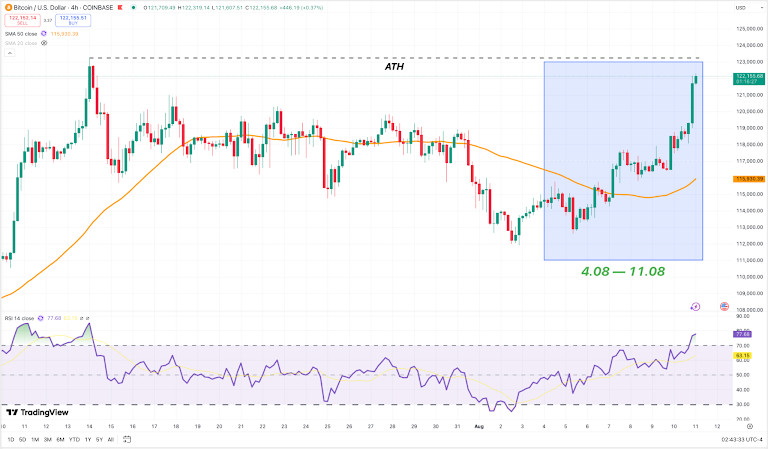
What a week, right? Between August 4 and August 11, the market did one of those dramatic turnarounds that makes last week’s panic look almost silly in hindsight. We went from that gut-wrenching flush down to ~112K straight into a rip back above 122K, and now BTC’s pressing right up against the 124K all-time-high line like it never existed. On the 4-hour chart, we’re cruising well above the 50-MA around 116K. The RSI’s hanging out in the high-70s, which, let’s be honest, is great for momentum, but also the kind of heat that usually cools off sooner or later.
BTC/USD 4H Chart, Coinbase. Source: TradingView
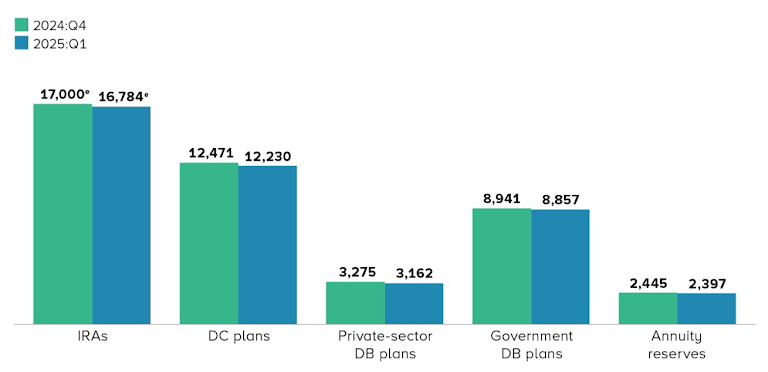
So, why the reversal? The mood shift really started when the White House dropped that executive order letting 401(k) retirement plans hold crypto. That, if you ask us, was a pretty unambiguous green light for long-term capital to start dipping into Bitcoin. 
Retirement assets by type. Source: Investment Company Institute and Federal Reserve Board
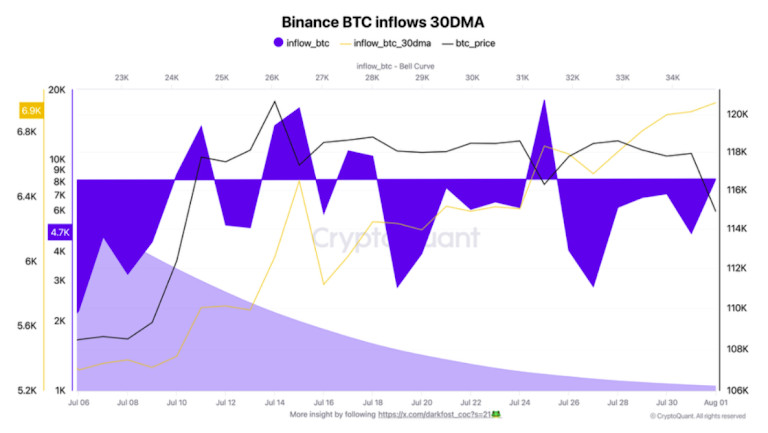
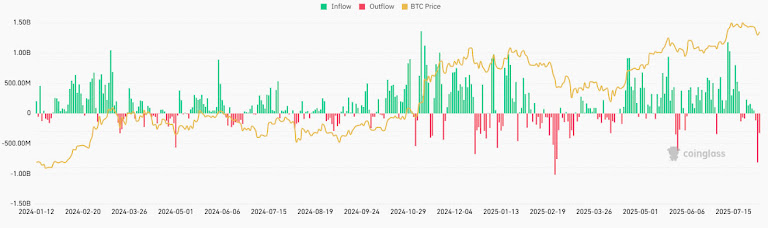
And once that landed, it felt like the market collectively went, “Ah, so this isn’t over.” Sure enough, ETF inflows picked up. After a few sluggish weeks, spot BTC funds were back in the green, and that’s when the bounce stopped feeling like a dead-cat and started looking like a move with legs.
Bitcoin BTC inflows 30-day moving average (screenshot). Source: CryptoQuant
Then the institutional flexing started. Harvard’s endowment popped up with a stake in BlackRock’s IBIT – symbolically huge, because let’s be honest, Harvard doesn’t exactly chase hype. Right after that, the Michigan state pension fund boosted its own BTC ETF holdings, basically confirming that big, patient money is using these dips to quietly build positions.
Spot Bitcoin ETF flows. Source CoinGlass
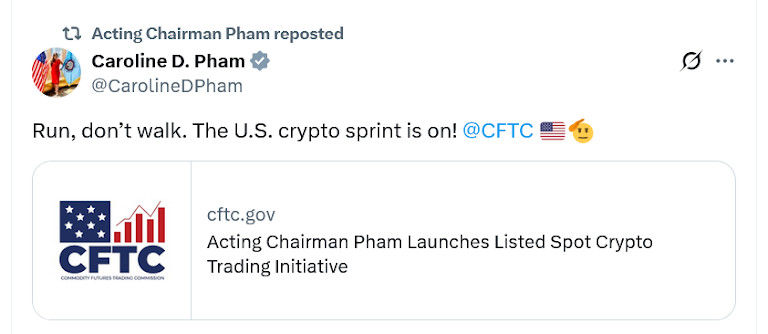
Even regulators, who’ve been happy to play the villain all year, weren’t in a wrecking-ball mood. The CFTC hinted at adding more structure to spot crypto trading, which, love it or hate it, at least gives the market a clearer playbook.
Source: Caroline Pham
All of this was happening while the U.S. dollar softened up, which only added fuel to the fire. We’ve got a friendlier-than-usual macro backdrop, institutions buying dips, and policy that wasn’t actively trying to ruin the party. So, no wonder we went from “BTC looks shaky” to “let’s take a run at the highs” in just a few sessions.
Bottom line: Bitcoin’s got the momentum. Just remember, with RSI this hot, a quick tag of the highs followed by a pullback into the 116–118K zone wouldn’t be a surprise. 
Ethereum (ETH)
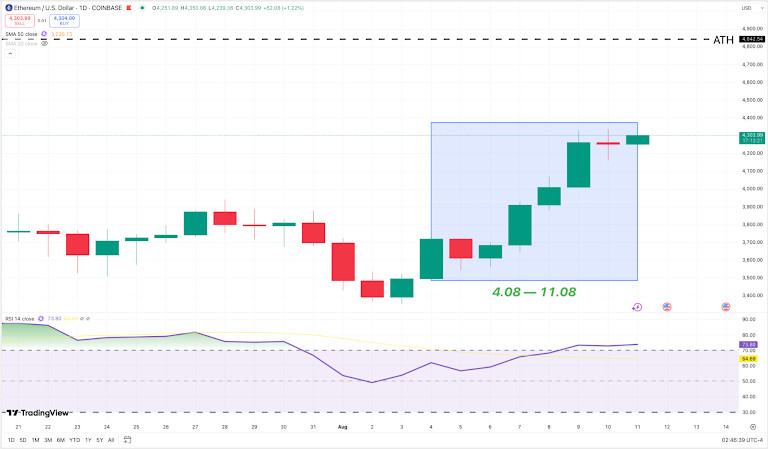
Okay, now over to Ethereum, where the picture last week was actuall pretty similar. From August 4 to August 11, ETH climbed back over 4K and is now leaning toward that 4.86 – 4.9K all-time-high zone. On the daily chart, price is sitting comfortably above the 50-MA down at ~3.24K, and RSI’s in the low-to-mid 70s.
ETH/USD 4H Chart, Coinbase. Source: TradingView
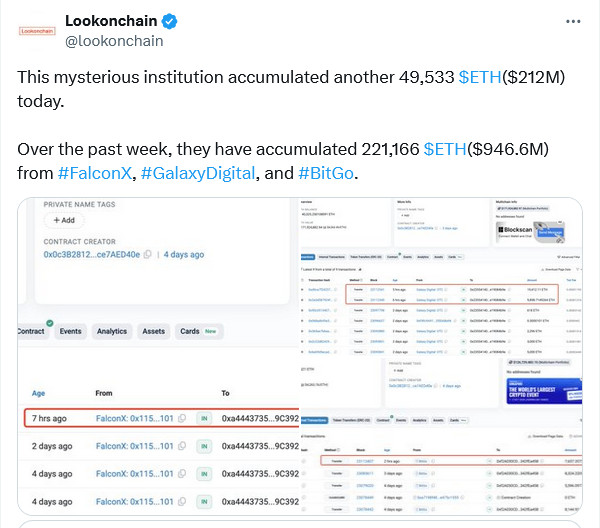
But ETH’s run wasn’t just spillover. One of the big sparks was that “mysterious institution” quietly scooping up nearly $1B worth of ETH in a single week (as per Lookonchain). 
Source: Lookonchain
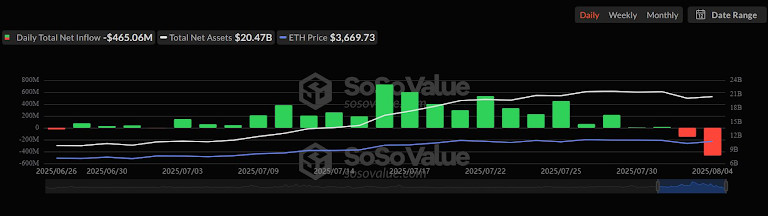
The ETF picture was a little messier though. Early in the week, spot ETH ETFs saw their largest single-day outflow on record – $465M led by BlackRock’s fund – which naturally rattled some nerves. 
Daily total inflows and outflows for Spot Ether ETFs. Source: SoSoValue
But as soon as Bitcoin started charging toward its highs, ETH’s flows steadied, and traders remembered that ETH tends to lag BTC on the way up before playing catch-up fast.
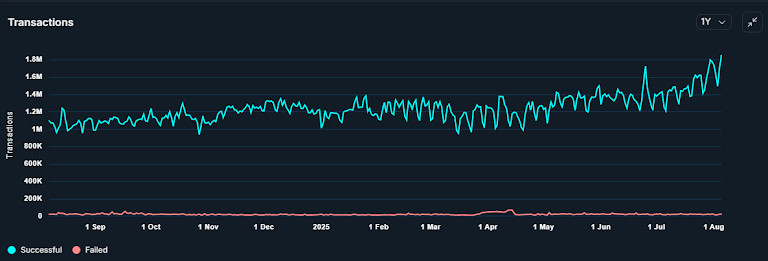
One-year chart of transactions on the Ethereum network. Source: Nansen
On-chain, activity has been picking up too. Ethereum transaction volumes hit a year-high, partly thanks to the ongoing drama over SEC staking rules. While the agency didn’t exactly roll out the red carpet for staking protocols, it didn’t shut the door either – and that “not bad news” was good enough for traders to stay risk-on.
Bottom line: if BTC clears 124K and holds, ETH has a clean shot at running into that 4.6 – 4.9K zone. The daily RSI says a breather is due, so a dip toward low-4Ks wouldn’t break the trend. In fact, it could set up the kind of reset that’s healthy before a real ATH attempt. But with sentiment flipping this fast, don’t be surprised if ETH takes that shot sooner rather than later.
Toncoin (TON)
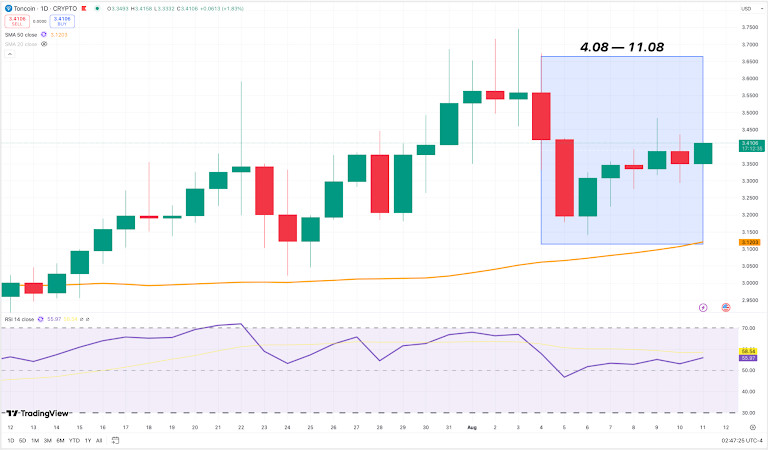
While Bitcoin and Ethereum were busy chasing their all-time highs, TON did what TON usually does: its own thing entirely. Between August 4 and August 11, it’s been in “bounceolidation” mode after last week’s drop – hovering in the 3.3–3.5 range, holding above its 50-MA around 3.12, and keeping its RSI in a pretty calm mid-50s zone. 
TON/USD 4H Chart. Source: TradingView
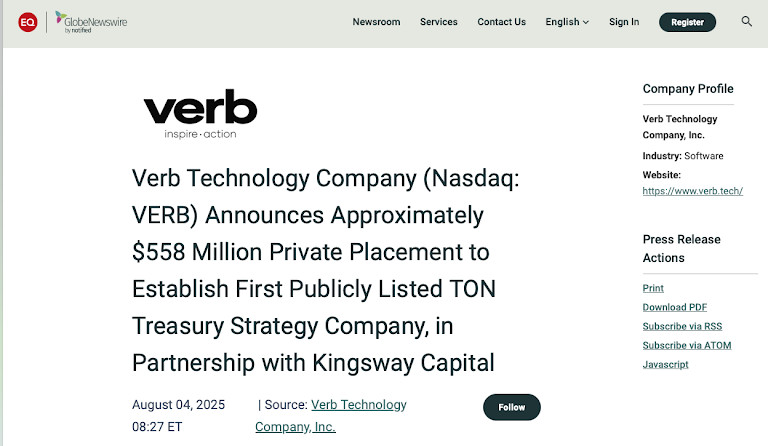
The week kicked off with a big one – Verb Technology announced a $558 million raise to create TON Strategy Co., the first publicly listed company with Toncoin as its treasury asset, in partnership with Kingsway Capital. 
Source: GlobeNewswire
If that wasn’t enough institutional spice, Telegram itself moved over 119 million TON (about $400 million) into the newly announced TON Strategy fund. So, the platform is putting serious skin in the game.
Source: Amazon Web Services
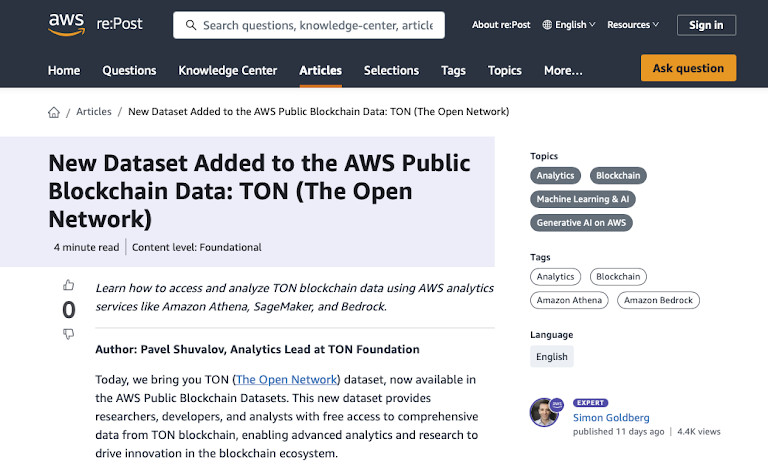
Also, the visibility push kept rolling. Amazon Web Services added TON to its Public Blockchain Datasets program, giving anyone free access to full chain data through AWS’s cloud tools. For developers, analysts, and anyone building on TON, that’s a major infrastructure boost.
Source: CoinGecko
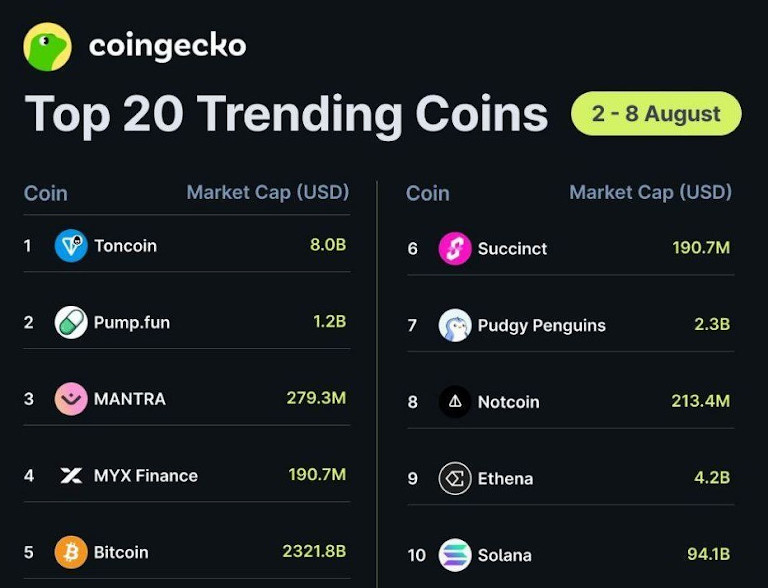
And, as the cherry on top, TON ranked as the most-trending coin on CoinGecko this week. Clearly, the ecosystem is pushing real hard to broaden its reach beyond Telegram’s backyard.
All told, TON’s price action was quieter than the news cycle, but the underlying story was still solid: a mix of deep-pocket institutional moves, quirky-but-on-brand product launches, some real infrastructure progress to back it all.
In our opinion, as long as Bitcoin keeps its momentum, TON has room to extend toward 3.6–3.8 without much resistance. But if BTC stumbles, expect TON to drift back toward the 50-MA before making another attempt higher. The difference this time is that it’s doing so with some of the most high-profile ecosystem support we’ve seen yet.

Bitcoin (BTC)

What a week, right? Between August 4 and August 11, the market did one of those dramatic turnarounds that makes last week’s panic look almost silly in hindsight. We went from that gut-wrenching flush down to ~112K straight into a rip back above 122K, and now BTC’s pressing right up against the 124K all-time-high line like it never existed. On the 4-hour chart, we’re cruising well above the 50-MA around 116K. The RSI’s hanging out in the high-70s, which, let’s be honest, is great for momentum, but also the kind of heat that usually cools off sooner or later.

BTC/USD 4H Chart, Coinbase. Source: TradingView

BTC/USD 4H Chart, Coinbase.

So, why the reversal? The mood shift really started when the White House dropped that executive order letting 401(k) retirement plans hold crypto. That, if you ask us, was a pretty unambiguous green light for long-term capital to start dipping into Bitcoin. 

Retirement assets by type. Source: Investment Company Institute and Federal Reserve Board

Retirement assets by type.

And once that landed, it felt like the market collectively went, “Ah, so this isn’t over.” Sure enough, ETF inflows picked up. After a few sluggish weeks, spot BTC funds were back in the green, and that’s when the bounce stopped feeling like a dead-cat and started looking like a move with legs.

Bitcoin BTC inflows 30-day moving average (screenshot). Source: CryptoQuant

Bitcoin BTC inflows 30-day moving average (screenshot).

Then the institutional flexing started. Harvard’s endowment popped up with a stake in BlackRock’s IBIT – symbolically huge, because let’s be honest, Harvard doesn’t exactly chase hype. Right after that, the Michigan state pension fund boosted its own BTC ETF holdings, basically confirming that big, patient money is using these dips to quietly build positions.

Spot Bitcoin ETF flows. Source CoinGlass

Spot Bitcoin ETF flows.

Even regulators, who’ve been happy to play the villain all year, weren’t in a wrecking-ball mood. The CFTC hinted at adding more structure to spot crypto trading, which, love it or hate it, at least gives the market a clearer playbook.

Source: Caroline Pham

All of this was happening while the U.S. dollar softened up, which only added fuel to the fire. We’ve got a friendlier-than-usual macro backdrop, institutions buying dips, and policy that wasn’t actively trying to ruin the party. So, no wonder we went from “BTC looks shaky” to “let’s take a run at the highs” in just a few sessions.

Bottom line: Bitcoin’s got the momentum. Just remember, with RSI this hot, a quick tag of the highs followed by a pullback into the 116–118K zone wouldn’t be a surprise. 

Ethereum (ETH)

Okay, now over to Ethereum, where the picture last week was actuall pretty similar. From August 4 to August 11, ETH climbed back over 4K and is now leaning toward that 4.86 – 4.9K all-time-high zone. On the daily chart, price is sitting comfortably above the 50-MA down at ~3.24K, and RSI’s in the low-to-mid 70s.

ETH/USD 4H Chart, Coinbase. Source: TradingView

ETH/USD 4H Chart, Coinbase.

But ETH’s run wasn’t just spillover. One of the big sparks was that “mysterious institution” quietly scooping up nearly $1B worth of ETH in a single week (as per Lookonchain). 

Source: Lookonchain

The ETF picture was a little messier though. Early in the week, spot ETH ETFs saw their largest single-day outflow on record – $465M led by BlackRock’s fund – which naturally rattled some nerves. 

Daily total inflows and outflows for Spot Ether ETFs. Source: SoSoValue

Daily total inflows and outflows for Spot Ether ETFs.

But as soon as Bitcoin started charging toward its highs, ETH’s flows steadied, and traders remembered that ETH tends to lag BTC on the way up before playing catch-up fast.

One-year chart of transactions on the Ethereum network. Source: Nansen

One-year chart of transactions on the Ethereum network.

On-chain, activity has been picking up too. Ethereum transaction volumes hit a year-high, partly thanks to the ongoing drama over SEC staking rules. While the agency didn’t exactly roll out the red carpet for staking protocols, it didn’t shut the door either – and that “not bad news” was good enough for traders to stay risk-on.

Bottom line: if BTC clears 124K and holds, ETH has a clean shot at running into that 4.6 – 4.9K zone. The daily RSI says a breather is due, so a dip toward low-4Ks wouldn’t break the trend. In fact, it could set up the kind of reset that’s healthy before a real ATH attempt. But with sentiment flipping this fast, don’t be surprised if ETH takes that shot sooner rather than later.

Toncoin (TON)

While Bitcoin and Ethereum were busy chasing their all-time highs, TON did what TON usually does: its own thing entirely. Between August 4 and August 11, it’s been in “bounceolidation” mode after last week’s drop – hovering in the 3.3–3.5 range, holding above its 50-MA around 3.12, and keeping its RSI in a pretty calm mid-50s zone. 

TON/USD 4H Chart. Source: TradingView

TON/USD 4H Chart.

The week kicked off with a big one – Verb Technology announced a $558 million raise to create TON Strategy Co., the first publicly listed company with Toncoin as its treasury asset, in partnership with Kingsway Capital. 

Source: GlobeNewswire

If that wasn’t enough institutional spice, Telegram itself moved over 119 million TON (about $400 million) into the newly announced TON Strategy fund. So, the platform is putting serious skin in the game.

Source: Amazon Web Services

Also, the visibility push kept rolling. Amazon Web Services added TON to its Public Blockchain Datasets program, giving anyone free access to full chain data through AWS’s cloud tools. For developers, analysts, and anyone building on TON, that’s a major infrastructure boost.

Source: CoinGecko

And, as the cherry on top, TON ranked as the most-trending coin on CoinGecko this week. Clearly, the ecosystem is pushing real hard to broaden its reach beyond Telegram’s backyard.

All told, TON’s price action was quieter than the news cycle, but the underlying story was still solid: a mix of deep-pocket institutional moves, quirky-but-on-brand product launches, some real infrastructure progress to back it all.

In our opinion, as long as Bitcoin keeps its momentum, TON has room to extend toward 3.6–3.8 without much resistance. But if BTC stumbles, expect TON to drift back toward the 50-MA before making another attempt higher. The difference this time is that it’s doing so with some of the most high-profile ecosystem support we’ve seen yet.

Disclaimer

In line with the Trust Project guidelines, please note that the information provided on this page is not intended to be and should not be interpreted as legal, tax, investment, financial, or any other form of advice. It is important to only invest what you can afford to lose and to seek independent financial advice if you have any doubts. For further information, we suggest referring to the terms and conditions as well as the help and support pages provided by the issuer or advertiser. MetaversePost is committed to accurate, unbiased reporting, but market conditions are subject to change without notice.

About The Author


Alisa, a dedicated journalist at the MPost, specializes in cryptocurrency, zero-knowledge proofs, investments, and the expansive realm of Web3. With a keen eye for emerging trends and technologies, she delivers comprehensive coverage to inform and engage readers in the ever-evolving landscape of digital finance.

More articles


Alisa Davidson


Alisa, a dedicated journalist at the MPost, specializes in cryptocurrency, zero-knowledge proofs, investments, and the expansive realm of Web3. With a keen eye for emerging trends and technologies, she delivers comprehensive coverage to inform and engage readers in the ever-evolving landscape of digital finance.


More articles


Source link

Popular Posts

My Favorites