Metaverse

Home Metaverse Page 120

Online Casino Insights: What to Expect from NFT Casinos | NFT News Today

Online Casino Insights: What to Expect from NFT Casinos | NFT News Today


The rise of blockchain technology has opened new doors for the online casino industry. With the integration of non-fungible tokens (NFTs), casinos are evolving into more transparent, player-driven platforms. 

But what exactly should players expect from an NFT online casino? Let’s explore the main features, challenges, and opportunities that this new form of iGaming brings.

Understanding NFT Casinos in the World of iGaming

NFTs are unique digital assets stored on a blockchain, often used to represent ownership of art, collectables, or even gaming items. In the casino online sector, NFTs are being introduced as tradable and usable in-game assets. For instance, players may hold exclusive avatars, event tickets, or even skins as NFTs.

Unlike traditional casino online games, an NFT casino operates with a layer of transparency powered by blockchain. This means transactions, outcomes, and ownership records are verifiable by all. While a crypto casino focuses on digital payments, an NFT casino online integrates digital asset ownership, providing a unique blend of financial and gaming utility.

One of the platforms often highlighted for innovation is CasinoLuck online casino, where blockchain-based solutions and player-centric features are gradually shaping the future of iGaming. Play the best casino games online and make seamless transactions via blockchain. 

5 Key Features to Check Before You Play Casino Online with NFTs

The growing popularity of blockchain casino games has made it essential for players to know what to look for before joining. Here are some key features you should check out before you take the plunge: 

1. Security and Blockchain Transparency

In any blockchain casino, robust security measures are essential for maintaining player trust and confidence. Blockchain technology inherently guarantees the provable fairness of casino game outcomes, as each transaction is recorded on a decentralised ledger that cannot be altered. Players should take the initiative to verify whether their chosen casino platform utilises independent auditing firms to assess its systems and practices. Additionally, examining the casino’s use of transparent smart contracts can help ensure that the rules governing games are clear and enforceable, further minimising the risks of manipulation and fraud.

2. NFT Ownership and Utility

Unlike simple in-game collectables that offer minimal interaction, NFTs in an online NFT casino often possess substantial utility that enhances the gaming experience. For instance, owning certain NFTs may grant players access to exclusive tournaments with higher stakes and rewards, provide opportunities for unique avatar customisation tailored to individual preferences, or even allow for passive income through mechanisms like staking. It is crucial for players to thoroughly research and verify the actual benefits associated with NFT ownership, as well as the potential for appreciating value, before making any financial commitments.

3. Payment Methods and Cryptocurrency Support

A significant advantage of blockchain casino software is its support for various cryptocurrencies, including well-known options like Bitcoin and Ethereum, as well as stablecoins that minimise volatility. Many platforms also recognise the demand for altcoins, offering a diverse array of payment methods to cater to different preferences. While cryptocurrency transactions generally boast quick processing times, players should remain aware of the price volatility that may affect the value of their digital assets, as well as any transaction fees that could impact overall earnings or wagers.

4. Licensing and Player Safety

Selecting a licensed online casino is paramount to ensuring a safe and fair gaming environment. Reputable jurisdictions such as Malta, the United Kingdom, and Gibraltar impose stringent regulations on online gambling operators to protect users from exploitation. Prospective players should diligently check for valid certifications and licenses, as this not only confirms adherence to fair play standards but also mitigates potential risks to their funds and personal data. Engaging with unlicensed casinos can lead to significant vulnerabilities, including the threat of fraud and data breaches.

5. Player Experience and Community Value

NFTs add a dynamic layer of community engagement and social interaction within the gaming environment. Many online casino platforms incorporate loyalty systems that reward players for their participation, enabling access to exclusive private clubs, special bonuses, and voting rights on game development decisions. A seamless wallet integration is essential for providing a hassle-free experience during transactions and playing online casino games, while the platform’s overall gameplay interface should prioritise smooth operation to enhance player satisfaction. The development of a vibrant community can significantly enhance the enjoyment of gaming, turning it into a more social and collaborative experience.

NFT Casinos vs Traditional Online Casino Platforms

The entry of NFT online casino platforms doesn’t mean traditional casinos are disappearing. Instead, they coexist with distinct advantages and similarities.

Key Differences

Feature

NFT Casino

Traditional Online Casino

Asset Ownership

NFTs as playable or tradable assets

No asset ownership

Payment Methods

Crypto-based transactions

Fiat currencies

Transparency

Blockchain records, provably fair systems

Standard RNG audits

Regulation

Still evolving

More established

Similarities That Remain

Despite their inherent differences, both online casinos and traditional brick-and-mortar establishments rely on random outcomes to determine the results of games, underscoring the pivotal role that luck plays in the gambling experience. Whether you’re engaging in online casino games that incorporate non-fungible tokens (NFTs) or participating in classic table games and slot machines at a physical casino, the unpredictability of game outcomes remains a common thread. 

Additionally, whether you play online casino games with NFTs or traditional setups, responsible gambling measures remain vital. This includes setting limits on time and money spent, recognising the signs of gambling addiction, and ensuring that players have access to support resources, elements that are essential for maintaining a safe and enjoyable gaming atmosphere for all participants.

How to Evaluate the Best Casino Online with NFTs?

Before choosing where to play, consider the following checklist:

Verify licensing and jurisdiction.

Review blockchain transparency and audits.

Confirm accepted cryptocurrencies and fees.

Assess NFT utility and membership perks.

Ensure responsible gambling tools are available.

Check reputation through community feedback.

Evaluate usability and wallet integration.

These steps help players find the best online casino games experience while safeguarding their funds and digital assets.

Final Thoughts: Casino Gaming & NFT Integration

The integration of NFTs into online casino games marks a significant shift. While opportunities exist in ownership, transparency, and enhanced experiences, risks like regulatory uncertainty and crypto volatility cannot be ignored. A balanced approach is essential: prioritising security, responsible play, and awareness.

As the casino blockchain industry matures, players may find NFT-based platforms becoming a mainstream part of iGaming. For now, staying informed remains the best bet.



Source link

Is Abandoning Sidechains the Future of Blockchain Gaming? | NFT News Today

Is Abandoning Sidechains the Future of Blockchain Gaming? | NFT News Today


Ronin’s decision to migrate back to Ethereum as a full Layer 2 network raises a big question: are standalone blockchains losing ground to Ethereum’s growing Layer 2 ecosystem? With Ethereum upgrades improving speed and lowering costs, the case for abandoning sidechains is becoming harder to ignore.

Key Takeaways

Ronin is moving back to Ethereum as a Layer 2, citing security, scalability, and cost improvements.

Sidechains face growing pressure as Ethereum Layer 2 networks mature and attract institutional adoption.

Immutable X and Polygon remain strong players in gaming but face competition from Ethereum’s scaling roadmap.

Ronin’s Proof-of-Distribution model shifts incentives from validators to active builders.

Security incidents on Ronin highlight the risks of running independent sidechains.

Why Ronin Is Returning to Ethereum

Ronin began as a gaming sidechain for Axie Infinity, providing low fees and fast transactions when Ethereum had limitations. After Ethereum 2.0 upgrades made transactions cheaper and more efficient, Ronin found it made more sense to become an Ethereum Layer 2.

By moving back, Ronin inherits Ethereum’s decentralization, institutional momentum, and security model. It also distances itself from past exploits, including the $625 million hack in 2022 and the $12 million exploit in 2024, which exposed the vulnerabilities of smaller sidechains.

Immutable X: Promise vs. Plateau

Immutable X set out to be the top platform for NFTs and gaming, using zero-knowledge rollups. The technology works well, but actual adoption has not matched the early excitement. Aside from a few major partnerships, growth in gaming has slowed. The goal of becoming the main gaming chain hasn’t happened at the scale many hoped for.

One challenge for Immutable X is its narrow focus. By concentrating on NFTs and gaming, it tied its growth to markets that can be unpredictable. When the play-to-earn trend faded, there were fewer big games to keep activity high, and smaller developers didn’t join as quickly. Without more use cases or a larger developer base, Immutable X could end up as a niche platform instead of a top Layer 2 option.

Polygon: Versatility or Fragmentation?

Polygon positioned itself as a versatile scaling solution, offering everything from proof-of-stake chains to zk-rollups. On the surface, this range suggests adaptability, but in practice, it may be creating more noise than clarity.

Much of Polygon’s momentum has been fueled by incentives, subsidies, and aggressive marketing campaigns rather than deep, organic developer commitment. While headline partnerships draw attention, questions remain about how much of that activity translates into sustainable, long-term usage.

The main risk for Polygon is trying to do too much at once. This could make its focus unclear and leave developers unsure about which products will last. In this case, being versatile might actually make it harder for Polygon to become a leader in any one area.

Ethereum’s Upgrades Change the Game

Ethereum’s move to Proof-of-Stake and recent scaling updates have changed things. Gas fees, which used to push projects to sidechains, have gone down, and the network can now handle more transactions.

Now, developers and investors don’t have to choose between cost and security. Instead of running separate chains, projects can use Ethereum’s strong infrastructure and benefit from its large pool of liquidity and developers.

New Tokenomics and Incentives

One of the more interesting aspects of Ronin’s transition is its new Proof-of-Distribution model. Instead of rewarding validators, Ronin will distribute incentives to developers, liquidity providers, and other contributors.

This approach is meant to support real growth in the ecosystem. It also shows that the future is not just about keeping chains secure, but about rewarding the people who help build and maintain these communities.

Security as a Deciding Factor

Security is still the biggest weakness for sidechains. The major Ronin hack in 2022 was a wake-up call for the whole industry. By moving to Ethereum’s Layer 2, Ronin lowers its risk of bridge attacks and other small-chain problems.

For projects considering their next steps, this migration is a reminder that trust and safety matter just as much as performance.

Is Abandoning Sidechains the Future?

Ronin’s return to Ethereum suggests that abandoning sidechains might become a trend, especially as Ethereum continues to strengthen. While networks like Immutable X and Polygon still have unique positions, the market seems to be consolidating around Ethereum’s scaling ecosystem.

For developers, this shift is a chance to build on infrastructure that balances cost, speed, and security. For investors, it’s a sign that Ethereum’s influence isn’t fading, it’s growing stronger.


Source link

Understanding Crypto Market Making: A Beginner’s Guide

Understanding Crypto Market Making: A Beginner’s Guide


In Brief

Market making in cryptocurrency involves providing continuous buy and sell orders to ensure liquidity, stabilize prices, and enable smooth trading on both centralized and decentralized exchanges.

Understanding Crypto Market Making: A Beginner’s Guide

If you’re new to the world of cryptocurrency, you’ve probably heard the term “market making” tossed around in discussions about exchanges and liquidity. But what does it really mean? At its core, market making is the process of providing buy and sell orders on trading platforms to ensure there’s always someone ready to trade with you. This keeps pricing more stable by reducing volatility and makes it easier for traders to buy or sell tokens instantly without major price gaps.

Market makers are the unsung heroes working behind the scenes on both centralized exchanges (like Binance) and decentralized ones (like Uniswap). They bridge the gap between buyers and sellers, earning a profit from the small difference in prices known as the bid-ask spread. Understanding the fundamentals behind this process isn’t just academic: it can help you maximize profits by knowing where to trade – and where to fade.

Spoiler alert: look for where the liquidity’s deepest. That isn’t always obvious at first sight – but it should be by the time you’ve read this guide. Let’s begin.

A Quick History of Crypto Market Making

Market making isn’t a crypto invention; it’s been around since the early days of traditional finance. Back in the stock market era, human traders on exchange floors would stand ready to buy or sell securities, ensuring trades could be executed promptly. With the rise of electronic trading in the late 20th century, algorithms took over, making the process faster and more efficient. A few years later, and as cryptocurrency matured and went mainstream, market makers began to move in.

Early centralized exchanges needed constant liquidity to satisfy the demands of global users, so specialist firms stepped up to the plate. Decentralized finance – DeFi – then emerged in 2020, starting on Ethereum, and adding a twist to crypto liquidity provision: now anyone could join in, using smart contracts to place their tokens into a liquidity pool and earn a share of the trading fees. Despite this innovation, DeFi is also dependent upon professional market makers to provide deep liquidity and to match bids and asks on orderbook-based decentralized exchanges. 

Today, market makers are deeply embedded into the crypto landscape, both on centralized and decentralized exchanges. They provide liquidity for everything from major pairs such as BTC/USDT to niche altcoins that are only hours old, helping to maintain a smooth trading experience no matter how calm – or volatile – the markets.

How Market Making Works in Crypto

In simple terms, a market maker quotes two prices: the “bid” – which is what they’re willing to pay to buy a particular asset – and the “ask,” which is what they charge to sell the asset. The difference – the spread – is their potential profit. When you place an order, the market maker fills it instantly, using automated systems to adjust pricing and other parameters based on market conditions.

Crypto market making occurs in two main arenas:

Centralized Exchanges (CEXs): These are platforms like Coinbase or Binance, where professional market makers (sometimes hired by the exchange itself) use high-tech algorithms to provide liquidity. They handle high volumes and aim to stay “delta neutral,” meaning they don’t bet on price directions – they just profit from the flow of trades.

Decentralized Exchanges (DEXs): On platforms like Uniswap or Jupiter, liquidity comes from pools where market makers – as well as ordinary users – lock in pairs of tokens (e.g. ETH and USDT). Smart contracts automate the trades and anyone can contribute. This democratizes the process, but it also introduces risks such as impermanent loss, where the value of your locked tokens changes due to price shifts.

How Market Makers Operate Onchain

One common misconception is that market makers manipulate prices or prop them up to prevent a particular token from “dumping.” In reality, they’re neutral players who follow the market’s ebb and flow, providing stability without steering the ship.

Market makers have a particularly valuable role to play when a token has just launched on a DEX, since initial liquidity would otherwise be low because users can’t provide liquidity themselves until they’ve had a chance to buy the token. To solve this chicken-and-egg problem, the token project will often provide a tranche of native tokens to a market maker. They’ll combine this with a base currency such as ETH or USDT and use it to provide liquidity from launch.

The launch of a highly anticipated new token attracts high volume resulting in significant volatility. Market makers can’t prevent this from occurring altogether, since “price discovery” is an organic part of the process when any popular token is listed on an exchange. By ensuring there is sufficient liquidity in place to facilitate this trading frenzy, however, market makers can dampen the worst of the volatility and ensure that traders aren’t adversely affected by slippage.

Once a project has stabilized, and onchain users have had a chance to provide liquidity, the market maker can take a step back. Rather than withdraw all their liquidity in one go, they’ll reduce it gradually to ensure a smooth transition that won’t impair the trading experience. Often, they’ll continue to provide liquidity for several months at the request of the project in question.

Key Strategies for Market Makers

Market makers aren’t one-size-fits-all; they use different approaches depending on the asset, exchange, and conditions. The methodology they deploy will vary according to the needs of the client who’s hired them. This could be an exchange or it might be a project that has a native token it would like to have supported in the form of liquidity provision.

Here’s a rundown of some of the primary strategies they employ:

Passive Market Making

This is the most common approach whereby the market maker places buy orders below the current price and sell orders above it, then waits for trades to come in. It’s ideal for stable markets with assets like major stablecoins or top cryptos. Profits come steadily from the spread, and it’s self-sustaining, eliminating the need for constant tweaks. If there’s a downside it’s that major price jumps – such as when a whale places a huge buy order – can leave the market maker with unbalanced holdings, but in high-volume pairs, this strategy delivers reliable returns, often 0.05-0.1% per trade.

Active Market Making

For more dynamic environments, such as volatile altcoins during a market surge, active strategies are preferable. Here, algorithms constantly monitor volatility and order books, adjusting positions in real-time. This might involve predicting short-term moves or pairing with arbitrage tactics. Active market making is more profitable in choppy waters – potentially 10-15% monthly during a bull run – but requires advanced tech and carries higher risks if the market outpaces the system.

Inventory Management

This isn’t a market making strategy per se but a smart overlay on others. Market makers track their overall holdings across assets and exchanges to avoid getting stuck with too much of a risky token. Using risk models, they hedge positions and maintain balance, prioritizing long-term survival over quick wins. It’s like portfolio management for pros: done right, it can cut risk by 30-40%, though being too cautious might limit monthly returns to 1-2%.

High-Frequency Market Making

Geared toward speed demons, this technique uses ultra-fast bots to exploit tiny price flickers in milliseconds. It’s common on liquid CEXs for big pairs, requiring low-latency setups and often run by firms from traditional finance. Profits can hit 3-5% monthly, but setup costs are steep and it’s a strategy that’s not used by delta-neutral market makers – rather it’s the preserve of private trading firms using their own initiative for profit maximization.

Demystifying Crypto Market Making

Market making is the glue holding crypto trading together, from smoothing out CEX orders to keeping DeFi pools deep enough for whales to swim. As a beginner, grasping these concepts empowers you to trade smarter and even contribute, should you decide to pool liquidity to earn rewards. For the most part, you don’t need to concern yourself with the finer points of market making: but you should at least be aware of the signs that show it’s in place on the exchange where you’re operating.

Whether trading on DEX or CEX, the price you’re quoted for a particular token should be extremely close to the final price you pay, and the difference between the bid and the ask should be nominal. If you receive an alert warning you that slippage is higher than 1% on the exchange where you’re about to make a swap, think twice before proceeding. Where possible, go elsewhere to make your trade – to a DEX or CEX where the price you’re quoted is the price your order is filled at. Nine times out of ten, when this happens it’s evidence that there’s a market maker in the background, quietly yet efficiently doing their thing.

Disclaimer

In line with the Trust Project guidelines, please note that the information provided on this page is not intended to be and should not be interpreted as legal, tax, investment, financial, or any other form of advice. It is important to only invest what you can afford to lose and to seek independent financial advice if you have any doubts. For further information, we suggest referring to the terms and conditions as well as the help and support pages provided by the issuer or advertiser. MetaversePost is committed to accurate, unbiased reporting, but market conditions are subject to change without notice.

About The Author


Alisa, a dedicated journalist at the MPost, specializes in cryptocurrency, zero-knowledge proofs, investments, and the expansive realm of Web3. With a keen eye for emerging trends and technologies, she delivers comprehensive coverage to inform and engage readers in the ever-evolving landscape of digital finance.

More articles


Alisa Davidson


Alisa, a dedicated journalist at the MPost, specializes in cryptocurrency, zero-knowledge proofs, investments, and the expansive realm of Web3. With a keen eye for emerging trends and technologies, she delivers comprehensive coverage to inform and engage readers in the ever-evolving landscape of digital finance.


More articles


Source link

Kraken Becomes First Major Exchange To Fully Integrate Distributed Validator Technology For Ethereum Staking Via SSV Network

Kraken Becomes First Major Exchange To Fully Integrate Distributed Validator Technology For Ethereum Staking Via SSV Network


In Brief

Kraken has become the first major exchange to fully integrate SSV Network’s Distributed Validator Technology for Ethereum staking, enhancing resilience, scalability, and security across its validator infrastructure.

Kraken Becomes First Major Exchange To Fully Integrate Distributed Validator Technology For Ethereum Staking Via SSV Network

Cryptocurrency exchange Kraken has announced the completion of a full integration of SSV Network’s Distributed Validator Technology (DVT) within its Ethereum (ETH) staking framework. SSV Network, a recognized provider of DVT solutions, is widely adopted by leading staking protocols across the Ethereum ecosystem to enable decentralized, secure, and high-performance staking operations.

Kraken’s deployment of this technology represents the first large-scale adoption of DVT by a major centralized exchange, marking a significant step toward creating a more resilient, scalable, and secure validator infrastructure for its staking clients.

DVT introduces a next-generation approach to validator operations by distributing responsibilities across multiple independent nodes rather than relying on a single machine or software client. Each node holds a cryptographically secure share of the validator key, working collectively to execute essential tasks such as block proposals and attestations. This design enhances fault tolerance, ensures stronger protection against individual machine or client failures, and improves validator uptime.

The integration reflects Ethereum’s broader objective of minimizing single points of failure within its consensus mechanism. By spreading validator responsibilities across diverse clients and environments, DVT strengthens the network’s resilience while allowing enterprise-level staking operations to scale without adding proportional levels of risk or operational complexity.

Kraken Partners With OpenPayd To Enable Real-Time Fiat Payments Across UK And Europe

Kraken is a global technology platform operating within the cryptocurrency sector, designed to improve access to financial systems and reduce inefficiencies with the goal of supporting greater financial freedom both within the digital asset economy and in broader markets. The platform is used by millions of individual participants, professional traders, and institutions worldwide, offering trading services across cryptocurrencies, national currencies, US futures, as well as US-listed equities and exchange-traded funds.

In a recent development, Kraken announced a partnership with OpenPayd to introduce real-time fiat payment functionality for users in the United Kingdom and Europe. Through this integration, Kraken customers gain the ability to transfer funds instantly via programmable domestic and international payment networks, supported by OpenPayd’s API-driven infrastructure and virtual IBAN technology.

Disclaimer

In line with the Trust Project guidelines, please note that the information provided on this page is not intended to be and should not be interpreted as legal, tax, investment, financial, or any other form of advice. It is important to only invest what you can afford to lose and to seek independent financial advice if you have any doubts. For further information, we suggest referring to the terms and conditions as well as the help and support pages provided by the issuer or advertiser. MetaversePost is committed to accurate, unbiased reporting, but market conditions are subject to change without notice.

About The Author


Alisa, a dedicated journalist at the MPost, specializes in cryptocurrency, zero-knowledge proofs, investments, and the expansive realm of Web3. With a keen eye for emerging trends and technologies, she delivers comprehensive coverage to inform and engage readers in the ever-evolving landscape of digital finance.

More articles


Alisa Davidson


Alisa, a dedicated journalist at the MPost, specializes in cryptocurrency, zero-knowledge proofs, investments, and the expansive realm of Web3. With a keen eye for emerging trends and technologies, she delivers comprehensive coverage to inform and engage readers in the ever-evolving landscape of digital finance.


More articles


Source link

From Staking to Banking: ether.fi Redefines Crypto Utility

From Staking to Banking: ether.fi Redefines Crypto Utility


In Brief

Ether.fi, now Ethereum’s fourth-largest protocol with $12B secured, is expanding beyond staking into a crypto-native neobank, with co-founder Rok Kopp highlighting liquid restaking, AVSs, and the future of DeFi banking.

From Staking to Banking: ether.fi Redefines Crypto Utility

ether.fi has grown into the fourth-largest protocol on Ethereum, securing more than $12 billion in assets and 2.6 million ETH, an achievement its co-founder Rok Kopp attributes to building beyond staking into full-scale DeFi banking services. In this conversation, he shares how liquid restaking reshapes risk and rewards, why Actively Validated Services (AVSs) are key to the future, and how ether.fi aims to evolve into a crypto-native neobank.

Could you start by introducing yourself and ether.fi?

My name is Rok, and I’m one of the co-founders of ether.fi, which is a liquid restaking platform. We’re building what you could call a DeFi bank, a place where you can save, invest, and spend your crypto assets. Our goal is to bring reward-bearing assets to crypto that can also be used in real life.

We offer maximum returns on ETH, Bitcoin, USD, and we’re adding more assets. Essentially, we want to provide all the services a traditional bank would, but for crypto. My background is in Web2 startups, and I’ve been building in this space for the last three years. Today, ether.fi is the fourth-largest protocol on Ethereum, with over $12 billion in assets.

How does liquid restaking with platforms like ether.fi change the risk-reward trade-offs compared to traditional staking models?

Early on, people were nervous about staking because of perceived risks, but the truth is that those risks are extremely low. If you’re at least semi-competent, you’re unlikely to get slashed. The Ethereum Foundation has done a lot of good work to make staking secure, with upgrades like Pectra.

With restaking, there isn’t much more risk, but the rewards are higher, around 50 basis points more on average compared to regular staking. Plus, our liquidity is as good as, if not better than, most liquid staking tokens.

What strategies are evolving for yield optimization in DeFi with tokenized restaked ETH like eETH?

There are plenty of opportunities. One of our key products is ether.fi Liquid, which is essentially tokenized, managed DeFi strategies. Users deposit assets, and then a vault and strategy manager optimizes the position.

The returns vary, ETH has been around 8%, USD is currently at 12–13%, while BTC is lower, just a couple of percent. The idea is to make it really easy for people to earn more on their assets. We focus mainly on ETH, BTC, and USD, and recently launched a Hype Vault, which has been very popular.

What infrastructure and risk management challenges arise when integrating restaked assets into more than 400 DeFi protocols?

There are a lot. We rely heavily on providers, especially Oracles, and we put significant effort into integrating our assets seamlessly across protocols. Our strategy has been “say yes to everything.” We wanted ether.fi to be ubiquitous in DeFi.

That meant ensuring that wherever people go in DeFi, they can use our assets. We worked hard to make sure that not having ether.fi-supported tokens would never be a barrier.

Ether.fi now dominates restaking with 2.6 million ETH. What drove this growth?

We always knew that staking on its own wasn’t enough. From the start, our vision was to build more products on top of staking. That’s why we have liquid products, cash products, and soon trade products.

For example, soon you’ll be able to trade perps, stocks, and more directly on ether.fi. Think of it like a banking app, Robinhood in the U.S. or Revolut in Europe, where you can manage everything in one place. Expanding beyond staking into real utility was key, and our deep integration with DeFi helped accelerate adoption.

How could services like ether.fi reshape DeFi staking into broader consumer finance?

I think it will become standard. Just like banks offer savings accounts with returns, crypto banks will do the same. Looking ahead, I believe most finance will run on crypto rails, but consumers won’t even notice.

The crypto layer will be abstracted away, and people will just use simple apps. That’s why building services that mirror everyday financial tools is so important for adoption and ecosystem growth.

What about regulatory uncertainties? How do they impact liquid staking?

Honestly, I don’t think there are many left. The SEC recently clarified that liquid staking tokens are not securities, which was the main concern. That’s now officially resolved, so I feel very good about where things stand.

Looking forward, I expect to see more digital asset trusts (DATs) and even ETFs moving into DeFi in the near future.

How do protocols manage systemic risks like slashing, smart contract failures, or liquidity crunches?

It’s complex, but our engineering team handles it really well. We monitor a range of KPIs to make sure the system stays healthy, and we act quickly if anything goes off balance.

We audit heavily, and we stay on top of node operators to make sure they perform correctly. Liquidity crunches can happen, but the key is solving them fast. We’ve always processed withdrawals one-to-one, and we’re an overcollateralized protocol.

The biggest risk is smart contract failure, so we consistently audit our contracts to ensure security.

What technical improvements could expand the appeal of restaking?

The biggest driver will be AVSs (Actively Validated Services) paying out real rewards. Right now, EigenLayer is subsidizing much of the ecosystem. However, with new projects like CAP Labs launching soon, AVSs will start incentivizing restaked ETH directly.

That’s when growth will really accelerate—when users see clear value from AVSs.

How might tokenization, such as eBTC or eUSD, affect cross-asset restaking strategies?

Each asset comes with its own challenges. Symbiotic has been great at enabling cross-asset restaking, but we’ve mostly stayed in our lane. We work with EigenLayer and Symbiotic for ETH, and with Babylon and Lombard for BTC. USD isn’t restaked yet.

Right now, there’s actually more supply of restaking than demand, so the market still needs time to balance.

What ecosystem developments could disrupt or elevate the restaking model?

On the technical side, Pectra was a strong upgrade. But at the ecosystem level, again, it comes back to AVSs. For restaking to thrive, AVSs need to create real utility and value. That’s what will ultimately prove out the model.

How do you see DeFi evolving to standardize restaking protocols?

I’d argue we’re already close to standardization. Wrapped ETH is one of the most used assets in DeFi.

The real differentiator is integrity, processing withdrawals reliably, maintaining liquidity, and doing exactly what you promise. Sadly, just doing what you say puts you in the top 5% of crypto companies. We’ve always held ourselves to that high standard, and it’s been a big part of our success.

Could you share ether.fi’s roadmap for the coming year?

Absolutely. Our vision is to do everything a traditional bank does, but for crypto. We launched ether.fi Cash a few months ago, and it’s been a huge success, 6,000 cards are used daily, and nearly 100,000 people have signed up. The growth has exceeded our expectations.

Next up is ether.fi Trade, which will let users trade perps, stocks, and more directly in the app. The idea is simple: whatever a bank offers, ether.fi should offer as well.

Disclaimer

In line with the Trust Project guidelines, please note that the information provided on this page is not intended to be and should not be interpreted as legal, tax, investment, financial, or any other form of advice. It is important to only invest what you can afford to lose and to seek independent financial advice if you have any doubts. For further information, we suggest referring to the terms and conditions as well as the help and support pages provided by the issuer or advertiser. MetaversePost is committed to accurate, unbiased reporting, but market conditions are subject to change without notice.

About The Author


Victoria is a writer on a variety of technology topics including Web3.0, AI and cryptocurrencies. Her extensive experience allows her to write insightful articles for the wider audience.

More articles


Victoria d’Este


Victoria is a writer on a variety of technology topics including Web3.0, AI and cryptocurrencies. Her extensive experience allows her to write insightful articles for the wider audience.


Source link

Scaliable Capital Makes Smart Investing Accessible To All

Scaliable Capital Makes Smart Investing Accessible To All


In Brief

Scaliable Capital has launched a technology-driven investment platform designed to make secure, accessible, and user-friendly wealth management available to a broad range of investors across both traditional and digital assets.

Scaliable Capital Makes Smart Investing Accessible To All

In a bid to democratize wealth creation, Scaliable Capital offers a technology-driven investment platform aimed at making intelligent, secure investing accessible to a wider audience, regardless of their financial background or experience level.

With the guiding principle of “Making Smart Investing Simple,” the platform offers users a streamlined gateway to both traditional and digital assets, combining ease of use with rigorous security standards.

Investing Reimagined For The Modern Era

Scaliable Capital is positioned as a comprehensive investment and wealth management platform that aligns with the evolving needs of today’s investors. Through strategic partnerships with reputable financial institutions and a strong emphasis on compliance and risk management, the company aims to simplify the investing process while maintaining transparency and control.

“We believe everyone should have the opportunity to grow their wealth, not just those with deep pockets or financial expertise,” said a Scaliable Capital spokesperson. The platform’s mission is to make investing smarter, safer, and more inclusive.

What Sets Scaliable Capital Apart

Scaliable Capital differentiates itself through a range of key features designed to attract and retain a broad user base:

Low Entry Barrier: Users can start investing with as little as $100, making the platform accessible to beginners and experienced investors alike.

Flexible Return Options: Investment products offer potential daily returns of up to 30%, catering to users looking for high-growth opportunities.

Multi-Asset Support: Users can deposit and withdraw using USD, USDT, Bitcoin (BTC), and Ethereum (ETH), bridging the gap between traditional finance and digital assets.

Robust Security Framework: The platform employs KYC verification, bank account binding, and multi-layered risk controls to ensure user safety.

Fast, Flexible Withdrawals: Funds can be withdrawn at any time, with prompt processing to both bank accounts and crypto wallets.

User-Friendly Design: A clean, intuitive interface combined with dedicated 1-on-1 support ensures a seamless experience from sign-up to withdrawal.

Solving Real-World Investment Challenges

With rising economic volatility and diminishing returns from traditional savings accounts, many investors are seeking more effective ways to grow their wealth. Scaliable Capital aims to fill that gap by offering a tech-enabled, low-friction investment experience that prioritizes both performance and accessibility.

The platform is particularly geared toward individuals looking to diversify their portfolios and engage with crypto assets, without the complexity or steep learning curve often associated with digital investing.

About Scaliable Capital

Scaliable Capital is a digital investment platform committed to making wealth management more inclusive through the use of cutting-edge technology and risk-conscious investment strategies. 

Built for both novice and seasoned investors, the platform prioritizes security, ease of use, and sustainable returns.

For more information or to register, visit the official website alongside Scaliable Capital’s Telegram channel.

Disclaimer

In line with the Trust Project guidelines, please note that the information provided on this page is not intended to be and should not be interpreted as legal, tax, investment, financial, or any other form of advice. It is important to only invest what you can afford to lose and to seek independent financial advice if you have any doubts. For further information, we suggest referring to the terms and conditions as well as the help and support pages provided by the issuer or advertiser. MetaversePost is committed to accurate, unbiased reporting, but market conditions are subject to change without notice.

About The Author


Gregory, a digital nomad hailing from Poland, is not only a financial analyst but also a valuable contributor to various online magazines. With a wealth of experience in the financial industry, his insights and expertise have earned him recognition in numerous publications. Utilising his spare time effectively, Gregory is currently dedicated to writing a book about cryptocurrency and blockchain.

More articles


Gregory, a digital nomad hailing from Poland, is not only a financial analyst but also a valuable contributor to various online magazines. With a wealth of experience in the financial industry, his insights and expertise have earned him recognition in numerous publications. Utilising his spare time effectively, Gregory is currently dedicated to writing a book about cryptocurrency and blockchain.


Source link

Cohere Unveils Command A Reasoning To Power Enterprise Applications With Advanced Performance, Efficiency, And Control

Cohere Unveils Command A Reasoning To Power Enterprise Applications With Advanced Performance, Efficiency, And Control


In Brief

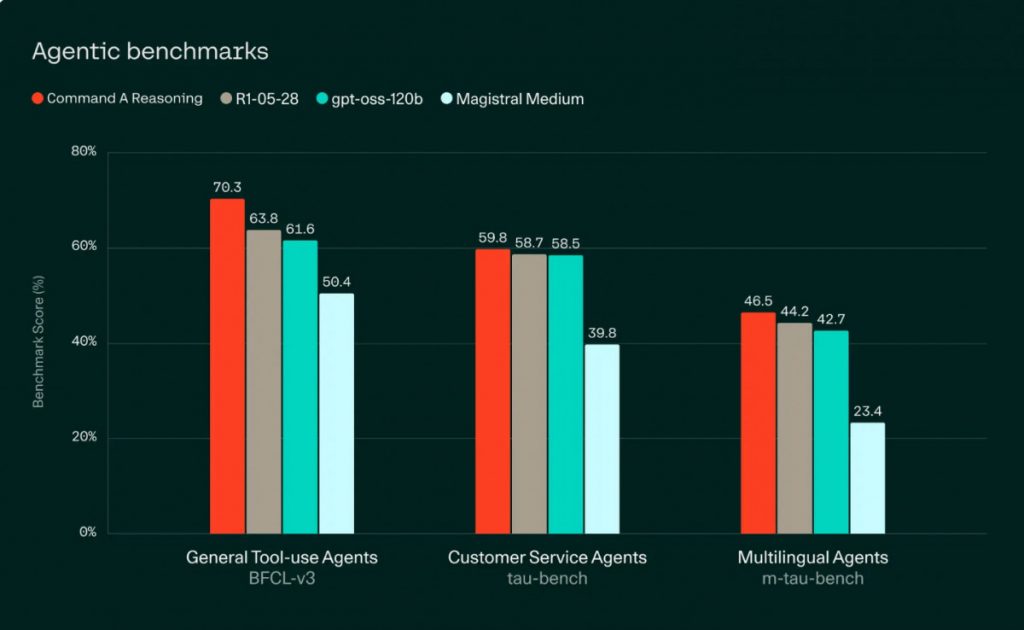
Cohere released Command A Reasoning, a new enterprise reasoning model that outperforms similar rivals like gpt-oss and DeepSeek R1 on agentic benchmarks.

Cohere Unveils Command A Reasoning, Delivering Advanced Enterprise AI For Scalable, Secure, And High-Performance Workflows

Cohere, a company specializing in natural language processing and large language models (LLMs), announced that it has launched Command A Reasoning, its most advanced model designed for enterprise reasoning tasks. The model demonstrates superior performance compared with other privately deployable models in its class, including gpt-oss-120b, DeepSeek-R1 0528, and Mistral Magistral Medium.

Command A Reasoning is tailored for enterprise deployment, offering secure, efficient, and scalable options. For smaller setups, it can operate on a single H100 or A100 GPU with a context length of 128k, while multi-GPU deployments optimized for latency can scale to a 256k context length. This flexibility allows organizations to maximize hardware utilization. Its extended context capabilities make it particularly suitable for document-intensive workflows and complex multi-step agentic applications.

Organizations can set token budgets to manage compute usage and control costs, enabling the model to handle tasks requiring maximum accuracy or be configured for faster, high-throughput operations. Command A Reasoning serves as the core generative model for North, Cohere’s secure agentic AI platform, allowing enterprises to deploy customized AI agents and automations on-premises, leveraging the model’s advanced reasoning capabilities.

Enterprise Reasoning Model Demonstrates Strong Performance Across Key Business Tasks

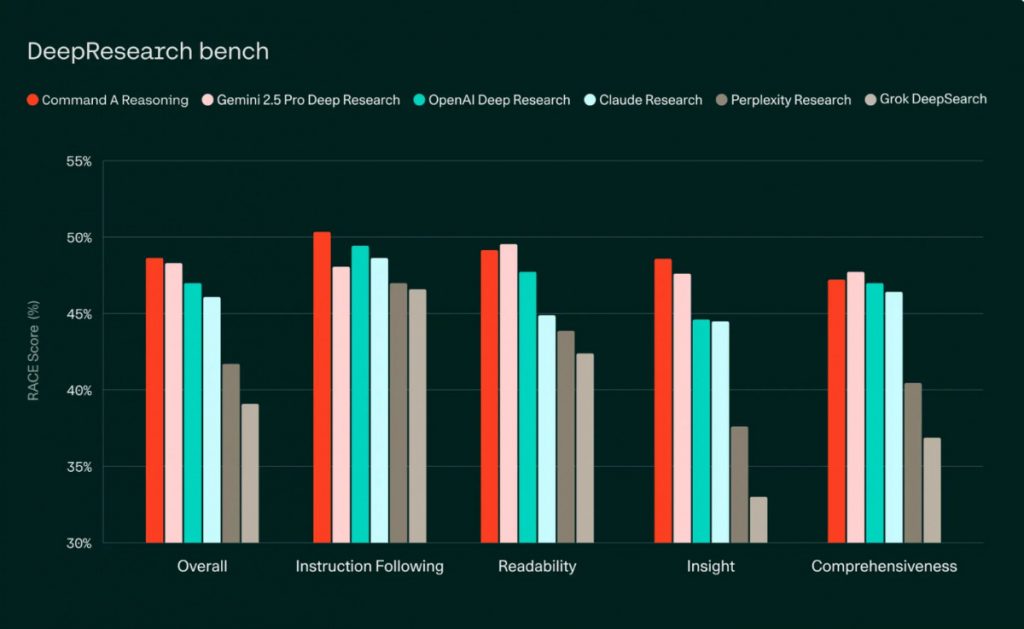
Command A Reasoning delivers top-tier performance across major agentic benchmarks and supports a wide range of business languages, enabling global enterprises to deploy agents with consistent quality. The model is particularly effective in powering end-to-end systems involving chained or hierarchical agents and in selecting the most relevant tools to complete tasks. A notable application is the Deep Research system, which surpasses similar capabilities from other leading AI labs.

Cohere

Deep Research is designed to handle complex, in-depth questions that require more than a simple search. It generates detailed, well-sourced reports in minutes—tasks that would typically take employees hours—by using a multi-agent architecture powered by Command A Reasoning. The system breaks down user requests into smaller research topics, then multiple AI agents search and analyze information from diverse sources in parallel, before consolidating verified findings into a single structured report directly addressing the original query.

cohere

The model enables scalable business applications across industries, combining high accuracy with efficient compute usage. Its low hardware requirements allow private deployments on a single H100 or A100 GPU. Users can manage compute and costs through a token budget, dynamically balancing precision for mission-critical tasks with high-throughput operations, eliminating the need for separate reasoning and non-reasoning models and maximizing GPU efficiency. North’s internal tests show smooth performance scaling from efficient responses at minimal reasoning to deeper, more detailed outputs at higher reasoning levels, with Command A Reasoning outperforming its predecessor even at zero reasoning.

Safety is a core principle in the training and evaluation of Command A Reasoning. The model is designed to balance avoiding over-refusal of valid requests while preventing the dissemination of harmful or malicious content. Focus areas include child sexual exploitation and abuse, self-harm, violence and hate, sexual content, and conspiracy theories.

Command A Reasoning is currently available on the Cohere platform and for research use via Hugging Face.

Cohere develops foundation models and end-to-end AI solutions aimed at addressing practical business challenges. Recently, the company partnered with Ensemble Health Partners to integrate secure agentic AI into complex healthcare workflows, providing providers, clinical staff, and revenue cycle teams with an advanced AI system designed to reduce administrative workloads while maintaining the high security and compliance standards required in healthcare operations.

Disclaimer

In line with the Trust Project guidelines, please note that the information provided on this page is not intended to be and should not be interpreted as legal, tax, investment, financial, or any other form of advice. It is important to only invest what you can afford to lose and to seek independent financial advice if you have any doubts. For further information, we suggest referring to the terms and conditions as well as the help and support pages provided by the issuer or advertiser. MetaversePost is committed to accurate, unbiased reporting, but market conditions are subject to change without notice.

About The Author


Alisa, a dedicated journalist at the MPost, specializes in cryptocurrency, zero-knowledge proofs, investments, and the expansive realm of Web3. With a keen eye for emerging trends and technologies, she delivers comprehensive coverage to inform and engage readers in the ever-evolving landscape of digital finance.

More articles


Alisa Davidson


Alisa, a dedicated journalist at the MPost, specializes in cryptocurrency, zero-knowledge proofs, investments, and the expansive realm of Web3. With a keen eye for emerging trends and technologies, she delivers comprehensive coverage to inform and engage readers in the ever-evolving landscape of digital finance.


More articles


Source link

Camp Network Launches Eligibility Checker For Season 1 Airdrop

Camp Network Launches Eligibility Checker For Season 1 Airdrop


In Brief

Camp Network, a Layer 1 blockchain bridging intellectual property and AI, has launched an eligibility checker for its Season 1 airdrop.

Camp Network Launches Eligibility Checker For Season 1 Airdrop

Layer 1 blockchain that positions itself at the intersection of intellectual property and AI, Camp Network announced that it has introduced an eligibility checker in preparation for its upcoming airdrop. The tool allows participants to confirm their status and complete registration ahead of the deadline set for August 25th at 23:59 PM ET. 

The announcement emphasized that individuals should connect using the same wallet previously engaged within the Camp ecosystem, including activity on the Summit Series Testnet, in order to confirm eligibility for Season 1 of the airdrop. 

Participation in the airdrop is open to two primary groups: holders of TrailHeads non-fungible tokens, which serve as the official profile picture collection within the Camp Network and feature six distinct animals crafted from natural materials, each designed with a unique identity and backstory, as well as verified contributors from the Summit Series Incentivized Testnet. 

In order to finalize registration, a fee of 0.0025 ETH must be paid. This one-time cost is intended to support the process of enabling gasless claiming on the Camp mainnet. However, the project clarified that additional fees may still apply at the time of claiming. 

Camp Network Launches CAMP Token To Power IP Tokenization And AI Integration, Secures Listing On Bybit

Camp Network describes itself as an autonomous intellectual property layer built to support the integration of IP and artificial intelligence. Operating as a Layer 1 blockchain, it is introducing the Proof of Provenance Protocol, a framework designed to incorporate IP registration, licensing, and royalty distribution directly into the execution layer, while streamlining workflows that involve autonomous agents. 

The platform allows intellectual property of various kinds to be tokenized, enables the fine-tuning and deployment of AI agents, and makes it possible for those agents to be tokenized on-chain for use across the wider ecosystem. 

Earlier in the week, The Camp Foundation, the organization responsible for overseeing the development of Camp Network, formally launched and confirmed the introduction of the CAMP token. The token underpins IP tokenization, licensing, and monetization within the network, while also serving as a mechanism for governance. The governance structure is designed so that token holders collectively participate in directing development and ensuring the protection of intellectual property on the platform. 

In another update recently shared through its official account on the social media platform X, the project noted that the CAMP token will be listed on the major cryptocurrency exchange Bybit, both on its spot market and through its Alpha platform. 

Disclaimer

In line with the Trust Project guidelines, please note that the information provided on this page is not intended to be and should not be interpreted as legal, tax, investment, financial, or any other form of advice. It is important to only invest what you can afford to lose and to seek independent financial advice if you have any doubts. For further information, we suggest referring to the terms and conditions as well as the help and support pages provided by the issuer or advertiser. MetaversePost is committed to accurate, unbiased reporting, but market conditions are subject to change without notice.

About The Author


Alisa, a dedicated journalist at the MPost, specializes in cryptocurrency, zero-knowledge proofs, investments, and the expansive realm of Web3. With a keen eye for emerging trends and technologies, she delivers comprehensive coverage to inform and engage readers in the ever-evolving landscape of digital finance.

More articles


Alisa Davidson


Alisa, a dedicated journalist at the MPost, specializes in cryptocurrency, zero-knowledge proofs, investments, and the expansive realm of Web3. With a keen eye for emerging trends and technologies, she delivers comprehensive coverage to inform and engage readers in the ever-evolving landscape of digital finance.


More articles


Source link

Tyr Capital Launches Market-Neutral Fund To Target Consistent Yields Amid Evolving Bitcoin Treasury Strategies

Tyr Capital Launches Market-Neutral Fund To Target Consistent Yields Amid Evolving Bitcoin Treasury Strategies


In Brief

Tyr Capital has launched a Market-Neutral Fund designed to generate consistent yields through diversified strategies, helping digital asset treasuries and institutional investors enhance capital efficiency and capture sustainable returns.

Tyr Capital Launches Market-Neutral Fund To Target Consistent Yields Amid Evolving Bitcoin Treasury Strategies

Global digital asset manager, Tyr Capital announced the launch of a new Market-Neutral Fund, aimed at providing investors with consistent returns through market-neutral and arbitrage strategies. The fund is structured to exploit inefficiencies across the digital asset market while remaining largely independent of overall market movements. 

By employing a diversified set of strategies, the fund seeks to generate and sustain competitive yields across different market conditions, leveraging the team’s extensive trading experience and proven track record.

The leadership at Tyr Capital began their careers as oil traders in the early 2000s, gaining significant expertise in executing market-neutral strategies under volatile conditions—experience that has been directly applied to the digital asset space. 

As corporate adoption of Bitcoin and other digital assets grows, Tyr Capital anticipates treasury strategies evolving beyond traditional financing methods such as convertibles and ATM issuance. Companies capable of generating sustainable yields from their holdings are increasingly rewarded with higher valuations, reflecting more efficient asset deployment and improved asset-per-share growth. The Market-Neutral Fund provides allocators and corporate treasuries with a platform to capture yield opportunities, enhance capital efficiency, and support long-term growth.

Ed Hindi, Chief Investment Officer at Tyr Capital, highlighted in a written statement that the market is signaling that digital asset treasuries actively generating yield are starting to trade at a premium. He explained that this premium is driven by capital efficiency, but emphasized that it is no longer solely about efficiency; it has become a matter of survival. Ed Hindi added that the companies that succeed in the next phase will be those that effectively integrate yield generation as a central element of their treasury strategy.

Tyr Capital Expands Digital Asset Offerings And Partnerships To Advance Bitcoin DeFi Adoption

Tyr Capital is an alternative asset manager specializing in the convergence of traditional finance and digital assets, with a focus on Bitcoin, decentralized finance (DeFi), and yield generation. It offers several investment vehicles, including the Tyr Capital Multi-Strategy Fund (TCMF) and the Tyr Capital Market-Neutral Fund (TCMN). The firm has also partnered with technology providers like HedgeGuard to enhance operational efficiency and transparency in its fund activities.

Recently, the firm has collaborated with BOB and the bitvm/acc working group to support and promote the adoption of DeFi solutions on the Bitcoin network.

Disclaimer

In line with the Trust Project guidelines, please note that the information provided on this page is not intended to be and should not be interpreted as legal, tax, investment, financial, or any other form of advice. It is important to only invest what you can afford to lose and to seek independent financial advice if you have any doubts. For further information, we suggest referring to the terms and conditions as well as the help and support pages provided by the issuer or advertiser. MetaversePost is committed to accurate, unbiased reporting, but market conditions are subject to change without notice.

About The Author


Alisa, a dedicated journalist at the MPost, specializes in cryptocurrency, zero-knowledge proofs, investments, and the expansive realm of Web3. With a keen eye for emerging trends and technologies, she delivers comprehensive coverage to inform and engage readers in the ever-evolving landscape of digital finance.

More articles


Alisa Davidson


Alisa, a dedicated journalist at the MPost, specializes in cryptocurrency, zero-knowledge proofs, investments, and the expansive realm of Web3. With a keen eye for emerging trends and technologies, she delivers comprehensive coverage to inform and engage readers in the ever-evolving landscape of digital finance.


More articles


Source link

Ripple And SBI VC Trade Collaborate To Introduce RLUSD Stablecoin In Japan By Q1 2026

Ripple And SBI VC Trade Collaborate To Introduce RLUSD Stablecoin In Japan By Q1 2026


In Brief

Ripple and SBI VC Trade have signed an MOU to distribute the enterprise-grade stablecoin RLUSD in Japan, targeting a Q1 2026 launch to expand market options and provide a compliant, transparent bridge between traditional and decentralized finance.

Enterprise-Grade Stablecoin RLUSD Set For Japanese Market As Ripple And SBI VC Trade Sign MOU

Provider of enterprise blockchain and cryptocurrency solutions, Ripple and SBI VC Trade, a subsidiary of SBI Group and licensed Electronic Payment Instruments Exchange Service Provider in Japan, have signed a new memorandum of understanding (MOU) to explore the distribution of Ripple USD (RLUSD) in Japan.

The stablecoin market, currently valued at nearly $300 billion, is projected to expand into the trillions in the coming years, with future adoption expected to be driven by practical utility and institutional demand. RLUSD is designed as an enterprise-grade stablecoin emphasizing compliance and transparency. 

It is fully backed by high-quality reserves, including US dollar deposits, short-term US government securities, and other cash equivalents, with monthly attestations provided by an independent accounting firm. This focus on regulatory clarity aims to differentiate RLUSD from other stablecoins and deliver the security standards required by institutional participants.

SBI VC Trade And Ripple Plan RLUSD Launch In Japan For Q1 2026

SBI VC Trade CEO Tomohiko Kondo highlighted in a written statement that SBI Group has been at the forefront of cryptocurrency and blockchain development in Japan, being the first company to obtain the Electronic Payment Instrument Exchange Service Provider License and begin handling stablecoins. He explained that the introduction of RLUSD would not only expand stablecoin options in the Japanese market but also represent a step forward in reliability and convenience, as well as in accelerating the convergence of finance and digital technology. 

Ripple’s Senior Vice President of Stablecoins, Jack McDonald, further noted that the partnership with SBI has always focused on more than just technology, emphasizing the goal of creating a trusted and compliant financial future. He described the distribution of RLUSD in Japan with SBI VC Trade as the culmination of that effort, highlighting that RLUSD is intended to serve as an industry standard and provide a reliable, efficient bridge between traditional and decentralized finance (DeFi). The partnership is set to enhance stablecoin utility in Japan and establish a new benchmark for the market.

SBI VC Trade aims to make RLUSD available in Japan during the first quarter of 2026.

Ripple is a prominent provider of digital asset infrastructure for financial institutions, offering software designed to improve efficiency, reduce operational friction, and support innovation in global finance. Its solutions utilize the XRP Ledger and its native digital asset, XRP, which was specifically developed to enable fast, low-cost, and highly scalable transactions for both developers and financial services.

Recently, Ripple enhanced the multichain capabilities of the XRPL by integrating Wormhole, a cross-chain interoperability protocol. This integration enables connectivity with the XRPL mainnet as well as the XRPL EVM Sidechain.

Disclaimer

In line with the Trust Project guidelines, please note that the information provided on this page is not intended to be and should not be interpreted as legal, tax, investment, financial, or any other form of advice. It is important to only invest what you can afford to lose and to seek independent financial advice if you have any doubts. For further information, we suggest referring to the terms and conditions as well as the help and support pages provided by the issuer or advertiser. MetaversePost is committed to accurate, unbiased reporting, but market conditions are subject to change without notice.

About The Author


Alisa, a dedicated journalist at the MPost, specializes in cryptocurrency, zero-knowledge proofs, investments, and the expansive realm of Web3. With a keen eye for emerging trends and technologies, she delivers comprehensive coverage to inform and engage readers in the ever-evolving landscape of digital finance.

More articles


Alisa Davidson


Alisa, a dedicated journalist at the MPost, specializes in cryptocurrency, zero-knowledge proofs, investments, and the expansive realm of Web3. With a keen eye for emerging trends and technologies, she delivers comprehensive coverage to inform and engage readers in the ever-evolving landscape of digital finance.


More articles


Source link

Popular Posts

My Favorites

Peni Parker has been revealed as the newest character for Marvel...

0
ARC System Works has announced the latest reveal for the Marvel Tokon: Fighting Souls roster, and that character is Peni Parker. She is...