Arts

Home Arts Page 90

A Shocking Breakthrough from a Vote to Delist Project VOXEL

0
A Shocking Breakthrough from a Vote to Delist Project VOXEL


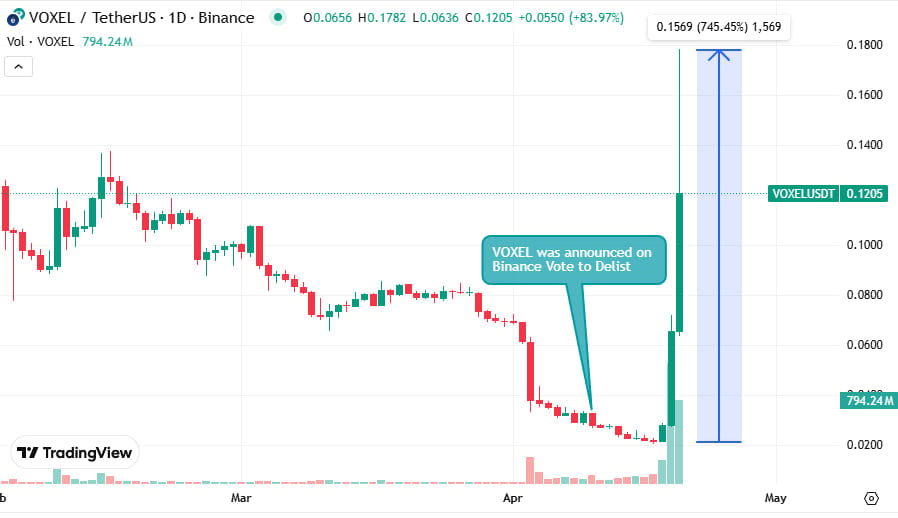
Voxie (VOXEL), a tactical GameFi project on the Polygon blockchain, recently recorded an unprecedented rise of more than 700% in three days after being announced on the second Binance Vote to Delist batch.

Unexpected Top Gainers Today: Binance’s 2nd Vote to Delist Tokens

On this Sunday, the cryptocurrency market is experiencing an unexpected surge in activity primarily driven by tokens featured in the second Binance Vote to Delist, deviating from the typical influence of major projects. The absence of significant participation from ETF entities or large institutional funds has created an opportunity for smaller projects, particularly those facing potential delisting from the Binance exchange, to take center stage.

Specifically, VOXEL is leading the day’s upward momentum with a dramatic increase of 745%. Following this significant gain are NKN, exhibiting a substantial rise of 270%, and ALPACA, with a notable growth of 150%.

Unexpected Top Gainers Today: Binance's 2nd Vote to Delist Tokens

VOXEL up 745%! – Source: TradingView

“Every Cloud has a Silver Lining”

While the observed growth in these projects may appear encouraging, it also serves as a significant warning for holders. It is crucial to recognize that inclusion in Binance’s Batch Vote to Delist typically signifies their prior categorization under Binance Monitoring Tags. These are projects that have largely become technologically outdated, exhibit limited community engagement, lack clear long-term strategic direction, or are led by individuals with questionable credibility.

Consequently, these projects carry exceptionally high risks and pose a potential threat to users’ investments.

The recent price surges experienced by projects within this batch, despite their impending delisting, do indicate that these assets can still exhibit upward momentum even after being placed on Binance’s ‘blacklist.’ However, such rallies are generally transient in nature.

Historically, projects facing delisting announcements from Binance often experience a price surge immediately before or after their removal from the exchange. This phenomenon is widely interpreted as a profit-taking opportunity before the projects gradually fade into obscurity. Notable examples include $BURGER and $REN.

"Every Cloud has a Silver Lining""Every Cloud has a Silver Lining"

$REN faced hard dump before rise significantly in November 26th – Source: TradingView

It is crucial to exercise caution and avoid succumbing to FOMO regarding projects currently listed under such high-risk conditions. In scenarios like these, instead of buying in anticipation of a project’s revival, investors might consider strategically identifying the point at which the FOMO-driven momentum subsides to initiate short positions in perpetual contracts.

binance-logo-2binance-logo-2


Source link

Ethereum Tanks, XRP Makes Wall Street Move—But BlockDAG’s $0.0031 Easter Drop

0
Ethereum Tanks, XRP Makes Wall Street Move—But BlockDAG’s alt=


Ethereum is facing serious headwinds. With ETFs crashing 60% and the token sitting below $1,600, investors are jittery despite the upcoming Pectra upgrade. XRP, meanwhile, is attempting a financial pivot with its $1.25 billion acquisition of Hidden Road, a move that grants it long-awaited regulatory footing. But for all the infrastructure headlines and protocol promises, it’s BlockDAG that’s stealing the spotlight. In just a few days, BDAG’s presale raked in over $10 million, contributing to a total raise of $215 million and 19.4 billion coins sold. 

The $0.0031 Easter drop is making headlines—not just because it’s limited, but because it offers a shot at 1,500% returns before its $0.05 launch. Ethereum has upgrades. XRP has Wall Street access. But BlockDAG has timing, momentum, and a presale price investors may never see again.

Ethereum Hits $1,580 as ETFs Crash 60% — Is This the Perfect Time to Buy?

Ethereum is trading around $1,580, down nearly 46% over the past year, with its ETF assets plunging from $14.28 billion to just $5.25 billion. Investor confidence is low, yet some see opportunity. Justin Sun, founder of Tron, refuses to sell his ETH despite market pressure, reportedly holding nearly 665,000 ETH. 

Meanwhile, transaction fees have dropped to $0.168—the lowest since 2020—highlighting weak network activity. However, the upcoming Pectra upgrade on May 7 could change things. It promises better scalability and lower fees, plus increased staking limits, which might bring institutions back in. 

Ethereum Hits $1,580 as ETFs Crash 60% — Is This the Perfect Time to Buy?

If Ethereum breaks above $1,904, bulls could push it toward $2,000 or even $2,500. For long-term investors, current levels could be a strategic entry point—especially with Ethereum’s major upgrade around the corner and prices far below their peak.

Ripple Buys FINRA Broker for $1.25B—Is XRP About to Explode 10x?

Ripple has acquired FINRA-approved broker Hidden Road for $1.25 billion, giving it a regulatory pathway into traditional finance. This move opens direct access to U.S. financial markets and strengthens Ripple’s push for institutional adoption of the XRP Ledger. Hidden Road already clears billions in daily trades and serves hundreds of institutional clients. Now under Ripple, that scale could grow fast.

XRP is trading near $2.05, holding a key support zone. A rebound toward $2.25 is possible if buying pressure builds. The RSI suggests the asset isn’t yet oversold, while MACD shows flat momentum. With Ripple aiming to build the largest non-bank prime broker, this acquisition may be the beginning of XRP’s wider use beyond payments. 

Ripple Buys FINRA Broker for $1.25B—Is XRP About to Explode 10x?Ripple Buys FINRA Broker for $1.25B—Is XRP About to Explode 10x?

For investors, it’s a critical moment—regulatory clarity, institutional tools, and Wall Street access are finally aligning. XRP’s next breakout could be backed by real infrastructure, not just hype.

Easter Alert: BDAG Just Dropped to $0.0031 – 3 Days Only!

BlockDAG’s presale just entered FOMO territory. For 3 days only, BDAG is slashed to $0.0031—a massive discount before it rockets to the official launch price of $0.05. That’s over 1,500% potential ROI, but only if you act now.

With over $215 million raised and 19.4 billion BDAG coins sold, BlockDAG isn’t just trending—it’s exploding. The X1 Miner app just surpassed 1 million global users, proving BlockDAG’s mass adoption is already underway. This isn’t a test phase. It’s a fast-moving presale that’s outpacing every other Layer 1 project in sight. As whales pour in and supply thins, this Easter drop is your last real shot at getting in early.

Easter Alert: BDAG Just Dropped to $0.0031 – 3 Days Only!Easter Alert: BDAG Just Dropped to $0.0031 – 3 Days Only!

The entire BlockDAG ecosystem is live, the community is fully engaged, and momentum is snowballing toward 10 major exchange listings. Once this 3-day window closes, the price jumps—and with it, the cost of missing out.

Whether you’re topping up or buying your first BDAG, now’s the time to strike. This is the golden entry point. Blink, and it’s gone.

Should You Buy Now? 

Each project here is playing a different game. Ethereum is betting on long-term scalability through protocol refinement, but it’s hampered by lagging ETFs and shrinking investor confidence. XRP is building a regulatory bridge to traditional finance, which may cement its institutional relevance—but execution takes time. BlockDAG, on the other hand, is moving fast. 

With 1 million+ miners already onboarded and a full ecosystem live before even listing, BDAG isn’t just ready—it’s racing ahead. Add in 10 upcoming CEX listings, a 3-day flash drop to $0.0031, and viral user growth, and it’s clear where the real upside lies. This isn’t about what might happen months from now—this is about acting before the window slams shut. For those searching for the next big crypto, the smart money isn’t just watching BlockDAG. It’s already buying in.

Should You Buy Now? Should You Buy Now? 

Website: https://blockdag.network

Presale: https://purchase.blockdag.network

Telegram: https://t.me/blockDAGnetworkOfficial

Discord: https://discord.gg/Q7BxghMVyu


Source link

JP Morgan: Investors Prefer Gold Over Bitcoin as a Safe-Haven

0
JP Morgan: Investors Prefer Gold Over Bitcoin as a Safe-Haven


Is Bitcoin losing its appeal as a safe-haven asset? Amid market turbulence, gold is being chosen over Bitcoin as a safe haven by investors, raising questions about its “digital gold” narrative, as stated by JP Morgan analysts in a report on Thursday. While gold ETFs saw massive inflows, Bitcoin faced declining interest, prompting a closer look at its evolving role in uncertain markets.

Gold vs Bitcoin: A Market Snapshot

According to the report from JP Morgan, investors are prioritizing gold over Bitcoin to find a safe haven amid geopolitical instability, especially the consequences of the global trade war initiated by President Trump.

According to Cointelegraph, global gold ETFs drew $21.1 billion in net inflows in Q1 2025. In late 2024, Bitcoin ETFs briefly surpassed gold ETFs in terms of trading volume, but their advantage soon dissipated. The gold price also rocketed to the ATH of $3,660/ounce this week. 

Meanwhile, Bitcoin struggled with three consecutive months of ETF outflows. Binance Futures experienced many large negative net flows, indicating multiple outflow instances since January and signaling reduced speculative trading activity as traders potentially close positions or decrease exposure. 

Gold vs Bitcoin: A Market Snapshot

Source: Coinglass

The $BTC price has also fluctuated at $85,000, plummeting by over 20% compared with the highest price of $109,000 in January, when President Trump won the election. This contrast underscores gold’s appeal amid economic uncertainty.

Redefining Bitcoin’s Narrative

Once celebrated as a modern equivalent to gold, Bitcoin’s recent price swings have cast doubt on its reputation as a safe-haven asset for the leading cryptocurrency. Earlier this month, JPMorgan analysts also said that “Bitcoin’s volatility and correlation with equities raise questions over its ‘digital gold’ narrative,” while gold is gaining stronger demand.

Trump’s election initially spurred optimism in the crypto market, with many expectations from investors. However, rising tariffs and the trade war with China, concerns over a global economic downturn, and a declining U.S. dollar have pushed investors toward the time-tested security of gold.

Still, Bitcoin’s future is fluid. Could less volatility restore its safe-haven appeal? Macro factors like monetary policy or ETF flows will shape its path. This shift reflects changing sentiment, but Bitcoin’s long-term role remains open to reinvention.


Source link

sUSD Stablecoin Suddenly Depegged Below $0.70

0
sUSD Stablecoin Suddenly Depegged Below alt=


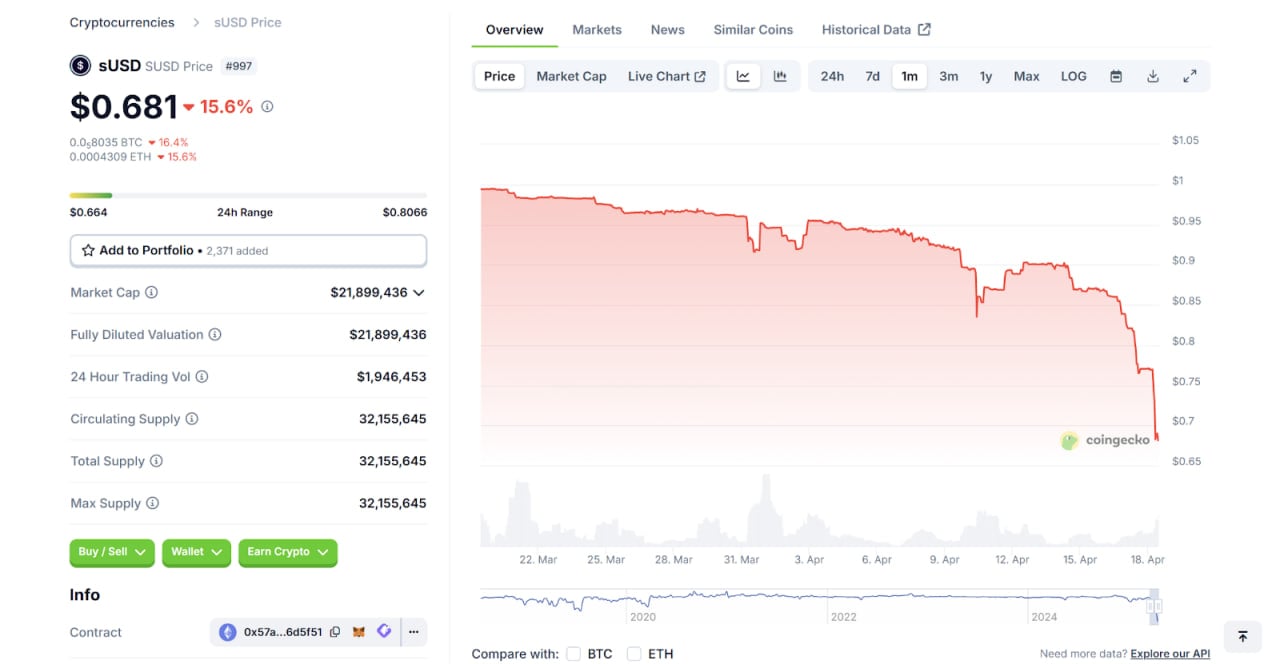
The sUSD stablecoin, integral to the Synthetix protocol and designed to hold a $1 peg, has crashed to $0.68 as of April 18, 2025. This dramatic depegging event has shaken the DeFi community, raising questions about the stability of decentralized stablecoins. 

sUSD Value Collapses to $0.68

Unlike fiat-backed stablecoins, sUSD relies on $SNX staking and debt pools, making it vulnerable to protocol changes. The recent price drop, which began around March 20, 2025, marks one of the most severe disruptions in sUSD’s history. The stablecoin’s value fell to $0.83 by April 10 and continued its significant decrease, hitting $0.68 today.

sUSD Value Collapses to $0.68

Source: CoinGecko

Why Did sUSD Depeg?

The depegging stems primarily from the SIP-420 protocol update, which changed the Synthetix ecosystem’s debt management and sUSD issuance processes. Before SIP-420, $SNX stakers minted sUSD individually and managed their debt, incentivizing them to buy sUSD at a discount to repay obligations and maintain the peg.

The update introduced a protocol-owned staking pool – “420 Pool”, where stakers deposit funds collectively, eliminating the stabilization mechanism in which the individual has an incentive to purchase discounted sUSD. This shift weakened the mechanism that historically restored the peg during price deviations.

The update also led to a surge in sUSD supply. The collateralization ratio for minting sUSD by $SNX has come down to the current 200%, making it easier to mint sUSD. Meanwhile, according to Parsec Research, over 80 million USD worth of $SNX has flowed into the “420 Pool.” Combined with Infinex campaign-driven holdings, there has been an expansion in sUSD supply, resulting in oversupply and insufficient buying incentives that have driven the price down.

Additionally, if the value of $SNX drops sufficiently, sUSD is no longer fully backed. Fears of under-collateralization might prompt users to exchange sUSD for $SNX and sell it. Such an action would lead to additional downward pressure on $SNX, triggering a deleveraging cycle. Declines in $SNX’s price since March have likely contributed to the sUSD depeg event recently. However, despite the dramatic price decrease of sUSD, $SNX still has positive growth today, reflecting mixed market sentiment.

Why Did sUSD Depeg?Why Did sUSD Depeg?

Source: CoinGecko

Responding to the depegging event, there has been a 30% drop in Synthetix’s Total Value Locked (TVL) from $100 million to $70 million between March 29 and April 17, 2025.


The decrease coincided with a 70% reduction in Perps Active Accounts and Perp Volume since April 9, reflecting reduced engagement due to sUSD’s instability, as reported on Synthetix Stats

Why Did sUSD Depeg?Why Did sUSD Depeg?

Source: DeFiLlama

Why Did sUSD Depeg?Why Did sUSD Depeg?

Source: Synthetix

Synthetix’s Response Plan

The Synthetix team has acknowledged the depegging as a result of “mechanism transition pains” and is actively addressing the issue. The team is enhancing liquidity incentives, particularly within Curve pools, to attract buyers and restore market balance.

More collaborations are also underway to create new demand channels for sUSD, potentially integrating it into lending markets or other DeFi applications.

Moreover, the Synthetix founder revealed through a post on X that he now holds 35 million $SNX and is the largest holder. He explained that he funded the purchases by selling as much as 90% of his $ETH holdings since 2020 to support Synthetix operations.

For the DeFi ecosystem, this crisis underscores the importance of robust fallback mechanisms during protocol upgrades. As Synthetix works to restore sUSD’s peg, the success of its efforts will shape confidence in algorithmic stablecoins and influence future DeFi designs. Stakeholders should closely monitor developments, as the outcome will determine whether sUSD can regain its stability or face ongoing challenges in a competitive DeFi market.


Source link

Leading 5 Cryptos in April 2025 Before They Explode [10,000% ROI Potential]

0
Leading 5 Cryptos in April 2025 Before They Explode [10,000% ROI Potential]


The crypto market in April 2025 is buzzing with early-stage opportunities. But with so many tokens vying for attention, how do you separate hype from actual potential? The answer lies in identifying projects with working products, active presales, and strong fundamentals. These are the investments that deliver not just speculation, but scalable value. If you’re seeking short-term gains with long-term vision, these are the Leading 5 Cryptos to Watch in April 2025. 

Leading the pack are five standout tokens: BlockDAG, Web3Bay, Cold Wallet, Dragoin, and Web3 ai. Each is solving a unique problem in the Web3 space—whether it’s blockchain speed, e-commerce decentralization, data privacy, meme coin scarcity, or AI-powered trading. All five are currently in presale, offering early backers a rare opportunity to enter at discount prices before listings go live

BlockDAG (BDAG) — $214M Raised and Mainnet in 4 Months

BlockDAG is rapidly becoming one of the most watched infrastructure plays in 2025. With over $214 million raised, 16,600+ ASIC miners sold, and 1 million + X1 mobile app users, it’s clear this project is far beyond the whitepaper stage. What makes BlockDAG different is its use of Directed Acyclic Graph (DAG) architecture instead of a traditional blockchain. 

This allows blocks to be created and processed in parallel, making it faster, cheaper, and more scalable than most layer-1s on the market. It’s also EVM-compatible, meaning Ethereum-based dApps can migrate with ease. BlockDAG’s presale is in Batch 27 at $0.0248, and with a projected 2,380% ROI based on post-listing estimates, it’s attracting both miners and DeFi builders. 

BlockDAG (BDAG) — $214M Raised and Mainnet in 4 Months

With mainnet launch just 4 months away, it’s one of the Leading 5 Cryptos to Watch in April 2025 for investors looking to back a next-gen chain with real traction

Web3Bay (3BAY) — The Amazon of Web3, Already Raised $1.7M+

Web3Bay is building a decentralized, peer-to-peer e-commerce platform that removes middlemen and gives power back to buyers and sellers. Instead of paying 10–30% in fees to centralized platforms like Amazon or eBay, Web3Bay users transact directly via smart contracts. The platform integrates both crypto and fiat payments, including PayPal, Apple Pay, and Google Pay—bridging the gap between Web2 and Web3. 

The 3BAY token, currently priced at $0.00524 in Stage 5, has already raised over $1.7 million, with 400M tokens sold. Token holders get 5% purchase discounts, staking rewards, and full voting power in future platform decisions via DAO governance. As e-commerce expands globally, Web3Bay is becoming one of the Leading 5 Cryptos to Watch in April 2025, especially for investors seeking real-world utility and mass adoption potential

Cold Wallet (CWT) — The First Always-On Wallet With Cold Storage Privacy

Cold Wallet is solving one of Web3’s most critical problems: exposure. Most wallets leak user data through IP tracking, on-chain profiling, and third-party analytics. Cold Wallet eliminates all of that by acting like a cold wallet—even while online. It uses zero-knowledge proofs (ZKPs) to ensure hidden balances, private transactions, and anonymous authentication. 

Unlike other privacy tokens, Cold Wallet isn’t just an idea—it’s a full ecosystem built around user control and data sovereignty. 

Cold Wallet (CWT) — The First Always-On Wallet With Cold Storage PrivacyCold Wallet (CWT) — The First Always-On Wallet With Cold Storage Privacy

The $CWT token is currently priced at $0.007, with a listing target of $0.35, offering a massive 4,900% ROI potential. As regulatory surveillance increases, Cold Wallet is emerging as one of the Leading 5 Cryptos to Watch in April 2025 for privacy-conscious users, traders, and institutions

Dragoin (DDGN) — Meme Coin Power With Scarcity That Works

Dragoin is bringing smart tokenomics to the meme coin world. Unlike most meme tokens that inflate endlessly, Dragoin features a built-in burn mechanism that reduces supply with every transaction, increasing long-term value. Its viral branding is supported by deflationary economics and community-focused incentives, making it a rare meme coin with real staying power. 

The DDGN token is in public presale, with a launch price of $0.002 and a projected 6,1647% upside based on current valuation metrics. As meme mania resurfaces in 2025, Dragoin stands out by offering not just entertainment but smart economics. That makes it a clear contender among the Leading 5 Cryptos to Watch in April 2025, especially for high-risk, high-reward portfolios

Web3 ai (WAI) — AI Tools That Actually Work, From Day One

Web3 ai is an all-in-one crypto intelligence suite that merges machine learning, NLP, and neural networks to deliver smarter trading, yield farming, and risk management tools. Unlike AI tokens that are still in concept mode, Web3 ai has 12 working tools live from day one, including a trading bot, scam detector, arbitrage engine, and staking advisor. 

It pulls data from Ethereum, Solana, BNB Chain, and more—then uses AI to generate actionable insights for traders and investors. The WAII token is priced at $0.0003 (Batch 1), with a listing price of $0.00524, giving early buyers up to 1647% ROI potential

Web3 ai (WAI) — AI Tools That Actually Work, From Day OneWeb3 ai (WAI) — AI Tools That Actually Work, From Day One

It also supports staking, revenue sharing, and governance. As AI continues to dominate global tech headlines, Web3 ai is carving out a serious niche in crypto—and it’s easily one of the Leading 5 Cryptos to Watch in April 2025

Leading 5 Cryptos to Watch in April 2025

Each of these projects offers more than hype—they’re building functional ecosystems with clear use cases. BlockDAG is scaling blockchain infrastructure. Web3Bay is reinventing online marketplaces. Cold Wallet protects users from digital surveillance. Dragoin adds real economics to meme coins. 

Web3 ai brings powerful AI tools into crypto’s most crucial decisions. With strong presale performance, defined roadmaps, and massive ROI potential, these tokens are the Leading 5 Cryptos to Watch in April 2025—and getting in now could make all the difference before they go live on major exchanges.

Leading 5 Cryptos to Watch in April 2025Leading 5 Cryptos to Watch in April 2025


Source link

Hyperliquid Destroyed Ethereum in Daily Fees Gained

0
Hyperliquid Destroyed Ethereum in Daily Fees Gained


Hyperliquid, an emerging Layer 1 blockchain, has surged in prominence following its record-breaking airdrop in November 2024, positioning itself as a formidable contender in the DeFi space. Its rapid rise invites comparisons with Ethereum, the leading Layer 1 blockchain.

While Ethereum boasts a massive Total Value Locked (TVL), Hyperliquid’s ability to generate significantly higher fees despite a smaller TVL highlights a fascinating dynamic in blockchain economics, driven by their distinct designs and market focuses.

Hyperliquid is Starring: The Numbers Speak

Hyperliquid is a high-performance Layer 1 blockchain tailored for decentralized perpetual futures trading. As of April 2025, its TVL is approximately $627.27 million, a fraction of Ethereum’s but impressive for a specialized platform. The recent airdrop of 310 million HYPE tokens to 94,000 users, valued at $7.6 billion, catapulted Hyperliquid into the spotlight, driving user adoption and trading volume.

Learn more: What is Hyperliquid?

Hyperliquid is starring: The Numbers Speak

Source: DefilLama

Ethereum, the backbone of DeFi, commands a TVL of over $46 billion, dwarfing Hyperliquid’s. Hosting over 1,216 projects, it supports a diverse ecosystem of dApps, NFTs, and DeFi protocols. Recent updates include the Dencun upgrade (March 2024), which slashed Layer 2 fees by 95%, and growing restaking adoption via EigenLayer.

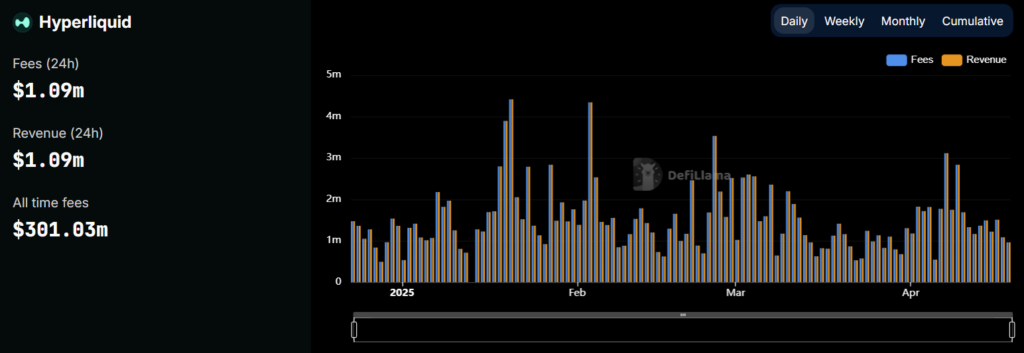
However, Ethereum’s chain fees have struggled, standing at $300,000 in the last 24 hours compared to Hyperliquid’s $1 million. Throughout Q1 2025, Ethereum’s performance faltered, with fees hitting record lows due to reduced network activity recently amid the chaos of the overall market and lower gas prices post-Dencun. Despite its unmatched validator count (1.05 million) and decentralization, Ethereum’s revenue has lagged, as its high TVL reflects passive activities like staking rather than high-turnover trading.

Hyperliquid is starring: The Numbers SpeakHyperliquid is starring: The Numbers Speak

Source: DefilLama

The contrast is stark: Ethereum’s TVL is nearly 80 times Hyperliquid’s, yet Hyperliquid generates over three times the daily fees. This gap widened in Q1 2025, as Ethereum’s fees repeatedly hit historic lows, while Hyperliquid’s DEX thrived despite whale-induced volatility. The airdrop further amplified Hyperliquid’s appeal, boosting its user base to over 230,000 and daily trading volume to $470 million.

Hyperliquid is starring: The Numbers SpeakHyperliquid is starring: The Numbers Speak

Source: Artemis

binance-logo-2binance-logo-2

Why Hyperliquid’s Fee Surge? 

Hyperliquid’s fee advantage stems from its specialized design and market fit. Its perpetual futures DEX, built on the Hyperliquid L1 with HyperBFT consensus, delivers sub-second latency and 100,000 orders per second, rivaling centralized exchanges.

The platform’s high-leverage trading (up to 50x) and low-cost structure drive massive trading volumes, amplifying fee generation. The HLP Vault, a unique feature, aggregates fees from transactions, funding, and clearing, ensuring efficient revenue capture.

In contrast, Ethereum’s gas fees, distributed to validators, depend on network congestion and are less tied to TVL, which is often locked in low-turnover protocols like Aave or Lido. The Dencun upgrade, while improving scalability, slashed fees, reducing Ethereum’s revenue.

Hyperliquid’s airdrop also played a pivotal role, drawing traders and sustaining TVL growth post-TGE, unlike typical post-airdrop declines seen in projects like Scroll. Its community-focused tokenomics, allocating 76.2% of HYPE tokens to users, further fueled engagement.

Hyperliquid Ecosystem after Its Raising Performance

Hyperliquid has evolved from a perpetual futures DEX into a multidimensional Web3 ecosystem since launching HyperEVM, an Ethereum-compatible blockchain, in February 2025. HyperEVM’s high-performance design, with quick block times and parallel processing, supports over 100 dApps across DeFi, NFTs, GameFi, AI, and liquid staking.

Projects like Hyperlend and Timeswap innovate in lending, while Cluster and Solv Protocol enhance liquid staking. Native DEXs (HyperSwap, Spectra) and AI-driven tools (Beats AI, HCR Bot) showcase its versatility.

Hyperliquid Ecosystem after Its Raising PerformanceHyperliquid Ecosystem after Its Raising Performance

NFT collections like Wealthy Hypio Babies and GameFi platforms like Hyperverse drive community engagement. Bridges (Wormhole, HyBridge) and oracles (Pyth Network) ensure interoperability, while meme tokens like Autist add viral appeal. Hyperliquid’s vision, likened to a “Solana on EVM,” aims for ultra-fast, scalable experiences, positioning it as a foundation for Web3 innovation. Its diverse ecosystem, built on a trader-centric core, signals a shift from a niche DEX to a broad, competitive platform.

Read more: Hyperliquid Ecosystem: From Perp DEX to Emerging Crypto Ecosystem


Source link

What Is Initia? A Comprehensive Guide to INIT Token

0
What Is Initia? A Comprehensive Guide to INIT Token


What is an Initia? It is a decentralized network designed to streamline the development of blockchain applications. By merging Layer 1 and Layer 2 technologies, it offers enhanced scalability and a unified platform for developers. In this article, we’ll dive into Initia’s innovative architecture, key features, and the role of the INIT token.

What is Initia?

Initia stands as a transformative network that tackles the challenges of fragmentation and complexity often encountered in the realm of decentralized application (dApp) development. The essence of Initia’s mission is to foster an environment where developers are empowered to focus on innovation rather than navigating technical obstacles.

This synergetic approach not only boosts functionality and cross-compatibility among blockchain applications but also eases developer efforts in crafting scalable, tailored dApps within the initia community.

The structural design underpinning Initia merges orchestration at Layer 1 with scaling solutions from Layer 2, paving the way for a singular blockchain architecture. Such integration amplifies functionalities across dApps while supporting an array of decentralized platforms, such as DeFi services and NFT marketplaces within its ecosystem.

INIT, which represents Initia’s native digital currency, has debuted through a Binance Launchpool announcement—marking another significant stride towards bolstering its imprint upon the ever-evolving blockchain landscape.


Learn more: Initia (INIT) Will be Listed to Binance Launchpool

What is Initia?

Source: Initia

The Core Features of Initia Network

The Initia Network expertly melds Layer 1 and Layer 2 technologies to construct an integrated architecture for blockchain networks that effectively meets the essential needs of decentralized applications. This advanced structural design comprises three key elements: the foundational Initia Layer 1, the Interwoven Rollups, and the comprehensive Interwoven Stack.

Together, they amplify scalability, bolster security measures and enhance operational efficiency across the platform while handling complex chain-level infrastructure intricacies.

Aimed at delivering a streamlined development experience within its ecosystem, Initia binds these integral components into a unified framework. At its core lies Initia Layer 1—the bedrock layer, which doubles as a pivotal liquidity hub connecting all associated Interwoven rollups—maintaining unwavering network security while establishing consensus mechanisms.

Interwoven Rollups extend scalable options that present high levels of interoperability along with adaptability tailored for diverse blockchain-powered endeavors. Meanwhile, data management becomes more manageable courtesy of the Interwoven Stack—which equips developers with an exhaustive array of tools and services designed to assist in honing their applications without undue distraction from underlying complexities.

By including these features in its design, Initia effectively overcomes typical infrastructure challenges faced by creators, making it easier to develop decentralized application ecosystems.


The Core Features of Initia NetworkThe Core Features of Initia Network

The Core Features of Initia Network – Source: Initia

Initia Layer 1

The Initia Layer 1 forms the core infrastructure of the Initia Network, utilizing the Cosmos SDK to establish a sturdy and secure foundation for the broader ecosystem. This pivotal orchestration layer maintains network security, consensus management, and governance protocols that are essential for effective and protected operations on the Initia platform.

By adopting Cosmos SDK’s CometBFT mechanism specifically tailored for smart contracts, Initia Layer 1 delivers a dependable framework capable of scaling seamlessly to meet decentralized application (dApp) development needs.

Centralized within this foundational structure is an orchestrated liquidity provision system, which acts as an integral nexus point supporting all interwoven rollups at Layer 2 with complete interoperability alongside streamlined routing functionalities. The coordination undertaken by this layer assures smooth execution of smart contracts along with steadfast consensus processes and well-structured governance—providing developers with a resilient platform upon which they can confidently create and deploy dApps.

In targeting these crucial facets head-on, Initia Layer 1 underscores its commitment to maintaining not only robustness in network integrity but also enabling assured scalability options—all while backing an expansive array of decentralized applications, thus promoting greater data availability throughout the entirety of the Initia ecosystem.

Interwoven Rollups (Layer 2)

Interwoven Rollups play a crucial role within the Initia ecosystem, serving as versatile and highly compatible Layer 2 solutions developed through the Interwoven Stack. These rollups offer extensive customization capabilities, allowing developers to select their preferred virtual machine (VM), including options like EVM, Move, or Wasm.

Such adaptability ensures that they can forge rollups with heightened efficiency and optimization for their unique application requirements.

These Interwoven Rollups grant users control over gas tokens and fee configurations so that each individual rollup may institute its own system of preferences. Such an arrangement could entail utilizing the INIT currency, stablecoins, or native tokens—or perhaps even an amalgamation of different tokens—to cover gas fees.

Enhancing flexibility is the ability for rollups to determine distinct transaction sequencing protocols. By dictating how transaction data should be handled in-house, effectively boosts their autonomy while participating in the broader network landscape—ultimately empowering them to construct advanced and high-performing Layer 2 applications on top of the Initia network infrastructure.

Interwoven Stack

Initia’s Interwoven Stack is a meticulously crafted platform tailored to streamline the development and deployment process for rollups, significantly simplifying it for developers. In the past, constructing a rollup required considerable effort, as developers were tasked with amalgamating diverse elements like virtual machines and various services, including wallets, explorers, bridges, etc., which often led to the allocation of time and resources away from core application work.

The Interwoven Stack eliminates these complexities by presenting a cohesive environment that effortlessly orchestrates the selection and fusion of essential tools and components.

Equipped with an extensive range of products necessary for initiating and maintaining a rollup, such as bridges, wallets, and explorers, along with compatibility across multiple virtual machines within its unified framework—security isn’t compromised in this package.

The system has built-in features that allow different rollups to work together easily with Initia’s Layer 1 protocol and other blockchain networks. This not only makes it easier for developers to work and be more creative, but it also improves user experiences by enabling smooth communication across different blockchains, showing Initia’s goal of creating a connected blockchain solution.

OPinit Stack: Enhancing Rollup Capabilities

The OPinit Stack stands as the inaugural framework designed exclusively for optimistic rollups within the Cosmos ecosystem, improving upon the functionality of intertwined rollup technology. It is equipped with mechanisms for both fraud proofs and rollback, enabling these optimistic rollups to operate in a manner that is not only streamlined and effective but also trustworthy.

It bolsters efficient data validation processes—all crucial elements of the OPinit Stack that elevate dependability and security across all implemented rollups.

This structure accommodates compatibility with an array of virtual machines, providing developers the liberty to select an optimal smart contract platform environment tailored to their decentralized applications. The integration of such features ensures that rollups underpinned by the Initia ecosystem achieve scalability without compromising on safety or efficiency. Consequently, this empowers developers who aim to create and launch substantial decentralized applications on the Initia platform with greater ease.

Minitswap: Bridging Tokens Efficiently

Minitswap is crafted to overcome the hurdles that come with token bridging, like extended delays and vulnerabilities linked to reliance on single sequencers. It facilitates swift bridging between Initia Layer 1 and users’ chosen rollups, boosting the effectiveness of token exchanges.

It alleviates risks tied to scant liquidity and complications stemming from single sequencer dependencies during token transfers. By offering a more streamlined and safeguarded method for token bridging, Minitswap significantly improves user interaction within the Initia ecosystem.

Consequently, it ensures transactions proceed without hitches while enhancing liquidity provision throughout this network.


Minitswap: Bridging Tokens EfficientlyMinitswap: Bridging Tokens Efficiently

Minitswap – Source: Initia

Benefit of Initia

The Initia Network provides a robust array of integrated functions that are advantageous for both developers and end-users. This suite includes the following features:

An inbuilt decentralized exchange (DEX)Collective security mechanismsInteroperability between virtual machines through cross-token fungibilityDirect fiat currency integration channelsA range of tools designed for developers’ needsIncorporation of USDC as a supported stablecoin

By integrating these native capabilities, Initia minimizes the dependency on external service providers, thus facilitating smoother development workflows and hastening deployment processes.

Initia equips developers with extensive software development kits (SDKs) and user-friendly front-end interfaces, which streamline app development activities. These resources allow creators to prioritize innovating while minimizing technical hurdles. Thanks to its flexible and modular structure, Initia empowers builders to operate within multiple programming landscapes, fostering an adaptable ecosystem conducive to growth in decentralized applications.

Unique Aspects of Initia Network

Initia Network stands out with its modular systems architecture, which significantly improves scalability and the ability to integrate. By merging Layer 1 and Layer 2 technologies, Initia simplifies the intricacies developers encounter while creating decentralized applications, offering a fluid user experience.

Initia equips developers with critical tools like a multi-chain block explorer, an Initia wallet, as well as social functionalities that facilitate blockchain development. These features enable straightforward communication throughout the ecosystem through cross-chain messaging and the use of usernames in this interconnected multi-chain landscape.

Another distinctive attribute is Minitswap within the network that elevates user experiences by curtailing extended waiting times typical of optimistic bridge withdrawals. It also lessens risks and addresses issues arising from single sequencers or inadequate liquidity pools.

INIT Tokenomics

The $INIT token is the native cryptocurrency of the Initia Network, with a total supply of 1 billion tokens. The INIT token distribution model promotes sustainability and community engagement, ensuring the long-term success of the Initia ecosystem.

Token distribution details:

Investors: 15%Community Round: 30%VIP & Enshrined Liquidity: 50%Airdrop: 5%

INIT TokenomicsINIT Tokenomics

INIT Tokenomics

Initia Mainnet Launch and Airdrop

The airdrop will distribute 50 million INIT tokens, representing 5% of the total supply, to early adopters and testnet participants. Community and ecosystem initiatives constitute 56% of the total $INIT token distribution, emphasizing the importance of community involvement in the network’s growth.

The allocation for social contributors, testnet participants, and ecosystem partners highlights Initia’s commitment to recognizing and rewarding active participation and contributions within the ecosystem.

The forthcoming debut of the Initia mainnet represents a pivotal event for the network, enabling stakeholders to acquire and employ their $INIT tokens. Following the launch, there will be a 30-day window during which individuals can claim their allocated $INIT tokens from the token airdrop as recognition for early support.


binance-logo-2binance-logo-2

How to Claim $INIT Airdrop

To qualify for the $INIT airdrop, individuals must have engaged in activities such as participating in the testnet, engaging on social media platforms, or contributing to associated partner ecosystems. Once Initia’s mainnet is operational, those who are eligible should link their wallet to the official Initia airdrop page and adhere to the given instructions there to receive their $INIT tokens.

Participants will have a 30-day period following the initiation of the mainnet within which they can confirm their eligibility and claim their allotted $INIT tokens. The necessary guidance and steps for users to successfully claim these tokens are available on this designated official webpage.

For additional information regarding claiming your $INIT token through this event, you’re encouraged to visit here, which serves as the homepage for all matters concerning the official Initia airdrop.

How to Claim $INIT AirdropHow to Claim $INIT Airdrop

How to Claim $INIT Airdrop

The Role of INIT Tokens

TThe $INIT token powers the Initia ecosystem, playing a crucial role in both its Layer 1 and Layer 2 offerings. These tokens are multifaceted, being employed for a range of uses such as covering transaction fees, enabling staking, and facilitating governance mechanisms.

Through staking their $INIT tokens, individuals help enhance the network’s security while also gaining the opportunity to engage in liquidity provision and influence decision-making processes within the Initia network through voting.

Holders who actively stake their tokens and participate in governance play a crucial role in fostering the continuous development of the Initia platform. Moreover, $INIT tokens serve as an instrumental tool for Layer 2 projects that aim to cultivate growth sustainably over time by allocating incentives and rewards judiciously.

OIndeed, the versatile utility of $INIT tokens plays a pivotal role in sustaining a robust and secure blockchain environment within Initiа’s landscape.

INIT Price Prediction

According to the NFTevening team analysis, the INIT price at TGE could go up to a range of $0.30–$0.40.

See why: Initia Price Prediction: Pre & Post-TGE Pathway

INIT Price PredictionINIT Price Prediction

INIT Price Prediction

binance-logo-2binance-logo-2

Summary

The Initia Network is set to transform the blockchain landscape by tackling the current issues of fragmentation and intricacy found in decentralized application creation. Its advanced fusion of Layer 1 and Layer 2 solutions offers a cohesive, expandable, and secure framework that caters to both developers and end-users.

With innovative features like Interwoven Rollups and the OPinit Stack, Initia offers a comprehensive range of development tools that enhance user experiences.

Significant developments within the Initia ecosystem are on the horizon with the forthcoming release of its mainnet coupled with an airdrop event for its native $INIT token. The ongoing expansion of this network will heavily rely on active community engagement, which plays a vital role in fostering innovation as well as upholding a decentralized model for governance.

Developers and users who adopt Initia’s offerings can anticipate a more user-friendly, potent, and seamlessly connected blockchain environment moving forward.

Frequently Asked Questions (FAQ)

Is Initia EVM compatible?

Initia is EVM-compatible, as it supports an Ethereum Virtual Machine module, enabling the execution of Ethereum smart contracts within its blockchain environment. This functionality ensures interoperability within the Cosmos ecosystem while leveraging the features of EVM.

What is the Initia Network?

The Initia Network is a Layer 1 blockchain built with the Cosmos SDK that aims to address fragmentation in multichain systems by providing scalable and interoperable app-chain development solutions.

Its integration of Layer 2 scalability tools facilitates deployment of app-specific blockchains for developers.

What is the Purpose of Initia Network?

The Initia Network aims to develop a cohesive ecosystem by merging Layer 1 and Layer 2 frameworks, which will simplify the process and reduce fragmentation challenges faced when constructing decentralized applications (dApps).

How does Initia Layer 1 Contribute to the Network?

The Initia Layer 1 enhances the network by providing fundamental security, consensus, and governance features. It uses the Cosmos SDK to forge a safe and scalable space for developing decentralized applications.

What are Interwoven Rollups?

Interwoven rollups are advanced Layer 2 solutions that provide scalability and interoperability through the customizable Interwoven Stack, allowing adjustments to virtual machines, gas tokens, and transaction ordering.

This flexibility enhances their ability to meet diverse blockchain needs.



Source link

AERGO’s Turnaround and Binance Delisting Dynamics

0
AERGO’s Turnaround and Binance Delisting Dynamics


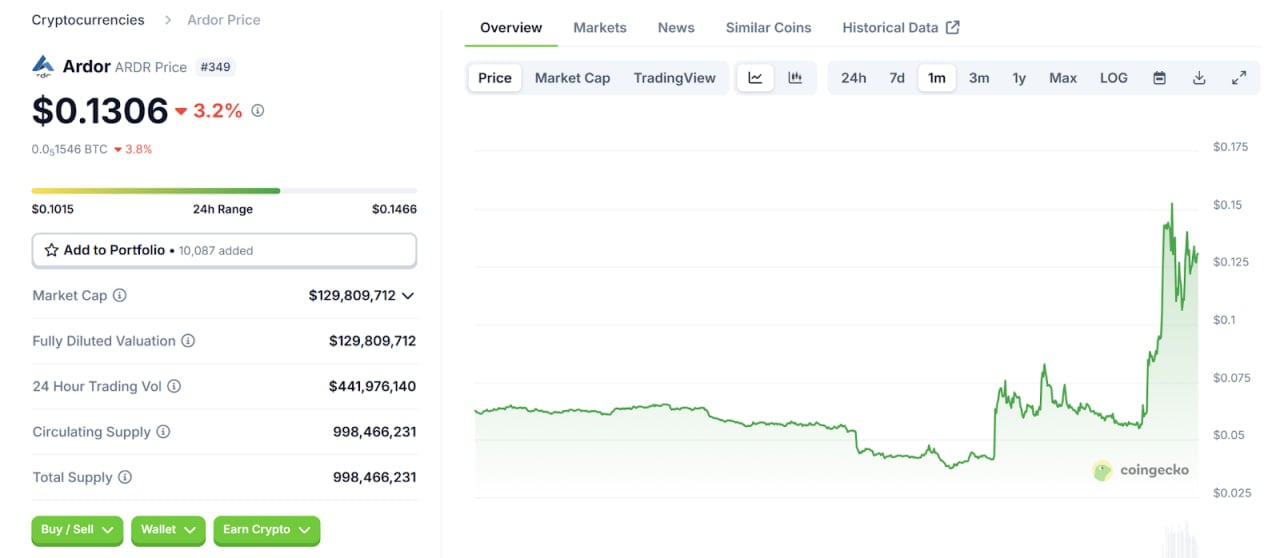
$AERGO demonstrated remarkable resilience following its delisting from the Binance spot market on March 28, 2025, skyrocketing 10x to $0.57, bolstered by activity on Upbit and Binance Futures. This unexpected turnaround, echoed by significant price increases in $ARDR (280%) and $ARK (60%) during Binance’s April “Vote to Delist” campaign, underscores how Binance’s Monitoring Tags and delisting events can create volatile, high-risk, high-reward scenarios for traders. 

$AERGO’s Price Rebound

On March 21, 2025, Binance announced AERGO’s spot market delisting, effective March 28, sending its price down 6% to $0.06845. While most delisted coins tend to fade into obscurity, $AERGO, the native token of a hybrid blockchain platform backed by Samsung’s Blocko, managed to defy expectations. After being delisted by Binance, $AERGO skyrocketed 10x to a peak of $0.57 with a $920 million volume surge before being relisted on Binance Futures. 

Compare this event to other delisted tokens like BAL and CREAM, removed on April 16, 2025. They plummeted, with $CREAM losing a significant market cap. 

AERGO’s edge? High Upbit volume sustained liquidity with $250M on 9/4, as stated by GEM DETECTER, turning a delisting dip into a speculative frenzy. Traders who spotted this pattern-volume spikes on South Korean exchanges, caught a massive wave, proving that not all delistings spell doom.

Parallel Surges of $ARDR and $ARK

A similar script played out with $ARDR and $ARK, included in Binance’s second “Vote to Delist” campaign from April 10-16, 2025. Despite receiving 3.6% and 5.8% of votes, respectively, neither $ARDR nor $ARK has confirmed delisting, yet their prices experienced a significant surge. 

AERGO’s Turnaround and Binance Delisting Dynamics

Source: Coingecko

Unlike other tokens in the 2nd “Vote to Delist” Batch like $PDA and $VOXEL, which saw substantial declines, $ARDR surged 280% to $0.15 by April 16, with a 1,100% volume spike. $ARK, less dramatic, likely climbed to $0.52, increasing by nearly 60%. Both these tokens are trader favorites on Bithumb, where high trading volumes sustain liquidity. Similar to $AERGO’s Upbit-driven rally ($250M volume on April 9), Bithumb’s ARDR/KRW and ARK/KRW pairs saw massive activity.

However, the hype didn’t last. $AERGO crashed 63% to $0.18 within 24 hours. $ARDR likely dipped 10-15%, while $ARK stagnated or slid slightly. These corrections highlight the volatility of delist-driven pumps. When momentum fades, traders chasing news often suffer, particularly if projects lack strong fundamentals.

Leveraging Binance’s Risk Indicators

Through the cases above, Binance’s Monitoring Tags can be considered a goldmine for traders. These flags mark coins at risk of delisting due to low liquidity, weak development, or regulatory red flags.

The Vote to Delist campaign, like the one ending April 16, amplifies volatility, creating pump-and-dump setups. To capitalize, track tagged coins via Binance announcements, then check Bithumb and Upbit volume on CoinMarketCap or CoinGecko. A surge, like in $AERGO, $ARDR, and $ARK, often precedes a rally.

Don’t forget to stay proactive: Monitor Binance Square for delist updates and Korean Upbit and Bithumb exchange data for volume clues. $AERGO, $ARDR, and $ARK show what’s possible, but timing and risk management are everything.


Source link

RAY Soars 13% with Raydium’s LaunchLab Debut on Solana

0
RAY Soars 13% with Raydium’s LaunchLab Debut on Solana


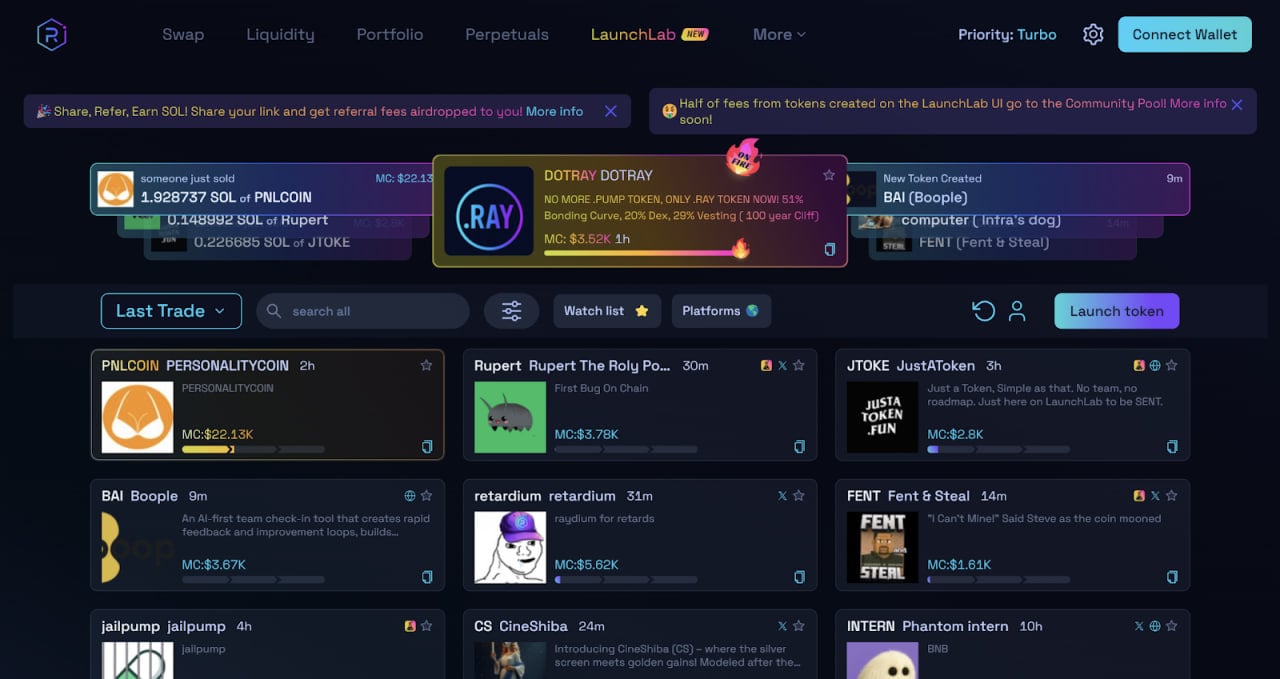
Raydium, a leading decentralized exchange (DEX) and automated market maker (AMM) on the Solana blockchain, officially launched LaunchLab on April 16, 2025. It has positively impacted $RAY’s price and the Solana ecosystem, driving increased activity and innovation. Explore Raydium’s LaunchLab now and participate in cutting-edge projects and opportunities.

What is LaunchLab?

LaunchLab is a token launchpad platform designed to compete with Pump.fun, a popular Solana-based memecoin launch platform. It aims to simplify token creation and distribution for developers, creators, and the broader Solana ecosystem. 

What is LaunchLab?

Source: LaunchLab

Raydium’s LaunchLab introduces a suite of innovative features designed to streamline and secure token launches on Solana. Creators can leverage customizable bonding curves to set token sale amounts, enabling dynamic pricing that adapts to market demand. The platform’s no-code interface offers flexibility with two modes: “JustSendIt” for quick launches with default settings and “LaunchLab” for tailored options like token supply, vesting, and distribution.

Free token launches make the platform accessible, allowing anyone to create a token, with liquidity automatically migrating to Raydium’s AMM pool upon reaching targets like 85 $SOL in JustSendIt mode.

To ensure trust, liquidity locking or burning post-migration minimizes rug pull risks. LaunchLab’s fee structure includes a 1% transaction fee, split as 50% to a community pool, 25% for $RAY buybacks, and 25% for infrastructure and operations. Additionally, token creators benefit from a post-migration fee share, claiming 10% of LP fees from AMM pool trades, incentivizing long-term project engagement.

Competitive Dynamics: LaunchLab’s Response to Pump.fun

The launch of LaunchLab is a strategic response to competitive pressures, particularly from Pump.fun, which had been a significant revenue driver for Raydium. Pump.fun announced its own AMM (PumpSwap) in March 2025, reducing its reliance on Raydium’s liquidity pools. Previously, Pump.fun tokens reaching a $69,000 market cap would migrate to Raydium for trading, contributing ~41% of Raydium’s swap fee revenue.

According to DefiLlama, PumpSwap’s debut, with over $31.7 billion in trading volume in just 10 days, increased the fierce competition with Raydium.

Moreover, with Pump.fun’s shift to PumpSwap, Raydium faced a potential loss of its revenue. LaunchLab aims to capture token launch activity and maintain Raydium’s dominance as Solana’s top DEX.

Therefore, LaunchLab aims to recapture token launch activity and reinforce Raydium’s dominance in Solana’s ecosystem. Beyond competition, it reflects Raydium’s vision to transition from a liquidity provider to a broader “ecosystem infrastructure builder,” supporting diverse, long-term projects with many key differences from Pump.fun, including:

Flexibility: LaunchLab offers advanced customization (bonding curves, vesting, fee-sharing) compared to Pump.fun’s aesthetic-only changes.Integration: LaunchLab connects directly to Raydium’s AMM, while Pump.fun now uses PumpSwap.Focus: LaunchLab supports all token types, not just memecoins, and aims for long-term project sustainability, addressing Pump.fun’s criticism for enabling pump-and-dump schemes.

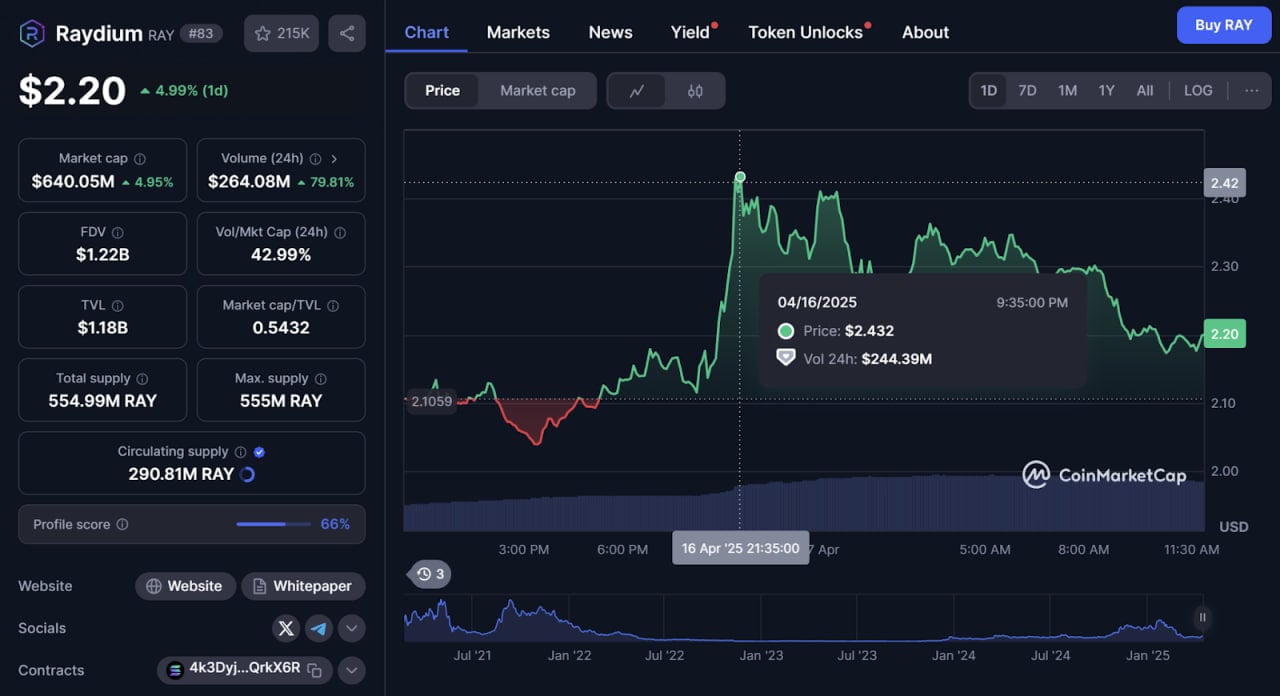
LaunchLab’s Immediate Effect: $RAY and $SOL Price Surge

LaunchLab's Immediate Effect: $RAY and $SOL Price SurgeLaunchLab's Immediate Effect: $RAY and $SOL Price Surge

Source: CoinMarketCap

The LaunchLab announcement catalyzed a 13% spike in RAY, just over 1 hour after the news, reaching ~$2.43 with a market cap exceeding $680 million. Trading volume surged 80% to $264.08 million in 24 hours. The launch and 25% fee allocation for $RAY buybacks might support this bullish sentiment. 

Learn more: Solana Price Prediction

For SOL, the direct impact is also immediate, with the price increasing 4.16% to $131 today. This spike is because of the belief in LaunchLab’s potential to drive ecosystem activity through new token launches and increased transactions, which could bolster $SOL’s value over time by enhancing Solana’s network usage.

While the initial market reaction has been positive, LaunchLab demonstrates significant potential beyond immediate price movements. Its focus on broader token types, long-term sustainability features, and direct integration with Raydium’s ecosystem positions it as a platform whose long-term impact on both Raydium and the wider Solana network is highly anticipated.


Source link

MapleStory Universe Launches Henesys Chain

0
MapleStory Universe Launches Henesys Chain


MapleStory Universe has launched the Henesys Chain, a new Layer 1 blockchain network built on Avalanche and powered by AvaCloud, to provide the technical foundation for MapleStory Universe’s expansion into web3 gaming.

Designed to simplify blockchain interactions for players, the Henesys Chain introduces features such as gasless transactions and a permissioned NFT system.

Developers will also have access to new tools that allow them to create dApss tied to the MapleStory Universe ecosystem.

MapleStory Universe Launches Henesys Chain Source: MapleStory Universe

What is Henesys Chain?

Henesys Chain is a custom Layer 1 blockchain created specifically for MapleStory Universe, developed using Avalanche’s technology through AvaCloud. The chain is named after Henesys, the starting village familiar to many MapleStory players, and is intended to reflect the original game’s focus on community, exploration, and player-driven narratives.

The network is built with an emphasis on scalability, accessibility, and transparency with key features including gasless transactions, permissioned minting of NFTs to maintain item scarcity, and integration with Chainlink’s Verifiable Random Function (VRF) to support fair in-game mechanics.

The technical infrastructure is designed to serve as the foundation for MapleStory Universe’s evolving web3 gaming platform, prioritising both new user onboarding and long-term ecosystem stability.

MapleStory Universe Launches Henesys Chain
MapleStory Universe Launches Henesys Chain Source: MapleStory Universe

What are the key features of Henesys Chain?

Henesys Chain introduces several systems aimed at improving user experience and supporting future growth.

Gasless Transactions: Players can complete blockchain transactions without paying gas fees or managing complex wallet interactions. This is achieved through meta-transaction technology provided by Bloxy and an Approve Controller system, removing common barriers for new users.Preserve and Enhance Item Value: The chain uses a permissioned model where only authorised smart contracts can mint in-game items as NFTs. This approach aims to preserve the value and scarcity of digital assets whilst using Chainlink VRF to ensure transparent and verifiable randomisation for item enhancements.Developer Tools for Synergy Apps: An upcoming Software Development Kit (SDK) will allow third-party developers to build Synergy Apps, which could include companion games, social tools, or marketplaces. These apps will extend the MapleStory IP into decentralised experiences linked directly to the Henesys Chain ecosystem.Participate-to-Own Economy: Henesys Chain supports the $NXPC token, designed as an ecosystem currency tied to item creation, enhancement, and trading. The model focuses on real economic activity within the network. $NXPC is positioned as a reflection of the ecosystem’s growth and activity, connecting gameplay, user-generated content, and digital economies.

The network’s design also includes plans for future interoperability, allowing assets to move between different games and blockchains.

MapleStory Universe Launches Henesys Chain
MapleStory Universe Launches Henesys Chain Source: MapleStory Universe

What’s next for MapleStory Universe?

Following the launch of Henesys Chain, MapleStory Universe has outlined several planned updates aimed at expanding functionality and improving transparency.

These include launching a public blockchain explorer to enable players to track item ownership and review transaction histories, integrate NFT-based name reservations obtained during the “Make Special Name” community event and expand the $NXPC contribution and reward system to further encourage participation by developers and content creators. These initiatives are part of a broader roadmap focused on building MapleStory Universe into a full-scale gaming ecosystem, rather than a single game.

Future developments will prioritise sustainability, community trust, and long-term player engagement, reflecting MapleStory Universe’s intent to create a lasting and evolving web3 platform rooted in player ownership and decentralised experiences.


Source link

Popular Posts

My Favorites