


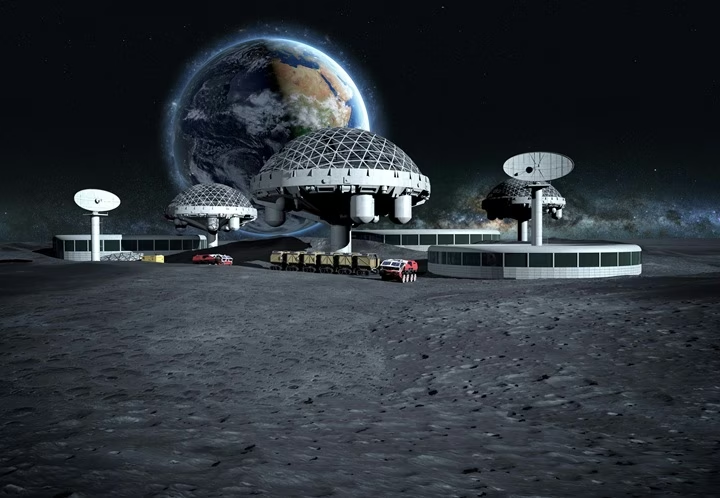
Every time I step outside at night and look up at the glowing sphere in the sky, my perspective on it shifts a little more. For most of human history, the Moon was just a nightlight, a muse for poets, or a destination for a brief, glorious visit. But lately, when I read the endless stream of updates from the aerospace industry, the narrative has completely changed. We aren’t just talking about visiting anymore; we are talking about moving in.
With Mars colonization plans seemingly taking a backseat—at least temporarily—the immediate, burning focus of tech giants and global superpowers has pivoted back to the lunar surface. Organizations like NASA, with its Artemis program, and private behemoths like SpaceX, are aggressively pushing the timeline. If you listen to Elon Musk or Jared Isaacman, you might believe that buying a ticket to a lunar settlement is an event right around the corner.
But let me be brutally honest with you. As someone who spends hours every week analyzing space tech and future trends, I have to step back from the billionaire hype. When you dig into the biological and engineering realities, the picture is terrifying. A decade sounds like a long time for us here on Earth, but in the realm of space logistics, it is the blink of an eye. The Moon is not a welcoming frontier; it is an unforgiving, hyper-lethal environment that will test the absolute limits of human endurance.
Here is my deep dive into the massive, potentially fatal hurdles that stand between us and a functioning lunar city.
The Invisible Threat: Breathing Microscopic Glass
When I first started researching the dangers of a lunar habitat, I assumed the biggest threats were the lack of oxygen or the freezing temperatures. I was wrong. The most immediate, destructive force on the Moon is something you can barely see: Lunar Dust (Regolith).
On Earth, dust and sand are constantly weathered by wind and water, rounding off their edges over millions of years. The Moon has no atmosphere and no weather. Because of this, lunar dust particles are effectively microscopic, razor-sharp pieces of glass.
Static Cling: Because the lunar surface is constantly bombarded by solar wind, these dust particles carry a static charge. They violently stick to absolutely everything they touch.Suit Destruction: During the Apollo missions, astronauts reported that this abrasive dust was eating through their spacesuits in a matter of days. Imagine what it would do to the joints and seals of heavy mining equipment.System Failures: If this dust gets inside a habitat—and it will, clinging to suits and airlocks—it possesses the power to clog life-support filters, short-circuit delicate electronics, and completely compromise air quality.Lung Damage: Inhaling regolith is incredibly dangerous. It can cause a condition similar to silicosis, permanently scarring the lungs.
We still do not have a foolproof engineering solution to keep this static, razor-sharp dust out of our machines and our lungs.
The Radiation Problem: Living in a Cosmic Microwave

Down here on Earth, we are spoiled. We are protected by a thick atmosphere and a powerful magnetic field that deflects the worst of the universe’s radiation. The Moon offers zero protection.
The moment you step onto the lunar surface, you are subjected to a relentless downpour of galactic cosmic rays and solar particle events.
Building a safe haven against particles traveling at the speed of light is an engineering nightmare that we haven’t solved yet. You can’t just pitch a high-tech tent. To survive long-term, habitats need incredibly thick shielding.
Underground Bunkers: The most viable idea I’ve seen is building habitats inside ancient, collapsed lava tubes beneath the lunar surface.3D Printed Shields: Another concept involves sending autonomous 3D printers ahead of time to build thick outer shells out of lunar regolith to protect the inner living quarters.
However, we do not yet have the technical capability to excavate lunar rock efficiently or 3D print massive structures in zero gravity. The chilling reality is that the first wave of lunar settlers will likely be the guinea pigs for long-term radiation exposure. Considering how cancer develops, the true biological cost of this space adventure might not be apparent until decades later.
What Low Gravity Actually Does to Your Body

We all love watching the old footage of Apollo astronauts bounding across the gray landscape in slow motion. It looks fun. But living long-term in an environment with only one-sixth of Earth’s gravity is an absolute disaster for human biology.
Our bodies evolved to fight the constant downward pull of Earth. When you remove that resistance, things go wrong very quickly.
Fluid Shifts: Without Earth’s gravity pulling blood down to your legs, bodily fluids migrate toward the head. This causes severe facial swelling, vision problems, and drastically increases the risk of dangerous blood clots.Muscle and Bone Atrophy: Your body is incredibly efficient; if it doesn’t need heavy muscles and dense bones to hold you up, it starts breaking them down.The Logistics of Exercise: To counteract this, astronauts on the ISS work out for hours every single day using massive, heavy resistance machines.
This brings up a massive logistical nightmare. How do you transport tons of heavy gym equipment to the Moon? Every single kilogram launched into space costs an astronomical amount of money. The budget required just to keep the colonists’ muscles from wasting away is staggering.
The Ultimate Billion-Dollar Gamble: Where is the Water?
This is the part that genuinely blows my mind. The entire foundation of building a sustainable lunar colony rests on one critical assumption: Water ice exists at the lunar south pole.
We need water for the colonists to drink, yes. But more importantly, we need to split that water into hydrogen and oxygen to create breathable air and rocket fuel. If we have to constantly ship water from Earth, the colony goes bankrupt immediately.
Here is the catch: While orbital satellites have detected strong signatures of ice hidden in permanently shadowed craters, no human or rover has ever actually touched it or extracted a sample.
We are designing billion-dollar rockets, drafting international treaties, and drawing up city plans based on a resource that we only think we can use. We don’t know how pure the ice is, how deep it goes, or how incredibly difficult it will be to mine in temperatures that hover near absolute zero. Planning a permanent settlement on an unverified resource feels like one of the biggest gambles in the history of science.
The Verdict
So, is a lunar colony a realistic near-term goal?
While I am in awe of the heavy-lift capabilities of Starship and the ambition of the Artemis accords, the biological and environmental facts cannot be ignored. Establishing a foothold on the Moon isn’t just a matter of building a big enough rocket; it is a matter of reinventing how human beings interact with their physical environment.
The Moon will not be a glittering resort for billionaires anytime soon. For the foreseeable future, it will be a harsh, desolate, incredibly dangerous work camp where survival is a daily battle against the laws of physics.
I’m incredibly curious to hear your take on this. Are we rushing too fast into an environment that our bodies simply weren’t built for, or is pushing through these brutal challenges the only way humanity will ever become a multi-planetary species? Let me know what you think!


