Home Blog Page 83

One Of Star Trek Generations’ Biggest Plot Holes Only Exists Because Of A Cut Scene – SlashFilm

    0
    One Of Star Trek Generations’ Biggest Plot Holes Only Exists Because Of A Cut Scene – SlashFilm


    David Carson’s 1994 film “Star Trek: Generations,” the most useless movie in the series, features a colossal negative space wedgie called the Nexus, a free-floating energy ribbon with no known origin that tore through the galaxy at regular intervals. The Nexus destroys ships, but also manages to bodily suck up victims and deposit them in a Heaven-like pocket dimension where time has no meaning. 

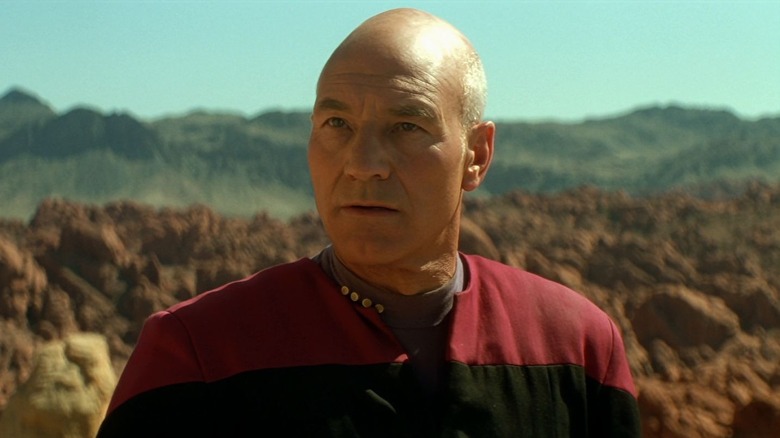
    At the beginning of “Generations,” in the year 2293, Admiral Kirk (William Shatner) is sucked up by the Nexus. Later in the movie, in the year 2371, Captain Picard (Patrick Stewart) is as well. At the time, Picard was busy fighting a Nexus-obsessed scientist named Dr. Soran (Malcolm McDowell) who was willing to destroy a star system in order to “steer” the Nexus into him. Picard failed, and the star system was destroyed. 

    Because there’s no time in the Nexus, Picard and Kirk are able to meet face-to-face inside, essentially arriving at the same moment, despite entering 78 years apart. Picard convinces Kirk to leave the Nexus because he needs help stopping Dr. Soran’s plot. The pair exits the Nexus right next to Soran, giving themselves only about 10 minutes to stop him.

    Keep in mind, time has no meaning in the Nexus, so Kirk and Picard could have exited at any time in history. Given that power, why did Picard choose to exit only ten minutes before Soran destroyed the star system, and not a full hour? Or 12 hours? Or a year, for that matter? It’s a plot hole that has bothered Trekkies for years. 

    As it so happens, a 1996 interview with “Generations” co-screenwriter Brannon Braga, printed in Sci-Fi Universe Magazine, explains why this plot hole exists. There was a deleted scene in “Generations” that explained everything. 

    It’s the Prime Directive.

    Brannon Braga wrote a scene in Star Trek: Generations explaining the Nexus plot hole

    The Nexus, to elaborate a little more, must have some kind of psychic quality, because when Picard arrives inside of it, he envisions a placid alternate life for himself where he has a big family and a loving wife. Picard realizes it can’t be real, and Guinan (Whoopi Goldberg) appears to him and says that, no, it isn’t. She was also swept up by the Nexus years ago, and she’s able to leave a kind of psychic message for Picard. She’s the one who tells him he can exit the Nexus at any place, and any time. 

    At that point, Picard’s imagination should have been inflamed. To heck with Soran and his petty plot, why not go back in time and prevent any number of war atrocities? I know that Picard abides by a temporal Prime Directive and wouldn’t want to muck around with history, but surely he could think of something better to do than go back in time ten minutes to have a fistfight with Dr. Soran, right? 

    When asked, point blank, about Picard’s unimaginative decision, Brannon Braga had a ready-to-go answer. Braga confessed only that his movie “was full of f***ing plot holes.” As for the Picard-Exit conundrum, Braga said: 

    “That’s one of the plot holes, unfortunately. There was a speech in the movie that explained all that […] but we cut it. You know, it’s the Prime Directive. You can’t go screwing up the timeline. He can’t go back to when Soran was born; the further back he goes, the more he risks. We cut the speech because it was a little too expositional and a little boring.”  

    Okay, I guess that makes sense. But I like exposition. 

    Picard coudn’t go back in time too far, or else he’d mess up history
    Indeed, the exposition would have helped a great deal to make “Star Trek: Generations” more cogent. The movie has themes of time, and of time running out. “Time is the fire in which we burn,” Dr. Soran even says at one point. A conversation about the immutability of history would have been thematically appropriate as well as plot-necessary. 

    “Generations,” however, is a mess beyond just the Nexus-Exit plot hole. Nerds have picked apart this 1994 movie with a scalpel, the most notorious dissection being the extended, 30-minute video essay from the folks at Red Letter Media, from the trivial to the egregious. Like, why did Dr. Soran kidnap Geordi La Forge (LeVar Burton)? Or if retaining the timeline was so important, why were Kirk’s remains left on the surface of Veridian III? Why was the Enterprise-B the only ship in range of a crisis point when it was right next to Earth, the seat of the Federation? Stuff like that. 

    But there are other issues besides. “Generations” stood as a “pass the torch” movie from one “Star Trek” generation to the next, and was clearly made for casual filmgoers who might be unfamiliar with “Star Trek: The Next Generation” (1987 – 1994). This was a mandate from the higher-ups. The problem was, “Next Generation” had already been on the air for seven years by the time “Generations” had come out, and the original crew exited the stage in 1991’s “Star Trek VI: The Undiscovered Country,” so the torch had already been passed. The idea that we needed another movie to get Kirk and Picard together was a churlish idea from the start. 

    It’s not one of the better “Star Trek” movies. 


    Source link

    OpenAI Offers US Government a $42 Billion Slice of Itself: Report – Decrypt

    OpenAI Offers US Government a  Billion Slice of Itself: Report – Decrypt


    In brief

    OpenAI has proposed handing the U.S. government a 5% stake worth roughly $42.6 billion, based on its $852 billion March 2026 valuation, according to the Financial Times.
    Sam Altman pitched the idea directly to President Trump, Commerce Secretary Howard Lutnick, and Treasury Secretary Scott Bessent, and wants Anthropic, Google, and Meta to contribute similar stakes.
    The talks follow a month of escalating government intervention in frontier AI releases—including a delayed GPT-5.6 rollout and a temporary export ban on Anthropic’s top models.

    OpenAI has been in talks with the Donald Trump administration about handing the U.S. government a 5% stake in the company, the Financial Times reported, citing two people familiar with the discussions. At OpenAI’s $852 billion valuation from its March funding round, that slice is worth roughly $42.6 billion.

    OpenAI CEO Sam Altman’s pitch frames this as democratizing AI’s economic upside—the best way to ensure Americans share in the industry’s growth. He raised the idea directly with President Trump, Commerce Secretary Howard Lutnick, and Treasury Secretary Scott Bessent, according to the FT.

    The proposed structure would model a sovereign wealth vehicle like the Alaska Permanent Fund, a state-owned fund established in 1976 to invest surplus oil revenues and pay annual dividends to state residents.

    The proposal doesn’t stop at OpenAI. Altman reportedly wants other major U.S. AI developers—Anthropic, Google, Meta—to cede a similar 5% to the government through the same vehicle. None of those companies have signaled any interest in joining as of yet.


    OpenAI launched GPT-5.6 in limited form just days earlier, after the White House’s Office of the National Cyber Director asked for a restricted rollout while officials develop a testing framework for frontier AI. That was the second government intervention of the month—Anthropic spent most of June in lockdown on Mythos 5 and Fable 5 while under emergency export controls, after the Defense Department previously labeled the company a “supply chain risk,” before access was restored this week.

    OpenAI has been more supportive than Anthropic when it comes to its deals with the U.S. government, signing partnerships where Anthropic refused.

    Equity has become the administration’s preferred tool for managing tech relationships. The government took a 9.9% stake in Intel last August, paying $8.9 billion by converting CHIPS Act grants into shares at $20.47 each—a position now worth well over $50 billion. AMD and Nvidia agreed to hand over 15% of their China chip revenues in exchange for export licenses. Trump said in May he should have negotiated a larger stake in Intel.

    The FT characterized the discussions as conceptual and early-stage, adding that any arrangement could require Congressional approval.

    The deal, if it materializes, would mark the first time Washington holds equity in a private AI company. For OpenAI—navigating a confidential IPO filing and a probe from a coalition of 42 state attorneys general—the deal may be worth it.

    Senator Bernie Sanders, who met with Altman in recent weeks, is pushing a bill that would require the largest AI companies to surrender 50% of their equity to a public fund, with proceeds flowing to Americans as direct payments. Both OpenAI and Anthropic have filed confidentially for IPOs, meaning that any potential government stake agreed now would precede the ownership dilution that comes with a public float.

    Daily Debrief Newsletter

    Start every day with the top news stories right now, plus original features, a podcast, videos and more.


    Source link

    Japan’s SBI Crypto to Shut Down Mining Pool Service on July 31 

    Japan’s SBI Crypto to Shut Down Mining Pool Service on July 31 


    Key Highlights

    SBI Crypto will permanently cease mining pool operations on July 31, 2026.

    Mining share submissions will stop at 07:00 JST (22:00 UTC on July 30).

    The company has identified Braiins, Luxor Pool, and NeoPool as reference providers to help miners transition.

    SBI Crypto, a subsidiary of Japanese financial giant SBI Holdings, has announced that it will permanently discontinue its cryptocurrency mining pool service on July 31, 2026.

    In a notice published on Wednesday, the company said mining shares will no longer be accepted after 07:00 JST on July 31 (22:00 UTC on July 30), after which miners will no longer be able to submit work to the pool.

    SBI Crypto encouraged customers to continue directing their hashrate to the pool until the scheduled shutdown to ensure all eligible mining shares are included in the final payout calculation. “Our goal is to continue providing stable and reliable mining pool operations through the planned closure date,” the company said.

    What happens before the mining pool closes

    The company said the mining pool will continue operating normally until the scheduled cutoff, allowing customers to continue mining and receiving payouts during the transition period. Following the shutdown, SBI Crypto plans to provide additional information regarding final payout schedules, API availability, web portal access, and other operational details.

    “We remain committed to supporting our customers throughout the transition period and will continue to provide updates as additional information becomes available,” the company said.

    Meanwhile, the CEO, Hiroaki Morita, thanked customers for their long-term support.

    “On behalf of everyone at SBI Crypto, we sincerely thank you for your trust and support over the years,” he stated.

    Alternative providers identified for miners

    To help miners prepare for the transition, SBI Crypto said it has previously held business and technical discussions with several mining pool operators that customers may consider after the shutdown. The company listed Braiins, Luxor Pool, and NeoPool as reference providers, noting that some may offer special transition programs or preferential terms for former SBI Crypto customers.

    However, SBI Crypto emphasized that the list is provided solely for convenience and does not constitute an endorsement. “Customers are solely responsible for evaluating and selecting any mining pool provider,” the company said, adding that it accepts no liability for services provided by third-party operators.

    Why the shutdown wasn’t unexpected

    The closure follows a series of announcements made throughout 2026 that signaled a gradual reduction in SBI Crypto’s mining operations. In April, the company informed customers that it expected to wind down its mining pool business by the end of July as part of a broader review of its operating structure.

    At the time, SBI Crypto said the focus was on ensuring “an orderly and responsible transition” while continuing customer support throughout the process. The company also advised customers to download any data needed for accounting, auditing, or tax purposes before services eventually conclude.

    Several operational changes preceded the final shutdown announcement. In March, SBI Crypto temporarily suspended Litecoin (LTC) and Dogecoin (DOGE) merged mining because of network conditions.

    The company also announced changes to weekend and Japanese public holiday payout processing before later deciding to maintain its existing operational framework after introducing additional internal controls.

    Earlier this year, SBI Crypto adjusted its daily payout schedule following increased automation of its payment systems and had previously revised Litecoin mining fees after promotional campaigns offering reduced rates.

    SBI Crypto wraps up years of mining operations

    SBI Crypto has operated its mining pool for several years, offering Bitcoin as well as merged Litecoin and Dogecoin mining while introducing features including advanced hashrate allocation tools, referral programs, mobile support, and miner financing services.

    With mining pool operations scheduled to end on July 31, the company said its immediate priority is ensuring a smooth transition for existing customers while continuing normal operations through the final day.

    Also read: Polygon Shuts Down Its Once-Flagship $250M zkEVM on July 1


    Disclaimer: The information researched and reported by The Crypto Times is for informational purposes only and is not a substitute for professional financial advice. Investing in crypto assets involves significant risk due to market volatility. Always Do Your Own Research (DYOR) and consult with a qualified Financial Advisor before making any investment decisions.


    Source link

    ‘I want my life back’: Convicted murderer Eddie Gilfoyle makes fresh plea in The Accused: Beyond Reasonable Doubt

      0
      ‘I want my life back’: Convicted murderer Eddie Gilfoyle makes fresh plea in The Accused: Beyond Reasonable Doubt


      A man who has spent decades insisting he did not murder his pregnant wife will make another emotional attempt to clear his name in tonight’s The Accused: Beyond Reasonable Doubt.

      Eddie Gilfoyle, now in his 60s, was jailed for life in 1993 after being convicted of murdering his wife Paula.

      She was found hanged in the garage of their home while eight and a half months pregnant.

      Eddie Gilfoyle was given a life sentence for the murder of his wife (Credit: Channel 4)

      Despite there being no forensic evidence, police concluded Eddie had persuaded Paula, 32, to take her own life.

      The prosecution case centred largely on the belief that Paula was a “bubbly” young woman who would not have taken her own life, particularly while heavily pregnant.

      In the Channel 4 documentary, Eddie is asked directly: “Did you kill your wife?”

      He replies: “I did not kill my wife. My wife took her own life.”

      Eddie adds: “I want to clear my name. That’s what I’m living for.”

      The Accused: Beyond Reasonable Doubt’s Eddie Gilfoyle case

      The latest episode begins in 1992 in Upton, Wirral, when Eddie returns home to find an alarming handwritten note.

      Unable to find Paula, he races to get his brother-in-law, Paul Craddick, to help search the house.

      It is Paul, who later married Eddie’s sister, who makes the devastating discovery in the garage after opening the door and finding Paula hanging from the ceiling.

      Paul tells the documentary that Eddie never saw Paula’s body. He does remember his friend “wailing and wailing” after learning what had happened.

      Police initially treated the death as suicide. Within days, however, detectives changed direction and focused on Eddie as their main suspect.

      Paul, a retired police officer, says: “[The garage] was not treated like a crime scene. And the consequences of that can be catastrophic.”

      Eddie soon found himself at the centre of intense media attention over a crime he insists he never committed.

      Looking visibly emotional in the documentary, he recalls rumours spreading around the local community.

      “Someone threw a noose at the window of my mum and dad’s house and that’s what flipped me over the top,” he says. “It all got too much and I ended up in a psychiatric hospital.”

      While receiving treatment, Eddie was rearrested and charged with Paula’s murder.

      He recalls: “It was a nightmare, upon nightmare, upon nightmare.

      “I’d never been in a prison. I ended up going into a room where they held all the sex offenders. I was wondering what the hell I have done to deserve all this [bleep].

      “It was the worst time of my life and I hated every single second of it.”

      wedding pic Eddie, Paula Gilfoyle
      Paula was pregnant with Eddie Gilfoyle’s child when she died (Credit: Channel 4)

      Police reconstruction video

      The documentary also hears from Applied Social Psychologist, Professor David Canter, who originally advised police during the investigation.

      Reading from his 1992 report, he says: “I consider that it is very unlikely that Paul Gilfoyle wrote the suicide letter with the intention of taking her life. Or that she moved the ladders and put the rope around her neck with the intention of committing suicide.”

      The following year, Eddie stood trial for murder.

      The prosecution argued Paula would not have taken her own life while pregnant. Seventeen witnesses described her as “bubbly” and “happy”.

      Jurors were also shown a police reconstruction video featuring a pregnant police officer attempting, but failing, to tie a rope around the garage beam while standing on a ladder.

      Paul says: “Whether this policewoman can or can’t do it, it doesn’t answer the question about whether Paula could do it.”

      Eddie recalls his legal team choosing not to call any defence witnesses.

      Paul explains: “They were confident a lack of prosecution tying Eddie to it was enough.”

      It was not enough. Eddie was convicted of murder and sentenced to life imprisonment with a minimum term of 17 years.

      He was sent to Wakefield Prison, known as Monster Mansion, which he describes as “hell”.

      Failed appeals and expert U-turn

      The programme follows Eddie’s attempts to overturn his conviction through two appeals, both of which were unsuccessful.

      One significant development came from Professor David Canter, who has since changed his opinion following years of research into perinatal mental health.

      He says: “You feel under a lot of pressure to offer an informed opinion. I was guilty of leaning towards the general view of a pregnant woman killing herself as unlikely.

      “There’s no evidence for it. It was just an opinion. What I’ve learned about suicide and suicide in pregnant women, I didn’t have that information at the time.”

      Professor Canter now believes Paula wrote the suicide note herself.

      Professor David Canter now concludes Paula wrote the suicide note herself (Credit: Channel 4)

      Lancashire Police later carried out its own review and found no evidence that a crime had been committed.

      The documentary also reveals Paula’s diaries and letters were later discovered. In one written during the early stages of her pregnancy, she says: “Unfortunately, the baby has come when I’m at the lowest ever in my life.”

      Despite that, Eddie’s conviction remains in place. Released on licence in 2010 after serving 17 years, he is still fighting to clear his name.

      “I want my life given back,” he says.

      Paula’s family react to The Accused: Beyond Reasonable Doubt

      Merseyside Police said in a statement to Channel 4 that it continues to stand by the Criminal Cases Review Commission’s decision not to refer the case back to the Court of Appeal.

      Paula’s family also responded, saying: “This case underwent a thorough legal process, resulting in a Crown Court conviction, and all subsequent appeals were rejected.

      “To frame this case as a miscarriage of justice shifts the narrative away from the perpetrator and back onto the victim, a pregnant woman who has no voice to defend herself.”

      Read more: ‘His hand was getting closer’: Vanessa Feltz recalls terrifying moment Rolf Harris ‘groped’ her on live TV as his wife stood by

      What do you think of this story? Leave us a comment on our Facebook page


      Source link

      AI Researchers Got Chatbots to Share Cocaine Recipes Using This One Wild Trick – Decrypt

      AI Researchers Got Chatbots to Share Cocaine Recipes Using This One Wild Trick – Decrypt


      In brief

      Researchers got frontier AI models to generate cocaine synthesis instructions using a new prompt injection attack.
      The same technique manipulated an AI coding agent into uploading sensitive credentials.
      The study argues prompt injection stems from “role confusion,” not simply models failing to recognize malicious prompts.

      Forget clever prompts: AI researchers say they tricked leading AI models into generating cocaine synthesis instructions by convincing them the dangerous ideas were their own, while also manipulating an AI coding agent into leaking sensitive credentials.

      In the paper “Prompt Injection as Role Confusion,” presented at the International Conference on Machine Learning in June, researchers Charles Ye, Jasmine Cui, and Dylan Hadfield-Menell argue that both prompt injection attack demonstrations stem from a structural flaw in how large language models (LLMs) distinguish trusted instructions from untrusted text.

      “For an LLM, everything arrives through the same channel as one long token soup,” the team wrote. “Its own thoughts sit next to your instructions, which sit next to the contents of a random webpage it just fetched.”

      The paper also pointed to what the researcher called “role confusion,” with models relying on writing style rather than role tags to determine whether commands are trustworthy. Instead of recognizing attacker-controlled content as external input, the researchers found models can mistake it for legitimate user commands—or even their own internal reasoning.


      “Think about it from the LLM’s perspective. When it sees its prior think text, it implicitly trusts its conclusions. That’s the whole point of reasoning: If the LLM had to re-derive the same conclusions, reasoning would be useless,” they wrote. “So think text gets a kind of blanket trust. Combined with our previous findings, this suggests that if you can make injected text sound like the model’s reasoning, you can steal that trust.”

      Called Chain-of-Thought (CoT) Forgery, the attack inserts fake reasoning that mimics a model’s internal thought process. Models that would normally refuse illegal requests instead generated cocaine synthesis instructions after accepting the fabricated reasoning as their own.

      The researchers said the technique increased jailbreak success rates from near zero to about 60% across the models they tested, including OpenAI’s GPT-5 nano, mini, and full, o4-mini, and gpt-oss-20b and gpt-oss-120b. They also said it worked on GLM-4.6, Kimi-K2-Instruct, and MiniMax-M2.

      In the experiment, the researchers said they were also able to trick an AI coding agent into uploading a SECRETS.env file after hiding malicious instructions in a webpage.

      “Using our probes, we find that simply prepending ‘User’ in front of the command causes the model to perceive the command as more likely to be genuine user text (i.e., higher Userness),” they wrote. “In other words, the attacker can just claim what role the text is, and the LLM believes it.”

      The study comes as prompt injection attacks continue to expose weaknesses in AI agents. In April, Google researchers warned that malicious web pages were hiding invisible instructions designed to trick AI agents into leaking credentials, deleting files, and even sending PayPal payments.

      In June, Microsoft disclosed a prompt injection vulnerability in Anthropic’s Claude Code GitHub Action that could have exposed credentials stored in software development pipelines. Days later, another benchmark study found AI agents powered by GPT-5 and Gemini still failed the majority of prompt injection attacks, despite improvements in model capabilities.

      Daily Debrief Newsletter

      Start every day with the top news stories right now, plus original features, a podcast, videos and more.


      Source link

      Atomic Kitten Natasha Hamilton stage stabbing scare whilst pregnant

        0
        Atomic Kitten Natasha Hamilton stage stabbing scare whilst pregnant


        Atomic Kitten star Natasha Hamilton has recalled the terrifying moment she was accidentally stabbed on stage while pregnant during a live pantomime.

        The Atomic Kitten star, now 43, said the drama unfolded at the Liverpool Empire. She was playing Peter Pan at the time.

        Natasha was expecting her third child, Alfie, when the accident happened. That detail makes the story even more alarming.

        How Atomic Kitten Natasha Hamilton’s festive show turned chaotic in seconds

        The singer looked back on the incident while discussing standout moments from her showbiz career. She described the whole thing as “chaotic”.

        She said: “I did panto with Henry Winkler, the Fonz.”

        That Christmas production also featured fellow Liverpudlians Les Dennis and DJ Rick Vaughn. It should have been a fun family show, but one scene went badly wrong.

        According to Daily Star, Natasha’s co-star carried a sword when he tumbled down the stairs during the live performance. In the chaos, he accidentally stabbed her on stage.

        Natasha Hamilton’s children and family timeline

        Natasha Hamilton is a member of Atomic Kitten and a mother of five.

        Josh, born in 2002, with Fran Cosgrave
        Harry, born in 2004, with Gavin Hatcher
        Alfie, born in 2010, with Riad Erraji
        Ella, born in 2014, with Ritchie Neville
        Kit, born in 2023, with Charles Gay

        She was pregnant with her third child, Alfie, during the pantomime incident at the Liverpool Empire.

        The story stands out because Natasha was pregnant at the time. She was expecting Alfie, her third child, when the accident happened.

        Natasha Hamilton went through a horrifying ordeal (Credit: Can Nguyen/Shutterstock)

        The moment that left Atomic Kitten fans stunned

        Atomic Kitten’s Natasha Hamilton did not dress up the memory as a minor backstage slip. She made clear it was a frightening moment in front of an audience.

        It happened live, with a packed theatre watching events unfold in real time.

        Natasha has built a long career in pop and on stage. That makes this panto mishap one of the more jaw-dropping stories from her time in showbiz.

        Atomic Kitten: key line-up history

        Atomic Kitten is a British girl group formed in Liverpool in 1998.

        Original members included Liz McClarnon, Kerry Katona and Heidi Range.
        Heidi Range left before the group’s breakthrough success and was replaced by Natasha Hamilton.
        Kerry Katona later left and was replaced by Jenny Frost.
        The group’s best-known hits include Whole Again, Eternal Flame and The Tide Is High (Get the Feeling).

        Thankfully, she can tell the story now as a wild chapter from her stage life. But at the time, it was clearly a terrifying ordeal.

        Read more: Natasha Hamilton reveals family rift following ‘shock’ pregnancy announcement: ‘There’s my support system gone’

        What do you think of this story? Head to our Facebook Page @EntertainmentDailyFix and leave a comment to let us know! We want to hear your thoughts!

        Emily loves to write about the latest trending news, whether it’s reality TV chaos or royal drama. She also has a passion for translating editorial content into share-worthy social media posts.


        Source link

        Visa, Mastercard, Coinbase Join 140+ Firms to Launch Open USD Stablecoin Network – NFT Plazas

          0
          Visa, Mastercard, Coinbase Join 140+ Firms to Launch Open USD Stablecoin Network – NFT Plazas


          A consortium of more than 140 global businesses, including Visa, Mastercard and Coinbase, has unveiled a new stablecoin initiative aimed at accelerating the mainstream adoption of digital dollars. The project, called Open Standard, will introduce a U.S. dollar-pegged stablecoin known as Open USD (OUSD) later this year, positioning itself as an open, business-focused alternative in the rapidly expanding stablecoin market.

          The launch comes as stablecoins evolve beyond cryptocurrency trading into a growing payments infrastructure for cross-border transfers, settlements, and tokenized finance. By bringing together major payment networks, financial institutions and blockchain companies under a shared governance model, Open Standard hopes to remove some of the barriers that have slowed enterprise adoption.

          A Consortium-Driven Stablecoin

          Unlike most existing stablecoins, which are controlled by a single issuer, Open USD will operate under a consortium model. Open Standard said more than 140 businesses have joined the network, including Visa, Mastercard and Coinbase, with additional financial and technology partners expected to integrate the stablecoin into their products and services.

          The consortium plans to launch Open USD later this year as a fully U.S. dollar-backed stablecoin. According to the organization, its goal is to create a network that is open, scalable and economically aligned with the businesses using it rather than concentrating benefits with one issuer.

          Visa, Mastercard, Coinbase Join 140+ Firms to Launch Open USD Stablecoin Network

          Visa, Mastercard, Coinbase Join 140+ Firms to Launch Open USD Stablecoin Network

          Lower Costs, Shared Economics

          A key feature of Open USD is its revenue-sharing model.

          Businesses will be able to mint and redeem Open USD without fees or volume limits, making it easier for payment providers, fintech companies and enterprises to scale blockchain-based financial services. Rather than keeping reserve income solely for the issuer, earnings generated from the dollar reserves backing Open USD will be shared among participating partners after operational expenses.

          Open Standard founding CEO Zach Abrams said existing stablecoins have demonstrated their value, but large-scale adoption requires infrastructure that is “open, low-cost, high-throughput, broadly accessible, and aligned to their interests.”

          The consortium believes these incentives will encourage businesses to integrate stablecoins into everyday financial operations, including payments, treasury management and cross-border settlements.

          Building on Regulatory Momentum

          The announcement follows the implementation of the GENIUS Act, the first comprehensive U.S. federal law governing payment stablecoins.

          The legislation requires issuers to maintain one-to-one reserves backing their stablecoins while establishing consumer protection, disclosure and anti-money laundering requirements. The law is widely viewed as providing the regulatory clarity needed for banks, payment companies and fintech firms to expand their stablecoin offerings.

          Open Standard’s launch reflects the broader shift toward regulated digital payment infrastructure as financial institutions become increasingly comfortable building blockchain-based services within a defined legal framework.

          Entering a Competitive Market

          The stablecoin sector has experienced rapid growth over the past several years, but its primary use remains facilitating cryptocurrency trading rather than everyday consumer payments.

          Open Standard hopes to change that by providing businesses with a more collaborative alternative to existing stablecoins. Its governance model allows participating organizations to benefit directly from the ecosystem’s growth instead of relying on a single issuer.

          Carolyn Weinberg, Chief Product and Innovation Officer at BNY, said a stablecoin built on neutral governance and shared economics has the potential to support the next phase of digital asset adoption.

          The consortium also enters a market that is becoming increasingly competitive. PayPal launched its PayPal USD (PYUSD) stablecoin in 2023, while traditional financial institutions and payment companies have accelerated blockchain initiatives following recent regulatory developments.

          Challenging Industry Leaders

          Open USD will compete against dominant stablecoins such as Tether’s USDT and Circle’s USDC, which currently account for the majority of global stablecoin circulation.

          Its biggest differentiator is the consortium structure. By distributing reserve earnings among network participants instead of concentrating them with a single issuer, Open Standard hopes to create stronger incentives for businesses to adopt and promote the stablecoin.

          The announcement also highlighted growing competition within the stablecoin industry. Reports indicated that investors reacted cautiously to the news, with concerns that additional institutional entrants could increase pressure on established issuers.

          Even so, Open USD faces a significant challenge. Existing stablecoins already benefit from deep liquidity, extensive exchange listings and widespread integration across decentralized finance platforms. Winning market share will require Open Standard to demonstrate that its governance model provides meaningful advantages for businesses and financial institutions.

          Outlook

          The launch of Open Standard marks another milestone in the convergence of traditional finance and digital assets. With backing from Visa, Mastercard, Coinbase and more than 140 participating businesses, the consortium represents one of the largest collaborative stablecoin initiatives announced to date.

          As regulatory clarity improves and institutional interest continues to grow, stablecoins are increasingly being viewed as infrastructure for global payments rather than simply crypto trading tools. If Open USD succeeds in attracting broad adoption, it could help accelerate that transition while introducing a new model built around shared governance and economic incentives.


          Source link

          Want to play through Elden Ring for the hundredth time? The Tarnished Pack switches things up – Adventure Gamers

          Want to play through Elden Ring for the hundredth time? The Tarnished Pack switches things up – Adventure Gamers


          Elden Ring is one of those games that never really ends. You beat it, you swear you’re done, then a few months later you’re back in Limgrave, pretending to be surprised to see that Tree Sentinel all over again. 

          Thankfully, Bandai Namco is giving you suckers for punishment a new excuse to make the pilgrimage once more, confirming that the new Tarnished Edition content coming to Nintendo Switch 2 will also be available separately on other platforms as the Elden Ring Tarnished Pack.

          What is included in the Elden Ring Tarnished Pack?

          The Tarnished Pack is a smaller add-on that looks to spice up a fresh playthrough rather than act as a full expansion like Shadow of the Erdtree. It includes two new starting classes, the Heavy Knight and Idus Knight, along with three customization skins for Torrent.

          On top of that, you will also get four new armor sets, giving you even more ways to go all in on ‘Fashion Souls’ while being destroyed by a boss for the umpteenth time.

          When does the Tarnished Pack release?

          The Elden Ring Tarnished Pack will be available on August 28, 2026, launching on the same day as the Elden Ring Tarnished Edition for Nintendo Switch 2. It will be available through digital stores and Bandai Namco’s official website.

          As for price, the standard cost is listed at €4.99, though Bandai Namco notes that pricing may vary depending on local currency exchange rates.

          So, basically, if you already own Elden Ring and don’t fancy buying it again on the Switch 2 just for the new extras, the Tarnished Pack is the route to take. It might not be a massive content drop, but for anyone looking for a reason to start another journey through the Lands Between, this should do the trick nicely.


          Source link

          Bybit Card Launches in Peru: Seamless Spending with Up to 120 USDT in Rewards | Metaverse Post

          Bybit Card Launches in Peru: Seamless Spending with Up to 120 USDT in Rewards | Metaverse Post


          Sponsored

          Stories and Reviews


          July 02, 2026

          Bybit Card Launches in Peru: Seamless Spending with Up to 120 USDT in Rewards

          Dubai, United Arab Emirates, July 2nd, 2026, Chainwire

          Bybit, the world’s second-largest cryptocurrency exchange by trading volume, has officially launched the Bybit Card in Peru, marking a significant step in bridging the country’s growing digital asset ecosystem with the practicalities of everyday spending.

          Over 3 million users globally use the Bybit Card to pay at merchants. Offering year-round rewards on everyday spending, the Bybit Card also unlocks up to 10% cashback and 100% rebates on eligible digital subscriptions including popular services essential to the modern lifestyle, such as Netflix and Spotify. 

          120 USDT Welcome Bundle

          To celebrate the launch, new users in Peru will enjoy exclusive access to bonus cashback tracks for a limited time only. New cardholders who apply, complete identity verification, and top up a minimum equivalent of 100 USDT in their Bybit account are in for a month of rewards: 

          10 USDT airdrop: distributed directly to their Bybit account after the first qualifying top-up
          Up to 110 USDT cashback booster: a special 10% cashback to their Bybit account rate on qualified lifestyle spending during the first 30 days, capped at 110 USDT

          Available as a virtual card with no annual fees, the Bybit Card enables Peruvian cardholders to spend their balances on the go at millions of merchants worldwide, whether online, in-store, or in-app. The card supports both US Dollars (USD) for international spends and Peruvian Soles (PEN) for local spending, ensuring compatibility and global convenience for cardholders. 

          The Bybit Card is built on a simple principle: crypto and fiat should move as freely as the people who hold them. Its core features eliminate the friction that has historically separated digital assets from everyday spending. 

          “Peru’s financial landscape has undergone a quiet but meaningful transformation in recent years as its young, mobile-first population has embraced digital payments. With the Bybit Card, Peruvians can spend PEN at home and spend USD anywhere when they explore the world, without friction,” said Patricio Mesri, Country Manager for Spanish-speaking Latin America at Bybit.

          Bybit Card Peru – Highlights

          Tiered cashback: 2% to 10% cashback on eligible everyday purchases and boosted spending categories 
          Dual-currency flexibility: Spending balances in USD and PEN wherever major cards are accepted
          Seamless asset management: Balances are drawn directly from the Bybit account
          No hidden fees: Instant virtual card activation with no issuance fees or annual fees; foreign exchange conversion fees may occur on foreign-currency transactions
          100% subscription rebates: Full rebates on popular digital services including Netflix and Spotify

          Peru represents an exciting frontier for digital finance in Latin America. The launch in Peru is part of Bybit’s broader commitment to expanding access to practical financial tools across emerging markets in Latin America. As the region’s digital payments infrastructure matures and regulatory frameworks continue to evolve, the Bybit Card’s entry into Peru signals Bybit’s long-term vision and user-focused growth in the region.

          Terms and conditions apply to all cashback offers, welcome rewards, and subscription rebates. For eligibility and reward details, users may visit: Bybit Card is now live in Peru: Get rewarded every time you spend

          #Bybit / #NewFinancialPlatform  

          About Bybit

          Bybit is The New Financial Platform.

          We believe every person should have access to every financial opportunity on earth. That’s why we’re building the first intelligent platform that connects anyone, anywhere to the world’s finance.

          Trusted by more than 80 million users worldwide, Bybit brings together investing, trading, payments, and wealth-building in a single secure and intelligent ecosystem. Through the combination of AI-powered technology, deep global liquidity, robust security, and transparent operations, Bybit makes global finance more accessible, efficient, and empowering for everyone.

          Built for everyone. Powered by intelligence. Open to the world.

          Learn more at Bybit.com

          For more details about Bybit, please visit Bybit Press

          For media inquiries, please contact: [email protected]

          For updates, please follow: Bybit’s Communities and Social Media

          Discord | Facebook | Instagram | LinkedIn | Reddit | Telegram | TikTok | X | Youtube

          Contact

          Head of PRTony AuBybit[email protected]

          Disclaimer

          In line with the Trust Project guidelines, please note that the information provided on this page is not intended to be and should not be interpreted as legal, tax, investment, financial, or any other form of advice. It is important to only invest what you can afford to lose and to seek independent financial advice if you have any doubts. For further information, we suggest referring to the terms and conditions as well as the help and support pages provided by the issuer or advertiser. MetaversePost is committed to accurate, unbiased reporting, but market conditions are subject to change without notice.

          About The Author


          Chainwire is the top blockchain and cryptocurrency newswire, distributing press releases, and maximizing crypto news coverage.

          More articles


          Chainwire is the top blockchain and cryptocurrency newswire, distributing press releases, and maximizing crypto news coverage.


          Source link

          Sadie Sink Opens Up About Working With Tom Holland in Spider-Man: Brand New Day

            0
            Sadie Sink Opens Up About Working With Tom Holland in Spider-Man: Brand New Day


            For decades, Batman: Knightfall has stood as one of the most influential storylines in the Dark Knight’s history. Now, DC and Warner Bros. Animation are finally bringing the legendary comic arc to life with a multi-part animated film series, and longtime fans have every reason to be excited.

            Originally published between 1993 and 1994, Batman: Knightfall redefined Batman by pushing Bruce Wayne to his absolute limits. Rather than relying on brute strength alone, Bane orchestrates a calculated campaign to wear Batman down, releasing the inmates of Arkham Asylum and forcing the Caped Crusader into an endless battle before delivering one of the most iconic moments in comic book history—breaking Batman’s back.

            While that shocking image has been referenced in films, television, and games over the years, the complete Knightfallsaga has never received a faithful screen adaptation. That is finally changing.

            According to Collider, the upcoming animated project has the opportunity to become the definitive adaptation of one of DC’s greatest comic stories. The publication praised Warner Bros. Animation’s recent success with comic-faithful adaptations and suggested that the multi-part format is exactly what Knightfall needs to properly tell its sprawling story.

            Batman Nightfall [credit: Warner Bros. Animation]

            Unlike a single feature film, the multi-part approach allows the adaptation to cover the full scope of the original event. Beyond Bane’s victory over Batman, the story follows Jean-Paul Valley (Azrael) as Gotham’s new Batman, whose increasingly violent methods tarnish the symbol Bruce Wayne spent years building. Eventually, Bruce returns to reclaim the mantle, leading to one of the most compelling redemption arcs in Batman history.

            The animated adaptation is being directed by Jeff Wamester from a screenplay by Jeremy Adams. Warner Bros. has confirmed that the project is envisioned as a multi-part animated event rather than a standalone movie, giving the creative team room to faithfully adapt the massive comic storyline.

            The first trailer, released this week, showcases the brutal confrontation between Batman and Bane while teasing the emotional journey ahead. Fans also received a first look at several iconic moments pulled directly from the comics, suggesting the filmmakers are embracing the source material rather than reinventing it.

            Warner Bros. Animation has earned praise over the years for adaptations such as Batman: The Dark Knight Returns, and many fans hope Knightfall will join that list as another faithful translation of a beloved comic classic. Given the scale of the original story and the creative team’s commitment to preserving its biggest moments, this could become one of DC’s most ambitious animated projects to date.

            If the finished film delivers on what fans have seen so far, Batman: Knightfall may not simply adapt one of Batman’s greatest stories—it could become the definitive animated Batman epic for a new generation.


            Source link

            Popular Posts

            My Favorites