
Home Blog Page 78

SAND: Raiders of Sophie Review

SAND: Raiders of Sophie Review


SAND: Raiders of Sophie is the new extraction shooter developed by two studios, Hologryph and TowerHaus, and published by tinyBuild. When tinyBuild initially revealed this project back in 2023, it showcased something unique to the extraction genre of the gaming industry. Giant mechs walking in a land of desert dunes- I’m all for it. After three years of development and multiple closed and open playtests, it is finally here. As the extraction shooter genre has grown so much in the past few years, uniqueness holds great value for a title. Apart from that, it should fulfill the core aspects of the genre to attract new players and keep them engaged. The following review is of the current state of SAND: Raiders of Sophie, explaining whether it is for you.

NOTE: The review copy of SAND: Raiders of Sophie was provided by the publisher.

Story and World

Honestly, there is no in-depth narrative for SAND: Raiders of Sophie, nor does the game provide a deep lore directly for the world and the raiders. The main overall plot for the game is that it takes place on Planet Sophie, which was once colonized by the Austro-Hungarian Empire in an alternate history in 1910. After an environmental disaster, the Empire left the planet, which became home to Upiors, hostile creatures. Planet Sophie is now covered in sand with desert dunes everywhere. It is home to deadly sandstorms and Upiors, requiring players to explore the ruins and structures to find any resources.

Gameplay
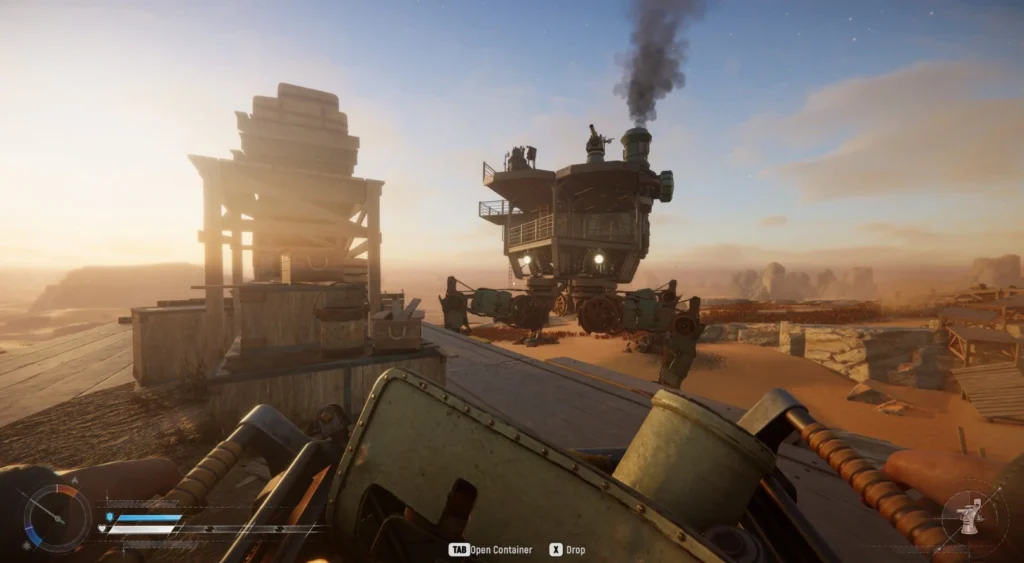
SAND: Raiders of Sophie is a first-person PVPVE extraction shooter with giant mechs. The walking giant mech is what makes this game unique from other extraction shooters. The giant mech is known as Trampler in the game, and every player gets one. Trampler is more than just a walking mech. It is your fortress and base that you control and manage throughout the raid. Players can customize their Trampler through the editor with numerous options. Moreover, better components for the Trampler can be unlocked from the Tech Tree. Acquiring these advanced parts requires Crowns and other resources you find in the raid.

Currently, SAND: Raiders of Sophie includes two game modes: Voyage Mode and Storm Dive. The Voyage Mode is the casual extraction experience with no time-limit. Players can freely join and extract as they please to gather crucial resources for upgrades. Storm Dive is where all the good stuff is, and it is more chaotic. It is more of a battle royale extraction game mode, where you have to survive the closing sandstorm while looking for loot and extract at the end of the match. This game mode can go on for like an hour and usually ends in a chaotic way, with survivors looking to gun down others.

Keeping your Trampler repaired throughout a match is crucial. Fixing the Trampler after every player or AI Trampler encounter is recommended for survival. Although there are gunfights at close range, it can be jarring with slow reload times. Moreover, limitations like carrying 2 weapons at a time can slow you down in a raid. Apart from the main game modes, there are no in-game merchants or quests to follow for lore or extra resources. A few of the crucial things that this game is missing are bosses and events.

Sound and Visuals
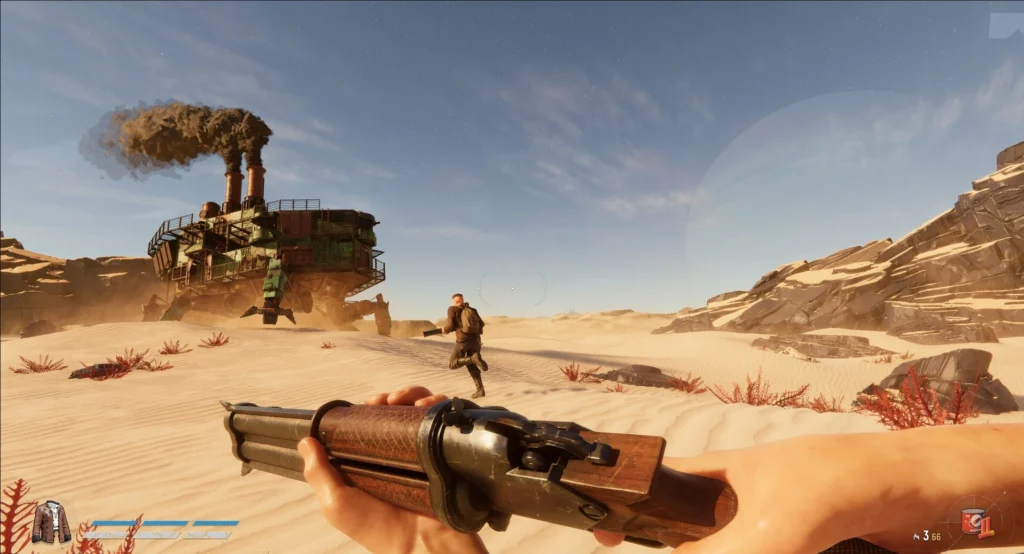
The sound quality of SAND: Raiders of Sophie is great, keeping the overall tension with eerie silence and blazing cannon shots. Moreover, the 1910s-designed firearms have great sound effects, which complement the overall environment and atmosphere. The overall visuals of SAND: Raiders of Sophie are great, highlighting the dangers of a deserted planet. The forts and ruins on planet Sophie also enhance the overall history. Other than that, the textures and combat animations are all great. However, during sandstorms and intense fights, it can cause stutters and performance issues, especially on low- and mid-tier PCs.

Verdict 7/10

SAND: Raiders of Sophie is a good and unique extraction shooter that grants a Trampler to each player. The ability to customize, control, and manage your Trampler while surviving the desert dunes on planet Sophie gives a unique taste to the whole extraction shooter genre. Although the game fulfills the overall generic rules of extraction shooters, there are still many crucial features missing at launch in Early Access. However, if you are in the mood for a unique extraction experience, SAND: Raiders of Sophie provides great value for $24.99.


Source link

Nancy Guthrie Case: Man Pleads Guilty Over Ransom Messages

    0
    Nancy Guthrie Case: Man Pleads Guilty Over Ransom Messages


    Reading Time: 2 minutes

    Even if authorities don’t seem to know who Porch Guy is or where Nancy’s remains might be, at least one aspect of this painful story is over.

    This week, a man pleaded guilty for his role in this family nightmare.

    He confessed to sending ransom demands to the Guthries.

    Though he has no apparent knowledge to help find Nancy, he won’t be prolonging their anguish any further.

    A photograph of Nancy Guthrie is seen on a sign that people can leave messages on February 26, 2026
    A photograph of Nancy Guthrie is seen on a sign that people can leave messages on February 26, 2026. (Photo Credit: Joe Raedle/Getty Images)

    He entered a guilty plea

    On Thursday, July 2, Derrick Callella pleaded guilty to transmitting a demand for ransom in interstate commerce.

    He also pleaded guilty to using a telecommunications device to abuse, threaten or harass a person.

    Callella is a resident of Hawthorne, California.

    He texted two members of Guthrie’s family on February 4 — Annie and Tommaso Cioni. For context, this was mere days after Nancy’s abduction.

    Callella also allegedly made a nine-second call to another relative.

    Obviously — now, to us — Callella was making fake ransom demands.

    He had no knowledge of the case, no access to Nancy, and could only demand payment via cryptocurrency.

    According to court records, Callella used a VOIP line to message: “Did you get the bitcoin [we’re] waiting on our end for the transaction.”

    This message came mere moments, investigators say, after the Guthrie family’s first public plea for proof of life.

    But, despite the content of his messages, Callella had no involvement with the abduction. There was no “we.” He wanted an easy payout for himself.

    Derrick Callella in his DMV photo.Derrick Callella in his DMV photo.
    On July 2, 2026, Derrick Callella entered a guilty plea. (Photo Credit: California Department of Motor Vehicles)

    The Guthries have suffered enough

    As we previously reported, the FBI determined that the ransom notes mailed to various media outlets were forgeries.

    This goes for those sent in February and for the additional note sent to TMZ in recent weeks.

    It isn’t simply that sending false messages to try to scam money out of grieving, desperate people is illegal.

    These notes — the ones in February, at least — gave the Guthrie family hope that she might be alive.

    It is now widely believed by most that Nancy died very early into her abduction. The family’s hopes of reunification with her were false.

    Callella has not yet been sentenced.

    His sentencing hearing will be in just over two months, on September 10.

    At that time, he will be ordered to 10 years of probation.

    According to court records, after entering his guilty plea, he reported to a residential addiction treatment facility.

    Reading between the lines, this appears to be a case of a troubled individual who made things worse for an already grieving family.

    We hope that rehab helps him to set his right life. Then, at least some piece of good can come from the horror story that the Guthries have now endured for half a year.


    Source link

    Here’s Why Rocky IV Is Still The Best July 4th Movie – SlashFilm

      0
      Here’s Why Rocky IV Is Still The Best July 4th Movie – SlashFilm


      Fourth of July weekend is the most purely American holiday, and it’s not exclusive to being a celebration of the adoption of the Declaration of Independence. There’s an unapologetic absurdity to Independence Day, where “freedom” and the lives lost in pursuit of it are honored by spending billions of dollars on explosives, getting sunburned for the fun of it, eating thousands of calories of charred meat, and spending hours making red, white, and blue jello molds. It’s a day where pure hedonism is encouraged without the stress of familial obligations or gift-giving, and no one is going to judge you if you chug a Pabst Blue Ribbon and smash the can on your head while wearing a Star-Spangled bikini top and cutoff jorts.

      Of course, it only works if you’re willing to ignore reality for a day. The United States turns 250 this year, and feeling patriotic has become harder than ever when every morning begins with another push notification that gives you another reason to be embarrassed to be American. Every year, movie fans start their day watching films like the alien-invasion classic “Independence Day,” Steven Spielberg’s blockbuster masterpiece “Jaws,” or Brian DePalma’s downright unforgettable “Blowout” (even if the film is set on “Liberty Day”).

      But the film that best embodies everything the Fourth of July represents — for better and for worse — is “Rocky IV.” A 90-minute movie that boasts 21-ish minutes of montage and a full-length performance by James Brown of “Living in America,” “Rocky IV” is the cinematic equivalent of chanting “USA! USA!” After Ivan Drago kills Apollo Creed mid-match, Rocky Balboa must avenge his friend and personally restore America’s honor. It’s as American as apple pie, Cold War paranoia, and the belief that one stubborn underdog can fix everything.

      Rocky IV is absolute nonsense [complimentary]

      Firing up “Rocky IV” rivals watching, slack-jawed, as fireworks explode, dazzling us with spectacle and giving us a break from The Horrors™ for at least one up look at the night sky. And it’s because it is arguably one of the greatest pieces of American propaganda ever made. Everything that makes “Rocky IV” a “bad” movie is actually what makes it great. It’s also why a holiday like July 4th absolutely rocks. And in both cases, you just can’t, uh, think too hard about it. Whether or not “Rocky IV” is a “good” movie is debatable, but it goes above and beyond in succeeding in everything it sets out to do. 

      Take the over-the-top training montages, for example: Rocky is in Siberia, chopping wood and dragging a rickshaw through the snow, and growing an ultra-masculine beard to show the passage of time and provide testosterone-driven evidence of his masculine dedication. Meanwhile, Ivan Drago, a walking Aryan wet dream, is juicing with steroids up to his eyeballs and training so hard he overpowers computerized workout trackers just short of making them all explode from his strength. This is the textbook definition of “bootstraps grit” overpowering “science from foreigners,” the same ass-backwards sentiment behind bringing back coal as an energy source instead of investing in solar or wind initiatives.

      But these so-called “bad” aspects of filmmaking — over-reliance on montage, a musical segment, a Hulk-hand-sized ham-fisted script, Paulie’s Robot — are the film’s greatest strengths. And the so-called “bad” aspects of July 4th, like eating garbage food and wearing tacky clothing, are precisely why the holiday is interesting. It’s no wonder why “The Pitt” chose the holiday for Season 2. I don’t know how you watch “Rocky IV” and walk away not feeling bricked up about America.

      Rocky IV embodies the idea of America

      An idea will never let you down, and that’s what most Americans are clinging to as the country crumbles around us. We want to believe that heroes come out on top and villains get their comeuppance. We want to believe blue-collar American grit can take down “evil Russian technology.” Rocky was never as good a fighter as Apollo Creed, but he would never give up. And THAT is the dream that we peddle to all Americans. You don’t have to be the strongest, the fastest, the smartest, or even the best; you just have to never give up. The film endures because it tells the story America has always wanted to believe about itself.

      It’s corny, it’s politically simplistic, and it’s wrapped in enough stars-and-stripes bombast to make Uncle Sam blush, but it’s also weirdly hopeful. Maybe that’s the reason the movie still works after all these years, and why it’s such a perfect watch on the Fourth of July. Deep down, nobody actually believes they can solve a geopolitical conflict by winning a boxing match, but most of us want to believe that perseverance matters and that getting back up after every punch counts for something. “Rocky IV” sells that fantasy with all the subtlety of a fireworks finale, and the Fourth of July asks us to buy into a similar dream every year: that America is always capable of becoming the version of itself it promises to be.

      For one day, we suspend our disbelief. We light the fuse, watch the sky explode in impossible colors, and cheer for the underdog one more time. Then we wake up on July 5 and get back to the hard work of trying to make the myth a little more true.


      Source link

      Bitcoin to $53K? Exchange Deposits Jump as Analysts Warn of Increased Volatility – Decrypt

      Bitcoin to K? Exchange Deposits Jump as Analysts Warn of Increased Volatility – Decrypt


      In brief

      Bitcoin deposits spiked to nearly 50,000 BTC per day in the last week, CryptoQuant said.
      The average size of deposits doubled to approximately 2 BTC, pointing to action from institutional and whale investors.
      Historically, this level of deposits has preceded sharp price volatility.

      Bitcoin deposits to centralized exchanges—often a precursor for sales—spiked in the last week as BTC fell below $60,000, according to data gathered by blockchain analytics firm CryptoQuant. 

      Deposits of the top crypto asset reached nearly 50,000 BTC a day, hitting that mark for only the fourth time thus far this year. In all other instances, it led to a significant increase in price volatility, according to the firm. 

      “The spike coincides with Bitcoin testing the critical $60K support level, which, if breached, could take Bitcoin towards $53K, the realized price,” the CryptoQuant report from Thursday reads. “At these inflow levels, the market is absorbing a large volume of Bitcoin being repositioned to exchanges, a pattern that has historically preceded significant directional moves.” 

      It wasn’t just the quantity of deposits increasing, but the size of them as well. During the period the average Bitcoin deposit approximately doubled from 1 BTC to 2 BTC, an indicator that the deposit surge is being driven by whales and institutions, not retail traders, the firm said. 


      In the past, this indicator has preceded downward price movement. 

      “Historically, a spike in average deposit size from larger entities is a more bearish signal than high inflow volume alone, as it indicates deliberate repositioning rather than routine activity,” the report notes.

      Bitcoin’s peers were not spared, with Ethereum daily inflows peaking at 1.25 million per day and other altcoin deposit transactions also jumping considerably to more than 45,000 per day. Their respective spikes further support the likelihood of a period of increased volatility for the crypto market.

      “Historically, surges in altcoin deposit transactions have marked inflection points for crypto prices and signaled increased volatility ahead,” the report notes. “This signal already played out precisely in 2026: Bitcoin’s decline from $82K in early May to below $58K in late June was preceded by a similar spike in altcoin deposits above 45K.” 

      After spending some time below $60,000, Bitcoin has rebounded moderately this week, jumping 3.5% to trade at $62,886. As it stands, BTC is now just over 50% off its October all-time high of $126,080. 

      Meanwhile, Ethereum gained nearly 12% this week to change hands at $1,787—about 64% off its all-time high of $4,946.

      Daily Debrief Newsletter

      Start every day with the top news stories right now, plus original features, a podcast, videos and more.


      Source link

      Perplexity Co-Founder: AI Safety Is an Excuse to Lock Down Frontier – Decrypt

      Perplexity Co-Founder: AI Safety Is an Excuse to Lock Down Frontier – Decrypt


      In brief

      Andy Konwinski, who cofounded Databricks and Perplexity AI, argued this week that concentrating AI power is a safety risk in itself.
      The essay followed Open Frontier, a working meeting of roughly 100 researchers in San Francisco on June 30.
      Turing Award winner Yann LeCun replied directly on X, comparing today’s closed-lab AI moment to “medieval obscurantism akin to the Ottoman empire banning the use of the printing press for 200 years.”

      Perplexity AI and Databricks co-founder Andy Konwinski thinks the AI safety conversation has a problem: It’s being used to concentrate power, not prevent harm. Earlier this week, he published an essay making his case, with Anthropic as the star witness.

      The case he builds starts with a decision Anthropic reversed in 48 hours. When Anthropic launched Claude Fable 5 on June 9, a paragraph buried in its 319-page system card disclosed that the model would silently degrade its own responses for anyone it suspected of training a competing AI.

      Researchers found it. The internet did not take it well.

      Anthropic walked it back, but for Konwinski this makes no difference when analyzing the bigger picture. “The problem isn’t that Anthropic made a bad decision,” he wrote. “The problem is that they assumed the decision was theirs to make.”

      His essay, titled “Concentration of power in AI is a risk, not a solution,” followed Open Frontier, a working meeting he convened through his nonprofit Laude Institute at San Francisco’s Exploratorium on June 30. About 100 researchers showed up.

      UC Berkeley dean Jennifer Chayes, who runs the College of Computing, Data Science, and Society, told a funding panel that Berkeley researchers are “all building on Chinese models because we don’t have a Western open frontier model”—and that the safety messaging from OpenAI and Anthropic ahead of their IPOs amounted to a “very effective fear campaign.”

      Konwinski’s argument is that centralizing access doesn’t neutralize risk; it creates a different one. AI is foundational infrastructure—in the same category as railroads, electricity, and the internet. Those technologies reorganized society around whoever controlled the underlying layer. The same is coming for AI. His alternative: a research commons with frontier-scale compute that lets top researchers reach the frontier without needing permission from a private lab to do it.

      LeCun: It’s the Ottoman empire banning the printing press

      Yann LeCun, Meta’s former chief scientist, replied to Konwinski’s essay on X with no ambiguity. “I’ve been disseminating a similar message for years,” he replied on Konwinski’s post. “The concentration of power in AI and the desire for control is by far the biggest danger of AI.”

      He also had a historical comparison ready. “It’s a kind of medieval obscurantism akin to the Ottoman empire banning the use of the printing press for 200 years, in part to keep control of the dogma, but also to protect the corporation of the calligraphers and scribes,” LeCun wrote.

      LeCun’s prediction for where this ends: “Infrastructure wants to be open. Foundation models are becoming an infrastructure and will inevitably become commoditized. Long term, the money is in the application layer.”

      LeCun left Meta in late 2025 and launched AMI Labs in Paris with $1.03 billion in seed funding in March 2026—his own answer to the question. The company runs on world models and his JEPA architecture, plans to open-source its research, and has no commercial product expected for years.

      Daily Debrief Newsletter

      Start every day with the top news stories right now, plus original features, a podcast, videos and more.


      Source link

      The Art Behind Fashion Drawing from a Live Model – University of Fashion Blog

      The Art Behind Fashion Drawing from a Live Model – University of Fashion Blog


      From University of Fashion’s lesson – Model Drawing: Non-Classic Silhouettes & Poses. (Image credit: University of Fashion)

      Fashion model drawing is often misunderstood as simply sketching what you see. In reality, it is a disciplined process of interpretation, structure, and intention. When working from a live model, you are not just copying a body—you are translating form, movement, and design into a visual language that communicates clothing.

      Understanding ProportionMapping the 9 ½ head fashion pose from UoF’s lesson Model Drawing: Fashion Proportion & MovementMapping the 9 ½ head fashion pose from UoF’s lesson Model Drawing: Fashion Proportion & Movement. (Image credit: University of Fashion)

      One of the first principles to understand is proportion. In fashion illustration, we commonly use the 9½-head figure, an elongated version of the human body that enhances elegance and emphasizes the garment. This is not about realism; it is about idealization. The extended proportions create space for design and movement, allowing the clothing to take center stage.

      Mapping the Action Line, Center Front & Balance LineMapping the action line, center front and balance line from UoF’s lesson Model Drawing: Fashion Proportion & Movement. Mapping the action line, center front and balance line from UoF’s lesson Model Drawing: Fashion Proportion & Movement. (Image credit: University of Fashion)

      From there, you begin with the action line—the visual spine of the pose. This line captures the energy and flow of the model and sets the tone for the entire drawing. Supporting this is the balance line, which ensures that your figure feels grounded, even in dynamic poses. You will also establish the center front line, a critical guide that helps you understand how the body—and therefore the garment—turns in space.

      Gesture DrawingMapping the gesture from UoF’s lesson Model Drawing: Fashion Proportion & Movement. Mapping the gesture from UoF’s lesson Model Drawing: Fashion Proportion & Movement. (Image credit: University of Fashion)

      Gesture drawing becomes your foundation. It is fast, expressive, and focused on movement rather than detail. A strong gesture captures life in just a few lines. Without it, even the most detailed rendering will feel stiff.

      Cylindrical PerspectiveMapping the cylindrical perspective from UoF’s lesson Model Drawing: Fashion Proportion & Movement. Mapping the cylindrical perspective from UoF’s lesson Model Drawing: Fashion Proportion & Movement. (Image credit: University of Fashion)

      Another essential concept is cylindrical perspective. The human body is not flat; it exists in three dimensions. Limbs, the torso, and even the neck should be understood as forms wrapping around an axis. Thinking in cylinders allows you to correctly place contours, seams, and shadows, giving your drawing depth and realism.

      Pose vs Garment SilhouetteUnderstanding pose choice based on garment silhouette from UoF’s lesson Model Drawing: Various Poses for Different Silhouettes. Understanding pose choice based on garment silhouette from UoF’s lesson Model Drawing: Various Poses for Different Silhouettes. (Image credit: University of Fashion)

      Equally important is the silhouette. The shape of the clothing—whether it clings tightly to the body or drapes loosely—dictates how the figure should be posed. This is where many beginners make a critical mistake: they choose a pose first, often inspired by a magazine image, and then try to fit their design into it. This approach rarely works.

      In fashion drawing, the design must come first. The pose is not arbitrary—it is a tool to showcase the garment.

      The Form-Fitting PoseFor a form-fitting silhouette the pose should support and reveal the contours of the body. From UoF’s lesson Model Drawing: Various Poses for Different Silhouettes.For a form-fitting silhouette the pose should support and reveal the contours of the body. From UoF’s lesson Model Drawing: Various Poses for Different Silhouettes. (Image credit: University of Fashion)

      For example, if you are designing a form-fitting outfit, the pose should support and reveal the contours of the body. A stance where the legs form a wide triangle would disrupt the line and obscure the garment’s shape.

      From UoF’s lesson Model Drawing: Pant PosesFrom UoF’s lesson Model Drawing: Pant Poses. (Image credit: University of Fashion)

      On the other hand, if you are designing wide-leg pants, that same triangular stance could enhance the volume and movement of the fabric, creating a casual and relaxed effect.

      Evening Wear & Tailored Silhouette Poses From UoF’s lesson Model Drawing: Pant Poses.From UoF’s lesson Model Drawing: Evening & Tailored Garments (Image credit: University of Fashion)

      Every decision you make—from proportion to pose—should serve the clothing. For example, an evening wear pose should be a dramatic, exaggerated pose, with an elongated neck and perhaps a back view that features a low back neckline.  The goal is not to create an interesting figure, but to create a compelling presentation of your design.

      When you begin to think this way, your drawings shift from sketches into intentional fashion illustrations. You are no longer just observing—you are designing with purpose.

      University of Fashion’s Model Drawing Lesson Seriesdrawing from a real-life model, view our entire Model Drawing lesson series.For more on drawing from a real-life model, view our entire Model Drawing lesson series, taught by Richard Rosenfeld. Richard has taught fashion illustration at Parsons and at FIT for 30+ years and is the Master!


      Source link

      Inside the Trading Engine Behind ChangeNOW’s ‘Fast, Seamless Swaps’ – Decrypt

      Inside the Trading Engine Behind ChangeNOW’s ‘Fast, Seamless Swaps’ – Decrypt


      In brief

      Crypto exchange ChangeNOW offers “fast, seamless crypto swaps with simplified onboarding.”
      The exchange’s “trading engine” acts as a middleman between users and exchanges, executing swaps from its own liquidity so customers never touch order books or fees, CSO Pauline Shangett explained.
      New features include private transfers, a Permanent Exchange Address, a crypto payment link and a prediction markets hub.

      Open ChangeNOW and a crypto swap looks like the simplest thing in the world: pick two tokens, send one, receive the other—a process the non-custodial exchange says usually completes within minutes, across more than 110 blockchains including ETH, BSC and SOL.

      It’s quick, streamlined—and, according to Chief Strategy Officer Pauline Shangett—underpinned by layers of dedicated infrastructure, supporting more than 70 fiat options and over 1,500 digital assets, with more added weekly.

      ChangeNOW is “a trading engine that a lot of people can access all at once,” Shangett said. The platform, she explained, acts as a middleman between the user and a centralized or decentralized exchange, executing trades on a client’s behalf “without the client having to watch over things like the order book, transaction fees and complicated interfaces.”

      That engine leans heavily on its own inventory. Shangett said ChangeNOW “mostly operates in our own liquidity when it comes to swaps,” pricing trades off exchange order books it sources liquidity from, market-data feeds such as CoinMarketCap, and an in-house “liquidity engine” of wallets holding balances for specific pairs. Running off its own reserves, she argued, means “network speed is not as much of a liability as it could be.”

      In a recent benchmark by swap aggregator Swapzone, drawing on 150,000 transactions, ChangeNOW’s median settlement for a USDT-to-ETH swap clocked in at under a minute, against an industry median of around 45 minutes.

      ChangeNOW CSO Pauline Shangett. Image: ChangeNOW

      Of course, such comparisons hinge on the pairs and conditions tested, with ChangeNOW offering swaps across a wide range of tokens including meme coins, AI coins, DeFi, GameFi, stablecoins, privacy coins, DePIN, and RWA.

      Fiat currency support operates through “trusted partners” including Transak, Simplex, Banxa, and Guardarian, enabling ChangeNOW users to buy crypto with Visa, MasterCard, Google Pay, Apple Pay, FasterPay, Sepa, Pix, ACH, and Revolut.

      New features

      ChangeNOW has rolled out a set of new tools that extend its offering beyond simple swaps. Private transfers route a transaction so the sender’s wallet address and on-chain trail aren’t exposed to the recipient, while still maintaining AML monitoring in the background. Users can also generate a Permanent Exchange Address that provides a fixed, reusable deposit address that automatically converts any incoming crypto into a preselected payout coin, aimed at recurring conversions.

      Meanwhile, a new crypto payment link lets users spin up a shareable link to request or accept payments in Bitcoin, stablecoins, and more than 100 other assets. And a prediction markets hub pulls popular markets across crypto, politics, finance, and pop culture into one place to track and compare.

      Push it to the limit

      Demand shocks are managed by geography. Shangett cited the 2021 Dogecoin frenzy, a Monero liquidity crunch, and the more recent TRUMP token launch as stress tests. Because the team spans time zones, it’s able to pre-position inventory, she explained. “We get extra liquidity for that particular token for when American users wake up,” she said, adding that those surges are when ChangeNOW “sets our transaction records.”

      On thinly traded or volatile pairs, Shangett said “we actively manage liquidity to ensure stability,” so the platform sometimes imposes minimum or maximum trade sizes—though when minimal amounts are required, they are “incredibly low,” running to as little as $2. When Ethereum congests, the fix is blunt—”adjusting the network fee,” which she said ChangeNOW sometimes absorbs. During chain halts, forks or hacks, “we provide real-time alerts” that swaps on networks like BNB Chain or Solana may run slow.

      The exchange is “proud” to point to its 4.6 rating on Trustpilot, based on more than 13.000 reviews, as evidence that its approach is working, while offering 24/7 support in the event of hiccups.

      That support structure includes an “L0” community team on social channels, “L1” handling chat and email tickets, escalating to L2 and then to L3 engineers “on call pretty much 24/7,” Shangett said. Emergencies trigger “an all-hands, rapid-response protocol” that activates L3 and L4 engineers—but “most of them can be solved by either our compliance department or L2 engineers.”

      Future facing

      Asked what she’s proudest of that goes unreported, Shangett named the platform’s cross-DEX bridging—”a lot cheaper and a lot faster than a traditional decentralized cross-chain bridge”—and its private transfers, which operate across both B2B and B2C transfers, as well as in the platform’s self-custody wallet, NOW Wallet.

      “We’ve always been huge privacy nuts,” she said. “It allows people to send funds to basically anybody without doxing their initial wallet address, which might be critical for legal entities or high net worth individuals, or just people who care about their privacy a lot, and we’ve seen quite a lot of use of this feature since its release.”

      Simplicity is a work in progress, with ChangeNOW constantly working to improve its offering, Shangett said. Some of that streamlining is taking place in the back end, with the exchange “upgrading our strong foundation to make it even better,” she said. The focus is on incremental improvements, she added, geared towards making the platform “a little bit faster, a little bit more optimal, a little bit safer, and more secure.”

      Daily Debrief Newsletter

      Start every day with the top news stories right now, plus original features, a podcast, videos and more.


      Source link

      Commando – 1980’s military shooter by Capcom is getting an Amiga AGA edition via JOTD [UPDATE]

      Commando – 1980’s military shooter by Capcom is getting an Amiga AGA edition via JOTD [UPDATE]


      The legend that is JOTD, who has done many conversions such as Double Dragon, Ghosts’n Goblins, and Xevious, is bringing Capcom’s classic vertical shooter Commando to the Amiga as an enhanced AGA edition. The upcoming conversion leverages the Advanced Graphics Architecture of the Amiga 1200 and 4000, hopefully bringing an arcade-faithful experience that aims to surpass previous home ports. While Elite Systems originally released a well-received ECS/OCS port for the platform back in 1989. JOTD has acknowledged that the classic Elite version remains a quality conversion, noting that the architecture of the game wasn’t overly complex to adapt, making an upgraded, arcade-accurate AGA version an enticing challenge he couldn’t pass up.

      JOTD’s updated version

      The prominent developer, renowned for high-quality arcade-to-Amiga transcodes like Double Dragon and Ghosts’n Goblins, revealed that this project marks a return to his specialized porting techniques. JOTD explained that he selected Commando specifically to kickstart his Z80 assembly-to-68000 binary conversion efforts again, utilizing the project to fine-tune and perfect his custom-built code translation tools. Just beware however, that JOTD has stated that the conversion is still in its early stages. The current software framework has visual glitches and some bugs, but early previews successfully convey the definitive direction and high potential of the final release.

      Original Version

      [UPDATE] Great news for a Saturday as JOTD has released another downloadable build with the following being said ” Playable version available (whdload/HD only)! New fixes include blocked paths and buggy scrolling titles, optimizations, awesome albeit incomplete music by IM76, and second button usage for grenade throws. Just be aware there’s missing end level music, highscores are not saved, sprites disappear too soon on the bottom and sometimes missing sprites (palm trees) in the center.

      Extra Info :

      I needed a simple yet properly coded & reversed game to test my new Z80 converter. Game was disassembled by Scott Tunstall (who also did a few other Z80 ones and which helped me a lot). It was incomplete and I completed it a little bit to be able to convert the code. I wanted to do that game not because I like it (I never played it in the arcades, or even on amiga), also not because the amiga conversion is bad (it is awesome for OCS) but it seemed fun and doable, with a hardware close from Ghosts’N’Goblins. Capcom code has good quality like Konami & Sega but unlike Namco shit, so it seemed easier to do that starting with DigDug or others.”

      And that’s all there is to say, so for now check out the beta below  

      Links 1) Download 2) Discussion


      Source link

      French Couple Loses €1.5M in Crypto to Camera-Glasses ‘Rip Deal’ Scam

      French Couple Loses €1.5M in Crypto to Camera-Glasses ‘Rip Deal’ Scam


      A wealthy couple in the Gulf of Saint-Tropez lost €1.5 million (~$1.71 million) in cryptocurrency to fraudsters who used cameras hidden in a pair of glasses to capture their account keys, French authorities say — an elaborate “rip deal” that has led to two arrests and a trial set for September.

      Wealthy couple’s attempt to sell a luxury property sparked a complex “rip deal” scam, leading to €1.5 million cryptocurrency loss

      Fraudsters used hidden cameras in glasses to capture account keys, exploiting the couple’s trust and lack of crypto security awareness

      Investigation revealed a year-long trail of deceit, with suspects traced to a rented villa, and a pattern of social-engineering fraud targeting crypto holders

      A sale that was never real

      The scheme began, according to French media reports citing investigators, with the couple’s attempt to sell a luxury property on the Côte d’Azur. A prospective buyer surfaced: a mysterious Italian who arranged to meet not on the Riviera but at a hotel in Milan, lending the transaction an air of discreet, high-value dealmaking.

      Over the course of the meetings, the “buyer,” in reality one of two fraudsters operating under false identities, persuaded the sellers that the deal required them to demonstrate liquidity through cryptocurrency. The couple was convinced to open a crypto account and deposit the €1.5 million (~$1.71 million) sum into it, a maneuver dressed up as a routine step in an unconventional but legitimate-seeming sale. It was, investigators say, the entire point of the con: getting the victims to gather a large sum in one place, under credentials the scammers could reach.

      The scheme is a known one, recognized by French police under the names “rip deal” or “fausse vente,” a fake sale. Such frauds typically target sellers of high-value assets, luring them into a bogus transaction engineered to separate them from money or, increasingly, digital assets.

      The glasses that emptied the account

      The decisive moment came at the second Milan meeting. The fraudsters told the sellers they wanted to confirm the funds were real and asked them to show that the account had genuinely been created and funded. As the couple pulled up the account, the scammers were wearing glasses fitted with concealed cameras, which they used to record the account number and its security keys.

      That was all they needed. Access to an account’s keys is, in the crypto world, access to the funds themselves, and shortly after the meeting the account was emptied. The €1.5 million (~$1.71 million) vanished in a matter of minutes. What made the theft possible was not a software exploit or a hacked exchange but old-fashioned observation, turned into a weapon by a pair of camera-equipped glasses and a victim persuaded to reveal what should never be shown.

      A year on the trail

      The victims filed a complaint with the gendarmerie, and the case was handed to the research brigade of the Gassin-Saint-Tropez company, working under the authority of the Draguignan prosecutor’s office. The investigation was, by authorities’ account, long and delicate, taking more than a year to identify the professionals behind the complex scheme.

      The suspects were eventually traced to a villa they had rented in Cavalaire-sur-Mer, on the Var coast. Domiciled in the Paris region but described as highly mobile and already known to police for fraud, the couple, both in their thirties, were arrested on June 25 in an operation involving roughly 20 gendarmes.

      Taken into custody, they denied the allegations and were subsequently placed under judicial supervision. They are due to stand trial on September 1 on charges of organized-gang fraud and failure to justify their resources. A financial investigation into their assets found that the alleged scammers owned three properties on the Côte d’Azur, worth a combined €1.9 million (~$2.17 million). As the case has not been tried, the pair are presumed innocent.

      The lesson for anyone holding crypto

      Stripped of its Riviera glamour, the case is a stark reminder of how crypto’s core security principle can be defeated without any technical sophistication at all. The keys or credentials that control a crypto account are the account; anyone who sees them, records them, or is shown them can take everything, instantly and irreversibly, in a way no bank transfer allows.

      That is precisely why they should never be displayed on a screen in front of others, entered where a camera might capture them, or shared under any pretext, however convincing the counterparty.

      The episode also fits a broader pattern of social-engineering fraud that has increasingly targeted crypto holders through deception rather than hacking, and it comes as France contends with a wider surge in crypto-related crime. Victims of such thefts should also be wary of a common follow-on trap: “recovery” operators who promise, for an upfront fee, to retrieve stolen crypto. These are almost always a second scam preying on the first, and legitimate recovery does not begin with a stranger demanding payment. For anyone approached with an unusual, high-value deal that hinges on moving money into crypto or revealing account access, the safest assumption is the one this couple learned too late: if a sale requires you to expose your keys, it was never a sale at all.


      Disclaimer: The information researched and reported by The Crypto Times is for informational purposes only and is not a substitute for professional financial advice. Investing in crypto assets involves significant risk due to market volatility. Always Do Your Own Research (DYOR) and consult with a qualified Financial Advisor before making any investment decisions.


      Source link

      Chandigarh University Uttar Pradesh Introduces 17 New-Age Academic Programs in Emerging Domains to Nurture a Futuristic Workforce | Web3Wire

      Chandigarh University Uttar Pradesh Introduces 17 New-Age Academic Programs in Emerging Domains to Nurture a Futuristic Workforce | Web3Wire


      Cutting-edge programmes across Engineering, Management, Computer Applications, Liberal Arts, Sciences, Fashion and Law aim to prepare future-ready professionals,

      CHANDIGARH, India, July 4, 2026 /PRNewswire/ — Chandigarh University Uttar Pradesh, positioned as India’s first AI-augmented multidisciplinary university, has introduced 17 new academic programmes from the 2026 academic session onward, including 5 postgraduate and 12 undergraduate courses across Engineering, Arts, Computer Applications, Sciences, Fashion, Law and Management. The expansion reflects the university’s stated focus on aligning higher education with emerging industry needs and preparing students not only for degrees, but for technology-driven careers in a rapidly changing global environment.

      Designed as a campus that seeks to reimagine learning in the age of machine intelligence, the university says the new programmes are intended to help students build future-ready skills, adapt to changing workforce requirements and access global career opportunities. The larger academic approach is built around multidisciplinary learning, AI integration and industry relevance.

      In addition to launching new programmes, Chandigarh University Uttar Pradesh has expanded its industry-linked academic offerings through collaborations with AON for MBA in Strategic HR and Deloitte for BBA (Hons.) in Business Analytics. The university has also highlighted that it is already offering multiple industry-collaborative programmes with leading Indian and global partners in emerging domains.

      New Programmes Across Key Domains

      Engineering and Technology

      To address growing demand in advanced technology and automation, the university has introduced B.Tech in Aerospace Engineering, B.Tech in Robotics and Automation, and B.Tech (Hons.) CSE in IoT and AI. These programmes are designed to expose students to areas such as artificial intelligence, automation, robotics, smart systems and next-generation technologies.

      The Aerospace Engineering curriculum is designed to include advanced themes such as machine learning, deep learning and digital twins, while integrating mechanical, electrical, electronics and computer engineering to support the development of smart machines and automated systems. The B.Tech (Hons.) CSE programme in IoT and AI is aimed at building capabilities in interconnected systems, data analytics, embedded systems and Industry 4.0 applications. The M.Tech in Computer Science and Engineering (Data Science) is intended to strengthen advanced skills in big data, machine learning, predictive modelling and applied data analysis.

      Management and Business

      The university has also introduced an MBA in Human Resources with a focus on developing professionals who can align people strategy with organisational goals and respond to evolving workplace challenges. The programme is designed to emphasise experiential learning, industry engagement and practical exposure to tools such as R, SQL, Python and Tableau, while familiarising students with AI-driven business applications.

      Computer Applications and AI

      In response to rising demand for digital and AI-enabled careers, Chandigarh University Uttar Pradesh has launched BCA in AI and Machine Learning and MCA in Data Science. These programmes are positioned around machine learning, data analytics, cloud technologies, full-stack programming and AI applications, with exposure to tools and frameworks such as Python, TensorFlow and PyTorch. The MCA in Data Science is intended to combine conceptual depth with practical learning through datasets, live projects, analytics training, research and innovation exposure.

      Liberal Arts and Psychology

      The newly introduced BA (Hons.) Liberal Arts and BA (Hons.) Psychology programmes are aimed at strengthening critical thinking, communication, behavioural understanding and social awareness. The Liberal Arts curriculum is intended to support human-centred thinking in an AI-enhanced environment, while the Psychology programme is designed to cover areas such as clinical psychology, developmental psychology, neuropsychology and counselling, alongside contemporary themes including social media psychology, AI and psychology, and cyber psychology.

      Hospitality, Aviation and Hotel Management

      The university has also expanded into service-sector education with B.Sc. programmes in Hospitality and Hotel Management and Airlines and Airport Management. These programmes are designed to prepare students for opportunities in hospitality, customer service, travel, aviation and airport operations through practical and industry-oriented learning.

      Science and Research

      Recognising growing opportunities in research and health sciences, Chandigarh University Uttar Pradesh has introduced B.Sc. Microbiology and M.Sc. Biotechnology. The Biotechnology programme is positioned as a research-focused postgraduate course with emphasis on genomics, molecular biology, bioprocess technology and bioinformatics, while the Microbiology curriculum is designed to connect core scientific learning with practical application.

      Legal Studies

      To strengthen advanced legal education, the university has introduced a one-year LL.M. programme with specialisation pathways in constitutional law, business law, criminal law and human rights. The programme is intended to prepare graduates for roles in legal practice, academia, judiciary-related work, corporate advisory and policymaking.

      Broader Academic Vision

      Through these 17 newly introduced programmes, Chandigarh University Uttar Pradesh is seeking to position education as more than a degree-granting exercise. The broader institutional objective is to connect academic learning with employability, technology adoption, industry exposure and global readiness. In an environment where employers increasingly value adaptability, digital fluency and practical capability, such programme expansion reflects the growing shift toward future-oriented higher education.

      Jai Inder Sandhu, Managing Director Chandigarh University Uttar Pradesh said, “After getting over whelming response in first academic year itself, India’s first AI-Augmented Multidisciplinary University, Chandigarh University Uttar Pradesh has introduced 17 new academic programs from 2026 academic session, This New age industry aligned programs would be instrumental in nurturing future ready workforce in Emerging domains.”

      The launch of these programmes reflects a larger attempt to align higher education with the realities of an economy increasingly shaped by artificial intelligence, data, automation and multidisciplinary problem-solving. By expanding options across technology, management, sciences, humanities and law, the university aims to create a wider talent base for emerging industries in India and beyond.

      About Chandigarh University Uttar Pradesh (Lucknow)

      Envisioned to foster a culture of sustainability and empower future global leaders, Chandigarh University, Uttar Pradesh, immerses 21st-century learners in a personalised and experiential learning experience, integrating an AI-powered academic model and a multidimensional, futuristic perspective on education. Our Uttar Pradesh campus carries forward the venerable legacy of more than a decade of Chandigarh University, Punjab, which has established itself as India’s No. 1 Private University and a torchbearer of groundbreaking pedagogy and research-driven innovation. The AI-augmented new campus offers a broad spectrum of industry-driven futuristic academic programs encompassing data-driven insights, virtual reality experiences, real-world simulations, corporate mentorship, international perspective, interdisciplinary research, cultivation of entrepreneurial spirit, and professional competencies.

      Website address: https://www.culko.in/

      Photo: https://web3wire.org/wp-content/uploads/2026/07/Chandigarh_University_Lucknow_Campus.jpg

      View original content to download multimedia:https://www.prnewswire.com/in/news-releases/chandigarh-university-uttar-pradesh-introduces-17-new-age-academic-programs-in-emerging-domains-to-nurture-a-futuristic-workforce-302817878.html


      Source link

      Popular Posts

      My Favorites

      What Are Arcade Games & More

      0
      Arcade games hold today a unique and lasting appeal. These quick and engaging experiences evoke nostalgia in players while also introducing newbies to...