Home Blog Page 69

Vanguard Seeks Digital Assets Chief After Years of Crypto Caution – NFT Plazas

Vanguard Seeks Digital Assets Chief After Years of Crypto Caution – NFT Plazas


Vanguard has opened its first-ever search for a Head of Digital Assets, a senior hire that would put a single executive in charge of the roughly $12 trillion asset manager’s strategy for cryptocurrencies and blockchain-based finance. The move signals a gradual but notable shift in Vanguard’s stance on digital assets, following its recent decision to allow trading of crypto ETFs and mutual funds while still declining to launch its own crypto products.

What the role covers

According to the job posting, the firm is seeking a Head of Digital Assets in the United States to lead “digital assets strategy, roadmap, and enterprise execution” across Vanguard Personal Wealth. The successful candidate is expected to serve as Vanguard’s senior subject matter expert for digital assets across that division, tasked with building a multi-year roadmap and defining how the firm implements digital asset capabilities, products, and operating models. The posting, based in Dallas, calls for the executive to lead execution across product, technology, operations, legal and compliance teams, while also advising senior leadership on shifts in digital asset markets and representing Vanguard with regulators and industry groups.

Vanguard says the person in the role will determine how the firm participates in digital assets, covering everything from product evaluation and tokenization initiatives to custody models, blockchain settlement considerations, and the operating infrastructure needed to support such efforts. Rather than pointing toward a specific fund launch, the mandate spans much of the digital-asset stack — tokenization, stablecoins, wallets and custody, blockchain-enabled settlement, and broader operating models — with the new executive expected to weigh whether Vanguard should build these capabilities internally, partner with outside firms, or hold off entirely.

Vanguard Seeks Digital Assets Chief After Years of Crypto Caution

Vanguard Seeks Digital Assets Chief After Years of Crypto Caution

Years of public resistance

The hire stands out because of how firmly Vanguard has historically opposed crypto exposure. The firm has described Bitcoin as an “immature asset class” ill-suited to long-term investors, and it was one of the only major asset managers to decline offering a spot Bitcoin ETF after the products won U.S. approval in 2024, even as BlackRock, Fidelity and Franklin Templeton built large crypto ETF businesses. In 2024, Vanguard stated it had “no plans to offer Vanguard Bitcoin ETFs or other crypto-related products,” explaining that “cryptocurrencies’ high volatility runs counter to our goal of helping investors generate positive real returns over the long term.”

CEO Salim Ramji, who joined Vanguard from BlackRock in mid-2024 after running the iShares business behind the industry-leading iShares Bitcoin ETF (IBIT), reinforced that stance before formally taking over, telling Barron’s that Vanguard’s decision not to offer its own bitcoin ETF was “entirely consistent” with its investment philosophy and that consistency in a firm’s product lineup mattered.

That posture began softening in December 2025, when Vanguard announced it would allow trading of mutual funds and ETFs that primarily invest in crypto on its brokerage platform, with the firm’s head of brokerage and investments, Andrew Kadjeski, noting that “cryptocurrency ETFs and mutual funds have been tested through periods of market volatility, performing as designed while maintaining liquidity.” 

The contrast wasn’t lost on industry watchers. ETF analyst Nate Geraci noted on X that Vanguard had once blocked clients from buying spot Bitcoin and Ether ETFs on its brokerage platform, adding simply, “Life moves pretty fast.”

Crypto ETF Net Flow (Source: Coinglass)Crypto ETF Net Flow (Source: Coinglass)

Crypto ETF Net Flow (Source: Coinglass)

A broader industry pattern

Vanguard’s move follows similar hiring by its largest rival. In December 2025, BlackRock opened a search for seven digital asset positions — six based in the U.S. and one in Singapore — as it continues deepening its footprint in crypto, with its own IBIT fund now holding roughly $46.7 billion in net assets.

The tokenization push extends well beyond the two giants. Franklin Templeton and Ondo Finance have launched tokenized ETFs built for round-the-clock trading through crypto wallets outside the U.S., Franklin Templeton has expanded its BENJI tokenized money market fund with new distribution through MoonPay Trade, and State Street has introduced a stablecoin reserve money market fund alongside a tokenized liquidity product for on-chain cash management.

Market data underscores why asset managers are paying attention. Figures from RWA.xyz put the tokenized real-world asset market at roughly $30.87 billion in distributed value, including about $14.86 billion in tokenized U.S. Treasuries — a segment where BlackRock, Franklin Templeton, WisdomTree, Ondo Finance and Fidelity-linked products are already competing.

Demand for crypto ETFs themselves has also proven resilient. U.S. spot Bitcoin ETFs held $74.37 billion in net assets as of July 2, and inflows returned with $221.72 million after a 10-day outflow streak, pushing total net assets to roughly $77.32 billion. Competition among issuers has separately pushed some Bitcoin ETF expense ratios as low as 0.14%.

No product commitment — yet

Despite the scope of the new role, Vanguard has not said it plans to launch its own crypto ETF or tokenized fund. Instead, the posting suggests the firm wants a senior executive to methodically study product design, risk controls, custody arrangements, servicing, pricing and client education before committing to any specific offering. For a firm long defined by caution toward speculative assets, the creation of a leadership role dedicated to digital assets — rather than another narrow ETF-distribution decision — is itself the headline: institutions of Vanguard’s scale generally don’t build out senior strategy functions for categories they intend to keep ignoring.


Source link

SEC Unveils 2026 Crypto Rulemaking Agenda, Targets Exchanges and Broker-Dealers – NFT Plazas

    0
    SEC Unveils 2026 Crypto Rulemaking Agenda, Targets Exchanges and Broker-Dealers – NFT Plazas


    The U.S. Securities and Exchange Commission has placed cryptocurrency regulation among its top priorities for 2026, releasing a regulatory agenda that lays out plans to rewrite key rules governing exchanges, broker-dealers, and digital asset custody.

    Agenda Signals Broad Shift in Crypto Oversight

    The SEC released its 2026 Regulatory Agenda on Tuesday, which spans proposed changes ranging from reducing compliance burdens for emerging companies to allowing semi-annual reporting, with crypto standing out as one of the agency’s biggest regulatory priorities. The agenda includes three distinct proposed rule changes: one addressing crypto broker-dealers, another concerning digital assets traded on alternative trading systems and national securities exchanges, and a third exploring potential exemptions and safe harbors for digital assets.

    Broker-Dealer Rules Under Review

    The SEC is considering amending a rule requiring brokers to maintain a minimum amount of liquid capital, along with a separate rule designed to protect customer assets if a broker becomes insolvent. The agency is also seeking to modify recordkeeping rules for broker-dealers, with all three changes aimed at addressing how these rules apply to crypto assets. According to reporting from Crypto Briefing, the centerpiece of the agenda is a set of proposed amendments filed under RIN 3235-AN48, targeting the financial responsibility, recordkeeping, and reporting rules that govern broker-dealers handling crypto assets.

    SEC plans crypto rule changes for exchanges and broker dealers in 2026 regulatory agenda

    SEC plans crypto rule changes for exchanges and broker dealers in 2026 regulatory agenda

    Exchange and Trading Platform Changes

    Beyond broker-dealers, the agenda also contemplates changes to rules governing crypto trading on alternative trading systems and national securities exchanges, with custody standards also on the table. The SEC framed the proposal as necessary to help clarify the regulatory framework for crypto assets and provide greater certainty to the market, particularly by establishing clear rules for the issuance, custody, and trading of crypto assets while continuing to discourage bad actors from violating the law.

    Coverage from crypto.news noted that the SEC’s Agency Rule List shows the commission considering separate rulemaking projects covering crypto assets broadly, crypto broker-dealers specifically, and crypto market structure overall. 

    A Deliberate Departure From the Gensler Era

    Over the past year since SEC Chair Paul Atkins took the helm, the agency has adopted a friendlier approach to crypto, taking the overarching position that clearer rules are needed, including through more tailored rules and exemptions. This marks a significant departure from the tenure of former SEC Chair Gary Gensler, during which the agency took a more cautious stance, pursued enforcement actions against several major crypto firms, and maintained that many cryptocurrencies qualified as securities — an approach that drew criticism from industry participants and lawmakers who argued the SEC relied too heavily on regulation through enforcement. Many of those enforcement cases have since been dropped.

    Cointelegraph reported that SEC Chair Paul Atkins said the 2026 agenda was intended to align with the Trump administration’s policy goals on crypto, including clarification on tokenized securities and capital raising with digital assets. However, the outlet also noted that the SEC’s approach under Trump and Atkins has drawn accusations from critics of a “pay-to-play scheme,” with Democratic lawmakers alleging in a January letter that Trump and his associates financially benefited from companies — including Binance, Coinbase, Ripple Labs, and Kraken — that had previously faced enforcement actions later dropped by the agency.

    Safe Harbors and Exemptions on the Horizon

    One of the more closely watched elements of the agenda is the prospect of new exemptions. In March, the SEC joined the Commodity Futures Trading Commission in releasing guidance asserting that most cryptocurrencies are not securities, while also outlining when a digital asset would cease to be classified as a security.

    Separately, guidance from the SEC’s Division of Trading and Markets has already begun reshaping broker-dealer practice around crypto. In May 2025, the division released FAQ-style guidance clarifying that broker-dealers may custody non-security crypto assets, treat crypto asset securities as held at a permissible control location, conduct non-security crypto businesses, hold crypto assets as proprietary positions for net capital purposes subject to applicable haircuts, and engage in in-kind creations and redemptions for spot crypto exchange-traded products.

    Legislative Backdrop

    The SEC’s rulemaking push is unfolding alongside ongoing congressional efforts. The CLARITY Act awaits a Senate vote as lawmakers work to reconcile competing versions before an August 7 deadline. Reporting from Grafa noted that the SEC said the changes are intended to provide greater regulatory certainty while Congress considers broader cryptocurrency market legislation.

    What Comes Next

    The proposals remain at an early stage. None of the rule changes have been formally published in text form, and public comment periods have not yet opened. Market participants — from exchanges and broker-dealers to early-stage token issuers — are expected to watch closely for the release of proposed rule text, which will determine the actual scope of new compliance obligations. Given the SEC’s stated intent to move away from “regulation by enforcement” toward defined rulemaking, the coming months are likely to bring the clearest picture yet of how U.S. securities law will formally treat digital assets.


    Source link

    Big Brother 28: First HOH Winner & Nominations & Three New Houseguests Revealed

      0
      Big Brother 28: First HOH Winner & Nominations & Three New Houseguests Revealed


      Big Brother Season 28 kicks off Thursday, and we supposedly got the full cast announcement from Julie Chen Moonves on the weirdly named YouTube Broveal, but doing the math, it was easy to see that that was not the end of it.

      Clearly, 14 house guests is way too few. Starting with Big Brother 14 back in 2012, there’s always been 16 or 17 house guests to start with. So, obviously doing the math there are at least two confirmed additions, but now we know there are three on top of the newbies.

      Plus, it looks like they’re taking this time trip thing seriously because reportedly there’s already an HOH and nominees. Let’s catch up on what is happening in the BB28 house because game play is underway.

      Big Brother 28: Who is Playing in Summer 2026?

      First, let’s talk about who all is playing. We got 13 younger players and one older player from the Broveal. 57-year-old outlier LaTrice “Lala” Verrett is pushing 60. And she looks good. I want to know her skincare regimen.

      On the other end of the scale is Drew Campbell, the 22-year-old dental surgical assistant guy. I love that he talked about being good with people and chatting while the oral surgeon is working on them. You ever try talking at the dentist office with a dam in your mouth?

      Then there’s the guy giving Weird Al Yankovic vibes. That’s Barrett Pfeiffer, the jumbotron engineer, AKA  an AV nerd on steroids. Then there’s Rocket scientist Mallory Aurichio in her big glasses and red t-shirt looking like someone from The Big Bang Theory.

      But on her Insta, she’s a partying sorority chick. She’s more likely to be showing her booty in a thong than dressed like they had her in that broveal. It’s production nonsense.

      BB 28: More New Players on the Roster

      We also have corporate game show host Melody Morris. She’s actually a graduate from journalism school. But she works at one of those places where you can go play a simulated game show. There’s one on the boardwalk near me. They’re cute. She works for the brand Game Show Battle.

      We also have Lyric Medeiros, the lawyer, who’s going to lie and say she’s a singer for tourists. Then we have Kamu Kirk, the MMA dude and Jason de Puy, the drag queen. By the way, the Broveal thing that CBS did seems to be a hat tip to RuPaul’s Drag Race that also announces their cast on YouTube on a live stream reveal called the “Ruveal”.

      Chuk Anyanwu, the cute cowboy from Dallas is interesting. He went to Texas Women’s University which despite the name is co-ed. I have much higher hopes for Chuk than Big Brother 27‘s creeper cowboy Riley. We’ve also got Ashley Trail the bartender.

      There’s Haley Thogmartin the telemedicine chick and Rome Seymour, pickle ball coach. I enjoy pickle ball, but would never hire a coach. I can figure out how to hit a whiffle ball on my own thanks.

      Taylor Brown is a school counselor from Deerfield Beach. It’s a nice area by Boca Raton. I like her vibe. And Yash Patel from Jersey is hoping to go home with a wife. It felt like almost everybody they cast is looking for a showmance.

      Big Brother 28: A Few Familiar Faces from CBS Shows

      Okay, so those are the newbies. Then we’re getting one Big Brother alum and two Survivor alums. On the plus side, the Big Brother returning player is not Paul Abrahamian. Instead, it’s the charcuterie queen herself, Angela Murray. Hope they waterproofed the Diary Room in preparation for her deluge of tears.

      And from Survivor, we got two coming fresh off Survivor 50. One is Rick Devens. He’s fun. If you don’t watch Survivor, he pulled a baller move in the recent season hiding a fake community idol near the fire pit at the tribal council set.

      And then a couple of tribal councils later, Devens was about to be voted out, and faked like he found it from a clue. He also risked his game on the Mr. Beast twist. He flipped a coin that risked his ejection but instead, he doubled the Survivor 50 winners pot to 2 million bucks.

      The other Survivor alum we’ve heard is playing is Dee Valladares. She won Survivor 45 and played Survivor 50, but was ousted without a win. Dee has also played on The Challenge. She’s a good physical competitor.

      Dee’s 29, Rick is 42, and Angela is 53. So, that brings us to three middle-aged players, a couple in their 30s, and the bulk of the house guests in their 20s, all looking to get lucky in the house. So, this could be the showmanciest season we’ve ever had of Big Brother.

      Big Brother 28: Players Living Room
      Big Brother 28: Players Living Room

      Major Changes and Shakeups on BB28

      Now, let’s talk about some things they’re changing up. Usually, we get photos and bios ahead, but this Broveal was something new. And Julie Chen did say they’re shaking up things. We’ll see the milestone 1,000th episode soon. They’re at 975 episodes going into the season.

      And with 90-minute episodes on Wednesdays throughout the season, there is plenty to see in BB28. The debut on Thursday, July 9th is also 90 minutes. Unlocked is back this Friday with Jerry O’Connell as a regular.

      The Big Brother Blockbuster is back in play again in BB28. And it looks like the houseguests are already inside and playing the game. So, Thursday’s episode will be pre-taped material since the move-in that already happened.

      Unlocked on Friday is supposed to dive into the Survivor Castaway reveals and the Big Brother alum playing the game. And the live feeds are up Friday night right after Unlocked. There are some fan voting features that affect gameplay that CBS is clearly using to drive viewers to this bonus content.

      Big Brother 28: HOH and Nominees Already Locked?

      They’re also using YouTube more heavily this season with free but limited post-show live feeds access. Just enough to drive people to subscribe to Paramount Plus. As for some early leaked info, take what I’m about to say with a grain of salt.

      Supposedly, the first HOH and nominees may already be locked in. Word is that Mallory Aurichio, the sorority party girl/rocket scientist, is the first HOH winner. And the chatter is that she nominated MMA fighter Kamu Kirk and pickle baller Rome Seymour.

      The HOH and nominations stuff is somewhat speculative, but hey, I like sharing leaks, so do with that what you will. Don’t miss the BB28 premiere on Thursday! Wouldn’t be summer without Big Brother.


      Source link

      Jimmy Tatro Reportedly Eyed to Play Gorilla Grodd in DC’s Jimmy Olsen Spinoff Series

        0
        Jimmy Tatro Reportedly Eyed to Play Gorilla Grodd in DC’s Jimmy Olsen Spinoff Series


        Rumors surrounding the DC Universe’s next Batman have exploded across social media, with multiple insiders claiming that Tom Brittney has been cast as the Dark Knight for DC Studios’ upcoming The Brave and the Bold.

        While nothing has been officially confirmed by James Gunn, the speculation gained momentum after well-known scooper MyTimeToShineHello simply posted, “It’s true, it’s Tom,” leading fans to connect the dots to Brittney. Several entertainment outlets have since echoed the rumor, although none have been able to verify it through DC Studios.

        For fans unfamiliar with Brittney, the English actor is best known for his starring role in Grantchester. He was also reportedly one of the finalists to play Superman before David Corenswet ultimately landed the role, making him someone already familiar to DC Studios during the casting process.

        Interestingly, James Gunn previously praised Brittney’s acting ability after seeing fan artwork imagining him as Batman, calling him “a great actor.” While that comment fueled fan speculation, Gunn has repeatedly stated that DC Studios will not officially cast Batman until the script for The Brave and the Bold is where they want it to be.

        At this point, it’s important to stress that this remains nothing more than a rumor. DC Studios has not announced its Batman, and neither Gunn nor co-head Peter Safran has confirmed Brittney’s involvement in the DCU.

        Still, if the reports prove accurate, Brittney would become the first actor to portray the DCU’s version of Bruce Wayne, separate from Robert Pattinson’s Batman, who continues to headline Matt Reeves’ standalone Elseworlds franchise.

        Until an official announcement arrives, fans should treat the reports with caution. However, the growing buzz has certainly made Tom Brittney one of the most talked-about names in the race to wear the cape and cowl.


        Source link

        Celeb Pregnancy Announcements of 2026: Little Mix Singer Leigh-Anne Pinnock and More

          0
          Celeb Pregnancy Announcements of 2026: Little Mix Singer Leigh-Anne Pinnock and More


          Source link

          Here’s where you’ve seen Coronation Street newcomer Ross actor Ian Burfield before

            0
            Here’s where you’ve seen Coronation Street newcomer Ross actor Ian Burfield before


            Coronation Street introduced a new face during Wednesday night’s episode (July 8), but there’s a good chance viewers recognised the actor straight away.

            As Cassie tried to put Steve’s rejection behind her with a trip to the Chariot Square Hotel bar, she found herself chatting up a stranger. It wasn’t long before she discovered the man was Ross, Tyrone’s biological father, played by familiar soap actor Ian Burfield.

            Cassie flirted with a stranger (Credit: ITV)

            Cassie flirts with Ross in Coronation Street

            Cassie was left heartbroken earlier this week when Steve turned down her marriage proposal. Although he assured her he loved her, he explained that he didn’t believe they needed to get married to prove it.

            Already devastated by the rejection, Cassie then had to deal with Tracy, who had overheard the awkward exchange and couldn’t resist making her feelings known.

            Convinced her relationship with Steve had reached the end of the road, Cassie headed to the Chariot Square Hotel bar in tonight’s episode to drown her sorrows.

            There, she spotted a stranger and wasted no time trying to flirt with him, completely misreading the situation. Ross rejected her advances before walking away, leaving Cassie Plummer staring at a piece of paper with his name written on it.

            As soon as she realised the stranger was called Ross, everything clicked into place. She worked out that he was actually Tyrone’s biological father.

            Coronation Street's Cassie, Tyrone and Ross talking in Speed Daal
            Do you recognise actor Ian Burfield? (Credit: ITV)

            Coronation Street spoilers reveal Tyrone’s first meeting with dad Ross

            Ross’s arrival comes after Hope and Ruby secretly arranged a DNA test and tracked down Tyrone’s biological father as a surprise.

            Spoilers reveal Cassie returns to Weatherfield hoping to avoid any more drama while Steve looks ahead to a fresh start. But things quickly take another turn when Hope and Ruby announce they’ve found Tyrone’s dad, with Ross then making an unexpected appearance.

            Cassie attempts to keep Ross at a distance, but Tyrone is keen to get to know his father. Their first golf outing, however, ends badly after Tyrone puts his back out.

            Bernie later realises Cassie is keeping something from everyone. After Cassie admits she’s being blackmailed, Bernie urges her to stop running away from the truth.

            The situation becomes even more complicated when Ross starts growing close to Tracy, leaving Cassie horrified. Despite warnings from Cassie, Tyrone and Hope, Ross is determined to make his own decisions.

            As more secrets begin to surface, Tyrone starts to suspect there’s something going on involving Cassie and Steve. That eventually leads him to make a shocking discovery, and with nowhere left to turn, Cassie decides it’s finally time to tell Steve the truth.

            Where you’ve seen Coronation Street newcomer Ian Burfield before

            Although this marks Ian Burfield’s first role in Coronation Street, soap fans are likely to recognise him from EastEnders.

            Between 1997 and 2025, Ian appeared in Walford as several different police officers, including D.C.I Peter Arthurs, D.I Kelly and D.I Hamilton.

            More recently, he played a key part in The Six storyline and Keanu’s murder investigation.

            Away from Albert Square, Ian has also appeared in The Hack, Big Boys, Doctors, Casualty and Holby City.

            His most recent television role was as John Bailey-Brown in Hijack, where he appeared between 2023 and 2026.

            Read more: Coronation Street opinion: Soap losing balance as villains dominate

            Coronation Street usually airs Monday-Friday at 8.30pm on ITV.

            What do you think about this story? Let us know by leaving a comment on our Facebook page @CoronationStreetInsider. We want to hear your thoughts!


            Source link

            Charles Barkley Turned Down an Invitation to Taylor Swift’s ‘Crap Show’ Wedding

              0
              Charles Barkley Turned Down an Invitation to Taylor Swift’s ‘Crap Show’ Wedding


              Reading Time: 2 minutes

              Charles Barkley has never been one to mince words.

              So when the basketball legend opened up about his decision to skip Taylor Swift and Travis Kelce’s wedding, he made it clear that he thought the event would be a total nightmare.

              Yes, it seems that Chuck is more of an introvert than we thought.

              Charles Barkley attends the Warner Bros. Discovery Upfront 2024 on May 15, 2024 in New York City.
              Charles Barkley attends the Warner Bros. Discovery Upfront 2024 on May 15, 2024 in New York City. (Photo by Mike Coppola/Getty Images for Warner Bros. Discovery)

              During an appearance on the “Unfiltered with Ricky Bo & Bill Colarulo” podcast, Barkley revealed that he was invited to the star-studded celebration but ultimately declined the offer.

              “I don’t go to weddings or funerals,” Barkley said.

              “But I did get an invite, and I politely declined because I thought it was going to be a crap show.”

              Despite skipping the festivities, Barkley made it clear there are no hard feelings between him and the newlyweds.

              “I love Travis and Jason, and I’ve only met Taylor one time,” he continued.

              “But yeah, I did get an invite. But I said, that’s just too much. I just want to hang out and play golf, and I don’t want to dress up and all that other stuff. But I appreciate the invitation; it was pretty special.”

              Barkley’s comments came after co-host Bill Colarulo assumed he hadn’t been invited to the lavish event, given that his name wasn’t among the many celebrities spotted at the wedding.

              Instead, the Hall of Famer revealed that the lack of an invite was never the issue. He simply wasn’t interested.

              The July 3 ceremony drew an estimated 1,000 guests and featured an A-list crowd that included sports stars, actors, musicians, and television personalities. The event has been widely described as one of the biggest celebrity weddings in recent memory.

              Barkley, however, preferred a much quieter holiday weekend.

              Rather than spend hours navigating a massive celebrity-filled event, the longtime broadcaster said he’d rather be on the golf course than wearing formal attire.

              Considering Barkley’s famously unfiltered personality, his explanation probably won’t surprise fans.

              He’s never been one to sugarcoat his opinions, and this time was no different.

              Even so, he emphasized that he appreciated receiving an invitation from Kelce and Swift and described it as “pretty special.”

              It just wasn’t special enough to get him into a suit. Honestly, valid.


              Source link

              Kylie Jenner’s KHY x Frankies Bikinis Fever Dream

              Kylie Jenner’s KHY x Frankies Bikinis Fever Dream


              Kylie Jenner is back in swim mode. Her fashion label KHY has reunited with Frankies Bikinis for Fever Dream, a new swimwear capsule co-designed with Frankies founder Francesca Aiello. The collection launches July 14 at 9 a.m. PT through KHY and Frankies Bikinis.

              The second KHY x Frankies Bikinis collaboration arrives with a sharper point of view than a standard summer drop. It is glossy, nostalgic and unmistakably Los Angeles, pulling from vintage swimwear, Old Hollywood glamour and the kind of poolside styling that has long fueled Jenner’s visual language.

              A Los Angeles Fantasy, Cut for Summer

              Fever Dream builds on the success of the first KHY x Frankies Bikinis release, while giving the partnership a warmer, more cinematic feel. Jenner and Aiello drew from their shared hometown of Los Angeles, looking to personal vintage references and the easy drama of California dressing.

              The mood sits somewhere between Malibu hillside and Hollywood screen test. The campaign, photographed by Daniel Saxon, places Jenner in sunlit interiors and water-soaked scenes that feel polished without losing the heat of a summer swim story.

              Inside the Collection

              Frankies Bikinis’ Cloud Cups return in new colors and prints, including the Cherish and Camila tops. The collection also includes string triangle tops, cheeky bottoms, low-waisted swim shorts and one-pieces, giving the capsule a full resort wardrobe feel rather than a simple bikini release.

              The prints carry much of the attitude. Leopard, cobra and camo appear alongside soft pink, black and chrome-accented finishes. Ruched details and sculpted shapes keep the silhouettes feminine, while the bolder patterns give the line its editorial edge.

              Why This Collaboration Works

              KHY has been most compelling when Jenner treats the brand as a curated fashion platform. Pairing with Frankies Bikinis gives the line real swimwear credibility, while Frankies gains the global reach and cultural heat that Jenner brings to a launch.

              Aiello’s brand has long understood the California bikini as both garment and lifestyle signal. With KHY, that language gets amplified into a broader fashion moment, built for vacation wardrobes, social feeds and the increasingly blurred line between swimwear and ready-to-wear.

              The Pursuitist Take

              Fever Dream has the right summer ingredients: flattering cuts, vintage references, bold prints and a campaign that sells the fantasy cleanly. It feels made for Malibu, St. Barts, Mykonos or the Amalfi Coast, but still casual enough for a long weekend by the pool.

              Kylie Jenner’s KHY x Frankies Bikinis

              For Jenner, the collection continues KHY’s move into sharper, collaboration-led fashion. For Frankies Bikinis, it reinforces the brand’s position as one of the defining names in contemporary California swim. For shoppers, it is a polished, photogenic resort drop arriving exactly when summer dressing starts to get serious.

              Launch date: July 14 at 9 a.m. PT

              Where to buy: KHY.com and FrankiesBikinis.com

              Campaign credit: KHY x Frankies Bikinis, photographed by Daniel Saxon.

              BECOME A PURSUITIST VIP!

              Sign up for our Free Insider Enewsletter. Get exclusive access. No ads, ever!Rated ⭐⭐⭐⭐⭐ from Forbes, The New York Times & The Wall Street Journal.

              Avatar photo

              Christopher Parr

              Christopher Parr, is the Editor and Chief Content Creator for Pursuitist, and a contributing writer to USA Today, Business Insider — and the on-air host of Travel Tuesday on Live at 4 CBS. He is an award-winning luxury marketing veteran, writer, a frequent speaker at luxury and interactive marketing conferences and a pioneer in web publishing. Named a “Top 10 Luxury Travel Blogger” by USA Today, Parr has also been selected as the official winner in Luxury Lifestyle Awards’ list of the “Top 50 Best Luxury Influencers and Bloggers in the World.”


              Source link

              Bitcoin Stalls as Ethereum Flashes Worst Weekly Signal in Years: Analysis – Decrypt

              Bitcoin Stalls as Ethereum Flashes Worst Weekly Signal in Years: Analysis – Decrypt


              In brief

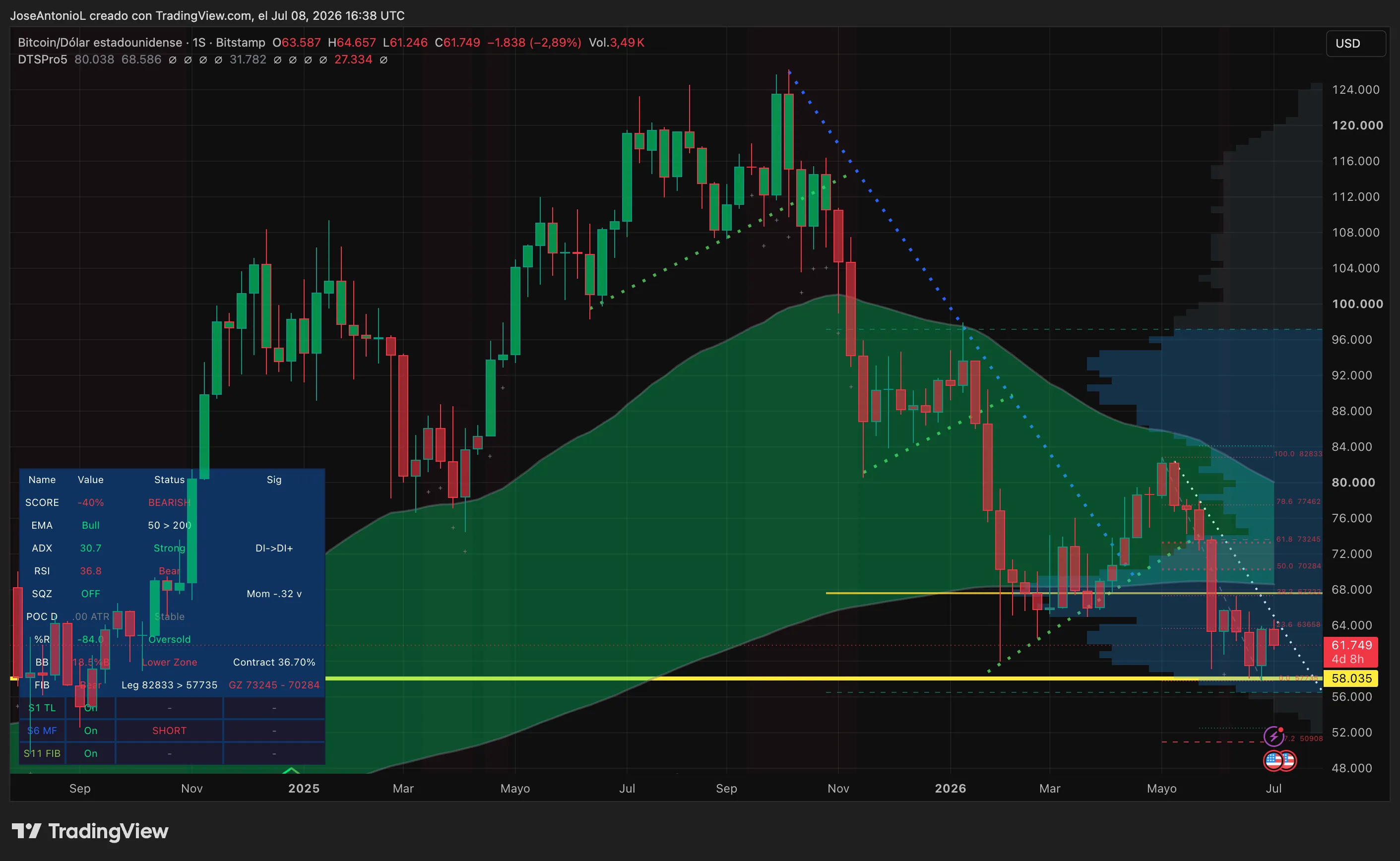
              Bitcoin fell 2.89% this week, closing at $61,749 after failing to break resistance in the $64–65K range—the key zone bulls needed to reclaim to change the short-term narrative.
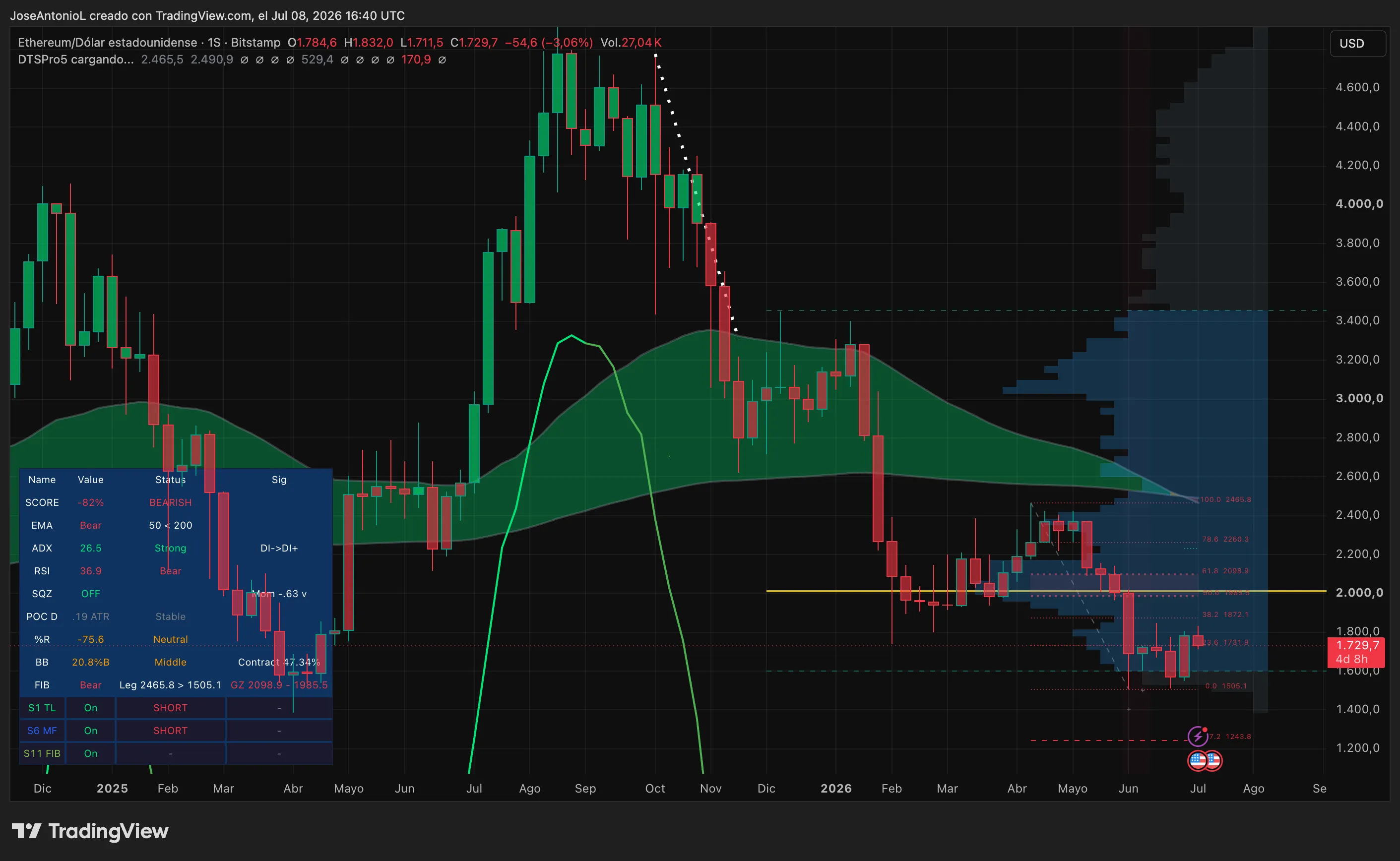
              Ethereum confirmed a weekly death cross for the first time in years, with its 50-week EMA now below its 200-week EMA, and prediction market traders now pricing a 72.3% chance ETH hits $1,500 before it sees $3,000 again.
              The broader crypto Fear & Greed Index sits at 23 (extreme fear), spot Bitcoin ETFs just ended a 10-day, $2.7 billion outflow streak.

              The crypto market enters the second week of July in rough shape.

              Bitcoin is holding on, but just barely, in the low $60,000s after briefly touching 21-month lows under $58,000 last week. Ethereum is below $1,750, down around 4% on the day, and more than 30% in the last year. The broader market is down, of course, and altcoins are down harder.

              The total crypto market cap excluding BTC and ETH shed 30% since January. Crypto IPOs—Gemini, Bullish, BitGo—have imploded since their debut.

              The mood is, understandably, grim.

              But grim moods have a long history of being wrong at exactly the wrong time. Every major Bitcoin bear cycle since 2009 has ended with a flush, an extreme fear reading, and a moment where the obvious trade looked like going short.

              Bitcoin has now been through four such cycles, and in nearly every case, a pre-halving compression phase—where price grinds lower and sentiment deteriorates before the next supply shock—preceded the next leg up. The next halving—when mining rewards, and therefore the supply of newly minted Bitcoin, are cut by 50%—is roughly 21 months away, which historically is when accumulation starts making uncomfortable sense.

              The difference this cycle? Crypto is now mainstream.

              Spot Bitcoin ETFs, institutional balance sheets, formal accounting standards changes, and a legislative framework for digital assets have all arrived since the last halving. Bitcoin now has a fundamentally different institutional status than it did when BTC was a niche hobby. That doesn’t eliminate volatility—it just means the players in this bear market are wearing different suits than last time. Whether that speeds up or delays the bottom is an open question. The charts, for now, have their answer.

              Bitcoin price: optimism with an asterisk

              Bitcoin opened the week at $63,587, hit a high of $64,657, then closed lower, meaning that the bulls showed up, tried to push through, and failed. Bitcoin is trading hands at $61,749, down 2.89% in the week.

              It’s important to note that BTC fell to $58,035 just days ago—a 21-month low—before bouncing.

              The resistance zone that stopped the spike is exactly the one everyone was watching. The $64–65K area has been acting as a ceiling since early June, and this week’s candle barely kissed it before retreating. On Myriad, a prediction market developed by Decrypt’s parent company Dastan, traders are placing nearly 73% odds that Bitcoin touches $55,000 before $84,000. The sentiment among predictors flipped on June 2—before that, the smart money was leaning bullish.


              Zooming out on the weekly chart, the Fibonacci retracement (natural support and resistance zones that happen during a trend) of that entire downleg from $82,833 places the $73,245 and $70,284 zone as with the most activity.

              The Average Directional Index, or ADX, is at 30.7. The ADX measures trend strength regardless of direction on scale from 0 to 100. When it’s above 25, this tells traders that an actual trend is in place, and 30.7 is solidly there. Based on directionality, bears are in control.

              The Relative Strength Index, or RSI, sits at 36.8. RSI measures momentum, similarly on a 0–100 scale: Above 70 signals overbought conditions and usually triggers profit-taking; below 30 signals oversold conditions that typically attract buyers. At 36.8, Bitcoin is close to oversold but hasn’t crossed the threshold yet. The technical setup suggests selling pressure may be approaching exhaustion—but “approaching” isn’t “done.” Right now markets appear to be panic selling.

              One note of caution for the bears: The picture painted by the exponential moving averages remains bullish. Bitcoin’s 50-week exponential moving average, or EMA, is still above its 200-week EMA. When this happens, it forms a pattern that traders refer to as a “golden cross,” which in this case is technically still intact. But it’s narrowing fast. The inverse of a golden cross is a death cross, and if it forms on the weekly chart it would represent a structural shift that very few Bitcoin cycles have survived without a deeper flush first.

              Thankfully for permabulls, this has not happened in a while.

              Reasons for the bullish case are mostly fundamental:

              Spot Bitcoin ETFs just snapped a 10-day, $2.7 billion outflow streak with a $221.7 million single-day inflow on July 2, and have since pulled in roughly $510 million. On-chain data from Glassnode shows long-term holders have returned to accumulation after an extended period of distribution, with buying activity broadening across wallet cohorts.

              The Fear & Greed Index at 23, registering “extreme fear,” is historically a contrarian signal—not a guarantee, but a pattern. Some indicators approaching oversold from the weekly chart suggest the selling may be closer to exhausted than just starting.

              For the bearish scenario, the technicals are more apparent for those focusing on shorter time frames:

              Bitcoin failed to break the exact resistance everyone was watching. ADX at 30.7 with bearish directional index confirms an active downtrend with real momentum. Year-to-date ETF outflows are still negative. Citi downgraded its 12-month Bitcoin forecast to $82,000 with a bear case at $53,000. The Fibonacci target below current price at $57,735 is still the most visible technical magnet on the chart. Myriad’s prediction market—where money, not opinions, speaks—says 72.3% chance of $55K first.

              Ethereum price: The death cross nobody wanted

              Ethereum is trading at $1,729.7, down 3.06% from its $1,784 weekly open. That number is painful enough. But the bigger story isn’t the weekly candle—it’s what just happened on the weekly chart under the hood.

              Ethereum has just confirmed a weekly death cross. The 50-week exponential moving average has crossed below the 200-week EMA for the first time in years. The upcoming days/weeks will be key to define positions for long-term trades if the cross extends and is not invalidated.

              On shorter timeframes, death crosses happen regularly and can reverse quickly. On the weekly chart, they represent months of structural deterioration, and they tend to define entire market phases rather than single moves.

              Ethereum’s daily chart has been in death cross since November 2025, when ETH peaked near $4,100 before beginning its extended decline. That daily bearish structure has now propagated to the weekly frame—a longer-timeframe confirmation that the bear trend isn’t a blip.

              Traders on Myriad appear as bearish on ETH as they do on BTC, likewise pricing in a 72% chance Ethereum hits $1,500 before $3,000. These odds flipped in May—before that, the market was closer to 50-50 between the two outcomes. The gap between options is now at its largest since June, suggesting conviction has moved firmly into the bearish camp among traders putting actual money on the line.

              The Fibonacci retracement on ETH’s downleg from $2,465.8 to $1,505.1 defines the zone between $2,098.9 and $1,985.5 as the ones with the most activity to watch for. Current price at $1,729.7 is pinned near the Fib level at $1,731.8. Below that, the next meaningful technical reference is the $1,500 price zone. That’s exactly the doom scenario Myriad traders are betting on.

              The ADX reads 26.5 with bearish directionality—same story as Bitcoin, just more pronounced. A trend is confirmed, the direction is down, and the bears have the momentum. RSI at 36.9 mirrors Bitcoin’s reading almost exactly: bearish, approaching oversold but not there yet.

              Some hopium for the bulls: Weekly death crosses on Ethereum have historically appeared around the final stages of bear market cycles—not the middle of them. In prior cycles, the three-day death cross frequently coincided with or immediately preceded significant bottoms. In other words, this is the panic zone in which many people wait to buy the asset for cheap.

              If that pattern holds, the pain may be closer to ending than beginning. ETH spot ETFs turned positive on July 2 with $29.1 million in inflows. RSI is approaching oversold on the weekly—a zone that has historically been a strong accumulation signal for patient buyers.

              Now for the bears: A weekly death cross is a new structural reality, not a temporary signal—it took months to form and typically takes months to reverse. US spot ETH ETFs logged a record 17 consecutive days of net outflows totaling $401 million in May, followed by another 10-day streak in June.

              The Fibonacci target of $1,500 is technically the next major level, and it’s the exact number Myriad’s 72.3% majority is betting on. Citi’s bear case for ETH is $1,094. The weekly structure doesn’t give bulls much to work with until the price of Ethereum reclaims the $2,000 area—a 15.6% climb from current levels that would require a sustained trend reversal that no indicator yet confirms.

              Disclaimer

              The views and opinions expressed by the author are for informational purposes only and do not constitute financial, investment, or other advice.

              Daily Debrief Newsletter

              Start every day with the top news stories right now, plus original features, a podcast, videos and more.


              Source link

              Pump Fun is unlocking $127M insider tokens worth double PUMP’s recent daily volume

              Pump Fun is unlocking 7M insider tokens worth double PUMP’s recent daily volume


              Pump.fun built one of crypto’s fastest meme-token liquidity machines. Now, on July 12, its own token faces the kind of liquidity test the platform usually creates for others.

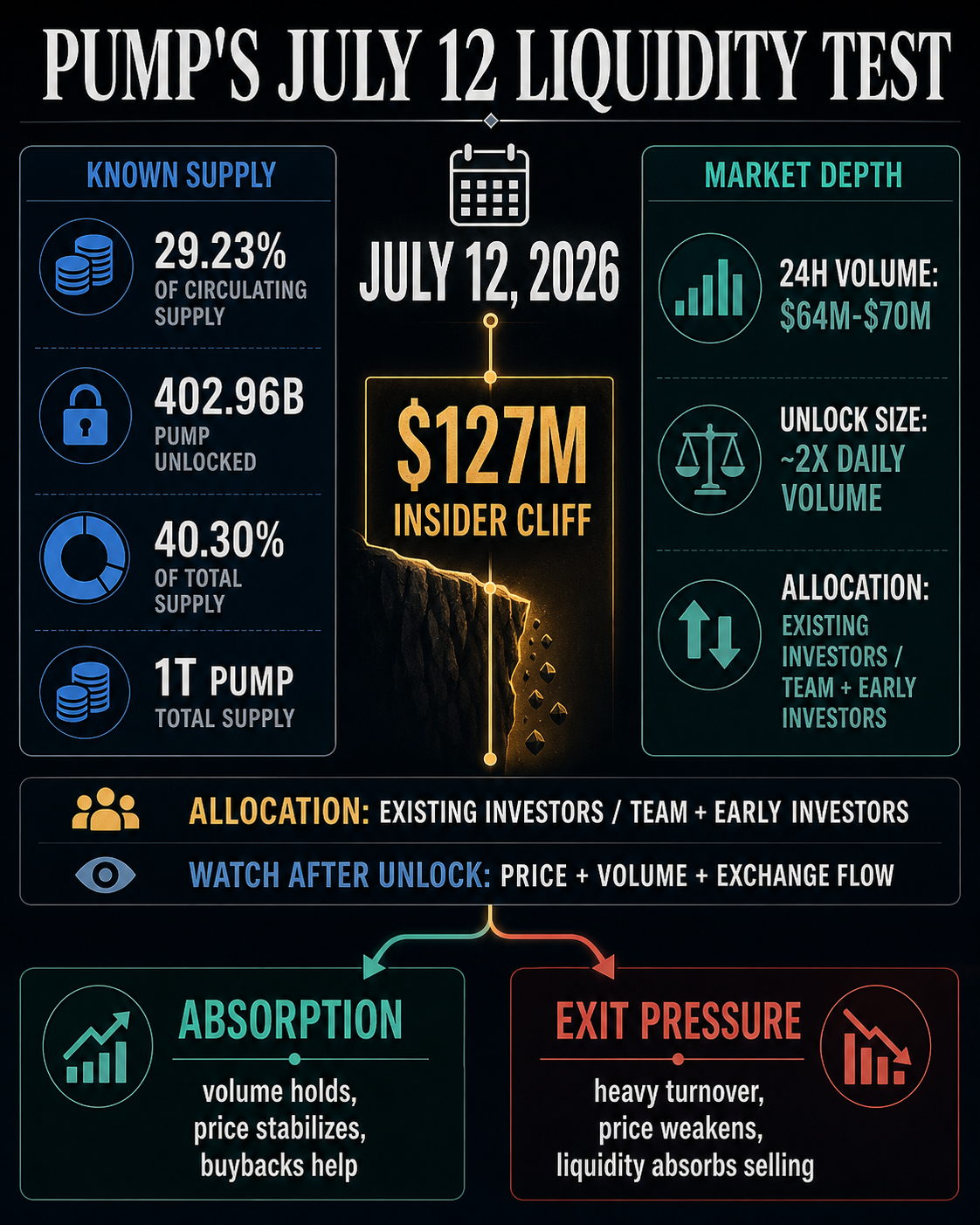
              The platform’s PUMP token is set to unlock on July 12, with Tokenomist valuing it at $127 million, equal to 29.23% of the circulating supply.

              The scheduled release is tied to insider allocations: Tokenomist’s weekly unlock digest describes the tranche as flowing to team and early investors, while its PUMP vesting page identifies the next release as Existing Investors.

              That matters because PUMP is facing a large scheduled release against an order book that recently showed far less daily turnover than the unlock size.

              CryptoSlate market pages showed PUMP trading near $0.00155 on July 8, with 24-hour volume between roughly $64 million and $70 million across the PUMP asset page and the broader coin rankings.

              The scheduled cliff is therefore close to twice recent visible daily volume before any adjustment for how much of the unlocked allocation is actually sold.

              The full $127 million may stay off exchanges if recipients hold. Unlock size only sets the maximum new supply available; sell-through decides the pressure.

              But the token is entering a more direct liquidity test than most meme-coin narratives produce: if recipients hold, demand may absorb the date. If they sell into weak depth, the unlock can turn from a calendar entry into visible exit pressure.

              PUMP debuts at $5.6B FDV, logs $34M volume within first 3 hours
              Related Reading

              PUMP debuts at $5.6B FDV, logs $34M volume within first 3 hours

              The token slid 7.3% in the same period, briefly touching the $5 billion in fully diluted valuation.

              Jul 15, 2025 · Gino Matos

              Why the PUMP unlock comes in one block

              Tokenomist’s vesting page says roughly 402.96 billion PUMP, or 40.30% of the token’s 1 trillion supply, has already been unlocked. The remaining supply is still governed by the project’s vesting schedule, which extends into 2029.

              The same page says Pump.fun uses cliff vesting across most allocations, meaning tokens are released in large, scheduled blocks rather than being smoothed into the market over time.

              Infographic showing PUMP's July 12, 2026 liquidity test with a $127 million insider cliff, 29.23% of circulating supply, 40.30% of total supply unlocked, and $64 million to $70 million 24-hour volume.Infographic showing PUMP's July 12, 2026 liquidity test with a $127 million insider cliff, 29.23% of circulating supply, 40.30% of total supply unlocked, and $64 million to $70 million 24-hour volume.

              That is why the July 12 event is more than a tokenomics footnote. Cliff structures concentrate risk into dates traders can see in advance.

              Traders can price them in, hedge them, ignore them, or use them as liquidity windows. The supply still arrives in a visible block.

              The upcoming release also lands in a token whose float is still maturing. Tokenomist lists the Initial Coin Offering at 33% of allocation, Community & Ecosystem Initiatives at 24%, Team at 20%, Existing Investors at 13%, Livestreaming at 3%, Liquidity & Exchanges at 2.6%, Ecosystem Fund at 2.4%, and Foundation at 2%. That mix puts a meaningful share of future supply in categories whose behavior can shape market confidence.

              The strongest bearish case is simple. A large block of insider-controlled PUMP becomes available while the token’s daily trading volume is lower than the scheduled release amount.

              If even a meaningful portion of that allocation seeks liquidity, buyers have to absorb it without demanding a larger discount. That is the definition of an exit-liquidity test.

              The strongest counterargument is also straightforward. Recipients can hold unlocked tokens, and PUMP is attached to a platform with real activity, fees, and past buyback demand.

              The trade turns on two observable outcomes: supply meets enough demand to clear without lasting damage, or the market reprices PUMP because the available bid is thinner than the insider supply.

              For traders, timing is the point. Cliff vesting compresses a supply decision that could have unfolded over months into a single window, so price action around the date becomes a live signal of confidence, depth, and whether holders want cash or exposure.

              Pump Fun retail demand was already tested once

              The tension is more acute because Pump.fun’s token already had one spectacular demand event. CryptoSlate reported in July 2025 that the memecoin launchpad sold 150 billion PUMP tokens to retail investors, raising $600 million in 12 minutes and bringing total token-sale proceeds to $1.32 billion.

              That was primary-market demand under launch conditions. The July 12 cliff tests something different: whether secondary-market liquidity can absorb supply after the trade has aged, the token has fallen far below its peak, and insiders have a new path to liquidity.

              The platform context makes the reversal harder to miss. Pump.fun built its reputation by making meme-token creation and trading fast.

              CryptoSlate’s launchpad review describes it as a Solana-native, bonding-curve launchpad where ordinary users can usually buy and sell quickly, and where the practical constraint is liquidity rather than formal vesting.

              In other words, Pump.fun turned fast retail flow into a product.

              Now PUMP has to demonstrate that the same market reflex exists for its own token when the seller profile changes. Retail buyers once funded the token sale at extraordinary speed.

              The next question is whether secondary traders are willing to provide sufficient depth when the scheduled supply comes from the team and investor categories rather than from new public demand.

              The question is market structure rather than a moral judgment about meme coins. PUMP can remain a tradable, revenue-linked token and still face pressure from cliff vesting.

              It can also suffer short-term volatility without proving the business is broken. The important point is that the July 12 date turns an abstract dilution risk into a measurable trade.

              That is where Pump.fun’s own design history tightens the story. The launchpad trained users to expect immediate market access and fast exits; PUMP’s unlock asks whether the platform’s token has the same depth when the flow moves in the other direction.

              CryptoSlate Daily Brief

              Daily signals, zero noise.

              Market-moving headlines and context delivered every morning in one tight read.

              5-minute digest 100k+ readers

              Free. No spam. Unsubscribe any time.

              Whoops, looks like there was a problem. Please try again.

              You’re subscribed. Welcome aboard.

              The platform created liquid attention for thousands of tokens, but insider supply tests whether attention is durable enough to support its own market.

              PUMP buybacks make the case for absorption

              The strongest case for absorption rests on Pump.fun’s revenue and buyback history. Tokenomist’s digest notes that Pump.fun has been a consistent revenue generator and has run token buybacks in the past, which can absorb some incremental supply if the program is large enough.

              CryptoSlate previously examined that question in the broader token-buyback market, noting that Pump.fun had spent $233 million to buy 62.2 billion PUMP as of Jan. 6.

              Pump fun's PUMP skyrockets 20% following buyback yet faces scrutiny over utility concernsPump fun's PUMP skyrockets 20% following buyback yet faces scrutiny over utility concerns
              Related Reading

              Pump fun’s PUMP skyrockets 20% following buyback yet faces scrutiny over utility concerns

              PUMP climbs to a $6.3 billion valuation amid market debates on its lack of inherent utility.

              Jul 16, 2025 · Oluwapelumi Adejumo

              The same buyback analysis warned that buyback programs only change the supply picture when fee revenue scales faster than scheduled unlocks.

              That is the relevant filter for the July 12 cliff. A buyback headline is insufficient on its own.

              What matters is coverage: how much demand the program creates relative to newly available supply, and whether that demand is visible when insiders are allowed to sell.

              If PUMP volume rises into the unlock, price holds, and buyback demand is evident, the market can interpret the event as manageable dilution.

              The result would leave future vesting risk in place, but it would show that the token has a deeper bid than the headline unlock suggests.

              If volume rises while price weakens, the signal changes. Heavy turnover can mean absorption, but it can also mean distribution.

              The difference is whether buyers are taking supply without forcing a sustained discount. That is why post-unlock price behavior matters more than the unlock calendar itself.

              The broader backdrop adds pressure. Tokenomist’s weekly digest described June as defensive, with Bitcoin dropping below $60,000 late in the month and spot Bitcoin ETF flows acting as a headwind.

              It also said capital had become selective, favoring tokens with clearer revenue and value-accrual mechanics rather than the market as a whole. That is a mixed setup for PUMP: the project has revenue, but the token has a large insider cliff.

              Pump Fun revenue slows as Collector Crypt’s $5.1M card-pack week reshapes Solana’s consumer loopPump Fun revenue slows as Collector Crypt’s $5.1M card-pack week reshapes Solana’s consumer loop
              Related Reading

              Pump Fun revenue slows as Collector Crypt’s $5.1M card-pack week reshapes Solana’s consumer loop

              Pump.fun is cooling as Collector Crypt posts a $5.1 million week and CARDS draws fresh attention on Solana.

              Jun 19, 2026 · Gino Matos

              The verdict comes after July 12

              Before the unlock, the cleanest conclusion is conditional. Pump.fun’s July 12 cliff is large enough, concentrated enough, and close enough to recent visible daily volume to qualify as PUMP’s first real exit-liquidity test.

              Sell-through remains the missing variable.

              The next signal will come from how PUMP trades after the tokens become available.

              A constructive outcome would show elevated volume without a lasting price break, limited evidence of exchange-bound supply, and enough demand or buyback activity to keep the market orderly.

              A weaker outcome would show heavy volume paired with price deterioration, suggesting that liquidity is being used to exit rather than to accumulate.

              That makes July 12 a deadline with a measurable aftermath. Pump.fun built one of crypto’s fastest retail attention machines.

              PUMP now has to show whether that attention is deep enough to meet insider supply when the cliff arrives.


              Source link

              Popular Posts

              My Favorites

              Ice Staff Wonder Weapon Returns in The Tomb for Black Ops...

              0
              Black Ops 6 Zombies is bringing back one of its most iconic Wonder Weapons, the Staff of Ice, when The Tomb launches in...