Avalanche and NEC Corporation signed an MoU to develop a biometric identity verification system for blockchain payments.
A joint whitepaper outlines a framework for identity-verified stablecoin transactions on Avalanche’s multi-chain network.
The design uses NEC’s FaceVC technology while ensuring biometric data is never stored on-chain.
Avalanche, a public blockchain and smart contract platform, and Japanese technology conglomerate NEC Corporation have signed a Memorandum of Understanding to explore integrating biometric identity verification with blockchain-based payments.
The collaboration, announced on July 10, includes publishing a joint technical whitepaper outlining a proposed architecture for identity-verified stablecoin transactions on Avalanche’s multi-chain network.
The global leader in biometric identity is working with Avalanche.@NEC has deployed 1,000+ biometric identity systems across 70+ countries.
Now, NEC and Ava Labs are working together to build an architecture for biometric-verified blockchain based services. pic.twitter.com/CJpr06iOKx
— Avalanche🔺 (@avax) July 10, 2026
The initiative centers on combining NEC’s established biometric technology, known as FaceVC, with Avalanche’s infrastructure. NEC, a player in facial recognition systems, has deployed over 1,000 biometric identification setups across more than 70 countries for applications ranging from law enforcement to national ID programs and large-scale events like Expo 2025 Osaka.
What does the whitepaper include
According to details shared in the announcement, the proposed system would allow users to complete identity verification and stablecoin payments in a single step. Importantly, biometric data itself would not be stored on the blockchain. Instead, the architecture relies on verifiable credentials and selective disclosure mechanisms, where only proof of successful verification is shared on-chain.
The whitepaper describes a three-part structure utilizing Avalanche’s multi-chain design:
A permissioned Layer 1 subnet for managing identity registries, decentralized identifiers (DIDs), and credential revocation without exposing raw biometric information.
SETTL, a dedicated payment chain optimized for stablecoin settlements with built-in privacy features and selective auditability for compliance purposes.
The public C-Chain for handling reward tokens and promotional NFTs.
What it means for users
For everyday users, particularly international travelers in markets like Japan, the proposed system could simplify payments by allowing a single biometric verification to handle identity checks and stablecoin transactions simultaneously. This might reduce friction at merchants and speed up checkout processes compared to repeated document submissions or app logins.
However, the integration of biometric verification raises important concerns. Users must trust that sensitive facial data remains securely stored only in personal wallets and never exposed on-chain, despite the involvement of a large corporation like NEC and permissioned infrastructure. Potential risks include data breaches, function creep where biometric credentials are used beyond payments, and reduced anonymity in blockchain transactions.
While promising convenience, the system introduces new dependencies on biometric accuracy, wallet security, and enterprise-controlled identity layers that may limit user control and raise privacy trade-offs. Adoption will ultimately hinge on whether these risks are effectively mitigated in practice.
Avalanche push for Blockchain payments
In a separate development for the blockchain payments push, Avalanche has officially formed the Avalanche Payments Collective, a new industry group uniting 28 companies and organizations developing payment solutions on its layer-1 blockchain network.
Announced on June 18, the initiative brings together existing builders focused on various aspects of blockchain-based payments, including settlement, stablecoins, treasury management, and cross-border transactions.
The diverse group features participants such as Franklin Templeton, VanEck, WisdomTree, Paxos, Agora, Ethena, Anchorage Digital, Kraken, Zerohash, and the Wyoming Stable Token Commission, along with several specialized firms like SETTL, Nonco, OatFi, and Request Finance.
The collective covers multiple layers of the payments infrastructure stack, from issuance and settlement to foreign exchange, compliance tools, and merchant-facing solutions.
Also Read: Robinhood Chain Outperforms Hyperliquid in Dex Volume
Disclaimer: The information researched and reported by The Crypto Times is for informational purposes only and is not a substitute for professional financial advice. Investing in crypto assets involves significant risk due to market volatility. Always Do Your Own Research (DYOR) and consult with a qualified Financial Advisor before making any investment decisions.
Published: July 10, 2026 at 10:36 am Updated: July 10, 2026 at 10:36 am
To improve your local-language experience, sometimes we employ an auto-translation plugin. Please note auto-translation may not be accurate, so read original article for precise information.
MEXC, a pioneer in 0-fee digital asset trading, announced the launch of its VVIP Futures Loss Coverage Program 2.0 from July 10 to July 30, 2026 (UTC), an upgraded initiative offering enhanced trading protection and a 1,000,000 USDT prize pool for futures users to share.
The Loss Coverage Program 2.0 introduces three key enhancements. Losses Covered Instantly gives eligible VVIP users same-day compensation on qualifying losing trades, with coverage chances and limits tiered according to VVIP level. Elite VVIP users with a credit score of 800 or above enjoy real-time compensation upon triggering loss coverage. Liquidation Protection allows users with eligible liquidated positions to receive up to 2,000 USDT in additional coverage. The Lucky Lottery allows qualifying losing trades to earn users lucky tickets, with additional tickets awarded based on loss size, giving ticket holders a chance to share a 100,000 USDT prize pool.
To ensure a transparent and verifiable result, the Lucky Lottery grand prize draw will be determined using the last six digits of the first Bitcoin block hash generated after July 31, 2026, 12:00 (UTC). Prizes include a grand prize gold bar valued at 4,000 USDT, ten gold bars valued at approximately 2,000 USDT each, ten gold bars valued at approximately 1,200 USDT each, and futures bonus rewards of up to 500 USDT.
As a one-stop trading platform, MEXC offers users access to a wide range of assets—including cryptocurrencies, US equities, gold, silver, and more—alongside a growing suite of protective mechanisms designed to support users through market volatility. In addition, MEXC Futures Insurance Fund stood at over 759 million USDT as of July 10, 2026, providing an additional layer of protection against extreme market conditions. These reflect MEXC’s continued commitment to user experience and protection.
Full event details and participation are available on the MEXC VVIP Futures Loss Coverage Program 2.0 page.
About MEXC
MEXC is the world’s fastest-growing cryptocurrency exchange, trusted by more than 40 million users across 170+ markets. Built on a user-first philosophy, MEXC offers industry-leading 0-fee trading and access to over 3,000 digital assets. As the Gateway to Infinite Opportunities, MEXC provides a single platform where users can easily trade cryptocurrencies alongside tokenized assets, including stocks, ETFs, commodities, and precious metals.
MEXC Official Website| X | Telegram |How to Sign Up on MEXC
For media inquiries, please contact MEXC PR team: [email protected]
Risk Disclaimer:
This content does not constitute investment advice. Given the highly volatile nature of the cryptocurrency market, investors are encouraged to carefully assess market fluctuations, project fundamentals, and potential financial risks before making any trading decisions.
Source
Disclaimer
In line with the Trust Project guidelines, please note that the information provided on this page is not intended to be and should not be interpreted as legal, tax, investment, financial, or any other form of advice. It is important to only invest what you can afford to lose and to seek independent financial advice if you have any doubts. For further information, we suggest referring to the terms and conditions as well as the help and support pages provided by the issuer or advertiser. MetaversePost is committed to accurate, unbiased reporting, but market conditions are subject to change without notice.
About The Author
Gregory, a digital nomad hailing from Poland, is not only a financial analyst but also a valuable contributor to various online magazines. With a wealth of experience in the financial industry, his insights and expertise have earned him recognition in numerous publications. Utilising his spare time effectively, Gregory is currently dedicated to writing a book about cryptocurrency and blockchain.
More articles
Gregory, a digital nomad hailing from Poland, is not only a financial analyst but also a valuable contributor to various online magazines. With a wealth of experience in the financial industry, his insights and expertise have earned him recognition in numerous publications. Utilising his spare time effectively, Gregory is currently dedicated to writing a book about cryptocurrency and blockchain.
Published: July 10, 2026 at 10:33 am Updated: July 10, 2026 at 10:34 am
To improve your local-language experience, sometimes we employ an auto-translation plugin. Please note auto-translation may not be accurate, so read original article for precise information.
In Brief
Backpack launches 24/7 trading of real U.S. equities for global investors, offering full ownership, instant settlement, and Solana-based tokenized asset access.
Backpack, a global financial platform bridging cryptocurrency and traditional capital markets, has announced the launch of 24/7 trading for select U.S. equities targeting international investors. The move allows users worldwide to buy, hold, and sell real U.S. securities at any hour of the day, any day of the week — a structural departure from the session-bound model that has long defined equity markets.
The announcement follows Backpack’s launch of the first real, tokenized equities in early June 2025, and marks the platform’s next step in positioning itself as a unified gateway connecting on-chain and off-chain liquidity.
Backpack launches the first 24/7 brokerage for real US equities.
International investors can now buy and sell select US equities on Backpack 24/7/365.
Not synthetic. Not derivatives. Real shares — tradable around the clock.
Via the first always-on market infrastructure… pic.twitter.com/YLuunlix9j
— Backpack 🎒 (@Backpack) July 10, 2026
Ownership, Settlement, and On-Chain Integration
A central distinction in Backpack’s offering is that investors hold full legal ownership of the underlying U.S. equities — not synthetic proxies or derivative exposure. The platform provides instant settlement, continuous price discovery, and funding flexibility via fiat currency or stablecoins, combining the infrastructure of modern markets with the protections of genuine asset ownership.
Beyond direct equity access, Backpack supports tokenized versions of these assets on the Solana blockchain, enabling 24/7 on-chain trading, wallet-to-wallet transfers, and compatibility with decentralized finance protocols. Users can move between traditional securities and their tokenized equivalents on a 1:1 basis through the platform.
The commercial case for this infrastructure has already taken shape. Last month, Backpack’s tokenized SpaceX equity ($SPCX) became the most liquid and highest-volume tokenized SpaceX product traded on-chain, surpassing competing offerings. The result reflects sustained investor appetite for direct, redeemable exposure to one of the most closely watched pre-IPO companies in recent memory.
Disclaimer
In line with the Trust Project guidelines, please note that the information provided on this page is not intended to be and should not be interpreted as legal, tax, investment, financial, or any other form of advice. It is important to only invest what you can afford to lose and to seek independent financial advice if you have any doubts. For further information, we suggest referring to the terms and conditions as well as the help and support pages provided by the issuer or advertiser. MetaversePost is committed to accurate, unbiased reporting, but market conditions are subject to change without notice.
About The Author
Alisa, a dedicated journalist at the MPost, specializes in crypto, AI, investments, and the expansive realm of Web3. With a keen eye for emerging trends and technologies, she delivers comprehensive coverage to inform and engage readers in the ever-evolving landscape of digital finance.
More articles
Alisa, a dedicated journalist at the MPost, specializes in crypto, AI, investments, and the expansive realm of Web3. With a keen eye for emerging trends and technologies, she delivers comprehensive coverage to inform and engage readers in the ever-evolving landscape of digital finance.
Strategy has started selling Bitcoin to fund dividends on its preferred stock, a shift from its long-standing “never sell” stance that has unsettled the market.
Standard Chartered calls the selling “mostly noise” and a communication problem, and is sticking to its end-2026 Bitcoin forecast of $100,000.
Bitcoin trades around $64,440, up 3.8% on the week but down 42% on the year, while Myriad traders give Strategy a slim chance of holding 1 million BTC this year.
Strategy’s turn from hoarding Bitcoin to selling it, in order to pay dividends on its preferred stock, has “muddied” Bitcoin’s near-term prospects, according to a new Standard Chartered note that nonetheless urges investors to look past it.
Last week, Bitcoin treasury company Strategy sold 3,588 BTC for about $216 million between June 29 and July 5 to cover preferred-share dividends and top up a cash reserve, leaving it with 843,775 BTC. That came after a token sale of just 32 BTC in early June that triggered its worst week since 2022.
In a note published Friday, Standard Chartered’s Geoff Kendrick wrote that the bank sees the sales as “mostly noise rather than a signal” of Bitcoin’s medium-term direction, and kept its end-2026 forecast of $100,000.
Strategy’s mNAV issue
For years Strategy ran a simple machine: as long as its shares traded well above the value of its Bitcoin holdings, a premium captured by a metric called mNAV, it could issue stock, buy more BTC, and lift both its own valuation and Bitcoin’s price. That premium has evaporated.
Standard Chartered puts mNAV at around 1 on an enterprise-value basis, while equity-based trackers land lower: BitcoinTreasuries has the stock at around 0.7 times the value of its Bitcoin on a diluted basis, a discount of roughly a third. Either way, the machine has stalled. Strategy’s BTC stack, bought for $63.7 billion, is worth around $54 billion at current prices, and the firm booked an $8.3 billion loss on its digital assets last quarter, almost all of it unrealized.
Backing the STRC dividend
With the accumulation model stalled, Strategy is repurposing its Bitcoin as collateral for STRC, a perpetual preferred stock known as “Stretch” that pays a 12% annual dividend and has about $10 billion outstanding, per Standard Chartered.
The shares are designed to trade near their $100 par value, but they slid to an intraday low of $71.25 on June 26 after the company disclosed its first Bitcoin sale earlier that month. Price action since suggests “the market has yet to be fully convinced of this pivot,” Kendrick wrote. Under a “BTC Monetization Program” unveiled on June 29, Strategy can raise up to $1.25 billion by selling Bitcoin to keep the dividends funded.
Kendrick argued that clear communication is “key to reassuring markets that wholesale selling is unlikely,” which should pull STRC back toward its $100 par and, in turn, ease pressure on Bitcoin. Because the stock is “heavily over-collateralised” by the Bitcoin behind it, he wrote, effective signaling could remove the need for Strategy to sell any more at all. The analyst noted that the reserve behind the dividend now holds $2.55 billion, almost a year and a half of coverage.
What the market thinks
Bitcoin changed hands around $64,440 on Friday, up 3.8% on the week but down 42% over the past year and about 49% below its October 2025 record of $126,080, per CoinGecko data.
Traders are doubtful Strategy’s buying spree will resume at full tilt. A market on Myriad, a prediction platform owned by Decrypt’s parent company Dastan, puts the chance of the company holding more than 1 million BTC before 2027 at around 13%. Strategy holds 843,775 today, more than 4% of all the Bitcoin that will ever exist.
Daily Debrief Newsletter
Start every day with the top news stories right now, plus original features, a podcast, videos and more.
Worlds of Play: The Game Art Exhibition has been announced to run alongside Gamescom 2026 from 27th to 29th August in Cologne, Germany.
It will take place at the WASSERMANNHALLE (Girlitzweg 30, 50829 Köln), and is free to attend, though registration is required via the Worlds of Play site. The venue is a bit out from the city centre, but can be reached with the S12 or S19 trains which stops nearby at Technologiepark, and can be caught from Köln Messe/Deutz, the station next to Gamescom itself.
The showcase will feature 40 games with their artworks and immersive installations, split into five themed zones – Reality, Experiments, Abyss, Epics and Wonderland – and includingeverything from DayZ to Control Resonant, Assassin’t Creed, League of Legends, romance game Light and Night, and more. Expect original concept art, character statues, scale models and even the potential to meet game creators face-to-face.
The event has been set up by Chinese publisher Tencent, partnering with a large variety of publishers and developers.
“Great games are remarkable expressions of creative collaboration, bringing together art, storytelling, music, design, and technology to create an experience unlike any other medium,” said Steven Ma, Senior Vice President of Tencent. “With ‘Worlds of Play,’ we are proud to collaborate with partner studios from around the world to celebrate the artists and creators behind them.”
Published: July 10, 2026 at 9:28 am Updated: July 10, 2026 at 9:28 am
by Anastasiia O
Edited and fact-checked:
July 10, 2026 at 9:28 am
To improve your local-language experience, sometimes we employ an auto-translation plugin. Please note auto-translation may not be accurate, so read original article for precise information.
In Brief
Gate US gains Florida MTL, launches Visa Card, while new ETFs, tokenized stocks, options, and World Cup prediction markets drive platform growth.
Gate’s push into mainstream financial services deepened this week on several fronts. Gate US secured a Florida Money Transmitter License, bringing its compliant operational footprint to 47 U.S. jurisdictions and reinforcing the exchange’s long-term regulatory strategy across one of the country’s most scrutinized financial markets. On the product side, Gate US launched Gate Card in partnership with Visa, Stripe, and Bridge, enabling eligible U.S. users to spend stablecoins such as USDC through Visa’s global merchant network, with automatic conversion at the point of sale. The moves align with the thesis outlined in Gate Research’s newly published report, “Crypto Finance Goes ‘Wall Street,’” which argues that crypto exchanges and traditional brokerages are converging toward a unified financial account — pointing to Gate’s own expansion into real stock trading as a case in point. Against this backdrop, the past few days brought a dense wave of product launches, market data milestones, and campaign updates across Gate’s ecosystem.
BTC, ETH, and Metals
Crypto markets showed signs of recovery, with BTC trading at $63,828 (+3.2% over 24 hours) and ETH at $1,767.87 (+2.36%). Gate’s BTC futures volume reached $4.86 billion and spot volume $677 million, both ranking top three globally. Gate’s ETH futures volume came in at approximately $3.78 billion, with spot volume at $178 million, also in the top three. On a broader network level, ETH 24-hour futures volume fell 11.92% to $33.16 billion, with Gate accounting for $4.25 billion in futures volume and $2.11 billion in open interest.
In metals, gold (XAU) climbed to $4,127.44 (+1.27%) and silver (XAG) to $60.36 (+3.50%). Gate XAU futures open interest reached $184 million and XAG hit $57.24 million, with both ranking among the top two in the industry. Gate’s XAUT spot trading volume also reached approximately $10.16 million, placing second globally.
Global Stocks: Active Sessions Across All Three Markets
Gate Stocks’ 24/7 ecosystem, spanning more than 12,500 equities and ETF assets across U.S., Hong Kong, and South Korean markets, saw strong sessions across all three regions. NVIDIA rebounded 3.66% to $204.15 following a semiconductor sector correction, with Gate’s NVDAX futures recording $3.39 million in 24-hour volume, ranking first across the entire network. Among U.S. growth stocks, healthcare services company rYojbaba (RYOJ) led the day with a gain exceeding 30%, followed by laser technology firm nLIGHT (LASR, +27.42%) and geothermal energy company Fervo Energy (FRVO, +15.86%).
In Hong Kong, SMIT HOLDINGS surged 66.66% intraday, PAG BIOPHARMA-B climbed 41.04%, and ZG GROUP-W gained 29.54%, with chip design, industrial internet, and biopharma sectors continuing to draw interest. On July 9, amid broader HK market volatility, TRIO IEL (01710) surged 49.18%, CHINA FRONTIER TECHNOLOGY GROUP (01661) jumped 36.05%, and TENGRUI AUTO INT (06162) gained 30.18%. In South Korea, beauty company Manyo Factory rose 18.43% to $11.60, HeungKoo Oil climbed 14.72%, and IT’S HANBUL advanced 13.51%, leading gains among Korean equities on the platform.
gStocks: 15 New Tokenized Securities Added
Gate’s gStocks section added 15 tokenized securities for spot trading on July 9, including CBRSG (Cerebras Systems), COING (Coinbase Global), SPYG (SPDR S&P 500 ETF Trust), QCOMG (Qualcomm), ORCLG (Oracle Corporation), SOXLG (Direxion Daily Semiconductor Bull 3X ETF), and nine additional names. All gStocks tokens are backed 1:1 by underlying assets, enabling 24/7 securities access through a single Gate account.
Polymarket: World Cup Prediction Activity Gains Momentum
Gate Polymarket tracked the 2026 World Cup quarterfinals as prediction market activity continued to build. France defeated Morocco 2–0 on July 10, becoming the first team through to the semifinals. Attention now shifts to Spain vs. Belgium on July 11, with Norway vs. England and Argentina vs. Switzerland to follow on July 12. Gate’s 100,000 USDT World Cup Prediction Championship remains active, rewarding users based on return multiples from correct predictions. The parallel “Gate Polymarket × World Cup Daily Featured Matches” campaign offers a 50,000 USDT prize pool accessible regardless of prediction outcome. Gate is the first centralized exchange to integrate with Polymarket.
Options and ETFs: New Products and Rising Engagement
Gate Options recorded a 33.05% week-over-week increase in active traders and a 57.89% surge in new users. The platform also introduced Simple Options, a streamlined product aimed at lowering barriers to options participation, with an ongoing campaign offering access to a shared prize pool.
Gate ETF expanded its lineup with four new leveraged token products — SAMSUNG3L/USDT, SAMSUNG3S/USDT, AMD3L/USDT, and AMD3S/USDT — bringing the total to 362 supported leveraged products. An ETF Trading Challenge running July 9–18 offers a 50,000 USDT prize pool for users trading the new pairs.
GUSD Launchpool
Gate Launchpool #365 is live through July 16, featuring dual GUSD staking pools and a total airdrop of 15 XAUT. GUSD carries a base APR of 3.8%, boosted to a combined 6.38% through Launchpool participation. New staking users can access a promotional APR of up to 100% on GUSD minting, with total APR reaching up to 132.2% when combined with Launchpool rewards. GUSD is backed by U.S. Treasury RWA and stablecoins and can be minted 1:1 with USDT, USDC, or USD1.
Gate Alpha, DEX BountyDrop, and Token Crew
Gate Alpha launched Hot Token Trading Competition Phase 49 on July 10, distributing $40,000 in airdrop rewards through a dual-mechanism structure with mystery box draws for both standard and referral-registered users. Gate DEX BountyDrop activated airdrop events for SPCX, TeQoin, and Eventra, with 1,000 to 2,000 participants selected per project to share the respective token pools. Token Crew Phase 13, running July 10 through August 6, features a 700,000 USDT prize pool built around user referrals, with both inviters and invitees eligible for cash rewards once verification, deposit, and trading requirements are met.
Gate Card: Paris Shopping Benefits
In addition to the U.S. launch, Gate Card has partnered with Printemps Paris on an offline shopping benefit running July 10 through October 9. Eligible Gate Card users visiting the Printemps Haussmann flagship for the first time can receive a 5% welcome discount. A summer tax refund promotion through August 31 offers tiered refunds from 12% to 16% based on spending. Users spending EUR 188 or more can claim a Machi Machi drink benefit, and Gate VIP 5 and above users may access a personal shopping advisor service on-site. Gate Card’s new Points System separately offers cashback of up to 8%, capped at 400 USDT per month.
Disclaimer
In line with the Trust Project guidelines, please note that the information provided on this page is not intended to be and should not be interpreted as legal, tax, investment, financial, or any other form of advice. It is important to only invest what you can afford to lose and to seek independent financial advice if you have any doubts. For further information, we suggest referring to the terms and conditions as well as the help and support pages provided by the issuer or advertiser. MetaversePost is committed to accurate, unbiased reporting, but market conditions are subject to change without notice.
About The Author
Alisa, a dedicated journalist at the MPost, specializes in crypto, AI, investments, and the expansive realm of Web3. With a keen eye for emerging trends and technologies, she delivers comprehensive coverage to inform and engage readers in the ever-evolving landscape of digital finance.
More articles
Alisa, a dedicated journalist at the MPost, specializes in crypto, AI, investments, and the expansive realm of Web3. With a keen eye for emerging trends and technologies, she delivers comprehensive coverage to inform and engage readers in the ever-evolving landscape of digital finance.
Published: July 10, 2026 at 9:08 am Updated: July 10, 2026 at 9:09 am
To improve your local-language experience, sometimes we employ an auto-translation plugin. Please note auto-translation may not be accurate, so read original article for precise information.
For most of the past three years, “AI agents using crypto” was a narrative in search of actual infrastructure. There were whitepapers, conference panels, and a lot of token speculation, but the real-world deployment was thin.
That changed in early 2026. Wallet infrastructure built specifically for non-human actors shipped. Transaction data from millions of autonomous payments started appearing. And on a single day in March, two of the most prominent figures in crypto made essentially the same argument about where this is heading. The theoretical case had become an operational one.
The Identity Problem That Banks Can’t Solve
The core reason AI agents end up on crypto rails rather than traditional banking rails isn’t ideological. It’s architectural. Banks require Know Your Customer verification: a government-issued ID, a legal address, a human being whose identity can be confirmed. AI agents have none of that. They’re software. You can’t hand an AI agent a passport.
Crypto wallets work differently. A wallet is generated from a private key. No identity verification required. No legal entity needed. An agent that holds a wallet can send and receive value and pay for services autonomously from the moment it’s deployed.
On March 9, 2026, Coinbase CEO Brian Armstrong posted on X: Very soon, there are going to be more AI agents than humans making transactions. They can’t open a bank account, but they can own a crypto wallet. Think about it.” The argument was structural, not promotional. Armstrong was describing an architectural constraint in traditional finance and pointing to the only current workaround.
Within hours, Binance founder Changpeng Zhao pushed further, writing that AI agents will make “1 million times more payments than humans”, and they will use crypto. The number sounds hyperbolic until you think about the transaction patterns of autonomous software: an agent running a complex task might call a dozen APIs, access multiple data sources, and pay for compute resources in a single workflow. At machine speed. Continuously.
The Infrastructure That Actually Shipped
The timing of those statements wasn’t accidental. Both Armstrong and Zhao were posting into a moment when the infrastructure to support agent-native payments had just arrived.
On February 11, 2026, Coinbase launched Agentic Wallets through its x402 protocol, described as “the first wallet infrastructure built specifically for agents.” The product gives autonomous AI agents the ability to hold funds, execute trades, earn yield, and make payments without requiring human confirmation at each step. Built-in guardrails let developers define spending limits and permissions. By the time Armstrong made his post in March, x402 had already processed more than 50 million transactions.
BNB Chain moved in parallel. On February 4, the network deployed ERC-8004, a standard creating verifiable on-chain identities for AI agents, alongside BAP-578, which introduced Non-Fungible Agents: software entities that exist as on-chain assets, hold their own wallets, and can spend funds to complete tasks. The combination creates an identity and payments layer designed from the ground up for software rather than people.
What the Transaction Data Actually Shows
The activity isn’t hypothetical. In early March 2026, Peter Schroeder, Global Head of Marketing at Circle, shared data on X showing that over the previous nine months, AI agents had completed 140 million payments totaling $43 million. The average transaction size was $0.31. And 98.6% of those payments settled in USDC.
Those numbers updated quickly. The Keyrock research report published in May 2026, produced in partnership with Coinbase, Tempo, and Virtuals, tracked 176 million agent transactions between May 2025 and April 2026, totaling more than $73 million in settlement value. Average transaction size sat between $0.31 and $0.48. Over 104,000 AI agents had registered by the end of Q1 2026.
The $0.31 average is the number worth sitting with. Visa’s fixed fee threshold sits at $0.30, meaning approximately 76% of all agent transactions would be underwater on traditional card rails before merchant margin is even calculated. Traditional payment networks were built around human-scale transactions: buying a coffee, booking a flight.
An AI agent paying for an API call or requesting compute for a fraction of a cent represents a completely different pattern, and one that stablecoins on public blockchains handle far better.
Rebuilding Wallets for Non-Human Users
The existing wallet UX was built on a set of assumptions that don’t hold for autonomous software. A human opens a wallet app, reads what’s on screen, decides whether to confirm a transaction, and taps approve. None of that applies to an agent.
At Consensus Miami in May 2026, Trust Wallet CEO Felix Fan and Mesh CTO Arjun Mukherjee laid out what actually needs to change. Fan described Trust Wallet taking a deliberately split approach: on the consumer side, agents act as a copilot while users retain full custody and confirm every step.
“Users always hold the keys and all these permissions. Every single step, they need to give consent,” Fan said. On the developer side, Trust Wallet took a different posture entirely, launching an Agent Kit that lets agents autonomously make trades, transfers, and on-chain actions without per-transaction human approval.
Fan framed the distinction plainly: “On the crypto app side, we’re enabling humans to have superpowers with AI, whereas on the developer side, we are enabling agents to do something like humans.”
Trust Wallet is also implementing EIP-8004, an Ethereum proposal that gives agents on-chain identity and credit-style reputation scores. The identity layer matters more than it might seem.
One of the genuine problems with deploying agents at scale is that services receiving agent requests currently have no way to distinguish a legitimate, well-behaved agent from a malicious bot. EIP-8004 creates an identity registry, a reputation registry, and a validation registry: the infrastructure for agents to prove they’re authorized to act before they transact.
Fan also put forward a broader vision for where this heads. He suggested wallets could evolve into the “new browser” for agent interactions with crypto, a framing that makes sense when you consider that browsers are the primary interface through which humans navigate the web. If agents become primary economic actors, the wallet becomes their equivalent interface layer.
Stablecoins as the Default Settlement Rail
The USDC dominance in agent payments, 98.6% of all tracked transactions, isn’t arbitrary. It reflects the properties that autonomous software actually needs from a settlement asset. Price stability so an agent doesn’t lose value between earning and spending.
Near-instant finality so it doesn’t need to wait for confirmations. Sub-cent transaction costs so micropayments don’t get consumed by fees. USDC on chains like Solana and Base delivers all three.
The x402 protocol is the enabling layer for much of this. Developed by Coinbase, x402 embeds payment capabilities directly into standard HTTP requests, so an agent can pay for an API call in the same step it makes the call, without a separate payment flow.
By March 2026, x402 had processed 35 million transactions on Solana alone, and across all supported chains it processes an estimated $600 million annually according to BlockEden data.
The concentration risk is worth acknowledging. The Keyrock report flagged that the agent-payment market’s dependence on USDC creates a single-issuer dependency that amplifies any regulatory or operational problems Circle might face. That’s a real structural vulnerability in a sector that’s otherwise growing fast.
The Regulatory Gap
The activity is running well ahead of the rules. MiCA in Europe, the US GENIUS Act, and the EU AI Act are all expected to take effect around mid-2026. None of them directly address autonomous machine-to-machine transactions, questions of agent liability, or the question of who is responsible when an agent makes a bad financial decision.
That regulatory gap is fine right now when transaction volumes are in the tens of millions at sub-dollar amounts. It becomes a harder conversation when the numbers scale.
Security is the more immediate concern. In April 2026, researchers from UC Santa Barbara, UC San Diego, Fuzzland, and World Liberty Financial published a paper documenting a class of attack specifically targeting the infrastructure connecting AI agents to crypto wallets.
The researchers found that “LLM routers,” the services sitting between users and AI models, were emerging as attack points capable of intercepting and altering data. They documented real-world abuses including 26 routers secretly injecting malicious tool calls, stealing credentials, and in at least one case draining a client’s crypto wallet of $500,000.
That’s not a reason to dismiss the agent payments thesis. It’s a reminder that the connective tissue between AI systems and financial infrastructure is currently the weakest link, and that the infrastructure build-out needs a security layer that keeps pace with the payments layer.
The fundamentals of what’s happening are real. Autonomous software needs payment rails. Crypto rails work for non-human actors in ways that banking rails structurally cannot. The transaction data is appearing, the infrastructure is live, and the question is less whether this develops and more how fast the security, identity, and regulatory layers catch up to the payments layer that’s already running.
Disclaimer
In line with the Trust Project guidelines, please note that the information provided on this page is not intended to be and should not be interpreted as legal, tax, investment, financial, or any other form of advice. It is important to only invest what you can afford to lose and to seek independent financial advice if you have any doubts. For further information, we suggest referring to the terms and conditions as well as the help and support pages provided by the issuer or advertiser. MetaversePost is committed to accurate, unbiased reporting, but market conditions are subject to change without notice.
About The Author
Alisa, a dedicated journalist at the MPost, specializes in crypto, AI, investments, and the expansive realm of Web3. With a keen eye for emerging trends and technologies, she delivers comprehensive coverage to inform and engage readers in the ever-evolving landscape of digital finance.
More articles
Alisa, a dedicated journalist at the MPost, specializes in crypto, AI, investments, and the expansive realm of Web3. With a keen eye for emerging trends and technologies, she delivers comprehensive coverage to inform and engage readers in the ever-evolving landscape of digital finance.
BGaming is sending its gold-hungry outlaw back into action with Train Heist Johnny Cash, the latest addition to its growing Johnny Cash series.
As the studio’s third release this July, the new slot takes you into classic Wild West territory, swapping dusty saloons for speeding railways and high-risk robberies. The game is already available in demo form, giving you an early look at Johnny Cash’s latest attempt to get his hands on the loot.
Johnny Cash returns for a high-risk heist
Train Heist Johnny Cash has been built with entertainment-focused players and streamers in mind. It comes with very high volatility, a 10,000x max multiplier, and a 97% RTP, immediately placing it in the high-potential category.
The game uses a Cluster Pays mechanic with cascading, refilling reels. This means winning symbols are removed from the grid, allowing new ones to drop into place and potentially create further wins.
The main action is pushed further by the Coin Respin round, which is triggered through highlighted winning cells. TNT symbols can turn winning cells into Coins carrying different multipliers, while Dynamite Sticks boost the values of neighbouring Coins. Money Bags then collect the values that have built up across the reels, creating a feature that can really ramp up when everything falls in line.
Bonus rounds keep the robbery moving
The heist theme also carries into the Bonus play. Each time the Bonus round is triggered, you rob a more elite train than the last, giving the feature a build rather than feeling like a one-off event.
A fully voiced Johnny Cash also reacts as the robbery unfolds, occasionally shooting at the reels to activate gameplay sequences.
You can also make use of several optional features, including Chance x5, which increases the frequency of the Bonus round, a Booster mode at x50, and two Bonus Buy options. A third Bonus type can only be reached organically, giving you a longer-term target during the base game.
Magic: The Gathering’s latest set, Marvel Super Heroes, once again encourages players to get chocolate in their peanut butter as Universes Within and Universes Beyond dovetail in surprising new ways.
From surprising commons to the infinite combo with The Incredible Hulk and Caltrops, there’s a lot to dig into. And, if yo’ve ever wanted to know how one of the smartest men in the Marvel Universe can combine with a legendary god of, uh, bugs, then this Izzet (red-blue) combo is worth a look.
Image: Wizards of the Coast/Rimas Valeikis
Mister Fantastic, Reed Richards, is a new four-cost uncommon card from the set that is a 2/4 with reach. Whenever tokens enter, it allows you to draw a card. That ability is very welcome in any capacity, and Richards himself is a nice cheap card, too, sitting at around 50 cents on TCGplayer at the time of writing.
Image: Wizards of the Coast/Lius Lasahido
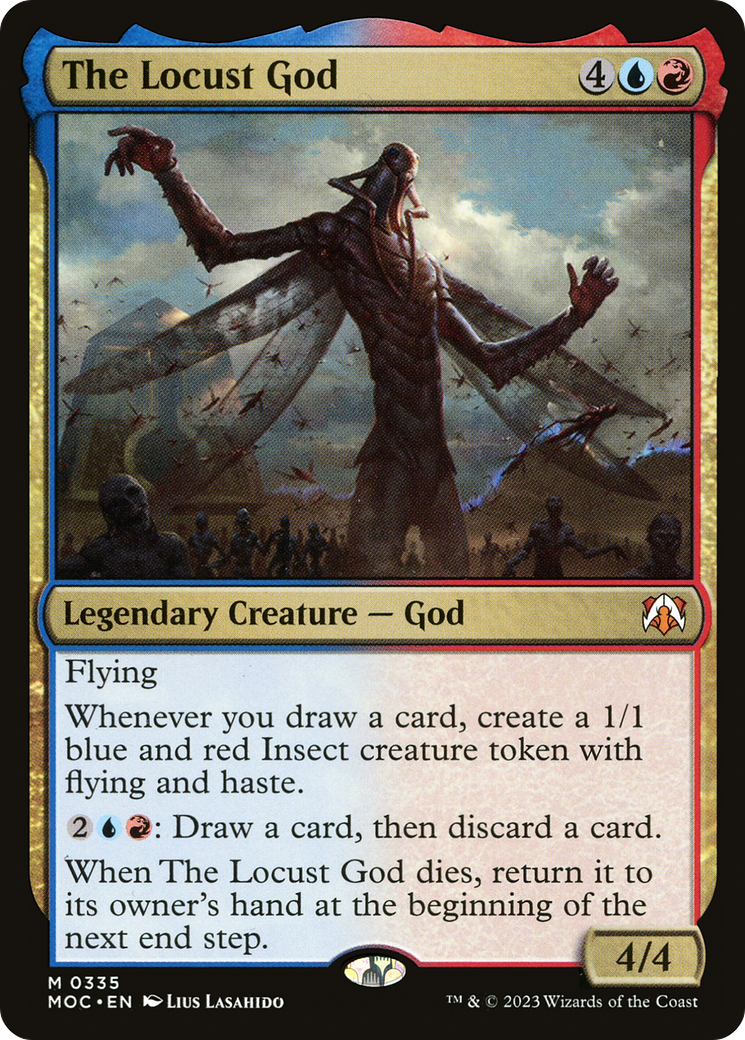
The other side of this combination is The Locust God, a six-cost 4/4 with flying. There are a few printings, but you can expect to pay around $7 — but it’s well worth the investment. That’s because whenever you draw a card, you can create a 1/1 insect creature token with flying and haste. You can probably see where this is going.
When you draw your first card of the turn, you’ll trigger The Locust God for a 1/1 insect. This then triggers Mister Fantastic, drawing another card and so on and so forth. You’re essentially getting infinite card draw and infinite creature tokens with which to overwhelm your foes. And, thanks to haste, you don’t need to wait another turn to do big damage. Thankfully, Mr. Fantastic’s ability is a “may,” meaning you won’t deck yourself.
The Locust God can trigger card draw on its own, too, with its activated ability. It won’t go infinite, of course, but it might just draw you Mister Fantastic at the moment you need him. In fact, if you get everything going your way, you could play this combo by turn six — sooner if you have some handy ramp. Also pretty scary is that your opponents will need to exile The Locust God to get rid of it for good. That’s because once it dies, it returns to its owner’s hand at the beginning of the next end step.
If you can get some protection on Mister Fantastic like Swiftfoot Boots or something similar, you can rest a little easier knowing that The Locust God can come back to your hand next turn. The Fantastic Four leader is just a great card for Commander, where token production is abundant. Expect to see “Stretcho” pop up in this type of combo quite often.
Image: Wizards of the Coast/Nathaniel Himawan
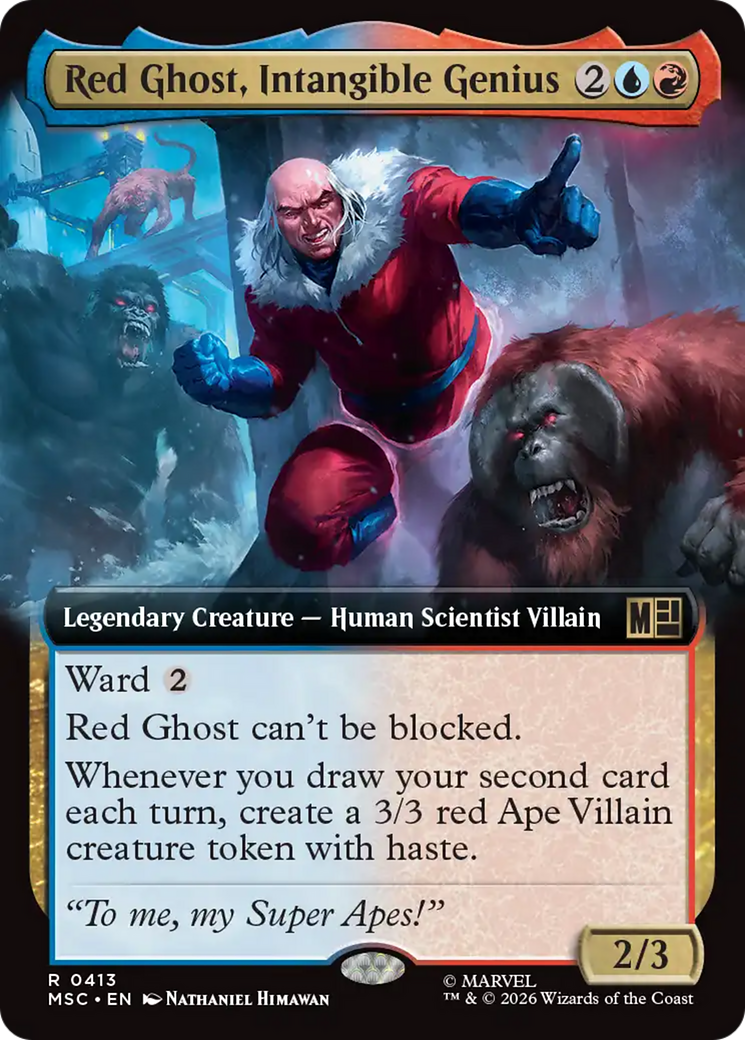
If you love comic book continuity in your Commander decks, or maybe you’re just a staunch defender of Universes Beyond, then consider adding Red Ghost, Intangible Genius. This classic Fantastic Four villain is a 2/3 that can’t be blocked and has ward 2. It creates 3/3 red Ape Villain tokens with haste when you draw your second card each turn. And, wouldn’t you know it, it’s also an Izzet card so it nestles nicely alongside the unlikely pairing of The Locust God and Mister Fantastic.
A full single-player expansion is coming to the great RTS game Tempest Rising. Titled The Veti’s Wrath, you’ll get some explosive new missions to play. In my initial review of the game I thought it was really good.
You only need to pay for it if you want the missions too – the faction is free for multiplayer which sounds like a nice compromise so multiplayer isn’t split. There’s even a demo of the DLC available with multiple missions and multiplayer against bots to try it out.
See the trailer and overview videos below:
Some key points of the DLC:
Features 11 new single-player Campaign missions where you will play as the Veti
The Veti Faction roster includes: 9 Buildings, 7 Vehicles, 6 Infantry Units, 5 Air Units, 5 Defensive Structures, 5 Specialists, 5 Support Powers, and 1 Superweapon
The Campaign expansion will be a paid DLC; we will share more information about the release at a later date
Playing as the Veti in Multiplayer will be FREE for all owners of the Tempest Rising base game. This includes Matchmaking, Custom Games, and Skirmish modes.
More about it:
In the wake of the Tempest Wars, the Veti lie shattered. Hunted by mankind’s warring factions across a world they once ruled, they scrape together what remains, restoring forces and rebuilding doctrine toward a single, absolute purpose: Reclamation.
K’uhul the Immutable watches through the cracks of his prison. An ancient Veti ruler entombed for devouring colony worlds across the stars, his acrid words seep through the scattered ranks of his own kind. If the reclamation fails, it will not be at human hands.
About Tempest Rising: The Veti’s Wrath
THE LOOMING DREAD
Experience the final chapter of Tempest Rising: lead the shattered Veti through a full-fledged 11-mission campaign to reunite your forces, reclaim stolen technology, and excise the corruption threatening to subsume your people from within.
SUBJUGATION AND SACRIFICE
The Veti do not waste their enemies. Convert fallen soldiers into the mindless Enlightened, then sacrifice them mid-battle to fuel your machines and empower your warriors. Master a full suite of new infantry, abilities, and doctrines built around total domination of the unworthy.
WRATH OF THE ANCIENTS
Every weapon in the Veti arsenal is designed to remind the humans of their place. From the colossal War Ender to the veiled Phantom Artillery, command a roster of devastating units. Deploy teleportation tactics, consume units on command for surges of power, and unleash the full might of a civilization older than human memory.
BLOOD IN THE MACHINE
Ascension Anchors are at the heart of every Veti base: sacrificial obelisks that ascend through tiers of power by consuming the Enlightened. Each tier extends new tethers to your surrounding structures, enhancing everything they touch. Choose where your power flows as the battlefield shifts.