Home Blog Page 59

Digger Trailer: Tom Cruise Has To Save The World Again, But This Time, He’s The Problem – SlashFilm

    0
    Digger Trailer: Tom Cruise Has To Save The World Again, But This Time, He’s The Problem – SlashFilm


    You know, it’s about time somebody finally canonized the subgenre involving Tom Cruise characters moving heaven and earth to save the world from some existential threat. Instead of another “Mission: Impossible” sequel or those harebrained plans to send the A-lister to space (yes, seriously), however, this one comes from one of our most distinctive (and divisive) filmmakers around. For years, we’ve only had the barest notion of what to expect from Cruise’s return to his more auteur-driven roots, teaming him up with Alejandro G. Iñárritu for “Digger.” Now, we’re finally getting a better picture of exactly what the “Birdman” and “The Revenant” director has up his sleeve next.

    Warner Bros. has released the first official trailer for “Digger” and, to put it lightly, the results have to be seen to be believed. Early word out of this year’s CinemaCon event in Las Vegas described the exclusive footage screened there in almost hyperbolic terms … but maybe they weren’t so unbelievable after all. Cruise stars as Digger Rockwell, a character unlike any we’ve seen from the legendary actor before. Not only is he a far cry from the suave, idealistic movie star we’ve come to know and love over the decades, but, according to the film’s synopsis, this plot involves the following:

    The most powerful man in the world embarks on a frantic mission to prove he is humanity’s savior before the disaster he’s unleashed destroys everything.

    Yeah, consider us intrigued. Knowing Iñárritu, this is going to be an unforgettable experience that demands to be seen on the big screen. If you haven’t already, check out the new footage above!

    Is Digger going to be more like Dr. Strangelove, or Don’t Look Up?

    Tom Cruise has frequently been tasked with saving the world on screen, but he’s not typically solving a problem that he himself caused. Leave it to Iñárritu to cast him against type as a blowhard oligarch who makes crass jokes and seems convinced he can “dig” his way out of any situation, even a self-imposed one. The humor in this trailer is very odd: Some of it is extremely broad (Cruise cracking wise about the size of his manhood, or John Goodman’s president appearing to be nearly dead and needing to be smacked back to consciousness), while other parts are bizarrely specific (what the heck is up with that cat’s face?). Historically, Iñárritu has not been an especially funny filmmaker, so we’re very curious to see if his sense of humor works better in context than it does in isolated moments.

    This seems like Cruise’s most overtly political movie in years: It appears to be partially about climate change, and how the gerontocracy tries to convince a gullible populace to buy into their sinister narratives. Iñárritu’s clearly not interested in subtlety – we see a fighter jet drop a bomb that has “suck it, nature” written on the side directly onto an iceberg. That makes us think we could be in for something similar to “Don’t Look Up,” Adam McKay’s divisive, bash-you-over-the-head political farce … but there’s also a chance this could end up closer to “Dr. Strangelove,” a cathartic comedy that met its moment and consequently went down in history.

    We’ll find out when “Digger” arrives in theaters on October 2, 2026.


    Source link

    How to Compare Bag Condition Photos Before You Buy

    How to Compare Bag Condition Photos Before You Buy


    Condition photos are the fastest way to separate a strong pre-owned bag from one that only looks good in the first image. When comparing authenticated pre-owned pieces on Couture USA, the practical question is not just whether a bag is beautiful, but whether it fits your routine, care tolerance, and budget. Start with a clear checklist so the photos, dimensions, return window, and condition notes have a job before a tempting listing takes over.

    Louis Vuitton Mini Soft Trunk Bag from Couture USA. Product photos can help you check shape, scale, material, and visible wear before comparing current listings.

    Quick buyer takeaway

    Condition photos are the fastest way to separate a strong pre-owned bag from one that only looks good in the first image. The right shortlist should make the piece easier to use, not just easier to admire.

    Couture USA offers authenticated pre-owned luxury, free shipping, and a 14-day return policy. Those details matter because a pre-owned bag decision depends on trust, condition clarity, and whether the item can be evaluated calmly once it arrives.

    What to check before you shortlist

    Before comparing prices, make sure the listing answers the practical questions a careful buyer would ask in person. Strong listings make condition visible rather than asking you to infer it from a polished first photo.

    Corner piping and edge glazing.
    Handle darkening or cracking.
    Zipper pulls, turn locks, and snaps.
    Lining stains and pocket wear.
    Base sagging or shape loss.

    How to compare the options

    Use the same comparison frame for every candidate. That keeps a rare color, famous logo, or tempting markdown from overpowering the details that determine whether you will actually carry the piece.

    Shopping situation
    What usually matters most
    How to confirm it

    Exterior photos
    look for shape, color consistency, corner wear, and hardware brightness
    Compare photos, dimensions, condition notes, and policy details before checkout.

    Interior photos
    confirm stains, peeling, odor notes, and pocket condition
    Compare photos, dimensions, condition notes, and policy details before checkout.

    Detail photos
    match closeups to the written condition notes before deciding
    Compare photos, dimensions, condition notes, and policy details before checkout.

    Photo and condition details that deserve extra attention

    Zoom in on contact points: corners, strap edges, handles, bases, closures, zipper pulls, and interiors. These areas show how a piece was used and whether the written condition notes match the visual evidence.

    For general designer bag browsing, compare the whole category first, then narrow by designer once the daily job is clear. Couture USA’s collection pages make it easier to move between Louis Vuitton, Chanel, Hermes, and the broader designer bag collection.

    Before checkout: score the piece like a buyer

    Give the listing a simple pass-fail review before you let scarcity or a markdown decide for you. A strong candidate should satisfy the practical job, show the wear clearly, and leave you with no major unanswered questions about authenticity, returns, fit, or care.

    Use case: the piece solves the main reason you started shopping, whether that is daily carry, work, travel, gifting, or a polished evening option.

    Condition: the visible wear matches the written notes and falls within what you will still enjoy using.

    Fit: dimensions, strap drop, closure, and capacity work with your body, wardrobe, and essentials.

    Confidence: authentication language, return policy, and seller detail are clear enough for the price level.

    Common mistakes to avoid

    Relying on only one front-facing photo.
    Assuming studio lighting reveals every flaw.
    Missing scale because no worn or angled photo is shown.

    A pre-owned piece can still be an excellent buy with visible wear, but the wear should be understood before checkout. The goal is not perfection; it is alignment between price, condition, use case, and expectations.

    Where to browse next on Couture USA

    Use these checks before moving into the live inventory pages that match your intent. Start broad if you are comparing designers; go directly to the brand collection if you already know the house you want.

    FAQs

    How many photos should a listing have?

    There is no fixed number, but a useful listing should show front, back, sides, base, interior, hardware, handles or straps, and closeups of wear.

    What if a detail photo is missing?

    Treat the missing angle as a question to resolve before buying. For high-value bags, uncertainty around corners, lining, or hardware is worth slowing down for.


    Source link

    Octopath Traveler 1 and 2 launch on Switch 2 – VideoGamer

    Octopath Traveler 1 and 2 launch on Switch 2 – VideoGamer


    You can trust VideoGamer. Our team of gaming experts spend hours testing and reviewing the latest games, to ensure you’re reading the most comprehensive guide possible. Rest assured, all imagery and advice is unique and original. Check out how we test and review games here

    Square Enix has brought both Octopath Traveler and Octopath Traveler II to Nintendo Switch 2, with the two acclaimed JRPGs available digitally from today, July 13.

    The ports were announced during a broadcast celebrating the eighth anniversary of the original Octopath Traveler, which first launched for Nintendo Switch on July 13, 2018. Rather than attaching the news to a lengthy marketing campaign or distant release date, Square Enix confirmed that both games would arrive on Nintendo’s latest console immediately.

    At the time of writing, we don’t have pricing details or confirmed whether players who already own either game on the original Switch will receive a free or discounted upgrade. It is also unclear whether save data can be transferred between versions. Square Enix has yet to detail any Switch 2-specific technical improvements, so prospective buyers may want to check the eShop listings before purchasing.

    The first Octopath Traveler takes place across the fantasy world of Orsterra and lets players begin as one of eight protagonists, each with their own personal story, abilities and reasons for setting out on the road. Players eventually recruit the other travellers, creating a party while working through a series of interconnected adventures.

    Octopath Traveler II follows a similar structure but introduces eight new heroes and moves the action to Solistia, a world entering a new industrial age. Its stories feature characters including a merchant hoping to eliminate poverty, a scholar seeking revenge and a thief desperate to escape a life of bloodshed. The sequel also expanded the original game’s ideas with a day-and-night cycle, shared character chapters and more interaction between party members.

    Both games are best known for Square Enix’s HD-2D visual style, which combines detailed pixel-art characters with modern lighting, effects and 3D environments. Battles use the series’ turn-based Break and Boost system, encouraging players to uncover enemy weaknesses, break their defences and store points for more powerful attacks.

    The two releases join Octopath Traveler 0 on Switch 2, meaning Nintendo’s newer hardware can now play all three main console entries in the series natively.


    Source link

    Ripple CEO says SEC suit nearly pushed company to shut down

    0
    Ripple CEO says SEC suit nearly pushed company to shut down


    Ripple CEO Brad Garlinghouse said he and co-founder Chris Larsen seriously considered shutting the company down after the SEC sued in 2020 and distributing Ripple’s XRP holdings to shareholders.

    In a KU Hustle interview, Garlinghouse said they chose to fight instead because closing Ripple would have cost hundreds of jobs. He estimated the four-year legal battle cost the company about $150 million. The scenario concerned Ripple as a company, rather than a shutdown of the XRP Ledger or a loss of XRP held by the public.

    We almost decided to shut down the company when the SEC sued us. We we were like uh you know like the government has infinite power and resources.

    The SEC’s August 2025 litigation release dismissed their respective appeals, resolving the enforcement action. However, the district court’s final judgment remained in effect, including a $125.04 million civil penalty and an injunction against Ripple.

    SEC files to settle lawsuit with Ripple, execs over civil penalty dispute
    Related Reading

    SEC files to settle lawsuit with Ripple, execs over civil penalty dispute

    The SEC filing virtually concludes the long-standing legal battle with Ripple, although additional steps are required to ultimately extinguish the lawsuit.

    May 8, 2025 · Gino Matos

    Garlinghouse said Ripple and Larsen had considered winding down the company and distributing its XRP holdings to shareholders on a pro rata basis. They chose to continue operating and fight the case, a decision Garlinghouse said preserved hundreds of jobs but ultimately cost about $150 million in legal fees.

    Ripple CEO calls SEC's appeal ‘insanity' as legal fight intensifiesRipple CEO calls SEC's appeal ‘insanity' as legal fight intensifies
    Related Reading

    Ripple CEO calls SEC’s appeal ‘insanity’ as legal fight intensifies

    Ripple remains resolute as it dismisses SEC’s latest appeal as groundless repetition of old arguments.

    Jan 16, 2025 · Oluwapelumi Adejumo

    A corporate decision with XRP at the center

    Conceptual diagram separating a crypto company, its token reserve, a decentralized ledger network and public token holders.Conceptual diagram separating a crypto company, its token reserve, a decentralized ledger network and public token holders.
    Conceptual diagram separating the crypto company, its token reserve, a decentralized ledger network and public token holders.

    Ripple equity, XRP held by Ripple, the XRP Ledger, and XRP held by the public are different things. The plan Garlinghouse described concerned dissolving Ripple and distributing the company’s XRP holdings to its shareholders. It did not imply that the ledger would shut down or that XRP held by the public would be transferred or lost.

    CryptoSlate Daily Brief

    Daily signals, zero noise.

    Market-moving headlines and context delivered every morning in one tight read.

    5-minute digest 100k+ readers

    Free. No spam. Unsubscribe any time.

    Whoops, looks like there was a problem. Please try again.

    You’re subscribed. Welcome aboard.

    Ripple could have shut down and the XRP Ledger still would have kept running. Garlinghouse wasn’t making a call on XRP’s price or suggesting the network or existing holders would be affected by the company’s fate.

    Ripple agrees to pay $50M fine and drop cross-appeal to settle SEC lawsuitRipple agrees to pay $50M fine and drop cross-appeal to settle SEC lawsuit
    Related Reading

    Ripple agrees to pay $50M fine and drop cross-appeal to settle SEC lawsuit

    The settlement is now pending the SEC’s vote, and will end the XRP lawsuit if approved.

    Mar 25, 2025 · Gino Matos

    Ripple’s XRP reserve gave the company a way out if it chose to shut down. Instead, leadership stayed the course, accepting years of litigation and mounting legal bills in exchange for keeping the business alive.

    The interview stops short of saying Ripple’s XRP reserve paid for its defense. What it reveals is the leverage that reserve gave its leaders when the choice narrowed to fighting on or shutting down.


    Source link

    Beastro Review | TheSixthAxis

    Beastro Review | TheSixthAxis


    Welcome to Palo Pori, a snuggly, tranquil village, where the villagers love culinary treats of all flavours. In Beastro, you play as Panko, a talented young chef who assists in the running of Palo Pori’s local restaurant. But on the morning we meet this budding cook, Panko’s teacher and lead chef of the restaurant, Travers, has gone missing, and a strange visitor – a magical flame spirit by the name of Flambe – has arrived with an injury and a troubling message about danger brewing outside the village walls. It’s down to Panko and Flambe to work together to save their home in the only way they know how – by cooking of course!

    The tastiest part of Beastro is the storyline – and the characters that accompany it. The player is welcomed into a one-of-a-kind universe of friendly creatures using wittily-named ingredients to rustle up magical food that can fight off evil monsters. What’s not to love? The spirits, caretakers and villagers you meet have all been well-shaped by the creators with their own unique and fully-formed personalities. For me, there was the potential to explore a little further into the world that had been created. But I was left wanting more, which is no bad thing.

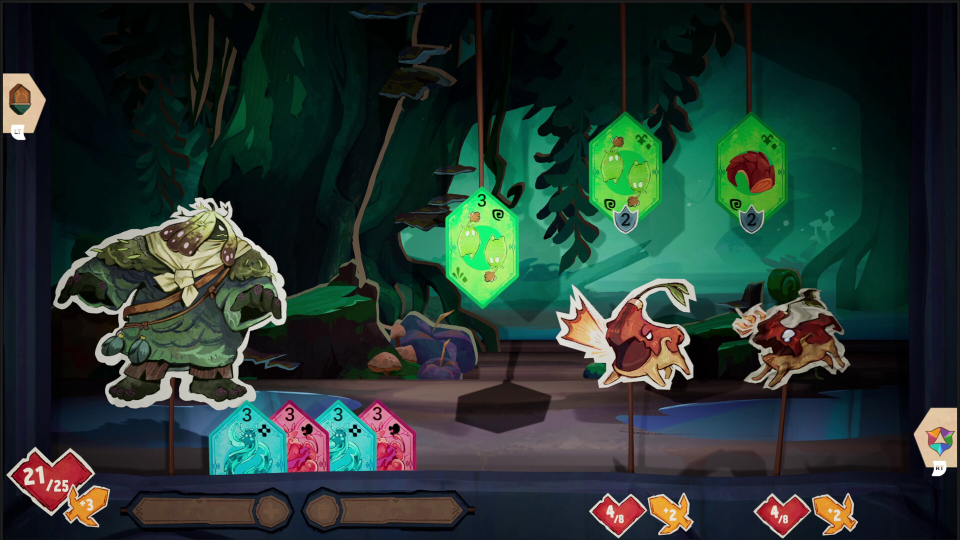
    Beastro throws many different play styles, like ingredients, into the pan. Each morning starts with an open-world venture around the lusciously vibrant village of Palo Pori, farming, chatting, fishing, and generally gathering ingredients. Next, you’re in the restaurant preparing food for your customers by completing a variety of enjoyable mini-games. Following this, you’re tasked with preparing a special magical meal for one of the caretakers before they head out of the village to fight monsters.

    Here, you build them a flavour-balanced meal from your available ingredients – this will form your card deck for combat later. You then conclude the day with the caretaker retelling the story of their adventures with a quirky puppet-show. For this section, you take on the role of the caretaker to defeat the monsters in card-based combat using the deck you prepared for yourself in the restaurant earlier.

    All in all, it seems like a lot of moving parts. But, in reality, the whole thing is very satisfying. The variety of playstyles combine beautifully, giving a fusion of gameplay flavours, each perfectly complimenting the next. The diverse range of activities for the player keeps things fresh and I found myself looking forward to the routine of each in-game day. Impressively, each of the separate gameplay elements perform to the same standard – each is individually well formed and engaging, with no single section letting the others down. A special mention must go to the the mini games that were equal parts entertaining and challenging – just when you feel you’ve got the hang of things, a new mechanic is added that spices things up again.

    In Beastro, everything revolves around the enhancing and/or balancing of the five main flavour groups; sweet, salty, sour, bitter, umami – and a cheeky sixth; spicy. The flavours are steeped into more than just the cooking – they’re used in combat, they define the regions to which the caretakers travel, and they characterise the monsters you fight. Even the personalities of the caretakers are defined by the flavour of the region they hail from. The full infusion of this flavour theme into every aspect of the game’s narrative and mechanics shows the amount of love and effort that must have gone into its creation. And it truly pays off, immersing the player into this taste-sensation of a universe.

    Beastro is characterised by a wonderfully sumptuous use of colour. From the vibrant cartoon visuals of the buildings, creatures and ingredients found in Palo Pori village, to the playful and imaginative 2D artwork of the puppet-show combat sections, the imagery of this game is charming and appealing to the eye.

    The combat section itself is fun and satisfying to play and has lots of personality. Though seemingly quite confusing during the initial tutorial, the base rules are refreshingly uncomplicated – particularly for a deck-building game. The aim is to match the flavour colour and strength of the enemy card with one of your own cards, or better yet, chop down the power of the enemy card with a balancing flavour card. On top of this, the caretakers, meals and ingredients you use can add bonus enhancements and abilities. Plus, you receive level-ups across the board the further you explore in the world, unlocking and upgrading things around the village. The upgrades can start to make later levels feel a little too easy to mash through, but overall, the combat is nicely achievable without too much pushback.

    My only grumble was the introduction of new caretaker characters that superseded the previous ones. By a certain level in the game, I didn’t see any benefit to using the earliest caretaker character, Oyshi, whose attacks weren’t as powerful as those of the later caretakers. A tiny niggle perhaps – but it would have been nice to level up individual caretakers so that the player could take on the monsters with their favourite challenger.


    Source link

    Heavy Metal Death Can is a retro survival horror set on a Cold War–era submarine – now on Linux

    Heavy Metal Death Can is a retro survival horror set on a Cold War–era submarine – now on Linux


    Heavy Metal Death Can released back in May and just recently the developer updated the game to include Native Linux and macOS support. It was already rated Steam Deck and Steam Machine Verified back in June using Proton.

    If you enjoy classics like Resident Evil – this is likely a good one for you to dive into.

    What is it? “Heavy Metal Death Can is a Retro Inspired Survival-Horror game set on a submarine in an alternate history version of late 70s Sweden. Trapped in the depths of the Norwegian Sea you must fight for survival against the terrifying Sludge which has possessed your crew mates and turned them into horrific zombies. Look for survivors and uncover the truth behind the madness”.

    See the original launch trailer below:

    More about it from the Steam page:

    A Return to True Survival Horror

    Step into a claustrophobic, rust-ridden nightmare inspired by genre-defining classics of the PS1 era. With limited ammo, fixed camera angles, and analog dread, every creak of the hull might be your last.


    Fixed Cameras. Real Tension.No handholding. No over-the-shoulder comfort. Your fear is earned.
    Inventory Matters.Manage dwindling supplies, makeshift keys, and enigmatic keepsakes from a submerged past. Every bullet counts—and you will never have enough.
    Retro Revival Aesthetics.The game’s art style draws inspiration from the vibrant backdrops of late ‘90s horror and adventure games, reimagined with modern rendering technologies.

    A Morbid Can of Death

    Discover the chilling secrets behind the incident on the vessel HMS Domherren. Each corridor reveals fragments of a buried conspiracy… and something not quite human.


    Alternate History. Nordic Noir Meets Deep Sea Horror.Immerse yourself in a Swedish setting where otherwise cozy cultural staples are contrasted with the metallic callousness of industrial brutality.
    A Lovable cast of survivors.Along the way, you’ll encounter other survivors—like the enigmatic Milton and the nihilistic Captain Olof—each with their own agendas and haunted pasts. Trust is scarce, but cooperation is the only way home.
    Soundtrack from the Depths.Drenched in distorted guitar, analog synth and unsettling silence. Every note is a nail in your coffin.

    Features:


    Old-school terror meets Swedish submarine surrealism in this survival horror in the style of early console classics.
    Fixed camera angles and tank controls (with modern options) lend a haunting atmosphere to the game.
    Uncover a twisting narrative through uneasy alliances and strange encounters.
    A nostalgic visual style inspired by ’90s horror games, enhanced with modern rendering technologies.
    Unique Late 1970s Swedish Naval setting gives you a creepy sense of fauxstalgia for a place in time that never quite was.

    Steam Deck ✅ Verified

    Release Date: 📅 28th May 2026

    Platform: 🐧 Native Linux

    🌐 External Sources: steamcommunity.com
    Article taken from GamingOnLinux.com.


    Source link

    Deathchase for the VIC-20 – A port of the classic Spectrum 3d forest chase game has arrived on the VIC-20

    Deathchase for the VIC-20 – A port of the classic Spectrum 3d forest chase game has arrived on the VIC-20


    Well this is glorious news for an early morning heads up, as the classic ZX Spectrum 3D forest chase game Deathchase has been successfully ported to the Commodore VIC-20 (8K RAM expansion) by Kweepa, the talented creator behind the VIC-20 Jet Set Willy port. To overcome the VIC-20’s lack of per-cell background colours, Kweepa implemented a clever raster split technique to dynamically change the background from sky to ground colour mid-frame. Furthermore, the game optimizes performance by ditching the original Spectrum version’s slow two- or three-pass rendering system. Instead, it utilizes a custom lookup table that scans ahead in the map to pull trees forward and outward. This mathematical approach speeds up gameplay significantly while ensuring highly accurate 3D perspective scaling.

    Players will notice a slightly modified 23×22 screen layout. While incredibly close to the VIC-20’s standard 22×23 display, this specific configuration places a distinct line directly down the center to establish perfect visual symmetry. Though the core gameplay remains delightfully simple, the developer notes that roughly 2K of memory remains entirely free. This open space provides a perfect opportunity for the community to tweak mechanics, optimize code, or introduce brand-new features.

    Links :1) Source 


    Source link

    Gate Introduces OpenAI Pre-IPO Investment Product Ahead Of Potential Public Listing | Metaverse Post

    Gate Introduces OpenAI Pre-IPO Investment Product Ahead Of Potential Public Listing | Metaverse Post


    In Brief

    Gate launches an OpenAI pre-IPO asset certificate offering, allowing USDT and GUSD subscriptions ahead of a potential public listing.

    Gate Introduces OpenAI Pre-IPO Investment Product Ahead Of Potential Public Listing

    Digital asset exchange Gate announced the second phase of its Pre-IPOs initiative, introducing a subscription offering linked to OpenAI ahead of any potential public listing. The subscription period is scheduled to run from July 15 to July 17, 2026, with participation available using USDT and GUSD.

    According to the company, the offering has a total subscription value of approximately $20 million and includes 27,700 OpenAI Asset Certificates priced at $722 each. The minimum subscription amount is 100 USDT or 100 GUSD, and the platform stated that no implied trading or custody fees will apply during the subscription period.

    The OpenAI Asset Certificates are structured as pre-IPO financial instruments designed to track the company’s valuation before and after a potential public listing. Gate said the certificates are issued as Contingent Payout Notes (CPNs) and are intended to provide exposure to OpenAI’s private market valuation. Following any future IPO and the applicable lock-up period, holders may be eligible to redeem the certificates for shares, tokenized stocks, or USDT based on the prevailing market value, subject to the platform’s redemption terms.

    Allocation, Trading, and Broader Investment Strategy

    Certificate allocation will be determined using users’ average locked subscription balances over the offering period. Distribution is scheduled to take place in three phases, with portions of the allocation unlocking in July, August, and September 2026. Gate also plans to enable pre-market trading of the certificates beginning on July 20, allowing participants to trade their holdings before any public listing of the underlying company.

    The platform is also introducing promotional incentives alongside the offering, including GT token airdrop rewards for eligible participants and annualized returns for users subscribing with GUSD.

    The launch forms part of Gate’s broader strategy to expand its investment products across pre-IPO opportunities, tokenized securities, and listed equities. The company stated that it continues to develop services that combine digital assets with traditional financial markets, including tokenized stock products and round-the-clock access to selected equity markets.

    Disclaimer

    In line with the Trust Project guidelines, please note that the information provided on this page is not intended to be and should not be interpreted as legal, tax, investment, financial, or any other form of advice. It is important to only invest what you can afford to lose and to seek independent financial advice if you have any doubts. For further information, we suggest referring to the terms and conditions as well as the help and support pages provided by the issuer or advertiser. MetaversePost is committed to accurate, unbiased reporting, but market conditions are subject to change without notice.

    About The Author


    Alisa, a dedicated journalist at the MPost, specializes in crypto, AI, investments, and the expansive realm of Web3. With a keen eye for emerging trends and technologies, she delivers comprehensive coverage to inform and engage readers in the ever-evolving landscape of digital finance.

    More articles


    Alisa, a dedicated journalist at the MPost, specializes in crypto, AI, investments, and the expansive realm of Web3. With a keen eye for emerging trends and technologies, she delivers comprehensive coverage to inform and engage readers in the ever-evolving landscape of digital finance.


    More articles


    Source link

    Hand-loomed madras back in stock, with two new colours

    Hand-loomed madras back in stock, with two new colours


    Hand-loomed madras back in stock, with two new colours

    Monday, July 13th 2026
    Share

    Subscribe
    4 Comments
    Add to favourites
    ||- Begin Content -||

    I was pleasantly surprised by the reaction to our madras shirt last year. Although there was a  nice craft story there with the hand weaving, I was a little afraid the bolder check and colour would put people off. 

    The first batch sold within a week though, and we rushed to get another one by the end of the summer, which then also sold out. A little bit of inadvertent hype probably played a role – the first batch was not large, given my concern, which made them seem to sell particularly quickly. Still, a nice reaction. 

    It’s not always like this. Readers have mentioned that it can seem as if everything sells quickly, that it’s all a roaring success. Well, in the interests of showing we’re not over-selling, some things don’t have that kind of reaction.

    The sleeveless sweaters, for example, have chugged along since they launched but not seen any kind of rush. A few readers love them, and have asked repeatedly for new colours, but they’re not for everyone. The Wool Walker also sold consistently over the past couple of years, but never fast. 

    Perhaps the success of the madras shows that there’s a hole in the market for interesting but eminently wearable patterns; the kind of thing your partner might be slightly but also pleasantly surprised by. 

    Fewer people might be exploring these because the market feels so tough at the moment. Everyone trends conservative in hard times. (And womenswear trends towards menswear – hence all the jeans, boat shoes and suede jackets in the women’s market.)

    Whatever the reason, I’m pleased to say we’ve restocked the original PS madras in greater volume than last year, and added two new colours – one brighter than the original, one more conservative. 

    The first, above, is a cream with brown, beige and blue overchecks, plus a hint of green and a dash of yellow. To me it’s the more adventurous of the two new colours, but probably because of the pale colour overall rather than the checks themselves. 

    It’s actually very easy to wear, as you can pick up the colour of any of those checks in other things you’re wearing: blues or browns, green and khaki. A little like we all used to be told to pick up a colour from a tweed jacket when making choices of the tie or handkerchief to go with it. 

    Here I’m wearing the shirt with some old Levi’s and our PS boat shoes, and tucked out. 

    This is easier with the madras shirts because they’re cut a bit fuller in the body than the other shirts (the same as the oxfords before the shrinkage, for those that know the range). It’s not how I wear my shirts during the week so much, but is a nice relaxed option on the weekend. 

    And then, to keep everyone happy, the new blue madras is tucked in. Both work equally well in either style, but I know readers like to see a range of options. 

    The blue was designed to be very easy to wear – it’s the same colour palette as your jeans, and navy suits, and blue oxfords – but light enough to go with all those jeans and navy chinos. 

    The background is a pale grey/beige, and then different blues are layered on top of it. I know not everyone will like the T-shirt underneath, but I like it as a nice piece of layering. More on the topic of tees under shirts here. 

    One last thing about the madras shirts that’s worth repeating: they need very little ironing. Just like the button-down oxfords that Ivy students apparently preferred because they didn’t need to be ironed (or more realistically, could get away most with not being ironed) this hand-loomed madras doesn’t wrinkle that much, which is a nice bonus. 

    Most of the time I just wash them and then hand to dry and they’re fine. 

    I should also say that all three madras patterns are available as cloth for people to buy their own and send to a shirtmaker. It’s narrow-width cloth with a selvedge, so we sell the lengths at 2.7m. 

    The cloth:

    100% cotton Madras, hand-woven in Chennai by Original Madras Trading Company
    Open and breathable, suitable for warmer weather though not high summer
    Softens with washing and wear
    Weight 150gsm
    Lengths sold as 2.7m, narrow width (95cm) with selvedge
    Slight differences in length and width a result of being hand loomed
    Occasional slubs in the clothare  also a natural result of the process, not a fault
    Slight colour fading, but only after many washes. Similar to a light denim shirt
    Minimal shrinkage, 1-2%

    Shirt summary:

    Hand-made in Naples, Italy by the workshop of Luca Avitabile
    Hand-attached collars and armholes; hand-sewn buttons and buttonholes
    Button-down collar designed to roll open from the neck, and around a jacket lapel
    Length of a regular dress shirt, but can be worn tucked in or out

    Care and fit:

    Machine wash and hang dry (or dry clean)
    Can be ironed as normal, but not necessarily needed
    Comfortable fit, 2cm wider in the waist than other PS shirts but otherwise the same fit
    Simon is wearing a size medium in the images of the two new colours, a bespoke shirt in the original (the brown and orange check)

    <!–

    –>


    Source link

    The Great AI Memory Chip Crisis Is Approaching | Metaverse Planet

    The Great AI Memory Chip Crisis Is Approaching | Metaverse Planet


    I was staring at the black background of my WordPress editor late last night, tweaking some code, when I stumbled upon a statement from SK Hynix that genuinely made me pause. We all know the artificial intelligence boom is consuming computing power at an insane rate, but the hardware reality behind it is starting to look a bit terrifying.

    According to SK Hynix CEO Kwak Noh-jung, the memory chip industry is heading straight toward the most severe supply shortage in its history. And it is not just a temporary hiccup.

    Why the Panic Over Memory Chips?

    Whenever I review high-tech gear, from the latest VR headsets to cutting-edge smart glasses, I always notice how memory-hungry modern devices are getting. The demand is skyrocketing, but physical manufacturing has hard limits.

    Here is what is currently keeping the industry awake at night:

    The AI Appetite: The massive surge in generative AI relies heavily on High Bandwidth Memory (HBM). Right now, SK Hynix is a crucial supplier for tech giants like Nvidia and AMD.A Decade-Long Problem: Even though they are aggressively expanding production, Kwak explicitly stated that customer demand will likely exceed supply capabilities well beyond the next decade.The Worst is Yet to Come: The CEO bluntly warned that, from a supply perspective, the upcoming years will be the toughest the industry has ever faced.

    It is wild to think about. We are building the software of the future, but we might physically run out of the hardware needed to run it.

    The Billion-Dollar Global Expansion Race

    To fight this incoming drought, companies are scrambling to build new fabrication plants, but it is not as simple as just throwing money at the problem. Finding the right location requires massive amounts of land, water, reliable energy, and highly skilled labor.

    Here is where the major investments are flowing right now:

    United States: SK Hynix is already injecting $4 billion into an advanced chip-packaging facility in Indiana and planning another $10 billion investment focusing on AI solutions.South Korea: Alongside Samsung Electronics, they are part of a massive government push. The plan? A staggering $266 billion joint investment to double the country’s memory production capacity within five years. They are currently building a mega-complex in Yongin.Exploring New Territories: Japan and Southeast Asia are also firmly on the table for future wafer fabrication plants.

    Will the Tech Industry Hit a Wall?

    There has been some recent chatter online about AI investments cooling down, but if you look at the supply chain, the big players are doubling down. Nvidia’s Jensen Huang recently confirmed that the AI memory squeeze will last for several more years. Financial institutions like UBS and Bank of America back this up, predicting that hyperscaler capital expenditures will hit over $1.15 trillion next year alone.

    As someone who covers emerging tech daily, I can’t help but wonder how this hardware bottleneck will impact the consumer side. If enterprise AI is eating up all the memory supply, will our consumer gadgets suddenly become significantly more expensive or delayed?

    I honestly think we are about to enter a very strange era of hardware rationing. But what do you think? Will this massive chip shortage slow down the AI revolution, or will companies find a new hardware breakthrough to bypass the crisis? Let me know your thoughts down below!

    You Might Also Like;


    Source link

    Popular Posts

    My Favorites

    Jackson Duggar: My Family is NOT a Cult, Okay?!?

    0
    Reading Time: 3 minutes Jackson Duggar is not exactly the most famous member of his controversial family. But the 21-year old is now...