Home Blog Page 57

Zcash (ZEC) Price Jumps 15% This Week as Trading Volume Falls

Zcash (ZEC) Price Jumps 15% This Week as Trading Volume Falls


Key Highlights

Zcash (ZEC) gained 3.65% today and is up 15% this week as investor confidence continues to recover after last month’s security fix.

Trading volume remained strong as buyers pushed ZEC higher from its June lows, helping fuel the recent price recovery.

Traders are watching the $534 resistance level, with a breakout pointing toward $675, while failure could send ZEC back to around $390.

Zcash (ZEC) surged about 4.72% on Tuesday as investors continued buying the privacy-focused cryptocurrency after its strong recovery from June’s security scare.

The move added to a 15.71% gain over the last seven days and remains one of the best-performing cryptocurrencies among the top assets over the last 30 days, with a 25% gain.

At the time of reporting, ZEC is trading for $532, up from an intraday low below $480. Meanwhile, the trading activity has dropped about 11% to around $481 million in volume, while the market cap sits at around $8.93 billion. 

ZEC price chart | Source: CoinMarketCap

Why is ZEC price up today?

One major reason is the hype from the upcoming Ironwood network upgrade. Recently, Zcash core developer Sean Bowe confirmed that the update will activate at block height 3,428,143, expected around July 28 at 8 a.m. EST.

The upgrade was moved back from the earlier July 21 target to give exchanges, mining pools, wallet providers, and other service providers more time to prepare. “Zcash’s Ironwood mainnet activation height has been set and tagged,” Bowe wrote, adding that all major ecosystem organizations are committed to activating NU6.3 at the scheduled block height.

Aside from this, the wider cryptocurrency market also helped support ZEC’s latest move after fresh U.S. inflation data came in lower than expected.

According to the U.S. Bureau of Labor Statistics, the Consumer Price Index (CPI) rose 3.5% year-over-year in June, below the expected 3.8%, while monthly CPI came in at -0.4%, compared with forecasts of -0.1%. Core CPI also slowed to 2.6% year-over-year and remained flat on a monthly basis, both below market expectations.

The inflation report attracted extra attention after Federal Reserve Governor Christopher Waller recently said he could support another interest rate hike if inflation remained high.

Instead, the softer inflation figures improved market sentiment and helped lift Bitcoin, which in turn supported buying across the broader cryptocurrency market. In short, as major cryptocurrencies like Bitcoin surge following the CPI release, investors also increased exposure to altcoins, with Zcash extending its rally alongside the wider market.

ZEC faces the $534 resistance level 

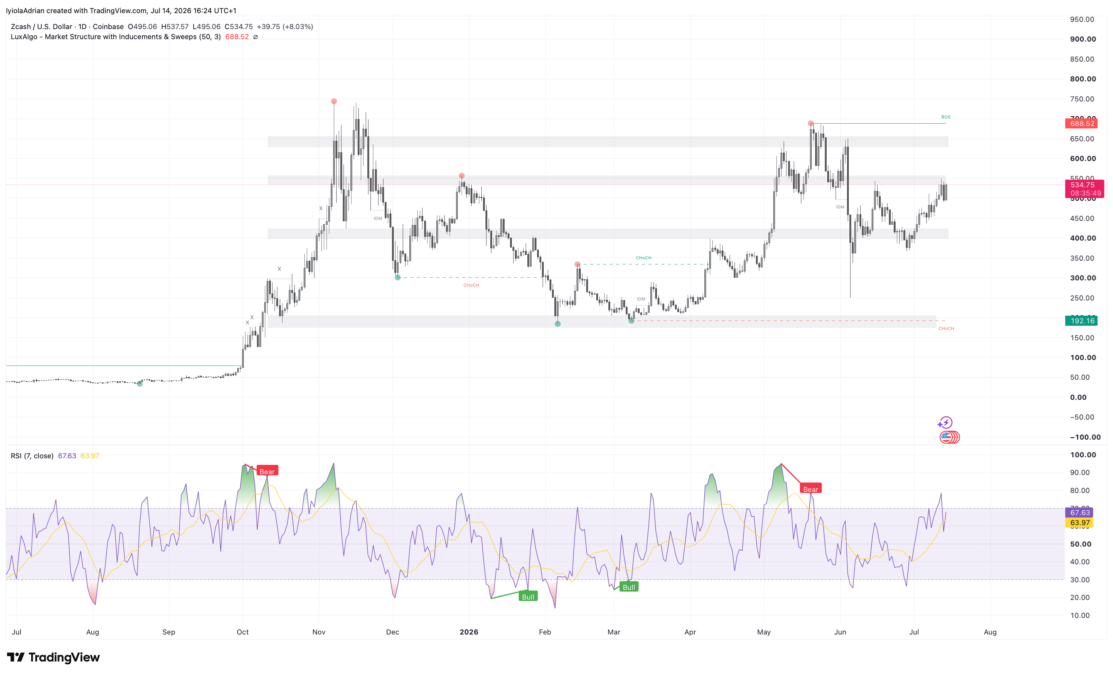
Looking at the chart on the daily time frame, the price is now reacting to a resistance level at $534, which is a level that had previously acted as both support and resistance in the past, making it an important point for the market.

ZEC daily price chart
ZEC daily price chart | Source: TradingView

If buyers can push ZEC above this level, the token could build enough strength to move toward its recent high near $644. On the other hand, if sellers take over, the price could lose momentum and fall toward the next major support around $410.

Moreover, the Relative Strength Index (RSI) is at 66, which suggests that buyers are in control and the price still has room for more upside move.

Also Read: Dogecoin (DOGE) Shows Buying Interest with 2.2% Gain in 24 Hours


Disclaimer: The information researched and reported by The Crypto Times is for informational purposes only and is not a substitute for professional financial advice. Investing in crypto assets involves significant risk due to market volatility. Always Do Your Own Research (DYOR) and consult with a qualified Financial Advisor before making any investment decisions.


Source link

Boundless Expands Distributed GPU Compute Network To Support AI Inference Workloads | Metaverse Post

Boundless Expands Distributed GPU Compute Network To Support AI Inference Workloads | Metaverse Post


In Brief

Boundless expands into AI inference, repurposing its distributed GPU network to deliver managed, lower-cost infrastructure for enterprise AI workloads.

Boundless Expands Distributed GPU Compute Network To Support AI Inference Workloads

Boundless has announced its expansion into the artificial intelligence sector, with plans to deploy its distributed GPU network to support the growing demand for AI inference. The move extends the company’s existing infrastructure, which was originally developed to power zero-knowledge (ZK) proving workloads for the cryptocurrency industry.

“Four years ago, we set out to solve one hard compute problem,” said Shiv Shankar, CEO of Boundless. “In the process, we built something bigger: a network for coordinating distributed GPU capacity. AI now needs the same foundation at a much larger scale. Open models are giving teams more control over what they build, but production inference is still constrained by cost, capacity, and reliability. Boundless is built to change that.”

The company’s ZK proving network was designed to coordinate distributed GPU resources, schedule compute-intensive tasks, and maintain efficient operations across multiple machines. Boundless stated that the same infrastructure is now being adapted to address increasing demand for AI inference as organizations expand the deployment of artificial intelligence applications.

According to the company, AI inference is emerging as a significant driver of computing demand, with infrastructure costs becoming an increasingly important consideration. Citing Gartner, Boundless noted that 55% of spending on AI-optimized infrastructure-as-a-service is expected to be allocated to inference in 2026, increasing to more than 65% by 2029.

Boundless Repurposes GPU Network for AI Inference

Boundless stated that many AI inference workloads do not require premium data center GPUs and can instead operate efficiently on lower-cost hardware, including consumer-grade graphics processors and GPUs originally acquired for compute-intensive applications such as cryptocurrency mining and ZK proving. The company said it aims to identify and optimize this underutilized capacity by integrating hardware, software, and inference-serving systems.

The company currently operates a distributed network of approximately 4,000 GPUs that was initially developed for ZK proving. As part of its AI strategy, Boundless is optimizing the network to provide managed inference infrastructure, including hardware optimization, workload adaptation, routing, batching, scheduling, monitoring, and operational support.

Boundless reported that early benchmarking indicates inference costs could be reduced by as much as 50% compared with hyperscale cloud providers, with the greatest potential savings expected for asynchronous workloads. The company also plans to integrate its native ZKC token into the AI network, with operators expected to stake the token to participate and with staking levels linked to earning potential.

Boundless stated that the expansion is intended to enable organizations to deploy AI inference workloads with lower computing costs. The transition to AI infrastructure was announced today, while the full product launch is scheduled for later this summer. The company added that it will continue operating its zero-knowledge proving network alongside its AI inference services.

Disclaimer

In line with the Trust Project guidelines, please note that the information provided on this page is not intended to be and should not be interpreted as legal, tax, investment, financial, or any other form of advice. It is important to only invest what you can afford to lose and to seek independent financial advice if you have any doubts. For further information, we suggest referring to the terms and conditions as well as the help and support pages provided by the issuer or advertiser. MetaversePost is committed to accurate, unbiased reporting, but market conditions are subject to change without notice.

About The Author


Alisa, a dedicated journalist at the MPost, specializes in crypto, AI, investments, and the expansive realm of Web3. With a keen eye for emerging trends and technologies, she delivers comprehensive coverage to inform and engage readers in the ever-evolving landscape of digital finance.

More articles


Alisa, a dedicated journalist at the MPost, specializes in crypto, AI, investments, and the expansive realm of Web3. With a keen eye for emerging trends and technologies, she delivers comprehensive coverage to inform and engage readers in the ever-evolving landscape of digital finance.


More articles


Source link

5 Skin Care Rules Dermatologists Actually Follow

5 Skin Care Rules Dermatologists Actually Follow


Great skin does not require a ten step routine or an hour in the bathroom. It requires a handful of habits, done consistently, backed by what dermatologists actually recommend rather than what trends online.

These five rules cover the fundamentals: sun protection, hydration, stress, diet, and how you cleanse. Skip the gimmicks. This is what actually moves the needle.

The 5 Rules for Healthier Skin

Wear broad spectrum SPF 30 or higher, every day

Sun exposure is the single biggest driver of visible skin aging, ahead of genetics or diet. It also raises skin cancer risk with every unprotected hour outdoors.

The American Academy of Dermatology recommends a broad spectrum sunscreen of SPF 30 or higher, applied daily regardless of weather or season. Most people apply far less than the labeled amount, which is why dermatologists suggest starting at 30 rather than the bare minimum. Reapply every two hours outdoors, and add sunglasses and a wide brimmed hat during peak UV hours, generally 10 a.m. to 4 p.m.

Why It Matters: Daily SPF use is the closest thing dermatology has to an anti-aging guarantee, and it costs less than most serums on the market.

Hydrate, and cut back on what dehydrates you

Water intake shows up directly in skin texture and tone. Dehydrated skin looks duller, and fine lines become more visible.

Caffeine and alcohol both pull water from the body. Alcohol in particular depletes vitamin A, an antioxidant the skin relies on, and can worsen conditions like rosacea over time. Replacing one caffeinated or alcoholic drink a day with water is a simple swap that supports the skin’s natural detox process.

Why It Matters: Hydration is free, unglamorous, and consistently underrated compared to what is in the medicine cabinet.

Manage stress before it manages your skin

Stress triggers hormonal shifts that increase oil production, which clogs pores and leads to breakouts. That is why a flare up so often shows up right before a big event.

Exercise offers a two part benefit here. It lowers stress hormones while increasing circulation, which delivers oxygen and nutrients to skin cells and helps sweat clear out pores naturally.

Why It Matters: Skin is one of the first places the body shows stress, and movement is one of the fastest ways to counter it.

Eat for your skin, not just your waistline

Skin health starts inside the body, and no topical product fully replaces what a good diet provides.

Omega-3 fatty acids, found in fatty fish, support collagen and elastin production, which keep skin firm and supple. Vitamin C from citrus fights free radical damage. Vitamin A from carrots and leafy greens converts into retinol, the same compound found in most anti-aging creams, and helps fade fine lines and age spots. Vitamin E from almonds and walnuts protects cell membranes from UV damage and helps manage dryness linked to conditions like eczema and psoriasis.

Why It Matters: A plate built around these nutrients does more for long term skin health than most serums layered on top.

Cleanse gently, and stop overdoing it

More cleansing is not better cleansing. Hot water and harsh products strip natural oils, which forces skin to overproduce oil in response, often leading to more breakouts, not fewer.

Stick to lukewarm water and a gentle, fragrance-free cleanser suited to your skin type, twice daily. Look for oil free, non-comedogenic formulas that clean without clogging pores, and pat skin dry instead of rubbing. Follow every cleanse with a moisturizer, since stripped skin needs replenishing, not more stripping.

Why It Matters: Most breakouts blamed on skin type are actually caused by over-cleansing, and the fix is doing less, not more.

The Pursuitist Final Word

None of these rules require a shopping spree. They require five minutes a day, applied consistently, and a diet and mindset that support the skin rather than work against it. Master these fundamentals first. Everything else in a skin care routine is optimization, not a substitute.

Frequently Asked Questions

What SPF should I wear every day?

Dermatologists recommend a broad spectrum sunscreen of SPF 30 or higher for daily wear, reapplied every two hours when outdoors. Higher SPF offers a small additional margin of protection, especially since most people under-apply.

Does stress actually cause breakouts?

Yes. Stress raises hormone levels that increase oil production, which can clog pores and trigger acne. Regular exercise and sleep are two of the most effective ways to manage stress-related skin issues.

Can diet really improve skin?

Diet plays a significant role in skin health. Foods rich in omega-3s, vitamin C, vitamin A, and vitamin E support collagen production, fight free radical damage, and help protect skin cell membranes from UV damage.

How often should I wash my face?

Twice a day, morning and night, with a gentle, fragrance-free cleanser is generally sufficient. Over-washing strips natural oils and can trigger the skin to overproduce oil in response.

Avatar photo

Christopher Parr

Christopher Parr, is the Editor and Chief Content Creator for Pursuitist, and a contributing writer to USA Today, Business Insider — and the on-air host of Travel Tuesday on Live at 4 CBS. He is an award-winning luxury marketing veteran, writer, a frequent speaker at luxury and interactive marketing conferences and a pioneer in web publishing. Named a “Top 10 Luxury Travel Blogger” by USA Today, Parr has also been selected as the official winner in Luxury Lifestyle Awards’ list of the “Top 50 Best Luxury Influencers and Bloggers in the World.”


Source link

Hyundai Introduces Internal Stablecoin Transfers for Cross-Border Treasury – NFT Plazas Hyundai Introduces Internal Stablecoin Transfers for Cross-Border Treasury

    0
    Hyundai Introduces Internal Stablecoin Transfers for Cross-Border Treasury – NFT Plazas Hyundai Introduces Internal Stablecoin Transfers for Cross-Border Treasury


    Hyundai Card and Hyundai Motor have completed a Proof of Concept (PoC) using stablecoins for international transfers between Hyundai Motor entities, according to an announcement from Hyundai Card on July 9. The first test connected entities in the US and Mexico, marking a transition from technical verification to testing the applicability of stablecoins in cross-border treasury. Hyundai Card stated that this model could significantly shorten settlement times compared to traditional bank transfers, before being expanded to a second PoC in Europe.

    Stablecoin PoC Reaches Real-World Treasury Test

    Hyundai Card described this PoC as preparation for the use of stablecoins in international transfers between Hyundai Motor entities, rather than stopping at technology verification alone. The focus of the test was a specific treasury problem: transfers and reconciliation between units in multiple countries.

    According to the official announcement, the PoC was designed around a scenario that could be encountered in real-world operations, in which foreign entities need to process internal payments faster and more transparently.

    To serve the test, Hyundai Card stated that they, along with Hyundai Motor, reviewed the legal, tax, accounting, and internal control factors for the relevant entities before executing the transaction. This preparation method shows that the PoC was built as a treasury test with real operational conditions, rather than an isolated blockchain transaction.

    Inside the US-Mexico Transfer

    The first PoC revolved around a relatively simple transfer flow but included all the necessary steps of a cross-border treasury transaction. Hyundai Motor America converted $20,000 into USDT, sent this stablecoin to Hyundai Motor Mexico, and then the Mexican side converted it back into USD after receiving the funds.

    This structure allowed Hyundai to test the entire lifecycle of the transaction, from converting fiat currency to stablecoin, sending it over the blockchain, confirming the transaction, to converting it back to fiat currency at the receiving entity. Avalanche was used as the processing network, Tether participated as the issuer of USDT, and Axiym supported the blockchain payment infrastructure layer.

    With a scale of $20,000, this was not yet a test of transaction load or large capital needs. The value of the PoC lay in the fact that it took place between two real foreign entities of Hyundai Motor, thereby testing whether a stablecoin transfer could pass through all the operational steps necessary for internal treasury.

    Why Hyundai Is Testing Stablecoin Rails

    For a conglomerate with a network of entities across multiple markets, internal transfers are not just payment operations. This is part of cash management: cost allocation, reimbursement, liquidity balancing, and processing accounts receivable and accounts payable between units.

    These processes usually go through banks and depend on processing hours, intermediary banks, verification steps, and post-transaction reconciliation. In its announcement, Hyundai Card compared the processing time of the PoC with the traditional bank transfer method, which can take from 3-4 hours or more.

    Stablecoins were tested by Hyundai as an additional rail for internal cash flows, not as a crypto product aimed at end-users. This helps position the PoC as a treasury infrastructure test, rather than a marketing move around blockchain or digital assets.

    Settlement Speed Becomes the Core Metric

    Hyundai Card stated that the entire transfer and verification process in the first PoC took an average of about 7 minutes, compared to the 3-4 hours or longer of the traditional bank transfer method.

    For internal transfers between entities, this difference is not just an improvement in speed. Faster settlement can help the treasury team coordinate cash flows more flexibly, reduce the time money sits idle between systems, and shorten post-transaction reconciliation steps.

    However, the 7-minute result still needs to be placed within the scope of the first PoC: a $20,000 transaction between two specific entities and on a pre-prepared infrastructure design. To evaluate scalability, subsequent tests will need to further verify transaction volume, transfer frequency, conversion costs, network fees, FX costs, and the capability to handle exception transactions.

    Europe Pilot Expands the FX Question

    Following the US-Mexico test, Hyundai Card stated that the second PoC would be conducted between Hyundai Motor entities in Europe at the end of the month. Unlike the first PoC, this test will focus on transfers based on local currencies, rather than just revolving around USD.

    For transactions across multiple markets, costs incurred during the currency exchange process can directly affect payment efficiency. The European PoC will therefore additionally test FX costs, a variable that was not clearly reflected in the first test.

    Hyundai Card stated that Circle and Visa will participate in the second PoC, expanding the group of infrastructure partners after the first test with Tether, Avalanche, and Axiym. This change shows that Hyundai is testing stablecoin transfers in a different configuration, where local currency and conversion costs become a larger focus.

    Compliance Work Shapes the Rollout Path

    Hyundai Card stated that the PoC was prepared along with Hyundai Motor with a review of legal, tax, accounting, and internal controls of the relevant foreign entities. With cross-border internal transfers, these steps determine whether transactions can be recorded and controlled within the treasury process or just stop at a technical test.

    At the corporate scale, stablecoin transfers need to pass through control layers similar to a traditional financial transaction: identifying the sending and receiving entities, checking infrastructure partners, keeping transaction logs, internal approval, and accounting recognition post-settlement. Hyundai Card stated that they will continue to consider the possibility of using stablecoins for payments, transfers, and reconciliation between foreign entities within Hyundai Motor Group, with a focus on whether this model can operate repeatedly across multiple markets.


    Source link

    ENJOY builds on a proven hit with Diamond Slam: Xtra Power – Adventure Gamers

    ENJOY builds on a proven hit with Diamond Slam: Xtra Power – Adventure Gamers


    ENJOY is returning to one of its standout slot releases with Diamond Slam: Xtra Power, an enhanced sequel that keeps the pace and simplicity of the original while adding more jackpot potential.

    Following the success of Diamond Slam, the iGaming content developer has chosen not to completely overhaul the formula. Instead, it has built on what already worked, bringing back the classic 3×3 reel layout and five fixed paylines while introducing a new jackpot tier and two fresh gameplay features.

    Diamond Slam adds a fifth jackpot tier

    The signature Diamond Slam mechanic returns, with you needing to collect tokens to fill progress bars and unlock jackpots. This time, however, there are five jackpots to chase: Mini, Minor, Maxi, Major, and Grand.

    The new addition is the Maxi jackpot, which sits between the Minor and Major tiers and pays 50x the total bet. It gives you another milestone to work toward, creating more opportunities for high-value wins without overcomplicating the game.

    Two new features also help push things forward. The Stepper feature can trigger when two Bonus or Diamond Slam symbols land in the main game. These symbols lock in place before nudging down one position on the following spin, giving you another chance to trigger Free Spins.

    Once the bonus round begins, the Lucky Slam feature can randomly add between two and four extra Bonus or Diamond Slam symbols to the reels. This can create bigger wins while also speeding up progress toward the jackpot meters.

    Free Spins keep the jackpot chase moving

    Free Spins are triggered by landing three special symbols, including at least one Diamond Slam. This can happen naturally, through the returning Extra Free Spins boost, or via the new Stepper feature.

    During the bonus, Bonus symbols award instant prizes, while Diamond Slam symbols contribute to one of the five jackpot meters. Once a meter is completed, the jackpot pays out and resets, meaning multiple jackpots can be won in a single bonus round.


    Source link

    Jeremy Vine’s heartbreaking tears over Ann Widdecombe’s tragic death on his show

      0
      Jeremy Vine’s heartbreaking tears over Ann Widdecombe’s tragic death on his show


      Jeremy Vine was left in tears on Channel 5 this week as he reflected on the tragic death of Ann Widdecombe.

      While discussing the latest developments in the investigation, the presenter was left fighting back tears after hearing just how much the former politician had valued their friendship.

      Jeremy Vine fought back tears on his show over Ann Widdecombe’s death (Credit: Channel 5)

      Jeremy Vine overcome with emotion over Ann Widdecombe’s death

      Jeremy was on air on Monday, July 13, when guest Iain Dale paid a heartfelt tribute to Ann, who was found dead at her Devon home last Thursday following an alleged attack.

      Speaking about her affection for the Channel 5 programme, Iain told Jeremy: “She loved your programme, she loved coming on it. She loved your viewers and she loved you. You were part of her family and she really spoke very highly of you, and I know you went out of your way to be kind to her.”

      Clearly moved by the comments, Jeremy struggled to compose himself.

      He said: “Well, that is too much to hear that today. Thank you very much, Iain,” as he choked back tears.

      Viewers were quick to share messages of support on X after the emotional exchange. One person wrote: “As a viewer it was easy to see you got on so well together. You had a lovely relationship. It must be so hard for you all. Rest in peace Ann.”

      Another posted: “Hope you’re doing ok Jeremy @theJeremyVine. A tough piece to do.”

      A third added: “The genuine friendship was clear to us viewers.”

      The touching moment came as the programme also covered the latest developments in the investigation into Ann’s death. Counter terrorism police are now leading the investigation after new evidence came to light.

      Ann was 78. She was found dead at her home in Devon on Thursday, July 9. Police believe she died on July 8.

      What Ann’s final texts revealed

      Jeremy also revealed that Ann had been due to appear on Channel 5’s Matt Allwright show on Wednesday, July 8. However, text exchanges showed she stopped responding to a Channel 5 producer.

      In messages later made public by ITV News, Ann wrote at 12.19pm: “Received! Panic over!!”

      But she did not respond to a Zoom link sent at 12.48pm. The producer then messaged at 12.55pm: “Hi Ann is everything okay?”

      There was no reply from Ann.

      A 28-year-old white British man was first arrested on suspicion of murder on Saturday. Police have since rearrested him on suspicion of the commission, preparation, or instigation of acts of terrorism.

      Ann Widdecombe smiling
      Ann Widdecombe was found dead at her Devon home on July 9 (Credit: SplashNews.com)

      Police statement on Ann Widdecombe’s death

      This week, Counter Terrorism Policing South East said in a statement: “Counter Terrorism Policing (CTP) can confirm it is now leading the investigation into the death of Ann Widdecombe.

      “Specialist officers from across the CTP network have been working alongside colleagues in Devon and Cornwall Police since a murder investigation was launched last week.

      Read more: Counter terrorism police share statement on Ann Widdecombe’s murder amid ‘new evidence’

      “New information and evidence has come to light during what has been a dynamic and complex investigation and as a result, Counter Terrorism Policing South East (CTPSE) is now leading the investigation.

      “The man in custody has since been re-arrested on suspicion of commission, preparation or instigation of acts of terrorism.”

      The Jeremy Vine Show continues weekdays at 9.15am on Channel 5. 

      What did you think of the Jeremy Vine moment? Leave us a comment on our Facebook page @EntertainmentDailyFix.


      Source link

      How to Research a Crypto Coin Before You Buy (2026 Guide) | NFT News Today

      How to Research a Crypto Coin Before You Buy (2026 Guide) | NFT News Today


      You hear about a coin in a group chat. The chart is already green, someone posts a screenshot of their gains, and a small voice says get in now or miss it. That gap between hearing about a coin and actually buying it is where most money is won or lost. Not because of the trade itself, but because of what you did (or skipped) in those few minutes.

      This guide walks through how to research a crypto coin before you buy, step by step, using free tools and a repeatable checklist. It’s written for the person who wants a real second opinion, not a hot tip. By the end you’ll have a routine you can run in five minutes on a listed coin, and a slower version for anything smaller or newer.

      Quick note before we start: nothing here is financial advice. Research lowers your odds of a bad surprise. It doesn’t remove risk, and it never tells you what to buy.

      Why research matters more in 2026

      Two things have changed the math on due diligence this year.

      First, the market is not handing out easy wins. Bitcoin is down roughly 30% since the start of 2026, and total crypto market value has slipped back toward the $2 trillion range after a rough first half. In a down market, sloppy entries get punished faster and forgiven slower. The margin for buying on impulse is thinner than it was in 2021.

      Second, scams have scaled up. Blockchain analytics firm Chainalysis tracked billions in rug-pull and scam losses through 2025, and on some launch platforms the overwhelming majority of new tokens show pump-and-dump or exit-scam traits from day one. The tooling to check a project has never been better — but neither has the tooling to fake one. Clean websites, paid influencer pushes, and bot-filled Telegram groups are cheap now.

      The upside: almost everything you need to check is public. Supply schedules, holder distribution, liquidity, and contract code all sit on-chain or on free data sites. Research in 2026 is less about finding secret information and more about slowing the decision down long enough to read what’s already there.

      The 7-step framework for researching a coin

      Think of this as a funnel. The early steps are quick gut-checks that filter out obvious junk. The later steps are for coins that survive the first pass and deserve a closer look.

      1. Start with the problem it solves

      Before any chart, ask one plain question: what does this project actually do, and who needs it? A serious project can answer that in a sentence a normal person understands. A decentralized exchange lets people trade without a central order book. A lending protocol creates borrowing and lending markets. If the only answer you can find is “number go up” or a vague promise about “the future of finance,” that’s your answer.

      The white paper is where this lives. A good one explains the problem, the technology, the token’s role, and the roadmap — and it’s free of the spelling mistakes and copied passages that tend to travel with cash-grab projects. Fidelity’s guide to evaluating a cryptocurrency makes the same point: a real project has a real document behind it.

      This is also where narrative comes in. Coins move with themes — AI, real-world assets, DePIN, restaking, stablecoins, tokenization. A project riding a growing narrative has tailwinds, but a narrative alone isn’t a business. If you want to see how a genuine sector story plays out versus hype, our breakdown of Ethereum vs. Solana for tokenization is a useful example of separating the trend from the marketing.

      2. Check the team

      Who is building this, and have they built anything before? Public, named founders with a track record put their reputation on the line. Anonymous teams aren’t automatically a scam — Bitcoin’s creator was anonymous — but an anonymous team making big promises has no reputation to lose if they walk away.

      Look up the founders on LinkedIn and X. Cross-check that the people listed actually exist and actually worked where they claim. Watch for stock-photo headshots and profiles that appeared the same week as the token. For projects with code, a real GitHub with genuine commit history beats a copied repo with a fresh coat of paint.

      3. Read the tokenomics and supply

      This is the step most impulse buyers skip, and it’s often the one that matters most. Tokenomics — the economics of the token — tells you how many coins exist, how many will exist, and who holds them.

      Two questions do most of the work:

      How concentrated is the supply? If the top ten wallets (excluding known exchange and contract addresses) hold more than 30–40% of supply, a handful of people can crash the price whenever they choose. A single non-team wallet holding more than 5% deserves a closer look. You can check holder distribution on a block explorer like Etherscan.

      When do locked tokens unlock? Team, investor, and treasury allocations usually vest over time. A large unlock landing into weak demand creates sell pressure that has nothing to do with the project’s quality. Unlock calendars from tools like DefiLlama and CoinGecko show these events before they surprise you.

      A big insider allocation doesn’t automatically make a project bad. It changes the question from is this good? to when can these people sell, and what happens to the price when they do?

      4. Verify liquidity and market cap

      Liquidity is what lets you actually get out. High trading volume and deep liquidity usually mean you can sell near the price you see. Thin liquidity means your exit could move the market against you, or trap you entirely.

      Market cap gives you context on size and maturity. A coin with a $1 billion-plus market cap is generally less fragile than a micro-cap, though size alone never guarantees safety. What you’re really checking is proportion: does the trading activity match the story being told? A token with a $50 million “valuation” and $8,000 of real liquidity is telling you something the marketing isn’t.

      You can pull volume, liquidity, and market cap for listed coins straight from CoinGecko. For brand-new tokens trading only on decentralized exchanges, a pair explorer like DEXScreener shows liquidity in real time.

      5. Gauge momentum and the market cycle

      Now you can look at the chart — but with context, not FOMO. Compare multiple timeframes. A coin that’s up 40% today but down 80% over three months is telling a different story than one grinding steadily higher. Steep-mountain-then-cliff price action is a classic pump-and-dump signature.

      Where a coin sits in the broader cycle matters too. Bitcoin still sets the tone for the whole market; entries into riskier altcoins tend to work better when they’re synced with BTC’s direction rather than fighting it. For coins with enough exchange history, technical tools like the Ichimoku cloud add structure, support, resistance, and trend on top of the raw price line.

      6. Weigh sentiment, hype, and news

      Crypto prices are driven by attention as much as fundamentals, so sentiment is real data,  you just have to read it critically. A healthy community talks about the product, milestones, and honest questions. A fragile one talks only about price targets, referral links, and attacks anyone who asks something hard. Ten thousand Telegram members and five actual conversations is a warning, not a win.

      Check recent news and any upcoming catalysts, a mainnet launch, an exchange listing, a token unlock, a partnership. Catalysts cut both ways: a listing can lift a coin, an unlock can sink it. The point isn’t to predict the reaction; it’s to know the event is coming so it doesn’t blindside you.

      7. Run the on-chain safety checks

      This step matters most for newer, smaller tokens, especially anything trading only on a DEX. For established coins on major exchanges, most of these risks are already off the table.

      Is the contract verified? An unverified contract on the block explorer is an immediate red flag.

      Can you actually sell? A “honeypot” lets you buy but blocks selling. Run the contract address through a checker like Honeypot.is or the GoPlus security API before you commit a cent.

      Is liquidity locked or burned? If liquidity sits unlocked in the deployer’s wallet, they can pull it at any moment. Legitimate projects lock for 6–12 months minimum; locks under 30 days are a countdown timer, not protection.

      Has the contract been audited? A report from a recognized firm like CertiK that covers the exact contract address is a good sign. Vague “audit” claims with no clickable proof are not.

      If you do interact with a new token, use Revoke.cash afterward to cancel the trading approvals you granted. It’s a 30-second habit that prevents a lot of pain.

      The 5-minute pre-buy checklist

      For a coin that’s already listed on major exchanges, you can run this fast:

      What does it do? One clear sentence, or pass.

      Who’s behind it? Named team with a track record.

      Supply: No single wallet or tiny cluster controls most of it; no giant unlock about to land.

      Liquidity and market cap: Real volume that matches the valuation.

      Trend: Check more than one timeframe; avoid mountain-then-cliff charts.

      Sentiment: Community discusses the product, not just the price.

      Safety (for newer tokens): Verified contract, sellable, liquidity locked, ideally audited.

      If several of these come back weak at once, the answer usually isn’t “buy.” It’s “wait,” “watchlist,” or “not enough evidence yet.” Those are legitimate outcomes. Doing nothing has never lost anyone money.

      Where CoinIQ fits into your research

      Here’s the honest problem with the framework above: running all seven steps by hand, on every coin someone mentions, is more work than most people will actually do in the moment they’re tempted to buy. That’s exactly the gap CoinIQ Crypto Analysis is built to close.

      CoinIQ scores a coin from 0 to 100 and turns it into a plain A–F grade, using a transparent nine-signal system — and those nine signals map almost directly onto the research steps above:

      Research step

      CoinIQ signal(s)

      Problem / narrative / cycle

      Narrative + Cycle (18%)

      Momentum and trend

      Momentum (18%)

      Liquidity

      Liquidity (12%)

      Market cap and size

      Market Cap (12%)

      Risk profile

      Risk Fit (10%)

      Upcoming catalysts

      Catalyst (10%)

      Hype and attention

      Hype (8%)

      Community sentiment

      Sentiment (6%)

      Recent news flow

      News (6%)

      Instead of opening six tabs, you get a single grade with a plain-English breakdown explaining which signals are pulling the score up or down — so nothing is left as a mystery number. For coins with enough exchange data, it layers in Ichimoku-based technical analysis for the trend and structure work in step five, pulling from multiple exchanges so coverage stays broad. The full picture of what it does is in our launch write-up: CoinIQ Crypto Analysis: the anti-FOMO crypto app that grades coins before you buy.

      Two honest caveats, because they matter. First, CoinIQ is an information tool, not financial advice — it grades signals, it doesn’t predict pumps or tell you what to buy. Second, it’s strongest on coins that already trade on major exchanges, where real market data exists. For a token that launched on a DEX an hour ago, the manual on-chain checks in step seven — contract, honeypot, liquidity lock — are still your job. Use the grade to speed up the decision on real, tradable coins; use the checklist to protect yourself on the risky fringe.

      CoinIQ is live on Google Play for Android now, with iOS planned.

      The red flags worth memorizing

      If you remember nothing else, remember these. When several show up together, walk away:

      Anonymous team making guaranteed-return promises (“100x,” “next Bitcoin,” “risk-free”).

      Unlocked liquidity, or a lock shorter than a month.

      A few wallets holding most of the supply.

      A contract you can buy into but can’t sell out of.

      A community that only talks about price and deletes hard questions.

      A big token unlock landing into weak demand.

      Volume and liquidity that don’t match the market cap being advertised.

      No single flag is a guaranteed scam. Several at once is the market telling you something.

      Final thoughts

      Good crypto research isn’t about being smarter than the market. It’s about slowing the decision down long enough to read what’s already public — the supply, the liquidity, the team, the trend, the community — before the FOMO makes the choice for you. Run the checklist. Check the grade. And when the evidence isn’t there, be comfortable doing nothing.

      The best entry is often the one you talked yourself out of.

      Frequently Asked Questions

      Here are some frequently asked questions about this topic:

      How long should researching a crypto coin take?

      For an established coin on major exchanges, a focused five-minute pass through the checklist is enough to catch most problems. For a brand-new or micro-cap token, budget more time and add the on-chain safety checks — contract verification, honeypot test, and liquidity lock status.

      What’s the single most important thing to check?

      For newer tokens, whether liquidity is locked. Unlocked liquidity is the difference between a project that can rug you and one that structurally can’t. For established coins, supply concentration and whether real trading activity matches the valuation tend to matter most.

      Is CoinIQ free, and does it tell me what to buy?

      CoinIQ is available free on Android. It gives each coin an A–F grade with a plain-English explanation of the signals behind it. It does not predict prices or tell you what to buy — it’s a research aid to support your own decision.

      Can I trust a coin just because it has a high market cap?

      A high market cap usually means more maturity and liquidity, which lowers some risks. But size alone doesn’t guarantee safety, and some large-cap coins are still high-risk. Use market cap as context, not a verdict.

      What tools do I need to research a coin?

      Most are free: CoinGecko for market data, a block explorer like Etherscan for holders and contracts, DefiLlama for unlock schedules, Honeypot.is to check if a token is sellable, and an app like CoinIQ to pull the signal analysis together into one grade.



      Source link

      The ‘Greek Isle Aesthetic’ Is Trending — Here’s How to Nail It With Pieces From $5

        0
        The ‘Greek Isle Aesthetic’ Is Trending — Here’s How to Nail It With Pieces From


        1. Our Favorite: Fluttery cap sleeves and a bow tie in the back give this delicate, printed blouse real charm. It’s on sale for well under $30, so run.

        2. Sleeveless Stunner: Plain tanks can read too casual for dinner out. This sleeveless top leans into pulled-together territory, thanks to the Swiss dots, flowy fabric and embroidered detailing.

        3. Real Deal: Throw on this lace tank over a swimsuit for the walk back from the beach. Nobody will ever guess the low price.

        4. Boutique Find: Yellow flatters tan skin in August, but most versions read too neon. This breezy, soft-shade top warms your face without being overpowering.

        Related: Amazon‘s Summer Sandals Collection Looks Designer — From $10

        If you’ve been eyeing a $600 pair of sandals, same, but nothing can justify the price tag for something you wear for three months of the year. That said, if you want to look like you dropped triple digits, these 13 luxe-looking sandals nail the assignment. Nobody at brunch will be able to tell the […]

        Dresses

        5. Our Favorite: Scalloped hems make this blue and white maxi look straight out of a designer boutique. The waist-cinching design is just a bonus.

        6. Could Be Zimmermann: Speaking of designer, this bright, floaty sundress has the painterly energy of Zimmermann without the four-figure receipt.

        7. Luxe Alert: White maxi dresses are fine, but this gold-accent version has enough pizzaz to carry you from the beach to dinner without changing.

        8. Hot Halter: Designed with a minimalistic halter neckline, this sassy number shows your shoulders off without going fully strapless. We also like the clean, solid hue and maxi length.

        Outfit Sets

        9. Our Favorite: Coordinating a top and bottom occupies precious vacation time. This drapey lounge set handles it for you, and the fabric doesn’t wrinkle too easily in a suitcase.

        10. Everywhere Outfit: Grab this tee and pants set for ferry rides and village wandering. It’s comfortable enough to nap in, yet structured enough for photos.

        11. Beach Day: Swim cover-ups usually look like, well, cover-ups. This top and skirt set, however, reads like an actual outfit. The eyelet fabric is as breathable as it is chic.

        Pants

        12. Our Favorite: Talk about a power duo! These wide-leg pants breathe like linen but wrinkle less, thanks to the cotton-blend fabric.

        13. Cute Print: Joggers instantly ruin your aesthetic. Thankfully, these printed lounge pants provide the same comfort, but scream ‘Santorini rich mom.’


        Source link

        The Outlast Trials Gets Even More Twisted With Season 7: Project Boneyard | TheXboxHub

        The Outlast Trials Gets Even More Twisted With Season 7: Project Boneyard | TheXboxHub


        The Outlast Trials Gets Even More Twisted With Season 7: Project Boneyard | TheXboxHub
        The Outlast Trials Project Boneyard

        The Outlast Trials is about to become even more disturbing as Season 7: Project Boneyard goes live today, delivering a grim new Prison Farm environment, a fresh Trial, new MK-Challenges and one of the game’s most unsettling enemies yet. Better still, the update is completely free for existing players across Xbox, PlayStation and PC.

        With Sergeant Leland Coyle stepping back into the spotlight and Murkoff opening the gates to another horrifying therapy programme, veteran Reagents will have plenty of reasons to return.

        At A Glance

        Game: The Outlast Trials

        Update: Season 7 – Project Boneyard

        Developer / Publisher: Red Barrels

        Platforms: Xbox, PlayStation, PC

        Welcome To The Prison Farm

        Project Boneyard introduces the Prison Farm, a bleak new environment where Murkoff’s warped vision of rehabilitation takes centre stage. Violence, control and punishment dominate every corner of this correctional nightmare, with players once again forced into increasingly disturbing experiments in the name of “therapy”.

        Leading the charge is the returning Sergeant Leland Coyle, one of The Outlast Trials’ most memorable antagonists. This time, he’s been handed an even greater role within Murkoff’s twisted hierarchy, overseeing the horrors awaiting inside the season’s headline Trial.

        New Trials Bring Fresh Horrors

        The centrepiece of Season 7 is Locksock the Warden, an all-new Trial that places Reagents inside the Prison Farm, tasked with eliminating the Warden in exchange for the promise of freedom.

        Alongside it come two new MK-Challenges:

        Bribe the Judges – Collect bribes and influence the corrupt justice system as Murkoff’s warped social experiment unfolds.

        Cancel the Broadcast – Sabotage propaganda, spread chaos and leave a trail of blood throughout the facility.

        As with previous content drops, expect these challenges to demand teamwork, careful planning and plenty of nerve.

        Meet The Biter

        Every new season of The Outlast Trials seems determined to introduce an even more disturbing enemy, and Project Boneyard certainly doesn’t disappoint.

        The Biter is the latest Ex-Pop stalking Murkoff’s facilities. Although its arms have been removed to prevent self-harm, its mechanically reinforced jaws have become terrifying weapons in their own right.

        Restrained by a neck chain but gifted with unnaturally powerful legs, The Biter can close distances with alarming speed, making every encounter inside the Prison Farm an exercise in panic and survival.

        More Than Just New Content

        Project Boneyard isn’t simply adding another Trial.

        Season 7 also introduces several quality-of-life improvements designed to give players more control over how they approach Murkoff’s experiments. Rig Customisation, Knife Customisation, Loadout Presets and Mastery Tasks all arrive with the update, allowing players to personalise their equipment and prepare more efficiently before entering each Trial.

        Red Barrels is also overhauling both Escalation and Invasion, promising significant improvements to the pacing, structure and overall flow of two of the game’s most popular modes. Full details on those reworks are expected closer to launch.

        Players can also earn exclusive rewards through a new Twitch Drops campaign running from July 14th (today) until August 11th, simply by watching participating streams.

        Another Strong Step For One Of Horror’s Best Co-op Experiences

        Project Boneyard looks set to continue Red Barrels’ impressive post-launch support for The Outlast Trials, adding meaningful new content while refining systems that regular players spend the most time with.

        When we reviewed The Outlast Trials, we awarded it 4/5, saying: “You may miss the straightforward single-player experience of previous Outlast games, but in The Outlast Trials the cooperative multiplayer experience feels original and well thought out. Fun to play with friends, it can be as scary as hell, but should things all get too much, at least you can take a break and play some chess through those night vision goggles that are screwed into your head.“

        If you’ve been looking for an excuse to jump back into Murkoff’s nightmare, Season 7 could be exactly the therapy session you’ve been waiting for.

        The Outlast Trials: Season 7 – Project Boneyard launches as a free update today for Xbox, PlayStation and PC. Download the base game from the usual digital storefronts, like that of the Xbox Store.


        Source link

        AI Diaries: Weekly AI News and Updates (July 14, 2026) | Metaverse Planet

        AI Diaries: Weekly AI News and Updates (July 14, 2026) | Metaverse Planet


        I spend my entire week glued to my screens, tracking every little shift in the technology space. Usually, I expect the AI industry to surprise me with mind-bending innovations—and we certainly got those—but this week, my jaw dropped for completely different reasons. From massive corporations crossing ethical lines to legendary investors ringing alarm bells, the ecosystem feels like it’s reaching a boiling point.

        I’ve dug through the noise, tested the waters, and gathered the most critical updates you actually need to care about. Let’s talk about the real cost of our rapidly advancing future.

        Meta’s Massive Privacy Misstep: The Fall of Muse Image

        a man standing in front of a blue screen

        I honestly thought we were moving past the era of blatant corporate data grabs, but Meta proved me wrong this week. They recently launched Muse Image, a shiny new AI image generation and editing tool directly integrated into Instagram and WhatsApp. On paper, it sounded like a massive leap for their ecosystem.

        In reality, it was an ethical nightmare.

        Almost immediately after launch, the tool faced a massive backlash. Why? Because Muse Image was pulling users’ private and public social media photos without explicit permission to train and generate its outputs. If your profile wasn’t locked down like Fort Knox, anyone could use your face to generate whatever they wanted.

        I find it staggering that a company of this size didn’t see the incoming PR disaster. The community backlash was so severe that Meta had to publicly admit their mistake and completely pull the model offline. It’s a harsh reminder for me—and for all of us—that our digital footprint is constantly being targeted as raw material for these models.

        Michael Burry’s AI Warning: Are We Nearing the End?

        You probably know Michael Burry as the guy who famously predicted the 2008 financial crisis (Christian Bale played him in The Big Short). Well, he is back, and he is pointing his finger directly at the artificial intelligence market.

        Burry took to social media with a chilling warning regarding the AI bubble: “We are nearing the end.”

        His core argument is something I’ve been thinking about a lot lately. The incredible surge in AI stock valuations isn’t being driven by actual corporate performance or profit margins anymore; it’s pure investor psychology. Investors are aggressively pricing these companies under the assumption that multi-billion dollar AI spending will continue at this breakneck pace forever.

        When I look at the hardware costs versus the actual software revenue some of these startups are generating, the math gets scary. We might be heading toward a massive market reality check sooner than we think.

        The Human Cost: Training Your Own Robotic Replacement

        This was by far the hardest piece of news for me to digest. A recent investigative report from The Guardian exposed a deeply dystopian side of AI development happening right now in countries like India.

        Factory workers are being equipped with cameras strapped to their heads while they do their daily tasks. The darkest part? They have no idea that the footage is being used to train the very humanoid robots that will eventually replace them.

        Egocentric Video: This method captures the exact first-person perspective of the human worker.Vision-Language-Action: The captured data is fed directly into next-generation AI models, allowing the robot developers to see and learn the job exactly through the worker’s eyes.

        I love covering advanced robotics, but seeing the human exploitation behind the curtain is a tough pill to swallow. It makes me question where we draw the ethical line in our race toward total automation.

        The Tool Drop: What Actually Launched This Week?

        Despite the drama, the engineering teams haven’t slowed down. We saw some massive leaps in generative models over the last few days. Here are the ones that actually caught my attention:

        The GPT-5.6 Family: OpenAI finally unleashed its most advanced models. According to the benchmarks I’ve seen, GPT-5.6 Sol is completely leaving Anthropic’s Mythos and Fable 5 in the dust.GPT-Live: This is a game-changer. OpenAI completely removed the old “push-to-talk” or “wait-for-response” lag. It listens and reacts simultaneously, giving you a completely real-time, uninterrupted conversational experience.Wan Streamer 0.2: If you’re tired of talking to a blank screen, this tool lets you assign any avatar—realistic or fictional—to your AI companion.Grok 4.5 by SpaceXAI: Elon’s team (now officially rebranded) dropped a model that supposedly matches Anthropic Opus 4.7 but does it with much higher speed, lower costs, and crazy token efficiency.Google Photos Video Remix: Powered by the Gemini Omni model, this new feature lets you turn your photo gallery into short, highly engaging videos with a single prompt.Abot World & Lingbot-World-2: We are entering the era of real-time world generation. Abot World lets you generate and interact with full 3D environments, while Lingbot-World-2 focuses on real-time interactive 720p 60fps video generation based purely on your keyboard inputs.ChatGPT Work: A massive productivity suite combining ChatGPT, Codex, and heavy desktop integration. It handles task automation and direct PC control.SeFi Image: A highly efficient, open-source image generator that absolutely nails photorealism and—finally—renders text accurately inside images.

        Quick Bites: What Else Missed the Headlines?

        xAI is now SpaceXAI: Following the massive merger, Elon Musk officially combined his AI and space ventures under one roof.DeepSeek Goes Custom: To kill their dependency on foreign hardware, the Chinese AI giant is prepping its own proprietary silicon.Samsung’s Secret Chip: Leaks reveal Samsung is building a dedicated AI accelerator chip for PCs, codenamed GAIA.Local Apple Intelligence: Apple is reportedly in deep talks with a startup called PrismML to run massive AI models locally on iPhones without melting the battery.Google’s New Data Grab: Be careful what you search for. Google will now use the images, audio, and files you upload for searches as training data for their models.The 2027 Memory Crisis: The CEO of SK Hynix warned that the insane demand for AI infrastructure will likely trigger the worst memory shortage in history by 2027.OpenAI Exodus: In a quiet but significant move, OpenAI’s top safety leader has stepped down.

        Looking at all of this—from Meta’s privacy failures to workers training their own replacements—it feels like we are sprinting into the future without looking at the ground beneath our feet. The tools are getting undeniably magical, but the infrastructure and ethics are struggling to keep up.

        What do you think is the most concerning piece of news this week? Are we actually in an AI bubble, or is Michael Burry just crying wolf again? Let me know your thoughts down below!

        You Might Also Like;


        Source link

        Popular Posts

        My Favorites

        Knight Quest: Goblins Raid – Can You Restore Peace? | TheXboxHub

        So, you think you want to be a hero? Prepare to put on your armour, grab your sword, and face down dangers that...