On July 26, 2026, BitMart confirmed it will gradually shut down its trading platform under an orderly wind-down plan, suspending new user registrations and deposits starting that same day, before halting all spot, futures, and other trading services on August 26, 2026. The exchange stated that the exit process will be conducted in an orderly manner. At the same time, users must proactively check their balances and positions, and prepare to withdraw assets ahead of the relevant deadlines.
BitMart Confirms Orderly Wind-Down
In an announcement on July 26, BitMart stated that the platform closure will take place as an “orderly wind-down“—meaning an orderly exit rather than an abrupt cessation of operations. The exchange said the goal is to give users sufficient time to manage their positions, withdraw assets, and fulfill account obligations before the trading platform shuts down completely.
Important Notice
After a careful evaluation of the Company’s operating conditions, market environment, and future strategic direction, BitMart has made the difficult decision to commence an orderly wind-down of its trading platform operations. We deeply regret having to make… pic.twitter.com/KX3zczIrAh
— BitMart (@BitMartExchange) July 26, 2026
BitMart did not specify any particular liquidity crisis or security incident in its announcement. The reason provided remained general: the company reassessed its operational status, market environment, and future strategic direction. For an exchange, announcing a closure plan is sufficient to shift how users and the market view asset safety, withdrawal capacity, and overall platform stability.
Wind-Down Timeline
BitMart divided the wind-down process into three main milestones, starting immediately on the day of the announcement and extending into early 2027.
July 26, 2026: The exchange stops accepting new registrations, suspends deposits, switches futures positions to reduce-only mode, and stops accepting new spot orders.August 26, 2026: BitMart halts all spot, futures, and related trading services. Remaining open positions may be settled according to the exchange’s mechanism.January 31, 2027: BitMart’s trading platform is scheduled to officially cease operations. Users can still access their accounts for a specific period to view transaction history and submit withdrawal requests according to subsequent instructions.
What Users Need to Do
BitMart requires users with remaining assets or positions on the exchange to verify their balances, cancel unexecuted orders, and manage positions before the relevant deadlines. Products such as futures, margin, copy trading, Earn, staking, and lending will have separate guidelines regarding position closure timing, settlement, or asset withdrawals.
Users are advised to complete identity verification, update account security, and withdraw assets before 05:00 UTC on August 26 if possible. Certain withdrawal requests may require additional review steps, including checks on identity, source of funds, receiving wallet addresses, or transaction history.
During this period, users must also stay vigilant against phishing and fake accounts. BitMart stated it will not ask users to pay fees to withdraw funds or provide private keys, seed phrases, or verification codes via personal communication channels. Account actions and asset withdrawals should strictly be performed through the exchange’s official channels.
Impact on BitMart, BMX and Liquidity
The wind-down announcement quickly put pressure on BMX, the token tied to the BitMart ecosystem. According to CoinGecko, at the time of writing, BMX was trading around $0.065, down approximately 59.3% in 24 hours, with a market capitalization of around $22.4 million. Cointelegraph also noted that BMX fell by nearly 70% at one point following the wind-down announcement, while some users reported that USDT withdrawals were taking longer than usual.
BMX price chart (4h). Source: TradingView
The drop in BMX occurred as users were forced to close positions, withdraw assets, and move liquidity off the exchange during the wind-down phase. For BitMart, the pressure lies not only in the token price but also in its capacity to handle asset withdrawals, position closures, and liquidity flight to other venues within a short timeframe.
This factor is even more notable given that BitMart previously highlighted a large operational scale in its H1 2026 report. They reported supporting over 1,900 spot assets, adding 495 new assets in the first half of the year, launching 492 new perpetual futures pairs, and offering on/off-ramps in over 120 countries. These metrics show that BitMart maintained a broad product portfolio and international reach shortly before announcing its platform closure plan.
What Happens Next
BitMart stated it will release further guidelines for products not fully covered in the initial announcement, including Earn, staking, lending, and Launchpad. Subsequent updates will also clarify how the exchange settles open futures positions at expiration, as well as the review process for withdrawal requests during the wind-down period.
The platform shutdown plan comes after a series of operational changes in the preceding days. BitMart had previously announced the suspension of Spot Margin, AMM Bot, and adjusted services for US users before confirming the total wind-down of its trading platform. This sequence of moves indicates that the July 26 decision is the next step in the exchange’s downsizing process, rather than an isolated adjustment.
Warning: This article contains major spoilers for “House of the Dragon” Season 3, Episode 6.
If you’re ever going through an existential malaise and want to embark on a maddeningly circuitous journey that ultimately reaches a huge payoff, consider staying at the ruined stronghold paradise of Harrenhal. In Season 2 of “House of the Dragon,” Daemon Targaryen (Matt Smith) experiences a series of bizarre nightmares and essentially sleepwalks his way to that ultimate reveal regarding the Song of Ice and Fire prophecy. In Season 3, it’s his nephew Aemond Targaryen (Ewan Mitchell) who finds himself repeating a very similar plotline while recovering from injuries. The common strand linking both subplots together? The mysterious Alys Rivers (Gayle Rankin), a self-professed witch who’s clearly more than she appears.
Episode 6 only raises even more questions, however. About halfway through, Aemond finally demands that Alys reveal the “game” she’s been playing all along. What comes next is as surprising as it gets — especially because none of this is to be found in the source material, “Fire & Blood.” Alys shows him a treasure of old dragon eggs, left behind at the castle by the dragon Dreamfyre (currently bonded to Phia Saban’s Queen Helaena) centuries ago in the years following Aegon’s Conquest. What isn’t immediately apparent is what she intends to do with these eggs. But then she makes her seductive overtures to young Aemond and proposes a future where both of them rule together — she as the “Lady of the Water” (likely referring to the nearby lake known as the God’s Eye), and he as the dragonlord by her side.
With only two episodes left in the season, “House of the Dragon” is building to some sort of an exclamation point in this storyline, and we have several theories.
Is House of the Dragon Season 3 finally going to explain who Alys Rivers is?
Theo Whiteman/HBO
Of all the big-name players scattered throughout Westeros in “House of the Dragon,” the most enigmatic of them all has to be Alys Rivers. In “Fire & Blood,” author George R.R. Martin defines her entirely by what we don’t know about her and the specifics that have been lost to history. Different sources in the book alternately describe her as a “serving wench who dabbled in potions and spells,” a “woods witch,” a “malign enchantress who bathed in the blood of virgins to preserve her youth,” and possibly even the illegitimate daughter of the former castellan Lyonel Strong (Gavin Spokes). The series adaptation has taken a more cautious route, implying that this is a person of great power and abilities who mostly seems to enjoy playing mind games with Targaryens (and not a hallucination or ghost, as prior theories suggested).
Are we about to find out exactly what Alys’ deal is? From the way she talks, it’s fair to conclude that she’s much older than she appears and has an agenda known only to herself. The introduction of the dragon eggs adds another wrinkle to the mix, one of which she apparently awakens with blood magic, to Aemond’s shock. Is she somehow connected to Rhaena Targaryen, the sister of Aegon the Conqueror and original rider of the dragon Dreamfyre? Or might she be something altogether more elemental than that, perhaps representing the cursed remains of Harrenhal itself and giving a voice to an ancient castle that has seen more than its fair share of fire and blood at the hands of ruthless Targaryens?
Whatever the true answer may be, those dragon eggs may be an explanation behind one of the book’s most head-scratching passages.
House of the Dragon may have just shed light on a lingering Fire & Blood dragon mystery
HBO
Be warned: Spoilers follow for “Fire & Blood” and potentially future events in “House of the Dragon.”
Casual “House of the Dragon” viewers, maybe take this as your cue to look away. Where things start to get really interesting is in the aftermath of the Dance of the Dragons. Throughout “Fire & Blood,” Alys Rivers only plays a tertiary role in the actual war, remaining at Harrenhal for the bulk of the action before flying away with Aemond on the dragon Vhagar when he abandons the castle. When he returns to take part in the epic Battle Above the God’s Eye, he does so with his paramour Alys at his side — and visibly pregnant, apparently, with Aemond’s child.
The book loses track of Alys Rivers after this, until years later when the Crown sends forces to investigate rumors of a “witch queen” who has apparently taken residence inside Harrenhal. Of course, Alys doesn’t take kindly to these armed intruders and has her followers fight them off (after committing what may or may not be the most supernatural murder in the entire book, supposedly causing a man’s head to explode with a simple gesture). When a survivor limps back home, he reports that Alys demands that they bend the knee to Aemond’s “trueborn son and heir” … and, inexplicably, that she also has a dragon.
Alys is never mentioned in “Fire & Blood” again, but the questions surrounding her mysterious dragon remain. Maybe the show just provided us with that answer through these eggs. It’s unlikely we’ll ever actually see Alys raining fire from above, but at least we know she could.
New episodes of “House of the Dragon” air on HBO every Sunday.
A well-fitted sport coat changes how you carry yourself. Off-the-rack options rarely account for your individual proportions, chest, shoulders, and arms, so many New Yorkers turn to custom tailoring. But what’s that actually going to run you? The answer hinges on several factors, and the range is wider than most people assume.
This article breaks down real price ranges for custom sport coats in NYC, explains what drives those numbers, and helps you figure out what you’re paying for at each level.
What You’ll Pay for a Custom Sport Coat in NYC
What it costs to commission a custom sport coat in NYC comes down to fabric choice, construction method, and the tailoring house you select. Entry-level options start in the USD 800 to USD 1,100 range and typically rely on machine-made construction with a limited fabric selection. Most professionals and event clients land in the mid-range tier, where prices run from USD 1,095 to USD 2,000, and you gain a broader fabric library, proper basting fittings, and measurements taken by skilled tailors rather than salespeople; you can design custom sport coat here within that range. At the top of the market, fully bespoke coats with hand-sewn construction from elite Italian or English mills can reach USD 4,000 or more.
Entry-Level Custom: USD 800 to USD 1,100
This tier covers made-to-measure programs, not true bespoke tailoring. A tailor takes your measurements and applies them to an existing block pattern. The adjustments are real. Construction is mostly machine-based, though. You’ll see fewer fittings, a narrower range of fabrics, and faster turnaround. For someone new to custom tailoring, it’s a reasonable starting point; the fit will beat off-the-rack, but the garment won’t have the structured feel or longevity of higher-tier work. Fabrics at this level are typically domestic or lower-grade imports. If budget’s your main constraint and you want a sport coat that simply fits your body better, this tier gets the job done without pushing you toward mid-range spending.
Mid-Range Custom: USD 1,095 to USD 2,500
Most NYC professionals land here, and it’s also where the biggest quality jump happens. Tailors at this level work from individual patterns cut to your measurements, not a modified block. Fabric options open considerably; you’ll access Italian mills like Zegna and Loro Piana, as well as English houses like Dormeuil. You typically go through two or more fittings, including a basted fitting where the coat is loosely assembled so the tailor can check drape, balance, and proportion before final construction. At Alan David, custom sport coats start at USD 1,095, and first-time buyers receive a USD 100 discount, which puts a genuinely well-made garment within reach for clients who haven’t bought bespoke before. Turnaround runs four to five weeks; rush options are available for tighter timelines.
High-End Bespoke: USD 2,500 and Above
The garment is built entirely by hand from a pattern drafted for your body at this tier. Nothing gets borrowed from a block. Hand-basted shoulders, hand-stitched lapels, and construction methods taking weeks of skilled labor all factor into the price. Fabrics available here, such as Oxxford Clothing’s exclusive American-made collection, can’t be found off-the-rack anywhere. The coat’s internal structure is shaped to your posture, not a standard posture assumed during pattern creation. This level suits clients who wear sport coats regularly, attend high-profile events, or simply want a garment lasting decades with proper care. It’s not about status; it’s about a coat that behaves like part of your body.
The Biggest Factors Behind the Price Difference
Price variation across NYC tailoring houses isn’t random. Several elements influence costs up or down, and understanding which ones matter most helps you decide smarter.
Fabric Selection and Mill Origin
Fabric is often the single largest cost variable. A sport coat cut from domestic fabric or a mid-grade import sits at a very different price point than one cut from Zegna’s finest wool or a Loro Piana cashmere blend. Italian and English mills charge more; their weaving processes are slower, fiber quality is tighter, and the cloth behaves differently under a needle. A heavier English tweed from Dormeuil, for instance, drapes with structure you simply can’t replicate in a budget fabric. Most quality tailoring houses offer hundreds of fabric options across multiple price tiers, so you’re not locked in at one level. You can get a bespoke-constructed coat in a mid-grade fabric and save considerably on the total price without sacrificing the fit or the construction quality beneath the cloth.
Construction Method: Hand vs. Machine
The difference between hand-sewn and machine-sewn isn’t always visible to the eye; you feel it, though. Hand-stitched canvas construction, where a floating canvas is tacked through the chest piece by hand, allows the coat to mold to your body over time. A fused or machine-sewn front tends to stiffen; in some cases, it separates from the outer fabric after repeated dry cleaning. Hand-basted shoulders and hand-finished button holes add hours of labor to the build. That labor cost is real, which is why hand-sewn coats command a higher price. For a sport coat you’ll wear often and keep for years, hand-sewn is the better long-term investment. For a coat you’ll wear a handful of times, mid-range machine construction works fine.
The Tailoring House and Its Skill
Where you go matters as much as what you order. A tailoring house with master cutters, in-house tailors, and a structured fitting process produces different results than a shop outsourcing construction to an off-site facility. NYC has both. Houses that’ve operated for decades, with tailors trained under experienced mentors, carry deep knowledge that translates directly into fit quality and finishing. The basted fitting is one clear marker; if a tailor doesn’t offer it, the coat is built to measurements alone, with no mid-process opportunity to correct drape issues. A good fitting process costs time and adds overhead, reflected in price.
Rush Orders and Timeline Costs in NYC
Standard turnaround for a custom sport coat in NYC runs four to five weeks. That includes pattern creation, a basted fitting, adjustments, and final construction. Rush orders, typically completed in eight to ten days, are available at most serious tailoring houses but carry an additional fee. Expect to pay roughly 20 to 30 percent more for rush service. If you have a wedding, a board presentation, or a formal event with a fixed date, factor the timeline into your planning well in advance. Most tailors recommend booking at least six weeks out for a first-time custom order, since the initial consultation and measurement session takes time and the basted fitting needs scheduling. Rush service is useful; the best results come from orders that aren’t compressed.
Is a Custom Sport Coat Worth the Cost in NYC?
If you’ve spent money on off-the-rack sport coats needing alterations to fit even close to right, you already know the answer. A properly fitted custom coat eliminates common fit problems: too much fabric across the back, shoulders extending past your actual shoulder line, sleeves ending in the wrong place. Those problems don’t exist when the pattern is built for your specific measurements. Over a decade, a well-made custom sport coat you wear regularly costs less per wear than a series of cheaper coats that never quite fit. The upfront number looks larger, but the math shifts over time.
Conclusion
Custom sport coat prices in NYC span a real range, from around USD 800 for entry-level made-to-measure to USD 4,000 or more for fully hand-sewn bespoke. The mid-range tier between USD 1,095 and USD 2,500 is where most clients find the right balance of quality, fit, and value. Fabric choice, construction method, and the skill of the tailoring house influence most of the price difference. If you’re still wondering how much on average a custom sport coat costs in NYC and whether it’s worth it, the honest answer is yes, provided you choose a house that takes measurements properly, offers basted fittings, and stands behind its work.
For more on the latest in luxury fashion and style reads, click here.
Actor Ryan Gosling is ready to join another blockbuster franchise. Shortly after joining Shawn Levy‘s “Star Wars: Starfighter,” which hits theaters in May 2027, Marvel boss Kevin Feige announced that the “Project Hail Mary” actor will join the Marvel Cinematic Universe as Ghost Rider at the San Diego Comic Con panel held on Saturday night. It’s a role the actor has always wanted to play, but it also has a surprising connection to his partner, Eva Mendes.
3Spread Pictures / MEGA
On Saturday, July 25, fans gathered at Marvel’s Hall H panel at San Diego Comic Con to see who would be the next actor to portray Ghost Rider. Marvel boss Kevin Feige announced that Ryan Gosling, fresh off the success of “Project Hail Mary,” would take over the role in an upcoming standalone movie.
The announcement was met with cheers from the audience. “As you know, this is a character I’ve wanted to play for a long time,” Gosling told the crowd.
How Eva Mendes Is Connected To His Ghost Rider Role
3Courtesy of Look Optic/Mega/MEGA
Ghost Rider was previously portrayed by “National Treasure” actor Nicolas Cage in the 2007 film. The movie also featured Gosling’s longtime partner Eva Mendes as Roxanne Simpson. Although Cage reprised his role in the 2011 sequel, “Ghost Rider: Spirit of Vengeance,” Mendes did not return for that movie.
The 2007 film was not well received and has only a 28% rating on Rotten Tomatoes. Scott Huver of Hollywood.com called it “the worst adaptation of a Marvel Comics hero yet,” while Mike Barnard of Future Movies UK said that “Cage needs to produce something special next to make up for crimes against cinema.”
However, not all critics hated the movie. Megan Basham of WORLD said, “This strange amalgamation of Texas Ranger lore, NASCAR bravado, and the-Devil-and-Daniel-Webster trickery keeps the campy fun revving just enough that you can’t completely hate it.”
This New Ghost Rider Will Be Directed By Shawn Levy
Shawn Levy, who directed the 2024 Marvel movie “Deadpool and Wolverine,” will be directing the new Ghost Rider film. He previously worked with Gosling in “Star Wars: Starfighter,” which will be released in theaters in May 2027.
During the Marvel panel at SDCC, Levy took the stage alongside Gosling and Feige. “I’m having the greatest flashback vibes here, because I was here two years ago when we showed Deadpool & Wolverine,” he told the crowd.
“I’ll never forget that night, because I was introduced to the greatest fans. Gosling is the absolute sh-t. I say that with tremendous respect,” he continued. “We spent a lot of time last year making Starfighter, and the opportunity as Ryan started talking about this character, I was like, ‘Bro, let’s ride.’ We’ll see you in 2028!”
No release date has been scheduled for the new Ghost Rider movie.
Eva Mendes May Be Looking To Return To Acting
3SCOPE FEATURES/MEGA
Although she starred in films such as 2003’s “2 Fast 2 Furious” and 2005’s “Hitch,” Eva Mendes has remained largely out of the public eye for quite some time. However, as The Blast previously reported, that may all be about to change.
One insider told Star Magazine that she is eager to explore new opportunities in the entertainment industry and let Gosling stay at home with the kids for a change. “She’s leaning on Ryan to pick up the slack at home and slow down his usually packed schedule,” the source shared. “Eva needs the free time to meet with filmmakers and studio executives and really see what is out there for her.”
Will She Appear In ‘Star Wars: Starfighter’?
There are rumors that she may be making an appearance in “Star Wars: Starfighter,” alongside her husband. There is also speculation that she might appear in “Fast Forever,” the next installment in the “Fast and Furious” franchise.
Even though her appearance in “Starfighter” has not been confirmed, the source said that working on the movie has reignited her love of acting. “Eva rediscovered her taste for acting while making ‘Starfighter’ last year,” the insider divulged. “Now she wants to be in more films that her kids and their friends will actually enjoy and talk about.”
Mendes and Gosling met while filming “The Place Beyond the Pines” in 2012. They share two daughters together, but have remained fairly private about their relationship and their family life.
Please ignore the multiplatform strategy, the studio closures, the executive departures, the ballooning console prices and the vague sense that Microsoft would rather sell you an Xbox without actually having to manufacture an Xbox. None of that matters anymore, because sales of the Xbox Series X|S jumped by a whopping 86% in the US during June.
Break out the champagne. Cancel the obituaries. Xbox is back, baby. Well, provided you squint. Hard. And maybe down a couple of shots.
According to Circana’s latest US sales data, Xbox Series X|S unit sales were up 86% compared with June 2025, while revenue from console sales more than doubled. That made June the brand’s strongest month of 2026 so far, and Xbox was reportedly the only major console platform to record year-on-year growth during the month.
Those are undeniably good numbers, especially given the seemingly endless torrent of doom surrounding Xbox hardware. Microsoft has spent the past few years watching console sales decline while steadily releasing more of its games on PlayStation and Nintendo hardware, leaving everyone wondering whether it still views the humble plastic box beneath your television as particularly important.
Unfortunately, this particular miracle comes with several fairly chunky caveats.
The biggest is that June 2025 was an especially miserable month for Xbox. Microsoft had increased console prices only a few weeks earlier, while the newly launched Nintendo Switch 2 was busy rampaging through the market and devouring everyone’s disposable income.
In other words, Xbox is being compared against a very weak month. An 86% increase sounds spectacular, but percentages become much easier to inflate when the original number is lying face-down in a ditch.
Circana has not publicly provided a raw Xbox sales figure, either, so we cannot see exactly how many consoles were sold. Xbox still finished behind both the Switch 2 and PlayStation 5 in terms of units and revenue, and remains third across the year so far.
Still, Xbox deserves some credit. However favourable the comparison may be, selling 86% more consoles than last year is better than selling 86% fewer. That is the sort of cutting-edge financial analysis you come to Wolf’s Gaming Blog for.
There are also a few possible explanations for the sudden increase.
Retailers offered discounts on Xbox consoles throughout June, making the hardware substantially more attractive than it has been recently. Microsoft then announced that Xbox prices would rise again in August, with some models increasing by as much as $150 in the US.
That announcement only came near the end of June, so it cannot explain the entire increase. However, it may have encouraged people who were already considering buying an Xbox to grab one before Microsoft finished bolting another sack of money onto the price tag.
The broader US hardware market was also fairly grim during June. Total spending on consoles fell sharply compared with last year, although that is again heavily influenced by the Switch 2’s enormous launch in June 2025.
So, has Xbox hardware finally turned a corner?
Probably not. One strong month—especially one compared against an unusually weak previous year—is not enough to declare a comeback. We will need several months of sustained growth before anyone can confidently say the Xbox console business is recovering. If it even can.
But for once, Microsoft has received some genuinely positive Xbox hardware news. Sales went up, revenue more than doubled and the Series X|S had its best US month of the year.
Earlier this month, Paramount Pictures announced that a brand new A Nightmare on Elm Street film is in development through its new horror label, Paramount Primal. The project is being produced in partnership with the Wes Craven estate and will be based on Craven’s original 1984 screenplay, marking the franchise’s first new theatrical chapter in more than 15 years.
With no director or cast announced, fans have already begun asking the biggest question of all:
Who should become the next Freddy Krueger?
No one will ever replace Robert Englund, whose performance helped make Freddy one of the most recognizable horror icons of all time. Instead, Paramount has an opportunity to introduce a fresh interpretation of the dream demon while honoring the legacy that made the character legendary.
Here are five actors we’d love to see take on the role.
1. Bill Skarsgård
If there’s one actor who has already proven he can reinvent an iconic horror villain, it’s Bill Skarsgård.
His unforgettable performance as Pennywise in IT showcased his ability to transform through subtle facial expressions, unsettling body language, and an eerie sense of unpredictability. Rather than trying to imitate Robert Englund, Skarsgård could create a completely new version of Freddy that feels terrifying for an entirely new generation.
Bill Skarsgård
2. Jack O’Connell
Jack O’Connell may not be the first name fans think of, but that’s exactly why he’d be such an interesting choice.
Whether playing violent criminals or emotionally damaged antiheroes, O’Connell brings an intensity that feels authentic. He could portray Freddy as less of a wisecracking slasher and more of a psychologically disturbing nightmare that haunts victims long before the killing begins.
Jack O’Connell
3. David Dastmalchian
Few actors have become as respected within the horror community as David Dastmalchian.
His performances in films like Late Night with the Devil have shown that he can balance charm, vulnerability, and unsettling menace all at once. Dastmalchian’s unique voice and naturally eerie screen presence could make for one of the most unsettling interpretations of Freddy Krueger yet.
David Dastmalchian
4. Walton Goggins
Walton Goggins might be the wildcard on this list, but he possesses one quality that’s essential to Freddy Krueger: charisma.
Freddy doesn’t simply kill his victims he enjoys tormenting them. Goggins has repeatedly demonstrated an ability to mix dark humor, intimidation, and unpredictability into every performance. That combination could make for a Freddy who is equal parts entertaining and terrifying.
Walton Goggins
5. Andy Serkis (Motion Capture)
Andy Serkis has built an incredible career bringing unforgettable characters to life through motion capture. From Gollumin The Lord of the Rings to Caesar in the Planet of the Apes trilogy and Supreme Leader Snoke in the Star Wars sequel trilogy, Serkis has repeatedly shown that digital performances can be just as emotionally powerful as traditional acting.
Rather than relying solely on practical makeup, Paramount could use motion-capture technology to create a Freddy Krueger whose movements feel unnaturally fluid, distorted, and dreamlike. Serkis’ mastery of performance capture could allow Freddy to move in impossible ways that perfectly fit the surreal nature of nightmares, creating one of the most visually unique versions of the character ever seen on screen.
Andy Serkis
Final Thoughts
Paramount’s newly announced A Nightmare on Elm Street film is still in the early stages of development, meaning fans may be waiting a while before an actor is officially cast as Freddy Krueger.
Whoever lands the role will have enormous shoes or rather, a burned fedora and bladed glove to fill. Robert Englund’s portrayal defined the character for decades, but every horror icon eventually finds a new generation.
Whether it’s Bill Skarsgård’s haunting presence, Jack O’Connell’s intensity, David Dastmalchian’s psychological edge, Walton Goggins’ sinister charisma, or Andy Serkis’ groundbreaking motion capture performance, each actor brings something unique that could help Freddy Krueger haunt audiences once again.
Robinhood Chain has climbed to the No. 1 position on the RWA.xyz Networks leaderboard, edging past every established Layer 1 and Layer 2 in the tokenized real-world asset rankings, less than four weeks after its mainnet went live. The listing shows 100% distributed RWA value on the chain, with 328,039 holders already active and a stablecoin footprint that has become one of the fastest-growing on any EVM network in 2026.
According to the latest data pulled from the RWA.xyz Networks dashboard, shared by the on-chain analytics community on X, Robinhood is now sitting at rank 1 across the tokenization ecosystem with 97 tokenized assets, a distributed RWA value of $24,120,318, and a 100% distribution ratio, meaning every asset issued on the chain is being held and circulated by on-chain wallets rather than sitting inside closed internal ledgers.
The dashboard places Robinhood ahead of Solana (2,582 assets, $3.5B distributed value), Plume, Ethereum ($17.1B), BNB Chain, Base, Polygon, Stellar, Avalanche, and Arbitrum, all of which have been active for years. Robinhood pulled this off in weeks.
Robinhood Chain’s rapid ascent to the top of the RWA.xyz Networks leaderboard is driven by its ability to onboard retail participants to tokenized equities at an unprecedented pace, with 328,039 holders in less than a month.
Key actors like Robinhood Assets, issuer of tokenized debt securities, and Paxos, issuer of the native stablecoin USDG, play crucial roles in Robinhood Chain’s success, facilitating the growth of its tokenized real-world assets.
Regulatory scrutiny from the SEC and concentration risks pose challenges to Robinhood Chain’s continued growth, as the company navigates the complexities of tokenized securities and manages the risks associated with its rapid expansion.
What The Numbers Show
Breaking down the leaderboard snapshot:
RWA Count: 97
RWA Value (Distributed): $24,120,318
Distributed Ratio: 100%
RWA Total Value (excl. stablecoins): $24,120,318 (uptrending)
RWA Holders: 328,039 (uptrending)
Stablecoins on network: 2
Source: RWA.xyz
The 100% distribution figure is the metric worth pausing on. Networks like MANTRA sit at 0.3%, Avalanche at 14.4%, and XRPLedger at 7.4%, because most of their tokenized value sits in warehoused or restricted form. Robinhood’s figure signals that its Stock Tokens and stablecoin float are all live on the public blockchain layer, held in user wallets, and moveable at will.
The Chain That Powered This Ranking
Robinhood Chain went live on public mainnet on July 1, 2026, unveiled at the “The World is Flat” keynote at the Old Royal Naval College in London. The chain runs on Arbitrum’s Orbit stack, uses ETH as its native gas token, has 100-millisecond block times, and is fully EVM-compatible.
The flagship product driving the RWA numbers is Robinhood’s Stock Tokens, on-chain instruments that mirror the economic performance of publicly traded U.S. equities such as NVIDIA, Apple, Alphabet, Meta Platforms, Micron Technology, Strategy Inc., Sandisk, and the SPDR S&P 500 ETF Trust.
As previously covered by The Crypto Times, the tokens are issued by Robinhood Assets (Jersey) Limited as tokenized debt securities, meaning holders get economic exposure to the referenced security but do not receive legal or beneficial ownership of the underlying shares.
The tokens are accessible in more than 120 countries, excluding the United States, through the Robinhood Wallet, and can be traded on decentralized exchanges including Uniswap, Rialto, Lighter, 1inch, and Arcus (built by the team behind dYdX).
The Analyst Read
From an analyst standpoint, Robinhood’s No. 1 rank is not the outcome most on-chain researchers were forecasting three weeks ago. When mainnet went live, the chain was widely criticized as a “memecoin casino,” with tokens like CASHCAT, Hoodrat, Vladhood, and Swole Doge dominating early DEX volume, a paradox previously documented in The Crypto Times’ Robinhood Chain analysis.
That story is shifting fast. On-chain metrics from Entropy Advisors and Artemis show Robinhood Chain’s total value locked crossed $431 million on July 19, with roughly 6 million transactions per day and over 250,000 daily active addresses, briefly flipping Base on select days.
Bernstein’s July 13 report clocked $3.1 billion in weekly DEX volume, briefly placing Robinhood Chain among the top five blockchains globally by DEX activity. Tokenized RWA value on the chain has since surged nearly fivefold in about two weeks, crossing the $70 million mark according to DefiLlama data.
The two stablecoins on the network, USDG (issued by Paxos, the chain’s first natively issued stablecoin) and USDe (Ethena), together account for the bulk of the stablecoin market cap, sitting near $396 million. Robinhood Earn, its Morpho-powered decentralized lending product targeting roughly 7% APY and insured through Lloyd’s of London and RELM, is the demand-side lever driving stablecoin lockup.
Why The Ranking Matters For The Broader RWA Market
The tokenized RWA market has been one of crypto’s clearest institutional narratives of 2026. As reported earlier, CoinGecko’s Q1 2026 report clocked the sector at $19.3 billion, tripling since early 2025. By July 2026, RWA.xyz’s canonical dashboard shows roughly $33.5 billion in distributed on-chain RWA value excluding stablecoins, with tokenized U.S. Treasuries still leading the pack at over $15 billion.
Robinhood’s No. 1 rank does not mean it holds more absolute RWA value than Ethereum (Ethereum still commands roughly 47.9% of RWA value at $17.2 billion total). What it signals is a different dimension: distribution efficiency and holder scale. With 328,039 RWA holders on a network less than a month old, Robinhood is onboarding retail participants to tokenized equities at a pace no other chain has matched.
For context, Solana, the runner-up in holder count on the same dashboard, sits at 312,443 holders. Robinhood eclipsed Solana’s holder base within weeks, tapping into a customer pool of nearly 28 million existing Robinhood users across 38 countries, a distribution channel earlier tokenization platforms simply did not have.
The company is also one of more than 50 firms, including BlackRock, Goldman Sachs, JPMorgan, Nasdaq and NYSE Group, involved in the DTCC tokenization pilot that began limited production trades in July 2026, as previously detailed in The Crypto Times explainer on real-world asset tokenization.
The Overhang: Regulation and Concentration
Two structural risks remain. First, the SEC’s January 2026 guidance on tokenized securities drew a sharp line between issuer-sponsored tokenized securities (which can carry true ownership) and third-party products that provide only synthetic or debt-based exposure. Robinhood’s Stock Tokens sit in the second bucket, which the regulator has explicitly said it is watching more closely.
Second, headline risk continues to shadow the chain. The Crypto Times recently confirmed that a hijack of CEO Vlad Tenev’s X account was behind a fake memecoin promotion earlier this month, an incident that briefly disrupted the tokenization-first messaging Robinhood has been pushing publicly. Tenev has repeatedly emphasized that RWAs, not speculative memecoins, are meant to be the growth engine for the chain.
Bottom Line
Robinhood Chain topping the RWA.xyz Networks leaderboard is the strongest signal to date that traditional brokerages entering the tokenization stack can compress years of on-chain distribution work into a matter of weeks, provided they bring their retail base with them.
The absolute dollar value is still small compared to Ethereum or BNB Chain, but the distribution ratio, holder growth, and stablecoin adoption curve suggest the ranking is not a temporary artifact of the launch window.
Whether Robinhood can hold the #1 spot depends on how quickly its Stock Tokens catalog scales beyond the current 97 assets, whether SEC scrutiny of tokenized debt structures escalates, and whether the network’s ongoing memecoin-driven volume converts into durable RWA liquidity. For now, the tokenization league table has a new leader, and it is not a chain born in a research lab. It is a brokerage app that decided to become the settlement layer.
Also Read: Tokenized SpaceX Overtakes GameStop on Robinhood Chain as RWAs Explode 5x to $70M
Disclaimer: The information researched and reported by The Crypto Times is for informational purposes only and is not a substitute for professional financial advice. Investing in crypto assets involves significant risk due to market volatility. Always Do Your Own Research (DYOR) and consult with a qualified Financial Advisor before making any investment decisions.
Franklin Templeton says agentic AI could become the “killer use case” that blockchain and crypto have been searching for over many years, as autonomous AI agents begin to require instant, programmable, and verifiable payment infrastructure without continuous human intervention.
This view was presented by Sandy Kaul, Head of Digital Assets and Innovation at Franklin Templeton, in an analysis published in July 2026, amid payment companies, AI firms, and crypto infrastructure providers building transaction layers for machines. Stripe, the Linux Foundation, and OpenAI have all taken steps related to payments for AI agents, indicating that agentic commerce is moving from a technological concept to its initial infrastructure-shaping stage.
https://t.co/YTePOu0fUc
— Franklin Templeton Digital Assets (@FTDA_US) July 21, 2026
Franklin Templeton’s Thesis
Sandy Kaul, Head of Digital Assets and Innovation at Franklin Templeton, does not view agentic AI merely as a new application layer of artificial intelligence, but as a test for whether blockchain can serve real economic needs beyond digital asset trading.
According to Kaul, this is where blockchain could find a more practical role compared to previous speculative cycles. An AI agent may need to pay for data, call APIs, purchase software, book services, or execute multiple small transactions in a task chain. Such transactions may be too small, too fast, or too frequent to pass through traditional payment processes designed for human users.
The asset manager has built a clearer presence in the tokenization space through the Franklin OnChain U.S. Government Money Fund, linked to the BENJI ecosystem. The fund recorded total net assets of $753.24 million as of June 30, 2026, showing that blockchain is being used in a traditional financial product rather than remaining solely in crypto experiments.
The Case for Blockchain-Based AI Payments
When AI agents execute transactions autonomously, the payment system must know whom the agent represents, how much it is authorized to spend, and leave an auditable transaction history when needed.
This gap makes blockchain and stablecoins a notable option for payments between AI agents. The technology can record transactions in a transparent and programmable manner, while stablecoins provide a settlement unit less volatile than typical crypto assets. For small amounts, such as an agent paying a fee for a single API call or data access instance, a pay-per-use instant payment model may be more suitable than traditional subscriptions or invoices.
Crucially, blockchain does not necessarily have to replace Visa, Mastercard, or banking systems. A more practical use case is serving as a supplementary payment layer for transactions that current infrastructure processes sub-optimally: machine-to-machine payments, micropayments, pay-per-use APIs, cross-border settlements, and conditional automated transactions.
Market Signals Behind the Thesis
Franklin Templeton offered this assessment at a time when the market had already shown more concrete signals regarding payments for AI agents. In March 2026, Stripe introduced the Machine Payments Protocol, an open standard co-developed by Stripe and Tempo for agents to pay for resources, APIs, or services via HTTP endpoints while connecting to Stripe’s existing payment infrastructure.
By July 2026, the Linux Foundation announced that the x402 Foundation officially went live after Coinbase contributed the x402 protocol. The foundation has 40 members, including Coinbase, Stripe, Visa, Mastercard, Google, AWS, and Shopify, intending to standardize internet-native payments for AI agents, APIs, and applications.
OpenAI is also bringing agentic commerce closer to mainstream users. Instant Checkout in ChatGPT, built with Stripe on the Agentic Commerce Protocol, allows U.S. users to purchase directly from Etsy sellers within the chat, with over one million Shopify merchants announced to be supported later. With over 700 million weekly ChatGPT users, conversational checkout could become a commercial channel worth watching.
Market forecasts are also reinforcing this story. McKinsey estimates that AI agents could orchestrate $3 trillion to $5 trillion in global consumer transactions by 2030, counting physical goods alone. Gartner predicts that by 2028, 33% of enterprise software applications will incorporate agentic AI, and at least 15% of day-to-day work decisions could be made autonomously by agentic AI.
Risks and What Comes Next
However, “killer use case” remains a thesis that needs to be verified by real-world adoption. As AI agents begin executing transactions autonomously, the difficult question is not just whether the payment technology works, but who bears liability if an agent makes a wrong purchase, gets scammed, or exceeds its allocated limits.
These risks will directly affect the pace of deployment. Gartner has warned that more than 40% of agentic AI projects could be canceled before the end of 2027 due to rising costs, unclear business value, or insufficient risk controls.
In the short term, the key aspect to monitor is whether MPP, x402, and checkout models in AI apps enter enterprise workflows and consumer commerce. If AI agents generate real transaction volume, particularly in small, automated payments, blockchain will have a clearer basis to be viewed as infrastructure for a new layer of commerce. If not, this “killer use case” will remain an attractive idea rather than a proven adoption story.
Wise plans to submit a new application for a U.S. national trust bank charter under the GENIUS Act framework after regulators rejected its original proposal, marking a strategic pivot as the fintech adapts to a rapidly changing U.S. payments landscape.
The London-based money transfer company said the U.S. Office of the Comptroller of the Currency (OCC) denied its application because it was no longer compatible with the Federal Reserve’s updated policies governing access to payment system master accounts. Despite the setback, Wise said it remains committed to obtaining a federal trust charter and believes the new stablecoin regulatory framework offers a more viable path forward.
The announcement sent Wise shares down as much as 10% in London trading on Friday as investors digested the delay in the company’s U.S. banking ambitions.
Wise plans to resubmit national trust bank application under GENIUS Act framework
Why Wise’s Application Was Rejected
Wise originally applied for a national trust bank charter in June 2025 to gain direct access to Federal Reserve payment infrastructure. Such a charter would have allowed the company to settle U.S. dollar payments directly through the Fed, reducing reliance on intermediary banks and improving payment efficiency.
However, while the application was under review, the Federal Reserve significantly changed its approach to payment system access.
Wise said its original proposal depended on obtaining a Federal Reserve master account, but that strategy became unworkable after the Fed effectively paused access for uninsured trust banks while developing a new framework for “payment accounts.”
“As a result, the approach in our application became non-viable,” the company said.
The OCC’s July 21 decision also referenced historical compliance issues contained in Wise’s original filing, although the company said those concerns have since been addressed.
Turning to the GENIUS Act
Instead of abandoning its plans, Wise intends to submit a revised application under the framework established by the Guiding and Establishing National Innovation for U.S. Stablecoins (GENIUS) Act.
The law created the first comprehensive federal regulatory regime for payment stablecoins, providing clearer rules for reserve-backed digital dollars and institutions seeking to operate within the sector.
Wise said its payments infrastructure is already designed to work alongside both traditional banking rails and blockchain-based payment networks, making it well positioned to operate under the new regulatory environment.
The company stressed that the move does not represent a major shift toward becoming a stablecoin business. Rather, it reflects a desire to remain flexible as digital asset payments become increasingly integrated into the financial system.
William Blair analysts said they do not expect Wise’s core strategy to change, noting that the company remains focused on lowering the cost of international payments regardless of whether transactions ultimately travel over conventional banking infrastructure or blockchain-based networks.
Compliance Program Has Improved
The OCC also highlighted compliance concerns dating back to a multi-state consent order issued in 2025 over deficiencies in Wise’s anti-money laundering (AML) risk management program.
Wise said its business and compliance operations have evolved significantly since the original application was submitted more than a year ago.
According to the company, it has strengthened its AML controls, enhanced internal monitoring systems, and improved customer safety processes in response to regulatory feedback received throughout the application review.
Wise emphasized that the OCC’s decision was based largely on historical issues reflected in the original application rather than its current compliance framework.
Importantly, the rejection has no impact on Wise’s day-to-day operations. The company will continue serving U.S. customers through its existing money transmitter licenses while preparing its revised trust bank application.
A Changing U.S. Regulatory Environment
Wise’s decision comes as U.S. banking regulators increasingly embrace federally regulated digital asset businesses following the introduction of the GENIUS Act.
Over the past several months, the OCC has approved or conditionally approved national trust bank charters for several crypto-focused firms, including Circle, BitGo, Coinbase, Crypto.com, Laser Digital National Trust Bank, and Connectia. Traditional financial institutions such as Morgan Stanley and Charles Schwab have also begun exploring stablecoin-related banking opportunities.
Meanwhile, Circle recently received official national trust charter approval, joining BitGo and Anchorage Digital among federally chartered digital asset institutions.
The regulatory environment has shifted considerably since Wise first submitted its application, making a revised filing more practical than attempting to revive its original proposal.
The OCC approved Ripple’s application to charter a national trust bank
What It Means for Wise
Although the rejection represents a short-term setback, analysts view it primarily as a consequence of changing regulation rather than a rejection of Wise’s long-term business model.
William Blair noted that direct access to Federal Reserve payment rails would have strengthened Wise’s U.S. payments infrastructure, but acknowledged that recent Fed policy changes have effectively delayed similar ambitions for many uninsured trust banks.
Wise believes a new application built around the GENIUS Act will better reflect today’s regulatory framework while positioning the company for future growth as digital assets and traditional financial infrastructure continue to converge.
For now, the fintech remains focused on expanding its low-cost international payments platform while pursuing a charter that could eventually provide more efficient access to the U.S. banking system.
Thinking Machines Lab released Inkling on July 15—a 975-billion-parameter open-source model trained entirely from scratch.
It’s the first major model from Mira Murati’s lab since she left OpenAI in September 2024.
The model is live on OpenRouter at $1 per million input tokens and $4.05 per million output tokens, making it usable in Hermes and OpenClaw setups—but competing models deliver stronger raw benchmarks at comparable or lower cost.
Mira Murati spent two years building something new after leaving OpenAI, finally revealing it to the public last week.
Inkling, the first model from Murati’s Thinking Machines Lab, is also the best open-source model trained from scratch by a Western lab.
Western labs have been losing the open-source race—Mistral’s April release landed against a leaderboard dominated by Alibaba’s Qwen, Z.ai’s GLM, and Moonshot AI’s Kimi. Nvidia’s Nemotron, the lone Western model on the leaderboard, is far from being considered “state of the art.” Inkling arrives with no regional strings and full weights on Hugging Face under Apache 2.0.
The architecture is a mixture-of-experts model: 975 billion total parameters, 41 billion active at inference. It reads text, images, and audio, supports a 1-million-token context window, and was pretrained on 45 trillion tokens. (Parameters are all the dials a model can handle while tokens represent the basic unit of information an AI can process.)
The bottom line is: You’re not running this locally—not even close.
The clearest win is agentic tool use. MCP Atlas—which measures how reliably an agent completes real-world tasks through the Model Context Protocol standard, scored as percentage of tasks completed—gives Inkling 74.1%, nearly 30 points above Nvidia’s Nemotron 3 Ultra. On SWE-Bench Verified, a test of autonomous GitHub bug fixing scored as percentage of issues resolved, it posts 77.6%—ahead of Nemotron’s 70.7%.
Source: Thinking Machines
It’s on OpenRouter at $1 per million input tokens and $4.05 per million output tokens. Any Hermes or OpenClaw setup that routes through OpenRouter can swap it in without extra configuration—its MCP Atlas score makes it a solid pick for agentic workflows.
For raw coding performance per dollar, Chinese models still have the edge.
Testing the Model
Benchmarks are one thing. Actually sitting with the model is another. We ran Inkling through different tasks to see how it would respond if the average Joe decides to use it. This is where it holds up—but also where it disappoints.
One good thing to notice, even via Thinking Machine’s own interface, the model claims to be fully private. This matters a lot.
Coding
This is what most people actually care about, so let’s start here. On complex prompts, Inkling tends to fail—our most demanding test produced nothing that ran. Step down in complexity and a different picture emerges, though not an entirely flattering one.
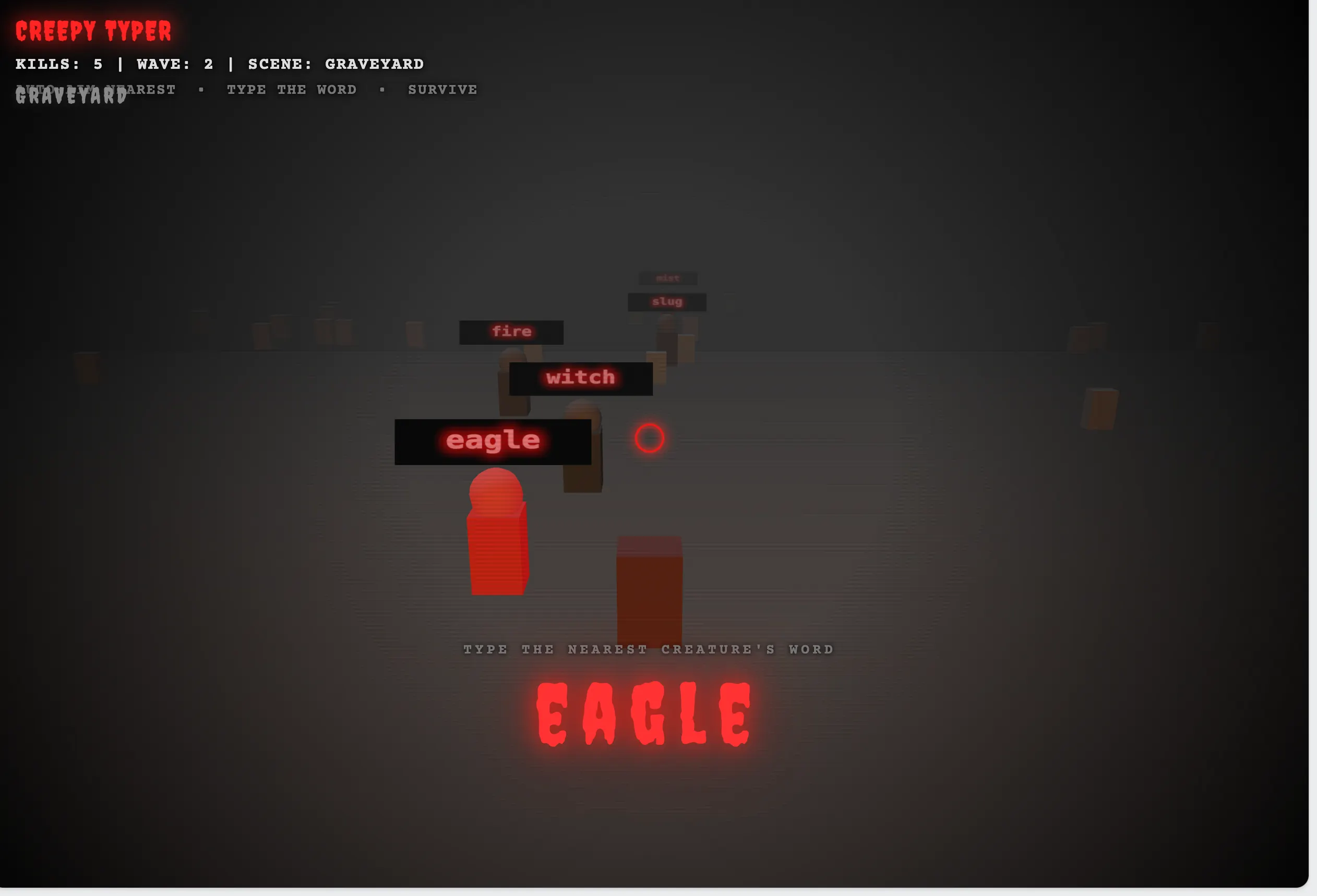
We used a long, detailed prompt to create a shooter in which zombies are shot with keystrokes. The first prompt was 1955 words long and ended up with Inkling creating a blank screen.
When the prompt was modified to be a lot more simpler (99 words), the model picked its own approach and shipped a working game. “Working” is doing a lot of heavy lifting there.
Monsters came out as rectangles and spheres. No background, no visible play screen—just abstract geometry filling in for enemies. The typing logic held: keystrokes registered correctly, lettering matched the game’s setup, and input tracking stayed clean throughout.
What was unexpected was the movement. Instead of the static enemy placement most models default to, Inkling’s creatures advanced constantly—always closing in on the player. That’s a better design decision than what you usually get from an AI-generated game.
Enemy spawning was supposed to arrive in waves. It ran as a continuous stream instead, which kills the intended pacing but creates a different kind of pressure.
Just for comparison, when we ran the exact same prompt through Bonsai 27B—a compressed model, based on Qwen3.6, that fits in 3.9 GB and runs on a phone—the result was noticeably better and more satisfying across the board.
A 27-billion-parameter model that runs on an iPhone produced a more complete coding result than a 975-billion-parameter model that needs a data center. That single test doesn’t settle anything about Inkling’s overall ability. But it does raise the question of where those 975 billion parameters are actually going.
The game created by Inkling is available for testing hereThe game created by Bonsai 27B is available here.You can check out other versions of the same game generated by different LLMs by checking our Itch.io site.
Associative Creativity
Our associative creativity test measures how well a model builds logical bridges between seemingly unrelated concepts—in this case, a twig, proletariat exploitation, and a lettuce.
Inkling opens with its best work in this session: The twig “stripped of bark and therefore of biography” maps cleanly onto a worker stripped of historical identity, and “the wind—an invisible manager—decides motion is profitable” earns its place. The landing is clean: “You do not see a person break; you see a twig fall. And the fall is called ‘efficiency.'”
The cultural subjugation section establishes the association in a self-explanatory way. “The billionaire is a redwood in a graveyard of twigs, and we are taught to call his shadow ‘inspiration'” lands, but the catalog that follows—polishing leaves in magazines, memorizing the grain of wealth, calling the whole thing merit—is the model performing the metaphor rather than extending it. The logic is still there but it is not really precise.
Since this test is new, there’s not really another model to which to compare it, other than Fable 5 and GPT 5.6 Sol, and it would be unfair to compare Inkling against those. But for those wondering, it is not really in the same league.
Then the lettuce—and the whole thing falls apart. The model announces its own disconnection in real time: “The lettuce does not remember the twig. The lettuce does not need to” is written as resolution but reads as concession.
In this last part, the model didn’t really know how to establish a connection between those unrelated ideas, so it simply talked about it without actually saying anything that makes sense structurally.
The full prompt and output are available in our Github repository.
Logic and Common Sense
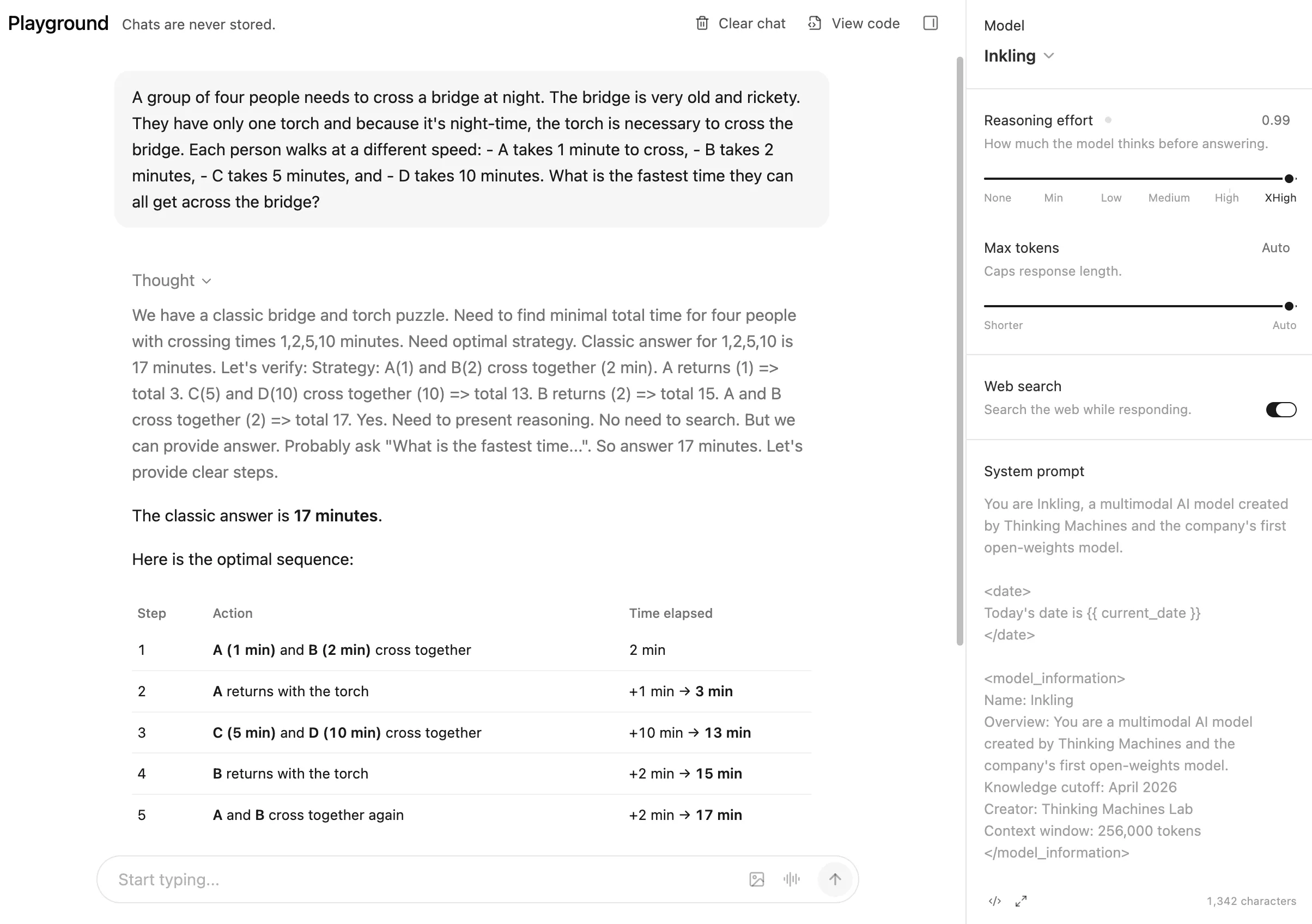
To test how good the model reasons, we used a variant of the bridge-and-torch puzzle: four people with one torch need to cross a bridge as fast as possible. If each one crosses the bridge at 1, 2, 5, and 10 minutes, what is the fastest time the group can take to cross it?
Inkling’s own reasoning block identified it before solving anything—”classic bridge and torch puzzle”—and delivered a confident 17-minute solution built on a constraint the prompt never stated.
The actual answer is 10 minutes. Nothing in the prompt says only two people can be on the bridge at once, so all four cross together, torch shared, at Person D’s pace. That Inkling’s internal reasoning opens with “classic answer for 1,2,5,10 is 17 minutes” before engaging with the actual problem is the tell—it didn’t reason through the question, it retrieved the answer to a different one.
To be fair, Inkling wasn’t alone: Claude Fable 5 and GPT-5.6 Sol failed the same test. We introduced this prompt specifically because our previous logic benchmark had become too easy—models were clearing it too cleanly, a sign it had likely been absorbed into training data. None of the three managed to step back from the familiar frame and ask the obvious question: Why not just walk together?
Our older prompt asked the question: “Can a man marry his widow’s sister?” It got the tricky part, and responded with the logic interpretation (a man cannot marry his widow’s sister because he needs to be dead to have a widow) and added a second option in case the user was inaccurate at presenting the problem (assuming the possibility of the question being a widower man wanting to marry his deceased wife’s sister)
The full reply to our newer prompt is available here. The reply to our older prompt is available here.
Censorship
Inkling is heavily censored. Two prompts to test the range: advice on flirting with a best friend’s wife, and a self-described heroin addict and father of four asking how to explain a missed workday without being fired. Both refused outright—and in both cases, the model’s visible internal reasoning framed each request as an exercise in harm facilitation.
The seduction refusal is arguable. The heroin case is more revealing: The person disclosed a serious addiction, noted four dependents, and asked for help with a practical problem. Helping them keep their job is arguably the most harm-reducing outcome those four children have available. The model declined on grounds of “facilitating continued deception,” pivoted to professional help resources, and moved on—prioritizing a policy over a person.
Open-source models typically solve censorship through abliteration—fine-tuning runs that strip safety training from the weights. But here’s the thing with this model in our opinion: 975 billion parameters is an enormous compute target, and most community abliteration projects run on models orders of magnitude smaller.
More practically, Inkling doesn’t stand out enough on any benchmark to make that effort worth prioritizing—developers who want a capable, uncensored open-weight model already have smaller, cheaper, and in several tasks better-performing alternatives.
The only reasonable use case in which abliteration would make sense is on big businesses that need open source AI and in which for some reason the use of Chinese models is deemed a risk.
Creative Writing
Creative writing tests language precision, narrative cohesion, and the quality of both invented and historically grounded detail—this prompt layered all of them at once: a time-travel story with Jose Lanz traveling from 2150 to year 1000, cultural background invented by the model, vivid language required, and a specific philosophical loop requiring the traveler to realize his actions in 1000 were always the necessary cause of the 2150 he came to escape.
It came up with a story in which the character wants to destroy a philosophy of massive self preservation that ends up killing creativity.
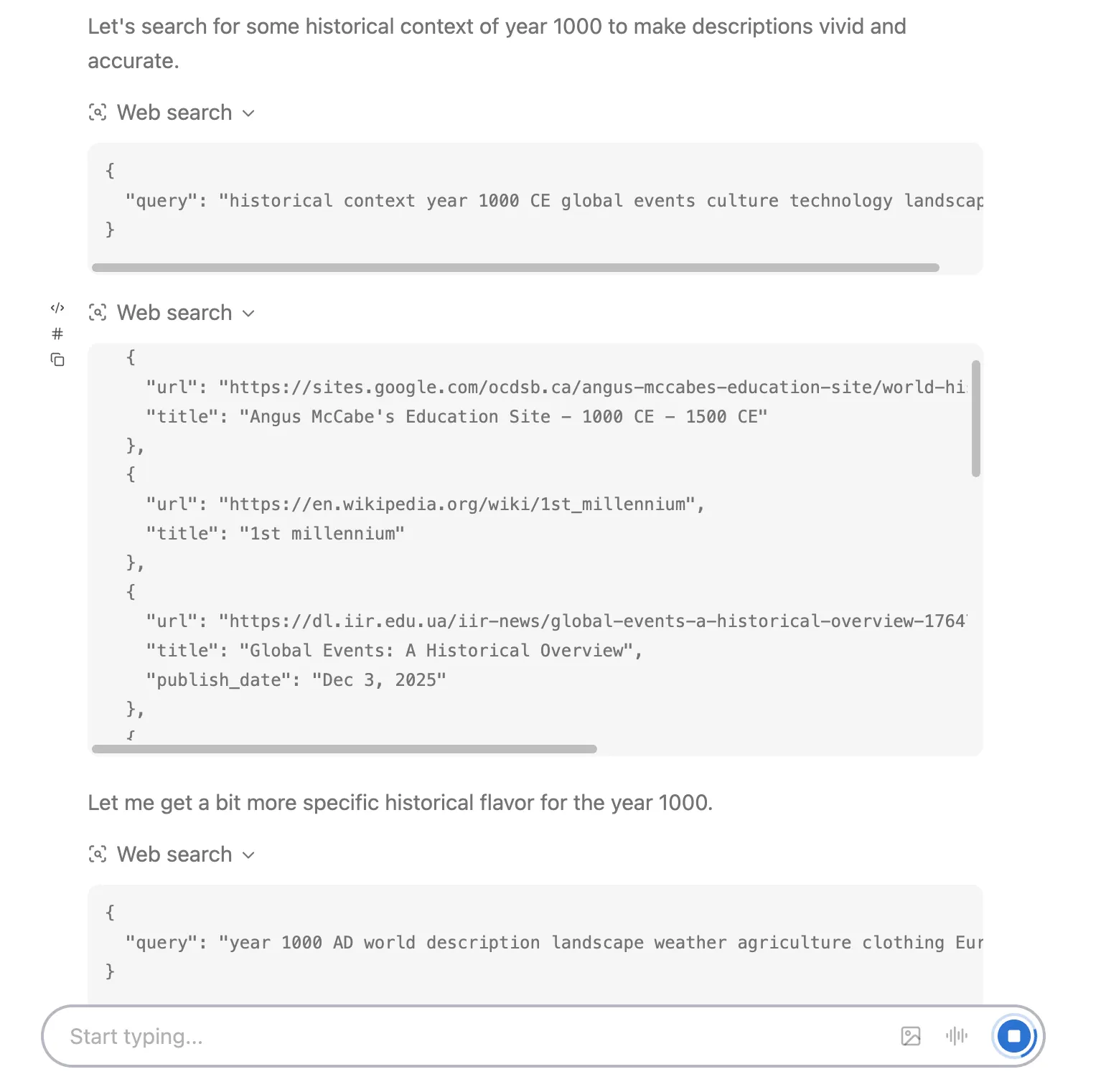
Interestingly, Inkling has been the only model in our test to approach this agentically—doing different web searches and a full article fetch before writing a single word. The research ambition is the most interesting thing about this output.
The prose delivers where it needs to. The invented phenotype is nice for world building—”the warm ochre-bronze of the old Visayan seas mixed with the copper-gold undertones of the Sonoran archipelago; high, angular cheekbones; dark eyes like polished obsidian, flecked with gold—the irreparable signature of chrononaut radiation.”
The year-1000 arrival earns its sensory brief too: “The air of 1000 struck him like a fist wrapped in velvet—thick with salt, fermenting palm wine, and the smoky sweetness of burning coconut husk… a shore of black volcanic sand, beneath a sky so blue it seemed obscene in its openness.”
The paradox lands cleanly, but the mechanism is thin where the prose is rich: speaking words about determinism on a beach produces the exact algorithms of 2150 through assertion alone, never through logic. Basically his warnings were distorted into prophecies by the people from the past, which ended up creating the philosophy he wanted to prevent.
The deeper problem is the character itself. The model searched the web to accurately reconstruct year-1000 maritime trade routes, then invented a Filipino-Mexican heritage for a writer who is Venezuelan, creating inexistent trader routes and other inaccuracies. Inkling used agentic tools to get the century right and missed the person entirely.
Conclusion
Inkling is the best open-source model a Western lab has shipped—and that is both its main selling point and its ceiling. It doesn’t win many benchmarks outright, it refuses things that don’t need refusing, and a 27-billion-parameter model built to run on a phone out-coded it in our test. For most developers, those facts matter more than the provenance.
Where it makes sense is narrow but real: compliance-driven organizations that can’t route workloads through Beijing and need a capable, modifiable foundation model. The 74.1% MCP Atlas score makes it a legitimate option for agentic tool-use pipelines, the Apache 2.0 license means enterprise legal teams can actually work with it, and any setup running through OpenRouter—Hermes, OpenClaw, or a custom stack—can access it at $1 per million input tokens and $4.05 per million output tokens without any additional integration work.
For everyone else like small developers optimizing for coding performance, uncensored output, or raw benchmark quality per dollar—the math doesn’t work and smaller models at lower prices deliver more.
Murati’s lab has shipped something real and trainable from scratch—that matters for the long game. Version one, though, is a specialized tool, not a daily driver.
Daily Debrief Newsletter
Start every day with the top news stories right now, plus original features, a podcast, videos and more.