Home Blog Page 20

What Is A Crypto Node: A Beginner’s Guide 2026 – NFT Plazas

0
What Is A Crypto Node: A Beginner’s Guide 2026 – NFT Plazas


Crypto nodes serve as connection points within a blockchain network that store, receive, validate, distribute, and broadcast data. They constitute the backbone of a blockchain’s infrastructure, as they help maintain a network’s speed, security, and decentralization. In this article, we’ll provide insights into blockchain nodes, their types, key functions, and significance. We’ll also guide you through a step-by-step process to set up a node.

What Is a Node in Crypto?

A crypto node is a single computer/device that forms part of a peer-to-peer network powered by blockchain technology. It interacts with other nodes in the network and stores a full or pruned copy of the blockchain’s digital ledger. Since every node holds an identical copy of the same ledger, it can independently validate transactions. It can also stay synchronized with other nodes.

In general, nodes record, verify, and relay new transactions across the network to help achieve consensus and secure the blockchain. Some nodes perform specialized tasks such as mining new blocks, assessing smart contracts, or processing instant payments.

However, each network incentivizes/penalizes nodes for their honest/malicious actions in different ways. Moreover, a blockchain’s design determines the number and types of nodes it contains and how they operate.

Core Functions of a Crypto Node

Core Functions of a Crypto Node

1. Transaction Validation

Nodes evaluate each transaction, including its signature and amount, according to network rules. If a transaction doesn’t conform to the rules, nodes reject it, ensuring only valid transactions are recorded on-chain.

2. Data Storage

Every node stores a copy of the blockchain ledger, either partially or fully. Both versions contain verified data and vital transaction history. Since the ledger is replicated across multiple nodes, it is easier to trace ownership of crypto assets in a trustless manner. Moreover, decentralized networks minimize single points of failure and link blocks cryptographically, making transaction data immutable.

3. Relaying information

Whenever a node observes any activity, including transactions and status updates, it immediately broadcasts the information to the entire network. This constant relaying of information keeps the nodes in sync. It minimizes censorship and delays, ensuring the communication between the nodes is open, trustless, resilient, and distributed. Even if one node or path fails, others continue to function, reducing network disruptions.

4. Consensus participation

Each blockchain follows a consensus mechanism to validate transactions. This automated system ensures that all nodes adhere to protocol rules and unanimously agree on the network’s current state. The higher the number of participating nodes, the stronger the network’s security. Nodes also help reduce network congestion by rejecting invalid transactions and spam data. However, high uptime is critical to fostering active participation and achieving consensus.

Types of Crypto Nodes Explained

1. Full Nodes

The nodes that store a copy of the entire blockchain ledger are known as full nodes. They save the complete blockchain history, including details of every transaction executed on-chain since the network’s launch. Therefore, they constitute the basis of every blockchain network. When a new node joins the network, it receives a copy of the blockchain ledger from full nodes. Some blockchains have pruned full nodes that store recent transactions while chronologically discarding older data.

2. Light Nodes

Light nodes store only the essential data, especially the block headers, and not the entire blockchain history. They require less storage capacity, making them ideal for blockchain networks like Bitcoin that have storage constraints. These nodes validate transactions using the simplified payment verification system, enabling users with limited resources to participate in the network. 

3. Mining Nodes

They are network participants who compete to solve complex mathematical equations to validate transactions and add new blocks. Miners install specialized hardware, a high-speed internet connection, and mining software to generate adequate computing power to solve these puzzles. If successful, miners receive newly minted coins and transaction fees as rewards. You’ll find mining nodes on proof-of-work (PoW) blockchains like Bitcoin and Litecoin.

4. Archival Nodes

Archive nodes are more comprehensive than full nodes. They store the entire blockchain history, including transitional states that other nodes may discard. 

5. Validator Nodes

Validator nodes propose, create, and add new blocks without solving cryptographic puzzles or consuming energy. Instead, validators are randomly selected by the system based on the amount of native tokens they stake. These nodes exist on proof-of-stake (PoS) networks like Ethereum and earn rewards for validating transactions. If found guilty of dishonest behavior, the network penalizes validators by slashing a portion of their staked funds.

6. Authority Nodes

Found in permissioned blockchains that follow the proof-of-authority consensus, authority nodes are pre-approved by the organization/community managing the network. Since PoA networks have a restricted number of validator nodes, they’re highly scalable but less censorship-resistant.

7. Master Nodes

Master nodes are potent, collateral-backed servers that perform additional services apart from hosting the entire blockchain ledger. These include transferring funds, facilitating instant transactions, participating in voting and governance, etc.

How Do Crypto Nodes Work?

How Do Crypto Nodes Work?How Do Crypto Nodes Work?

When you sign a cryptocurrency transaction using your wallet’s private key, the transaction is first relayed to a single node. The node performs transaction-level checks such as evaluating the validity of the signature, sender’s balance, transaction format, etc. If the transaction fails to conform to the network rules, it is immediately rejected.

Conversely, if the transaction is deemed valid, it is added to the mempool. The mempool is a list of unconfirmed transactions awaiting inclusion into a block. The validated transaction is propagated to the mempools of other nodes. This way, blockchain networks ensure all nodes possess up-to-date information.

From the mempool, validator nodes select transactions and group them to create a block. Usually, validators prioritize transactions with higher fees to maximize their earnings. They verify the transaction based on the network rules and broadcast it to all nodes for confirmation.

Once the majority of the nodes approve the transaction, the transaction’s status changes from “queued” to “pending”. The validator who successfully creates a block includes the transaction in it and appends the block to the blockchain. After a transaction is recorded on a blockchain, it becomes immutable. Nobody can alter/delete it because any update requires the approval of all participating nodes. The higher the number of nodes, the more secure and tamper-proof the network.

In general, all nodes in a peer-to-peer network begin from the genesis block and follow the same rules. They compare blockchain data while synchronizing and accept the most valid or longest chain.

Crypto Nodes vs. Miners vs. Validators: What’s the Difference?

Miners: The term miner is often used in the context of PoW blockchains like Bitcoin. It refers to a node that solves complex puzzles to mine a block. However, mining is an energy-intensive process requiring specialized equipment and truckloads of computational power. It also entails high costs, making it extremely challenging for malicious actors to launch 51% or Sybil attacks. Validators: In consensus mechanisms such as proof-of-stake, the network’s algorithm randomly chooses validator nodes to verify transactions. Validators are network participants who stake their native cryptocurrencies to get the opportunity to authenticate transactions and earn rewards.Crypto nodes: While all miners and validators are nodes, not all nodes are miners or validators. You can easily run your own node without actually mining cryptocurrencies or locking up coins. Standard crypto nodes simply participate in the transaction confirmation process, helping the network achieve consensus.

Why Are Crypto Nodes So Important?

Decentralization: Regardless of a blockchain’s design or the consensus system it uses, nodes ensure transactions are verified in a transparent manner. They also prevent a centralized entity from gaining control, ensuring the network remains truly decentralized. Security: All nodes within a network verify transactions and hold an identical copy of the distributed ledger. This distributed verification makes it nearly impossible for bad actors to manipulate or cheat the systemTransaction validation: A crypto node validates transactions in accordance with the network rules. Once a transaction is approved by the network, a node includes it in a block, which is appended to the blockchain. Transaction broadcast: Nodes propagate verified transactions/blocks to other nodes to attain consensus. This process ensures all nodes have access to the latest updates.Consensus participation: Consensus mechanisms represent collective power as nodes unanimously agree on the state of the blockchain, including valid and invalid transactions.Data storage: Full nodes maintain complete copies of the blockchain ledger that contain the entire transaction history since the network’s launch.

How to Set Up a Crypto Node?

Step 1: Identifying the type of node

Based on your goals, budget, and resources at hand, decide the role you’d like to play. If you want to run a full node, you need more storage and bandwidth. If you have only limited resources, you can run a light node. To operate a mining setup, you can either invest in powerful hardware or join a mining pool. 

Step 2: Check hardware requirements

Nodes must run consistently without frequent disruptions. Hence, a reliable internet connection and power supply backup are essential. Additionally, you need a durable computer with high processing power. It should have at least an 8GB RAM and a 1TB storage to run a full node. If you want to mine cryptocurrencies, you require specialized hardware like Application-Specific Integrated Circuits (ASIC) miners.

Step 3: Install the Node Software

Download the latest version of the node software from the blockchain project’s official website or GitHub repository. This client software enforces the blockchain protocol and enables you to function as a node.

Step 4: Synchronize the Blockchain

Once you’ve set up the necessary hardware and software, sync your node by downloading and validating historical data. While full nodes take several days to align your node with the blockchain, light nodes complete this step faster.

Step 5: Configure and Connect Your Node

Configure your node to start automatically when you turn on your computer and connect seamlessly with peers. To enable other nodes to communicate with you smoothly, open or forward specific ports like 8333. The more reachable your node, the greater its reliability.

Step 6: Maintain and Monitor

Service your node hardware regularly to prevent overheating and improve performance. Also, update the node software periodically. Continuously monitor your internet connectivity as well as your node’s uptime, memory usage, and storage consumption.

How Popular Cryptocurrencies Use Nodes?

1. Bitcoin

The Bitcoin blockchain follows the proof-of-work consensus algorithm, where miners create blocks by solving complex mathematical puzzles using computational power. However, the block will be appended to the blockchain only if all participating nodes approve it. Additionally, Bitcoin nodes enforce limits, such as block validity and total BTC supply. Full nodes use the Bitcoin Core software to validate transactions against pre-defined rules.

2. Ethereum

Ethereum is a proof-of-stake blockchain, where you need to lock up at least 32 ETH to run a validator node. As a validator, you can propose, validate, and add blocks, earning money from transaction fees. You can also verify and execute smart contracts that power dApps, NFTs, and DeFi protocols. If you want to run a resource-light, embeddable, and trustless node, you can set up a Light Client.

3. Solana

Solana follows a hybrid proof-of-history cum proof-of-stake consensus mechanism. Due to Solana’s high transaction throughput, you require powerful hardware and a stable internet connection to operate a node. By running a validator node, you can earn protocol-based rewards and transaction fees.

Can You Make Money Running a Crypto Node?

Not all crypto nodes are rewarding. Moreover, reward structures and specifications vary across blockchains and node types. In general, you can make money by running a validator, master, DePIN, or mining node. However, the higher the amount you invested in setting up a node, the lower your profits. 

Validator nodes propose and verify blocks to enforce consensus in PoS blockchains. If you want to become a validator, you need to stake a minimum amount of the native coin. Depending on your timely participation and uptime, you’ll earn a portion of the transaction fees.

Similarly, master nodes that provide unique services such as privacy boosts, treasury-funded governance, or instant payments earn rewards. You need to lock up a pre-fixed amount of the native cryptocurrency as collateral to set up a master node.

You can also generate passive income by running DePIN nodes. These hardware/software nodes execute utility-oriented tasks and contribute real-world resources like storage, Wi-Fi hotspots, or bandwidth. 

Lastly, mining nodes can yield high profits. For example, a Bitcoin miner who produces the winning hash earns 3.125 BTC and a portion of the transaction fees as rewards. 

Common Myths About Crypto Nodes

Nodes control the network: A common myth surrounding nodes is that they control blockchain networks. However, nodes are responsible for verifying transactions only. They don’t influence cryptocurrency prices or favour a few users. Only confirmed transactions appear in the mempool: Contrary to popular belief, mempools comprise unconfirmed transactions that have been propagated to the network. They aren’t included in a block yet and are awaiting validation by the network.

Conclusion

Crypto nodes play a key role in maintaining the security and integrity of blockchain networks. By running a node, you can contribute to network consensus. However, you must thoroughly understand node types, especially the investment each requires, before choosing one.

FAQs

How many crypto nodes are there?

The number of nodes varies across blockchains. At the time of writing, Bitcoin has 23,850 reachable nodes, including 15,342 Tor nodes.

Do I get paid for running a node?

It depends on the type of node and the network for which you’re running the node. Usually, you don’t get paid for running standard nodes that only help in maintaining a network’s security. Generally, mining/staking nodes earn money, provided they fulfil the specific requirements, like solving cryptographic puzzles or staking cryptocurrencies.

What is the difference between a node and a blockchain?

A blockchain is a decentralized and immutable ledger that records transactions across a network of computers. It comprises a chain of cryptographically-linked data blocks. Conversely, nodes are computers/devices that participate in network consensus by storing, broadcasting, and validating transactions.

What happens if a crypto node goes offline?

When a crypto node goes offline, the network continues to function without any disruption. Blockchains are designed to process transactions as long as the majority of the nodes are online and maintain uptime. Besides, offline nodes can resync once they come online.

What is the difference between a node and a miner?

A node is a computer or device that forms part of a blockchain network. It includes the necessary hardware and software, enabling the node operator to participate in the consensus process. In contrast, a miner is a specialized node critical to the functioning of a PoW network. It uses computational resources to solve complex puzzles to validate transactions and mine new blocks.

Is running a Bitcoin node profitable?

Running a Bitcoin node is not as profitable now as it used to be. To make gains, you must set up a miner node, which entails a huge upfront investment. Moreover, the complexity of cryptographic puzzles has increased significantly, reducing a miner’s chances of generating a winning hash. Furthermore, block rewards will further decrease to 1.5625 BTC after the halving event in 2028.


Source link

A Master Class in Measuring the Female Body – University of Fashion Blog

A Master Class in Measuring the Female Body – University of Fashion Blog


UoF’s lesson on measuring 104 points of the female body. (Image credit: University of Fashion).

One of the greatest challenges our students confess to is mastering the art (and science!) of measuring the female body. Take one wrong measurement, and it’s fashion’s version of a domino effect—suddenly your pattern fits like it was made for a completely different species. Accurate measuring isn’t just important; it’s the difference between runway-ready and “what on earth happened here?”

Measuring Points Diagrams

measuring points diagram

UoF’s measuring points diagrams. (Image credit: University of Fashion).

Our master class on how to measure an actual, living, breathing female body—the kind that moves, sighs, and occasionally checks her phone mid-measurement, comes with free downloadable diagrams to help with the process.

UoF’s measuring point diagrams.

UoF’s measuring points diagrams. (Image credit: University of Fashion).

You’ll master the fine art of extracting every vital dimension needed for draping and pattern making (without losing your tape measure halfway through). No more guess work.

UoF’s measuring point diagrams.

UoF’s measuring points diagrams. (Image credit: University of Fashion).

Along the way, we’ll decode all those fancy anatomical terms the fashion industry loves, such as, front neck base, bust arc, apex and bust span.

Measuring Points Chart

measuring points charts

An example of UoF’s 7-page body measuring points chart — a color-coded companion to the diagrams. (Image credit: University of Fashion).

Think of our downloadable, color‑coded chart as the VIP pass to your measuring marathon, perfectly in step with the diagrams and packed with clear explanations for the placement of all 104 official points of measure. Yes, 104—because in fashion, precision is everything and your tape measure is basically training for its own endurance sport.

But There’s More

measuring points chart

UoF’s Women’s Global Size Range Chart Sizes 2-18 and their European equivalents. (Image credit: University of Fashion).

Our Women’s Global Size Chart is the extra perk you didn’t know you needed. It not only breaks down points of measure for US sizes 2–18, but also gives you the European size equivalents, so your patterns can country-hop as effortlessly as your wardrobe.

Finale

By the time you are done with this lesson, you will not only speak the fluent geometry of the female form, you will move through spec sheets and tech packs with the quiet confidence of someone who knows exactly where every millimeter goes—and why it matters.


Source link

HBAR Price Prediction 2026–2030: Hedera Has the Tech, But Does the Token Have a Pulse?

0
HBAR Price Prediction 2026–2030: Hedera Has the Tech, But Does the Token Have a Pulse?


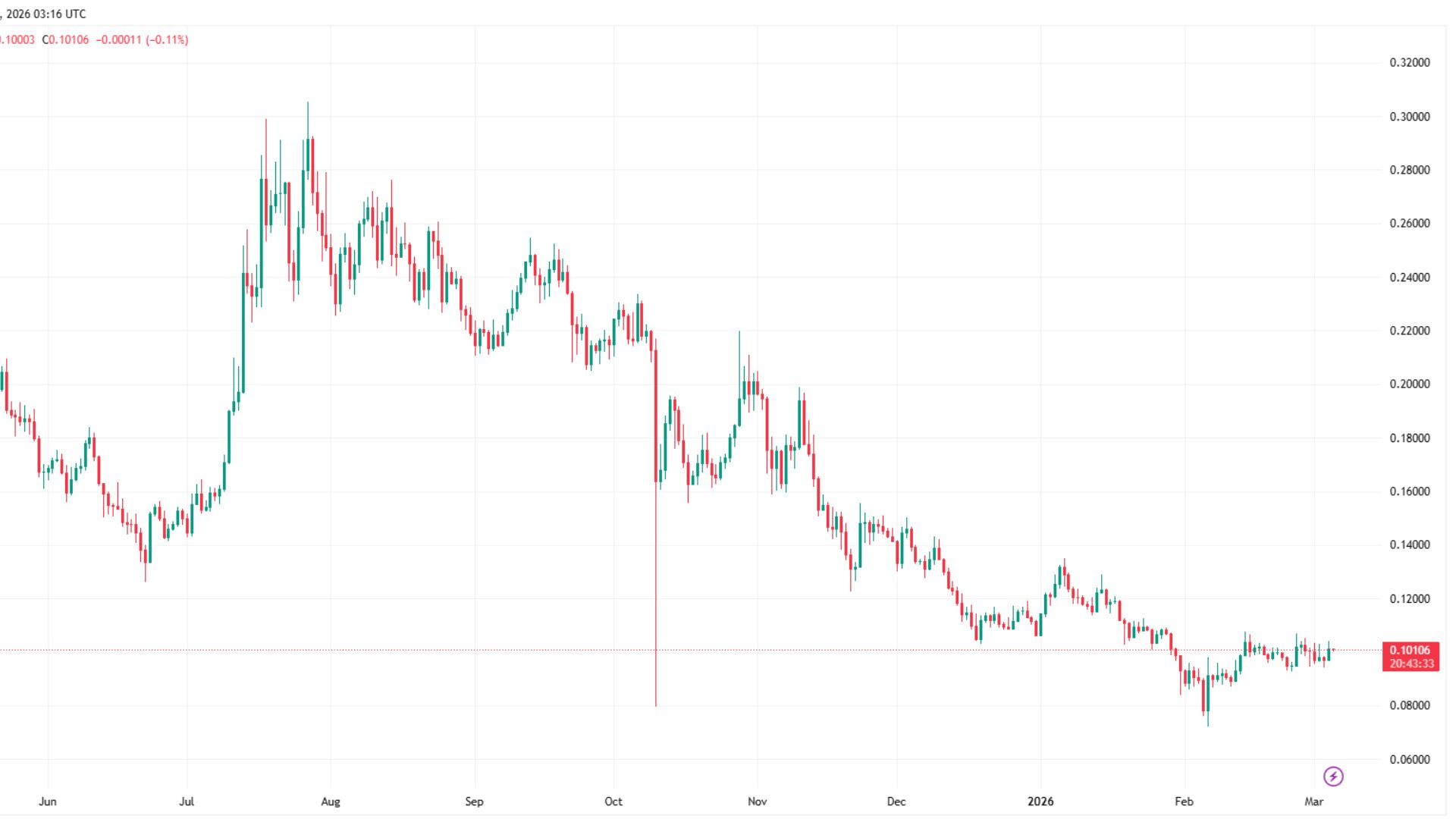
Let’s be straight about something that doesn’t get said enough in HBAR coverage: this token peaked at $0.57 in September 2021, collapsed to $0.036 by the end of 2022, bounced all the way back to $0.40 in January 2025 — and then quietly gave most of that back again. Right now it sits just above $0.10, down over 74% from that January 2025 high.

And still, Hedera’s underlying network keeps adding enterprise partners. Google Cloud. IBM. Boeing. The Australian Reserve Bank. The DTCC. Real institutions running real pilots on real infrastructure — not vaporware, not promises on a whitepaper.

So what’s actually going on? Is HBAR genuinely undervalued relative to its network traction, or has the market decided that enterprise blockchain adoption just doesn’t move token prices the way crypto Twitter assumes it does? That’s the question this piece tries to answer honestly — without the price-prediction cheerleading that dominates most HBAR coverage.

HBAR Price Predictions at a Glance

YearBearBase CaseBull2026$0.10–$0.13$0.15–$0.45$1.052027$0.11$0.22–$0.50$1.20–$1.842028$0.13$0.35–$0.65$1.402029$0.15$0.50–$0.80$1.602030$0.20–$0.28$0.50–$2.20$5.25

HBAR Right Now — March 2026

HBAR Price 2026

HBAR Price 2026

HBAR is trading at approximately $0.102, ranked around #21–24 by market cap, with a total valuation of roughly $4.4 billion and 24-hour volume near $132–137 million. On the face of it, those are respectable numbers for what is, fundamentally, an enterprise-grade distributed ledger that most retail crypto traders couldn’t explain at a dinner table.

The technical picture is interestingly split along timeframes. Weekly: bearish — the 50-day MA sits above price and is falling, the 200-day MA has been declining since August 2025. But flip to the 4-hour chart and the story changes: both moving averages are rising as of late February, suggesting short-term momentum is quietly turning. RSI on the daily sits around 47–48, which is neither here nor there — not oversold enough to trigger mechanical buyers, not healthy enough to confirm a trend shift.

Traders are watching $0.103 as the key level to confirm a bullish momentum shift in the near term, with $0.080 as the downside level to watch if that fails. The 30-day performance shows a correction of around 27%, but there was a 13% bounce during one week in mid-February, which is the kind of whipsaw HBAR holders have become grimly accustomed to.

One bright spot worth noting: HBAR rallied 8.7% in one week in early March, driven by a notable increase in stablecoin supply on the network and a general crypto market rebound — which suggests that when sentiment tilts even slightly, there’s a base of buyers ready to move.

Key levels to monitor:

LevelWhat it signals$0.080Critical support — losing this opens the $0.05 zone$0.095–$0.100Current floor; buyers appearing here$0.103–$0.120Reclaim is required to shift the short-term bias bullish$0.178–$0.193First meaningful resistance zone (mid-2026 targets)$0.401January 2025 cycle high — the big target$0.569All-time high (September 2021)

HBAR Price Prediction 2026

This is where the forecast landscape fragments completely, and understanding why it fragments tells you more than the actual numbers.

At the most conservative end, some algorithmic models project HBAR barely moving at all through 2026 — staying essentially flat around $0.10, which implies the market continues to treat Hedera as an enterprise curiosity rather than a speculative asset worth chasing.

Then you have mid-tier models: Binance community forecasts suggest a modest rise to around $0.177 by end of 2026, while DigitalCoinPrice puts the range at $0.12 to $0.15 — slow but steady. PricePrediction is slightly more optimistic, suggesting HBAR could reach $0.18 by year-end, a 75% gain from current levels.

At the aggressive end, CoinPedia’s model projects HBAR trading between $0.45 and $1.05 in 2026, with an average around $0.80 under favorable conditions — a scenario that assumes a strong altcoin cycle materializes in H2. Telegaon goes even further, projecting a range of $0.49 to $0.93 if a major adoption wave hits.

The honest read? For H1 2026, the bears probably have it right — HBAR is likely to grind between $0.10 and $0.18, influenced more by Bitcoin’s direction than by any Hedera-specific news. The bull case for H2 depends on two things happening simultaneously: the U.S. CLARITY Act passing (which executives from JPMorgan, Ripple, and Coinbase currently estimate at 80–90% probability by mid-2026), and an SEC decision on the pending spot HBAR ETF applications from Grayscale and Canary Capital.

If both materialize, $0.30–$0.45 by December 2026 is defensible. If neither does, $0.12–$0.18 is probably the ceiling.

HBAR Price Prediction 2027

By 2027, the gap between conservative and aggressive models doesn’t close — it widens. CoinCodex’s algorithm has HBAR trading within a $0.097 to $0.223 range, suggesting 2027 could be flat or even slightly down from a 2026 recovery.

On the other end of that spectrum, Telegaon’s model places 2027 HBAR somewhere between $0.96 and $1.84 — which would represent either a 10x from current levels or just a recovery to the January 2025 high, depending on whether you’re measuring from today or from wherever the market settles mid-cycle.

The $1 milestone is the psychological flashpoint for HBAR in 2027. Cryptonews considers it more realistic for HBAR to break $1 in 2029 or 2030 than in 2027, which feels like a grounded take given the current pace of institutional adoption versus actual price momentum.

What could push 2027 higher than most models expect: if the Kraken EVM and Hedera Token Service integration that launched in Q1 2026 actually generates developer momentum, and if the block node infrastructure upgrade planned for June 2026 noticeably improves transaction throughput metrics — two things that would make Hedera genuinely more attractive to DApp builders who currently default to Ethereum or Solana.

HBAR Price Prediction 2028

Most 2028 models cluster in the $0.35–$0.65 range as a base case, with CoinPedia projecting a minimum of $0.65 and a ceiling of $1.40. This is the year where the Real World Asset (RWA) tokenization narrative either starts delivering measurable on-chain activity or gets written off as another institutional blockchain promise that never quite arrived.

Hedera is uniquely positioned for the RWA story. The Hedera Council — which includes Alphabet (Google’s parent), IBM, LG, Deutsche Telekom, and others — gives the network enterprise credibility that permissionless chains genuinely struggle to replicate. Whether that credibility translates into HBAR token demand by 2028 is the core bet.

HBAR Price Prediction 2030

The 2030 forecasts are, candidly, all over the place in a way that should make anyone skeptical of pinning a number on them.

Conservative models like Changelly’s put HBAR between $0.207 and $0.281 by 2030 — modest growth, nothing dramatic. VentureBurn’s technical model suggests $0.294 as a reasonable end-of-decade target. These are the “adoption happens, but slowly” scenarios, and they’re probably the most common outcome historically for enterprise blockchain plays.

Then there’s CoinPedia’s bull model, which projects an average of $2.20 with a high of $1.70 — and Telegaon’s ultra-bull case of $3.82 to $5.25. For context, $5.25 would give Hedera a fully diluted market cap of roughly $262 billion, which would make it larger than JPMorgan Chase is today. That’s not physically impossible, but it requires believing that Hedera becomes foundational infrastructure for global financial markets within nine years.

The number most worth anchoring to, for investors who want something grounded: $0.50–$1.00 by 2030 in a base case where Hedera successfully executes on RWA tokenization, passes compliance hurdles in major markets, and benefits from one more broad crypto bull cycle.

What’s Actually Worth Watching on Hedera Right Now

Where the genuine bull case lives

The Hedera Council is unlike anything else in crypto

This is Hedera’s most underappreciated structural advantage. Most blockchains have foundations that are nominally decentralized but practically controlled by a small group of insiders. Hedera’s governing council reads like a Fortune 500 board meeting: Google, IBM, Boeing, LG Electronics, Nomura, Deutsche Telekom, Standard Bank, Wipro, and roughly a dozen others. Each member runs a consensus node and holds a council seat.

That structure means enterprise procurement teams can point to it and say “we’re running on infrastructure governed by IBM and Google” without anyone in legal raising an eyebrow. No other public network can say that. Whether it translates to HBAR price appreciation is a different question — but as a sales tool for institutional adoption, it’s genuinely powerful.

Hashgraph is meaningfully different from blockchain

Hedera doesn’t use a blockchain at all — it uses a directed acyclic graph (DAG) structure with a gossip-about-gossip consensus mechanism. The practical result: the network can process around 10,000 transactions per second with sub-3-second finality and transaction fees of approximately $0.0001. Compare that to Ethereum’s 15–30 TPS at peak, or even Solana’s occasional congestion problems. For high-volume enterprise applications — supply chain audits, micropayments, financial settlement — those specs matter.

CLARITY Act tailwinds

The U.S. CLARITY Act, which aims to divide regulatory oversight between the SEC and CFTC and end the “regulation by enforcement” era, has become the most important near-term catalyst for HBAR. If it passes by mid-2026 as executives from JPMorgan and Coinbase publicly estimate, it potentially classifies HBAR as a commodity — substantially reducing the compliance risk that has kept institutional allocators on the sideline.

Spot ETF applications are in play

Both Grayscale and Canary Capital have filed for spot HBAR ETFs. The SEC has delayed decisions, but those reviews extend into 2026 — meaning a decision is coming. An approval would be a significant institutional capital unlock, similar to what XRP ETFs did for that market in late 2025.

Network upgrades are consistent and real

Hedera’s testnet upgraded to v0.70.0 in February 2026, focused on smart contract automation and developer tooling. A transition from cloud storage to block nodes is scheduled to complete in June 2026, improving data access and reliability. These aren’t flashy announcements — they’re the unglamorous engineering work that either compounds into a durable platform or goes unnoticed. For Hedera, the track record of shipping is solid.

Where the skepticism is justified

The token-network disconnect is the defining HBAR problem

HBAR’s all-time high was $0.569 in September 2021. At that point, Hedera had a fraction of its current enterprise partnerships. Today, the network has significantly more adoption, more developers, more real-world pilots — and the token is 82% below that peak.

That gap doesn’t resolve itself automatically. You can build an incredible enterprise network and still have a token that doesn’t appreciate meaningfully if the token’s utility within that network is limited. HBAR is used to pay transaction fees (tiny amounts per transaction) and can be staked — but the economics of per-transaction HBAR consumption at $0.0001 per transaction don’t generate meaningful demand pressure at current scale.

“Enterprise blockchain” has a long track record of overpromising

IBM’s Hyperledger. R3 Corda. The Linux Foundation’s blockchain projects. Countless enterprise blockchain initiatives from 2016–2020 generated press releases, pilot programs, and conference keynotes — and then quietly failed to reach production scale. Hedera is better-positioned than most of those predecessors, but the pattern of enterprise interest without enterprise deployment is real and worth keeping in mind.

The supply picture is heavy

Hedera has a maximum supply of 50 billion HBAR, with approximately 43 billion currently in circulation. That’s an enormous float. For context, XRP has 100 billion total supply, Bitcoin has 21 million. When prices rise, there are a lot of coins available to sell — which creates structural headwinds for any sustained rally.

Competition for the enterprise DLT dollar is intensifying

R3, Quant Network, Polygon CDK, and Hyperledger Fabric are all competing for the same enterprise procurement budget that Hedera is pitching. And increasingly, private permissioned chains — where the customer controls everything — are winning deals over public networks simply because legal and compliance teams prefer them. Hedera’s public network model, despite its council governance, still faces this headwind.

The Technical Picture in More Detail

The weekly chart has looked bearish since August 2025, when the 200-day MA turned downward. The 50-day MA has been falling above price and acting as resistance — the classic configuration of a downtrend in progress.

What’s slightly interesting is the 4-hour chart behavior since late February. Both the 50-day and 200-day MAs started rising as of February 28, 2026 — a timeframe shift that can sometimes precede a weekly trend reversal, though it’s early to read too much into it.

The $0.10 level has become a psychological and technical battleground. HBAR dipped below it briefly in February and bounced hard both times — which suggests buyers are actively defending it. Whether they can defend it against a broader crypto market selloff is another question entirely.

If HBAR can hold $0.10 and reclaim $0.120 on a weekly close, the next realistic target zone is $0.178–$0.193 — roughly where Changelly’s mid-2026 models place the autumn price. Below $0.080, the picture deteriorates quickly toward the $0.055 demand zone.

Should You Hold HBAR?

The case for holding HBAR through 2026 rests on believing that eventually, network adoption translates into token demand. History of the current cycle (2024–2025) gave some hope for that thesis: the January 2025 pump to $0.40 happened, suggesting that when the market wanted exposure to “enterprise blockchain,” HBAR was where capital went.

The case against is that you might be waiting a long time for the adoption story to become a price story — and in the meantime, you’re holding a token that’s down 82% from ATH, in a market where attention rotates fast and patience is rewarded inconsistently.

For long-term investors who believe in the RWA and enterprise DLT narratives, HBAR at $0.10 offers a reasonable entry relative to the $0.40 it touched just 14 months ago. Position sizing conservatively, watching the $0.080 floor, and keeping an eye on ETF filing decisions seems like the sensible playbook.

For traders: $0.103 reclaim first. Weekly close above $0.120 is the confirmation you want before adding conviction.

FAQs

Will HBAR reach $1?

Most analyst models don’t project HBAR hitting $1 before 2029–2030. CoinPedia’s bullish 2026 scenario reaches $1.05, but that requires a strong altcoin bull market materializing in H2 2026 alongside regulatory catalysts. The base case for $1 is more realistically a 2028–2030 event.


What is the HBAR price prediction for 2030?

Forecasts range from $0.20 (Changelly conservative) to $5.25 (Telegaon ultra-bull). The most grounded base case from multiple analysts sits between $0.50 and $2.20, with VentureBurn’s technical model suggesting $0.294 as a reasonable floor and CoinPedia projecting an average of $2.20 under sustained growth conditions.

Why is HBAR price so low despite enterprise adoption?

The network charges roughly $0.0001 per transaction in HBAR fees. Even at millions of transactions per day, the token demand generated is tiny relative to the circulating supply of 43 billion HBAR. Unless token economics change — through significant staking uptake, ETF demand, or broader speculative appetite — enterprise adoption doesn’t automatically produce price appreciation.

What companies are on the Hedera Governing Council?

The council includes Google (Alphabet), IBM, LG Electronics, Boeing, Nomura, Deutsche Telekom, Standard Bank, Wipro, Ubisoft, and others — major multinationals that each operate a consensus node and hold a governance seat. This is meaningfully different from most crypto foundations and gives Hedera a compliance credibility advantage with enterprise customers.

Is there a Hedera ETF?

Grayscale and Canary Capital have both filed for spot HBAR ETFs with the SEC. Decisions have been delayed but are expected during 2026. An approval would be a significant catalyst for institutional capital inflows — similar to the effect XRP ETFs had in late 2025.

What is Hedera’s all-time high?

HBAR reached $0.5692 in September 2021. The most recent cycle peak was $0.4010 in January 2025 — a high that represented Hedera briefly entering the top 20 by market cap before giving back most of its gains through 2025 and into 2026.

Can HBAR reach $10?

Getting to $10 would require a fully diluted market cap of roughly $500 billion — making Hedera one of the most valuable financial networks on the planet. Most mainstream models don’t project $10 within a 10-year window. Technewsleader’s model suggests $10.94 is a potential 2030 peak in their most aggressive scenario, which they note requires conditions well beyond ordinary market cycles.


Source link

OmniPact Secures $50 Million to Advance Trust Infrastructure

OmniPact Secures  Million to Advance Trust Infrastructure


Sponsored

Stories and Reviews

March 07, 2026

OmniPact Secures $50 Million to Advance Trust Infrastructure

New York, United States, March 7th, 2026, Chainwire

OmniPact, a decentralized protocol building a trust layer for peer-to-peer transactions of physical and digital assets, announced today it has raised $50 million in a private funding round. The investment will speed up the development of its mainnet, integration of cross-chain features, and deployment of its decentralized arbitration module.

The funding round was backed by a consortium of institutional investors and family offices that requested anonymity. Investors voiced confidence in OmniPact’s technical roadmap and its ability to set new standards for secure, intermediary-free transactions across Web4 and traditional commerce.

A significant share of the proceeds will fund the final development and security audits of OmniPact’s core contracts and multi-chain infrastructure. The funds will also support the protocol’s testnet launch, scheduled for Q1 2026, and expand the engineering team to accelerate the integration of real-world asset (RWA) and AI agent transaction capabilities.

“The funding validates our thesis that the future of commerce requires a neutral, transparent, and trustless foundation,” said Alex Johnson, Co-founder and CEO of OmniPact. “Our infrastructure eliminates intermediaries entirely, returning power to users. This investors’ confidence lets us execute our roadmap and bring secure, decentralized custody to a global audience.”

OmniPact protocol addresses the “trust problem” in peer-to-peer transactions by using smart contracts as on-chain guarantors. Combining algorithmic custody with decentralized arbitration and reputation systems, it enables secure exchanges without centralized platforms—with the new funding set to bring this vision to market.

About OmniPact

OmniPact is a decentralized protocol founded in 2024 with the mission to create a neutral, transparent, and trustless foundation for peer-to-peer commerce. By leveraging smart contracts as on-chain guarantors, OmniPact enables secure transactions of physical and digital assets without intermediaries. The protocol combines algorithmic custody, decentralized arbitration, and reputation systems to solve the “trust problem” in both Web4 and traditional commerce. With a focus on cross-chain interoperability and real-world asset integration, OmniPact is committed to returning control and security to users worldwide. For more information, visit [www.omnipact.io].

Contact

OmniPact Secures $50 Million to Advance Trust InfrastructureAlex JohnsonOmniPact[email protected]

Disclaimer

In line with the Trust Project guidelines, please note that the information provided on this page is not intended to be and should not be interpreted as legal, tax, investment, financial, or any other form of advice. It is important to only invest what you can afford to lose and to seek independent financial advice if you have any doubts. For further information, we suggest referring to the terms and conditions as well as the help and support pages provided by the issuer or advertiser. MetaversePost is committed to accurate, unbiased reporting, but market conditions are subject to change without notice.

About The Author

Chainwire is the top blockchain and cryptocurrency newswire, distributing press releases, and maximizing crypto news coverage.

More articles

Chainwire is the top blockchain and cryptocurrency newswire, distributing press releases, and maximizing crypto news coverage.


Source link

What Is DeFi? A Beginner’s Guide to Decentralized Finance – NFT Plazas

    0
    What Is DeFi? A Beginner’s Guide to Decentralized Finance – NFT Plazas


    Chances are, you’ve probably asked someone or Googled “what is DeFi?” after hearing the term pop up in crypto conversations. Decentralized finance is changing how people think about money by removing banks and putting financial control directly in your hands. As opposed to paperwork, long approvals, or middlemen, DeFi lets you send, borrow, lend, and manage digital assets online through simple apps.

    Read on as we go in-depth into how decentralized finance works, why it’s growing so quickly, the benefits and risks involved, and how you can start exploring the DeFi ecosystem, even if you’re completely new to crypto. 

    What is Decentralized Finance (DeFi)?

    What is Decentralized Finance (DeFi)?

    Decentralized finance, often called DeFi, is a system of financial services built on blockchain networks instead of traditional financial institutions.

    It allows people to move, trade, save, and grow money without using a bank. There’s no central company controlling your funds. Instead, the system runs through code and community-driven networks.

    The DeFi ecosystem includes decentralized apps that let you swap tokens, earn interest, take out loans, and even buy digital collectibles. Everything happens online and is recorded publicly on a blockchain, which helps keep things transparent.

    Unlike banks, DeFi platforms are open 24/7 and usually don’t require credit checks, lengthy approvals, or physical branches.

    How Does DeFi Work?

    DeFi works by using blockchain networks to record and verify financial transactions. It achieves this through automated programs that follow predefined rules and carry out actions independently.

    What Is the Technology Behind DeFi?

    At the heart of DeFi is blockchain technology. A blockchain is a digital ledger that records transactions in a secure and public manner.

    Popular networks like Ethereum allow developers to build DeFi protocols, which are online platforms that offer services like lending, trading, and investing. These protocols operate without a central authority.

    Because everything is recorded on-chain, users can see how funds move. This openness builds trust without relying on a bank or company.

    How Smart Contracts Execute Transactions

    Smart contracts are simple programs stored on a blockchain. They automatically carry out actions when certain conditions are met.

    For example, if you lend digital assets on a DeFi platform, a smart contract holds your funds and releases interest payments based on preset rules. There’s no employee manually approving the transfer.

    This automation reduces delays and removes the need for middlemen. Once conditions are met, the transaction happens instantly and cannot be altered.

    Benefits of Using DeFi

    DeFi offers several advantages over traditional finance:

    Full control: You keep control of your funds through your own crypto wallet. No bank can freeze your account or limit access to your money.Global access & inclusion: Anyone with an internet connection can participate in DeFi. You don’t need a credit history, a minimum balance, or access to a physical bank branch.Lower costs & faster transactions: By removing banks and brokers from the process, DeFi eliminates many of the fees associated with traditional financial systems. Transactions often happen within minutes and are available 24/7, even across borders.Transparency: DeFi transactions are recorded on public blockchains, making them easier to verify.Flexibility & innovation: Many DeFi protocols are open-source, which allows developers to create new financial products, such as decentralized exchanges.Earning opportunities: Users can put their digital assets to work by lending, staking, or providing liquidity to earn passive income and grow their funds beyond a regular savings account.

    Drawbacks & Risks of DeFi

    DeFi offers exciting opportunities, but it comes with several risks:

    High volatility: Crypto prices can swing dramatically in short periods. This means investments can gain or lose value very quickly.Smart contract risks: Hackers can exploit bugs or errors in code. Funds locked in faulty contracts could be lost permanently.Scams & fraud: Some projects may be poorly designed or intentionally malicious. Users need to research platforms carefully before committing funds.Regulatory uncertainty: Laws around decentralized finance are still evolving. Future financial regulations could affect the access, legality, or operations of DeFi platforms.User responsibility: You control your wallet and private keys. Losing access or making mistakes can result in irrecoverable funds.Technical complexity: DeFi interfaces can be confusing for beginners. Errors, such as sending funds to the wrong address, are permanent and can be costly.Limited consumer protection: Unlike banks, DeFi lacks insurance or a central authority to reverse fraudulent or accidental transactions.

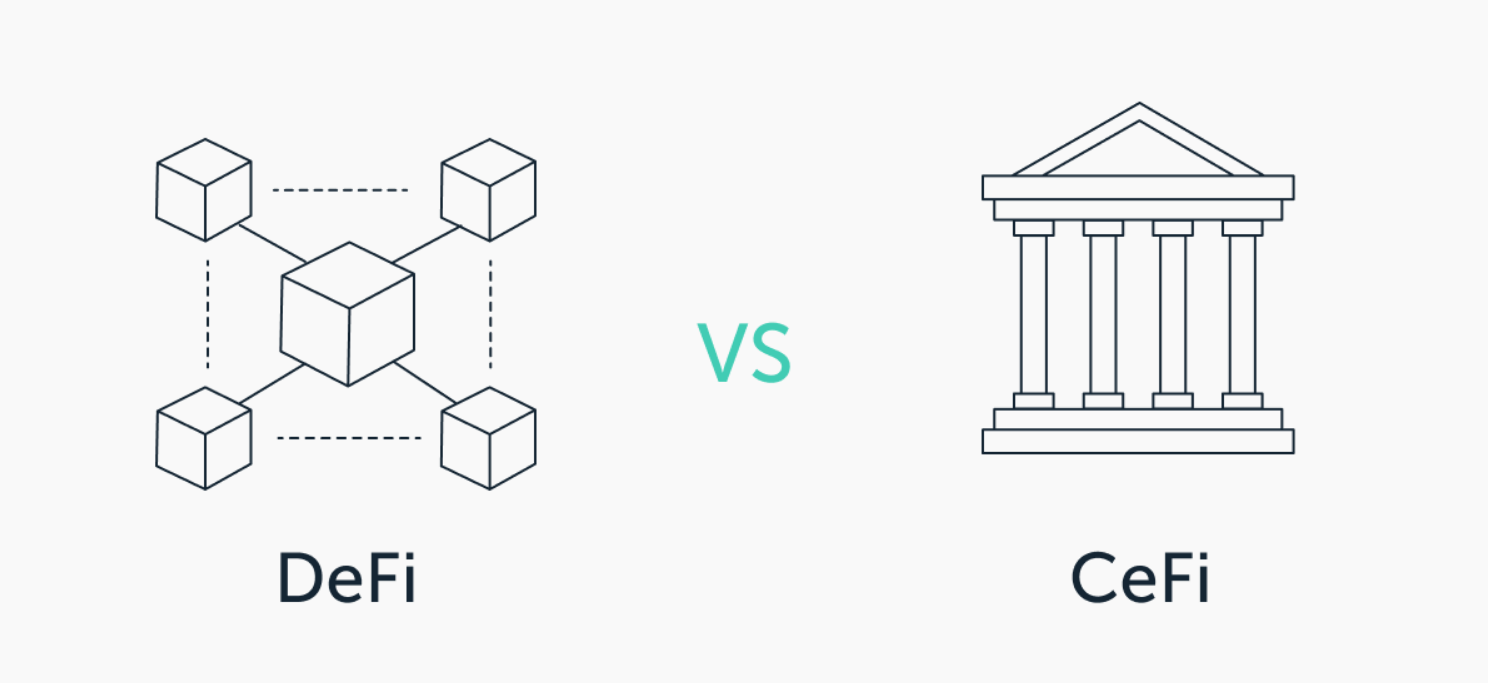
    DeFi vs CeFi: Key Differences

    CeFi stands for centralized finance. It includes banks, exchanges, and other financial institutions that manage users’ funds. The table below shows how they compare:

    FeatureDeFiCeFiControlYou retain full control of funds via personal walletsInstitutions control your fundsInterest ratesHigh and more volatile (5% to 50%+)Lower and more stable (1% to 8%)FeesTypically 0.1–0.5% per transaction$1–$30 per bank transferAccessibilityAnyone with an internet connection and a crypto walletRestricted by account approval, KYC, and geographic regulationsCensorship and restrictionsHardly any, as no single central authority can block transactionsFinancial institutions can freeze accounts, block transactions, or deny servicesTransparencyFully transparent, as all transactions are on-chain and auditableLimited transparency. You can only rely on institutional statements and reportsSpeedNear instant, available 24/7International transfers may take 1 to 5 days, and services are limited to business hours

    Real-World DeFi Use Cases

    DeFi isn’t just a concept. It’s already powering real financial services that people use every day. Here are some of the most common ways DeFi is being used today:

    1. Decentralized Exchanges (DEXs)

    DEXs let users trade cryptocurrencies directly with each other without a central company controlling the funds. Smart contracts handle trades automatically, removing the need for an intermediary. Popular DEXs include Uniswap, SushiSwap, and PancakeSwap, which allow users to swap tokens quickly while keeping full control of their assets.

    2. Stablecoins

    Stablecoins are digital tokens designed to maintain a steady value, often pegged to a currency like the US dollar. They help users store value or move money within DeFi without worrying about price swings. Stablecoins such as USDT (Tether), USDC (USD Coin), and DAI see widespread use across payments, savings, and trading across various DeFi platforms. These coins make it easier to interact with crypto while avoiding the volatility of typical digital assets.

    3. Real-World Asset Tokenization (RWA)

    Tokenization converts physical assets, like real estate, gold, or art, into digital tokens on a blockchain. Fractional ownership becomes possible, allowing investors to buy a portion of an asset instead of the whole. This approach opens new investment opportunities that were previously hard to access.

    4. Yield Farming & Staking

    Yield farming and staking allow users to lock their tokens in DeFi platforms to earn rewards. Platforms pay interest or extra tokens depending on the program. These methods let your crypto generate income while you continue holding it.

    5. Lending & Borrowing

    DeFi lending platforms let people earn interest by lending their digital assets. Borrowers can access loans by providing collateral, often without lengthy credit checks. Loans become faster and more accessible for anyone with crypto holdings.

    6. Non-Fungible Tokens (NFTs)

    NFTs represent ownership of unique digital items, like art, music, or collectibles. Users can buy, sell, or trade them on blockchain marketplaces. DeFi adds tools for NFTs, such as lending against them or fractional ownership, to provide more flexibility.

    Steps to Get Started With DeFi

    Starting with DeFi is easier than you might think, even if you’re new to crypto:

    Set up a crypto wallet: Download a trusted wallet like MetaMask, Trust Wallet, or Coinbase Wallet and follow the steps to create your account. Keep your recovery phrase safe. It’s the only way to restore your wallet.Buy digital assets: Purchase a small amount of a major coin like ETH, SOL, or BNB from an exchange such as Coinbase, Binance, or Kraken, then transfer it to your wallet.Connect to a DeFi protocol: Link your wallet to platforms like Uniswap or Sushiswap for trading, Aave or Compound for lending, or Yearn Finance for yield farming. Always double-check the website and connection to avoid scams.Start small and explore: Begin with a modest amount to test features like token staking, swapping, or staking. This helps you understand how each platform works without risking too much.Do your own research: Knowledge is the best way to avoid mistakes and protect your assets. Always read reviews and check community feedback for the latest insights.

    Taking these steps lets you start using DeFi confidently while minimizing risks and making the most of what the ecosystem has to offer.

    How Does DeFi Make Money?

    DeFi makes money in multiple ways:

    Transaction fees: Platforms like Uniswap and PancakeSwap charge a small fee for each trade. A portion goes to the platform to cover operations and development.Lending and borrowing interest: Protocols such as Aave and Compound earn revenue from the interest borrowers pay. The platform keeps a cut of the interest while the rest goes to lenders.Liquidity provider incentives: DeFi apps offer rewards to those who supply liquidity to trading or lending pools. Fees collected from trades or loans contribute to these incentives, encouraging ongoing participation.Staking and protocol rewards: Platforms may require users to lock tokens for network operations or governance. A share of the fees or newly issued tokens flows back to the protocol’s treasury, supporting growth and security.Protocol treasury & governance fees: Some platforms take a portion of fees and allocate them to a central treasury. These funds can finance development, security audits, or ecosystem expansion.Token appreciation: Platforms often hold their own tokens. As the platform grows and usage increases, the value of these tokens can rise, indirectly generating revenue for the project.

    Users can also make money by earning rewards, collecting interest, or benefiting from price increases in digital assets. However, profits are never guaranteed.

    The Future of DeFi

    The DeFi market is projected to hit over $351.75 billion by 2031, showing how quickly this space is growing. More banks and institutions are exploring DeFi to deliver fast, 24/7 financial services that comply with regulatory requirements. Tokenizing real-world assets such as stocks, bonds, and real estate could unlock more value, making DeFi more closely aligned with everyday finance. On top of that, AI is helping automate trades and provide smarter tools for users, while platforms focus on safer, more sustainable yield models. The future points to a DeFi ecosystem that’s bigger, smarter, and more accessible worldwide.

    Conclusion

    Decentralized finance is changing the way people think about money. By removing middlemen and using smart contracts, DeFi protocols allow users to manage transactions directly and securely.

    While risks exist, the opportunities for access, transparency, and innovation are significant. Understanding what DeFi is and how it works is the first step toward deciding whether it fits your financial goals.

    FAQs

    Is DeFi a good investment?

    DeFi can offer strong opportunities, but it comes with risk. The prices of digital assets can change rapidly, which is why it’s essential to evaluate a project carefully before investing.

    Can I make money with Decentralized Finance?

    Yes, you can earn money with DeFi through lending, staking, or trading digital assets. However, returns are not guaranteed, and losses are possible.

    Is DeFi legal in the US?

    DeFi isn’t explicitly illegal, but it exists in a complex regulatory “grey area.” Users and developers must comply with rules such as tax reporting and anti-money laundering (AML) requirements. Regulations are evolving, so it’s important to stay informed before participating.

    Is DeFi Safe?

    DeFi can be secure when used carefully, but risks such as smart contract bugs, scams, and lost wallet keys are real. Always stick to trusted platforms such as Uniswap, Aave, or Compound. Protect your wallet information and double-check transactions before confirming.

    What blockchain does DeFi run on?

    DeFi primarily runs on Ethereum, the open-source blockchain that powers most protocols and smart contracts. Other networks, such as Solana, Polkadot, and layer-2 solutions, also support DeFi apps. The choice of blockchain can affect transaction speed, fees, and overall user experience.


    Source link

    What Is Polymarket? A Beginner’s Guide to Prediction Markets – NFT Plazas

    0
    What Is Polymarket? A Beginner’s Guide to Prediction Markets – NFT Plazas


    You may be an investor asking, what is Polymarket? This blockchain-based platform has gained attention as a hub for prediction markets, where users can trade on outcomes of real-world events. With its innovative approach, Polymarket is reshaping how people engage with market trends and data-driven insights. 

    In this guide, we’ll break down everything you need to know about Polymarket, its role in prediction markets, and why it’s becoming a key player in this space. Read on to uncover how it works and what makes it stand out in 2026.

    What is Polymarket?

    What is Polymarket?

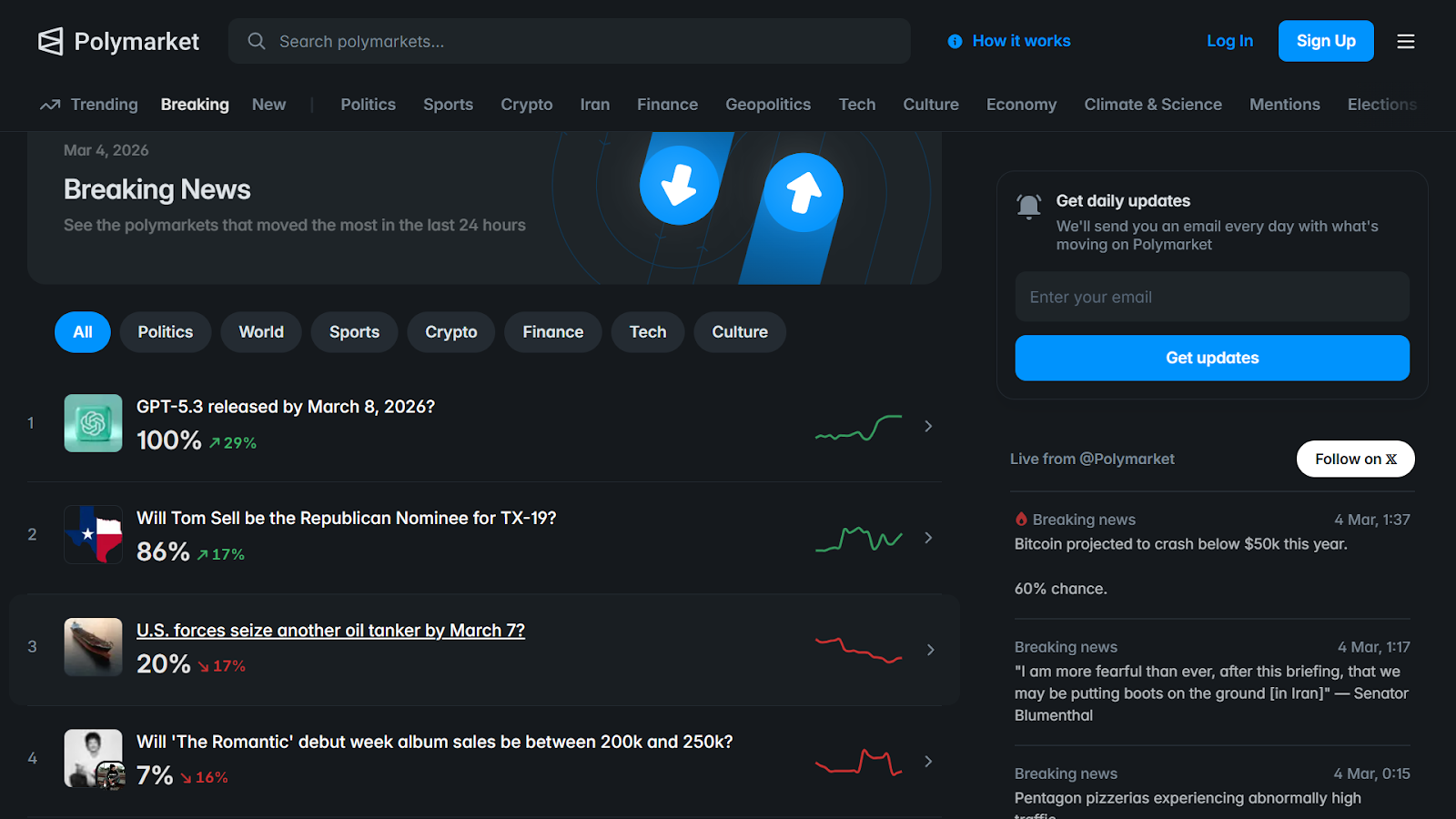
    Polymarket is a decentralized prediction market where people trade on the outcome of future events. Instead of relying on a central operator, the platform runs on blockchain infrastructure, which records transactions and manages settlements through automated systems. Users interact directly with each other by taking positions on whether an event will occur or not.

    Markets on the platform are created around specific questions about real-world developments. These questions may involve politics, finance, sports, or other public events. In a landscape where many cryptocurrencies have currently failed to provide tangible value, Polymarket stands out by providing a practical use case that combines market insights with blockchain innovation.

    How Does Polymarket Work?

    Polymarket functions by allowing users to buy and sell shares tied to specific event outcomes. Each share’s price reflects the collective probability of an event occurring, dynamically adjusting as market sentiment evolves. Transactions are recorded on a blockchain ledger, ensuring tamper-proof operations. 

    The way to secure the cryptocurrency used on Polymarket lies in its integration with blockchain protocols. Transactions are recorded on a decentralized ledger, ensuring that funds are protected and tamper-proof. Additionally, smart contracts automate the resolution of markets, distributing payouts to users based on the verified outcome of events. This framework not only enhances security but also builds trust among participants, solidifying Polymarket’s position in the prediction markets ecosystem.

    Understanding Market Prediction on Polymarket

    Prediction markets rely on collective forecasting. When users trade shares tied to event outcomes, the market price reflects the probability that participants assign to that outcome. A share trading at $0.70 suggests that traders estimate a 70% chance of the event occurring.

    Prices change as new information enters the market. When participants revise their expectations, they buy or sell shares, which adjusts the probability reflected in the price. This mechanism allows the market to combine information from many participants into a single probability estimate, often referred to as crowd-based forecasting.

    Why Is Polymarket So Popular?

    Polymarket has gained significant traction as a leading platform in the world of prediction markets. Its unique approach to trading on real-world events has set it apart from traditional betting platforms. Here are some of the reasons why:

    1. Transparent and Decentralized Framework

    Unlike traditional sites where you place bets, Polymarket operates on a decentralized blockchain, where all transactions are recorded and tamper-proof. This builds trust among users and removes the need for intermediaries.

    2. Real-Time Market Sentiment

    Polymarket reflects real-time public sentiment on global events. Prices shift dynamically as new insider information becomes available, making it a reliable tool for gauging probabilities in prediction markets.

    3. Low Fees and Fast Transactions

    The platform uses the Polygon blockchain, which offers low transaction fees and fast settlement times. This makes it accessible to users at different investment levels.

    4. Wide Variety of Markets

    Polymarket covers a diverse range of real-world events, including elections, sports, and financial trends. The variety attracts a broad audience and keeps markets active.

    What Can You Trade on Polymarket? 

    Polymarket offers a wide range of markets, allowing users to trade on the outcomes of real-world events. From global headlines to niche topics, the platform provides opportunities for traders to engage in diverse prediction markets. Whether you’re looking to speculate on political outcomes or financial trends, Polymarket caters to various interests. Here’s what you can trade:

    Elections: Predict odds for the outcomes of major elections, such as presidential races, congressional seats, or referendums.Sports: Trade on events like the Super Bowl, World Cup, or Grand Slam finals.Crypto & Finance Markets: Speculate on cryptocurrency trends, such as Bitcoin’s price movements, or financial indicators like interest rate changes.Climate & Science: Engage in markets related to climate patterns, scientific breakthroughs, or environmental policies.Politics: Trade on legislative outcomes, policy decisions, or geopolitical developments.Culture: Forecasting those who win awards like the Oscars, Grammys, or other cultural milestones.

    Is Polymarket Legal in Your Country?

    Polymarket’s legality depends on the regulations of your country. While the platform operates globally, some regions restrict or prohibit prediction markets. Users must verify local laws before participating to avoid legal complications. Polymarket also employs geo-fencing to block access in restricted areas, ensuring compliance with regional regulations. Always trade responsibly and within the legal framework of your jurisdiction.

    How Accurate Are Polymarket Predictions?

    How Accurate Are Polymarket Predictions?How Accurate Are Polymarket Predictions?

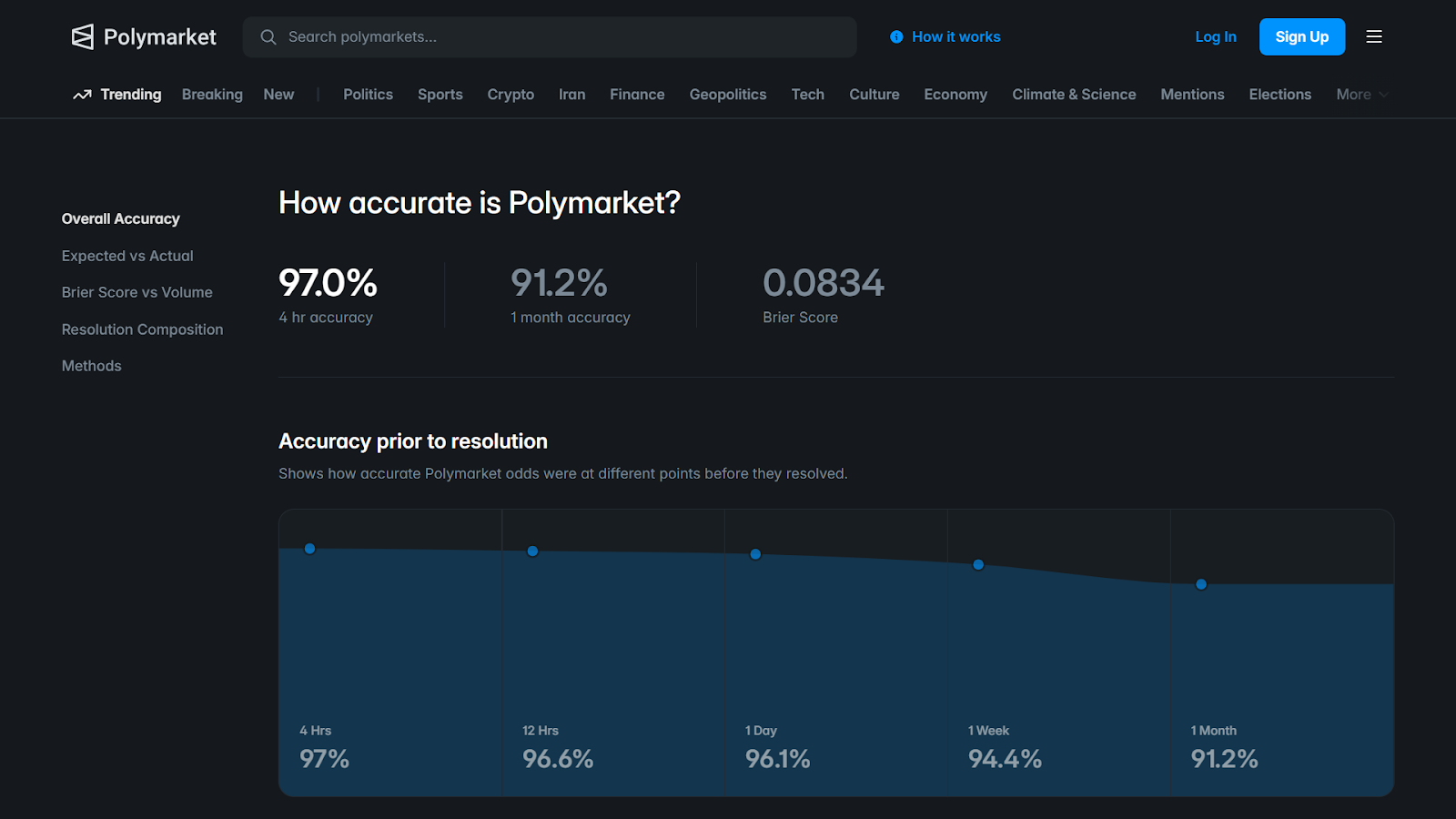
    Polymarket predictions demonstrate a high level of accuracy, particularly as events approach resolution. Metrics show that:

    97% Accuracy (4 Hours Before Resolution): Predictions are highly reliable close to event resolution.96.1% Accuracy (1 Day Before Resolution): Strong alignment between forecasts and outcomes, even a day prior.91.2% Accuracy (1 Month Before Resolution): Consistent accuracy over longer timeframes.Brier Score of 0.0834: Reflects precise probability assessments, measuring how close predictions are to actual outcomes.

    Key Benefits of Using Polymarket

    Below are the standout advantages that keep traders coming back to Polymarket:

    Decentralized Control: Polymarket allows traders to maintain full control of their funds through self-custody wallets, eliminating reliance on intermediaries.Transparent Transactions: All trades are recorded on the blockchain, providing a tamper-proof and auditable record of activity.Low Costs: The platform operates with minimal fees, making it cost-effective for traders of all levels.Diverse Market Options: Traders can participate in a wide range of prediction markets, from political events to financial trends, catering to various interests.Real-Time Adjustments: Market prices shift dynamically based on new information, allowing traders to act on the latest developments on a certain date.Flexible Trading: Shares can be bought or sold at any time before market closure, giving traders the ability to lock in profits or minimize losses.

    Risks of Using Polymarket

    Polymarket carries several risks that users should consider before participating. Market risk is inherent, as incorrect predictions can lead to a total loss of funds. Low liquidity in less popular markets may make it challenging to buy or sell shares, especially near resolution. 

    Regulatory restrictions also pose a challenge, as some regions prohibit or limit access to prediction markets. Additionally, reliance on decentralized oracles and blockchain technology introduces potential vulnerabilities, such as smart contract risks. Users are advised to trade responsibly and only invest amounts they can afford to lose.

    How to Get Started with Polymarket

    Getting started with Polymarket is a straightforward process that allows you to dive into the world of prediction markets. By following a few simple steps, you can begin trading on real-world events and leveraging your insights. Here’s how to get started:

    Step 1: Create a Polymarket Account

    To begin, visit Polymarket and connect a self-custodial wallet like MetaMask. This wallet will serve as your gateway to the platform, enabling secure transactions. The account creation process is quick and does not require additional signups, making it user-friendly. Once connected, you’re ready to explore the platform and its key features.

    Step 2: Funding Your Account with USDC

    Polymarket operates using USDC, a stablecoin pegged to the US dollar. To fund your account, transfer USDC to your connected wallet through a supported exchange or platform. The use of the Polygon blockchain ensures low transaction fees and fast processing times. Having sufficient USDC in your wallet is essential to start trading on the platform.

    Step 3: Browse & Explore Available Markets

    Polymarket offers a diverse range of markets, covering topics like elections, sports, and crypto trends. Each market includes clear resolution criteria, helping you understand the basis for outcomes. Take your time to explore and identify markets that align with your interests or expertise. This step is crucial for making informed decisions and maximizing your trading potential.

    Step 4: Understanding Shares

    Shares on Polymarket represent the probability of an event occurring, expressed as a price. For example, a share priced at $0.70 suggests a 70% likelihood of the event happening. You can buy shares if you believe the event will occur or sell them if you think otherwise. Understanding how shares work is key to navigating the platform effectively.

    Step 5: Place Your First Trade

    Once you’ve selected a market, decide on your prediction and place your trade. Monitor the market as it evolves, as prices may shift based on new information. You can adjust your position by buying or selling shares before the market closes. This flexibility allows you to manage your trades and optimize your outcomes.

    Polymarket vs Other Prediction Markets

    Polymarket stands out from other prediction markets due to its decentralized and transparent framework. Unlike traditional platforms, Polymarket operates on the Polygon blockchain, ensuring low fees and fast transactions. It also offers a wide variety of markets, from elections to crypto trends, catering to diverse user interests. Additionally, Polymarket’s accuracy metrics and Brier scores highlight its reliability, making it a trusted choice for traders.

    In contrast, many traditional prediction markets rely on centralized systems, which may lack transparency and involve higher fees. These platforms often have limited market options and slower transaction times. Furthermore, Polymarket’s use of blockchain technology ensures tamper-proof records, a feature not commonly found in centralized alternatives. This combination of innovation and user-centric features positions Polymarket as a leader in the prediction market space.

    The Future of Decentralized Prediction Markets

    The future of decentralized prediction markets holds immense potential as blockchain technology continues to advance. These platforms provide unmatched transparency, enabling users to verify transactions and outcomes without the need for intermediaries. With smart contracts ensuring secure and tamper-proof operations, decentralized prediction markets foster trust and reliability among participants. As awareness of these benefits grows, prediction markets are expected to attract a wider audience, increasing market liquidity and global adoption.

    Innovations in blockchain technology, such as improved scalability and interoperability, will further enhance the appeal of decentralized prediction markets. Reduced transaction fees and faster processing times will make these platforms more accessible to other users worldwide. Additionally, the integration of advanced data analytics and artificial intelligence could refine market accuracy, offering participants deeper insights. With these developments, decentralized prediction markets are set to revolutionize how individuals engage with real-world events, creating a secure, efficient, and transparent ecosystem.

    Conclusion

    Decentralized prediction markets, powered by blockchain technology, are transforming how individuals engage with real-world events. With their transparency, security, and growing accessibility, these platforms are set to play a pivotal role in the future of global financial ecosystems. As technology advances, its potential for innovation and broader adoption continues to expand.

    FAQs

    Is Polymarket safe to use?

    Yes, Polymarket is generally safe to use as it operates on blockchain technology, ensuring transparency and security. However, users should be aware of market risks, smart contract vulnerabilities, and regulatory restrictions in their region.

    Is Polymarket legal in the US?

    Yes, Polymarket is legal in the United States but operates under strict regulatory oversight from the Commodity Futures Trading Commission (CFTC).

    How does Polymarket make money?

    Polymarket earns revenue mainly through small trading fees on transactions within its prediction markets. When users buy or sell outcome shares, a minimal fee may apply.

    Is Polymarket gambling or investing?

    Polymarket is generally categorized as a prediction market rather than traditional gambling. Users trade shares that represent the probability of real-world events occurring.

    Can I use Polymarket anonymously?

    Polymarket allows pseudonymous participation through crypto wallets. Users connect wallets instead of creating traditional accounts, which means personal details like names or emails are not always required.


    Source link

    Scream 7 Spoiler Review – It’s Just Stab At This Point

    Scream 7 Spoiler Review – It’s Just Stab At This Point


    Sometimes it’s fun to change gear and write about something else for a change, and Scream holds a special place in my dark heart. Like so many other people, Scream is the movie that got me into horror. I picked up the original three movies in Asda on a whim, and it sparked a love for the genre. Since then, I’ve seen every movie multiple times, so Scream 7 was an exciting prospect for me, even despite the many controversies leading up to its release.

    There was a time when the Scream series felt untouchable. Ever since Scream hit cinemas and gleefully tore apart the rules of slasher movies, the franchise has managed to walk a clever tightrope. It was both a horror series and a commentary on horror series. It was a slasher series where the characters were gleefully aware of horror movie conventions, and yet it itself was something of a generic slasher series.

    Even when the films stumbled—looking at you, Scream 3—they still had ideas. They tried things. Sometimes those things worked, sometimes they absolutely did not, but at least they felt like someone was swinging for the fences. Well, slashing at the victims, at any rate.

    Scream 7 is strange because it doesn’t really swing at all. It’s like a lazy Ghostface, idly jogging after a victim and occasionally taking a swipe with all the passion of someone contemplating even more fucking jogging. My distaste of jogging might be bleeding through here.

    The movie isn’t terrible. It’s competently made, occasionally entertaining, and even has a couple of interesting ideas floating around. But for the first time in the series, it feels completely content to simply exist as another slasher sequel. And when a franchise built on self-awareness stops having anything to say, you start to realise just how ordinary it really is.

    Image credit: Paramount

    Right from the start, Scream 7 leans hard into nostalgia. The original Woodsboro house has been turned into an Airbnb for anyone with a fascination for the Stab movies or Sidney’s traumatic past, old faces pop up here and there, and the film is packed with little nods to earlier entries. The movie almost invites you to sit there pointing at the screen like Leonardo DiCaprio. “Hey, I remember that!” When the original murder house is burned down, it’s almost like the film is saying it wants to burn the past. But it isn’t. It wants to live in the past, to revel in it, to embrace the safety of what came before even as Scream 6 finally started to move the franchise forward into a world without Sidney.

    In theory, the film is actually aware of this. There’s an idea floating around in the background about nostalgia and how people obsess over the past. The series has always liked poking at the media culture surrounding horror, so examining the way audiences cling to the original Scream could have been interesting.

    The problem is that the movie also can’t stop indulging in that nostalgia itself. It wants to comment on the phenomenon while simultaneously using it as a selling point. It’s a bit like complaining about junk food while eating a family-sized bag of crisps.

    Image Credit: Paramount

    Still, one piece of nostalgia actually works surprisingly well. The film teases the return of Stu Macher, the original Ghostface accomplice, once again played by Matthew Lillard.

    Considering the internet has spent about twenty years insisting Stu somehow survived a television being dropped on his head, you might expect the film to drag that mystery out for a while, right?

    Instead, Scream 7 gets it out of the way fairly quickly. Stu pops up early on, appearing via video call to Sidney and immediately reminding us why he’s still the most memorable Ghostface alongside Billy Loomis.

    A reminder here: this is a spoiler-filled review, so Stu isn’t secretly alive. The killer is simply using AI-generated footage and manipulated recordings to make it appear like he is. It’s all part of a plan to mess with Sidney Prescott and drag her back into the nightmare she thought she’d escaped.

    Honestly, I kind of appreciate that the movie doesn’t waste much time pretending Stu is really back. Bringing him back for real would have been opening a door that Scream should probably avoid. When death starts becoming optional, that’s fine for certain types of story, but I’m not sure I want Scream to step through that door.

    Image Credit: Paramount

    What I mean by pretending is that while the movie doesn’t confirm it’s AI until closer to the end, it’s like the script never really tries to sell the audience on Stu being alive. It makes it obvious. He only ever appears via phone call, never in person. Multiple characters openly talk about it probably being a trick or AI, and both Sidney and the returning Gale Weathers are never convinced that it’s really him.

    This way the film gets its nostalgia hit without completely snapping the logic of the original movie in half. And even in this limited form, Matthew Lillard still manages to inject some manic energy into the character. Which is impressive considering he basically phoned the performance in. Literally.

    The AI angle itself is actually a decent idea. The series has always reflected the technology of its time. The original Scream leaned into the terror of anonymous phone calls, while Scream 4 explored internet fame and livestream culture. Using AI manipulation and deepfakes as the next step feels like a natural progression. In a modern setting, how would people abuse AI? What horrors could be inflicted by virtually raising the dead?

    Image Credit: Paramount

    Unfortunately, Scream 7 doesn’t really do anything with the concept. AI exists purely as a plot device to justify fake videos and creepy voice recordings. The movie never actually explores the idea or comments on it in any meaningful way. It just sort of shrugs and says, “AI did it.” For a series all about meta-commentary, it sure doesn’t have much to say.

    It also doesn’t make a whole lot of sense if you think about it too hard. Somehow the killer has enough footage of Stu to create convincing AI-generated appearances decades after his death. It’s one of those moments where you can almost hear the script waving its hands in the air while hoping nobody asks too many questions. Bluntly, it’s somebody throwing AI into the script who doesn’t understand it, but does know it’s the top topic.

    Still, even with those issues, the Stu stuff is probably the most entertaining thread running through the film. Which unfortunately makes the actual Ghostface reveal feel even more underwhelming.

    The main killer turns out to be Jessica Bowden, Sid’s neighbour who developed a parasocial obsession with Sidney after reading her book. In her mind, Sidney isn’t just a survivor—she’s a personal hero, almost like a celebrity figure who helped her through a dark time. When Sidney disappears from the public spotlight, Jessica can’t handle it.

    Image Credit: Paramount

    Her solution is… interesting, if a bit ridiculous. She plans to murder Sidney in front of her daughter in order to create a new traumatised survivor. Essentially a twisted attempt to manufacture a “Sidney 2.0”.

    It’s not the worst idea on paper. Parasocial relationships and celebrity obsession are definitely things the series could explore. Hell, we touched on it a little with Scream 4 when Sid’s own niece wanted some of that celebrity status. The problem is that the movie never really develops the idea beyond that basic explanation. The character has no meaningful connection to Sidney beyond admiration, which makes the reveal feel oddly distant compared to some previous Ghostface motivations.

    Her accomplice, an AI expert whose name I can’t even remember, doesn’t fare much better. His reveal lands with all the dramatic impact of someone reading out a Wi-Fi password. I genuinely had to Google his name (it’s Marco, apparently) and could tell you nothing else about him, except that Gale Weathers, a supposed journalist, should have been a bit more suspicious about a mental asylum employee gleefully handing out information like it’s a public bloody library.

    For a series famous for memorable killer reveals, this one is shockingly bland. I think it’s genuinely the worst Ghostface reveal. The number one, of course, being Doofy Gilmore in Scary Movie.

    Image Credit: Parmount

    One genuinely interesting idea arrives when a third Ghostface gets taken out midway through the film, a first for the series. Normally the killers survive until the final act so they can do their dramatic reveals and monologue a little bit while conveniently giving our heroes time to get their shit together. So seeing one of them get abruptly killed should shake up the formula and create the sense that the plan is falling apart.

    It’s a fun concept, but the execution is a little weird. The character is portrayed as a genuinely intimidating Ghostface just minutes earlier, hiding in the attic and stalking his prey. It’s actually a fun sequence, including a cool wall-stabbing scene as Sid and her daughter attempt to escape the house.

    But then he suddenly gets taken out in a fairly unceremonious fashion by an arriving Gale Weathers in an SUV. The idea itself is solid, but the moment doesn’t quite land the way it probably should have. That was probably the idea, though—to shock the audience with his sudden demise. I was expecting him to have disappeared when they go to check the body, but nope, he’s dead.

    This sudden life-deletion service via delivery driver, AKA Gale, also heralds the arrival of the twins from Scream 5 and Scream 6, who have now decided to go into the content business for… er, reasons. Mindy and Chad are actually pretty fun returns, even if they don’t actually have much to do in the movie outside of what is now a running joke about them getting stabbed or sliced every movie and still surviving. Uncle Randy would be proud. Well, not so proud of Mindy, who has still yet to successfully guess a killer’s identity.

    Image Credit: Paramount

    The supporting cast doesn’t help matters much either. One of the strengths of the earlier films was the friend group dynamic. You needed a colourful set of suspects and victims because the entire movie revolves around the mystery of who Ghostface might be.

    Here, most of the secondary characters barely register. In fact, I realised a few days after watching the film that I couldn’t remember the names of most of them. That’s not a great sign. Hell, one of them is just constantly referred to as the creepy kid, although I do appreciate him getting the most colourful kill in the entire movie.

    They’re basically corpses who just haven’t died yet. Not that unusual for a slasher movie, I suppose, but that lack of memorable characters makes the mystery aspect feel weaker than usual. If you don’t care about the suspects, the reveal doesn’t carry much weight. Of course, it wouldn’t have mattered anyway since the killer was never part of that circle.

    Image Credit: Paramount

    Perhaps the strangest thing about Scream 7, though, is its deliberate step away from the kind of meta-commentary that defined the series. Apparently this was intentional, which makes it an even more baffling decision.

    The whole identity of the franchise was built around that idea. The original Scream wasn’t just a slasher movie—it was a slasher movie that analysed the genre itself. Without that layer, the series becomes exactly what it once parodied: a long-running horror franchise that keeps dragging itself back from the grave.

    Now with added nostalgia, except the nostalgia is for itself because it has been around for so long.

    That’s the weird paradox the film finds itself in. It still references horror culture and its own history, but it doesn’t really have anything new to say about it. That’s the problem when your franchise becomes big enough to be the meta it was trying to be meta about.

    Image Credit: Paramount

    At least Neve Campbell remains reliably good as Sidney Prescott. She still brings a grounded intensity to the role, and it’s easy to see why the filmmakers hit the emergency button and brought her back into the spotlight. And I have to admit that as much as I’m poking fun on the reliance on nostalgia, it warms my heart to see Sid back on screen, being a badass. At this point, any Ghostface going after is just choosing death by Sid.

    The film also introduces Sidney’s daughter, Tatum, who actually ends up being one of the more interesting characters in the movie. The divide between her and her mother feels very artificial, relying on Sid not wanting to discuss her trauma, but I can just about buy into it. And I appreciate the idea that by trying to shield her from the horrors, Sid has actually left Tatum unprepared for a Ghostface assault.

    If the series continues, Tatum could probably carry the franchise just fine. Which ironically makes the decision to drag Sidney back into the centre of the story feel even more like a panic move.

    Point is, I’m down with Tatum taking over the role of Final Girl, albeit with one major caveat: if that’s the plan, Ghostface needs to kill Sidney. Without some convoluted way to keep her out of the script, any story involving Tatum being terrorised by a new Ghostface would naturally draw Sidney in, because she would never willingly let her daughter face that horror alone.

    My answer? Kill Sidney in the opening. And then have Tatum go after Ghostface. It could make for a fun dynamic shift, where the Ghostface only cared about Sidney and had no interest in Tatum, but the killing sends Tatum down a path of revenge. It could make for an interesting dynamic, and murdering Sid might be the kick in the crotch the series needs at this point. Or it might piss off the fanbase to the point they abandon Scream entirely.

    In Conclusion…


    Rating: 2.5 out of 5.

    In the end, Scream 7 isn’t a terrible movie. It has a couple of clever ideas and a few entertaining moments. But those ideas never go anywhere interesting, and the film seems strangely unwilling to push itself in any real direction.

    Even the messiest entry in the franchise, Scream 3, at least tried to do something different. It swung big and missed a few times, but it had heart. It embodied Ghostface in a lot of ways—full of murderous intent, but prone to tripping over its own robe or stumbling down some stairs.

    Scream 7 doesn’t fail because it’s incompetent. It fails because it’s perfectly content to be fine. Just a slasher sequel.

    And for a series that once made its name by reinventing the slasher genre, “fine” might be the most disappointing outcome of all.

    Dear reader, if you’re still here, thanks for reading and letting me talk about something other than videogames for a minute. If you’d like to see a Scream ranking, let me know!


    Source link

    A New Nightmare on Elm Street May Finally Be Coming

      0
      A New Nightmare on Elm Street May Finally Be Coming


      For horror fans, Freddy Krueger has been silent for far too long. The last film in the franchise was the 2010 reboot, meaning it has been more than fifteen years since audiences last stepped into the dream world of Elm Street. But new developments suggest that Freddy may be sharpening his claws once again.

      The Rights Situation Finally Changed

      One of the biggest reasons the franchise has remained dormant is a complicated rights situation. The U.S. rights to A Nightmare on Elm Street reverted back to the estate of creator Wes Craven, while New Line Cinema continues to control the international rights to the series and the iconic Freddy Krueger character.

      Since that shift, the Craven estate has reportedly begun reviewing pitches for new projects connected to the franchise, including potential films and even television series.

      In other words, Freddy’s return has been a matter of timing rather than interest.

      Freddy Could Return With a Completely New Direction

      Several creators have already floated ideas for bringing the character back. One proposal would move away from simply remaking the original 1984 classic and instead build a new story inspired by later entries in the franchise.

      Another idea would explore Freddy’s backstory before the events of the first film, creating a prequel that dives deeper into the mythology of Springwood and the infamous dream demon.

      The biggest challenge facing any new project will be replacing Robert Englund, the actor who made Freddy Krueger one of horror’s most recognizable villains.

      Could a New Actor Become Freddy?

      Englund has largely stepped away from the role, but the character could live on through a new interpretation. Some filmmakers have even suggested bold casting choices that would take the character in an unexpected direction.

      Others believe the role should go to a relatively unknown actor who can create a fresh version of Freddy without competing with Englund’s legendary performance.

      Why Now Might Be the Perfect Time

      Horror franchises are thriving again. Films like Halloween, Scream, and The Exorcist have all returned to theaters with new legacy sequels and reboots.

      Freddy Krueger remains one of the most iconic villains in film history, and the franchise still holds enormous cultural power. The original series was so successful that it helped establish New Line Cinema as a major studio, earning the nickname “The House That Freddy Built.”

      Never Sleep Again

      While no official Nightmare on Elm Street film has been announced yet, the pieces are finally in place for Freddy’s return. With rights issues largely resolved and new ideas circulating, it may only be a matter of time before a new generation hears the warning once again.

      One. Two. Freddy’s coming for you.

      FILM RATING

      The post A New Nightmare on Elm Street May Finally Be Coming appeared first on Coastal House Media.


      Source link

      ‘Hope she’s okay!’ Concerns for Loose Women star Katie Piper over her appearance on show today

        0
        ‘Hope she’s okay!’ Concerns for Loose Women star Katie Piper over her appearance on show today


        Loose Women fans expressed concern for Katie Piper over her appearance on the ITV show today (March 6).

        This afternoon’s instalment of the ITV panel show saw Kaye Adams, Jane Moore, Katie Piper and GK Barry unpacking topics such as Britney Spears’ arrest, female body-image and prenups.

        However, in the week it was revealed the man who orchestrated her acid attack may be eligible for parole, many viewers were left worried that Katie didn’t appear to be on top form.

        Don’t miss a single story! Add us as a Preferred Source in Google for all your entertainment news

        It’s important to us that you never miss our articles when searching for stories! We have all the latest TV & Celebrity news to share with our community of loyal readers.

        Click here and tick Entertainmentdaily.com to ensure you see stories from us first in Google Search.

        Katie Piper fans shared concerns for the star after today’s Loose Women (Credit: ITV)

        Loose Women viewers voice Katie Piper concern

        Several fans took to social media following the programme to check all was well with the star.

        One person tweeted: “Katie is a terrible colour today, bless her. Hope she is okay.

        Another also agreed: “Katie looks like she lost all colour on her face.

        However, a third viewer believed makeup could be to blame, tweeting that they thought all the Loose ladies looked a little peaky! They said: “Why do they all look grey?? Sack the makeup department!

        ‘You look amazing!’

        However, after Katie posted a smiling series of pictures showing off her outfit for Friday’s Loose Women, her loyal supporters flooded the comments section with love, and it appeared all was well with the mum of two.

        “Suited for today’s Loose Women,” she shared.

        “You look amazing Katie!!” commented one person, as the 42 year old posed in a chic two-piece suit and perfectly waved hair.

        “Wow wow wow wow,” gushed a second.

        “So beautiful!” Agreed a third.

        “Loving this look,” cheered on somebody else.

        Kaye Adams, GK Barry and Katie Piper on Loose Women
        Katie Piper joined Kaye Adams, Jane Moore and GK Barry on the Loose Women panel today (Credit: ITV)

        Loose Women back next month!

        At the end of the show, Kaye Adams also shared the news that Loose Women will be taking a short break from our screens.

        “We will be back next month,” she announced as they bid their farewells. “Until then, take care, have a fabulous weekend and Easter, and we’ll see you very soon!”

        The shake-up will, in part, make way for ITV’s coverage of Cheltenham Festival, which takes place next week.

        Read More: Katie Piper’s health setback that meant she was unable to have third child with husband

        You can share your thoughts with a comment on our Facebook page @EntertainmentDailyFix.


        Source link

        Nigel Farage Confidant Linked to $550K Loss On Iran Strike Polymarket Bet: Report – Decrypt

        0
        Nigel Farage Confidant Linked to 0K Loss On Iran Strike Polymarket Bet: Report – Decrypt


        In brief

        An account bearing George Cottrell’s name appeared to lose $550k on an Iran strike bet.
        An additional $125k loss was tied to a wager on Keir Starmer leaving office.
        Polymarket is not licensed to operate in the UK.

        An account on the prediction market Polymarket that appears to bear the name and birth year of British financier and Nigel Farage confidant George Cottrell lost more than $550,000 on bets about whether the U.S. would bomb Iran.

        The “GCottrell93” account wagered roughly $550,000 on the outcome “No” to the question “US strikes Iran by February 28, 2026?” according to Polymarket data first cited by UK newspaper The Daily Telegraph. The position was wiped out after the United States struck Iran on February 28. Prior to this, the account won multiple bets against the strikes before other dates in February.

        The same account also appears to have lost around $125,000 on a bet that Prime Minister Keir Starmer would be out of office by February 28. It has garnered almost $3.5 million in profits, the bulk of that coming from a bet on Trump winning the 2024 election.

        Blockchain investigator ZachXBT has previously expressed “high confidence” that the account belongs to Cottrell, a longtime associate of Reform UK leader Farage who has helped raise millions of pounds for his political movements, including Ukip and the Brexit Party. In 2025 his mother, aristocrat Fiona Cottrell, emerged as one of Reform UK’s largest donors.

        Cottrell has a long history with high‑stakes betting and finance. Court filings in the UK previously named him as part of a professional betting syndicate linked to Brighton and Hove Albion owner Tony Bloom. The syndicate, tied to the analytics firm Starlizard, reportedly generated hundreds of millions of dollars in winnings, with Cottrell said to have earned substantial sums by copying its bets.

        ]]>

        Cottrell was arrested in 2016 while attending the Republican National Convention in Chicago alongside Farage. U.S. prosecutors charged him with conspiracy to commit money laundering, wire fraud, blackmail and extortion after meetings with undercover federal agents in Las Vegas. Following a plea agreement, he pleaded guilty to a single count of wire fraud and served eight months in prison.

        Last month, he published a book entitled “How To Launder Money: A guide for law enforcement, prosecutors and policymakers,” whose launch was attended by Farage and senior Reform UK figures.

        In a statement emailed to Decrypt, a Reform UK spokesperson said that “George Cottrell is not employed by the party so you are best approaching him for comment.” Decrypt has attempted to contact Cottrell via his company, Geostrategy. 

        Reform UK and crypto

        Reform UK has taken an explicitly pro‑cryptocurrency stance and became the first major British political party to accept crypto donations in June 2025. The policy has drawn criticism from lawmakers and transparency campaigners who warn that cryptocurrency donations could enable money laundering or foreign interference in British elections.

        This week former Labour minister Rushanara Ali called for a ban on crypto political donations, describing them as a potential vector for “foreign interference in our democracy.” Seven parliamentary committee chairs also wrote to the prime minister earlier this year urging an explicit prohibition on cryptocurrency donations.

        Campaign groups have raised similar concerns. The UK Anti‑Corruption Coalition and Spotlight on Corruption argue that the Electoral Commission lacks the powers necessary to properly monitor the origin of crypto donations.

        Despite publicly saying it accepts it, donating online to Reform UK using crypto doesn’t seem to work. Decrypt tried to access the party’s crypto donations page online on multiple browsers and was directed to a blank page each time.

        Prediction markets under scrutiny

        Cottrell’s bets also come at a time of increased scrutiny of prediction markets. Polymarket is not licensed to operate in the UK and limits services to UK-based users. The Gambling Commission told Decrypt it “does not comment on individual businesses” but pointed to its register of licensed operators, which does not include Polymarket.

        In guidance published last month, the regulator said prediction market platforms would likely fall under the legal definition of a “betting intermediary” in the UK, similar to a betting exchange, and would require the appropriate gambling licence to operate legally.

        Despite arguments by some platforms that prediction markets are distinct from gambling, regulators around the world have taken an increasingly hard line. Companies in the sector face legal or regulatory challenges in numerous jurisdictions including  France, Germany, Italy, Australia, Singapore, Portugal, Hungary, Thailand and the Netherlands.

        Daily Debrief Newsletter

        Start every day with the top news stories right now, plus original features, a podcast, videos and more.


        Source link

        Popular Posts

        My Favorites