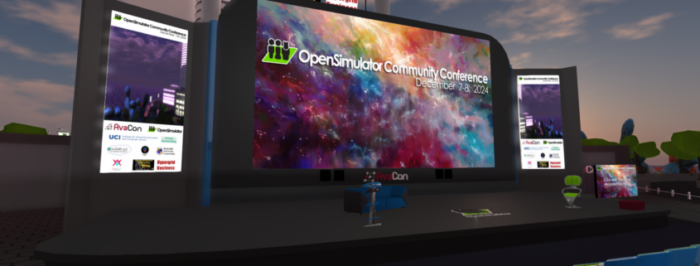
The OpenSimulator Community Conference, starts today with music and celebrations, then gets off to its full start tomorrow morning with a welcome panel with OpenSim core developers at 7 a.m. Pacific time tomorrow morning.
You can see the full schedule here.
You can also watch the presentations live streamed at AvaCon’s YouTube channel.
The conference is free to attend in person on the Open Simulator Conference grid, and you can register here or hypergrid to attend.
The hypergrid address is cc.opensimulator.org:8002.
Follow @opensimcc on X or on BlueSky and use the hashtags #OSCC24 or #oscc, and post your conference pictures and snapshots on our Flickr and Facebook group, or join the Discord server where you can also chat with other attendees during and after the event.
This year’s conference features over 55 speakers sharing innovative content, dynamic short presentations, and panels that all take place on Saturday, December 7, and Sunday, December 8, within the grid’s OSCC Keynote regions.
The schedule also includes live music, community and social events, and plenty of Expo regions to explore over the weekend. Don’t miss OSCC presenter booths located in OSCC Expo Zone 3 and the special hypergrid resources located in the OSCC Expo Zone 2 region with many how-to’s and scavenger hunt landmarks to interesting destinations where you can learn to hypergrid visit throughout the OpenSimulator metaverse.
There is also the chance to attend live music during Friday afternoon and Saturday evening #OSCC24 Music Showcase and on Sunday at the virtual venue of Maritime Club Belfast, as well as many post-conference community events and simulation tours.
Read more about the conference here.
Hypergrid Business editor and publisher Maria Korolov is a science fiction novelist. During the day, Maria Korolov is an award-winning freelance technology journalist who covers artificial intelligence, cybersecurity and enterprise virtual reality. See her Amazon author page here and follow her on Twitter, Facebook, or LinkedIn, and check out her latest videos on the Maria Korolov YouTube channel. Email her at maria@hypergridbusiness.com. Her first virtual world novella, Krim Times, made the Amazon best-seller list in its category. Her second novella, The Lost King of Krim, is out now. She is also the publisher of MetaStellar, a new online magazine of speculative fiction.
The Metaverse Standards Forum is proud to introduce the Metaverse Educational Register, a dedicated initiative designed to organize and guide the rapidly growing field of Metaverse-based education and training.
As virtual and augmented reality become integral to learning environments, a centralized register of resources, trends, and best practices is essential. This Register aims to support organizations and educators seeking to leverage Metaverse tools for internal training, external educational programs, and skill development. By compiling information from diverse sources, this Register will empower stakeholders to make informed decisions, streamline their approaches, and stay abreast of challenges and emerging trends in Metaverse education. Here, “education and training in the Metaverse” encompasses both instruction conducted within the Metaverse and education about its potential.
Key goals of the Working Group include:
Developing a comprehensive list of Metaverse training use cases: Cataloging diverse applications of the Metaverse in education to serve as a reference point for educators and organizations.
Creating a registry of recognized Metaverse-specific educational resources: Compiling high-quality learning materials, platforms, and tools tailored for education.
Liaising with Metaverse educational providers: Establishing partnerships and networks with leading educational entities to exchange knowledge and best practices.Highlighting best practices in Metaverse education: Identifying and promoting effective strategies to enhance Metaverse-based learning.
Publishing case studies and white papers: Analyzing successful metaverse educational programs to provide insights and empirical evidence for future initiatives.
In addition, the Forum will also facilitate workshops, presentations, and events to promote Metaverse education, engage a broader audience, and encourage participation from various stakeholders.
Join us for our Upcoming Speaker Panel
On December 12, 2024 at 11 am Eastern US / 4 pm UTC we will host a virtual panel with experts in the field of education. This session will explore key topics around learning in virtual environments. Attendance is free. Register here.
To join the Metaverse Standards Forum and participate in the ongoing Educational Register discussions, please see the membership application form. Once you are a member you can join the Metaverse Educational Register working group. Learn more about our work.
Together, we can navigate the complexities of Metaverse education and advance the field towards greater effectiveness, interoperability and accessibility.
It’s hard to delve into the cryptocurrency market or blockchain technology without encountering the term peer-to-peer (P2P). At some point, you’ve probably asked yourself, “What is P2P?” The concept of P2P, short for “peer-to-peer,” forms the backbone of Bitcoin and numerous other decentralized cryptocurrencies. It represents a revolutionary model for data transfer and communication.
In this article, we will explore:
What is P2P?
What does P2P mean?
What is P2P trading?
Is P2P gaming the same as P2P transfer?
Is P2P legal?
What is P2P?
The term P2P, or peer-to-peer, refers to a decentralized model of communication or data transfer. In this system, two parties interact directly, eliminating the need for an intermediary. Imagine a scenario where a friend asks you for a loan. You can transfer money through a bank, involving a third party. Alternatively, you could hand over the money directly, removing the intermediary. This is the essence of P2P: direct transactions without middlemen.
However, physical handovers aren’t always feasible, especially when distance is involved. The internet revolution of the late 1990s gave rise to peer-to-peer file-sharing applications, such as BitTorrent (BTT), which remains influential today as a cryptocurrency.
In 2008, the introduction of Bitcoin, detailed in the Bitcoin whitepaper titled “Bitcoin: A Peer-to-Peer Electronic Cash Payment System”, marked a pivotal moment. It demonstrated how the blockchain—a decentralized P2P network—could facilitate secure, intermediary-free transactions. Bitcoin was soon followed by smart contract platforms like Ethereum (ETH), catalyzing the rise of the decentralized finance (DeFi) ecosystem.
What Does P2P Mean?
In the context of blockchain, P2P signifies a direct interaction between two users, facilitated by a decentralized platform. These platforms, unlike traditional centralized systems, allow for increased privacy, efficiency, and cost-effectiveness.
For instance, P2P networks enable cryptocurrency trading directly between parties, bypassing intermediaries such as banks or centralized exchanges. This mechanism has become the cornerstone of DeFi applications.
Is P2P Gaming the Same as P2P Transfer?
The term P2P in gaming usually refers to the “pay-to-play” model, where players pay a fee—either one-time or recurring—to access a game. However, this differs from the blockchain-based P2P model.
Blockchain games, especially play-to-earn (P2E) games, integrate P2P trading of in-game assets, often represented as NFTs. While P2P mechanisms exist in these games, “P2P gaming” typically describes pay-to-play games rather than blockchain-based gaming activities.
What is P2P Trading?
P2P trading, or peer-to-peer trading, refers to the exchange of assets directly between users without intermediaries. Commonly facilitated by decentralized exchanges (DEXs), P2P trading employs smart contracts to enable secure, automated transactions. For example, trading ETH for XRP without involving a centralized exchange is a classic P2P operation.
Are Decentralized Exchanges Intermediaries?
No, decentralized exchanges are platforms that facilitate direct interactions between users. Think of a DEX as a bus route where passengers buy tickets directly from the driver—no third-party involvement, much like P2P trading.
Advantages of P2P Trading
Privacy: Transactions occur directly between parties, enhancing confidentiality.
Efficiency: Removing intermediaries streamlines the process.
Cost Savings: Without third-party fees, costs are significantly reduced. Some DEXs charge minimal fees for platform maintenance or reward users with incentives.
For more details on decentralized exchanges, check out our article, “What is a DEX?“.
Is P2P Legal?
The legality of P2P trading depends on regional regulations. In USA, for instance, the Capital Markets Board (CMB) restricts P2P platforms. The CMB’s bulletin dated September 19, 2024, states:
“P2P platforms facilitating the buying, selling, or exchanging of crypto assets directly between users are deemed unauthorized crypto-asset service providers under Article 99/A of the Law. These activities must cease by December 6, 2024.”
While many countries embrace P2P technology, understanding local laws is crucial before engaging in P2P transactions.
You May Also Like
Follow us on TWITTER (X) and be instantly informed about the latest developments…
Web3, heralded as the future of the internet, leverages blockchain technology and cryptocurrencies to promise complete decentralization. With democratic governance mechanisms and full user control over data, Web3 is transforming the digital landscape. In this article, we explore the most popular Web3 applications of 2025 that are shaping this new era.
Polkadot (DOT) stands out for its unique blockchain architecture, enabling the creation of customizable blockchains that interact seamlessly. This interoperability makes Polkadot a cornerstone of the Web3 ecosystem.
Key Features:
Robust infrastructure for decentralized applications.
Facilitates blockchain interoperability.
DOT, its native token, ranks among the top Web3 coins by market cap.
2.CyberConnect (CYBER)
CyberConnect (CYBER) redefines social networks by offering users full control over their data, content, and monetization channels. By empowering users to own and manage their social graphs, CyberConnect epitomizes the decentralized ethos of Web3.
Key Features:
Enhances interoperability across decentralized applications.
CYBER token is a leading Web3 cryptocurrency, gaining popularity for its role in reshaping social media.
3.Solana (SOL)
Known for its low fees and high-speed transactions, Solana (SOL) is a favorite among Web3 app developers and NFT creators. Its scalable infrastructure supports a wide range of NFT and Web3 projects, making it essential to the ecosystem.
Key Features:
High-performance blockchain with fast transactions.
Integral to the NFT sector, a key component of Web3.
SOL coin remains a top cryptocurrency by market cap.
Filecoin (FIL) revolutionizes data storage by offering a decentralized storage network as an alternative to centralized cloud solutions. Users can earn FIL tokens by renting out unused storage space, making it both practical and rewarding.
Key Features:
Ensures secure and decentralized data storage.
Passive rewards for participants in the Filecoin network.
Recognized as a transformative Web3 project.
Flow (FLOW) is a blockchain tailored for NFT gaming and applications, with a focus on speed and low transaction costs. Projects like CryptoKitties, NBA Top Shot, and Dapper Wallet thrive on the Flow blockchain.
Key Features:
Multi-node architecture for handling transaction demands.
Popular among developers of NFT and Web3 projects.
FLOW token is a top choice among Web3 coins.
The Web3 revolution continues to evolve, with applications like Polkadot, CyberConnect, Solana, Filecoin, and Flow leading the charge. These blockchain-based projects showcase the immense potential of decentralized technology to reshape how we interact with data, applications, and digital assets.
You May Also Like
Follow us on TWITTER (X) and be instantly informed about the latest developments…
Jerome Powell, the Chairman of the US Federal Reserve (Fed) since 2018, has made noteworthy comments on Bitcoin (BTC), despite his typically skeptical stance on cryptocurrencies. Speaking at the DealBook Summit organized by the New York Times, Powell compared Bitcoin to gold, stating it is not a competitor to the US dollar but rather to gold.
During his speech, Powell referred to Bitcoin as a speculative asset, saying:
“Bitcoin is just like gold. It’s virtual, it’s digital.”
He clarified that BTC’s volatility prevents it from being used as a form of payment or a store of value, differentiating it from the US dollar.
Powell stated, “BTC is not a competitor to the dollar. BTC is actually a competitor to gold.”
This is not Powell’s first time likening Bitcoin to gold. In March 2021, he made similar remarks, describing both BTC and gold as speculative assets.
When asked during the summit whether he personally owns Bitcoin, Powell declined to comment, citing restrictions on addressing such questions.
Bitcoin Surpasses $100,000 for the First Time
In a historic milestone, Bitcoin’s price reached $103,679 on December 5, surpassing the long-anticipated $100,000 mark for the first time. This achievement set a new all-time high (ATH) and marked BTC’s debut above the $100K level in its history.
The cryptocurrency has experienced a series of record-breaking performances, coinciding with pivotal moments in US politics, such as Donald Trump’s election as president.
Jerome Powell’s remarks underscore the perception of Bitcoin as digital gold, positioning it as a speculative alternative to traditional assets like gold, rather than a replacement for fiat currencies like the US dollar. As Bitcoin continues to break records, its role in the financial world remains a subject of significant debate and interest.
You May Also Like
Follow us on TWITTER (X) and be instantly informed about the latest developments…
Google has introduced its latest artificial intelligence model, PaliGemma 2, which aims to revolutionize the analysis of visual content by incorporating emotion detection capabilities. Although this feature is not yet fully operational, PaliGemma 2 marks a significant step forward in understanding and interpreting human emotions within images.
Key Features of PaliGemma 2
PaliGemma 2 goes beyond basic object recognition by providing detailed descriptions of actions, emotions, and narratives within images. Google emphasized the following capabilities of the model:
Detailed Analysis: Accurately identifies actions, emotions, and overarching stories in visual scenes.
Multi-Parameter Options: Available in 3D, 10D, and 28D parameter configurations.
Resolution Flexibility: Supports image resolutions of 224px, 448px, and 896px.
Optical Character Recognition (OCR): Recognizes and interprets text within images and documents.
Specialized Recognition: Capable of identifying chemical formulas, music notes, and generating chest x-ray reports.
Emotion Detection and Ethical Considerations
One of PaliGemma 2’s most anticipated features is its ability to recognize emotions in visual content, offering new possibilities for applications in healthcare, education, and entertainment. However, this feature is still under development and not fully functional.
With this advancement comes important ethical concerns. Experts caution that emotion detection technology could be misused, potentially leading to privacy violations or social harm. Google has acknowledged these concerns, highlighting the need for rigorous ethical evaluations before rolling out the feature widely.
Broader Applications
In addition to emotion recognition, PaliGemma 2 offers a wide range of practical applications:
Enhanced visual content categorization for media and marketing.
Advanced document processing, including table structure analysis.
Improved medical imaging interpretations for more accurate diagnostics.
PaliGemma 2 represents a significant leap forward in AI-driven visual content analysis, combining narrative description, action identification, and emerging emotion recognition capabilities. As the technology evolves, its potential to reshape industries will depend on addressing the associated ethical challenges, ensuring its responsible and beneficial use.
You May Also Like
Follow us on TWITTER (X) and be instantly informed about the latest developments…
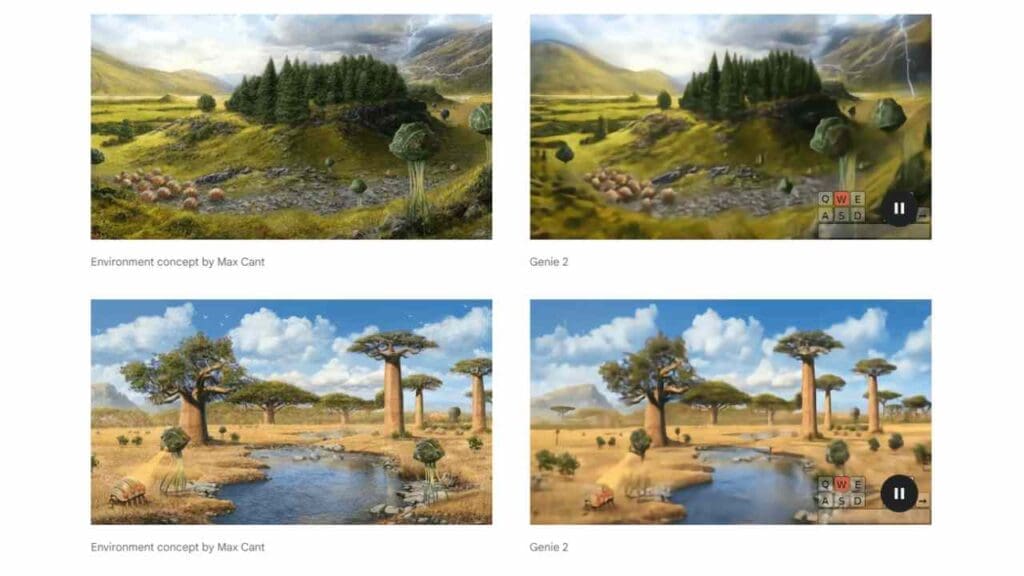
Google DeepMind has unveiled a groundbreaking artificial intelligence tool, Genie 2, which enables the creation of fully playable 3D worlds with a single visual command. This innovative tool represents a significant leap forward in game design and AI research, highlighting the increasing role of artificial intelligence in the gaming industry.
Genie 2’s 3D World Creation Capabilities
Building on its predecessor, Genie 1, which focused on 2D environments, Genie 2 takes the next step by designing interactive 3D worlds. These worlds can be generated from various perspectives and simulate complex interactions such as movement and environmental changes. Notable features include:
Environmental dynamics, such as gravity and water physics.
Realistic lighting and animations.
NPC creation, enhancing immersion and realism.
Accelerating Game Design
One of Genie 2’s most valuable features is its ability to streamline game design processes, significantly reducing development time. By automating the creation of intricate 3D elements, the tool empowers developers to focus on higher-level aspects of their games.
Research and Future Applications
While Genie 2 has not yet been directly applied to video game development, its potential as a research tool is undeniable. Google has indicated plans to use this technology to train and improve AI agents, further expanding its applications.
As artificial intelligence continues to reshape the gaming landscape, Genie 2 stands as a testament to the potential for AI to revolutionize both game development and interactive simulations. Its future impact is highly anticipated by industry experts and developers alike.
You May Also Like
Follow us on TWITTER (X) and be instantly informed about the latest developments…
Free League Publishing has announced a partnership with Italian game studio Two Little Mice (2LM) for the cinematic RPG Outgunned. The game is now available through Free League’s Workshop sub-label, which focuses on externally developed titles.
The Outgunned core rulebook, along with expansions Action Flicks and World of Killers, the mini-campaign Project Medusa, and a Director Screen, can now be purchased from the Free League webshop. The game will also be featured at the Free League booth (#3035) during PAX Unplugged in Philadelphia from December 6–8.
Outgunned is a roleplaying game inspired by action and heist films. Players take on the roles of Heroes facing off against Villains in a world of high-stakes scenarios. The game uses a system called “Director’s Cut,” where outcomes are determined by rolling combinations of two-, three-, or four-of-a-kind on six-sided dice.
During its Kickstarter campaign, Outgunned raised €286,323, significantly surpassing its €10,000 goal and achieving all stretch goals.
Two Little Mice is a game studio based in Italy, founded by Riccardo Sirignano, Simone Formicola, and artist Daniela Giubellini. The studio focuses on creative design and production, earning recognition with multiple ENNIE Awards.
Visitors to PAX Unplugged can explore Free League’s lineup, including Outgunned, Dragonbane, and The Electric State Roleplaying Game. The Outgunned team will be present at the booth to sign books, and Daniela Giubellini will create custom sketches at scheduled times.
CMON has announced the release of Cthulhu: Death May Die – Forbidden Reaches, a new core box that expands the boundaries of the popular Lovecraftian board game. This latest addition brings new challenges and mechanics, offering players a deeper exploration into the Mythos.
The expansion introduces a campaign mode that allows players to experience a connected, three-act narrative, blending flexibility and storytelling. With the ability to pair any combination of Elder Ones and Episodes, this mode creates a unique experience with every playthrough. Alongside this new gameplay structure, Forbidden Reaches includes fresh content, including investigators, episodes, and monsters, as well as new mechanics like investigator skills and location effects, adding further depth to the game.
A highlight of this release is the inclusion of a crossover featuring Godzilla, which introduces the legendary monster to the game and provides a unique twist to the gameplay.
The crowdfunding campaign has surpassed $1.5 million, far exceeding its initial $300,000 goal within minutes of launching.