The ConsenSys Web3 Survey gives us a closer look at how people around the world are getting involved with NFTs, blockchain, and other web3 technologies. This is the second global opinion survey by ConsenSys and YouGov, gathering extensive responses from more than 18,000 people across 18 countries, including nations in Africa, Asia, Europe, and the Americas.
The survey highlights that while more people are exploring Web3 activities like collecting NFTs, using crypto wallets, and playing blockchain-based games, many still don’t fully understand these technologies. It also shows that issues like data privacy and security remain big concerns.
ConsenSys Web3 Survey: More People Are Joining Web3 Activities
The survey found that 42% of people globally have bought or currently own cryptocurrencies, with some countries seeing a big jump compared to last year. Crypto ownership increased in the Philippines, Mexico, Germany, South Africa, and Japan.
NFTs are becoming more popular, too. People in Nigeria, South Africa, India, and Vietnam are the most familiar with NFTs. On the other hand, 76% of people in the UK said they’ve never owned an NFT. Still, interest in NFTs is growing, especially in Nigeria, where 94% of respondents plan to invest in them in the next year.
Participation in other Web3 activities has also gone up this year:
Collecting NFTs: Up 3%.
Using decentralized finance (DeFi): Up 4%.
Playing blockchain-based games: Up 3%.
Owning web3 wallets: Up 6%.
Using staking services: Up 3%.
These trends show that more people are finding ways to use web3 in their daily lives. Web3 wallets, in particular, are becoming a key tool for activities like sending transactions and storing digital assets.
Source ConsenSys
Learning About Decentralization and Blockchain
The survey also looked at how well people understand decentralization and blockchain. Over half of the respondents in places like the United States, Nigeria, South Africa, and India are familiar with the idea of decentralization.
When it comes to blockchain, awareness is improving. In Nigeria, 77% of people could correctly identify what blockchain is, and 52% in South Africa did as well. However, Web3 itself is still confusing for many people. Nigerian (61%) and South African (48%) respondents were the most familiar with Web3, while people in Japan, South Korea, and Europe were the least familiar, according to the survey.
NFT Awareness and Ownership
Compared to Web3, NFTs are slightly better understood. In Asia, about 36% of people know about NFTs, and in the US, awareness is around 45%. However, the UK showed a decline in NFT ownership compared to last year, which is an interesting exception to the trend.
Globally, more awareness usually means more ownership, but regional differences suggest local factors also play a role.
However, a global majority of people aware of NFTs (65%) say they plan to invest in or collect them over the next 12 months. This trend is particularly strong in 14 out of the 18 countries surveyed, where most respondents familiar with NFTs view crypto as part of their near future.
Challenges That Hold Web3 Back
Even though Web3 is growing, it still faces challenges:
Security is the top concern for 77% of respondents, especially when choosing crypto wallets.
Ease of use is also important, with 74% of people saying Web3 tools need to be simpler.
People in Africa strongly prefer wallets they control themselves, with 93% favouring self-custody wallets.
Another major issue is data privacy. Most people (83%) believe privacy is important, but less than half trust their internet service providers to handle their personal data securely. Blockchain and decentralization could offer solutions by giving people more control and transparency over their data.
What’s Next for Web3 and NFTs?
The survey shows that Web3 and NFTs are becoming more popular, but there’s still a long way to go. Many people need more education about these technologies, and governments need to provide clearer regulations to address concerns.
As more people discover the benefits of Web3 wallets, NFTs, and blockchain, the findings from this ConsenSys survey help us understand how to build a better future for these technologies. Web3 could change how we use the internet, but for that to happen, it must become safer, easier to use, and better understood.
Editor’s note: Written with the assistance of AI – Edited and fact-checked by Jason Newey.
Jason Newey is a seasoned journalist specializing in NFTs, the Metaverse, and Web3 technologies. With a background in digital media and blockchain technology, he adeptly translates complex concepts into engaging, informative articles.
AI is no longer a myth confined to science fiction; it is shaping the present and will determine the future. From smart assistants distributing reminders about meetings to algorithms involved with huge breakthroughs in health care, it has already been a game changer across various sectors. But how does artificial intelligence work today, and what the future holds? In this blog, we will explore the applications of AI to use cases and the emerging trends that will transform the world.
Top Applications of AI: Transforming Industries Across the Globe
AI applications span a wide range of industries, offering innovative solutions to challenges and driving efficiency. Below are some of the most impactful AI applications:
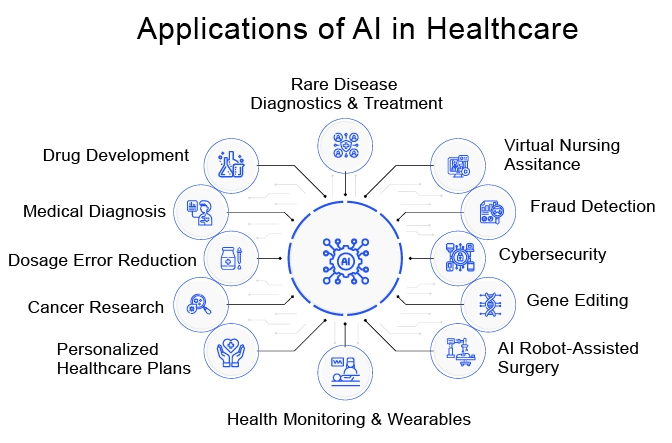
1. Healthcare and Medicine:
Picture Courtesy: delveinsight.com
AI offers solutions to improve patient care and enhance operational efficiencies in health facilities.
Medical Diagnostics: AI-powered tools, such as that in IBM Watson Health and Google’s DeepMind, can now analyze internal medical pictures with unmatched accuracy. With such advanced AI algorithms, early detection of diseased conditions like cancer, heart diseases, and rare diseases even before going into traditional tests becomes possible.
Personalized Medicine: Most importantly, AI is now creating personalized treatment plans entirely based on the patient’s genetic profile as well as medical history and lifestyle. Some of the largest companies occupying this area include Tempus and GRAIL.
Robotic Surgery: AI provides highly advanced robotic systems, such as the da Vinci Surgical System, with which minimally invasive operations can be performed very efficiently and with shorter recovery periods.
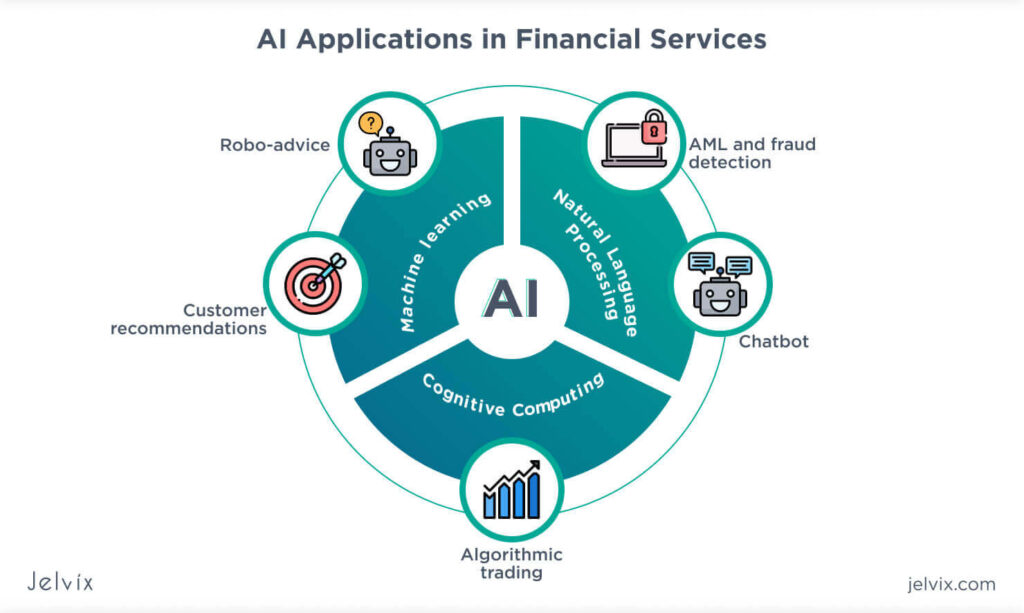
2. Finance and Banking:
Picture Courtesy: jelvix.com
AI has been implemented in the financial sector to improve efficiency, accuracy, and security.
Fraud Detection: AI systems analyze transaction patterns in real-time to identify and preventing fraud. PayPal and other companies, such as Mastercard use AI to secure transactions.
Algorithmic Trading: AI algorithms for trading decisions on analyzing market data and firms such as Renaissance Technologies and Goldman Sachs leverage AI for smart investment strategies.
Personal Finance: This enables virtual assistants, such as Cleo and Mint, to offer AI solutions for individuals to manage budgets and track expenses for their financial goals.
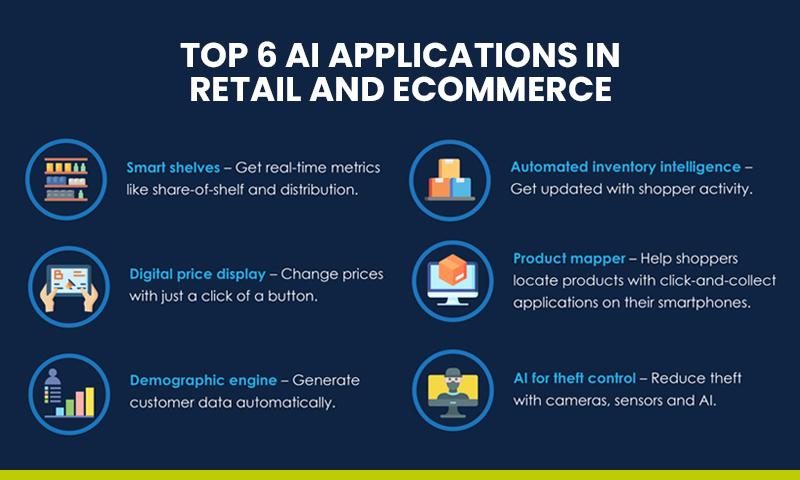
3. Retail and E-Commerce:
Picture Courtesy: thinkpalm.com
AI redefines the shopping experience for consumers and improves business processes.
Recommendation Engines: AI sites like Amazon, Netflix, or Spotify analyze user behavior and recommend products, movies, and songs in a personalized way.
Chatbots and virtual assistants: AI-based chatbots complement customer service with immediate answers to queries and 24/7 customer satisfaction.
Inventory management: AI tools predict demand, manage stock levels, and optimize logistics to reduce waste and costs.
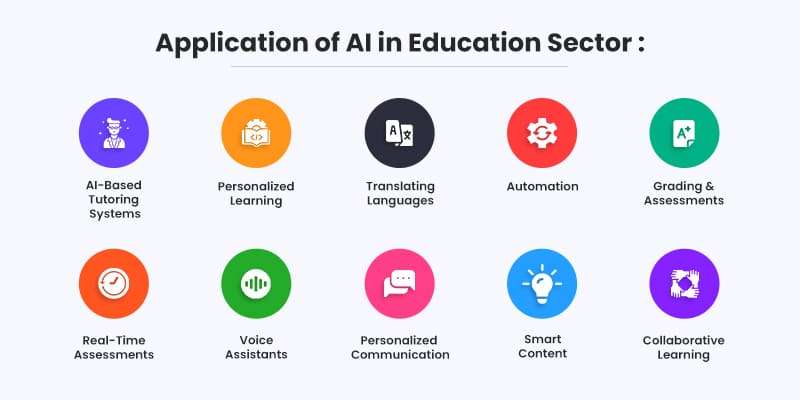
4. Education:
Picture Courtesy: matellio.com
AI is making learning more personalized and available to the masses.
Personalized Learning: Some tools, such as Duolingo and Coursera, use AI to impart learning according to each person’s pace and style, which improves understanding and retention.
Administrative Automation: AI handles the entire administrative work like grading, scheduling, and maintaining student records; thus, releasing more teaching time to the educators.
Virtual Tutors: AI-based tutoring systems such as Squirrel AI can give a 1:1 learning experience even in remote areas.
5. Manufacturing:
Picture Courtesy: viact.ai
AI transforms production with efficiency and preciseness revolutionizing the production lines.
Predictive Maintenance: Tools like GE and Siemens, machine monitoring using AI technologies can predict any malfunction before an occurs, thus less downtime due to wear.
Quality Control: AI systems inspect products for defects at every manufacturing process. This clear and stable quality will minimize waste.
Automation: Working robots in factories are performing artificial assembly, packaging, and logistics work.
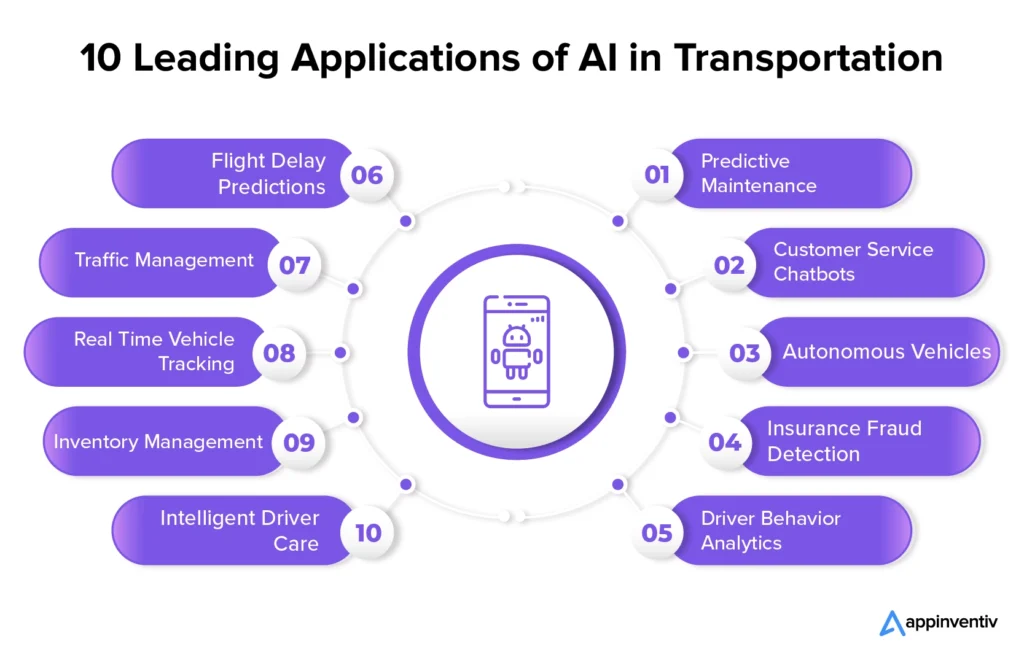
6. Transportation and Logistics:
Picture Courtesy: appinventiv.com
AI innovates everything about people’s or goods movement.
Autonomous Vehicles: Several companies, such as Tesla, Waymo, and Cruise, currently produce self-driving cars that are entirely dependent on AI to drive in real-time.
Route Optimization: With the help of AI, Google Maps and Waze devise ways of delivery routes to minimize time and fuel costs.
Fleet Management: AI analyzes vehicle performance and usage patterns in a fleet to maximize efficiency and safety.
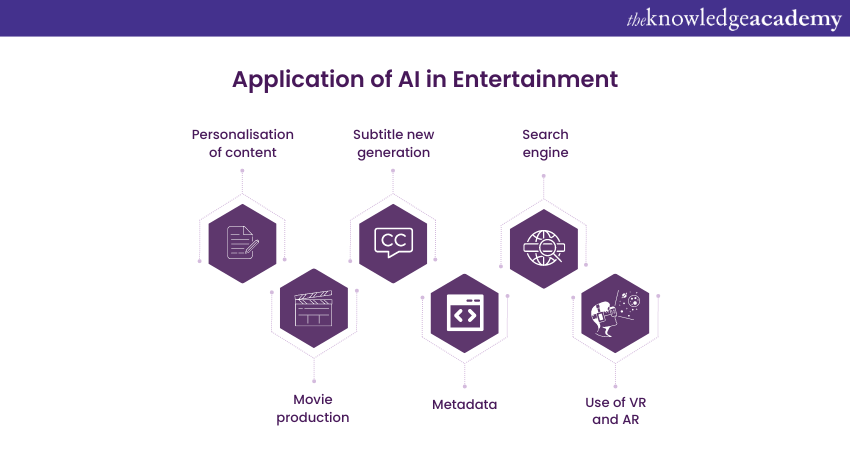
7. Entertainment and Media:
Picture Courtesy: theknowledgeacademy.com
The entertainment industry would be using AI to produce and distribute contents more effectively.
Content Generation: AI tools such as Jasper and OpenAI ChatGPT assist in writing articles, and scripts, and even creating music. Making imagery and videos AI systems like Runway Gen-2 are creating it.
Personalized Content Delivery: Streamers on YouTube and Netflix use their study of viewer habits to inform their customers of shows and videos they might want to view.
Deepfake Technology: Using very controversial AI-generated deepfake technology in a movie to recreate historical figures is a form of creative outlet.
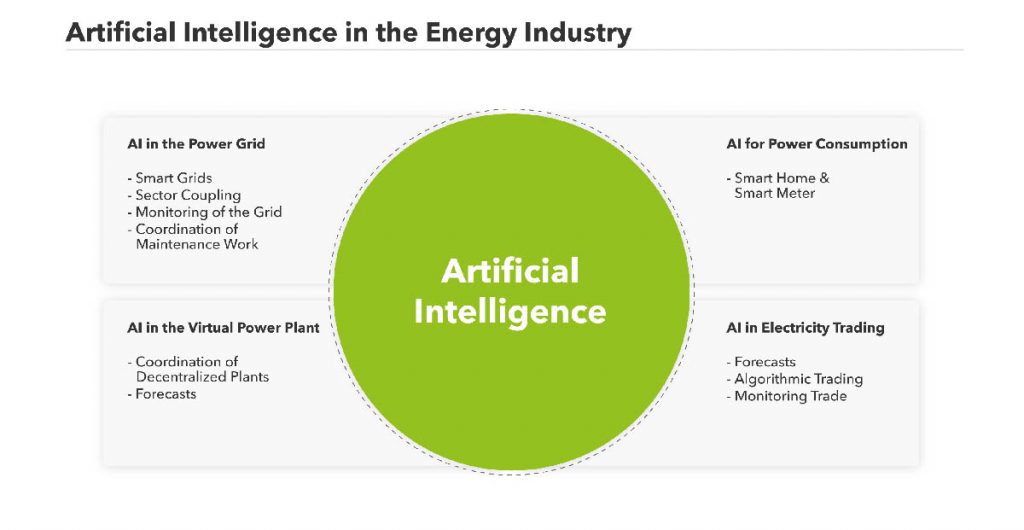
8. Energy and Utilities:
Picture Courtesy: biomassproducer.com.au
AI as a transformative agent makes sustainable energy solutions efficient and utilities management smart.
Smart Grids: AI systems optimize energy distribution by forecasting energy demand in various load areas and identifying outages that may occur. Siemens and Schneider Electric are the pioneers in this arena.
Renewable Energy Optimization: AI models often predict them about the efficiency of wind and solar energy systems. AI is performing energy conservation through intelligent home devices like Nest to monitor and reduce energy use.
9. Agriculture:
Picture Courtesy: pequea.com
Global agricultural productivity has been improved, plus resource sustainability through AI.
Precision Farming: AI tools analyze soil data, weather conditions, and crop health in an optimized planting and harvesting cycle. The company manufactures AI-enabled machinery, and it is the leading commercial company in the industry.
Pest Control: AI-powered drones and systems such as Blue River Technology utilize machine learning to recognize and target pests at the lowest level of pesticide application.
Yield Prediction: AI algorithms predict crop yields, allowing more accurate decisions for farmers regarding when to plant or allocate resources.
10. Cybersecurity:
Picture Courtesy: codestoresolutions.com
AI is increasingly vital to defend digital assets against threats that evolve every day.
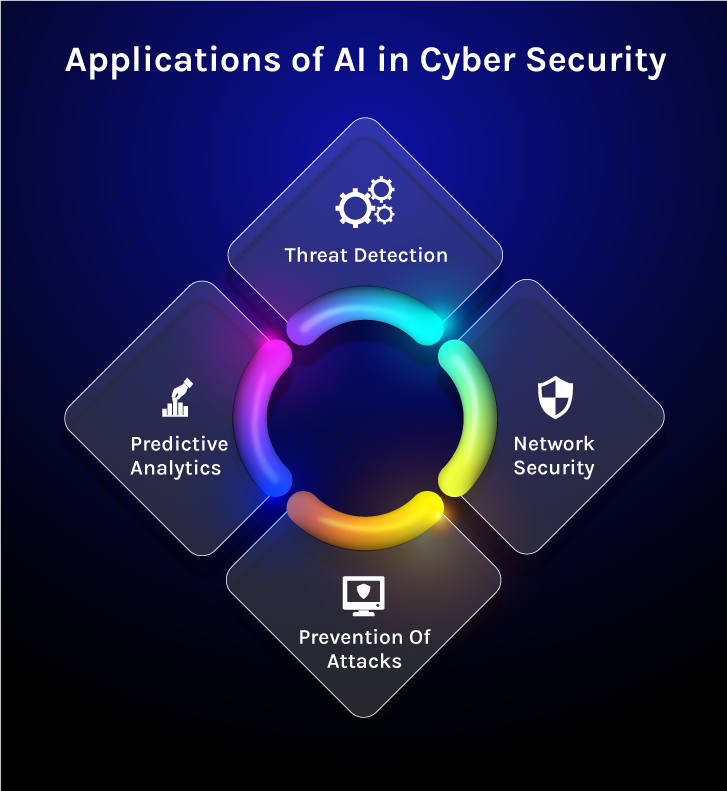
Threat Detection: Network activity is monitored in real-time; anomalies are identified and measures to prevent cyber-attacks are automatically undertaken by AI systems like Darktrace.
Phishing Prevention: AI tools analyze e-mails and conversations of possible phishing attempts.
Identity Verification: The AI-based facial recognition and biometric systems are a further improvement in security for online transactions and access control.
Key Use Cases of AI Across Industries:
Picture Courtesy: Medium
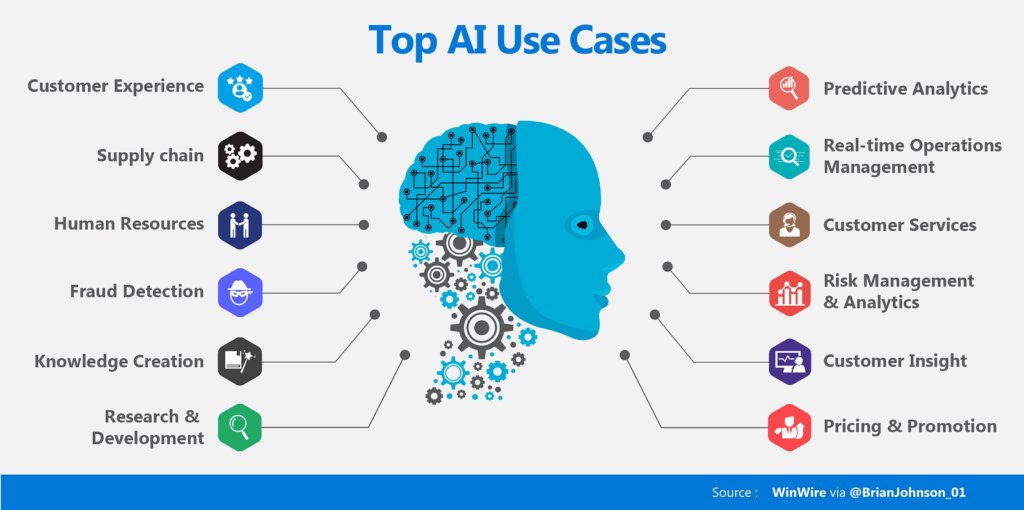
Artificial Intelligence has become a transformative force, delivering innovative solutions and reshaping industries. Here’s an overview of its prominent use cases:
Healthcare:
Healthcare has been redefined through its state-of-the-art diagnostics, customized treatments, and robotic surgeries. All administrative tasks are done away with, and patient data is fed to improve results, and hence efficiency is improved.
Finance and Banking:
In finance, AI detects fraud, predicts market trends, and optimizes trading strategies. It also personalizes customer interactions, automates compliance, and secures transactions.
Retail and E-Commerce:
AI personalizes shopping experiences via recommendation engines and chatbots, controls inventories, and makes smoother supply chains, thus making less cost and raising customer satisfaction.
Education:
AI mass computerized learning tailored to the needs of each automates grading and administration while virtual tutoring opens more access to education, makes it possible, and adapts learning with time and needs.
Manufacturing:
AI also enhances manufacturing in predictive maintenance, quality control, and automation, reducing downtime and increasing production efficiency.
Transportation and Logistics:
Vehicles running on AI militate against the probable causes of road accidents and assist in optimizing the direction of travel and thus contribute something to the improvement of more efficient logistics.
Entertainment and Media:
AI supports user experiences in all areas of entertainment and their media, from personalized content recommendations and assistance in content creation to those embracing user experiences in gaming and digital media.
Energy and Utilities:
Optimization of energy distribution and prediction of outages are some expected contributions of AI to renewable energy efficiency enhancement, which is supposed to bear fruits in sustainable energy solutions.
Agriculture:
Precision agriculture using AI helps finely tune resource use in crop management, allowing farmers to achieve greater production levels while incurring less impact on the environment.
Cybersecurity:
AI strengthens cybersecurity by detecting threats, preventing cyberattacks, and securing sensitive data through real-time monitoring and biometric authentication.
Future Prospects and Emerging Trends:
Picture Courtesy: issuu.com
As AI evolves, its potential to reshape industries continues to grow. Here are some emerging trends:
1. AI in Space Exploration:
Artificial intelligence has made advanced space missions possible by interpreting massive amounts of data and supporting autonomous decision-making.
Autonomous Rovers: A typical feature of this is the AI that has been implemented in the Perseverance rover by NASA for the purposes of navigation and data collection, as the rover adapts to the difficult terrain of Mars without needing constant human input.
Satellite Management: The maintenance needs of satellites can be predicted, and operations can be optimized so that the provision of uninterrupted services is ensured.
Exoplanet Discovery: Use of machine learning models to sift through astronomical data for detection of potential exoplanets that are speeding up the quest to find inhabitable worlds.
2. Ethical AI and Responsible Development of AI:
If AI becomes ubiquitous, it makes perfect sense to try and use it ethically.
Bias Detection: Tools are being devised that will recognize bias in AI algorithms and help mitigate it in order to build fairness and inclusiveness.
Transparent AI: There are efforts underway to make the AI decision-making process interpretable so that users can trust it.
Regulatory Frameworks: Governments and organizations alike are busy drawing out comprehensive policy frameworks to regulate the ethical usage of AI and curb any misuse.
3. AI in Climate Change Mitigation:
Artificial Intelligence has a big part to play in the fight against climate change.
Carbon Footprint Calculation: AI-enabled platforms will be able to estimate emissions and provide actionable suggestions to reduce them.
Reforestation Efforts: AI-powered drones plant trees in deforested areas at scale, accelerating reforestation efforts.
Climate Modeling: AI enhances the accuracy of climate simulations, helping policymakers devise effective strategies.
4. AI Creativity:
AI is becoming a collaborator in creative fields, sparking new possibilities.
Art and Design: An example of such phenomenon is DALL-E and MidJourney, which create beautiful artworks through textual description.
Music Composition: AI platforms like AIVA compose original music tailored to specific moods or themes.
Storytelling: AI helps writers develop engaging plots and narratives, blending creativity with data-driven insights.
5. AI in Personalized Healthcare:
The future of medicine lies in hyper-personalized treatments.
Genomics: AI analyzes genetic data to predict disease risks and develop tailored treatments for individuals.
Wearables: Devices like Fitbit and Apple Watch use AI to monitor health metrics, providing early warnings for potential issues.
Mental Health: AI chatbots like Woebot offer real-time support and therapy recommendations, making mental health care more accessible.
Artificial Intelligence is a versatile tool that has already made profound impacts across various industries. From revolutionizing healthcare to enhancing our daily lives through smart devices, AI’s applications are vast and varied. As technology advances, the possibilities for AI are only limited by our imagination and ethical considerations.
What excites you most about the future of AI? Let’s discuss your thoughts and predictions in the comments below!
And if you’re as excited about DeFi, blockchain, and the evolving Web3 universe as we are, join our community! Subscribe to our newsletter for the latest updates, trends, and insights—let’s navigate the world of Web 3 together!
Human trafficking is profoundly dangerous for society as it perpetuates a cycle of violence, exploitation, and inequality. It preys on the most vulnerable populations, often targeting marginalized individuals, which fosters a culture of fear and helplessness. Howard J Ford’s gripping thriller ESCAPE joins the ranks of films tackling the harrowing issue of human trafficking. Starring Sarah Alexandra Marks and Sophie Rankin in key roles, the film follows the harrowing story of ten young women who are abducted from an island resort by a ruthless gang. As the narrative unfolds, it becomes clear that these women are destined for an international trafficking ring. However, their spirit remains unbroken; they refuse to accept their fate. Determined to regain their freedom, they devise a clever plan to outsmart their captors and take back control of their lives.
The film captivates audiences primarily with its gripping storyline, but it’s the performances that truly elevate the film and highlight the severity of the situations depicted. Among the cast, Sophie Rankin stands out with her nuanced portrayal of Lucy. Her character serves as a beacon of hope for the other captives, constantly finding a way to get out of the dangerous situation. With years of experience in the industry, Sophie has delivered many strong performances, yet this role presents one of her most demanding challenges to date. I recently had the opportunity to chat with Sophie about her experience filming ESCAPE, her approach to embodying Lucy, and how she overcame all the odds to do her stunts in a terrain that was so harsh to shoot in. She also shared her opinion about her character’s resilience and how it can inspire others.
Sophie Rankin as Lucy in a still from ‘Escape’ (Photo Courtesy: The Movie Partnership)
Aayush Sharma: Congratulations on the movie ‘Escape’ but before we talk about the film. I would love to know how your journey has been in Hollywood and the entertainment industry.
Sophie Rankin: My journey began around 14 years ago. I initially took the standard route through drama school, followed by a short course in New York, where I studied film and TV acting. Gradually, I started working as an actor in London, appearing in a few films and TV shows and eventually got an agent. Then, in a rather unexpected turn, I emigrated to the Philippines and lived there for five years. During that time, I worked on numerous films and TV shows, with my films making it to the cinema, which helped put me more on the map and led to more TV work in the region. I returned to the UK about three years ago, and since then, I’ve completed 12 feature films back-to-back, which has been incredibly exciting. I’d say the last three years have been the most significant for my career so far.
Aayush Sharma: What was that first moment or instance where you thought this was it and I want to pursue a career in acting?
Sophie Rankin: I think my journey really began around age 17 when I was in college. Academic subjects never quite held my attention the way dance, drama, and P.E. did. With a background in gymnastics, I was already used to performing, so although I did well academically, I found much more enjoyment in drama. That’s when I realized acting was my true passion and decided to pursue it, even though I had little idea of how to make it happen at the time. Since then, every job has led to the next, and my training has been a big help along the way. I also have a background in modeling, which I still do, and all these experiences have gradually come together to help shape my acting career. It’s definitely been a gradual process.
Aayush Sharma: The film deals with themes of empowerment and resilience. How do you think Lucy embodies these themes, and what do you hope audiences take away from her journey?
Sophie Rankin: I think Lucy’s character is powerful in itself—she’s determined and incredibly feisty. Her background of surviving an abusive relationship and coming through it gives her a compelling depth. Her ability to express vulnerability after everything she’s been through is empowering; it shows both women and men that, no matter what they’ve endured, they can still be vulnerable and strong at the same time. Despite memories that may haunt her, Lucy has this inner strength that drives her to fight back, no matter the obstacles. It’s a message of resilience: no matter what you’ve been through, you can still come out the other side, hopefully with newfound strength.
Additionally, I think the story serves as a reminder for women to be cautious. While there are many good people in the world, there are also some who aren’t, so it’s wise to be aware of personal safety. Simple precautions, like letting someone know your location, can help keep you safe. Unfortunately, while we shouldn’t have to worry about these things, it’s realistic to be a little cautious. The story encourages this awareness—little reminders, like not getting into a car with someone you’ve just met, even if the first date went perfectly. Small messages like these are important and worth conveying.
Sophie Rankin as Lucy in a still from ‘Escape’ (Photo Courtesy: The Movie Partnership)
Aayush Sharma: How did you approach developing Lucy’s character, considering the traumatic circumstances she faces? What aspects of her personality did you find most compelling?
Sophie Rankin: I found her determination to be the most compelling aspect of her character. I also love how outspoken and direct she is—she doesn’t sugarcoat her feelings or intentions. She lives off her emotions, and I admire how she’s willing to say exactly what she thinks. Even though her dialogue is filled with bold language (probably 90% of it!), her forwardness and outspokenness are qualities I really love. To get into her persona, I imagined myself truly experiencing everything she was going through and thought about how I would respond in those situations.
As humans, we have a deep drive to survive and push through, no matter what, and I believe that instinct is embedded within us. I pictured how I might act if I were pushed to the edge with adrenaline coursing through me, and I tried to embody that determination as I portrayed what she was experiencing.
Aayush Sharma: The desert setting plays a significant role in the story. What does the desert symbolize for Lucy and the other characters, both literally and metaphorically?
Sophie Rankin: I think it symbolizes the idea that there are no limits, that anything is possible. No matter what you’ve endured or how many miles of difficult terrain you’ve crossed, anything can be achieved. It represents the concept of being limitless, especially for Lucy. Despite being warned—there’s a powerful line from Scott Hillier’s character that goes, “You’ll be hunted down like a pack of wild dogs”—she’s unwavering in her determination to escape. I find that incredibly powerful. The filming locations were breathtaking as well. Filming in the Canary Islands was amazing, as the landscape there resembles everything from the Grand Canyon to parts of Europe, creating a stunning cinematic backdrop. We also filmed in Spain and in an incredible underground fort in the UK. Altogether, the locations added so much beauty and grandeur to the visual experience. It’s truly beautiful to watch.
Aayush Sharma: Given the film’s setting in the desert and the physical challenges Lucy faces, how did you prepare physically for this role? Were there specific training or stunts involved?
Sophie Rankin: Honestly, I worked out like crazy for this role! I wish I could say that looking like that comes naturally to me, but that would be a lie. Knowing my outfits in the film would be minimal, I wanted to feel as confident and look as good as possible. So, for months before filming, I committed to a rigorous workout routine: I was doing about an hour and a half of cardio every day, along with tons of toning exercises. My diet was extremely healthy, full of protein, and I drank loads of water. Since I also have a background in gymnastics, I knew the role would require some physical demands, so I incorporated stretches to maintain my flexibility, which was especially helpful for stage combat and martial arts scenes I did. In short, I worked out like crazy!
Aayush Sharma: You’re known for performing your own stunts, which is impressive! Does that give you an adrenaline rush that motivates you to perform better? Have you always been someone who prefers to take on these challenges yourself rather than relying on others for assistance?
Sophie Rankin: Absolutely! I love doing my own stunts because it allows me to showcase all those years of gymnastics training and stage combat. If I’m given the opportunity, I enjoy fully immersing myself in the role and truly becoming that character. It was fantastic to perform my own stunts in Escape—I loved every moment of it! We did have a stunt coordinator to help choreograph the scenes, but we didn’t use stunt doubles, so we really were thrown around and thrown off the ground. I appreciated every aspect of that experience.
Aayush Sharma: What was your experience working with director Howard J. Fox and your co-star Sarah Alexandra Marks?
Sophie Rankin: Oh, that’s so lovely! I truly had the most amazing time working with Sarah. She’s incredibly talented and one of the kindest people I’ve ever met. We really became a support network for each other on set, helping each other out whenever needed. Everything she’s said about me, I’d say right back at her. If I ever felt a bit insecure—like wondering if a line sounded okay—she was always the first to reassure me. She’s such a lovely person, and we formed a really special friendship that we still share today. We’re both very supportive of each other’s careers and have even worked together on a few other films now, which has been fantastic. It’s truly a dream when you arrive on set and immediately connect with the other actors, especially with Sarah, as we were like partners in crime, doing so many scenes together. I absolutely loved working with her.
Howard J. Ford is also an incredibly talented director. I always describe him as a rare talent in the industry because he can handle nearly every aspect of filmmaking—from lighting and writing to production and directing. He works quickly and thinks on his feet, which I absolutely love. We worked well together as a team, and he allowed me a lot of creative freedom. He was always open to my opinions and ideas and was very supportive of my work. He’s truly a brilliant director, and I can’t recommend him highly enough. I also recently worked with him on a film called Dark Game, starring Ed Westwick, where I play Faye. I’d also love to mention a few other cast members. Louis James was fantastic to work with—he’s a brilliant actor and a wonderful person. He starts as the villain, but his character has a deep backstory and eventually wants to help, adding a powerful twist to the story. Stephen Murphy has a smaller role, but he was wonderful to work with as well. Honestly, every actor on this project was amazing to work with!
Sarah Alexandra Marks as Carla in Escape (Photo Credit: The Movie Partnership)
Aayush Sharma: In what ways does Lucy demonstrate resilience in the face of adversity? How do you think this resilience can inspire viewers in their own lives?
Sophie Rankin: I hope my character can inspire people by showing that you can achieve anything, no matter what life throws at you. Of course, I know it’s not always that simple, but often we tend to get caught up in our heads about things we want to pursue—whether it’s a goal or a new class we’re interested in. People can feel really nervous about stepping into something new, and I think just going for it can be such a powerful approach. It’s about not letting past experiences or even current struggles hold you back.
And yes, mental health can complicate things, and it’s not always easy, but in some cases, it can just come down to deciding, ‘I want this, I have a goal—let’s do it now and not procrastinate.’ Life is unpredictable, so if there’s something you want and you have the chance to go for it, do it now. I hope my character encourages others to take that leap and also shows that it’s okay to be outspoken, to say what you think, and to fight for what you want. You can come out the other side of difficult times stronger and ready to make your voice heard.
Rapid Fire Questions –
Aayush Sharma: Your Top 3 films of all time?
Sophie Rankin: Mean Girls, Avatar, and Tomb Raider
Aayush Sharma: Three directors you would want to work with?
Sophie Rankin: Greta Gerwig, Alfred Hitchcock, and Howard J. Ford (again).
Aayush Sharma: If you weren’t an actor or a part of the entertainment industry, which profession would you have chosen?
Sophie Rankin: Before I chose a creative path, I actually wanted to be a vet because I love animals and loved the idea of helping them. But then I realized I’m squeamish and afraid of blood, so that wasn’t the best career option for me! I think my next choice would have been psychology. In college, psychology was one of the few academic subjects that really fascinated me, and my mom is a counselor, so maybe that interest runs in the family. I find human behavior absolutely fascinating, and I think I’ve always been perceptive and fairly good at reading people, which really helps me get into character as an actor. Plus, spreading awareness about mental health is so important to me. So, if I weren’t acting, I’d probably want to be a psychologist or counselor for sure.
Aayush Sharma: After playing a role as intense as Lucy, how do you see this experience influencing your future choices in acting? Are there particular themes or characters you’re drawn to exploring next?
Sophie Rankin: Playing Lucy has been such a rewarding experience, and it’s definitely inspired me to pursue similar roles. I’d love to play more characters that empower women—ones who fight back, show strength, and have that same determination. I also really enjoy roles that allow me to perform action scenes and fight moves. That said, I also love comedy! I did a few comedy films in the Philippines, which I absolutely enjoyed, and I feel comedy comes quite naturally to me. So, for my next role, I’d love to play a lighthearted, carefree character—someone who doesn’t take herself too seriously, is fun, happy, and just lives life to the fullest. Additionally, I’d love the opportunity to portray someone based on a true story, maybe a character who has escaped a war zone or endured something unimaginable.
When I think about what some people in the world have gone through, it’s almost beyond comprehension. While I’m grateful we don’t have to live through those experiences, I believe portraying such a character would be incredibly powerful. It would be a privilege to get into the mind and emotions of someone who’s overcome that kind of adversity.
‘ESCAPE’ is now available on Digital Download in the UK.
From heart-pounding action games to remastered classics, there’s something for everyone this GFN Thursday.
Six new titles join the cloud this week, starting with The Thing: Remastered. Face the horrors of the Antarctic as the game oozes onto GeForce NOW. Nightdive Studios’ revival of the cult-classic 2002 survival-horror game came to the cloud as a surprise at the PC Gaming Show last week. Since then, GeForce NOW members have been able to experience all the bone-chilling action in the sequel to the title based on Universal Pictures’ genre-defining 1982 film.
And don’t miss out on the limited-time GeForce NOW holiday sale, which offers 50% off the first month of a new Ultimate or Performance membership. The 25% off Day Pass sale ends today — take advantage of the offer to experience 24 hours of cloud gaming with all the benefits of Ultimate or Performance membership.
It’s Alive!
Freeze enemies, not frame rates.
The Thing: Remastered brings the 2002 third-person shooter into the modern era with stunning visual upgrades, including improved character models, textures and animations, all meticulously crafted to enhance the game’s already-tense atmosphere.
Playing as Captain J.F. Blake, leader of a U.S. governmental rescue team, navigate the blood-curdling aftermath of the events depicted in the original film. Trust is a precious commodity as members command their squad through 11 terrifying levels, never knowing who might harbor the alien within. The remaster introduces enhanced lighting and atmospheric effects that make the desolate research facility more immersive and frightening than ever.
With an Ultimate or Performance membership, stream this blood-curdling experience in all its remastered glory without the need for high-end hardware. GeForce NOW streams from powerful GeForce RTX-powered servers in the cloud, rendering every shadow, every flicker of doubt in teammates’ eyes and every grotesque transformation with crystal-clear fidelity.
The Performance tier now offers up to 1440p resolution, allowing members to immerse themselves in the game’s oppressive atmosphere with even greater clarity. Ultimate members can experience the paranoia-inducing gameplay at up to 4K resolution and 120 frames per second, making every heart-pounding moment feel more real than ever.
Feast on This
Dive into the depths of a gothic vampire saga, slide through feudal Japan and flip burgers at breakneck speed with GeForce NOW and the power of the cloud. Grab a controller and rally the gaming squad to stream these mouth-watering additions.
Time to rise again.
The highly anticipated Legacy of Kain Soul Reaver 1&2 Remastered from Aspyr and Crystal Dynamics breathes new life into the classic vampire saga genre. These beloved titles have been meticulously overhauled to offer stunning visuals and improved controls. Join the epic conflict of Kain and Raziel in the gothic world of Nosgoth and traverse between the Spectral and Material Realms to solve puzzles, reveal new paths and defeat foes.
Defend the forbidden village.
The Spirit of the Samurai from Digital Mind Games and Kwalee brings a blend of Souls and Metroidvania elements to feudal Japan. This stop-motion inspired 2D action-adventure game offers three playable characters and intense combat with legendary Japanese weapons, all set against a backdrop of mythological landscapes.
The ice cream machine actually works.
Or take on the chaotic world of fast-food management with Fast Food Simulator, a multiplayer simulation game from No Ceiling Games. Take orders, make burgers and increase earnings by dealing with customers. Play solo or co-op with up to four players and take on unexpected and bizarre events that can occur at any moment.
Shift between realms in Legacy of Kain at up to 4K 120 fps with an Ultimate membership, slice through The Spirit of the Samurai’s mythical landscapes in stunning 1440p with RTX ON with a Performance membership or manage a fast-food empire with silky-smooth gameplay. With extended sessions and priority access, members will have plenty of time to master these diverse worlds.
Play On
Evil never sleeps.
Diablo Immortal — the action-packed role-playing game from Blizzard Entertainment, set in the dark fantasy world of Sanctuary — bridges the stories of Diablo II and Diablo III. Choose from a variety of classes, each offering unique playstyles and devastating abilities, to battle through diverse zones and randomly generated rifts, and uncover the mystery of the shattered Worldstone while facing off against hordes of demonic enemies.
Since its launch, the game has offered frequent updates, including two new character classes, new zones, gear, competitive events and more demonic stories to experience. With its immersive storytelling, intricate character customization and endless replayability, Diablo Immortal provides members with a rich, hellish adventure to stream from the cloud across devices.
Look for the following games available to stream in the cloud this week:
Indiana Jones and the Great Circle (New release on Steam and Xbox, available on the Microsoft Store and PC Game Pass, Dec. 8)
Fast Food Simulator (New release on Steam, Dec. 10)
Legacy of Kain Soul Reaver 1&2 Remastered (New release on Steam, Dec. 10)
The Spirit of the Samurai (New release on Steam, Dec. 12)
Diablo Immortal (Battle.net)
The Lord of the Rings: Return to Moria (Steam)
What are you planning to play this weekend? Let us know on X or in the comments below.
If you were the main character in a survival game, what would your main skill be? 🧗🗺️
— 🌩️ NVIDIA GeForce NOW (@NVIDIAGFN) December 11, 2024
Push Protocol has announced the launch of Push Chain, a layer 1 blockchain that connects chains and integrates communication protocols with on-chain transactions.
The platform’s architecture supports interactions across EVM and non-EVM ecosystems, allowing developers to access wallet states from distinct networks without relying on fragmented infrastructure. Transactions can be executed from any chain, and the chain’s approach includes consumer-focused features intended to smooth user experiences through wallet and fee abstraction while parallel validators and dynamic sharding address throughput demands.
Push Chain introduces consumer transactions that add flexibility for builders, enabling applications to function as universal hubs across networks. The result is an environment where developers can create shared-state smart contracts that read wallet data from disparate chains.
Push Protocol—formerly known as EPNS—previously focused on delivering notifications and chat functionalities to decentralized applications and wallets. With this launch, those established communication protocols become integrated at the chain level, turning interactions into on-chain transactions that can accrue value. The chain’s architecture, along with sub-second finality, suggests a scalable foundation for various use cases, including social platforms, gaming, finance, and cross-chain NFT trading.
The introduction of blockchain-agnostic wallet addresses and Push ID technology supports more direct interoperability. This design enables multiple wallets across different chains to consolidate under a single decentralized identifier.
Push Protocol previously expanded its presence beyond Ethereum to other networks, including BNB Chain, enhancing its reach. The new chain’s rollout will proceed in phases, beginning with consumer-centric applications, then interoperability layers, and finally, universal smart contracts and shared-state capabilities. This structured approach appears aligned with the objective of scaling to meet complex demands in the web3 environment.
Push Chain’s integration of notification and chat protocols into the core infrastructure indicates a shift from traditional communication layers to on-chain environments that treat messaging as data-rich transactions.
The chain’s compatibility with on-chain AI agents and applications may also open pathways to more advanced functionalities spanning multiple domains. Developer resources, including a whitepaper, explorer tools, and simulation environments, are now available, and Push Chain is live on devnet.
The team plans an incentivized testnet and additional documentation, aiming to provide builders with a toolkit to develop applications accessible from any supported chain.
Hybrid god game, card-battling roguelite title Apeiron has released Apeiron: Godling Genesis, available on the Apple App and Google Play Stores.
Bringing the title’s unique gameplay to mobile devices, this release opens up the title to a much wider market, with the hopes of expanding its already significant playbase.
This initial mobile release is available to players in Southeast Asia, Hong Kong, and Japan, with plans for a broader launch in the US, China, and Latin America in 2025.
Source: Apeiron
What is Apeiron?
Apeiron is the world’s first web3 god game and card-battler title, built on the Ronin Network.
Developed by Hong Kong-based studio Foonie Magus, Apeiron sees players tackle a unique mix of card-battling roguelite dungeon gameplay and god game simulation elements, inspired by classic god game titles such as Populous and Black & White.
In Apeiron: Godling Genesis, players are born into Apeiron’s godiverse where they learn the basics of battling, recruit their apostles, and build decks in roguelite dungeons as they progress through the story. The release includes early access to the arena, which allows for PvP competitive play, an official battle pass, and a webstore with items purchasable in Apeiron’s in-game currencies.
The title continues to be expanded by a 60-strong team, with their prototype generating one of the largest single game seed fundings in web3. Investors backing the studio include the likes of Hashed, IVC, Morningstar Ventures, Spartan Group, and DeFinance – who have raised $24 million USD towards Apeiron to date.
Source: Apeiron
What impact will this release have?
The Foonie Magus team is excited to see what impact the release of Apeiron: Godling Genesis will have on the web3 mobile market.
“Our goal has always been to make Apeiron accessible to players worldwide, and we are excited to bring Apeiron: Godling Genesis to a new audience of gamers through the Apple App Store and Google Play,” said Frank Cheng, CEO and co-founder of Foonie Magus.
“With blockchain technology and UGC, Apeiron introduces a unique meta-game layer where players can own, create, and connect their in-game experiences. This adds new dimensions to gameplay, offering deeper engagement and expanding the game’s universe with endless opportunities for players and creators alike.”
Apeiron is currently midway through its Season 4 period, running from December 4, 2024 to January 15, 2025. During this time, players are competing for top spots on both the PvP and PvE leaderboards, with over 240,000 $APRS, 200,000 APRM, and more than 1 million Animus up for grabs as rewards.
Select users can now download Apeiron: Godling Genesis for free on the Apple App Store and Google Play Store. All players can access Apeiron on PC through the Mavis Hub and the Epic Games Store. For updates on Apeiron, join the official Discord community.
Floki (FLOKI), one of the most renowned meme coins, is broadening its functionality by introducing a cryptocurrency debit card. This innovative debit card, developed and officially launched by Floki, supports eight blockchain networks and multiple cryptocurrencies. With this card, users can make payments using cryptocurrencies at merchants that accept Visa and Mastercard.
Launch and Availability
The Floki cryptocurrency debit card was announced on Floki’s official website, where detailed information about the card was also shared. The card is currently available in 31 European countries, including France, Germany, Spain, and Sweden.
Features of Floki’s Cryptocurrency Debit Card
Floki (FLOKI) has established itself as a leading meme coin. Initially, like many other meme coins, it lacked a practical use case. However, the Floki ecosystem is rapidly evolving, and the introduction of the cryptocurrency debit card marks a significant enhancement. This card enables cryptocurrency holders to utilize their digital assets for everyday purchases through a debit card.
Prepaid Card Functionality
The Floki debit card operates as a prepaid card and is available in both physical and virtual formats. It supports the following cryptocurrencies and blockchains:
FLOKI
Bitcoin (BTC)
Ethereum (ETH)
Solana (SOL)
USDT
USDC
BNB Chain (BNB)
The Open Network (TON)
DOGS
HMSTR
Notcoin
Supported Countries
The Floki debit card can be used in the following 31 European countries:
The Floki debit card distinguishes itself by eliminating transaction fees and trading commissions. However, there are specific fees associated with obtaining and using the card:
One-time Fee:
32 euros for the physical card
10 euros for the virtual card
Loading Fee:
A 2% fee is applied when loading funds onto the card.
With the launch of its cryptocurrency debit card, Floki (FLOKI) is making significant strides in enhancing the practicality and usability of meme coins. By supporting multiple blockchain networks and offering seamless integration with Visa and Mastercard, Floki is providing its users with more versatile and convenient ways to spend their cryptocurrencies. As the Floki ecosystem continues to grow, features like the cryptocurrency debit card are pivotal in driving broader adoption and real-world utility for digital assets.
You May Also Like
Follow us on TWITTER (X) and be instantly informed about the latest developments…
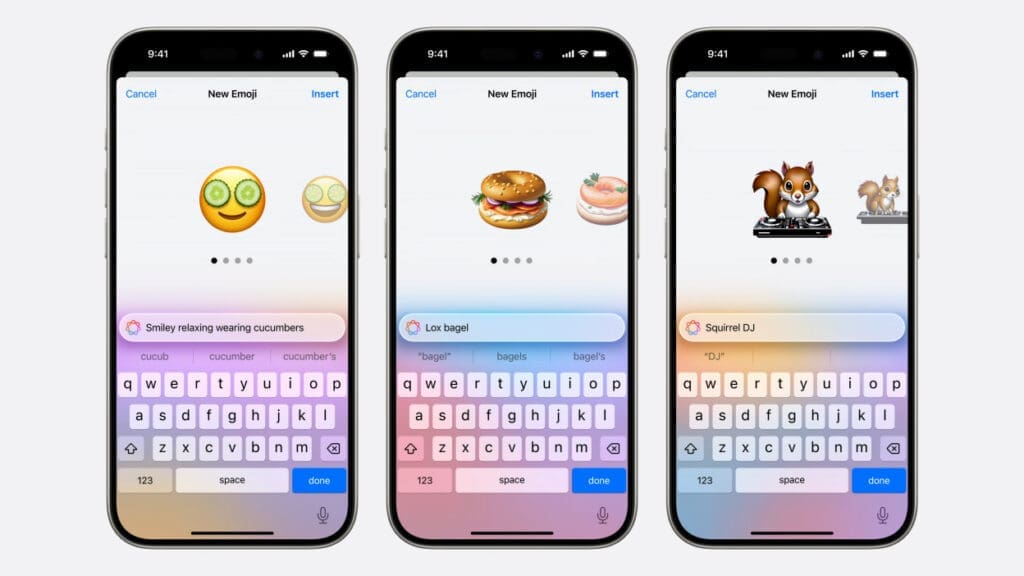
iOS 18.2, released yesterday, introduced Genmoji, one of Apple’s most impressive intelligence features, to iPhones. In this guide, we’ll explain how to use this feature to create custom emojis tailored to your personality.
Introducing iOS 18.2 and Genmoji
Apple officially launched iOS 18.2 last night, bringing with it the most extensive suite of Apple Intelligence features to date. Among these is Genmoji, an innovative tool that leverages artificial intelligence to help you design personalized emojis. It’s important to note that your device must be set to English to utilize Genmoji and other AI-powered features. Additionally, Genmoji is available on the following models:
iPhone 15
iPhone 15 Pro Max
iPhone 16
iPhone 16 Plus
iPhone 16 Pro
iPhone 16 Pro Max
How to Use the Genmoji Feature
To start creating your own custom emojis with Genmoji, follow these simple steps:
Step 1: Set Your Language to English
First, ensure that your iPhone is set to the English language. This is a prerequisite for accessing Apple Intelligence features, including Genmoji.
Step 2: Enable Apple Intelligence & Siri
Open the Settings app on your iPhone.
Navigate to Apple Intelligence & Siri.
Toggle the switch to activate the Apple Intelligence section, enabling AI functionalities on your device.
Step 3: Access the Messages App
Open the Messages app.
Enter an existing chat or start a new one.
Tap on the emoji icon located on the keyboard to access the emoji panel.
Step 4: Create Your Custom Genmoji
In the emoji section, click on the emoji creation icon situated at the top right corner.
Define the emoji you wish to create by entering descriptive text.
Genmoji will generate a custom emoji based on your input, allowing you to personalize your messaging experience.
Compatible Devices
To enjoy Genmoji and other advanced AI features, ensure you are using one of the following iPhone models:
iPhone 15
iPhone 15 Pro Max
iPhone 16
iPhone 16 Plus
iPhone 16 Pro
iPhone 16 Pro Max
With the release of iOS 18.2, Apple continues to enhance user experience by integrating sophisticated AI tools like Genmoji. This feature not only allows for creative self-expression through custom emojis but also showcases Apple’s commitment to advancing intelligent functionalities on its devices. Make sure your iPhone is updated to iOS 18.2 and set to English to take full advantage of Genmoji and other Apple Intelligence features.
You May Also Like
Follow us on TWITTER (X) and be instantly informed about the latest developments…














 Source: Apeiron