Home Blog Page 1266

Indonesia’s National Postal Service Releases NFT Stamps for the First Time – Cryptoflies News

0
Indonesia’s National Postal Service Releases NFT Stamps for the First Time – Cryptoflies News


5

Pos Indonesia has announced the release of its first non-fungible token (NFT) stamp series to mark the 278th Postal Bhakti Day. 

The news, shared via an Instagram post on September 29, introduces stamps featuring the Cenderawasih bird, an endemic species native to Papua island that holds cultural significance for the indigenous people of Papua.

The stamps will be available in both physical and NFT formats, sold in limited quantities. Each stamp costs 150,000 rupiah (around $10). 

The physical version will come in booklet form, with a QR code included. Scanning the code directs buyers to the Ciphers.me marketplace, where they can claim the NFT version of the stamp.

Pos Indonesia isn’t the first postal service to adopt NFT technology for stamp innovation. Just last week, An Post, the Irish postal service, launched its own NFT-linked stamps, which celebrate Irish heritage while integrating modern technology. 

In recent months, other postal services have also explored NFTs. Guernsey Post, Belgian Post Group, and Deutsche Post in Germany have all released NFT stamps. 

In May, Ghana Post introduced commemorative stamps linked to NFTs, marking the 25th coronation anniversary of Otumfuo Osei Tutu II and acknowledging his contribution to Ghana’s development.


Source link

How to Buy Bitcoin (BTC): The Beginner’s Guide 2024

0
How to Buy Bitcoin (BTC): The Beginner’s Guide 2024


Buying Bitcoin can seem overwhelming at first, but it is easier than you might think. With the rise of digital currencies, many people want to know how to buy Bitcoin and invest in this exciting market. 

This guide will walk you through the steps you need to follow, from choosing the right platform to understanding how to store your Bitcoin safely.

Key Takeaways:

You can buy Bitcoin using popular crypto exchanges like Binance, Coinbase, and OKX, as well as payment methods such as credit cards, PayPal, and Bitcoin ATMs for easy transactions.Buying Bitcoin involves selecting a crypto platform, creating an account, depositing funds, placing an order, and finally purchasing BTC using market or limit orders.You can store Bitcoin safely using hardware wallets for offline security, software wallets for ease of access, and paper wallets for long-term storage.

How to Buy Bitcoin: Step-by-Step Guide

Buying Bitcoin may seem tricky at first, but it’s quite simple once you know the steps. Let’s walk through the process:

Step 1: Choose a Crypto Exchange or Trading Platform

There are many crypto exchanges and apps out there, each with its own trading features. Some popular ones include Binance, Bybit, MEXC, OKX, and Coinbase

When picking an exchange, consider factors like fees, security, supported cryptocurrencies, and whether it’s legal in your country. It’s like choosing a bank – you want one that’s trustworthy and meets your needs.

Also, ensure that the crypto trading platform accepts the payment methods that you want. Some allow you to use credit cards, while others may only support bank transfers. Also, search for an exchange with an easy-to-use interface and responsive customer service. If you still need more assistance, you can check our detailed guide on the best crypto exchanges in the world.

Step 2: Create an Account and Deposit Fiat or Crypto

Once you’ve chosen an exchange, it’s time to set up your account. This process is similar to opening a new bank account. You’ll need to provide some personal information and verify your identity. This is called the KYC procedure. This step is important to follow anti-money laundering rules.

After your account is set up, you’ll need to add money to it. This is called making a deposit. You can usually do this with regular money (also called fiat currency) like USD, EUR, INR, or GBP. The crypto exchanges also let you deposit other cryptocurrencies if you already have them on another crypto wallet.

Usually, you’ll need to utilize a credit card or link a bank account to make a fiat deposit. You can also use third-party payment providers like MoonPay, Simplex, Banxa, Google Pay, Apple Pay, and more

Remember, each exchange has its own rules about minimum deposit amounts and fees. Make sure you understand these before you start. It’s always wise to start with a small amount until you’re comfortable with how everything works.

Step 3: Place a Buy BTC Order

Once your account has funds in it, you can place an order to buy Bitcoin (often abbreviated as BTC).

There are usually two main ways to buy:

Market Order: This is like saying, “I want to buy Bitcoin right now at whatever the current price is”. It’s quick and simple, but the price might change slightly between when you click “buy” and when the order goes through. This is generally called price slippage and is very little or often negligible. It depends on exchange liquidity and trading volume.Limit Order: This is more like saying, “I want to buy Bitcoin, but only if the price reaches X amount”. You set the price you’re willing to pay, and the order will only go through if Bitcoin reaches that price. This can be useful if you’re trying to get a specific deal, but it might take longer or not happen at all if the price doesn’t reach your set amount.

When you’re ready to buy, you’ll need to figure out how much Bitcoin you want. You do not have to buy an entire Bitcoin; you can purchase parts of one. For example, you can choose to buy $100 worth of Bitcoin, regardless of how many Bitcoins you receive.

Once you’ve made these options, double-check everything and finalize your purchase. The exchange will process your order, and you will shortly become a Bitcoin owner.

Step 4: Transfer Bitcoin to an External Wallet

After buying Bitcoin, it is highly suggested that you transfer it to an external Bitcoin wallet. Keeping your Bitcoin on an exchange exposes it to possible threats like hacking or platform failure. An external wallet provides increased protection for your Bitcoin and gives you complete control over your assets. 

There are several sorts of wallets accessible, including hardware wallets, software wallets, and paper wallets. To send Bitcoin, you’ll only need the Bitcoin deposit address from your external wallet.

How to Buy Bitcoin (BTC) with PayPal

Currently, PayPal allows certain users, specifically those with PayPal Balance accounts and eligible business account holders, to buy cryptocurrency, including Bitcoin. 

To purchase Bitcoin through PayPal, you will need to follow these simple steps on the PayPal mobile app.

Step 1: First, open the app and go to the “Accounts” section. From there, select “Crypto”. This will take you to the cryptocurrency section, where you can start your Bitcoin purchase.

Step 2: Next, tap on “Buy” to initiate the transaction. You’ll then be prompted to choose the amount of Bitcoin you wish to purchase. PayPal gives you several options regarding the frequency of your purchase. You can decide if you want it to be a one-time transaction or if you’d prefer recurring purchases. 

The frequency options include daily, weekly, biweekly, or monthly purchases. If you’re not looking for a recurring purchase, it will default to a one-time buy.

Step 3: Once you’ve selected the amount and frequency, you’ll be asked to choose a starting date for your transaction. After doing that, tap “Confirm” to proceed to the next step. At this point, you’ll be shown a summary of your order, where you can review all the details. If everything looks correct, tap “Next” to move forward.

Step 4: After confirming your order, you’ll need to select your payment method. PayPal allows you to use the payment options linked to your account, such as your bank account or credit card. Once you’ve chosen the preferred method of payment, tap “Next” to authorize the transaction.

Step 5: Finally, you’ll be asked to confirm and schedule the purchase. Tap “Authorize and Schedule”, and the transaction will be finalized. If you opt for a one-time purchase, your Bitcoin will be purchased immediately. If you selected a recurring option, the app will schedule future purchases according to the frequency you chose.

Note: Many cryptocurrency exchanges like Binance, OKX, and Bybit also allow you to buy Bitcoin using PayPal through their P2P marketplace.

How To Buy Bitcoin With a Credit Card

Many cryptocurrency exchanges allow users to purchase Bitcoin using credit cards. This option provides ease of use, as most people are familiar with credit card payments.

The process is straightforward. First, make sure the exchange accepts credit card payments. Binance and KuCoin are the two most popular platforms. Then, enter your credit card details and link them to the exchange, deposit funds into your exchange account, and place a buy order for Bitcoin.

Be aware that using a credit card to buy Bitcoin often incurs higher fees compared to bank transfers or other forms of payment. Some platforms might charge a percentage of the transaction amount as a fee.

Different Ways to Buy Bitcoin (BTC)

Buying Using Bitcoin ATMs

Bitcoin ATMs offer a straightforward method to purchase Bitcoin using cash or, in some cases, a debit card. While these machines function similarly to traditional ATMs, the process is somewhat different. 

Buying Using Bitcoin ATMs

Here’s a detailed guide on how to navigate a crypto ATM effectively.

Step 1: Found a Bitcoin ATM in a Nearby Area

Your first task is to find a Bitcoin ATM. Websites like CoinATMRadar can be helpful. Ensure that you check the transaction fees and limits beforehand, as these can vary by machine. 

Step 2: Set Up Your Wallet

Before making a purchase, you need a crypto wallet capable of receiving Bitcoin. This could be a software or hardware wallet, depending on your preference for security. Have your wallet’s QR code or public key accessible, as the machine will need this information to transfer your Bitcoin.

Step 3: Input Your Purchase Amount

Select the “Buy Bitcoin” option and specify the cash amount you wish to convert into Bitcoin. The ATM will display the current exchange rate and applicable transaction fees, allowing you to review the total cost before proceeding.

Step 4: Scan Your Wallet Address

The next step involves scanning your wallet’s QR code using the ATM’s scanner. This step ensures the Bitcoin is sent directly to your wallet. Double-check the wallet address for accuracy, as Bitcoin transactions are irreversible.

Step 5: Insert Cash

With your wallet address confirmed, proceed to insert cash into the machine. It automatically converts the cash into Bitcoin based on the prevailing exchange rate. Be aware that transaction fees for Bitcoin ATMs can be significant, often ranging from 5% to 10%, which is much higher than online exchanges.

Step 6: Confirm Your Transaction

After cash insertion, finalize your purchase by pressing the “Buy” or “Confirm” button. The machine will process the transaction, which may take several minutes to complete due to the Bitcoin network’s congestion.

Step 7: Verify Receipt in Your Wallet

Once the transaction is processed, the purchased Bitcoin will be sent to your wallet. Depending on network activity, it might take some time for the coins to appear. After confirming that the transaction is complete, store your Bitcoin securely in your wallet.

Buy Bitcoin on Cryptocurrency Exchanges

Cryptocurrency exchanges are the most common platforms used to buy Bitcoin. However, not all exchanges function the same way. You can purchase Bitcoin on centralized exchanges, peer-to-peer (P2P) platforms, decentralized exchanges (DEXes), and even through mainstream brokerages.

Centralized Exchanges

Centralized exchanges (CEXs) like Binance, Coinbase, OKX, KuCoin, Bybit, and Kraken are popular choices for purchasing Bitcoin. 

These platforms act as intermediaries, providing you with a user-friendly interface and advanced security features. Although convenient, they require you to trust the platform with your funds and personal data. This means they are the custodial crypto platforms.

Peer-to-Peer (P2P) Platforms

P2P platforms, such as Paxful, mean buying Bitcoin person-to-person without any middleman. These platforms act as facilitators but don’t control the transaction. 

You and the seller agree on terms, and the transaction is processed without intermediaries. P2P platforms offer greater privacy but may require more caution due to the direct interaction with other individuals. This entire P2P process is based on the “Escrow” system.

Decentralized Exchanges (DEXes)

On decentralized exchanges like Uniswap or PancakeSwap, you can buy Bitcoin without a centralized authority. DEXes operate on smart contracts and allow for direct trading between you and another party. 

These exchanges provide higher privacy and reduce the risk of hacking, but they can be more complex to navigate, especially if you are a beginner.

Mainstream Brokerages

Mainstream brokerages, like Robinhood or eToro, have also integrated Bitcoin trading into their platforms. While they don’t offer the same range of cryptocurrency features as specialized exchanges, they provide an easy way for those familiar with traditional investing to enter the Bitcoin market. However, many of these platforms limit your ability to withdraw Bitcoin to external wallets.

How to Store Bitcoin

After buying Bitcoin, ensuring its safe storage is essential. Various storage methods are available, each providing different levels of security and ease of access.

Hardware Wallets: Among the safest ways to store Bitcoin are hardware Bitcoin wallets or cold wallets. These devices securely store your private keys offline. Well-known examples include Ledger Nano X and Trezor Safe 5, making them suitable for long-term holders of Bitcoin.Software Wallets: Software wallets, often referred to as hot wallets, are applications that can be installed on your computer or smartphone. They offer greater convenience but are somewhat less secure than hardware wallets, as they are connected to the internet. Many cryptocurrency exchanges provide built-in software wallets, yet using an independent non-custodial wallet like MetaMask or Trust Wallet is generally a safer choice.Paper Wallets: Paper wallets consist of printed documents that contain your public and private keys. While they are highly secure against online threats, they can be vulnerable to physical damage or loss. These wallets are best suited for long-term storage but require careful management to prevent mishaps. You can generate paper wallets using software programs like BitAddress.

How to Sell Bitcoin

Selling Bitcoin is similar to the process of buying it. To sell, you’ll need to transfer your Bitcoin to an exchange that allows selling. Most of the major exchanges support both buying and selling functions.

Once your Bitcoin is on the exchange, you can place a sell order. You have two options: a market order or a limit order, just like when buying Bitcoin. A market order allows you to sell Bitcoin instantly at the current price, while a limit order allows you to set the price at which you want to sell.

After the sale is complete, you can withdraw the funds in your local currency. This can be done through bank transfers or other supported withdrawal methods.

Conclusion

To sum up, knowing how to buy Bitcoin is important for anyone wanting to invest in cryptocurrency. You can easily purchase Bitcoin by following the steps in this guide and choosing the right platform. 

There are many ways to buy Bitcoin, like using credit cards, bank transfers, or PayPal, so you can find what works best for you. It’s also essential to know how to keep your Bitcoin safe after buying. Hardware wallets offer the best protection, while software wallets are easier for quick access. 

FAQs

What is Bitcoin?

Bitcoin (BTC) is a decentralized digital currency that allows peer-to-peer transactions without the need for intermediaries, such as banks. It operates on a public ledger called the blockchain.

Who created Bitcoin?

Bitcoin was created in 2008 by an anonymous person or group using the pseudonym Satoshi Nakamoto.

How does Bitcoin work?

Bitcoin is a digital currency that functions through a technology called blockchain. This is a public record that keeps track of every transaction made with Bitcoin, ensuring everyone can see it while keeping users anonymous. When you send Bitcoin, your transaction is shared with the entire network of users.

To confirm the transaction, special users called miners use powerful computers to solve complex problems. Once they solve these problems, the transaction is approved and added to a block of other transactions. This block then connects to previous blocks, forming a chain—hence the term “blockchain”.

Bitcoins are created through mining, where miners are rewarded with new coins for their efforts. This process also helps protect the Bitcoin blockchain or network from fraud. By combining blockchain technology and mining, Bitcoin operates without needing a central authority, making it a decentralized currency.

How much Bitcoin should I buy?

When considering how much Bitcoin to invest in, it is wise to begin with a modest amount. Many financial experts recommend that investors allocate 5% to 30% of their total investment funds to cryptocurrencies like Bitcoin. For instance, if you have $1,000 set aside for investment, starting with $50 to $300 can be a sensible approach, depending on your comfort with risk.

How much is one Bitcoin worth?

Bitcoin is valued at around $65,473.98, but this figure can change rapidly. To obtain the most accurate and current price, it’s advisable to check CoinMarketCap.

Is Bitcoin a good investment?

Investing in Bitcoin can offer high returns, but it also involves significant risks due to its price volatility. Historically, Bitcoin has demonstrated strong long-term growth potential; however, its short-term price can vary dramatically. 

How many Bitcoins are there?

The total supply of Bitcoin is capped at 21 million coins. Currently, most of these (over 19.76 million) have been mined, and the rest will be gradually released through mining rewards.

Is Bitcoin legal?

Yes, Bitcoin is legal in most countries. In the United States, it is treated as a form of property rather than currency. This means that transactions involving Bitcoin are subject to capital gains tax, similar to other assets.



Source link

How to Build Virtual Empire Store in Metaverse in 2024 | Vegavid

How to Build Virtual Empire Store in Metaverse in 2024 | Vegavid


The Metaverse may be the next frontier for entrepreneurs looking to expand their reach and attract new customers. But what exactly is the Metaverse, and why should you consider building a store there?

The Metaverse refers to a virtual world where users can interact with each other and with virtual objects. Think of it as a fully immersive and interactive version of the internet. It’s a world where users can create their avatars, explore virtual spaces, and engage in various activities, from gaming to socializing to shopping.

Building a store in the Metaverse can be a game-changer for businesses of all sizes. It offers an opportunity to reach a new audience of tech-savvy consumers looking for innovative and engaging ways to shop. It also allows businesses to create unique, interactive experiences to help them stand out from the competition.

The concept of the Metaverse has been gaining traction in recent years as virtual and augmented reality technologies continue to advance. But what exactly is the Metaverse? In simple terms, it’s a virtual world that people can interact with in real-time. However, the Metaverse is more than just a video game or virtual reality experience. It’s a fully immersive, interconnected universe where people can socialize, do business, and attend events.

The Metaverse has evolved from its early beginnings in science fiction to a tangible concept that major technology companies are developing. It’s believed that the Metaverse will be the next phase of the internet and could potentially revolutionize how we live. The Metaverse will be a fully immersive experience where people can interact with each other and digital objects in real time, breaking down the barriers of physical distance.

Several examples of existing Metaverse platforms exist, including Second Life, VRChat, and Minecraft. Second Life has been around since 2003 and has a loyal user base that spends significant time in the virtual world. VRChat has gained popularity in recent years, particularly during the COVID-19 pandemic, as a way for people to socialize and attend events in a virtual environment? Minecraft has also been used as a platform for virtual events, including concerts and conventions. As technology advances, we can expect to see even more Metaverse platforms emerge, providing new opportunities for socializing, entertainment, and commerce.

Building a store in the Metaverse can be an exciting and lucrative endeavor. However, it requires careful planning and attention to detail. Here are some key points to keep in mind:

Setting up a virtual store: The first step is to choose a virtual world or platform where you want to set up your store. Popular choices include Second Life, Decentraland, and The Sandbox.

Choosing the right platform: Each platform has its own strengths and weaknesses. Consider factors like the user base, ease of use, and the level of customization available before making your choice.

Customizing your store: Once you have chosen a platform, it’s time to start customizing your store. This involves selecting a design template, choosing colors and textures, and adding signage and branding elements.

Merchandising your products: To attract customers, you need to showcase your products appealingly. Consider highlighting your offerings by using virtual displays, interactive product demos, and other engaging features.

Pricing your products: Setting the right price for your products is crucial. Research the market and competition to determine a fair price that will attract customers without undercutting your profits.

Free photos of Rainbow

The metaverse is becoming an increasingly popular place for entrepreneurs to start their own virtual stores. However, just like in the physical world, promoting your store to attract customers is essential. Here are some ways to promote your metaverse store:

1. Building brand awareness

Create a unique brand identity and visual style that stands out.Establish a consistent voice and tone across all your marketing materials.Host events like product launches or contests to engage with customers and build buzz around your brand.

2. Leveraging social media

Establish a presence on social media platforms like Twitter, Instagram, and Discord.Use social media to engage with customers, answer questions, and promote new products.Leverage social media influencers to reach a broader audience and gain credibility.

3. Advertising in the Metaverse

Invest in advertising within the metaverse, such as in-game or virtual billboard ads.Participate in community events and sponsorships to get your brand in front of a wider audience.Consider partnering with virtual influencers to promote your store.

4. Collaborating with other Metaverse businesses

Look for opportunities to collaborate with other metaverse businesses, such as hosting joint events or offering cross-promotions.Join a metaverse business community to network and find potential collaborators.Co-create products or services with other metaverse businesses to offer unique value propositions to customers.

Promoting your metaverse store is crucial for its success. By building brand awareness, leveraging social media, advertising in the metaverse, and collaborating with other metaverse businesses, you can attract more customers and increase your sales.

Join us in shaping the future of digital experiences. Together, we can unlock the full potential of the metaverse and create innovative solutions that revolutionize industries and enhance human interaction.

Vegavid Metaverse development company services

With the rise of the Metaverse, it has become a potential opportunity for entrepreneurs to monetize their Metaverse stores. If you are considering creating your Metaverse store and want to monetize it, here are some pointers to help you:

Creating revenue streams: You can create revenue streams for your Metaverse store in several ways. You can sell virtual goods like avatars, clothing, and accessories. You can also offer services, such as virtual event planning or building custom virtual spaces. You can also generate income through advertising and sponsorship deals with other companies.

Understanding cryptocurrency: Cryptocurrency is a digital or virtual currency that uses cryptography for security. With the rise of the Metaverse, many people use cryptocurrency to buy and sell virtual goods. Understanding cryptocurrency and its potential benefits can help you attract more customers to your Metaverse store.

Accepting payments: Accepting payments in cryptocurrency is becoming more common, and offering this payment option to your customers is important. However, offering traditional payment options, such as credit cards or PayPal, is also important, as not all customers may be familiar with cryptocurrency.

Managing transactions: Managing transactions in the Metaverse can be complex, as different platforms and payment methods exist. However, it is important to have a system in place to track sales and manage transactions. This can include using a payment gateway or hiring a financial expert to help manage transactions.

Monetizing your Metaverse store requires some strategy and understanding of the virtual world. You can turn your Metaverse store into a profitable business by creating revenue streams, understanding cryptocurrency, accepting payments, and managing transactions.

Changes in 2024 as compared to 2023 

The year 2023 is really going to be when the virtual world starts getting serious! So many companies are planning to open up virtual stores in the metaverse to sell digital goods. But technology is advancing so quickly, that those early shops will need to be prepared to modernize if they want to keep up.

By 2023, most virtual stores will probably have pretty simple 3D graphics and designs to keep costs low at first. Folks will mostly be able to check out the shop fronts using smartphones or VR goggles in basic VR and AR modes. However, by 2024 things are going to step up majorly. Stores will be able to have incredibly lifelike visuals almost like real life to really immerse people in the shopping experience. Dynamic lighting, textures, animations – the whole shebang!

And it’s not just the graphics. Right now, in 2023, the virtual economy and payment systems might have some kinks to work out. But, just wait till 2024 hits – stuff like accepting different cryptocurrencies will be normalized. Digital property records will be way more robust too. Shops can use sophisticated virtual inventory software to easily sell, deliver, and manage digital goods online.

With the rise of the Metaverse, it’s no surprise that more and more businesses are considering opening virtual stores. However, launching and marketing your Metaverse store can be daunting, especially if you’re unfamiliar with the Metaverse community. Here are some tips to help you create buzz and promote your store:

1. Creating buzz for your virtual store launch

Start by creating a teaser campaign to generate excitement before your launch.Offer exclusive sneak peeks or previews of your virtual store to your followers.Consider hosting a virtual event or party to celebrate your launch and invite people to visit your store.

2. Utilizing social media and other marketing channels to promote your store

Use social media platforms like Twitter, Instagram, and TikTok to showcase your virtual store and its products.Leverage paid advertising to reach a wider audience and attract potential customers.Collaborate with relevant blogs, podcasts, or other media outlets to increase your reach and credibility.

3. Partnering with Metaverse influencers and communities

Find Metaverse influencers and communities relevant to your niche and reach out to them to promote your store.Offer them exclusive discounts or promotions to incentivize them to share your products with their followers.Participate in Metaverse events and communities to connect with potential customers and build relationships.

As more people enter these digital realms, the demand for virtual products and services grows rapidly. Managing and scaling your Metaverse store is essential for success in this new market.

Monitoring store performance and customer feedback

The first step in managing your Metaverse store is to monitor its performance and collect customer feedback. This will help you identify areas that need improvement and address customer concerns. You can use tools like Google Analytics to track your store’s traffic, conversion rates, and revenue. Additionally, you should collect customer feedback through surveys or social media channels to understand their needs and expectations.

Scaling up production and operations

Once you have established a strong presence in the Metaverse, you may need to scale up production and operations to meet the growing demand for your products. This can involve hiring more staff, investing in new technology and equipment, and optimizing your supply chain. You can also explore partnerships and collaborations with other Metaverse stores to expand your reach and share resources. 

Expanding to other Metaverse platforms

To maximize your potential in the Metaverse, it is important to expand to other platforms. This will help you reach a wider audience and diversify your revenue streams. Some popular Metaverse platforms include Decentraland, Somnium Space, and The Sandbox. Each platform has unique features and user base, so it’s important to research and understand the differences before expanding.

Conclusion

Building a store in the Metaverse can be an exciting and profitable opportunity for entrepreneurs and businesses. As we have discussed, the Metaverse offers a vast and growing market for virtual commerce, and with the advancements in technology, the potential for immersive shopping experiences is endless. As the Metaverse continues to evolve and expand, virtual commerce’s future looks bright. With more and more people spending time in virtual worlds, the demand for virtual goods and services will only increase. Now is the time to start taking action. Start by researching the various available platforms and marketplaces, and identify which is the best fit for your business. Then, create your virtual store and develop your virtual products or services. With dedication and creativity, you can build a successful store in the Metaverse and tap into a new world of customers.


Source link

CryptoKitties Are Back! Discover the New Game That’s Taking Over Telegram!

0
CryptoKitties Are Back! Discover the New Game That’s Taking Over Telegram!


In 2017, CryptoKitties was a popular blockchain game and the first NFT to use the ERC-721 standard. Now, Dapper Labs, the company behind CryptoKitties, has brought back the game on the Telegram platform, sparking renewed interest in virtual feline collectibles. This move reflects a growing trend of blockchain gaming on messaging platforms.

What is CryptoKitties?

One of the first games to truly make non-fungible tokens (NFTs) popular in the crypto world was CryptoKitties. Its a game that allows players to purchase, breed, and trade one-of-a-kind digital cats on the Ethereum blockchain. The game turned into a massive phenomenon and brought mainstream attention to blockchain gaming. Meanwhile, the success of CryptoKitties also drove the development of the ERC-721 standard, an NFT standard that’s now used widely in the ecosystem.

Dapper Labs, the creators of CryptoKitties, have developed other successful apps such as NBA Top Shot and Disney Pinnacle. However, CryptoKitties remains a cornerstone of the NFT world, and its return indicates a renewed interest in blockchain gaming. This time, they are introducing their innovative approach to gaming communities on Telegram.

CryptoKitties on Telegram

Telegram’s latest mini-game, CryptoKitties: All the Zen, invites users to play on the Telegram platform and promises to reward those who engage with strategy and hidden prizes. The game draws inspiration from the growing trend of gaming on Telegram and joins titles like Hamster Kombat, MemeFi, and Frog Farm, which have found a thriving community on Telegram.

Starting from October 1, 2024, you will be able to play the All The Zen game by connecting with the CryptoKitties Telegram community. The game provides players with a preview of the upcoming CryptoKitties developments, enabling them to grow their “Zen” and hatch eggs to acquire new Kitties for their collection.

How to Play: Growing Your Zen

When players start the game, they meet Felis, a cosmic trickster who acts as their guide. He teaches them the basics and ensures they understand how to play. The initial mission is to hatch a Fancy Kitty from a Page Egg. This egg brings forth Page, a brave Kitty always ready to help players in their quests to gather ZEN. As the game progresses, the player can collect more Fancy Kitties, each with unique abilities that enhance ZEN production.

The core of the gameplay revolves around the ReGenesis Egg, also known as the “Big Egg.” When players interact with this egg, they generate ZEN, a crucial resource that enables them to expand their Fancy Kitty collection. The game introduces a strategic element: Using ZEN to hatch a new Kitty cat replenishes your TAO bar, providing you with extra charges to interact with the egg and increase ZEN production. This cycle of earning, spending, and boosting ZEN creates a dynamic and captivating gameplay experience that promotes continuous growth.

Why Telegram?

Choosing to launch on Telegram is not a random decision. Telegram has become a magnet for crypto communities, and gamers. The platform’s easy-to-navigate interface, combined with features like bots and channels, creates an ideal playground for games that thrive on direct interaction and community engagement.

CryptoKitties leverages Telegram’s popularity within the blockchain community. The platform allows easy access for both new and returning players, enabling real-time interaction with fellow enthusiasts. This aligns with the growing trend of integrating games into messaging platforms, recognizing that players often congregate and communicate where their games are hosted. The more seamless the integration between gaming and messaging experiences, the more lively the communities become.

Impact and Future Prospects

All The Zen’s release on Telegram is bigger than just a return of CryptoKitties; it’s a signal that blockchain gaming is coming back. The new game claims to be a mix of strategy, fun, and community interaction, appealing to not only the old-school fans of CryptoKitties but also to new players that are exploring the NFT space.

The current mini-game is a preview of the upcoming reintroduction of CryptoKitties on the Flow blockchain. The project team is currently working to generate excitement within the community on Telegram and is promising new features and mechanics that will elevate the CryptoKitties universe to the next level.

The CryptoKitties community is likely to grow even more from this latest round of interest in the game, as Telegram offers an engaging space for its users to both interact and strategize. And like any good game, renewed interest brings an uptick in secondary market sales and overall ecosystem health. 

While the community looks forward to the full relaunch of Flow, All The Zen harkens back to an earlier time while also serving as a clean restart. It’s a way of reintroducing CryptoKitties to the next generation of blockchain gamers. On its own, the game/messaging project might be seen as an unambitious attempt to recapture earlier glory. But its ambitious blend of gaming and messaging has potential, and not just for CryptoKitties. Projects like this are part of an attempt to find profitable forms for web3 gaming.

As the community eagerly awaits the relaunch of Flow, “All the Zen” serves as both a tribute to the past and a new beginning, reintroducing CryptoKitties to a fresh generation of blockchain gamers. The combination of gaming and messaging on Telegram has potentially paved the way for new projects within the web3 world. However, the impact of CryptoKitties within this emerging space should not be underestimated.

Editor’s note: This article was written with the assistance of AI. Edited and fact-checked by Owen Skelton.

Owen Skelton

Owen Skelton is an experienced journalist and editor with a passion for delivering insightful and engaging content. As Editor-in-Chief, he leads a talented team of writers and editors to create compelling stories that inform and inspire.

View all posts


Source link

2024 Dungeon Master’s Guide: What’s New and What to Expect – TGN – Tabletop Gaming News

0
2024 Dungeon Master’s Guide: What’s New and What to Expect – TGN – Tabletop Gaming News


Wizards of the Coast shared more info about the 2024 Dungeon Master’s Guide in a new video on the official YouTube channel. The book will bring a mix of expanded content, updates, and some new features. This release, part of the revised core rulebooks for the 50th anniversary of D&D, aims to build on the 2014 version with additions based on feedback from the community. Here’s a look at what was revealed in the video.

One of the goals for the new DMG, according to Wizards, is to improve the accessibility of information within the book. The layout has been revised to help Dungeon Masters find the sections they need more easily. The book has also been expanded, with more pages dedicated to advice on adventure and campaign creation, as well as tools for running games.

New Sample Adventures and Campaign Setting

One of the major additions in the 2024 DMG is the inclusion of five sample adventures and a complete campaign setting. This marks the first time a DMG has included a full campaign setting, which could help newer DMs by offering a ready-to-use world. The setting chosen is the classic Greyhawk, one of D&D’s earliest campaign settings, known for its rich lore and iconic characters. The book provides a starting point in the City of Greyhawk and extends outwards to the surrounding regions. However, it’s presented in a deliberately skeletal format, meaning DMs will need to flesh out the details on their own, in line with the original 1980s Greyhawk products.

The inclusion of these sample adventures, alongside an appendix of reusable maps, is a significant shift from the 2014 DMG, which focused more on advice than ready-to-play content. This could be a positive step for new DMs, though it remains to be seen whether these simplified adventure formats will appeal to more experienced DMs or those seeking more complex narrative tools.

The Bastions System: A New Layer of Gameplay

A completely new addition is the Bastions system, which allows players to build and manage strongholds. Starting at level 5, players can create their own home base, issuing orders, recruiting inhabitants, and harvesting resources. Wizards says this feature draws from older editions of D&D, where strongholds were a part of high-level play, but here, the concept is introduced earlier in the game. Bastions are designed to function independently from the characters’ adventuring, providing a place for narrative development while characters continue exploring the world.

Expanded Tools for Adventure and Campaign Creation

The new DMG includes a greatly expanded section dedicated to creating adventures, which is paired with the aforementioned sample adventures to help DMs visualize their own story-building process. The book provides adventure hooks and advice tables sorted by levels, which could make it easier for DMs to construct balanced and varied adventures for different tiers of play.

In terms of campaign building, the revised campaign setting chapter has been moved later in the book, with an emphasis on giving DMs tools to build campaigns once they have a solid grasp of running the game.

Updated Magic Items and Treasure

Magic items continue to have a significant presence in the DMG, and this edition aims to broaden the variety of items available. Wizards has added more common magic items and updated the art for many items, including nostalgic ones from older editions. Notably, items used by characters from the 1980s D&D cartoon, like Hank’s Energy Bow and Diana’s Quarterstaff, are included.

For DMs looking to craft magic items within the game, the magic item crafting rules have been expanded. While the 2014 edition offered basic rules, the new DMG promises to provide a more comprehensive guide for crafting items with your DM’s approval.

Lore Glossary and Expanded Multiverse

The lore glossary is a new feature, offering a quick reference guide to D&D’s most iconic characters, locations, and materials. This includes entries on classic figures like Tasha, Mordenkainen, and Iuz, as well as lesser-known but significant figures from various editions of D&D.

The multiverse remains a core part of the D&D experience, and the new DMG includes a chapter on the cosmology of D&D’s various planes of existence. This section expands on how different settings and planes fit together.

To assist with gameplay, the DMG will also include tracking sheets for DMs to use during campaigns. These sheets cover a variety of in-game needs, such as tracking NPCs, settlements, and major campaign events.


Source link

Marlow – A new platformer for the ZX Spectrum 128k, inspired by The Great Giana Sisters

0
Marlow – A new platformer for the ZX Spectrum 128k, inspired by The Great Giana Sisters


The last news story from me today, as thanks to a recent contact by the developer(Amaweks) and our good friend Saberman(YT), we’ve been told if you remember playing the famous platformer of the Great Giana Sisters which was released from 1987 onwards. Then you may like the latest Amaweks ZX Spectrum game of ‘Marlow’. A game in which the developer says is a platformer for the ZX Spectrum 128k, inspired by “The Great Giana Sisters”. To coincide with this news, as ever we’ve got some more information about the game as well as a gameplay video below.

This is what the website says about the game. “Malow in Apocalyptic Acid World is a platform game for ZX Spectrum 128k, inspired by “The Great Giana Sisters.” What? You thought the inspiration came from a certain mustached plumber? No way… Navigate this vast apocalyptic world by jumping, stomping on enemies, collecting crystals, throwing molotov cocktail, and breaking blocks with your head across 4 worlds, in a total of 17 levels and 5 Boss battles”.

Dev Notes :

This project was only possible thanks to MPAGD Gen2, modified version of the engine by Xavisan, that expands memory usage beyond the 48kb, without which the complex title screens, introduction, and ending, as well as the large number of music tracks, screens, and code, would not have been possible.

Marlow Key Features:

5 Bosses and 17 stages Spread through 2 Episodes (2 programs)7 catch sound tracks (more info on readme.txt)10 Full screen illustrations (loading, title, intro cutscenes and endings)Fluid gameplay mechanics in a style rarely seen on the ZX Spectrum


Source link

Van Cleef & Arpels: A Legacy revived

0
Van Cleef & Arpels: A Legacy revived


Van Cleef & Arpels is a testimony of excellent craftsmanship, innovation and timeless pieces like the Alhambra collection. With its distinctive four-leaf clover motif, first designed in 1968, the collection has achieved an iconic status and was worn by icons such as Audrey Hepburn and Princess Grace of Monaco. More recently many celebrities have been wearing it and showing it on social media like Gwyneth Paltrow and Reese Witherspoon. It is also a great investment piece that exudes prestige and admiration. 

If you always dreamt of having your own, we invite you to look at our selection and find the piece waiting for you, so you too, can have a piece of history.


But what is the story of Van Cleef & Arpels?

Once upon a time, a Dutch diamond cutter named Alfred Van Cleef and his father-in-law, Salomon Arpels, founded a French luxury jewelry company. It was 1896 in Paris when elegance, innovation, and cultural richness met and created what French people like to call today “La Belle Epoque.” This was an era of timeless elegance, where iconic landmarks like the Eiffel Tower were constructed, and the city was known for its grand cafes, cabarets, and the rise of the modern entertainment industry, including the famous Moulin Rouge.

After his father-in-law’s death in 1906, Alfred was joined by two of his brothers-in-law, Charles and Julien, and acquired a new space in front of the Ritz on the renowned Place Vendome. Today, it is still their first and oldest boutique.

Success came quickly, and boutiques opened in the most luxurious cities of France, like Nice and Deauville and later Monte-Carlo.  Their jewelry was wanted worldwide, making them the first French jewellers to open boutiques in Japan and China. They even worked with foreign royalty; in 1966, Empress Farah Pahlavi asked Van cleef & Arpels to make her a crown. It was made with an emerald velvet set with 36 emeralds, 36 rubies, 105 pearls, and 1,469 diamonds!


Van Cleef & Arpels was always ahead of its time and leading the movement, today several brands and jewellers are taking inspiration from the famous four-leaf clover motif>


Source link

Step-by-Step Guide to Launch Your Fizz Node

0
Step-by-Step Guide to Launch Your Fizz Node


Spheron’s Fizz Nodes offer a low-barrier entry point for anyone looking to contribute resources to Spheron’s decentralized compute network—and earn ongoing rewards for their contributions.

Whether you’re looking to run a basic CPU configuration or a powerful GPU setup, this guide will walk you through the entire process, from Fizz Node registration to management. Let’s dive in!

For a step-by-step guide on getting started, head over to our YouTube Tutorial below.

You don’t need to be a high-end crypto miner or have access to a top-tier data center to participate in running a Fizz Node. In fact, even if you have a laptop with decent GPU capabilities and a few good CPU threads, you’re more than ready to contribute to the decentralized network. Your underutilized resources are all you need to help power the future of decentralized infrastructure!

Fizz Nodes are currently supported on macOS and Linux, with Windows support arriving soon. Performance may vary based on the operating system in use. Below are the necessary specs for running your own Fizz Node:

Minimum Specifications

4 CPUs

8 GB RAM

100 GB Disk Space

Maximum Specifications

32 CPUs

128 GB RAM

2000 GB Disk Space

Note: To run the Fizz Node in privileged mode, root or sudo access is required. This elevated permission is essential for executing system-level operations necessary for node functionality.

Step-by-Step Guide to Registering Your Fizz Node

Once you’ve completed the requirements to run your own fizz node, setting things up only takes a few quick steps.

Register Your Fizz Node

Open Your Browser: Navigate to fizz.spheron.network.

Sign up or log in through Gmail or Github.

Click on the “Register New Fizz Node” Button.

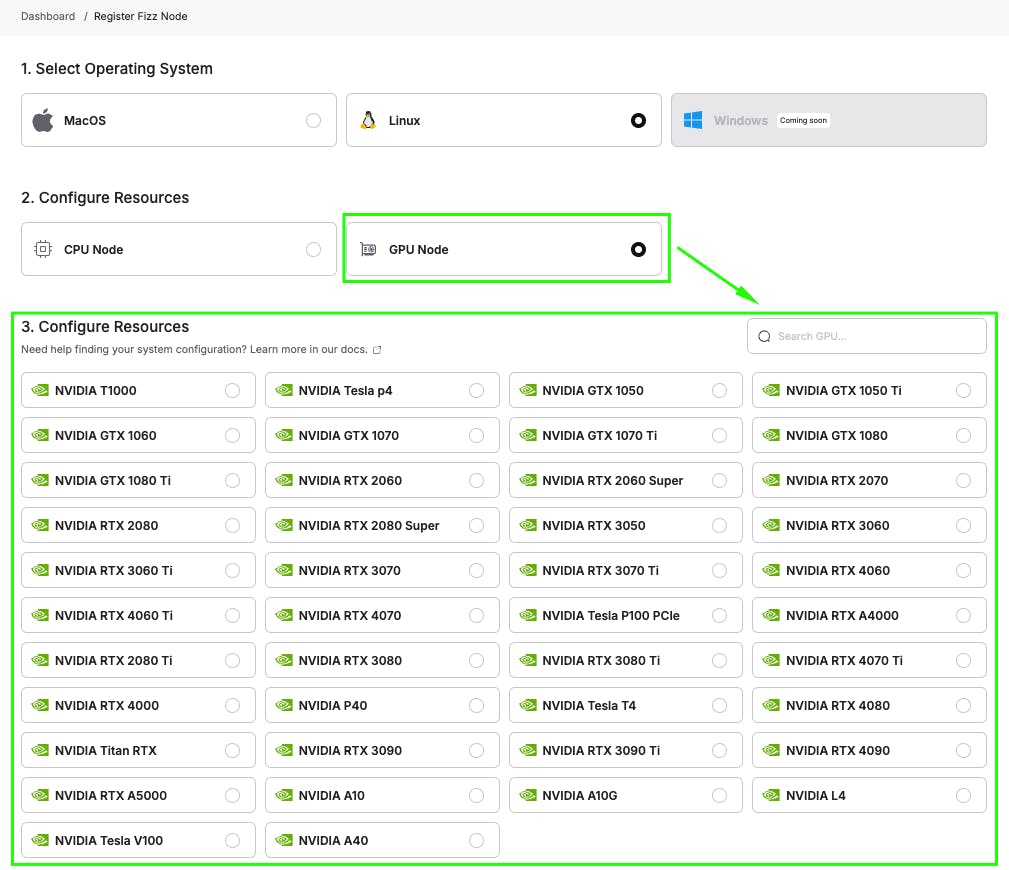
4. select your node’s OS from the options provided (MacOS, Linux, or Windows—coming soon) in the next window.

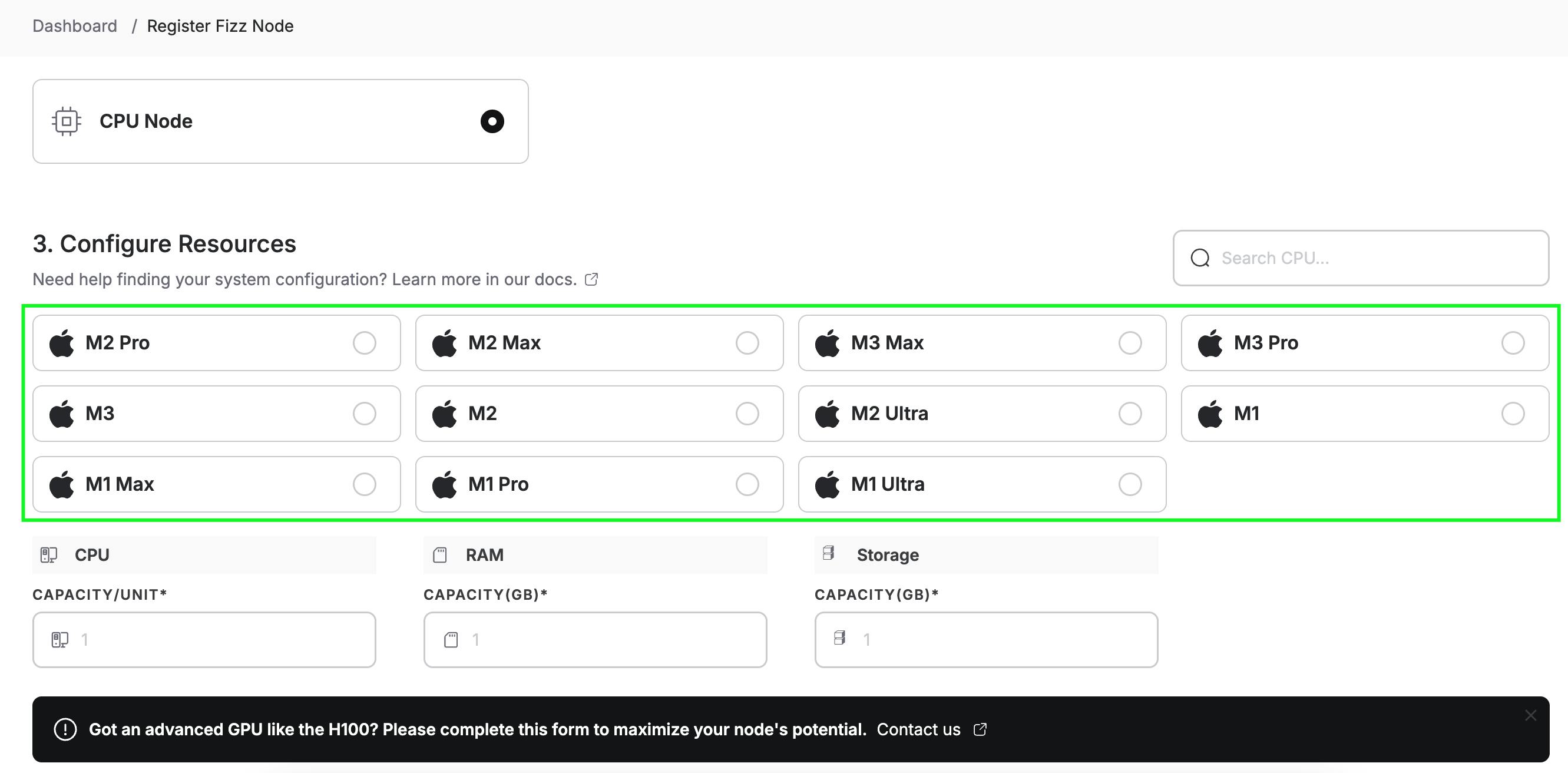
5. For Mac OSIf you select MacOS, You need to choose which Apple laptop mode you have. Need help finding your system configuration? Learn more in our docs here

For LinuxIf you select Linux, You can choose which Nvidia GPU specifications you have. Need help finding your system configuration? Learn more in our docs here.

6. Resource Details: Provide accurate information about the resources you’re willing to lend, including:

CPU cores

RAM capacity

Available storage

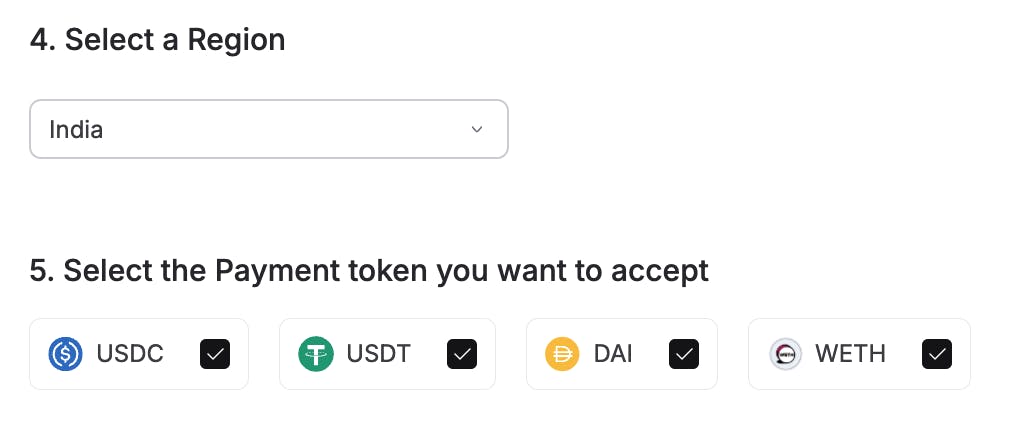
7. Region: Select the geographical location where your node is situated. This helps users choose nodes based on their proximity requirementsPayment Tokens: Choose the cryptocurrencies or tokens you will accept as payment for your services.

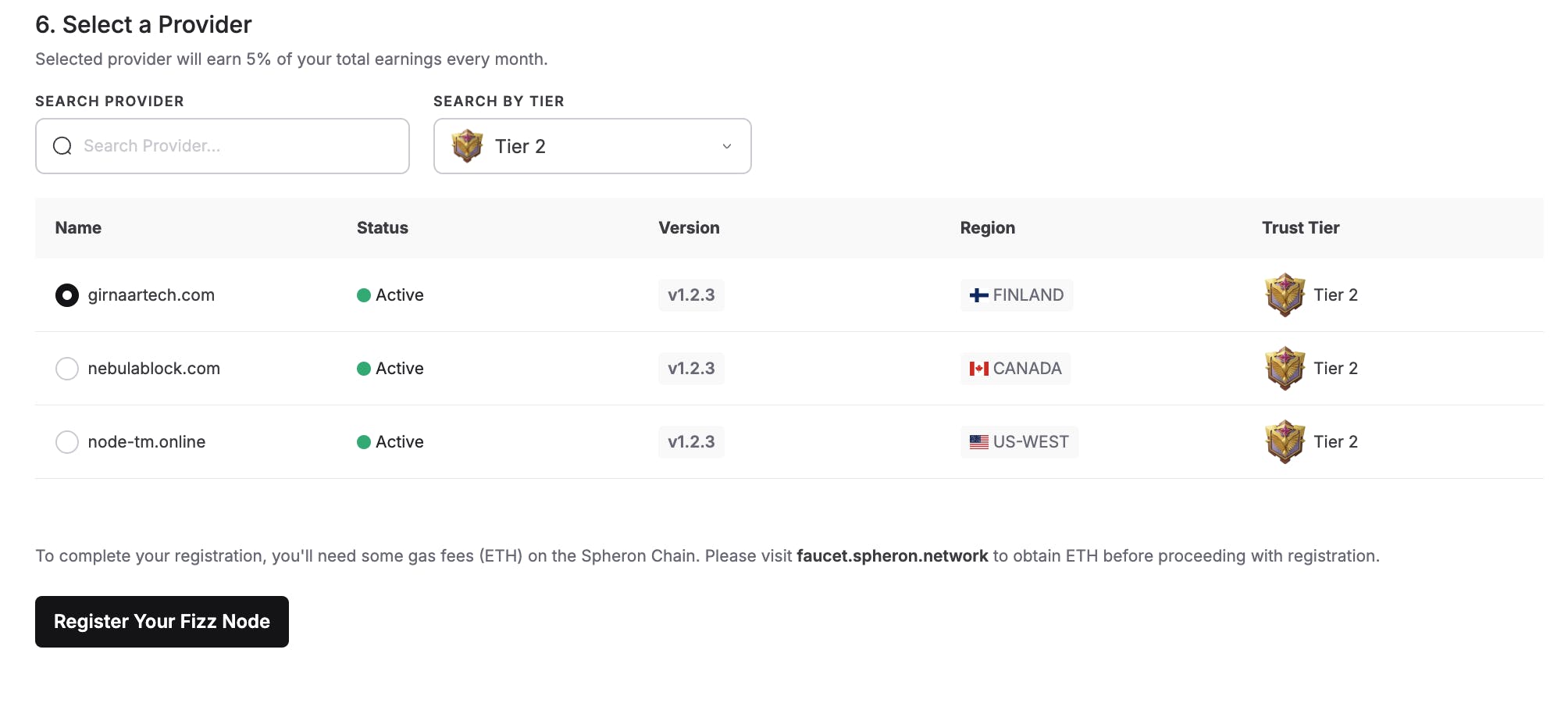
8. Provider Selection: This is a crucial step. Choose a provider carefully, considering factors such as:

Uptime track record: A provider with high uptime increases your chances of getting deployments.

Provider tier: Higher-tier providers may offer better opportunities.

Overall reputation in the network

9. Click “Register Your Fizz Node“, To complete the registration, you’ll need some ETH on the Spheron chain for gas fees. If you don’t have any, you can get some from our faucet at faucet.spheron.network.

Once you confirm the transaction, your node will be officially registered in the Spheron network, and you can proceed to the next steps.

Boom 💥— You’re officially part of the decentralized revolution!

Running the Fizz Node Client

After successfully registering your node, you need to set up and run the Fizz node client on your machine. This client software connects your node to the Spheron network and manages resource allocation. Follow these steps:

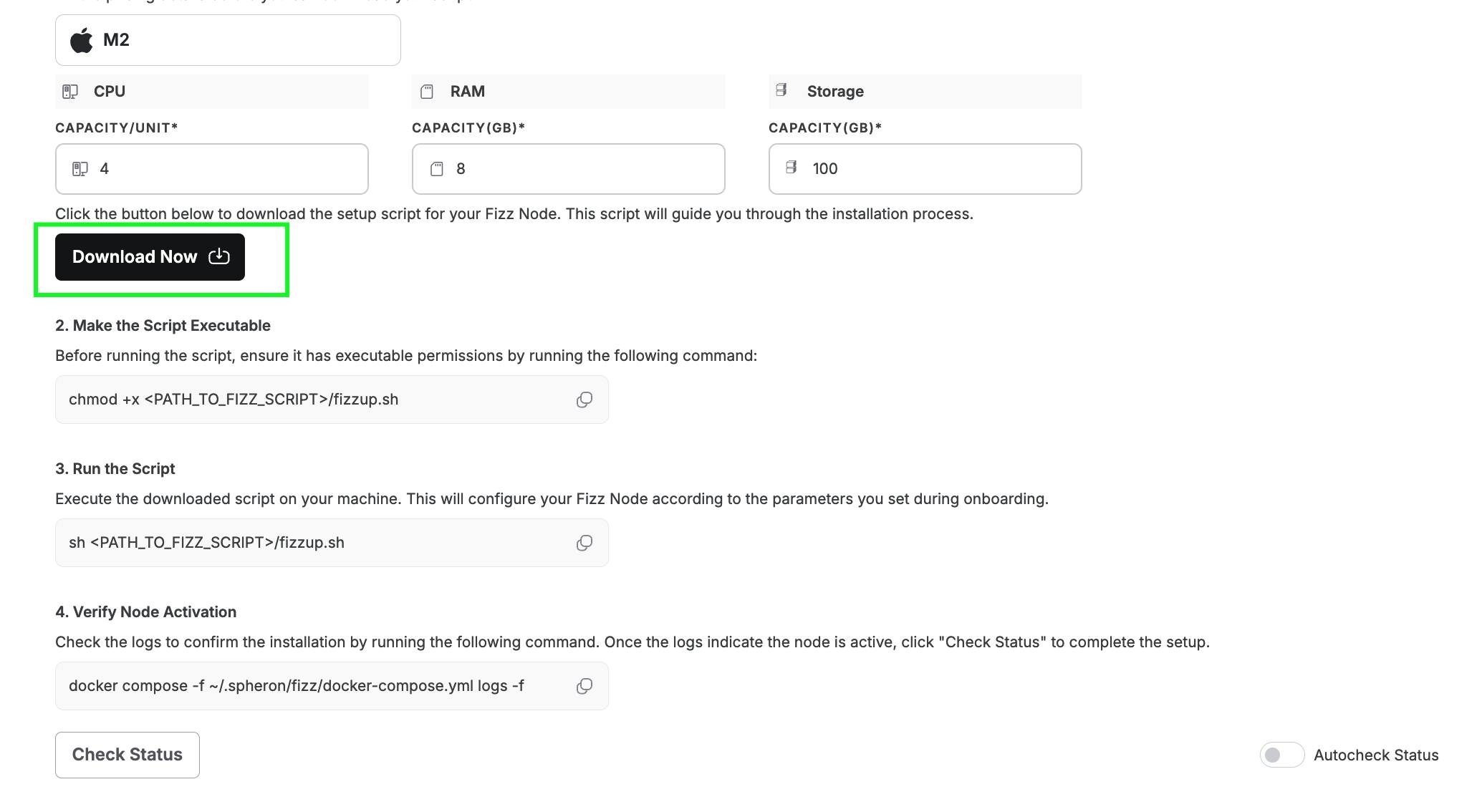
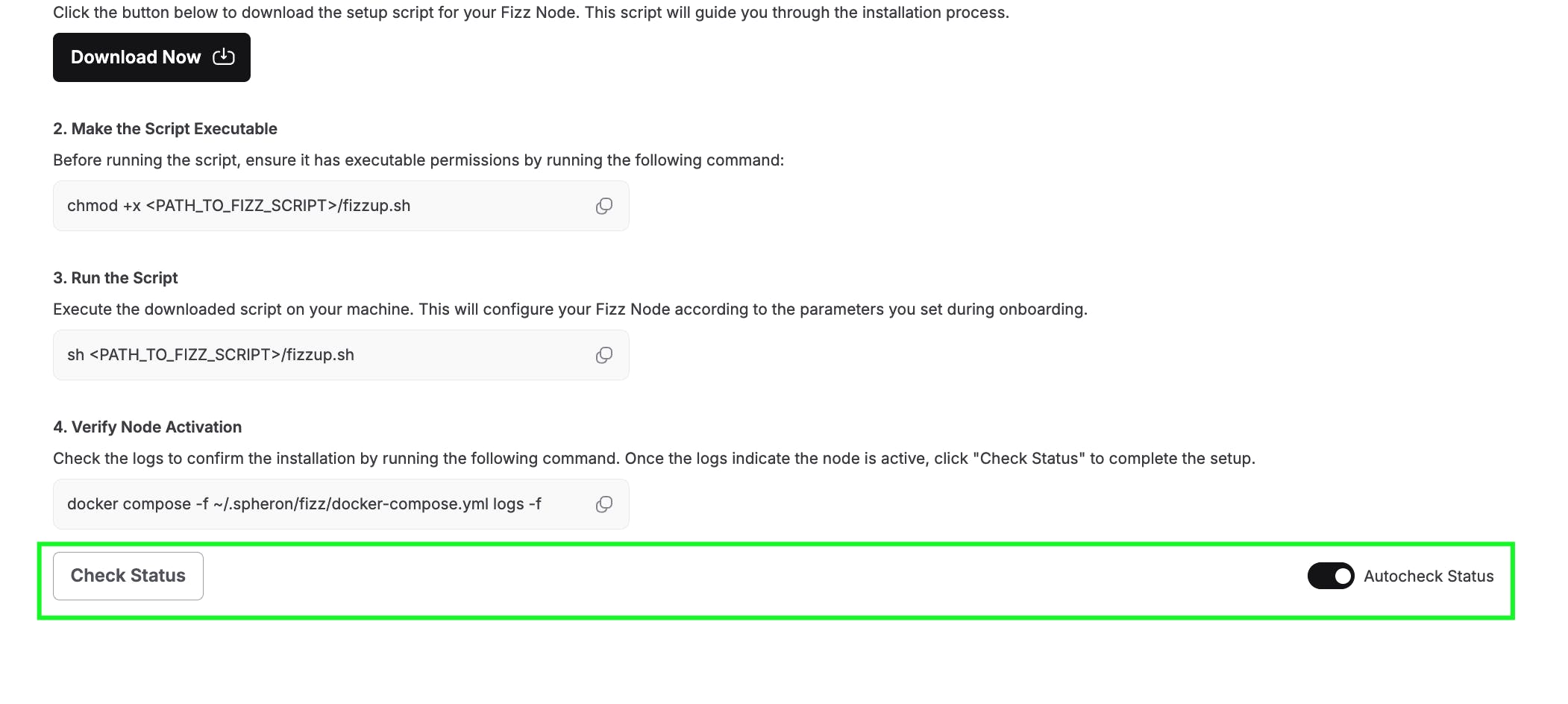
Access the setup page for your registered node. There, You should find a link to download the fizzup.sh script.

Download the fizzup.sh script to your machine. Save it in a location you can easily access via a terminal or command prompt.

Open your terminal or command prompt and navigate to the directory where you saved the script. Make the script executable by running the following command:

chmod +x <location of fizzup script>/fizzup.sh

Replace <location of fizzup script> with the actual path to the script’s directory.

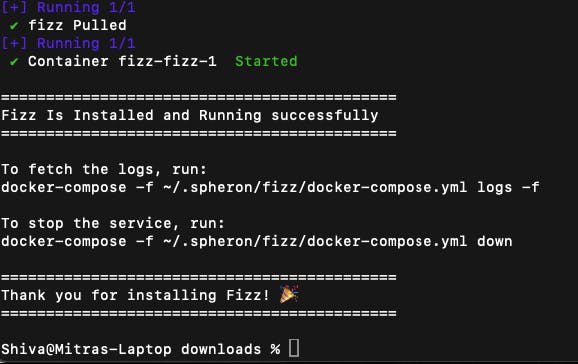
Run the script by entering the following command:

<location of fizzup script>/fizzup.sh

This command executes the script and starts the Fizz node client on your machine.

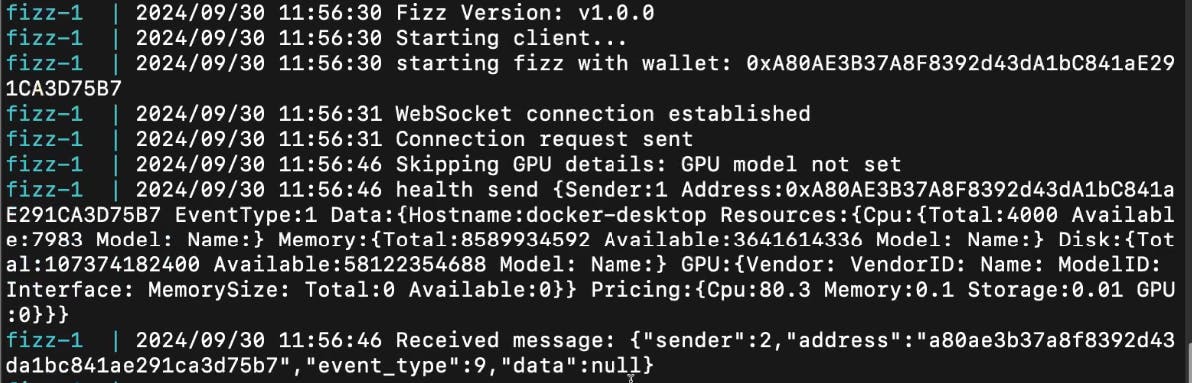
To verify if your Fizz node is running, use the following command:

docker-compose -f ~/.spheron/fizz/docker-compose.yml logs -f

If this doesn’t work, try:

docker compose -f ~/.spheron/fizz/docker-compose.yml logs -f

These commands will show you the logs of your Fizz node, allowing you to confirm it’s running correctly.

Once you’ve verified the node is running, return to the setup page on the Spheron Fizz App.

On the setup page, you’ll see a “Check Status” button and a switch to “Automatically check status.” Click the “Check Status” button to manually initiate a status check for your Fizz node.

Alternatively, you can toggle on the “Automatically check status” switch to have the system periodically check your node’s status without manual intervention.

The system will now perform checks to validate if your node is active and correctly configured.

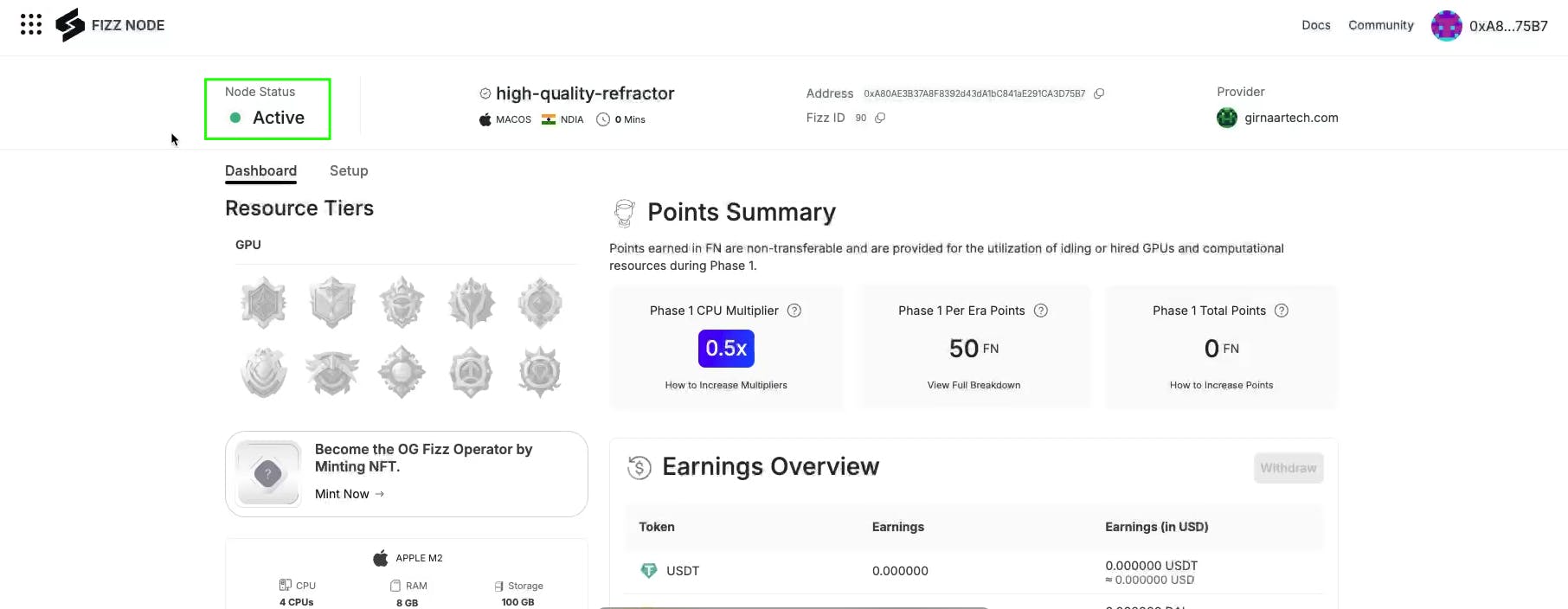
The validation process may take a few minutes. During this time, the system verifies your node’s connectivity, resource availability, and configuration. Once your node is confirmed active, you will be automatically directed to your Fizz dashboard.

Fizz Nodes earn rewards based on two factors: resource contribution and uptime.

Resource Contribution: You’ll earn more if your node provides higher-tier resources such as a powerful GPU or more CPU cores.

Uptime: Fizz Nodes must maintain at least 50% uptime within an ERA (24 hours) to receive rewards.

The final reward calculation is a combination of the resource performance and uptime factor. This system encourages node operators to maintain stable, reliable operations while rewarding those who contribute higher-quality resources to the network.

On top of that, Fizz Node operators also earn direct payments from users who lease their compute resources. Operators keep 90% of the payment, with a small fee going to the network and providers. You can withdraw these earnings at any time from your dashboard.

Fizz Node Benefits

Beyond providing decentralized compute resources, running a Fizz Node offers several exclusive perks:

Monetize your idle compute power by selling resources in an open market.

Earn $FN points that will eventually merge with $SPHN tokens.

Join the first DePIN Super Compute Network, designed to distribute energy usage and help reduce carbon emissions.

Become eligible for the Fizzer Special Discord Role, unlocking special rewards like $500 monthly quests—on top of regular rewards from resource contributions.

Early Access to Updates & Announcements – Be the first to learn about Spheron Network’s upcoming features so you can prepare and take full advantage.

And More to Come – As we approach our token launch, there are plenty of additional perks in the pipeline!

At the end of the day, Fizz Nodes represent a new model for decentralized compute—one that’s accessible, profitable, and easy to manage. They’re a critical piece in Spheron’s broader decentralized vision that lets anyone with a modest setup participate in a network traditionally reserved for institutional players.

So if you’ve ever wanted to dip your toes into decentralized compute without needing to break the bank on hardware, now’s your chance. Get your node up and running, and start contributing to the future of decentralized compute today!


Source link

UK believes trial to embrace digital securities can protect ‘market integrity’

0
UK believes trial to embrace digital securities can protect ‘market integrity’


Receive, Manage & Grow Your Crypto Investments With Brighty

The UK’s Financial Conduct Authority (FCA) and the Bank of England have officially launched the next phase of their Digital Securities Sandbox (DSS), enabling firms to explore distributed ledger technology (DLT) and tokenized securities within traditional financial markets.

The DSS, which will be operational until December 2028, provides a structured environment for testing and implementing DLT applications, aiming to enhance market efficiency, transparency, and resilience.

The initiative seeks to position the UK as a global leader in financial innovation by fostering conditions conducive to investment and sustainable growth. Divided into sequential stages known as gates, the DSS allows sandbox entrants to progressively increase their level of permitted activity as they advance through each phase.

Activities will go live after the Gate 2 stage, involving the issuance, trading, and settlement of actual digital securities. These securities are designed to function similarly to traditional counterparts, facilitating use in repurchase agreements and derivative contracts. Eligible financial instruments encompass equities, corporate and government bonds, money market instruments, fund units, and emissions allowances.

Open to UK-based firms of all sizes and development stages—including both existing financial institutions and new market entrants—the DSS invites applications until approximately March 2027. This timeframe allows regulators and participating firms to prepare for a potential transition to a new permanent regime, contingent upon the successful implementation of the new technologies.

In conjunction with the DSS launch, the FCA and the Bank of England published Policy Statement PS24/12, outlining the final policy approach and addressing industry feedback. Per the Policy Statement, several targeted changes have been made following consultation. These include extending the scope to incorporate non-pound sterling-denominated assets and adopting a more flexible method for setting firm-specific limits during the go-live stage by introducing limit ranges instead of fixed limits.

Additional adjustments involve reducing the minimum capital requirement for a Digital Securities Depository (DSD) to six months of operating expenses, down from the initially proposed nine months. Clarifications have also been made regarding provisions related to securities settlement systems, aiming to simplify understanding and navigation of the DSS rules.

Firms interested in participating are advised to review the provided guidance and complete the online application process, ensuring adherence to the outlined requirements. Upon submission, applications will be shared with both regulators, and further information may be requested as part of the evaluation.

The DSS represents a step forward in exploring the potential of blockchain and other emerging technologies within the UK’s financial markets. By facilitating innovation while safeguarding “financial stability” and “market integrity,” the initiative aims to contribute to a safe, sustainable, and efficient financial system.

However, it’s important to note that the UK’s focus on DLT does not necessarily mean it intends to promote the decentralized ethos that engulfs Web3.


Source link

Aldora Games and the Degradation of the Nintendo eShop!

0
Aldora Games and the Degradation of the Nintendo eShop!


This was going to be a review of a shitty visual novel called Animal Kung Fu, but I decided to turn it into an editorial to call out its publisher, Aldora Games. You see, awhile back I reviewed another of their “visual novels” called Cyberpunk Paradise Elysium. It was crap too, using AI generated everything and a half-assed story I could write in my sleep if I wanted to. Ironically, it was removed from the eShop, probably for copyright violations. Not surprised at all.

Who are his family and friends? Never elaborated on.

Animal Kung Fu is no different, being a thinly-veiled ripoff of Kung Fu Panda. The protagonist is a clumsy red panda, who learns kung fu and goes on an adventure with lots of animal friends to defeat evil. I surprised they haven’t been sued. But lets say you don’t want a Kung Fu Panda ripoff, how about an Aldora Games’ Bambi ripoff? Or how about an Aladdin ripoff? Looking for something more adult, how about a zombie romance? There are sixty-five titles listed on the eShop under Aldora Games. More when including those removed for copyright violations.

Eight of these shitty visual novels in a little over ten days.

But why even care about Aldora Games? I’m singling them out for the same reason I singled out Pakotime. These visual novels are cheaply made, AI-generated garbage that clog up the e-shop and push out more deserving titles. There are tons of great visual novels on the eShop. They range from Sunlight Scream to ones I haven’t gotten around to reviewing but sound interesting, like Caffeine: Victoria’s Legacy. Aldora Games says, “We are dedicated to creating exciting and unique games for the Nintendo platform.” However, they are creating the exact opposite.

Describe the journey! *throws Switch*

Aldora Games could create great visual novels if they just took the time and energy to write and produce something good. But they don’t. Instead, they do the meme, “Mom: We have Kung Fu Panda at Home!” And its Animal Kung Fu. That’s how they make their money. So tell parents far and wide, if it is an Aldora Games visual novel, don’t buy it for your kids! So in conclusion, the tag line on their website reads: “Video games for gamers developed by gamers.” But we all know that is a lie. Let them die.

Update: A few hours after going live, I discovered Aldora released yet another visual novel today, this time based on Peter Pan. They never stop do they!

P.S. Read up on Artem Kritinin releasing dozens of asset flips on the eShop1


Source link

Popular Posts

My Favorites

Chinese Exec Jailed for Laundering $19.5M Through Crypto Mixers, Exchanges –...

In brief Authorities recovered over 90 BTC, valued at about $11 million. Prosecutors said the funds were moved through eight offshore exchanges and obscured using...