Virtualized retail stores are fully shoppable, 3D digital twins of brick-and-mortars, enabling brands to recreate IRL locations in dynamic, virtual environments and amplify the reach. These online replicas combine the intuitive in-person shopping experience with the convenience of virtual, enabling shoppers to explore, browse and shop at exact locations from all around the world. Shoppers can navigate the store just as they would in real life and interact with products from their fingertips.
These virtual experiences extend the ROI of physical locations, expanding a brand’s reach with 24/7 accessibility, increasing engagement and conversion rates by bringing real-world aesthetics to a highly engaged online audience across verticals. But how do brands virtualize their retail storefronts? And what does the process look like?
We sat with Obsess’ Director of Content, Melissa Molina, to discuss the top three asked questions about virtualizing a retail store and the role our team plays in the creation of these digital twins.
How Can Brands Create a Digital Twin of a Physical Store?
Molina: To virtualize a retail store location, we recreate the physical store with photography. First: we gather reference images of the store, floor plan and square footage to get an idea of how big the store is. Based on that, we provide recommendations and a timeline for how long the process will take before coordinating a time with the brand’s on-site store team and our network of specialized photographers to begin the shoot.
A member of the Obsess team is always onsite to direct the photoshoot, working with our photographers to mark viewpoints, ensure the store is perfect from every angle and prioritize any focus areas or hero collections. Our photographers will shoot multiple shots in each direction to capture the smallest details, and then stitch them together for a seamless 360-degree effect. We work with the onsite team to update everything for an ideal, mobile-friendly user journey. This ensures the journey feels natural and the end user is able to move around, explore and discover products freely. That’s the joy of shopping in person that we try to translate over to the photographed digital twin.
Once shoots are complete, our team builds out the digital twin in our proprietary CMS, AVA, and works with the brand to ensure all products are shoppable. Prior to launch, we also dedicate resources to ensure that all content within the store is of the utmost quality and functioning smoothly—including embedded media and campaign assets, plus e-commerce and other third-party integrations.
How Long Does it Take to Virtualize a Retail Store?
Molina: We’ve turned around virtual retail stores in as little as just a couple of weeks! The launch timeline is dependent on a lot of different factors, including the size of the store. With larger stores that have more complex layouts, for example: it can take us a little longer. Typically, we deliver a photographed, shoppable store from end-to-end within 8-12 weeks from a brand signing with us.
Is There a Limit on the Space that Brands Can Digitize?
Molina: There are no limitations–we can really shoot everything! We’ve shot large, multi-level stores with intricate layouts, and have digitized it all. Over the years, we’ve perfected this process, launching more than 100 digital twins, ranging from flagship locations and showrooms, to pop-up activations for leading brands in fashion, beauty, CPG, media and more.
Ready to scale your physical presence and engage a new audience of digitally-native shoppers with virtualized retail stores? Find out more by booking a demo or emailing us at contact@obsessvr.com.
Telegram founder and CEO Pavel Durov on Wednesday said the messaging platform has been built to shield activists and ordinary people from “corrupt governments.”
Durov said that there were discussions surrounding changes to Telegram’s privacy policy and concerns among users about a possible shift in the platform’s stance on privacy. Addressing the issue, Durov clarified that while Telegram has cooperated with legal authorities for years, its foundational principles remain unchanged.
“Telegram was built to protect activists and ordinary people from corrupt governments and corporations,” he said. “We do not allow criminals to abuse our platform or evade justice.”
Durov added that since 2018, the messaging app has had the ability to share the IP addresses and phone numbers of criminals with law enforcement—provided the legal requests are properly formed and verified.
In August this year, Pavel Durov was arrested in France on charges related to content moderation on Telegram. While many speculated about potential links to cryptocurrency, the charges did not mention crypto at all.
Instead, they focused on allegations that Durov had allowed illegal content, including child pornography and drug sales, to spread on the platform. This incident intensified the scrutiny of Telegram’s approach to user privacy and content control.
Sharing data on Telegram’s cooperation with legal requests, he noted that the platform has adhered to requests in multiple countries.
For example, Durov said the company disclosed data in response to more than 200 legal requests in Brazil this year. In India, Telegram’s largest market, the platform processed almost 7,000 requests since the start of the year.
This year, European authorities also increased the use of the official communication channel, in compliance with the EU’s Digital Services Act (DSA), resulting in a higher number of requests during Q3.
Despite the disclosure of data under specific circumstances, Durov made it clear that Telegram’s policies have not fundamentally changed. The company recently streamlined its privacy policy to align with its principles across different regions.
“Our core principles haven’t changed,” Durov stated, reiterating that while Telegram strives to comply with relevant local laws, this compliance does not come at the cost of compromising its values of freedom and privacy.
Edited by Stacy Elliott.
Daily Debrief Newsletter
Start every day with the top news stories right now, plus original features, a podcast, videos and more.
Here is the daily combo solution for Captain Tsubasa: Rivals on Telegram for Wednesday, October 2.
Captain Tsubasa: Rivals is a tap-to-earn game on Telegram with a token airdrop planned.
Upgrading or buying the three cards in the daily combo will earn you 5 million free balls in the game.
Captain Tsubasa: Rivals is a fast-rising Telegram tap-to-earn game that puts a different kind of spin on the Hamster Kombat formula. Yes, it’s still largely about tapping the screen and investing your earned in-game coins into upgrades, all with the hopes of a future airdrop.
In this case, however, “Captain Tsubasa” is a classic Japanese IP tied to beloved anime and manga series dating back more than 40 years. And the upgrades you’re making are to your squad, your tactics, and your stadium. It’s pretty simple for now, but the game’s interface suggests more ambitious plans ahead.
In the meantime, early players have an opportunity to stack up balls—Captain Tsubasa’s version of in-game coins—before an eventual token launch and airdrop on The Open Network (TON). And just like Hamster Kombat, Rivals has a daily combo that lets you grab a free 5 million balls each and every day.
Here is today’s daily combo solution, along with details on how to claim the daily deluge.
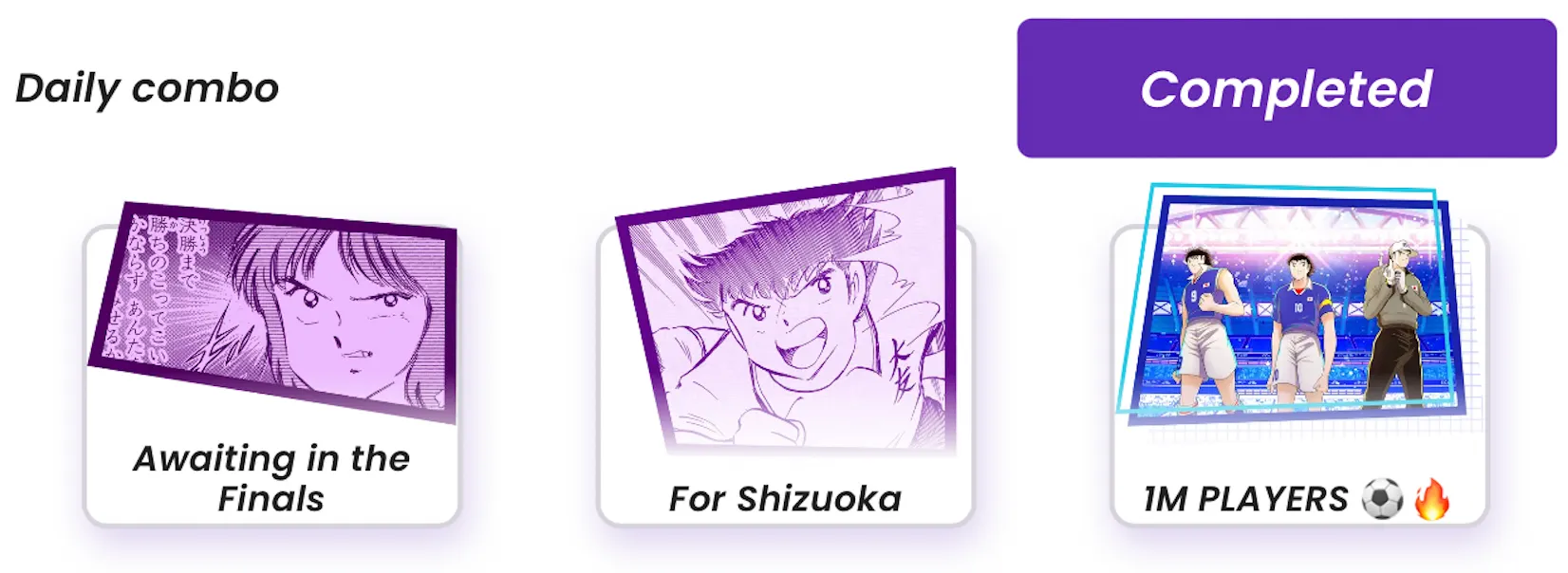
You’ll see this image if you complete the daily combo. Image: Decrypt
Captain Tsubasa Rivals daily combo
Every single day at 8am ET, Captain Tsubasa: Rivals on Telegram introduces a new daily combo—that is, three specific cards that you need to either purchase or upgrade in the game to immediately earn a free haul of 5 million balls.
You’ll need to spend the balls you have to purchase these upgrades, and each upgrade level gets more expensive. There might be days where you can’t afford to buy the cards to trigger the combo bonus, plus the other challenge is that many cards are locked and require you to invite a certain number of friends to play the game, which could slow your progress.
But given the size of the bonus, it’s certainly worth Captain Tsubasa: Rivals players on Telegram trying to claim the daily combo reward if they are able.
Here is the daily combo for Wednesday, October 2: Awaiting in the Finals, For Shizuoka, and 1M Players.
Image: Decrypt
Editor’s note: This story was first posted on September 24, 2024 and will be updated daily with the latest combo info.
GG Newsletter
Get the latest web3 gaming news, hear directly from gaming studios and influencers covering the space, and receive power-ups from our partners.
Bouillabaisse is one of the rare meals in Palia that players can consume to gain a decent amount of Focus or give it to the characters who love/need it. Currently, Zeki and Kenli need the Bouillabaisse and this guide will walk you through how to unlock the Bouillabaisse recipe and make it in Palia.
How to Unlock the Bouillabaisse Recipe in Palia
Like every cooking recipe in Palia, players must first learn its recipe and it is the same for Bouillabaisse. Before players get to make the Bouillabaisse, they will have to unlock it. The Bouillabaisse recipe is rewarded by completing the Freshwater Bundle of the Vault of the Waves.
How to Make the Bouillabaisse in Palia
Once you have the Bouillabaisse recipe, you will be able to make it using your cooking appliances. As each recipe requires certain cooking appliances and ingredients, it is the same for the Bouillabaisse. You need 1 Standard Stove, 1 Standard Oven, and 1 Prep Station to make the Bouillabaisse using the following ingredients.
Follow the following steps to make the Bouillabaisse.
Step 1: Interact with the Standard Stove and select the Bouillabaisse recipe to start making it.
Step 2: Go to the Prep Station and interact with it to make Chopped Onion by chopping the Onion.
Step 3: Interact with the Prep Station again to make Chopped Potato by chopping the Potato.
Step 4: Interact with the Prep Station again to make Chopped Spice Sprouts by chopping the Spice Sprouts.
Step 5: Interact with the Prep Station again to make Basic Dough by rolling the Wheat.
Step 6: Go to the Standard Oven and interact with it to make a Baguette.
Step 7: Interact with the Standard Oven again to make Roasted Potatoes.
Step 8: Go to the Standard Stove and add Any Bass, Oyster Meat, Baguette, Roasted Potatoes, Chopped Onion, and Chopped Spice Sprouts.
Step 9: Complete the stirring mini-game to finish making Bouillabaisse.
Make sure to complete all of the above steps in under 3min otherwise, you will get Spoiled Food.
Use of Bouillabaisse in Palia
Consuming Bouillabaisse generates 350 Focus (Basic) or 525 Focus (Star Quality). You can sell it for 57 Gold (Basic) or 91 Gold (Star Quality) at the Shipping Bin. Additionally, you can give it to the villagers who like it or who need it as a weekly want. Zeki and Kenli need Bouillabaisse until October 6, 2024, so if you have prepared some, bring them one each.
Indonesia’s state postal service, Pos Indonesia, has launched NFT stamps that combine traditional stamping with blockchain technology. The first NFT stamp, themed “Cenderawasih,” aims to attract the attention of collectors with both physical and digital versions. This move highlights the country’s growing presence in the Web3 space.
Postage stamps are taking on a new identity in the blockchain era, and Indonesia’s initiative is the latest example of efforts to revive traditional stamp collecting. However, this launch comes at a time when the popularity of NFTs is declining. According to data from CryptoSlam, NFT sales volume dropped to $296 million in September, significantly lower than the peak of $1.6 billion in March.
NFT Technology Opens New Doors in Traditional Industries
Indonesia’s state-owned postal service, Pos Indonesia, has unveiled its first postage stamps with NFT (non-fungible token) counterparts. This innovative step aims to modernize stamp collecting by combining traditional elements with blockchain technology.
In an announcement on its Instagram page, Pos Indonesia introduced its first NFT stamp with the theme of “Cenderawasih,” or “bird of paradise.” The NFT stamp will have both a physical version and an NFT equivalent. The collection will also be published as a booklet. According to the postal service, this initiative combines blockchain innovation with traditional values and may attract the interest of collectors.
This NFT stamp breakthrough aligns with Indonesia’s growing involvement in the Web3 space. On March 28, Indonesia’s financial authorities announced plans to launch a regulatory sandbox for crypto assets in early 2025 to prevent fraud.
Indonesia’s launch of NFT postage stamps comes at a time when interest in digital collectibles is waning. In September, NFTs reached their lowest monthly sales volume since January 2021. According to data, NFTs generated $296 million in sales during the month, representing a 20% decline from August and an 81% drop from March, when sales peaked at $1.6 billion.
The number of NFT transactions also decreased in September, dropping from 7.3 million in August to 4.9 million, a 32% decline.
NFT stamps are not an entirely new concept. In 2021 and 2022, several organizations sought to revive interest in stamp collecting by incorporating NFTs. Entities in the United Arab Emirates, Austria, and the Netherlands launched initiatives to combine blockchain technology with traditional stamp collecting.
Pos Indonesia’s NFT stamp initiative hints at the future of the crypto asset market. While NFT sales are declining, traditional institutions are adopting this technology, signaling that the industry is evolving. This trend suggests that NFTs could become a part of everyday life, not just digital art.
You may also like this content
Follow us on TWITTER (X) and be instantly informed about the latest developments…
Catching Uncommon and rare fish is the crucial step in leveling up the Fishing Guild in Palia. It unlocks advanced versions of the Fishing Rod, new items, and crafting recipes at the Fishing Guild Store. One of the common fish that players can catch is a Mottled Gobi which Einar currently needs. This guide will walk you through where to find and catch Mottled Gobi in Palia.
Where to Find Mottled Gobi in Palia
The Mottled Gobi is found in Ponds at any time. There are several ponds in Kilima Valley and Bahari Bay, and you can go to any pond to try and find Mottled Gobi. However, the Mirror Pond Ruins located northwest of the Kilima Valley is the pond we recommend for catching the Mottled Gobi.
How to Catch Mottled Gobi in Palia
Upon reaching the Mirror Pond Ruins, look for a fishing bubble in the pond. After that, equip the Fishing Rod tool and cast the line inside the bubble while equipping a Glow Worm as bait.
NOTE: Glow Worm bait is mandatory for catching the Mottled Gobi. Make sure to equip Glow Worm Bait on the fishing rod before casting the line into the pond.
Once done, wait for the bobber to shake three times. As the bobber starts to move after the third shake, reel in the fish by holding the Left-Click Button and moving the mouse to keep the fish inside the brackets to catch the fish.
Uses of Mottled Gobi in Palia
The Mottled Gobi can be sold for 100 Gold (Base) or 150 Gold (Star Quality) to Zeki or at the Shipping Bin. Moreover, you can also gift it to certain villagers who like it or those who need it. Currently, Einar needs the Mottled Gobi until October 6, 2024, so if you caught one, bring it to him.
The Role of WAX Blockchain in Digital Assets & NFTs
Top Projects on WAX Blockchain
Future of WAX Blockchain
From being just, a source of entertainment to a way of earning real money, Blockchain has transformed the whole gaming industry. Thanks to the rapidly evolving blockchain technology, we can buy, sell, and create digital goods like never before. But, as exciting as it sounds, many Blockchain platforms make the process too complex or too costly. Even, they have set their potential limit as well. This is where WAX Blockchain steps in, offering an easy, secure way to buy, sell, create, and trade your digital goods.
WAX Blockchain is designed to fulfill the needs of gamers and digital collectors to solve the challenges of speed, security, and cost that other blockchain struggle with. So, what makes WAX Blockchain different from others? In this blog, we will see how WAX Blockchain is changing the crypto economy.
The WAX (Worldwide Asset eXchange) Blockchain is a decentralized platform, specially designed for virtual goods, video games, collectibles, and NFTs (Non-Fungible Tokens). Wax Blockchain aims to create, buy, sell, and trade virtual and digital assets in a secure, transparent, and efficient way.
WAX Blockchain has its native cryptocurrency, named WAX Token (WAXP). It is used in various activities within the platform. Let’s get to know about that.
What is WAX Token (WAXP)?
Source: naijatechguide.com
The WAX Token is the native cryptocurrency of WAX Blockchain. It plays a central role in the ecosystem, enabling users to interact with decentralized applications (dApps), trade digital assets, and participate in governance.
Why is WAXP Important?
WAXP serves as a backbone for the WAX ecosystem, facilitating frictionless transactions and interactions. It enables people to trade digital assets at minimal costs, access NFT marketplaces, and vote in the governance of the blockchain. Users contribute to network growth and security through staking and usage of WAXP.
Since its innovation, WAX Blockchain has attracted a global community of gamers, creators, and traders, making it a major player in the world of NFTs and digital assets. But how was WAX Blockchain invented?
Who Invented WAX Blockchain?
The WAX blockchain was developed by William Quigley and Jonathan Yantis, who co-founded an online marketplace for virtual video game assets named OPSkins. The concept of WAX stemmed from the increasing need for the safe and efficient trading of digital products especially within the gaming industry.
In 2004, a peer-to-peer secondary market emerged where players could sell virtual items from games like World of Warcraft for real-world money. As a result of growing interest led to the creation of, OPSkins in 2015. OPSkins dominated the online exchange of game assets such as skins or weapons making it easier for users to buy, sell, or exchange these items. This led them to think that by adopting blockchain technology they could revolutionize this area further.
By 2017 they finished the WAX Initial Coin Offering (ICO) which effectively initiated the Worldwide Asset eXchange (WAX) Blockchain. Their ambition was to make virtual goods trading quicker than before as well as safer and accessible thereby solving numerous issues related to regular marketplaces.
But why WAX Blockchain is different from other blockchain platforms? What is so special about WAX Blockchain? Let’s dive into that.
Key Features of WAX Blockchain:
1. Built for Virtual Goods and NFTs:
WAX Blockchain is designed for virtual assets trade such as video game items and NFTs. In this platform, users can create, buy, sell, and trade digital goods easily. WAX Blockchain is the recommended blockchain for gaming and virtual collectibles.
2. Delegated proof of stake (DPoS) consensus mechanism:
WAX Blockchain employs a delegated proof-of-stake mechanism which permits faster as well as more efficient transactions as opposed to conventional proof-of-work systems. Therefore, in DPoS, token holders elect trustworthy validators leading to enhanced transaction speed as well as scalability.
3. WAXP Token:
WAX Blockchain also has its own native token known as WAXP that powers transactions on the platform. The uses of WAX include staking, governance participation, transaction fees, and trading on WAX’s ecosystem.
4. NFT Marketplace:
WAX Blockchain is a thriving marketplace for Non-Fungible Tokens (NFTs) that allows users to mint, trade, and sell them. It supports famous collections of NFTs as well as partnerships with companies such as Topps and Capcom for exclusive digital assets making it even more attractive.
5. Energy-efficient and eco-friendly:
Unlike blockchains like Bitcoin and Ethereum which consume a significant amount of energy, WAX is highly energy-efficient due to its DPoS mechanism. This makes it an eco-friendly option for digital asset trading.
6. Cross-Chain Compatibility:
WAX Blockchain interoperability has been emphasized, especially with Ethereum. For instance, through WAXP-to-WAXE conversion users can shift their assets and engage in decentralized finance (DeFi) applications based on Ethereum platform.
7. WAX Cloud Wallet:
The WAX Cloud Wallet is user-friendly enabling the creation of the user account and interaction with the blockchain without much complexities in cryptocurrency wallets.
8. Governance and Voting:
DPoS system by WAX Blockchain allows token holders to elect the block producers who participate in the governance of the platform. This helps maintain decentralization while ensuring efficient operations on the network.
9. dApp Ecosystem:
WAX Blockchain fosters various decentralized applications (dApps) among them games and entertainment ones. Developers can easily develop using WAX since it provides high transaction speeds and NFT features.
As we already have an idea, WAX Blockchain has played a crucial role in the world of digital assets and NFTs by providing a blockchain platform specifically designed to enable the creation, buying, selling, and trading of these virtual goods. Let’s explore the important role of WAX Blockchain in digital assets and NFTs.
The Role of WAX Blockchain in Digital Assets & NFTs:
1. Specialized marketplace for virtual goods and NFTs:
WAX Blockchain is designed to promote creating, buying, and swapping digital assets, positioning it as a prime market for NFTs. This marketplace supports multiple asset types such as in-game items, collectibles, and digital art to enable seamless trading amongst users without the intervention of intermediaries. By partnering with familiar brands, WAX Blockchain enables the tokenization of massive digital well-known brands, Topps, famous for its baseball cards, and Street Fighter, famous for its collectibles.
2. Simple and easily accessible NFT creation:
Creating NFTs on the WAX blockchain is much easier to do as compared to other blockchains, which are very technical and have a high cost of fees. With WAX Blockchain, users and creators can easily mint NFTs at low fees and list them without much hassle on marketplaces. That makes WAX Blockchain popular among artists, game developers, and other content creators who want to foray into the NFT space without too many barriers.
3. Speedy and Inexpensive Transactions:
on some blockchain networks, an important challenge of digital assets and NFTs relates to the high fees and time-consuming processing times, like Ethereum. The Delegated Proof of Stake mechanism of WAX Blockchain helps solve this problem by allowing users to make fast, cheap transactions. With that mechanism, users are therefore able to participate in trading even low-value digital assets without worrying about charges that would be too high.
4. Bridging NFTs Across Blockchains:
WAX Blockchain supports cross-chain compatibility, especially with Ethereum. Therefore, users can swap their WAX-based NFTs to Ethereum to participate in decentralized finance applications using WAXP-to-WAXE token bridge. This increased ability to become liquid and versatile will help digital assets on the WAX blockchain.
5. WAX decentralized applications for gaming and digital collectibles:
WAX Blockchain hosts a wide range of dApps, with the largest concentration being in games and digital collectibles, in which NFTs play a central role. For example, many blockchain-based games use NFTs as game items, and that provides gamers with assets to own, trade, and leverage on their gaming assets. Such NFTs could represent such varied things as unique characters and rare items, thereby giving players a way to create real-world value from their gaming efforts.
6. Partners with Leading Brands:
WAX Blockchain collaborations with well-known brands and franchises have placed the platform as a player in the NFT space. For example, WAX Blockchain has collaborated with companies such as Capcom and Funko to create rare, limited-edition NFTs with notable collectible value. Such collaborations add to the stature of WAX Blockchain while helping to bring a wider audience to the world of digital assets and NFTs.
Now, let’s explore notable projects on WAX Blockchain.
Top Projects on WAX Blockchain:
1. Alien Worlds:
Source: altcoinbuzz.io
Alien Worlds is a blockchain-based play-to-earn game where players mine planets in search of valuable assets. NFTs are used as native assets on the platform, which, in this case, comprise tools, land, and characters. Players get TLM or Trillium through participating in mining, staking, and governance activities in general.
WAX Blockchain is leveraging fast transaction speeds and minimal cost with their games in this regard. Various in-game assets are represented as NFTs, allowing players to own and trade unique items.
2. RPlanet:
Source: nftevening.com
RPlanet is a decentralized platform that offers the creation, collection, and trading of NFTs as unique digital assets. It’s focused on a play-to-earn model where users participate in a futuristic metaverse, mining for resources and crafting NFTs in the process. RPlanet is certainly focused on developing an exciting and engaging NFT ecosystem.
Users combine different elements to craft their own unique NFTs. Players can extract resources and will use them to create or trade NFTs. RPlanet is a part of a larger metaverse where people can do a variety of activities.
3. Topps NFTs:
Source: play.toppsapps.com
Topps is best known for collectible cards. The company recently launched NFT collections on WAX. The list of NFTs includes digital baseball cards, soccer cards, and many more types of collectibles. The project is a confluence of old interests in collecting card sets and the ease of capabilities offered by blockchain technology.
Every card has official branding and premium artwork. Users can trade Street Fighter NFTs on WAX’s marketplace, increasing the liquidity and price of Street Fighter NFTs.
4. Street Fighter NFTs:
Street Fighter, a popular fighting game series, has released numerous different NFTs on the WAX blockchain. Street Fighter NFTs are independent unique digital collectibles. They present character skins and artworks as in-game items for fans and collectors to enjoy and treasure.
This has been one new method of fan interaction with the game through collectibles. The majority of these items arrive in low quantities which sometimes enhances their appeal and scarcity.
5. WAX Studio:
WAX Studio is the creation platform that offers creators the ability to develop and launch their own NFT projects on the WAX blockchain. This is a more rewarding tool and resource system supporting artists and developers in making, minting, and managing their NFTs, thereby breaking into the NFT space much easier.
NFTs created on WAX Studio can be listed and traded on the WAX marketplace. The system also offers support and resources for creators through tutorials and community engagement.
Future of WAX Blockchain:
As of 2024, the future of WAX Blockchain looks promising, with continued growth and innovation in the digital assets and NFT space. WAX Blockchain is expected to further solidify its position as a leading platform for NFT trading and gaming by enhancing its ecosystem with more partnerships and integrations. The blockchain’s focus on fast, low-cost transactions and its eco-friendly approach will likely attract more developers and users.
Additionally, WAX’s efforts to bridge with other blockchains and expand its dApp offerings are anticipated to increase its adoption and utility. This WAX Creator program has already created over 150,000 NFTs. The continued development of tools for creators and the expansion of its marketplace are set to drive its success in the evolving digital economy.
WAX blockchain is paving the way for the future of digital assets and NFTs with its unique approach to fast transactions, low costs, and eco-friendliness. Whether you’re a gamer looking to earn from your favorite games or a creator eager to mint and trade NFTs, WAX Blockchain offers a versatile platform that’s easy to use and packed with potential.
What are your thoughts on WAX Blockchain’s role in the digital asset space? Do you see it as the future of NFT trading and gaming? We’d love to hear your opinions and experiences!
For more updates and insights on Web3 and other exciting blockchain developments, don’t forget to subscribe to our newsletter. Stay tuned and stay informed!
The NFT (Non-Fungible Token) market has exploded in recent years, giving rise to a multitude of platforms where users can buy, sell, and mint digital assets. Among the most popular NFT marketplaces are Rarible and OpenSea, both of which offer unique features and cater to different types of users. Whether you’re an artist looking to mint your first NFT or a collector seeking rare digital items, choosing the right marketplace is crucial for maximizing your experience.
In this blog, we’ll dive into a detailed comparison of Rarible and OpenSea. We’ll explore their features, ease of use, fees, and community engagement to help you determine which platform is the best fit for your NFT needs.
What is Rarible?
Source: es.beincrypto.com
Rarible is a decentralized NFT marketplace that operates on the Ethereum blockchain. It distinguishes itself by offering a community-driven approach to NFT trading and governance.
Now let’s explore about Rarible’s features.
Features:
1. Royalties by Creators:
The creator of Rarible gets to set a royalty fee for the owner of a piece at any future sale. Although this means that the artist doesn’t receive money upfront, it will guarantee that their work is going to continue generating money if the digital item becomes valuable enough over time.
2. Governance:
Governance of the product is via the RARI token; using this will allow individuals to vote on decisions and proposals made within the platform, hence creating a decentralized model of governance.
3. Minting Options:
Rarible has lazy minting, which means that the creators do not pay any initial upfront gas fees for minting. These costs are covered when an NFT is bought.
Example:
Rarible has been used by a diverse range of artists and creators. For example, well-known digital artist Fewocious and the iconic collection Bored Ape Yacht Club have utilized Rarible to reach audiences and sell their unique digital assets.
What is OpenSea?
Source: thecoinacademy.co
OpenSea is the largest NFT marketplace by volume, also built on the Ethereum blockchain. It is renowned for its vast selection of NFTs and user-friendly interface.
Now let’s explore OpenSea’s features.
Features:
1. Vast Marketplace:
OpenSea has a very rich marketplace, millions of NFTs-from digital art and collectibles to virtual land and domain names.
2. Cross Chain Compatibility:
OpenSea supports other blockchains beyond that of Ethereum like Polygon and Klaytn. The transaction fee was lower with ample options for open trading.
3. Minting & Trading:
The customer can efficiently mint, buy and sell NFTs with streamlined processes and filters to search for items of interest.
Example:
OpenSea is home to a wide array of successful projects and creators. Notable examples include CryptoPunks, Axie Infinity, and Art Blocks, which have gained significant traction on the platform.
Now, to help you make an informed decision, you need to understand the differences between Rarible and Opensea.
Key Differences Between Rarible and OpenSea:
FeatureRaribleOpenSeaLaunch Date20202017Key FeatureCommunity governance through $RARI tokenLargest selection of NFTs across categoriesUser InterfaceCreator-focused, but can be clutteredBeginner-friendly, intuitive, and scalableSupported BlockchainsEthereum, Flow, TezosEthereum, Polygon, KlaytnGas FeesHigh on Ethereum, lower on Tezos/FlowHigh on Ethereum, gas-free with PolygonPlatform Fees2.5% (charged to buyer and seller)2.5% (charged to seller only)MintingStandard minting process, gas fees upfront“Lazy minting” allows for gas-free creation until saleRoyaltiesFully customizable by creatorsCustomizable by creatorsGovernanceDecentralized, users participate via $RARI tokenCentralized, private companySecuritySome issues with fake NFTs, improving verificationGenerally secure, with verification for major creatorsCommunityCommunity-driven, DAO participation through $RARILarge, engaged, but no decentralized governanceBest ForCreators valuing decentralization and royaltiesNew users, traders looking for variety and cost-efficiencyEnvironment ImpactLower with Tezos and FlowReduced with Polygon integration
But to understand them in a better way, you have to go through the pros and cons of Rarible & OpenSea.
Pros and Cons of Rarible & OpenSea:
Rarible:
Pros:
1. Decentralized Governance:
Rarible enables users to have a say in the decisions with the platform, or rather letting the users decide on the future of the marketplace.
2. Royalties:
Creators can set up specific royalty fees which are paid out at times when their NFTs reap value over time.
3. Creative Control:
Lazy minting on Rarible, saves creators to avoid costs that come with upfront costs, paving easier entry for new artists in NFT.
Cons:
1. Smaller Marketplace:
Compared to the large user base as well as the traffic on OpenSea, Rarible has a small user base and hardly as many visitors for your NFTs, meaning lesser exposure.
2. Higher Learning Curve:
The decentralized governance and blockchain elements might be more complicated for new users compared to more straightforward platforms.
OpenSea:
Pros:
1. The largest NFT Marketplace:
OpenSea, which boasts the highest trading volume in the market, gives maximum exposure to its creators while allowing collectors the opportunity of a highly massive amount of selection.
2. Friendly Interface:
The OpenSea interface was designed using ease and has intuitive navigation, with comprehensive filtering options.
3. Multi-chain Support:
OpenSea supports Ethereum, Polygon, and Klaytn compatibility, giving users more flexibility, including lower fees on some chains.
Cons:
1. No Community Governance:
Since OpenSea doesn’t have a decentralized governance model, the users have little say in how the platform should be developed.
2. High Traffic, High Competition:
The more listings there are, the harder it becomes for smaller projects or newer projects to attract much attention.
But which platforms can give you benefit? Which one gives you more profit? Let’s get to know that.
Which Platform is Best for You?
For Creators:
Users who might prefer Rarible are those who want control over their royalties and are either more involved in the community or would like to be. Its decentralized approach is further helpful with minting options as it can confer more creative freedom and low entry costs.
OpenSea would be far better suited for maximum exposure and a wider audience. The user-friendly interface of the website extends to millions all over the world, so reaching out to a larger market is easier in this way.
For Collectors:
Rarible offers unique, niche collections, making it one of the best sites to get something new or discover relatively new artists and projects.
OpenSea provides quite a variety in NFTs-from well-established collections to some newly emerging trends. It gives collectors great choices.
Future Outlook for Rarible and OpenSea:
Rarible is focusing on expanding its ecosystem with more blockchain integrations and enhancing its governance model through the RARI token. Future developments may include more features for creators and expanded marketplace capabilities.
OpenSea continues to grow its platform, with plans to improve user experience, expand cross-chain support, and integrate more blockchain technologies. Its ongoing innovations aim to maintain its position as the leading NFT marketplace while enhancing its offerings for both creators and collectors.
Conclusion:
Choosing between Rarible and OpenSea largely depends on your needs as a creator or collector. Rarible offers decentralized governance and more flexible royalty options, making it a strong choice for those who value creative control and community involvement. OpenSea, on the other hand, provides extensive exposure and a user-friendly experience, making it ideal for those seeking a broad range of NFTs and high liquidity.
Ultimately, both platforms have their strengths and cater to different segments of the NFT market. Explore both to see which aligns best with your goals and preferences.
FAQs:
1. What is the difference between Rarible and OpenSea?
Rarible focuses on decentralized governance and creator royalties, while OpenSea offers a larger marketplace and multi-chain support.
2. Can I sell NFTs on both Rarible and OpenSea?
Yes, you can list your NFTs on both platforms, but you will need to manage each listing separately.
3. Which platform has lower fees?
Both platforms charge a 2.5% fee on transactions, but gas fees may vary depending on the blockchain used. OpenSea’s support for Polygon can offer lower transaction fees.
Earlier in 2024, Valve announced that games being sold in Germany were going to require an Age Rating to continue to be sold, and now there’s a deadline.
An update was posted to Valve’s official Steamworks documentation (thanks SteamDB), that now makes it clear that game developers have a deadline of November 15th 2024 to ensure an Age Rating is provided. If one is missing, from that date the games simply won’t be displayed to Steam customers in Germany.
Developers will need to “truthfully complete Steam’s built-in content questionnaire and publish the results”. Thankfully Valve has a built-in system for this, so it shouldn’t take long for developers to do.
From Valve’s FAQ:
Q. When do I need to complete this questionnaire by?A. You can complete the questionnaire at any time. Games without a German age rating will be hidden from customers in Germany starting November 15, 2024.
Q. If I fill out the questionnaire, is my game guaranteed to remain available in Germany?A. No. There are certain kinds of content that are not allowed for sale to customers in Germany. If present in your game, this content must be disclosed in the content questionnaire. Please complete the questionnaire completely and truthfully. Steam will automatically generate an appropriate rating for your game in Germany. If the generated rating allows, your game will automatically become visible to customers in Germany.
Q. What if my game has a USK rating?A. If your game has been issued an age rating by going through the rating process directly with USK, you may also enter that information within the store page editor for your game. This is rare. If you do not have an agreement directly with USK, do not enter a USK rating.
Get ready to put your observation skills to the test as Spot The Differences! Party has arrived on Xbox Series X|S and PC.
Complete with full Xbox Play Anywhere support, this one brings with it a visual overhaul and hours of fun for solo players and groups alike. With stunning 4K graphics, this classic game challenges you to find the subtle differences between two seemingly identical images. You know, it’s Spot the Difference, just in Party form…
A Party for Your Eyes (and Brain)
Spot The Differences! Party boasts a whopping 300 pictures and 3,000 differences to find, guaranteeing hours of engaging gameplay. Whether you’re a seasoned spotter or a casual observer, there’s something for everyone with three distinct game modes.
And what are those modes? Well, how do the following sound to you?
Timed Mode: Race against the clock to find all the differences before time runs out. Perfect for those who love a challenge and want to test their speed and accuracy.
Casual Mode: Relax and take your time as you search for differences without the pressure of a timer. Ideal for a more laid-back experience.
Party Mode: Gather your friends and family for a competitive spotting frenzy! See who has the sharpest eyes and the fastest reflexes in this exciting multiplayer mode.
Xbox Play Anywhere Support
With Xbox Play Anywhere support, you can seamlessly switch between your Xbox Series X|S and PC, picking up where you left off on either platform. Share your progress and achievements across devices, and enjoy the game wherever you go.
Sharpen Your Senses
Spot The Difference! Party is more than just a game; it’s a fun and engaging way to improve your observation skills and attention to detail. Challenge yourself, compete with friends, and enjoy the satisfaction of finding those elusive differences.
Spot The Differences! Party is available now on Xbox Series X|S and PC. Gather your friends, grab your controllers, and get ready for a party of spotting fun! Just head to the Xbox Store to get access via a download for £8.39.
You can’t play this one on Xbox One.
Our full review is coming soon. Just as soon as we’ve spotted all those differences.
Spot The Differences! Party Description
The most complete difference game on consoles, in an all-new version with gorgeous 4K graphics! Play solo or with up to 3 friends, and see who is the quickest spotter!