The year began on shaky ground for NFTs, with major collections struggling to maintain value amid a persistently bearish sentiment. Floor prices dipped across the board as trading volumes waned, leaving many to question whether the NFT market could rebound.
Yet, as the year progressed into the final quarter, new bullishness in the broader cryptocurrency market set the stage for a late-year resurgence. Keep your expectations in check. It wasn’t a 2021/2022-like gold rush, but the vibe shift was welcomed by the NFT faithful.
Leading the charge was Pudgy Penguins, a once-declining collection that blossomed under new ownership starting in 2022, and hit new all-time highs above $100,000 in anticipation of its token airdrop.
This revitalization came as NFT marketplace competition intensified in 2024. Platforms like Magic Eden, Blur, and OpenSea battled for dominance, driving innovation through the inclusion of new blockchains and trading types.
From a sluggish start to an electrifying close, 2024 reminded the world that the NFT space is as dynamic and unpredictable as ever, fueled by the passion of its community and the constant push for innovation.
Here’s some of the top themes from the year in NFTs in 2024.
Bitcoin Ordinals find their footing
Though introduced at the start of 2023, Bitcoin Ordinals—or Bitcoin NFTs, more or less—truly found their stride this year thanks to significant infrastructure upgrades and growing adoption. Early challenges, such as the lack of user-friendly wallets and marketplaces, faded as wallets like XVerse and Unisat made holding Ordinals safer and easier.
Meanwhile, trading became more seamless as marketplaces like Magic Eden and OXK added critical support, drastically improving from the chaotic early days which saw Bitcoin Ordinals traded via spreadsheets in Discord servers.
This infrastructure evolution paved the way for standout projects to capture the spotlight, and helped “drive a renaissance in activity on Bitcoin,” according to Franklin Templeton.
Bitcoin Puppets and NodeMonkes led the charge, jumping from modest mint prices to peaks of 0.469 Bitcoin ($33,000) and 0.897 Bitcoin ($56,000) respectively, according to Magic Eden. While prices have since retraced to 0.138 ($14,000) and 0.125 Bitcoin ($12,650) respectively with the price of BTC itself being much higher, their impact on the Ordinals ecosystem remains significant. And other high-profile projects like Quantum Cats and Ordinals Maxi Business have similarly found fervent collector bases.
NFT marketplaces evolve and expand
This year has been pivotal for NFT marketplaces, with OpenSea, Magic Eden, and Blur shaping the narrative in distinct ways. Blur retained dominance in Ethereum NFT trading, but its influence waned during the summer as the NFT bear market dragged on. Plus, its founding team had its attention elsewhere, launching Blast, an Ethereum layer-2 network.
Magic Eden, on the other hand, stole the spotlight with bold innovations in 2024. It led the charge on Bitcoin NFTs and added a decentralized exchange for Runes—Bitcoin’s version of meme coins—after the halving. Excitement around the brand culminated in the launch of the ME token by the ME Foundation, which airdropped more than $700 million to users of its protocol.
Meanwhile, OpenSea—the leading marketplace from the 2021 boom—reemerged as a figurehead in the NFT world towards the end of the year. First, CEO Deven Finzer was outspoken about the company’s willingness to “stand up and fight” amid SEC scrutiny of the platform in September.
Shortly thereafter, buzz surrounded the marketplace as its OpenSea 2.0 marketplace overhaul began testing, ultimately fueling questions about a potential future token launch. That speculation only grew as users reported loyalty programs during the closed beta, and an OpenSea Foundation was registered in the Cayman Islands.
Brands come and go
The NFT craze of 2021 saw major brands like Nike and Adidas rush into the space. But a bear market and fading sentiment on NFTs prompted some giants to retreat in 2024.
Among the most significant exits came with Nike’s decision to shut down RTFKT, the fashion and technology studio it acquired in 2021 for an undisclosed sum. Prior to Nike’s move, Starbucks wound down its Web3 loyalty program, Starbucks Odyssey, which the coffee giant operated on the Polygon blockchain.
DraftKings, a major player in the fantasy sports and sportsbook industries, abruptly discontinued its involvement with NFTs, closing its DraftKings Reignmakers fantasy game after several years of operation. The move came amid a class action lawsuit from users and lingering regulatory questions around the space.
But while some major brands took a step back, at least one made a big splash in Web3. McDonald’s jumped into a notable collab, teaming up with NFT collection Doodles for a holiday-themed campaign. The collaboration brought NFT branding into the physical world with custom holiday coffee cups available in McDonald’s locations. It signaled that even in a quieter NFT market, some brands still see potential in creative integrations.
Going token-crazy
Perhaps no narrative has gained as much momentum and attention in the last few months as NFT projects and their connections to fungible tokens, sometimes referred to as utility tokens for their ecosystems.
While NFT collections launching or having an associated token is not a new phenomenon, the rise of tokenization in 2024—and growing optimism about the U.S. regulatory landscape under President-elect Donald Trump—has put token launches squarely back in the limelight.
Most notably, Pudgy Penguins launched its ecosystem token PENGU on Solana this month. The token, which was eligible to claim by more than 7 million unique wallets, provided NFT holders and many other eligible parties with a more than $1.5 billion collective stimulus infusion.
But it’s not just the Pudgy Penguins that have gone the token route in 2024. This year alone the NFT collections Memeland, Milady, and Mocaverse all dropped tokens to their NFT holders and ecosystem participants.
All three of those respective tokens have surpassed and maintained market caps of more than $100 million at the time of writing—and that’s just the tip of the iceberg.
It’s likely that this narrative will maintain some buzz going into 2025, when Azuki is poised to drop its anticipated ANIME token to its ecosystem and other Web3 users on AnimeChain. Plus, Yuga Labs, the parent company of Bored Ape Yacht Club is expected to continue strong promotion around ApeCoin (APE) amid the recent ApeChain launch.
Edited by Andrew Hayward
Daily Debrief Newsletter
Start every day with the top news stories right now, plus original features, a podcast, videos and more.
Ina Garten never saw the need to compare herself to Martha Stewart — despite what everyone around her said.
“[I learned] to just trust your vision,” Garten, 76, said during a Tuesday, December 24, podcast appearance. “I think the thing that works is if you’re really true to who you are. If you believe in it so fiercely, somebody out there is going to believe in it too.”
She added, “It’s true. It’s not, ‘I’m going to become this perky person … that people will just love.’ Just put out who you are and do the best job you possibly can do and I think people will trust that. They honor that and they believe in that.”
Garten says she sees her life like a train ride.
Related: Ina Garten and Martha Stewart’s Feud: Us Explains
Daniel Zuchnik/WireImage; Michael Simon/Getty Images Martha Stewart and Ina Garten are two of the biggest names in the lifestyle space, but their onetime friendship has, apparently, evaporated. They first crossed paths in the early 1990s when Stewart went shopping at Garten’s now-closed Barefoot Contessa shop in East Hampton, New York. “My desk was right in […]
“People are trying to pull me off the train and I just keep it right on the tracks,” she explained. “If I feel, like, I’m so sure what I’m doing is right, I don’t let people pull me off my game.”
Ina GartenNoam Galai/Getty Images for NYCWFF
The two lifestyle gurus first crossed paths in the early 1990s when Stewart, now 83, went shopping at Garten’s now-closed Barefoot Contessa shop in East Hampton, New York.
“My desk was right in front of the cheese case and we just ended up in a conversation,” Garten previously told TIME in a 2017 interview. “We ended up actually doing benefits together where it was at her house and I was the caterer, and we became friends after that.”
One day, Stewart brought a publisher to the Barefoot Contessa outpost that helped secure Garten’s first cookbook deal. They have each since published numerous recipe compilations and helmed respective culinary shows.
Nearly two decades later, it was reported that Stewart and Garten were on the outs. Stewart had claimed to The New Yorker in September that Garten “stopped talking to me” after she went to prison. (Stewart was found guilty on felony charges of conspiracy to obstruct and of making false statements to federal investigators. She was sentenced to five months in prison and was released from jail in March 2005.)
Garten, however, has denied that the alleged falling-out was a result of Stewart’s prison stint.
Thank You!
You have successfully subscribed.
“Well, let’s just say her story isn’t exactly accurate,” Garten said earlier this month during a book event, supporting her recently released memoir. “You know, that was 25 years ago. I think it’s time to let it go.”
Garten further noted on Tuesday that she surrounds herself “with really creative, smart people” to help make the best decisions for her own career.
“What I tend to do is I talk to everybody in the beginning and I get everybody’s point of view,” Garten explained. “I hear and we talk and we, kind of, build something. But, at the end of the day, it’s my job to choose and once I get all the information … I know exactly what the right thing to do is.”
Decentralized Autonomous Organizations (DAOs) represent a fundamental shift in how communities, companies, and initiatives can coordinate efforts, funds, and decisions on the blockchain. By leveraging transparent smart contracts and on-chain governance mechanisms, DAOs aim to distribute authority, reduce overhead, and foster a more democratic decision-making process. However, building a successful DAO isn’t just about cutting-edge tech or grand ideas—it also requires a clear vision, well-crafted governance rules, and a strategically engaged community.
In this article, we’ll take a counterintuitive approach by highlighting how not to create a DAO. By focusing on common pitfalls—from legal oversights to governance missteps—we can better understand what truly contributes to a thriving, sustainable DAO. This perspective aligns with the importance of recognizing cognitive biases, such as insensitivity to base rates and the conjunction fallacy, which often lead enthusiastic founders to overlook real-world data and complexity. Avoiding these traps can be the difference between launching a resilient DAO and watching an ambitious project crumble under misaligned structures or unmet expectations.
Governance thresholds dictate how many votes or what percentage of voting power is needed to pass a proposal within a DAO. Striking the right balance here is crucial. Thresholds that are set too high can stifle progress by making it nearly impossible for proposals to succeed, effectively discouraging member participation. On the other hand, thresholds that are too low can lead to frivolous proposals or constant voting spam, making governance more of a burden than a benefit.
It’s tempting to either pile on complicated governance rules or oversimplify them to keep decision-making quick. However, both extremes can be problematic. Simplicity in governance is key to enhancing clarity and participation. Overly complex smart contracts and procedural layers can dissuade newcomers from getting involved, while an oversimplified model might fail to address potential conflicts or security vulnerabilities.
Ultimately, aiming for a balanced governance framework—one that is easy enough for members to participate in but comprehensive enough to protect the DAO from abuse—is central to avoiding the pitfalls of governance threshold mismanagement.
3. Underestimating Legal and Regulatory Aspects
Legal Wrappers and Compliance
Building a DAO without considering legal and regulatory frameworks is a common recipe for disaster. While decentralization is a powerful concept, it doesn’t absolve projects from potential liabilities and compliance obligations. Assigning your DAO a formal legal wrapper—whether it’s a foundation, a cooperative, an LLC, or another entity type—can help mitigate personal risks for contributors and align your organization with existing regulatory regimes.
Failing to think through these details often leads to:
Personal Liability for Founders: Without a proper legal entity, core contributors might become personally responsible for any legal disputes or financial mishaps involving the DAO.
Regulatory Crackdowns: Governing bodies worldwide are actively monitoring DAOs for compliance with securities laws, anti-money laundering (AML) regulations, and tax obligations. Ignoring these can lead to penalties, fines, or forced shutdowns.
Non-Existent or Inadequate Documentation
Equally problematic is the lack of clear documentation outlining the DAO’s legal structure and operational protocols. From voting procedures to treasury management, every aspect of the DAO’s lifecycle should be properly documented to reduce ambiguity and help new members understand their responsibilities. Inadequate documentation or outright neglect can create:
Confusion Over Roles and Responsibilities: Without explicit definitions, it’s easy for tasks to fall through the cracks or for disagreements to escalate.
Inability to Enforce Rules: DAOs rely on both smart contracts and social consensus. Formalizing rules in documentation helps ensure consistent enforcement and prevents unwelcome surprises.
In short, underestimating the legal dimension of DAO creation can derail even the most innovative projects. By proactively addressing legal and regulatory considerations—and maintaining thorough documentation—you not only protect core contributors but also fortify trust within your community and with external stakeholders.
Overlooking Community Building
The Importance of Community Engagement
A DAO, at its core, is nothing without an active and supportive community. Driving grassroots enthusiasm and participation is often the deciding factor between a thriving DAO and one that fizzles out. Yet, it’s surprisingly easy to underestimate just how vital it is to nurture community trust and engagement—especially during the early stages.
Some common pitfalls include:
Treating Community Members as Passive ObserversInstead of viewing your community as a dynamic force, you might slip into a one-way communication style. This discourages members from taking initiative or contributing fresh ideas.
Lack of Clear Roles and ChannelsWithout well-defined roles and open communication channels—like forums, Discord servers, or governance platforms—members can feel confused about where to participate or how to add value.
Ignoring Early FeedbackIn a DAO, the “wisdom of the crowd” can be a powerful asset. Overlooking or trivializing user feedback can lead to missed opportunities for innovation and improvement.
Failing to Incentivize Properly
Well-structured incentives lie at the heart of any successful DAO. Whether you’re offering governance tokens, staking rewards, or recognition badges, these incentives must be aligned with the DAO’s long-term goals. Misalignment often causes short-sighted behavior, where participants chase quick rewards rather than contributing meaningfully.
Overemphasis on Token SpeculationIf the primary draw for community members is the promise of quick token price gains, you risk attracting speculators instead of builders. This can lead to fleeting participation and sell-offs at the first sign of trouble.
Neglecting Non-Monetary RewardsRecognition, social standing, and meaningful collaboration can be just as powerful as financial incentives. When a DAO fails to provide pathways for skill development or leadership, member engagement wanes.
Cognitive Bias TrapsBiases such as the conjunction fallacy can mislead founders into believing that if multiple positive outcomes are possible (e.g., rising token prices, active participation, mainstream adoption), then all those outcomes will inevitably happen together. This wishful thinking can blind DAOs to the need for thoughtful, data-driven incentive models.
To avoid these pitfalls, DAO creators must actively foster a culture of transparency, collaboration, and mutual respect. By setting clear expectations, leveraging diverse incentive structures, and consistently involving community feedback, you ensure members are motivated to contribute more than just their votes—they become co-creators in the DAO’s shared vision.
5. Ignoring Technical Considerations
Token Standards and Governance Frameworks
A solid technical foundation is essential when you create a DAO, particularly if it involves on-chain governance. Selecting the appropriate token standards and governance frameworks can significantly impact your DAO’s security, efficiency, and scalability.
Some pitfalls to watch out for include:
Choosing Incompatible Token StandardsIf your DAO relies on a token that isn’t easily integrated with governance contracts or lacks upgradeability, you might face roadblocks when implementing new features or patching vulnerabilities.
Underestimating Smart Contract ComplexityEven “simple” governance tokens can hide complex logic behind the scenes. Overlooking these complexities may result in bugs, lockouts, or exploits that harm the DAO’s reputation and finances.
Ignoring Off-Chain vs. On-Chain DynamicsGovernance strategies often combine on-chain decisions with off-chain discussions (e.g., using platforms like Discord or forums). Failing to synchronize these two spheres can fracture community engagement and hamper decision-making.
Poor Architecture and Security
Robust security isn’t just about preventing hacks—it’s about building an architecture that can adapt to evolving threats and changing community needs.
Key oversights include:
Inadequate AuditingSmart contracts require thorough reviews, both automated and manual. Rushing to mainnet deployment without proper audits can lead to major losses—financial, reputational, or both.
No Contingency PlansIf a vulnerability is discovered, how will you respond? Lacking emergency procedures or fallback governance mechanisms can leave a DAO paralyzed when critical decisions must be made quickly.
Over-Engineered SolutionsWhile security is paramount, over-complicating the DAO’s architecture can create unintended vulnerabilities. Keeping your setup as simple as possible reduces attack surfaces and makes it easier for community members to understand and trust the system.
In short, technical considerations form the bedrock of a functional DAO. Choosing appropriate token standards, thoroughly auditing contracts, and designing for both present-day and future needs are non-negotiable steps in avoiding costly pitfalls.
Best Practices and Lessons
When studying successful DAOs, certain themes emerge time and again. According to Aragon the most robust DAOs share a commitment to simplicity, iteration, and transparent governance. Instead of rolling out overly sophisticated models from day one, they evolve and adapt based on community feedback and real-world performance.
Here are a few best practices worth emulating:
Iterative Approach to GovernanceStart small and build up. Launch a Minimal Viable DAO (MVD) to test voting processes, incentive mechanisms, and proposal management. Gather community feedback and refine before taking bigger steps.
Simple, Transparent Rules and ProcessesEnsure proposals are easy to understand and that the voting process is accessible to all token holders. Overly complicated frameworks can dissuade new members from participating.
Clear Roles and Shared ResponsibilitiesDefine contributor and community member roles early on. Whether you rely on working groups, committees, or elected leaders, clarity prevents power vacuums and fosters collaboration.
Open Communication and EducationFrom Discord channels to public documentation, keep conversation and learning at the heart of your DAO. Encourage members to ask questions, propose improvements, and take leadership roles.
Academic Perspectives
Beyond practical experience, a growing body of research offers theoretical insights that can strengthen DAO governance. The discusses emerging patterns in DAOs, including how incentives and on-chain rules interact with off-chain social dynamics. By examining these findings, DAO creators can better anticipate challenges—like voter apathy, whale influence, or collusion—and integrate solutions from the outset.
Incorporating academic perspectives can help:
Validate Governance AssumptionsEmpirical data and rigorous analyses can confirm or challenge the assumptions behind your DAO’s architecture, preventing costly mistakes.
Stay Ahead of Regulatory and Social ShiftsAcademics often explore how upcoming policies or societal trends might impact DAOs, offering a forward-looking lens that day-to-day builders might miss.
Establish CredibilityAligning your DAO’s structure and operations with recognized research signals professionalism and thoroughness, potentially attracting more serious contributors, partners, and investors.
Conclusion
As you can see, creating a DAO involves more than just deploying a smart contract and distributing tokens. By examining these common pitfalls—from poor governance thresholds to inadequate legal structures, from neglecting community engagement to disregarding technical complexities—you gain a clearer picture of what not to do when you set out to create a DAO. Failing to address these areas often leads to compromised security, stalled decision-making, regulatory headaches, or outright community collapse
At Nextrope, we specialize in tailored blockchain and cryptocurrency solutions, including DAO creation and tokenomics design. If you’re looking to avoid these common pitfalls and build a thriving DAO that stands the test of time, feel free to contact us or explore more resources on our blog.
Tintin, the seminal hero of the pulp genre of boy adventurers, enters the United States public domain in 2025, though in a way that probably wouldn’t please his creator Hergé very much. Not necessarily because the cartoonist would be angry at other folks being able to legally make Tintin stories — but because the Tintin story entering the public domain is among his least favorite ones.
On Jan. 1, 2025, works first published in 1929 (and sound recordings from 1924) will enter into the public domain in the United States, and that includes a good portion of Tintin in the Land of the Soviets, a work of explicit and broad anti-Soviet/Marxist propaganda that Hergé was so embarrassed by that he refused to allow it to be reprinted for 40 years.
But Tintin and his little dog Snowy aren’t the only comic strip characters whose earliest adventures will no longer be covered under copyright. Popeye (you know, the sailor man?) also appeared in E.C. Segar’s Thimble Theater for the first time in 1929. Though, at that point, Thimble Theater had already been running in the New York Journal for a decade — Popeye was merely a one-arc guest character in the adventures of Ham Gravy (boyfriend to Olive Oyl) and Castor Oyl (brother to… yeah, you get it). The nautical hombre hadn’t even developed his trademark spinach-powered super strength, and Olive Oyl wouldn’t break up with Ham Gravy to date him until 1930.
Other 2025 entries to the wild world of public domain art include many films from the bleeding edge of the Silent Era and the Talkie revolution, including Alfred Hitchcock’s first sound film, Blackmail, and the first feature-length Marx Brothers movie, The Cocoanuts. Numerous Disney animated shorts also enter the field, like “The Skeleton Dance,” whose dancing skeletons (what else?) have gained new life in celebratory Halloween gifs.
Mickey and Minnie Mouse themselves made a big splash last year when their earliest shorts hit public domain, enabling gleefully emotionally transgressive and carefully not-legally transgressive horror art, and more than a dozen more 1929 Mickey Mouse shorts will follow in 2025, including “The Karnival Kid,” in which the famous mouse has a speaking role for the first time.
What would this writer like to see in the public domain in 2025? Maybe our universal agreement that, in the pursuit of something to do with newly public domain art, low-budget horror is low-hanging fruit. (Of course we are getting Popeye the Slayer Man in 2025.)
For more notable works entering the public domain in the United States in 2025, you can check out the Center for the Study of the Public Domain’s yearly bulletin.
Published: December 27, 2024 at 9:02 am Updated: December 27, 2024 at 9:02 am
by Ana
Edited and fact-checked:
December 27, 2024 at 9:02 am
To improve your local-language experience, sometimes we employ an auto-translation plugin. Please note auto-translation may not be accurate, so read original article for precise information.
In Brief
Meme coins dominate 2024 crypto market, accounting for 31% of attention, indicating speculative assets are increasingly appealing over technological-based initiatives, highlighting changing investor preferences.
According to a CoinGecko analysis, meme coins became a hot topic of the 2024 crypto market, accounting for 31% of narrative attention. This pattern demonstrates how speculative assets are becoming more and more appealing than initiatives that prioritize technological foundations. Gaining knowledge of the elements behind these shifts might help one better understand how cryptocurrency investors’ tastes are changing.
The Crypto Narrative Landscape Is Led by Meme Coins
With a combined 30.67% of investor interest, meme currencies dominated the narrative space. This rise is an enormous spike over prior years due to the acceleration of speculative possibilities. With 14.36% of investor interest, the primary topic topped all meme currency storylines, a notable increase from its 8.32% share in 2023. This spike emphasizes how important community-driven investment excitement and viral trends are to the industry.
A noteworthy subcategory was Solana meme coins, which ranked fourth overall in the narrative rankings and garnered 7.65% of all attention. The varied attraction of this asset class was demonstrated by the extra interest generated by other meme coin trends, such as Base meme coins, AI-themed meme coins, and cat-themed meme coins.
AI Narratives’ Ascent in the Crypto Market
Even while meme coins were at the top of the list, stories about artificial intelligence continued to gain popularity, garnering 15.67% of investor interest. With a share of 12.58%, the total AI narrative came in second, up from 11.32% in 2023. Despite this expansion, the rise in popularity of meme coins overshadowed AI storylines, demonstrating a change in investor attention toward riskier ventures.
Smaller developments within the AI industry also become more well-known. For instance, 1.17% of investor interest was in AI agents, while 1.49% was in meme coins with an AI theme. These findings point to a persistent need for stories that blend technical advancement with the possibility of speculation.
Growing Interest in DePIN and Real-World Assets
There were noticeable rises in interest in decentralized physical infrastructure networks (DePIN) and real-world assets (RWA). With an 8.64% proportion of investor interest, RWA jumped from 6.48% in 2023 to take third position. The rise of this narrative is indicative of a larger movement to combine blockchain technology with physical assets, which appeals to those looking for practical applications in the cryptocurrency industry.
DePIN, which came in at number eight, increased its share from 1.82% to 3.38%. Its increasing appeal demonstrates the growing interest in narratives that connect the digital and physical worlds, highlighting the potential of decentralized infrastructure to solve pressing issues.
The GameFi narrative had a dramatic downturn in comparison to the increasing popularity of meme currencies and RWAs. In 2024, its percentage of investor interest fell to just 3.72% from 10.49% in 2023. This change indicates a decline in interest in blockchain initiatives pertaining to gaming, while different narratives attracted investors.
Narratives of the Solana and Base Ecosystems Gain Momentum
With a combined 14.30% share of investor interest, Solana attracted a lot of attention. The robust success of Solana meme currency, which generated about half of the narrative’s overall focus, supported this category. Furthermore, the Solana ecosystem as a whole obtained a 5.78% share, highlighting the platform’s adaptability and wide range of user appeal.
Additionally, Base-related narratives gained traction and together accounted for 4.87% of investor interest. Base meme coins finished in 11th position with a 2.13% share, while the Base ecosystem came in ninth overall. These patterns demonstrate how blockchain ecosystems that can support specialized narratives are becoming more and more popular.
More General Patterns in the Storytelling Environment
In 2024, 78.72% of worldwide investor attention was captivated by the top 20 crypto narratives, while the remaining 21.28% was distributed across 180 lesser-known ones. This focus demonstrates how the market is competitive and how most attention is drawn to a small number of prominent topics.
Together, the top three narratives—meme coins, AI, and RWAs—accounted for over 40% of investor interest. While conventional categories like DeFi and Ethereum ecosystems remained somewhat relevant, Solana and Base-related narratives further cemented their roles as major actors. Interestingly, the ones on the TON ecosystem, smart contract platforms, and BRC-20 tokens garnered lower shares, indicating a more dispersed distribution of interest outside of the top narratives.
In order to assess narrative interest, the CoinGecko study examined non-botted worldwide online traffic between January 1 and December 21, 2024. The research offers a glimpse of the changing dynamics of the cryptocurrency business by concentrating on categories with quantifiable involvement.
The prevalence of meme coins reflects a larger tendency toward speculative investing, which is fueled by viral trends and social media impact. This change can be a result of investors’ shifting risk tolerances as well as the growing influence of community-driven narratives on market dynamics. On the other hand, the fall of some, like GameFi, highlights the difficulties encountered by initiatives that find it difficult to maintain interest in the face of intense competition.
The emergence of meme coins and the ongoing appeal of AI and RWA narratives characterized the 2024 cryptocurrency market. Traditional storylines like GameFi saw decreases as investors shifted their focus to high-risk alternatives, indicating a competitive and dynamic environment.
Market actors may get important insights from understanding these trends, which highlight how crucial it is to adjust to changing consumer preferences. Navigating the intricate and quickly evolving world of cryptocurrencies will require keeping an eye on these changes as the market continues to develop.
Disclaimer
In line with the Trust Project guidelines, please note that the information provided on this page is not intended to be and should not be interpreted as legal, tax, investment, financial, or any other form of advice. It is important to only invest what you can afford to lose and to seek independent financial advice if you have any doubts. For further information, we suggest referring to the terms and conditions as well as the help and support pages provided by the issuer or advertiser. MetaversePost is committed to accurate, unbiased reporting, but market conditions are subject to change without notice.
About The Author
Victoria is a writer on a variety of technology topics including Web3.0, AI and cryptocurrencies. Her extensive experience allows her to write insightful articles for the wider audience.
More articles
Victoria d’Este
Victoria is a writer on a variety of technology topics including Web3.0, AI and cryptocurrencies. Her extensive experience allows her to write insightful articles for the wider audience.
Published: December 27, 2024 at 8:48 am Updated: December 27, 2024 at 8:49 am
by Ana
Edited and fact-checked:
December 27, 2024 at 8:48 am
To improve your local-language experience, sometimes we employ an auto-translation plugin. Please note auto-translation may not be accurate, so read original article for precise information.
In Brief
The National Bank of Cambodia has allowed commercial banks and payment institutions to offer services involving secured assets and stablecoins.
The National Bank of Cambodia (NBC) has issued a new directive allowing commercial banks and payment institutions to offer services involving cryptocurrencies, including stablecoins or those backed by assets. However, unbacked cryptocurrencies, such as Bitcoin, remain prohibited.
This move aims to regulate the use of digital currencies in the country, reflecting Cambodia’s efforts to align with global financial trends. Under the new directive, any commercial bank or payment institution wishing to provide cryptocurrency-related services must first obtain approval from the NBC.
Authorized institutions will be permitted to engage in activities such as converting cryptocurrency to fiat currencies and vice versa, transferring cryptocurrency assets between accounts, and offering custody services. However, these institutions are explicitly prohibited from using their clients’ cryptocurrency assets for their own purposes.
Cambodia Blocks Access To Major Crypto Exchanges Amid Ongoing Efforts To Regulate Digital Asset Market
Historically, Cambodia has prohibited cryptocurrency transactions and trading due to concerns about high risks, such as money laundering, fraud, and involvement in illicit activities within the black market.
Earlier this month, the Cambodian authorities blocked access to 16 cryptocurrency exchange websites, including well-known platforms like Binance, Coinbase, and OKX, as part of ongoing efforts to regulate the digital asset market.
This action followed a directive issued by the Telecommunication Regulator of Cambodia (TRC), which restricted access to 102 websites, primarily targeting online gambling platforms. Cryptocurrency exchange websites were included in the restriction due to their lack of licensing from the Securities and Exchange Regulator of Cambodia (SERC). While access to these websites has been blocked, mobile applications for these platforms are still accessible.
Despite these measures, Cambodia continues to be a global leader in retail cryptocurrency use per capita, according to data from analytics firm Chainalysis. Centralized exchanges account for 70% of cryptocurrency transactions in the country.
Disclaimer
In line with the Trust Project guidelines, please note that the information provided on this page is not intended to be and should not be interpreted as legal, tax, investment, financial, or any other form of advice. It is important to only invest what you can afford to lose and to seek independent financial advice if you have any doubts. For further information, we suggest referring to the terms and conditions as well as the help and support pages provided by the issuer or advertiser. MetaversePost is committed to accurate, unbiased reporting, but market conditions are subject to change without notice.
About The Author
Alisa, a dedicated journalist at the MPost, specializes in cryptocurrency, zero-knowledge proofs, investments, and the expansive realm of Web3. With a keen eye for emerging trends and technologies, she delivers comprehensive coverage to inform and engage readers in the ever-evolving landscape of digital finance.
More articles
Alisa Davidson
Alisa, a dedicated journalist at the MPost, specializes in cryptocurrency, zero-knowledge proofs, investments, and the expansive realm of Web3. With a keen eye for emerging trends and technologies, she delivers comprehensive coverage to inform and engage readers in the ever-evolving landscape of digital finance.
Bold and the Beautiful had Brooke Logan texting Ridge Forrester while he was at the Forrester family’s Christmas party on the CBS soap this week. While Brooke tells her sister she doesn’t blame Ridge for being angry at her taking the CEO position, she shocks B&B fans with what she makes an excuse for next.
Bold and the Beautiful Spoilers: Brooke Logan Not Done with Ridge Forrester Yet
Bold and the Beautiful had a devastated Brooke Logan (Katherine Kelly Lang) walk out of Eric Forrester’s (John McCook) mansion. She stopped by because she needed to explain to Ridge Forrester (Thorsten Kaye) why she took the Forrester Creations CEO position.
But once she discovered her soulmate had company, it rendered her speechless. That is because his company was Taylor Hayes (Rebecca Budig), Brooke’s long-time rival on B&B.
The next day, Brooke conveyed how hurt she was to her sister Katie Logan (Heather Toms). They talked about this at the family’s Christmas gathering. But Bold and Beautiful fans suggest her wording got a bit odd. Brooke Logan first said she was upset the Ridge didn’t wait long before turning to Taylor. But what she said next was what fans had a tough time swallowing.
B&B | CBS
Brooke couldn’t have misinterpreted the scene that she stumbled upon. Ridge came downstairs when he heard Brooke call out his name. Then, after a few minutes, Taylor saunters down the stairs, walking bare-legged and barefoot, with just an oversized shirt on. So, it was obvious what they had been up to.
B&B Spoilers: Ridge Gets a Pass from Brooke?
While the scene of Taylor coming down the stairway hurt Brooke Logan, it didn’t seem to do much to taint her against Ridge Forrester. What she told her sister Katie seemed to offer evidence of her forgiveness toward him. Then, she said the same thing to Hope Logan (Annika Noelle).
It was almost as if she didn’t blame him, since he didn’t know her plan behind taking the CEO position. So, she may be hurt over what Ridge did, but she seems to demean herself by not blaming him for running to Taylor.
Bold and the Beautiful fans were surprised. When she declared she hadn’t given up on him, it seemed as if she was willing to overlook this betrayal. So, Brooke declares, that she’s not done with him yet, and she plans to bring him back into her bed.
Hope tries to make her mom see the whole picture, suggesting that maybe he isn’t her destiny, as Brooke always said. But no, the Logan matriarch seemed to think his cheating was her fault and gives him a pass.
Bold and the Beautiful Spoilers: Desperate Play…
Bold and the Beautiful starts Brooke Logan on her journey to lure Ridge Forrester back to her. She seems willing to resign herself to the notion that she drove Ridge into Taylor’s arms after he heard her CEO announcement.
Instead of becoming infuriated over him cheating on her, she has a different approach on Bold and the Beautiful this week.
It is more like she will take this betrayal as collateral damage. It sounds like she thinks she deserves it after Ridge thought she betrayed him by taking the CEO position.
B&B Spoilers: Brooke Faces a Tough Road Back to Ridge?
Brooke Logan getting her destiny back on track will likely be tougher than ever before on Bold and the Beautiful. That’s due to Taylor Hayes and her broken heart syndrome.
Steffy Forrester (Jacqueline MacInnes Wood) already warned her father not to break her mother’s heart again. So it appears he painted himself into a corner, one that he can’t get out of.
Taylor Hayes was diagnosed with broken heart syndrome a while back. Bold and Beautiful fans learned from watching Taylor at the doctor’s office that it is a diagnosis that could become fatal in certain circumstances.
B&B | CBS
So, if Ridge goes back with Brooke Logan after that intimate evening with Taylor Hayes, this could become one of those circumstances. This means dumping Taylor could jeopardize her health, which he wouldn’t want to do.
So, Bold and the Beautiful likely has Brooke Logan become desperate, when her rival’s roadblock emerges. Ridge Forrester probably finds himself in a position with Taylor that proves almost impossible to walk away from.
While Brooke is willing to overlook Ridge romancing Taylor, this likely isn’t enough to bring him back into her arms. So, he might have sealed a deal with his ex by romancing her. It could turn out as something he can’t get out of without causing Taylor major health problems on the CBS soap.
Head back to Soap Dirt for the latest Bold and the Beautiful spoilers.
Artificial Intelligence Jobs and Career Opportunities
Benefits of Artificial Intelligence
Artificial Intelligence Resources
Conclusion and Future of Artificial Intelligence
Artificial intelligence is no longer a fad, it is shaping how we perceive life, treat our work, and interact with the world around us. In this blog, we will explore the fascinating journey of artificial intelligence, its origin, core principles, real-world applications, and future implications.
1. Introduction to Artificial intelligence:
AI mainly involves the creation of various types of machines and algorithms that can perform tasks that require human intelligence. These tasks include problem-solving, perception and decision-making, understanding language, pattern recognition, and many more.
At its core, AI aims to simulate human thought processes enabling learning experiences and performing the same task through new input. Such machines are capable of receiving very huge data through machine learning with natural language processing (NLP) and computer vision.
The influence of AI is profound, spanning industries such as healthcare, finance, education, and entertainment. Algorithms manage what is fed to social media feeds and self-driving vehicles pave the way for intelligent personal assistants, such as Siri and Alexa to build a new future path in how we live, work, and play.
History and Evolution of AI:
Picture Courtesy: analyticsjobs.in
The journey of AI began long before it became a household term, rooted in philosophical questions about the nature of intelligence and the potential of machines. Here’s a brief look at its evolution:
1950s: The Birth of AI
Alan Turing’s significant question “Can machines think?” gave added impetus to the idea of AI. His Turing Test became a measure for judging the ability of a machine to simulate intelligent behavior. The Dartmouth Conference of 1956 marked the beginning of AI as an area of study, where scientists explored symbolic reasoning and problem-solving.
1960s–1970s: Early AI Programs
Early AI programs were limited to playing chess or solving algebraic problems. These programs proved slow due to a lack of computational power and data.
1980s: The AI Boom
With the advent of expert systems, AI gathered momentum. These systems worked as a simulated human activity in specific fields, such as medicine and engineering. This time also witnessed the emergence of neural networks, defining the modern scenario of AI.
1990s–2000s: Practical Applications:
AI moved from theory to real-world applications. Some of the eye-catching event milestones included IBM’s Deep Blue defeat of chess champion Garry Kasparov in 1997 and the intelligent search algorithms on which Google and other platforms base their teachings.
The 2010s: The Era of Machine Learning
The explosion of data, combined with advancements in computing power and algorithms, brought AI to new heights. It led to machine learning and deep learning becoming the centerpiece of AI research, offering gains in image recognition, natural language understanding, and autonomous systems.
2020s: The Rise of Generative AI
Generative AI such as GPT (Generative Pre-trained Transformer) and DALL·E has made a unique discovery of new methods of creativity and problem-solving. AI has now become part of every industry, ranging from healthcare solutions to entertainment ones, with footprints across innovation that promise to change the future.
2. Core Concepts of Artificial Intelligence:
Let’s explore the core concepts of AI:
What is AI?
Picture Courtesy: hostadvice.com
Artificial Intelligence is a field of computer science that deals with the simulation of human intelligence processes by machines. This includes the ability to learn, recognize speech, string sentences into an understandable natural language, solve problems, and sometimes create something new.
AI seeks all techniques tries to imitate as well as enhance human cognitive functions at the illusion of independence in the domain of specific situations. AI-powered systems can learn from data, improve over time, and adapt to changing circumstances, mimicking human-like abilities to a remarkable degree.
Key Components and Technologies:
AI operates through a blend of sophisticated components and cutting-edge technologies. Let’s break down the core elements that power AI systems:
A. Machine Learning (ML):
Machine learning manages to learn most without the system having to program them explicitly. In addition to this, ML models rely on algorithms to discover patterns and make decisions on the basis of provided data.
B. Natural Language Processing (NLP):
Enable machines to recognize, interpret, and generate any language spoken by a human. All these could be applications for chatbots and language translation tools, even voice assistants like Alexa and Siri.
C. Computer Vision:
Empower machines to understand and analyze visual data, meaning to categorize space, images, and videos. It has uses in recognition purposes, such as facial recognition, building autonomous vehicles, and studying images in medicine.
D. Neural Networks:
Computational systems imitate the structure of the human brain. Neural networks mainly fall under the category of deep learning, a part of machine learning able to deal completely with unstructured data like text, images, and audio.
E. Robotics:
AI and mechanical systems harmoniously blend to ensure that robots are intelligent enough to do things on their own such as warehouse automation have robotic surgery.
F. Expert Systems:
Expert systems are AI-based computer programs developed to simulate the decision processes of experts in particular fields on the basis of a knowledge base and inference rules.
Machine Learning vs. Artificial Intelligence
Picture Courtesy: readitquik.com
The terms “Machine Learning” and “Artificial Intelligence” are often used interchangeably, but they have distinct meanings:
AspectArtificial Intelligence (AI)Machine Learning (ML)DefinitionAI is the broader field focused on creating machines that simulate human intelligence.ML is a subset of AI that enables machines to learn from data and improve over time.ScopeEncompasses various techniques, including ML, rule-based systems, robotics, NLP, and computer vision.Specifically focuses on algorithms and statistical models to analyze data and make predictions.GoalTo develop intelligent systems capable of performing tasks like problem-solving, reasoning, and adapting.To create systems that learn from data to perform specific tasks with minimal human intervention.FunctionalityCan include systems that do not learn but act based on predefined rules or logic.Entirely data-driven; models improve by identifying patterns in the data provided.ApproachUses diverse approaches, such as symbolic reasoning, decision trees, neural networks, and deep learning.Primarily uses algorithms like regression, classification, clustering, and deep learning.Dependency on DataData is important but not always required for rule-based AI systems.Relies heavily on large datasets for training and testing.FlexibilityCan function with predefined instructions or adapt using ML and other techniques.Requires adaptability and continuous learning from new data.Learning CapabilityIncludes both learning and non-learning systems (e.g., expert systems, robotics).Exclusively focuses on systems that learn and improve over time.Key TechnologiesNLP, computer vision, robotics, expert systems, and ML.Algorithms like decision trees, support vector machines (SVM), neural networks, and clustering.ExamplesAI assistants (Siri, Alexa), autonomous vehicles, chess-playing robots, facial recognition.Product recommendations, fraud detection, spam filtering, medical diagnoses.Human InteractionCan range from high automation (autonomous cars) to interactive systems (chatbots).Typically operates in the background with minimal direct interaction (e.g., recommendation systems).ComplexityBroader, integrating multiple disciplines and technologies.Narrower, focusing on training and improving models.ApplicationsDiverse applications across industries like healthcare, finance, gaming, and manufacturing.Specific use cases like customer segmentation, predictive analytics, and personalized experiences.Future PotentialAims to create generalized intelligence or systems capable of broader decision-making.Advances the field of AI by improving the efficiency and accuracy of specific tasks.
AI has become an integral part of our lives, influencing how we work, interact, and solve problems. From simplifying everyday tasks to driving innovation across industries, its applications are diverse and impactful. Here’s a look of examples of AI.
Artificial Intelligence in Everyday Life:
Picture Courtesy: claysys.com
AI-powered solutions are everywhere, often making our lives easier in ways we may not even notice:
A. Voice Assistants: Virtual assistants such as Siri, Alexa, and Google Assistant employ natural language processing (NLP) to hear commands, then process them, and finally answer.
B. Recommendation Systems: Netflix, Spotify, and Amazon use AI to analyze your preferences and derive personalized content and products.
C. Navigation and Ridesharing: Real-time traffic updates, route optimization, and dynamic pricing depend on AI with applications like Google Maps and Uber.
D. Smart Home Devices: Smart Thermostats, such as Nest, and security cameras that employ AI for automation and face recognition.
E. Social Media Algorithms: Social media feeds, connection suggestions, and content moderation on Instagram, TikTok, and other platforms rely on AI algorithms.
The Latest Inventions In AI:
AI is an evolving field of technology, witnessing developments that stretch far beyond current capabilities:
A. Generative AI Models: ChatGPT, DALL·E, etc. create images, art, and finally human-sounding text, hence revolutionizing content creation.
B. Autonomous Vehicles: AI basically provides self-driving technology to Tesla and Waymo, adopting computer vision, sensor fusion, and decision-making algorithms.
C. AI in Space Exploration: Mission planning, robotic exploration, and analysis of an enormous amount of data from space telescopes with AI nets are researched by NASA.
D. Healthcare Advancements: AI is being used to develop personalized medicine, predict patient outcomes, and assist in complex surgeries using robotic systems.
E. Agricultural Technology: AI-powered drones and sensors help farmers monitor crop health, optimize irrigation, and predict harvest yields.
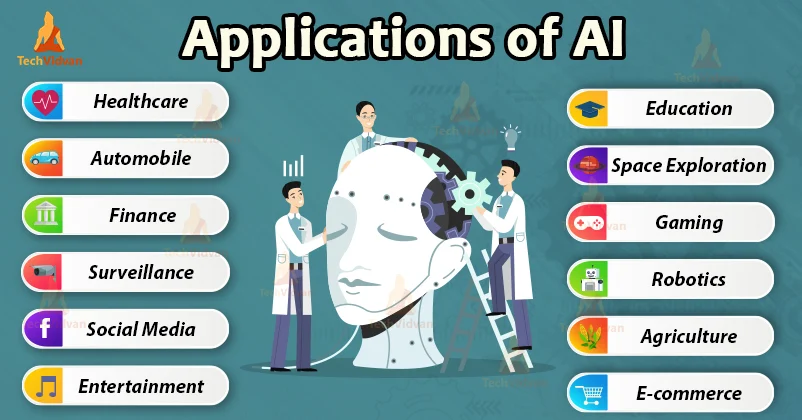
Applications of AI:
Picture Courtesy: techvidvan.com
Here are some applications of AI:
A. AI in Healthcare: IBM Watson
IBM Watson changed the face of oncology with its analysis of enormous amounts of medical data to offer personalized treatment options for cancer patients and save doctors’ hours while improving outcome results for patients.
B. AI in Retail: Amazon Go
Amazon Go stores use AI-powered cameras and sensors to enable cashier-less shopping. Customers simply pick up items, and their accounts are automatically charged, creating a seamless shopping experience.
C. AI in Finance: JP Morgan Chase
JP Morgan uses AI to analyze financial contracts, reducing hours of manual labor to mere seconds. AI also aids in fraud detection and risk management.
D. AI in Entertainment: DeepMind’s AlphaGo
DeepMind’s AI system, AlphaGo, defeated the world champion in the ancient game of Go. This marked a major milestone in AI, demonstrating its potential to solve highly complex problems.
E. AI in Environment: Google AI’s Flood Prediction
Google AI predicts devastating occurrences with accuracy so that communities might be enabled towards preparation and possible loss of lives.
Artificial Intelligence is revolutionizing industries by providing innovative solutions that enhance efficiency, decision-making, and customer experiences. Let’s explore applications of AI and its impact in key sectors:
A. AI in Healthcare:
Picture Courtesy: yourstory.com
AI in Healthcare is transforming healthcare by enabling faster diagnoses, personalized treatments, and improved patient outcomes:
Medical Imaging and Diagnostics: AI tools such as DeepMind’s healthcare algorithms scrape and find matching codes for virtual disease events like cancer or diabetic retinopathy in patients’ manifests or symptoms.
Personalized Medicine: AI helps analyze genetic makeup, medical history, and lifestyle elements, and crafts personalized treatment plans.
Virtual Health Assistants: Chatbots and virtual assistants like Babylon Health offer patients 24×7 on-call answering and primary-level diagnosis.
Drug Discovery: Drug development by AI, has the ability to comb through, analyze, and interpret massive databases, thus saving time and costs.
Robotic Surgery: The da Vinci Surgical System employs AI to carry out minimally invasive and very precise surgeries, leading to faster recovery periods.
B. AI in Finance:
Picture Courtesy: thefinancialpandora.com
The financial sector has embraced AI to enhance security, improve customer experiences, and streamline operations:
Fraud Detection: AI systems continuously watch transaction patterns to identify and prevent fraud in real time.
Algorithmic Trading: The AI trading algorithm relies on a trading signal that points to an optimal time to trade, thus maximizing profits by analyzing historical and real-time market data.
Personalized Banking: Provides account insights, reminders for bills, and tips on expenses and spending by chatbot, like Erica from Bank of America.
Risk Management: Market risks and financial crises could be predicted using AI by studying data trends and anomalies given to these financial institutions to proactively make decisions.
Credit Scoring: AI enhances the accuracy of credit risk assessments, ensuring fair and efficient lending and borrowing processes.
C. AI in Education:
Picture Courtesy: orangemantra.com
AI is revolutionizing education by making learning more accessible, personalized, and engaging:
Adapted Learning: Platforms such as DreamBox and Coursera have lessons where paces and styles are adapted so that learners have different experiences in education.
Virtual Tutors: AI-driven tools like Squirrel AI can assist students instantly, giving them explanations and more resources for better understanding.
Automated Grading: Grading platforms such as Gradescope using AI help teachers by automatically grading student work, giving them extra time to teach.
Language Learning: Apps like Duolingo deploy artificial intelligence in customizing modules, real-time feedback, and promoting interactive learning.
Education Accessibility: AI tools for speech-to-text and visual aids enable students with disabilities to enjoy the same opportunity to learn as their able-bodied peers.
D. AI in Retail:
Picture Courtesy: goodworklabs.com
AI is enhancing customer experiences and optimizing operations in the retail sector:
Personalized Shopping Experiences: AI analyzes customer data and recommends products according to the preference of the buyer such as Amazon and Sephora.
Inventory Management: AI predicts demand trends, helping retailers manage inventory levels and reduce wastage.
Customer Service Chatbots: AI reviewers give instant feedback, resolve inquiries, and further assist clients in buying goods via developing internal systems.
Visual Search: AI tools like Pinterest Lens allow users to search for products using images instead of text, making shopping more intuitive.
Dynamic Pricing: AI adjusts prices according to demand, competition, and consumer behavior.
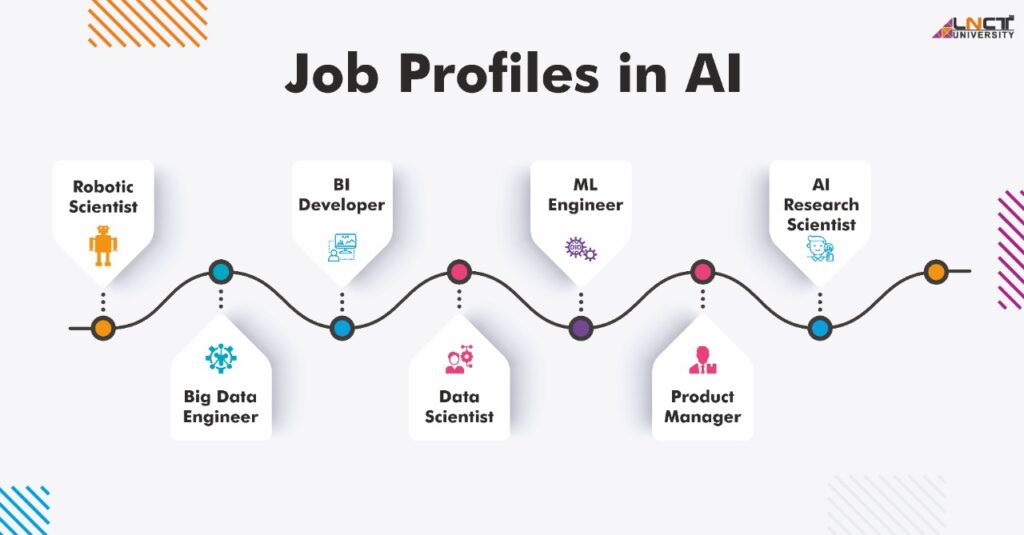
5. Artificial Intelligence Jobs and Career Opportunities:
Picture Courtesy: lnctu.ac.in
The rise of Artificial Intelligence has created a booming job market with opportunities across industries. From research and development to practical implementations, AI professionals are in high demand. Let’s delve into the key aspects of pursuing a career in AI.
A. Types of AI Jobs:
AI offers diverse roles catering to different skills and interests:
Machine Learning Engineer: Designs and builds machine learning models, requiring skills in Python, TensorFlow, and statistical analysis.
Data Scientist: Analyzes large datasets to derive insights and develop predictive models, using tools like SQL, R, and Tableau.
AI Research Scientist: Conducts advanced research to create innovative AI solutions, relying on deep learning and programming expertise.
NLP Engineer: Focuses on natural language processing to create chatbots and text analysis tools, leveraging libraries like spaCy and NLTK.
Robotics Engineer: Develops AI-driven robots for various industries, requiring knowledge in embedded systems and mechanical engineering.
AI Ethicist: Ensures responsible AI usage by addressing ethical concerns such as bias and privacy.
Computer Vision Specialist: Works on enabling machines to process and interpret visual data, utilizing image processing and convolutional neural networks.
B. Skills Required for AI Careers:
Success in AI demands a mix of technical expertise, analytical thinking, and domain-specific knowledge:
Programming Proficiency: Strong skills in Python, Java, C++, and R because they help to develop algorithms and software models for artificial intelligence.
Mathematics and Statistics: Familiarity with linear algebra and calculus, as well as some aspects of probability theory, may assist in the construction of an AI model.
Machine Learning Algorithms: Expertise in supervised, unsupervised, and reinforcement learning techniques.
Big Data Handling: Familiarity with tools like Hadoop and Spark for processing large-scale datasets.
Cloud Computing: Experience with platforms like AWS, Google Cloud, and Azure for deploying AI solutions.
Communication Skills: Good in explaining AI processes in simple terms to non-technical stakeholders.
Continuous Learning: Look up the latest AI developments, frameworks, and ethical practices.
C. How to Start a Career in AI:
Breaking into the AI field requires strategic planning and consistent effort. Here’s a step-by-step guide:
Build a Strong Foundation: Pursue a degree in computer science, data science, or a related field and take specialized AI courses.
Work on Projects: Gain practical experience by creating predictive models, chatbots, or image recognition systems.
Learn AI Tools and Frameworks: Master tools like TensorFlow, Keras, Scikit-learn, and PyTorch.
Join Online Communities: Network with AI professionals through GitHub, Reddit, and LinkedIn groups.
Seek Internships: Apply for AI-focused internships to gain hands-on industry experience.
Build a Portfolio: Showcase your AI projects on platforms like GitHub or personal websites.
Pursue Advanced Education: Consider a master’s degree or certifications like Google AI Certification or IBM AI Engineering Professional Certificate.
Stay Updated: Follow AI news, attend webinars, and engage with the AI community to keep up with trends.
6. Investing in Artificial Intelligence:
Artificial Intelligence is not only transforming industries but also offering lucrative opportunities for investors. Here’s a closer look at how to navigate AI investments effectively.
AI Stocks: The Overview
Picture Courtesy: fool.com
AI stocks refer to shares of companies that either directly develop or utilize artificial intelligence technologies. These companies could be manufacturers of AI hardware, like advanced processors and chips, or they could be software companies that build AI algorithms and platforms. Companies like Nvidia, Alphabet (Google), and Microsoft as leaders in this space, develop generic capabilities that hundreds of thousands of others can use. Firmly established players include companies such as C3.ai that focus all their efforts on AI applications.
In addition, an investor could explore ETFs dedicated to artificial intelligence. These funds could thereby give exposure to diverse companies in the industry while limiting the risk and aiming for great revenue from various applications of artificial intelligence.
An investment in AI stocks is a long-term bet as, given the fact that businesses will quickly adopt AI and automated solutions, the demand for AI technologies will also rise rapidly.
Understanding Artificial Intelligence Stock:
Artificial intelligence stocks can be categorized into two primary groups: pure-play AI companies and diversified tech giants that integrate AI into their operations.
Pure-play companies are those whose business model is entirely based on artificial intelligence technology. C3.ai, which is entirely concerned with AI software for the enterprise sectors across many industries, is one such company.
Diversified tech giants like Amazon, Apple, or IBM would not be focused as AI companies. They have considerable interest in artificial intelligence research and development.
The key considerations for an investor looking at AI stocks include the growth in revenue from AI for specific companies, investment in research and development, and competitive positioning in the AI market. The success of AI companies is often tied to their ability to innovate, keep up with technological advancements, and capitalize on the growing demand for AI applications.
AI Penny Stocks: Risks and Rewards
AI penny stocks are shares of smaller companies in the AI sector, typically trading for less than $5 per share. These stocks can be an attractive option for investors seeking high-risk, high-reward opportunities, as smaller companies in emerging sectors often have the potential for rapid growth. However, investing in AI penny stocks comes with significant risks.
Rewards: The appeal of AI penny stocks lies in their potential for explosive growth. Early-stage companies that develop innovative AI technologies can see their stock prices rise sharply as their products gain traction in the market. For investors who manage to enter these stocks early, the financial rewards can be substantial.
Risks: Penny stocks are often highly volatile, with price fluctuations that can be difficult to predict. These companies are typically less stable than their larger counterparts, which can lead to liquidity issues and larger-than-usual swings in stock prices. Additionally, penny stocks are more prone to speculative trading, which can distort the true value of the company. Investors in AI penny stocks must conduct extensive research to evaluate the viability of the company’s AI technologies, market demand, and overall financial health.
Despite the risks, AI penny stocks offer an intriguing opportunity for investors who are willing to take on higher risk in exchange for the chance to invest in promising, early-stage companies. However, careful research and diversification strategies are essential to mitigate the risks associated with penny stocks.
Picture Courtesy: nbkomputer.com
Artificial Intelligence (AI) has transformed the way we interact with technology, enabling machines to mimic human intelligence and perform tasks with remarkable precision. From streamlining processes to enhancing user experiences, AI’s applications are vast and impactful. Its ability to process large volumes of data, learn from patterns, and adapt to new inputs makes it a powerful tool for solving complex problems across various industries. Here are some of the key benefits of AI:
A. Efficiency and Automation:
On the one hand, AI automation saves businesses worldwide time and money. Repeated and mundane tasks can be automated by machine learning algorithms or robotics. AI systems manage workflow, inventory, and supply chains without human touch. Consequently, they become more productive while maintaining the highly strategic roles of human workers.
B. Enhanced Decision Making:
AI analyzes data on a greater scale and faster speed than ever before and produces actionable information for decision-making. Through processing historical and real-time data, these tools can forecast trends, identify risks, and provide recommendations aligned with business needs. This results in informed decisions, reducing the probability of errors.
C. Personalization and Customer Experience:
AI customizes interactions with customers as well as anticipates their demands. Whether through product recommendations appearing on an e-commerce website or 24/7 support provided through AI-enabled chatbots, organizations use technology to present personalized experiences to customers. It finally creates trust, loyalty, and a competitive edge in the market.
8. Artificial Intelligence Resources:
Whether you’re a beginner eager to dive into AI or a professional looking to enhance your expertise, a wealth of resources is available to help you. From books to online courses, staying updated on AI developments is essential for mastering this transformative field. Here’s a breakdown of some key AI resources:
A. Books: Artificial Intelligence: A Modern Approach
Picture Courtesy: in.pinterest.com
Artificial Intelligence: A Modern Approach is written by Stuart Russell and Peter Norvig, gives a definitive guideline to the principles and application of AI. This massive text covers every theoretical material of AI from search algorithms to what it relates with, machine learning, robotics to what it can do, and natural language processing. However, again it remains a genuine material for beginners and professionals alike in understanding both theoretical and practical aspects of AI.
B. AI News and Updates:
It is really important to keep up with the latest trends and innovations in AI. Sites like AI News, MIT Technology Review, and OpenAI Blog are good resources for keeping up with AI advancements, breakthroughs in research, and industry applications. Signing up for newsletters or following these AI influencers on sites like LinkedIn and Twitter can also keep you updated.
C. Online Courses and Certifications:
Several online platforms offer AI courses for all skill levels:
Coursera: Offers courses like “Machine Learning” by Andrew Ng, a great starting point for beginners.
edX: Features programs such as “AI for Everyone” and advanced courses like “Artificial Intelligence MicroMasters.”
Udemy: Provides a wide range of AI courses, from beginner-friendly to advanced deep learning tutorials.
Google AI and TensorFlow: Free resources and courses for understanding machine learning and building AI applications.
Completing these certifications can boost your understanding of AI concepts and enhance your career prospects in the field.
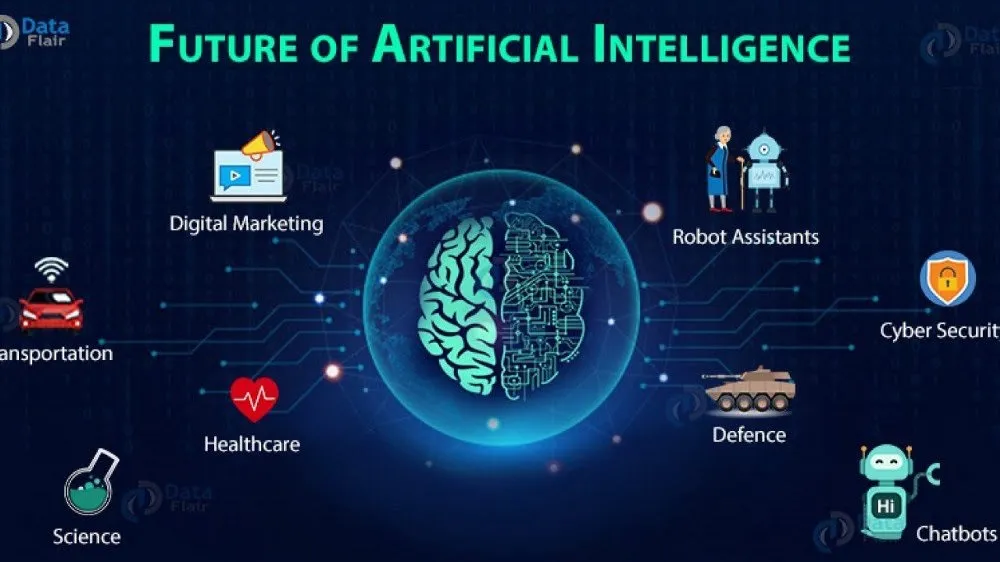
9. Conclusion and Future of Artificial Intelligence:
Picture Courtesy: aiecommerce.com
Artificial Intelligence (AI) is no longer just a futuristic concept—it’s a transformative force shaping industries, economies, and daily life. From improving efficiency and decision-making to revolutionizing customer experiences, AI has proven its value across diverse domains. As AI continues to evolve, it will unlock new possibilities, addressing challenges in healthcare, education, transportation, and beyond. However, with its potential comes the need for ethical considerations, transparency, and robust frameworks to guide its development and implementation.
Future of AI: What Lies Ahead?
Let’s see what lies ahead in the future of AI:
A. Enhanced Human-AI Collaboration:
The future will see AI acting as a complementary partner to humans, amplifying our capabilities rather than replacing us. From AI-powered tools that assist in creative processes to robotic systems that support physically demanding tasks, collaboration will redefine work and productivity.
B. AI in Healthcare:
AI is set to revolutionize healthcare through personalized medicine, predictive analytics, and advanced diagnostics. Technologies like AI-driven drug discovery and robotic surgery will become more widespread, improving patient outcomes and accessibility.
C. Autonomous Systems and Smart Cities:
The rise of autonomous vehicles, drones, and smart infrastructure will redefine urban living. AI will play a pivotal role in reducing traffic congestion, optimizing energy consumption, and ensuring public safety in smart cities worldwide.
D. AI and Education:
Education will be transformed by AI through adaptive learning platforms, personalized curriculums, and virtual tutors. These innovations will make learning more accessible, efficient, and tailored to individual needs, bridging educational gaps globally.
E. Ethical AI and Regulation:
As AI becomes more integrated into society, there will be a stronger focus on developing ethical AI systems. Governments and organizations will work to establish guidelines ensuring fairness, accountability, and transparency in AI applications.
F. Quantum AI:
The integration of AI with quantum computing holds immense potential for solving problems currently beyond the scope of traditional computing. From complex simulations to advancements in cryptography, Quantum AI could lead to groundbreaking discoveries.
G. AI-Driven Sustainability:
AI will be instrumental in tackling global challenges like climate change, resource management, and biodiversity conservation. By analyzing environmental data, AI can help create sustainable solutions, monitor ecosystems, and predict natural disasters.
A World of Possibilities:
The future of AI is as exciting as it is unpredictable. While we continue to innovate and leverage AI’s potential, it’s equally important to address challenges such as data privacy, algorithmic bias, and job displacement. By fostering collaboration between researchers, policymakers, and industry leaders, we can ensure AI is developed responsibly and inclusively. The next frontier of AI will be defined by how effectively we balance its immense potential with its inherent responsibilities, creating a future where technology truly benefits humanity.
AI holds the promise of reshaping our world, making it smarter, more efficient, and interconnected. However, as we embrace its potential, we must also navigate challenges like ethical use, data privacy, and societal impact. The future of AI depends on how responsibly we innovate and integrate it into our lives.
What’s your take on AI? Do you see it as a tool for progress, or do you have concerns about its rapid growth? Share your thoughts in the comments below!
For more insights and updates on Metaverse, DeFi, Blockchain, NFT & Web3, be sure to subscribe to our newsletter. Stay informed on the latest trends and developments in the decentralized world!
Published: December 27, 2024 at 8:19 am Updated: December 27, 2024 at 8:19 am
To improve your local-language experience, sometimes we employ an auto-translation plugin. Please note auto-translation may not be accurate, so read original article for precise information.
The cryptocurrency boom has seen many individuals benefitting from its initial adoption stage, and here we have a few DOGE holders who profited a lot from its past cycles. These investors are now shifting their focus to Rexas Finance (RXS), a new token with tremendous growth potential. With an introductory price of $0.150 in its presale, the native token RXS plans to change the approach of the blockchain industry with the enhancement of real-world asset tokenization. With estimates suggesting a possible 24,039% return on investment for RXS, it is becoming a crucial consideration for everyone looking for high returns this cycle.
Rexas Finance (RXS): Redefining Investment Through Real-World Asset Tokenization
Rexas Finance is venturing into uncharted territories in the blockchain space by tokenizing real world assets. Most cryptocurrencies are based solely on speculation. Conversely, Rexas creates use cases and appeals to practical investors interested in using the blockchain. Tokenization of real-world assets includes the process of buying, selling, and trading real estate, an expensive piece of art, or even a patent on a blockchain. This encourages high-value assets to be further expanded because it allows partial ownership. For example, RXS tokens would allow individuals to buy and trade fractional shares and offer an affordable alternative to many valuable markets. Rexas Finance further launches platforms such as Rexas Estate, which allows users to trade tokenized Real Estate. Rexas GenAI allows the creation of high-quality NFTs through AI. These make investors liquid, allow them to earn passive income, and meet investors of all classes. With the growing use of blockchain technology worldwide, RXS’s utility and use-based nature have positioned it as a leader in asset tokenization.
Presale Success and a Strong Foundation for Growth
As one can see from the Rexas Finance token presale, it has been a great success and has recorded huge investment volumes. From the beginning of the project, starting September 2024, this project has been going above the expected levels, whereby the token price inflates from $0.030 in stage 1 to $0.150 in stage 10. Out of a total of 380 million tokens, so far, 374 million tokens have been sold, raising over $32.3 million. So, investors have a great sense of trust regarding this project’s vision and potential. Only a small portion of the presale allocation is left, making it the best time to buy RXS at the current price. With the end of stage ten approaching, it had been forecasted that the price would increase to $0.175 and eventually significantly higher once listed on major exchanges. The listing price would be $0.20, but the token’s growing popularity was bound to grow faster in the market, bringing more significant gains.
RXS’s most significant selling point is its insane upside potential, especially for DOGE holders. Dogecoins have offered impressive returns, but their use case is still minimal. RXS encapsulates realistic use cases with good market potential and is thus ideal for individuals aiming to broaden their asset portfolios and make life-altering profits.
The Power of Security and Community Engagement
What undoubtedly stands out about Rexas Finance is its continual concern for security. Due to the risks arising from its deployed active smart contracts, the project was certified and verified by CertiK, a high-end blockchain security company. Such certification confirms that the undertaking operates according to the most stringent safety and transparency criteria, thus assuring potential investors of the platform’s reliability. Rexas Finance also considers active participation in community activities to be one of the key tools for achieving organizational growth. The project has initiated a $1 million giveaway and hopes that most of its users will participate actively in the competition. This initiative rewards the top 20 lucky users with 50 RXS tokens each. Thus making the investors feel a sense of commitment to the project. Such efforts reinforce the project’s community and marketing in the market, making it quite a strong player in the crowded crypto space.
Conclusion: The Next Big Opportunity Awaits
The cryptocurrency market offers countless opportunities, but few projects have the potential to deliver the kind of returns that Rexas Finance promises. With its innovative approach to real-world asset tokenization, presale success, and commitment to security, RXS is poised to become a game-changer in the blockchain industry. For Dogecoin holders and other investors seeking the next big opportunity, RXS represents a unique chance to achieve extraordinary profits. Priced at $0.150 and backed by a robust ecosystem, this token has all the ingredients for success in the upcoming market cycle.
For more information about Rexas Finance (RXS) visit the links below:
In line with the Trust Project guidelines, please note that the information provided on this page is not intended to be and should not be interpreted as legal, tax, investment, financial, or any other form of advice. It is important to only invest what you can afford to lose and to seek independent financial advice if you have any doubts. For further information, we suggest referring to the terms and conditions as well as the help and support pages provided by the issuer or advertiser. MetaversePost is committed to accurate, unbiased reporting, but market conditions are subject to change without notice.
About The Author
Gregory, a digital nomad hailing from Poland, is not only a financial analyst but also a valuable contributor to various online magazines. With a wealth of experience in the financial industry, his insights and expertise have earned him recognition in numerous publications. Utilising his spare time effectively, Gregory is currently dedicated to writing a book about cryptocurrency and blockchain.
More articles
Gregory, a digital nomad hailing from Poland, is not only a financial analyst but also a valuable contributor to various online magazines. With a wealth of experience in the financial industry, his insights and expertise have earned him recognition in numerous publications. Utilising his spare time effectively, Gregory is currently dedicated to writing a book about cryptocurrency and blockchain.
Published: December 27, 2024 at 8:07 am Updated: December 27, 2024 at 8:07 am
To improve your local-language experience, sometimes we employ an auto-translation plugin. Please note auto-translation may not be accurate, so read original article for precise information.
The iGaming industry has hit a transformative milestone in 2024, powered by Web3 technologies such as blockchain, cryptocurrency, and decentralized finance. These advancements are delivering unparalleled transparency, instant transactions, and secure gameplay while reimagining the traditional online gaming experience. With innovations in AI, immersive gaming, and tokenized ecosystems, the sector is poised for further exponential growth in 2025.
Here’s a look at the standout Web3 iGaming platforms leading the charge this year, showcasing how technology and user-centric design are reshaping the global iGaming landscape.
1. Bitcasino.io
A Pioneer in Crypto iGaming
For nearly a decade, Bitcasino.io has led the way in crypto igaming with a player-focused approach and rapid withdrawals averaging just 1.5 minutes. Offering over 6,000 slots and table games from renowned providers, alongside unique selections like Live88 and custom Bitcasino titles. Its VIP program blends global events with day-to-day premium service, while a pioneering loyalty scheme grants exclusive privileges, cashback, and free spins.
With innovative promotions such as the Bitcoin Predictor and the Casino Boost, Bitcasino continues to refine the premium crypto gaming experience, offering high standards in fairness, transparency, and consistent responsible gaming.
2. TG.Casino
The Future of Telegram-Driven iGamingTG.Casino has revolutionized accessibility by offering a fully integrated gaming experience directly through Telegram. This unique approach eliminates the need for additional apps, streamlining user interaction. Boasting a robust selection of over 350 casino games and 30 sports betting markets, TG.Casino is a rising star in 2024.
The platform supports instant crypto transactions and provides substantial bonuses, including a welcome offer of up to 10 ETH. TG.Casino has also leveraged its community-driven model to foster player engagement, solidifying its position as a key innovator in the Web3 iGaming space.
3. Lucky Block
Expanding Horizons with a Rich Gaming LibraryKnown for its extensive gaming portfolio, Lucky Block is a top choice for players seeking variety and accessibility. With over 5,000 games, including slots, live dealers, and table games, the platform offers something for everyone. In 2024, Lucky Block introduced a revamped rewards program, featuring a 200% welcome bonus and free spins, making it one of the most enticing platforms for new users.
Its seamless support for multiple cryptocurrencies ensures fast and hassle-free transactions. Lucky Block’s commitment to user-friendly design and high-quality gameplay continues to make it a standout in the Web3 iGaming sector.
4. BC.Game
Community-Driven ExcellenceBC.Game has built a reputation for its vibrant community and innovative features. In 2024, the platform introduced localized games and interfaces tailored to emerging markets, further cementing its global appeal.
What truly sets BC.Game apart is its gamified ecosystem, where players earn rewards by participating in community forums, challenges, and leaderboards. Supporting over 100 cryptocurrencies, BC.Game exemplifies accessibility and inclusivity, making it a key player in the Web3 gaming revolution.
5. Metaspins
Where Web3 and Gaming ConvergeMetaspins is a prime example of how Web3 integration can elevate the iGaming experience. Featuring a diverse array of Ethereum-based games, the platform is designed for crypto enthusiasts seeking innovation and fairness.
With a robust VIP program, seamless crypto transactions, and a library of over 2,500 games, Metaspins has become a favorite among tech-savvy players. The platform’s dedication to transparency and user engagement underscores its reputation as a leader in the decentralized gaming space.
Looking Ahead to 2025
The Web3 iGaming platforms of 2024 are redefining the industry by seamlessly blending blockchain technology with user-centric design. With enhanced security, instant payouts, and innovative engagement models, these platforms are setting the stage for the future. As the industry evolves, expect to see deeper integrations of AI, decentralized finance, and immersive gaming experiences that will further revolutionize how players engage with iGaming platforms globally.
Disclaimer
In line with the Trust Project guidelines, please note that the information provided on this page is not intended to be and should not be interpreted as legal, tax, investment, financial, or any other form of advice. It is important to only invest what you can afford to lose and to seek independent financial advice if you have any doubts. For further information, we suggest referring to the terms and conditions as well as the help and support pages provided by the issuer or advertiser. MetaversePost is committed to accurate, unbiased reporting, but market conditions are subject to change without notice.
About The Author
Gregory, a digital nomad hailing from Poland, is not only a financial analyst but also a valuable contributor to various online magazines. With a wealth of experience in the financial industry, his insights and expertise have earned him recognition in numerous publications. Utilising his spare time effectively, Gregory is currently dedicated to writing a book about cryptocurrency and blockchain.
More articles
Gregory, a digital nomad hailing from Poland, is not only a financial analyst but also a valuable contributor to various online magazines. With a wealth of experience in the financial industry, his insights and expertise have earned him recognition in numerous publications. Utilising his spare time effectively, Gregory is currently dedicated to writing a book about cryptocurrency and blockchain.