The release of Football Manager 25 has been postponed from its initial November 26, 2024, launch date to March 2025, marking a significant shift in the franchise’s history. Sports Interactive (SI), the developer, cited challenges in the game’s development as the primary reason for the delay. This postponement is the first time in nearly two decades that the series will not meet its traditional fall release window, which typically coincides with the start of the European football season.
The decision to delay the game emerged from the team’s ongoing struggle to adapt the game to the new Unity engine. SI acknowledged that despite efforts to meet deadlines, rushing to release the game could compromise the quality and expectations fans have come to associate with the franchise. This installment is touted as the most ambitious in the series, promising both technical and visual advancements that require more time to refine.
While many fans expressed frustration over the delay, SI explained that releasing the game prematurely could result in a product that falls short of expectations. The new March launch, though later in the football season, aims to ensure the highest quality experience for players. SI also confirmed that those who pre-ordered the game are eligible for refunds and assured players that an “Advanced Access” period would be provided before the official release date, with a gameplay reveal planned for January 2025.
This delay raises concerns about whether the game will remain relevant given the short window before the end of the football season. Some fans have even suggested skipping Football Manager 25 entirely and focusing on the next iteration. However, the developers remain committed to delivering a product worthy of the franchise’s legacy, underscoring their dedication to maintaining the series’ high standards despite the setbacks.
Meetings after meetings, they can’t seem to take a break and are always pushing themselves to be the best. They need a bag that can keep up with their lifestyle, a solid and chic companion that can accompany them to meetings carrying all work-essentials. At couture we have Tote bags, cross bodies, and backpacks that fit that description.
They are driven by the need to explore different places, see everything for themselves, and live the thrill of traveling into the unknown. What they need is a solid, practical, good-quality travel companion with a bit of style to accompany them across the world.
Travel & Luggage
@coutureusa Travel in style! Shop Louis Vuitton luggage with the link in our bio. . #louisvuitton #lv #luggage #travel #traveltiktok #traveltok #fashion #fashiontiktok #fashioninspo #fashiontok #designer #designerbags #luggage #luxury #luxurylife #shop #shopping #shoppinghaul #shopsmall #shoplocal #onlineshopping #onlinebusiness #tampa #tampabay #tampaflorida #fy #fypage #fypシ゚viral #foryou #foryoupage ♬ Eyes Like Blue Skies (Instrumental) – SoulChef
“In order to be irreplaceable, one must always be different” Coco Chanel
For those who dare to test the limits set by society, who want to express their true selves and are not afraid of doing it. Wear colorful and unique shaped products that will ensure you stand out in the crowd.
Always looking for the latest collections, trends, and designs, the fashion expert knows what is happening in the fashion world. They can’t be cheated or beaten when it comes to fashion advice. At Couture we have current products still in vogue with the fashion trends.
This is for those who feel they were born too late or dream of what it used to be. We say fashion is a cycle that keeps returning, but it can never be the same. Vintage pieces have a story and comfort us, knowing that some things are timeless and that despite the change happening around us, some things will always stay the same.
“Elegance is not about being noticed; it is about being remembered.” – Giorgio Armani.
Icons like Audrey Hepburn, Marilyn Monroe, and Grace Kelly perfectly exemplify this timeless quality. Their elegance goes beyond fashion, representing a way of life that shines through their grace, poise, and lasting influence. Elegance is more than what you wear, it’s how you live. We have a large selection of bags that represents elegance, among them is the classic Chanel Flap Bag, the Capucine from Louis Vuitton and our Diamond jewelry selection.
The Dragon Ball Budokai Tenkaichi series hasn’t seen the light of day since the PlayStation 2 was in its heyday, back in 2007 when the third entry launched. A lot has changed in the time that has passed, in both the real world and the Dragon Ball universe, but now it’s finally ready to be resurrected using modern gaming technology and harnessing the power of next-gen consoles.
Can the fourth instalment, Dragon Ball: Sparking! Zero, take the franchise to a whole new level and deliver a delightfully destructive fighter?
Dragon Ball is back with Sparking! Zero
Dragon Ball: Sparking! Zero is a 3D arena fighter, meaning you have the freedom to battle across vast settings that span great distances. And not just in a horizontal sense, for there is also plenty of verticality to provide even more scope to fight within. The iconic locations are filled with breakable environmental structures too. After all, you’re not working with average combatants here – these are super powerful Z-Fighters bringing special skills and ultimate destruction everywhere they go.
There’s a quick tutorial to run through the absolute basics, however it barely scratches the surface on the depth to the gameplay mechanics. That’s why developers Spike Chunsoft have included a Super Training mode, where Battle Training breaks everything down into byte-sized lessons to tackle at your leisure. These lessons cover everything from evasive manoeuvres and Ki blasts, to rush combo chains and advanced techniques. I’d give it an ‘A’ for effort, but a ‘D’ for execution, because the menus are so clunky and it’s rather boring. Whether anything sticks with you via such a method will vary by person.
Throwing a few kicks or punches, sending simple Ki blasts, activating skills, and performing awesome looking Super Attacks, should be straightforward enough to pull off. However, accurately blasting the opponent with Ki-based super moves, chaining attacks together through rapid dashing, countering or blocking incoming attacks effectively, and making the most of Sparking Mode takes a little while to get to grips with. The Sparking Mode is especially cool as it enhances your combos and, most importantly, opens up a character’s Ultimate Blasts.
Other interesting features of the gameplay, of those that are newly added, include the Skill Count and the Revenge Counter. The Skill Count increases with every move you instigate and this is crucial for activating transformations, fusions, and the aforementioned Sparking Mode. It’s additionally handy for the Revenge Counters, which see you bring an opponent’s flurry to an abrupt end.
Easy to pick up, hard to master…
On the whole, Dragon Ball: Sparking! Zero is definitely a case of easy-ish to pick up, but hard to master. Putting it all together – if you can – on the battlefield creates a rather frantic, yet brilliant, spectacle to partake in. The pace is absolutely in keeping with the nature of Dragon Ball fights in the anime and the on-screen effects really convey the destructive action. Every battle feels different and requires a strategic approach, which is something that’s instantly apparent in the story-focused Episode Battle mode.
In Episode Battle mode, you’ll delve into some of the greatest and most memorable arcs of the Dragon Ball anime. There are eight different Sagas, each focusing on a particular character including Frieza, Gohan, Jiren, and Vegeta. Obviously there’s a Goku Saga too, and while you must begin here, you’re not restricted from jumping into the others which unlock fairly swiftly. There are also opportunities to make decisions and do things that trigger alternative paths, like ‘What If?’ scenarios, to witness confrontations that could have been. It’s a nice touch for those who have seen it all a hundred times before in other Dragon Ball games.
Nevertheless, even as someone who has rewatched Dragon Ball Z on repeat for years as a kid, it’s a total nostalgia-fuelled experience. The narratives are told in between battles using a mixture of stills and wonderful animated scenes featuring top drawer voiceovers. The potential downside is how rushed the storytelling is and the gaps within it probably won’t do justice to the epic arcs for newcomers to the franchise. The battles themselves might result in a mass exodus of players from Sparking! Zero, if indeed they dare to give them a go at all.
The Sagas are pretty brutal in regards to difficulty, with almost universal agreement already from the Sparking! Zero community that one of the early encounters, where Goku faces Great Ape Vegeta, is stupidly hellish. I have no shame in admitting that even before meeting the behemoth I took beatings from Raditz. Forget Goku, I thought I had control of Mr Satan instead. It was so one-sided and although lowering the difficulty is an option, that doesn’t make an awful lot of difference.
Plenty to involve yourself in
You see, in Episode Battle, the AI is smart and relentless, but there’s always a specific approach to figure out. There’s not really a cookie cutter formula for success, except knowing the mechanics and then reacting to your opponent. It’s incredibly rewarding to overcome each and every battle, whilst you’ll also feel as though you’ve actually gone to war just like the characters did.
Outside of the episodes, you can also attempt to overcome a selection of pre-made scenarios in Bonus Battles. While these aren’t necessarily as exciting as the Sagas, the win conditions and character variety ensures a decent level of enjoyment. There’s an option to create similar battles yourself, and have a bash at those crafted by the imagination of other players. Unfortunately, you’ll either be underwhelmed by the simple editing route, or be overwhelmed by the more in-depth setup.
If you just want a casual fight, then you’re better off trying the regular Battle and World Tournament offerings found in Dragon Ball: Sparking! Zero. It’s actually the best place to start, whether you want a one on one, team battle, or fancy recreating a tournament like Cell Games. Aside from being able to beat up your buddies locally, the more forgiving AI eases you in and proves to be enough of a test while you get comfortable with the mechanics. Another benefit is the fact you can have a go with a multitude of different characters, which increases proficiency, helps complete a myriad of challenges, and earns plenty of in-game currency, Zeni.
What’s pretty cool is that you can use the likes of Goku here in order to master his techniques and garner currency to purchase ability capsules. These abilities can then be equipped, boosting blast attack power, prolonging Sparking Mode, increasing health, and such. Thus, you’re better prepared to attempt the episodes again because the ability items carryover.
The Battle and World Tournament modes are also available as online prospects if you are confident enough to take on Z-Fighters across the world. For the most part, it’s relatively quick to find a match and upon doing so, the connectivity holds up well to ensure the high octane action isn’t hindered. There are few slouches online however, with competent opponents waiting in Player and Ranked options. I’ll happily keep training against the bots, but the opportunity is definitely there to test your skills.
Full of Dragon Ball goodness
And then there’s the roster, comprised of over 180 playable characters. Now, much like the bloated rosters of the WWE 2K games, with multiple John Cenas turning up, Sparking! Zero has a fair few variations of Goku, Gohan and Vegeta. It’s not necessarily a bad thing though, because they have different loadouts and skins for each. Furthermore, the roster is stacked with everyone from Golden Frieza and the Ginyu Force, to Kale and Spopovich. Essentially, if you want to play as anyone from Dragon Ball Z, GT, or Super, they’re most likely present.
Having so many playable characters to choose from certainly keeps the action fresh for a long, long time. Simply giving each one a run out and going through their arsenal of moves will occupy you for a while, plus it’s great to watch the animated manoeuvres. Working your way through the roster in such a manner is strangely satisfying, especially when you can perform the likes of the Spirit Bomb, the Special Beam Cannon and the Omega Blaster.
Dragon Ball: Sparking! Zero is undeniably a great 3D fighter that’s geared up to pander to fans in the best way. The impressive visuals, the nostalgia-fuelled Episodes, the humongous roster of characters, and the exciting action are praiseworthy. The only major sticking point is the steep learning curve and the potentially off-putting difficulty spikes that hit you from the outset. There’s also a worry that those unfamiliar with the classic encounters won’t gain much from the streamlined story arcs.
If you love Dragon Ball and fancy a challenge, then Dragon Ball: Sparking! Zero should definitely be on your wish list.
DRAGON BALL: Sparking! ZERO Ignites a New Era of Explosive Battles – https://www.thexboxhub.com/dragon-ball-sparking-zero-ignites-a-new-era-of-explosive-battles/
Buy Sparking! ZERO from the Xbox Store – https://www.xbox.com/en-GB/games/store/dragon-ball-sparking-zero/9N7XMJJHNFC3/0010
Published: October 16, 2024 at 10:00 am Updated: October 16, 2024 at 9:15 am
by Ana
Edited and fact-checked:
October 16, 2024 at 10:00 am
To improve your local-language experience, sometimes we employ an auto-translation plugin. Please note auto-translation may not be accurate, so read original article for precise information.
In Brief
Gaia and Vana’s partnership aims to create a diverse, egalitarian, and privacy-aware AI environment, enabling developers and users to design, manage, and profit from AI models.
The partnership between Gaia and Vana paves the way for an AI environment that is more diverse, egalitarian, and privacy-aware. This cooperation is redefining the connection between AI, data, and user ownership by enabling developers and users to design, manage, and profit from AI models using open and collaborative frameworks.
Decentralization and Open-Source Frameworks
Gaia has advocated for decentralized AI systems for a long time. With its open-source platform, developers may design and implement AI agents without being constrained by centralized control. In the past, big, centralized companies with access to enormous datasets have developed and maintained AI systems. This gives rise to concerns over data ownership, privacy, and unequal distribution of AI’s advantages.
Vana’s contribution to this collaboration enhances Gaia’s decentralization initiatives by incorporating user data in a way that upholds privacy and ownership. Users may contribute data to Vana’s distributed network, maintain control over its usage, and even make money off of it. This stands in sharp contrast to traditional approaches, where consumers’ data is frequently gathered without their knowledge or consent and utilized for uncontrollable objectives.
Providing User-Owned Data to Developers
Developers are no longer dependent on huge, centralized data sources thanks to user-contributed data. Alternatively, they can use private datasets from those who own and control the data using Vana’s network to train and implement AI agents. This creates opportunities for creating highly customized and specialized AI agents that fit the unique requirements and tastes of users.
Additionally, this method promotes the development of AI in a more moral manner. The collaboration guarantees the protection of people’s rights and privacy by empowering users to own and manage their data. In addition to being more individualized, developers may create AI models that respect user permission and data security. This lessens the possibility of personal data being exploited and misused by fostering a more open interaction between AI developers and data producers.
Converting Data into Useful AI Resources
The conversion of user-contributed data into useful digital assets is one of the most important results of the Gaia-Vana collaboration. Data is now an active and liquid asset that users can manage, control, and even profit from thanks to this partnership, rather than only being a passive resource gathered for business purposes.
These user-owned datasets may now be used to fuel AI agents created on Gaia’s platform. It gives them more intelligence as well as contextual awareness and relevance. For example, user-contributed data that is unique to each person’s situation may be used to fine-tune AI models intended to provide personalized services, like financial planning or healthcare advise. As a result, a new class of AI agents is produced that are closely linked to the user’s personal information and expertise, providing more accurate and useful insights.
A more incentive-driven AI environment, as envisioned by Gaia and Vana, is likewise compatible with the capacity to transform data into a monetizable commodity. Users may now be paid for the value their data adds to AI systems, making them active participants rather than passive providers.
Control, Ownership, and Privacy in the Development of AI
Respecting user privacy and data ownership is one of the main issues facing AI development today. Large volumes of user data are frequently collected by centralized AI systems, raising worries about data abuse, privacy violations, and a loss of control over personal data. Gaia and Vana’s collaboration tackles these problems head-on by offering a decentralized platform that gives people authority over their data.
Vana’s distributed data network gives consumers non-custodial control over their data. In this way, customers have complete control over their data, even when it is being used to train AI models. They have control over the usage, access, and monetization of their data. This method helps create sophisticated AI systems while guaranteeing that user data security and privacy are given top priority.
On the other hand, Gaia’s AI infrastructure is made to work in unison with Vana’s data governance tools, allowing for the development of AI agents that provide insightful, useful information while protecting user privacy.
Encouraging User Input into AI Networks
The Gaia-Vana alliance is based on an economic strategy that focuses on providing incentives for people to provide their data. Users frequently have little to no control over how their data is utilized in traditional AI systems, and they are not paid for the value that their data produces. Widespread worries over the morality of data collecting and the disparity in power between data suppliers and AI developers have resulted from this.
In order to allay these worries, Gaia and Vana are working to create a new, more just economic framework for AI research. Users are encouraged to provide their data under this approach by offering them direct payment or other benefits in exchange. In addition to guaranteeing that users receive just compensation for their efforts, this promotes a more cooperative approach to AI research, allowing for a wider distribution of the advantages of AI.
The foundation for a new generation of AI agents based on the values of equity, openness, and user empowerment is being laid by Gaia and Vana using this incentive-aligned paradigm. The collaboration seeks to establish a more inclusive AI ecosystem that benefits all players, not just a chosen few, by enabling users to take an active role in AI networks.
Building a Developer-Centric Future
In addition to empowering consumers, the Gaia-Vana alliance aims to enable developers to create the upcoming wave of AI apps. Gaia and Vana are enabling developers to construct more intelligent, context-aware, and customized AI agents by making user-contributed data accessible.
The modular and adaptable architecture of Gaia’s decentralized AI platform enables developers to create unique AI solutions that can easily interface with a variety of data sources and knowledge bases. Developers may access user-owned datasets that are customized for certain use cases thanks to Vana’s distributed data network, which offers an additional degree of customization.
Gaia and Vana are also funding other community projects to help developers create these new AI applications. This includes developer gatherings, virtual hackathons, and instructional materials meant to provide developers with practical experience with the merged technology. Gaia and Vana want to promote the use of decentralized AI and establish a flourishing ecosystem of AI-powered apps that benefit consumers and developers alike by cultivating a worldwide community of AI developers.
Disclaimer
In line with the Trust Project guidelines, please note that the information provided on this page is not intended to be and should not be interpreted as legal, tax, investment, financial, or any other form of advice. It is important to only invest what you can afford to lose and to seek independent financial advice if you have any doubts. For further information, we suggest referring to the terms and conditions as well as the help and support pages provided by the issuer or advertiser. MetaversePost is committed to accurate, unbiased reporting, but market conditions are subject to change without notice.
About The Author
Victoria is a writer on a variety of technology topics including Web3.0, AI and cryptocurrencies. Her extensive experience allows her to write insightful articles for the wider audience.
More articles
Victoria d’Este
Victoria is a writer on a variety of technology topics including Web3.0, AI and cryptocurrencies. Her extensive experience allows her to write insightful articles for the wider audience.
In the world of investing, the choices can be overwhelming. Have you ever wondered how could you invest in the future of technology without picking individual stocks? There comes Blockchain ETFs. Blockchain ETFs are making this possible, offering everyday investors like you a chance to tap into this groundbreaking technology with ease. Unlike traditional mutual funds that might focus on a broad range of assets, Blockchain ETFs specifically target companies involved in blockchain technology.
What is Blockchain ETF?
A Blockchain ETF (Exchange-Traded Fund) is a type of investment fund that is traded on stock exchanges. They will invest solely in blockchain-based companies.
Unlike traditional companies, a Blockchain ETF helps to track the performance of companies.
They offer a more diversified exposure to the broader blockchain industry across sectors like finance, supply chain management, and healthcare as the technology is changing. Blockchain ETFs allow you to gain experience and exposure in the blockchain industry, whereas you do not have to invest directly in cryptocurrency or companies. Instead, they invest in various companies that are likely to benefit from blockchain technology.
But before we explore Blockchain ETF, we need to understand what exactly ETF is. Why should we use ETFs?
What is ETF?
Source: hxeetdrjg.blob.core.windows.net
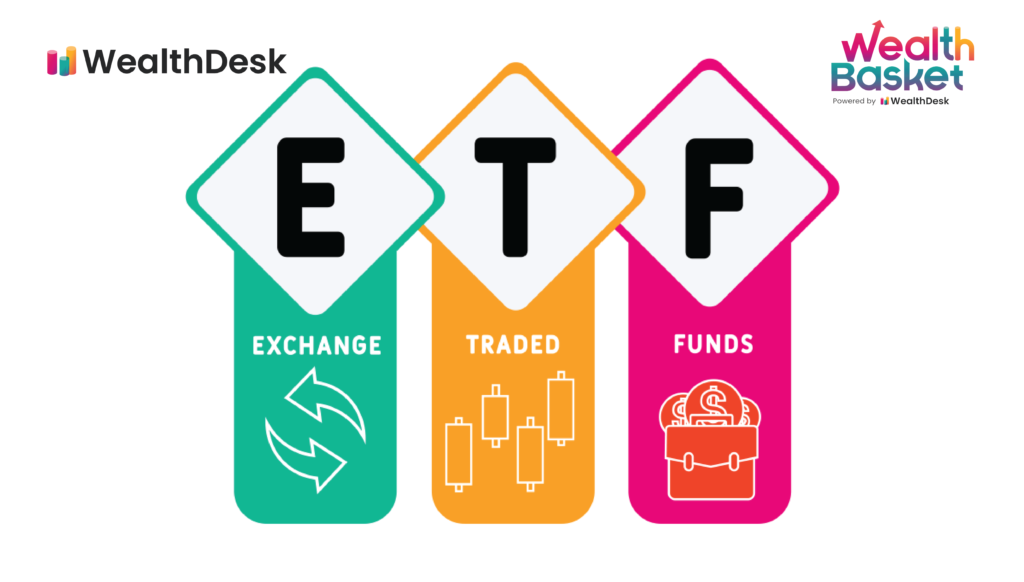
ETF stands for Exchange-Traded Fund. ETF is a type of investment fund that is traded with the exchange of stocks. They track the performance of a specific index, sector, or asset. They pool together money from multiple investors to invest in a diverse sector of assets, such as stocks, bonds, commodities, etc.
Both individual and institutional investors can invest in a wide range of assets through a single product.
ETF minimizes capital gains distribution. That’s why they are tax efficient than mutual funds.
Also, ETFs are affordable for investors because they have a lower expense and fee ratio.
Now, how will we benefit through Blockchain ETF? Why should we put our faith in ETFs instead of mutual funds?
Benefits of Investing in Blockchain ETFs:
1. Diversity:
When you invest in one company, the risk is higher. Because if the company doesn’t do well in the stock market, you will be at a loss. But in the case of Blockchain ETFs, your money is spread across many companies, so if one doesn’t give you any profit, the others might still perform well.
2. Lower Risk compared to Direct Crypto Investment:
Cryptocurrency can be extremely volatile. One day, the price is rising, another day it is falling quickly. Blockchain ETF spreads your investment to various companies, making it less risky than putting your money into one cryptocurrency.
3. Management:
There are professional people in the blockchain ETFs, who carefully select the companies to include. These experts do the research and make decisions on your behalf. They will ensure that you will get the maximum returns while minimizing the risks.
4. Exposure:
Blockchain is an innovation in the tech industry, and it has been growing rapidly. Currently, blockchain is spreading into various industries like finance, healthcare, and supply chain management. If you invest in Blockchain ETFs, you will get that cutting-edge technological exposure without needing to understand all the technological details.
5. Flexibility:
As you know, Blockchain ETFs are traded on stock exchanges. It means that you can buy and sell them throughout the trading day at the market prices. If you need money, it gives you the flexibility to access it quickly, unlike some investment funds that lock your money in for a longer period. Most ETFs disclose their holdings daily. It allows investors to see exactly what assets the fund owns. This transparency helps investors make informed decisions.
Therefore, risks come along with the benefits. We have to get an alert of them.
Risk of Investing Blockchain ETFs:
1. Volatility:
Though Blockchain is a great innovation, but it is still new and rapidly changing. That means the price rate of the blockchain ETF can go up and down a lot. So, in a short period of time the value of an investment can fluctuates widely.
2. Regulatory Risks:
Governments are figuring out how to regulate this new technology and sudden changes in regulations could negatively impact the blockchain companies in your ETF.
3. Technological Risks:
Though Blockchain has opened so many doors for earning, still it is a complex technology. It is evolving. Many companies might struggle to keep up with technological advancements or might invest in blockchain projects that won’t work out as planned.
4. Market Risks:
The performance of Blockchain ETF depends on the overall market. If the stock market or the technological sector is going through a downfall, the value of your Blockchain ETF could decrease, even if the market itself is still promising.
5. Focused:
Although Blockchain ETFs offer diversity within the blockchain sector. They are still focused on a particular industry. If the blockchain sector faces challenges, your investment could suffer, as it is not spread across different sectors.
Leading Blockchain ETFs in the Market:
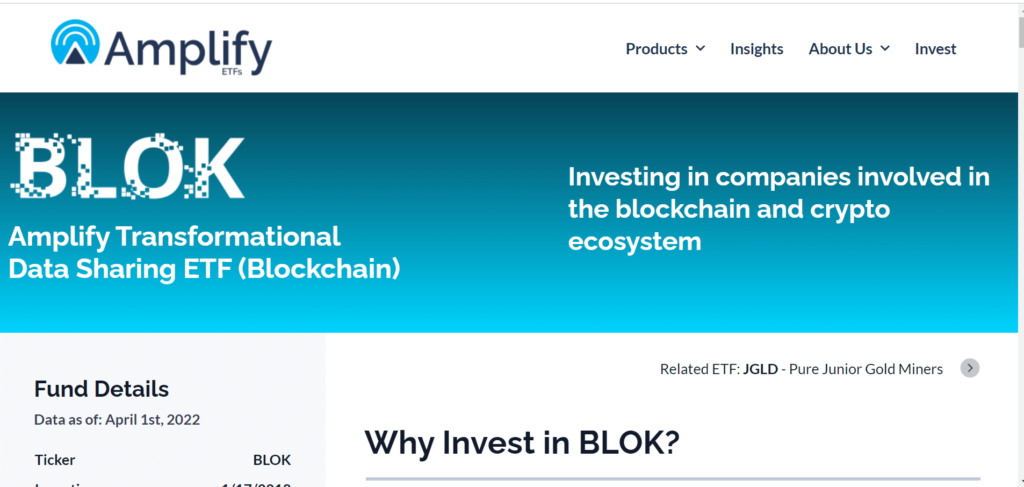
1. Amplify Transformational Data Sharing ETF (BLOK):
BLOK is one of the popular Blockchain ETFs, actively managed to invest in blockchain companies. It has the exposure of both high-cap and low-cap companies.
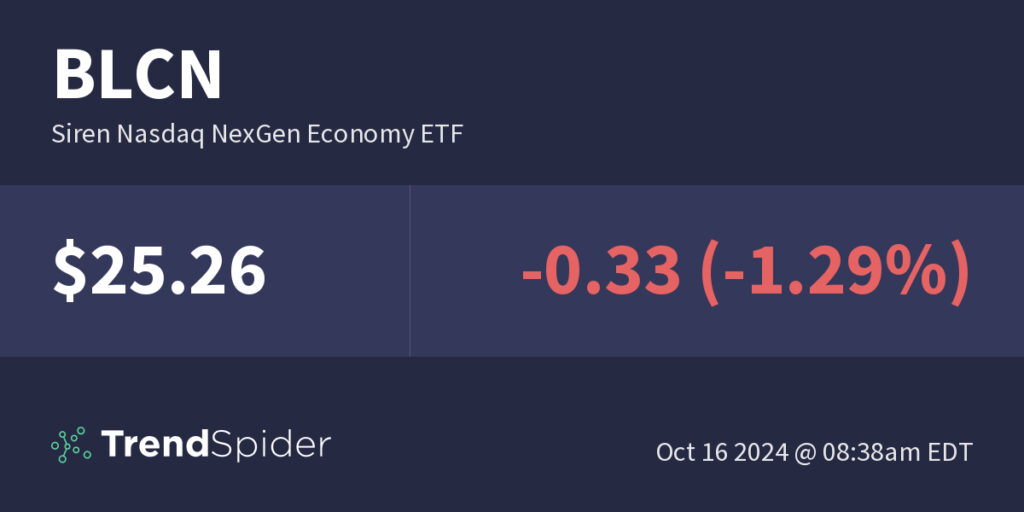
2. Siren Nasdaq NexGen Economy ETF (BLCN):
Source: trendspider.com
BLCN tracks the performance of the Reality Shares Nasdaq Blockchain Economy Index, focusing on companies that are expected to benefit from blockchain technology.
3. Global X Blockchain ETF (BKCH):
Source: financial-independence.xyz
BKCH targets companies that are involved in the development, research, and use of blockchain technologies.
4. Bitwise Crypto Industry Innovators ETF (BITQ):
BITQ focuses on businesses that are heavily involved in the cryptocurrency ecosystem. It provides exposure to the crypto industry by investing in companies that are at the forefront of the crypto and blockchain revolution.
5. VanEck Digital Transformation ETF (DAPP):
Source: trendspider.com
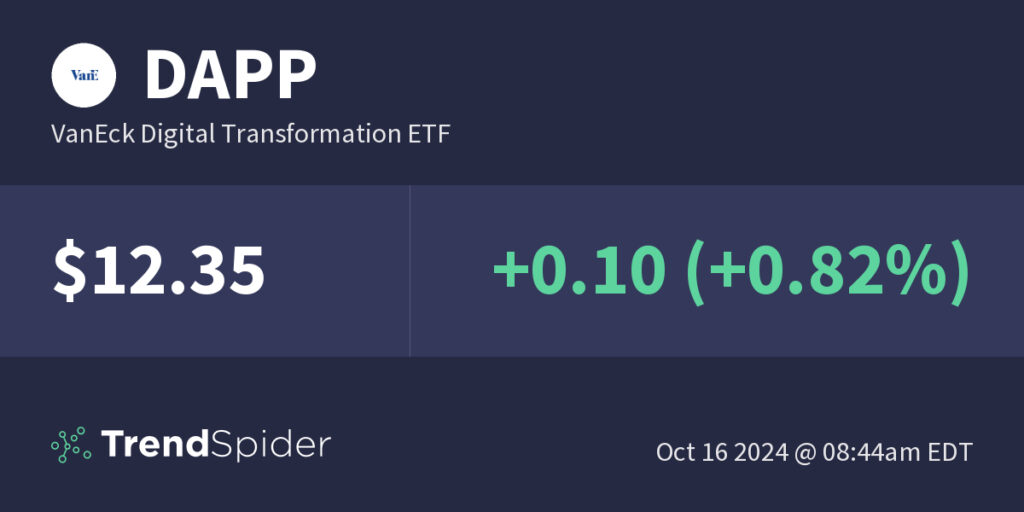
DAPP invests in firms that are leaders in areas such as cryptocurrency mining, blockchain technology, and digital asset exchanges.
Investing in Blockchain ETFs can be an attractive option for gaining profit. Also, you can have the perfect exposure to the growing blockchain industry without directly investing in the crypto market. While there are several benefits, there are risks too. Be a potential investor before you make up your mind to invest. You should be aware of the inherent risks. There are some popular ETFs, like – BLOK, BLCN, etc offer various approaches to investing in this space. But, you have to understand your requirements and demands that align with their investment goals.
So, whether you’re an experienced investor looking to diversify or someone eager to explore the future of finance, Blockchain ETFs present a compelling choice
Ready to make a move? Dive into the world of Blockchain ETFs and position yourself at the forefront of the financial revolution. The future is here—don’t miss out on your chance to be a part of it.
If you want to get more updates related to Web3, subscribe our website and get yourself updated.
We always try to keep you up to date with the best in retro gaming news, but boy do we have a special treat for you. As we’ve recently found out through Facebook, that the classic game of ‘Pyjamarama’, has been ported over to the MSX by Fregarni via the MSXDev24 competition. A Mikro-Gen action-adventure game from 1984 that was only available for the ZX Spectrum, Commodore 64 and Amstrad CPC until now. To coincide with this news, we’ve got another screenshot from the game and at some point later today a gameplay video.
Here’s the latest from the competition page. “Finally MSX has a version of this game thanks to Fregarni. This game is pure 80s design -it is an 80s game after all- and you should expect the classic weird nonsense we all grew up with and love. Wally went to sleep, but forgot to wind up his clock, and now he’s trapped on a nightmare. He needs a way out, and you are the only one that can help him. Control Wally as he moves and jumps from room to room, carrying objects (up to 2) dodging enemies and and jumping on platforms. As you can expect from a nightmare, the house is quite confusing, rooms appear to be repeating, objects have the wrong size, and nothing is really what it seems”.
“Be careful to not run out of snooze energy (yes, it is represented by a glass of milk) and hop around helping Wally in this crazy adventure to wake up and be in time for work. It makes us wonder if Christopher Nolan got some of his inspiration for Inception by playing this video game when he was a kid. Pyjamarama runs on any MSX1 computer with 64KB of RAM, you’ll find the game play instructions in the attached manual”.
Nick Knowles has confirmed a Strictly Come Dancing comeback just days after his sad exit from the show.
The DIY SOS star, 62, and his pro partner Luba Mushtuk were eliminated from the show last weekend following a dance-off against Shayne Ward and Nancy Xu.
In a video this week, Nick shared that he will be back on the show with Luba – for the grand finale.
Nick Knowles on Strictly exit
In a video shared to Instagram on Tuesday, after their final It Takes Two interview, Nick said alongside Luba: “It Takes Two the last time.
“Last duties on Strictly…”
You’ll come back for the final and we’ll do our special dance.
Luba then cut in: “Apart from the final. You’ll come back for the final and we’ll do our special dance with maybe, a sandwich. I don’t know.”
Nick continued: “Yeah the final. That would be nice, I’ll get another marmalade sandwich!”
Nick and Luba left Strictly last Sunday (Credit: BBC/Guy Levy)
He added: “Thank you to all of you for the messages of support and those of you who voted. I’ve really loved the journey.
“Luba’s been the best partner in the world.”
For all the latest Strictly Come Dancing news head to our dedicated Facebook page here.
Luba then offered to come and teach Nick all the dances once his knee and arm injuries are sorted.
Alongside the video, Nick wrote: “An unforgettable @bbcstrictly journey with @lubamushtuk! We’ve laughed, worked hard, and made memories to last a lifetime.
“Thanks to everyone who had our backs along the way – we couldn’t have done it without you.”
After his exit from Strictly, Nick recently said on Instagram: “Gutted but so grateful for the opportunity and to have the super talented @lubamushtuk as my dance partner. Thank you everyone for the support.”
Nick and Luba will return to Strictly for the final (Credit: BBC)
Nick on his injuries
During his It Takes Two interview with Luba on Monday evening, Nick shared an update on his injuries. During his time on Strictly, he injured his shoulder whilst changing a car tyre and then injured his knee during a dress rehearsal.
Now, Nick may have to undergo two operations.
Read more: Strictly Come Dancing viewers express concern for Nick Knowles
He explained on the spin-off show: “I might have an operation on the arm this week then another operation on the knee in a couple of weeks. So I can get myself sorted.”
Will you miss Nick on Strictly? Tell us on our Facebook page @EntertainmentDailyFix.
Have you already tried one of the latest features to Microsoft 365 Copilot: Copilot Pages? These are dynamic, persistent canvases designed specifically for multiplayer AI collaboration ( = working together with others in the same Page in real time). This feature can be used to make spontaneous, AI-generated content durable, editable, and shareable. That’s what Copilot Pages offer and they matter because they turn fleeting Copilot responses into reusable and workable assets. Used via Copilot BizChat, these pages allow users to transform Copilot responses into something more permanent. You can then continue editing the result just like a Loop page. And as a matter of fact, Copilot Pages are Loop Pages.
Think of it as upgrading from a notepad (only you work on your text) to a collaborative workspace where everyone you choose can see and build on each other’s ideas in real-time. This is not just a new tool—it’s a new way of working, blending human and AI interactions into a seamless workflow, if you want to say it in a fancy way. If you have already been using Microsoft Loop, then this way of working is nothing new to you. But if you haven’t: welcome to the future of work happening today.
How to Use Copilot Pages Details for IT Admins Upcoming Features (Q4 CY2024):
How to Use Copilot Pages
Using Copilot Pages is simple and intuitive. Here’s a quick guide to get you started. Remember that you need to have Microsoft 365 Copilot license, to be able to use Copilot Pages today.
Use BizChat (Business Chat, Microsoft 365 Copilot Chat) via Microsoft 365 portal ( https://m365.cloud.microsoft/chat ) or using Copilot inside Microsoft Teams. Copilot Pages are only available at Work-side at the moment.
Interact with Copilot as you normally would. When you receive a response you’d like to keep, click ‘Edit in Pages.’
This will create a page and open it side-by-side with the chat, with the response already copied and formatted.
You can continue your conversation in chat, and each subsequent response can be added to the page by clicking ‘Edit in Pages’ again.
Remember, that these are Loop Pages! You can use a many of rich features what Loop has to offer. Copilot doesn’t seem to work when using Copilot Pages via BizChat, but when you open these pages in the Loop App, you can also use Copilot to summarize, rewrite etc the content on the page.
Note: the name of the page will be the beginning of the prompt you used for the response you chose to Edit in Pages. So.. I warmly recommend you to change the name of the page, so it makes sense to you and others later 😊
You can make it multiplayer, by sharing your page with others. This allows collaborators to view and edit the page, but they won’t have access to your Copilot session. This sharing can be done by clicking the share icon on top right are of your Page.
From there you can choose to share a Page link or Copy component. When pasting the Page to Teams chat (or Outlook, Whiteboard, etc) , use Copy component, but if you want receiver to open the page in Loop App, share a link to that page.
Tip: easy way to share Copilot Page to your colleague by using @-mention and giving permissions to that Page.
This way William will have a notification in his Loop app and can open that page right away.
At this point both Emma and William can edit the content simultaneously in real-time, just like in ordinary Loop pages and components.
You can return to your page by clicking Edit in Pages in the chat where you first created it.
There is also a small page-icon on the top right area of the Page. It indicates that this chat has a page attached to it, and you can open (or close ) the Page by clicking it.
In the near future you can find the Pages tab in Microsoft365.com, where all your previously created pages are stored.
As a best practice, I recommend that relevant Copilot Pages are added to Loop Workspaces ( for example this one would be in a ForestSilk Webpage workspace), so they can be discovered more easily later by you and the team.
I am also looking forward to rest of the features, that were visible in Microsoft’s Copilot Pages videos I have seen.
Details for IT Admins
Copilot Pages are Loop Pages, and thus they already have controls and compliance features:
Storage and Management: Copilot Pages are stored as .loop files in a user-owned SharePoint Embedded container, counting against the tenant’s SharePoint quota. They support all SharePoint file system features, including governance and compliance processes.
Configuration and Control: Admins can control Copilot Pages using Loop admin switches in Cloud Policies (https://config.office.com/ – Customization / Policy Management ). Notably, disabling Loop in the tenant does not disable Copilot Pages, but a specific switch has been added for Pages management which needs to be used. By default Copilot Pages are on.
Copilot Pages are Loop Pages and thus support the capabilities listed in the Summary of governance, lifecycle, and compliance capabilities for Loop. In summary, that includes admin toggles, GDPR and EUDB compliance, Intune device management, Conditional Access policies, Information Barriers, Customer Lockbox, individual file recycle bin, version history, audit logs, eDiscovery, export, legal hold, retention policies, sensitivity labels, and data loss prevention.
Read more admin details from Microsoft’s post. Note that at the time of writing this, they are still talking about Copilot Chat and not BizChat. Name changes do take time..
Upcoming Features (Q4 CY2024):
Retention labels at the file level.
Programmatic API access to content in SharePoint Embedded containers, enabling third-party governance, management, and compliance tools.
Guest/external access via Entra B2B configuration for tenants with sensitivity labels.
SharePoint Admin Center columns to identify user-owned containers.
Sharing is Caring! #CommunityRocks
Aiheeseen liittyy
Published by Vesa Nopanen
Vesa “Vesku” Nopanen, Principal Consultant and Microsoft MVP (M365 and AI Platform) working on Future Work at Sulava.
I work, blog and speak about Future Work : AI, Microsoft 365, Copilot, Microsoft Mesh, Metaverse, and other services & platforms in the cloud connecting digital and physical and people together.
I have about 30 years of experience in IT business on multiple industries, domains, and roles.
View all posts by Vesa Nopanen
If you’re modding Bethesda games on Linux / Steam Deck, GE-Proton 9-16 could make things a little easier for you.
As your reminder: GE-Proton (or Proton-GE) a community-build of Proton, nothing to do with the official Proton from Valve. You’ll find GE adds specific fixes that Valve often can’t (due to legal reasons), and sometimes other special additions, but GE comes with less testing and support. Usually you only want to use it for specific games until they work properly in Valve’s Proton, or for using Proton outside of Steam like in Heroic and Lutris. See more about Proton in my guide.
In GE-Proton 9-16 one of the main additions is a change to how Bethesda games will launch like the Fallout series, Skyrim, Oblivion and Starfield. If GE-Proton detects a known mod executable for these it will launch that instead of the original – something that will just save players a fair bit of messing around. Seems like a nice change!
Another addition is that games run with UMU (Unified launcher for Windows games on Linux), for using it outside of Steam like in Heroic Games, is that games will now have the /mnt, /run/media and /media and the user’s home folder added as drives that games can see.
Pictured – Skyrim
There’s also a few other game-specific fixes, and the usual additions of new code from the official upstream projects.
Here’s the full changelog:
Proton:
import upstream makefile changes
import upstream proton changes
import upstream steam_helper changes
import upstream vkd3d-shader changes
update wine to latest bleeding edge
updated dxvk to latest git
update vkd3d-proton to latest git
update dxvk-nvapi to e4bad70
Protonfixes:
fixed issue with game_titles not being pulled correctly for UMU
game_titles are now looked up as part of included umu-database csv instead of trying to send online website api call
games run with UMU will now have /mnt,/run/media,/media/, and the user’s home folder added as drives u:,v:,w:,x: respectively inside the prefix if they are not empty. This is to allow users to install or import games outside of the prefix more conveniently. A typical scenario for this would be if you have your games pre-installed on a different mounted drive, or somewhere else in your home folder outside of the prefix and you want to add them without reinstalling the game, OR if you want to install the game to one of those mounts instead of the C:\ drive inside the wine prefix. With steam, users don’t really have to worry about this because steam handles the drive mounts and the install locations, however we found that outside of steam users were trying to use the Z: drive (which is symlinked to root (/)) — which is of course containerized and read only, and therefore also unable to provide a proper drive size, resulting in users being told they don’t have enough space. With the new drives added into the prefix it should fix this, allowing users to access their mount locations or existing game folders for installation or importing via the new drives instead of Z:.
Mod support for various bethesda games has been added (Thanks Root-Core). If a mod executable is found for bethesda games it will launch the mod executable instead of the original:mapping = {‘22380’: (‘FalloutNV.exe’, ‘nvse_loader.exe’), # Fallout New Vegas’22370′: (‘FalloutLauncher.exe’, ‘fose_loader.exe’), # Fallout 3’377160′: (‘Fallout4Launcher.exe’, ‘f4se_loader.exe’), # Fallout 4’22330′: (‘OblivionLauncher.exe’, ‘obse_loader.exe’), # Oblivion’72850′: (‘SkyrimLauncher.exe’, ‘skse_loader.exe’), # Skyrim’489830′: (‘SkyrimSELauncher.exe’, ‘skse64_loader.exe’), # Skyrim SE’1716740′: (‘Starfield.exe’, ‘sfse_loader.exe’) # Starfield}.get(game_id, (”, ”))
protonfix added for metal gear solid 2 (thanks FranjeGueje)
protonfix for Kindom Hearts HD Remix added for steam version (already existed for egs version) (thanks Internetbestfriend)
protonfix added for Gothic Playable Teaser (thanks Root-Core)
Star Citizen protonfix updated (no longer requires EAC workaround)
The metaverse version of Gordon Ramsay’s reality show Hell’s Kitchen, originally launched in The Sandbox in 2022, has introduced two new gaming experiences: “Fork Off” and “The Chef’s Table.”
The first game, Fork Off, is an arcade-style experience. Players navigate the game board, collecting ingredients while dodging various obstacles. The gameplay is fast-paced and designed to challenge players’ reflexes and decision-making skills. As they progress, players can power up their avatars to increase speed and collect more coins for extra points.
The Chef’s Table, the second new experience, offers a more interactive, storytelling approach. Players step into Gordon Ramsay’s iconic kitchen, where they take part in culinary challenges and creative tests. They can explore the kitchen, interact with team members, and engage in quests like solving puzzles or finding hidden ingredients.
These new additions are part of The Sandbox’s Alpha Season 4, which offers over 100 unique experiences and 50 hours of gameplay. Players participating in these events can complete quests and earn rewards, with a total prize pool of over $2.5 million in SAND tokens.
Since their launch in early October — Fork Off on October 9 and The Chef’s Table on October 11 — both experiences have gained popularity. Fork Off has attracted over 34,000 plays, while The Chef’s Table has seen more than 45,000 plays.
Hell’s Kitchen entered the metaverse in August 2022, when The Sandbox partnered with ITV Studios to introduce the cooking-themed game. It was the first cooking-related experience to be featured on the platform, allowing fans of the show to engage in a virtual version of the competition.
Hell’s Kitchen debuted as a reality cooking show in 2005, hosted by celebrity chef Gordon Ramsay. The show features young chefs competing in various kitchen challenges to win the competition. The metaverse version adds a new layer of interactivity to the franchise, blending gaming with the culinary world.
Hell’s Kitchen is not the only reality show to make its way into the metaverse. Earlier in May, The Voice also expanded into The Sandbox, introducing “The Voice Coach Battle.” This gamified experience lets players act as celebrity coaches, influence the competition’s outcome, and earn exclusive rewards.