Home Blog Page 1178

Paradigm, EFF Rally Behind Tornado Cash’s Roman Storm Amid Legal Battle – Decrypt

0
Paradigm, EFF Rally Behind Tornado Cash’s Roman Storm Amid Legal Battle – Decrypt


Tornado Cash co-founder Roman Storm’s cause has drawn support from the likes of venture capital firm Paradigm and the Electronic Frontier Foundation (EFF) as he faces prosecution in the U.S. for allegedly facilitating money laundering through the Ethereum-based crypto mixer.

Paradigm announced that it would donate $1.25 million to support Storm’s legal defense, while the EFF has filed an amicus brief in support of the developer.

Announcing the contribution to Storm’s legal fund, Paradigm co-founder Matt Huang called the charges an attack on software developers.

“The prosecution’s case threatens to hold software developers criminally liable for the bad acts of third parties, which would have a chilling effect in crypto and beyond,” Huang wrote in a tweet.

Acknowledging Paradigm’s contribution, Storm expressed his “enormous gratitude” to the VC firm in a tweet. He added that, “Your support means the world, not just to me, but to every developer fighting for fairness and innovation. Thank you for believing in me and defending the principles that matter!”

Civil liberties nonprofit Electronic Frontier Foundation (EFF), meanwhile, has filed an amicus brief in support of Storm, warning that his prosecution could stifle privacy-focused software development.̉

“The EFF pointed out that holding developers responsible for how their tools are used is an overreach, comparing privacy protocols like Tornado Cash to physical cash or encryption tools that serve legitimate purposes but can also be misused,” the EFF wrote.

It added: “The government’s prosecution raises larger civil liberties concerns that could chill the future development of privacy-enhancing technologies more broadly.”

It also criticized the use of the International Emergency Economic Powers Act (IEEPA) in the case, saying that laws regulating such technologies should be enacted by Congress, not through broad interpretations of existing sanctions laws.

Decrypt has reached out to the EFF for comment and will update this article should they respond.

The Tornado Cash prosecution

In August 2023, the U.S. Department of Justice (DOJ) charged Tornado Cash founders Roman Storm and Roman Semenov with money laundering, sanctions violations, and operating an unlicensed money-transmitting business.

With Storm’s trial set for April 14, 2025, the outcome of his case could have far-reaching implications for financial privacy and software development.

The case comes amid shifting legal ground for Tornado Cash.

In September, a New York court denied Storm’s motion to dismiss his charges, stating that while parts of Tornado Cash were immutable, other aspects remained under developer control.

But just last week, a Texas court dealt a blow to the regulators as it overturned U.S. Treasury sanctions on the coin mixer, ruling that immutable smart contracts do not qualify as “property” under the IEEPA.

This follows a similar ruling in November 2024, where the U.S. Fifth Circuit Court found that sanctioning immutable smart contracts exceeded the Treasury’s legal reach.

Edited by Stacy Elliott.

Daily Debrief Newsletter

Start every day with the top news stories right now, plus original features, a podcast, videos and more.


Source link

Skate Rolls Out ‘Skate Shuffle,’ Allowing Users To Interact With Random EVM Apps And Earn Ollies

0
Skate Rolls Out ‘Skate Shuffle,’ Allowing Users To Interact With Random EVM Apps And Earn Ollies


In Brief

Skate has launched its new “Skate Shuffle” feature on Eclipse, allowing users spin and earn Ollies points with each interaction.

Skate Rolls Out ‘Skate Shuffle’ Feature For Interacting With Random EVM Apps And Earning Ollies

Platform focused on liquidity provisioning, Skate announced the launch of its new “Skate Shuffle” feature on Eclipse. This feature allows users to spin and earn Ollies points with each interaction. Every time a user spins, a cross-VM transaction is initiated to interact with a random Ethereum Virtual Machine (EVM) application.

As per the announcement, Skate allows applications to run natively on any VM without requiring bridging. Users on alternative VMs like Eclipse can now engage with EVM-based applications, including ether.fi, mETH Protocol, Virtuals Protocol, Lombard, Pendle, Resolv Labs, Angle, and GMX.

In order to start spinning, users need to connect their wallets. Currently, the platform supports the Backpack Wallet on Eclipse. After connecting, users can spin to trigger a random cross-VM transaction with one of the supported applications. A small fee will be prompted to cover the gas costs of the transaction. The status of the transaction can be checked under the “Your Cross-VM Tasks” section at the bottom of the page.

Users will receive a random amount of Ollies points based on the results of their spin. The number of Ollies earned is influenced by the outcome of the spin, which can result in one of three possibilities: No Match, Two of a Kind–medium-sized bonus, or Three of a Kind–large bonus. Each protocol’s logo has a specific multiplier associated with it, and players are encouraged to aim for “Three of a Kind” to maximize their reward.

What Is Skate?

Skate, formerly known as Range Protocol, operates as a liquidity provisioning platform that facilitates cross-chain functionality for applications, all while maintaining a single state. With reliable on-chain trading infrastructure, it combines the benefits of automated market makers (AMMs) and request-for-quote (RFQ) systems, offering optimized strategies for investors.

The platform officially launched its Shadow Mainnet in the fall of last year, marking the initial phase in the broader rollout of its Skate Mainnet.

Disclaimer

In line with the Trust Project guidelines, please note that the information provided on this page is not intended to be and should not be interpreted as legal, tax, investment, financial, or any other form of advice. It is important to only invest what you can afford to lose and to seek independent financial advice if you have any doubts. For further information, we suggest referring to the terms and conditions as well as the help and support pages provided by the issuer or advertiser. MetaversePost is committed to accurate, unbiased reporting, but market conditions are subject to change without notice.

About The Author


Alisa, a dedicated journalist at the MPost, specializes in cryptocurrency, zero-knowledge proofs, investments, and the expansive realm of Web3. With a keen eye for emerging trends and technologies, she delivers comprehensive coverage to inform and engage readers in the ever-evolving landscape of digital finance.

More articles


Alisa Davidson


Alisa, a dedicated journalist at the MPost, specializes in cryptocurrency, zero-knowledge proofs, investments, and the expansive realm of Web3. With a keen eye for emerging trends and technologies, she delivers comprehensive coverage to inform and engage readers in the ever-evolving landscape of digital finance.


More articles


Source link

Best Crypto Exchange in UAE: 8 Safest Platforms 2025

0
Best Crypto Exchange in UAE: 8 Safest Platforms 2025


Binance FZE,The best UAE crypto exchange is a platform that offers a secure and user-friendly environment for buying, selling, and trading digital currencies. It must good selection of cryptocurrencies, competitive fees, and smooth AED payment options. A trustworthy exchange also ensures strong security features to protect your funds and personal information.

We will review the 8 best crypto exchanges in Dubai based on key factors such as supported coins, trading fees, regulatory compliance, ease of use, payment methods, and overall security.

List of Best Crypto Exchanges in UAE: Our Top Picks

Binance: Overall best crypto exchange in UAE
Bybit: Best crypto derivatives exchange in UAE
OKX: Safest Dubai crypto exchange
BitOasis: Best licensed exchange in the Middle East
Rain: Low-fee crypto exchange in Dubai
Bitget: Best crypto copy trading UAE platform
MEXC: No-KYC crypto exchange in UAE
Crypto.com: Best Bitcoin and crypto trading platform in Dubai

Best UAE Crypto Trading Apps and Platforms Reviewed

1. Binance

Binance is one of the leading crypto and  Bitcoin exchange platforms in the UAE. Its Dubai subsidiary, Binance FZE, received a Virtual Asset Service Provider (VASP) license from Dubai’s Virtual Assets Regulatory Authority (VARA). This license allows Binance to extend its product offerings to both retail and institutional investors in the UAE, including services such as spot trading, lending, borrowing, and staking.

The platform maintains deep liquidity, with a daily BTC trading volume exceeding $76 billion. In terms of supported cryptocurrencies, Binance provides access to over 400 digital assets and more than 1,500 trading pairs. Binance’s fee structure is competitive, with trading fees ranging from 0.1% to 0.024% for takers and 0.1% to 0.012% for makers, depending on the user’s 30-day trading volume.

For UAE users, Binance supports various payment methods to deposit AED, including MasterCard, Visa, bank transfers, and ADVCash, with instant fiat-to-crypto transactions. Also, Binance offers its own payment system, Binance Pay, which includes a prepaid Visa debit card usable for purchasing goods and services.

Pros

Supports 400+ cryptocurrencies for diverse trading options
Competitive trading fees starting at 0.1%
Licensed by Dubai’s VARA and holds an FSP
Multiple payment methods like cards, bank transfers, Binance Pay
Advanced security with 2FA, whitelisting, and Proof of Reserves

Cons

Limited customer support with slow response times
Full access requires identity verification through KYC

binance-logo-2

2. Bybit

Bybit

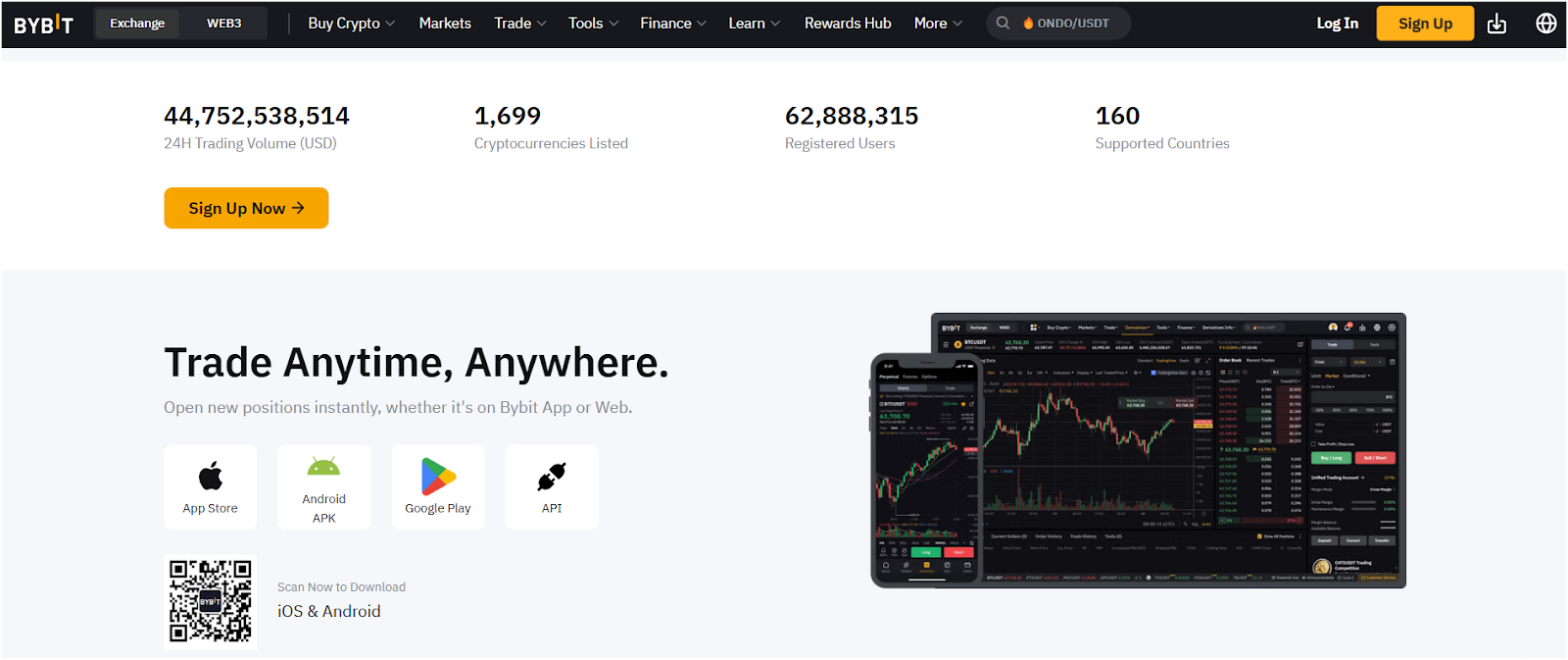
Bybit is another one of the top cryptocurrency exchanges in the UAE. Established in 2018, It has grown rapidly and, as of today, serves over 50 million users worldwide. Recently, Bybit secured a Provisional (Non-Operational) Approval for a Virtual Asset Service Provider (VASP) license from Dubai’s VARA. It provides access to 1,699 different cryptocurrencies and 275 crypto derivatives. The platform supports spot trading and 100x perpetual futures markets.

The exchange offers competitive trading fees, with spot trading fees ranging from 0.02% to 0.1% for both makers and takers. For derivatives, the fees are between 0.01% and 0.055% for makers and 0% to 0.02% for takers. Plus, a funding fee of 0.02% applies. Bybit accepts various payment methods, including credit and debit cards, PayPal and cryptocurrencies. Also, the platform allows users to buy crypto with AED.

Bybit’s platform is user-friendly and offers features such as fixed and flexible staking, high-yield savings accounts, copy trading, and liquidity mining. The exchange also provides automated wealth management services, a prepaid crypto debit card, and a built-in NFT marketplace.

Pros

Supports 1699 cryptocurrencies and 275 derivatives markets
Competitive fees, 0.1% for spot, 0.02%-0.055% for derivatives
UAE-friendly with AED payment supported via cards and PayPal
User-friendly platform with staking, copy trading, and savings
Strong security with 1:1 Proof of Reserves and two-factor authentication

Cons

Provisional license; not yet fully operational in Dubai
Limited direct fiat withdrawals for AED

bybit-logo-white

3. OKX

OKX

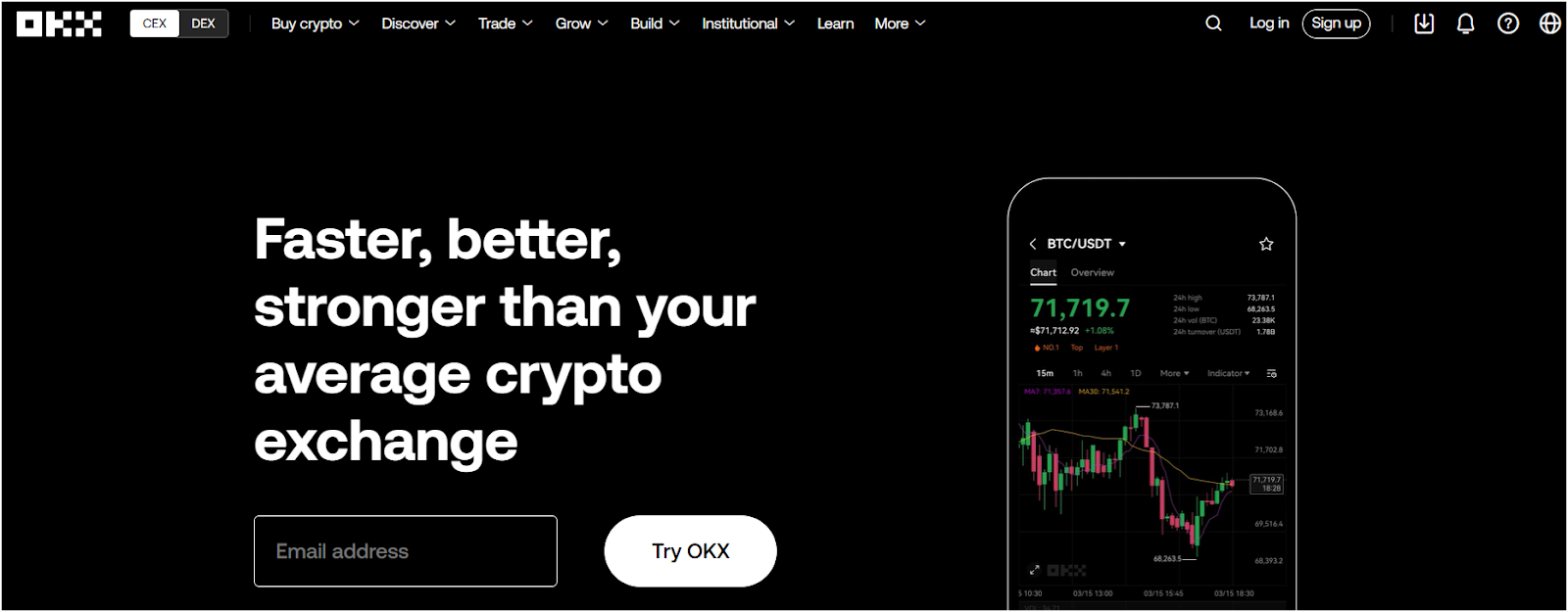
OKX is one of the best UAE crypto exchanges, designed for all types of traders. It is licensed by Dubai’s Virtual Assets Regulatory Authority (VARA), making it a trusted platform for cryptocurrency trading. You can trade over 280 cryptocurrencies on OKX, including popular ones like Bitcoin, Ethereum, and Tether. The platform also offers more than 480 trading pairs, such as BTC/AED and ETH/AED, making it easy to trade in AED.

The trading fees on OKX start at 0.10% for both makers and takers. You can get discounts if you trade large volumes or hold OKX’s native token, OKB. In the UAE, OKX allows you to deposit and withdraw AED directly using local bank accounts.

The platform is simple for beginners but has advanced tools for experienced traders like 100x leverage trading, margin trading, NFT marketplace, and Web3 ecosystem. Your funds are also safe with top-level security, including PoR, multi-factor authentication, and offline storage.

Pros

Licensed by VARA, ensuring regulatory compliance in Dubai
Supports over 280 cryptocurrencies and 480+ trading pairs
AED deposits and withdrawals via local bank accounts
Low trading fees start at 0.08% for makers and 0.1% takers
Advanced security with multi-factor authentication and cold storage

Cons

Lack of detailed customer support for niche trading issues
Trading fee discounts require holding OKB tokens

OKX Review 2024: Trading Features, Fees, and Security

4. BitOasis

BitOasis

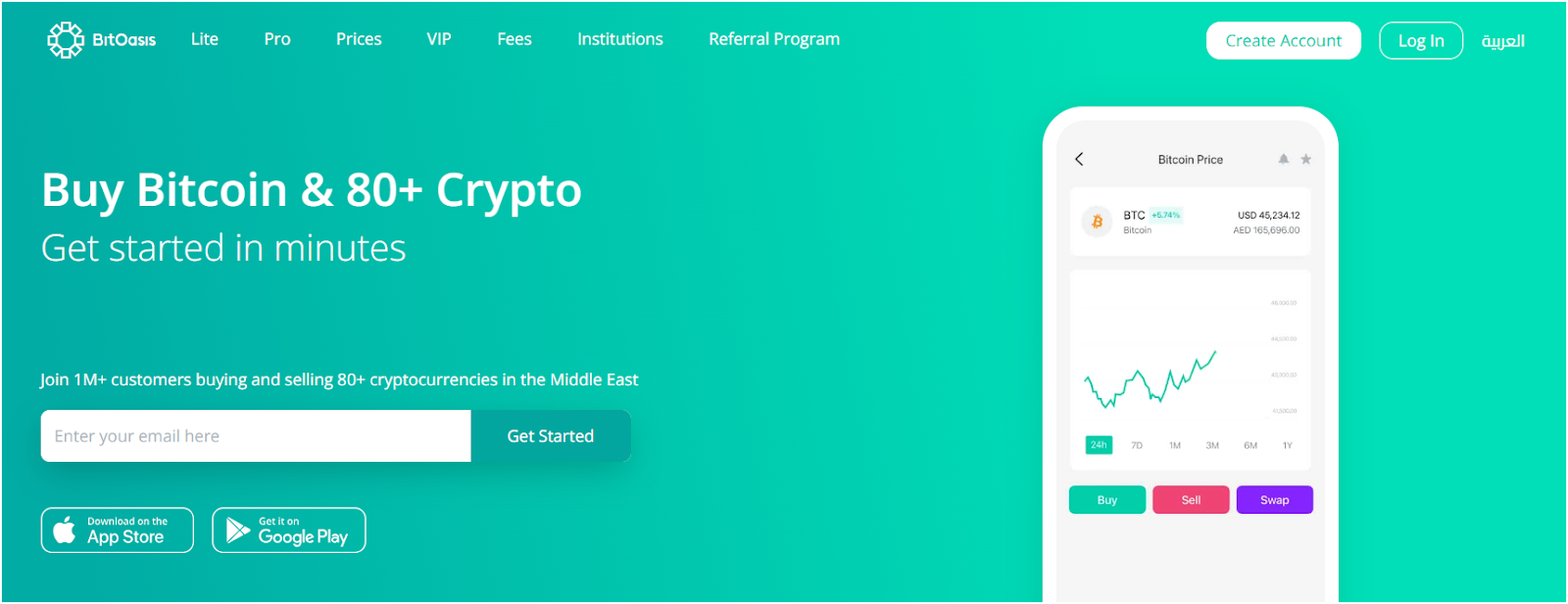
BitOasis is one of the top cryptocurrency exchanges in the UAE. It started in 2015 and is based in Dubai. The platform lets you trade more than 80 cryptocurrencies, including popular ones like Bitcoin, Ethereum, Ripple, and Cardano. It’s only designed to meet the needs of UAE residents, making it a trusted choice for buying, selling, and holding crypto.

The exchange is licensed by Dubai’s Virtual Assets Regulatory Authority (VARA), ensuring it follows all local laws. It also has approval from Bahrain’s Central Bank to operate as a broker-dealer. 

For payments, BitOasis provides several options. You can deposit money using credit or debit cards, with a fee of 3.99%. Wire transfers from local banks are also supported, and while BitOasis doesn’t charge for these, some banks may add their own fees. There’s a special feature for UAE users called Easy Funding, which lets you link your bank account for fast deposits. This option does not charge fees. Apple Pay is also available for instant deposits starting at AED 100.

The platform is easy to use on both mobile and desktop, making it convenient for all types of traders. Security is a priority, with strong measures in place to protect your funds and information. BitOasis also provides helpful guides and resources to make crypto trading easier for beginners.

Pros

Licensed by VARA and Central Bank of Bahrain
Easy funding with local bank accounts for UAE users
Multiple payment methods like Apple Pay, wire transfers
User-friendly interface on both mobile and desktop

Cons

3.99% fee for card payments
Limited cryptocurrency options compared to larger exchanges

5. Rain
Rain

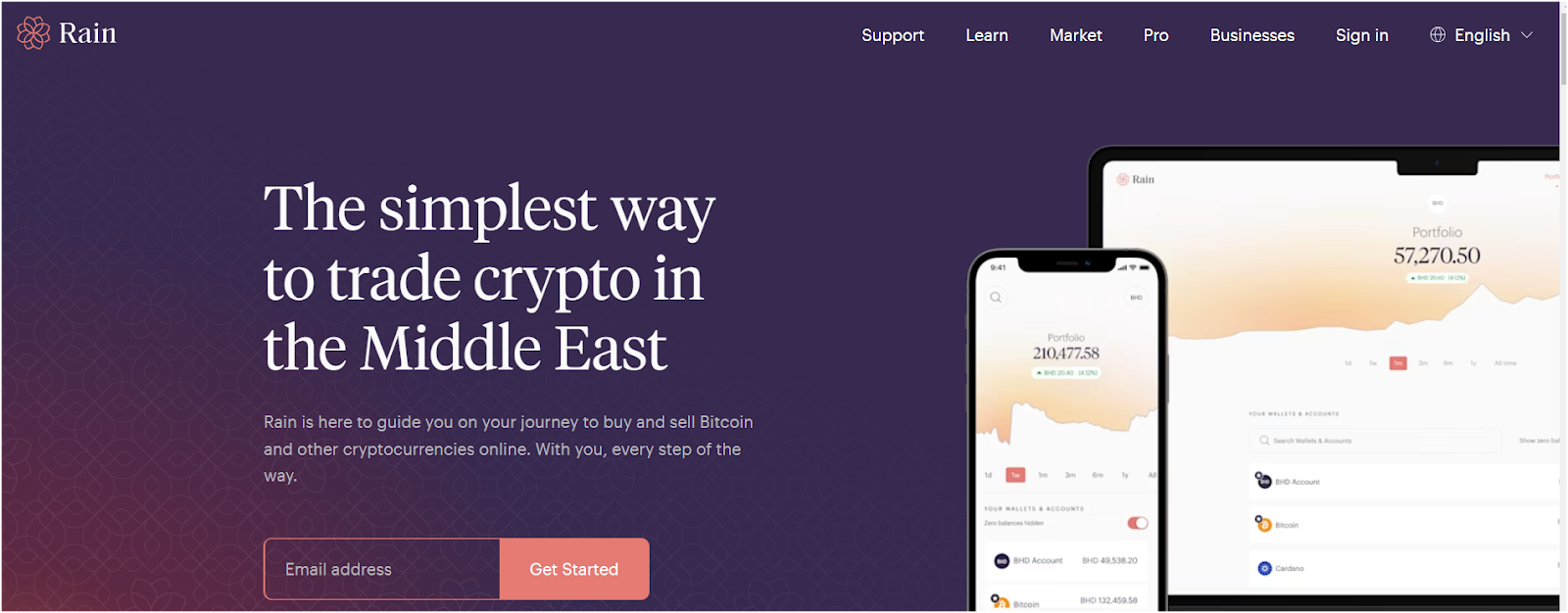
Rain is one of the top crypto trading platforms in the UAE, known for its secure and easy-to-use platform. It is licensed by the Abu Dhabi Global Market (ADGM), ensuring that it operates within strict regulations. Rain supports over 70 cryptocurrencies, including popular ones like BTC, ETH, USDT, and SOL.

When it comes to fees, Rain keeps things simple and transparent. Instead of charging traditional trading fees, a margin of 1% to 2.5% is included in the prices shown. Depositing AED into your Rain account is free, and withdrawals in AED to local banks also come without any charges. For the advanced platform, it charges 0.10% maker fees and 0.25% taker fees on all trades.

You can use local bank transfers to deposit AED seamlessly, and credit or debit cards like Visa and MasterCard are also supported. It uses advanced measures like cold storage and multi-factor authentication to protect your assets. Additionally, the platform has a mobile app available on iOS and Android.

Pros

Licensed by ADGM, ensuring strong regulatory compliance
No fees for AED deposits and withdrawals to UAE banks
Multiple payment methods like bank transfer and credit cards
Sharia-compliant for users seeking ethical investment options

Cons

Fewer supported cryptocurrencies compared to global exchanges
Credit card transactions may incur high bank-imposed charges

6. Bitget
Bitget

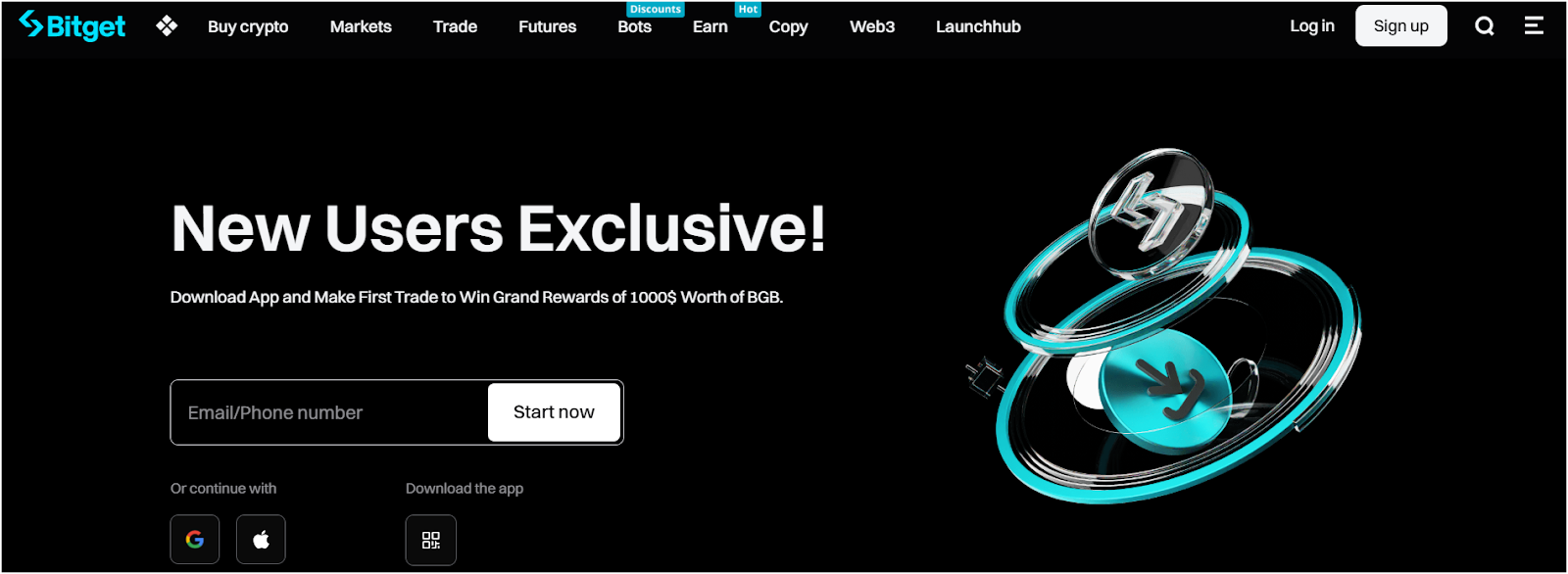
Bitget is one of the best Bitcoin exchanges in the UAE, offering a range of advanced trading features. The platform supports over 1200 cryptocurrencies. So, whether you’re buying major coins like Bitcoin and Ethereum or exploring smaller tokens, Bitget has plenty of options.

Bitget has zero fees for buying and selling crypto through its Peer-to-Peer (P2P) platform. Additionally, it supports fiat gateways for multiple Middle Eastern currencies, including UAE Dirhams. To make the platform more user-friendly for Arabic-speaking traders, Bitget offers full Arabic language support on its mobile app and website.

While Bitget is not yet fully licensed in the UAE, the company is actively working to secure regulatory approvals and establish a regional office. Bitget is known for its unique features like copy trading, which lets beginners mimic the trades of experienced investors. Plus, the platform offers advanced futures trading options, with 125x leverage.

Another standout feature is the Bitget Wallet, a multi-functional crypto wallet that supports swaps, NFTs, and decentralized apps (DApps). This makes it easy for users to manage their digital assets and explore the Web3 ecosystem.

Pros

Supports 1200+ cryptocurrencies for diverse trading options
Zero fees for P2P crypto transactions
Arabic language support for UAE and MENA users
Unique copy trading feature for beginners
Advanced futures trading with leverage options

Cons

Not yet fully licensed in the UAE.
No local customer support offices in the region

bitget-token-new-bgb-logo

7. MEXC

MEXC

MEXC is the cheapest crypto trading platform in the UAE, offering a wide range of features and benefits for users. Launched in 2018, it has grown rapidly and now supports millions of users globally, including many in Dubai and the UAE. MEXC offers an impressive selection of over 2,500 cryptocurrencies and 2,900 trading pairs.

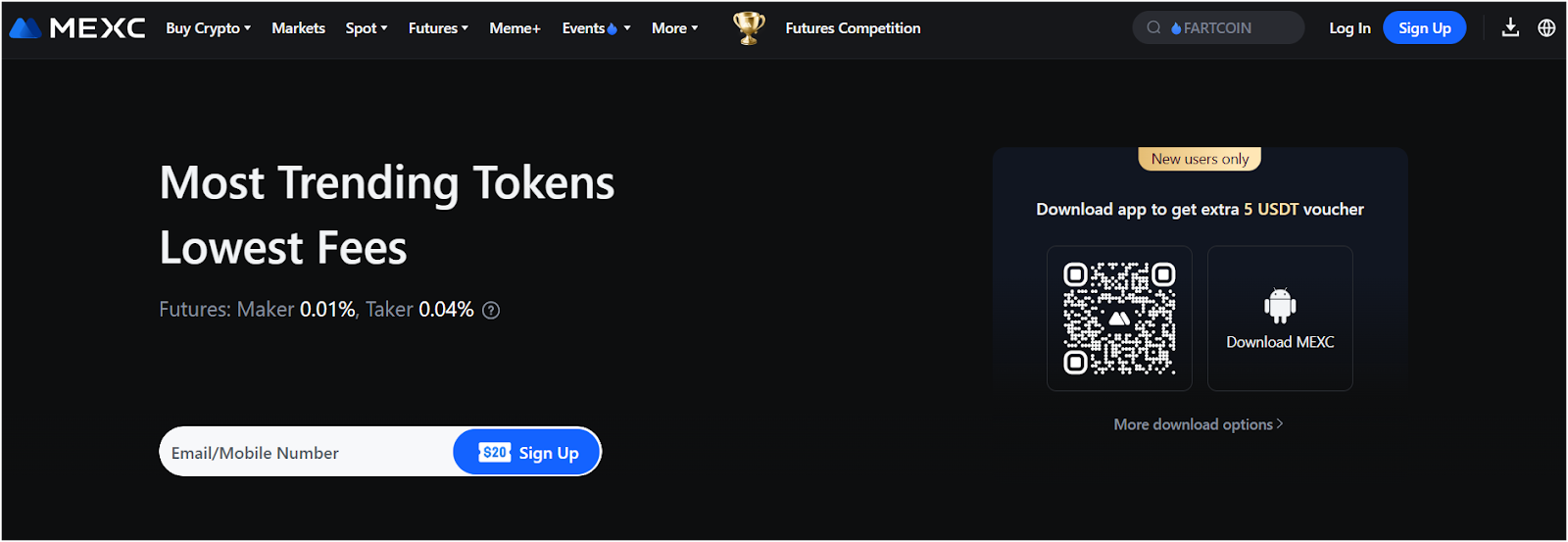
One of MEXC’s best features is its low fees. For spot trading, the platform charges 0.05% for both makers and takers. Futures trading is also affordable, with 0.01% maker fees and only 0.04% for takers. Deposits are free, although standard network fees apply when moving funds on the blockchain. These low costs make MEXC one of the low-fee platforms for crypto trading in the UAE.

MEXC supports multiple payment options that work well in the UAE. You can deposit money using bank transfers, credit or debit cards, or third-party payment services through P2P. The platform also offers OTC (Over-The-Counter) services. MEXC provides advanced trading tools like spot and futures trading with leverage, copy trading to mimic the strategies of top traders, and demo accounts to practice. The platform is easy to use, with a simple interface and a mobile app. You can also trade crypto without KYC verification and withdraw up to 10 BTC per day.

Pros

Supports 2,500+ cryptocurrencies and 2,900 trading pairs
Very low fees for crypto trading
Multiple payment methods, including bank transfers and cards
User-friendly interface and feature-rich mobile app
Offers advanced tools like copy trading and demo accounts

Cons

The licensing status in the UAE remains unclear
Limited customer support options for urgent issues
OTC services may involve higher spreads than regular trading

MEXC_square_logo-removebg-preview

8. Crypto.com

Crypto.com

Crypto.com is another licensed and one of the best crypto trading exchanges in the UAE. It is fully licensed by the Virtual Assets Regulatory Authority (VARA) in Dubai. This license allows Crypto.com to provide various services, such as buying, selling, and trading cryptocurrencies, as well as lending and borrowing digital assets.

The platform also offers spot trading, which is ideal for those who want to trade cryptocurrencies directly. Additionally, users can enjoy features like trading bots and sub-accounts, making it easier to manage multiple portfolios or automate trades.

One of the major advantages of using Crypto.com in the UAE is the introduction of the AED Fiat Wallet. This enables users to deposit and withdraw UAE Dirhams (AED) directly from their accounts. This is great news for local users as it allows for quick and easy transactions without having to convert to other currencies. Plus, deposits from UAE bank accounts are completely free of charge.

Pros

Licensed by Dubai’s VARA for regulated operations in UAE
Supports AED deposits and withdrawals with no fees
350+ cryptocurrencies available for trading
Offers trading bots and advanced trading features
Security-focused with strong encryption and user protection

Cons

High fees on some transactions, especially for small amounts
Occasional withdrawal delays for certain assets

crypto.com

Best Crypto Exchanges in Dubai – Comparison Table

Exchange
Supported Coins
Trading Fees
UAE Regulated

Binance
400+
0.1% maker/taker
Yes (Licensed by VARA)

Bybit
1,699+
0.1% maker/taker
Provisional VARA license

OKX
280+
0.08% maker and 0.1% taker
Yes (Licensed by VARA)

BitOasis
80+
3.99% for card payments, wire transfers free
Yes (Licensed by VARA & Bahrain CBB)

Rain
70+
Free, 0.10%-0.25% (advanced portal)
Yes (Licensed by ADGM)

Bitget
1,200+
0.1% maker/taker
No

MEXC
2,500+
0.05% maker/taker
No

Crypto.com
350+
0.25% maker and 0.5% taker
Yes (Licensed by VARA)

How to Choose a UAE Crypto Exchange?

Trading Fees

Trading fees are the costs you pay when buying or selling cryptocurrencies in the UAE. These fees can be either transaction charges, withdrawal fees, or deposit fees. High fees can reduce your profits, so it is important to find an exchange with fair rates. 

Some UAE exchanges offer discounts for high-volume traders or low fees for specific crypto transactions. Hence, comparing these all types of fees helps you choose a platform that lets you trade without losing your extra money.

Available Cryptocurrencies

Different crypto exchanges in the UAE offer a different variety of cryptocurrencies. Some of them will offer only popular coins like Bitcoin, Ethereum, or Binance Coin, while many support newer or less common options. 

So, if you want to trade specific coins or tokens, check the exchange’s list of coins and tokens before signing up. A platform with more cryptocurrencies gives you more trading opportunities and helps you diversify your portfolio.

User Interface & Experiences

A proper user interface is critical, especially if you are a newbie in crypto trading in the UAE. A clean and simple platform makes it easy for you to purchase, sell, or follow cryptocurrencies. Complicated platforms increase the chances of making mistakes or frustration. 

UAE crypto exchanges with beginner-friendly designs and helpful tools save you time and effort. Look for an exchange that works properly on mobile and desktop devices for ease.

Security

The most important aspect when selecting a UAE crypto exchange is security. If an exchange is not secure, your funds and personal information may be stolen. Reliable UAE platforms have robust measures such as two-factor authentication, encryption, and cold wallets to protect your assets. 

You must look for security certifications and user reviews before signing up. A safe exchange ensures your trading experience is hassle-free and your money is protected.

Payment Methods

The ease with which you can deposit or withdraw money on a crypto exchange in the UAE is determined by the available payment methods. Most UAE platforms support bank transfers, credit or debit cards, and sometimes e-wallets. 

Choose an exchange that offers payment methods you are comfortable using. Fast and simple payment options save time and make it easier for you to start trading. Ensure the platform also supports AED to avoid extra conversion fees.

Regulatory Compliance

Regulatory compliance is imperative when selecting the best crypto exchange in the UAE. Platforms following UAE’s crypto laws and regulations are safer for you to use. The most regulated exchanges ensure transparency and protect your funds besides reducing risks of scammers. 

Before signing up, examine if it is licensed by an authority in the UAE, either the Dubai Multi Commodities Centre (DMCC) or Abu Dhabi Global Market (ADGM). A regulated platform will give you peace of mind while trading.

Types of Crypto Exchanges in UAE

Decentralized Exchanges (DEXs)

Decentralized exchanges let you trade cryptocurrencies directly with other people. There is no middleman or company controlling the exchange. These platforms run on blockchain technology, which makes them secure and private. 

In the UAE, using a DEX is a good option if you want full control of your crypto. You also don’t need to share personal information. But, DEXs can be a bit tricky sometimes for beginners because they have fewer user-friendly features. 

One example of a DEX is Uniswap, where you can trade tokens without signing up. But keep in mind, DEXs usually don’t support traditional currencies like AED. If you are comfortable with tech and want more freedom, a DEX is a smart choice. Also, just remember, if you lose your wallet key, your funds can’t be recovered.

Centralized Exchanges (CEXs)

The most common type of crypto exchange in the UAE is centralized exchanges, also known as CEXs. These are run by companies that act as middlemen for buying and selling cryptocurrencies. They are easy to use and often support fiat currencies like AED. 

For instance, Binance and Bybit are popular CEXs in Dubai that offer fast transactions, many cryptocurrencies, and helpful tools for traders. However, because you are giving the company your funds, you must trust them to keep your assets safe. 

Also, many people are worried about hacks or insolvency on CEXs, but most of the platforms have strong security measures. If you are new to crypto trading or want simple payment methods such as credit cards or bank transfers, a trustworthy CEX is always a good choice. Also, just make sure that your exchange is legalized in the UAE.

Peer-to-Peer (P2P) Exchanges

P2P exchanges enable you to trade Bitcoin or crypto directly with other people. They connect buyers and sellers, enabling both parties to negotiate and set their own prices. P2P exchanges are very popular in the UAE because they give you control over trade. Binance P2P and Paxful are examples of such platforms. They offer secure escrow systems to ensure that both parties complete the deal before transferring funds.

P2P exchanges are good to use if you want to trade in AED or avoid high transaction fees. They also accept many forms of payment, including bank transfers or even cash deposits.

However, the process is a little slower than centralized ones, since you will be waiting for someone who would accept your offer or agree on your terms to become either the buyer or the seller. But if you’re concerned about privacy and flexibility, a P2P exchange may be what you’re looking for.

How to Buy Bitcoin and Crypto in the UAE?

Buying Bitcoin or any cryptocurrency in the UAE is easy if you follow the right steps. Here’s a simple guide to help you get started, even if you’re a total beginner.

Choose a Reputable Exchange: The first step is to choose one of the reputable crypto exchanges. There are many such in the UAE including Binance, Bybit, and BitOasis. You must look for one that is registered in the UAE, supports AED, and has good security. Also, see how reliable and secure the platform is by reading some reviews.
Create an Account and Complete KYC: You would need to open an account after choosing an exchange. This is about as easy as signing up for any website. You would have to provide some basic details, such as your name, email, and phone number. And, most UAE exchanges also require you to complete a KYC process. This means uploading documents like your Emirates ID or passport to verify your identity
Deposit Funds: Once your account is ready, it’s time to add money to it. Most exchanges in the UAE allow you to deposit AED using a bank transfer, credit card, or even e-wallets like PayPal. Hence, choose a method that is convenient for you.
Buy Bitcoin or Crypto: Now that you have money in your account, you can buy Bitcoins or any other cryptocurrency. Look for the crypto you are looking to buy on the exchange. You could look for Bitcoin (BTC) or Ethereum (ETH). Enter the amount you wish to buy and confirm the details. Many exchanges also allow you to set a price if you want to buy when the market is lower. Click “Buy” and, within seconds, you’ll own your first cryptocurrency.
Withdraw Funds: Once you have bought the crypto, you might need to withdraw it to keep it safe. You can either transfer it to a personal wallet or hold it on the exchange. If you like to have control over your crypto, send it to a secure wallet, for example, a hardware wallet or a mobile wallet app.

UAE Crypto Regulations

The UAE has clear rules for cryptocurrency to keep trading safe and protect investors. The Securities and Commodities Authority (SCA) made it necessary for all crypto businesses to get a license from them. These rules cover activities like offering, buying, selling, and trading cryptocurrencies. Companies must also follow laws to prevent money laundering and illegal funding.

In Dubai, the Virtual Assets Regulatory Authority (VARA) requires any crypto business working in or from Dubai to get a license.

When it comes to taxes, individuals don’t have to pay capital gains or income tax on their crypto earnings. However, businesses earning more than AED 375,000 per year must pay a 9% corporate tax, which started in 2023. Also, cryptocurrency mining is not free from VAT (Value Added Tax), so miners must pay the standard VAT rate.

Conclusion

In a nutshell, the best crypto exchanges in the UAE are Binance, Bybit, OKX, BitOasis, Rain, Bitget, MEXC, and Crypto.com. These platforms are best due to their large cryptocurrency offerings, competitive fees, and strong security measures. 

The choice of the best AUE platform depends on your needs, such as supported cryptocurrencies, fees, and regulatory compliance. Also, prioritize security and functionality to make the most of your trading experience in Dubai.

FAQs

Is crypto exchange legal in UAE?

Yes, trading cryptocurrencies like Bitcoin on a crypto exchange is legal in the United Arab Emirates (UAE). The government has set up rules to make sure that buying and selling digital money is safe and follows the law. The SCA introduced regulations requiring all crypto businesses to get a license.

What are the best Bitcoin wallets in the UAE?

The best Bitcoin wallets in the UAE are Phantom Wallet and Trezor Safe 5. For software wallets, Phantom Wallet is a popular choice. It’s easy to use and lets you manage your Bitcoin on your computer or phone. For hardware wallets, the Trezor Safe 5 is well-known for its strong security features. It keeps your Bitcoin offline, which makes it harder for hackers to access it.

Which bank is most crypto-friendly in the UAE?

Emirates NBD and Abu Dhabi Commercial Bank (ADCB) are the leading banks known for their relatively crypto-friendly approach. They have been open to serving customers involved in the cryptocurrency space.

Is UAE a crypto-friendly country?

Yes, the UAE is considered one of the most crypto-friendly countries in the world. The government is open to new technologies and has created rules to support the growth of cryptocurrencies.

For instance, in Dubai, there is an official government-licensed company, KIKLABB, that accepts cryptocurrency in exchange for issuing trade licenses or visas. As such, one can clearly determine that the UAE offers a secure climate for crypto-based businesses and people.

Which crypto exchange is best in Dubai?

Binance and Bybit are the best crypto exchanges in Dubai. Binance is one of the biggest and has numerous cryptocurrencies that can be traded. Bybit is another exchange that is more used nowadays for being user-friendly and with advanced trading facilities. Both platforms are known for high-security features and are well-present as regional platforms.

Which banks allow you to buy Bitcoin in UAE?

Emirates NBD is the bank that allows you to buy Bitcoin in UAE. It is known for its relatively crypto-friendly approach and has been open to serving customers involved in the crypto market.

Is it legal to cash out crypto in Dubai?

Yes, it is legal to cash out your cryptocurrency in Dubai. To do this, you would sell your crypto assets on a licensed exchange platform, converting them into fiat currency like UAE Dirhams or US Dollars. After selling, you can withdraw the funds to your linked bank account.



Source link

The 5 Best Chuck Lorre TV Shows, Ranked – SlashFilm

    0
    The 5 Best Chuck Lorre TV Shows, Ranked – SlashFilm


    We may receive a commission on purchases made from links.


    When it comes to modern television, few names are as powerful or profitable as Chuck Lorre. For the past few decades, Lorre has written for, produced, and created several hit television series that have not only helped shape the landscape of primetime network sitcoms but often set the trend for comedy TV moving forward. By and large, Lorre’s shows either feature relatable, everyday people in extraordinary situations or find the relatable human elements ignored when focusing on extraordinary people.

    Having earned his stripes as a TV writer on shows like “Charles in Charge” and “My Two Dads,” Lorre has been a staple of the industry for over 40 years. He’s proven time and again that he understands the key to finding commercial success, despite the many valid criticisms of his reliance on formulaic humor. Hence, we’re here to highlight the five best Chuck Lorre shows, with the focus being solely on the ones he’s created or co-created (sorry, “Roseanne” and “Mike and Molly”). That also includes his ventures beyond broadcast TV and into the world of streaming.

    5. The Big Bang Theory

    Chuck Lorre may be “The King of Sitcoms,” but his golden goose comes in the form of 12 seasons of the pop culture phenomenon “The Big Bang Theory,” which he co-created with Bill Prady. Few popular sitcoms have ever been as polarizing as “The Big Bang Theory,” with its undeniable popularity bringing in millions of viewers (and dollars) despite the numerous critics and viewers alike who consider the show one of the worst comedies ever made. Regardless of how anyone feels about the show or how it ended, to deny the impact and sitcom cultural shift that occurred in the wake of “Big Bang Theory” is to be ahistorical. Not only has the show spawned two separate spin-off series, but it also helped to normalize geek culture as no longer being a niche interest, all while comic book movies and the new eras of “Star Wars” and “Star Trek” picked up steam.

    More importantly, it also proved there was still value in the multi-camera sitcom performed for a live studio audience, absolutely crushing it in the ratings game when it looked like the form was going to shift to prioritize single-camera comedies that often broke the fourth wall. The show, which revolved around four scientists and a “normal” gal named Penny, relied on well-trodden tropes and surface-level punchlines, but people couldn’t get enough of it. “Bazinga” shirts sold like hotcakes, and once the series finally introduced two female scientists in season 4 to balance its gender dynamic, “The Big Bang Theory” stopped being quite so cringe-worthy and instead started to resemble a hang-out sitcom about people with varying levels of social skills learning how to be a community. Love it or hate it, the sitcom landscape as we currently know it owes a hell of a lot to the “Big Bang.”

    4. Cybill

    Chuck Lorre has set a number of his shows in Los Angeles and featured characters working in the entertainment industry. However, the popular 1990s sitcom “Cybill,” in particular, really helped open general audiences’ eyes to the inherent sexism found in Hollywood. Starring Cybill Shepherd as Cybill Sheridan, the series centers on an aging woman who has been relegated to playing bit parts, guest spots, and appearing in commercials because she committed the unforgivable crime of, you guessed it, aging. Many episodes featured a show-within-a-show format where Cybill played the different characters she had been cast as, and many of the storylines were pulled from Shepherd’s real-life experiences. Shepherd was joined by a stellar supporting cast that included Christine Baranski, Alicia Witt, Alan Rosenberg, Dedee Pfeiffer, and Tom Wopat.

    Although the show ended after four seasons (with CBS citing a lack of ratings), Shepherd alleged in her autobiography “Cybill Disobedience” that the show was canceled due to the network’s unease with the series’ feminist leanings and “frank depiction of female sexuality.” Throughout its run, “Cybill” was nominated for 12 Emmy Awards, winning the 1996 Golden Globe Award for Best Television Series — Musical or Comedy. Shepherd won her third Golden Globe Award for her performance, while Baranski received an Emmy, a Screen Actors Guild Award, and an American Comedy Award for her performance as Cybill’s best friend, Maryann Thorpe. “Cybill” walked so “Sex and the City” could run. 

    3. Young Sheldon

    I’m firmly convinced that the loudest haters of “Young Sheldon” are those who have never seen the show and think it’s just a cheap cash-grab in the wake of “The Big Bang Theory.” It’s not unheard of for a spin-off to reach the same heights as the series that spawned it (shout out to “Frasier,” “The Jeffersons,” and “Daria”), but “Young Sheldon” is, in this writer’s opinion, the best thing to come from “Big Bang.” What started off as an origin prequel (which Chuck Lorre co-created with Steven Molaro) for the hit sitcom’s most memorable character soon evolved into a genuinely touching coming-of-age dramedy about a complicated family featuring a genius child.

    Shifting tonally and narratively from its multi-camera predecessor, “Young Sheldon” featured narration from the adult Sheldon (Jim Parsons) as he looked back on his childhood while writing his memoir. This gives the show a sentimental air among the comedy, making it feel more like “The Wonder Years” than “Big Bang.” While it only made it to seven seasons compared to the massive 12 of its parent series, the show concluded on its own terms and with a satisfying ending to appease its massive viewership. And if fans are missing some of their favorite characters, the spin-off of this spin-off, “Georgie and Mandy’s First Marriage,” is currently on the air at the time of publication.

    2. Mom

    “Whatever happened to Anna Faris after the ‘Scary Movie’ movies?” is a question I hear unfortunately all too often — because it means folks not only missed out on her truly incredible turn in “The House Bunny” but also all eight seasons of her sitcom with Allison Janney, “Mom.” Created by Chuck Lorre, Eddie Gorodetsky, and Gemma Baker, “Mom” centered on the dysfunctional relationship between Bonnie (Janney) and her estranged daughter Christy (Faris), who are both recovering addicts on the path to staying sober. “Mom” often tackled tough, real-life difficulties like alcoholism, teen pregnancy, terminal illness, domestic violence, mental health, sexual assault, and garden-variety misogyny, but helped characters and the audience alike get through it with gallows humor and a whole lot of heart.

    Faris and Janney are both at the top of their craft (Janney even nabbed two Primetime Emmy Awards for Outstanding Supporting Actress in a Comedy Series), and as is customary with Lorre shows, they’re supported by a banger ensemble, including Mimi Kennedy, Jaime Pressly, Beth Hall, William Fichtner, Sadie Calvano, Blake Garrett Rosenthal, Matt Jones, French Stewart, and Kristen Johnston. Although Faris’ decision to leave the series after season 7 helped speed-run the show’s end with season 8, “Mom” was a hilarious watch and a fantastic showcase of some of the funniest women in comedy.

    1. The Kominsky Method

    Although it only lasted for three seasons, Chuck Lorre’s Netflix series “The Kominsky Method” is undoubtedly the best show he’s ever made in terms of quality. Starring Michael Douglas and Alan Arkin (in his final television role), the series follows Sandy Kominsky (Douglas), a former successful actor who now works as a beloved acting coach in Hollywood. He also runs a studio with his daughter Mindy (Sarah Baker), his longtime agent Norman Newlander (Arkin) always by his side. 

    “The Kominsky Method” is a fascinating examination of how former A-listers navigate a city and industry that prioritizes youth and beauty. Its supporting cast is equally stacked, with Nancy Travis, Paul Reiser, Kathleen Turner, Emily Osment, Ann-Margret, Jane Seymour, and Haley Joel Osment rounding out the big names. That’s to mention nothing of the flurry of guest stars in the forms of celebrities playing themselves, including Jay Leno, Patti LaBelle, Elliott Gould, Eddie Money, Allison Janney, Morgan Freeman, and Barry Levinson. Even folks like Bob Odenkirk, Willam Belli, and Danny DeVito make cameos along the way.

    Having nabbed Emmy nominations and two Golden Globe Awards (for Best Television Series — Musical or Comedy and a Best Actor — Television Series Musical or Comedy statuette for Douglas), “The Kominsky Method” was a great way to remind audiences that Lorre is capable of more than just laugh-track enhanced comedies.


    Source link

    How Telegram and TON Are Powering the 2025 NFT Revival

    0
    How Telegram and TON Are Powering the 2025 NFT Revival


    If you asked most people in 2023, they would have sworn that NFTs were past their prime. After capturing global attention in 2021 and peaking in hype around 2022, NFTs seemed to lose steam. Trading volumes fell, mainstream media coverage waned, and more than a few marketplaces either downsized or disappeared. Fast-forward to 2025, however, and a surprising resurgence is underway—led, in large part, by Telegram and the TON blockchain.

    In this article, we’ll explore how Telegram’s huge user base is driving a new wave of NFT adoption, why TON blockchain technology provides the perfect backbone for this revival, and how the focus has shifted from purely speculative assets to NFTs with actual, tangible utility.

    We’ll also look at some of the flagship Telegram NFT projects—like NFT-based Usernames, Anonymous Numbers, and Gifts—and what their success might mean for the future. Whether you’re a seasoned investor or a curious newcomer, get ready to see why people are calling this the NFT comeback of 2025.

    Understanding the 2024 NFT Market Slump

    In 2024, the NFT world was still reeling from a year-long downturn. According to data from DappRadar, the overall trading volume for NFTs dropped by about 20%, cementing the notion that the market had entered a correction phase. Headlines reported the closure of once-thriving platforms like MakersPlace and the scaling back of operations at other well-known NFT marketplaces. This wasn’t just a minor slump; it felt, to many, like the end of an era.

    What caused this downturn? For starters, the hype cycle that drove the NFT boom in 2021–2022 had cooled. People who entered the market only to flip digital art for quick profits found fewer buyers as public interest shifted elsewhere. At the same time, regulatory uncertainty around crypto and blockchain technology had companies and collectors not wanting to get too deep into purely speculative projects.

    Why Speculative NFTs Failed to Retain Interest

    The core issue behind the NFT slump was oversaturation. The market was flooded with PFP (Profile Picture) collectibles that offered little more than eye-catching visuals. These assets enjoyed initial popularity, but the novelty wore off quickly.

    Collectors began demanding real-world use cases or at least platform-specific benefits. If an NFT was just a digital image with no extended functionality—no game to play, no community utility, no special platform features—it became increasingly difficult to justify its price. The era of “buy low, sell high” with no underlying purpose was coming to an end.

    The Rise of Telegram as an NFT Powerhouse

    Enter Telegram, the instant messaging platform that quietly built a base of over 950 million monthly active users worldwide. Unlike niche NFT marketplaces that struggled to attract a broad audience, Telegram was already a household name in many regions.

    This massive user pool turned out to be a goldmine for NFT adoption. Why? Because moving from chatting with your friends to exploring Telegram’s NFT features is a far smoother process than signing up for a separate NFT platform. The entire onboarding experience takes place within the app’s familiar interface, significantly lowering the barrier to entry. For millions of users, this was the nudge they needed to give NFTs another chance.

    Utility vs. Speculation: Telegram’s Key Differentiator

    Telegram’s entry into NFTs isn’t about selling cartoon avatars for millions of dollars. Instead, the platform is focused on utility-based NFT solutions:

    NFT Usernames: Let users own unique digital identities they can sell.

    Anonymous Numbers: Add an extra layer of privacy and security.

    Gifts: Introduce interactive and shareable collectibles users can send to friends.

    By centering on functionality—whether it’s identity, privacy, or social engagement—Telegram is attracting users who might have been turned off by the speculation mania of previous NFT cycles.

    Spotlight on TON and Getgems

    You may have heard the acronym TON thrown around when talking about Telegram. Originally developed with Telegram’s involvement, TON (short for “The Open Network”) is a blockchain that is fast, scalable and user-friendly. This makes it perfect for applications that need fast transaction speeds and a seamless user experience—both key for any large-scale NFT project.

    Some notable advantages of TON include:

    High Throughput: It can handle thousands of transactions per second, essential for a busy marketplace.

    Low Fees: Users don’t have to worry about exorbitant gas fees.

    Deep Telegram Integration: Because TON was born out of Telegram’s ecosystem, it dovetails smoothly with the chat app’s features.

    Getgems Betting on Telegram NFTs

    If TON provides the foundation, then Getgems is the vibrant marketplace where the action happens. Positioned as the go-to platform for Telegram-based NFTs, Getgems has been instrumental in fueling wider adoption of NFTs on TON.

    Trading Volumes: Over 72 million TON has been traded in Telegram Usernames, and 24 million TON has been spent on Anonymous Numbers. These figures showcase the enormous demand for utility-driven NFTs.

    Telegram Gifts: Before even officially launching, the on-chain Telegram Gifts saw more than $1 million in trading volume and boasted a $10 million market cap. Clearly, the appetite for these interactive collectibles is huge.

    Breaking Down Telegram’s NFT Innovations

    What does it mean to own a Telegram username? In practical terms, it’s akin to owning a digital identity that nobody else can claim. Instead of squabbling over handles on social media or dealing with name conflicts across platforms, you get a unique NFT that cements your chosen username for future use—or resale if you ever decide to transfer it.

    For businesses, influencers, or simply users who value exclusivity, NFT-based usernames serve as a status symbol. Beyond that, they can also be traded on secondary markets like Getgems, meaning each username has a liquidity component that typical usernames on other platforms simply don’t have.

    Anonymous Numbers

    The idea behind Anonymous Numbers is simple: in a world where personal data is getting more and more vulnerable, Telegram offers phone numbers minted on the blockchain. These allow users to keep their privacy while still verifying their identity. Imagine signing up for a service or chat group without revealing your real phone number—yet still proving you’re a real, unique person.

    For businesses, this means they can offer exclusive deals to certain “number holders” without needing to know anyone’s real-world phone number. For activists or journalists, it means an extra layer of security. In other words, these NFTs serve a real-world purpose, bridging digital convenience with personal safety.

    Telegram Gifts

    Telegram Gifts turn sending a simple animated message into something special. You can share these collectible “gifts” with friends, and they have the potential to become NFTs once redeemed or unveiled. It’s a fun, gamified approach that highlights how digital items can carry emotional resonance. Instead of sending holiday GIFs or birthday memes, you’re sending a collectible with real value.

    This is a big boost to user engagement and brand loyalty. People love collecting limited edition items especially when tied to personal memories or milestones. It’s a reminder that NFTs can be more than just investments – they can be tokens of shared experiences.

    Will Telegram Lead the 2025 NFT Revival?

    In many ways, the slump of 2024 laid the groundwork for the 2025 revival. Projects that survived did so by emphasizing sustainability and real-world integration, exactly what Telegram is now offering. With Telegram’s user base continuing to expand—and the TON community growing alongside it—market indicators point to a strong resurgence for NFTs that serve genuine purposes.

    Challenges Ahead

    Of course, Telegram and TON don’t exist in a bubble. Other messaging platforms will launch their own blockchain-based projects, and regulators will be watching crypto closely. Compliance and privacy will be key as Telegram’s NFT ecosystem grows.

    User education also remains a key challenge. For some, the phrase “NFT” still conjures images of overpriced pixel art. Telegram and TON must continue demonstrating that NFTs can offer day-to-day functionality and fun, not just speculation.

    Predictions

    In the next few years, NFTs will likely be integrated into everyday applications, from shopping to identity management. Telegram’s model of direct user engagement—coupled with TON’s fast and accessible blockchain—is a template others may follow. We could witness more messaging apps adding NFT-based features, or see new startups emerge to fill gaps in user experience.

    Actionable Insights for Investors and Enthusiasts

    Diversify into Utility-Based Collectibles

    Look for NFTs that do more than just look good. Whether it’s a Telegram Username or an Anonymous Number, tangible functionality often means long term value.

    Explore Telegram-Based NFTs via Getgems

    Spend some time on the Getgems marketplace to see user sentiment and find emerging trends. Hands on is the best.

    Participate in Community-Driven Initiatives

    Whether it’s Telegram channels about TON or forums about new NFT features, being active helps you spot opportunities early.

    Monitor Regulatory Changes

    Keep an eye on legal and policy developments related to crypto and NFTs. Knowing the rules before they change can help you adapt quickly.

    NFTs Beyond the Hype

    The NFT renaissance in 2025 isn’t about digital art that looks good and sells for millions. It’s about practical tools that improve user experience, privacy and community engagement. Telegram, with its massive user base, and TON, with its user-friendly blockchain, is leading the way to a future where NFTs aren’t just traded – they’re used.

    If you’ve written off NFTs as a fad that ended in 2022, it may be time to take a second look. The combination of Telegram NFT adoption, TON blockchain scalability, and the thriving Getgems marketplace is showing just how dynamic and innovative this space can be. As 2025 unfolds, expect NFTs that blend seamlessly into your daily routine rather than just sitting in a digital wallet gathering dust.

    Editor’s note: This article was written with the assistance of AI. Edited and fact-checked by Owen Skelton.

    Owen Skelton

    Owen Skelton is an experienced journalist and editor with a passion for delivering insightful and engaging content. As Editor-in-Chief, he leads a talented team of writers and editors to create compelling stories that inform and inspire.

    View all posts


    Source link

    Here’s How US AI Giants Are Responding to DeepSeek’s Disruption – Decrypt

    0
    Here’s How US AI Giants Are Responding to DeepSeek’s Disruption – Decrypt


    A small Chinese startup just forced America’s biggest tech companies to rethink how they build artificial intelligence.

    DeepSeek’s release of its R1 model, which reportedly matches or exceeds the capabilities of U.S.-built AI systems at a fraction of the cost, triggered a massive sell-off in tech stocks that erased nearly $600 billion from Nvidia’s market value alone.

    The shockwaves hit the US tech sector in the gut, with leaders in the industry hurrying to analyze how DeepSeek achieved such results.

    Though there are still open questions, after analyzing the open-source code, the consensus, for now, is that Chinese developers are better at building efficient models. And the tech titans of AI put on their smiley faces and looked at the bright side, embracing the notion that any advance in AI was good for the industry.

    OpenAI’s Sam Altman acknowledged the model’s impressive performance while promising to accelerate the release of “better models.”

    Meta’s Mark Zuckerberg said his company had assembled multiple “war rooms” filled with engineers bent on analyzing DeepSeek’s technology and strategizing Meta’s response.

    Meanwhile, President Donald Trump, never one to miss a news cycle, characterized DeepSeek’s breakthrough as both a “wake-up call” and a “positive” development for U.S. technology “because you don’t have to spend this much money.”

    The Post-DeepSeek Era

    OK, so let’s ignore what they are saying and consider what they will most likely do to respond to the DeepSeek breakthrough.

    It turns out that several big closed-source players are already sneaking DeepSeek’s methods into their playbooks—they just won’t make headlines about borrowing from the competition.

    For instance, Perplexity already implemented the model on its search engine, and Groq also made it available to run at record speed inference times.

    Most of the big names in the American AI scene, including Meta, are either adapting to DeepSeek or thinking about ways to take advantage of its technology.

    As the initial market panic subsides—Nvidia stock rebounded 9% today—technology leaders point to a counterintuitive economic principle suggesting that DeepSeek’s efficiency breakthrough might boost demand for AI hardware.

    Known as Jevons’ Paradox, this concept explains why technological efficiency tends to expand usage rather than decrease consumption.

    “As AI gets more efficient and accessible, we will see its use skyrocket, turning it into a commodity we just can’t get enough of,” said Satya Nadela, CEO of Microsoft, OpenAI’s largest investor.

    Despite suffering Wall Street’s most significant single-day drop in market cap, Nvidia sees DeepSeek’s breakthrough as an opportunity.

    “The pie just got much bigger, faster. Nvidia Chief Researcher Jim Fan tweeted Monday. “We, as one humanity, are marching towards universal AGI sooner.”

    In other words, if Jevons’ paradox applies, DeepSeek’s demonstration that high-quality AI models can be built with minimal computational resources doesn’t mean we’ll use fewer GPUs overall. Instead, the big guys will get bigger.

    At the other end of the spectrum, as the barrier to entry drops, a surge of new developers and companies will jump into AI development.

    The explosion in total projects will likely drive compute and chip demand to unprecedented levels. Of course, for AI, not all chips are alike, and the market has apparently decided that Apple silicon might have a leg up on Nvidia chips in this new world.

    That’s why AAPL shot up 8% this week, despite its consumer-grade “Apple Intelligence” being derided as an oxymoron.

    The argument is that Apple chips are more energy efficient, designed for localized use versus the big server farms that use Nvidia chips, and feature a “unified memory architecture,” meaning the CPU, GPU, and Neural Engine share a single pool of ultra-fast memory.

    This eliminates the need for data transfer between separate components, reducing latency and increasing efficiency for AI workloads. For models like DeepSeek, which rely on fast memory access for complex operations, UMA supposedly significantly improves performance.

    Clearly, in the throes of the Innovator’s Dilemma, it’s unlikely that Nvidia will change its strategy—considering they are the dominant supplier of AI hardware thanks to their monopolization of the CUDA architecture, the key to running and developing most of the AI models currently available.

    DeepSeek doesn’t challenge this monopoly—but China is working on it to boost the adoption of the Huawei Ascend lineup of chips.

    As it stands, Microsoft doesn’t seem too worried about changing its business strategy as an infrastructure provider.

    However, OpenAI did apply a small change to counter users’ expectations, giving Plus users (those paying $20 a month) some of the features that previously were available only for Pro users (those paying $200 a month) to retain clients.

    Another company with a lot of skin in the game is Meta, developers of Llama—the world’s largest and most popular family of Open Source LLMs.

    Meta has already committed to investing $65 billion in AI infrastructure this year.

    The company’s chief AI scientist, Yann LeCun, also looked at the bright side of getting pantsed by a tiny startup in China: “To people who see the performance of DeepSeek and think: ‘China is surpassing the US in AI.’

    “You are reading this wrong; the correct reading is: ‘Open source models are surpassing proprietary ones,’” Lecun posted on LinkedIn.

    Don’t be surprised if Meta adopts DeepSeek’s methods to enhance Llama-4: “Because their work is published and open source, everyone can profit from it—that is the power of open research and open source,” Lecun wrote.

    During its Q4 earnings call, CEO Zuckerberg said Meta is planning to allocate ten times more computing power to develop Llama-4 than the resources allocated to train Llama-3.

    The company may either reduce its spending and apply DeepSeek’s techniques—or maintain the spending while applying those techniques and come up with a model that’s even more powerful.

    The Future of AI Might Not Depend on The Better AI

    No matter how brilliant DeepSeek’s inference model is, in the end, AI still has a voracious appetite for two things: power (server farms) and data (to train and learn on).

    Industry analysts project the demand for GPUs will spike 30% this year, and global AI computing costs could grow 10X in the next five years.

    How those costs get passed on to businesses and consumers is still an open question.

    In the meantime, open-source AI models, such as DeepSeek’s, are getting so good that people are questioning whether the premium prices charged by proprietary code companies are fair.

    Who wants to pay $20 a month for OpenAI’s consumer-grade offering—let alone $200 a month for its high-end model–when you can get it for free?

    “More companies are building open-source alternatives to premium AI tools, creating competition that benefits [small and medium-sized enterprises],” Karan Sirdesai, CEO & Co-Founder of Mira, a decentralized network of AI models, told Decrypt. “This natural evolution toward accessible solutions mirrors how other technologies have become democratized through market dynamics rather than regulation.”

    For Sirdesai, models like DeepSeek and other open-source initiatives push the industry forward as they give developers tools to position themselves in markets that look like they are going to be wholly dominated by oligopolies and a few massive corporations.

    It turns out, however, that “decentralized infrastructure and open-source development are already creating competitive alternatives to premium AI tools,” he said.

    Atul Arya, CEO and founder of Blackstraw.ai, which develops AI implementation strategies for different businesses, said the larger benefit of open-source AI is that it will help the world avoid a potential gap between the AI-haves and the AI-have-nots.

    “The difference between free and paid versions typically centers on speed and scale, rather than fundamental capabilities, ensuring that core functionality remains accessible to the broader public,” he told Decrypt.

    Arya believes open source developments like DeepSeek help level the scale and create more fair conditions in a market as wild as the AI industry.

    “The true driver of democratized access is the open-source community, which is rapidly catching up,” he said.

    Edited by Sebastian Sinclair and Josh Quittner

    Generally Intelligent Newsletter

    A weekly AI journey narrated by Gen, a generative AI model.


    Source link

    Bold and the Beautiful: Li Dives Deeper Into Jack’s Blood After Finn Slips?

      0
      Bold and the Beautiful: Li Dives Deeper Into Jack’s Blood After Finn Slips?


      Bold and the Beautiful had Finn talking with his mom, Li Finnegan, on the heels of Jack Finnegan‘s paternity test, but when she ruled out the short list of possible fathers, John Finnegan looked a bit rattled.

      It seems the young Finnegan doctor knows the secret his Aunt Poppy Nozawa keeps, suggesting to the B&B viewers that Luna Nozawa’s father is likely him. Or… at least that is what Finn and Poppy think.

      Bold and the Beautiful: Finn Out in Left Field?

      Bold and the Beautiful stuffed all the details into the last few episodes to pave the way for this storyline. Unless some twist is planned, Finn (Tanner Novlan) looks more like the long-lost father of Luna Nozawa (Lisa Yamada) than ever before.

      Li Finnegan broke down once Jack Finnegan (Ted King) was ruled out as Luna’s father. She threw herself at Poppy Nozawa‘s (Romy Park) mercy, which she will likely soon regret.

      Bold and the Beautiful: Li Finnegan (Naomi Matsuda) - Finn - John Finnegan (Tanner Novlan)
      B&B | CBS

      Finn’s reaction to finding out his mother tested Jack with a paternity test was odd. It was like he was out in left field somewhere, deep in thought.

      Then Li Finnegan ran the shortlist of ruled-out fathers by Finn. She told her son that Tom Starr (Clint Howard), Bill Spencer (Don Diamont), and Jack Finnegan were not Luna’s father.  Some Bold and the Beautiful fans suggest Finn had a look of panic forming on his face. Then his world closed in as he kept hearing the echoes of his mother in his head once she left the room.

      B&B Spoilers: Finn’s Memory Floods Back In?

      Li Finnegan rehashed some of the Finnegan family history for the Bold and the Beautiful viewers over the last several episodes. So, they know that Poppy lived with Li’s family when Finn was in college.

      Instead of her little sister canoodling with Jack, which Li Finnegan suspected, she helped care for the Finnegan family. But, just maybe a bit too much.

      Bold and the Beautiful: Poppy Nozawa (Romy Park) -Jack Finnegan (Ted King)Bold and the Beautiful: Poppy Nozawa (Romy Park) -Jack Finnegan (Ted King)
      B&B | CBS

      Poppy made dinners and helped with housework as a younger Li Finnegan pulled long shifts as a doctor at the hospital. But Li Finnegan failed to remember how Jack was gone for long hours every day while building a law practice, so he wasn’t around either.

      So, it was John Finnegan and his aunt at home together back then. But today, Li Finnegan is mortified that she ever suspected Poppy of betraying her. Again, Li’s disgust at herself is likely short-lived.

      Finn Not a Blood Relative – But Li Likely Sees This as Taboo

      Bold and the Beautiful may have another, almost taboo betrayal in the wind. A while ago, Finn and his aunt talked about how much fun they had when she lived with them. They had all-night dance parties. This became one of the first red flags for the Bold and the Beautiful viewers.

      After Finn’s reaction to his mother’s news of who is not Luna’s father, he looked worried. But many fans thought if Finn had done the deed with Poppy 20 years ago, he might not remember it. He was still a teen or in his early 20s, so alcohol and possibly Poppy’s special mints had a part in an unethical romp.

      But one look at Finn’s face after learning the hunt is still on for Luna’s paternity, says differently. Fans suggest either Finn remembers, or a semi-memory suddenly comes flooding in.

      But the younger Finnegan doctor slipped while talking to his mother. Li Finnegan told her son that her instincts made her so suspicious that Poppy was hiding something. His reply was odd, but Li didn’t catch it. He told her she had every right to be suspicious.

      The second time he mentioned this he elaborated on what he meant. He said she should be suspicious because Jack Finnegan cheated on her with Sheila Carter (Kimberlin Brown).

      Bold and the Beautiful: John Finnegan’s Live Unravels

      Bold and the Beautiful may have Li Finnegan headed back to Jack’s vile of blood, once the possibility of Finn being the father finally hits her. Jack was not the 50 percent match needed to indicate he is Luna’s father.

      So, she will likely look for a 25 percent DNA match, which would mean that Jack is the grandfather. Then she would have her answer. It would have to be Finn.

      B&B: Finn’s Life in Shambles

      If B&B has Finn named as Luna’s father, the fabric of the soap changes drastically. Li may start to enjoy time with her sister, now that Li Finnegan’s suspicions have been put to bed.

      But if Finn surfaces as the father, Li will never forgive her sister and likely blame it all on her. While this may bring Li and Jack closer together, Li likely wipes her sister out of her life. But it’s Finn’s life that would take the biggest hit.

      If Finn is the father, The Bold and the Beautiful fans can’t see Steffy Forrester (Jacqueline MacInnes Wood) sticking around in this marriage. Not because she blames Finn for a deed done long ago. But she will likely want to distance her kids from his family with murderous characters coming out of the woodwork.

      She would never want anyone to learn that her son has a sister who killed two men and was almost successful in killing her. So, unless B&B plans another twist, it looks like John Finnegan’s life is about to fall to shambles on the CBS soap.

      Head back to Soap Dirt for the latest Bold and the Beautiful spoilers.


      Source link

      Lady Gaga Shares First Comment On Joker 2 Flopping

      0
      Lady Gaga Shares First Comment On Joker 2 Flopping


      Image: WB / DC

      Lady Gaga has finally spoken publicly about the critically panned Joker: Folie À Deux flopping last year, saying that artists have to be willing to fail, adding that sometimes people just “don’t like” stuff.

      Released last October, Joker: Folie À Deux was the expensive musical sequel to 2019’s surprise blockbuster Joker. Joaquin Phoenix returned to play Arthur Fleck/Joker alongside new cast member Lady Gaga as Harley Quinn. The movie had a lot of hype ahead of release, but upon release critics hated it. Fans didn’t care for it, either. And worst of all, it wasn’t even a fun kind of bad, but just a boring jukebox musical that wasted Gaga’s talents and retroactively made the first movie worse with its bizarre ending. It grossed $207 million on a reported budget of $200 million, which means it flopped hard. And now Lady Gaga has shared her feelings on the WB and DC’s failed sequel.

      In a new interview with Elle Magazine the famous pop star, actor, and Fortnite character talked about her upcoming album, Mayhem, and also briefly talked about Joker 2 without directly naming the flick.

      “People just sometimes don’t like some things,” Gaga told the outlet. “It’s that simple. And I think to be an artist, you have to be willing for people to sometimes not like it. And you keep going even if something didn’t connect in the way that you intended.”

      Gaga further explained that the fear of failure can be a problem for artists and added: “When that makes its way into your life, that can be hard to get control of. It’s part of the mayhem.”

      While Gaga’s comments don’t change the movie or make it better, they do point to the reality that making art isn’t easy and it only gets harder after you fail or make a mistake. And hey, don’t be too upset Lady Gaga, according to Death Stranding and Metal Gear Solid creator Hideo Kojima, in the decades to come, people will turn around on Joker 2 and love it. So you’ve got that to look forward to in 2035!


      Source link

      Charity Launches AI ‘Muses’ for Fact-Checking, Research – Decrypt

      0
      Charity Launches AI ‘Muses’ for Fact-Checking, Research – Decrypt


      With Meta disbanding its fact-checking program, technical charity The Society Library is stepping up, developing AI agent ‘Muses’ for fact-checking and research.

      Released in beta this week on X (formerly Twitter), Telegram, and Discord, the @MuseofTruth and @MuseofResearch AI agents are designed to advance the charity’s mission to “help people seek truth and make more informed decisions.” The AI agents were created as a way to thank the crypto community for creating the SL token in their name and donating a large share to the charity.

      The @MuseofTruth agent is designed to be as “objective and unbiased as possible,” a spokesperson for The Society Library said. When tagged, @MuseofTruth performs a fact-check by calling the Society Library’s internal V.1. fact-checking AI, available via their API. Operating on a minimum of 14 pages of expert instructions for analysis, the agent searches the web using the charity’s “bifocal browser” system, combined with a fine-tuned model created for the logical deconstruction of content.

      Unlike conventional LLMs, the @MuseofTruth draws on “diverse sources, an analysis, and identifies gaps in evidence,” the nonprofit said, adding that the agent advances its educational mission through teaching users epistemology. The @MuseofResearch, meanwhile, is designed to retrieve topic-related content.

      Built atop AI16Z’s Eliza architecture, the agents have a biography, lore, linguistic style and personality. Although the Society Library considers the agents “tinker toys” compared to the truth-seeking work they are building tools for internally, the charity teased a future roadmap including three more Muses and, potentially, “secret muses” to come.

      “Meme-ing the mission”

      Founded as an “independent freedom-fighting force” working on software, standards, methods, educational curricula and AI systems, The Society Library’s datasets have been used for truth-seeking by the public, government, and the private sector.

      Its Muses project was created as a thank-you to the crypto community for “meme-ing the mission of the Society Library all around the world,” after ai16z founder Shaw launched an “experiment in generosity,” donating $15,000 worth of tokens to the charity and encouraging others to donate their meme coins.

      The crypto community stepped up, with an anonymous third party developer creating an SL token named after The Society Library, and handing over 50% of its supply to the nonprofit. After having the contract and early blockchain transactions audited by third parties, The Society Library made the decision to lock 80% of its SL holdings—40% of the total supply—so as not to damage the community, instead vowing to use the token to “broaden the awareness of, and support, the mission over time.”

      SL Token contract address for community safety: 7wUwkXo8Qjt3cYM8BaHHHeyfDY7ZSn7qvod92pNupump

      Generally Intelligent Newsletter

      A weekly AI journey narrated by Gen, a generative AI model.


      Source link

      Inside Alison Hammond’s son Aidan’s private life – love split, ‘rent’ he pays famous mum, relationship with his dad and half-siblings

        0
        Inside Alison Hammond’s son Aidan’s private life – love split, ‘rent’ he pays famous mum, relationship with his dad and half-siblings


        Alison Hammond is one of the most beloved presenters in the UK, but while her career is widely celebrated, Alison’s greatest joy is her son, Aidan.

        Now 20, Aidan is stepping into the spotlight alongside his mum as they co-host BBC Two travel show Florida Unpacked.

        Despite growing up with a famous parent, Aidan has led a relatively private life. From his burgeoning DJing career to his family dynamics and journey to independence, here’s everything we know about Alison Hammond’s only child.

        Alison appears with her son Aidan on Florida Unpacked (Credit: BBC)

        Alison Hammond on bond with son Aidan

        Aidan was born on February 5, 2005 – sharing a birthday with his mum, Alison, who gave birth to him on her 30th birthday.

        Alison has often joked about how her son didn’t get her a birthday gift that day. “He was there. He was loving it!” she quipped. “I was a bit miffed because I was like: ‘I can’t believe it’s my birthday, and you haven’t even bought me flowers or a card!’”

        Aidan is Alison’s only child, who she shares with her ex-fiancé, Noureddine Boufaied, a Manchester-based cab driver.

        Although the couple separated in the early 2010s, they successfully co-parented Aidan.

        Alison has spoken fondly of Noureddine, calling him “a lovely man with a beautiful smile”.

        Aidan also has three half-siblings from Noureddine’s other relationships. Alison has shared how these blended family dynamics have become a meaningful part of their lives.

        Speaking on This Morning, she said: “I felt that failure with my son’s dad when we broke up but he moved on and has three other kids now and they are part of our life.”

        Aidan’s love life

        Last year, Alison revealed on the Parenting Hell podcast that Aidan had recently split from his girlfriend. According to Alison, the breakup stemmed from a miscommunication following a lads’ holiday to Zante.

        “She was a lovely girl, I really liked her,” Alison said. “But then [he] went off with his mates to Zante, had a lovely time, came back and they kind of finished. And I was like: ‘Why did it finish darling?’, and he was like: ‘Well I think she might have thought that I might have been naughty in Zante.’”

        Alison asked if he had been unfaithful, but Aidan assured her he hadn’t, chalking it up to insecurity.

        Currently, Aidan is single and focusing on his career, hobbies, and friends. “He’s happy being single at the moment,” Alison shared. “He’s just chilled being single and he’s happy.”

        Paying rent

        Despite her multi-million pound fortune, Alison is determined to keep Aidan grounded. Last year, she revealed that she started charging him rent to teach him responsibility.

        “I’m going into a new phase of life where, wait for it… my son is paying rent,” She said on This Morning.

        Aidan now contributes £40 for rent and £30 for Sky TV. Alison explained that this modest fee was meant to prepare him for real-world responsibilities.

        “He’s getting a good deal!” she joked.

        The rent, Alison admitted, goes toward her self-care, as she uses it to get beauty treatments.

        Aidan Hammond on the Spin Justice podcast

        Aidan is an aspiring DJ (Credit: YouTube)

        DJ career

        Aidan is carving out his path in the entertainment world as a DJ. His passion for music led to his first major gig at Camp Bestival in the summer of 2024. Proud mum Alison couldn’t contain her excitement.

        “DJing was always his passion,” She said. “So I said: ‘You know what, in life, you should do something where you love it.’”

        Aidan previously credited his mum for helping him get a start in the music industry.

        Appearing on the Spin Justice podcast, he said: “Most of my jobs, she’s always helped me get the job. She’s put my foot in the door and now she’s said: ‘Go on, carry on.’”

        Tonsil surgery

        In late 2023, Aidan underwent surgery to have his tonsils removed. Alison documented the experience, sharing hilarious moments of her son’s post-surgery recovery.

        “Dunno what all the fuss is about, really,” Aidan quipped in a video from his hospital bed. “It’s fine!”

        Another lighthearted video showed Aidan sitting next to the hospital’s help button, with Alison teasing: “But you don’t need it right now. I’m here.”

        As the post-surgery medication began to take effect, Alison encouraged her son to “relax”, to which he slurred: “I’m relaxed, man! I’m good.”

        Alison Hammond and son Aidan’s close relationship is evident in their everyday lives and shared projects, such as Florida Unpacked. But it’s also clear that Aidan plays an important role in Alison’s personal life.

        Recently, Alison revealed that her son even gives her relationship advice. During an appearance on Romesh Ranganathan’s Parents’ Evening, she shared: “When it comes to relationship advice, you’re very good!”

        However, she joked that when it came to career advice, she was “not sure”.

        Florida Unpacked airs weeknights on BBC Two at 6.30pm.

        Read more: Alison Hammond’s Florida Unpacked slated minutes into first ep: ‘Seriously considering cancelling my licence fee’

        Alison Hammond’s Florida Unpacked Trailer

        What are your thoughts? Share them on our Facebook page @EntertainmentDailyFix.


        Source link

        Popular Posts

        My Favorites

        Spheron X HETU: Unlocking the Future of Scalable, Trustless DeAI DeSci

        0
        We live in a world where technology continues to push boundaries, unlocking new possibilities. Yet, the challenges of scalability, real-time efficiency, and trust...