Home Blog Page 1075

Atelier Yumia: The Alchemist of Memories & the Envisioned Land Review | TheXboxHub

0
Atelier Yumia: The Alchemist of Memories & the Envisioned Land Review | TheXboxHub


From Preview to Playthrough: Atelier Yumia’s Expanded Experience

In our recent preview of Atelier Yumia: The Alchemist of Memories & the Envisioned Land, we left very impressed with the size and scope of the game. 

Now, with our hands on the full game, we’ve been able to experience the peaks and troughs for a much longer period. Whilst the full game can’t quite match up to the opening hours from the preview, Atelier Yumia is still a great JRPG that marks the first entry for the long-running series on Xbox.

In a world where alchemy and alchemists have been outlawed, you naturally play as one. As Yumia, the daughter of an atelier who taught her all she knows, you have been drafted in to an expedition team to uncover the many secrets across the Aladissian Empire.

Atelier Yumia The Alchemist of Memories & the Envisioned Land review 1
Everything the light touches…

An open-world worthy of your time

This open-world of Aladiss is simply begging to be explored. After a short introduction that is actually from way further on in the game, the map opens up to you in four distinct regions. Much of these areas are covered with a thick fog and are called Manabound Areas, and clearing this fog is one of the major goals for exploration. 

Yumia has a constant supply of Mana Energy for nearly every activity she performs, but it depletes in these Manabound Areas. It is easy to get sidetracked when aiming for the source of the Mana – like any good open-world should feel – but sticking to the main path for the most part to be able to clear it meant that I rarely felt my Mana was going to run out completely. Should this happen though, a debuff will be applied to combat.

The main narrative follows a simple quested structure, with plenty of side quests to undertake too. Whether these are randomly generated or not is unknown as they devolve into mainly fetch quests. And in a game where you are highly encouraged to collect as much as possible, many of these can be turned in almost instantly due to the sheer volume of resources you need to be collecting. They are worth it though, granting plenty of skill points to upgrade in the skill tree.

The exploration aspect will definitely appeal to those that played Breath of the Wild or Genshin Impact. Open-worlds may not be entirely new to the Atelier series, but this is one of the more enjoyable worlds we’ve explored in a long while.

Exploration and combat are two of the main pillars of Atelier Yumia, along with synthesising and new for the series, building.

A more approachable combat system

Combat has evolved from the turn-based mechanics of earlier Atelier games into a more action-oriented system, but one that doesn’t disregard turn-based altogether. 

When you get into a fight, you can choose to fight in close quarters, or at ranged with magical abilities. Typically, this will depend on what your enemy is weakest to, as doing enough attacks correlating to their weakness can stun them. At this point, an enemy’s elemental weakness can be utilised, making the most of an item that Yumia has created and equipped.

Atelier Yumia The Alchemist of Memories & the Envisioned Land review 2Atelier Yumia The Alchemist of Memories & the Envisioned Land review 2
Yumia. The face of an outlaw

As you level up, you unlock more uses for your attacks, as well as new ones, meaning you will spend less time waiting for cooldowns to finish. Fights can be quite intense with a lot going on on-screen at any one time, but on Normal difficulty I rarely ran into any issues, even during the boss battles. 

These themselves are perhaps something that long-term Atelier fans will not be used to; a proper antagonist. They aren’t quite as frequent with their appearances as other JRPG antagonists, but they do help push the story along more than just simply through exploration.

Enemies can be seen on the world map, so initiating a fight is easily done. However, what type of fight you get into isn’t telegraphed, and this can be frustrating. A regular encounter is where you just fight the enemy you have run into. These can either be Rumble Encounters or Split Encounters. Rumble Encounters increase the number of enemies to defeat at once, pooling their life together and stun defences. These are fine and are at least explained to you in a tutorial.

Split Encounters on the other hand separate your team of three into individuals fighting against one monster each. Aside from a notification in the top of the screen, these aren’t ever properly explained to you, nor is why they occur. There is no story reasoning for why your party splits up for these battles either, and considering they take a considerable amount of time more than a standard battle, this just doesn’t sit right.

Your party expands over time, and each member brings with them their own baggage, much like any JRPG party. Yumia starts with siblings Isla and Viktor, who’s reasons for joining the expedition are laid out quite early. Isla is far more welcoming to Yumia’s alchemical abilities than her brother, but it is enjoyable to see their relationship evolve over time, even if it is a well-worn path at this point. 

Rutger and Nina join some time after, and aren’t just here to make up numbers. They can both handle a fight but also bring distinct enough personalities that makes the journey together more personal. Finally, there is Lenja, a non-human, but also part of the expedition team and again, unique enough to keep things interesting.

Super-Sized Synthesise

The third pillar of Atelier Yumia: The Alchemist of Memories & the Envisioned Land is the main pillar for the entire series; that of synthesising and making things. At first, hearing that Yumia was an alchemist, I was expecting lotions and potions of all kinds, but her skills are much more than just concocting defensive and offensive brews. Weapons, armour, crafting items, plot specific items and at one point a crucial component for what was essentially a motorbike, Yumia can lend her hand to anything.

Simple synthesis can be used to keep your bag topped up with healing items, lures for fishing and other simple items, and is new for the series as well. The core synthesis though is still here for those that want to get into the crux of the Atelier games.

Atelier Yumia The Alchemist of Memories & the Envisioned Land review 3Atelier Yumia The Alchemist of Memories & the Envisioned Land review 3
Isla and Viktor will join your party early

To explain what is needed here for regular synthesis would take too long. Basically, it involves cores, mana extraction, quality components and resonance areas; creating one item can take a while if you intend to maximise its potential. The reality though is that it is very easy to follow once you have done it a couple of times. Which is just as well, because it is something you will be doing often enough. You can get by only doing it for core plot devices, but you will be missing out on maximising battle proficiencies at the very least.

It is interesting to see how individual components can affect your cores when synthesising, and if you wanted to get into the minutiae of it, you most definitely can. For those who just want to crack on, you can auto-add ingredients and stipulate whether you want high quality, bare minimum or something in between.

Between this, the simple synthesis and the updated combat, the Atelier series is clearly setting its stall out to be more appealing to a wider audience. And as a member of that wider audience, it’s all pretty positive stuff.

A New Pillar For The Series

This approachability is even apparent in the new building mechanics. As you clear up Manabound Areas, you will uncover little areas where you can build upon to help the expedition team cross the map more easily. Your starting buildable items will be very basic, but there are a ton of additional items to craft with recipes found all over the world.

And you can get quite creative with it, albeit in a fairly restricted space for each location. But if that isn’t your thing, you can randomly generate buildings based on certain criteria that picks from the pool you have unlocked. Sadly, this random generation doesn’t do any interior design so whatever you generate looks like an ugly outer husk until you then spend the time decorating it. Again, you don’t have to though, but this will be detrimental to your Pioneering Effort.

That’s in capitals because it’s another mechanic, and one I will admit to spending a bit too long on, just to see the numbers tick up if nothing more. But there are also some valuable rewards to be had also. Each region has certain criteria that as you complete it, unlocks new blueprints or crafting items. Once again, you get out of it what you put in and doesn’t necessarily need to be done for you to just progress the story.

Atelier Yumia The Alchemist of Memories & the Envisioned Land review 4Atelier Yumia The Alchemist of Memories & the Envisioned Land review 4
A stellar addition

A Stellar Xbox Debut for the Atelier Series

As a first foray onto Xbox consoles, Atelier Yumia: The Alchemist of Memories & The Envisioned Land does a stellar job. It looks stunning, and the strong mix of exploration, alchemy and combat all complement each other extremely well. At times it does feel the story beats are a bit too spaced out, and the world map is daunting to look at, but no two play sessions are the same. 

This is an open-world that can quickly capture your attention, and then present you with numerous distractions; before you know it two hours have passed. It isn’t so much the story or the crafting elements that will keep you playing Atelier Yumia: The Alchemist of Memories & the Envisioned Land, but simply uncovering every corner of this beautifully realised world.

Atelier Yumia: The Alchemist of Memories & The Envisioned Land – The JRPG You’ve Been Waiting For? – https://www.thexboxhub.com/atelier-yumia-the-alchemist-of-memories-the-envisioned-land-the-jrpg-youve-been-waiting-for/

Buy Atelier Yumia: The Alchemist of Memories & the Envisioned Land – https://www.xbox.com/en-GB/games/store/atelier-yumia-the-alchemist-of-memories-the-envisioned-land/9MZZJJ7KGL7Q/0017

Grab the Deluxe Edition – https://www.xbox.com/en-GB/games/store/atelier-yumia-the-alchemist-of-memories-the-envisioned-land-digital-deluxe-edition/9NNFSNV4J7BX/0017

Or go Ultimate – https://www.xbox.com/en-GB/games/store/atelier-yumia-the-alchemist-of-memories-the-envisioned-land-ultimate-edition/9MTB3K9DL3WK/0017


Source link

SoundPEATS POP Clip: good for music, not so much for work meetings

SoundPEATS POP Clip: good for music, not so much for work meetings


Recently, I had a chance to early-access and test out the SoundPEATS POP Clip earbuds, which just came out last night. As someone who often tries different audio devices and how they work especially during Microsoft Teams meetings, I wanted to see how these earbuds perform in daily use. It is good to note that these POP Clips are priced about $40 USD, so we are talking about inexpensive buds here as they are cheaper than PearlClip Pros.

Key featuresMy ThoughtsKey differences between the POP Clip and the PearlClip Pro:Feature tablePeats application

Key features

Clip-On Design with Memory Steel and Only 4.73g for a Secure and Comfortable Fit

10.8mm Dual-Magnet Driver & PU+LCP Composite Diaphragm

Exclusive Open-Space Sound Effect (Movie Mode)

Innovative Bidirectional Wind Noise Cancellation (25% Improved)

Automatic Left/Right Channel Adaptation with Charging Case

Find My Earbuds Function via PeatsAudio App (Including Beeping Alert)

Physical Button Controls for a More Reliable, Tactile Experience

Quick Charge: 15-Minute Charge for 3 Hours of Playtime

First, the audio quality in Teams meetings wasn’t the best. When directly comparing these earbuds with my Microsoft Audio Dock, the difference was huge. While Teams picked up my voice loud and clear  ( In Teams audio settings you can see how microphone is picking up audio) using the POP Clip, the audio quality fluctuated between bad and just average. This inconsistency might not be a dealbreaker for quick calls, but for regular work meetings, I’d personally recommend something with better microphone quality.

The POP Clips are quite similar to the PearlClip Pro, another set of earbuds I’ve tested (you can read my full review of the PearlClip Pro here). However, the PearlClip Pro clearly wins on audio quality. Listening to other speakers in meetings, I occasionally experienced audio breaking up with the POP Clip, something I hadn’t noticed with PearlClip Pro. To be fair, it wasn’t constant, so it could be even just on computer’s Bluetooh as these devices are not Microsoft Teams certified. 

On the bright side, the earbuds are impressively lightweight. Even after wearing them for a full hour, they remained comfortable and secure. You do feel them, of course, but they’re so light that I didn’t pay any attention to them. If comfort and stability are important to you, the POP Clip scores points here.

I am not a fan of the style / looks, but these stay on much better than Pro’s. Looks like this is sized closer to what sits comfortably at my earlobe.

When it comes to music, things are better. The audio quality for casual music listening was surprisingly good, especially considering my lukewarm impression during calls. While still not quite matching the fuller sound profile of the PearlClip Pro, the POP Clip holds its own nicely—especially considering they’re significantly more affordable.

Controls are a bit mixed bag. On one hand, I appreciate the simplicity of physical buttons compared to touch controls on PearlClip Pros. On the other hand, the buttons could definitely be bigger. At first, it felt awkward trying to press them, but after some practice, I found a comfortable grip and got used to it quickly. Controls could be better, but they are much much much better than those touch controls PearlClip Pros have.

The size comparison between PearlClip Pro and POP Clip cases shows that the Pro’s case is much better in the shape, but POP Clip’s case surface material feels much better and more “pro” than the glossy plastique of Pro’s.

My Thoughts

SoundPEATS POP Clip earbuds are lightweight and enjoyable for music listening, and their significantly lower price compared to the PearlClip Pro makes them a good budget-friendly choice – these seem to pack quite a lot of buds for the price. However, if clear audio in professional calls—particularly in Microsoft Teams—is crucial for you, I suggest exploring other options and I always recommend going for Teams Certified business devices for the best quality.

For those interested, there is a special offer at US Amazon. The url has no incentives for me.

Key differences between the POP Clip and the PearlClip Pro:

10.8mm Dual-Magnet Driver (Compared to the PearlClip Pro’s 12mm Driver)

Patented C-shaped Bidirectional Wind Noise Chamber for superior wind noise reduction, enhancing call quality by 25%

Lightweight (4.73g) open-ear clip design for a pressure-free, comfortable fit (Compared to PearlClip Pro’s 5.85g)

8 hours of playtime + 22 hours with charging case ( compared to 6 hours + 18 hours in the case)

Physical Button Controls for a more reliable, tactile experience

Find My Earbuds function via PeatsAudio App (including beeping alert)

While the case surface outside is great matt look and feel, the inners are glossy plastique again. But considering the price, this is expected.

Feature table

(Length*Wideth*Height)Size (mm)Earbuds: 27.4*26.7*22.5mmCharging Case: 63.7*49.8*30.6mmNet Weight (g)Single Earbud: 4.73gEarbuds+Charging Case: 46.73gBluetooth VersionV5.4Supported Bluetooth ProfilesA2DP 1.4, AVRCP 1.6.2, HFP 1.8, SPP 1.2.4Supported Bluetooth CodecAAC/ SBCBattery CapacityEarbuds: 45mAh*2Charging Case: 400mAhCharging portType-CNoise CancellationSingle-mic ENC (Environmental Noise Cancellation) for callsCharge TimeEarbuds: <1.5HCharging Case: ≤2H(Fast Charging 15min=3H )Total Music Play Time at 60% Volume(BT AAC connection & all other features turned off)8Hrs Playtime + 22Hrs with Charging CaseCharging Case Charging Times2.8Total Standby Time65HWater ResistanceIPX5Frequency Response20Hz-20KHzBattery ComponentsCase: Li-ion Polymer BatteryEarphones: Rechargeable Li-ion BatteryMutiple ConnectionYesOne earbuds use?YesAuto-turn off function if it is disconnected?After disconnection, it will enter low power mode after 10 minutes and shut down after 2 hours.Automatic Left/Right Channel Adaptation· You can store the earbuds in the charging case without needing to distinguish between the left and right earbuds.· After closing the lid, simply wait for 10 seconds, and the left/right channel adaptation will be completed automatically.Game ModeYes

Not a surprise, but still USB-A – USB-C cable.

Peats application

The app isn’t a bad to use at all. It is also possible to customize button actions and so on. What’s a nice feature is the “Find earbuds” which plays quite a tone at them (don’t try this when you wear these.. ).

Yes, I did use AI to help me write this one. This time I used ChatGPT 4.5. First I created a blog writing prompt, and then included my insights and observations. With some adjustments, I got a nice draft text. After that I went for editing. As the text is shorter, it took me perhaps 45 minutes to finalize the text and some edits afterwards.

Published by Vesa Nopanen

Vesa “Vesku” Nopanen, Principal Consultant and Microsoft MVP (M365 and AI Platform) working on Future Work at Sulava.

I work, blog and speak about Future Work : AI, Microsoft 365, Copilot, Microsoft Mesh, Metaverse, and other services & platforms in the cloud connecting digital and physical and people together.

I have about 30 years of experience in IT business on multiple industries, domains, and roles.
View all posts by Vesa Nopanen


Source link

Blizzard must really like Diablo 4 players, because it’s bringing back the suped up bonus XP and Gold event yet again

0
Blizzard must really like Diablo 4 players, because it’s bringing back the suped up bonus XP and Gold event yet again


No, this isn’t a deja vu, Blizzard really is bringing back Diablo 4’s Mother’s Blessing event for the second month in-a-row. This is the game’s not-quite double XP bonanza, though it does boost your XP and Gold earn rate significantly.

You may recall that Blizzard rolled it out in February, and pretty much about the same time, too.

Manage cookie settings

March’s Mother’s Blessing is, just like the February edition, the upgraded version of the thing. You still get 35% more XP, and a 50% boost to Gold (multiplicative). What’s new – which is something that started with the currently-active Season of Witchcraft – is the extra Gift of the Tree cache you get whenever you turn in your Whispers.

It’s a Collection of Chaos, so you won’t be able to optimise your farming, but it is a major bonus, especially seeing as how the entire loop of Season of Witchcraft revolves around Whispers. As always, the bonuses all stack with any Elixirs you may have active, as well as with the Urn of Aggression from the Seasonal Journey.

The event kicks off on Tuesday, March 18 and will be available for one week – until Tuesday, March 25. Anyone on the Seasonal, and Eternal Realms will be able to enjoy the bonuses, and this goes for all World Tiers, too.

Praise her.

Elsewhere in the world of Diablo 4, Blizzard recently hosted a livestream detailing everything coming to the game with patch 2.2, whose PTR kicked off this week. The PTR previews what’s to come in the game’s next season, and the list of exciting additions includes the ability to claim and use boss powers, an overhaul to the endgame boss ladder and how they’re summoned, as well as the arrival of Belial’s legion of enemies.


Source link

Silo Launches V2 On Sonic Network, Enabling Users To Access Risk-Isolated Markets

Silo Launches V2 On Sonic Network, Enabling Users To Access Risk-Isolated Markets


In Brief

Silo announced the launch of its V2 protocol on Sonic, allowing users on the Layer 1 network to access risk-isolated markets.

Silo Launches V2 On Sonic Network, Enabling Users To Access Risk-Isolated Markets

Non-custodial decentralized finance (DeFi) lending marketplace, Silo announced the launch of its V2 protocol on Sonic, allowing users on the high-performance Layer 1 network to access risk-isolated markets. This V2 release comes after thorough auditing and introduces programmable lending markets to Sonic for the first time.

With the successful completion of several audits, Silo V2 has exited its beta phase and begun rolling out isolated lending markets across various chains, starting with Sonic. Over $400 million is currently locked into Silo V2, enabling Sonic users to earn yields on their capital while reducing associated risks.

Looking ahead, Silo plans to expand to additional chains, including Mainnet, Arbitrum, Base, and other Ethereum virtual machine (EVM) Layer 2 and EVM-compatible networks. 

Silo V2: Introducing Customizable Twin-Asset Lending Markets For ERC-20 Tokens, Permissionless Market Deployment, And Deployer Revenue

Silo V2 builds upon the achievements of its predecessor, V1, which has enabled loans totaling hundreds of millions of dollars across more than 50 isolated lending pools on Ethereum and various Layer 2 networks, while consistently maintaining solvency. The upgraded V2 protocol introduces customizable twin-asset lending markets for any ERC-20 token, giving deployers the ability to adjust loan-to-value (LTV) ratios, liquidation thresholds, oracles, and interest rate models.

Notable features of Silo V2 include permissionless market deployment and optional “hooks” that facilitate new functionalities, such as connecting market clusters, directing idle liquidity to other decentralized applications (dApps) for yield generation, or creating fixed-term and permissioned markets for regulated assets. The adoption of the ERC-4626 standard ensures smooth integration with third-party platforms.

V2’s modular liquidation and interest rate options – including traditional, auction-based, or fixed-rate models – provide greater flexibility for a wide range of assets, from stablecoins to real-world assets (RWAs). A dual-oracle system further mitigates bad debt risks by separating the calculations for LTV and liquidation thresholds. 

The V2 launch also introduces deployer revenue, an optional fee on interest and incentives that is accrued by market creators as an ERC-721 token. This feature encourages the development of customized markets. Silo V2’s isolated design helps mitigate systemic risks commonly associated with traditional pooled lending.

Silo V2 on Sonic is built to provide secure and flexible lending solutions. Its programmable markets enable deployers to tailor the platform to specific goals, such as optimizing yield or managing risk, while maintaining the isolation that protects users from broader systemic failures.

Sonic’s infrastructure supports Silo V2 with an emphasis on scalability and developer tools, enhancing the platform’s ability to enable new decentralized lending use cases. 

Disclaimer

In line with the Trust Project guidelines, please note that the information provided on this page is not intended to be and should not be interpreted as legal, tax, investment, financial, or any other form of advice. It is important to only invest what you can afford to lose and to seek independent financial advice if you have any doubts. For further information, we suggest referring to the terms and conditions as well as the help and support pages provided by the issuer or advertiser. MetaversePost is committed to accurate, unbiased reporting, but market conditions are subject to change without notice.

About The Author


Alisa, a dedicated journalist at the MPost, specializes in cryptocurrency, zero-knowledge proofs, investments, and the expansive realm of Web3. With a keen eye for emerging trends and technologies, she delivers comprehensive coverage to inform and engage readers in the ever-evolving landscape of digital finance.

More articles


Alisa Davidson


Alisa, a dedicated journalist at the MPost, specializes in cryptocurrency, zero-knowledge proofs, investments, and the expansive realm of Web3. With a keen eye for emerging trends and technologies, she delivers comprehensive coverage to inform and engage readers in the ever-evolving landscape of digital finance.


More articles


Source link

Gate.io Releases GT Performance Analysis, Reporting 65% Gain In 90 Days

Gate.io Releases GT Performance Analysis, Reporting 65% Gain In 90 Days


In Brief

Gate.io has released an analysis of GT’s performance, examining its underlying technology, ecosystem, and market strategies, while comparing it to other crypto exchange tokens to provide insights.

Gate.io Releases GT Performance Analysis, Reporting 65% Gain In 90 Days

Cryptocurrency exchange Gate.io announced the release of a comprehensive analysis of the rise of GT, its native token, in spite of broader market challenges. This analysis explores the underlying technology, ecosystem, and market strategies of GT, while also comparing it to other prominent exchange tokens to offer useful insights for investors and industry professionals. 

Despite the overall decline in the market, GT has managed to stand out. As reported by CoinMarketCap, GT experienced a surge of up to 65% over the past 90 days, placing it among the top 10 tokens in the top 100 by market capitalization. 

The data further illustrates GT’s impressive performance over the past year. Its annual gain exceeded 300%, reaching a peak of $17.699 in December 2024 with a 24-hour increase of 20.1%. In January 2025, GT reached a high of $25.960, and its total circulating market cap exceeded $2.5 billion. By March 2025, GT’s price had fluctuated between $21.3 and $22.5, showing a nearly 60-day increase of 11.44%, highlighting its strong market performance.

In the cryptocurrency market, periods of bull and bear cycles are common, yet few assets manage to maintain stability during these shifts. Over the past year, GT has displayed exceptional resilience, a key factor in its market performance. This resilience is evident not only in its price stability but also in its consistent trading activity and increasing volume.

From a technical standpoint, the GateChain network completed its v1.1.6 mainnet upgrade in August 2024. This update introduced a new gas mechanism and burn strategy, establishing the foundation for the ecosystem’s steady growth. The updated gas-burning mechanism reduces the total supply of GT, increasing its scarcity and potential value. These technological advancements contribute to a deflationary environment, offering solid technical support for GT’s long-term development.

In terms of market factors, GT’s resilience is also driven by its wide range of uses within the ecosystem. It plays a key role in trading fee discounts, VIP privileges, staking rewards, and on-chain governance, ensuring consistent demand in the market. These varied applications enhance GT’s market value, helping it maintain trading activity and volume even amid market volatility.

Ecosystem Empowerment Drives Global User Growth

The development of a strong ecosystem is a crucial indicator of a project’s potential for future growth, and GT has demonstrated a progress in this regard. By swiftly launching innovative products and services, GT has successfully accelerated user adoption and fostered substantial growth. As of March 2025, Gate.io’s global user base has exceeded 21 million.

In addition, by the fourth quarter of 2024, the Gate Web3 ecosystem had notably improved its multi-chain support, expanding to 199 public chains and adding over 54 million new addresses. As more applications and public chains integrate with the ecosystem, GT is expected to play an increasingly important role across this expanding network.

Recent updates reveal that GateChain intends to continue enhancing core functionalities, including DApp development, and to broaden its Web3 ecosystem to cover wallets, trading, earning, non-fungible tokens (NFTs), and meme tokens. This ongoing strengthening of the ecosystem is anticipated to increase GT’s value, attract more potential users, and create richer application scenarios and investment opportunities.

Estimate Recovery: Strong Scarcity And Market Confidence

Furthermore, the estimate recovery and growth of a project in the market is an essential sign of its acceptance, and GT’s performance in this area has been noteworthy. Thanks to its innovative and continuous burn mechanism, the circulating supply of GT has steadily decreased, enhancing its scarcity.

As the Utility Token and Gas Fee Payment Token on GateChain, GT is essential to the network’s core transfer system. Since the launch of GateChain in 2019, GT has been regularly burned, reducing its total supply by roughly 60% from its original 300 million tokens. 

Recent data shows that in Q4 2024, GT underwent an on-chain burn, with 2,904,885.4321514 tokens destroyed, valued at more than $63.9 million. To date, a total of 177 million GT tokens have been burned, positioning GT as a leader in burn scale within the industry.

In terms of market capitalization, GT has experienced notable growth in both value and ranking over the past two years. In early 2024, GT’s market cap was under $1 billion, but by March 2025, it had surpassed $2.6 billion, placing it among the top 50 cryptocurrencies globally. Currently, GT holds a market cap of $2.68 billion, ranking 46th.

GT Breaks Through Amid Intense Competition With BNB And OKB

In the competitive cryptocurrency market, GT contends with established leaders like BNB and OKB. A comparative analysis highlights GT’s strategies for survival and potential for growth as it competes against these major players.

GT’s success can largely be attributed to its flexible innovation strategy. By quickly expanding into emerging markets and consistently launching new products and services that meet market demand, GT has been able to seize opportunities and strengthen its market position. This proactive approach not only enhances its competitiveness but also provides a valuable window of opportunity in its competition with established players.

GT’s innovation extends beyond just technological advancements; it also includes sharp market insights and a swift response to changes. This ability enables GT to quickly adjust to market shifts, capture a market share in a short time, and establish a strong competitive advantage.

In comparison, long-established players like BNB and OKB maintain their positions through strong ecosystem integration. BNB, for example, fosters synergistic growth by forming close partnerships with various collaborators and platforms, enhancing its competitiveness across multiple sectors.

Regarding token burn mechanisms, GT currently has a circulating supply of 96 million tokens and a burn rate of 58.06%. This gives it the highest burn rate, the lowest circulating supply, and the most notable scarcity among its competitors. On the other hand, BNB follows a more conservative burn strategy, yet its market cap outpaces GT’s, with BNB’s market cap being more than ten times greater, securing its position in the fifth spot.

GT’s fast rise in the cryptocurrency market is the result of several factors converging. Its performance during market downturns is due to its resilience, efficient ecosystem development, and ongoing recovery efforts. Through its dynamic competition with established industry players, GT has carved out a place for itself by leveraging innovation and unique advantages.

As the cryptocurrency market and Web3 ecosystem continue to grow, tokens like BNB, OKB, and GT are expected to play increasingly important roles, capturing more market share and gaining greater user trust. While exchange tokens have shown strong potential for industry growth, uncertainties remain, and their future paths will face ongoing challenges.

Disclaimer

In line with the Trust Project guidelines, please note that the information provided on this page is not intended to be and should not be interpreted as legal, tax, investment, financial, or any other form of advice. It is important to only invest what you can afford to lose and to seek independent financial advice if you have any doubts. For further information, we suggest referring to the terms and conditions as well as the help and support pages provided by the issuer or advertiser. MetaversePost is committed to accurate, unbiased reporting, but market conditions are subject to change without notice.

About The Author


Alisa, a dedicated journalist at the MPost, specializes in cryptocurrency, zero-knowledge proofs, investments, and the expansive realm of Web3. With a keen eye for emerging trends and technologies, she delivers comprehensive coverage to inform and engage readers in the ever-evolving landscape of digital finance.

More articles


Alisa Davidson


Alisa, a dedicated journalist at the MPost, specializes in cryptocurrency, zero-knowledge proofs, investments, and the expansive realm of Web3. With a keen eye for emerging trends and technologies, she delivers comprehensive coverage to inform and engage readers in the ever-evolving landscape of digital finance.


More articles


Source link

How Does Blockchain Work? A Beginner’s Guide – Nextrope – Your Trusted Partner for Blockchain Development and Advisory Services

0
How Does Blockchain Work? A Beginner’s Guide – Nextrope – Your Trusted Partner for Blockchain Development and Advisory Services


Introduction

Web3 backend development is essential for building scalable, efficient and decentralized applications (dApps) on EVM-compatible blockchains like Ethereum, Polygon, and Base. A robust Web3 backend enables off-chain computations, efficient data management and better security, ensuring seamless interaction between smart contracts, databases and frontend applications.

Unlike traditional Web2 applications that rely entirely on centralized servers, Web3 applications aim to minimize reliance on centralized entities. However, full decentralization isn’t always possible or practical, especially when it comes to high-performance requirements, user authentication or storing large datasets. A well-structured backend in Web3 ensures that these limitations are addressed, allowing for a seamless user experience while maintaining decentralization where it matters most.

Furthermore, dApps require efficient backend solutions to handle real-time data processing, reduce latency, and provide smooth user interactions. Without a well-integrated backend, users may experience delays in transactions, inconsistencies in data retrieval, and inefficiencies in accessing decentralized services. Consequently, Web3 backend development is a crucial component in ensuring a balance between decentralization, security, and functionality.

This article explores:

When and why Web3 dApps need a backend

Why not all applications should be fully on-chain

Architecture examples of hybrid dApps

A comparison between APIs and blockchain-based logic

This post kicks off a Web3 backend development series, where we focus on the technical aspects of implementing Web3 backend solutions for decentralized applications.

Why Do Some Web3 Projects Need a Backend?

Web3 applications seek to achieve decentralization, but real-world constraints often necessitate hybrid architectures that include both on-chain and off-chain components. While decentralized smart contracts provide trustless execution, they come with significant limitations, such as high gas fees, slow transaction finality, and the inability to store large amounts of data. A backend helps address these challenges by handling logic and data management more efficiently while still ensuring that core transactions remain secure and verifiable on-chain.

Moreover, Web3 applications must consider user experience. Fully decentralized applications often struggle with slow transaction speeds, which can negatively impact usability. A hybrid backend allows for pre-processing operations off-chain while committing final results to the blockchain. This ensures that users experience fast and responsive interactions without compromising security and transparency.

While decentralization is a core principle of blockchain technology, many dApps still rely on a Web2-style backend for practical reasons:

1. Performance & Scalability in Web3 Backend Development

Smart contracts are expensive to execute and require gas fees for every interaction.

Offloading non-essential computations to a backend reduces costs and improves performance.

Caching and load balancing mechanisms in traditional backends ensure smooth dApp performance and improve response times for dApp users.

Event-driven architectures using tools like Redis or Kafka can help manage asynchronous data processing efficiently.

2. Web3 APIs for Data Storage and Off-Chain Access

Storing large amounts of data on-chain is impractical due to high costs.

APIs allow dApps to store & fetch off-chain data (e.g. user profiles, transaction history).

Decentralized storage solutions like IPFS, Arweave and Filecoin can be used for storing immutable data (e.g. NFT metadata), but a Web2 backend helps with indexing and querying structured data efficiently.

3. Advanced Logic & Data Aggregation in Web3 Backend

Some dApps need complex business logic that is inefficient or impossible to implement in a smart contract.

Backend APIs allow for data aggregation from multiple sources, including oracles (e.g. Chainlink) and off-chain databases.

Middleware solutions like The Graph help in indexing blockchain data efficiently, reducing the need for on-chain computation.

4. User Authentication & Role Management in Web3 dApps

Many applications require user logins, permissions or KYC compliance.

Blockchain does not natively support session-based authentication, requiring a backend for handling this logic.

Tools like Firebase Auth, Auth0 or Web3Auth can be used to integrate seamless authentication for Web3 applications.

5. Cost Optimization with Web3 APIs

Every change in a smart contract requires a new audit, costing tens of thousands of dollars.

By handling logic off-chain where possible, projects can minimize expensive redeployments.

Using layer 2 solutions like Optimism, Arbitrum and zkSync can significantly reduce gas costs.

Web3 Backend Development: Tools and Technologies

A modern Web3 backend integrates multiple tools to handle smart contract interactions, data storage, and security. Understanding these tools is crucial to developing a scalable and efficient backend for dApps. Without the right stack, developers may face inefficiencies, security risks, and scaling challenges that limit the adoption of their Web3 applications.

Unlike traditional backend development, Web3 requires additional considerations, such as decentralized authentication, smart contract integration, and secure data management across both on-chain and off-chain environments.

Here’s an overview of the essential Web3 backend tech stack:

1. API Development for Web3 Backend Services

Node.js is the go-to backend runtime good for Web3 applications due to its asynchronous event-driven architecture.

NestJS is a framework built on top of Node.js, providing modular architecture and TypeScript support for structured backend development.

2. Smart Contract Interaction Libraries for Web3 Backend

Ethers.js and Web3.js are TypeScript/JavaScript libraries used for interacting with Ethereum-compatible blockchains.

3. Database Solutions for Web3 Backend

PostgreSQL: Structured database used for storing off-chain transactional data.

MongoDB: NoSQL database for flexible schema data storage.

Firebase: A set of tools used, among other things, for user authentication.

The Graph: Decentralized indexing protocol used to query blockchain data efficiently.

4. Cloud Services and Hosting for Web3 APIs

When It Doesn’t Make Sense to Go Fully On-Chain

Decentralization is valuable, but it comes at a cost. Fully on-chain applications suffer from performance limitations, high costs and slow execution speeds. For many use cases, a hybrid Web3 architecture that utilizes a mix of blockchain-based and off-chain components provides a more scalable and cost-effective solution.

In some cases, forcing full decentralization is unnecessary and inefficient. A hybrid Web3 architecture balances decentralization and practicality by allowing non-essential logic and data storage to be handled off-chain while maintaining trustless and verifiable interactions on-chain.

The key challenge when designing a hybrid Web3 backend is ensuring that off-chain computations remain auditable and transparent. This can be achieved through cryptographic proofs, hash commitments and off-chain data attestations that anchor trust into the blockchain while improving efficiency.

For example, Optimistic Rollups and ZK-Rollups allow computations to happen off-chain while only submitting finalized data to Ethereum, reducing fees and increasing throughput. Similarly, state channels enable fast, low-cost transactions that only require occasional settlement on-chain.

A well-balanced Web3 backend architecture ensures that critical dApp functionalities remain decentralized while offloading resource-intensive tasks to off-chain systems. This makes applications cheaper, faster and more user-friendly while still adhering to blockchain’s principles of transparency and security.

Example: NFT-based Game with Off-Chain Logic

Imagine a Web3 game where users buy, trade and battle NFT-based characters. While asset ownership should be on-chain, other elements like:

Game logic (e.g., matchmaking, leaderboard calculations)

User profiles & stats

Off-chain notifications

can be handled off-chain to improve speed and cost-effectiveness.

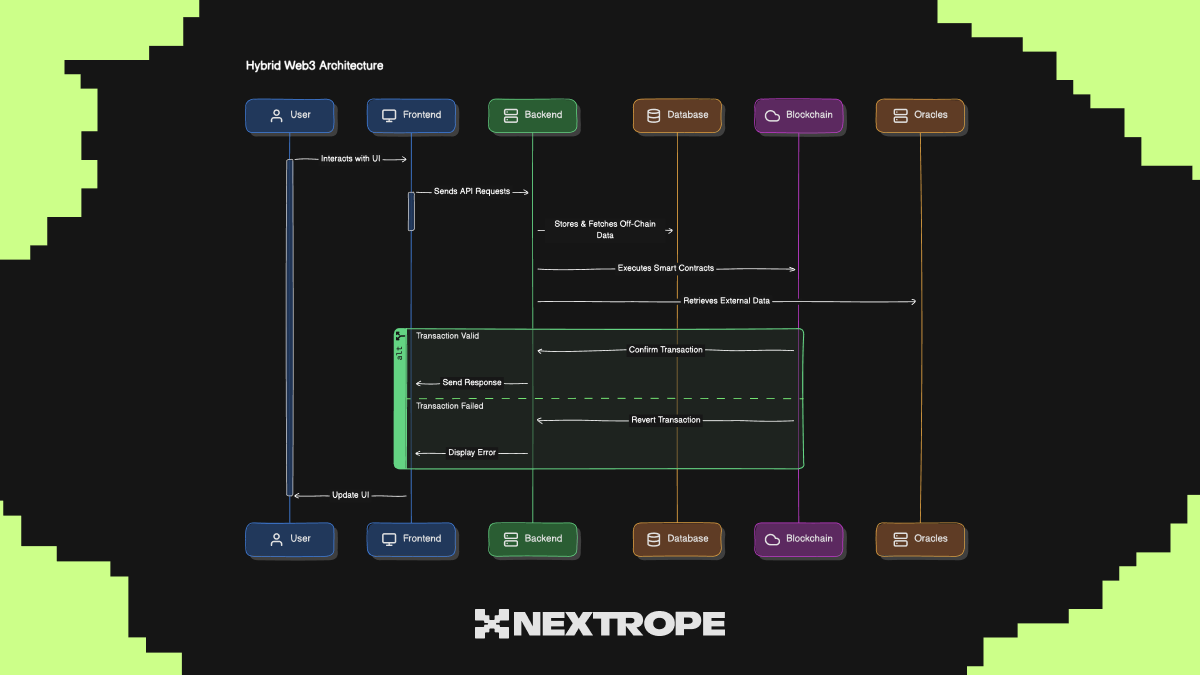
Architecture Diagram

Below is an example diagram showing how a hybrid Web3 application splits responsibilities between backend and blockchain components.

Hybrid Web3 Architecture

Comparing Web3 Backend APIs vs. Blockchain-Based Logic

FeatureWeb3 Backend (API)Blockchain (Smart Contracts)Change ManagementCan be updated easilyEvery change requires a new contract deploymentCostTraditional hosting feesHigh gas fees + costly auditsData StorageCan store large datasetsLimited and expensive storageSecuritySecure but relies on centralized infrastructureFully decentralized & trustlessPerformanceFast response timesLimited by blockchain throughput

Reducing Web3 Costs with AI Smart Contract Audit

One of the biggest pain points in Web3 development is the cost of smart contract audits. Each change to the contract code requires a new audit, often costing tens of thousands of dollars.

To address this issue, Nextrope is developing an AI-powered smart contract auditing tool, which:

Reduces audit costs by automating code analysis.

Speeds up development cycles by catching vulnerabilities early.

Improves security by providing quick feedback.

This AI-powered solution will be a game-changer for the industry, making smart contract development more cost-effective and accessible.

Conclusion

Web3 backend development plays a crucial role in scalable and efficient dApps. While full decentralization is ideal in some cases, many projects benefit from a hybrid architecture, where off-chain components optimize performance, reduce costs and improve user experience.

In future posts in this Web3 backend series, we’ll explore specific implementation details, including:

How to design a Web3 API for dApps

Best practices for integrating backend services

Security challenges and solutions

Stay tuned for the next article in this series!


Source link

Gasless USDT-TRC-20 Transactions Now Live On Tonkeeper Pro

Gasless USDT-TRC-20 Transactions Now Live On Tonkeeper Pro


In Brief

Tonkeeper announced that Tonkeeper Pro now supports USDT TRC-20 tokens without requiring the acquisition of TRX.

Gasless USDT-TRC-20 Transactions Now Live On Tonkeeper Pro

Tonkeeper Wallet, a platform for TON blockchain, announced that its upgraded version, Tonkeeper Pro now supports USDT TRC-20 tokens without requiring the acquisition of TRX. The transaction fees are covered by Tonkeeper Battery, a feature that can be funded with either TON or USDT. 

This service is available for in-app purchases on both iOS and Android devices. The Tonkeeper Battery allows users to preload credits into their wallets, from which transfer fees will be automatically deducted. Additionally, the battery supports a variety of tokens for preloading and facilitates top-ups via bank card through in-app purchases. 

“The mission of Tonkeeper is to make crypto payments easy for everyone and everything,” said CEO Oleg Andreev in a written statement. “With USDT-TRC-20 support in Tonkeeper Pro, users can make USDT payments without having to hold TRX on balance: fees are covered by Tonkeeper Battery. Support for USDT-TRC-20 makes it easier for people to gradually transition to USDT on TON, where transaction fees are significantly lower,” he added.

With the addition of USDT TRC-20 support, Tonkeeper Pro further establishes itself as a payments-focused wallet, enabling users to securely send and receive USDT TRC-20 payments across the TON and TRON ecosystems. Tonkeeper Battery ensures seamless transactions without the need to hold TRX for network fees.

A key challenge in Web3 is maintaining sufficient TRX to cover transaction fees. On the TRON network, USDT transfers require energy and bandwidth, which means users either need to use their available bandwidth or purchase additional resources with TRX.

Tonkeeper Battery, a built-in feature that streamlines transactions, removes this complication. It automatically calculates the required energy and bandwidth, covers the associated costs, and processes the transaction—without the need for TRX. Since its launch, Tonkeeper Battery has supported over 9 million transactions, becoming an essential tool for users managing on-chain payments.

In order to access the new TRC-20 feature, Tonkeeper Pro users can launch the desktop wallet and navigate to Settings. After enabling TRC-20, they can charge Tonkeeper Battery with supported tokens or a bank card, allowing them to send USDT TRC-20 payments without needing TRX for transaction fees.

What Is Tonkeeper Pro?

Tonkeeper is a leading non-custodial wallet for the TON blockchain, known for innovations such as Tonkeeper Battery, which helps manage token and non-fungible token (NFT) fees, and TON Connect, providing secure connections to thousands of Web3 apps.

Tonkeeper Pro is the extended version of Tonkeeper, designed for advanced users, including Web3 enthusiasts, DAOs, and businesses that need a powerful and efficient solution for managing digital assets. Tonkeeper Pro offers a range of features such as Multi-Send, Multisig Wallets, Multi-Accounts, Gasless Transactions, Tonkeeper Battery, and Ledger Support. It is available across all major platforms, including iPad, Linux, Web, and Desktop.

In addition to its advanced functionality, Tonkeeper prioritizes strong security for both individual users and project teams. Furthermore, Tonkeeper boasts the largest developer platform on the TON blockchain, with its TON API being used by over 80% of projects in the ecosystem. 

Disclaimer

In line with the Trust Project guidelines, please note that the information provided on this page is not intended to be and should not be interpreted as legal, tax, investment, financial, or any other form of advice. It is important to only invest what you can afford to lose and to seek independent financial advice if you have any doubts. For further information, we suggest referring to the terms and conditions as well as the help and support pages provided by the issuer or advertiser. MetaversePost is committed to accurate, unbiased reporting, but market conditions are subject to change without notice.

About The Author


Alisa, a dedicated journalist at the MPost, specializes in cryptocurrency, zero-knowledge proofs, investments, and the expansive realm of Web3. With a keen eye for emerging trends and technologies, she delivers comprehensive coverage to inform and engage readers in the ever-evolving landscape of digital finance.

More articles


Alisa Davidson


Alisa, a dedicated journalist at the MPost, specializes in cryptocurrency, zero-knowledge proofs, investments, and the expansive realm of Web3. With a keen eye for emerging trends and technologies, she delivers comprehensive coverage to inform and engage readers in the ever-evolving landscape of digital finance.


More articles


Source link

Does Black Ops 6 Zombies’ Next Map Have a T-Rex Boss Fight?

0
Does Black Ops 6 Zombies’ Next Map Have a T-Rex Boss Fight?


Call of Duty: Black Ops 6 players are discussing the possibility that the upcoming Shattered Veil map could be teasing a boss fight with a dinosaur.

In case you’re not up to speed on the latest Black Ops 6 Zombies news, it is now confirmed that we’ll be getting our next map in Season 3.

Although the major update was initially scheduled for March 20, it has since been delayed and will now arrive on April 3, 2025.

Those who finished The Tomb’s Main Quest will already know that our next destination is Edward Richtofen’s mansion in Liberty Falls. But after Treyarch released a new teaser image of Shattered Veil, some fans believe they’ve already worked out what prehistoric boss we’ll be going up against.

Liberty Falls Mansion Map’s Dinosaur

Even before Treyarch revealed the name of its upcoming Zombies map, the developer had already released several images of the mansion on its social media.

We first saw the Shattered Veil mansion in the Liberty Falls intro cinematic, where it was revealed to be both home to Richtofen and the headquarters of Project Janus.

T-Rex in Liberty Falls Mansion Black Ops 6 Zombies
Richtofen passes the T-Rex in the Liberty Falls cinematic

As Eddie battled the undead on his way to the secret basement containing the Forsaken, he passes a full recreation of a T-Rex near the main staircase.

Now, a new image of the Grand Foyer reveals our first full look at the dinosaur in all its glory. Thankfully, despite the screenshots being dated ten days after the events of the zombie outbreak, the T-Rex looks fully intact.

However, the dinosaur does seem to have moved slightly, and its jaws are no longer as close to the stairs as they were in the trailer…

Dinosaur Statue in Liberty Falls Mansion Black Ops 6 ZombiesDinosaur Statue in Liberty Falls Mansion Black Ops 6 Zombies

Given that the statue in Citadelle des Morts turned out to be the map’s boss, it seems only natural that fans are suspicious that we could be doing battle against a dinosaur boss in our next map.

But is there any truth to this?

Here’s Why It’s Unlikely

Although an undead T-Rex coming to life Night at the Museum-style would be a sight to behold, we think it’s unlikely. The change in position is likely just due to Treyarch making minor tweaks to the map after releasing the cinematic trailer.

What’s more, we’re pretty sure we know who the Shattered Veil boss will be already…

Given that the location was home to series antagonist Eddie Richtofen, it seems only natural that he will be involved heavily with the upcoming round-based map.

Edward Richtofen Black Ops 6 Zombies Mansion MapEdward Richtofen Black Ops 6 Zombies Mansion Map

But given that Richtofen was abducted at the end of the Liberty Falls cinematic, he’s not likely the boss himself.

Instead, we think that S.A.M. could actually be our main enemy this time around, given that the AI appears to originate from the Forsaken’s prison.

The recreation of Samantha Maxis certainly seemed menacing enough in the Liberty Falls intro, and now we’re about to deliver the Sentinel Artifact right into its hands!

Black Ops 6 Zombies Forsaken SAMBlack Ops 6 Zombies Forsaken SAM

Could the mansion’s dinosaur have its own Easter Egg to discover? Perhaps it hides a secret passage, or acts as a trap against the undead?

We’ll have to wait and see when Shattered Veil arrives in Black Ops 6 on April 3.

For more information on the upcoming map, check out everything we know about the next Zombies experience here!


Source link

MEXC Report: Memecoins Made Almost 50% of New Token Listings In February

MEXC Report: Memecoins Made Almost 50% of New Token Listings In February


In Brief

MEXC has released token listing and trading data for January and February, highlighting strong market demand for new tokens, particularly memecoins, despite overall market volatility and downturn.

MEXC Report: Memecoins Made Almost 50% of New Token Listings In February

 MEXC, the leading global cryptocurrency exchange, has released token listing and trading data for January and February, highlighting strong market demand for new tokens, particularly memecoins, despite overall market volatility and downturn. 

Key Takeaways:

Meme coins accounted for 50% of all new tokens listed in January and February.

Seven out of the top 10 tokens by trading volume were launched in February, highlighting continuous demand for promising listings despite market volatility.

The average peak increase for new tokens jumped from 388% in January to 660% in February, with TST surging by 4,792% and ELONSOL rising by 1,128%.

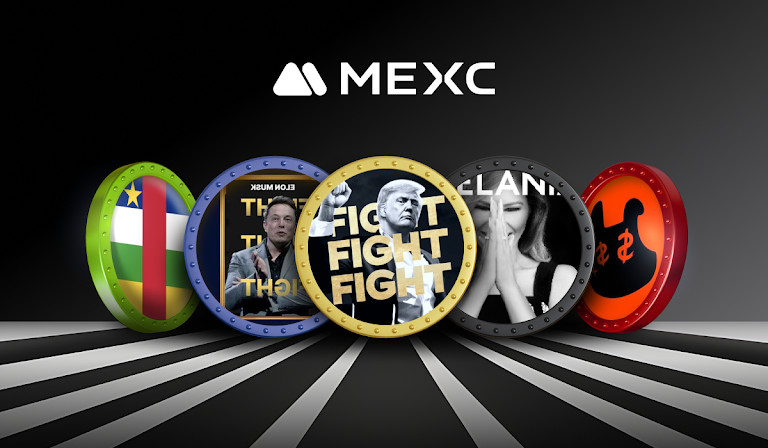
Four of the five best-performing tokens — TST, ELONSOL, MELANIA, and CAR — were linked to public figures, driven by the power of social trends.

TRUMP accounted for over 45% of the total trading volume for new tokens.

The report covers 451 new tokens listed on MEXC between January and February, with memecoins accounting for approximately 50% (245 tokens). This trend reflects the growing investor appetite for community-driven and viral digital assets. 

MEXC Report: Memecoins Made Almost 50% of New Token Listings In February

The findings reflect the growing investor appetite for community-driven assets. Among the top 10 new tokens by trading volume, seven were launched in February, demonstrating sustained demand for high-profile listings despite a more subdued overall market trend in January.

MEXC Report: Memecoins Made Almost 50% of New Token Listings In February

February outperformed January in terms of average peak increases for new tokens, with the figure climbing from 388% to 660%. TST led the surge, reaching a staggering 4,792% increase, with ELONSOL following at 1,128%. The top 10 new tokens by trading volume recorded an average peak increase of 756%, underscoring the high level of trader interest and market activity.

Celebrity and politically themed memecoins demonstrated significant price surges, with four of the top five best-performing tokens — TST, ELONSOL, MELANIA, and CAR — linked to public figures. The top three memecoins (TST, ELONSOL, and MELANIA) recorded an average peak increase of 2,338%, compared to 640% for the top three non-meme tokens (BSX, J, and RIZ).

MEXC Report: Memecoins Made Almost 50% of New Token Listings In February

The TRUMP token was a dominant force in the market, accounting for over 45% of the total trading volume for new tokens. It attracted significant market liquidity and investor interest, strengthening its position as a top-performing asset. 

MEXC’s latest data highlights the continued demand for trendy tokens and social trends, with meme coins driving trading activity. The dominance of meme coins in listings and their record-breaking price surges highlight MEXC’s position as a leading exchange for discovering and trading early digital assets. As the exchange remains committed to supporting innovations and trends, its deep liquidity and diverse listings offer traders unique opportunities in the fast-moving digital asset space.

For more details, please visit link.

About MEXC

Founded in 2018, MEXC is committed to being “Your Easiest Way to Crypto”. Serving over 34 million users across 170+ countries, MEXC is known for its broad selection of trending tokens, frequent airdrop opportunities, and low trading fees. Our user-friendly platform is designed to support both new traders and experienced investors, offering secure and efficient access to digital assets. MEXC prioritizes simplicity and innovation, making crypto trading more accessible and rewarding.

For more information, visit: MEXC Website|X|Telegram|How to Sign Up on MEXC

For media inquiries, please contact Lucia Hu: [email protected]

Disclaimer

In line with the Trust Project guidelines, please note that the information provided on this page is not intended to be and should not be interpreted as legal, tax, investment, financial, or any other form of advice. It is important to only invest what you can afford to lose and to seek independent financial advice if you have any doubts. For further information, we suggest referring to the terms and conditions as well as the help and support pages provided by the issuer or advertiser. MetaversePost is committed to accurate, unbiased reporting, but market conditions are subject to change without notice.

About The Author


Gregory, a digital nomad hailing from Poland, is not only a financial analyst but also a valuable contributor to various online magazines. With a wealth of experience in the financial industry, his insights and expertise have earned him recognition in numerous publications. Utilising his spare time effectively, Gregory is currently dedicated to writing a book about cryptocurrency and blockchain.

More articles


Gregory, a digital nomad hailing from Poland, is not only a financial analyst but also a valuable contributor to various online magazines. With a wealth of experience in the financial industry, his insights and expertise have earned him recognition in numerous publications. Utilising his spare time effectively, Gregory is currently dedicated to writing a book about cryptocurrency and blockchain.


Source link

How to Build a Profitable Crypto Portfolio in 2025: Which One Coin Must I Include That’s Not Stunted Like Ethereum?

How to Build a Profitable Crypto Portfolio in 2025: Which One Coin Must I Include That’s Not Stunted Like Ethereum?


In Brief

In 2025, the crypto market is rapidly growing, with new projects like Rexas Finance offering superior efficiency and real-world applications, positioning it as a must-have asset for building a profitable portfolio.

How to Build a Profitable Crypto Portfolio in 2025: Which One Coin Must I Include That’s Not Stunted Like Ethereum?

The cryptocurrency marketplace is undergoing rapid growth in 2025 as investors expand their pursuit of potentially lucrative assets that extend past Ethereum (ETH). The dominance of ETH invites new projects with superior efficiency, reduced costs and real-world applications to navigate its scalability issues while maintaining its status as an industry leader. Rexas Finance (RXS) emerges as a top RWA tokenization project, which shows tremendous potential in the cryptocurrency market of 2025. If you’re looking to build a profitable crypto portfolio, including RXS could be a game-changer. Here’s why Rexas Finance is the must-have coin of 2025.

Rexas Finance (RXS): The Future of Blockchain-Based Asset Trading

Rexas Finance (RXS) provides concrete value to users through its connection between cryptocurrency and conventional financial systems. Through its platform, users can purchase real-world assets such as real estate together with gold items and fine art from the estimated $500 trillion market value.

Why RXS Stands Out

Real-World Asset (RWA) Tokenization: Converts physical assets into liquid, tradeable digital tokens.

Innovative Tools: Includes the Rexas Token Builder, Rexas Launchpad, and QuickMint Bot for easy token generation.

Fractional Ownership: Through fractional ownership, investors can buy parts of high-value assets, which lowers entrance requirements.

Deflationary Tokenomics: built-in deflation mechanisms create long-term asset scarcity, which boosts its overall value.

Defi leadership belongs to Ethereum, yet congestion issues alongside elevated fees hamper its operational performance. RXS represents an appealing choice because this Ethereum-based ERC-20 standard enables users to access efficient and speedier payment processes at lower costs.

RXS Price Momentum: A Strong Buy Signal

Rexas Finance has seen a massive 566.67% increase in its presale, surging from $0.03 to $0.20. Investors are flocking to RXS, with over 453 million tokens sold and $46.6 million raised.

Key Indicators of RXS’s Future Growth

Presale Success: Each stage sold out early, proving high investor confidence.

Upcoming Exchange Listings: The official launch on June 19, 2025, at $0.25 could spark a major price rally.

Market Analysts’ Predictions: Experts forecast RXS could reach $20, marking a potential 100x return.

With Ethereum facing competition from faster networks, RXS provides a more scalable, real-world-driven alternative for investors seeking exponential growth.

Security and Market Trust

Rexas Finance has undergone a Certik audit, confirming strong security measures. The presence of the token on CoinMarketCap and CoinGecko improves transparency, which enables investors to monitor its performance.

Why RXS Could Outperform ETH in 2025

Mass Adoption of RWA Tokenization – As businesses and individuals embrace tokenized assets, RXS stands to gain significantly.

Deflationary Supply Model – Unlike ETH, which lacks a consistent burn mechanism, RXS’s decreasing supply could drive its price higher.

Scalability & Efficiency – Ethereum still struggles with high gas fees, while RXS provides a cost-effective solution for asset tokenization.

Final Verdict: Should You Include RXS in Your Portfolio?

Absolutely. Rexas Finance (RXS) stands out as the top altcoin to own in 2025 based on its robust presale performance and its practical use cases and predicted upward trend. People seeking the next major cryptocurrency investment beyond Ethereum should prioritize getting RXS tokens. Invest now before the June 19, 2025 launch, and you could maximize your profits before mass adoption takes off. 

Website: https://rexas.com

Whitepaper: https://rexas.com/rexas-whitepaper.pdf

Twitter/X: https://x.com/rexasfinance

Telegram: https://t.me/rexasfinance

Disclaimer

In line with the Trust Project guidelines, please note that the information provided on this page is not intended to be and should not be interpreted as legal, tax, investment, financial, or any other form of advice. It is important to only invest what you can afford to lose and to seek independent financial advice if you have any doubts. For further information, we suggest referring to the terms and conditions as well as the help and support pages provided by the issuer or advertiser. MetaversePost is committed to accurate, unbiased reporting, but market conditions are subject to change without notice.

About The Author


Gregory, a digital nomad hailing from Poland, is not only a financial analyst but also a valuable contributor to various online magazines. With a wealth of experience in the financial industry, his insights and expertise have earned him recognition in numerous publications. Utilising his spare time effectively, Gregory is currently dedicated to writing a book about cryptocurrency and blockchain.

More articles


Gregory, a digital nomad hailing from Poland, is not only a financial analyst but also a valuable contributor to various online magazines. With a wealth of experience in the financial industry, his insights and expertise have earned him recognition in numerous publications. Utilising his spare time effectively, Gregory is currently dedicated to writing a book about cryptocurrency and blockchain.


Source link

Popular Posts

My Favorites

Aave Governance Vote Blocks DAO Takeover of Brand Assets

0
Key Highlights Aave holders rejected a proposal to shift control of brand assets to the DAO, with over 55% voting against it. Some token holders...