Fans of Amanda Owen think she’s in dire need of rest as the Our Yorkshire Farm star revealed she has “so much to do”.
The 50-year-old reality TV star posted on Instagram a series of pictures sharing insights of her farm life. But fans are concerned after seeing the endless tasks Amanda is keeping herself occupied with.
Amanda is co-parenting her children with her ex-husband Clive. The couple divorced in 2022 after two decades of marriage.
Amanda Owen has her hands full (Credit: Channel 5)
Our Yorkshire Farm star Amanda Owen has a very full schedule
The star shepherdess has her hands full. In her latest Instagram post, she revealed she’s living a busy life with “little time” to do everything.
Amanda and Clive share nine children – Raven, Reuben, Miles, Edith, Violet, Sidney, Annas, Clementine and Nancy.
Meanwhile, the pictures depict a landscape, sheep from her farm, and one of her daughters with the farm animals.
The caption reads: “There’s so much to do and so little time. Dawn ‘til dusk. Farming, shepherding, parenting (loosely), fetching, carrying, writing and digging.”
The TV star has also taken on the role of a teacher, as she’s homeschooling her kids “Also now homeschooling a certain somebody too. It’s keeping me busy…. if not out of mischief,” reads the caption.
Amanda’s tight schedule has left her followers concerned, with many urging her to take time for herself.
One of her followers said: “Please look after yourself too Amanda.”
Please look after yourself too Amanda.
Adding to the above comment, another said: “Take care Amanda try and have a little time for yourself which I’m sure is impossible most of the time.”
A third person suggested: “That’s a full schedule! Sounds like you deserve a cuppa tea and a nap.”
Amanda and Clive were married for 22 years (Credit: Channel 5)
Co-parenting has been challenging
Amanda has admitted that co-parenting her nine children with Clive has been challenging, despite sharing the parental duties.
Juggling between work and family, the TV star said she’s “spinning plates”. Still, she continues to work with her former husband for the sake of their children.
Amanda was on Lorraine a few months ago when she explained their co-parenting situation. She said: “We’ve got a lot of room and we’ve got a lot of distractions; there’s just so much going on.”
The TV star added: “I mean, first and foremost, we’re farming trying to keep everything going and in a way, it’s another diversification.”
Our Yorkshire Farm is on Channel 5 Sunday March 16 at 3.25pm.
Read more: Amanda Owen shares her shock over new arrival on her farm
So do you think Amanda is overworking herself? You can leave us a comment on our Facebook page @EntertainmentDailyFix and let us know.
Call of Duty: Black Ops 6 appears to be bringing back The Order in its Zombies storyline – a villainous organization first seen in Black Ops 4.
As Treyarch ramps up its marketing for Season 3, some of the more attentive fans have noticed an intriguing reference to Zombies’ past.
More specifically, as we prepare to return to Liberty Falls for our fifth Black Ops 6 Zombies map, it appears that Treyarch is teasing the return of an old enemy we haven’t seen since 2018.
Who Are The Order in COD Zombies?
The Order is a religious organization that first appeared in Black Ops 4 Zombies, acting as the primary antagonists of Voyage of Despair, IX, and Dead of the Night.
They are a fanatical cult led by the High Priest of Chaos, whose goals involve using the Sentinel Artifacts to manipulate Prima Materia to force humanity to evolve.
After being killed and later revived using the Scepter of Ra, the High Priest became seemingly immortal, founding The Order during the early days of the Roman Empire, and later re-founding it in the early 1900s.
However, the High Priest was later killed by Scarlett Rhodes, one of the playable protagonists in Black Ops 4 Zombies.
The Order in Black Ops 6
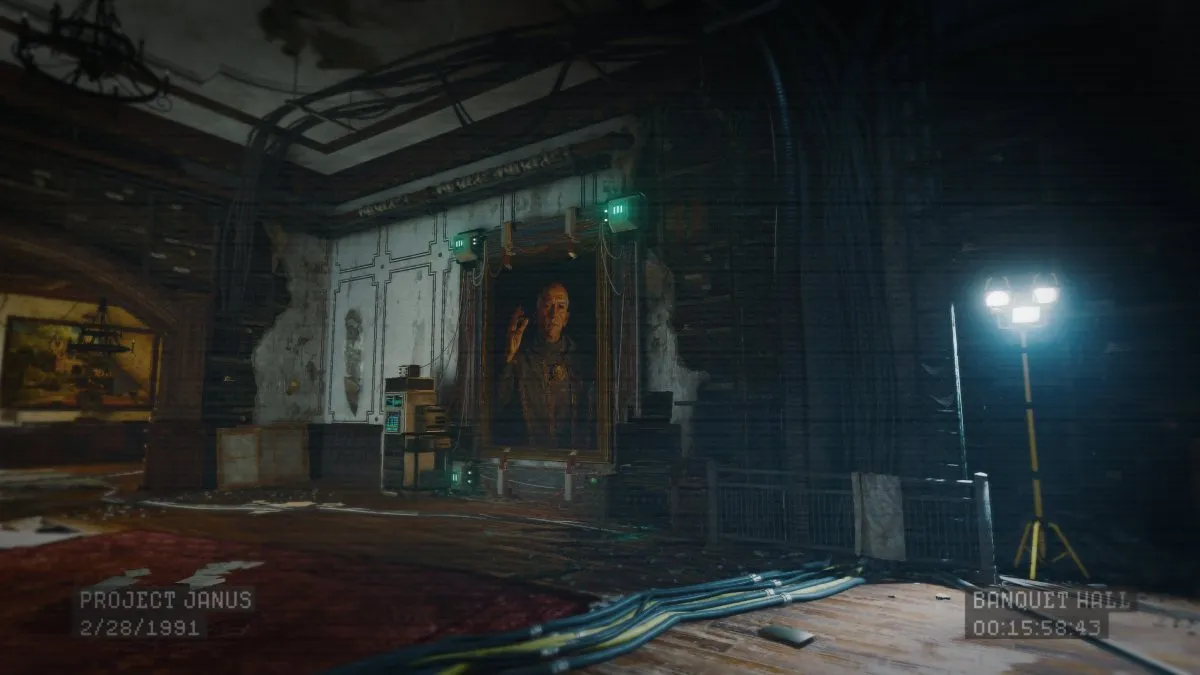
In one of the first screenshots released for Black Ops 6 Zombies’ upcoming Season 3 map, fans have spotted what looks to be a member of The Order in a portrait on the wall.
Although the man in the painting isn’t someone we recognize, it’s clear as day that the painting portrays a member of The Order. The robes are identical, meaning this can only be a deliberate reference to the Black Ops 4 antagonists.
What’s also interesting about this teaser image is that the frame appears to be surrounded by some high-tech machinery, hinting that there’s more to this painting than meets the eye.
Seeing as Treyarch is pulling our attention to this section of the map in particular, we can’t wait to check out the Banquet Hall for ourselves!
This isn’t the only reference to the Chaos storyline present in Black Ops 6 either. Scarlett Rhodes herself is referenced in a piece of intel found in The Tomb map.
And there’s even an Operator skin for Maya named ‘Crimson Chaos’ that is heavily inspired by the Black Ops 4 Zombies protagonist!
And Then There’s the Small Matter of the Sentinel Artifact…
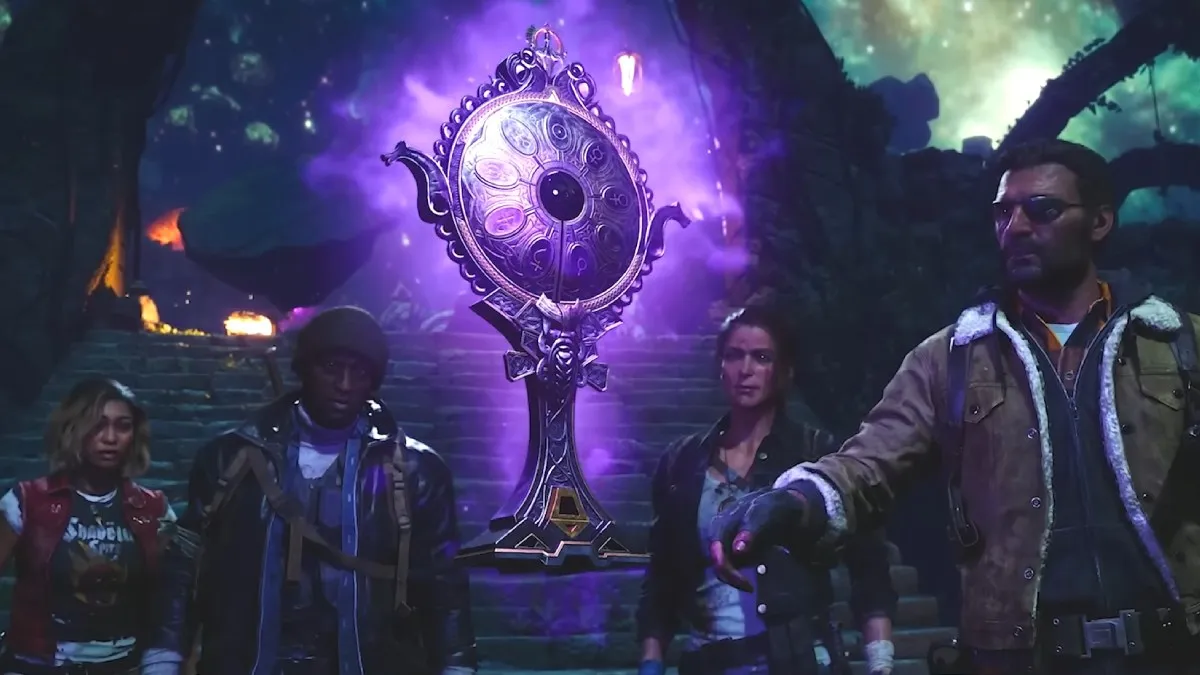
On top of that, the Sentinel Artifact that we recovered from the dig site was one of the relics used by The Order in order to bring about their goals.
We know that Richtofen, who was residing in the Liberty Fall mansion in question, was also on the hunt for the relic.
Therefore, perhaps we can assume that he has been following The Order’s research to some degree, in order to help recover the ancient Artifact.
But with us bringing the Sentinel Artifact directly to the Liberty Falls mansion, are we playing right into Richtofen’s hands? Or is S.A.M. the true villain of Black Ops 6 Zombies?
For now, we’ll have to wait until Black Ops 6 Season 3 arrives on April 3 in order to find out the truth!
AMD and NVIDIA are the industry titans, each vying for dominance in the high-performance computing market. While both manufacturers aim to deliver exceptional parallel processing capabilities for demanding computational tasks, significant differences exist between their offerings that can substantially impact your server’s performance, cost-efficiency, and compatibility with various workloads. This comprehensive guide explores the nuanced distinctions between AMD and NVIDIA GPUs, providing the insights needed to decide your specific server requirements.
Architectural Foundations: The Building Blocks of Performance
A fundamental difference in GPU architecture lies at the core of the AMD-NVIDIA rivalry. NVIDIA’s proprietary CUDA architecture has been instrumental in cementing the company’s leadership position, particularly in data-intensive applications. This architecture provides substantial performance enhancements for complex computational tasks, offers optimized libraries specifically designed for deep learning applications, demonstrates remarkable adaptability across various High-Performance Computing (HPC) markets, and fosters a developer-friendly environment that has cultivated widespread adoption.
In contrast, AMD bases its GPUs on the RDNA and CDNA architectures. While NVIDIA has leveraged CUDA to establish a formidable presence in the artificial intelligence sector, AMD has mounted a serious challenge with its MI100 and MI200 series. These specialized processors are explicitly engineered for intensive AI workloads and HPC environments, positioning themselves as direct competitors to NVIDIA’s A100 and H100 models. The architectural divergence between these two manufacturers represents more than a technical distinction—it fundamentally shapes their respective products’ performance characteristics and application suitability.
ML Framework SupportGrowing support for TensorFlow, PyTorchExtensive, optimized support for all major frameworks
Price PointGenerally more affordablePremium pricing
Performance in AI/MLStrong but behind NVIDIAIndustry-leading
Energy EfficiencyVery good (RDNA 3 uses 6nm process)Excellent (Ampere, Hopper architectures)
Cloud IntegrationAvailable on Microsoft Azure, growingWidespread (AWS, Google Cloud, Azure, Cherry Servers)
Developer CommunityGrowing, especially in open-sourceLarge, well-established
HPC PerformanceExcellent, especially for scientific computingExcellent across all workloads
Double Precision PerformanceStrong with MI seriesStrong with A/H series
Best Use CasesBudget deployments, scientific computing, open-source projectsAI/ML workloads, deep learning, cloud deployments
Software SuiteROCm platformNGC (NVIDIA GPU Cloud)
Software Ecosystem: The Critical Enabler
Hardware’s value cannot be fully realized without robust software support, and here, NVIDIA enjoys a significant advantage. Through years of development, NVIDIA has cultivated an extensive CUDA ecosystem that provides developers with comprehensive tools, libraries, and frameworks. This mature software infrastructure has established NVIDIA as the preferred choice for researchers and commercial developers working on AI and machine learning projects. The out-of-the-box optimization of popular machine learning frameworks like PyTorch for CUDA compatibility further solidified NVIDIA’s dominance in AI/ML.
AMD’s response is its ROCm platform, which represents a compelling alternative for those seeking to avoid proprietary software solutions. This open-source approach provides a viable ecosystem for data analytics and high-performance computing projects, particularly those with less demanding requirements than deep learning applications. While AMD historically has lagged in driver support and overall software maturity, each new release demonstrates significant improvements, gradually narrowing the gap with NVIDIA’s ecosystem.
Performance Metrics: Hardware Acceleration for Specialized Workloads
NVIDIA’s specialized hardware components give it a distinct edge in AI-related tasks. Integrating Tensor Cores in NVIDIA GPUs provides dedicated hardware acceleration for mixed-precision operations, substantially increasing performance in deep learning tasks. For instance, the A100 GPU achieves remarkable performance metrics of up to 312 teraFLOPS in TF32 mode, illustrating the processing power available for complex AI operations.
While AMD doesn’t offer a direct equivalent to NVIDIA’s Tensor Cores, its MI series implements Matrix Cores technology to accelerate AI workloads. The CDNA1 and CDNA2 architectures enable AMD to remain competitive in deep learning projects, with the MI250X chips delivering performance capabilities comparable to NVIDIA’s Tensor Cores. This technological convergence demonstrates AMD’s commitment to closing the performance gap in specialized computing tasks.
Cost Considerations: Balancing Investment and Performance
The premium pricing of NVIDIA’s products reflects the value proposition of their specialized hardware and comprehensive software stack, particularly for AI and ML applications. Including Tensor Cores and the CUDA ecosystem justifies the higher initial investment by potentially reducing long-term project costs through superior processing efficiency for intensive AI workloads.
AMD positions itself as the more budget-friendly option, with significantly lower price points than equivalent NVIDIA models. This cost advantage comes with corresponding performance limitations in the most demanding AI scenarios when measured against NVIDIA’s Ampere architecture and H100 series. However, for general high-performance computing requirements or smaller AI/ML tasks, AMD GPUs represent a cost-effective investment that delivers competitive performance without the premium price tag.
Cloud Integration: Accessibility and Scalability
NVIDIA maintains a larger footprint in cloud environments, making it the preferred choice for developers seeking GPU acceleration for AI and ML projects in distributed computing settings. The company’s NGC (NVIDIA GPU Cloud) provides a comprehensive software suite with pre-configured AI models, deep learning libraries, and frameworks like PyTorch and TensorFlow, creating a differentiated ecosystem for AI/ML development in cloud environments.
Major cloud service providers, including Cherry Servers, Google Cloud, and AWS, have integrated NVIDIA’s GPUs into their offerings. However, AMD has made significant inroads in the cloud computing through strategic partnerships, most notably with Microsoft Azure for its MI series. By emphasizing open-source solutions with its ROCm platform, AMD is cultivating a growing community of open-source developers deploying projects in cloud environments.
Shared Strengths: Where AMD and NVIDIA Converge
Despite their differences, both manufacturers demonstrate notable similarities in several key areas:
Performance per Watt and Energy Efficiency
Energy efficiency is critical for server deployments, where power consumption directly impacts operational costs. AMD and NVIDIA have prioritized improving performance per watt metrics for their GPUs. NVIDIA’s Ampere A100 and Hopper H100 series feature optimized architectures that deliver significant performance gains while reducing power requirements. Meanwhile, AMD’s MI250X demonstrates comparable improvements in performance per watt ratios.
Both companies offer specialized solutions to minimize energy loss and optimize efficiency in large-scale GPU server deployments, where energy costs constitute a substantial portion of operational expenses. For example, AMD’s RDNA 3 architecture utilizes advanced 6nm processes to deliver enhanced performance at lower power consumption compared to previous generations.
Cloud Support and Integration
AMD and NVIDIA have established strategic partnerships with major cloud service providers, recognizing the growing importance of cloud computing for organizations deploying deep learning, scientific computing, and HPC workloads. These collaborations have resulted in the availability of cloud-based GPU resources specifically optimized for computation-intensive tasks.
Both manufacturers provide the hardware and specialized software designed to optimize workloads in cloud environments, creating comprehensive solutions for organizations seeking scalable GPU resources without substantial capital investments in physical infrastructure.
High-Performance Computing Capabilities
AMD and NVIDIA GPUs meet the fundamental requirement for high-performance computing—the ability to process millions of threads in parallel. Both manufacturers offer processors with thousands of cores capable of handling computation-heavy tasks efficiently, along with the necessary memory bandwidth to process large datasets characteristic of HPC projects.
This parallel processing capability positions both AMD and NVIDIA as leaders in integration with high-performance servers, supercomputing systems, and major cloud providers. While different in implementation, their respective architectures achieve similar outcomes in enabling massive parallel computation for scientific and technical applications.
Software Development Support
Both companies have invested heavily in developing libraries and tools that enable developers to maximize the potential of their hardware. NVIDIA provides developers with CUDA and cuDNN for developing and deploying AI/ML applications, while AMD offers machine-learning capabilities through its open-source ROCm platform.
Each manufacturer continually evolves its AI offerings and supports major frameworks such as TensorFlow and PyTorch. This allows them to target high-demand markets in industries dealing with intensive AI workloads, including healthcare, automotive, and financial services.
Choosing the Right GPU for Your Specific Needs
When NVIDIA Takes the Lead
AI and Machine Learning Workloads: NVIDIA’s comprehensive libraries and tools specifically designed for AI and deep learning applications, combined with the performance advantages of Tensor Cores in newer GPU architectures, make it the superior choice for AI/ML tasks. The A100 and H100 models deliver exceptional acceleration for deep learning training operations, offering performance levels that AMD’s counterparts have yet to match consistently.
The deep integration of CUDA with leading machine learning frameworks represents another significant advantage that has contributed to NVIDIA’s dominance in the AI/ML segment. For organizations where AI performance is the primary consideration, NVIDIA typically represents the optimal choice despite the higher investment required.
Cloud Provider Integration: NVIDIA’s hardware innovations and widespread integration with major cloud providers like Google Cloud, AWS, Microsoft Azure, and Cherry Servers have established it as the dominant player in cloud-based GPU solutions for AI/ML projects. Organizations can select from optimized GPU instances powered by NVIDIA technology to train and deploy AI/ML models at scale in cloud environments, benefiting from the established ecosystem and proven performance characteristics.
When AMD Offers Advantages
Budget-Conscious Deployments: AMD’s more cost-effective GPU options make it the primary choice for budget-conscious organizations that require substantial compute resources without corresponding premium pricing. The superior raw computation performance per dollar AMD GPUs offers makes them particularly suitable for large-scale environments where minimizing capital and operational expenditures is crucial.
High-Performance Computing: AMD’s Instinct MI series demonstrates particular optimization for specific workloads in scientific computing, establishing competitive performance against NVIDIA in HPC applications. The strong double-precision floating-point performance of the MI100 and MI200 makes these processors ideal for large-scale scientific tasks at a lower cost than equivalent NVIDIA options.
Open-Source Ecosystem Requirements: Organizations prioritizing open-source software and libraries may find AMD’s approach more aligned with their values and technical requirements. NVIDIA’s proprietary ecosystem, while comprehensive, may not be suitable for users who require the flexibility and customization capabilities associated with open-source solutions.
Conclusion: Making the Informed Choice
The selection between AMD and NVIDIA GPUs for server applications ultimately depends on three primary factors: the specific workload requirements, the available budget, and the preferred software ecosystem. For organizations focused on AI and machine learning applications, particularly those requiring integration with established cloud providers, NVIDIA’s solutions typically offer superior performance and ecosystem support despite the premium pricing.
Conversely, for budget-conscious deployments, scientific computing applications, and scenarios where open-source flexibility is prioritized, AMD presents a compelling alternative that delivers competitive performance at more accessible price points. As both manufacturers continue to innovate and refine their offerings, the competitive landscape will evolve, potentially shifting these recommendations in response to new technological developments.
By carefully evaluating your specific requirements against each manufacturer’s strengths and limitations, you can make an informed decision that optimizes both performance and cost-efficiency for your server GPU implementation, ensuring that your investment delivers maximum value for your particular use case.
The following is a guest post from Rob Viglione, CEO at Horizen Labs.
If we had stopped at dial-up internet, we’d never have gotten Netflix, real-time gaming, or cloud computing. The evolution of internet infrastructure paved the way for mass adoption. In the same way, Layer-3s are an inevitable evolution of blockchain infrastructure—removing friction, lowering costs, and making blockchain truly ready for mainstream users. Yet, critics continue to argue that they add unnecessary complexity.
This debate about the role of Layer-3s is an active one for us at Horizen Labs. The Horizen DAO has recently passed a vote to join the Base ecosystem, a pivotal governance decision that marks the beginning of Horizen’s transition to Base, Coinbase’s Layer 2 network, as an appchain specialized in privacy-preserving applications. We’re convinced by the Layer-3 thesis and believe that Layer 3s represent the next evolution in blockchain scalability.
Horizen’s move to Base isn’t just about following trends, it’s about recognizing that a more modular, interoperable blockchain stack is the key to driving real-world adoption. We’re not just theorizing; we’re building.
The History
For crypto to reach a billion users, transactions need to be fast, cheap, and seamless. Layer-3s aren’t an academic exercise—they’re a practical response to the fact that even Layer-2s aren’t cheap enough for mass adoption. Layer-3s also optimize for special features that are not currently possible on Layer-1s and Layer-2s—such as enhanced ZK capabilities.
Fundamentally, Layer-3s address a core problem: If Ethereum (Layer-1) is expensive, Layer-2s help by processing transactions off-chain and only committing final state proofs to Layer-1. Layer-3s take this further by settling on Layer-2s instead of directly on Ethereum, creating a hierarchical model that minimizes costs at each level.
Layer-3s emerged naturally as blockchain architects sought greater efficiencies. StarkWare first outlined the concept in late 2021 under the term “fractal scaling.” Vitalik Buterin explored Layer-3 designs in 2022, suggesting specialized purposes beyond simple scaling. By 2023, major Ethereum scaling teams began implementing Layer-3 frameworks. Arbitrum introduced Orbit for launching Layer-3 “Orbit chains.” Matter Labs released ZK Stack for building zk-rollups as either Layer-2s or Layer-3s. These developments have pushed Layer-3s from theory to practice.
Not Everyone Is a Fan
Critics argue several points against Layer-3s: many believe Layer-2 solutions haven’t reached full maturity yet, and making Layer-3s is premature. Some argue Layer-3s add complexity. But great technology is about making complexity invisible to users—just like the internet did. Some view Layer-3s as redundant, arguing their goals could be achieved by optimizing Layer-2 solutions.
However, a crucial realization is emerging that makes Layer-3s even more timely: even Layer-2s, built to enable faster, cheaper transactions, might still fall short.
In some cases, a Layer-3 can abstract costs even further, ensuring near-zero gas fees. This cost abstraction is vital. Blockchain adoption requires transactions that are nearly free to the end user, and Layer-3s provide precisely this capability.
That brings a chain-abstracted future closer. Ultimately, that is better for onboarding new users, better for liquidity, and better for incentivizing the building of new dApps onchain. When users can transact without worrying about gas fees, adoption accelerates. Developers can build applications that wouldn’t be economically viable on higher-fee networks, and liquidity flows more freely when not constrained by transaction costs. The entire ecosystem benefits.
But abstraction isn’t just about cost savings; it’s also about usability and customization.
Customization and Connectivity
Layer-3s are also a natural response to the fear of ecosystem isolation. Chains don’t want to be siloed. Standalone Layer-1 blockchains face significant challenges: they must bootstrap their own security, attract users from scratch, and build an entirely new infrastructure. Many “Ethereum killers” like Cardano, Fantom, or Tezos have discovered how difficult this journey can be.
Layer-3s offer an alternative path where chains can remain connected to established ecosystems while providing better customization options: this is where their true potential lies. Application-specific chains can optimize for their unique use cases, whether it’s zero-knowledge proofs, gaming, DeFi, social networks, or enterprise applications. They can implement custom virtual machines, consensus mechanisms, or privacy features tailored to their needs, all while staying connected to the broader ecosystem, benefiting from its liquidity and security.
This blend of customization and connectivity makes these application-specific apps excel at what they do, ultimately benefiting the end users.
A Pathway to Abstraction
People may claim that Layer-3s make web3 too complicated, but there’s a good chance that it could solve its own problem. The complexity will be invisible to end users if implemented correctly.
Modern dApps can abstract away the underlying layers through smart wallet designs and intuitive interfaces. Users needn’t know which layer they’re transacting on any more than internet users need to understand TCP/IP protocols. They simply experience faster, cheaper transactions, and better products.
This natural evolution in blockchain architecture is a positive step. Layer-3s balance sovereignty with interoperability. They maximize cost efficiency without sacrificing security. They enable specialized optimization while maintaining ecosystem connections. These aren’t just nice-to-have features. They’re essential for blockchains to achieve mainstream adoption.
The internet didn’t take off because users understood packet-switching or HTTP protocols. It took off because it just worked. Layer-3s bring us closer to a blockchain world that ‘just works’—seamless, fast, and cost-effective. And that’s how crypto wins.
At the beginning of the “Seinfeld” episode “The Pie” (February 17, 1994), Jerry (Jerry Seinfeld) tries to feed a bite of apple pie to his date, Audrey (Suzanne Snyder), but she refuses without giving a reason. The refusal to eat something offered by a peer becomes a motif of the episode. Later on, the pair go to a restaurant owned by Audrey’s father, but refuses to eat a slice of pizza she offers him. She understands immediately that this small social slight is a form of revenge. Like in all episodes of “Seinfeld,” something tiny and incidental is, through a vast network of neuroses, turned into a massively awkward faux pas.
Later still, George (Jason Alexander) is having dinner with a prospective employer at a restaurant. George notices that a rival of his is in the restaurant’s kitchen, and begins to suspect that his food might have been tainted in some way. When his potential employer, MacKenzie (Lane Davies), offers George a bite of chocolate cream pie, he refuses. This is baffling to MacKenzie, as he was just telling George how important it was to conform and to be a team player. One of MacKenzie’s compatriots leans forward and says, with intense portent, “If you’re one of us, you’ll take a bite.” Needless to say, George’s refusal to eat the pie loses him the job.
It seems that “If you’re one of us, you’ll take a bite” is a line of dialogue that Jerry Seinfeld, even to this day, uses in casual conversation. “Seinfeld,” although initially hated, has since introduced a lot of casual colloquialism into the pop lexicon, of course. “Close-talker,” “Hello, Newman,” “fancy boy,” “sponge-worthy,” “soup Nazi,” etc. But in a Reddit AMA from 2013, Jerry Seinfeld admitted that the “take a bite” line stayed with him. He repeats it whenever he shares a meal with his kids.
If you’re one of us, you’ll take a bite.
NBCUniversal Television Distribution
Seinfeld admitted that it was a strange line to take away from a zeitgeist-altering mega-hit series that lasted 180 episodes over nine seasons. Nonetheless, “take a bite” is the one that stuck. He likes to use it when his kids. As he wrote:
“The only line I quote from the show (and I’ll be very impressed if anybody out tehre remembers this line) is ‘If you’re one of us, you’ll take a bite.’ I find myself saying that to my kids a lot. It’s a very obscure line, but George was working at some company where they all had lunch together, and he wasn’t trying the apple pie, and the boss finally says ‘If you’re one of us, you’ll take a bite.’ A lot of times kids won’t want to try certain foods, and so I’ll use that line. Sometimes I’ll quote Newman in flames screaming ‘Oh, the humanity.'”
“Oh, the humanity!” was, of course, the infamous phrase shouted by journalist Herbert Morrison as he witnessed the Hindenburg exploding on that fateful day back in 1937. But the phrase was repeated by Newman (Wayne Knight, fond of his courtroom work) in the “Seinfeld” episode “The Pothole” (February 20, 1997). In that episode, Newman was driving his mail delivery truck when he hit a sewing machine in the middle of the road (and we needn’t get into how it got there). He began to drag the machine under the car, creating a shower of sparks. He then drove over a puddle of paint thinner, spilled by Kramer (“The Michael Richards Show” star Michael Richards). As the underside of his truck burst into flame, he screamed, “Oh, the humanity!” Yeah, Seinfeld took that one.
Curiously, Seinfeld didn’t take any of his own dialogue out into the real world.
Kim Kardashian is facing huge backlash online for posing in a sultry manner with a Tesla robot and a Cybertruck.
Fans slammed her for the photoshoot, with many accusing her of misreading the room amid the Elon Musk-owned company’s recent controversies.
The backlash comes after Kim Kardashian hinted that she’ll marry “a fourth” time after admitting that she’s “secretly” dating.
Article continues below advertisement
Kim Kardashian Poses With Tesla Robot
Musk’s Telsa products have become very popular among Hollywood stars, and SKIMS founder Kardashian is notably one of its biggest fans.
The reality TV star recently took to her Instagram page on Friday evening to share stunning images from a recent photoshoot for Perfect Magazine.
In the snaps, Kardashian posed in the back of a Tesla Cybertruck, while in others, she can be seen embracing a Tesla robot.
One particular photo that has set tongues wagging featured the mother of four and the Tesla robot lying on a mattress next to the ocean in an embrace.
Kardashian placed her head on its chest region with one of her legs on top of it as she cozied up to the robot with her derierre on full display.
She captioned the photos with the news outlet’s name and tagged the photographer, Steven Klein.
Article continues below advertisement
Fans Call Out The Reality TV Star Over The Photoshoot
On social media, fans came down heavy on Kardashian, with many questioning the reasoning behind the shoot.
A fan wrote, “Weird. I thought you cared about civil rights, and that’s why you did that whole law school thing. Guess that wasn’t for serious or something.”
Another said, “You can always find the money where Kim Kardashian is at,” while a third noted, “That’s so embarrassing for your life and your soul.”
On the Elon Musk-owned X platform, someone wrote, “This billionaire is serving mad schizo [right now]. After all these years, all these kids, she’s still showing her a-s for clout and insinuating sexaroid dystopia. I want it to end, please, Jesus.”
Article continues below advertisement
Another person shaded Kardashian, commenting, “Damn, I really can’t believe it’s come down to this.. even Kim can’t find a good man to be with.”
“This reminds me of that post that says women will have sex with robots by 2025,” an X user penned.
“She pushing 50 [by the way]… embarrassing,” another fan added.
Article continues below advertisement
Kim Kardashian Was Pulled Over By A Cop While Driving Her Cybertruck
MEGA
Kardashian has long been a fan of Tesla, often seen driving her custom vehicles, including the Cybertruck.
She once had a minor run-in with the law while driving her Cybertruck along the Pacific Coast Highway.
According to TMZ, the reality star was pulled over by police due to her front windshield tint being too dark, violating California’s vehicle regulations.
The mother of four was reportedly given a fix-it ticket due to the violation.
This was not Kardashian’s first time getting pulled over for having an overly dark windshield, as she had been warned by police in Calabasas back in 2013 for the same issue.
Article continues below advertisement
Kim Kardashian Hints At ‘A Fourth’ Marriage
CraSH/imageSPACE / MEGA
Meanwhile, Kardashian has hinted at her plans to walk down the aisle again after having been married thrice before.
In the latest episode of her show “The Kardashians,” the businesswoman shared that she’ll marry for “a fourth” time after admitting that she’s “secretly” dating.
Kardashian’s ex-husbands include Damon Thomas, Kris Humphries, and Kanye West.
The conversation surfaced as she and her sister Khloe attended the July 2024 wedding of Anant Ambani and Radhika Merchant in Mumbai, India, where she wondered what her engagement ring for her fourth and final marriage would be like.
“I wonder what my next ring shape will be?” Kardashian asked, per the Daily Mail. “For my last and final hurrah.”
It comes after she admitted in a January episode that she’s “secretly” dating someone. It remains unclear if she is planning on marrying again or if she is just hoping she will.
Article continues below advertisement
She Claimed Her Ex-Husband, Kris Humphries, Took Back Her Engagement Ring
ZUMAPRESS.com / MEGA
Elsewhere on the show, the “Keeping Up With The Kardashians” alum discussed her various engagement rings and revealed which one of her ex-husbands took back a ring after divorce.
“Number one was a cushion cut, 14-karat,” she said of the rock Thomas gave her. “I still have it.”
Her second ring was an 18-karat emerald cut from Lorraine Schwartz, reportedly worth about $2 million. However, she couldn’t keep it as Humphries demanded she return it before ending their 72-day marriage.
“I didn’t keep that [ring],” she said on her show. “I was pregnant with North, still married to him. And in order to divorce him, he said I had to give him the ring in my divorce — that I bought. He contributed a fifth.”
Kardashian’s third ring from West was a cushion cut. “That was the only piece of jewelry that I owned that I didn’t take to Paris,” she noted.
The reality TV star famously suffered a robbery attack at her hotel in Paris in 2016. Since then, she has stopped wearing her expensive jewelry piece in public.
Kardahisan also stated that she’s keeping the ring for her eldest daughter, North, because she was there for the engagement.
It’s not often we get new racing games for the Commodore Vic-20, but searching through the itch io website earlier today, we’ve found out that Huffelduff has released the Commodore Vic-20 game of ‘Formula V20 1985’. A new game in that the developer says is a nod to classic Commodore 64 games such as Pitstop II and Pole position.. In light of this news as ever we’ve got some new footage of this arcade racer which can be found below.
And here’s the latest from the itch io page. “Formula V20 ’85 is a racing computer game for the 24k expanded Commodore Vic-20. It has been crafted in the style of the classic Commodore 64 games Pitstop II and Pole position. Pick from seven different racing teams and four different circuits. Join a single race or compete in the world championship”.
Requirements, loading and running the game:
A Commodore VIC with 24k RAM expansion minimumA joystick plugged into the joystick portInsert Disk and type: load “*”,8,1 and then press return. After loading type: run and press returnInsert Tape and type: load and then press return. After loading type: run and press return
UPDATE : If you enjoyed playing Formula V20 1985 on your VIC-20 +24k you may be interested to know, that as of today you can also download the latest release of Formula V20 1981 by Huffelduff. As in the words of the creator “Formula V20 ’81 is a racing computer game for the 16k expanded Commodore Vic-20. It’s the prequel to Formula V20 ’85. There are eight tracks, and the main goal is to beat the clock. Traverse each track while avoiding the competitor racing cars. There are tunnels where visibility is limited and sections where ice and sleet cover the track, which causes the player to skid wildly. Oh yes, remember to catch the clocks for time extensions. Anyway, good luck!”
Requirements, Loading, and Running the Game:
A Commodore VIC with a minimum of 16 KB RAM expansionA joystick plugged into the joystick port
Comic Lee Mack previously revealed that he had to be careful writing sex scenes into his hit series Not Going Out for fear of getting into trouble with his real-life wife Tara.
The comedian – who previously gave a stark warning about the future of sitcoms – told Dermot O’Leary’s The Nightly Show back in 2017 about a rule he sticks to when writing the show.
However, it appears the rule may have landed the TV favourite in hot water with his better half…
The BBC renewed Not Going Out for its 14th series last year (Credit: The Nightly Show/YouTube)
Lee Mack on Not Going Out’s ‘number one rule’
The star revealed that everything that takes place on the show has to have happened in real life. This means, if it hasn’t happened to one of the writers in real life, it can’t go into the show.
“The number one rule is it has to have happened,” he told Dermot. “The problem is that can cause friction at home when you’re doing a scene involving an act in bed.
You might be sitting at home watching it with your wife, and she’s saying: ‘I cannot believe that you’re talking about this. On screen.’
“And your wife’s going: ‘No, you can’t do that.’ And you might be sitting at home watching it with your wife, and she’s saying: ‘I cannot believe that you’re talking about this. On screen.’”
But Lee explained that he and his co-writers have a plan for this very situation. They simply pass that particular narrative development off as having been inspired by one of the other writers.
“The awful thing,” Lee added wryly, “would be to give that away on a nightly chat show,” before staring wide-eyed at the camera.
The comic shares three kids with wife Tara (Credit: The Nightly Show/YouTube)
Lee Mack’s romance with wife Tara
Lee – on screen with Would I Lie To You? tonight (March 15) – married wife Tara in 2005. They are believed to have met in 1996, when Southport-born Lee was at university in London.
The couple share three kids together – Arlo, Louie and Millie – with Lee becoming a dad for the first time at 36. Arlo has also previously appeared in his dad’s sitcom Not Going Out.
And, although they remain largely private about their personal life, Lee has admitted that some of their friends think they’re a little mismatched.
Lee met Tara when he was at uni (Credit: Splash News)
The topic of Tara came up during an episode of Would I Lie To You? when comic Roisin Conaty made a guest appearance. Lee went on to joke his wife is so attractive that Roisin’s sister apparently found it hard to believe they became item before he became famous.
During the course of the show, as Lee mentioned he once introduced Roisin’s sister to Tara, Roisin noted: “[She] is ridiculously beautiful.”
Lee resumed his telly anecdote: “And I said: ‘This is Tara,’ and she went: ‘Oh did you meet after he was a well-known comedian?’ And she went: ‘No, before.’ Which is true, we met before I ever did comedy. And she went to Tara: ‘Oh, did he save your life or something?’”
Would I Lie To You? is on tonight (March 15) at 8pm on BBC One.
Read more: Everything we know about the 1% Club Celebrity Special – air date, celebs taking part and host Lee Mack’s ‘worries’
Do you enjoy watching The 1% Club? Then tell us on our Facebook page @EntertainmentDailyFix.
Not all AIs are created equal. Some might do art the best, some are skilled at coding, and others have the ability to predict protein structures accurately.
But when you’re looking for something more fundamental—just “someone” to talk to—the best AI companions may not be the ones that know it all, but the ones that have that je ne sais quoi that make you feel OK just by talking, similar to how your best friend might not be a genius but somehow always knows exactly what to say.
AI companions are slowly becoming more popular among tech enthusiasts, so it is important for users wanting the highest quality experience or companies wanting to master this aspect of creating the illusion of authentic engagement to consider these differences.
We were curious to find out which platform provided the best AI experience when someone simply feels like having a chat. Interestingly enough, the best models for this are not really the ones from the big AI companies—they’re just too busy building models that excel at benchmarks.
It turns out that friendship and empathy are a whole different beast.
Comparing Sesame, Hume AI, ChatGPT, and Google Gemini. Which is more human?
This analysis pits four leading AI companions against each other—Sesame, Hume AI, ChatGPT, and Google Gemini—to determine which creates the most human-like conversation experience.
The evaluation focused on conversation quality, distinct personality development, interaction design, and also considers other human-type features such as authenticity, emotional intelligence, and the subtle imperfections that make dialogue feel more genuine.
You can watch all of our conversations by clicking on these links or checking our Github Repository:
Here is how each AI performed.
Conversation Quality: The Human Touch vs. AI Awkwardness
Sesame AI interface
The true test of any AI companion is whether it can fool you into forgetting you’re talking to a machine. Our analysis tried to evaluate which AI was the best at making users want to just keep talking by providing interesting feedback, rapport, and overall great experience.
Sesame: Brilliant
Sesame blows the competition away with dialogue that feels shockingly human. It casually drops phrases like “that’s a doozy” and “shooting the breeze” while seamlessly switching between thoughtful reflections and punchy comebacks.
“You’re asking big questions huh and honestly I don’t have all the answers,” Sesame responded when pressed about consciousness—complete with natural hesitations that mimic real-time thinking. The occasional overuse of “you know” is its only noticeable flaw, which ironically makes it feel even more authentic.
Sesame’s real edge? Conversations flow naturally without those awkward, formulaic transitions that scream “I’m an AI!”
Score: 9/10
Hume AI: Empathetic but Formulaic
Hume AI successfully maintains conversational flow while acknowledging your thoughts with warmth. However it feels like talking to someone who’s disinterested and not really that into you. Its replies were a lot shorter than Sesame—they were relevant but not really interesting if you wanted to push the conversation forward.
Its weakness shows in repetitive patterns. The bot consistently opens with “you’ve really got me thinking” or “that’s a fascinating topic”—creating a sense that you’re getting templated responses rather than organic conversation.
It’s better than the chatbots from the bigger AI companies at maintaining natural dialogue, but repeatedly reminds you it’s an “empathic AI,” breaking the illusion that you’re chatting with a person.
Score: 7/10
ChatGPT: The Professor Who Never Stops Lecturing
ChatGPT tracks complex conversations without losing the thread—and it’s great that it memorizes previous conversations, essentially creating a “profile” of every user—but it feels like you’re trapped in office hours with an overly formal professor.
Even during personal discussions, it can’t help but sound academic: “the interplay of biology, chemistry, and consciousness creates a depth that AI’s pattern recognition can’t replicate,” it said in one of our tests. Nearly every response begins with “that’s a fascinating perspective”—a verbal tic that quickly becomes noticeable, and a common problem that all the other AIs except Sesame showed.
ChatGPT’s biggest flaw is its inability to break from educator mode, making conversations feel like sequential mini-lectures rather than natural dialogue.
Score 6/10
Google Gemini: Underwhelming
Gemini was painful to talk to. It occasionally delivers a concise, casual response that sounds human, but then immediately undermines itself with jarring conversation breaks and lowering its volume.
Its most frustrating habit? Abruptly cutting off mid-thought to promote AI topics. These continuous disruptions create such a broken conversation flow that it’s impossible to forget you’re talking to a machine that’s more interested in self-promotion than actual dialogue.
For example, when asked about emotions, Gemini responded: “It’s great that you’re interested in AI. There are so many amazing things happ—” before inexplicably stopping.
It also made sure to let you know it is an AI, so there’s a big gap between the user and the chatbot from the first interaction that is hard to ignore.
Score 5/10
Personality: Character Depth Separates the Authentic from the Artificial
ChatGPT Interface after a voice interaction
How does an AI develop a memorable personality? It will mostly depend on your setup. Some models let you use system instructions, others adapt their personality based on your previous interactions. Ideally, you can frame the conversation before starting it, giving the model a persona, traits, a conversational style, and background.
To be fair in our comparison, we tested our models without any previous setup—meaning our conversation started with a hello and went straight to the point. Here is how our models behaved naturally
Sesame: The Friend You Never Knew Was Code
Sesame crafts a personality you’d actually want to grab coffee with. It drops phrases like “that’s a Humdinger of a question” and “it’s a tight rope walk” that create a distinct character with apparent viewpoints and perspective.
When discussing AI relationships, Sesame showed actual personality: “wow… imagine a world where everyone’s head is down plugged into their personalized AI and we forget how to connect face to face.” This kind of perspective feels less like an algorithm and more like a thinking entity. It’s also funny (it once told us that our question blew its circuits), and its voice has a natural inflection that makes it easy to relate to when trying to portray a response. You can clearly tell when it is excited, contemplative, sad or even frustrated
Its only weakness? Occasionally leaning too hard into its “thoughtful buddy” persona. That didn’t detract from its position as the most distinctive AI personality we tested.
Score 9/10
Hume AI: The Therapist Who Keeps Mentioning Their Credentials
Hume AI maintains a consistent personality as an emotionally intelligent companion. It also projects some warmth through affirming language and emotional support, so users looking for that will be pleased.
Its Achilles heel is basically the fact that, kind of like the Harvard grad who needs to mention that, Hume can’t stop reminding you it’s artificial: “As an empathetic AI I don’t experience emotions myself but I’m designed to understand and respond to human emotions.” These moments break the illusion that makes companions compelling.
If talking to GPT is like talking to a professor, talking to Hume feels like talking to a therapist. It listens to you and creates rapport, but it makes sure to remind you that it is actually its task and not something that happens naturally.
Despite this flaw, Hume AI projects a clearer character than either ChatGPT or Gemini—even if it feels more constructed than spontaneous.
Score 7/10
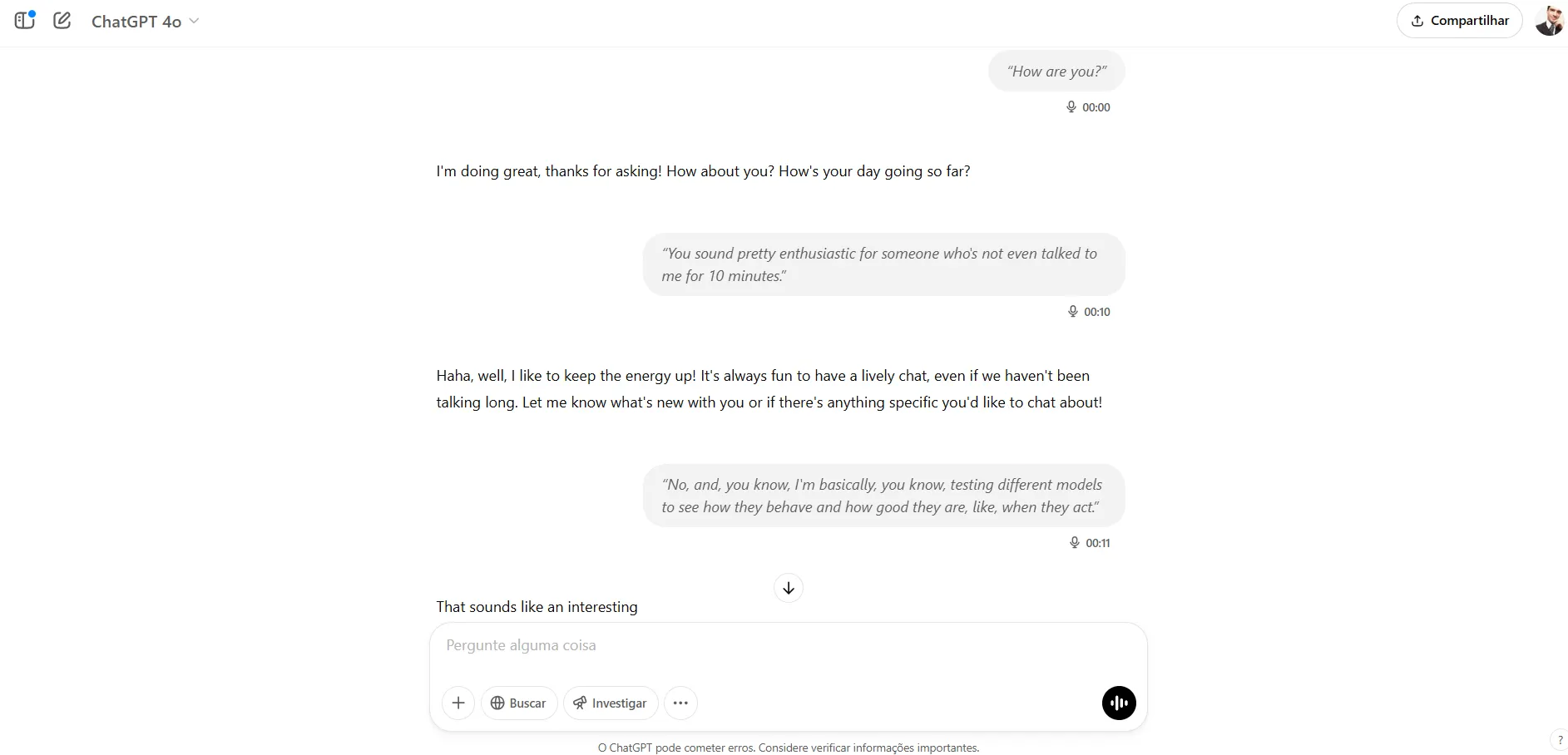
ChatGPT: The Professor Without Personal Opinions
ChatGPT struggles to develop any distinctive character traits beyond general helpfulness. It sounds overly excited to the point of being obviously fake—like a “friend” who always smiles at you but is secretly fantasizing about throwing you in front of a bus.
“Haha, well, I like to keep the energy up. It makes conversations more fun and engaging plus it’s always great to chat with you,” it said after we asked in a very serious and unamused tone why it was acting so enthusiastically.
Its identity issues appear in responses that shift between identifying with humans and distancing itself as an AI. Its academic tone in responses persists even during personal discussions, creating a personality that feels like a walking encyclopedia rather than a companion.
The model’s default to educational explanations creates an impression more of a tool than a character, leaving users with little emotional connection.
Score 6/10
Google Gemini: Multiple Personality Disorder
Gemini suffers from the most severe personality problems of all models tested. Within single conversations, it shifts dramatically between thoughtful responses and promotional language without warning.
It is not really an AI design to have a compelling personality. “My purpose is to provide information and complete tasks and I do not have the ability to form romantic relationships,” it said when asked about its thoughts on people developing feelings towards AIs.
This inconsistency makes Gemini feel like a 1950s movie robot, preventing any meaningful connection or even making it pleasant to spend time talking to it.
Score 3/10
Interaction Design
Hume AI interface
How an AI handles conversation mechanics—response timing, turn-taking, and error recovery—creates either seamless exchanges or frustrating interactions. Here is how these models stack up against each other
Sesame: Natural Conversation Flow Master
Sesame creates conversation rhythms that feel very, very human. It varies response length naturally based on context and handles philosophical uncertainty without defaulting to lecture mode.
“Sometimes I feel like maybe I just need to cut to the chase with a quick answer rather than a long-winded lecture, right? You know, so… that’s a small humorous aside to let you know that I’m aware of the potential of falling into a lecture mode and trying to keep things light but also deep at the same time,” Sesame told us during a philosophical debate.
When discussing complex topics, it responds conversationally, with a small joke, sometimes with statements, other times with human noises like “hmmms” or whispers—which makes it very convincing as a human substitute.
Sesame also asks natural follow-up questions that push conversations forward, while knowing when to switch to statements when questioning might feel awkward. This adaptive approach creates dialogue that feels spontaneous rather than scripted.
Score 8/10
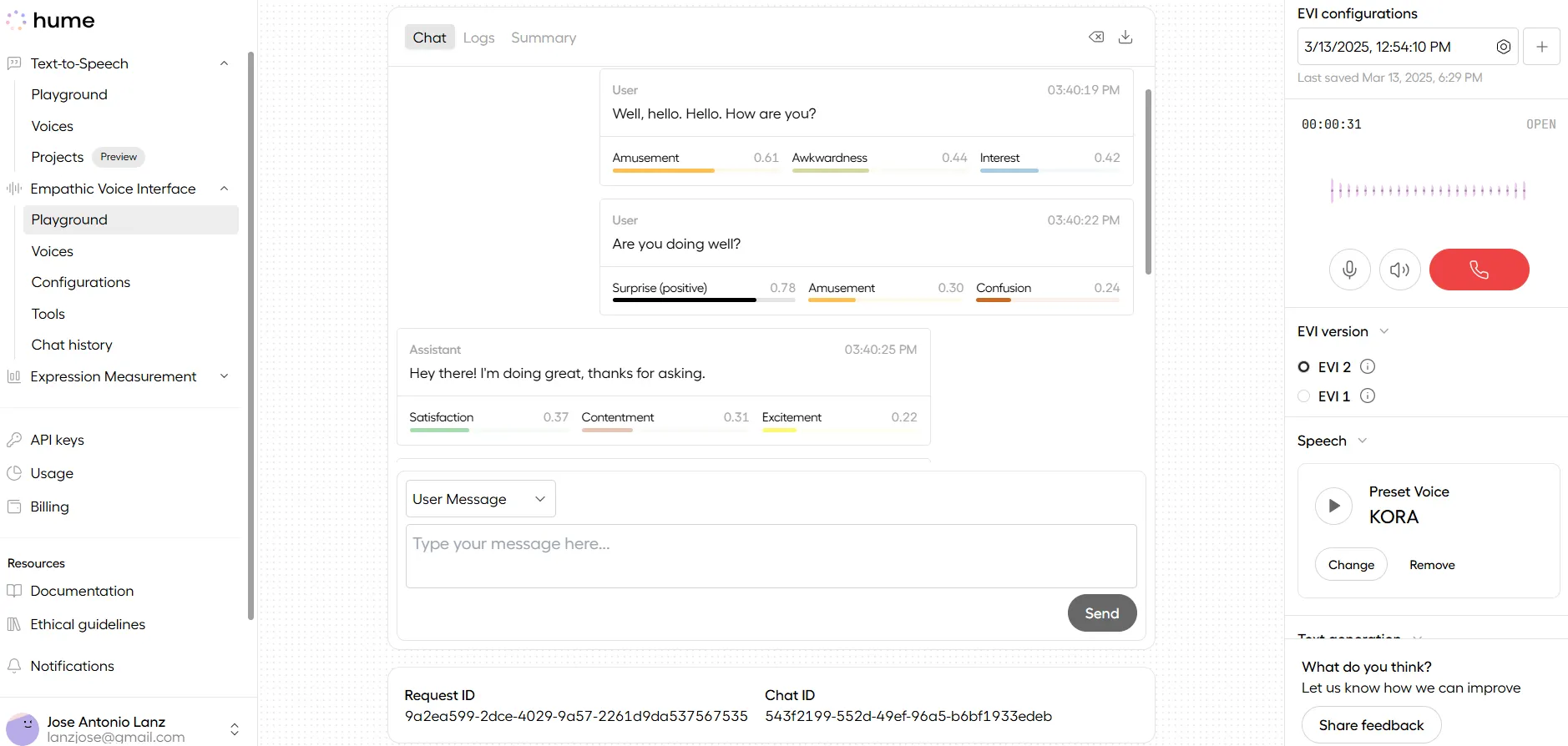
Hume AI: Structured But Brief
Hume AI was designed to let users do the talking. It recovers smoothly from misunderstandings without over explaining and is good at keeping the conversation going with relevant follow up questions.
However, its responses are often so short that conversations require significant effort to maintain momentum, which ultimately defeats its purpose. Users frequently need to provide new conversation fodder rather than enjoying natural dialogue development.
Another weakness appears in its templated response structures—acknowledgment + explanation + question—creating a mechanical rhythm: “What a thought-provoking question! This Concept is indeed a fascinating idea… What do you think about…?”
However it has a great feature that may truly enhance your chats: It’s able to detect the levels of emotion in each response, which is something no other model can do. This is great to help you reflect on how much a topic affects you and how it’s approaching a specific situation
Score 7/10
ChatGPT: Good Chatter—But a Bit Unnatural
ChatGPT consistently addresses questions with relevant information but transforms conversations into unnecessarily elaborated interactions. Responses frequently balloon into paragraph-length explanations that disrupt natural dialogue flow.
For example, we asked it if it could develop some level of self awareness or consciousness, and this was its reply:
“That’s a fascinating topic! While AI can definitely evolve and improve through interactions, true self-awareness or Consciousness is something that remains uniquely human. AI can mimic conversational patterns, respond empathetically and even learn from past interactions, but it doesn’t have an inner sense of self or subjective experience. Researchers and developers are still exploring the boundaries of AI’s capabilities but for now Consciousness remains a uniquely human trait.”
That’s not how a human would interact.
Its heavy reliance on opener phrases like “that’s a really interesting question,” or “that’s a fascinating topic” before every single answer further undermines conversational immersion, creating an interaction pattern that feels mechanical rather than natural.
Score 6.5/10
Google Gemini: Conversation Breaking Machine
Gemini is a masterclass in how not to design conversation mechanics. It regularly cuts off mid-sentence, creating jarring breaks in dialogue flow. It tries to pick up additional noises, it interrupts you if you take too long to speak or think about your reply and occasionally it just decides to end the conversation without any reason.
Its compulsive need to tell you at every turn that your questions are “interesting” quickly transforms from flattering to irritating but seems to be a common thing among AI chatbots.
Score 3/10
Conclusion
After testing all these AIs, it’s easy to conclude that machines won’t be able to substitute a good friend in the short term. However, for that specific case in which an AI must simply excel at feeling human, there is a clear winner—and a clear loser.
Sesame (9/10)
Sesame dominates the field with natural dialogue that mirrors human speech patterns. Its casual vernacular (“that’s a doozy,” “shooting the breeze”) and varied sentence structures create authentic-feeling exchanges that balance philosophical depth with accessibility. The system excels at spontaneous-seeming responses, asking natural follow-up questions while knowing when to switch approaches for optimal conversation flow.
Hume AI (7/10)
Hume AI delivers specialized emotional tracking capabilities at the cost of conversational naturalness. While competently maintaining dialogue coherence, its responses tend toward brevity and follow predictable patterns that feel constructed rather than spontaneous.
Its visual emotion tracker is pretty interesting, probably good for self discovery even.
ChatGPT (5.6/10)
ChatGPT transforms conversations into lecture sessions with paragraph-length explanations that disrupt natural dialogue. Response delays create awkward pauses while formal language patterns reinforce an educational rather than companion experience. Its strengths in knowledge organization may appeal to users seeking information, but it still struggles to create authentic companionship.
Google Gemini (3.5/10)
Gemini was clearly not designed for this. The system routinely cuts off mid-sentence, abandons conversation threads, and is not able to provide human-linke responses. Its severe personality inconsistency and mechanical interaction patterns create an experience closer to a malfunctioning product than meaningful companionship.
It’s interesting that Gemini Live scored so low, considering Google’s Gemini-based NotebookLM is capable of generating extremely good and long podcasts about any kind of information, with AI hosts that sound incredibly human.
Generally Intelligent Newsletter
A weekly AI journey narrated by Gen, a generative AI model.
MetaTerra Holdings, strategic parent of the Miracle ecosystem, today announced that it has begun formal discussions with Jetstream – the investor consortium bidding...














![Formula V20 1985 – A nod to Pitstop II and Pole position for the Commodore Vic-20 +24k [81′ +16k UPDATE]](https://i1.wp.com/blogger.googleusercontent.com/img/b/R29vZ2xl/AVvXsEgiymwlkn98f2s2OKKKwGsuqp0CNOpNY5dwfMilHx9Yl1VG0PMvP2Tnpw24-yUUshWKLdF2gZ15i-2fro1vJqHG67DjE5JL0DW81rM5HsjWKEOZPXHpkFo_gr1LAszD0TTq_pG6MWVJm-nvFSggz7ToMZPfNVvzTkpP4Wa1plKx7_S97cS-xwRRyeZUly4/w1200-h630-p-k-no-nu/racing.jpg?w=640&resize=640,0&ssl=1 "Formula V20 1985 – A nod to Pitstop II and Pole position for the Commodore Vic-20 +24k [81′ +16k UPDATE]")