Home Blog Page 1058

Meghan Markle Sends Personal Note To Podcaster After Criticism Of Her Show

    0
    Meghan Markle Sends Personal Note To Podcaster After Criticism Of Her Show


    Meghan Markle recently took podcaster Amanda Hirsch by surprise after Hirsch expressed worry about her show, “With Love, Meghan.”

    In a shocking move, the Duchess of Sussex sent Hirsch a handwritten note, which has excited fans and fueled speculation about a potential podcast appearance.

    Despite negative reviews and mockery, Netflix has renewed Meghan Marlke’s show for a second season, with the company’s CEO defending her cultural impact.

    Article continues below advertisement

    Meghan Markle Sends Handwritten Note To Podcaster After Criticism Of Her New Show

    MEGA

    Meghan reportedly sent a handwritten note to podcaster Hirsch following her scathing criticism that the duchess’s Netflix series lacked authenticity.

    In January, Hirsch, host of the “notskinnybutnotfat” podcast, had expressed her worries in a video where she watched the teaser trailer. She noted she was anxious the show might worsen claims of Meghan’s inauthenticity.

    Commenting on a baking scene, Hirsch said: “I’m genuinely concerned for Meghan. I am not a Meghan hater at all; it feels like a Blake Lively situation where people just piled on this woman,”

    Repeatedly lowering her head and grimacing, Hirsch continued: “I haven’t formed an opinion; I don’t hate her as a lot of the world does. I understand that some people are like, ‘She’s inauthentic’ – I get it.”

    Article continues below advertisement

    Article continues below advertisement

    The podcaster further expressed fear that the Netflix show might only fuel and magnify those claims, saying: “From the trailer, it looks like it might be kind of trying to be a Martha Stewart situation that feels a little forced.”

    “The trailer at least doesn’t seem like she’s going to come across relatable, which I feel like she’ll want to try to be. I’m scared for herm,” she continued, per the Daily Mail.

    Addressing Meghan directly, Hirsch stated, “Meghan, why did you have to go and do that? Consult with me, I would have told you.”

    Article continues below advertisement

    The Duchess’s Handwritten Note To The Podcaster

    The Duchess of Sussex at the 2024 Children's Hospital Los Angeles (CHLA) Gala
    MEGA

    Hirsch was stunned to receive a beautifully designed card featuring Meghan’s distinctive logo.

    The note read, “Dear Amanda, I heard you were feeling scared. Don’t be. This is the fun part—let’s enjoy it,” and ended with the signature “as ever, Meghan,” a nod to the royal’s new lifestyle brand.

    The duchess’s elegant handwriting excited Hirsch’s 893,000 followers, with many praising the card’s “beautiful” style.

    Hirsch declared she’d frame the note, saying, “Obviously framing this. Beyond shook. Beyond spiraling. Did I smell the paper? Yes. Do I want my own monogram? Yes. Am I absolutely flabbergasted and obsessed? F-ck yes. Meghan, you have a fan for life.”

    Article continues below advertisement

    Fans also speculated that Meghan might be angling to appear as a guest on the podcast, with many saying the gesture made them “like her even more.”

    “I hated the show, but I genuinely like her. This makes me like her even more,” one person wrote.

    “That handwriting is rich,” another said, while a third added: “I find myself Team Meghan suddenly.”

    Meghan Markle’s Netflix Show Has Already Been Renewed

    Meghan Markle in Colombia
    MEGA

    Meghan’s handwritten note is widely seen as part of a broader effort to push back against criticism of “With Love, Meghan,” which, despite receiving negative reviews, has been renewed for a second season.

    The Duchess of Sussex announced the news via social media on her Instagram Stories: “I’m thrilled to share that season 2 of With Love, Meghan is coming!”

    The first season of “With Love, Meghan,” which premiered on Tuesday, featured eight 33-minute episodes in which Meghan, alongside various guests, shared lifestyle advice from a luxurious $8 million (£5 million) rental home near Montecito.

    Article continues below advertisement

    Netflix CEO Ted Sarandos Defends The Duchess’s Influence

    Meghan Markle and Prince Harry in Colombia
    MEGA

    Netflix’s CEO Ted Sarandos recently defended the duchess, stating that she has been “underestimated.”

    In an interview with Variety, Sarandos discussed the future of Netflix and its ongoing partnership with the Sussexes following their $100 million deal with the streaming giant in 2020.

    “I think Meghan is underestimated in terms of her influence on culture,” Sarandos said.

    He continued, “When we dropped the trailer for the Harry & Meghan doc series [in 2022], everything on-screen was dissected in the press for days. The shoes she was wearing sold out all over the world. The Hermès blanket that was on the chair behind her sold out everywhere in the world.”

    Netflix Has Partnered With Meghan Markle On Her Lifestyle Brand, As Ever

    Meghan Markle in Colombia
    MEGA

    While speaking with the publication about the Sussexes, Sarandos stated, “People are fascinated with Meghan Markle. She and Harry are overly dismissed.”

    Netflix has also taken an interest in the duchess’s new lifestyle brand, As Ever, which will mark its entry into e-commerce.

    The brand is set to launch a range of teas, jams, and other products in the U.S. this spring.

    “We’re a passive partner in Meghan’s company, and it’s a big discovery model for us right now,” Sarandos added.


    Source link

    How Much Would Monica’s Apartment In Friends Cost Today? – SlashFilm

      0
      How Much Would Monica’s Apartment In Friends Cost Today? – SlashFilm


      David Crane and Marta Kauffman’s “Friends” is one of the great hang-out sitcoms of all time. Built around six immensely appealing and talented young actors, the series offered a peppy portrait of twentysomething/thirtysomething Generation X ennui. Its characters weren’t necessarily aimless, but they definitely didn’t have it together. What they did have was each other, which was a weekly Must-See TV balm for the souls of many a Gen X-er going through similar tsuris in the 1990s and 2000s.

      While viewers all over the world could relate to the struggles of Monica (Courtney Cox), Rachel (Jennifer Aniston), Chandler (Matthew Perry), Ross (David Schwimmer), Joey (Matt LeBlanc), and Phoebe (Lisa Kudrow), there were aspects of these characters’ lives that were a tad hard to swallow. Sure, many of us knew what it was like to struggle to get by in a bustling metropolis like New York City (I lived there during the peak of the series’ popularity), but none of us could ever hope to slug it out while living in a stunningly spacious apartment in the West Village. As someone who did a fair amount of apartment hopping during that period, I will tell you that if a broker (which I couldn’t afford in the first place) showed me a flat akin to Monica and Rachel’s place, I would’ve punched them in the face for trying to humiliate me. That’s a rich person’s apartment.

      How rich? That’s a question many people have asked over the years, and while we can’t give you exact numbers for fictional accommodations, we can ballpark it. Prepare to be astonished.

      Monica and Rachel did not pay market value for the apartment

      According to Architectural Digest, Monica’s “shabby chic” and “countrycore” apartment would’ve set off a bidding war the second it hit the market. So how did Monica land such prime Manhattan real estate? Her grandmother illegally sublet it to her!

      Per the show’s canon, the apartment is rent-controlled, which means the unit’s rent increases were reasonably incremental to not drive the un-moneyed tenant (in this case Monica’s grandmother) out of her residence and, potentially, onto the streets. This means Nana, who’d retired to Florida, occupied this apartment for quite some time, and, as a senior citizen collecting Social Security in the Sunshine State (as was her right as a once hard-working American), probably didn’t need to charge her granddaughter market value for the unit.

      Once you factor this in, you’re in the too-good-to-be-true realm of Hollywood entertainment, like Adam Sandler’s unemployed protagonist in Paul Thomas Anderson’s beloved “Big Daddy” living in a Manhattan loft because he banked a massive settlement off a minor accident. At this point, you should probably just shrug and enjoy the fantasy, which is easy to do because “Friends” was a consistently hilarious show with very few dud episodes. But you still need to know, right? Spoiler: Monica and Rachel would’ve never sniffed a Manhattan apartment of that caliber.

      Monica and Rachel fell $200,000 short of being able to afford their apartment

      In 2024, Architectural Digest cited the real-estate concierge company Clever, which used current Department of Labor statistics to determine that occupants Rachel and Monica — who worked, respectively, as a chef and a waitress at the series’ outset — earned $120,000 a year combined. They then zeroed in on apartment 12A at 136 Waverly Place in the West Village as a stand-in for the unit (estimated to be somewhere between 1,125 and 1,500 square feet) and decided Monica and Rachel would’ve had to pull down at least $321,429 combined to afford the rent straight-up. If they wanted to purchase the unit, they’d have to make $782,379 to cover the $2.65 million it would go for on today’s market. Obviously, any member of the “Friends” cast could afford to buy the entire building nowadays.

      Had Crane and Kauffman taken a realistic approach to “Friends,” they would’ve placed Monica and Rachel in a railroad apartment somewhere in Alphabet City, which would’ve lent the show a decidedly gritty air that probably wouldn’t have appealed to people who like their network sitcom settings to be aspirational. Considering the circles the “Friends” gang traveled in, there also would’ve been more job turnover and copious cocaine use. Again, because I lived in New York City at the time, I would’ve loved this. My guess, and it’s just a guess, is that NBC might’ve frowned at such a depiction.


      Source link

      The Rise of Play-to-Own Games and How NFTs Are Changing In-Game Economies | NFT News Today

      The Rise of Play-to-Own Games and How NFTs Are Changing In-Game Economies | NFT News Today


      Statistics show that gaming is bigger than ever, with the Entertainment Software Association reporting that approximately 227 million people in the United States took part in video games in 2021. That’s a significant number, and it reflects a broader global trend: individuals worldwide have shifted from seeing games as a simple pastime to treating them as hobby-grade pursuits that bring people together. Interest in blockchain-based games has grown significantly, partly because these games allow players to earn tangible rewards. The market for these game-centric tokens was valued at several billion dollars in 2022, according to some studies. That’s a hefty figure and hints at the growing popularity of play-to-own titles and their associated tokens, often called NFTs.

      A Quick Look at the Play-to-Own Phenomenon

      The play-to-own model has become an intriguing aspect of both NFT gaming and virtual casinos. In the world of NFTs, players can own, trade, and profit from digital assets, similar to how participants in virtual casinos have the chance to win real value through gameplay. This crossover creates a unique synergy where both industries are offering more than just entertainment—they’re offering ownership and potential long-term rewards. Virtual casinos, like golden panda attract crowds because they add an extra layer of excitement and the possibility of walking away with a prize, all from the comfort of home. It’s not just about pulling a lever on a slot machine; it’s also about using smart methods, balancing risk, and finding ways to have fun. This kind of excitement is quite similar to what players experience when diving into a fresh play-to-own release. Many consider both approaches rewarding, though in different ways. 

      Play-to-own has come a long way since the first wave of browser titles that rewarded players with minor trinkets or game credits. In these new ecosystems, participants might collect blockchain-based items that have verifiable scarcity, meaning that each one has a unique ID. This setup makes game content feel more like a personal holding than just something that exists on a server. Many fans say it pushes them to spend more time in these worlds and connect with fellow players, since each collectible can be traded or even sold for real money.

      A big incentive for players is the idea that they’re not throwing cash at ephemeral items with no value outside a publisher’s platform. Instead, they have items that can be tracked and moved, as though they’re part of a broader collectibles market. It’s one reason folks have been so intrigued by this new approach: it combines the fun of games with the chance to accumulate assets in a way that previously wasn’t possible. 

      This isn’t just about financial speculation, though. Many gamers want a deeper experience, and they appreciate the choice to hold, trade, or even craft fresh collectibles using in-game systems. Some titles let participants stake or bond their items, further increasing the variety of tasks one can do. So rather than repeating the same raids or quests just for bragging rights, people actually compete and collaborate for rewards that can carry weight in the real world.

      NFTs and Their Impact on Game Economies

      Non-fungible tokens (NFTs) became a hot topic in 2021, from carbon credits to gaming credits, it’s all thanks to massive headlines about art-based auctions and high-profile drops. In the gaming sector, NFTs have opened the door to new revenue models by allowing unique skins, characters, and gear to be traded directly between players. It’s a direct shift from the days when game publishers were the sole gatekeepers of in-game transactions, forcing players to buy items with no real mechanism for resale.

      Thanks to blockchain technology, each NFT has a recorded ownership history, plus details that confirm its uniqueness. That means that even if two items appear similar, they can still be recognized as entirely separate entities on the public ledger. The upside for gamers is not just bragging privileges, but also the possibility of fetching higher prices for certain items, especially if they’re scarce or have a strong utility in a game’s mechanics. The sense of genuine scarcity can encourage specialized markets that revolve around collecting or trading these items, potentially fueling more involvement from enthusiastic fans.

      How Play-to-Own Differs from Play-to-Earn

      Although the two terms may sound similar, play-to-own is a slightly different spin compared to play-to-earn. Play-to-earn titles generally emphasize the idea that you can generate a stream of currency simply by playing. Some participants treat those games almost like a side job, focusing on ways to grind out coins or tokens. The risk is that if prices drop, the perceived “earnings” may lose a good chunk of their worth overnight.

      Play-to-own leans a bit more toward the concept of collecting and building a permanent library of items, characters, or other assets. Instead of focusing on short-term token rewards, many of these titles revolve around the process of making meaningful progress in the game while holding onto items that might be sold or traded later. In short, it strikes a balance between fun and potential payback. Gamers who prefer variety often gravitate to these models, since they can shift between different types of playstyles—some might enjoy exploring the environment in cooperative quests, while others enjoy a more competitive scene.

      Conclusion

      NFTs have experienced a steady rise in value over the past four to five years, with sales reaching record numbers in late 2023, surpassing $900 million. In 2024, the market value of NFTs reached approximately $8.8 billion, up from $8.7 billion in 2023. 

      Ethereum and Bitcoin continue to lead the market, each registering $3.1 billion in sales, and then comes Solana with $1.4 billion. Looking ahead to 2025, the global NFT market is projected to grow significantly, with estimates suggesting it could reach $61 billion, up from about $43 billion in 2024. Additionally, the global user base of NFT enthusiasts is expected to expand to around 11.6 million by 2025. 

      Long-term projections for the market are even more optimistic, with forecasts indicating it could soar to $247 billion by 2029, driven by increasing utility, mainstream adoption, and involvement across various industries—from carbon markets to gaming, where NFTs are increasingly shaping economic models. The rise of NFTs is transforming the digital landscape, affecting everything from virtual economies to consumer behaviors.

      Main Image Source: Unsplash


      Source link

      Alan Wake 2 Devs Designed Their Multiplayer Shooter For People With Kids And Jobs

      0
      Alan Wake 2 Devs Designed Their Multiplayer Shooter For People With Kids And Jobs


      Games from Remedy Entertainment—like Alan Wake 2, Control, and Max Payne—tend to be single player, third-person, linear adventures with cutscenes, lots of dialogue, and endings. FBC: Firebreak isn’t like those past games at all. And while it might disappoint some Remedy fans, I’m excited to see the studio doing something so different.

      Earlier this month I took part in a digital preview event for first-person co-op sci-fi horror shooter FBC: Firebreak, which is set to launch later this year on Xbox, PS5, and PC. The devs at Remedy talked about their design philosophy behind the Left 4 Dead 2-like shooter, answered some questions, and showed off one of the game’s missions.

      What kind of game is Firebreak?

      FBC: Firebreak is set in the same universe as Control, which itself is part of the larger “Remedy Connected Universe” that also includes Alan Wake. Specifically, FBC is set roughly six years after the events of Control. The destructive interdimensional Hiss still infest most of the Oldest House, the impossibly large and cosmic-horror filled HQ of Control’s Federal Bureau of Control. The lockdown is still in place, and after all these years, supplies are running out and people are getting desperate to take back the HQ and kick the Hiss out for good. So the Bureau’s director—Control protagonist Jesse Faden— has ordered the creation of the Firebreak Initiative. This is a volunteer-based emergency response team tasked with stopping the Hiss.

      One of first things that surprised me was Remedy confirming that FBC: Firebreak has no cutscenes. This is part of Remedy’s desire to make FBC pick-up-and-play friendly, one of the game’s core design pillars. The idea is that no matter how many hours you’ve played, you should be able to quickly hop into a game with a buddy and have a good time.

      The other two pillars: Make sure FBC is fun on repeat, and content needs to feel like it could only be found in the wild, strange world of Control.

      During the event, Remedy showed a pre-recorded mission involving three players. Remedy calls these missions “Jobs,” featuring a single main objective with action spread out across a number of sections. Players can control how long and difficult these jobs are before hopping in, which will determine the kinds of rewards and how much XP is awarded at the end

      The job we saw was called Paper Chase and involved three players working together to fight through the Hiss, including battling many enemies seen in Control, while destroying thousands of sticky notes scattered around the Oldest House. The post-it notes can even stick to you and obscure your vision. The combat reminded me of what you might find in Left 4 Dead 2 or Back 4 Blood, or even a mission in Destiny 2. Lots of shooting, managing space, and working together to defeat hordes of baddies or complete smaller sub-objectives.

      Image: Remedy Entertainment

      Each player takes into battle a special kit that includes different tools that can change things up in a big way. These include turrets, which are just guns taped to office chairs, or a boom box that attracts enemies to it. Like L4D2, players reach big emergency checkpoints throughout the mission and can take a breather and restock. How many of these doors appear in a mission will depend on how hard you made the job.

      Eventually, at the end of the mission, the group took on a giant monster made out of yellow sticky notes. With regards to the key pillars, this certainly seems like something that could only happen in the universe of Control.

      FBC Won’t Feel Like A Second Job

      If you are wondering why Remedy decided to limit FBC to only three players instead of the more traditional four, the devs explained that they tried out four players early on but it felt like “a little too much to pay attention to” during jobs, and three players “felt better.” You can play solo if you want, or just with one other buddy, but there are no bots. So you’ll need some friends and you’ll need to plan time to play together.

      Getting friends together is tricky for a lot of adults and Remedy seem aware of this. Their goal is to make the game extremely easy to hop into, hence no cutscenes or lengthy tutorials, and to not include any FOMO elements or make FBC feel like a “second job.” You can stop playing FBC for months and then come back and you won’t be behind or need to grind to catch up to friends.

      Relatedly, when I asked if FBC had an ending that players could eventually reach, I was told no. The game is meant to be played over and over again, with players unlocking new perks and gear to alter how they play while trying out harder jobs. Interestingly, there also won’t be any major “bespoke” story updates. So it seems the world of FBC will be pretty static compared to some other online games.

      As a big fan of Control, I asked how FBC: Firebreak will impact the already announced and currently in development Control 2. For the most part, it won’t. In a later answer given to me via an email after the event, Remedy provided more detail on their thinking.

      “This was a very conscious decision made early on to protect Control players who shouldn’t be made to go outside their genre comfort zone to follow those stories and to protect non-Control players, who shouldn’t feel like they need to go out of their genre comfort zone to understand Firebreak,” said game director Mike Kayatta. Remedy did confirm that FBC is “canon” to Control and hinted that some characters from the game might show up in Firebreak.

      Is FBC: Firebreak a live-service game?

      Remedy revealed during the event that FBC will include paid cosmetics and post-launch updates, another fairly big departure from Remedy’s past games. However, they admitted that they were hesitant to use words like “live-service” or “seasons” as these mean very different things to different people.

      They instead explained that they want to respect players’ time. No content in FBC will be “time-restricted” or be based around FOMO. Remedy insists they are working hard to make a game “for people with kids,” aka gamers with limited time. They also confirmed that all playable content updates will be free and promised more specific details closer to launch.

      When I asked if FBC: Firebreak will have a battle pass or not, the answer was fairly vague. I asked for some clarification and received this response:

      We’re not going to have any time-restricted content delivery mechanisms. We’ll be revealing more about our post launch a bit later, but ultimately we can confirm that none of this content will be released on limited time rotation. We want to ensure that whether you play daily or play every other week, you’ll have the opportunity to acquire all the same items.

      Image for article titled Alan Wake 2 Devs Designed Their Multiplayer Shooter For People With Kids And Jobs

      Image: Remedy Entertainment

      When I asked how FBC: Firebreak will compete with other online shooters and co-op games, Remedy pushed back and said they weren’t competing with those kinds of games. Instead they want FBC to “slot in” to your life between other games that might demand more of your time. FBC can be a thing you come back to whenever you want and have some free time. Once again, the devs brought up the goal of not making FBC feel like a second job.

      Finally, I asked about Switch 2. Remedy made a point during the presentation to talk about how they are striving to make FBC Steam Deck verified and want it to run well on lower spec PCs. So I wondered if that meant a Switch 2 port was in the works.

      “We are very busy in developing the game for the launch,” said Kayatta. “So we haven’t given the Switch 2 any thought at this point, but things can always change in the future.” Well, I tried.

      For now, FBC: Firebreak will launch later this year on PS5, Xbox Series X/S, and PC. It will launch day one on both Game Pass and PS Plus, another way Remedy is trying to give FBC the best shot at finding an audience and avoiding the fate of Sony’s failed FPS Concord.

      .


      Source link

      How to Acquire Higher Level Skills in Assassin’s Creed Shadows

      0
      How to Acquire Higher Level Skills in Assassin’s Creed Shadows


      Exploring feudal Japan in Assassin’s Creed Shadows allows you to discover various points of interest, engage in battles with bandits and samurais, interact with locals, and more. As you progress through the story and gain experience, you will level up. Leveling up grants you Mastery Points, which you can spend in the Mastery tab to unlock skills for Naoe and Yasuke. However, with the new skill system in AC Shadows, you may find it confusing to obtain higher-level skills in each skill tree for Naoe and Yasuke. In this guide, we will explain how to acquire higher-level skills in Assassin’s Creed Shadows.

      How to Acquire Higher Level Skills in Assassin’s Creed Shadows

      Assassin’s Creed Shadows introduces a new skill system, which requires players to increase their Knowledge Rank to access higher-level skills in the skill tree. This system applies to both protagonists of the game. Fortunately, the Knowledge Rank is universal, like the Mastery Level, so players do not have to level it up separately for each protagonist.

      How to Increase the Knowledge Rank in Assassin’s Creed Shadows

      To increase your Knowledge Rank, you must collect a certain number of Knowledge Points. These points can be earned by completing side activities, such as finding scroll pages in specific locations, clearing castles of samurais and looting legendary chests, practicing horse archery, meditating at Kuji-Kiri spots, and more.

      As you explore the provinces of Japan, you will come across various points of interest. To be exact, always prioritize completing locations marked with orange markers, as they guarantee a Knowledge Point. Upon collecting a certain number of Knowledge Points, your Knowledge Rank will be upgraded. As it increases, you will unlock skills of the corresponding level across all skill trees for both protagonists.

      NOTE: The higher-level skills require more Mastery Points to acquire. So, you will have to save up Mastery Points to get a strong skill in the upper-level Knowledge Ranks.


      Source link

      Days of our Lives: Rumors for Spring & Fall – Philip Outed, Kristen Jailed & Ava Out!

        0
        Days of our Lives: Rumors for Spring & Fall – Philip Outed, Kristen Jailed & Ava Out!


        Days of Our Lives spoilers show that there is a new batch of rumors for spring and fall from my source. And, according to my leaker, Philip Kiriakis (John-Paul Lavoisier)’ fraud scheme may come out soon. And Kristen DiMera (Stacy Haiduk) could face arrest, while Ava Vitali (Tamara Braun) may be packing out of Salem soon.

        I’ve got more than 10 hot new rumors from my trusted source to share with you.

        Right off the bat, number one, we just saw Joy Wesley (AlexAnn Hopkins) leave Salem pregnant with Alex Kiriakis (Robert Scott Wilson)’ baby, and that is actually a rumor that I was sent a couple of weeks ago. I can’t remember if I talked to you guys about it, and then it manifested. So yay for my leaker’s track record on that!

        Days of Our Lives Rumors: Chloe’s Return and Philip’s Exit

        The Days of our Lives rumor related to this is that Chloe Lane (Nadia Bjorlin) may come back to Salem in October. This would be after what would be Joy’s due date. And, the leaker said there’s a chance it could be a recast because Nadia Bjorlin is reportedly living in Ireland now with her husband and kids. They said Chloe may come to town with Joy’s baby looking for the biological father. So, if Chloe showed up with a baby saying, “Oh, I’ve got my sister Joy’s kid, who’s the daddy,” that would be pretty easy to figure out.

        All right, the second rumor we’ve heard is that Philip Kiriakis (John-Paul Lavoisier) may exit during May sweeps. It will happen when his fraud against Xander Cook (Paul Telfer) is found out. The leaker says that Philip is going to leave Salem in shame under a shadow but then is back again in the fall, and the rumor also says that Xander and Sarah Horton (Linsey Godfrey) separate when Xander finds out she lied about the forgery because she knew for quite a while now, and that those two remain split but have not divorced throughout the time that Philip is gone. Interesting.

        DOOL: Baby Drama, Jada’s Choice, and EJ’s Shooting Fallout

        All right, the third DOOL rumor is small and kind of vague. But, what the heck, I’m just going to go ahead and share it with you guys. It says that something is up with Sophia Choi (Rachel Boyd)’s baby. And, by the way, the leaker didn’t say something up with Tate Black (Leo Howard) and Sophia’s baby. So, to me, that could mean there’s still a chance that may not be Tate’s kid. Now, there is a chance it could be some sort of medical issue. Or some baby swap drama, you know, something soapy, though.

        All right, our fourth rumor from Days of our Lives is about two couples. One of them is about Jada Hunter (Elia Cantu) and Rafe Hernandez (Galen Gering) and Shawn Brady (Brandon Beemer). So Jada’s there, you know, she was engaged to Rafe, and then everything blew up, and she spent the night with Shawn. Rafe still doesn’t know. Shawn told JJ, very messy. So the rumor says Jada may actually be with Shawn by November rather than Rafe, so we’ll see if that manifests. But I have seen a ton of Days fans on soap social media talking about how much they love the chemistry between Jada and Shawn and not so much between her and Rafe.

        EJ and Belle Stay Together?

        And the other couple in this rumor is EJ DiMera (Dan Feuerriegel) and Belle Black (Martha Madison), and the leaker said they are still together this fall, although EJ’s antics have her mad right now. Perhaps him being shot and nearly dying will convince Belle that she really cares about the hunky villain.

        And speaking of EJ’s shooting, the leaker reiterated what they told me before and then added some new info. They told me that Johnny DiMera (Carson Boatman) really wants to shoot EJ for raping Sami Brady (Alison Sweeney), but then he just can’t do it because he’s that one decent DiMera, you know. Johnny leaves the gun, and little Rachel Black (Finley Rose Slater), by then recast with the new actress, accidentally shoots her uncle EJ, and Kristen confesses to the shooting. According to the rumor, it’s to spare Rachel given all the trouble the kid has had over the past few months. And, the whole looming CPS thing.

        And then extra info from the leaker says that Sarah gets involved in the plot when she figures out Rachel is the one who put a bullet in EJ DiMera (Dan Feuerriegel), but of course, before then, we’ll have a who done it with plenty of suspects.

        Days of Our Lives Exit Rumors: Ava’s Departure and Gwen’s Return with a Twist

        All right, our sixth rumor is an exit rumor, and it’s about Ava Vitali (Tamara Braun). We were told that Brady Black (Eric Martsolf)’s girlfriend is a casualty of the new writing regime and that Ava may exit Salem in the next couple of months, so we’ll see. I really like Tamara Braun, so I hope she sticks around, but again, this is a wait and see. My leakers got a decent track record, but by no means a perfect one, so everything with a grain of salt, you guys.

        All right, seventh rumor about Gwen Rizczech (Emily O’Brien)’s return. Emily O’Brien exits as Theresa Donovan (Emily O’Brien) this week because her mom’s leukemia is back, and the leaker said the actress is back as Gwen late June, early July, and there’s a twist. The rumor said that on Days of our Lives that Gwen comes back rich and with some power. So, it may be interesting if Gwen actually scored some of Dimitri von Leuschner DiMera (Peter Porte)’s inheritance from Albania.

        Days of our Lives: Philip, Kristen and Ava
        Days of our Lives: Philip, Kristen and Ava

        Chad’s Desperate Search and Bo’s Return

        All right, related to that Gwen rumor is our eighth one, and this one’s about Chad DiMera (Billy Flynn). The leaker said that he asks Xander Cook (Paul Telfer) to help him deal with Gwen. This is because Chad thinks Gwen may know where her sister Abigail Deveraux (AnnaLynne McCord) is. Dead or alive, he thinks she knows where Abby is or knows where her remains are.

        All right, our ninth rumor is a little one about Bo Brady (Peter Reckell). We were told that Peter Reckell did some filming for an arc airing in November. This has some Kiriakis drama overlapping with a little bit of DiMera action. The leaker says Bo, Sarah, and some others will be dealing with some drama stirred up by Gwen, who is scheming with Vivian Alamain (formerly played by Linda Dano), and it’s rumored to be a fight over Victor Kiriakis (John Aniston)’s legacy with a new scheme dreamed up by the devious and fabulous Miss Vivian.

        So they’re supposed to be doing a fake location shoot. Because, you know, Days of our Lives doesn’t have a large budget. They never do location shoots. They use b-roll and purchased footage, and they just slap the country name on it. But anyway, there is supposed to be a fake location for some of this plot to take place in Albania. It will involve Chad and Cat Greene (AnnaLynne McCord) because they are there looking for Abigail’s body, Or perhaps the woman herself. And, there’s a whole lot to that leak, so we’ll see if some, any, or none of it manifest.

        Days of Our Lives: Baby Victoria’s SORAS and Final Thoughts

        All right, so number 10, we also heard from this round of rumors that little Victoria Kiriakis (daughter of Xander Cook (Paul Telfer) and Sarah Horton (Linsey Godfrey) is going to get a SORAS during May. SORAS is “soap opera rapid aging syndrome”. That would bring Victoria up to preschool age, like around three or four years old.

        So that’s it. Those are the 10 rumors. Actually 10 plus because some of them involved multiple facets, 10 that we’ve got this time around. And on Days of our Lives we’ll start seeing in about a month how many of these, if any, if some, if all, go from rumor and leak over to actual official spoilers. And again, to reiterate, these are rumors and leaks from my source, not spoilers, not official, not yet at least, so wait and see.


        Source link

        EastEnders opinion: Phil special episode offered important and emotional insight into mental illness

          0
          EastEnders opinion: Phil special episode offered important and emotional insight into mental illness


          Tonight’s episode of EastEnders (Thursday, March 20) was a rather special one that focused on Phil Mitchell’s stay in the mental health unit.

          The episode solely focused on Phil’s four week stay, receiving support for his depression.

          Here’s why we think tonight’s episode was beautifully done and conveyed a really important message.

          Phil discharged himself at the end of the four weeks (Credit: BBC)

          EastEnders: Phil Mitchell special mental health episode

          Tonight’s episode of EastEnders picked up right from the point where Phil agreed to get support during the 40th week after trying to end his own life.

          The episode showed Phil’s journey from Day One in the mental health unit up until the present day.

          His initial reaction to going to the unit was one of anger and frustration. Phil refused to get involved with group therapy activities and isolated himself in his room.

          After days of not showering or speaking to others, by Day 14 Phil started to make a friend in Gaz who suffered from complex trauma.

          Unfortunately, Phil offered his new friend a can of beer which later led to an incident. Phil’s mental health support worker then helped him see that he needed to get better for himself and that sometimes, no matter how hard others try to help, the only one who can save you is yourself.

          With Phil starting to participate in art therapy, he decided to discharge himself and head back to Walford. Nigel, Billy, Linda and Lexi all then found him at Eric Mitchell’s grave after hearing that he’d left the mental health unit.

          Beautifully done (Credit: BBC)

          Opinion: Soap episode offered important insight into mental illness

          Phil’s special mental health episode was cleverly done, highlighting the entirety of Phil’s stay within a 30 minute episode.

          During the span of the episode, Phil’s mental health started to pick up. Although, there was still a long way to go in his journey to getting better.

          Throughout his stay though, EastEnders beautifully portrayed the real-life challenges – from big to small – of someone struggling with their mental health. Taking a shower, or making eye contact with someone might just be a huge achievement.

          It also showed that one method of support might not work for everyone. It’s not a one size fits all situation. Each person has a different way of coping, with the core message being that only you can figure out what works for you. You just have to be willing to try and take that small step to getting better.

          Many aspects covered in ‘real and raw’ way

          As well as the soap depicting Phil’s person experience with mental health (an important topic to highlight, playing a part in tackling the unfair taboo surrounding male mental health struggles), the episode also showcased the continuous struggles the mental health unit staff face on a daily basis.

          They try their best yet get a lot of slack for it, also putting themselves in potential danger when faced with violent situations. It makes viewers realise just how much respect and praise these staff members deserve for trying to help those struggling.

          By having a stereotypically ‘tough’ guy like Phil struggle with his mental health in such a real and raw way, the soap has done justice to such an important subject.

          Read more: EastEnders spoilers for next week: First look as Avani struggles to cope

          4 EastEnders spoilers for next week (March 24th-28th)

          EastEnders usually airs Monday to Thursday at 7.30pm on BBC One.

          Leave us a comment on our Facebook page @EntertainmentDailyFix and let us know what you think.


          Source link

          Mellow Makes On-Chain Yield Generation Effortless

          Mellow Makes On-Chain Yield Generation Effortless


          In Brief

          Mellow is revolutionizing on-chain yield generation by providing a modular, permissionless platform for structured financial products. By simplifying access to DeFi’s complex yield mechanisms, Mellow bridges traditional and decentralized finance, enabling greater participation and innovation in digital asset management.

          Mellow Makes On-Chain Yield Generation Effortless

          The financial industry has traditionally depended on structured products to manage risk and return. In traditional finance, these products incorporate traditional assets and derivatives to produce customized investment strategies. Structured products become increasingly important in on-chain markets, providing investors with new options to acquire and control returns. Mellow is developing a modular platform to enable this transition, resulting in a permissionless and extensible foundation for structured products.

          Understanding Structured Products

          Structured products are financial tools that combine diverse assets and derivatives to meet particular risk-return profiles. They enable investors to tailor their exposure, ensure capital protection, and access specialist markets. Traditional examples include market indexes, exchange-traded funds, and other specialized financial products. Structured products in decentralized finance are emerging to take use of onchain yield mechanisms, which opens up new opportunities for portfolio diversification and risk management.

          DeFi Complexity and Yield Generation

          The decentralized financial ecosystem has grown beyond its original focus, currently including AI, DeSci, social finance, real-world assets, and data. Despite this diversity, banking remains a fundamental pillar due to blockchain’s capacity to quantify and automate financial transactions. Yield-generating assets are critical in this ecosystem since they drive liquidity, encourage participation, and support decentralized infrastructure.

          DeFi’s yield mechanisms include staking, lending, liquidity provisioning, incentive farming, bonding, vesting, and revenue-sharing tokens. These processes are based on a network of infrastructure suppliers, liquidity facilitators, and risk management instruments. Each market cycle introduces additional layers of complexity, posing problems for both new and experienced market players. Mellow’s modular strategy aims to simplify access to these systems, promoting greater engagement and integration.

          Perspectives from Traditional Finance

          Traditional finance’s structured products sector is highly established, with firms like BlackRock and Vanguard leading the way. These financial behemoths provide customized investing solutions based on varied risk tolerances. In centralized finance, obtaining such scale is uncommon, but DeFi opens up new possibilities owing to higher accessibility, lower entry hurdles, and transparent market systems.

          Web3 allows node operators, decentralized autonomous organizations, and other market participants to create structured goods. Meanwhile, established financial institutions are slowly incorporating cryptocurrency-related products as regulatory frameworks emerge. This trend is likely to increase capital in on-chain markets, closing the gap between traditional and decentralized finance.

          Creating a Market for Onchain Yield

          Mellow’s platform is intended to encourage the commoditization of on-chain yield by offering foundational primitives that allow easy access to structured goods. The objective is to make the process easier for market players by removing barriers to entrance and increasing operational efficiency.

          Currently, yield providers work inside complicated financial institutions that necessitate interoperability, strong infrastructure, and security measures. These obstacles stifle market expansion and impede innovation. Mellow’s concept focuses on building an interconnected environment in which diverse parties may work together efficiently. Mellow’s goal is to make the financial system more efficient and scalable by eliminating fragmentation and boosting vertical integration.

          Implementation & Features

          A successful financial innovation requires good execution. Mellow’s primary offering is a system for releasing structured goods with onchain yield. The platform offers ready-made interfaces with financial sources and secondary markets, allowing for greater access to decentralized financing. Curators play an important role in this system, managing integrations and enabling money flows.

          Mellow’s MultiVault technology is the backbone of its structured product ecosystem. This modular vault system integrates with Symbiotic and EigenLayer while remaining ERC-4626-compatible for future modifications; by using ERC-4626 adapters, the vault system may connect to new protocols and strategies, hence increasing its versatility.

          The MultiVault architecture enables curators to manage many sub-vaults and rebalance assets using various methodologies. This flexibility allows for the building of bespoke risk-return profiles that correspond to a wide range of investor demands. Mellow’s permissionless architecture enables players to create and deploy structured goods with little friction.

          A Permissionless Future

          Decentralization is at the heart of blockchain innovation. Mellow is offering a permissionless framework for structured products, same like Uniswap did with trading. This open architecture enables market participants to build on the platform, introduce new financial products, and establish their own business verticals.

          Mellow promotes an open environment, allowing network effects to fuel innovation and liquidity. The site gathers items, boosts secondary market activity, and connects more consumers with its curators. Mellow regularly introduces new primitives to meet new financial demands, ranging from additional integrations to autonomous AI-driven financial agents. The ultimate aim is to optimize capital efficiency while providing a consistent experience for all participants.

          Structured products play an important role in financial markets, providing personalized solutions for risk and return management. As DeFi advances, on-chain structured products are developing as a valuable tool for both investors and institutions. Mellow’s modular platform seeks to bridge the gap between traditional and decentralized finance by offering an extensible, permissionless environment. Mellow is paving the way for the next generation of structured products by combining several income sources, optimizing financial procedures, and allowing permissionless participation.

          Disclaimer

          In line with the Trust Project guidelines, please note that the information provided on this page is not intended to be and should not be interpreted as legal, tax, investment, financial, or any other form of advice. It is important to only invest what you can afford to lose and to seek independent financial advice if you have any doubts. For further information, we suggest referring to the terms and conditions as well as the help and support pages provided by the issuer or advertiser. MetaversePost is committed to accurate, unbiased reporting, but market conditions are subject to change without notice.

          About The Author


          Victoria is a writer on a variety of technology topics including Web3.0, AI and cryptocurrencies. Her extensive experience allows her to write insightful articles for the wider audience.

          More articles


          Victoria d’Este


          Victoria is a writer on a variety of technology topics including Web3.0, AI and cryptocurrencies. Her extensive experience allows her to write insightful articles for the wider audience.


          Source link

          The State of the GPU Marketplace: What You Need to Know

          0
          The State of the GPU Marketplace: What You Need to Know


          One resource has recently become the cornerstone of innovation: computing power. As AI-driven workloads surge across industries, GPU rentals fundamentally redefine access to high-performance computing—offering cost-effective, on-demand solutions that keep pace with the breakneck speed of technological advancement. This transformation is occurring against explosive growth in the global GPU market, which reached $61.58 billion in 2024 and is projected to expand to somewhere between $461.02 billion by 2032 and an astounding $1,414.39 billion by 2034.

          The GPU Market Revolution

          The meteoric rise of the GPU market is primarily fueled by the widespread adoption of AI and machine learning technologies across virtually every industry. Organizations, from startups to Fortune 500 companies, deploy increasingly sophisticated models that demand unprecedented computational resources. This demand has catalyzed a fundamental shift in how businesses approach high-performance computing infrastructure.

          Rather than investing heavily in hardware that can depreciate by 15-20% annually, companies are increasingly turning to flexible rental models. These arrangements provide access to cutting-edge GPUs on pay-as-you-go terms, with costs ranging from $0.23 per hour for entry-level cards to $6.50 per hour for NVIDIA’s top-tier H200 GPUs. This approach effectively transforms substantial capital expenditures into manageable operational costs, democratizing access to powerful computing resources and allowing even modestly funded startups to leverage enterprise-grade infrastructure.

          The Strategic Advantages of Rental Models

          The shift toward GPU rentals represents more than a cost-saving measure; it’s a strategic realignment offering multiple advantages over traditional ownership models.

          Financial Flexibility and Resource Optimization

          Owning GPUs entails significant upfront costs and ongoing expenses related to maintenance, cooling, power consumption, and eventual upgrades. The rental model eliminates these overheads while providing the agility to scale resources up or down based on immediate needs. This elasticity is particularly valuable for workloads with variable demands, such as training large language models or processing real-time analytics during peak periods.

          Rental platforms routinely refresh their hardware inventories, ensuring users can access the latest GPU architectures like NVIDIA’s H100 or H200. This continuous access to cutting-edge performance shields organizations from the risk of technological obsolescence that comes with owning hardware outright.

          Optimizing Rental Strategies

          Organizations must adopt thoughtful planning and implementation strategies to maximize the benefits of GPU rentals. This includes carefully matching hardware specifications to specific workload requirements—for instance, recognizing that training a large language model might necessitate a GPU with at least 24GB of memory, while smaller inference tasks may have less demanding requirements.

          Cost-conscious organizations can take advantage of spot pricing or interruptible instances, which can reduce expenses by up to 50% compared to standard on-demand rates. However, these cost savings must be weighed against the potential for workflow disruptions, making them most suitable for fault-tolerant tasks that can handle occasional interruptions.

          The Diverse Landscape of GPU Marketplaces

          The growing demand for flexible GPU access has spawned a diverse ecosystem of providers, each with unique value propositions and specializations. Understanding the nuances of these platforms is essential for organizations seeking to optimize their AI computing strategies.

          Spheron has emerged as a pioneering force in the GPU rental space, leveraging its decentralized programmable compute network to orchestrate a globally distributed network of underutilized GPUs. Spheron’s GPU Marketplace effectively eliminates artificial scarcity while allowing GPU owners to monetize idle compute capacity by efficiently coordinating resources from data centers, mining farms, and personal machines. The platform’s clustered architecture enables fractionalized, on-demand rentals, potentially reducing costs by up to 75% compared to traditional cloud providers.

          Vast.ai also operates on a decentralized model, unifying GPUs from both institutional data centers and individual contributors. With costs potentially 6x lower than traditional cloud services, Vast.ai offers both on-demand and interruptible “spot” instances through an auction system. Its Docker-based templates streamline environment setup for popular frameworks, and its tiered trust system—ranging from community contributors to Tier 4 data centers—allows users to balance budget constraints with security requirements.

          Amazon Web Services (AWS) stands as a dominant force in the cloud computing landscape, offering comprehensive GPU rental options as part of its broader ecosystem. AWS’s GPU instances span multiple families (P3, P4, G4, G5) and integrate seamlessly with services like SageMaker for end-to-end AI development, S3 for scalable storage, and IAM for security. With a global presence across more than 25 regions and diverse pricing models (on-demand, reserved, spot), AWS delivers reliable, enterprise-grade GPU infrastructure, albeit often at premium rates.

          CoreWeave is a cloud provider designed explicitly for GPU-intensive workloads, frequently offering first-to-market access to next-generation NVIDIA architectures. Its managed Kubernetes environment supports distributed training across thousands of GPUs, enhanced by high-speed InfiniBand networking. CoreWeave’s sustainability focus is evident in its liquid-cooled racks capable of handling power densities up to 130kW, appealing to organizations with large-scale training needs and environmental concerns.

          Nebius takes an AI-centric approach to cloud services, operating proprietary data centers in Finland and Paris and planning to expand into the U.S. market. Designed for hyper-scale GPU compute, Nebius offers deep integration with NVIDIA technologies and hosts popular models like Llama 3.1, Mistral, and Nemo. Its token-based pricing structure ($1 per 1M input tokens) provides a transparent alternative to hourly GPU billing, particularly appealing to organizations with high-throughput inference requirements.

          Together AI specializes in large-scale AI model development and fine-tuning, combining top-tier NVIDIA GPUs with proprietary optimizations through its Together Kernel Collection (TKC). The platform supports prominent open-source models and offers advanced fine-tuning features like LoRA, alongside comprehensive model management capabilities. Together AI’s specialized kernel optimizations can accelerate AI training by up to 75%, making it particularly valuable for teams advancing foundational model research.

          Lambda Labs caters primarily to researchers and ML engineers, providing straightforward access to high-end NVIDIA GPUs. Its developer-first toolkit, Lambda Stack, comes preloaded with frameworks like PyTorch and TensorFlow, eliminating installation complexities. Contract-based reservations allow organizations to secure capacity at favorable rates, while the platform’s intuitive interface minimizes friction when scaling from single GPUs to large clusters.

          Baseten focuses on streamlining AI inference, offering a direct path from local development to production hosting. Its Truss framework simplifies model packaging from various frameworks, dramatically reducing DevOps overhead. Baseten’s value proposition includes rapid deployment with cold starts reduced to seconds and efficient autoscaling during fluctuating demands. Integration with NVIDIA TensorRT-LLM enhances inference throughput, making Baseten ideal for smaller teams deploying diverse models without complex infrastructure management.

          Paperspace (now part of DigitalOcean) specializes in high-performance computing for AI, ML, and rendering workloads. Its Gradient platform includes Jupyter Notebooks and workflows for rapid prototyping, while Core offers customizable virtual machines for more intensive requirements. With data centers strategically located for low latency, Paperspace’s developer-friendly approach features pre-configured environments, automated deployments, and per-second billing. Its integration with DigitalOcean provides additional stability for teams scaling AI projects.

          RunPod emphasizes accessibility and affordability, offering GPU and CPU resources across more than 30 regions. Its containerized Pods simplify workload scaling, while the Serverless tier provides second-based billing for autoscaling scenarios. Users can choose between secure T3/T4 data centers or community clouds with lower prices, aligning budget with security priorities. RunPod’s elimination of egress fees makes it particularly attractive for data-intensive projects requiring substantial data transfer.

          SF Compute (SFC) introduces a real-time marketplace where users can purchase or resell GPU time, reducing contract risks. Through dynamic “binpacking” of GPU allocations, SFC optimizes cluster usage and eliminates inefficiencies common in traditional rental arrangements. With prices ranging from $0.99-$6/hour based on demand and cluster spin-up times under one second, SFC prioritizes flexibility for teams requiring short, high-intensity bursts of GPU power without long-term commitments.

          Spheron’s Vision: Redefining the GPU Rental Paradigm

          Spheron is a Decentralized Programmable Compute Network that simplifies how developers and businesses use computing resources. Many people see it as a tool for both AI and Web3 projects, but there is more to it than that. It brings together different types of hardware in one place, so you do not have to juggle multiple accounts or pricing plans.

          Spheron lets you pick from high-end machines that can train large AI models, as well as lower-tier machines that can handle everyday tasks, like testing or proof-of-concept work and deploying SLMs or AI agents. This balanced approach can save time and money, especially for smaller teams that do not need the most expensive GPU every time they run an experiment. Instead of making big claims about market sizes, Spheron focuses on the direct needs of people who want to build smart, efficient, and flexible projects.

          As of this writing, the Community GPUs powered by Spheron Fizz Node are below. Unlike traditional cloud providers, Spheron includes all utility costs in its hourly rate—there are no hidden fees or unexpected charges. You see the exact cost you have to pay, ensuring complete transparency and affordability.

          Spheron’s GPU marketplace is built by the community, for the community, offering a diverse selection of GPUs optimized for AI training, inference, machine learning, 3D rendering, gaming, and other high-performance workloads. From the powerhouse RTX 4090 for intensive deep learning tasks to the budget-friendly GTX 1650 for entry-level AI experiments, Spheron provides a range of compute options at competitive rates.

          By leveraging a decentralized network, Spheron not only lowers costs but also enhances accessibility, allowing individuals and organizations to harness the power of high-end GPUs without the constraints of centralized cloud providers. Whether you’re training large-scale AI models, running Stable Diffusion, or optimizing workloads for inference, Spheron Fizz Node ensures you get the most value for your compute needs.

          High-End / Most Powerful & In-Demand GPUs

          #GPU ModelPrice per Hour ($)Best for Tasks

          1RTX 40900.19AI Inference, Stable Diffusion, LLM Training

          2RTX 4080 SUPER0.11AI Inference, Gaming, Video Rendering

          3RTX 40800.10AI Inference, Gaming, ML Workloads

          4RTX 4070 TI SUPER0.09AI Inference, Image Processing

          5RTX 4070 TI0.08AI Inference, Video Editing

          6RTX 4070 SUPER0.09ML Training, 3D Rendering

          7RTX 40700.07Gaming, AI Inference

          8RTX 4060 TI0.07Gaming, ML Experiments

          9RTX 40600.07Gaming, Basic AI Tasks

          10RTX 40500.06Entry-Level AI, Gaming

          Workstation / AI-Focused GPUs

          #GPU ModelPrice per Hour ($)Best for Tasks

          11RTX 6000 ADA0.90AI Training, LLM Training, HPC

          12A400.13AI Training, 3D Rendering, Deep Learning

          13L40.12AI Inference, Video Encoding

          14P400.09AI Training, ML Workloads

          15V100S0.12Deep Learning, Large Model Training

          16V1000.10AI Training, Cloud Workloads

          High-End Gaming / Enthusiast GPUs

          #GPU ModelPrice per Hour ($)Best for Tasks

          17RTX 3090 TI0.16AI Training, High-End Gaming

          18RTX 30900.15AI Training, 3D Rendering

          19RTX 3080 TI0.09AI Inference, Gaming, Rendering

          20RTX 30800.08AI Inference, Gaming

          21RTX 3070 TI0.08Gaming, AI Inference

          22RTX 30700.07Gaming, Basic AI

          23RTX 3060 TI0.07Gaming, 3D Rendering

          24RTX 30600.06Entry-Level AI, Gaming

          25RTX 3050 TI0.06Basic AI, Gaming

          26RTX 30500.06Basic AI, Entry-Level Workloads

          Older High-End / Mid-Range GPUs

          #GPU ModelPrice per Hour ($)Best for Tasks

          27RTX 2080 TI0.08Gaming, ML, AI Inference

          28RTX 2060 SUPER0.07Gaming, Basic AI Training

          29RTX 20600.06Gaming, AI Experiments

          30RTX 20500.05Entry-Level AI, Gaming

          Entry-Level & Budget GPUs

          #GPU ModelPrice per Hour ($)Best for Tasks

          31GTX 1660 TI0.07Gaming, ML Workloads

          32GTX 1660 SUPER0.07Gaming, ML Workloads

          33GTX 1650 TI0.05Basic AI, Gaming

          34GTX 16500.04Entry-Level AI, Gaming

          Older GPUs with Lower Demand & Power

          #GPU ModelPrice per Hour ($)Best for Tasks

          35GTX 10800.06Gaming, 3D Rendering

          36GTX 1070 TI0.08Gaming, AI Experiments

          37GTX 10600.06Gaming, Entry-Level ML

          38GTX 1050 TI0.07Entry-Level AI, Gaming

          Low-End Workstation GPUs

          #GPU ModelPrice per Hour ($)Best for Tasks

          39RTX 4000 SFF ADA0.16AI Training, Workstation Tasks

          40RTX A40000.09AI Inference, Workstation Workloads

          41T10000.06Entry-Level AI, Graphics Workloads

          Why Choose Spheron Over Traditional Cloud Providers?

          1. Transparent Pricing

          Spheron ensures complete cost transparency with all-inclusive rates. You won’t encounter hidden maintenance or utility fees, making it easier to budget your infrastructure expenses. Traditional cloud providers often impose complex billing structures that lead to unexpected costs, but Spheron eliminates that frustration.

          2. Simplifying Infrastructure Management

          One reason to look at Spheron is that it strips away the complexity of dealing with different providers. If you decide to host a project in the cloud, you often navigate a maze of services, billing structures, and endless documentation. That can slow development and force you to spend energy on system admin work instead of your core product. Spheron reduces that friction. It acts like a single portal where you see your available compute options at a glance. You can filter by cost, power, or any other preference. You can select top-notch hardware for certain tasks and switch to more modest machines to save money. This helps you avoid waste when you reserve a large machine but only need a fraction of its power.

          3. Optimized for AI Workloads

          Spheron provides high-performance compute tailored for AI, machine learning, and blockchain applications. The platform offers:

          Bare metal servers for intensive workloads.

          Community GPUs for large-scale AI model training.

          Flexible configurations that let users scale resources as needed.

          4. Seamless Deployment

          Spheron removes unnecessary barriers to cloud computing. Unlike traditional cloud services that require lengthy signups, KYC processes, and manual approvals, Spheron lets users deploy instantly. Simply configure your environment and start running workloads without delays.

          5. Blending AI and Web3 Support

          Spheron unifies AI and Web3 by offering a decentralized compute platform that caters to both domains. AI developers can leverage high-performance GPUs for large-scale computations, while Web3 developers benefit from blockchain-integrated infrastructure. This combined approach allows users to run AI models and smart contract-driven applications on a single platform, reducing the need to juggle multiple services.

          6. Resource Flexibility

          Technology evolves rapidly, and investing in hardware can be risky if it becomes outdated too soon. Spheron mitigates this risk by allowing users to switch to new machines as soon as they become available. Whether you need high-powered GPUs for deep learning or cost-effective compute for routine tasks, Spheron provides a marketplace where you can select the best resources in real-time.

          7. Fizz Node: Powering Decentralized Compute at Scale

          Fizz Node is a core component of Spheron’s infrastructure, enabling efficient global distribution of compute power. Fizz Node enhances scalability, redundancy, and reliability by aggregating resources from multiple providers. This decentralized model eliminates the inefficiencies of traditional cloud services and ensures uninterrupted access to compute resources.

          Current Fizz Node Network Statistics:

          10.3K GPUs

          767.4K CPU cores

          35.2K Mac chips

          1.6 PB of RAM

          16.92 PB of storage

          175 unique regions

          These numbers reflect Spheron’s ability to handle high-performance workloads for AI, Web3, and general computing applications globally.

          8. Access to a Wide Range of AI Base Models

          Spheron offers a curated selection of AI Base models, allowing users to choose the best project fit. Available models include:

          All models use BF16 precision, ensuring efficiency and reliability for both small-scale experiments and large-scale computations. The platform presents model details in a clear, intuitive interface, making it easy to compare options and make informed decisions.

          9. User-Friendly Deployment Process

          Spheron prioritizes ease of use by eliminating technical barriers. The platform’s guided setup process includes:

          Define your deployment in YAML: Use a standardized format to specify resources clearly.

          Obtain test ETH: Secure test ETH via a faucet or bridge to the Spheron Chain for deployment costs.

          Explore provider options: Browse available GPUs and regions at provider.spheron.network or fizz.spheron.network.

          Launch your deployment: Click “Start Deployment” and monitor logs in real-time.

          These steps ensure a smooth experience, whether you’re a beginner setting up your first AI Agent or an experienced developer configuring advanced workloads.

          Want to test it out? Just go to the Spheron Awesome repo and github.com/spheronFdn/awesome-spheron, which has a collection of ready-to-deploy GPU templates for Spheron.
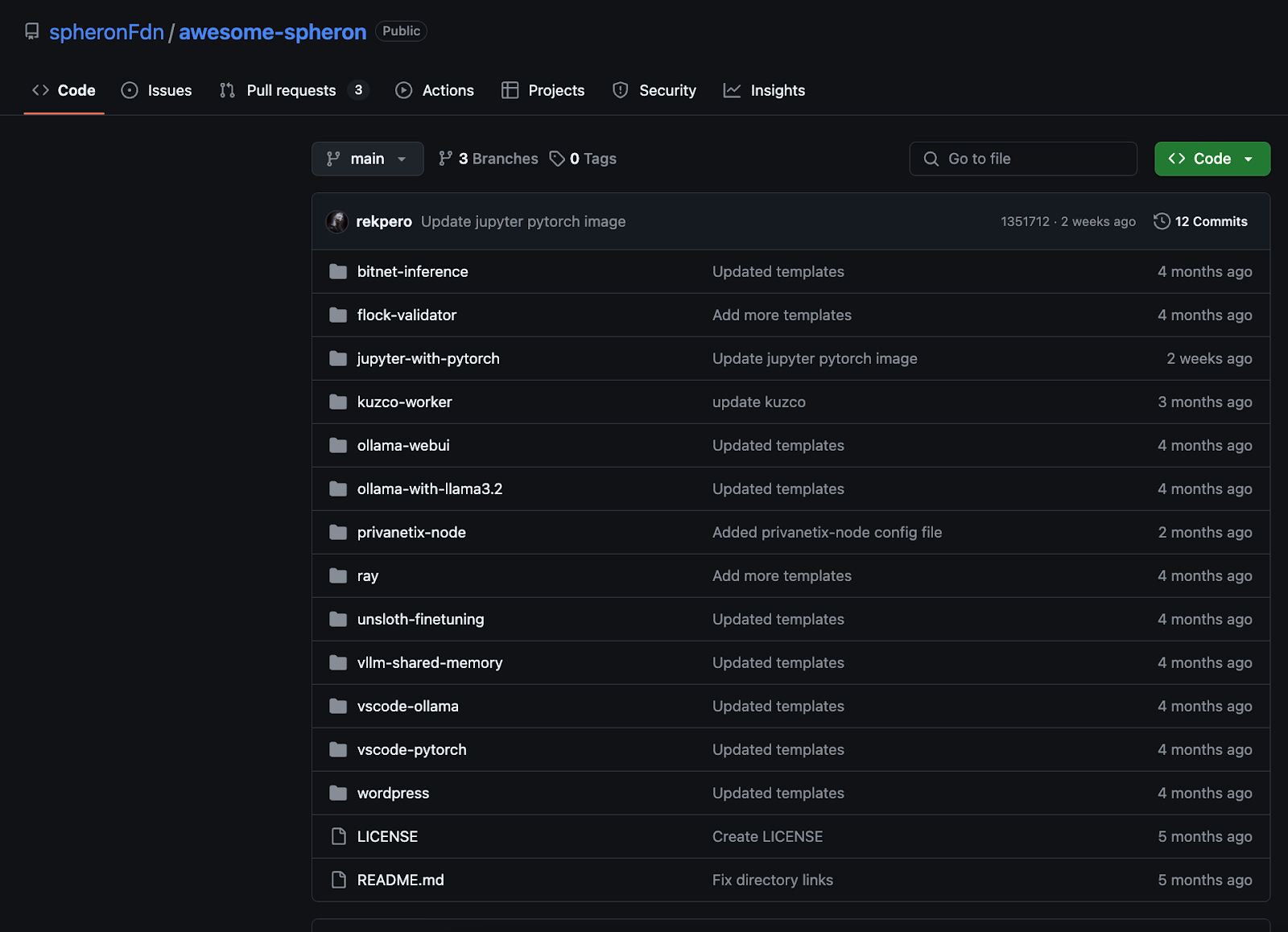
          10. The Aggregator Advantage

          Spheron operates as an aggregator, pooling resources from multiple providers. This approach enables users to:

          Compare GPU types, memory sizes, and performance tiers in real time.

          Choose from multiple competing providers, ensuring fair pricing.

          Benefit from dynamic pricing, where providers with idle resources lower their rates to attract users.

          This competitive marketplace model prevents price monopolization and provides cost-effective computing options that traditional cloud platforms lack.

          The Future of GPU Rentals

          As AI, machine learning, and data analytics advance, the GPU marketplace stands at the technological frontier, driving innovation across sectors. By transforming capital expenses into operational costs, rental models democratize access to cutting-edge hardware, fueling competition and accelerating development cycles.

          The evolving ecosystem—encompassing both centralized platforms and decentralized networks—reflects the growing global demand for high-performance computing resources. Organizations increasingly view GPU rentals as cost-saving measures and strategic accelerators that enable faster development, real-time insights, and sustained growth in AI-driven markets.

          For businesses navigating this landscape, the key lies in aligning rental strategies with specific workload requirements, security needs, and budget constraints. By carefully selecting from the diverse array of providers and leveraging flexible consumption models, organizations of all sizes can harness the transformative power of GPU computing while maintaining financial agility in an increasingly competitive market.

          As computing demands grow exponentially, the GPU rental market will likely see further innovation, focusing more on sustainability, efficiency, and accessibility. This democratization of high-performance computing resources promises to unlock new possibilities for AI development and deployment, potentially accelerating technological progress across the global economy.




          Source link

          Kym Marsh ‘quits Waterloo Road’ as she plans life overhaul after ‘dumping’ toyboy boyfriend 19 years her junior

            0
            Kym Marsh ‘quits Waterloo Road’ as she plans life overhaul after ‘dumping’ toyboy boyfriend 19 years her junior


            20 Mar 2025, 17:25
            |
            Updated:
            20 Mar 2025, 17:36

            Kym Marsh has reportedly quit Waterloo Road just months after she “dumped” her toyboy beau.

            The actress, 49, joined the BBC show back in 2023 playing canteen worker Nicky Walters.

            However, it has now been claimed that Kym has quit the drama in a bid to try “new things” amid her split from her boyfriend Samuel Thomas.

            The actress has reportedly quit the show (Credit: BBC)

            Kym Marsh ‘quits’ Waterloo Road

            Kym was a firm favourite on BBC’s Waterloo Road playing Nicky Walters. However, fans who are hoping to see her in any future series will be disappointed…

            According to The Sun, Kym’s upcoming 50th birthday milestone played a part in her deciding to quit Waterloo Road.

            She just wanted to have some fun.

            “Kym is in a new chapter of her life. She’s heading towards 50 and wants to try as many new things as she can,” a source alleged to the publication.

            Why Kym ‘dumped’ toyboy beau

            The star’s reported Waterloo Road exit comes after her split from boyfriend Samuel Thomas, 30 – who she met while working on 101 Dalmatians: The Musical, and reportedly “fell head over heels” in love with.

            But the insider claims she called it quits with Samuel – who is 19 years younger – because she “wanted to have some fun”.

            Kym Marsh and her ex boyfriend smiling

            Kym recently ended things with her toyboy beau (Credit: SplashNews.com)

            Kym is ‘enjoying her freedom’

            The source alleged: “One of the reasons she dumped Samuel was because she just wanted to have some fun and see where her work takes her.

            “She’s already got a busy work and family life. And is very much enjoying her freedom and being able to take on exciting new projects wherever they may take her.”

            ED! has contacted Kym’s representatives for comment.

            Kym and Samuel’s split

            It was reported back in February, that Ex-Coronation Street star Kym decided to split with Samuel before Christmas, once the pair had finished working on the 101 Dalmatians: The Musical.

            “Kym and Sam fell head over heels when they first met and couldn’t wait to tell the world,” a source alleged The Sun.

            They added: “But once Kym’s role in 101 Dalmatians ended it became harder to spend time together. And some of the magic they had at the beginning just disappeared.

            “It’s such a shame, especially before Christmas but Kym surrounded herself with family.”

            Read more: Kym Marsh reveals on Instagram the ‘turning point’ that made her stop smoking

            YouTube video player

            So what do you think of this story? You can leave us a comment on our Facebook page @EntertainmentDailyFix and let us know.


            Source link

            Popular Posts

            My Favorites

            a

            Spirit of Adventure Rises

            0
            Proin gravida nibh vel velit auctor aliquet. Aenean sollicitudin, lorem quis bibendum auctor, nisi elit consequat ipsum, nec sagittis sem nibh id elit. Duis sed odio sit amet nibh vulputate cursus a sit amet mauris. Morbi accumsan ipsum velit. Nam nec tellus a odio tincidunt auctor a ornare odio. Sed non mauris vitae erat auctor eu in elit. Class aptent taciti sociosqu ad litora torquent per conubia nostra, per inceptos himenaeos. Mauris in erat justo. Nullam ac urna eu felis dapibus condim entum sit amet a augue. Sed non neque elit. Sed ut imperdiet nisi. Proin condimentum fermentum nunc. pharetra, erat sed fermentum feugiat velit