The 42-year old YouTube personality, who has risen to fame and popularity by sharing fun and unique educational videos for kids, has been absent from social media for a very long time.
She last shared a video on YouTube back on January 9, titled, “Hide and Seek with Ms Rachel & Elmo + More Games, Kids Songs, Nursery Rhymes & Social Skills.”
What has been the basis for this hiatus?
Ms. Rachel is a very popular personality on YouTube. (YouTube)
Fans have been asking and, on March 19, Ms. Rachel finally gave them an answer. Sort of.
In the comments of a photo she shared on Instagram at the time of her and her husband, Mr. Aron, Ms. Rachel responded to a user who asked her, “When are we getting more episodes? I feel like since you’ve signed with Netflix we don’t really get good content anymore …”
“I’m sorry. We’ve had some family things to attend to. Nothing to do with Netflix, as that is content from YouTube,” she replied.
No further details have since been made available.
(Instagram)
Just over two months ago, Ms. Rachel said on social media that her content was coming to Netflix.
On January 27, the streaming service released four episodes of Ms. Rachel… made up of compilations of her existing videos, while announcing that more episodes were set to drop later in 2025.
This week, in her Instagram remark, the star clarified that her YouTube absence had “nothing to do with Netflix,” adding that her show’s episodes there are made up of “content from YouTube.”
Ms. Rachel did not elaborate on what’s going on with her at the moment.
But she released TikTok footage on February 27, 2023 during which she sang the words, “I’m taking a break from TikTok for my mental health.
She returned to the platform six days later.
(YouTube)
“I’m back after a short break,” Ms. Rachel sad back then. “So I was able to spend some time thinking about setting social media boundaries for myself, which is a good practice for a lot of people.”
She continued:
“The idea of protecting your peace and your heart really resonated with me. We’re kind of not meant to take in the amount of information we do online, and it changes your opinion.
“So I have changed the way that I interact with social media, but I think that that’s healthy for everyone to have boundaries and to be aware of how your relationship with social media affects you.
“With social media boundaries, you figure out ways to protect yourself and you recognize, ‘Oh, when I do this, I don’t feel so good, and so I’m gonna do less of this,’ and it’s a good way to practice self-care, which is very important. But I am here to serve children and their families every day and to share the love and kindness that we want to see reflected in the world.”
A solo Bitcoin miner hit the jackpot early Friday, mining a block without a pool of supporting miners and bagging a $266,000 reward in the process. But just how realistic is such a feat?
On Friday, an unknown miner processed Bitcoin block 888,737. The block contained 2,327 transactions and the miner received a payout of 3.125 BTC, as well as 0.032 BTC in fees.
At today’s Bitcoin price of $84,257 per coin, that’s a more than $266,000 payday.
Bitcoin miners work to process blocks on the cryptocurrency’s network. Blocks are full of transaction data and are part of the Bitcoin blockchain.
Miners are given newly minted coins: a 3.125 BTC fixed reward, along with the transaction fees paid by those using the payment system during that particular block window.
As the network has grown, mining operations have become more energy-intensive, and are typically now industrial-sized setups consisting of warehouses full of machines.
But occasionally, a solo miner can score big using a home hobby machine. In this case, according to blockchain data, the miner was using a DIY FutureBit Apollo machine.
However, experts told Decrypt that things might not be as simple as they sound: “solo mining,” per blockchain jargon, technically refers to any miner that’s not in a mining pool. Pools are groups of crypto miners that share their resources so that they have a better chance of processing a transaction. But they also then share the reward.
“The term ‘solo miner’ is a really broad term,” pseudonymous Bitcoin miner Econoalchemist told Decrypt. “It could just be one dude in his apartment, or a warehouse full of high-powered miners.”
Ultimately, this means that a “solo miner” could have a room full of hobby miners all switched on and working to secure a transaction. Such an operation wouldn’t necessarily be as easy—or cheap—to set up, though it would give the miner a better shot at securing a block win.
Still, with solo miners securing numerous block wins in recent months, Friday’s news may spur more Bitcoiners to try and have a go at home mining.
Edited by Andrew Hayward
Daily Debrief Newsletter
Start every day with the top news stories right now, plus original features, a podcast, videos and more.
Sister Wives star Tony Padron recently surfaced with some insight on Kody Brown‘s habits – and he’s talking about it in real-time during the mid-season break.
By now we know that Tony Padron shares a few things in common with his father-in-law, Kody Brown – And their similarities go beyond each sporting a mass of wild hair.
Sister Wives: Tony Padron a Kody Brown Mini-Me?
Sister Wives stars, Kody Brown and Tony Padron are missing something. Neither of these two men has a filter – you know – the one most people use to think about what they are going to say – before they say it. The Sister Wives family members have said that Kody and Tony just say what they are thinking at the time, without any thoughts of consequences.
Sister Wives | Instagram – TLC
Throughout their 19 seasons, many times Kody’s wives have mentioned how he lacks this filter. More recently, Christine Brown said the same thing about her son-in-law Tony.
So, we have it from a few good sources that both these guys speak out, before first thinking about it. The lack of this filter has put Kody in hot water through the years – and made Tony look like one colorful character on the screen.
An Hour of Watching Paint Dry…
Tony Padron and Mykelti Brown Padron recently offered inside info on the Sister Wives family from their Patreon site. – But I have to say most of this video was about as entertaining as watching paint dry – Even their critique on the cruise they just returned from was rather bland.
In this recent video, the couple spent most of the time watching the first episode from Sister Wives Season 4 and then commented on what they watched. There was one problem with this – you didn’t watch along with them.
Instead, you watched these two – as they watched the episode. All you could see was Mykelti and Tony staring back at you. Yep, paint drying.
The volume was so low on the episode they watched, that most of the time you had no idea who they saw on the screen while making those comments.
But they did touch on a topic that gathered some interest from the fans. Something in the episode sparked Mykelti’s memories of Kody’s fathering strategy from her childhood days.
Sister Wives: Mykelti Brown Padron Remembers Kody’s Father Tactics
One of Mykelti’s favorite memories of family time with her father was when he would sit with all the kids and watch a movie. You probably can’t imagine a lot of dad-kid interaction involved in this activity. Most people don’t do a lot of talking while watching TV.
But Mykelti said they would talk about the movie and even break out in wrestling matches with the movie going on in the background – Still, that wasn’t the surprising part of what this couple had to say about time with Kody.
Mykelti said as the kids got older and less interested in family movie time, Kody changed his ritual. He would still sit with the family – but his focus was on his cell phone’s screen. She also said, this activity did away with her father’s interaction with his offspring.
Although, Mykelti has a theory on why her father’s attention went to his phone instead of his kids. She thinks her father was so used to watching TV with his offspring – this was the next best thing – and watching something came naturally for him with everyone around.
She thinks that when the kids got older and stopped this movie ritual, Kody still carried on the tradition. But in a different way.
Tony’s Filter Out of Whack?
Tony agreed that his father-in-law spent an exorbitant amount of time on his cell. He said that when the family got together, his father-in-law would sit among everyone, with his head buried in his phone.
But while Tony discussed this topic, his lack of that filter became apparent once again. Tony’s next blurb is a bit snarky and a tad risque. He shares how he hopes Kody would put that phone down once he gets into the bedroom. He alluded to Kody turning in for the night with one of his wives.
But from where the Sister Wives viewers sit today, it looks like a cell phone in the bedroom was the least of Kody’s problems with his wives. Then another strange thing happened, Mykelti seemed to defend her father.
Don’t forget, recent reports put her estranged from Kody and Robyn. Despite being one of the last of the kids not to ditch their father amid the three marriages imploding, she’s not talking to him tody. But… she defended him.
Sister Wives: Kody’s Behavior In a Nutshell…
Mykelti mentioned how Kody’s focus on his cell phone screen during family functions didn’t help with bonding. In fact, she suggested it worked against him spending quality time with his kids. But, then she threw him a lifeline, in a form of an excuse for that behavior.
She thought that maybe in Kody’s mind – looking at the phone screen was a substitute for the movies they used to watch. So, in her eyes, he was doing what came natural to him when everyone gathered.
The expressions on Tony’s face seem to indicate he wasn’t buying what his wife was selling about his father-in-law doing this to keep the tradition going. And it also didn’t fly with fans.
Tony also brought up Christine Brown, Mykelti’s mom. He said Christine probably would have left years ago if not for the kids. Mykelti also piped up with some of the things she witnessed as a teen.
Kody – As Seen Through the Eyes of a Kid…
She said Christine didn’t have a relationship with Meri or Robyn through most of their polygamous marriage. And while her mom and Janelle are close today, they were just cordial to each other as sister wives for many years.
Then there was Kody, who wasn’t giving Christine what she needed as a wife over the last decade. So, Mykelti agreed with Tony, saying her mom stayed so her kids could be around their siblings.
But, if it wasn’t for the kids needing their half-siblings, Christine would have left along time ago – both Mykelti and Tony agreed on that point.
Mr and Mrs Padron offered more than an hour of looking back at a long ago episode. They made some observations and added some insights about Kody’s mindset at the time.
But while you gotta love these two together, you might find this hour a bit taxing to watch. Even Mykelti looked like she was about to dose off as we watched them stare into the screen.
So, the entertainment value of this segment was probably hovering toward the low side of the scale for fans. That’s if they could even get through it.
So, until the second half of Season 19 rolls out, we look to many of the Brown family members on social media to dish out the latest on Kody Brown and his Sister Wives world.
Head back to Soap Dirt for the latest scoop on Sister Wives.
Josie Gibson brings her four-part travel show to an end tonight, but a second series of Around the World in First Class is looking unlikely, bookies have revealed.
The show, which airs on Channel 5, sees Josie living it up in style, as she travels the globe with no expense spared.
And, while the verdict from viewers has been largely positive, it seems Josie‘s final outing tonight (March 21) could be her last before the show is “grounded”.
Josie Gibson has been living the high life on her travel show (Credit: Channel 5)
Fans ‘obsessed’ with Josie Gibson travel show
The show premiered earlier this year, with one Josie fan commenting: “Obsessed with this show.”
“You’ve given us all a brilliant and breathtaking inside knowledge into first class travel. I love it! Keep being your fab, smiley and bubbly self always – it’s lovely to watch,” said a second.
However, bookies speaking on behalf of Spaceport Sweden have some bad news for fans of the Channel 5 show…
‘More likely to be grounded’
Speaking exclusively to ED!, spokesperson Lee Astley told us he thinks the show’s “whirlwind adventure” will come to an end tonight.
The show has odds of 2/5 on to be cancelled by Channel 5. Wider odds of 2/1 are offered for the show to be renewed for a second series.
Likely to be grounded after tonight’s final episode.
Lee said: “Josie Gibson’s Around the World in First Class has certainly taken viewers on a whirlwind adventure, but whether it gets a return ticket remains to be seen.
“We go 2/1 to be renewed for another season, though at 2/5, the odds suggest it’s more likely to be grounded after tonight’s final episode.”
The star has travelled the world, seemingly fuelled by champagne! (Credit: Channel 5)
Josie replaces Alison on This Morning
However, Josie’s career is going from strength to strength.
Earlier today, she took over from bestie Alison Hammond on Friday’s This Morning.
Alison is taking a month out from the show to focus on other projects. It comes after she faced intense backlash for one of her interviews on the show.
Around the World in First Class is on tonight (March 21) at 8pm on Channel 5.
Read more: Cruel nickname Josie Gibson gave herself before six stone weight loss
Would you like to see Josie Gibson and her travel show return? Tell us on our Facebook page @EntertainmentDailyFix.
Thanks to another heads up by the developer(Amaweks) and our good friend Saberman(YT), we’ve been told if you remember playing the famous platformer of the Great Giana Sisters which was released from 1987 onwards. Then it will be well worth your time checking out Amawek’s latest MSX game of ‘Marlow’. An incredible platformer that is inspired by “The Great Giana Sisters” and was previously released for the ZX Spectrum 128k.
And here’s the latest. “Marlow in Apocalyptic Acid World is a platform game for MSX (and ZX Spectrum), inspired by “The Great Giana Sisters.” What? You thought the inspiration came from a certain mustached plumber? No way…Navigate this vast apocalyptic world by jumping, stomping on enemies, collecting crystals, throwing molotov cocktail, and breaking blocks with your head across 4 worlds, in a total of 17 levels and 5 Boss battles.
Marlow Key Features:
5 Bosses and 17 stages Spread through 2 Episodes (2 programs)7 catch sound tracks (more info on readme.txt)Aditional Graphic details and PSG sound effects not present on the Zx Spectrum version.Jukebox screen to listening to the game songs on the title screen.
US investment firm Canary Capital has filed with the Securities and Exchange Commission (SEC) to launch a new exchange-traded fund (ETF) that would combine cryptocurrency and NFTs in a single investment product.
The proposed fund Canary PENGU ETF, would include the $PENGU token—issued on the Solana blockchain—and digital assets from the Ethereum-based Pudgy Penguins NFT collection, marking the first known attempt to include NFTs in a regulated ETF in the United States.
The SEC filing was submitted on Thursday, but it does not provide a timeline for review or approval.
Source: Luca Netz
What is an ETF?
An exchange-traded fund (ETF) is a financial product that tracks the performance of a specific asset or group of assets.
ETFs are traded on stock exchanges and can be bought and sold like individual shares. They are typically used to give investors access to specific sectors, commodities, or indexes without requiring them to directly purchase or manage the underlying assets.
In the context of cryptocurrency, ETFs can provide exposure to digital tokens without requiring investors to handle wallets, exchanges, or custody directly.
Source: Igloo Inc.
Why is this significant?
If approved, this would be the first ETF in the US to include NFTs as part of its portfolio. Previous digital asset ETFs—such as those tracking Bitcoin or Ethereum—have only included fungible tokens.
NFTs are inherently different from cryptocurrencies due to their unique nature and variable pricing. Including them in a regulated investment fund presents novel challenges, including how to value, store, and audit such assets. The SEC has yet to issue specific guidance on NFT-based ETFs.
Other firms, including VanEck and Bitwise, have submitted proposals for ETFs tied to cryptocurrencies like Solana, Litecoin, and XRP.
Having brain surgery to remove a tumour late last year changed Davina McCall’s life. But her son didn’t quite appreciate how serious it was until after the fact, she has revealed.
Davina, 57, had a couple of reservations ahead of her TV comeback for the Comic Relief telethon later on tonight (March 21).
And she was understandably angry – at first – when her partner Michael pushed her to return to work. She was glad for the encouragement in the end, though.
Now we know from a new interview that her son Chester didn’t know quite how serious her brain surgery was until after she’d had it…
The TV star went in for surgery on November 15 (Credit: Begin Again with Davina McCall/YouTube)
Davina McCall reveals son’s reaction to brain tumour removal
TV presenter and national treasure in the making Davina McCall has opened up about her recovery following brain surgery.
Speaking during Brain Tumour Research’s Closer to a Cure: 15 Years of Impact gala at London’s Dorchester Hotel, she said she feels “exactly the same”.
Her partner, hairstylist Michael Douglas, was with her. Davina told Hello! magazine she had a new outlook on life, but that she felt no different in terms of her personality.
Of course her children, Holly, 23, Tilly, 21, and Chester, 18, whom she shares with ex-husband Matthew Robertson, are delighted that she’s back to her bubbly old self.
But seeing her off to the hospital may have been easier for some than others. Namely her son Chester, who said when she got home that he “didn’t know it was that serious”.
“I was quite pleased in a funny sort of way but then I also thought I hadn’t really done my job properly,” she said.
Davina added: “I didn’t want to worry him, but I hadn’t prepared him [for] if it hadn’t gone well. I felt like I’d slightly shortchanged him there. But I’m okay, so it’s great news.”
Fortunately, she’s returned to good health (Credit: Begin Again with Davina McCall/YouTube)
She’s found the return of her normal brain function ‘exhausting’
Davina McCall had a cyst between the left and right hemispheres of her brain. Now that her cognitive function has returned to normal, four months after the operation, she appreciates the symptoms she experienced before it.
“My mind had gone quiet, and now my mind’s woken up. It’s absolutely exhausting! I remember waking up going: ‘Oh my god, shut up!’ I was thinking so much.”
She was the same in every other way, she says. And she’d started meditating, so she assumed the quieting of her “brain chatter” was a sign she’d just “gone a bit more zen”.
Davina is among the stars presenting the Comic Relief telethon tonight (March 21) on BBC One at 7pm.
Read more: Davina McCall’s tears over daughter Tilly: ‘I cried all the way home’
So what do you think of this story? You can leave us a comment on our Facebook page @EntertainmentDailyFix and let us know.
Logitech has introduced the Zone 305 headset, positioned as an affordable solution designed especially for business users. But how does it stack up against higher-end models like the excellent Zone Wireless 2, and to who exactly is the Zone 305 suited for? I have written a Logitech Zone Wireless 2 in review article before, and it is quite logical to compare these two headsets together. Thank you Logitech for providing me Zone 305 for testing and honest review.
What is Logitech Zone 305?Key Specifications:Who is the Zone 305 for?My hands-on impressions: Pros and ConsPros:Cons:Logitech Zone 305 vs. Zone Wireless 2Feature Comparison Zone 305 vs Zone Wireless 2:Should You Buy the Logitech Zone 305?
What is Logitech Zone 305?
Logitech Zone 305 is a lightweight, inexpensive wireless business headset optimized specifically for daily office use, calls, and meetings and priced for mass deployment. 305 is certified for Microsoft Teams, ensuring seamless compatibility and easy integration into your Teams workflow. Logitech describes it as a practical, no-nonsense headset for hybrid or open-office scenarios, emphasizing clarity, affordability, and user-friendliness.You can manage Zone 305 with Logi Tune and with Logitech Sync as it is designed for businesses for mass deployment. I also like how much of materials is either recycled materials and overall how Logitech is keeping the sustainability in mind with both products and packaging (easy to recycle carbon).
Key Specifications:
FeatureSpecificationConnectivityWireless (Dongle required for Teams Certification & Teams-button functionalities)MicrophoneBeamforming, Noise-cancellingBattery LifeUp to 16 hours (Talk), 24 hours (Listening)ChargingUSB-CCompatibilityMicrosoft Teams certified, Zoom, Google MeetEar Cushion TypeOn-earMicrophone PositionFixed (Left side)Weight4.30 oz (122 g)Price (List)$99.99
Check detailed specs here
Who is the Zone 305 for?
Zone 305 is aimed at professionals who need a reliable, budget-friendly headset without the frills of premium features like Active Noise Cancellation (ANC). If you’re in a quiet home office or prefer simplicity over feature overload, the 305 is a good candidate. Logitech has designed 305 for organizations buying headsets in bulk, keeping budgets tight without compromising call quality.
However, if your workplace is noisy or you spend extended hours wearing your headset, this might not be your ideal choice.
My hands-on impressions: Pros and Cons
Pros:
Lightweight: Weighing less than heavier models, it doesn’t feel cumbersome initially.
Audio Quality: Despite its affordable price, audio playback is surprisingly good. Music sounds clear and enjoyable—impressive for a business-oriented headset.
Microphone Quality: The mic is excellent, featuring noise-canceling via beamforming mics, significantly reducing ambient noise for those on the other end of the call.
Microsoft Teams Certified: Seamless integration makes daily meeting setups hassle-free.
Budget-friendly: At a list price of just $99.99, the value proposition is strong.
Cons:
Slight Comfort Issues: Despite its lightweight build, Zone 305 presses firmly onto the ears. Mind you, I am not a fan of on-ear headsets as they generally aren’t comfortable when used for several hours without a break. After an hour, 305 starts to become uncomfortable and press my ears. After two hours, I need a break.
No ANC: Ambient noise can quickly become distracting. If your office is busy or noisy, this headset may not sufficiently isolate you.
Dongle Required for Teams Certification (at the moment): Returning to a dongle after experiencing dongle-free connectivity (like with the latest Zone Wireless 2 update) feels disappointing. This adds inconvenience and occupies one of my two USB-C ports. The headset can be used without a dongle, but it then loses Teams Certification and Teams-button functionalities.
Build Quality: The headset feels plasticky compared to the Zone Wireless 2, lacking that premium touch.
Volume Issue: It defaults volume to 100% on Windows 11 when initially connecting, which can be a slightly unpleasant surprise.
Fixed Microphone Position: Unlike the Zone Wireless 2, the microphone is fixed on the left side and cannot be swapped.
Zone 305 is undergoing certification for Microsoft Teams over native Bluetooth, which means it will be dongle-free soon / in the future. See this Logitech info page for details about models getting native Bluetooth support.
Logitech Zone 305 vs. Zone Wireless 2
Comparing the Zone 305 directly to my recent favorite, the Zone Wireless 2 (read more about Zone Wireless 2), highlights key trade-offs. The Wireless 2 feels superior in almost every respect—better comfort, premium build, ANC, and flexibility (e.g., microphone can be flipped from side to side). Zone Wireless 2 also recently got a fantastic dongle-free upgrade (check my post here), making it even more appealing. The advantages of Zone 305 over Wireless 2 are affordability, lighter and it has a newer Bluetooth support.
Feature Comparison Zone 305 vs Zone Wireless 2:
FeatureZone 305Zone Wireless 2ConnectivityDongle required for Teams certification ( at the moment). Bluetooth 5.3.Teams Certification over native Bluetooth, Bluetooth 5.2Microphone FlexibilityFixed (Left side only)Flip microphone to use it left or right sideActive Noise CancellationNoYesComfort (my experience)Moderate (short-term)Better (medium-term)Build QualityPlastic feelPremiumWeight4.30 oz (122 g)8.11 oz (230 g)Battery Life (Talk)Up to 16 hoursUp to 15 hours (ANC on), 18 hours (ANC off)Battery Life (Listening)Up to 24 hoursUp to 22 hours (ANC on), 40 hours (ANC off)Microsoft Teams CertifiedYes, with dongleYesList price$99.99$249.99Zone Wireless 2 “gently cushions your ears with a silicone headband and breathable materials that are soft to the touch and designed to apply pressure evenly.” Quote and picture from Logitech Wireless 2 site.
If the budget isn’t your primary concern, Zone Wireless 2 is clearly the superior headset, especially if you frequently spend long hours on calls. Having a need for mass deployment, the price is clearly on 305’s side.
Should You Buy the Logitech Zone 305?
The Zone 305 is a solid headset choice if you’re budget-conscious and don’t have too much requirements. It excels in voice, microphone quality, and simplicity. However, the lack of ANC, comfort issues during prolonged use (my personal experience, but head sizes and details vary), and the necessity of a dongle (at the moment of writing this article) may be significant downsides for some.
Overall, the Zone 305 delivers precisely what it promises: a practical, reliable, and affordable headset for mass deployment. No surprises. Keep in the mind: 305 isn’t trying to be the best headset for individuals, it wants to be the best headset for mass purchases where you are equipping your workforce with quality devices, while keeping the cost of a single device low enough and you can ensure the management and updates of these devices centrally.
Individually I would always want to pick Zone Wireless 2, but when there are budget limits it might be better to have quality headsets for all of the workforce, instead of getting a premium-quality headset for just one-third of people. But if you have the budget, and you know everyone can be more efficient with Wireless 2 (you want to make sure they have best tools available and ANC can boost their focus by reducing distracting noise) then it is a better choice for sure.
Which one would you pick? Logitech Zone 305 or Wireless 2? How about if you are getting 500 or 5000 headsets to your workforce?
Sharing is Caring! #CommunityRocks
Aiheeseen liittyy
Published by Vesa Nopanen
Vesa “Vesku” Nopanen, Principal Consultant and Microsoft MVP (M365 and AI Platform) working on Future Work at Sulava.
I work, blog and speak about Future Work : AI, Microsoft 365, Copilot, Microsoft Mesh, Metaverse, and other services & platforms in the cloud connecting digital and physical and people together.
I have about 30 years of experience in IT business on multiple industries, domains, and roles.
View all posts by Vesa Nopanen
As you might be aware (we’ve banged on about it a bit already this week) Helldivers 2 got a cowboy-themed Warbond dubbed Borderline Justice yesterday. It has no cowboy hat, because Arrowhead doesn’t reckon that such headgear fits within the Helldiver uniform restrictions.
A lot of players don’t agree with that assessement – some of them have even stormed out of the official gear saloon to pick up a mod that’ll let them team the new armours with a ten-gallon hat. Now, currently on sabbatical Helldivers 2 director and chief creative officer Johan Pilestedt has offered his own view on the situation via a twitter thread sent while he’s at GDC saying things during panels.
To see this content please enable targeting cookies.
Manage cookie settings
Having asked players for their thoughts on the Borderline Justice gear, the dev was naturally quickly asked by multiple people where the Warbond’s cowboy hat is, or whether the game will be getting one at some point down the line.
“I don’t know – haven’t heard the design convo. But I think it crossed the line of what the Helldivers are. Which I agree with,” he wrote in one reply, “I will ask the team next time I pop by the office.” Another player got a slightly different response from Pilestedt: “I agree that it would be awesome, but I think it would break the fantasy of Helldivers…people don’t wear hats on helmets.”
I don’t know – haven’t heard the design convo. But I think it crossed the line off what the Helldivers are. Which I agree with.
I will ask the team next time I pop by the office.
— Pilestedt (@Pilestedt) March 20, 2025
To see this content please enable targeting cookies.
Manage cookie settings
A number of players have been a bit exasperated by that last bit, and have been trying to remind the dev that the beret from the PH-9 Predators armour in last year’s Viper Commandos Warbond is also a hat on top of a helmet, and got past those strict uniform regs. I suppose it depends on your definition of suitably military-ish hats. Do cowboys go to war, and is a cavalry hat a different thing?
Regardless, one thing Pilestedt did suggest might be coming in the fiuture duuring that thread sounds pretty cool. “[A] perk that allows people to take sidearms as primary AND wield them akimbo…”, he wrote, “Unfortunately a bit too much work to make the animations, but maybe sometime in the future?”
Do you waltz around rocking a hat on your helmet in real life? Which helmet are you referring in your answer? Let us know below!
Published: March 21, 2025 at 12:37 pm Updated: March 21, 2025 at 12:38 pm
by Ana
Edited and fact-checked:
March 21, 2025 at 12:37 pm
To improve your local-language experience, sometimes we employ an auto-translation plugin. Please note auto-translation may not be accurate, so read original article for precise information.
In Brief
Gear.exe is revolutionizing Web3 scalability and efficiency by offering a decentralized compute network that enhances Ethereum’s performance, eliminates fragmentation, and introduces a unique reverse gas model to improve adoption.
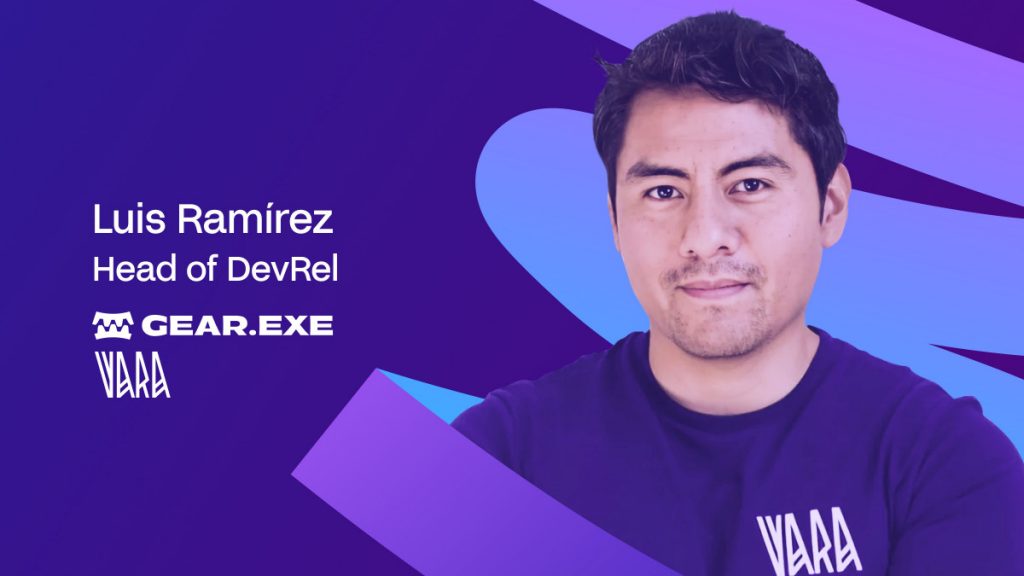
Scaling and efficiency are major challenges in Web3, and Gear.exe is tackling them head-on. To learn more, we spoke with Luis Ramírez, Head of DevRel at Gear Foundation, about how their decentralized compute network is improving Ethereum’s performance while avoiding fragmentation.
In this interview, Luis explains how Gear.exe enables seamless scalability and discusses its unique reverse gas model. He also touches on the future of blockchain, AI, and what’s next for Gear.exe.
Can you share your journey to Web3?
I’m currently the head of the World Wide Web Foundation, and my background is primarily technical. I have been working in IT for 20 years. I started as a developer and founded my own company 10 years ago to create various products. Like almost everyone, I began in Web2 because Web3 is still relatively new.
During my journey with my company, I integrated different technologies. In 2013, I started accepting Bitcoin as payment for my development services, but nothing significant happened back then since it wasn’t the best time for Bitcoin. Later, in 2017, I began developing smart contracts on Ethereum. From that point on, I transitioned to blockchain technology.
In 2019, a Russian friend introduced me to Rust and blockchain, and later, he invited me to be part of Gear. I have now been working with Gear for three and a half years. My background is mostly focused on development, growing developer communities, and strategic initiatives across different regions where the Gear Foundation has an official presence. Currently, we have teams in the US, Mexico, Spain, India, China, and other parts of the world.
Ethereum has been facing growing challenges, such as high latency and limited computational power. How does Gear.exe address these issues? How does it compare to Layer 2 solutions?
Gear.exe is a decentralized compute network, and we focus on solving Ethereum’s computational challenges. We’re using technology already proven in Vara, such as WebAssembly, the Actor Model, and Persistent Memory. These technologies allow us to scale applications in the Web3 space securely while utilizing frameworks and programming languages like Rust.
We transferred this technology to Gear.exe to solve Ethereum’s scalability issues. However, Gear.exe is not a blockchain—it’s a decentralized compute network. This distinction is important because while Layer 2 solutions solve scalability issues, they also introduce fragmentation. Users often need to create new accounts, which fragments TVL and token balances. Gear.exe prevents this by allowing developers to interact with our network via an API while maintaining compatibility with Ethereum infrastructure.
Fragmentation of liquidity and data has been a persistent issue for Ethereum. Gear.exe claims to eliminate fragmentation. How does it achieve this while maintaining scalability?
Even though Gear.exe is not a blockchain, we use some blockchain-based technologies. For example, we validate data, but we don’t store user accounts. This means no additional user data is created, no new accounts are required, and liquidity remains entirely within Ethereum.
Our system only processes computational requests and returns the results to Ethereum within the same block. Other technologies can achieve similar results, but often in different blocks, which introduces delays. Depending on the computation required, we ensure high scalability. Our platform is compatible with WebAssembly, and smart contracts are interpreted by a WebAssembly virtual machine within our nodes. This makes our solution both fast and secure.
Gear.exe uses a reverse gas model, allowing apps to cover user fees. How does this work in practice?
In traditional Web3 applications, users interact with a frontend but need a wallet and tokens to communicate with the blockchain. This requirement can be a major barrier for adoption.
Gear.exe solves this with a reverse gas model. Instead of requiring users to hold tokens for transactions, developers can prepay transaction fees using a system called vouchers. These vouchers are stored in the smart contract, and any user interacting with the contract doesn’t have to worry about providing tokens or covering gas fees. This is a powerful feature that enhances usability and adoption.
Have you conducted performance benchmarks comparing Gear.exe-enabled dApps to traditional Ethereum or roll-up-based dApps? If so, what are the results?
Yes, absolutely. We have published videos and articles detailing our benchmarking results. We compared Gear.exe to Ethereum and Layer 2 solutions like Arbitrum, both its EVM and WebAssembly versions.
Compared to Ethereum, Gear.exe is approximately 1,000 times faster and significantly cheaper. Compared to Arbitrum, Gear.exe is about 200 times more cost-efficient. Even Arbitrum’s WebAssembly-compatible implementation—arguably the best Layer 2 option for Ethereum—cannot match our performance, as we use Rust instead of Solidity and have our own smart contract platform.
Given the ongoing challenges of high fees, network congestion, and centralization risks in Layer 2 solutions, do you believe Ethereum will remain the dominant smart contract platform, or will alternative architectures take the lead?
Other platforms like Solana are gaining traction, particularly among developers. However, many of the most well-known use cases revolve around meme coins, since Web3 users primarily focus on financial gains. While technology is crucial, user behavior also plays a key role in adoption.
That said, Ethereum still has the largest developer community. We aim to attract developers through Gear.exe while remaining blockchain-agnostic. Currently, Gear.exe is integrated with Ethereum’s Holesky testnet, but in the future, we plan to expand support for additional networks.
Gear.exe leverages WebAssembly for efficiency. Do you see WebAssembly-based execution environments becoming the industry standard for next-generation blockchain platforms?
Yes, WebAssembly has significantly improved virtual machine performance. Early smart contract platforms relied on Ethereum’s EVM, but the transition to WebAssembly started with Gavin Wood when he was developing Polkadot. Our CEO, Nikolay, was involved in that shift from EVM to WebAssembly.
Today, WebAssembly has proven itself in terms of both efficiency and security. Several blockchain platforms, including Near and some Ethereum Layer 2 solutions like Arbitrum, are adopting WebAssembly. This indicates a growing trend towards WebAssembly-based execution environments.
With the increasing overlap between blockchain and AI, do you see Ethereum’s future tied to AI-driven smart contracts and decentralized compute networks?
Absolutely. Even though Ethereum is facing internal challenges within its community, it remains the largest ecosystem for developers. The intersection of AI and blockchain is already being explored, with several solutions built on Ethereum.
Currently, AI computations are not performed directly on Ethereum due to high costs. Instead, many solutions rely on off-chain processing. With Gear.exe, decentralized AI execution becomes feasible, making AI-driven smart contracts more practical. AI agents are gaining traction, and this trend will continue growing.
Will innovations like Gear.exe’s reverse gas model be enough to make Web3 as seamless as Web2, or are bigger infrastructural changes needed?
I believe it’s not enough on its own. The reverse gas model is an important step in making Web3 more accessible, especially for Web2 developers. However, the Web3 ecosystem also needs new business models that bridge Web2 and Web3. Adoption isn’t just about infrastructure—it’s also about creating viable business incentives.
Can you share the roadmap for Gear.exe?
Currently, Gear.exe is running on the Holesky testnet. The team is working on improvements to enhance compatibility, particularly with the Vara network’s smart contracts.
Our goal is to enable seamless migration of Vara smart contracts to Gear.exe without any modifications. This is a key part of our roadmap. Once this is complete, we plan to launch Gear.exe on the mainnet in the coming months.
Before the mainnet launch, we will introduce a bridge between Gear.exe, Ethereum, and Vara, allowing seamless communication and token swaps between these networks.
Disclaimer
In line with the Trust Project guidelines, please note that the information provided on this page is not intended to be and should not be interpreted as legal, tax, investment, financial, or any other form of advice. It is important to only invest what you can afford to lose and to seek independent financial advice if you have any doubts. For further information, we suggest referring to the terms and conditions as well as the help and support pages provided by the issuer or advertiser. MetaversePost is committed to accurate, unbiased reporting, but market conditions are subject to change without notice.
About The Author
Victoria is a writer on a variety of technology topics including Web3.0, AI and cryptocurrencies. Her extensive experience allows her to write insightful articles for the wider audience.
More articles
Victoria d’Este
Victoria is a writer on a variety of technology topics including Web3.0, AI and cryptocurrencies. Her extensive experience allows her to write insightful articles for the wider audience.






 Source: Luca Netz