Home Blog Page 1051

The Future of VAR: What Technologies Are Next? | NFT News Today

The Future of VAR: What Technologies Are Next? | NFT News Today


The technology of VAR is not new anymore, but its introduction to the football sport was a game changer. It eliminated the ineffectiveness of making rough match calls. With that being said, there is still more than enough room for improvement. Technology errors, disputes, and delays still annoy the fans and players. What will take VAR to the next level? The use of AI analysis and 3D maps will create a transformation in VAR technology. Let’s take a look at the facts and answer the important question of where VAR technology is heading in the near future.

Current Limitations of VAR

While VAR provides improvement for decision-making, it is enormously lacking in several areas. The time taken for reviewing is usually too much and interrupts the flow of the game. Inconsistencies in handball and offside calls have made fans of the game very irritable. In addition, camera angles do not account for the entire arena. Therefore, even by reviewing, some decisions are still left questionable.

Transparency is another important issue. Rarely do fans and players become enlightened about how a decision was made. Hence their frustration and mistrust. After all, everyone who is involved in sports betting NZ wants to be sure that everything is fair. And they can be understood. The bets of millions of players can depend on one decision. This is crazy money. The solution to these problems lies not only in upgrading technologies. There should also be better communication and integration in the flow of the game.

Upcoming Innovations for VAR

Brand-new technologies are already being tested for the roadblocks VAR faces. A massive part of AI in the near future will be to speed up the process of decision-making. In contrast to human operators going through the footage, the AI algorithms would automatically detect offsides, fouls, and handballs and thus be put into action within the shortest possible time.

Another game-changing innovation would be a 3D map in real-time. Advanced sensors will make it possible to trace the movements and trajectories of players with ball replay incidents in virtual reality. Thus, it will put an end to arguments about camera angles. Additionally, wearable technology could be developed so that players can provide accurate data regarding physical contact and fouls when making decisions.

Key Technologies That Will Shape VAR’s Future

Here are four technologies likely to change VAR:

AI Decision-Making: Instant analysis of incidents through machine learning.

Reconstruction Tools: Plays that were done during a match are accurately recreated for better understanding.

Player-Wearable Sensors: Physical impact data used to confirm fouls and penalties.

Enhanced Broadcast Enrichment: Real-time replay and analysis at the venue or at home.

The end product is sure to promise VAR, which is faster, fairer, and more transparent for all.

Fan and Player Experience with Next-Gen VAR

The future of VAR’s advanced features includes even more strategic game enjoyment for both professionals and fans. With the growing popularity of NRL betting, scrutinizing the accuracy and fairness of officiating is now more important than ever. Instead of indecipherable calls, fans will be given immediate visuals, and faster reviews will guarantee stoppages don’t break the flow of the game. This will increase the appeal of online football betting, as impartiality strengthens trust in outcome predictability. For players, increased precision means that debates will be reduced, lowering on-field tensions and vexation.

Allowing fans to view the data live as it happens can change the stadium experience for the better, reducing the number of spectators who chose not to attend games in person. In relation toe the VAR system, these changes can make it less of a stop in the action and more of a display that enhances the sporting experience, using it as a chance to create thrill.

Challenges Ahead for VAR’s Future

Yet, with the excellent innovations that may give everyone hope, that light is overshadowed by the remaining challenges. Among these obstacles is the cost of introducing new technology, which smaller leagues may find difficult to bear. Technology, moreover, might lead to over-reliance that could take the human side out of the game. All efforts should converge on finding the balance between technology and traditional officiating.

Another area is global uniformity. At present, different leagues and competitions implement VAR in different ways. It is mandatory to propagate great measures for the implementation of VAR at an international level in order to ensure fairness throughout the sport.

A Vision for Perfect VAR

Think of a time when every decision is not debated but taken accurately on time instantly. That time does not look far away when the fusion of VAR technology and the spirit of the game will make every football match fair without any controversies. Football modified with VAR technology does not possess problems. Rather, it enhances the experience. VAR these days is not just developing but is changing the game we all watch and love. Are you ready for the next era of football?


Source link

Helldivers 2 could be taking the fight to “new” Automaton Homeworld, according to leaks

0
Helldivers 2 could be taking the fight to “new” Automaton Homeworld, according to leaks


You can trust VideoGamer. Our team of gaming experts spend hours testing and reviewing the latest games, to ensure you’re reading the most comprehensive guide possible. Rest assured, all imagery and advice is unique and original. Check out how we test and review games here

In an interview at the beginning of the year, Arrowhead discussed how there is more to come from the Illuminate. Some of these plans include leaked enemies with an effect that has secretly been added to HD2 in the most recent update. However, in addition to the Illuminate, Arrowhead also said there are more plans for bugs and Automatons. Nothing is official yet, but leaks have revealed Helldivers 2 could be taking the fight to a “new” Automaton Homeworld.

Helldivers 2 “new” Automaton Homeworld leaks

Prolific Helldivers 2 leaker, Iron_S1ghts, has revealed details about the “new” Homeworld for Automatons. The previous Homeworld for bots was an icy planet called Cyberstan, and their homeplanet now is supposedly just called “New Cyberstan”.

According to Iron_S1ghts, while the leaked New Cyberstan biome “banner is likely a placeholder,” the planet is “said to be some sort of forest”. Iron_S1ghts also reports “some of the values make the planet look like Super Earth, but this is also a placeholder”.

Image credit: @Iron_S1ghts on X

Reacting to these leaks, players are excited for the prospect of a New Cyberstan Homeworld. The biggest discontent amongst the replies is the prospect of the new bot homeworld being a “f****** jungle,” but, again, this is not official and could just be a placeholder.

In addition to this New Cyberstan, Iron_S1ghts previously leaked a new Automaton enemy called the Automaton Assault Strider. Along with it came leaked abilities such as firing rockets and melee stomping.

Image credit: @Iron_S1ghts on X

For more Helldivers 2, check out our guide to the best warbonds ranked, along with the best stratagems and best throwables. We have also a guide to the best weapons, and, if you’re coming back to HD2 for the first time in a long while, we have a bunch of tips and tricks to help you get reaccustomed to the battlefield.


Source link

Google’s AI Tool Gemini Can Now “See” the World Using Your Phone Camera – Metaverseplanet.net

Google’s AI Tool Gemini Can Now “See” the World Using Your Phone Camera – Metaverseplanet.net


Google’s generative AI model, Gemini, has now gained camera and screen recognition capabilities. However, this feature is exclusive to paid subscribers only.

The US-based tech giant has made a significant move with its Gemini AI model, allowing it to perceive the world visually—just like humans do. But how exactly is this possible?

According to a statement from Google spokesperson Alex Joseph, Gemini now supports camera and screen interaction through the Live feature. This means that while using Gemini Live, users can activate their phone’s camera, show their surroundings to the AI, and receive assistance on virtually any topic.

Available Only to Google One AI Premium Subscribers

Google clarified that the ability of Gemini to process visual input through the camera and screen is currently restricted to Google One AI Premium subscribers.

At the moment, this feature appears to be in the gradual rollout phase. Posts on Reddit indicate that while some users can already access it, others have yet to receive the update. This suggests that many users will need to wait a little longer before unlocking Gemini’s visual capabilities.

A New Dimension for Generative AI

By integrating real-world visual perception, Gemini takes a significant step forward in how generative AI interacts with users. This update allows for context-aware support, enabling users to show the AI their environment and ask questions related to what it sees—such as identifying objects, reading signs, or understanding screen content.

You May Also Like

Follow us on TWITTER (X) and be instantly informed about the latest developments…

Copy URL


Source link

Blockchain and Artificial Intelligence – Metaverseplanet.net

Blockchain and Artificial Intelligence – Metaverseplanet.net


Blockchain and artificial intelligence (AI) are two of the most groundbreaking and rapidly evolving technologies of our time. While their origins differ greatly, the convergence of these technologies opens up entirely new possibilities for users. In fact, many emerging projects are now being developed where blockchain, cryptocurrencies, and AI work together in harmony.

In this article, we’ll explore the connection between blockchain and artificial intelligence, their common use cases, and the opportunities that arise from their integration.

What Is Blockchain?

Popular platforms such as Bitcoin (BTC), Ethereum (ETH), and Avalanche (AVAX) are all examples of blockchains. These platforms support the operation of cryptocurrencies, smart contracts, and decentralized applications (dApps). But what exactly does the term blockchain mean?

A blockchain is a distributed digital ledger that is shared across a network of computers (nodes). It stores information in an encrypted format and ensures data integrity, transparency, and security without requiring a central authority. This is one of the key innovations of blockchain technology.

Unlike traditional databases that store data in tables, blockchains group data into blocks. Each block has a limited storage capacity. Once full, the block is sealed and linked to the previous block, forming a chain—hence the name “blockchain.” New information is added in subsequent blocks, creating an unalterable timeline of data entries. This structure makes tampering with the data virtually impossible.

Bitcoin stands as a prime example of blockchain’s security and resilience. The system has never been hacked, proving its ability to prevent fraud, ensure transparency, and reduce reliance on third parties.

Artificial intelligence involves using machines, data, and algorithms to mimic the problem-solving and decision-making abilities of the human mind. It includes subfields such as machine learning (ML) and deep learning, which use large datasets and algorithms to make predictions and classifications.

The benefits of AI include automating decision-making processes, handling repetitive tasks, and minimizing human error. Moreover, AI plays a pivotal role in enhancing technologies such as big data, the Internet of Things (IoT), and robotics.

The Relationship Between Blockchain and Artificial Intelligence

When AI and blockchain are combined, they create a powerful synergy that transforms nearly every industry they touch. From supply chain logistics and healthcare data sharing to media rights, cybersecurity, and financial services, the integration of these technologies is reshaping our world.

Blockchain provides a secure, verifiable infrastructure, while AI enhances the system’s ability to process and analyze large volumes of data. For example, AI can detect patterns and create predictions, while blockchain can validate and store this data in a tamper-proof manner. This collaboration ensures both security and efficiency.

Let’s take a closer look at the key benefits of combining blockchain and artificial intelligence:

1. Transparent Data Source

AI models require vast amounts of high-quality data for training. Blockchain provides a transparent and verifiable source of data. Because every transaction on a blockchain is traceable and immutable, it becomes easier to verify the authenticity of training data—enhancing the accuracy and reliability of AI systems.

2. Autonomous Systems

Through decentralized ledger technology (DLT), blockchain enables AI applications to operate without a central server. This decentralization promotes self-governing autonomous systems, where AI can train and make decisions independently—leading to more robust and scalable solutions.

3. Enhanced Privacy Protection

Blockchain’s cryptographic techniques help protect data privacy, which is especially critical in AI training environments. With a secure system in place, organizations can confidently develop competitive and complex AI models without risking sensitive data exposure.

4. Distributed Computing Power

Training advanced AI algorithms requires significant computing power. Blockchain networks distribute this load across numerous nodes, reducing the need for centralized, high-cost infrastructure. This helps minimize costs related to hardware, storage, and maintenance, while maximizing computational efficiency.

5. Security Enhancement

Although smart contracts are a revolutionary feature of blockchains, they are not always immune to exploitation. When vulnerabilities exist, they can be exploited, harming decentralized applications. Here, AI can play a crucial role by auditing and optimizing smart contracts, reducing risk and enhancing their security.

6. Data Authenticity

With blockchain, it is possible to trace the origin and integrity of the data used by AI systems. This assurance of data authenticity ensures that AI models are trained using legitimate, untampered datasets—boosting overall reliability and trust in AI outcomes.

7. Process Automation

By combining automation, AI, and blockchain, businesses can streamline multi-party processes—making them faster, more efficient, and cost-effective. For instance, AI-driven smart contracts can help resolve disputes or automatically select eco-friendly shipping methods based on real-time data.

Recent research highlights the undeniable synergy between blockchain and artificial intelligence. While these technologies have traditionally developed independently, they are now merging at an increasing pace. One key reason is the exponential growth of big data, largely driven by AI systems.

Efficient data management is becoming a top priority for businesses. When the power of AI is combined with the security and transparency of blockchain, data handling becomes significantly more secure and streamlined.

With no central authority, blockchains provide a resilient and distributed network where data remains safe. If you’re aiming for a system that ensures privacy, automation, and data integrity, integrating artificial intelligence with blockchain technology may be the ideal solution.

Follow us on TWITTER (X) and be instantly informed about the latest developments…

Copy URL


Source link

Quantum Teleportation Achieved Over Standard Internet Cable – Metaverseplanet.net

Quantum Teleportation Achieved Over Standard Internet Cable – Metaverseplanet.net


Engineers at Northwestern University have made history by successfully achieving quantum teleportation over a fiber-optic cable that also carries regular internet traffic. Professor Prem Kumar, who led the research, stated, “No one believed this could be done. Our work opens the door to taking quantum communications to the next level.”

The engineering team has made a major breakthrough in the field of quantum teleportation, demonstrating for the first time that quantum information can be transmitted alongside classical internet data through the same physical infrastructure. As research progresses, this could mark the beginning of a new era where quantum and classical networks operate side-by-side, offering unprecedented levels of speed and security in communications.

Quantum Teleportation via Standard Internet Cables

The researchers successfully conducted quantum teleportation using a fiber-optic cable that already handles standard internet traffic. The details of the experiment were published in the journal Optica, revealing new opportunities to merge quantum communication with existing internet infrastructure. This advancement also holds significant potential for quantum sensing and quantum computing applications.

Quantum teleportation leverages the power of quantum entanglement to allow ultra-fast and secure information transfer between distant users. Unlike traditional communication methods, it doesn’t involve the physical transfer of particles. Instead, it enables information to be shared between entangled particles across long distances.

“No One Thought It Was Possible”

Professor Prem Kumar emphasized that the idea was widely doubted: “Our research provides a path for quantum and classical networks to coexist on a shared fiber-optic infrastructure. Fundamentally, this paves the way for the future of next-level quantum communication.”

Previously, many researchers were skeptical about the feasibility of quantum teleportation over cables already carrying classical communication. The main concern was that entangled photons would be drowned out by millions of other light particles traveling through the fiber-optic cables.

However, Kumar and his team found a solution. By conducting in-depth studies on light scattering within fiber-optic lines, they identified a less crowded wavelength to transmit their photons. They also applied specialized filters to reduce noise caused by regular internet traffic.

Kumar explained that the team performed a meticulous analysis of scattering patterns and strategically placed the photons at a critical point where interference was minimal. This approach made it possible for quantum signals to survive and function effectively, even within a noisy classical communication channel.

You May Also Like

Follow us on TWITTER (X) and be instantly informed about the latest developments…

Copy URL


Source link

Creating UI Components with AI: Enhance Frontend Development

0
Creating UI Components with AI: Enhance Frontend Development


AI Revolution in the Frontend Developer’s Workshop

In today’s world, programming without AI support means giving up a powerful tool that radically increases a developer’s productivity and efficiency. For the modern developer, AI in frontend automation is not just a curiosity, but a key tool that enhances productivity. From automatically generating components, to refactoring, and testing – AI tools are fundamentally changing our daily work, allowing us to focus on the creative aspects of programming instead of the tedious task of writing repetitive code. In this article, I will show how these tools are most commonly used to work faster, smarter, and with greater satisfaction.

This post kicks off a series dedicated to the use of AI in frontend automation, where we will analyze and discuss specific tools, techniques, and practical use cases of AI that help developers in their everyday tasks.

AI in Frontend Automation – How It Helps with Code Refactoring

One of the most common uses of AI is improving code quality and finding errors. These tools can analyze code and suggest optimizations. As a result, we will be able to write code much faster and significantly reduce the risk of human error.

How AI Saves Us from Frustrating Bugs

Imagine this situation: you spend hours debugging an application, not understanding why data isn’t being fetched. Everything seems correct, the syntax is fine, yet something isn’t working. Often, the problem lies in small details that are hard to catch when reviewing the code.

Let’s take a look at an example:

function fetchData() {
fetch(“htts://jsonplaceholder.typicode.com/posts”)
.then((response) => response.json())
.then((data) => console.log(data))
.catch((error) => console.error(error));
}

At first glance, the code looks correct. However, upon running it, no data is retrieved. Why? There’s a typo in the URL – “htts” instead of “https.” This is a classic example of an error that could cost a developer hours of frustrating debugging.

When we ask AI to refactor this code, not only will we receive a more readable version using newer patterns (async/await), but also – and most importantly – AI will automatically detect and fix the typo in the URL:

async function fetchPosts() {
try {
const response = await fetch(
“https://jsonplaceholder.typicode.com/posts”
);
const data = await response.json();
console.log(data);
} catch (error) {
console.error(error);
}
}

How AI in Frontend Automation Speeds Up UI Creation

One of the most obvious applications of AI in frontend development is generating UI components. Tools like GitHub Copilot, ChatGPT, or Claude can generate component code based on a short description or an image provided to them.

With these tools, we can create complex user interfaces in just a few seconds. Generating a complete, functional UI component often takes less than a minute. Furthermore, the generated code is typically error-free, includes appropriate animations, and is fully responsive, adapting to different screen sizes. It is important to describe exactly what we expect.

Here’s a view generated by Claude after entering the request: “Based on the loaded data, display posts. The page should be responsive. The main colors are: #CCFF89, #151515, and #E4E4E4.”

Generated posts view

AI in Code Analysis and Understanding

AI can analyze existing code and help understand it, which is particularly useful in large, complex projects or code written by someone else.

Example: Generating a summary of a function’s behavior

Let’s assume we have a function for processing user data, the workings of which we don’t understand at first glance. AI can analyze the code and generate a readable explanation:

function processUserData(users) {
return users
.filter(user => user.isActive) // Checks the `isActive` value for each user and keeps only the objects where `isActive` is true
.map(user => ({
id: user.id, // Retrieves the `id` value from each user object
name: `${user.firstName} ${user.lastName}`, // Creates a new string by combining `firstName` and `lastName`
email: user.email.toLowerCase(), // Converts the email address to lowercase
}));
}

In this case, AI not only summarizes the code’s functionality but also breaks down individual operations into easier-to-understand segments.

AI in Frontend Automation – Translations and Error Detection

Every frontend developer knows that programming isn’t just about creatively building interfaces—it also involves many repetitive, tedious tasks. One of these is implementing translations for multilingual applications (i18n). Adding translations for each key in JSON files and then verifying them can be time-consuming and error-prone.

However, AI can significantly speed up this process. Using ChatGPT, DeepSeek, or Claude allows for automatic generation of translations for the user interface, as well as detecting linguistic and stylistic errors.

Example:

We have a translation file in JSON format:

{
“welcome_message”: “Welcome to our application!”,
“logout_button”: “Log out”,
“error_message”: “Something went wrong. Please try again later.”
}

AI can automatically generate its Polish version:

{
“welcome_message”: “Witaj w naszej aplikacji!”,
“logout_button”: “Wyloguj się”,
“error_message”: “Coś poszło nie tak. Spróbuj ponownie później.”
}

Moreover, AI can detect spelling errors or inconsistencies in translations. For example, if one part of the application uses “Log out” and another says “Exit,” AI can suggest unifying the terminology.

This type of automation not only saves time but also minimizes the risk of human errors. And this is just one example – AI also assists in generating documentation, writing tests, and optimizing performance, which we will discuss in upcoming articles.

Summary

Artificial intelligence is transforming the way frontend developers work daily. From generating components and refactoring code to detecting errors, automating testing, and documentation—AI significantly accelerates and streamlines the development process. Without these tools, we would lose a lot of valuable time, which we certainly want to avoid.

In the next parts of this series, we will cover topics such as:

Stay tuned to keep up with the latest insights!


Source link

Hotel Review: The Ned NoMad New York

Hotel Review: The Ned NoMad New York


If you are familiar with the private club concept that comes with staying at The Ned (or being a member), then this well-located hotel is for you. Its small lobby is the first indication that The Ned NoMad New York is not like other hotels in the neighborhood. It oozes sophistication and charm, making it feel like you have stepped into somewhere that is reserved for someone special.

While there is membership, this hotel is one of New York’s special gems. Here are five reasons why you should give it a try, whether you belong to its club or not.

The rooms

The rooms here are just as swanky as a public areas, and the variance size from the smaller Classics or Crash Pads to the much larger Grand and Studio rooms. What they have in common are beautiful hardwood floors with colorful area Ruth’s and a mix of antique and modern furnishings. It’s an early 20th century vibe, but in closer inspection although the modern conveniences are in place. Yes, you can charge your phone using the latest USB port, for example.

You’ll sink right into the beds with pillowtop mattresses, thick duvets and a bevy of pillows up against studded leather headboards. Eclectic design pieces and books like the shelves and tables. Work space is plentiful, and closets have all the necessities, including umbrellas. Deluxe rooms have cozy armchairs while Grand rooms and larger come with sofas.

The most impressive feature, besides the views from many of the rooms of the bustling neighborhood, are the bathrooms. Like other Ned properties, vanities stock Cowshed products, but not just small bottles. Instead, there are a half dozen full-size bottles of every scent and desired effect from rejuvenating to relaxing. By the sinks, some of which are open to the room (like in Studios), are even more toiletries like combs, razors and even condoms. Larger rooms add soaking tubs in the room.

The suites are real winners here. The salon and larger rotunda suites have separate living areas, and the Broadway sweep is enormous with lovely views of its namesake neighborhood. The largest is the Johnston Terrace Suite, which comes with a proper dining room, living room and stunning outdoor terrace.

The membership

Similar to its hotels in London, Washington DC and Doha, this hotel offers membership rates that allow others to enjoy exclusive access to special events, deals at its food, beverage and spa outlets, and priority service. Few other hotels tread this line, and the benefit of being a guest here is that you feel just like one of the members (as long as your key unlocks one of the guest rooms here).

Members can access the Library for a space to work away from home or the office and both the Magic Room and the Club room for live music or special events. They can also attend special panels and educational talks. And when they have guests in town, they enjoy special member rates for overnight stays.

If you’re a Ned member in Doha, you have access to any of the other locations, for example. It is this type of exclusivity, as well as opportunity to hob knob with other elite of the same ilk, that pays off for joining. If you chat with members, story after story reveals how membership has paid off in spades for them. They have closed big deals, networked with investors and even sparked romantic relationships among the people that they meet here.

This should come as no surprise since The Ned is born from Soho House’s Membership Collective Group although there is no reciprocal access between the brands.

The food

Cecconi’s, the main restaurant here, is a local institution. While it serves a decadent breakfast, it is the lunch and dinner menus that draw the most interest. Expect dishes like an authentic taglierini cacio e pepe, cavatelli with lamb ragu and veal Milanese.

Once the sun sets, don’t expect to parade around as you wish. A strict dress code calls for at least business casual attire if you want to enter some of the swanky bar spaces. The most prized vantage point is up on the rooftop where the city’s glittering skyline unfurls as you sip sexy cocktails (or mocktails) or indulge in the bar bites menu.

Little Ned serves light bites and craft cocktails to complement the famous Cecconi’s menu. Top Chef winner and culinary host Kristen Kish is adding her talents to the menu here, which means there are plenty of reason to dine onsite and hob knob with members rather than fight for a table elsewhere.

The location

In the heart of Broadway’s bustling theater district and not far from most major tourist and business addresses, this hotel is in the center of it all. It sits in the landmark Johnston Building, which dates back to 1908. Seen from across the street, the Beaux Arts architecture is rather chic and striking, alluding to the interesting encounters that a visit might entail.

This is New York City after all, and space is at a premium. There are not as many restaurants and bars as other Ned properties, but the city-center NYC location makes up for it. Being a member here pays off, especially since a second Ned location is in the works (and DC is not far away either).

The decor

From the vintage elevator entrances to the marble floor of the lobby, this is no average hotel. Guests sink into leather sofas while they await friends to join them in the bar, perhaps a special treat for locals who have always wondered more about The Ned NoMad.


Mahogany woods and Art Deco accents fill the public spaces, which are divided into numerous smaller rooms adding curiosity for arrivals to discover hey is just around the dim corner or behind the thickly tasseled curtain.

If you’re an art aficionado, you’ve come to the right place. The hotel boasts almost 300 individual, museum-quality pieces in its collection from names like Mickalene Thomas, Laurie Simmons, Hank Willis Thomas and Rachel Jones. A particular focus was given to female artists, a cue the hotel took from its sublime property in London. Many are bespoke for the hotel and include work from emerging talent who can showcase their work in front of the discerning Ned clientele.


Source link

When Will Quantum Internet Arrive? – Metaverseplanet.net

When Will Quantum Internet Arrive? – Metaverseplanet.net


The internet as we know it has undergone significant transformations over the past decades, evolving from dial-up connections to fiber-optic speeds that allow for real-time communication across the globe. However, even with these advancements, traditional internet has its limitations in speed, security, and efficiency. Enter Quantum Internet, a revolutionary concept that promises instantaneous data transfer, absolute security, and unparalleled computational capabilities. But when will it actually become a reality?

Understanding Quantum Internet

Quantum Internet leverages quantum mechanics to transmit information using qubits (quantum bits) rather than traditional binary bits. It relies on phenomena such as quantum entanglement, superposition, and quantum teleportation to enable ultra-secure and lightning-fast communication.

Key Advantages of Quantum Internet

Zero Latency: Quantum entanglement allows for instantaneous data transfer over any distance.

Unhackable Security: Quantum Key Distribution (QKD) ensures that any interception attempts will alter the quantum state, making hacking impossible.

Ultra-Fast Processing: Complex computations that take supercomputers weeks could be done in seconds with quantum networks.

Stages of Quantum Internet Development

Quantum Internet is not an overnight innovation; it is being developed in stages, each overcoming significant technological challenges. Here’s a look at where we stand today:

Phase 1: Experimental Quantum Networks (2020 – 2025)

Several governments and research institutions have already begun building small-scale quantum networks. The most notable advancements include:

China’s Quantum Satellite (Micius): Demonstrated quantum entanglement-based communication between continents.

Europe’s Quantum Internet Initiative: Aims to establish quantum-secured communication across key European cities.

U.S. Quantum Network Prototypes: Companies like Google, IBM, and DARPA are working on establishing early quantum networks.

Phase 2: Early Adoption and Limited Use Cases (2025 – 2035)

In this phase, quantum internet is expected to become available for government and military applications, financial institutions, and high-security industries. Quantum-secured communication may first appear in:

Banking & Finance: Secure transactions immune to cyber threats.

Healthcare: Secure patient data exchange between hospitals.

Defense & Cybersecurity: Fully protected communication channels.

Phase 3: Widespread Public Availability (2035 – 2050)

By mid-century, quantum internet may become commercially viable for businesses and general consumers. However, widespread adoption will depend on:

Infrastructure readiness: Establishing large-scale quantum networks across continents.

Affordability: Making quantum communication cost-effective.

User-friendly applications: Quantum-based services integrated into everyday life.

How Will Quantum Internet Change Daily Life?

To illustrate the impact of Quantum Internet, let’s compare it with traditional internet in real-world scenarios:

1. Gaming and Streaming

Traditional Internet: Loading a massive online game like Call of Duty Warzone (150GB) takes 1-2 hours. Quantum Internet: The game would be instantly downloaded.

Traditional Internet: A 4K movie might buffer for a few seconds before playing. Quantum Internet: The movie would start instantly, no buffering.

2. Online Shopping and Banking

Traditional Internet: Online transactions can take seconds to minutes due to encryption and verification delays. Quantum Internet: Transactions will be instant and completely secure.

3. Scientific Research and AI

Traditional Internet: Processing a large DNA dataset could take days. Quantum Internet: AI-driven models could analyze DNA within minutes.

Challenges and Future Prospects

Despite its potential, Quantum Internet still faces hurdles:

Hardware limitations: Quantum processors are still in early stages of development.

Distance constraints: Currently, entangled qubits degrade over long distances.

Energy efficiency: Maintaining quantum states requires extreme cooling and precise conditions.

Quantum Internet is not a question of if, but when. The next two decades will see rapid advancements, with the first practical applications appearing in high-security sectors by 2030. By 2040-2050, we may witness a fully functioning Quantum Internet accessible to everyone.

Just as fiber-optic technology revolutionized communication, Quantum Internet will reshape the digital world, unlocking possibilities that seem like science fiction today. The countdown to this quantum leap has already begun!

You May Also Like

Follow us on TWITTER (X) and be instantly informed about the latest developments…

Copy URL


Source link

New Malware Targets and Empties Crypto Wallets Installed on Browsers – Metaverseplanet.net

New Malware Targets and Empties Crypto Wallets Installed on Browsers – Metaverseplanet.net


A newly discovered piece of malware is specifically targeting crypto wallet extensions installed on users’ computers. This malicious software has been found to affect over 20 popular cryptocurrency wallets used around the world.

Cybersecurity experts have uncovered this threat, which poses a serious risk to crypto investors. The malware has been detected on Google Chrome and is designed to attack wallet extensions already installed on a victim’s device, with the intent of draining cryptocurrency funds.

The malware, dubbed “StilachiRAT”, was identified by security analysts working under Microsoft. It focuses on users who have stored their wallet passwords in the Chrome browser. Although the exact number of affected users remains unknown, the malware is capable of targeting more than 20 well-known crypto wallets.

Major Wallets at Risk

According to reports, StilachiRAT is capable of compromising major wallets such as Trust Wallet, MetaMask, BNB Chain Wallet, OKX Wallet, Bitget Wallet, TokenPocket, TronLink, Leap Cosmos, Coinbase Wallet, StarkNet, Keplr, Phantom, ConfluxPortal, and Plug, among many others. This highlights the high level of risk currently facing the crypto community.

If you’re a cryptocurrency investor and use any of the wallets listed above, it’s crucial to be more cautious than ever. To stay safe, avoid clicking on unknown links, refrain from downloading suspicious files, and do not save sensitive credentials in Chrome. For additional security, consider switching to a cold wallet, which could significantly reduce exposure to threats like StilachiRAT.

You May Also Like

Follow us on TWITTER (X) and be instantly informed about the latest developments…

Copy URL


Source link

Built a $1M Business in 17 Days Using AI – Metaverseplanet.net

Built a M Business in 17 Days Using AI – Metaverseplanet.net


Dutch entrepreneur Pieter Levels has achieved a remarkable milestone by creating a $1 million business in just 17 days — using nothing but artificial intelligence to write all the code.

With the rapid rise of AI technologies, more and more people are either automating their workflows through AI or becoming pioneers in brand-new industries powered by it.

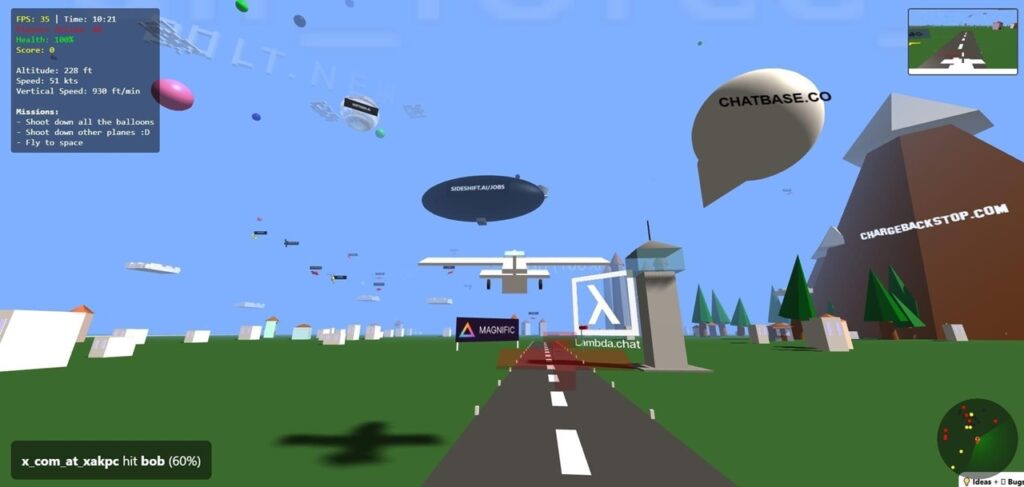
At 38 years old, Pieter Levels, known for launching successful platforms such as Nomad List, Remote OK, and Rebase, has now developed a browser-based flight simulator called fly.pieter.com — entirely using AI-assisted tools. Impressively, he claims to have built the first version of the simulator in just three hours.

By leveraging tools like Three.js and Cursor, Levels created a game that offers users an instant flight experience — without any long loading screens or large updates. The simulator features a variety of aircraft, including F-16 fighter jets, allowing for an immersive and diverse flight experience.

Monthly Revenue Surpasses $87,000

Levels states that the game now earns over $87,000 per month, with annual revenue exceeding $1 million. He also anticipates monthly income to soon cross the $100,000 mark.

This achievement is a clear example of how artificial intelligence is not just about automation — when used strategically, it can empower entrepreneurs to build innovative, high-revenue ventures in record time.

You May Also Like

Follow us on TWITTER (X) and be instantly informed about the latest developments…

Copy URL


Source link

Popular Posts

My Favorites

The Biggest Games Coming to Nintendo Switch 2 – Decrypt

Nintendo fully unveiled the Nintendo Switch 2 this week, and it sports a bigger LCD screen, updated Joy-Con controllers that can also be...