Home Blog Page 1042

One Battle After Another | Official Trailer

    0
    One Battle After Another | Official Trailer


    Genre: Horror / Mystery

    Release Date: May 16, 2025

    Directed by: Zach Lipovsky and Adam Stein

    Produced by: Craig Perry, Sheila Hanahan Taylor, Jon Watts, Dianne McGunigle and Toby Emmerich

    Distributed by: Warner Bros. Pictures

    Music by: Tim Wynn

    Running Time: 109 minutes

    Cast: Kaitlyn Santa Juana, Teo Briones, Richard Harmon, Owen Patrick Joyner, Anna Lore, with Brec Bassinger, and Tony Todd

    Final Destination: Bloodlines Movie Poster (Warner Bros.)


    Plot

    The newest chapter in New Line Cinema’s bloody successful franchise takes audiences back to the very beginning of Death’s twisted sense of justice—“Final Destination Bloodlines.” Plagued by a violent recurring nightmare, college student Stefanie heads home to track down the one person who might be able to break the cycle and save her family from the grisly demise that inevitably awaits them all. The movie was filmed for IMAX as well.

    Watch the official trailer from Warner Bros. online now:


    Source link

    Tigran Gambaryan Honored with Hero Award at DC Blockchain Summit for Courage and Commitment to Justice | Web3Wire

    0
    Tigran Gambaryan Honored with Hero Award at DC Blockchain Summit for Courage and Commitment to Justice | Web3Wire


    The Digital Chamber proudly presented a special Hero Award to Tigran Gambaryan at the 2025 DC Blockchain Summit, recognizing his extraordinary courage, resilience, and unwavering commitment to combating illicit finance in the digital asset industry. The award was presented by U.S. Rep. Warren Davidson in a powerful moment that underscored the values of justice, freedom, and integrity. 

    A former IRS Special Agent and current Binance executive, Tigran was unjustly detained in Nigeria for nearly a year in 2024 while working to promote compliance and responsible practices in the digital asset space. Despite enduring significant physical and emotional hardship, he remained steadfast in his principles — a powerful example of integrity in the face of adversity. 

    “We are humbled to honor Tigran Gambaryan with the Hero Award,” said Perianne Boring, Founder and CEO of The Digital Chamber. “His life’s work — both in law enforcement and in the private sector — has made this industry safer and more accountable. His unjust detention highlighted the very real risks faced by those who uphold the rule of law. Today, we celebrate his strength, his service, and his return.” 

    Congressman Davidson, a longtime advocate for civil liberties and financial innovation, delivered remarks before presenting the award and shared this statement: 

    “I am proud to recognize Tigran Gambaryan – a U.S. citizen – for his resilience and bravery in the face of his unjust detention in Nigeria. His release is a relief, but it never should have happened—no American should be used as leverage by a foreign government. I’m honored to present him with the Hero Award and to welcome him home.” 

    “I’m deeply honored to receive this award and want to sincerely thank The Digital Chamber, the U.S. government, my incredible wife Yuki, and the countless friends—both personal and professional—who worked tirelessly to bring me home. Your support carried me through the darkest days. I hope what happened to me never happens to another compliance professional. No one should be punished for doing the right thing.” 

    Tigran’s career — from leading complex investigations at the IRS to building global compliance programs in the private sector — has left a lasting impact on the digital asset industry. As this space continues to evolve, The Digital Chamber remains committed to honoring those who lead with integrity and ensuring that no one who stands up for what’s right ever stands alone. 

    About The Digital Chamber The Digital Chamber is the world’s leading trade association representing blockchain and digital asset innovators. Founded in 2014, the organization has shaped national policy, defended the industry during its most challenging periods, and secured bipartisan support for blockchain innovation. Today, The Digital Chamber is building the future of the digital economy through education, advocacy, and strategic engagement in Washington and around the world. 

    About Web3Wire Web3Wire – Information, news, press releases, events and research articles about Web3, Metaverse, Blockchain, Artificial Intelligence, Cryptocurrencies, Decentralized Finance, NFTs and Gaming. Visit Web3Wire for Web3 News and Events, Block3Wire for the latest Blockchain news and Meta3Wire to stay updated with Metaverse News.


    Source link

    The Future of AI Agents: Why Event-Driven Architecture Is Essential

    0
    The Future of AI Agents: Why Event-Driven Architecture Is Essential


    AI agents are poised to revolutionize enterprise operations through autonomous problem-solving capabilities, adaptive workflows, and unprecedented scalability. However, the central challenge in realizing this potential isn’t simply developing more sophisticated AI models. Rather, it lies in establishing robust infrastructure that enables agents to access data, utilize tools, and communicate across systems seamlessly.

    Beyond Better Models: An Infrastructure Challenge

    The true hurdle in advancing AI agents isn’t an AI problem per se—it’s fundamentally an infrastructure and data interoperability challenge. For AI agents to function effectively, they need more than sequential command executions; they require a dynamic architecture that facilitates continuous data flow and interoperability. As aptly noted by HubSpot CTO Dharmesh Shah, “Agents are the new apps,” highlighting the paradigm shift in how we conceptualize AI systems.

    To fully understand why event-driven architecture (EDA) represents the optimal solution for scaling agent systems, we must examine how artificial intelligence has evolved through distinct phases, each with their own capabilities and limitations.

    The Evolution of Artificial Intelligence

    First Wave: Predictive Models

    The initial wave of AI centered on traditional machine learning approaches that produced predictive capabilities for narrowly defined tasks. These models required considerable expertise to develop, as they were custom-crafted for specific use cases with their domain specificity embedded in the training data.

    This approach created inherently rigid systems that proved difficult to repurpose. Adapting such models to new domains typically meant building from scratch—a resource-intensive process that inhibited scalability and slowed adoption across enterprises.

    Second Wave: Generative Models

    The second wave brought generative AI to the forefront, powered by advances in deep learning. Unlike their predecessors, these models were trained on vast, diverse datasets, enabling them to generalize across various contexts. The ability to generate text, images, and even videos opened exciting new application possibilities.

    However, generative models brought their own set of challenges:

    They remain fixed in time, unable to incorporate new or dynamic information

    Adapting them to specific domains requires expensive, error-prone fine-tuning processes

    Fine-tuning demands extensive data, significant computational resources, and specialized ML expertise

    Since large language models (LLMs) train on publicly available data, they lack access to domain-specific information, limiting their accuracy for context-dependent queries

    For example, asking a generative model to recommend an insurance policy based on personal health history, location, and financial goals reveals these limitations. The model can only provide generic or potentially inaccurate responses without access to relevant user data.

    The Compound AI Bridge

    Compound AI systems emerged to overcome these limitations, integrating generative models with additional components such as programmatic logic, data retrieval mechanisms, and validation layers. This modular approach enables AI to combine tools, fetch relevant data, and customize outputs in ways static models cannot.

    Retrieval-Augmented Generation (RAG) exemplifies this approach by dynamically incorporating relevant data into the model’s workflow. While RAG effectively handles many tasks, it relies on predefined workflows—every interaction and execution path must be established in advance. This rigidity makes RAG impractical for complex or dynamic tasks where workflows cannot be exhaustively encoded.

    The Third Wave: Agentic AI Systems

    We’re now witnessing the emergence of the third wave of AI: agentic systems. This evolution comes as we reach the limitations of fixed systems and even advanced LLMs.

    Google’s Gemini reportedly failed to meet internal expectations despite being trained on larger datasets. Similar challenges have been reported with OpenAI’s next-generation Orion model. Salesforce CEO Marc Benioff recently stated on “The Wall Street Journal’s “Future of Everything” podcast that we’ve reached the upper limits of what LLMs can achieve, suggesting that autonomous agents—systems capable of independent thinking, adaptation, and action—represent the future of AI.

    Agents introduce a critical innovation: dynamic, context-driven workflows. Unlike fixed pathways, agentic systems determine next steps adaptively, making them ideal for addressing the unpredictable, interconnected challenges that businesses face today.

    This approach fundamentally inverts traditional control logic. Rather than rigid programs dictating every action, agents leverage LLMs to drive decisions. They can reason, utilize tools, and access memory—all dynamically. This flexibility allows for workflows that evolve in real-time, making agents substantially more powerful than systems built on fixed logic.

    Design Patterns That Empower Agents

    AI agents derive their effectiveness not only from core capabilities but also from the design patterns that structure their workflows and interactions. These patterns enable agents to address complex problems, adapt to changing environments, and collaborate effectively.

    Reflection: Self-Improvement Through Evaluation

    Reflection allows agents to evaluate their own decisions and improve outputs before taking action or providing final responses. This capability enables agents to identify and correct mistakes, refine reasoning processes, and ensure higher-quality outcomes.

    Tool Use: Expanding Capabilities

    Integrating with external tools extends an agent’s functionality, allowing it to perform tasks like data retrieval, process automation, or execution of deterministic workflows. This capability is particularly valuable for operations requiring strict accuracy, such as mathematical calculations or database queries. Tool use effectively bridges the gap between flexible decision-making and predictable, reliable execution.

    Planning: Transforming Goals Into Action

    Agents with planning capabilities can decompose high-level objectives into actionable steps, organizing tasks in logical sequences. This design pattern proves crucial for solving multi-step problems or managing workflows with dependencies.

    Multi-Agent Collaboration: Modular Problem-Solving

    Multi-agent systems take a modular approach by assigning specific tasks to specialized agents. This approach offers flexibility—smaller language models (SLMs) can be deployed for task-specific agents to improve efficiency and simplify memory management. The modular design reduces complexity for individual agents by focusing their context on specific tasks.

    A related technique, Mixture-of-Experts (MoE), employs specialized submodels or “experts” within a unified framework. Like multi-agent collaboration, MoE dynamically routes tasks to the most relevant expert, optimizing computational resources and enhancing performance. Both approaches emphasize modularity and specialization—whether through multiple agents working independently or through task-specific routing in a unified model.

    Agentic RAG: Adaptive and Context-Aware Retrieval

    Agentic RAG evolves traditional RAG by making it more dynamic and context-driven. Instead of relying on fixed workflows, agents determine in real-time what data they need, where to find it, and how to refine queries based on the task. This flexibility makes agentic RAG well-suited for handling complex, multi-step workflows requiring responsiveness and adaptability.

    For instance, an agent creating a marketing strategy might begin by extracting customer data from a CRM, use APIs to gather market trends, and refine its approach as new information emerges. By maintaining context through memory and iterating on queries, the agent produces more accurate and relevant outputs. Agentic RAG effectively combines retrieval, reasoning, and action capabilities.

    The Challenge of Scaling Intelligent Agents

    Scaling agents—whether individual or collaborative systems—fundamentally depends on their ability to access and share data effortlessly. Agents must gather information from multiple sources, including other agents, tools, and external systems, to make informed decisions and take appropriate actions.

    Connecting agents to necessary tools and data represents a distributed systems challenge, similar to those faced when designing microservices architectures. Components must communicate efficiently without creating bottlenecks or rigid dependencies.

    Like microservices, agents must communicate effectively and ensure their outputs provide value across broader systems. Their outputs shouldn’t merely loop back into AI applications—they should flow into critical enterprise systems like data warehouses, CRMs, customer data platforms, and customer success platforms.

    While agents and tools could connect through RPC calls and APIs, this approach creates tightly coupled systems. Tight coupling inhibits scalability, adaptability, and support for multiple consumers of the same data. Agents require flexibility, with outputs seamlessly feeding into other agents, services, and platforms without establishing rigid dependencies.

    The solution? Loose coupling through event-driven architecture—the essential foundation that enables agents to share information, respond in real-time, and integrate with broader ecosystems without the complications of tight coupling.

    Event-Driven Architecture: A Foundation for Modern Systems

    In computing’s early days, software systems existed as monoliths—everything contained within a single, tightly integrated codebase. While initially simple to build, monoliths became problematic as they grew.

    Scaling represented a blunt instrument: entire applications required scaling, even when only specific components needed additional resources. This inefficiency led to bloated systems and brittle architectures incapable of accommodating growth.

    Microservices transformed this paradigm by decomposing applications into smaller, independently deployable components. Teams could scale and update specific elements without affecting entire systems. However, this created a new challenge: establishing effective communication between distributed services.

    Connecting services through direct RPC or API calls creates complex interdependencies. When one service fails, it impacts all nodes along connected paths, creating cascading failures.

    Event-driven architecture (EDA) resolved this problem by enabling asynchronous communication through events. Services don’t wait for each other—they react to real-time occurrences. This approach enhances system resilience and adaptability, allowing them to manage the complexity of modern workflows. EDA represents not just a technical improvement but a strategic necessity for systems under pressure.

    Learning from History: The Rise and Fall of Early Social Platforms

    The trajectories of early social networks like Friendster provide instructive lessons about scalable architecture. Friendster initially attracted massive user bases but ultimately failed because their systems couldn’t handle the increasing demand. Performance issues drove users away, leading to the platform’s demise.

    Conversely, Facebook thrived not merely because of its features but because it invested in scalable infrastructure. Rather than collapsing under success, it expanded to market dominance.

    Today, we face similar potential outcomes with AI agents. Like early social networks, agents will experience rapid adoption. Building capable agents isn’t sufficient—the critical question is whether your underlying architecture can manage the complexity of distributed data, tool integrations, and multi-agent collaboration. Without proper foundations, agent systems risk failure similar to early social media casualties.

    Why AI’s Future Depends on Event-Driven Agents

    The future of AI transcends building smarter agents—it requires creating systems that evolve and scale as technology advances. With AI stacks and underlying models changing rapidly, rigid designs quickly become innovation barriers. Meeting these challenges demands architectures prioritizing flexibility, adaptability, and seamless integration. EDA provides this foundation, enabling agents to thrive in dynamic environments while maintaining resilience and scalability.

    Agents as Microservices with Informational Dependencies

    Agents resemble microservices: autonomous, decoupled, and capable of independent task execution. However, agents extend beyond typical microservices.

    While microservices typically process discrete operations, agents depend on shared, context-rich information for reasoning, decision-making, and collaboration. This creates unique requirements for managing dependencies and ensuring real-time data flows.

    An agent might simultaneously access customer data from a CRM, analyze live analytics, and utilize external tools—all while sharing updates with other agents. These interactions require systems where agents operate independently while exchanging critical information seamlessly.

    EDA addresses this challenge by functioning as a “central nervous system” for data. It allows agents to broadcast events asynchronously, ensuring dynamic information flow without creating rigid dependencies. This decoupling enables agents to operate autonomously while integrating effectively into broader workflows and systems.

    Maintaining Context While Decoupling Components

    Building flexible systems doesn’t sacrifice contextual awareness. Traditional, tightly coupled designs often bind workflows to specific pipelines or technologies, forcing teams to navigate bottlenecks and dependencies. Changes in one system area affect the entire ecosystem, impeding innovation and scaling efforts.

    EDA eliminates these constraints through workflow decoupling and asynchronous communication, allowing different stack components—agents, data sources, tools, and application layers—to function independently.

    In today’s AI stack, MLOps teams manage pipelines like RAG, data scientists select models, and application developers build interfaces and backends. Tightly coupled designs force unnecessary interdependencies between these teams, slowing delivery and complicating adaptation as new tools emerge.

    Event-driven systems ensure workflows remain loosely coupled, allowing independent innovation across teams. Application layers don’t need to understand AI internals—they simply consume results when needed. This decoupling also ensures AI insights extend beyond silos, enabling agent outputs to integrate seamlessly with CRMs, CDPs, analytics tools, and other systems.

    Scaling Agents with Event-Driven Architecture

    EDA forms the backbone for transitioning to agentic systems, with its ability to decouple workflows while facilitating real-time communication ensuring efficient agent operation at scale. Platforms like Kafka exemplify EDA advantages in agent-driven systems:

    Horizontal Scalability: Kafka’s distributed design supports adding new agents or consumers without bottlenecks, enabling effortless system growth

    Low Latency: Real-time event processing allows agents to respond instantly to changes, ensuring fast, reliable workflows

    Loose Coupling: Communication through Kafka topics rather than direct dependencies keeps agents independent and scalable

    Event Persistence: Durable message storage guarantees data preservation during transit, critical for high-reliability workflows

    Data streaming enables continuous information flow throughout organizations. A central nervous system serves as the unified backbone for real-time data transmission, connecting disparate systems, applications, and data sources to facilitate efficient agent communication and decision-making.

    This architecture aligns naturally with frameworks like Anthropic’s Model Context Protocol (MCP), which provides a universal standard for integrating AI systems with external tools, data sources, and applications. By simplifying these connections, MCP reduces development effort while enabling context-aware decision-making.

    EDA addresses many challenges that MCP aims to solve, including seamless access to diverse data sources, real-time responsiveness, and scalability for complex multi-agent workflows. By decoupling systems and enabling asynchronous communication, EDA simplifies integration and ensures agents can consume and produce events without rigid dependencies.

    Conclusion: Event-Driven Agents Will Define AI’s Future

    The AI landscape continues evolving rapidly, and architectures must adapt accordingly. Businesses appear ready for this transition—a Forum Ventures survey found 48% of senior IT leaders prepared to integrate AI agents into operations, with 33% indicating they’re very prepared. This demonstrates clear demand for systems capable of scaling and managing complexity.

    EDA represents the key to building agent systems that combine flexibility, resilience, and scalability. It decouples components, enables real-time workflows, and ensures agents integrate seamlessly into broader ecosystems.

    Organizations adopting EDA won’t merely survive—they’ll gain competitive advantages in this new wave of AI innovation. Those who fail to embrace this approach risk becoming casualties of their inability to scale, much like the early social platforms that collapsed under their own success. As AI agents become increasingly central to enterprise operations, the foundations we build today will determine which systems thrive tomorrow.



    Source link

    What is GUNZ (GUN)? A Latest Project on Binance Launchpool

    0
    What is GUNZ (GUN)? A Latest Project on Binance Launchpool


    This article explores its unique gameplay and answers the question: What is Gunz, and how does it stay relevant with cutting-edge features, and what are the token utilities in contributing to the on-chain economy?

    What is GUNZ?

    Gunzilla Games created the blockchain-based platform GUNZ. Its function is to enable users to own, acquire, and exchange in-game objects as digital assets like NFTs and works with video games.

    Built on the Layer 1 Avalanche subnet, the platform wants to utilize a scalable and energy-efficient blockchain network to manage the ecosystem effectively.

    By utilizing blockchain technology to guarantee the ownership and tradeability of in-game assets, it seeks to establish a player-driven economy within gaming environments.

    GUNZ’s native token is GUN, which players can use to trade items on the marketplace or earn through in-game challenges. Notably, participation in the blockchain and NFT aspects is optional—players can enjoy the games fully without engaging with these features.

    The Layer 1 protocol also integrates with tools like Zealy for gamified quests and supports marketplaces like OpenSea for NFT trading. It emphasizes a player-first approach, aiming to innovate in the gaming industry by blending traditional AAA gaming with Web3 technologies.

    In essence, the platform currently is still in its development with a testnet already live, processing significant transaction volumes, and a mainnet launch is anticipated soon, as highlighted in community updates and events.

    Significantly, this GameFi infrastructure project recently announced its launch on Binance Launchpool.

    Learn more: Binance Introduces Gunz (GUN) on Binance Launchpool

    Partners

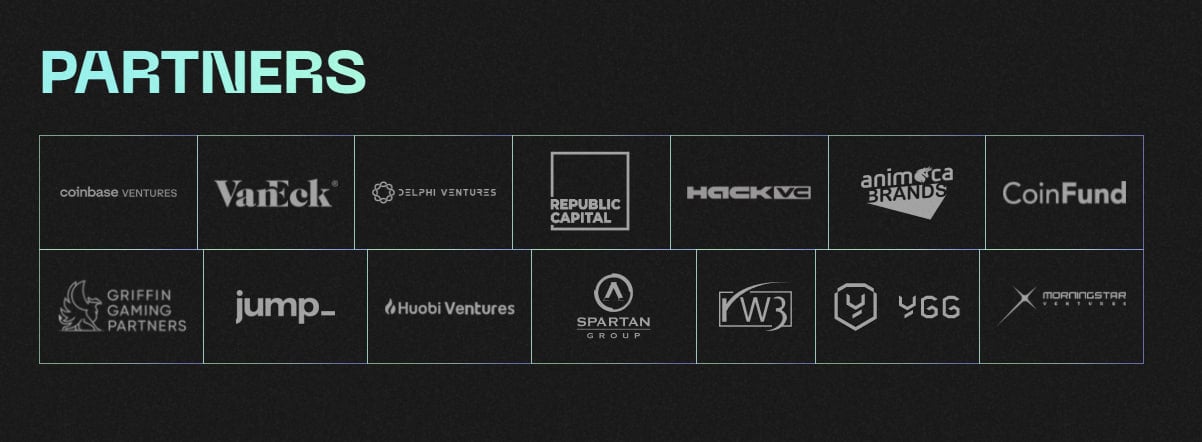
    GUNZ has a mass group of partners all over the crypto market, including giants crypto venture capitals: Coinbase Ventures, Jump Crypto, VanEck, Animoca Brands, Dephi Digital, etc.

    PartnersPartners

    Many great crypto venture capital (VC) have partnered with the Layer 1 protocol

    Key features of GUNZ

    Built on a Scalable Blockchain

    The deployment on the Layer 1 blockchain Avalanche has significantly facilitated the utilization of resources for the development of GUNZ’s ecosystem. With inherent advantages such as high scalability, rapid transaction processing, and low transaction costs, it enables the project to compete effectively with other gaming sector players in the market.

    This further reinforces the core values the game aims to promote, such as encouraging users to mine and hold on-chain assets, which demands seamless and swift transaction processes.

    Platform Economy

    Games utilizing the GUNZ platform, like Off The Grid, offer players the opportunity to acquire in-game items through active gameplay. These items, which can range from weapons and skins to cyberlimbs, provide tangible rewards for player engagement.

    Particularly, GUNZ allows players to elevate these in-game items by converting them into NFTs, effectively granting them verifiable ownership recorded on the blockchain.

    This conversion to NFTs breaks the traditional mold of gaming, where in-game items are typically confined to a specific platform. Unlike those systems, GUNZ empowers players with true ownership, enabling them to trade or sell their acquired NFTs.

    In extension, these transactions can occur within the game’s native marketplace or on external platforms, such as OpenSea, which exemplifies GUNZ’s commitment to providing players with a wider ecosystem for their digital assets.

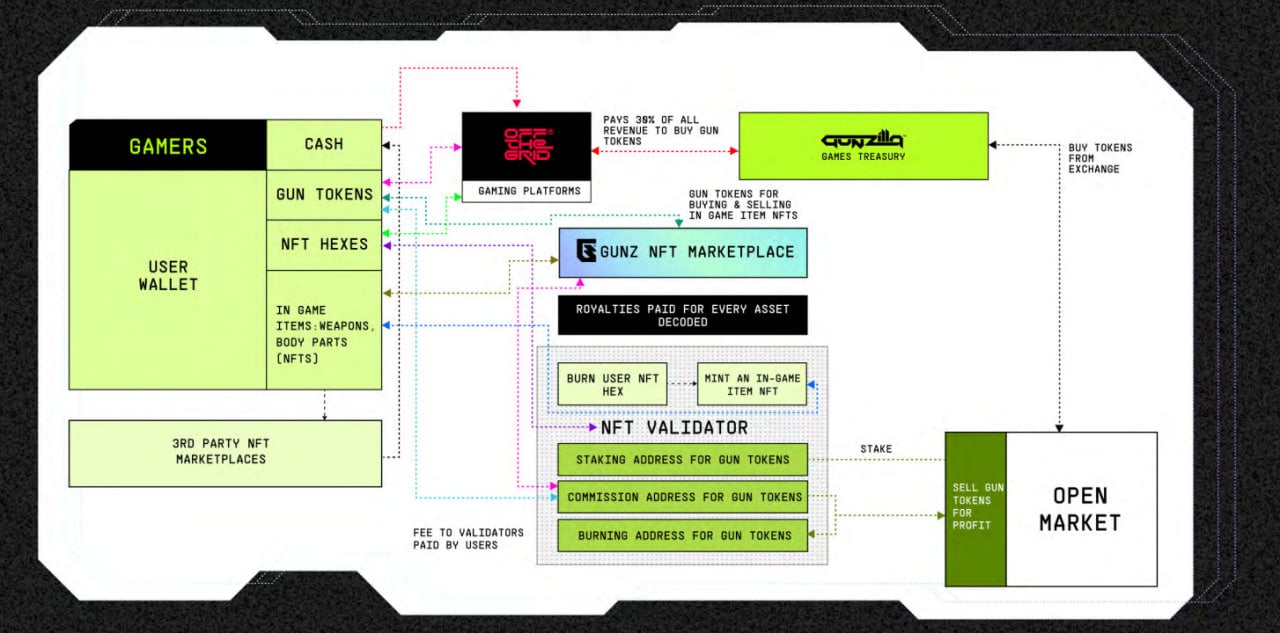
    Platform EconomyPlatform Economy

    Source: GUNZ

    Gunz Marketplace

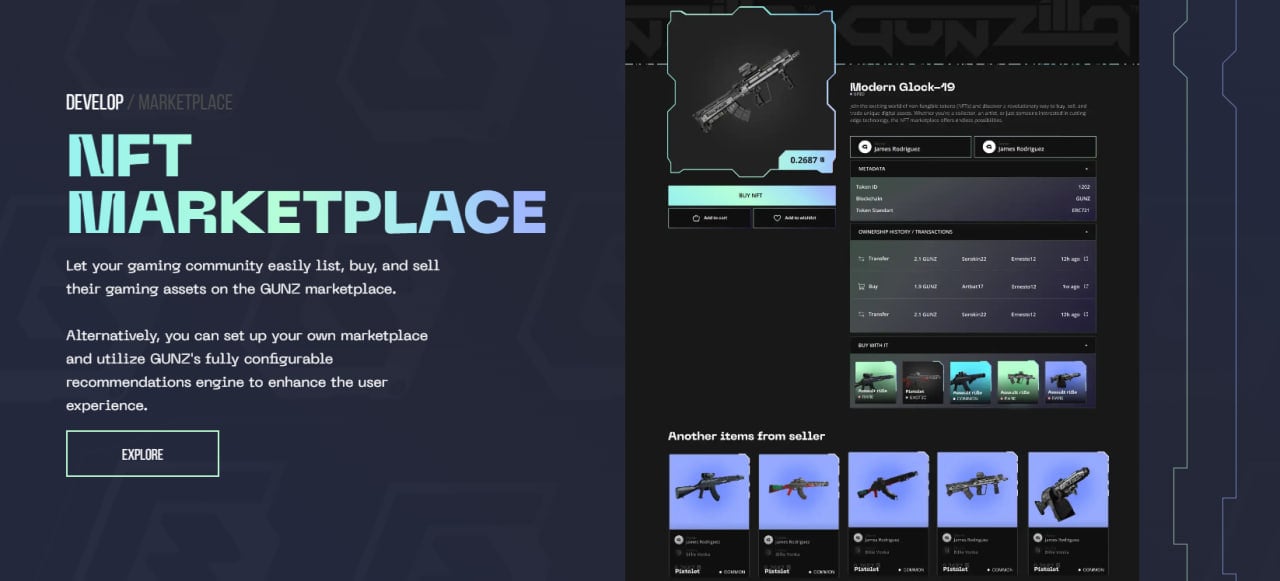
    Gunz MarketplaceGunz Marketplace

    Source: GUNZ

    The Gunz marketplace is a bustling hub where players can trade virtual items and in-game loot, creating a dynamic economy driven by user interactions. Players can trade items with other players, enhancing the interactive nature of the game. In-game items such as weapons and cosmetics can be traded, allowing players to customize their experience and enhance their gameplay. Not just about buying and selling; the marketplace’s goal is about crafting new items and upgrading gear using GUN tokens, which adds a layer of strategy to the game.

    Premium items are also available for purchase, offering exclusive content that can provide an edge in combat. Loot boxes and special hex items found during missions can be converted into GUN tokens, providing additional ways to earn and enhance their arsenal. This vibrant economy ensures that there’s always something new and exciting for players to explore.

    The marketplace facilitates more than just trading; it offers players opportunities to earn rewards through strategic gameplay. Whether you’re extracting valuable loot or trading high-demand items, this place is a key component of the game’s economy, providing endless opportunities for players to engage and prosper.

    Web3 Features in Off the Grid

    Web3 features in Off the Grid mark a significant evolution in the gaming landscape. The Gunz marketplace operates on a decentralized platform, allowing players to trade in-game items as NFTs, providing true ownership and transparency. This means that items you earn and craft in the game can be transformed into NFTs, which are owned and managed by the players themselves.

    NFT trading is not just a gimmick; it allows players to mint items earned in the game into digital assets stored on the blockchain. Players can extract hexes to mint items into NFTs, emphasizing the player-driven economy. To ensure that player efforts dictate the marketplace dynamics, the team intends to turn it into a fair and balanced system where hard work and skill are rewarded.

    HEXes, a unique in-game resource, are crucial for minting these items into NFTs and extracting hexes.

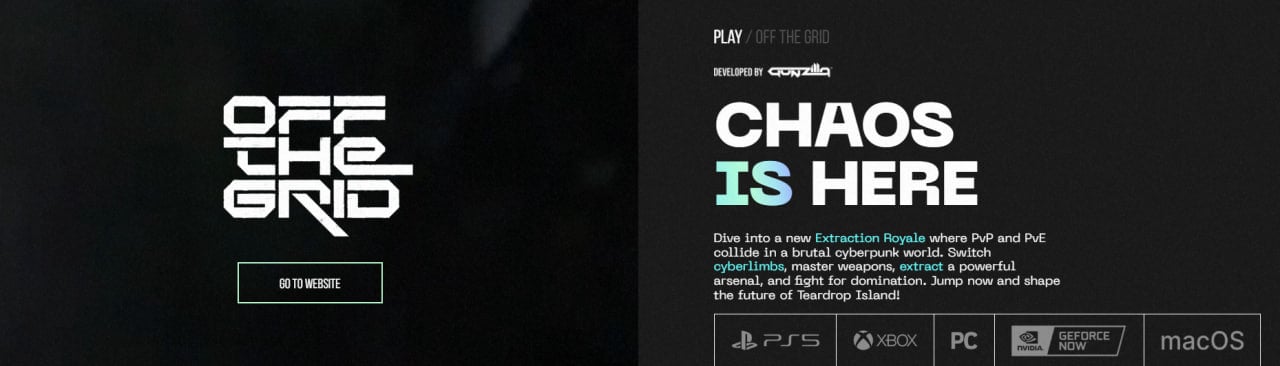
    Web3 Features in Off the GridWeb3 Features in Off the Grid

    Source GUNZ


    In general, the integration of NFTs ensures that the economy within the platform is shaped by player effort. This system not only enhances the gaming experience but also bridges the gap between virtual and real-world economies, offering players a new way to engage with and benefit from their gaming activities.

    Security and Online Play in Gunz

    Gunz employs the Blockchain Scanners to secure personal data during transmission over the internet, ensuring safety. On a regular basis, audits of security processes are conducted to ensure their effectiveness and proper administration. These measures are crucial in protecting players’ data and providing a seamless gaming experience.

    User interactions with Gunz services, including conversations with customer support as well as monitoring the Validator performance, may be monitored to ensure compliance with security standards and to enhance player safety. Therefore, players can enjoy their online play without worrying about data breaches or other threats.

    Furthermore, this function supports users in analyzing the in-game assets, where they are encouraged to hand-check the information of the item, such as total supply.

    The contribution of these security measures not only protects personal data but also contributes to a smooth and enjoyable online gaming experience. With secure information, you can fully immerse in the thrilling world of Gunz without concerns.

    Developer Tools and Infrastructure

    Gunzilla Games offers a robust suite of software developer tools designed to enhance the ecosystem. These tools empower developers to create custom content, such as game modes, maps, and items, for Off The Grid.

    GUNZ’s infrastructure also empowers these tools, allowing developers to create and manage NFTs for the game, providing a seamless experience. The tool integration ensures that developers can focus on producing high-quality content while leveraging the benefits of blockchain technology.

    Token Minting

    It allows partner developers to create their own tokens using GUNZ’s native token as gas, providing access to the GUNZ ecosystem and its integrations with exchanges, marketplaces, and other services. This simplifies operations and accelerates market entry for developers.

    GUN Token

    GUN is a native token of the GUNZ ecosystem, leveraging all in-game trade transactions and ecosystem engagement.

    Token Details

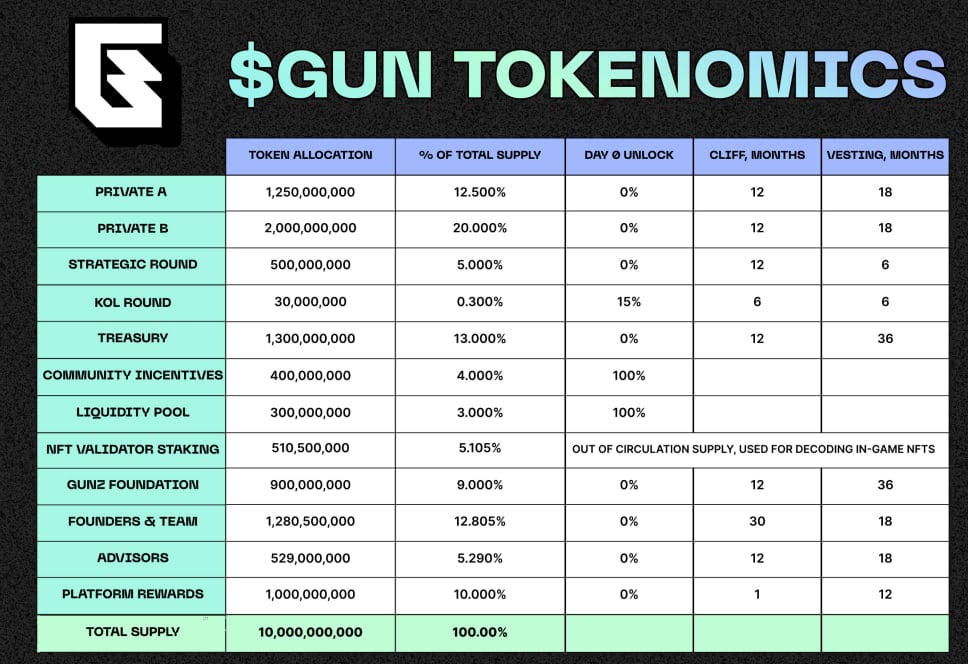
    Total Supply: 10,000,000,000 GUN.

    Max Supply: 10,000,000,000 GUN.

    Circulating Supply: 604,500,000 GUN (6.05% of total supply).

    Token Distribution

    The team will actively utilize GUN to support sustainable and long-term initiatives, grow the ecosystem, and provide incentives.

    Token DistributionToken Distribution

    GUN Tokenomics

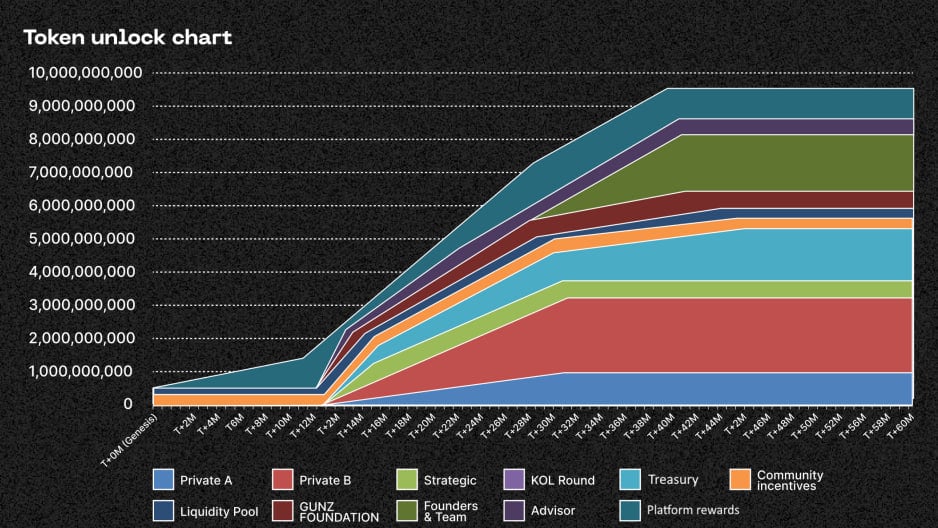
    Token Vesting Schedule

    In order to retain the gaming ecosystem and long-term ownership among society, there will be a token burn mechanism, a token buyback, and fair distribution for stakeholders and distributors. This system aims to maintain the game’s sustainability while also creating consistent demand for the GUN token.

    Gunzilla Games will dedicate 30% of the revenue generated by their game, Off The Grid, to regularly buy back GUN tokens from the market. The game will then use these tokens to replenish its reward pool and distribute them to players based on their performance, at a rate already shown on the main website.

    Token Vesting ScheduleToken Vesting Schedule

    Source: GUNZ

    Token Usecase

    GUN will serve in 3 main functions:

    Transaction fees in the GUNZ ecosystem.Rewards for Validator NFTs and enable them to function.Rewards for hardware validators in validating on-chain transactions.

    Future Perspective

    Off The Grid is currently available for free in Early Access on PC, PlayStation, and Xbox Series X|S. Players can engage with the game without participating in NFT aspects, maintaining a traditional free-to-play experience. This flexibility ensures that all players, regardless of their interest in Web3 features, can enjoy the game.

    The recent launch of the project on Binance Launchpool has increased attention towards various projects within the GameFi ecosystem, signaling a relatively positive trend.

    With these upcoming developments, the future of Gunz looks bright and full of potential.

    How to Buy GUNZ (GUN)

    binance-logo-2

    Create an Account: Sign up on Binance, it’s free and also has multiple newcomer bonuses.Select Payment Method: Choose how you want to buy GUNZ on Binance. However, this function has only been available since 2025-03-31 13:00 (UTC).Confirm Payment: Set your order at a fixed price.Store or Trade: Keep your GUNZ in the Binance Spots Wallet, or stake in Binance Simple Earn.

    Summary

    Gunz is not just another game; it’s a pioneering blend of innovative gameplay and cutting-edge Web3 technology.

    From its unique mechanics and dynamic marketplace to the integration of NFTs and a decentralized economy, the Layer 1 project offers a gaming experience like no other.

    What makes Gunz different from other shooting games?

    Gunz stands out from other shooting games due to its unique acrobatic movements and bullet-blocking mechanics, allowing players to execute gravity-defying actions that enhance both strategy and combat dynamics.

    How can I earn GUN tokens in the game?

    You can earn GUN tokens by completing missions, extracting valuable loot, and winning battles within the game. These tokens are useful for marketplace transactions and trading items.

    What is the role of NFTs in Gunz?

    NFTs in Gunz enable players to own and trade in-game items through a decentralized marketplace. This allows for true ownership and the ability to mint items as blockchain-based digital assets. This innovation enhances the gaming experience by providing tangible value to players.

    Is it safe to play Gunz online?

    Yes, it is safe to play Gunz online, as the game conducts regular audits to protect personal data.


    Source link

    Birds of A Feather star reveals she was rejected from huge reality show: “They didn’t want me”

      0
      Birds of A Feather star reveals she was rejected from huge reality show: “They didn’t want me”


      Birds of A Feather star Lesley Joseph has revealed she was snubbed from a spot on a major reality show.

      Best known for her role as Dorien Green in the ITV sitcom, Lesley, 79, has been a staple on screens for over six decades. From Strictly stint to performing at the West End, Lesley has kept herself busy over the years.

      But according to Lesley, there is one celebrity reality show that “didn’t want” the national treasure…

      Lesley is best known for her role in Birds of A Feather (Credit: ITV)

      Birds of A Feather star Lesley Joseph ‘snubbed’

      In a new interview, Birds of A Feather star Lesley shared that she was recently turned away from BBC’s upcoming Celebrity Traitors series.

      The Beeb confirmed in August last year that a celebrity series of the hit gameshow is in the works. The iconic programme, fronted by Claudia Winkleman, has been a hit with fans since its first series back in 2022.

      Just this week, it was reported that Kate Garraway had signed up for the show.

      But one celeb that won’t be making an appearance on Celebrity Traitors is Lesley…

      Claudia Winkleman in front of The Traitors castle

      A celebrity version of The Traitors is in the works (Credit: BBC)

      Celebrity Traitors ‘didn’t want’ Lesley

      At the Spring Ball at the Bloomsbury Ballroom this week, Lesley was quizzed on what reality shows she would love to take part in.

      “I couldn’t do Big Brother, because I like my own bathroom too much. And I wouldn’t do I’m A Celebrity with putting things in my mouth,” she told The Sun.

      Revealing that The Traitors snubbed her, Lesley shared: “I wanted to take part in The Traitors but that didn’t happen. So I think that would be the one I’d do.”

      Lesley was then asked if he had tried to go on the show. She replied: “I did but they didn’t want me.”

      Who is tipped to appear on Celebrity Traitors

      Celebrity Traitors – hosted by Claudia Winkleman – will follow a group of famous faces become Faithfuls, and battle to work out who the Traitors among them are and banish them before they’re murdered.

      As for the rumoured celebs taking part in the upcoming series, Kate Garraway, Peter Crouch, Dame Judi Dench and Rob Rinder are among the stars said to be in with a chance of becoming a Faithful or a Traitor.

      Read more: Inside Birds of a Feather reunion lunch as Pauline Quirke shared dementia diagnosis

      YouTube video player

      So who do you want to appear on Celebrity Traitors? You can leave us a comment on our Facebook page @EntertainmentDailyFix and let us know.


      Source link

      Ben Shephard called out for ‘weird and unprofessional’ interview with Adolescence star Owen Cooper

        0
        Ben Shephard called out for ‘weird and unprofessional’ interview with Adolescence star Owen Cooper


        Viewers of This Morning hit back at Ben Shephard as he was accused of being “unprofessional” during his interview with Adolescence star Owen Cooper.

        The 15-year-old actor currently stars in the Netflix phenomena, written by fellow actor Stephen Graham, as the lead role of Jamie Miller. The show has since sparked discussions about its portrayal of male violence and its potential to divert attention from issues of men’s violence against women.

        On Thursday (March 27), he appeared on This Morning to discuss his blossoming acting career alongside Faye Marsay, who also appears in the same series. However, while cracking a joke with the rising star, one of Ben’s comments seemed to rub viewers the wrong way…

        Owen stars as Jamie in Adolescence (Credit: ITV)

        Ben Shephard meets Adolescence star Owen Cooper

        While talking about the huge success of the show, Ben initially asked how Owen had felt about the reception.

        Declaring everything had been going “well so far”, the teenager said he didn’t have much to complain about after not reading anything “bad said about me”.

        Since the release of Adolescence, Owen revealed he hasn’t seen his school friends yet as he has been busy working on another project. However, he shared that he is set to return to school next Monday (March 31).

        Owen is currently filming for the upcoming 2026 adaptation of Wuthering Heights, where he will play young Heathcliff and will star alongside Barbie actor Margot Robbie.

        While discussing the Australian superstar, Owen said he speaks to and sees her “all the time” despite not having any scenes with her. Ben then asked how Margot is, to which Owen stated: “She is really nice.”

        However, Ben took things one step further and joked: “I think your mates might be interested in that coming back.”

        Owen laughed the harmful joke off and quickly continued to discuss filming for the movie.

        Ben Shephard on This Morning

        Ben’s joke didn’t go down well with viewers (Credit: ITV)

        Viewers slam Ben for ‘unprofessional’ interview

        Following the interview, viewers seemed unhappy with Ben’s joke about Margot, believing it was inappropriate given Adolescence’s focus on the treatment of women.

        “Great interview. Apart from when Ben Shephard suggested that Owen and his friends would want to talk about Margot Robbie for obvious reasons. I thought it was presumptuous and unprofessional,” one user wrote.

        “Yes, a bit clumsy of Ben considering the topic of adolescence,” a second remarked. “Bit weird,” they added.

        “Why wouldn’t teenage boys get excited about Margot Robbie? She’s a great actress, if my friend was working with her I’d talk to them about her too,” another countered.

        Others also praised Owen’s acting potential.

        “This kid is so talented. He showed his acting skills is so natural. I hope he’ll get more TV shows or series and movies in the future,” one person wrote.

        “Such a humble, down-to-earth young man who is exceptionally talented. His acting was so natural (like he wasn’t even acting). Looking forward to watching his future projects,” another said.

        Read more: Coronation Street star Tina O’Brien ‘very proud’ as she reveals surprise connection to Adolescence teen Owen Cooper

        Owen Cooper: The Breakout Child Star of Netflix Hit ‘Adolescence’ | This Morning

        So what do you think of this story? You can leave us a comment on our Facebook page @EntertainmentDailyFix. Let us know!


        Source link

        Korean Drone Flying Tour Switch Review

        0
        Korean Drone Flying Tour Switch Review


        There are currently eight Korean Drone Flying Tour games available for Switch, with seven more released weekly for the next two months. They used to be released sparingly, now they’re weekly:

        I bought Korean Drone Flying Tour Muui-Do. The game sucks. I cannot label it anything as else but Garbage. The game play is the gaming equivalent of adjusting the playing speed of a video. They even say it in the blurb:

        There is no up, down, left or right direction control, only the control to increase or decrease the drone speed.You can also change the drone’s flight mode from Normal, Sport, and Eco to any of the 3.

        A Korean Drone Flying Tour game is basically adjusting the speed of the video to the required speed by pressing up or down. You need to get or exceed a target time to finish the video while not draining your battery. You get gold coins which you can buy powerups, new courses and new modes. That’s about it. These games are ultra-lame and the developers should feel bad for subjecting people to them. Who is this for? I guess Koreans and nobody else. I take that back, I bet Koreans would be bored too. They’re not fun. They’re not interesting. You could have a flying drone tour of the Grand Canyon and I’d still be bored out of my mind.

        14Dimension thought they could get away with subjecting the eShop to this garbage. This is why I exist, to draw attention to this crap. Korean Drone Flying Tour gets a Garbage Verdict with a two back-end score. That’s for all the games, cause they’re all identical, just different areas. The drone footage is pretty, but that’s not enough to be worth it. Finally, In physical therapy, I had an exercise bike that showed a road tour and you could adjust the speed with how fast you pedaled. I loved it and pedaled as fast as I could. You’ll get nothing out of these games except curing your insomnia.

        Overall: Korean Drone Flying Tour is a series of garbage titles that are the gaming equivalent to adjusting the playback speed of a video. Worthless.

        Verdict: Garbage

        eShop Page

        Release Date3/27/25Cost$2.99Publisher14DimensionESRB RatingE

        P.S. I could’ve made this a Degradation article but opted for a standard review because using the series name is better SEO wise.

        Subscribe so you miss nothing:


        Source link

        I Thought I Was Done With The MCU, But Avengers: Doomsday Just Cast Alan Cumming – SlashFilm

          0
          I Thought I Was Done With The MCU, But Avengers: Doomsday Just Cast Alan Cumming – SlashFilm


          Man. Just when I thought I could finally leave the Marvel Cinematic Universe behind, they went ahead and added Alan Cumming to their proverbial Infinity Gauntlet … and just like that, I’m back in.

          Let me explain. I’ve been a fan of the MCU for a while now; I’ll admit, to the likely horror of any purists reading this, that I’m extremely unfamiliar with the comic books themselves, but I watched all four initial phases of the MCU religiously and even managed to fit in a chronological rewatch during the COVID-19 lockdown in 2020. Frankly, for a long time, it was my job to care about the MCU, until it wasn’t. I don’t need to get into all the specifics of how the proverbial sausage is made, but once I was no longer professionally obligated to keep up with the MCU, I just sort of … stopped, because honestly? I was somehow both bored and overwhelmed.

          Advertisement

          At a certain point, any involvement in the MCU just felt like homework — and by that, I mean that in order to watch one MCU project, I had to watch like, five others to even sort of understand what was going on. This was too large of a commitment for me, a person prone to bouts of intellectual laziness that result in me turning on a “Vanderpump Rules” marathon for the millionth time. Now? Everything’s different. In a live stream on YouTube, Marvel Studios announced cast members simply by showing their names on the backs of “on-set” chairs, and based on everything I’ve told you up until this point, imagine my shock when I learned that Alan Cumming, one of my favorite actors of all time, will appear in “Avengers: Doomsday.” This, to put it bluntly, rules, because Cumming isn’t just one of the most talented performers working today. He also might be the most fun performer working today.

          Advertisement

          Alan Cumming understands that performing is fun — and that’s precisely what the MCU needs

          The first major news we got about “Avengers: Doomsday” was that Robert Downey Jr. will return to the MCU as Doctor Doom, which was a decidedly not fun piece of news; Downey Jr. won an Oscar in 2024 for “Oppenheimer” and seemed like he’d permanently left the cinematic universe behind, and honestly, it felt like a huge bummer that the very dead Tony Stark was coming back to the MCU as a different character for no apparent reason other than “wow, look at that!” The really, really good news about Alan Cumming joining the MCU is he makes projects fun, fresh, and exciting, and he’s exactly the kind of shot in the arm this entire enterprise needs.

          Advertisement

          Cumming, a guy who once released a fragrance simply called “Cumming” and operates a super-inclusive cabaret space in New York City called Club Cumming, knows the real meaning of the word “camp,” and to quote Jenna Maroney on “30 Rock,” it seems like he “lives theatrically in everyday life.” From “Romy & Michele’s High School Reunion” to “Josie and the Pussycats” to his long-running role on “The Good Wife” and his current hosting gig on “The Traitors” — which earned him two Emmys — Cumming brings a sense of whimsy to everything he touches, and he pretty much always makes a concept better than it has any right to be. (For God’s sake, he’s good enough on “The Traitors” as an exaggerated version of himself that he almost makes you believe he owns that castle.) 

          Advertisement

          I thought the MCU had climaxed with Endgame, but it turns out there’s more Cumming

          We don’t know, as of this writing, precisely who Alan Cumming will play in “Avengers: Doomsday,” but based on the fact that the X-Men are finally back in the on-screen Marvel family and a whole bunch of actors from that franchise are also set to return, he’s probably going to play Nightcrawler, his evil teleporting mutant from “X2: X-Men United.” Though Cumming has publicly said he didn’t enjoy working on “X2” due to the difficult work environment, describing himself as a “miserable blue mutant” — which was, very likely, due to the fact that the movie was helmed by disgraced director Bryan Singer — he also recently described “X2” as the “gayest film that [he’s] ever done” in an interview with Entertainment Weekly, so perhaps he felt like he could return to this universe now that Singer is out of the picture.

          Advertisement

          The bottom line here is that Cumming is an utter delight. He’s an incredibly talented performer in essentially every way that matters — he’s just as phenomenal onstage in shows like “Cabaret” as he is on either the big or small screen — but he also makes everything he’s in fun and irreverent and even joyful, and he’s exactly what this next Marvel Cinematic Universe project needs. We need this whole thing to be a little less serious and a little more campy, and nobody can do that like Cumming.


          Source link

          Space Marine 2 devs promise “much more content” is coming as “no one is abandoning the game” for Space Marine 3

          0
          Space Marine 2 devs promise “much more content” is coming as “no one is abandoning the game” for Space Marine 3


          You can trust VideoGamer. Our team of gaming experts spend hours testing and reviewing the latest games, to ensure you’re reading the most comprehensive guide possible. Rest assured, all imagery and advice is unique and original. Check out how we test and review games here

          Saber Interactive and Focus Home Interactive have reiterated their plans to continue supporting Warhammer 40K: Space Marine 2 for “years to come”. 

          Following the announcement of the “bigger and better” Space Marine 3, the studios confirmed the team’s dedication to the second game, promising that “no one is abandoning the game” because of the new title. 

          Space Marine 2 will be supported for years 

          In the latest patch notes for Space Marine 2’s upcoming 7.0 update, Saber “set the record straight” with fans. 

          “Space Marine 3 does not mean the end of Space Marine 2’s development. ​Far from it,” the studio confirmed. “No teams are shifting over, no one is abandoning the game, and our plans to bring more awesome content to Space Marine 2 remain.”

          Saber teased that the team is working on “much more content and surprises for the months to come, such as a new class, more operations, melee weapons, and more”. The studio even jokes that data miners haven’t uncovered all of their secrets just yet so we’ll have to keep our eyes peeled. 

          “This announcement simply marks the genesis of a new project, years away from release,” the team said. “We’ve made a decision and have just started the process.”

          With Saber aiming to give the third game a considerable jump in scale, Warhammer 40K: Space Marine 3 will take a long time to create. Combined with continued development of Space Marine 2 Operations, new enemies, PvP and more, as well as a unique Horde Mode, there’s tonnes of goodies coming. 


          Source link

          Tunguska: The Visitation – Complete Edition Reminds of the Horrors of S.T.A.L.K.E.R. on Xbox | TheXboxHub

          0
          Tunguska: The Visitation – Complete Edition Reminds of the Horrors of S.T.A.L.K.E.R. on Xbox | TheXboxHub


          Tunguska The Visitation CoverArt
          Tunguska The Visitation – now on Xbox

          Soviet era, exclusion zones, ghoul hunting. Yep, Tunguska: The Visitation on Xbox has all the hallmarks of being inspired by the S.T.A.L.K.E.R. series, and developers Rotorist Workshop make no secret of this. The question is, will this top-down action shooter be as equally as captivating? Read on for more info!

          A Cursed Realm

          Now available on Xbox consoles – a first foray onto console for a game that has previously only been PC-exclusive – Tunguska: The Visitation is heavily inspired by the novel Roadside Picnic, and sets you slap-bang into the middle of all of the panic that came with the Soviet era.

          You are a Ghoul Hunter in a long-abandoned Soviet Exclusion Zone, which has come a cropper after the mysterious Tunguska event of 1908. Your goal? Figure out the mystery behind this terrifying and dangerous area, avoid the monsters that aim to kill you without a second’s thought, and perhaps make a bit of a fortune in the meantime…

          The console edition of Tunguska: The Visitation just so happens to be the Complete Edition. This means that your hardcore survival experience will come bundled in with a ton of previously-released DLC that PC players must shell out extra for.

          This includes New Game+, additional modes such as Slaughterhouse mode, additional weapons in the Shadow Master DLC, and story-based additional content such as the Ravenwood Stories DLC. You lucky, lucky Xbox player!

          Tunguska: The Visitation – Complete Edition Key Features

          Dangerous mutants and skillful, well-equipped human NPCs powered by Goal-Oriented AI

          Radiation hazard and T-Syndrome infection, both mitigated in multiple ways

          Large arsenal of Soviet-era weapons with matching ammunition

          Weapon customization/upgrade via attachments

          Skill system with 12 skills and 72 perks, each adds a unique ability for the player and NPCs

          Earn combat and survival XP separately through gameplay, which converts to skill points after each level

          Grid-based tetris inventory with weight limit

          Power-ups crafted from mutant body parts with both positive and negative effects

          Extensive story and lore discovered through dialogues, notes, and journals

          Realistic weathers with continuous day/night cycle that affects gameplay

          Suppressed weapons, silent takedown, and interactive dynamic lighting allowing for stealth style gameplay

          Wearable detectors to assist the player across different situations

          Fast-travel available via vehicles or as a paid service through the NPCs

          Play Today!

          Tunguska: The Visitation – Complete Edition is now available on Xbox Series X|S and Xbox One. There’s also versions of the title available for PC players.

          So, what are you waiting for? Pick up a copy today via the Xbox Store for £33.49, and make sure to check out our full review of Tunguska: The Visitation – Complete Edition on Xbox, coming soon!

          Tunguska: The Visitation – Complete Edition Description

          Seek fortune as a Ghoul Hunter in an abandoned Soviet Exclusion Zone. Use your grit and ingenuity to survive deadly radiation, mysterious anomalies, and poisonous mutants. Go in guns-blazing, or stay in the shadows – your choice.

          Uncover the dark secrets of Tunguska from the Soviet era. Venture across desolate villages, abandoned facilities, toxic swamps, and ominous tunnels in this top-down adventure RPG, in a realm cursed by the mysterious Tunguska Event in 1908.

          Inspired by the novel Roadside Picnic, Tunguska is one man’s vision and creation of a new post-Visitation zone: a place not just full of horror and danger, but also the freedom and opportunities sought after by many near the fall of the USSR.


          Source link

          Popular Posts

          My Favorites

          How to Use Virtual Stores to Drive Holiday Shopping

          0
          It’s not surprising that holiday sales account for a significant amount of retailers’ annual sales. Brands are continually searching for engaging and entertaining...