Home Blog Page 1010

Babylon (BABY) Price Prediction: Pre & Post-TGE

0
Babylon (BABY) Price Prediction: Pre & Post-TGE


As Babylon prepares for its eagerly awaited token generation event (TGE), the focus is on its pricing strategy and post-launch performance. With a unique model for non-custodial BTC staking and over 3.8B USD in TVL, Babylon enters the modular infrastructure arena alongside EigenLayer, Solayer, and Pendle – poised to unlock new value but also facing the pressure to deliver immediately.

Highlights of Babylon

Babylon’s most unique feature is its non-custodial Bitcoin staking mechanism: BTC holders can stake their Bitcoin directly on the Bitcoin network without going through third parties or centralized bridges.

Learn more: What is Babylon?

In essence, Babylon transforms Bitcoin into a “security layer” for the PoS ecosystem while also building a liquidity hub to channel BTC into DeFi. At the Genesis phase, Babylon Chain aims to integrate with multiple blockchains such as Osmosis, Cosmos Hub, and Sei.

Currently, Babylon’s total value locked (TVL) exceeds 3.8 billion USD, accounting for approximately 80% of the total TVL within the Bitcoin ecosystem.

Prior to the rise of Babylon, YZI Labs had already been actively supporting liquid staking initiatives like Kernel DAO. Even CZ has repeatedly highlighted this narrative. These factors have helped Babylon stand out as a leading player in this emerging space.

Highlights of Babylon

Babylon’s TVL – Source: DefiLlama

Babylon Tokenomics

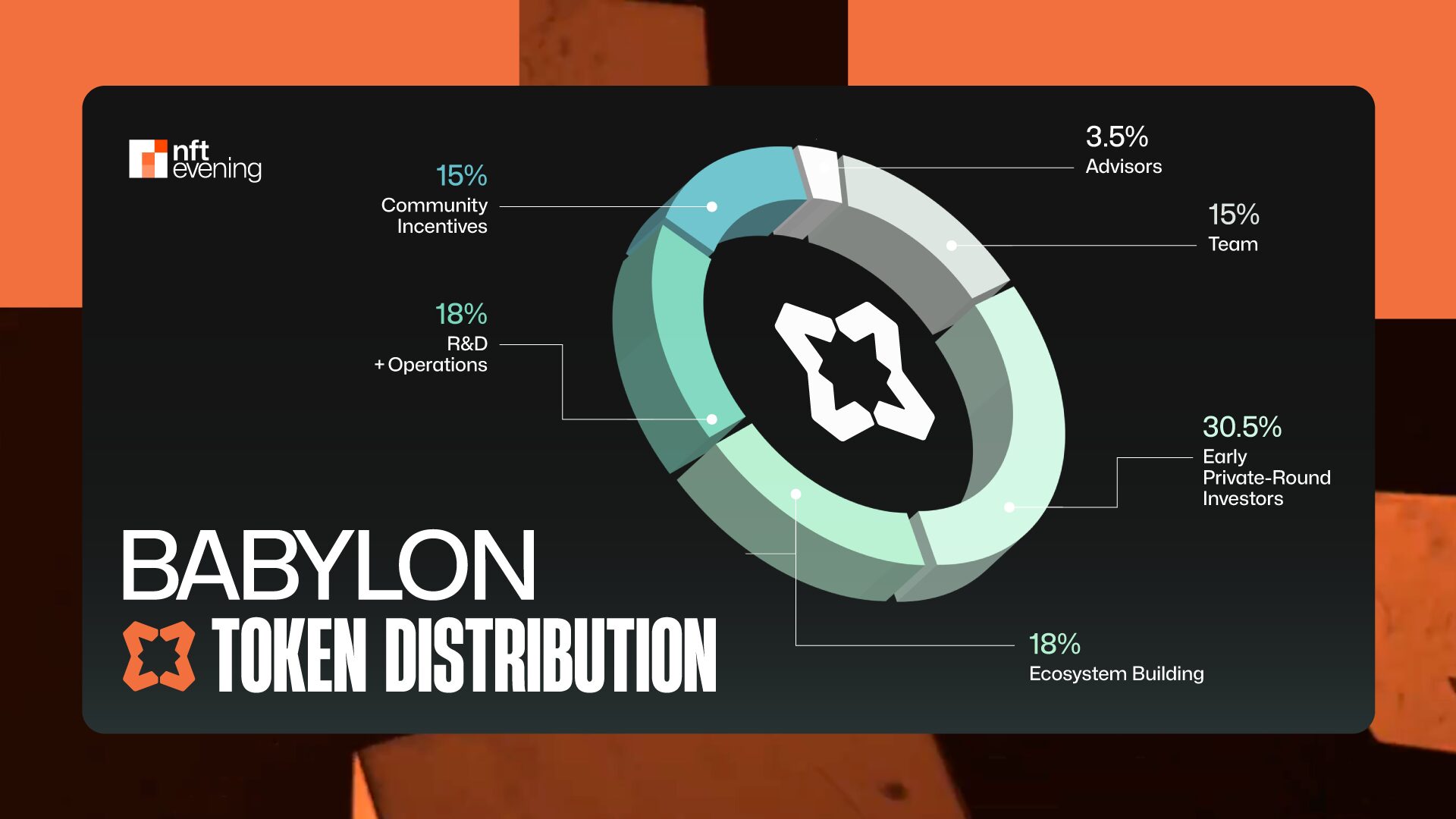
Token Allocation

Early Private Round Investors: 30.5%Ecosystem Building: 18%R&D Operation: 18%Team: 15%Community Incentives: 15%Advisor: 3.5%

Babylon TokenomicsBabylon Tokenomics

Babylon Tokenomics

The initial circulating supply is 2,294,036,491 tokens (22.9% of the total supply), which is a relatively high percentage and could create sell pressure.

BABY Price Prediction

Market Comparison

Babylon is not alone in the mission to unlock the foundational asset value for other blockchain networks. Several other notable infrastructure projects, such as EigenLayer EIGEN, Solayer LAYER and Pendle PENDLE are also working toward similar goals of shared/reused security and interchain connectivity.

Babylon is not alone in the mission to unlock foundational asset value across networks. Other prominent infrastructure projects aiming to enable shared or reusable security and cross-chain connectivity include EigenLayer, Solayer and Pendle.

Market ComparisonMarket Comparison

Market Comparison

Babylon vs EigenLayer

EigenLayer leverages Ethereum’s massive staked capital (currently over 7 billion in TVL) to serve as a “shared security layer” for multiple applications, eliminating the need for each app to issue its own staking token. Both EigenLayer and Babylon are considered pioneers of the “restaking” and shared security movement in their blockchain space.

However, there is a key distinction: EigenLayer targets the Ethereum staking community, while Babylon attracts Bitcoin holders into the DeFi ecosystem. Ethereum already has a rich DeFi and application landscape that can naturally integrate restaking. In contrast, Babylon opens up a new market for Bitcoin but must convince independent PoS chains to join its network.

Babylon currently trails EigenLayer in TVL, with 57,000 BTC versus an ETH equivalent of 4.4 billion USD on EigenLayer. Nonetheless, Babylon still has significant growth potential due to Bitcoin’s vast untapped liquidity.

Babylon vs Solayer

Solayer represents a new direction in the modular security space, offering a “modular security layer” for appchains. The project launched its LAYER token via Binance Launchpool in March 2025, and shortly after listing, the token peaked at around 1.15 USD before correcting to the current range of 0.42 to 0.45 USD.

With a total supply of 1 billion tokens and an initial circulating supply of over 220 million tokens, Solayer currently holds a circulating market cap of approximately 370 million USD, while its FDV hovers around 1.5 USD–1.7 USD billion. Although this valuation is not high compared to other infrastructure projects, it reflects a degree of market caution toward the modular security narrative via staking.

Babylon vs Pendle

Pendle, on the other hand, does not focus on security but has gained prominence in the yield optimization segment. This is a direction that Babylon could potentially expand into over the long term – once a significant amount of BTC is staked via Babylon, derivative products based on BTC yield could see meaningful growth.

As for the token, PENDLE has seen tremendous growth, rising from around 0.10 USD in 2023 to a peak of over 7.50 USD in April 2025, with a current circulating market cap exceeding 1.1 billion USD. Pendle is considered a prime example of the new generation of DeFi protocols, where capital efficiency is a core value proposition.

Babylon has raised 70 million USD from Paradigm and a total of 88 million USD across multiple seed and strategic rounds from investors including Polychain, Binance Labs, Galaxy, Framework, and Hashkey. If 30.5% of tokens are allocated to investors, the implied fundraising valuation suggests a private round price of around 0.028 USD per BABY.

With over 4 billion USD in TVL (57,000 BTC) , Babylon has already surpassed both Solayer and Pendle in real traction. 

Babylon Price Prediction

binance-logo-2binance-logo-2

Thus, upon listing on Binance, users are anticipating a 3x–5x multiple over private round pricing, translating to an FDV between 840 million and 1.4 billion USD. At a public price between 0.084 USD and 0.14 USD, Babylon’s circulating market cap would still be within a reasonable range compared to top-tier infrastructure projects like EigenLayer, Lido, and Solayer.

It’s also possible that Babylon could follow the same path as many highly anticipated infrastructure projects that saw sharp declines after listing. Even EigenLayer, considered the flagship of the restaking narrative, has dropped more than 85% from EIGEN’s all-time high.

Babylon vs PendleBabylon vs Pendle

EIGEN’s price – Source: CoinGecko

However, an alternative outcome remains entirely plausible: BABY could gain strong momentum right after its TGE, especially if Babylon chooses to list it at an FDV and price exploration similar to Solayer’s.

Babylon vs PendleBabylon vs Pendle

LAYER’s price – Source: CoinGecko

Conclusion

Babylon enables non-custodial BTC staking, positioning Bitcoin as modular security for PoS chains. With over 57,000 BTC staked (TVL 4.2B USD), it has already outpaced peers like Solayer and Pendle in real traction.

BABY’s 0.084 USD – 0.14 USD range shows strong upside, but short-term risks remain. Babylon must prove its utility fast to avoid sell-offs and secure long-term value this cycle.

Read more: Binance Introduces Babylon (BABY) on HODLer Airdrops Program


Source link

Megan Fox and Machine Gun Kelly Shouldn’t Get Back Together

    0
    Megan Fox and Machine Gun Kelly Shouldn’t Get Back Together


    It seems that Megan Fox and Machine Gun Kelly are on better terms following the birth of their first child, but that doesn’t mean they should get back together.

    On March 27, MGK, 34, announced that he and Fox, 38, had welcomed a baby girl. Fox is also the mother to Noah, 12, Bodhi, 10, and Journey, 8, whom she shares with her ex-husband, actor Brian Austin Green. Kelly also has a 15-year-old daughter named Casie with his ex, Emma Cannon.

    Article continues below advertisement

    Megan Fox and Machine Gun Kelly Split A Year After Getting Engaged

    MEGA

    In March 2020, Fox and MGK, real name Colson Baker, met on the set of “Midnight in the Switchgrass.” She later appeared in his “Bloody Valentine” music video, where the two shared several intimate scenes. They confirmed their relationship during a July 2020 episode of the “Give Them Lala” podcast, where Fox referred to him as her “twin flame.”

    In January 2022, MGK popped the question in a ceremony where they reportedly “drank each other’s blood,” as per the Instagram caption shared alongside a video of the proposal. However, the following year, it seemed that they had broken up after attending a Super Bowl party in February 2023.

    Article continues below advertisement

    Fox deleted all photos and videos, including the one of their engagement, from her Instagram account and shared a cryptic post about “dishonesty.” She then deleted her entire Instagram account hours later. At the time, sources said that they had broken up, but were going to therapy to see if they could salvage the relationship.

    Article continues below advertisement

    They Split Up Again Right After Thanksgiving

    Megan Fox and Machine Gun Kelly out in NYC
    MEGA

    A few months later, they were spotted on vacation in Hawaii while attempting to repair their relationship. In November 2023, Fox released her poetry book, “Pretty Boys Are Poisonous,” where she revealed that they had been through a miscarriage together.

    Although she remained coy about their relationship status, she attended his birthday party in April 2024 and announced that they were expecting their first child together in November; however, they went their separate ways after Thanksgiving, when she allegedly found something upsetting on his phone.

    An insider told TMZthat the argument occurred while they were vacationing together in Colorado. Fox reportedly left the trip early and did not speak to MGK at all for at least two weeks.

    Article continues below advertisement

    Sources Say That There Has Been A ‘Noticeable Change’ In Machine Gun Kelly

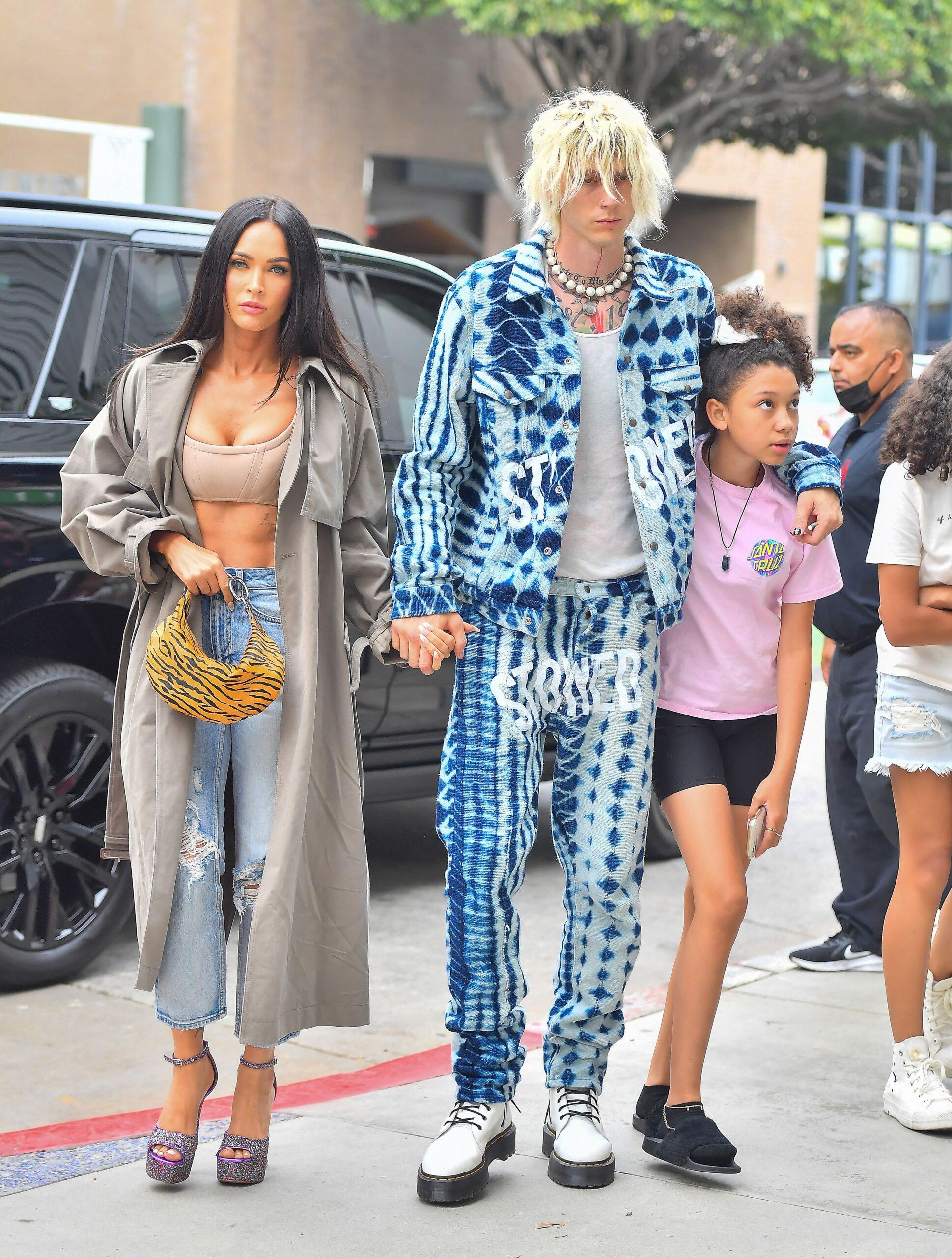
    Machine Gun Kelly and Megan Fox head out to dinner with his daughter in Santa Monica
    Snorlax / MEGA

    Following the birth of their first child, Fox has reportedly detected a “noticeable change” in the rocker. “The relationship is still complicated. They haven’t reconciled,” a source told Us Weekly. “It’s a mix of healing and hard conversations that they have had.”

    “The baby has brought them closer together,” the insider added, noting that both parents are currently “obsessed” with their little girl, whose name they have yet to disclose. They went on to say that MGK has “completely changed” after the “Jennifer’s Body” actress gave birth.

    “The baby is already wrapped around his finger,” the insider shared. “Megan has noticed his energy is different, the look in his eyes is different, [and] his aura has changed. She feels the baby is exactly what he needed, and she is hoping it sticks.”

    Article continues below advertisement

    Megan Fox’s ‘Biggest Worry’ About Machine Gun Kelly Is That He’ll ‘Change Again’

    Machine Gun Kelly and Megan Fox attend the afterparty for his Madison Square Garden Show in New York
    MEGA

    The insider revealed that the actress’s “biggest worry” right now is that MGK “will change again and be the guy she doesn’t know,” adding, “Fatherhood seems to have cracked something open in him. He’s been more reflective and quieter, almost like he’s processing on a deeper level.”

    Fortunately, sources say that MGK has been there “100 percent” of the time since she gave birth, “making sure they are taken care of, doting on them, being present.”

    “It’s changed her mind a little bit about him and if there can be a future for them together,” they added, letting slip that she is “allowing MGK to be there and be in their daughter’s life” for now because they are “in a good place” for the moment.

    “It’s all her rules, under her roof right now and has been on his best behavior,” another source told the publication last week. “She’s just focused on their baby and is so in love.”

    Article continues below advertisement

    Megan Fox Needs To Be Focused On Her Baby, Not A Relationship

    Megan Fox and Machine Gun Kelly At Sports Illustrated Swimsuit 2023 Issue Release Party
    MEGA

    As the mother of three children already, it sounds like Fox already knows that she has to focus on her daughter and not her relationship with Machine Gun Kelly, especially when he has seemingly disappointed her so many times in the past. There is an old saying that a leopard can’t change its spots, and it seems that whatever caused them to break up in February 2023 caused them to split for a second time in November 2024.

    Although MGK might be enamored with his baby daughter now, he already shares a 15-year-old daughter with his ex, so he knows what it is like to co-parent while not in a relationship. Fox is familiar with this as well. Considering their on-and-off relationship, this is a situation where they shouldn’t be together for “the sake of the child,” as insiders have hinted that their relationship is nothing but toxic drama.

    Although it’s understandable that he is doting on her now right after she’s just given birth (as he should), it seems like it won’t be long until he slips back into old habits that caused the rifts between them to begin with. It wouldn’t be surprising to hear that they get together at least one more time… before they call it quits for good.


    Source link

    Magic Eden Expands Into Crypto Trading With Slingshot Acquisition | NFT News Today

    Magic Eden Expands Into Crypto Trading With Slingshot Acquisition | NFT News Today


    NFT marketplace Magic Eden has finalized its acquisition of Slingshot, a cross-chain trading app, marking a significant pivot beyond digital collectibles into comprehensive crypto trading. The strategic move, completed on April 9, 2025, transforms Magic Eden from an NFT-focused platform into a full-spectrum digital asset marketplace supporting over 5 million tokens across multiple blockchains.

    Key Takeaways

    Magic Eden’s acquisition of Slingshot positions the company to compete directly with centralized exchanges like Coinbase and Binance while maintaining a non-custodial, on-chain model.

    Slingshot’s chain-abstraction technology enables trading across 10+ blockchains without requiring users to bridge assets between networks.

    Despite generating $75 million in revenue from NFTs in 2024, Magic Eden is diversifying its business model amid changing market conditions.

    The platform will maintain its existing NFT marketplace while adding trading capabilities for millions of tokens, including those often excluded from centralized exchanges.

    Future plans include integrating Bitcoin runes and expanding to additional blockchains like HyperLiquid, XRP, Cardano, Sui, and TON.

    Slingshot’s Game-Changing Cross-Chain Technology

    The foundation of this expansion is Slingshot’s innovative chain-abstracted trading system. This technology eliminates traditional barriers between blockchains, allowing users to trade assets across Solana, Ethereum, and soon Bitcoin without manually transferring tokens between networks.

    Slingshot’s approach includes a universal USDC balance system that simplifies the user experience. By removing technical hurdles like gas fees and bridging requirements, Magic Eden can now offer non-custodial trading with transparent on-chain settlements across multiple blockchain ecosystems.

    Strategic Diversification Beyond NFTs

    While Magic Eden achieved impressive financial results with $75 million in revenue in 2024 despite NFT market challenges, the company recognizes the need to adapt to changing market conditions. At its peak, the platform facilitated $1.9 billion in secondary NFT trading volume and attracted 22 million monthly visitors.

    CEO Jack Lu emphasized that while the company remains “incredibly bullish” on NFTs, mainstream crypto adoption requires utility-driven applications rather than purely speculative trading. This acquisition represents a calculated move to expand Magic Eden’s reach while maintaining its core NFT business.

    Frictionless Onboarding for New Crypto Users

    A key advantage of the Slingshot integration is its user-friendly features that remove common barriers to entry for crypto newcomers. With support for Apple Pay, Venmo, and traditional credit/debit cards, the platform simplifies the purchasing process.

    The system’s email login option mirrors the familiarity of centralized exchanges while providing multi-chain flexibility. Slingshot has already attracted nearly 1 million users, showing the potential of this approach to broaden Magic Eden’s audience beyond NFT collectors.

    Competing with Centralized Exchanges

    Lu describes the vision for Magic Eden’s expanded platform as “Think Binance or Coinbase, but fully on-chain.” This approach provides the company with a competitive edge against centralized exchanges by avoiding regulatory and security issues associated with custodial models.

    The company’s strategy is guided by what Lu calls the MAGIC Principles:

    Magic Eden’s historical 2% NFT marketplace fee undercut competitors like OpenSea (2.5%), suggesting a willingness to compete on price in the broader token trading market as well.

    Expanding Beyond NFT Collections

    The acquisition dramatically increases Magic Eden’s asset offerings. While the platform will continue to support its 8,000 existing NFT collections, users will now have access to over 5 million tokens, including memecoins and altcoins that are often excluded from centralized platforms due to regulatory considerations.

    This vast expansion of available assets helps Magic Eden capture users who might be deterred by the limitations of major exchanges, positioning the company uniquely in both the NFT and broader crypto-trading spaces.

    Future Roadmap

    Magic Eden has outlined ambitious plans for the continued expansion of its cross-chain ecosystem. Key upcoming features include:

    Bitcoin Runes integration

    Support for additional blockchains including HyperLiquid, XRP, Cardano, Sui, and TON

    Enhanced social features enabling copy trading and portfolio sharing

    The success of Magic Eden’s expanded platform will depend on how effectively the company balances innovation with stability as it enters the competitive and volatile token-trading sector.

    As Magic Eden evolves from an NFT marketplace to a comprehensive crypto trading platform, it faces the challenge of maintaining its existing community while attracting traders who previously might have used centralized exchanges. With Slingshot’s technology now integrated, the company is betting that reducing friction between blockchains will prove appealing to both casual and advanced crypto users.


    Source link

    Sweet’s SCOR Token Integration Bridges Sports and Web3 Gaming | NFT News Today

    Sweet’s SCOR Token Integration Bridges Sports and Web3 Gaming | NFT News Today


    Sweet, a platform focused on sports fan engagement, plans to introduce a new rewards token called SCOR within its Web3 ecosystem. Participants can collect Gems by playing a series of sports mini-games on the “$SCOR on Sweet” Telegram channel, then convert those Gems into SCOR when the token is publicly launched.

    SCOR, supported by the SCOR Foundation, aims to serve as an entry point for digital collectibles, premium upgrades, merchandise, and other exclusive benefits tied to professional sports through Sweet’s Web3 platform.

    SCOR’s Role in Sweet’s Expanding Ecosystem

    Sweet has partnered with major sports organizations such as the NHL, MLS, select NBA teams, and Formula 1 partners, leveraging blockchain-based features to enrich fan experiences. By introducing SCOR, Sweet aims to connect sporting communities and casual gamers who may be less familiar with Web3 applications.

    Through accessible retro-style mini-games, users can gather Gems by completing tasks like achieving high scores, referring friends, taking part in community discussions, connecting a wallet, and linking a Sweet account. Gems can also be used to complete challenges and maintain activity streaks.

    Source: Sweet

    Once SCOR launches, these Gems convert into tokens, offering tangible rewards within the platform. This approach appears designed to encourage sustained involvement and create a more interactive environment for fans.

    “Integrating $SCOR into our platform is all about making sports fandom even more exciting and rewarding. With the introduction of $SCOR, fans can now earn real rewards that enhance the connection between pro sports and their fans in a fun and rewarding way,” said Sweet CEO Tom Mizzone.

    The TON Protocol and Tokenomics

    SCOR is built on the TON protocol, which is noted for its speed and scalability. The token supply is capped at four billion, with 44% allocated to ecosystem growth. This portion is intended to foster in-game incentives and community engagement strategies, potentially offering long-term value for token holders.

    The underlying infrastructure aims to accommodate users who are either new to Web3 or accustomed to more traditional gaming. According to Alena Shmalko, Ecosystem Lead at TON Foundation, “We are thrilled to see $SCOR integrated into Sweet’s platform, pushing forward the adoption of blockchain in sports and gaming.”

    Gamified Experiences and Beyond

    On the user-facing side, Sweet’s platform ties each mini-game to various professional sports partnerships, encouraging fans to engage with digital collectibles, interactive challenges, and merchandise opportunities. Individuals who accumulate Gems through gameplay can convert them into SCOR, granting access to premium features, in-app upgrades, and items that correlate with real-world sports.

    Sweet has previously released experiences like NHL Breakaway and MLS QUEST, which illustrate how blockchain elements can add a dynamic layer to sports fandom.


    Source link

    Biomorph Switch Review

    Biomorph Switch Review


    Biomorph is a great game. It gets a Must Play with a nine back-end score. I started off the verdict and score because I want to frame this review. The game has some neat twists on the Metroidvania formula, like spicing up revisiting earlier areas with harder creatures. Still, it feels very familiar at times, but that’s not necessarily a bad thing here. I haven’t seen many games attempt to replicate Metroid’s morphball, but this game does, and does it well. The game is huge, I barely cracked the surface, but played enough to give it a good review. So let’s begin:

    I’ll start with what drags the game down to a nine from a ten: the plot. There is one, but its not really explained at that well, though the animated cut-scenes certainly sure are pretty. You’re this character who wakes up in an alien spaceship, escapes and sets off on a quest to restore the very spaceship you escaped… or something. Fortunately, the rest of the game is exquisite. Biomorph’s name comes from its signature ability, where you kill, then morph into various creatures that do various things. Morph enough times, you unlock the ability to morph at will. Morph even more times, and the morphing itself becomes more powerful.

    When not morphing in Biomorph, you use chips that provide a wide range of skills, from shields to melee and ranged attacked. You get upgrades that upgrade the chips. You also have momentos, which provide passive abilities, like dealing more damage to bosses. You can change your outlay at any save point, which also doubles as a fast travel system. There is also vital scans, which restore health after a few seconds of pressing R. You start with 2 and can get more. Finally, you can slide from the start by pressing ZR. Other abilities like wall jumping is unlocked as you go.

    Biomorph

    In Biomorph, there is a main town called Blightmore, and here is where you can upgrade your chips and momentos, as well as do other things. The town’s features are mainly unlocked by various side quests scattered around the map. I guess they’re nice and do add to the plot and ambiance, but are just kinda there. There are bosses, and they are well done, but stragely I had the most problems with the first main one. You can watch me beat it below:

    Me beating a boss, barely.

    Biomorph has great graphics, they look like hand drawn animation at times. The sound is nothing write home about, but gets the job done. The game play is smooth and slick. The game has twists(the aforementioned making revisiting old areas harder) while feeling familiar in a good way. Only the plot drags this down. So as I said at the start, this gets a Must Play with a nine back-end score.

    Overall: Biomorph is a great Metroidvania that manages to do new things while still feeling familiar. It works very well!

    Verdict: Must Play

    eShop Page

    Release Date4/3/25Cost$19.99PublisherLucid Dreams StudioESRB RatingT

    p.s. I don’t review many Metroidvanias due to the time commitment, but another one I did review was Sugamenia.

    Game received for free from the publisher!

    Subscribe so you never miss a review:


    Source link

    General Hospital Early Spoilers April 14-18: Carly Attacks, Sonny Snaps & Sidwell Recruits

      0
      General Hospital Early Spoilers April 14-18: Carly Attacks, Sonny Snaps & Sidwell Recruits


      General Hospital spoilers for April 14-18, 2025 see Carly Corinthos Spencer (Laura Wright) attacking Sonny Corinthos (Maurice Benard), snapping, and Sidwell (Carlo Rota) recruiting somebody. As we always do on early edition day, we start with what’s coming the rest of this week to set up those spoilers for next week. With that in mind, Wednesday, April 9th, we have got Alexis Davis‘ (Nancy Lee Grahn) head absolutely spinning.

      General Hospital Spoilers: Ava’s Shocking Revelation to Alexis – “Kristina Tried to Kill Me!”

      At the end of Tuesday’s episode, Ava Jerome (Maura West) showed up in her office, and of course, Alexis just wanted her to go away, but she did not. Instead, on Wednesday, she is going to completely shock the lawyer. Ava is going to tell Alexis Kristina Corinthos-Davis (Kate Mansi) tried to kill me, and I can prove it.

      Ava is going to show Alexis the footage of Kristina from the garage. Now, it doesn’t show her up under the car cutting the brake lines, but it shows her with something in her hand and at the car, and it doesn’t look very good at all. At the same time this is going on, Kristina is with her dad, Sonny, and she’s making a confession and begging him.

      General Hospital Spoilers: Kristina’s Confession and Sidwell’s Recruitment Strategy

      I wonder if she is going to come clean and tell him that she nearly killed Ric and Elizabeth Webber (Rebecca Herbst) and begs him for help. She doesn’t want Molly Lansing-Davis (Kristen Vaganos) to know, so she doesn’t want Alexis to know, which is why she’s over there talking to her dad.

      Sidwell is recruiting. He’s trying to hire somebody. It might be Jordan Ashford (Tanisha Harper). She has a job as deputy mayor, but she has been playing this long con with him. Jordan talks to Isaiah Gannon (Sawandi Wilson) and informs him that Sidwell is asking to see her, and of course, Isaiah is a little worried that Jordan’s getting in over her head, but she reminds him she used to be a cop.

      Curtis’s Warning, Cody’s Inquiry, and Lois’ Concerns

      Curtis Ashford (Donnell Turner) gives Laura Spencer (Genie Francis) an advanced warning. Curtis has some bad news; maybe it’s about this Kai (Jens Austin Astrup) thing, we’ll see. Could always be Drew Cain Quartermaine (Cameron Mathison) related.

      Cody Bell (Josh Kelly) is pushing on Lulu Spencer (Alexa Havins Bruening) about something. And she asks Cody (Josh Kelly) if she should tell Dante Falconeri (Dominic Zamprogna) how she feels. Lois Cerullo (Rena Sofer) says to her daughter, Brook Lynn Quartermaine [BLQ] (Amanda Setton), that it sounds like she wants to come clean to Dante, which she is really struggling with this, and of course, Lois doesn’t want this can of worms open for lots of reasons.

      General Hospital Spoilers: Josslyn’s First Mission, Sonny’s Tense Talk, and Willow’s Advice

      Thursday, April 10th, Vaughn (Bryce Durfee), who is Josslyn Jacks’ (Eden McCoy) WSB handler, has a briefing for her. Looks like she might be getting her first mission, and I wonder who that will be, somebody in town. Sounds like Natalia Rogers-Ramirez (Eva LaRue) and Sonny have a very tense talk, and she makes a confession.

      He demands to know what Natalia’s connection is to Sidwell, and I wonder if she’s going to tell him the truth, or will she lie to Sonny because she is too scared of Sidwell and his threats to reveal that they were married and had at least one kid. We don’t know yet if he’s Blaze’s (Jacqueline Grace Lopez) dad, but he’s definitely her son, Marco’s dad. Also, Nina Reeves (Cynthia Watros) tries to give Willow Tait (Katelyn MacMullen) some advice.

      General Hospital Spoilers: Carly Corinthos Spencer (Laura Wright) - Sonny Corinthos (Maurice Benard) - Sidwell (Carlo Rota)
      General Hospital Spoilers: Carly Corinthos Spencer – Sonny Corinthos – Sidwell

      GH Spoilers: Carly’s Confrontation, Jordan’s Plan, and Tracy’s Warning

      We’ve also got Carly confronting Willow this week and just about slapping her face off. That’s going to happen in the Thursday-Friday range. I don’t have the exact date. Jordan goes to Laura to reveal her plan. Looks like they’re talking about what to do about the Sidwell problem, and Tracy Quartermaine (Jane Elliot) has a warning for somebody on Thursday.

      General Hospital Spoilers: Sasha, Danny, and Jason’s Balancing Act

      Then on Friday, April 11th, Sasha Gilmore (Sofia Mattsson) and Danny Morgan (Asher Antonyzyn) have a warm moment. They are in this strange dynamic because Sasha and Jason Morgan (Steve Burton) have told Danny that they are faking that he is the father of her baby. So Danny is faking,

      I guess, that that’s going to be his sibling, but I actually think he is going to get excited about the baby because he’s been excited to have other partial siblings, you know, Scout Cain (Cosette Abinante), and he’s fine with all that. You know, he feels like Rocco Falceroni (Finn Frances Carr) is his brother as well. Jason has to reign in Carly on Friday, so maybe he is stopping her from slapping the stupid out of Willow although if you were going to try and slap the stupid out of her, it would probably take more than once.

      General Hospital Spoilers: Willow Rattled, Kai’s News, and Anna’s Concerns

      That same day, we’re going to see Willow a little rattled, and it may be from the confrontation with Carly. It may be that she has finally found out about Nina and Drew (Cameron Mathison) hitting the sheets. That is long overdue. Kai has news that shocks Trina Robinson (Tabyana Ali), and I wonder if he’s decided to pull the trigger and go ahead and get that surgery and let Congressman Cutthroat Cain pay for it.

      Anna Devane (Finola Hughes) wants answers from Emma. She wants to know about these prior arrests, and Emma, of course, says, I can’t tell you; I had to sign an NDA. But Anna is very concerned that ADA Justine are Turner (Nazneen Contractor) is coming not just for her but also for Emma, just guilt by association, and she can’t protect her granddaughter unless she has all the info.

      General Hospital Spoilers: Alexis’s Dilemma, Jason’s Secrets, and Willow’s Stubbornness (April 14th-18th)

      The week of April 14th through the 18th, Alexis’s reaction to Ava’s blackmail is going to determine Kristina’s future because Ric wants Kristina in jail, and if Ava was not in dire financial straits, she would probably already have dialed 911 and given the cops the video. So will Alexis cave?

      You know, she’ll hate to do it, but does she have a lot of choice? I mean, maybe she thinks Kristina should pay. Maybe, you know, Diane Miller (Carolyn Hennesy) is going to give Alexis some tough love this week, so we’ll see.

      Jason tries to reason with Carly who is totally unhinged about Willow and the whole Drew situation because Michael Corinthos (Chad Duell) is still in bad shape. Jason is balancing a lot since he’s pretending to be Sasha’s (Sofia Mattsson) baby daddy to keep Willow from knowing that Mikey cheated.

      At some point, I feel like Jason is also going to know that Josslyn is a WSB agent and have to keep that secret too. There’s so much going on. Willow is stubbornly insisting she’s going to move in with Drew despite all the red flags. Watch as Trina and Kai’s relationship starts to move forward faster very soon, and looks like he may roll the dice on that risky surgery.

      WSB Assignments, Emma’s Past, and Relationship Roadblocks

      Josslyn is excited to get her first official WSB assignment, but she and Jack Brennan (Chris McKenna) are walking this fine line to keep Carly and Jason and others in the dark and still doing their spy business.

      Obviously, everything will be outed at some point, but we’ll see how long it lasts. Anna needs answers about Emma’s past to protect her future from ADA Turner, and after Natalia reveals some truth to Sonny, he may take a big step back from her.

      Brad Cooper (Parry Shen) takes note as Lucas Jones (Van Hansis) and Marco Rios (Adrian Anchondo) begin dating, and of course, Brad is going to try and throw up some roadblocks. And Cody is going to step up for Molly (Kristen Vaganos) while she deals with this Ric crisis and finds out her sister Kristina (Kate Mansi) is to blame.


      Source link

      Opinion: Tonight’s episode proved that Debbie was the right character for Coronation Street to give the dementia storyline to

        0
        Opinion: Tonight’s episode proved that Debbie was the right character for Coronation Street to give the dementia storyline to


        Coronation Street aired an emotional episode this evening (Wednesday, April 9) in which Debbie was referred for tests for dementia.

        Debbie headed for her doctor’s appointment, with a series of flashbacks showing several times ‘something was not right.’

        And, despite public backlash, we reckon tonight’s episode proved that Debbie was the right one to give this storyline to.

        Debbie was referred for tests (Credit: ITV)

        Coronation Street: Debbie’s dementia storyline

        Ever since fans found out about Debbie’s upcoming dementia storyline, they weren’t happy. Some even started up a petition, begging the show to backtrack on the decision.

        However, after a few signs over the past couple of weeks that something is the matter with Debbie, the soap properly kicked off her dementia storyline this evening.

        Debbie attended a doctor’s appointment and explained that she had experienced a few ‘odd’ instances recently. She’d blamed Mick Michaelis for taking her purse but had actually put it in the fridge herself.

        She’d also suffered a mini-stroke aka a TIA, with Ronnie falsely jumping to the conclusion that Mick had attacked her.

        The doctor then told Debbie that these symptoms were likely not down to the menopause… Instead, he was referring her for tests for early onset vascular dementia.

        Debbie then started to panic as the doctor suggested she let Ronnie know what was going on. She failed to accept that she might have dementia, getting worked up during her appointment before heading back to Weatherfield and attempting to drown her sorrows.

        Debbie Webster Coronation Street

        Sue will do the storyline justice (Credit: ITV)

        Opinion: Coronation Street made the right choice

        While we’re absolutely devastated that Debbie’s dementia storyline will lead up to her eventual death, we think that tonight’s episode proved that if this storyline must be given to anyone in Weatherfield, then Debbie is the right fit.

        This evening, Sue Devaney smashed it out of the park with her acting skills, with the first part of the episode being just Debbie talking to the camera, breaking the fourth wall of television. If this is just the start of Debbie’s emotional journey, we can count on Sue to deliver and do it justice.

        Debbie’s such a likeable character, with lots of essences of Classic Corrie involved in her character. And, she’s often has a really comedic role, while also being head-strong at work at the Chariot Square Hotel.

        To watch Debbie slowly deteriorate will be heart-breaking. The storyline’s bound to have such a huge impact on viewers who will be saddened to see the smile fade from her face, and Debbie’s pride and joy – her hotel – start to become a challenge to keep on top of.

        We’re not prepared for the emotional rollercoaster this storyline will bring us, but Debbie is the best character to choose if the soap wants to do the storyline justice. Combining such a talented actress and much-loved character with a story like this highlights that dementia doesn’t discriminate and can affect anyone. It’s an important story to tell, and one that is bound to have us all in tears.

        Read more: Coronation Street spoilers for next week: First look as Kevin becomes suspicious of Abi and Carl

        9 dramatic Coronation Street spoilers for next week (April 7th-11th)

        Coronation Street usually airs on Monday, Wednesday and Friday at 8pm on ITV.

        What do you think of this story? Leave us a comment on our Facebook page @EntertainmentDailyFix and let us know your thoughts!


        Source link

        10 Best Movies Directed By Alexander Payne | MarkMeets Media

          0
          10 Best Movies Directed By Alexander Payne | MarkMeets Media


          Alexander Payne, the mastermind behind cinematic gems like “Election,” “Sideways,” “Nebraska,” and the recent sensation “The Holdovers,” has carved a niche in the film industry with his unique blend of dark humor, insightful storytelling, and a keen eye for the complexities of the human condition. With a penchant for writing his own scripts, Payne has twice clinched the Oscar for Best Adapted Screenplay. In this exploration, we delve into his illustrious filmography, celebrating the top 10 Alexander Payne movies that have left an indelible mark on cinema.

          1. Unveiling the World of Downsizing (2017)

          Rating: RRuntime: 140 minutes

          “Downsizing” takes a quirky leap into sci-fi, exploring the idea of shrinking humans to combat overpopulation and environmental challenges. The narrative follows Paul Safranek (Matt Damon) and his wife Audrey (Kristen Wiig) as they undergo a groundbreaking procedure to become five inches tall. What initially promises a better life in a miniaturized community unveils its own set of challenges. Despite the fascinating premise and impressive visual effects, the film falls short of expectations, with a somewhat muddled tone that left many viewers puzzled.

          2. The Passion of Martin (1991): A Student Film with Impact

          “The Passion of Martin” serves as Payne’s MFA thesis project at UCLA Film School, a 49-minute black comedy that left a lasting impression. The story revolves around Martin (Charley Hayward), a lonely photographer whose night with a woman named Rebecca (Lisa Zane) takes a dark turn when she disappears. Payne’s deft execution and exploration of twisted subject matter marked a significant step in establishing him as a feature director.

          3. Citizen Ruth (1996): Payne’s Explosive Debut

          Genre: ComedyThree women standing in a doorway in Citizen Ruth

          Payne burst onto the scene with his feature debut, “Citizen Ruth,” starring Laura Dern as Ruth Stoops. A homeless, substance-addicted woman, Ruth becomes embroiled in a legal and political storm after being arrested for endangering her unborn child. The film navigates the abortion debate with unexpected twists, showcasing Payne’s sharp storytelling and Laura Dern’s compelling performance. Nearly three decades later, “Citizen Ruth” remains strikingly relevant.

          4. Paris, je t’aime (2006): Payne’s Love Letter to Paris

          Genre: AnthologyA man and woman reading a booklet outside in Paris, je t’aime

          In the anthology film “Paris, je t’aime,” Payne directs the segment titled “14e arrondissement,” starring Margo Martindale. As an American postal worker on holiday in France, Martindale delivers an endearingly blunt performance, contributing to an immersive portrait of Paris. Despite varying segment quality, Payne’s short stands out for its thoughtful examination of being a tourist in the City of Light.

          5. About Schmidt (2002): Jack Nicholson’s Brilliant Exploration

          Genre: Comedy-DramaJack Nicholson, Dermot Mulroney, and Hope Davis sitting in an airport terminal in About Schmidt

          Jack Nicholson leads in “About Schmidt” as Warren Schmidt, a retired insurance executive on a soul-searching journey after his wife’s sudden death. The film explores Schmidt’s reflections on his past, strained relationships, and the search for meaning in the twilight of his life. With a nuanced performance from Nicholson, the movie provides a thoughtful commentary on aging, regret, and the potential for redemption.

          Read Next: James Bond Movie Franchsie

          6. Election (1999): A Satirical Triumph

          Rating: RReese Witherspoon as Tracey Flick in ‘Election’

          Arguably Payne’s funniest film, “Election” satirizes both politics and high school politics. Centered around the ambitious Tracy Flick (Reese Witherspoon) running for student body president, the movie introduces Matthew Broderick as a civics teacher entangled in the election chaos. With witty dialogue, stylistic flourishes, and a darkly comic chain of events, “Election” received critical acclaim and became a cult favorite.

          7. The Descendants (2011): George Clooney’s Hawaiian Odyssey

          Rating: RGeorge Clooney, Shailene Woodley, and Nick Krause standing together in The Descendants (2011)

          In “The Descendants,” George Clooney takes on the role of Matt King, a Hawaiian landowner grappling with life-altering decisions after his wife’s boating accident. The film, while not flashy, unfolds as an intimate story about family struggles. Smart writing and outstanding performances, particularly from Clooney, elevate this small gem into a poignant exploration of familial bonds and unexpected unity.

          8. Sideways (2004): A Brilliant Exploration of Friendship

          Rating: RPaul Giamatti and Thomas Haden-Church as Miles and Jack toasting with glasses of wine in Sideways

          “Sideways” embarks on an alcohol-fueled road trip through California wine country with Paul Giamatti as Miles Raymond and Thomas Haden Church as Jack Cole. What begins as a journey to introduce Jack to the world of wine turns into a self-discovery odyssey. With brilliant performances and Payne’s exploration of midlife crises, the film delves into friendship, passion, and the complexities of human connections.

          9. Nebraska (2013): A Journey Through the Heartland

          Genre: DramaBruce Dern and Will Forte as Woody and David Grant in Nebraska

          “Nebraska” unfolds as a father-son road trip with Bruce Dern as Woody Grant, who believes he has won a million-dollar sweepstakes prize. Will Forte plays David, his skeptical son accompanying him on the journey. The film, combining humor with melancholy, showcases Payne’s naturalistic approach, focusing on character dynamics and allowing stars like Dern to shine. “Nebraska” stands as a testament to Payne’s ability to balance humor and heartfelt storytelling.

          10. The Holdovers (2023): A Christmas Classic in the Making

          Rating: RDomnic Sessa, Paul Giamatti, and Da’Vine Joy Randolph as Angus, Paul, and Mary eating in front of a Christmas tree in The Holdovers

          “The Holdovers” emerges as the best Christmas movie of 2023, set in a New England boarding school during the holidays. Paul Giamatti, alongside a stellar cast, navigates the complexities of grief, forming an unexpected makeshift family. With echoes of Payne’s previous works, this film encapsulates fractured family dynamics, high school comedy, and a sensitive portrayal of alcoholism. “The Holdovers” stands poised to become a holiday classic, showcasing Payne’s mastery in blending humor, sadness, and heartwarming narratives.

          In the grand tapestry of Alexander Payne’s movies, each thread weaves a unique and captivating story. From satirical political dramas to intimate family explorations, Payne’s films resonate with audiences, leaving an enduring legacy in the world of cinema. As we celebrate his diverse filmography, we eagerly await the next masterpiece Payne will unveil, confident that it will add yet another layer to the brilliance that defines his cinematic journey.

          Author Profile

          Mohammad Mo
          Senior TV Reporter

          The former Big Brother contestant has been working with MarkMeets for 5+ years.

          Often spotted on the red carpet interviewing for MarkMeetsTV.

          Email https://markmeets.com/contact-form/


          Source link

          Disney Illusion Island will release on May 30th for PC, PS5, and Xbox Series X|S | TheSixthAxis

          Disney Illusion Island will release on May 30th for PC, PS5, and Xbox Series X|S | TheSixthAxis


          Disney Illusion Island will no longer be a Nintendo Switch exclusive, as today it has been announced that the platformer will be coming to PC, PS5, and Xbox Series X|S on May 30th. There will be a physical version released for PS5 and Xbox Series X|S, with that launching on May 30th in North America and in Europe on June 27th, with pre-orders live now.

          When Disney Illusion Island releases for all of these platforms, new free content will be added in the form of Cave Adventuring Scavenger Hunt, which will allow players to unlock permanent upgrades. Disney Illusion Island will support four player co-op allowing the whole cast of characters to be playable at the same time, where players will swim, jump, and run through the different levels. Of course, you can also play the game solo too and you can choose who to play as with those options being Mickey Mouse, Minnie Mouse, Donald Duck and Goofy.

          The setting of Disney Illusion Island is the mysterious island of Monoth, which is split into three different biomes. Those areas are the leafy and overgrown Pavonia, the puzzling structures of Gizmopolis and the space styled oceans of Astrono. . All of the cutscenes are fully voiced and brand new characters will be introduced through the game.

          Source: Press Release


          Source link

          The Anatomy of AI Minds: Decoding Neural Networks

          0
          The Anatomy of AI Minds: Decoding Neural Networks


          One of the most persistent challenges has been understanding exactly how large language models (LLMs) like ChatGPT and Claude work. Despite their impressive capabilities, these sophisticated AI systems have largely remained “black boxes”—we know they produce remarkable results, but the precise mechanisms behind their operations have been shrouded in mystery—that is, until now.

          A groundbreaking research paper published by Anthropic in early 2025 has begun to lift this veil, offering unprecedented insights into the inner workings of these complex systems. The research doesn’t just provide incremental knowledge – it fundamentally reshapes our understanding of how these AI models think, reason, and generate responses. Let’s dive deep into this fascinating exploration of what might be called “the anatomy of the AI mind.”

          Understanding the Foundations: Neural Networks and Neurons

          Before we can appreciate the breakthroughs in Anthropic’s research, we need to establish foundational knowledge about the structure of modern AI systems.

          At their core, today’s most advanced AI models are built upon neural networks – computational systems loosely inspired by the human brain. These neural networks consist of interconnected elements called “neurons” (though the technical term is “hidden units”). While the comparison to biological neurons is imperfect and somewhat misleading to neuroscientists, it provides a useful conceptual framework for understanding these systems.

          Large language models like ChatGPT, Claude, and their counterparts are essentially massive collections of these neurons working together to perform a seemingly simple task: predicting the next word in a sequence. However, this simplicity is deceptive. Modern frontier models contain hundreds of billions of neurons interacting in extraordinarily complex ways to make these predictions.

          The sheer scale and complexity of these interactions have made it exceptionally difficult to understand exactly how these models arrive at their answers. Unlike traditional software, where developers write explicit instructions that the program follows, neural networks develop their internal processes through training on vast datasets. The result is a system that produces impressive outputs but whose internal mechanisms have remained largely opaque.

          The Problem of Polysemantic Neurons

          Early attempts to understand these models focused on analyzing individual neuron activations – essentially monitoring when specific neurons “fire” in response to particular inputs. The hope was that individual neurons might correspond to specific concepts or topics, making the model’s behavior interpretable.

          However, researchers quickly encountered a significant obstacle: neurons in these models turned out to be “polysemantic,” meaning they would activate in response to multiple, seemingly unrelated topics.

          This polysemantic nature made it exceedingly difficult to map individual neurons to specific concepts or to predict a model’s behavior based on which neurons were activating. The models remained black boxes, and their internal workings were resistant to straightforward interpretation.

          The Feature Discovery Breakthrough

          The first major breakthrough in understanding these systems came when Anthropopic researchers discovered that while individual neurons might be polysemantic, specific combinations of neurons were often “monosemantic “—uniquely related to specific concepts or outcomes.

          This insight led to the development of the concept of “features” – particular patterns of neuron activation that could be reliably mapped to specific topics or behaviors. Rather than trying to understand the model at the level of individual neurons, researchers could now analyze it in terms of these feature activations.
          None

          To facilitate this analysis, Anthropic introduced a methodology called “sparse autoencoders” (SAEs), which helped identify and map these neuron circuits to specific features. This approach transformed what was once an impenetrable black box into something more akin to a map of features explaining the model’s knowledge and behavior.

          Perhaps even more significantly, researchers discovered they could “steer” a model’s behavior by artificially activating or suppressing the neurons associated with particular features. By “clamping” certain features – forcing the associated neurons to activate strongly – they could produce predictable behaviors in the model.

          In one striking example, by clamping the feature associated with the Golden Gate Bridge, researchers could cause the model to essentially behave as if it were the bridge itself, producing text from the perspective of the iconic San Francisco landmark.

          None

          Feature Graphs: The New Frontier

          Building on these earlier discoveries, Anthropic’s latest research introduces the concept of “feature graphs,” which takes model interpretability to new heights. Rather than trying to map the billions of neuron activations directly to outputs, feature graphs transform these complex neural patterns into more comprehensible representations of concepts and their relationships.

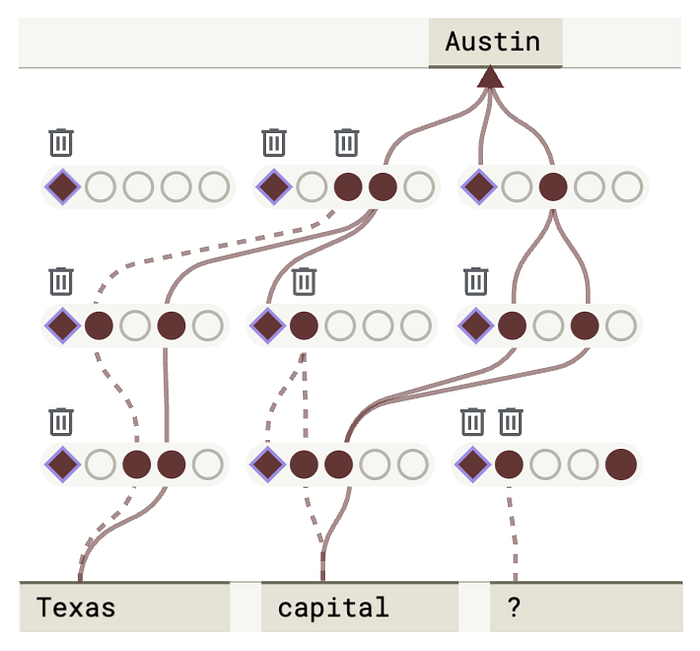
          To understand how this works, consider a simple example: When a model is asked, “What is the capital of Texas?” The expected answer is “Austin.” In traditional approaches to understanding the model, we would need to analyze billions of neuron activations to understand how the model arrived at this answer—an effectively impossible task.
          None

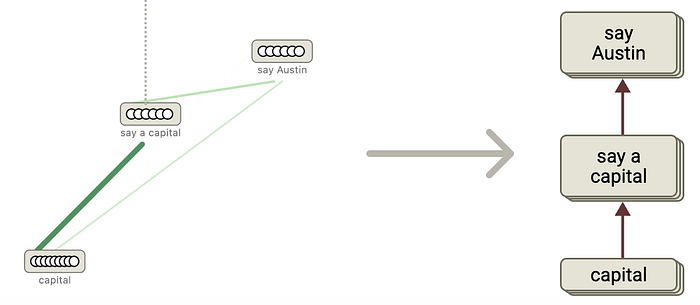
          But feature graphs show something remarkable: When the model processes the words “Texas” and “capital,” it activates neurons related to these concepts. The “capital” neurons promote a set of neurons responsible for outputting a capital city name. Simultaneously, the “Texas” neurons provide context. These two activation patterns then combine to activate the neurons associated with “Austin,” leading the model to produce the correct answer.
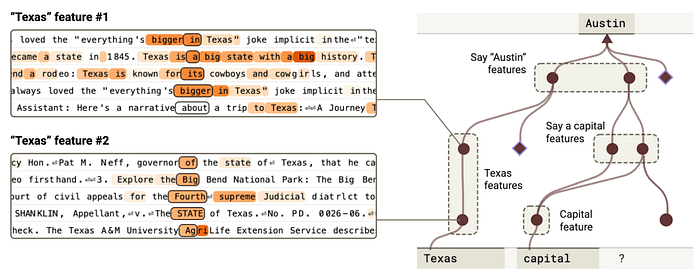
          None

          This represents a profound shift in our understanding. For the first time, we can trace a clear, interpretable path from input to output through the model’s internal processes. LLM outputs are no longer mysterious; they have a mechanistic explanation.

          Beyond Memorization: Evidence of Reasoning

          At this point, it would be easy to take a cynical stance and argue that these circuits simply represent memorized patterns rather than genuine reasoning. After all, couldn’t the model just be retrieving the memorized sequence “Texas capital? Austin” rather than performing any real inference?

          What makes Anthropic’s findings so significant is that they demonstrate these circuits are actually generalized and adaptable – qualities that suggest something more sophisticated than simple memorization.

          For example, if researchers artificially suppress the “Texas” feature while keeping the “capital” feature active, the model will still predict a capital city – just not Texas’s capital. The researchers could control which capital the model produced by activating neurons representing different states, regions, or countries, while still utilizing the same basic circuit architecture.
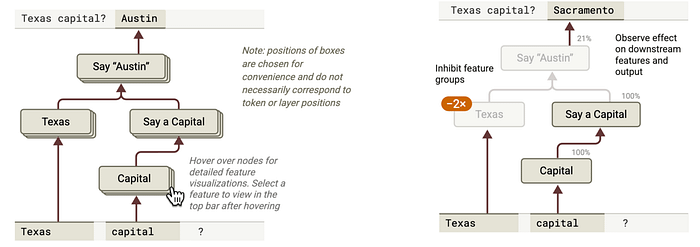
          None

          This adaptability strongly suggests that what we’re seeing isn’t rote memorization but a form of generalized knowledge representation. The model has developed a general circuit for answering questions about capitals and adapts that circuit based on the specific input it receives.

          Even more compelling evidence comes from the model’s ability to handle multi-step reasoning tasks. When prompted with a question like “The capital of the state containing Dallas is…”, the model engages in a multi-hop activation process:

          None

          It recognizes the terms “capital” and “state,” activating neurons that promote capital city predictions

          In parallel, it activates “Texas” after processing “Dallas”

          These activations combine – the urge to produce a capital name and the context of Texas – resulting in the prediction of “Austin”

          This activation sequence bears a striking resemblance to how a human might reason through the same question, first identifying that Dallas is in Texas, then recalling that Austin is Texas’s capital.

          Planning Ahead: The Autoregressive Paradox

          Perhaps one of the most surprising discoveries in Anthropic’s research concerns the ability of these models to “plan ahead” despite their fundamental architectural constraints.

          Large language models like GPT-4 and Claude are autoregressive, meaning they generate text one token (roughly one word) at a time, with each prediction based solely on the tokens that came before it. Given this architecture, it seems counterintuitive that such models could plan beyond the immediate next word.

          Yet Anthropic’s researchers observed exactly this kind of planning behavior in poetry generation tasks. When writing poetry, a particular challenge is ensuring that the final words of verses rhyme with each other. Human poets typically address this by planning the rhyming word at the end of a line first, then constructing the rest of the line to lead naturally to that word.

          Remarkably, the neural feature graphs revealed that LLMs employ a similar strategy. As soon as the model processes a token indicating a new line of poetry, it begins activating neurons associated with words that would make both semantic sense and rhyme appropriately – several tokens before those words would actually be predicted.

          In other words, the model is planning the outcome of the entire verse before generating a single word of it. This planning ability represents a sophisticated form of reasoning that goes well beyond simple pattern matching or memorization.

          The Universal Circuit: Multilingual Capabilities and Beyond

          The research uncovered additional fascinating capabilities through these feature graphs. For instance, models demonstrate “multilingual circuits” – they understand user requests in a language-agnostic form, using the same basic circuitry to answer while adapting interchangeably to the input language.

          Similarly, for mathematical operations like addition, models appear to use memorized results for simple calculations but employ elaborate circuits for more complex additions, producing accurate results through a process that resembles step-by-step calculation rather than mere retrieval.

          The research even documents complex medical diagnosis circuits, where models analyze reported symptoms, use them to promote follow-up questions, and elaborate on correct diagnoses through multi-step reasoning processes.

          Implications for AI Development and Understanding

          The significance of Anthropic’s findings extends far beyond academic interest. These discoveries have profound implications for how we develop, deploy, and interact with AI systems.

          First, the evidence of generalizable reasoning circuits provides a strong counter to the narrative that large language models are merely “stochastic parrots” regurgitating memorized patterns from their training data. While memorization undoubtedly plays a significant role in these systems’ capabilities, the research clearly demonstrates behaviors that transcend simple memorization:

          Generalizability: The circuits identified are general and adaptable, used by models to answer similar yet distinct questions. Rather than developing unique circuits for every possible prompt, models abstract key patterns and apply them across different contexts.

          Modularity: Models can combine different, simpler circuits to develop more complex ones, tackling more challenging questions through composition of basic reasoning steps.

          Interventability: Circuits can be manipulated and adapted, making models more predictable and steerable. This has enormous implications for AI alignment and safety, potentially allowing developers to block certain features to prevent undesired behaviors.

          Planning capacity: Despite their autoregressive architecture, models demonstrate the ability to plan ahead for future tokens, altering current predictions to enable specific desired outcomes later in the sequence.

          These capabilities suggest that while current language models may not possess human-level reasoning, they are engaged in behaviors that certainly transcend mere pattern matching – behaviors that could reasonably be characterized as a primitive form of reasoning.

          The Path Forward: Challenges and Opportunities

          Despite these exciting discoveries, important questions remain about the future development of AI reasoning capabilities. The current capabilities emerged after training on trillions of data points, yet remain relatively primitive compared to human reasoning. This raises concerns about the viability of improving these capabilities within current paradigms.

          Will models ever develop truly human-level reasoning capabilities? Some experts suggest that we may need fundamental algorithmic breakthroughs that improve data efficiency, allowing models to learn more from less data. Without such breakthroughs, there’s a risk that these models could plateau in their reasoning abilities.

          On the other hand, the new understanding provided by feature graphs opens exciting possibilities for more controlled and targeted development. By understanding exactly how models reason internally, researchers might be able to design training methodologies that specifically enhance these reasoning circuits, rather than relying on the current approach of massive training on diverse data and hoping for emergent capabilities.

          Furthermore, the ability to intervene in specific features opens new possibilities for AI alignment – ensuring models behave in accordance with human values and intentions. Rather than treating alignment as a black-box problem, developers might be able to directly manipulate the specific circuits responsible for potentially problematic behaviors.

          Conclusion: A New Era of AI Understanding

          Anthropic’s research represents a watershed moment in our understanding of artificial intelligence. For the first time, we have concrete, mechanistic evidence of how large language models process information and generate responses. We can trace the activation of specific features through the model, watching as it combines concepts, makes inferences, and plans.

          While these models still rely heavily on memorization and pattern recognition, the research conclusively demonstrates that there’s more to their capabilities than these simple mechanisms. Identifying generalizable, modular reasoning circuits provides compelling evidence that these systems are engaging in processes that, while not identical to human reasoning, certainly transcend simple retrieval.

          As we continue to develop more powerful AI systems, this deeper understanding will be crucial for addressing concerns about safety, alignment, and the ultimate capabilities of these technologies. Rather than flying blind with increasingly powerful black boxes, we now have tools to peer inside and understand the anatomy of the AI mind.

          The implications of this research extend beyond technical understanding – they touch on fundamental questions about the nature of intelligence itself. If seemingly simple neural networks can develop primitive reasoning capabilities through exposure to patterns in data, what does this tell us about the nature of human reasoning? Are there deeper information processing principles that underlie biological and artificial intelligence?

          These questions remain open, but Anthropic’s research has given us powerful new exploration tools. As we continue to map the anatomy of artificial minds, we may gain unexpected insights into our own.



          Source link

          Popular Posts

          My Favorites