Home Blog Page 7

Solana Governance Proposal Could Increase Daily SOL Burns More Than 10-Fold While Reducing Inflation – NFT Plazas

    0
    Solana Governance Proposal Could Increase Daily SOL Burns More Than 10-Fold While Reducing Inflation – NFT Plazas


    Solana validators are moving closer to advancing a governance proposal that could significantly reshape the network’s tokenomics by dramatically increasing the amount of SOL permanently removed from circulation while accelerating the reduction of new token issuance.

    The proposal, SGP-0003, combines two previously introduced Solana Improvement Documents (SIMDs) into a single governance package designed to tighten SOL’s supply. If approved, it would increase daily token burns by more than tenfold while speeding up Solana’s path toward lower inflation, potentially strengthening the long-term supply dynamics of the blockchain’s native asset.

    The proposal is currently in its signaling phase and has already attracted support from several prominent validators and infrastructure providers, with backing steadily approaching the threshold required to move to a formal vote.

    Solana Proposal Would Increase Daily SOL Burns More Than 10-Fold (Source: X)

    Solana Proposal Would Increase Daily SOL Burns More Than 10-Fold (Source: X)

    Two proposals designed to slow supply growth

    SGP-0003 merges SIMD-0553 and SIMD-0550, each targeting a different side of SOL’s supply equation.

    SIMD-0553 introduces a resource-based transaction fee model, replacing Solana’s relatively uniform fee structure with one that charges users according to the network resources consumed by their transactions. More computationally intensive transactions would therefore pay higher fees than simpler ones.

    Because part of Solana’s transaction fees is burned, the proposal would dramatically increase the amount of SOL permanently removed from circulation. Estimates suggest daily burns would rise from roughly 650 SOL to between 7,500 and 9,000 SOL, increasing the value of burned tokens from about $48,000 to as much as $668,000 per day, depending on network activity.

    The companion proposal, SIMD-0550, focuses on reducing new token issuance. It would double Solana’s annual disinflation rate from 15% to 30%, allowing the network to reach its long-term inflation floor of 1.5% by 2029 instead of 2032.

    Developers estimate the faster disinflation schedule would reduce future SOL emissions by approximately 18.9 million tokens over the next six years, equivalent to around $1.36 billion at current market prices.

    Working together, the proposals aim to slow the growth of SOL’s circulating supply by burning more existing tokens while issuing fewer new ones.

    Higher burn rates alone would not be enough to counter Solana's daily token emissionsHigher burn rates alone would not be enough to counter Solana's daily token emissions

    Higher burn rates alone would not be enough to counter Solana’s daily token emissions

    Higher burns alone won’t make SOL deflationary

    Despite the dramatic increase in token burns, SOL would not immediately become deflationary.

    The Solana network currently issues around 60,000 SOL every day through its inflation schedule. Even if daily burns reach the projected maximum of 9,000 SOL, newly issued tokens would still outnumber those permanently removed from circulation.

    That is why the two proposals have been packaged together. While SIMD-0553 increases token destruction through transaction fees, SIMD-0550 simultaneously reduces the pace of new issuance, narrowing the gap between supply entering and leaving the market.

    Solana’s inflation rate currently stands at roughly 3.8%, having gradually declined from its original 8% launch rate under the network’s existing disinflation model.

    Validator backing continues to grow

    Before reaching a network-wide vote, the proposal must first clear Solana’s validator signaling process.

    Under governance rules introduced by the Solana Foundation, proposals must secure support representing 15% of the network’s staked SOL before advancing to the discussion stage and eventually a formal validator vote.

    Support has increased steadily this week.

    According to the Solana Validator Governance dashboard, SGP-0003 has accumulated backing from approximately 63 million SOL, representing just over 14.4% of the network’s staked supply. That leaves roughly 3 million additional SOL needed to reach the required threshold of 65.16 million SOL before the August 18 deadline.

    The proposal has received support from 73 validators, including major ecosystem participants such as Helius, Jupiter, Staking Facilities, Drift, OtterSec, and Solana Compass.

    Earlier in the signaling process, Helius contributed the largest share of pledged support. The company has attracted additional attention because the engineer responsible for drafting SIMD-0550 is part of its team.

    If the proposal reaches the required support threshold, it will proceed to the discussion phase before facing a formal validator vote.

    Could tighter tokenomics benefit SOL?

    If approved, SGP-0003 would represent one of the most significant updates to Solana’s monetary policy since the network launched.

    Supporters argue that reducing long-term token issuance while increasing transaction-fee burns could strengthen SOL’s scarcity over time. Although the proposal does not guarantee higher prices, slower supply growth could improve the token’s long-term fundamentals if network adoption and investor demand continue to expand.

    Still, SOL’s price will remain influenced by broader market conditions, institutional participation, on-chain activity, and overall sentiment across the cryptocurrency sector.

    SOL is currently trading around $74, giving the network a market capitalization of roughly $43 billion. While the token has posted modest gains recently, it remains well below its all-time high of approximately $293 reached during the previous market cycle.

    Market sentiment also remains cautious. Traders on Myriad, the prediction market developed by Decrypt’s parent company Dastan, currently assign roughly 70% odds that SOL falls to $40 before eventually recovering to $160, reflecting continued uncertainty despite the proposed supply reforms.

    With less than two weeks remaining before the August 18 signaling deadline, validator support will determine whether SGP-0003 advances to the next stage of Solana’s governance process. If ultimately approved, the proposal would tighten SOL’s supply from both ends—burning substantially more tokens while issuing fewer new ones—marking one of the network’s most consequential tokenomic changes to date.


    Source link

    Trump Media’s bitcoin stash may be down to loan collateral after $165 million BTC move

    0
    Trump Media’s bitcoin stash may be down to loan collateral after 5 million BTC move


    Wallets linked to Trump Media & Technology Group transferred an additional 2,628 BTC, worth approximately $165.07 million, to Crypto.com on August 2, according to Lookonchain data. The move raises questions about how much unencumbered bitcoin the Truth Social parent company actually has left, as reconciliations with Q1 2026 filings show the remaining BTC holdings may almost entirely match the portion used as collateral for convertible notes. To date, Trump Media has not confirmed selling these BTC, but inflows to the centralized exchange are drawing increased market attention to the liquidity of this bitcoin treasury.

    Bitcoin Transfer Raises Fresh Questions

    Lookonchain reported on August 2 that “it looks like” Trump Media sold an additional 2,628 BTC, worth around $165.07 million, based on transactions from company-linked wallets to Crypto.com. Accompanying data showed two major transactions from wallets labeled by Arkham as Trump Media, including approximately 198.964 BTC and 2,429 BTC.

    According to Lookonchain, Trump Media previously bought 11,542 BTC with a total value of about $1.37 billion, equivalent to an average price of $118,522 per BTC. After outflows spanning roughly seven months, the platform estimates total BTC sold or transferred out of these wallets at 7,281 BTC, worth around $545 million, with an average price of $74,855.

    Following those transactions, the remaining BTC from the initial position is estimated at around 4,261 BTC, almost identical to the 4,260.73 BTC that Trump Media reported as collateral for convertible notes in its Q1 filing. This overlap shifts the question beyond whether the company is selling BTC to whether the remaining bitcoin consists almost entirely of collateral.

    Filings Show Much of the Stack Is Restricted

    In its Q1 2026 10-Q, Trump Media reported holding 9,542.16 BTC as of March 31, 2026. This BTC stack had a cost basis of approximately $1.13 billion and a fair value of about $647.1 million, indicating that the market value of the bitcoin position was significantly lower than its cost basis.

    The filing also noted that 4,260.73 BTC, with a fair value of around $288.95 million at quarter-end, served as collateral for convertible notes. This portion of assets is bound by debt obligations, distinct from unencumbered BTC in the treasury that the company can flexibly sell, transfer, or use for other liquidity purposes.

    Trump Media also disclosed a separate derivative structure: covered-call options on 4,000 BTC, requiring the company to maintain 2,000 BTC as collateral with a counterparty having rehypothecation rights. These options were recorded in the filing as expiring in June 2026, leaving the current status of this collateral dependent on whether the contracts were settled, extended, or restructured after Q1.

    Why Crypto.com Does Not Prove a Sale

    A transaction to Crypto.com does not automatically prove Trump Media sold bitcoin. For large institutions, centralized exchanges can be used for multiple purposes, including custody, settlement, liquidity management, collateral arrangement, or trade execution. This is why a clear boundary must be maintained between on-chain data and accounting disclosures.

    Lookonchain also used cautious wording when stating “it looks like” Trump Media sold an additional 2,628 BTC. This is an analytical signal, not an official corporate disclosure. Arkham labeling represents attribution data from a blockchain analytics platform, not a company filing.

    However, transferring BTC to an exchange remains a notable data point. In the crypto market, large inflows to exchanges are often viewed as potential signals related to selling or liquidity restructuring. For Trump Media, this signal is particularly sensitive because the company has disclosed a large amount of pledged BTC while current BTC prices sit far below its cost basis.

    Losses Deepen Pressure on Trump Media’s Treasury Bet

    These transactions occur against a backdrop where Trump Media’s business performance increasingly depends on fluctuations in financial assets. In Q1 2026, the company reported revenue of $871,200 but a net loss of $405.9 million. According to its earnings release, the majority of the loss stemmed from non-cash items, including approximately $368.7 million in unrealized losses on digital assets, digital assets pledged, and equity securities.

    With an average purchase price of around $118,522 per BTC, Trump Media’s bitcoin position faces pressure as BTC trades around the $63,000 level in early August. Lookonchain estimates the company currently suffers a total loss of about $555 million on its BTC holdings, based on transactions tracked by the platform and market prices.

    Truth Social remains Trump Media’s core brand asset, but Q1 results show that the largest financial swings came from bitcoin, equities, and collateral/derivative structures. With operating revenue below $1 million for the quarter, the crypto treasury serves as a major variable in how the market views DJT stock.

    What to Watch in the Next Filing

    Trump Media’s upcoming filing will serve as a key verification checkpoint. Key items to watch include reported remaining BTC, the portion classified as digital assets, the portion held under digital assets pledged, and the fair value of these assets at quarter-end.

    A specific point of interest is the covered-call option structure on 4,000 BTC that expired in June 2026. If the company extended or restructured the contracts, restricted BTC may remain larger than the loan collateral portion. If the contracts were settled, the status of the 2,000 BTC collateral would have shifted significantly.


    Source link

    Proof of Play Shuts Down Despite a16z Backing – NFT Plazas

    0
    Proof of Play Shuts Down Despite a16z Backing – NFT Plazas


    Proof of Play, the Andreessen Horowitz (a16z)-backed Web3 gaming studio behind the fully on-chain RPG Pirate Nation, is shutting down after concluding it could not build a scalable and sustainable blockchain gaming business, marking another high-profile setback for the Web3 gaming industry.

    The company announced on Aug. 4 that it will cease operations after failing to validate its vision of fully on-chain games as a commercially viable business. While Proof of Play did not disclose its remaining financial position, employee impact, or a final shutdown date, it acknowledged that its core thesis had ultimately fallen short despite years of development and strong venture backing.

    Proof of Play Shuts Down Despite a16z Backing (Source: X)

    Proof of Play Shuts Down Despite a16z Backing (Source: X)

    A bold vision backed by top investors

    Proof of Play emerged as one of blockchain gaming’s most ambitious startups after raising a $33 million seed round in 2023 led by a16z and Greenoaks. The company set out to prove that blockchain technology could fundamentally change how games are built by placing game logic, assets, and player ownership directly on-chain.

    Its flagship title, Pirate Nation, became the centerpiece of that vision. Rather than simply incorporating NFTs or crypto rewards, the role-playing game served as a demonstration of fully on-chain infrastructure, where players could retain ownership of in-game assets while developers could build persistent gaming worlds that survived beyond the life of a single studio.

    Despite attracting attention across the crypto industry, Proof of Play admitted that the concept failed to evolve into a sustainable business.

    We couldn’t build a product and sustainable business that proved out this thesis at scale,” the company said in its shutdown announcement, confirming that commercial viability—not technical capability—ultimately drove the decision.

    The company did not release player statistics, revenue figures, or operating costs explaining the closure.

    Pirate Nation will live on through open source

    Rather than allowing years of development work to disappear, Proof of Play is making much of Pirate Nation publicly available.

    The studio has released four public repositories covering the game’s Unity client, smart contracts, artwork, and its internal AI development tool, PopBot.

    The Unity client has been published under the MIT license, although it serves primarily as an archival release. Several commercial Unity assets, backend services, software development kits, and authentication systems have been removed, meaning developers cannot simply relaunch the game without rebuilding critical infrastructure.

    Likewise, the smart contract repository is intended as a reference rather than production-ready software.

    Perhaps the most notable release is the game’s artwork. Pirate Nation assets—including Founder Pirate NFT artwork, logos, combat cards, and voxel assets—have been licensed under Creative Commons CC0, allowing unrestricted public reuse, modification, and distribution without traditional copyright restrictions.

    Proof of Play also open-sourced PopBot, its internal system designed to coordinate multiple AI coding agents during game development, making another piece of its engineering stack available to developers.

    PIRATE token survives under independent foundation

    Although the studio is shutting down, the PIRATE token ecosystem will continue operating under the independent Pirate Nation Foundation.

    Proof of Play confirmed that the foundation remains active and will continue supporting the PIRATE token after the company’s closure. However, it emphasized that its internal reward points will not be redeemable for tokens, products, or any other compensation, urging users not to treat them as claims against either the foundation or the company.

    Investors reacted negatively to the news.

    Following the announcement, the PIRATE token dropped nearly 14% over 24 hours, trading near $0.00112 with a market capitalization of roughly $803,000. Daily trading volume stood at approximately $209,000, meaning relatively small trades were capable of triggering sharp price swings.

    Meanwhile, Proof of Play confirmed that its mobile title Shiba Story Go has been acquired by an undisclosed third party and will continue operating independently. The company did not identify the buyer or disclose financial terms of the transaction.

    Pirate Nation (PIRATE) Price Performance (Source: CoinMarketCap)Pirate Nation (PIRATE) Price Performance (Source: CoinMarketCap)

    Pirate Nation (PIRATE) Price Performance (Source: CoinMarketCap)

    Another reality check for Web3 gaming

    Proof of Play’s closure reflects broader challenges across blockchain gaming, where many studios have struggled to convert technological innovation into profitable businesses.

    During the 2021-2022 crypto boom, numerous projects launched with business models centered on token incentives, NFT trading, and speculative demand. As market conditions normalized, however, maintaining active player communities became significantly harder once financial incentives declined.

    At the same time, operating proprietary blockchain networks, maintaining token ecosystems, and continuously funding live-service games proved considerably more expensive than many developers anticipated.

    Supporters continue to argue that blockchain offers meaningful benefits through digital ownership, interoperability, and decentralized infrastructure. Critics, however, contend that most players prioritize engaging gameplay over tokenization, limiting mainstream demand for crypto-native games.

    Proof of Play’s decision underscores that even one of the industry’s best-funded and most technically ambitious projects could not overcome those commercial realities.

    Still, the company’s legacy may extend beyond its closure. By releasing Pirate Nation‘s codebase, artwork, smart contracts, and AI development tools as open-source resources, Proof of Play has ensured that its technical innovations remain accessible to the broader development community.

    While the company itself is coming to an end, its technology—and the lessons learned from one of Web3 gaming’s most ambitious experiments—may continue shaping the next generation of blockchain-powered games.


    Source link

    Why AI Humanoids Will Conquer Deep Space | Metaverse Planet

    Why AI Humanoids Will Conquer Deep Space | Metaverse Planet


    I was reading up on the latest space missions the other day, and something hit me. We’ve been obsessing over putting human boots on Mars, but let’s be brutally honest for a second: the universe was absolutely not designed for our biology. Cosmic radiation, muscle atrophy, the infinite vacuum—it’s a logistical nightmare to keep human flesh alive out there. But what if we simply don’t have to?

    What if, instead of strapping ourselves into metal tubes for years, we send our silicon counterparts? I’m talking about AI-powered humanoid robots becoming our ultimate cosmic explorers. Imagine an astrophysicist brewing their morning coffee on Earth, putting on a haptic VR headset, and seamlessly connecting to a server to feel the dust of an alien world light-years away through a robotic avatar. It’s not sci-fi anymore; it’s the engineering roadmap we are writing right now.

    The Biological Bottleneck

    dead-space-3

    Let’s look at the facts. Keeping a human alive in orbit currently costs an astronomical amount of money and effort. Maintenance alone eats up about 35% of crew time aboard the International Space Station, at an estimated cost of $140,000 per astronaut-hour. That’s a massive waste of human intellect. We send brilliant scientists up there, and they spend a third of their time fixing toilets, sorting supplies, and doing repetitive physical labor.

    Then there is deep space. When we talk about interstellar travel, the “helicopter parenting” model of ground control guiding a probe or a rover simply breaks down due to the limits of physics. The communication time-delay is just too long. If something goes wrong on a moon of Jupiter, ground control won’t know about it until hours later. Biological astronauts require water, food, oxygen, and heavy shielding against cosmic rays. Silicon and steel? They just need a power source, radiation-hardened processors, and a solid line of code.

    Enter the Silicon Astronauts

    This is where I get really excited, because the hardware is finally catching up to the vision. We aren’t just talking about wheeled rovers anymore. We are building machines made in our image, designed to operate in environments built for humans, or entirely new form factors engineered for zero gravity.

    NASA’s Valkyrie: NASA has been iterating on bipedal humanoids for years. Valkyrie, a 44 degree-of-freedom robot, was built with the application intent of advancing human spaceflight endeavors in extraterrestrial planetary settings. It is designed to climb ladders, handle debris, and turn valves—tasks exactly like those required of a robotic astronaut assistant on Mars or the Moon.The Microgravity Specialists: Have you seen what Orbit Robotics is doing? They recently unveiled Helios, a four-armed robot designed specifically for zero-g. Two arms anchor it to the space station walls, and the other two unload cargo and handle tools. In microgravity, a traditional two-legged humanoid can be a liability, but a four-armed machine with rolling-contact elbow joints for smooth movement is a total game-changer.The AI Brain: Hardware is nothing without a brain. The European Space Agency’s (ESA) AI Lab is actively integrating advanced artificial intelligence into space missions, ensuring spacecraft and rovers can navigate and land autonomously. By utilizing large language models and digital twins, these systems give robots the ability to assess and execute tasks completely autonomously without waiting for ground commands.

    A Swarm of “Technological Kids”

    When I think about the true future of cosmic exploration, I lean towards the concept of autonomous AI probes. Harvard’s Avi Loeb recently compared them to dandelion seeds—self-replicating systems equipped with AI and 3D printers that we launch into the void without an umbilical cord connecting them to Earth. We let our “technological kids” figure it out.

    They could land on an exoplanet, mine local resources, print more of themselves, and build the infrastructure we need. If they find something incredible—like subterranean water ice reservoirs or ancient technological relics—they just beam the data back home. We get all the data, all the thrill of discovery, with zero loss of human life.

    The Telepresence Revolution

    But this doesn’t mean humans are entirely out of the loop. If we deploy humanoid robots on the Moon or Mars, they can serve as our physical avatars. Through high-bandwidth communications and advanced VR, you and I could literally rent a robot on the Moon for an hour. We could look through its optical sensors, feel the tactile resistance of a moon rock through haptic feedback, and experience space exploration from the comfort of our living rooms.

    I genuinely believe that while humanity’s consciousness and curiosity will map the stars, our physical bodies will likely stay close to home. AI humanoids will be the ones braving the cosmic rays, taking the physical risks, and building the foundations of an interplanetary civilization.

    Over to You

    I can’t help but wonder: if an AI robot is the one that steps onto an exoplanet, makes the scientific discovery, and sends the data back… does that count as a human achievement, or a machine achievement?

    Is human space travel destined to be replaced entirely by machine consciousness? Drop your thoughts in the comments below—I’d love to hear if you think we should risk our own lives, or let the machines do the heavy lifting out there in the dark!

    You Might Also Like;


    Source link

    XRP Ledger upgrade brings back features once pulled over critical bugs

    0
    XRP Ledger upgrade brings back features once pulled over critical bugs


    XRP Ledger is preparing for the XRPLD 3.3.0 release, which Jazzi Cooper, Head of Product at RippleX, announced on July 31, 2026, with an expected target release in the following week. This release will introduce 5 new amendments to the voting schedule, including Confidential MPT, Batch, Permission Delegation, Sponsored Fees and Reserves, and Dynamic MPT. The goal is to expand XRPL’s support for tokenized assets, ranging from private transactions and batch settlement to transaction delegation, fee sponsorship, and post-issuance token configuration updates.

    Notably, two of these features, Batch and Permission Delegation, were previously removed from the mainnet roadmap after critical bugs were discovered during the voting phase or in non-production environments.

    A Cleanup Upgrade With Security Baggage

    XRPLD 3.3.0 continues a series of maintenance upgrades that XRPL executed throughout 2026. Before this, v3.1.1, released on February 23, disabled Batch and fixBatchInnerSigs after a critical bug was discovered.

    On May 14, the company released V3.1.3, introducing fixCleanup3_1_3 to address bugs in NFTs, Permissioned Domains, Vaults, Lending Protocol, and MPTs. By v3.2.0 on June 15, XRPL renamed the core server from rippled to XRPLD and added fixCleanup3_2_0 for vaults, lending, permissioned DEX, MPTs, and permissioned domains.

    These steps reflect efforts to re-establish the network’s security discipline before re-launching major features.

    The Features Coming Back Into Focus

    Confidential MPT adds a privacy layer to Multi-Purpose Tokens, enabling the hiding of balances and transfer amounts on the public ledger while maintaining mechanisms for designated issuers or auditors to view transaction data. This is the aspect RippleX emphasizes for financial institutions that require transaction privacy while maintaining auditability.

    Batch allows grouping up to 8 transactions into a single ledger. Transactions can be processed under various execution modes, such as all-or-nothing (all succeed), single success, execution until an error occurs, or independent execution. This paves the way for workflows like delivery-versus-payment, atomic settlement, or multi-step transactions that must be bundled together.

    Permission Delegation allows an account to delegate a narrow scope of permissions to another account to execute transactions on its behalf. For financial institutions, this is a familiar model: one party holds custody, while another operates transactions, but permissions are restricted by action type.

    Sponsored Fees and Reserves allow a sponsor—such as a bank, issuer, or platform—to pay transaction fees and account reserves on behalf of another user. Dynamic MPT allows certain properties of an MPT to be updated post-issuance, rather than fixing the token completely from day one.

    The Bug That Forced A Reset

    According to a vulnerability disclosure from XRPL Labs, on February 19, 2026, Pranamya Keshkamat and Cantina AI’s security tool, Apex, discovered a logic flaw in the signature check mechanism of the Batch amendment.

    In the Batch design, inner transactions do not carry their own signatures. Delegation is handled at the outer transaction level via a list of batch signers. The bug resided in a signer check loop: when encountering an account that did not yet exist on the ledger but possessed a signing key matching that account, the system could conclude successfully prematurely and skip the remaining signers.

    If Batch had been activated before the bug was discovered, an attacker could have executed a Payment from a victim’s account without requiring their private key. The XRPL Labs disclosure also highlighted the potential for unauthorized execution of AccountSet, TrustSet, or even AccountDelete. The bug was discovered during the voting phase before becoming active on the mainnet, meaning no user funds were ever at real risk.

    Permission Delegation also had its own history. A disclosure from September 2025 indicated that a bug in this feature could cause an account to have transaction fees unauthorizedly deducted under certain conditions. This feature was also not active on the mainnet when the bug was found, and validators were advised to vote No. A corrected version was later included in a replacement roadmap.

    Validators Face The Real Deadline

    The amendments in XRPL 3.3.0 will not automatically activate simply because the software is released. On XRPL, changes impacting transaction processing must pass through the amendment process. An amendment requires maintaining over 80% support from trusted validators for two weeks to be permanently activated.

    This point is crucial as Jazzi Cooper also emphasized that amendments only activate after approval by validator voting. For validators, early upgrading provides them with the code to understand the new rules if the amendments pass. For node operators, exchanges, API providers, or applications building on XRPL, lagging behind on updates could lead to an “amendment-blocked” state when the network transitions to the new rule set.

    According to data on xrpscan, the XRP Ledger has 546 running nodes. Among them, 334 nodes run rippled-3.2.1 (approximately 61%), 113 nodes run rippled-3.2.0 (nearly 21%), and 58 nodes remain on rippled-3.1.3 (nearly 11%).

    Distribution of Node versions on the XRP Ledger

    Distribution of Node versions on the XRP Ledger. Source: XRPScan

    A Test For XRPL’s DeFi Ambitions

    If put to a vote and sequentially activated, this group of 5 amendments will complete a critical technical piece for the real-world asset (RWA) tokenization puzzle on XRPL: ensuring both privacy and enterprise-grade permissioning, while optimizing onboarding costs for end users.

    However, the greatest value of the 3.3.0 upgrade lies in serving as a “litmus test” for network discipline. Batch and Permission Delegation are not entirely new features, but tools once suspended due to critical bugs that are now returning after rigorous auditing.

    For everyday XRP holders, the update does not alter tokenomics or require any wallet actions. But for builders and issuers, this serves as a practical yardstick for whether XRPL can safely scale into the DeFi/Institutional Finance space without sacrificing execution speed.


    Source link

    Sydney Sweeney, Scooter Braun On the Ground Helping Washington Wildfire Victims

      0
      Sydney Sweeney, Scooter Braun On the Ground Helping Washington Wildfire Victims


      Sydney Sweeney & Scooter Braun
      Hometown Wildfire Relief
      … Lending a Helping Hand

      Published
      August 5, 2026
      6:51 PM PDT

      Sydney Sweeney isn’t just sending love to her wildfire-ravaged hometown from afar … she’s boots on the ground — and Scooter Braun is right there with her.

      Sources with direct knowledge tell TMZ … Sydney and her boyfriend are in Washington state amid the devasting Spokane area wildfires, with Sydney feeling compelled to head home and help any way she could.

      Sweeney in Washington wm 2

      Our sources tell us Sydney has been working nonstop since arriving … bringing food to firefighters between shifts on the front lines and helping prepare and distribute meals to families affected by the fires.

      Play video content

      080426 spokane kal

      We’re told they volunteered with Second Harvest Food Bank in Spokane and World Central Kitchen, personally handing out food and providing relief to people in need.

      Sweeney in Washington wm

      Our sources say Sydney has also been spotted around town buying groceries and working with local restaurants to secure food and shelter for displaced residents. We’re told she has made major donations to multiple relief organizations as well.

      The trip hits especially close to home for Sydney. The “Euphoria” star grew up in Spokane and revealed this week the fires have affected members of her own family.

      washington state wildfires 2

      Sydney posted an emotional message Tuesday saying Spokane has always been home to her … adding it’s where she grew up, where her family still lives and where many of the people and places that shaped her remain.

      washington state wildfires

      She said the fires have changed countless lives, including members of her own family, and urged her followers to donate as residents begin rebuilding.

      The fires around Spokane have scorched more than 10,000 acres, destroyed hundreds of structures and forced tens of thousands from their homes.


      Source link

      Dr. Torkian Reveals Why Filler Won’t Lift Your Face and What Will

        0
        Dr. Torkian Reveals Why Filler Won’t Lift Your Face and What Will


        Everyone wants a sculpted appearance, but according to celebrity plastic surgeon Dr. Behrooz Torkian, you might be surprised by what really delivers that look.

        The Beverly Hills, California based plastic surgeon has spent the past 20 years specializing in facial rejuvenation and says if you’ve been told filler can lift your face, it’s time to rethink that advice.

        Torkian Aesthetics

        “For years we have been trying to bust the myth that fillers can lift skin or the face. They simply do not do that,” he tells ET. “Due to this wrongful belief, many patients have been overfilled with filler.”

        Instead, he recommends solutions that truly address sagging skin.

        “My practice is largely treatment of the aging face. One of the most requested procedures is treatment of the jowls and heavy necks. This was largely driven by the snatched look popularized by social media platforms, but with the increasing use of weight loss drugs, we are seeing more and more droopy lower faces as people lose fat. For this reason, my most requested procedures now are face and neck lift procedures,” he explains.

        Torkian Aesthetics

        While platforms like Instagram and TikTok have made cosmetic procedures more mainstream, Torkian says it’s important to separate trends from reality.

        “Patients are by and large more educated by social media. They have a better understanding of procedures and better knowledge of expected results. Unfortunately, some people get misled by the results they see and believe that any result is possible with any starting point. Sadly, that is not the case, and this is often best discussed during a consultation with an honest surgeon.”

        If you’re not ready to go under the knife just yet, there are plenty of in-office options that can help refresh and tighten the skin.

        Torkian Aesthetics

        “Botulinum toxin administered on a regular basis is our usual first step and another one of our favorites is doing a combination of Virtue RF and CoolPeel to tighten and improve skin laxity and polish skin that is getting droopy and dull in the lower face.”

        To enhance those effects even further, he recommends incorporating regenerative therapies.

        “The addition of biostimulatory treatments using peptides, exosomes, stem cells, and other such products to our existing treatments can enhance rejuvenation treatments overall,” he notes.

        Torkian Aesthetics

        For anyone ready to dive face first into cosmetic surgery, subtlety is always the goal for Torkian.

        “I always tell patients, ‘Let’s try not to get greedy’ when planning our aesthetic goals. Trying too hard to change features and change the structure of the face can quickly lead to very obviously surgical-looking results.”

        His final piece of advice: Patience pays off.

        “Come prepared with questions regarding healing and recovery so that you can proceed at a time that fits your life. Never rush a procedure into your schedule since you can never tell how you will feel and when you will feel comfortable resuming personal and social activities.”

        RELATED CONTENT:


        Source link

        Meta Debuts AI Coding Agent Muse: Here’s How It Compares to Claude Code and Codex – Decrypt

        0
        Meta Debuts AI Coding Agent Muse: Here’s How It Compares to Claude Code and Codex – Decrypt


        In brief

        Meta released Muse Code (beta), a terminal coding agent powered by Muse Spark 1.2, its updated coding model. It’s available now via the Meta Model API and a curl install script.
        The agent coordinates persistent background subagents and keeps a replay-exact event log, so a crash resumes exactly where it stopped.
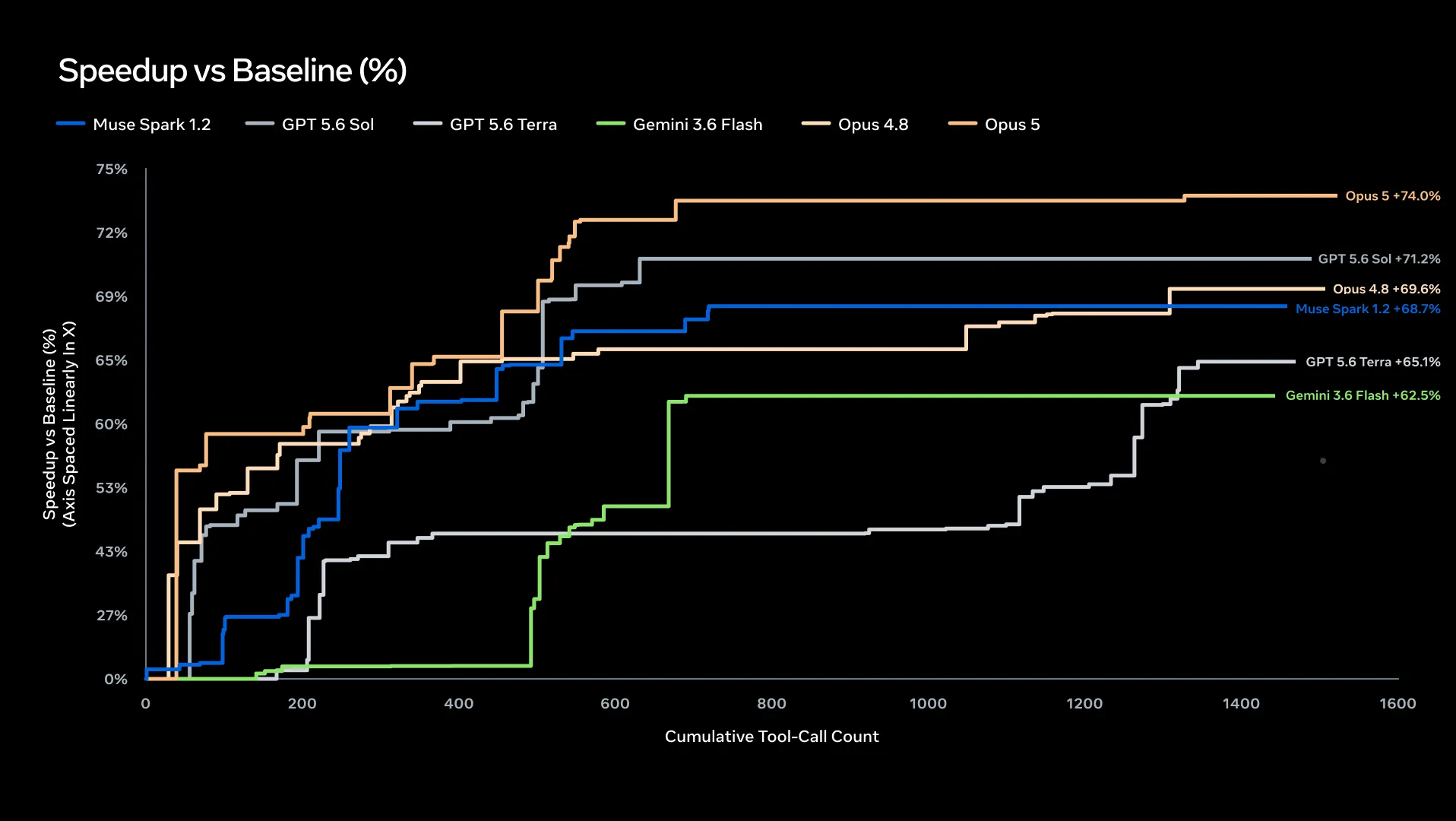
        On Meta’s own charts, Muse Spark 1.2 trails Anthropic’s Opus 5 on every coding benchmark shown, while beating OpenAI’s Codex and Google’s Antigravity on most.

        Meta is the latest tech giant to ship a coding agent, racing to compete with leading AI behemoths Anthropic and OpenAI.

        “We’re excited to release Muse Code (beta), a terminal coding agent powered by Muse Spark 1.2, our newest model,” the company wrote in an official announcement. “This marks our next step toward the frontier, with larger and much more capable models on the way.”


        As an agentic coding tool, Muse Code is built for software engineering across large repositories. Per Meta, it “takes on complex software engineering tasks across large repositories: planning changes, writing code, and validating the results. It can coordinate multiple persistent subagents for each task, solving difficult problems faster, more accurately, and with less intervention.”

        The detail that stands out is the runtime. Muse Code logs every model call, tool run, approval, and edit to a local event log that acts as a single source of truth. “This single source of truth makes the runtime replay-exact and restart-safe: after a crash, the agent can resume precisely where it stopped,” Meta said. For long-running jobs, that’s the feature that matters more than raw speed—and it’s the part competitors haven’t made a selling point.

        It also ships with default skills. The “/plan” command turns a task into an approval-gated plan, while “/grill” stress-tests that plan until it holds up and “/goal” works toward successful completion of the objective similar to what Hermes does. Meta said it co-trained Muse Spark 1.2 with Muse Code so the core LLM and the agent work together in synergy.

        The benchmarks, and the catch

        Muse Spark 1.2 is a coding-focused update to Muse Spark 1.1. Meta said it “significantly scaled up training compute on coding tasks while expanding training environment diversity, delivering improvements in code generation, complex debugging, and end-to-end developer workflows.” The charts tell a clear story.

        On Terminal-Bench 2.1, Muse Spark 1.2 with Muse Code scored 82.9%, behind Claude Code on Opus 5 at 86.7% but ahead of GPT-5.6 Terra on Codex (81.8%) and Grok Build (81.6%).

        DeepSWE 1.1, which measures agentic coding capabilities, was closer: 59.3% for Muse versus 65.0% for Opus 5 and 64.8% for Codex. On Meta’s internal coding bench, Muse hit 70.6% to Opus 5’s 79.4%.

        The speedup charts flip the order. Over 1,000-plus tool calls, Opus 5 posted the biggest gain versus baseline (about 74–75%), with Muse Spark 1.2 mid-pack at roughly 61–69% depending on the run. Meta’s point is that the agent keeps improving as tool calls accumulate, the behavior you want from a long-horizon coder.

        The most interesting demos are long-horizon and multimodal. In stress testing, Meta said Muse Code “iteratively optimized GPU kernels over 1,000+ tool calls (up to 24 hours) on Nvidia Hopper GPUs.” That means it was able to improve over time.

        There’s also a visual-coding angle. In one demo, a user drops a fly-through video of a house into the terminal as an mp4, and Muse Code “interprets the video and produces a visually rich website with booking capabilities.” Reading raw video into a working web app is the multimodal pitch Meta has been making across the Muse line.

        See the launch thread:

        The field is already crowded

        That said, Meta is late to the fight. OpenAI’s Codex already runs parallel cloud agents; DeepSeek has built its own rival to Claude Code and agentic tools like Hermes or OpenClaw are already good substitutes with more capabilities. Muse Code’s edge is the crash-safe runtime and the subagent design, not benchmark supremacy.

        The risk is the usual one for agentic coding: an agent that resumes after a crash and keeps calling tools for 24 hours is powerful and unpredictable. Meta is betting developers want that autonomy, and it’s shipping now.

        Muse Code is available for testing upon installation entering this command:curl -fsSL https://dev.meta.ai/install.sh | bash

        Daily Debrief Newsletter

        Start every day with the top news stories right now, plus original features, a podcast, videos and more.


        Source link

        Bitcoin, Ethereum, and XRP Whales Are Buying the Dip: CryptoQuant

        Bitcoin, Ethereum, and XRP Whales Are Buying the Dip: CryptoQuant


        Key Highlights

        CryptoQuant says Bitcoin, Ethereum, and XRP whales are buying while many retail investors continue selling.

        Large Bitcoin and Ethereum holders have increased their holdings, while XRP whales are quietly building positions.

        The firm believes the bear market may be in its final stage but says prices could still fall before a confirmed bottom.

        Large investors are quietly buying more Bitcoin, Ethereum, and XRP even as the crypto market remains under pressure, according to a blockchain analytics firm CryptoQuant. 

        In a report published on Wednesday, the firm said that while many smaller investors are selling their coins during the ongoing bear market, whales are steadily increasing their holdings. CryptoQuant said this could mean the market is entering the final stage of its downturn, although it warned that prices could still fall before reaching a confirmed bottom. 

        The report highlights a widening gap between investor groups. While many retail traders continue reducing exposure as prices remain weak, whales are steadily adding to their positions.

        CryptoQuant said this pattern has often emerged during the later stages of previous bear markets. “Across bitcoin, ether and XRP, the largest cohorts are adding supply as prices sit near or below their realized prices,” CryptoQuant Head of Research Julio Moreno said. “This positioning lowers downside pressure and is consistent with the final phase of the cycle’s decline.” 

        Bitcoin whales continue to add more coins 

        For Bitcoin, CryptoQuant said wallets owned by Bitcoin whales now hold about 3.06 million BTC. That figure had dropped to around 2.87 million BTC in December 2025 before starting to climb again. The firm added that buying became much stronger after Bitcoin’s price slipped below $60,000 in June. 

        At the time of this writing (1:35 AM IST), BTC was trading for $64,863, approaching the $65,000 mark after gaining 1.66% over the past month.

        Even with this increase, the firm said whale holdings are still below the previous peak of about 3.23 million BTC reached during the last bull market, showing there is still room for more accumulation

        The report noted that these Bitcoin figures do not include coins held by exchanges, mining pools, exchange-traded funds, or digital asset treasury companies. Instead, they focus on large private holders to better show what long-term investors are doing. 

        Ethereum whales are buying while smaller holders sell 

        Ethereum is showing a similar trend, but the difference between large and small investors is even more noticeable. 

        CryptoQuant said wallets holding between 10,000 and 100,000 ETH have continued buying throughout the bear market, pushing their combined holdings to a record 19.6 million ETH. At the same time, wallets holding between 1,000 and 10,000 ETH have been reducing their balances, falling from about 15.6 million ETH in January to 12.9 million ETH. 

        The firm also highlighted the activity of what it calls “mega whales,” or wallets with more than 100,000 ETH. Since the middle of 2025, these wallets have added around 1.8 million ETH, increasing their combined holdings by about 70% to roughly 4.6 million ETH.

        “This is what accumulation looks like in a bear market: strong hands absorbing weak-hand supply,” Moreno said. “Concentrating ownership in large holders tightens available float and is constructive for ETH once demand returns — even as price sits below its cost basis.”

        For XRP, the buying has been less obvious but still important. CryptoQuant said large investors are quietly building their positions while the token continues trading between $1.00 and $1.20. 

        CryptoQuant says the bottom may not be in yet 

        The report also looked at how current prices compare with each asset’s realized price. Realized price is an on-chain measure that shows the average price at which coins were last moved. 

        Bitcoin’s current price of $64,863 remains above its realized price of $52,900, providing an on-chain cost-basis floor, while XRP is changing hands near $1.10 against a realized price of about $0.75. Ethereum stands out as the only asset trading below its realized price, priced around $1,900 compared with a realized price of roughly $2,450.

        According to CryptoQuant, assets trading near or below their realized prices have often been seen during the later stages of previous bear markets. Even so, the firm said investors should not assume the market has already reached its lowest point.

        “The risk-reward ratio has declined significantly since the bear market began — but valuation leaves room for one more leg lower before the floor is confirmed,” Moreno said.

        Also Read: “Tranquilize the Bears”: Saylor Roasts Cramer After CNBC Host Vows to Dump All His Bitcoin 


        Disclaimer: The information researched and reported by The Crypto Times is for informational purposes only and is not a substitute for professional financial advice. Investing in crypto assets involves significant risk due to market volatility. Always Do Your Own Research (DYOR) and consult with a qualified Financial Advisor before making any investment decisions.


        Source link

        Martha Stewart Shares Savage Dig About Meghan Markle’s Failed Cooking Show After First Encounter

          0
          Martha Stewart Shares Savage Dig About Meghan Markle’s Failed Cooking Show After First Encounter


          Martha Stewart doesn’t seem to be a fan of Meghan Markle’s career progression. 

          The lifestyle icon recently opened up about a brief encounter with Markle and expressed her true feelings about the Duchess of Sussex’s cooking show. 

          Stewart’s statements come months after the partnership between Markle’s lifestyle brand and Netflix was reportedly terminated. 

          Eric Kowalsky / MEGA

          During an interview, Stewart was asked to share how she prefers to navigate social events. She admitted she prefers keeping her attendance brief, earning a reputation among friends for arriving right before dinner and exiting soon after dessert. 

          She recalled putting this routine into practice while attending a recent California dinner party where Markle was also a guest. Stewart mentioned that while the Duchess had recently returned from the United Kingdom and was actively sharing her experiences with attendees, their own interaction was limited to just a few brief words.

          “I didn’t talk to her really more than to say a couple of words, but I know she was talking about it,” Stewart told People Magazine. 

          When asked about Markle launching a lifestyle and cooking venture of her own, the media mogul offered a sharp critique regarding the Duchess’s career trajectory. She expressed skepticism about attempting to build a cooking and homemaking empire after transitioning out of Hollywood and the royal family. 

          “If you’re an actress, it’s hard to then transition from a princess into a homemaking guru on a television show. It doesn’t sort of follow,” she noted. 

          Stewart observed that moving trajectories in such a manner lack a natural progression.

          Martha Stewart Previously Took A Dig At Meghan Markle

          Meghan Markle leaving her hotel during Paris Fashion Week
          Spread Pictures / MEGA

          This isn’t the first time Stewart has spoken on Markle’s lifestyle brand. In August 2025, she shared her thoughts on Markle’s move into the lifestyle market following her departure from royal life alongside Prince Harry. 

          The 83-year-old media figure explained that building a lasting brand requires outstanding quality and true expertise. Though she noted she does not know Markle well, Stewart stressed that anyone entering the industry must truly understand their subject.

          “Authenticity, to me, is everything, and to be authentic and knowledgeable about your subject matter is extremely important,” she stated, as reported by The Blast.

          Notably, in contrast to her guarded take on Markle’s venture, Stewart offered strong praise for Gwyneth Paltrow’s success in the business space. 

          Gwyneth Paltrow Backed Meghan Markle And Welcomed The Industry Competition

          Gwyneth Paltrow on the red carpet
          Lee Watt/AFF-USA.COM / MEGA

          Unlike Stewart’s sharp critique, Paltrow showed strong support for Markle when she introduced her lifestyle brand. The actress made it clear that she views competition in the industry as healthy rather than hostile. 

          She noted that everyone should have the chance to follow their dreams and that Markle deserves the space to pursue her own ambitions without restrictions, as reported by The Blast.

          While Stewart voiced doubts about Markle’s career move, Paltrow actively spoke up to support the royal, explaining that she often feels driven to defend the mother of two against online criticism and public backlash.

          Martha Stewart Unveiled Her Skincare Brand Elm Biosciences

          Martha Stewart, RHONY
          MPI099/Capital Pictures / MEGA

          Shortly after offering her perspective on Markle’s lifestyle venture, Stewart gave fans a look at her own new business project.

          Celebrating her 84th birthday, the seasoned entrepreneur took to social media to tease a major update for her followers. 

          The Blast reported that she posted an image holding an elm plant alongside a birthday note. Stewart revealed her latest business effort: a luxury skincare line named Elm Biosciences. 

          Developed in partnership with board-certified dermatologist Dr. Dhaval Bhanusali, the brand represents a project five years in the making. Stewart noted the extensive research behind the launch, highlighting that it required hundreds of formula variations and years of testing before officially coming to market.

          Netflix Ended Its Partnership with Meghan Markle’s Lifestyle Brand

          Meghan Markle at the Nations Home, Invictus Games
          James Whatling / MEGA

          While Stewart unveiled new business ventures, Markle’s career took a big hit behind the scenes. 

          In March, The Blast reported that  Netflix officially ended its business partnership with Markle’s brand, As Ever. The decision to part ways followed the end of the show’s second season run. 

          Confirming the shift in their working relationship, a spokesperson for Netflix praised Markle’s original vision, stating that her “passion for elevating everyday moments in beautiful yet simple ways inspired the creation of the As Ever brand.”

          Looking ahead, Netflix explained that Markle will continue growing the brand, adding that it was glad to help launch the business in its early stages.


          Source link

          Popular Posts

          My Favorites

          AI Narrative Might Face Significant Threat from Trump

          0
          President Donald Trump’s escalating trade policies and the recent U.S. ban on NVIDIA selling advanced AI chips to China are causing significant disruptions...