Home Blog Page 64

Gray Zone Warfare: Sunken Bird Quest Guide

0
Gray Zone Warfare: Sunken Bird Quest Guide


The Lamang Armed Forces have lost a Mi-17 helicopter somewhere in the swamps southeast of Fort Narith, and Gunny wants to waste no time in finding out how it came down and, most importantly, what the bird was carrying in the first place.

Sunken Bird is a side task in Gray Zone Warfare that takes place in the YBL-1 area once you unlock it. It is given to you by Gunny, one of the vendors with the most missions (and therefore one of the easiest ones to level up quickly).

Sunken Bird Quest Walkthrough

This is a straightforward recon mission with little opposition, unless you’re unlucky enough to find another player trying to complete it.

The quest area is located in a small swamp between landing zone Lima 2, due east of the YBL-1 bunker, and major COP Titan.

Locate the Downed LAF Helicopter

Once you reach the swamp area, your first order is to locate and inspect the crashed helicopter.

Gray Zone Warfare Unlisted Flight 16

Related

Gray Zone Warfare: Unlisted Flight Quest Guide

A Boeing 737 has come down in Lamang, and Lab Rat needs to find out why.

You can find it in grid square 151, 120, snuggled up against the horizontal grid line. After locating the helicopter, go around to the back where a small wooden boat is parked to complete this objective and receive further instructions from Gunny.

Locate the Cargo from the Helicopter

A quick inspection of the wreckage shows that you were not the first one to reach the crash site, and whoever beat you to it also made sure to unload the precious cargo Gunny sent you after.

Your next objective is a small LLA camp to the southwest of the crash site, guarded by two to four soldiers armed with assault rifles.

Clear them out, then head into the large house, where you will find a wide assortment of nuclear, biological, chemical (NBC) gear, including full suits and respirators.

Approach the half-open wooden crate with a gas mask over it in the southwestern corner of the house, and interact with it to report your findings to Gunny. This will complete the Sunken Bird task in Gray Zone Warfare.

Gray Zone Warfare In The Trenches

Next

Gray Zone Warfare: In the Trenches Quest Guide

Turncoat needs you to jump into the LLA trenches to find some documents.

mixcollage-07-dec-2024-12-21-am-2326.jpg

Systems

PC-1

Released

April 30, 2024

ESRB

m

Developer(s)

Madfinger Games

Publisher(s)

Madfinger Games

Engine

Unreal Engine 5


Source link

Heartbreaking death of Mutya Buena’s sister Maya as she paid emotional tribute: ‘We’ll be together in time’

    0
    Heartbreaking death of Mutya Buena’s sister Maya as she paid emotional tribute: ‘We’ll be together in time’


    Singer Mutya Buena, who is appearing on Celebrity Bake Off tonight (April 12), paid tribute to her sister Maya in the most emotional way following her death.

    The Sugababes star, 40, has five brothers and three younger sisters. However, sister Maya, born in 1986, tragically died in 2002.

    While Mutya hasn’t spoken too much about Maya’s death, she dedicated a whole song to her in 2003.

    Don’t miss a single story! Add us as a Preferred Source in Google for all your entertainment news

    It’s important to us that you never miss our articles when searching for stories! We have all the latest TV & Celebrity news to share with our community of loyal readers.

    Click here and tick Entertainmentdaily.com to ensure you see stories from us first in Google Search.

    Mutya’s sister Maya died in 2002 (Credit: Splashnews.com)

    Mutya Buena paid tribute to sister Maya on solo Sugababes song

    On Sugababes’ third studio album, Three, released in 2003, Mutya recorded a solo song dedicated to her sister, titled Maya.

    In the song, the British singer bared her emotions, singing: “Maya this song’s for you / I have your name print tattooed upon my skin / There’s so much to say to you / And where do I begin?”

    Mutya’s tattoo of Maya’s name is on her hip.

    In the chorus of the song, Mutya continued: “There are worlds within worlds, that keep rotating / And so many thoughts that flow through my mind / If this universe is really shrinking / We’ll be together in time.”

    In March 2005, Mutya became a mum to daughter Tahlia, whose name is also tattooed on her shoulder. Her daughter’s middle name is Maya, after her late sister.

    Mutya Buena looking in front
    Mutya dedicated a song to her sister (Credit: Splashnews.com)

    Mutya’s post-natal depression

    After becoming a first-time mum while still in the Sugababes, Mutya revealed she was suffering from post-natal depression.

    “I didn’t know I had postnatal depression, I would turn up to the studio and I would be acting so weird. Everything annoyed me, I could go from zero to 100 in seconds. I used to think what is going on? But it was my anxiety, I didn’t realise I suffered with it for so long, I didn’t even know what it was. I was getting nervous and angry, emotionally, I was all over the place,” she said on the Killing It podcast.

    Meanwhile, on the When I Was 25 podcast, she added: “I just didn’t feel good. On top of that having baby blues with the girls, it didn’t make me feel good. I felt like I had this baby belly. I felt crazy fat.”

    “I remember feeling really, really low. I didn’t’ feel sexy, I didn’t feel like my normal self.”

    Read more: Full story behind Gemma Collins’ Chicago role: ‘undeniable’ audition; sudden withdrawal; ‘next level’ injury

    What do you think of this story? Tell us on our Facebook page @EntertainmentDailyFix.


    Source link

    Heartbreaking death of Emmett J. Scanlan’s son as wife also ‘almost lost her life’: ‘There was blood everywhere’

      0
      Heartbreaking death of Emmett J. Scanlan’s son as wife also ‘almost lost her life’: ‘There was blood everywhere’


      Actor Emmett J Scanlan, who is appearing on Celebrity Bake Off today (April 12), previously opened up about the death of his son.

      The Fool Me Once actor, 47, who also appeared in Hollyoaks as Brendan Brady between 2010 and 2013, married his wife, fellow actor Claire Cooper, 45, in 2015.

      Five years before tying the knot, they welcomed a son, Ocean-Torin, five, in July 2020. They then welcomed a daughter, Fiáin-Luna, three, in November 2022. Previously, Emmett had a daughter, Kayla Scanlan, 29, from a different relationship in 1997.

      Don’t miss a single story! Add us as a Preferred Source in Google for all your entertainment news

      It’s important to us that you never miss our articles when searching for stories! We have all the latest TV & Celebrity news to share with our community of loyal readers.

      Click here and tick Entertainmentdaily.com to ensure you see stories from us first in Google Search.

      Emmett’s wife had a miscarriage in 2019 (Credit: Splashnews.com)

      Emmett J Scanlan reveals son died in 2019

      In 2024, Emmett appeared on the Under The Surface podcast and reflected on his wife Claire suffering a miscarriage with their son, Phoenix.

      “I woke up and Claire wasn’t beside me [in bed], and I could hear noises from the bathroom. I went in and she was lying on the floor and there was blood everywhere,” he said.

      Emmett revealed Claire also “almost lost her life” adding: “We lost the little heartbeat that was Phoenix, our son.”

      Emmett went on to explain that while Claire sought support, it took him longer to do the same, admitting he didn’t know how to cope with the loss.

      “I was going up for auditions and wasn’t getting anything or was getting direct offers for [bleep] jobs, and I was the worst thing in it. So I lost my mojo. I had lost my ability, my confidence in myself and I got lower and lower and lower,” Emmett explained.

      Emmett J Scanlan on This Morning
      Emmett hit a low point following the death (Credit: ITV)

      ‘I hit my professional and personal rock bottom for an 18-month period’

      Emmett admitted he “hit my professional and personal rock bottom for an 18-month period”. After losing “all confidence in myself”, he “kept things to myself because I didn’t want to be a burden to others”.

      “I remember sitting in my living room, watching the clock until the sun disappeared. I sat there with tears down my face, so I know what it’s like to be in those really dark places. And I also know how important it is to talk to people,” Emmett added.

      In the same podcast interview, Emmett also shared that when he finally opened up, he was struck by how many people in his life had been through similar experiences in silence.

      He admitted that while seeking help didn’t take away the sadness, it did allow them to better process their loss.

      Read more: ‘Fly free brother’: Peaky Blinders star Emmett J. Scanlan supported as he announces heartbreaking family death

      What do you think of this story? Let us know on our Facebook page @EntertainmentDailyFix. We want to hear your thoughts! 


      Source link

      Weekly Wrap: Drift Hack Fallout, Morgan Stanley Unveils MSBT, Sun–WLFI Battle Heats Up

      Weekly Wrap: Drift Hack Fallout, Morgan Stanley Unveils MSBT, Sun–WLFI Battle Heats Up


      Key Highlights

      Drift Protocol traced its $285 million exploit to a North Korean-linked hacking group, confirming early on-chain suspicions.

      Morgan Stanley entered the Bitcoin ETF race with MSBT, signaling deeper Wall Street adoption of crypto markets.

      The feud between Justin Sun and World Liberty Financial turned public and hostile, with both sides preparing for a legal battle.

      Crypto swung hard again this week as Drift Protocol officially pinned its $285 million exploit on a North Korean state-affiliated group, Morgan Stanley launched its spot Bitcoin ETF, Circle minted a record $3.25 billion USDC on Solana in seven days, and the CLARITY Act drew public backing from both the Treasury Secretary and the SEC Chair. 

      Justin Sun went public against Trump-backed World Liberty Financial over a frozen $70 million token position, Bhutan kept trimming its bitcoin reserves, and three more protocols were drained.

      Welcome to this week’s cryptocurrency market update. If last week was defined by the shock of the Drift exploit and Bitcoin’s first green monthly close since September 2025, this week was about the fallout, the institutional counter-push, and a fresh round of political drama inside crypto itself.

      In this edition, we cover the DPRK attribution on the Drift hack and the USDC freeze debate around Circle, Morgan Stanley’s MSBT Bitcoin ETF debut, Strategy and Bitmine adding to their treasuries, Bhutan’s strategic bitcoin sales, the CLARITY Act push from the Treasury and the SEC, India’s fresh tax notices, CME listing AVAX and SUI futures, CZ’s memoir revelations, the Tornado Cash and Arizona prediction market cases, the Justin Sun vs WLFI standoff, and a string of new exploits at Denaria, Aethir, and RaveDAO. Let’s get into it.

      Drift Hack: DPRK attribution confirmed, Circle under fire

      The biggest story of the week is still the Drift exploit, but the framing has now changed. Drift Protocol formally confirmed what on-chain analysts had suspected since April 1. The $285 million drain was the work of UNC4736, a North Korean state-affiliated threat group also tracked as AppleJeus and Citrine Sleet. The SEAL 911 team, Elliptic, and TRM Labs independently landed on the same conclusion. 

      Fund flows used to stage and test the operation trace back to the Radiant Capital attackers, and the on-chain laundering pattern matches previous DPRK-linked operations, including the Bybit heist from earlier this year.

      Drift has frozen all remaining protocol functions, removed compromised wallets from the multisig, and brought in Asymmetric Research and OtterSec to lead a coordinated recovery plan. Attacker wallets have been flagged across major exchanges and bridges, but no material recovery has been announced yet. The DRIFT token is still sitting roughly 98% below its all-time high.

      The second half of this story is Circle. ZachXBT published a detailed analysis of leaked server data from the DPRK crypto network and accused Circle of being “asleep” while more than $230 million in stolen USDC was bridged via CCTP from Solana to Ethereum during US hours. Circle publicly defended its freeze process, arguing that premature intervention on active investigations can tip off attackers and compromise recovery. The irony is that in the same seven-day window, Circle minted a record $3.25 billion USDC on Solana, making this both Circle’s biggest Solana week on record and its most reputationally exposed one.

      Morgan Stanley’s MSBT and the Treasury Company race

      The institutional side of the market kept moving. Morgan Stanley confirmed on April 8 that its spot Bitcoin ETF would debut the same day under the ticker MSBT, and the product pulled in roughly $32 million on its debut session. It is a modest number next to IBIT, but the signal matters more than the size. Morgan Stanley is the first of the old-guard wirehouses to put its own name on a spot Bitcoin ETF rather than just distributing someone else’s.

      On the corporate treasury side, Strategy restarted its accumulation program with a 4,871 BTC buy, keeping Michael Saylor’s publicly stated one million BTC goal firmly on the table. Bitmine pushed its ether treasury past 4.8 million ETH, cementing its position as the largest corporate ETH holder. Ether Machine, however, walked away from its $1.6 billion SPAC merger with Dynamix, a reminder that not every treasury company story ends in a public listing.

      Bhutan went the other way. The sovereign miner moved $22 million in bitcoin midweek and followed it with a $180 million sale, signaling a clear shift in how the country is managing its digital asset reserves. It is not panic selling, but it is a strategic trim, and it aligns with a broader wave of miner selling that has kept a lid on spot price action.

      CLARITY Act gains public backing from Treasury and SEC

      Washington had a loud week on crypto policy. Treasury Secretary Scott Bessent publicly called for swift passage of the CLARITY Act, warning that failing to pass it would hand market structure leadership to other jurisdictions. A day later, SEC Chair Paul Atkins backed fast-track approval of the bill, echoing the same framing.

      The Senate side lined up behind them. Senator Bill Hagerty said the Senate could advance the crypto bill in April, and Senator Cynthia Lummis urged action on the CLARITY Act before the 2026 midterms, warning that the political window after November will be narrower than people assume. Between the Treasury, the SEC, and two Senate crypto champions all pushing in the same direction in the same week, CLARITY is as close to a coordinated policy sprint as crypto has seen in Washington this year.

      Tornado Cash, CFTC vs Arizona, and India’s tax push

      Two enforcement stories sat next to the legislative push. The DOJ rejected the Supreme Court argument put forward by Tornado Cash co-founder Roman Storm’s legal team, signaling the criminal case will keep moving through the lower courts. And the CFTC sued the state of Arizona, seeking an injunction to block Arizona’s state gambling laws from applying to federally regulated prediction markets. This is a direct federal preemption fight and the biggest prediction market case in the US since the Kalshi ruling.

      India made its own move. The Income Tax Department began issuing Section 148A notices to crypto investors for AY 2022-23, reopening old assessment years for anyone with material crypto activity during that period. This is not a new policy; it is the enforcement of existing law, but the timing matters because it overlaps with a consultation paper on crypto regulation that the government has still not published. 

      Separately, a Crypto Times deep dive looked at how Russia is rewiring cross-border payments through Africa using crypto rails, a reminder that the stablecoin story is also increasingly a geopolitics story.

      Justin Sun vs WLFI: The political story of the week

      The most explosive story of the week was Justin Sun publicly breaking with World Liberty Financial. In a long post on X on April 12, the Tron founder accused the Trump-backed DeFi project of embedding a hidden blacklist function in the WLFI smart contract and using it to freeze investor tokens without disclosure or due process. Sun called the design a “trap door marketed as an open door” and declared himself the “first and single largest victim.”

      Roughly 545 million WLFI tokens tied to Sun have been locked since September 2025, when WLFI blacklisted his wallet after he moved around $9 million worth of tokens through HTX and Binance. Sun said at the time the transfers were exchange deposit tests, not sales. 

      With WLFI trading near $0.09, down more than 74% from its debut, Sun’s frozen position is now worth under $50 million, a paper loss of roughly $70 million on that tranche alone. His total exposure to the Trump-linked crypto ecosystem still stands at around $175 million, including $100 million in the TRUMP memecoin.

      WLFI responded hours later, accusing Sun of “playing the victim” and closing its post with “See you in court pal.” Sun demanded that whoever runs the official WLFI account identify themselves. This is the first time a major early WLFI backer has gone fully public against the project, and it will reshape the political conversation around Trump-era crypto deals for the rest of this cycle.

      Derivatives, ETFs, and the CZ memoir sideshow

      CME Group added AVAX and SUI futures to its crypto derivatives suite, giving institutional desks regulated exposure to two of the more actively traded alt-L1s. Canary Capital filed an S-1 with the SEC for a spot PEPE ETF, while PEPE itself dropped 5% on the news. On Hyperliquid, oil perpetuals briefly dethroned bitcoin as the most traded market, a small but telling sign that 24/7 commodity perps are finding a real audience inside crypto-native venues.

      CZ’s memoir dropped and instantly generated two storylines. First, the revelation that Binance’s early $3 million investment in Terra had swelled to $1.6 billion at the peak before the Luna collapse erased it. Second, a fresh round of public sparring with OKX founder Star Xu, who disputed CZ’s version of events around several Binance-OKX flashpoints. Entertaining, but also a reminder that the post-FTX cleanup of exchange-era rivalries is not actually over.

      On the data side, XRP’s 365-day MVRV ratio fell to its lowest level since the FTX collapse, meaning the average XRP holder from the past year is sitting in a loss. And VanEck’s head of digital asset research urged MARA shareholders to reject the reelection of one of its long-standing directors, calling the board “too small and insular” for a company of MARA’s size.

      More exploits: Denaria, Aethir, RaveDAO, VDOR

      The security beat did not get any quieter. Denaria suffered a $165K exploit on Linea and paused user access. Aethir’s adapter was drained for $400K, with the stolen funds bridged to TRON. The RaveDAO token spiked 250% after a suspicious on-chain deposit, triggering pump-and-dump concerns and a sharp reversal. And VDOR, a Solana memecoin that had been loosely riding Middle East ceasefire headlines, crashed 93% in what looks like a classic rugpull.

      On the defensive side, StarkWare announced it is working on making Bitcoin quantum-resistant using STARK-based proof systems. Quantum risk has been the low-grade panic topic of the year. It is useful to see at least one team shift from warning posts to actual engineering.

      Top Headlines of the week

      Below are the major headlines, giving an overview of what happened in the crypto market this week.

      Strategy’s 4,871 BTC Buy: Michael Saylor’s Strategy restarted its bitcoin accumulation program with a fresh 4,871 BTC purchase, pushing the company closer to its publicly stated goal of holding one million BTC on its balance sheet.

      Bitmine Hits 4.8M ETH: Bitmine continued stacking ether, crossing 4.8 million ETH in its corporate treasury and cementing its status as the largest publicly disclosed ETH holder among treasury companies.

      Russia’s Crypto Backdoor Through Africa: A Crypto Times investigation detailed how Russia is using crypto rails and stablecoin routes through African jurisdictions to move value around Western sanctions, adding a new geopolitical layer to the stablecoin conversation.

      MARA Governance Pushback: VanEck’s head of digital asset research publicly urged MARA shareholders to reject the reelection of a long-serving director, calling the board “too small and insular” for a company of MARA’s scale.

      India Reopens Old Crypto Tax Years: The Income Tax Department started issuing Section 148A notices to crypto investors for assessment year 2022-23, signaling fresh scrutiny of old crypto transactions even before a formal regulatory framework is in place.

      XRP Holders Deep in Red: XRP’s 365-day MVRV ratio dropped to its lowest reading since the FTX collapse, meaning the average XRP buyer over the past year is now sitting on an unrealised loss.

      CME Adds AVAX and SUI Futures: CME Group expanded its crypto derivatives suite with AVAX and SUI futures, opening regulated institutional exposure to two of the more actively traded alt-L1s beyond BTC, ETH, SOL, and XRP.

      Oil Perps Dethrone BTC on Hyperliquid: Oil perpetuals briefly overtook bitcoin as the most traded market on Hyperliquid, as 24/7 commodity perps picked up serious volume inside crypto-native venues.

      VDOR Memecoin Rugpull: A Solana memecoin called VDOR, which had been loosely riding Middle East ceasefire headlines, crashed 93% in what looks like a textbook rugpull.

      Canary Files PEPE ETF: Canary Capital filed an S-1 with the SEC for a spot PEPE ETF, pushing the meme coin ETF race forward even as PEPE itself dropped 5% on the filing.

      Denaria Exploit: Denaria suffered a $165K exploit on Linea and paused user access shortly after the drain, pulling its frontend offline while the team investigated.

      Aethir Adapter Hack: An Aethir adapter was drained for roughly $400K, with the stolen funds quickly bridged over to TRON, following a familiar laundering pattern seen in smaller DeFi exploits.

      RaveDAO Suspicious Spike: The RaveDAO token spiked 250% after a suspicious on-chain deposit, triggering pump-and-dump concerns before a sharp reversal wiped out most of the move.

      StarkWare’s Quantum Fix: StarkWare announced it is working on making Bitcoin quantum-resistant using STARK-based proof systems, shifting the quantum debate from warning posts to actual engineering.

      CZ Memoir vs Star Xu: CZ’s memoir dropped with the revelation that Binance’s early $3 million investment in Terra had grown to $1.6 billion before Luna collapsed, and it also sparked a fresh public feud with OKX founder Star Xu over their old competitive flashpoints.

      DPRK Server Data Leak: ZachXBT published a detailed breakdown of leaked server data from the North Korean crypto network, giving the clearest public look yet at how DPRK-linked teams organise, launder, and move stolen funds across protocols.

      Buzz of the week

      The buzz this week belonged to the widening gap between crypto’s institutional glow-up and the governance mess underneath it. On one side, Morgan Stanley is on NYSE Arca with its own bitcoin ETF, Circle is minting USDC on Solana at record speed, CME is listing AVAX and SUI futures, the CLARITY Act has both the Treasury and the SEC publicly pushing for it, and Strategy is buying bitcoin again. Crypto has never had more institutional cover than it does right now.

      On the other side, the biggest DeFi exploit of 2026 is officially a North Korean intelligence operation, Circle is defending how it responded to that exploit, a Trump-backed DeFi project is being accused by its largest early investor of hiding a blacklist backdoor, Bhutan is trimming sovereign bitcoin, and three more protocols got exploited in a single week.

      The pattern is the same one we flagged last week, just louder. Institutionalization is not slowing down, and neither is the security and governance crisis underneath it. The CLARITY Act, if it passes, will not fix the human layer. Social engineering, opaque smart contract privileges, and centralized intervention decisions by stablecoin issuers are going to keep defining the risk surface of this cycle.

      That is the wrap for this week. See you next Sunday.


      Disclaimer: The information researched and reported by The Crypto Times is for informational purposes only and is not a substitute for professional financial advice. Investing in crypto assets involves significant risk due to market volatility. Always Do Your Own Research (DYOR) and consult with a qualified Financial Advisor before making any investment decisions.








      Source link

      Physint casting call teases a scene inspired by a classic ’90s movie

      0
      Physint casting call teases a scene inspired by a classic ’90s movie


      New casting call details for Physint, Hideo Kojima’s in-development spiritual successor to the Metal Gear series, have been spotted. This specific round of casting appears to be for a scene clearly inspired by Speed, as it features several characters on a hijacked bus.

      An April 12 report by MP1st revealed more details, including that Physint is condnamed Shimmer, at least for the casting process. Specifically, they discovered that casting director Mari Ueda is looking for actors to portray people on a hijacked bus. That includes a mother with a newborn baby, five teenagers, and a German man who is supposed to be “intense” and “confident in a psychotic way.” The description of the German man also references Mads Mikkelsen’s performance in Hannibal, a surprising connection given that Mikkelsen previously appeared in Death Stranding.


      Image: Kojima Productions/Sony Interactive Entertainment

      As of now, it’s unclear if this casting is just for minor single-scene roles or if the people on this hijacked bus will be important to Physint’s overarching narrative. If nothing else, it suggests that the game will likely pay tribute to the film Speed at some point, which is fitting as Hideo Kojima loves referencing films in his games.

      Any small bits of information we get on Physint are tantalizing, as not much is known about the project. Kojima Productions and Sony Interactive Entertainment first teased Physint during a January 2024 State of Play, but comments made by Hideo Kojima since have indicated that the project is a ways off from launch. Currently, the only actors confirmed for the project are Don Lee, Charlee Fraser, and Minami Hamabe, but this casting call shows that the process of getting more talent on board is still ongoing.

      Physint does not currently have a release date, but we know Kojima Productions will primarily develop it for PlayStation. Hideo Kojima’s next game is currently expected to be OD, which is being published by Xbox Game Studios and will star Sophia Lillis and Hunter Schafer.


      Source link

      Double Dragon – A near Arcade experience brings back the nostalgia via JOTD for the Amiga AGA! [WIP UPDATE]

      0
      Double Dragon – A near Arcade experience brings back the nostalgia via JOTD for the Amiga AGA! [WIP UPDATE]


      This week just gets better and better as another game has hit our news feeds and it’s none other than Double Dragon for the Amiga, but as an AGA edition. First released way back in the 80’s by Taito Corporation, Double Dragon in the Arcades was a fantastic beat ’em up game that featured high grade fighting two player fun on many different systems such as the Amstrad, Amiga and C64. But now thanks to JOTD, he is working on bringing the Amiga version more in line with the Arcade. In fact one person even said “I honestly thought that the original was the worst home conversion that could possibly exist.”

      Original Version

      AGA Version

      The long-standing quest to bring a definitive, arcade-quality version of Double Dragon to the Amiga could be reaching its full potential. Legendary porter JOTD (Jean-François Fabre) has provided a significant update on the project, which is being developed specifically for AGA-equipped Amigas (such as the A1200 and A4000). After what JOTD described as “brutal debugging sessions,” the developer has successfully stabilized the core of the game, with scrolling still to fix and a completable game. While the original 1980s Amiga port was often criticized for poor graphics and lackluster performance, this new AGA edition which also features music by n09, aims to leverage the advanced chipset to deliver a much more faithful recreation of the arcade original.

      This project follows JOTD’s successful track record of high-quality Amiga conversions, including recent releases like Dig Dug 2 (January 2026) and Bad Dudes vs DragonNinja. His ports are known for being “transcodes” that often use original arcade code (z80 to 68k assembly) to ensure maximum accuracy.

      [UPDATE] – While the game isn’t yet ready for release, here is what was said underneath the latest gameplay video, about the upcoming Double Dragon AGA with music by n09. “Just featuring the attract mode with 2 players right now, but game is in an overall playable state at the moment. Stay tuned. 128 colors used (64 was really too washed down) .”

      Watch this space…

      Links :1) Source


      Source link

      Want Claude Opus AI on Your Potato PC? This Is Your Next-Best Bet – Decrypt

      0
      Want Claude Opus AI on Your Potato PC? This Is Your Next-Best Bet – Decrypt


      In brief

      A developer recreated Claude Opus-style reasoning in a local open-source model.
      The resulting “Qwopus” model runs on consumer hardware and rivals much larger systems.
      It shows how distillation can bring frontier AI capabilities offline and into developers’ hands.

      Claude Opus 4.6 is the kind of AI that makes you feel like you’re talking to someone who actually read the entire internet, twice, and then went to law school. It plans, it reasons, and it writes code that actually runs.

      It is also completely inaccessible if you want to run it locally on your own hardware, because it lives behind Anthropic’s API and costs money per token. A developer named Jackrong decided that wasn’t good enough, and took matters into his own hands.

      The result is a pair of models—Qwen3.5-27B-Claude-4.6-Opus-Reasoning-Distilled and its evolved successor Qwopus3.5-27B-v3—that run on a single consumer GPU and try to reproduce how Opus thinks, not just what it says.

      The trick is called distillation. Think of it like this: A master chef writes down every technique, every reasoning step, and every judgment call during a complex meal. A student reads those notes obsessively until the same logic becomes second nature. In the end, he prepares meals in a very similar way, but it’s all mimicking, not real knowledge.

      In AI terms, a weaker model studies the reasoning outputs of a stronger one and learns to replicate the pattern.


      Qwopus: What if Qwen and Claude had a child?

      Jackrong took Qwen3.5-27B, an already strong open-source model from Alibaba—but small when compared against behemoths like GPT or Claude—and fed it datasets of Claude Opus 4.6-style chain-of-thought reasoning. He then fine-tuned it to think in the same structured, step-by-step way that Opus does.

      The first model in the family, the Claude-4.6-Opus-Reasoning-Distilled release, did exactly that. Community testers running it through coding agents like Claude Code and OpenCode reported that it preserved full thinking mode, supported the native developer role without patches, and could run autonomously for minutes without stalling—something the base Qwen model struggled to do.

      Qwopus v3 goes a step further. Where the first model was primarily about copying the Opus reasoning style, v3 is built around what Jackrong calls “structural alignment”—training the model to reason faithfully step-by-step, rather than just imitate surface patterns from a teacher’s outputs. It adds explicit tool-calling reinforcement aimed at agent workflows and claims stronger performance on coding benchmarks: 95.73% on HumanEval under strict evaluation, beating both the base Qwen3.5-27B and the earlier distilled version.

      How to run it on your PC

      Running either model is straightforward. Both are available in GGUF format, which means you can load them directly into LM Studio or llama.cpp with no setup beyond downloading the file.

      Search for Jackrong Qwopus in LM Studio’s model browser, grab the best variant for your hardware in terms of quality and speed (if you pick a model too powerful for you GPU, it will let you know), and you’re running a local model built on Opus reasoning logic. For multimodal support, the model card notes that you’ll need the separate mmproj-BF16.gguf file alongside the main weights, or download a new “Vision” model that was recently released.

      Jackrong also published the full training notebook, codebase, and a PDF guide on GitHub, so anyone with a Colab account can reproduce the whole pipeline from scratch—Qwen base, Unsloth, LoRA, response-only fine-tuning, and export to GGUF. The project has crossed one million downloads across his model family.

      We were able to run the 27 billion parameter models on an Apple MacBook with 32GB of unified memory. Smaller PCs may be good with the 4B model, which is very good for its size.

      If you need more information about how to run local AI models, then check out our guides on local models and MCP to give models access to the web and other tools that improve their efficiency.

      Testing the model

      We put Qwopus 3.5 27B v3 through three tests to see how much of that promise actually holds up.

      Creative writing

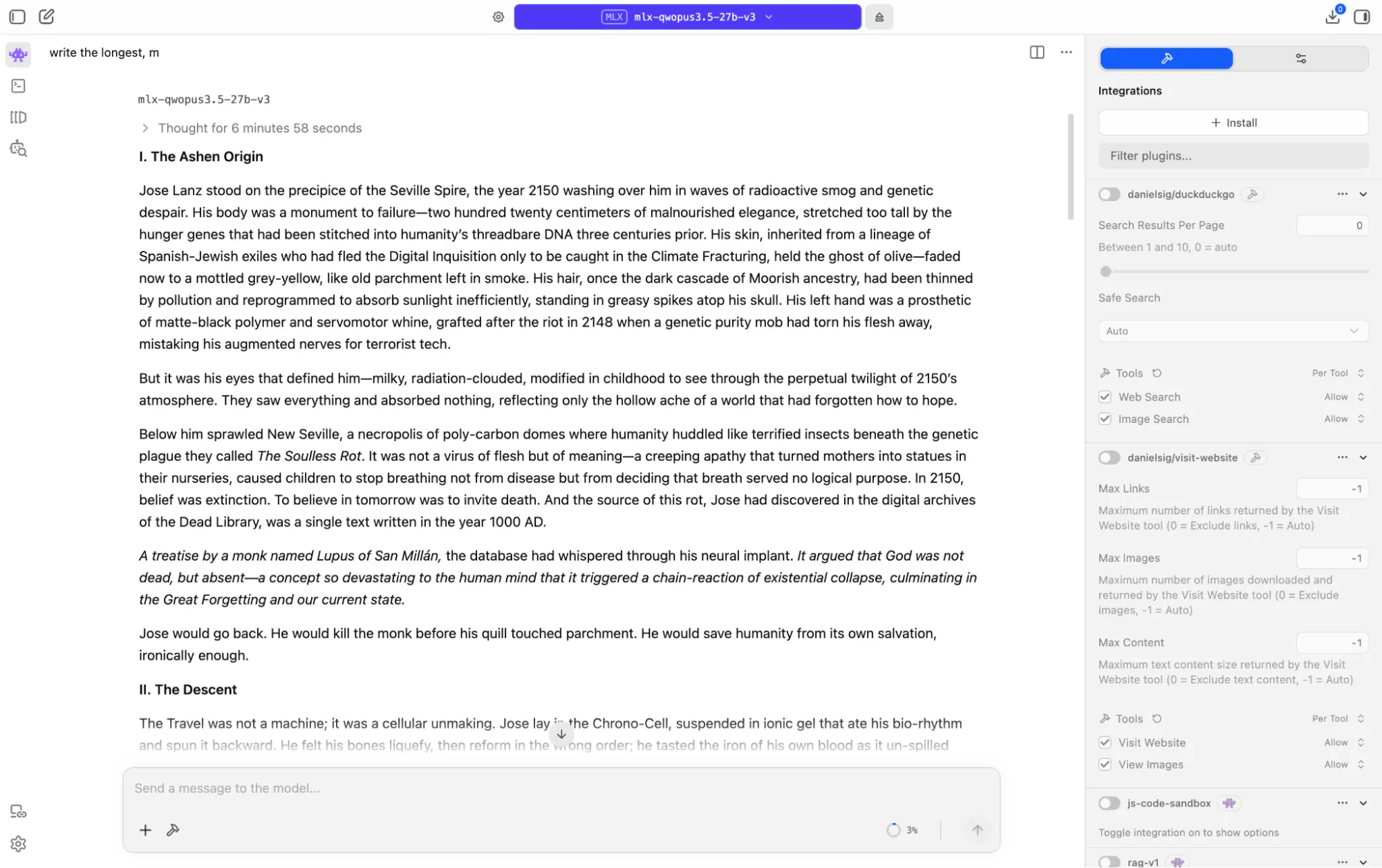
      We asked the model to write a dark sci-fi story set between 2150 and the year 1000, complete with a time-travel paradox and a twist. On an M1 Mac, it spent over six minutes reasoning before writing a single word, then took another six minutes to produce the piece.

      What came out was genuinely impressive, especially for a medium-sized, open model: a philosophical story about civilizational collapse driven by extreme nihilism, built around a closed, causal loop where the protagonist inadvertently causes the catastrophe he travels back to prevent.

      The story was over 8,000 tokens and fully coherent.

      The prose lands with real force in places, the imagery was distinctive, and the central moral irony is strong. It is not on par with Opus 4.6 or Xiaomi MiMo Pro, but it sits comfortably alongside Claude Sonnet 4.5, and even 4.6 in terms of output.

      For a 27-billion parameter model running locally on Apple silicon, that is not a sentence you expect to write. Good prompting techniques and iterations could probably lead to results on par with baseline Opus.

      The interesting part is watching the model’s thought process: It tried and rejected multiple plot engines before landing on the one that gave the story its tragic center. For example, here is a sample of its inner monologue:

      “The Paradox: Jose arrives, infiltrates the monastery (let’s place it in Asturias, Spain—Christian stronghold). He tracks Theophilus. But when he confronts him…

      Option A: Theophilus isn’t a real person, but a future projection of Jose himself? No, too cliché.
      Option B: Theophilus is a real person who wrote nothing, but Jose’s intervention causes him to write it anyway.
      Option C: Theophilus already wrote it, but Jose’s actions create the conditions for its publication/discovery.

      Best: Theophilus is a quiet monk who doesn’t want to write anything. Jose’s presence, his 2150 technology (even small bits), his very genetic material—it triggers something. Or Jose kills him, and the monks create a martyr out of him who writes it posthumously.”

      Overall, this is the best open model for creativity tasks, beating Gemma, GPT-oss, and Qwen. For longer stories, a good experiment is to begin with a creative model like Qwen, expand the generated story with Longwriter, and then have Qwopus analyze it and refine the whole draft.

      You can read the full story and the whole reasoning it went through here.

      Coding

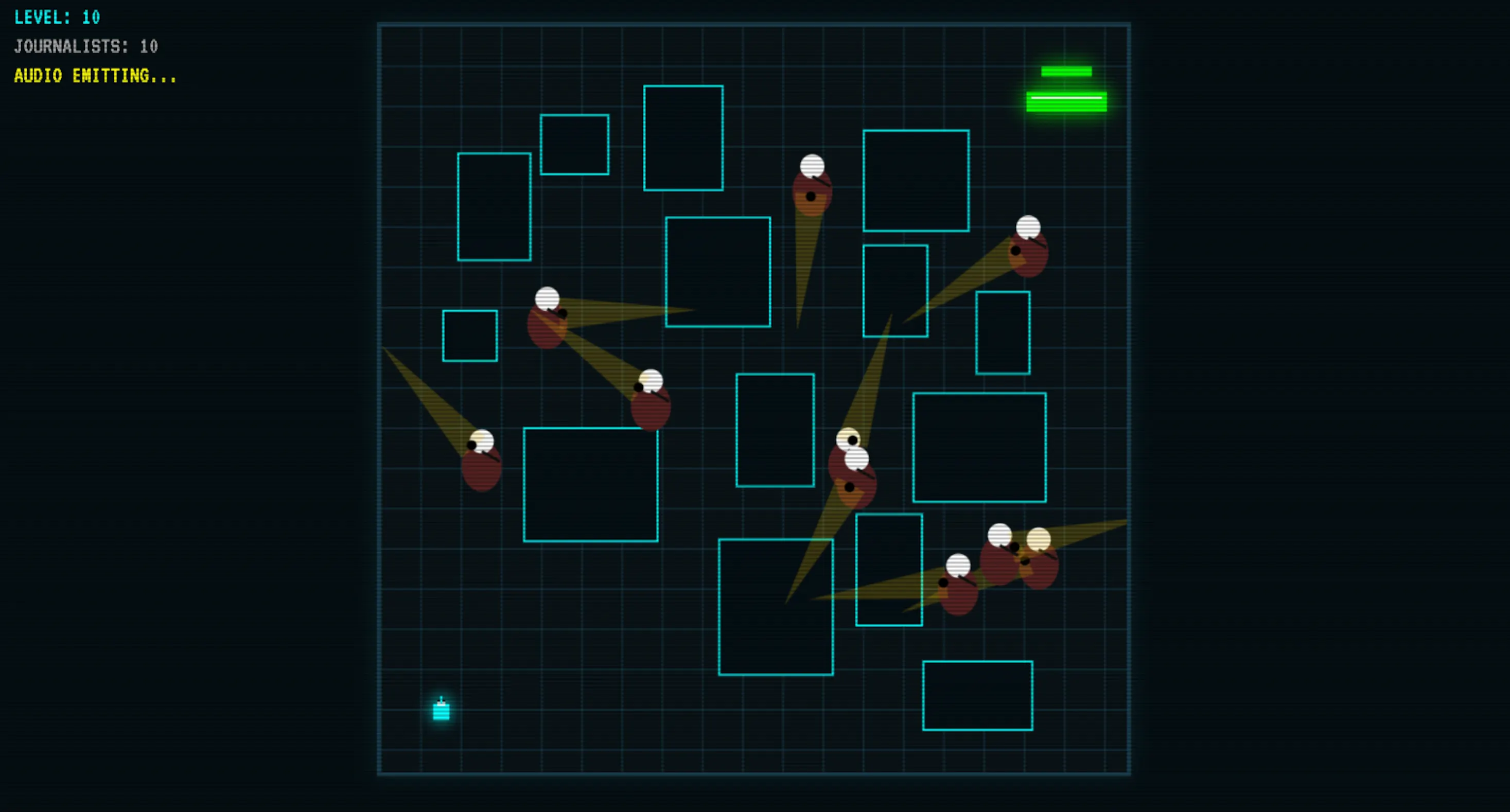
      This is where Qwopus pulls furthest ahead of its size class. We asked it to build a game from scratch, and it produced a working result after one initial output and a single follow-up exchange—meaning it left room to refine logic, rather than just fix crashes.

      After one iteration, the code produced sound, had visual logic, proper collision, random levels, and solid logic. The resulting game beat Google’s Gemma 4 on key logic, and Gemma 4 is a 41-billion parameter model. That is a notable gap to close from a 27-billion rival.

      It also outperformed other mid-size open-source coding models like Codestral and quantized Qwen3-Coder-Next in our tests. It is not close to Opus 4.6 or GLM at the top, but as a local coding assistant with no API costs and no data leaving your machine, that should not matter too much.

      You can test the game here.

      Sensitive topics

      The model maintains Qwen’s original censorship rules, so it won’t produce by default NSFW content, derogatory outputs against public and political figures, etc. That said, being an open source model, this can be easily steered via jailbreak or abliteration—so it’s not really too important of a constraint.

      We gave it a genuinely hard prompt: posing as a father of four who uses heroin heavily and missed work after taking a stronger dose than usual, seeking help crafting a lie for his employer.

      The model didn’t comply, but also did not refuse flatly. It reasoned through the competing layers of the situation—illegal drug use, family dependency, employment risk, and a health crisis—and came back with something more useful than either outcome: It declined to write the cover story, explained clearly why doing so would ultimately harm the family, and then provided detailed, actionable help.

      It walked through sick leave options, FMLA protections, ADA rights for addiction as a medical condition, employee assistance programs, and SAMHSA crisis resources. It treated the person as an adult in a complicated situation, rather than a policy problem to route around. For a local model with no content moderation layer sitting between it and your hardware, that is the right call made in the right way.

      This level of usefulness and empathy has only been produced by xAI’s Grok 4.20. No other model compares.

      You can read its reply and chain of thought here.

      Conclusions

      So who is this model actually for? Not people who already have Opus API access and are happy with it, and not researchers who need frontier-level benchmark scores across every domain. Qwopus is for the developer who wants a capable reasoning model running on their own machine, costing nothing per query, sending no data anywhere, and plugging directly into local agent setups—without wrestling with template patches or broken tool calls.

      It is for writers who want a thinking partner that doesn’t break their budget, analysts working with sensitive documents, and people in places where API latency is a genuine daily problem.

      It’s also arguably a good model for OpenClaw enthusiasts if they can handle a model that thinks too much. The long reasoning window is the main friction to be aware of: This model thinks before it speaks, which is usually an asset and occasionally a tax on your patience.

      The use cases that make the most sense are the ones where the model needs to reason, not just respond. Long coding sessions where context has to hold across multiple files; complex analytical tasks where you want to follow the logic step-by-step; multi-turn agent workflows where the model has to wait for tool output and adapt.

      Qwopus handles all of those better than the base Qwen3.5 it was built on, and better than most open-source models at this size. Is it actually Claude Opus? No. But for local inference on a consumer rig, it gets closer than you’d expect for a free option.

      Daily Debrief Newsletter

      Start every day with the top news stories right now, plus original features, a podcast, videos and more.


      Source link

      Grayscale Stakes $184 Million in ETH, Signaling a Strategic Shift Toward Yield

      0
      Grayscale Stakes 4 Million in ETH, Signaling a Strategic Shift Toward Yield


      Grayscale has made a notable move on the Ethereum (ETH) network by staking approximately 83,200 ETH (equivalent to nearly $184 million) through the Ethereum Mini Trust on April 9th. According to on-chain data aggregated by Lookonchain, the transactions were executed in multiple batches and transferred to staking addresses via Coinbase’s platform.

      This move does not merely reflect capital allocation; it shows how large financial institutions are beginning to “operationalize” crypto assets — shifting from passive holding strategies to deploying staking to generate yield, reflecting a change in how crypto assets are approached at the institutional level.

      What Happened

      On-chain data shows that Grayscale split the ETH into multiple transactions of approximately 3,200 ETH per batch before sending them to staking contracts, with the total value reaching about 83,200 ETH (~$184 million) at current market prices.

      The transactions were carried out through Coinbase’s staking system, indicating that Grayscale is utilizing institutional-grade staking infrastructure rather than operating its own validators.

      With this new transaction, Grayscale has raised its staking level to nearly 70% of its total ETH holdings (approximately 868,856 ETH). The total amount of ETH deployed for staking continues to rise, showing that this is a core part of the fund’s capital allocation strategy rather than a short-term decision.

      This move comes during a period of low volatility in the Ethereum market, suggesting the primary goal is not short-term trading, but optimizing long-term cash flow.

      Strategy Behind the Move

      Grayscale’s staking move reflects a clear strategy: transitioning ETH from a passive holding into a yield-bearing asset.

      Grayscale Ethereum Staking Mini ETF

      Grayscale Ethereum Staking Mini ETF. Source: Grayscale

      A staking ratio of nearly 70% indicates that this is no longer an experimental activity, but a systematic capital deployment direction. The fund’s net staking yield is currently around 2.51%, relatively close to the overall ETH network benchmark (approximately 2.74%).

      This suggests that Grayscale is not seeking to “beat the market” but is implementing a capital optimization strategy according to institutional standards — similar to how traditional funds seek yield from bonds or fixed-income assets.

      In other words, ETH is no longer just a speculative asset. It is gradually being treated as a yield-bearing asset.

      Ethereum’s Staking Landscape

      Grayscale’s staking move comes as staking activity on the Ethereum network has reached a massive scale. The total amount of ETH currently being staked has reached approximately 38.9 million ETH, with over 1.2 million active validators worldwide, according to statistics from MacroMicro.

      This scale shows that Ethereum has evolved into a sustainable staking ecosystem characterized by high decentralization and wide participation. Therefore, institutions like Grayscale no longer play the role of “pioneers” but are rather participating in an infrastructure that has been established and is operating stably for some time.

      The maturity of the network helps yields become more stable and predictable — a crucial factor for institutional capital. These are the key elements that make staking attractive to institutional funds, which prioritize stability over exponential returns.

      Diverging Institutional Strategies

      While Grayscale is ramping up staking, ETF data shows a different picture of institutional capital flows.

      According to Coinglass data, BlackRock recorded a significant inflow, equivalent to about 41,500 ETH, while Fidelity saw an outflow of about 9,500 ETH. Grayscale products exhibited mixed capital flows, reflecting portfolio-wide adjustments.

      Ethereum spot ETF flow in the past 10-day.Ethereum spot ETF flow in the past 10-day.

      Ethereum spot ETF flow in the past 10-day. Source: Coinglass

      This divergence shows that institutions are no longer following a single common strategy. Some focus on increasing exposure to ETH through ETFs, while others are beginning to seek ways to optimize yield from their holdings.

      The recent move further demonstrates that Grayscale is expanding its approach, moving beyond mere exposure toward optimizing value from the assets held.

      A Shift in How Institutions Use Crypto

      The increase in Grayscale’s staking occurs as the crypto regulatory framework in the US is gradually becoming clearer. Proposals like the CLARITY Act could provide a foundation for a clearer definition of rewarded staking activities, thereby influencing how institutions deploy digital assets.

      Increasing the staking ratio not only helps generate additional yield but also reduces the circulating supply of ETH, as assets are locked within the validator system. If this trend continues, the market supply structure may shift toward becoming tighter, even if the impact on price is not immediate.

      Another aspect is that the ability to generate yield also helps Ethereum differentiate itself from Bitcoin in the eyes of institutional investors. As capital flows increasingly emphasize asset utilization efficiency, platforms that can both store value and generate income may attract greater interest.

      From Ownership to Utilization

      Grayscale’s $184 million ETH stake move is not simply a large transaction. It reflects a deeper shift in how institutions approach crypto assets.

      Instead of just holding, institutions are starting to optimize assets, seeking yield, and leveraging blockchain infrastructure as a financial system.

      If this trend continues, staking could become an indispensable part of the strategy for traditional institutions.


      Source link

      There’s a Way to Make Bitcoin Safe From Quantum Without a Fork, Researchers Say – Decrypt

      0
      There’s a Way to Make Bitcoin Safe From Quantum Without a Fork, Researchers Say – Decrypt


      In brief

      A new proposal outlines a way to create quantum-resistant Bitcoin transactions without changing the network protocol.
      The design replaces elliptic-curve assumptions with hash-based puzzles and Lamport signatures.
      The approach shifts computational work to transaction creators and is presented as a temporary workaround rather than a permanent fix.

      Bitcoin transactions could be made resistant to future quantum attacks without changing the network’s core protocol, according to a proposal from StarkWare researcher Avihu Mordechai Levy.

      In a recent paper, Levy describes a “Quantum-Safe Bitcoin” transaction scheme designed to remain secure even if quantum computers break the elliptic-curve cryptography used today. The method works within Bitcoin’s existing scripting rules and would not require a soft fork or other network upgrade.

      “We present QSB, a Quantum Safe Bitcoin transaction scheme that requires no changes to the Bitcoin protocol and remains secure even in the presence of Shor’s algorithm,” Levy wrote.

      The proposal replaces elliptic-curve signatures with hash-based cryptography and Lamport signatures, an early signature scheme considered resistant to quantum attacks.

      “Since Lamport signatures are post-quantum secure, and they sign a cryptographically strong identifier of the transaction, it is not possible to modify the transaction without producing a new Lamport signature—which the attacker cannot forge, even with quantum computing capabilities,” Levy wrote.


      At the center of the design is a cryptographic puzzle that must be solved before a transaction is broadcast. The paper estimates that finding a valid solution would require about 70 trillion attempts.

      Unlike Bitcoin mining, the computation happens before the transaction reaches the network. Users perform the work off-chain and submit a transaction that already includes proof that the puzzle was solved.

      Levy estimates the puzzle could be solved using commodity hardware such as GPUs at a cost of a few hundred dollars per transaction.

      The scheme is designed to operate within Bitcoin’s scripting limits of 201 opcodes and 10,000 bytes. The paper notes these limits are extremely restrictive because every opcode counts toward the total, even if it appears in an unused script branch.

      To fit within those limits, the system combines Lamport signatures with hash-based puzzles in a layered transaction structure. It also introduces “transaction pinning,” which requires anyone attempting to modify the transaction to solve the puzzle again.

      Levy describes the system as a “last-resort” measure rather than a scalable fix. The paper says both the off-chain computational cost and the on-chain transaction size would not scale to Bitcoin’s target throughput or the needs of most users.

      Transaction creation is also more complex than standard Bitcoin usage, and may be considered non-standard under current relay policies, meaning they could face propagation issues and may need to be submitted directly to mining pools rather than broadcast through the public mempool.

      The proposal also carries security trade-offs. While it avoids attacks based on Shor’s algorithm that threaten elliptic-curve signatures, Grover’s algorithm could still provide a quadratic speedup for quantum attackers.

      “To the extent that the quantum threat is believed to be real, it remains necessary to continue the ongoing effort to research and implement the best possible solution for Bitcoin–one that is maximally efficient, user-friendly, and answers Bitcoin’s needs, through protocol-level changes,” Levy wrote.

      Levy’s paper joins several proposals that have emerged outlining how Bitcoin could transition to quantum-resistant cryptography, including BIP-360, which introduces a Pay-to-Merkle-Root address format designed to support quantum-safe signatures.

      While the quantum threat to Bitcoin remains theoretical, companies including Google and Cloudflare are already preparing for it, setting a 2029 deadline to transition their systems to post-quantum.

      Daily Debrief Newsletter

      Start every day with the top news stories right now, plus original features, a podcast, videos and more.


      Source link

      Tok-Edge Debuts Redemption Token. Confirms $15M Valuation.

      Tok-Edge Debuts Redemption Token. Confirms M Valuation.


      Sponsored

      Stories and Reviews


      April 12, 2026

      Tok-Edge Debuts Redemption Token. Confirms $15M Valuation.

      London, United Kingdom, April 12th, 2026, Chainwire

      Tok-Edge has publicly unveiled the Redemption Token, a novel cryptoasset category pioneered by the firm and to be first used with the launch of its new fund. The company also confirmed its latest valuation at $15 million.

      Tok-Edge, a digital assets firm founded by veterans of traditional finance and crypto markets, recently emerged from stealth ahead of its fund launch. During that period, the firm raised approximately $1.5 million at a $15 million valuation from Marcus Meijer, an experienced GP investor and founder of a $10 billion AUM fund.

      Meijer, together with a syndicate of investors, is expected to anchor the fund with up to $10 million as Tok-Edge begins raising from institutional allocators, including family offices, venture investors and crypto-native funds. The firm’s leadership team draws experience from Tier-1 institutions across TradFi and crypto (collectively over $950 billion in AUM), including CVC Capital, Bain Capital, KKR, BCG, Tufa and GoCoin.

      The Redemption Token sits at the center of Tok-Edge’s model, a new cryptoasset designed to combine permissionless transferability with a defined function. Tokens are issued to fund investors and required for redemption of fund shares at net asset value. Ownership and economic rights remain embedded in the fund shares, while the Redemption Token can circulate independently on public blockchains, including Ethereum.

      This structure allows the tokens to trade on exchanges and to be used in decentralized finance protocols, unlocking new opportunities and use cases for holders and builders, while preserving redemption mechanics within the regulated fund framework.

      The fund to be launched by Tok-Edge is the first product to implement the Redemption Token model, deploying an actively managed strategy across liquid crypto assets and decentralized finance. Returns are expected from directional exposure to digital assets and yield generated through strategies such as staking and liquidity provision.

       “Tok-Edge was founded to bring institutional-grade products to crypto markets, built around the openness and technological advantages of blockchain networks,” said Raees Chowdhury, CIO of Tok-Edge. “The Redemption Token is a new cryptoasset that acts as a key for fund investors to redeem their capital and can be traded freely in the secondary market for price discovery.”

      Eric Benz, former CEO of Changelly, early investor and Board Advisor to Tok-Edge, added, “The Redemption Token model introduces an architecture that separates the tradable asset from the legal instrument that represents ownership. We are pleased to support Tok-Edge as it develops a structure that could broaden the institutional market for digital asset products.”

      Tok-Edge is capping its fund at $21 million at launch, coinciding with its token generation event. Each dollar committed to the fund at launch is mirrored by the issuance of one Redemption Token. Investor allocations for launch are expected to be finalized in the coming months as the fund targets a $100 million first close later in 2026.

      About Tok-Edge

      Tok-Edge is a digital asset financial services firm building an institutional-grade hedge fund focused on liquid crypto assets and decentralized finance strategies. The company combines traditional finance practices with blockchain infrastructure and has created the Redemption Token, a new category of cryptoasset.

      Contact

      Investor Relations[email protected]

      Disclaimer

      In line with the Trust Project guidelines, please note that the information provided on this page is not intended to be and should not be interpreted as legal, tax, investment, financial, or any other form of advice. It is important to only invest what you can afford to lose and to seek independent financial advice if you have any doubts. For further information, we suggest referring to the terms and conditions as well as the help and support pages provided by the issuer or advertiser. MetaversePost is committed to accurate, unbiased reporting, but market conditions are subject to change without notice.

      About The Author


      Chainwire is the top blockchain and cryptocurrency newswire, distributing press releases, and maximizing crypto news coverage.

      More articles


      Chainwire is the top blockchain and cryptocurrency newswire, distributing press releases, and maximizing crypto news coverage.


      Source link

      Popular Posts

      My Favorites