Home Blog Page 43

No Need for Space Gear — Capcom’s ‘PRAGMATA’ Joins GeForce NOW on Launch Day

0
No Need for Space Gear — Capcom’s ‘PRAGMATA’ Joins GeForce NOW on Launch Day


Head straight for orbit with GeForce NOW — no space helmet required. 

PRAGMATA, Capcom’s long-awaited sci-fi action adventure, touches down on GeForce NOW the same day it launches worldwide. The futuristic journey through a cold lunar station in the near future can be streamed instantly from the cloud to almost any device, no console or heavy hardware needed.

That’s only the beginning. Five new titles join the cloud this week, expanding April’s gaming galaxy with fresh adventures and endless possibilities. 

Plus, the GeForce NOW Ultimate membership comes to gamers in India for the first time, with the service now available in beta and operated by NVIDIA.               

Time to see what’s landing on GeForce NOW.

A Mission Gone Wrong

PRAGMATA is Capcom’s newest sci-fi action adventure that blends heart, high-tech and a hauntingly quiet world set in the near future. Step into the boots of Hugh Williams, an investigator navigating a lunar research station gone silent and Diana, a young android. Armed with an arsenal of weapons and the ability to hack, every corridor and console becomes part of a cinematic experience filled with tense exploration and fast-paced action.

The story unfolds amid the cold vacuum of the moon after a massive quake hits the station researching Lunafilament — a material said to be able to create anything given enough data. Awake, injured and disoriented, Hugh crosses paths with Diana, the mysterious android girl known as a Pragmata. Now, they must work together as they face the rogue station on their way back to Earth.

PRAGMATA shines in stunning clarity with ray-traced lighting and NVIDIA DLSS 4 technology boosting frame rates and image quality. Stream it on launch day at full fidelity, even without the latest hardware — no need to wait on a large install or worry about hardware specs. Hugh and Diana’s lunar mystery is ready when the moment strikes.

Let’s Play Today

Heroes in the cloud don’t have to wait for updates.

Fortnite: Save the World is now free and ready to stream instantly on GeForce NOW. The storm hits hard and the heroes hit harder — jump into a co-op adventure that mixes base-building, looting and all-out action against waves of Husks. Craft the ultimate fort, set sneaky traps and team up to protect what’s left of the world — no waiting for updates or patches, just pure fight-and-build mayhem. The storm’s closing in, but thanks to the cloud, the party’s jumping right into the action. “Save the World” isn’t available on mobile devices, including tablets.

In addition, members can look for the following:

REPLACED (New release on Steam and Xbox, available on Game Pass, April 14, GeForce RTX 5080-ready)
Windrose (New release on Steam, April 14, GeForce RTX 5080-ready)
Cthulhu: The Cosmic Abyss (New release on Steam, April 16, GeForce RTX 5080-ready)
PRAGMATA (New release on Steam, April 16, GeForce RTX 5080-ready)
PRAGMATA SKETCHBOOK – DEMO (Steam, GeForce RTX 5080-ready)

What are you planning to play this weekend? Let us know on X or in the comments below.


Source link

Morning Minute: Bitcoin Devs Propose New Quantum Solution – Decrypt

0
Morning Minute: Bitcoin Devs Propose New Quantum Solution – Decrypt


Morning Minute is a daily newsletter written by Tyler Warner. The analysis and opinions expressed are his own and do not necessarily reflect those of Decrypt. And check out our new daily news show covering all of the top stories in 5 minutes or less, downloadable on Apple Pod or Spotify.

GM!

Today’s top news:

Crypto majors slightly green; Bitcoin at $74,600
BTC ETFs see $186M in inflows, $600M in past 2 days
BIP-361 proposal would freeze unmigrated Bitcoin in effort against quantum
All Birds stock soars 800% after pivot to AI
UNC jumps another 120% to $20M, fastest meme runner in months

⚛️ Bitcoin Developers Propose Freezing Quantum-Vulnerable Coins

The newest quantum-proof theory for Bitcoin came on Wednesday.

Casa CTO Jameson Lopp and five co-authors posted BIP-361 to Bitcoin’s GitHub Tuesday – a three-phase plan to migrate coins off quantum-vulnerable addresses or have them frozen by the network.

About 34% of all BTC sits in early Pay-to-Public-Key addresses with exposed public keys, including Satoshi’s estimated 1.1M BTC (~$74B). A quantum computer running Shor’s algorithm could theoretically derive private keys from those exposed public keys. Google’s quantum team has flagged 2029 as a possible threat date.

How this plan works would ban new transactions to legacy addresses, then freeze all unmigrated coin and then offer ZK-proof recovery via BIP-39 seed. Lopp himself calls it a rough sketch and says he doesn’t think it’s necessary yet. But the quantum clock is ticking and new solutions are at least starting to come in…

Key Details:

BIP-361 posted to Bitcoin’s GitHub Tuesday by Jameson Lopp and five co-authors; three-phase plan to freeze quantum-vulnerable coins that don’t migrate; ~34% of BTC at risk including Satoshi’s ~1.1M BTC
The timeline: Phase A bans legacy address sends 3 years post BIP-360 activation; Phase B freezes unmigrated coins 2 years later; Phase C optional ZK-proof recovery via BIP-39 seed; Google flags 2029 as a possible quantum threat date
The debate: Lopp calls it a rough sketch, not currently positioned for adoption; critics argue the freeze mechanism fundamentally violates Bitcoin’s permissionless, sovereign ownership principle

🌞 WLFI Wants Your Tokens Locked Past Trump’s Second Term

Fresh off last week’s $75M Dolomite loan debacle and Justin Sun’s public break with the project, World Liberty Financial dropped a governance proposal Tuesday that investors did not receive well.

WLFI proposed unlocking 62.3 billion locked tokens under terms that stretch vesting well past Trump’s second term. Early investors get a 2-year cliff then 2-year linear vest. Anyone who doesn’t vote to accept gets locked indefinitely. Founders burn 10% of their allocation and vest the rest over 5 years after a 2-year cliff.

This clearly didn’t go over well with WLFI holders, including Justin Sun.

Key Details:

World Liberty Financial proposed unlocking 62.3 billion WLFI tokens under terms that push full vesting past Trump’s second term; early investors face a 2-year cliff and 2-year linear vest, or tokens stay locked indefinitely if they reject
The governance math: quorum is only 1 billion WLFI with simple majority required; founding team can pass this without any outside support
Market response: WLFI trades at $0.079, 48% below the treasury’s own $0.1507 buyback average

👟 Allbirds Is Now an AI Company, and The Stock Is Up 600%

The company that made wool sneakers for SF tech workers, hit a $4B valuation, and then collapsed 99% announced Tuesday it’s abandoning shoes for AI compute infrastructure. The new name: NewBird AI.

And the stock went from $2.49 to $17 intraday.

The plan: sell the Allbirds brand to American Exchange Group for $39M, take a $50M convertible facility from an institutional investor, and use the proceeds to acquire GPU hardware for lease to customers.

Is this the pets.com moment of the AI cycle? History doesn’t repeat, but is sure does rhyme…

Key Details:

Allbirds announced a pivot to AI compute infrastructure as NewBird AI, selling its shoe brand for $39M and raising $50M in convertible financing for GPU acquisitions; stock surged 600%
The reality check: no existing compute infrastructure, $58M in free cash flow burned over the last 12 months; company was days from closing down for good
The Decrypt comparison: Long Island Iced Tea renamed itself Long Blockchain in 2017, stock surged, got delisted, and three executives were charged with SEC insider trading

🐦 Elizabeth Warren Is Coming for X Money

X Money is launching this month. Musk’s vision is peer-to-peer payments built into X, with potential stablecoin integration and a product he wants to eventually replace traditional banking. Warren fired off a letter to Musk on Tuesday, demanding written answers by April 21.

Her concerns: FDIC insurance gaps, potential stablecoin issuance under the GENIUS Act, financial surveillance and data monetization, and whether Musk’s track record running X gives consumers any reason for confidence.

Warren is the ranking member of the Senate Banking Committee, the exact committee running the Clarity Act markup this month. X Money, the Warsh hearing, and the FOMC are all happening in the same two-week window. Washington is having a very busy April.

Key Details:

Senator Warren sent a letter to Musk demanding answers by April 21 on X Money’s consumer protections, FDIC insurance gaps, potential stablecoin issuance under the GENIUS Act, and financial surveillance risks
The timing: Warren is ranking member of the Senate Banking Committee, currently handling the Clarity Act markup; her X Money pressure lands in the same window as the Warsh confirmation hearing and April 28-29 FOMC
What X Money is: peer-to-peer payments built into X with crypto and stablecoin integration; Musk’s first step toward an “everything app” for financial services; early access reportedly opening this month


🌎 Macro Crypto and Markets

Crypto majors are slightly green; BTC +0.6% at $74.6k; ETH +0.1% at $2,337; SOL +2% at $85; HYPE +1% at $44.66
RAVE (+18), DOT (+9%), and FIL (+9%) led top movers
Oil -1% at $88; Gold even at $4,820
Bitcoin whales have accumulated 270,000 BTC ($20B) in the past month, the largest accumulation streak since 2013 according to CryptoQuant
Tether acquired another 951 Bitcoin, now holding 97,141 and 5th largest onchain holder

Corporate Treasuries & ETFs

Meme Coin Tracker

Meme leaders were mostly green; DOGE +3%, SHIB +3%, PEPE +5%, TRUMP +2%, PENGU +5%, SPX +6%, FARTCOIN +8%
Unc (+120%), Peace (+28x), Dumbmoney (+120%), and Bio (+35%) led notable onchain movers

💰 Token, Airdrop & Protocol Tracker

🚚 What is happening in NFTs?

NFT leaders were slightly green; Punks even at 26 ETH, Pudgy +1% at 4.1 ETH, BAYC +1% at 6.35 ETH; Hypurr’s even at 402 HYPE
Del Mundos (+25%) and Moonbirds (+5%) led notable movers

Daily Debrief Newsletter

Start every day with the top news stories right now, plus original features, a podcast, videos and more.


Source link

The One Show uproar over Sheridan Smith’s appearance as she is accused of ‘sporting new look’: ‘Looks so different’

    0
    The One Show uproar over Sheridan Smith’s appearance as she is accused of ‘sporting new look’: ‘Looks so different’


    The One Show viewers had mixed opinions as Sheridan Smith was accused of “sporting a new look”.

    The 44-year-old star, who is known for roles in Two Pints of Lager and a Packet of Crisps and Gavin & Stacey, appeared on the BBC evening show last night (April 15) alongside fellow actors Peter Capaldi and co-star Michael Socha.

    For Wednesday’s programme, the guests were welcomed by hosts Roman Kemp and Alex Jones.

    Sheridan appeared on The One Show last night (Credit: BBC)

    Sheridan Smith on The One Show

    For their appearance, Sheridan and Michael promoted their new BBC drama, The Cage.

    No stranger to a glam moment, Sheridan stunned in a matching denim-style co-ord. She styled her signature blonde locks off her face and into a more wet-style and accessorised with small gold hoop earrings.

    Sheridan, who has many tattoos, rolled her sleeves up, showing off the ink down her arms and hands.

    Despite glowing, many appeared not to be the biggest fans of her look.

    Sheridan Smith on The One Show
    Sheridan’s look left viewers divided (Credit: BBC)

    ‘What’s she done to her face?’

    “Sheridan looks so different,” one user insisted on Facebook.

    “Sheridan sporting a new look?” another person shared.

    “Why do these lovely ladies ruin themselves,” a third remarked.

    “Hair looked awful,” a fourth said.

    “I’m confused. Is the Sheridan Smith on the sofa the same person in the trailer for her new show?” a fifth asked over on X.

    “What’s Sheridan Smith done to her face?” another questioned.

    ‘Natural beauty’

    Meanwhile, her followers on Instagram adored the look.

    “I love your suit,” one user said.

    “I have nothing but admiration for you Sheridan so much of your journey resonates with me. Through it all you still maintain being an incredible actress and a national treasure. Your family must beam with pride. An inspiration. Keep doing what you do best,” another shared.

    “Awww you look absolutely gorgeous, beautiful Sheridan,” a third expressed.

    “Looking good Sheridan!!” a fourth wrote.

    Read more: Sheridan Smith wipes her tears following Ann Ming’s emotional admission on This Morning

    What do you think of this story? You can leave us a comment on our Facebook page @EntertainmentDailyFix and let us know.


    Source link

    Why Web3 Lost $482M in Q1 2026: The Same Security Mistakes Keep Happening | NFT News Today

    Why Web3 Lost 2M in Q1 2026: The Same Security Mistakes Keep Happening | NFT News Today


    Hacken’s Q1 2026 Blockchain Security & Compliance Report, released on April 14, 2026, shows $482.6 million lost across 44 incidents—an update from an initial $464.5M estimate after a late-confirmed social engineering case. Yet the bigger story lies in how predictable and repeatable most losses were.

    This isn’t a story about unknown vulnerabilities or novel attack techniques. It’s about familiar weaknesses being exploited again and again.

    The Same Problems, Still Working

    Hacken’s central question is direct: why does the industry keep losing money to problems it already understands?

    The numbers offer a clear answer.

    Roughly $306 million of total losses came from phishing and social engineering. However, that figure needs context. A single incident—a $282 million hardware wallet scam involving a fake IT support call—accounted for over half of the quarter’s total losses and about 92% of the phishing category.

    That doesn’t make phishing less important. If anything, it highlights how damaging a single successful attack can be when operational controls fail.

    The takeaway is straightforward: the biggest risks are still tied to human behavior and access management, not just code.

    A Shift in Attack Patterns

    There’s a noticeable change in how losses are distributed.

    Q1 2026 recorded 44 incidents, with fewer massive, headline-grabbing breaches and more mid-sized, repeatable attacks. This creates a different kind of risk profile—less dramatic, but more persistent.

    At the same time, it’s worth noting that total losses were still the second-lowest Q1 since 2023. The absence of an event on the scale of the $1.46 billion Bybit phishing incident in Q1 2025 played a major role in that.

    So while incidents increased, the average loss per attack decreased. This suggests attackers are leaning into consistency rather than scale.

    Breaking Down the Losses

    Looking beyond the headline numbers provides a clearer picture:

    Phishing and social engineering: ~$306M

    Smart contract exploits: $86.2M across 28 incidents (a 213% increase year-over-year)

    Access control failures: ~$71.9M (including compromised keys and infrastructure)

    This distribution reinforces a key point: most losses are not coming from unknown technical flaws. They’re coming from weaknesses in access, authentication, and operational processes.

    The Weakest Layer Is Still Identity

    Many of the attack methods described—fake investment calls, malicious software updates, compromised employee devices—are well-known tactics.

    Groups linked to North Korea (DPRK) alone were responsible for more than $40 million in losses using these approaches.

    These are not blockchain-specific exploits. They are extensions of traditional cyberattack methods applied to an environment that often lacks mature defensive layers.

    The result is a mismatch: high-value assets protected by strong cryptography, but accessed through comparatively weak human and operational systems.

    Audits Aren’t Saving You

    One of the more revealing findings is that several exploited protocols had already undergone audits. In total, six audited projects were compromised, resulting in $37.7 million in losses. One of these had been audited 18 times, another five times by different firms.

    In many cases, the issue wasn’t a missed vulnerability in the audited code. Instead, problems appeared in off-chain infrastructure, key management, post-audit changes, or legacy code.

    Examples include:

    This reinforces an important distinction: audits evaluate code at a specific moment. They don’t account for how systems evolve, integrate, or are operated over time.

    Where Risk Is Concentrated

    Hacken’s internal audit data shows that risk is not evenly spread.

    A disproportionate share of critical and high-severity issues came from a small subset of audits, particularly those involving newer architectures like account abstraction, DEX plugins, and advanced protocol extensions.

    There’s also a recurring issue with enforcement. In 38.5% of stablecoin audits, compliance mechanisms were present in the code but not consistently enforced across all execution paths.

    That gap between intention and execution creates openings attackers can exploit.

    Security Is Still Treated Like a Phase

    A core structural issue remains unchanged.

    Many teams still follow a linear approach:

    Build → Audit → Launch → Move on

    Attackers operate differently:

    Probe → Adapt → Exploit → Repeat

    This difference in approach creates ongoing exposure. Security isn’t something that can be completed before launch. It requires continuous monitoring, validation, and response.

    Without that, even well-audited systems can become vulnerable over time.

    Regulation and AI Are Changing the Landscape

    The report highlights Q1 2026 as a turning point for both regulation and technology.

    Frameworks like Europe’s MiCA and DORA have moved into active enforcement, alongside new U.S. stablecoin legislation, expanded oversight in Dubai, and stricter standards in Singapore. Regulators are increasingly focused on real-time monitoring, rapid incident detection, and enforceable controls.

    At the same time, AI is beginning to influence both development and attack strategies. The report documents one of the first known exploits involving AI-generated smart contract code, alongside broader risks such as wallet signer manipulation and MEV-related exposure.

    These developments are pushing the industry toward systems that can operate and defend in real time, rather than relying on static checks.

    The Real Issue Isn’t Awareness

    None of these problems are new.

    The industry understands phishing risks. It recognizes the limitations of audits. It’s aware of the challenges introduced by complex, composable systems.

    The gap lies in execution.

    Security is still too often treated as a checkpoint instead of an ongoing function. Operational defenses lag behind technical safeguards. Rules are defined but not always enforced.

    Until those gaps are addressed, similar patterns will continue to appear.

    What Needs to Change

    If there’s a clear takeaway from this report, it’s that security needs to operate as a continuous system.

    That includes:

    Building monitoring and response capabilities from the start

    Treating identity and access management as critical infrastructure

    Extending security practices beyond code into operations and human processes

    Ensuring compliance rules are consistently enforced across all execution paths

    Designing systems with failure scenarios in mind

    Incorporating real-time monitoring and automated response mechanisms as core infrastructure

    Teams that adopt this approach are beginning to separate themselves from those that don’t.

    Final Thought

    The losses recorded in Q1 2026 were not random. They followed patterns the industry has seen before.

    That’s what makes them significant.

    The challenge ahead isn’t discovering new risks—it’s addressing the ones that are already well understood.


    Source link

    ORDI Explodes Over 70%: Bitcoin’s First BRC-20 Token Tops Trending Charts

    ORDI Explodes Over 70%: Bitcoin’s First BRC-20 Token Tops Trending Charts


    ORDI’s surge is driven by renewed interest in Bitcoin-native tokens and the Ordinals ecosystem.
    The token’s creation on the Bitcoin blockchain using the Ordinals protocol marked a new chapter for Bitcoin’s capabilities.
    The BRC-20 standard enabled by ORDI allows for fungible token issuance without smart contracts, driving innovation in the ecosystem.

    ORDI, the flagship token of Bitcoin’s Ordinals ecosystem, has delivered one of the sharpest rallies in the crypto market today, surging more than 70% in the last 24 hours and climbing to the top of trending lists alongside other high-momentum plays.

    As of the latest data, ORDI is trading at approximately $4.43, pushing its market capitalization to around $92 million (with a fixed circulating supply of 21 million tokens). Trading volume has exploded to over $229 million, more than 2.5x its market cap, underscoring intense buying pressure and renewed interest in this Bitcoin-native token.

    Source: TradingView

    This breakout stands out as broader market leaders like Bitcoin and Ethereum show only modest movement, pointing to a clear rotation into Bitcoin Layer-1 narratives — particularly the Ordinals and BRC-20 sector.

    What is ORDI? The pioneer of Bitcoin’s BRC-20 standard

    ORDI is the first-ever fungible token created on the Bitcoin blockchain using the Ordinals protocol and the BRC-20 standard. Launched in early 2023, it marked the beginning of a new chapter for Bitcoin by enabling the inscription of data (text, images, audio, or video) directly onto individual satoshis — the smallest unit of BTC.

    Key features include:

    BRC-20 Standard: A Bitcoin-native way to issue and transfer fungible tokens without smart contracts, using JSON inscriptions for deployment, minting, and transfers.

    Fixed Supply: 21 million ORDI tokens, mirroring Bitcoin’s total supply for scarcity and cultural alignment.

    Ordinals Ecosystem Flagship: Serves as the leading representative for Bitcoin inscriptions, NFTs, and digital artifacts — over 18 million inscriptions have been created on Bitcoin to date.

    Bitcoin-Native Utility: Powers experiments in on-chain NFTs, memecoins, and emerging DeFi primitives directly on Bitcoin’s base layer, without relying on sidechains or Layer-2s initially.

    While often described as a memecoin due to its viral origins, ORDI pioneered the entire BRC-20 category and remains the most prominent token showcasing Bitcoin’s potential beyond “digital gold” — turning satoshis into unique, tradable digital assets.

    Technical breakout fuels the rally

    The price action reflects a powerful bullish breakout. ORDI shattered multi-week resistance levels around $2.50–$2.90 on the 4-hour and daily charts, with the 24-hour range stretching from approximately $2.54 to a high near $4.61. The move was backed by a massive surge in trading volume, confirming strong buyer conviction and short-covering activity.

    Analysts highlight:

    Volume-to-market-cap ratio exceeding 250% in the session — well above typical altcoin averages.

    Bullish momentum indicators flipping to “strong buy” across short-term timeframes.

    Outperformance versus BTC and ETH pairs, with on-chain metrics showing heavy accumulation.

    This technical setup aligns with renewed ecosystem momentum in Bitcoin’s Ordinals sector.

    Why ORDI is defying the broader market

    While the wider crypto market trades cautiously amid macro uncertainty, ORDI’s surge is powered by narrative strength in the Bitcoin ecosystem. The Ordinals protocol has reignited interest in Bitcoin-native innovation, with BRC-20 tokens and inscriptions driving fresh capital rotation into BTC Layer-1 plays.

    Additional tailwinds include:

    High-beta positioning — ORDI often leads sentiment shifts in the Bitcoin ecosystem.

    Speculative frenzy around BRC-20 revival and potential new inscription cycles.

    Community sentiment turning sharply bullish as volume metrics validate the move.

    This rally isn’t random; it reflects growing conviction that Bitcoin can support its own vibrant token and NFT economy directly on the base layer, solving for decentralization and security in ways that sidechains or alt-L1s cannot match.

    What’s next for ORDI?

    With bulls firmly in control, the next key resistance sits in the $5.00–$5.50 zone, which could open the door to 15–25% additional upside if volume holds. However, the token remains volatile after such a parabolic move — a failure to sustain above $3.80–$4.00 on any retrace could trigger quick profit-taking.

    For the long term, sustained growth hinges on continued development in the Ordinals ecosystem: more BRC-20 adoption, Layer-2 integrations, and real on-chain utility beyond speculation.

    CryptoTimes Take: ORDI’s explosive breakout is a classic example of how Bitcoin-native narratives can drive outsized gains even when the broader market consolidates. As the original BRC-20 pioneer, it continues to act as a high-conviction barometer for the entire Ordinals sector. While we don’t provide financial advice, this move highlights why Bitcoin ecosystem tokens remain one of the most exciting stories heading deeper into 2026. Watch volume, inscription activity, and any fresh BRC-20 developments for the next leg up.

    Also Read: Bitcoin, Ethereum, and the Quiet Construction of a New Financial Layer


    Source link

    Hades II Review | TheXboxHub

    0
    Hades II Review | TheXboxHub


    As Beautiful as Aphrodite, as Swift as Hermes

    There can’t be many more pointless things than a review of Hades II in 2026. There have been at least three moments to assess it or re-assess it: the Game of the Year nomination in 2025 (and associated End of Year lists), the full release three months earlier, and the Early Access release in 2024. It must be one of the most written-about games of last year, yet here we are adding another sheet of paper to the Herculean pile. 

    The excuse, of course, is that Hades II is only now releasing on Xbox, and Game Pass to boot. We’ve been made to wait, pressing our faces against the window while Supergiant’s title has been gathering up the plaudits. It’s been agony.

    Environmental screenshot from Hades II on Game Pass
    Hades II – finally on Xbox

    Xbox, Mate, You’re Late to the Party

    My plan for the review, as a Hades enjoyer but Hades II noob, was to approach it slightly differently. I was going to list out the things that surprised me about the game. It was going to be a kind of ‘Notes from a Newcomer’, as I brought along my wrong or right assumptions. But having played it for many, many hours now, that doesn’t feel right either. Because nothing really surprised me about Hades II. 

    More precisely, Hades II is everything I expected it to be. It is, emphatically, the shape of the first game. Sure, there’s a new system here and a structural difference there, but in its zoomed-out entirety it is the same proposition. You are a godly being living among other godly beings, and the moment-to-moment experience is to hop from the ever-progressing hub into roguelike combat, which includes branching doors and boons from Poseidon, Zeus and more. 

    But while Hades II is the same shape as its predecessor, everything – across every conceivable axis – is both ‘more’ and ‘better’. It feels like a game that has been worked on and polished for a couple of centuries. 

    Somehow More Vibrant and Good-Natured Than the Original

    The art is sensational. I’d probably pick the VFX as the standout. I could watch the swirling Cauldron in the Crossroads for hours, and the various attacks, both from enemies and players, are somehow clear (important when you’re leaning on the cues) and ludicrous. Animation would be a close second place. Melinoë, the main character, glides between combat-states with impossible fluidity, and animation frames can be cancelled near-immediately with a touch of the button. 

    I want to slip in some love for the character designs, too. Supergiant playfully subvert expectations when it comes to the presentation of favourite gods and mythological characters. There’s a welcome emphasis on female characters, a diversity of age and ethnicity, and a shockingly large number of cosplayable and fanciable characters. 

    Hades II xbox screenshotHades II xbox screenshot
    Gloriously vibrant

    And yes, Hades II sounds stunning. It’s my vote for best voice-acting of last year, with Judy Alice Lee’s Melinoë being a fantastic anchor for everyone else. Everything surges, pops and blasts as well as any game I have ever played.

    While I was waiting for Hades II to find its way onto Xbox, I began playing some alternatives. I’ve got a couple of dozen hours in Sworn, for example. But playing Hades II now, it’s clear how distant they all are. Combat in Hades II is peak. The addition of Ω Moves, activated with a hold of each action button, means that I am constantly managing the space around me. How much time do I have? Can I afford to unleash a sweeping attack? And will I have charged my Moon attacks for a barrage afterwards? Whatever I choose, I can be sure that it will look OTT, even if I end up dying at the end of it.

    Constant Peaks and Very Few Troughs

    Hades II pulls off this trick. I will often think that I am on a downward trend of enjoyment. I will have faced – and been killed by – a new boss four or five times. The prospect of dying again is less than appealing. But a combination of things happen. I will become incrementally more powerful thanks to a new unlock. I’ll have learned a cue from the boss, or found an exploit. And a new story moment will be waiting for me, and its associated character – whether it’s Chaos or Moros or Hades or Artemis – will have a gift that invites a new way to play, or even a new way to skip the play. 

    The downward trend is now upward. And this doesn’t happen just once – it happens dozens of times. It’s like I have a personal assistant, hovering next to me. Whenever things err towards tedious or repeated, Hades II offers yet another trinket to keep me playing.

    Are there things I would improve? Sure. I would have loved more agency and variety in the pathing. There are moments, particularly in the early game, when Hades II can feel a little too roguelike: you can repeat the same levels, enemies and bosses, slightly more onerously than you would like. I wondered what Hades II would be like if there were a greater number of starting points, or a more modular level system. But there would have been counter-weights to that: it would be all too easy to lose the knowledge I had gained if I was constantly switching to new environments and enemies. 

    Combat screenshot from Hades IICombat screenshot from Hades II
    Hades II – a game you’ll constantly return to

    A Roguelike That I’ll Return to Over and Over Again

    No, I think I would change very little about Hades II. It’s a game that’s so easy to love that I can’t imagine someone disliking it. People who are allergic to roguelikes, perhaps? That’s understandable. But I find it so slick, well-constructed, beautiful and rewarding that I cannot fathom another criticism. To me, it’s as perilously close to perfect as video gaming can get.

    Now, excuse me while I stack another hour on top of all the other hours. I have Olympus to rebuild, and a ‘True’ ending to unlock. A million other players have reached the summit before me (damn you, Xbox), but I won’t let that stop me.

    Hades II Lands Day One On Game Pass – The Biggest Roguelike Drop Of The Year? – https://www.thexboxhub.com/hades-ii-lands-day-one-on-game-pass/

    Best New Xbox And Game Pass Games For April 2026 – https://www.thexboxhub.com/best-new-xbox-and-game-pass-games-for-april-2026/

    Download from the Xbox Store, via Game Pass if you like – https://www.xbox.com/en-gb/games/store/hades-ii/9pcr3z2msm4t


    Source link

    How Do You Know If Prada Bag Is Real or Fake? – Complete Guide

    How Do You Know If Prada Bag Is Real or Fake? – Complete Guide


    April 16, 2026


    Introduction 

    When you get a nice luxury bag, making sure it’s real is important. Prada is one of the famous names in the luxury fashion world, liked for its long-lasting looks, high quality materials and great craftsmanship. But͏ as it gets more popular there are many fake products that can be hard to tell apart from the genuine ones? This means it’s very important for buyers to know how you can tell if a Prada bag is real before they buy.

    Fake Prada bags are getting more and more tricky, they often copy the brand’s key parts like logo, stitch and fitting. While some fakes are easy to see, others can be very real looking especially when bought from unofficial or another seller. This is why it’s important to know clear skills for checking if they’re real.

    A real Prada bag isn’t only a style item it’s a smart buy, it’s an investment. Real items are made with care, using good leather and stuff that make them last a long time. Fake bags, on the other hand, often skip parts on quality leading to poor stitching of low quality items and not much care on detail.

    If you are getting a new Prada bag or looking at an older one knowing the main signs of realness can help you dodge high-cost mistakes. By looking at the logo and parts, as well as checking the seams and box, there are many things that show if a Prada bag is true or not fake. 

    In this simple guide, we will help you learn all that you need to know about how you can tell if a Prada bag is real. This way, you can shop with trust and make sure your fancy buy is really genuine. 

    Why Prada Bags Are Commonly Counterfeited

    Prada bags are one of the most copied fancy items in the world. Their world fame, well-known styles and high costs make them a main aim for fake makers. Knowing why these bags are copied so much can help you be more care͏ful when shopping. 

    One big reason is high demand. Prada has made a strong name for making trendy but useful bags that attract many people. This need opens a chance for people to make fake ones at cheaper prices, drawing in shoppers who can’t pay for the real one.

    One more thing is the known branding. Prada’s sign, triangle tag and simple look are easy to copy in sight, even if the standard does not match the real one. Fakes often depend on the truth that a lot of shoppers may not see small changes in style or work quality.

    Also, the growth of online shops has made it simpler for fake goods to move around. Without looking at the bag in person buyers may not know they are getting fake products based on wrong images or descriptions.

    Lastly, fakes have gotten better at their tricks. New fake Prada bags can look like real ones making it hard to tell them apart͏ without a close check. This is why it is important to know how you can see if a Prada bag is genuine, especially when buying from sellers that aren’t allowed.

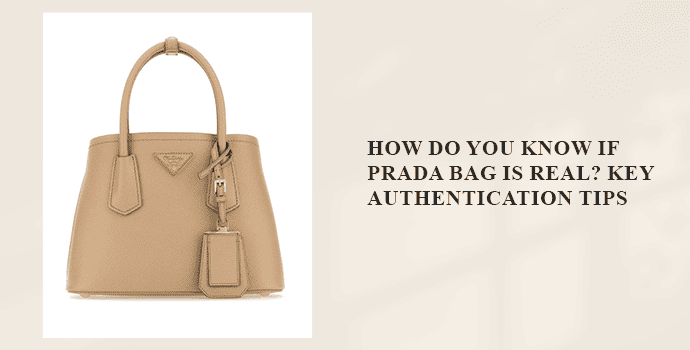
    How Do You Know If Prada Bag Is Real? Key Authentication Tips

    How Do You Know If Prada Bag Is Real- key authentication tips

    1. Check the Prada Logo Carefully

    1. Check the Prada Logo Carefully

    The logo is a key sign in finding out if a Prada bag is genuine. Real Prada bags have a neat, clear logo with equal space and typeface.

    The “R” in Prada is very special. It has a bit of a bendy leg, which are often wrongly copied in fake bags. Fake bags can have letters that don’t match right, space that is not correct or a font that looks kind of weird.

    The triangle Prada sign plate, which is usually seen on the front of a bag, must be just right lined up and tightly put on. The letters should be spaced out evenly and carved with care. On real bags, the color of the plate matches the metal parts, if it’s gold or silver.

    Inside a bag, you might usually see a Prada logo piece. This piece needs to match the outside parts in color and have good carving. The words must say “Prada Milano” with “Made in Italy” underneath it but if the bag is made in another allowed country, then it’s different.

    Fake bags often have bad carved logos, wrong fonts or strange spots. Looking closely at these things can help you tell if the bag is real.

    2. Examine the Stitching Quality 

    2. Examine the Stitching Quality

    Sewing is a big part in knowing if something is real. Prada is famous for its great skill and you can see this in the sewing of its bags.

    Real Prada bags have flat, straight and close stitches. The stitching must be the same all over the bag with no loose threads or odd designs. The thread color often matches the leather making a smooth and neat look. 

    On the other hand, fake Prada bags often have unbalanced sewing, loose strings or mismatched gaps. These mistakes may look small but they are clear signs of bad workmanship. Also, the sewing around handles, zippers and edges should be very tidy and strong. Prada makes sure that important spots are built well to make them last longer. 

    If you see any oddities in the sewing it’s a hint that the bag might not be real. Good quality sewing is a mark of true Prada skill.

    3. Inspect the Material and Leather 

    3. Inspect the Material and Leather

    One of the simple ways to tell how you can know if a Prad͏a bag is real, is by looking at the material. Prada uses fine materials like Saffiano leather, which is known for its strength and unique crosshatch feel. 

    Real Saffiano leather has a strong form and a soft shine. It feels fancy to the hand and keeps its look over time. The touch should be even all over the bag with no bumps. 

    Fake bags often use cheap stuff that can feel too soft, too hard or odd-looking. The touch might be rough and the bag may not have the nice finish of a real Prada leather.  

    Also, the sides of the bag should be tidy, painted and sealed. Real Prada bags have clear, smooth edges but fake ones might have rough or uneven finishings. 

    The inside of the bag is another key detail. Prada usually picks top-notch cloth lining with a special design that shows the Prada name. The design ought to be sharp and steady, not blurry or twisted. By looking at the stuff and leather, you can easily tell if a Prada bag is up to the brand’s high standards.

    4. Check the Hardware 

    4. Check the Hardware

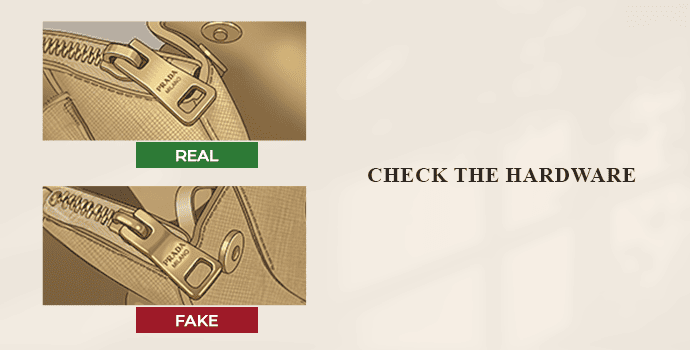
    Gear is a main part in spotting a real Prada bag. Real Prada bags have nice metal gear that feels strong and long-lasting.

    Zippers, clips and fasteners should move well without getting stuck. The parts should have a steady look if it’s gold, silver or some other color. It shouldn’t peel, lose color or feel too light. 

    Lots of Prada bags have pieces with the Prada name on them. The mark should be clear and neat, not soft or badly made. Fake bags can have fuzzy or lumpy marks. Another important detail is the zipper brand. Prada often u͏ses good zippers from known makers. If the zipper feels low-cost or weak it could be a sign of a fake bag. Looking at the tools can give good hints about if the bag is real.

    5. Verify the Authenticity Card and Packaging

    5. Verify the Authenticity Card and Packaging

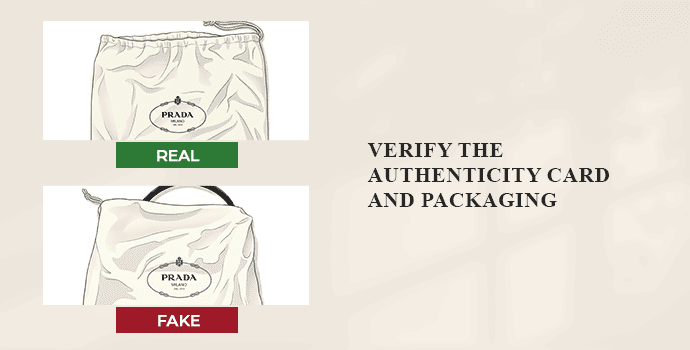
    Real Prada bags have an authentication card and nice packing. The card is often in a tiny envelope and has info like the bag’s type and number.

    The card must have neat print, right spelling and good paper. Fake cards often have fuzzy text, wrong info or low printing quality.

    The wrap, with the dust sack and case, should also show Prada’s high quality rules. The dust sack is mostly made of soft, good fabric with a clear Prada sign. But, it’s key to say that the box by itself is not a sign of real-ness. Fakers can copy these parts, so they must be thought about with other things.

    6. Look at the Serial Number and Interior Details 

    6. Look at the Serial Number and Interior Details

    Prada bags often have a serial number or id tag inside the bag. This number is usually found on a small white tag or pressed onto a leather tab.

    The series number must be clear and well formatted. While it might not always be unique, it should match with Prada’s make rules.

    The inside logo plate is another important part. It needs to go with the color of the metal and have clear carvings. The letters and space should be the same as the real Prada brand.

    Also, the inside cloth should be well sewn and without flaws. The Prada logo design on the cloth should be spread out evenly and easy to see. Looking at these inside features can give good proof of being real.

    Common Mistakes When Identifying Fake Prada Bags 

    Common Mistakes When Identifying Fake Prada Bags- how do you know if prada bag is real

    Lots of shoppers fall into the trap of counting on only one thing to check if something is real. But, spotting a fake Prada bag needs a full way to look at it. No one detail can prove it’s real by itself.

    One other easy mistake is to trust the price. While a very low price can be a warning sign, some fake bags are sold at high prices to look real. Always check the bag based on its quality instead of its cost.

    Buyers also often miss tiny things like sewing, metal parts or where the logo is. These small bits are where fake bags often fail. In the end, just using online pics can be risky. Photos can be changed or unclear, making it hard to judge a bag’s real quality. 

    When to Use Professional Authentication Services 

    When to Use Professional Authentication Services- how do you know if prada bag is real

    If you are not sure about a bag’s realness, it is always smart to look for a pro who can check it. These professionals have a lot of skill and know-how in finding true fancy things.

    Expert checkers look at all parts of the bag, from stuff and sewing to number tags and tools. They can offer a true review, giving you calmness.

    This is very key when getting expensive or used Prada bags. Paying a bit more for checking whether the bag is authentic or not can keep you safe from big money loss.

    One of the key ways to tell if a Prada bag is real or fake is by looking closely at its overall make and material quality. Real Prada bags are made from nice materials like high quality leather, Saffiano leather or strong nylon, which all have their own look and feel. The leather should feel rich, smooth and well-shaped— not too soft, plastic-y or uneven. Stitching is another big sign; true Prada bags have neat, even and tight stitching all over with no loose thread͏s or odd spacing. Watch for the bag’s balance too— real pieces are built to keep a steady shape and size. Bits like zippers, hooks and metal names should feel strong and heavy, never weak or cheap. The Prada name itself must be clearly carved or pressed in, with clear and sharp letters. Any sign of blur, smear or wrong font style is a big warning. All in all the look of a real Prada bag shows care and a promise to luxury something fake versions often do not copy well.

    One more main thing to check is the inside details and real signs that Prada puts in its bags. Many real Prada bags have a triangle logo plate inside, which looks like the outside logo in font and space. The inner lining often has the well-known Prada jacquard design, where the brand name is woven straight and clear all over the cloth. Also real Prada bags have a small white tag inside of the pocket with factory number printed on it. This number shows where it was made and usually isn’t there or looks bad in fake ones. The authenticity card is another point to look at, it should be in black envelope and have info like the bag’s model or purchase details. But, it’s key to see that real cards by themselves are not proof; they can be copied a lot. Boxes, dust bags and how it looks should also feel nice and match Prada’s brand style. By looking closely at these inside parts and checking details, you can greatly lower the risk of buying a fake Prada bag.

    Conclusion 

    Knowing how you can tell if a Prada bag is r͏eal is key for anyone buying fancy handbags and clothing. As fake ones get better, it’s now more important than ever to look closely at every part before you buy something. 

    True Prada bags are known for their good craft, high-quality stuff and care on little details. From the clear logo and tidy seams to the nice metal parts and stylish leather, each piece shows the brand’s vow to be best. Fake bags, no matter how real they look, often do not reach these rules well. 

    By using the sign in tips found in this guide you can lessen the chance of buying a fake Prada bag. Always check the sign, sewing, stuff, tools and inside parts well. Also think about where you buy it from and stay away from offers that look too great to be real.

    For more trust, expert checking services can give skilled proof, mainly when getting second-hand things. Doing these steps not only guards your money but also makes sure you like the real worth of having a true Prada bag. 

    Finally, a true Prada bag is more than just a style sign— it’s a mark of good making and lasting look. By learning how to see for realness, you can buy with surety and make smart choices that show your love for luxury 

    FAQs

    1. How do you know if a Prada bag is real quickly?

    Look at the logo, sewing and metal bits. Real Prada bags have clear logos, neat sewing and good metal parts. The leather should feel expensive and not flimsy. The lettering or branding should be even and consistent.

    2. Do all Prada bags come with an authenticity card?

    Many Prada bags have an authenticity card but its being there does not make sure it is real. Also not all bags might have it as it depends upon product to product and which retailer it is coming from.

    3. Can fake Prada bags look real?

    Yes, some fake bags can seem very real and that’s why careful checking is needed.

    4. Is it safe to buy pre-owned Prada bags?

    Yes but only if you check the truth by close look or by an expert, realness helps.


    Source link

    Max Mara Studio Vs Max Mara: Understand The Difference

    Max Mara Studio Vs Max Mara: Understand The Difference


    April 16, 2026


    Introduction 

    When it is about fancy clothes that show lasting grace, great fitting and fine style, Max Mara is one of the best names in the field. Known for its simple look and worth-it items, the brand has made a name for giving good quality fashion that goes beyond seasonal styles. But inside its wide range, there are many lines that fit different people and taste— two of the most often talked about being Max Mara and Max Mara Studio. If you have ever thought about Max Mara Studio vs Max Mara, you are not on your own.

    Getting the gap between these two lines is key, mainly if you want to put money into fancy clothes that fit with your style, money plan and way of living. Though both are from the same fashion brand and care about quality and good design they change a lot in price target group, design idea and general place in the luxury market.

    Max Mara shows the main identity of the brand— simple, elegant and very rich. In contrast, Max Mara Studio gives a bit easier and modern view on the brand’s usual style making it welcome to a wider crowd without losing on grace. 

    In this clear guide about Max Mara Studio and Max Mara, we will look at every part of these two brands from making and design style to cost and flexibility. If you are a regular buyer of fancy things or someone looking at fancy clothes for the first time this guide can help you pick a good option and find which brand suits your closet needs best.

    Brand Overview: The Legacy of Max Mara

    Brand Overview

    To get the whole picture of Max Mara Studio and Max Mara, it’s key to start with the story of Max Mara, a name that stands for lasting style, exact fitting and simple luxury. Started in 1951 in Italy, Max Mara changed women’s clothes by bringing ready-to-wear lines that mixed high-end skill with daily use. Back when made-to-order wear ruled the fancy market, the brand offered top-quality, finely fitted outfits for more people without losing any classiness.

    At the start, Max Mara set up a clear design style based on simple shapes, plain colors and strong forms. The brand got really well-known for its famous coats which are still seen as some of the best outerwear in the high-end market. These coats often made from nice materials like cashmere and wool show the brand’s promise to quality and long life. In͏stead of chasing quick trends Max Mara focused on making lasting clothes that stay useful year after year.

    Over the years, Max Mara has grown into a big name in fashion, bringing out many smaller brands for different groups of people and style likes. Every line, like Max Mara Studio, is made to show what the brand stands for while giving a fresh take on its look. This smart choice helps the brand attract both classic luxury buyers and newer fans who like modern styles. Grasping this history is key when looking at Max Mara Studio and Max Mara, since it shows how both lines are closely linked by a common idea of style and standard. Though they change in usage and place, they still show different forms of the same famous fashion past making Max Mara a brand that keeps on shaping modern luxury.

    What Is Max Mara?

    What Is Max Mara

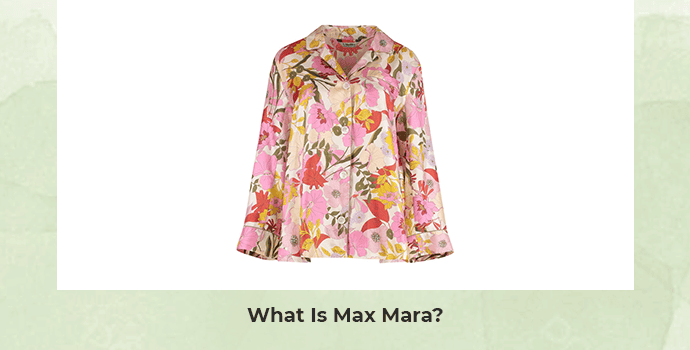
    Max Mara is the main and most important line of Max Mara fashion house, showing the brand’s true self and top level of luxury. Started as part of the first idea for the brand, Max Mara mainline is known for its classic designs, great craftsmanship and use of high-quality materials. It is a collection that really shows what the brand means— grace, style and lasting look. 

    The Max Mara main line mainly aims at making fine closet basics like nice coats, smart j͏ackets, pretty dresses and well-fitted pants. These items are made with care and focus on detail, giving a perfect fit and a neat look. One of the most famous items from this line is its selection of coats which has become known for luxury outerwear around the world. 

    What makes Max Mara special is its dedication to good stuff, not trends. Instead of chasing quick theme changes, the brand focuses on making items that stay important from season to season. Plain color combos; tidy shapes and simple forms lead the group making it good for people who like quiet fancy.

    In the case of Max Mara Studio and Max Mara, the main line is at the highest level in pricing and uniqueness. It is made for folks who see fashion as a long-lasting buy and care about clothes that have both strength and lasting style. Picking Max Mara me͏ans putting money into items that not only improve your closet but also last over time.

    What Is Max Mara Studio?

    What Is Max Mara Studio

    Max Mara Studio is an offshoot line that gives a newer and easier way to see the brand’s old style. While it still shows the grace and charm linked with Max Mara, it aims to attract a younger and trendier crowd.

    The studio line often uses trendy parts, softer shapes and more flexible designs. This makes it great for people who want to try out their style while still keeping a neat and elegant look.

    When we talk about prices, Max Mara Studio is cheaper than the main line which makes it a good starting place for luxury clothing. But this doesn’t mean you lose quality. The fabrics and work are still high standard, even if they might not be as fancy as what’s in the main line collection.

    When you look at Max Mara Studio and Max Mara, it is clear that the Studio is made for daily use and new ways of living. It gives a good mix of comfort and luxury.

    Key Differences: Max Mara Studio Vs Max Mara

    Key Differences

    When looking at Max Mara Studio and Max Mara, few main differences show up. These gaps help shape the name of each line and aid buyers in making a good choice.

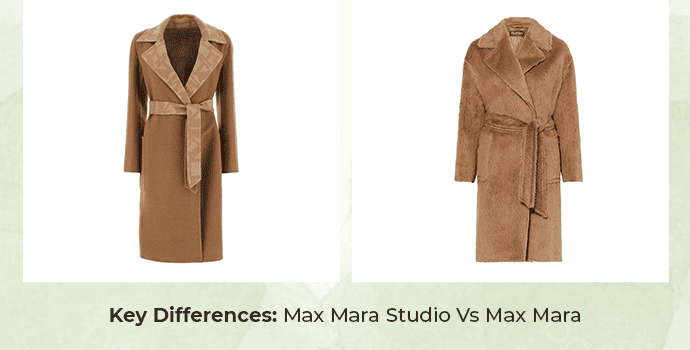
    First, cost is one of the biggest clear differences. Max Mara main line items are much pricier because they use better materials and fine work. On the other hand, Max Mara Studio has cheaper choices but still keeps a nice feel.

    Next, the way of designing is different between the two. Max Mara aims at timeless, classic shapes that hardly fade in style. Max Mara Studio, on another hand, includes more modern parts and current trends making it a bit more lively and ahead in fashion.

    One other key thing is the aim group. Max Mara serves people who like timeless, costly items, often working folks or those with a stylish look. Max Mara Studio attracts a younger crowd or those wanting fancy yet practical wear.

    Finally, the amount of uniqueness varies. The main line is often viewed as more fancy and special while Studio is more commonly reachable.

    Fabric and Craftsmanship Comparison

    Fabric and Craftsmanship Comparison

    A main part in knowing Max Mara Studio and Max Mara is the difference between cloth quality and skill, as these things change how fancy it feels to wear each line. Both sets show the brand’s promise to quality but they are not the same in material uniqueness, building methods and finishing touches.

    Max Mara mainline is famous for its use of very high-quality fabrics like soft cashmere, new wool, camel hair and silk mixes. These materials often come from top cloth mills in Italy, mostly in places known for fancy fabric making. The aim is to get a great mix of softness, strength and shape which makes Max Mara coats and fitted items seen as lasting purchases. The craftwork is also fine with careful cutting, strong building and close focus on small details. From hand-finish seams to well-made shapes every piece is made to give a perfect fit and lasting quality.

    Max Mara Studio, though keeping a good standard, takes a bit easier. The clothes used are nice but may mix more or use less special stuff than the main line. Even so, Studio items are still made with care for quality and are often done in Italy, which keeps a steady level of craft across styles. The build is usually lighter and not so stiff, thinking more about comfort and how easy it is to wear instead of very strict tailoring. 

    One key difference is in the amount of detail. Max Mara mainline clothes often have fancy finishes, better linings and more tricky building methods. On the other hand, Max Mara Studio focuses on being practical and flexible which leads to a bit simpler finishes that help its ͏lower price. In the end, both lines give great quality but Max Mara shows off luxury at its top level, while Max Mara Studio gives fine work with a more useful and easy edge.

    Design Aesthetic and Versatility

    Design Aesthetic and Versatility

    When looking at Max Mara Studio and Max Mara, one of the biggest differences is in their style and how well they can be worn. Both lines have the brand’s main qualities of grace and polish, but they show it in a little bit different ways to fit different fashion likes and ways of living. 

    Max Mara’s main line is based in timeless, simple design. It looks at clear lines, firm shapes and a plain color scheme that seldom goes out of fashion. The style is often called “trend-less luxury,” pointing to things that can stay important for many years instead of just seasons. This is why famous things like tailored coats, blazers and trousers from the main line are seen as wardrobe investments. Their flexibility lies in their skill to move easily between events from formal business places to fancy evening wear without ever feeling old fashioned. 

    On the other hand, Max Mara Studio gives a newer and a bit bolder take on the same look. Even with its style, Studio sets bring softer shapes, gentle designs and new details that feel more fresh and flexible. You are likely to see womanly styles, light patterns and easy fit that work well for jobs and casual times. This makes Studio items very nice for those who like smart looks with a touch of trendy style.

    Flexibility also changes based on use. Max Mara main items are very flexible for a long time, as they can be put together many times over years in various ways. On the flip side, Max Mara Studio does great in everyday flexibility, giving pieces that fit well into a busy, modern closet. 

    In the end, Max Mara tends to show lasting class but Max Mara Studio offers easy style. Together, they stand for two ways of the same thing- one classic and known, the other modern and simple to wear.

    Which One Should You Choose?

    Which One Should You Choose

    When you choose between Max Mara Studio or Max Mara, the best choice really depends on your own style, daily needs and how you see fashion; if it’s something to invest in or nice to enjoy every day. Both lines come from the same well-known brand but are made for different reasons, making your choice less about which is “better” and more about which is “better for you.”

    If you like classic style, great fitting and clothes that last a long time, Max Mara mainline is a good pick. This group shows what the brand is all about, famous for its rich fabrics like cashmere and wool and items made to stick around for many years. These are outfits you buy with a plan of using them in different seasons and events making them ideal for workers, fancy places or anyone putting together a nice wardrobe.

    On the other hand, Max Mara Studio is a better fit for people who want a more current, flexible and somewhat cheaper way to enjoy fancy clothes. As a branch line, Studio gives new takes on old styles with prices usually lower than the main line but still keeps good quality. This makes it good for everyday wear, work clothes and people who enjoy testing styles while staying neat. Another thing to think about is how often you plan to use the clothing. If you want bold coats or main things that show your style, spending on Max Mara main line makes sense. But if you need many nice choices that can change in your daily looks, Studio gives better use and worth. 

    In the end, the smartest way for many style lovers is a mix of both— putting money into fam͏ous Max Mara items while adding them with useful Max Mara Studio stuff for regular wear.  

    Pricing and Value Proposition 

    Pricing and Value Proposition

    When looking at Max Mara Studio and Max Mara, cost is an important part of seeing what they offer. Max Mara’s main line has a higher price because it uses better fabrics, finer sewing and classic style that lasts. These items are made to be worn for a long time, giving good value. On the other hand, Max Mara Studio gives easier access to luxury with prices that are a bit lower but still keep quality and style. It is great for people who want nice and flexible clothes without spending too much money. In the end, both brands give worth in different ways, one by lasting a long time and being well-known, the other by being cheap and useful for today. 

    Conclusion 

    The look at Max Mara Studio and Max Mara shows how one fancy clothing brand can serve different crowds while keeping a steady name. Both lines show the class, style and good quality that Max Mara is famous for but they have clear roles in the fashion world.

    Max Mara mainline is the best of fancy, making ageless stuff from top materials with much care. These outfits are made to be long-lasting buys, ideal for folks who treasure good quality and classic look more than short trends. Having a piece from the mainline isn’t just about style, it’s about taking on a history of skill and elegance.

    Max Mara Studio, on the other hand, gives an easier way into the world of fancy clothes. With its new styles and little more easygoing approach, it serves today’s lives and changing fashion preferences. It lets people try out style while still having the class linked with the brand.

    In the end, the pick between Max Mara Studio and Max Mara is about your own needs and what you care for. Whether you choose the classic look of the main line or the modern style of Studio, both lines give great quality and design.

    By know͏ing the changes between these two groups, you can make a smarter choice and create a closet that shows your own style while taking in the grace of Max Mara.

    FAQs

    Q1. Is Max Mara Studio considered luxury?

    Yes, Max Mara Studio is thought of as a fancy line even if it’s a bit less than the main Max Mara group in terms of rarity and cost. It is part of the larger Max Mara clothing house which is known worldwide for fine work and lasting style.

    Q2. Why is Max Mara more expensive than Max Mara Studio?

    The big cost of Max Mara main line items is mostly because of the better quality of stuff, skilled work and the amount of specialness linked with the collection. The main line often uses fancy fabrics like real cashmere, good wool and silk mixes which raise making costs a lot. Also, the clothes are put together using more detailed sewing methods to make sure they fit well and last long.

    Q3. Are Max Mara Studio pieces good quality?

    Max Mara Studio items are known for their great quality and care to detail, especially when matched with other labels in a similar price range. Though they might not hit the same level of polish as the main Max Mara line, they still keep the brand’s rules of s͏kill and style.

    Q4. Can Max Mara Studio be worn for formal occasions?

    Yes, lots of Max Mara Studio items are flexible enough to be used for fancy and half-fancy events. The line has fitted dresses, nice jackets and polished pieces that can simply be made fancier with the right add-ons.

    Q5. Which line is better for everyday wear?

    Max Mara Studio is generally considered the better option for everyday wear due to its practical designs, contemporary styles and more accessible pricing. The pieces are created with modern lifestyles in mind, offering comfort, versatility and ease of styling.


    Source link

    Nokia and Cinia partner to secure Finland’s critical infrastructure with advanced DDoS protection | Web3Wire

    0
    Nokia and Cinia partner to secure Finland’s critical infrastructure with advanced DDoS protection | Web3Wire


    Nokia and Cinia partner to secure Finland’s critical infrastructure with advanced DDoS protection

    Cinia deploying Nokia advanced Distributed Denial of Service (DDoS) protection solution to safeguard critical networks against evolving cyber threats.Solution’s real-time threat identification aligns with Cinia’s responsibility to maintain resilient infrastructure that underpins Finland’s digital economy.

    16 April 2026 

    Espoo, Finland – Nokia today announced it is partnering with Cinia, a leading Finnish provider of critical connectivity and cybersecurity services, to deliver an advanced Distributed Denial of Service (DDoS) protection solution. This collaboration establishes a new managed security service provider (MSSP) model, specifically designed to safeguard critical infrastructure networks against modern, complex cyberattacks, ensuring the resilience and continuity of essential services. Through this MSSP model, Cinia will offer customers a fully managed 24/7 DDoS protection service that leverages network-embedded detection and mitigation capabilities developed by Nokia.

    As an operator of critical digital infrastructure in Finland, including international submarine cable systems, Cinia requires robust protection against evolving cyber threats. Nokia Deepfield Defender delivers AI-based, network-embedded DDoS detection and mitigation, enabling Cinia to safeguard essential connectivity services for Finnish customers and maintain resilient infrastructure that underpins Finland’s digital economy.

    Joint development of the solution enables highly effective detection, mitigation, and protection against DDoS attacks. The solution will provide customers with comprehensive, up-to-date defense against the latest generation of DDoS threats, ensuring business continuity and service uptime. The joint expertise of Nokia and Cinia provides a guarantee of improved network security and reliability in a constantly changing threat landscape, with a solution that offers real-time contextual awareness and network-wide protection against a wide range of threats, including botnet DDoS attacks, combined with Cinia’s deep understanding of critical infrastructure requirements.

    “Our cooperation with Nokia enables us to offer the most advanced DDoS protection capabilities on the market to our customers. By leveraging Cinia’s Network Operation Center (NOC) and Security Operations Center (SOC) services and experience in 24/7 monitoring of critical environments, together with Nokia’s cutting-edge technologies, we ensure that our customers’ networks and internet-facing services remain secure and reliable even as the threat landscape evolves. This partnership allows us to bring truly market-leading protection and operational visibility to Finnish customers,” said Jukka-Pekka Lithovius, Development Director at Cinia.

    “Working with Cinia underscores Nokia’s commitment to securing critical infrastructures globally and locally. By integrating our Deepfield and IP routing solutions with Cinia’s managed services, we are enabling powerful protection against cyber threats. This collaboration ensures that vital mission-critical networks remain operational and secure, contributing to the stability and trust, which are essential for a connected society,” said Jeff Smith, Vice President and General Manager of Nokia Deepfield.

    The Deepfield solution provides Cinia with detailed visibility into its network infrastructure through advanced correlation and analysis of IP network and flow telemetry. The network-wide insight, which is correlated with a broader internet context obtained through Deepfield Genome, supports Cinia’s operational requirements for managing complex connectivity. Enhanced visibility enables faster anomaly identification and more informed capacity-planning decisions.

    This collaboration highlights Nokia’s strategic focus on strengthening cybersecurity for critical national assets and demonstrates Cinia’s enhanced capability to deliver market-leading security services, backed by a trusted layer of local support and consultancy.

    Multimedia, technical information and related news

    Webpage: Deepfield | NokiaWebpage: Deepfield Defender | Advanced DDoS Security by Nokia

    About Nokia 

    Nokia is a global leader in connectivity for the AI era. With expertise across fixed, mobile, and transport networks, we’re advancing connectivity to secure a brighter world.

    About Cinia 

    Cinia is a Finnish expert in cybersecurity of digital operating environments and a specialist in critical high-reliability connections and software. We deliver comprehensive solutions in which information security, continuity and technical expertise support each other, from devices to applications, connections and users.

    Media Inquiries Nokia Press Office Email: Press.Services@nokia.com Follow us on social media LinkedIn X Instagram Facebook YouTube  

    Cinia CommunicationsEmail: communications@cinia.fiFollow us on social mediaLinkedIn Facebook

    About Web3Wire Web3Wire – Information, news, press releases, events and research articles about Web3, Metaverse, Blockchain, Artificial Intelligence, Cryptocurrencies, Decentralized Finance, NFTs and Gaming. Visit Web3Wire for Web3 News and Events, Block3Wire for the latest Blockchain news and Meta3Wire to stay updated with Metaverse News.


    Source link

    RWA Leaderboard 2026: Circle vs BlackRock in the $13.5B Tokenized Treasury Market | NFT News Today

    RWA Leaderboard 2026: Circle vs BlackRock in the .5B Tokenized Treasury Market | NFT News Today


    Something significant happened in Q1 2026 that most mainstream financial outlets barely covered. For the first time, tokenized U.S. Treasuries grew faster than stablecoins in absolute dollar terms.

    That’s not a footnote. It’s a signal.

    According to RWA.xyz, the tokenized treasury market now stands at $13.53 billion as of April 12, 2026. Eighteen months ago, that figure sat closer to $270 million. That’s roughly 50x growth since the start of 2024, and it wasn’t driven by retail speculation. This expansion has been led by institutions, corporate treasuries, and asset managers who have quietly concluded that on-chain finance is now operational infrastructure, not a pilot program.

    What analysts are calling the “flight to safety” into on-chain cash management has concentrated capital around a small group of high-quality products. And at the center of it all is a battle between two giants: Circle and BlackRock, each staking a claim to the top of the RWA leaderboard with competing visions of what tokenized money should look like.

    Understanding the Tokenized Asset Landscape

    What Are Real World Assets (RWAs) in Crypto?

    Real World Assets (RWAs) are traditional financial instruments represented as tokens on a blockchain. The category is broad: government bonds, corporate debt, real estate, commodities, private credit. But through 2025 and into 2026, one segment has dominated the conversation: tokenized U.S. Treasuries.

    Here’s the basic comparison. A stablecoin like USDC holds $1 of value but earns no yield. A tokenized Treasury fund holds that same $1, puts it to work in short-duration government debt, and passes the yield back to the holder — all on-chain, 24/7, with near-instant settlement. For a corporate treasury managing hundreds of millions in digital assets, the gap between those two options is no longer easy to justify. If you want a broader primer on how blockchain tokenization works, we’ve covered the mechanics in depth separately.

    Why Tokenized Treasuries Are Growing So Fast

    Three factors are driving adoption right now, and each one reinforces the others.

    The first is the yield gap. On-chain capital parked in stablecoins earns nothing. Tokenized Treasuries offer government-backed returns, currently in the 4–5% range, with the same on-chain composability institutions already rely on. For large organizations managing significant digital asset balances, that difference is material.

    The second driver is regulatory clarity. The legal framework around tokenized securities has matured considerably across the U.S., European Union, and key offshore jurisdictions. The gray areas that discouraged institutional participation two years ago have, in most major markets, been largely addressed.

    Third, and often underappreciated, is T+0 settlement. Traditional Treasury and repo markets settle on T+1 or T+2 timelines, meaning capital sits idle for 24 to 48 hours after a trade executes. On-chain settlement is instant. For institutions running active repo operations, that capital efficiency alone makes a compelling case for migration.

    Top Tokenized Treasury Funds by AUM (April 2026)

    Here’s where the market stands. Five funds account for the majority of the $13.53 billion in tokenized Treasury assets. For a deeper look at the full protocol landscape, see our 2026 RWA protocol snapshot.

    USYC

    Circle

    $2.67B

    Non-U.S. Investors

    Bermuda domicile; USDC ecosystem integration

    BUIDL

    BlackRock

    $2.42B

    U.S. Qualified Purchasers

    $5M minimum; compliance-first via Securitize

    USDY

    Ondo Finance

    $1.88B

    Retail-adjacent

    16,500+ holders; widest distribution

    Anemoy

    Janus Henderson

    $1.32B

    Corporate Treasuries

    AA+ S&P credit rating

    BENJI

    Franklin Templeton

    $1.02B

    Mid-market

    $20 minimum investment

    1. Circle — USYC ($2.67B AUM)

    Circle’s USYC claimed the number one position in March 2026, and the reasoning behind its ascent is straightforward once you understand the product’s structure.

    USYC is domiciled in Bermuda and issued by Circle International Bermuda Limited, regulated by the Bermuda Monetary Authority — which makes it accessible to non-U.S. investors. That’s a significant structural advantage when most competitors are restricted to qualified U.S. purchasers. More importantly, USYC plugs directly into the USDC ecosystem. Capital moves seamlessly between the stablecoin and the yield-bearing asset. There’s no separate onboarding process, no additional custody setup, no workflow disruption.

    For DeFi protocols, trading desks, and global fintech companies that already operate within the USDC infrastructure, USYC is the natural next step for idle treasury assets. The friction is close to zero. CoinDesk reported in March 2026 that a significant portion of USYC’s recent growth was driven by its adoption as collateral on BNB Chain through Binance’s institutional platform — a sign of just how embedded the product has become in major exchange infrastructure.

    2. BlackRock — BUIDL ($2.42B AUM)

    BUIDL sits at number two, but that ranking needs context.

    When BlackRock launched BUIDL in March 2024 — its first tokenized fund issued on a public blockchain — it captured roughly 46% of the entire tokenized Treasury market. That share has since compressed to around 18%, according to Messari, which is a sign of market health rather than BlackRock weakness. New capital entering the space has diversified across multiple products, and BUIDL’s proportional share has contracted even as its absolute AUM has grown.

    BUIDL carries a $5 million minimum investment and is managed through Securitize, one of the most compliance-forward digital asset platforms operating today. This is a product built for endowments, sovereign wealth funds, and large asset managers who require full regulatory documentation at every stage. The compliance overhead that limits BUIDL’s accessible market is also precisely what makes it the most trusted product in the category.

    3. Ondo Finance — USDY ($1.88B AUM)

    Ondo Finance’s USDY has taken a different approach. Rather than chasing AUM from a handful of large allocators, the team optimized for distribution. USDY now counts over 16,500 individual holders — far more than any competitor — making it the primary bridge between institutional-grade yield and a broader, retail-adjacent audience.

    That distribution model has its own compounding advantages. A wider holder base creates deeper secondary liquidity and more extensive integrations across DeFi protocols.

    4. Janus Henderson — Anemoy ($1.32B AUM)

    Anemoy holds something genuinely rare in the tokenized asset space: an AA+ credit rating from S&P. That single credential opens doors most tokenized funds can’t access.

    Corporate treasury departments managing cash for large public companies operate under strict investment policy statements. Many of those policies require rated instruments. Anemoy is one of very few tokenized products that can sit inside those mandates without requiring a policy exception — which means it can reach institutional capital that most RWA products simply cannot.

    5. Franklin Templeton — BENJI ($1.02B AUM)

    Franklin Templeton’s BENJI crossed the $1 billion threshold by prioritizing accessibility. The minimum investment is just $20, several orders of magnitude below BUIDL, and below most traditional money market funds as well. Launched in 2021 as the world’s first U.S.-registered mutual fund to use a public blockchain for transaction recordkeeping, BENJI has steadily built a presence across multiple networks including Stellar, Ethereum, Solana, and more.

    BENJI isn’t competing with BlackRock for sovereign wealth fund allocations. It’s targeting the mid-market: smaller family offices, fintech integrations, and institutional clients who want exposure but don’t write eight-figure checks.

    Market Analysis: Why Circle Overtook BlackRock

    The “Stablecoin Plumbing” Advantage

    Circle’s path to number one came down to composability — the ability for financial products to interact with each other without friction.

    USDC is already the operational backbone of a significant portion of DeFi activity. Exchanges, lending protocols, payments infrastructure, much of it runs on USDC. When Circle introduced USYC as a yield-bearing layer sitting natively within that ecosystem, it didn’t need to convince anyone to change their workflows. The capital was already there. It just needed a better place to sit. As Circle’s own documentation notes, USYC paired with USDC resolves a longstanding tension: liquidity has traditionally come at the expense of yield. USYC resolves that trade-off without adding operational complexity.

    BlackRock doesn’t have that kind of embedded financial infrastructure. BUIDL requires a separate onboarding process, compliance review, and operational setup. For traditional institutions, that’s familiar territory. For crypto-native firms, it’s friction they’d prefer to avoid.

    BlackRock’s Tradeoff: Trust vs. Accessibility

    It would be a mistake to interpret BlackRock’s position as anything resembling a setback.

    BUIDL’s compliance framework, the very feature that limits its addressable market, is a deliberate design choice, and it’s what the product’s target clients actually need. Pension funds and large asset managers don’t need easy. They need defensible. They need documentation, regulated custodians, and clear legal enforceability. BUIDL delivers all of that.

    The two products are, in many ways, optimized for entirely different customers. Circle is winning on velocity. BlackRock is winning on institutional credibility. Both are growing.

    Beyond Treasuries: The Rise of Hard-Asset Tokenization

    Datavault AI’s $750M Bet on Commodities

    While the Treasury market captures most of the attention, a parallel story is developing in commodity tokenisation, and one company in particular is moving fast. As we’ve covered in our overview of RWA trends in 2025, the shift toward tangible, yield-bearing assets on-chain has been one of the defining moves of this cycle.

    Datavault AI (NASDAQ: DVLT) announced in early April 2026 that it had signed $750 million in tokenization contracts during Q1. Those contracts generated $77 million in fees from minting, intellectual property licensing, and banking services. These aren’t proof-of-concept programs. This is live revenue from a live business, and it supports the company’s stated full-year 2026 revenue guidance of at least $200 million.

    Why Copper & Gold Tokenization Matters

    The bulk of Datavault AI’s Q1 contracts focused on copper and gold mining companies. The mechanics are straightforward, but the implications are significant.

    Mining companies have historically raised capital through equity offerings or debt, both of which carry real costs. Equity dilutes existing shareholders; debt adds leverage and interest obligations. Tokenization offers a third option: representing future production or proven reserves as on-chain assets that investors can purchase directly. The mining company gets capital without dilution. The investor gets direct exposure to commodity production, with transparent on-chain data rather than opaque reporting.

    This model is particularly relevant for mid-tier mining operations with solid reserves but limited access to traditional capital markets. Tokenization effectively globalizes their investor base without the overhead of a traditional securities offering.

    Infrastructure Play — Tokenized Commodity Exchanges

    Datavault AI is currently relaunching four specialized exchanges — including the International Elements Exchange, to support secondary trading of these tokenized commodity assets. The platforms incorporate AI-driven valuation tools built to price assets using real-time reserve data, production forecasts, and commodity spot prices.

    Transparent, liquid, on-chain trading of hard assets has historically been one of the most opaque corners of global finance. Whether Datavault AI captures that market or simply opens the door for others, the structural direction is clear.

    Key Trends Driving the RWA Market in 2026

    1. The Yield Gap Is Closing — And That Changes Everything

    Plain stablecoins are losing their appeal as passive holdings. Why accept zero yield on idle USDC when tokenized Treasuries offer government-backed returns with the same on-chain utility? More DeFi protocols and crypto-native businesses are now treating tokenized Treasuries as default collateral rather than a niche product. That shift, once it reaches a tipping point, will likely be permanent. The rise of RWA NFTs through 2025 was an early indicator of this institutional appetite for yield-bearing, on-chain instruments.

    2. Ethereum Remains the Primary Settlement Layer

    Despite the proliferation of alternative L1s and L2 networks, the vast majority of RWA assets by value continue to settle on Ethereum. According to RWA.xyz network data, Ethereum hosts the clear majority of distributed tokenized asset value. The logic is consistent: institutional participants require deep liquidity and a proven security track record. Until an alternative network can credibly match those properties at comparable volume, institutional RWA activity will remain anchored there.

    3. T+0 Settlement Is the Real Disruption

    This point deserves more attention than it typically receives. The ability to settle a Treasury or repo trade instantly — rather than waiting for traditional systems to clear over 48 hours — is a genuine operational advantage. Capital that would otherwise sit in settlement limbo can be redeployed immediately. For large institutions running high-frequency Treasury operations, this is a quantifiable efficiency gain, not just a nice-to-have.

    4. The $12.6 Trillion Repo Market Migration

    The next frontier for on-chain finance is the repo market. Global repo activity runs at roughly $12.6 trillion. Early-stage experiments suggest that tokenized infrastructure can support repo operations more efficiently than legacy systems — with real-time collateral management and instant settlement replacing the cumbersome processes of traditional counterparty clearing. The migration is quiet and largely happening below the headline level, but the institutional rails are being built. This is probably the most consequential structural development happening in the space right now.

    Competitive Outlook: Who Wins the RWA Race?

    Bull Case for Circle

    Circle’s advantage compounds with scale. Every new protocol that integrates USDC is a potential distribution channel for USYC. The network effects are real, and the capital velocity argument — moving quickly between yield and liquidity without friction — only strengthens as DeFi activity grows. Circle already has the pipes. It just keeps adding more reasons to use them.

    Bull Case for BlackRock

    Regulatory trust isn’t built quickly, and it isn’t easily replicated. BlackRock has spent decades cultivating relationships with the world’s largest pools of institutional capital. BUIDL is, in many respects, the only tokenized product that large traditional institutions can hold without extensive internal policy debates. That structural advantage is a formidable one.

    Emerging Threats

    The middle tier of this market deserves attention. Ondo’s distribution strategy, Janus Henderson’s credit rating, and Franklin Templeton’s accessibility focus each represent differentiated approaches that capture specific segments Circle and BlackRock aren’t optimizing for. And Datavault AI’s commodity angle opens an entirely separate market — one that’s effectively uncorrelated with the Treasury race.

    Key Risks in Tokenized RWAs

    No honest analysis of this market omits the risks. There are real ones.

    Regulatory fragmentation remains the most immediate concern. The U.S., EU, and Asian jurisdictions are each developing independent frameworks for tokenized securities. A product compliant in one jurisdiction may face material restrictions in another, creating operational challenges for platforms with global ambitions.

    Smart contract risk is inherent in any on-chain financial product. The code managing billions in Treasury assets has been audited extensively, but audits are not guarantees. A critical vulnerability in a widely-used contract could have systemic consequences for the broader market.

    Liquidity concentration is another factor worth monitoring. The market remains dominated by a small number of products. If a major fund faces significant redemption pressure, secondary market liquidity could prove shallower than participants currently expect.

    Counterparty & Custody Concerns

    Tokenized assets derive their value from off-chain collateral. That creates a fundamental dependency: the token is only as valuable as the legal enforceability of the underlying claim and the integrity of the custodian holding the physical assets. These mechanisms are improving, but investors should understand that the on-chain token and the off-chain asset remain legally distinct things — and that distinction matters in a stress scenario.

    Conclusion: The Institutional Phase of Crypto Has Arrived

    The $13.53 billion tokenized Treasury market isn’t a speculative bubble waiting to deflate. It’s the product of institutional capital making a rational decision: on-chain infrastructure now offers yield, liquidity, and settlement efficiency that legacy systems cannot match at scale.

    Circle and BlackRock are currently the two dominant forces, but in many ways they aren’t competing with each other at all — they’re serving different segments of the same broad institutional market. The more interesting competition may come from below: from Ondo’s distribution network, from Janus Henderson’s credit-rated product, and from entirely new categories like Datavault AI’s push into commodity tokenization.

    The $12.6 trillion repo market sitting at the edge of this infrastructure is the number to watch. When that migration begins in earnest — and the early signals suggest it has already started — the current leaderboard will look like the beginning of a much larger story.

    Frequently Asked Questions

    Here are some frequently asked questions about this topic:

    What is an RWA in crypto?

    RWA stands for Real World Asset. In the context of crypto, it refers to traditional financial instruments — such as government bonds, real estate, or commodities — represented as tokens on a blockchain. This allows them to be traded, held, and used as collateral in on-chain financial systems. For a full breakdown of the current RWA protocol landscape, see our 2026 RWA protocols guide.

    What are tokenized treasuries?

    Tokenized treasuries are blockchain-based tokens representing ownership in funds that hold U.S. government bonds. They allow holders to earn government-backed yields while keeping assets on-chain and accessible around the clock — unlike traditional Treasury products that are subject to standard market hours and settlement delays. Live market data is tracked by RWA.xyz.

    Is BlackRock BUIDL available to retail investors?

    No. BlackRock’s BUIDL fund carries a $5 million minimum investment and is restricted to U.S. qualified purchasers, placing it firmly in the institutional category. Retail investors looking for similar exposure may find Ondo Finance’s USDY or Franklin Templeton’s BENJI more accessible entry points.

    Why are institutions moving to on-chain assets?

    The primary drivers are yield (tokenized Treasuries earn returns that idle stablecoins don’t), T+0 settlement (instant settlement versus 48-hour traditional delays), and capital efficiency (assets can function as live collateral in DeFi protocols without being locked up). Taken together, these advantages are difficult for large institutions to ignore.

    What blockchain is used for RWAs?

    Ethereum remains the dominant settlement layer for institutional RWA products, accounting for the majority of tokenized Treasury assets by value. Its deep liquidity, long security track record, and broad developer ecosystem make it the preferred foundation for institutions that require operational certainty. You can explore network-level breakdowns in real time at RWA.xyz.



    Source link

    Popular Posts

    My Favorites

    Where to Find & Catch Cave Piksii in Palia

    Palia offers various types of Bugs that players can catch while doing the Bug Catching Guild. Catching all rarities of bugs is the...