Home Blog Page 25

PENGU Is Up 8% While Pudgy Penguins NFT Floor Is Flat – What the Divergence Tells Collectors – NFT Plazas

0
PENGU Is Up 8% While Pudgy Penguins NFT Floor Is Flat – What the Divergence Tells Collectors – NFT Plazas


Something unusual is happening in the Pudgy Penguins ecosystem. The project’s native token, PENGU, has surged roughly 8% in the past 24 hours – but if you checked the NFT floor price on OpenSea, you’d barely notice a ripple. That divergence between the token and the underlying NFT collection isn’t noise. It’s a signal, and it tells collectors something important about how the market values this project in 2026.

The Numbers at a Glance

The live PENGU price is approximately $0.008203, with a 24-hour trading volume of $144 million. The token is up around 8% in the last 24 hours, with a current market cap over $515 million. According to the screenshot data visible on CoinGecko-powered trackers, the token is now ranked #80 by market cap, and carries a fully diluted valuation (FDV) of approximately $729 million.

Meanwhile, the Pudgy Penguins NFT collection, an 8,888-piece set on Ethereum, has seen its floor price hold relatively flat over the same period, showing none of the same momentum. That split is worth examining closely.

PENGU 24H price chart on 22/4/2026 (Source: CoinMarketCap)

PENGU 24H price chart on 22/4/2026 (Source: CoinMarketCap)

Why Is PENGU Moving Without the NFTs?

The key insight is structural. PENGU now functions less as a derivative of NFT sentiment and more as an independent liquid asset with its own demand drivers – many of them rooted in real-world ecosystem expansion.

Recent ecosystem developments include a partnership with asset manager VanEck for NFC-chip-enabled hybrid collectibles and the launch of the Pengu Card, a Visa-backed crypto debit card, both announced in April 2026. These are not vague roadmap promises – they are live or near-live products that give PENGU holders a tangible utility story that NFT collectors, largely sitting on illiquid assets, don’t benefit from directly.

Pudgy Penguins also launched Pudgy World, a browser-based game, and expanded to Amazon, broadening the digital experience to a major retail platform for wider user access. The token is integrated into in-game transactions within Pudgy World, creating a use case that doesn’t require owning a $40,000+ NFT.

This is the “reverse funnel” effect playing out in real time: traditional crypto projects build tokens first and try to manufacture community; Pudgy Penguins built the community first – through NFTs, physical merchandise, and cultural reach – and then introduced PENGU as the ecosystem’s liquid layer. The community already existed. Now the token is monetizing it.

Why is PENGU moving without the NFTs?Why is PENGU moving without the NFTs?

Why is PENGU moving without the NFTs?

The Volume Story Supports Organic Demand

Skeptics of any altcoin rally should always check the volume-to-market-cap ratio. Trading volume over the past 24 hours reached approximately $144 million against a market cap of roughly $515 million, putting the ratio near 28%. That sits well above the 15–20% threshold analysts commonly use to distinguish genuine buying interest from wash trading or artificial price inflation.

Altcoin Sherpa, a widely-followed market analyst, noted on April 20 that PENGU has spent about 2.5 months in a descending wedge range, with one-day EMAs flattening out and the market structure “starting to look much healthier,” adding that the token could “move hard” once conditions align,  though it still needs a supportive Bitcoin environment.

On the chart, the RSI sits at approximately 63, technically elevated but not yet in overbought territory. The MACD is in a bullish configuration, suggesting the current momentum has room to continue in the near term before hitting resistance.

The volume story supports organic demandThe volume story supports organic demand

The volume story supports organic demand

What Collectors Should Understand About the Divergence

For NFT holders, the divergence can feel disorienting, and even slightly unfair. The token rallies while the floor stays flat, meaning liquid PENGU holders capture gains that illiquid NFT collectors miss. But this dynamic reflects a structural maturation in how markets price multi-asset crypto ecosystems.

Analysts note that if PENGU is rising, NFT floor prices for the collection usually follow, but the relationship is loose, not tight. Monitoring NFT floor prices on OpenSea alongside the PENGU token price is considered essential for anyone holding a position in either asset.

The NFT collection’s relative flatness right now may also reflect the broader state of the Ethereum NFT market, which has been quieter than the Solana-based token market in early 2026. PENGU, issued on Solana, has benefited from Solana’s more active trading environment and liquidity infrastructure, giving the token its own market microstructure that can diverge from what happens on Ethereum’s NFT layer.

Institutional Interest Is Building – But Slowly

One of the most meaningful developments underpinning PENGU’s longer-term narrative is the presence of institutional-grade filings. Canary Capital filed for a PENGU ETF in March 2025, which, if approved, would be the first US exchange-traded fund to include both PENGU tokens and Pudgy Penguins NFTs. The ETF received SEC acknowledgement in July 2025, marking one of the first steps toward institutional access to an NFT-native brand. Approval remains pending and faces a high regulatory bar, but the filing itself signals that serious capital allocators are watching.

In June 2025, CEO Luca Netz rang the Nasdaq opening bell alongside VanEck, a symbolic entry into traditional finance and mainstream institutional recognition. For a project that began as a collection of cartoon penguins on Ethereum, that is a remarkable trajectory.

Not just ringing the bell, but opening the mainstream financial door through VanEck and ETFs.Not just ringing the bell, but opening the mainstream financial door through VanEck and ETFs.

Not just ringing the bell, but opening the mainstream financial door through VanEck and ETFs.

The Risk Collectors Shouldn’t Ignore

None of this is risk-free. The token’s tokenomics include a fully diluted valuation that represents a significant premium over realized market cap, indicating substantial token unlock events ahead, with allocations to the team and company subject to vesting schedules extending through mid-2027. Historical precedent suggests these unlocks can create selling pressure in the weeks surrounding vesting milestones.

The SEC has so far classified pure meme coins as non-securities, but PENGU is more complex given the centralized commercial activities of the Pudgy Penguins team – meaning future regulatory shifts remain a variable to watch.

Bottom Line

The divergence between PENGU’s 8% rally and a flat NFT floor isn’t a contradiction – it’s a maturation signal. The token has developed an independent identity backed by real products, institutional filings, and a cultural brand with over 100 billion cumulative social views. For collectors, the takeaway is clear: holding the NFT and holding the token are no longer the same bet. In 2026, they track different things, respond to different catalysts, and carry different risk profiles. Understanding that distinction may be the most important thing a Pudgy Penguins participant can do right now.


Source link

Introducing: The Boat Shoe with August Special

Introducing: The Boat Shoe with August Special


Introducing: The Boat Shoe with August Special

Wednesday, April 22nd 2026

Share

Subscribe
23 Comments
||- Begin Content -||

The shoe will be available to try on in all sizes at the London pop-up, starting tomorrow. All details on that here

A couple of years ago, in an article about the appeal of Riviera style in the summer, we wrote about the need for a soft but elegant shoe that can accompany everything from tailored linen trousers to shorts. 

It’s a category that quite a lot of brands have explored, but they can be a bit too smart (eg Belgians) or too chunky (eg regular boat shoes) to bridge all these uses. It’s something we mentioned to Joseph Pollard – the ex-design head at RRL who now runs shoe brand August Special – and that started a conversation around developing something together. 

To fit the brief, the shoe had to be soft enough to wear without socks – to simply slip into at the back door of the summer house – but also elegant enough to wear with our beloved bespoke tailoring. 

It would be unlined, in a mouldable veg-tanned leather, but designed to look slim on the feet and made to a high quality, with fine stitching and construction. Inspiration came from traditional boat shoes, but also the kind of low-profile, laid-back shoe Ralph Lauren did particularly well in the nineties (below) and I’ve worn vintage versions of. 

The nice thing about those shoes was they were casual in design (leather lacing, hand-stitched apron) but the low vamp and slightly elongated last made them elegant as well. 

For our summer version, we took that idea and an old pair of boat shoes I had, and created a new, custom last that emphasised comfort in places like the width at the joints, but used elements like the shape of the apron to push the more refined style. 

If you look at the shoe below, it’s interesting to compare the shape of the apron (that ‘U’ of stitching on the front) with the width of the shoe overall. It’s the apron that catches the eye and makes the shoe look elongated, but the shoe itself is actually fairly wide and comfortable. 

During the design iterations with the shoemaker in Italy, Joseph helped us push that shape of the apron, to make it slimmer and longer, moving the point of it right to the end of the toe. It wasn’t a standard design but it really helped drive the overall look. 

Other aspects we worked on consistently were creating a larger heel cup – wider and roomier but not big at the top – and lowering the toe spring to give it a really flat, laid-back feel. 

“There’s a lot in the dynamism of a shoe that comes from these decisions,” Joseph told me. “Trainers are angled forwards, for example, to give the impression of speed. By contrast, I like how low and still this shoe feels, like it’s not in a hurry to go anywhere.”

So, the shoe is an unlined loafer in veg-tanned leather, made in moccasin style with self-tying leather laces. The vamp and counter are hand sewn, and there is a Maine-guide style seam as an extra design detail. 

We used a small, family-run shoemaker in Italy that Joseph has worked with in the past, and actually used to make some of the Ralph Lauren shoes we were inspired by. 

They make at a higher level than most of the similar shoes you see outside Italy, with finer finishing, more stitches per inch, and details like a rounded edge to the sole through the waist. 

The sole is blake-stitched, which for me is the best in this kind of lightweight summer shoe. They can be resoled fairly easily as a result, at least two or three times. 

The leather is deliberately left with minimal finish, so it will age quickly and beautifully. The shoes will noticeably acquire scuffs and marks, but these mellow and become part of the patina, making it feel like an old favourite. 

Interestingly, the rubbing on the inside of the shoe can also cause the leather to darken slightly with friction, but this fades. You can also use a waterproofing spray if you might wear them in the rain; more generally, a little clear or tan shoe cream will be useful every few months. 

Style-wise, we find the shoes can be worn with everything from jeans to tailoring. During our recent trip to LA myself, Lucas and Manish all wore the shoes, and you can see the variety of outfits in the images in this article. 

At the top, Lucas is wearing them in a semi-smart outfit with white jeans and a navy cotton sweater (our hand-framed model). Above, Manish is wearing them with a linen suit (Art du Lin from The Anthology) and a white linen shirt, so an elegant summer look. 

And I’m wearing the shoes with blue jeans, but with both a very casual look on top (untucked chambray shirt, below) and a smarter one (tailored linen jacket, further above). I’d wear them, personally, with shorts as well.

Fit

I know the first question readers will have will be about sizing. We’ve tried to break this down as fully as possible below, using all three of us as examples, as we all have slightly different shapes of feet. 

General advice:

The shoes are listed in US sizing, as per August Special’s other shoes 
Generally US sizes are a half or full size above UK sizes. These are generally a half size bigger, so a UK 9 or EU 43 equates to a US 9.5
The shape is moderately slim, an E width, but the unlined construction means they mould easily and can expand to wider fits
The laces are functional and can be used to tighten the top line of the shoe slightly. We wouldn’t recommend doing so by more than a centimetre, but it does make a difference. If the laces then look a little long they can easily be cut shorter

Our sizing:

Simon is a size 9E in Edward Green and Crockett & Jones, a 43 in European brands, and a 9.5D in Alden. He has a slim, long foot and often struggles to get loafers that fit around the toes but hold the heel in the back

In this shoe he takes a 9.5. He considered a 9 as the heel held a little better, but tightening the laces slightly made a difference and 9.5 was the right choice

Manish has a wider foot so is usually between a 8.5 and 9 depending on width. He wears a 9.5D in Alden’s Aberdeen last and a 9E in their Van last. He wears a 9 in Edward Green and his August Special Augie shoes are US 10.

For the boat shoes, he considered a 10 again but had some heel slippage, so the 9.5 was best overall for him

Lucas is a 10.5E in Edward Green, 45 in most EU brands, 11 in Barrie/Trubalance and 11.5 in Aberdeen last from Alden.

He normally takes an 11.5 from August Special but he took an 11 in these, as he plans on wearing them mainly without socks and found the 11 gave him a snugger heel grip which was his priority, with still room at the front

Care

The boat shoe is made in a soft calf leather with only a light wax finish. It is intended to age noticeably and quickly, creating a personal patina
If there is a chance of wearing it in the rain, a waterproofing spray such as Saphir Super Invulner is advised
Shoe cream will be useful in the long term to maintain the leather. Perhaps once or twice a year depending on use
Use of shoe trees will keep the shoe looking smarter, if that’s desired. The team have not been using them
The shoe is blake stitched and so the sole can be replaced at many shoe-repair shops. If done carefully, this can be done two or three times

Product details

Boat shoe made in Italy with hand-stitched apron and counter
Italian veg-tanned calf leather
Blake-stitched leather sole
Unlined, but with full leather sock lining
Functional moccasin-style leather laces
Made in coordination with the US brand August Special
Available only at Shop.PermanentStyle.com

NB: When trying shoes on at home, please only do so on a carpeted floor. Shoes with scuffed soles cannot be accepted on returns or exchanges

<!–

–>


Source link

Kelp DAO Hacker Just Moved $175 Million In Ethereum And Started Laundering It – Here Is What We Know – NFT Plazas

0
Kelp DAO Hacker Just Moved 5 Million In Ethereum And Started Laundering It – Here Is What We Know – NFT Plazas


This is a developing story. Figures may have changed since publication.

One of DeFi’s largest exploits in recent memory has taken a sharp new turn after the Kelp DAO hacker began moving around $175 million in Ethereum and appears to have started laundering the stolen funds. The attacker’s on‑chain reaction came almost immediately after Arbitrum’s Security Council froze roughly $71 million of the stolen ETH, underscoring how quickly the hacker is trying to obscure the trail.

How the Kelp DAO exploit unfolded

The incident began on April 19–20, 2026, when an unknown attacker exploited a vulnerability in Kelp DAO’s rsETH bridge, which runs on LayerZero. According to LayerZero’s preliminary analysis, the setup Kelp DAO used – a 1/1 decentralized verifier network (DVN) – created a single‑point‑of‑failure by relying on one verifier path, which let the attacker forge cross‑chain messages.

Via that bridge, the hacker drained approximately 116,500 rsETH, valued at roughly $292–293 million at the time, representing about 18% of the token’s circulating supply. Kelp DAO responded by pausing its core contracts, but by then most of the rsETH had already been moved.finance.

Lending market domino: $195M+ bad debt on Aave

The stolen rsETH was quickly deposited as collateral on Aave V3, where it was used to borrow around $195–196 million in wrapped ether (WETH). This turned Aave into a passive victim: the protocol did not create the vulnerability, yet it still carries substantial bad debt on its balance sheet.

In a follow‑up incident report published on April 20, Aave outlined two potential scenarios: ~$123.7 million in bad debt under a more optimistic recovery assumption, and roughly $230.1 million if the hacked funds prove irrecoverable. On‑chain tracking firms such as PeckShield and CoinDesk have described this as one of the most damaging DeFi incidents in 2026 so far, both in absolute terms and in its impact on market confidence.

The equivalent of approximately 116,500 rsETH at current prices.

The equivalent of approximately 116,500 rsETH at current prices.

Arbitrum freezes $71 million – but most funds are still moving

Arbitrum’s 12‑member Security Council stepped in late on April 20, announcing it had frozen 30,766 ETH (about $71 million at current prices) tied to the exploit. Those funds were moved into an “intermediary frozen wallet” that can only be unlocked through Arbitrum governance, with law‑enforcement involvement noted in the council’s statement.

Importantly, Arbitrum emphasized that the freeze affected only specific addresses linked to the stolen funds and did not alter the broader state of the network or harm other users. However, on‑chain data from Arkham Intelligence and other trackers show that the $71 million locked by Arbitrum represents less than 30% of the roughly $292–293 million total stolen, leaving the bulk of the funds still in motion.

Attacker moves 75,701 ETH – early laundering signaled

Hours after Arbitrum’s intervention, the hacker began reacting on‑chain. The wallet tagged by Arkham as linked to the Kelp DAO exploit moved approximately 75,701 ETH, valued at about $175 million, in three large transactions on Ethereum.

25,000 ETH to one newly created address;50,700 ETH and 0.7 ETH to another new address.

These flows were directed to freshly created addresses, which on‑chain investigators treat as an early sign of “layering” – the phase where attackers fragment and redirect funds to make tracing harder. CoinMarketCap and ARKHAM note that the attacker is now actively “layering” the stolen ETH across multiple wallets and protocols rather than holding it in one spot.

On-chain data also shows the stolen crypto being routed through the privacy protocol Umbra. (Source: Arkham)On-chain data also shows the stolen crypto being routed through the privacy protocol Umbra. (Source: Arkham)

On-chain data also shows the stolen crypto being routed through the privacy protocol Umbra. (Source: Arkham)

Cross‑chain moves via THORChain and Umbra

On‑chain sleuth ZachXBT reported on Telegram that funds tied to the exploit have begun moving through non‑custodial protocols that complicate tracing. 

Around $1.5 million was bridged from Ethereum to Bitcoin via THORChain, a cross‑chain DEX that does not require Know‑Your‑Customer checks.An additional $78,000 flowed through Umbra, a privacy‑oriented protocol that obscures sender and recipient addresses.

These tools are often favored in early‑stage laundering because they allow attackers to change chains, mix liquidity, and obscure relationships between addresses without leaving a clear KYC trail. Analysts from CoinDesk and The Block note that similar patterns have appeared in past hacks allegedly linked to state‑sponsored groups, including those suspected of ties to the Lazarus Group, though there is no confirmed law‑enforcement attribution in this case.

Lazarus Group has also been linked with the other high-profile hack this month: Drift ProtocolLazarus Group has also been linked with the other high-profile hack this month: Drift Protocol

Lazarus Group has also been linked with the other high-profile hack this month: Drift Protocol

RsETH and restaking layer under stress

The market cap of rsETH, Kelp DAO’s liquid restaking token, has come under heavy pressure since the exploit. Trading viewers show rsETH’s market cap has pulled back sharply from earlier peaks above $2 billion, now hovering closer to $1.3 billion after a rapid expansion‑and‑collapse pattern characteristic of forced unwinds rather than organic selling.

From a technical‑analysis standpoint, rsETH is now trading below key moving averages, with its 200‑day trend flattening and beginning to roll over, suggesting the earlier growth phase is stalled. Because rsETH is used as collateral across multiple DeFi protocols, its market cap effectively acts as a proxy for trust in Kelp DAO’s restaking layer; the current compression signals that confidence has weakened and volatility could persist.

Fallout across Aave and DeFi TVL

The Kelp DAO attack has triggered a meaningful risk‑off response across the broader DeFi ecosystem. Data from DeFiLlama indicate that Aave’s TVL dropped by about $10 billion following the incident, falling from roughly $26 billion to around $16.4 billion by April 22.

CryptoQuant’s head of research, Julio Moreno, pointed out that borrow rates for USDT (USDt) on Aave’s Ethereum V3 market spiked from about 3% to 14%, a level not seen since December 2024, as liquidity thinned and users rushed to deleverage. At the same time, Kelp DAO restaked a large share of rsETH across 20 different chains, spreading the knock‑on effects well beyond Arbitrum and Ethereum.

AAVE V3: USDT, USDC Borrow Event Amount ($) and Borrow RateAAVE V3: USDT, USDC Borrow Event Amount ($) and Borrow Rate

AAVE V3: USDT, USDC Borrow Event Amount ($) and Borrow Rate

Freeze vs. decentralization: the debate ignited

Arbitrum’s ability to freeze $71 million in ETH has reignited a core philosophical debate about blockchain immutability, decentralization, and crisis response. Supporters argue that the Security Council’s move was a responsible, targeted intervention that preserved value for users and gave law enforcement breathing room to act.

Critics, meanwhile, warn that any mechanism allowing a council or small group to override address states undermines the idea that “code is law” and could set a precedent for future interventions. As The Block and CoinDesk have highlighted, the Kelp DAO case sits squarely in the middle of that tension: it is one of the largest DeFi hacks in recent years, yet the response has been more centralized and forceful than the market was built to expect.

What investigators are watching now

On‑chain analysts from Arkham, ZachXBT, and firms such as PeckShield continue to track the $175 million in newly moved ETH and the cross‑chain flows through THORChain, Umbra, and other DeFi protocols. Multiple sources report that the attacker has created several new addresses, redistributing smaller chunks of ETH in an attempt to deepen the laundry trail rather than simply exiting the ecosystem.

For now, the key open questions remain:

How much of the remaining $175 million can be effectively traced or recovered?Will law enforcement or exchange operators manage to freeze or seize additional assets on other chains?And whether the broader DeFi ecosystem will harden restaking and bridge architectures in response to the Kelp DAO exploit.

Those answers will shape both the financial fallout and the ideological debate about how much centralized control is acceptable in an ecosystem built on the promise of decentralization. 


Source link

CEX.IO selects OpenPayd to power real-time settlements for institutional clients | Web3Wire

0
CEX.IO selects OpenPayd to power real-time settlements for institutional clients | Web3Wire


London, United Kingdom, April 22nd, 2026, Chainwire

-Integration delivers multi-currency accounts, including SEPA Instant-enabled EUR payments, and FX infrastructure across CEX.IO’s global operations.

OpenPayd, a leading provider of financial infrastructure, has been selected by global cryptocurrency exchange CEX.IO to underpin its fiat payment operations and institutional settlement activity across its global platform.

CEX.IO supports 15 million retail and professional users worldwide, where managing liquidity across jurisdictions creates operational complexity. For institutional participants in particular, settlement reliability is as important as execution quality. Through OpenPayd’s infrastructure, CEX.IO has introduced multi-currency accounts in EUR, GBP, and USD, alongside integrated FX capabilities, enabling more efficient treasury management and streamlined movement of funds across its global operations.

Within this framework, EUR payment flows are supported via SEPA and SEPA Instant, giving CEX.IO access to near real-time settlement for euro-denominated transactions. By consolidating these flows within a single environment, CEX.IO gains a unified treasury view, supporting faster reconciliation, seamless settlement, and greater control as volumes and counterparty relationships scale.

The integration is designed to simplify how funds move across CEX.IO’s global operations. Rather than relying on fragmented banking relationships, CEX.IO can now route deposits, withdrawals, and internal treasury flows through a unified infrastructure, delivering faster, more consistent settlement for institutional and corporate clients.

Iana Dimitrova, CEO at OpenPayd, said: “CEX.IO operates at a global scale, with institutional clients who expect consistency across every touchpoint. The infrastructure underpinning that consistency is what allows exchanges to compete seriously for institutional flow. By choosing OpenPayd and consolidating fiat settlement into a single environment, CEX.IO is building the operational foundation required to support its next phase of growth.”

Arina Dudko, Head of Corporate Payment Solutions at CEX.IO, said: “Institutional participants increasingly expect crypto platforms to match the speed, reliability, and transparency of traditional financial systems. This integration reflects our focus on closing that gap. By embedding OpenPayd’s real-time EUR settlement and unified treasury capabilities, we’re aligning our infrastructure with the standards institutions are used to—while preserving the flexibility of digital asset markets.”  

This collaboration reflects a broader shift in how digital asset exchanges are approaching fiat infrastructure. As institutional participation in crypto markets deepens, the ability to deliver regulated, real-time EUR settlement across a complex entity structure – without the friction of fragmented banking arrangements – is an increasingly important operational capability. Through OpenPayd’s regulated infrastructure, CEX.IO can extend that capability as its institutional business continues to scale.

CEX.IO, a crypto industry pioneer since 2013, began as the GHash.IO mining pool, which mined over 583K bitcoins. After nearly reaching 51% of Bitcoin’s mining power, the platform voluntarily scaled back mining capacity, shifting its focus to trading. Since then, CEX.IO has grown into a comprehensive platform with over 15M registered users, offering services for buying, storing, trading, selling, sending, and earning digital assets. As the first exchange to enable crypto purchases via credit card, CEX.IO has consistently led in innovation while maintaining a spotless 13-year record of security and regulatory compliance, having 40 global licenses and registrations.

About OpenPayd

OpenPayd is building the universal financial infrastructure for the digital economy. Founded in 2018 by Dr. Ozan Ozerk, its rails-agnostic platform enables businesses to move and manage money globally – across fiat and digital assets – through a single, powerful API. OpenPayd provides embedded accounts, FX, domestic and international payments, Open Banking, and stablecoin on/off ramps – delivering interoperability between traditional finance and digital assets. With one of the most comprehensive banking networks in the market, OpenPayd enables real-time money movement, everywhere.

Trusted by global brands including eToro, Kraken, OKX, and B2C2, OpenPayd processes more than $180 billion in annual volumes for over 1000 businesses. It is the infrastructure layer powering the next generation of financial services.

Contact

Openpaydpress@openpayd.com

About Web3Wire Web3Wire – Information, news, press releases, events and research articles about Web3, Metaverse, Blockchain, Artificial Intelligence, Cryptocurrencies, Decentralized Finance, NFTs and Gaming. Visit Web3Wire for Web3 News and Events, Block3Wire for the latest Blockchain news and Meta3Wire to stay updated with Metaverse News.


Source link

Roblox Can’t Seem To Keep Anyone Happy Right Now

0
Roblox Can’t Seem To Keep Anyone Happy Right Now


Roblox has a tricky tightrope to walk between making its online sandbox safe and keeping it fun. On one side, players rail against changes locking off social settings and requiring privacy-threatening age checks, and on the other side Roblox is beset by lawmakers claiming the platform isn’t doing enough. It’s a balancing act, but at the moment Roblox doesn’t seem to be pleasing anyone.

Roblox has long faced controversy fuelled by its young-skewing player base, from accusations of child labor exploitation to a bombshell Bloomberg report that alleged Roblox had become a hotbed for child predators. The company has faced legal action from many states across the US and internationally, including from LA, Australia, Texas, Louisiana, California, and more.

The company’s responses to such accusations haven’t always made for great PR, from CEO David Baszucki’s notoriously poor handling of a New York Times interview to studio head Stefano Corazza saying Roblox was doing a good thing by allowing 15-year-olds to work. While defensiveness has often been the company’s go-to response to accusations around safety, the mounting pressure has now seen Roblox pull the trigger on a number of sweeping platform changes.

Continue Reading at GameSpot


Source link

Decentralized Exchanges Statistics 2026: Volume, Market Share & Growth – NFT Plazas

    0
    Decentralized Exchanges Statistics 2026: Volume, Market Share & Growth – NFT Plazas


    The way people trade crypto has shifted significantly over the past few years. Decentralized exchanges are no longer just a workaround for those looking to avoid centralized platforms. They have become a legitimate and growing part of how the market moves, attracting everyone from retail traders to institutions.

    This shift is playing out across blockchains, trading pairs, and derivatives markets alike. This article explores the key decentralized exchanges statistics shaping 2025 and 2026, covering market size, trading volume, platform rankings, blockchain activity, and the trends driving it all forward.

    DEX Market Size and Growth Overview

    Crypto Exchange Market 2026

    Decentralized exchange (DEX) recorded $4,492.0 million in revenue in 2025, and is expected to grow to $242,030.1 million by 2033, with a projected CAGR of 68.7%. The total crypto exchange market is valued at $71.35 billion in 2025. Centralized exchanges (CEXs) hold the majority of the market with an 87.4% share, whereas decentralized exchanges (DEXs) make up the remaining 12.6%.  The global crypto exchange market is projected to grow from USD 103.30B in 2026 to USD 381.18B by 2033, with a 20.5% CAGR. By 2026, centralized exchanges (CEX) are expected to dominate with an 88.4% share, while DEXs hold 11.6%. The decentralized exchange market size has grown exponentially in recent years. It will grow from $44.22 billion in 2025 to $53.97 billion in 2026 at a compound annual growth rate (CAGR) of 22%. 

    DEX Trading Volume Statistics

    CoinGecko tracked over 1,100 decentralized exchanges with combined daily trading volumes exceeding $6.48 billion in April 2026. The three largest platforms by volume are PancakeSwap V3 (BSC), Uniswap V3 (BSC), and Uniswap V3 (Ethereum). According to Coinlaw (2025), DEX trading volume rose about 37% in 2025, with an average monthly volume of roughly $412 billion.CoinGecko reports that the top 10 DEXs recorded a total of $876.3B in trading volume in 2025 Q2, up 25.3% from $699.2B in 2025 Q1. 

    DEX Trading Volume by Quarter (2025) 

    Q1 2025: The top 10 DEXs recorded $700.7 billion in trading volume, up 6.2% QoQ from $660.0 billion in Q4 2024. The growth was mainly driven by increased activity on Solana-based DEXs, particularly in February 2025.Q2 2025: Trading volume surged to $876.3 billion, marking a strong 25.3% QoQ increase from Q1. Q3 2025: The top 10 DEXs generated $963.7 billion in volume, growing 9.9% QoQ. However, the DEX-to-CEX ratio declined to 0.18 as centralized exchanges outpaced DEX growth. Market share shifted as Uniswap regained dominance, while Fluid and Hyperliquid posted significant volume growth. Q4 2025: Perpetual DEX trading volume surged sharply, with the top 10 perp DEXs reaching $3.2 trillion in Q4, an 80.8% increase from $1.8 trillion in Q3, partly fueled by incentives and airdrop farming.  Q1 2026: Total DEX volume reached $284.5B in Q1 2026, an 18% decline QoQ from Q4 2025, largely linked to reduced memecoin activity rather than competitive displacement. 

    DEX by Blockchain Network

    DEX Trading Volume Breakdown by ChainDEX Trading Volume Breakdown by Chain

    BSC began 2025 with just 4% market share in January, rose modestly through March, dipped again in April, then surged sharply to 39% in May before peaking at 68% market share in June when total volume reached $399B. Solana showed consistent participation but with fluctuating market share, ranging from 8% to 53% market share across most months.Hyperliquid’s Q3 success in spot trading tapered off in Q4 2025, while Arbitrum made a comeback, achieving yearly DEX volume highs of $25.2B in October. By the end of 2025, Avalanche re-entered the Top 10 DEX rankings while Aptos declined, with trading volume falling from $15.5B in Q3 to $9.4B in Q4.Arbitrum and Base collectively held a modest but consistent share from 6% to 25% throughout 2025, representing the Ethereum Layer 2 ecosystem’s steady contribution to DEX volume. Smaller chains like Avalanche, Unichain, and Tron remained marginal, rarely exceeding single-digit percentages. According to DeFiLlama, decentralized exchanges on Ethereum handle roughly $3.7 billion in daily trading volume. In comparison, BNB tops the list with $7.088 billion per day, while Solana ranks next at $2.65 billion, based on data from July 30, 2025.OKX reports that Solana became the leading blockchain for DEX trading volume in 2025, capturing 48% of the total DEX market share. Around 60% of Solana’s DEX activity was driven by pump. fun-related trading, highlighting the major impact of meme-coin and retail-driven activity during 2025. Ethereum and its Layer-2 ecosystem dominated high-value DEX trading in 2025, particularly for transactions above $50,000. This shows a clear market split in which Solana leads retail trading volume while Ethereum leads institutional-sized trades. In terms of liquidity depth, Ethereum held 10 of the top 20 DEX liquidity pools in 2025, far ahead of competing chains. It was followed by Base with 5 pools, Arbitrum with 2, BNB Chain with 2, and Solana with 1, reinforcing Ethereum’s position as the primary liquidity hub. 

    Top DEX Platforms by Market Share

    Leading DEXs (Latest Ranking)

    Rank Decentralized Crypto ExchangesMarket Share (%)1Uniswap35.92PancakeSwap29.53Aerodrome7.44Hyperliquid6.95Orca6.66Meteora4.37Raydium4.18Curve2.99Sunswap1.410Maverick1.2Uniswap was the leading decentralized exchange (DEX), holding a 35.9% market share as of August 2025. Its trading volume stood at $111.8 billion in August, an increase of +28.3% from July. The second largest DEX was PancakeSwap, which recorded a 29.5% market share and trading volume of $92.0 billion in August 2025. Aerodrome emerged as the third-largest DEX, with a 7.4% market share and $22.9 billion of trading volume in August 2025. Newcomer Hyperliquid has seen a meteoric rise in market share, with a 6.9% dominance in August 2025, up +129.3% from July 2025, making it the fastest-growing DEX in the top 10. 

    Trading Volume of Leading DEX Platforms 

    At its peak in June 2025, PancakeSwap had $254.8 billion in volume and would have been the second-largest centralized exchange if it were one, just behind Binance. PancakeSwap was the largest gainer QoQ, growing +539.2% from $61.4B in 2025 Q1 to $392.6B in 2025 Q2. It became the largest DEX by quarterly trading volume in Q2 2025, accounting for 45% of all trades during the quarter. PancakeSwap’s trading volume hit $325 billion in June 2025, its highest monthly figure ever. In May 2025 alone, Uniswap recorded $88.8 billion in trading volume. As of March 2026, Hyperliquid has approximately $208 billion in 30-day volume, over 229,000 active traders, and daily volume regularly exceeding $8 billion. 

    DEX & DeFi Liquidity (TVL)

    Lido stands far above all competitors with $30B in TVL, more than double the second-place Aave at $15B, cementing its position as the dominant liquidity protocol in DeFi as of mid-2025. Among the smaller players, JustLend ($3.7B), Curve ($2.1B), and Convex Finance ($1.7B) occupy the lower tier, collectively holding less TVL than Uniswap alone. Despite their niche roles in lending and stablecoin liquidity, none have managed to scale beyond the $4B threshold as of mid-2025. PancakeSwap holds $2.47B in TVL as of mid-2025, with the majority (~$2.18B) coming from BNB Chain, where it dominates over 85% of DEX market share. Uniswap v4 achieved approximately $1 billion in total value locked (TVL) within its first 177 days after launch in early 2025, reaching the milestone faster than Uniswap v3 did at the same stage of its lifecycle. In mid-2025, Uniswap’s TVL is approximately $4.5 billion across all supported chains.

    Most Popular Trading Pairs on DEXs

    ETH/USDC and ETH/USDT remained among the most traded pairs on Ethereum DEXs in 2025, with Uniswap recording $88.8B in trading volume in May alone, largely driven by ETH–stablecoin swaps. This highlights ETH’s role as the primary base asset, while stablecoins serve as the dominant settlement currency. BTC/USDT continued to rank among the most traded pairs across CEXs and DEXs in 2025, with BTC perpetual futures exceeding $65B in weekly derivatives volume. Its deep liquidity and global recognition keep it the default trading pair for Bitcoin exposure. On Solana DEXs, SOL/USDC dominated activity in 2025, generating nearly $7B in weekly trading volume on Jupiter. Stablecoin pairs such as USDC/USDT also ranked highly, confirming Solana’s strong stablecoin-driven trading ecosystem. On Uniswap V4 in 2025, liquidity concentrated heavily in ETH–stablecoin and stablecoin–stablecoin pools, with over 2,500 custom pools created using Hooks. At the same time, 67.5% of daily volume shifted to Layer-2 networks, reflecting growing demand for low-cost, capital-efficient trading.BNB/USDT remained a leading pair on BNB Chain in 2025, supported by PancakeSwap’s dominance of over 85% DEX market share on the network. As the native gas token, BNB continues to serve as the main gateway asset within the BNB ecosystem. 

    DEX vs CEX Statistics

    The spot DEX-to-CEX trading volume ratio climbed to approximately 0.23 in Q2 2025, marking the highest level ever recorded for decentralized exchanges.  Centralized exchanges continued to control 87.4% of the total crypto exchange market share in 2025. Combined spot trading volume across centralized and decentralized exchanges reached about $18.6 trillion in 2025, representing a 9% year-over-year increase. The share of perpetual futures volume on DEXs relative to CEXs tripled from 6.3% to 18.7%, indicating a clear shift away from markets traditionally dominated by centralized exchanges.Decentralized exchanges (DEXs) achieved an all-time high market share relative to centralized exchanges (CEXs) in spot crypto trading volume during Q2 2025. Meanwhile, Binance retained its leading position among CEXs, even as its trading volume declined significantly. 

    Spot & Perpetuals Exchanges Ranking

    Top 10 Spot & Perpetuals ExchangesTop 10 Spot & Perpetuals Exchanges

    Among perpetual exchanges, Hyperliquid was the only perp DEX to enter the global top 10, ranking tenth. Between August 2025 and January 2026, it processed $1.6 trillion in trading volume, surpassing major perp CEXs including Coinbase International, Crypto.com, and HTX.Binance remained the dominant exchange across both spot and perpetual markets, maintaining its position as the industry leader from August 2025 to January 2026. Over the past six months, two spot DEXs, PancakeSwap and Uniswap, have managed to break into the Top 10 largest spot exchanges, securing ninth and tenth place, respectively. From August 2025 to January 2026, PancakeSwap recorded $548.4 billion in trading volume, while Uniswap followed closely with $542.6 billion. According to Crypto Economy, the spot DEX-to-CEX ratio on Ethereum fell from over 21% in summer 2025 to 14.1% by Q1 2026. 

    CEX vs DEX Notable Hacks & Security Risks

    Since the start of 2025, CEXs and DEXs have recorded more than $2.4B in combined losses due to wallet compromises, smart-contract exploits, and price manipulation.Centralized exchanges accounted for the majority of losses, with over $2.0B stolen, including the $1.4B Bybit hack in Feb 2025, the second-largest crypto hack in history.In comparison, the top 5 DEX exploits combined represented only 20.9% of the losses from the largest CEX hack in 2025, highlighting the continued security challenges faced by centralized custodial platforms. 

    Derivatives and Perpetuals Growth

    According to CoinGecko, the trading volume of the Top 10 Perp DEXes grew by +80.8% from $1.8T in Q3 to $3.2T in Q4 2025. This was largely driven by:Airdrop farming on platforms like Lighter, edgeX, GRVT, and Extended post -Aster.Zero-fee trading on Lighter and on Paradex as of September.Perpetual trading volume on DEXs surged 346% in 2025, marking a new all-time high. The top 10 perpetual DEXs processed $6.7 trillion in volume, up from $1.5 trillion in 2024. Hyperliquid ($2.9T) and Lighter ($1.3T) are now amongst the Top 10 largest perp exchanges by annual volume. Zooming in to just Q4, Hyperliquid, Lighter, and Aster would be amongst the Top 10 Perp venues. The single largest drop occurred on October 10, with $9.1B in OI wiped out in 24 hours, representing a -42.5% drop at the time. Hyperliquid predictably experienced the largest OI loss of -$8.2B. According to CoinGecko, the derivatives protocols sector’s market cap soared 654%, rising from about $2.5 billion in October 2024 to nearly $18.9 billion by late August 2025. 

    Dominance of Hyperliquid 

    Hyperliquid and Lighter led the perpetual DEX market in 2025 by annual trading volume, reaching $2.9 trillion and $1.3 trillion, respectively. Throughout the first half of the year, Hyperliquid consistently posted monthly volumes between $175 billion and $248 billion, establishing an early lead in the sector.In Q2 2025 alone, perpetual DEX trading volume reached $898 billion, with Hyperliquid processing $653 billion and capturing roughly 73% market share. By August 2025, the platform’s dominance strengthened further, controlling 70 to 80% of the decentralized perpetual market, with monthly volumes exceeding $350 billion and daily trading frequently surpassing $30 billion.

    NFT Trading, Marketplaces & NFT DEXs

    At the beginning of 2025, OpenSea handled about 36% of Ethereum and EVM NFT marketplace trading volume, while Blur led with 58%. By the end of the year, the situation had flipped. OpenSea’s share rose to over 67%, and Blur’s dropped to under 24%. OpenSea’s yearly trading volume grew by more than 10% to over $1.4 billion, even though the overall NFT market was shrinking, while Blur’s annual volume fell by more than 73%.Data from The Block shows that by June 2025, OpenSea’s monthly NFT trading volume had fallen to around US$120 million, a steep decline from its peak of more than US$4 billion in early 2022.Ethereum NFT marketplace activity peaked at 409,620 total transactions in August 2025, with OpenSea commanding 377,070 of those trades, roughly 92% of all activity on the chain. Blur, once the dominant force among professional traders, contributed just 30,680 transactions, a sign that its airdrop-fueled momentum had well and truly faded.In October 2025, OpenSea reached a record month for its DEX activity, generating about $2.41 billion in trading volume. According to DefiLlama, this spike did not last, as volume dropped 75% to roughly $581.48 million in November. Even so, these numbers remain small compared to major DEX platforms like Uniswap, which recorded nearly $80 billion in monthly volume in November.By February 2026, the gap had widened even further. Total monthly trades rebounded to 374,840, yet OpenSea captured 365,320 of them, a 97.5% share, while Blur managed just 8,720. Down more than 70% from its August 2025 level, Blur had gone from ruling Ethereum NFTs to barely registering on the chain.The NFT lending market has fallen sharply, dropping 97% from its peak in January 2024, when monthly volume was close to $1 billion, to just over $50 million by May 2025.By mid-May 2025, GONDI had surpassed Blend to lead the market with 54.2% of outstanding volume, while Blend held about 30%. At the start of 2025, Blend had dominated the space with a 96% share before its airdrop incentives faded.

    References

    BingX (2026). What Are the Top Perp DEXs (Perpetual DEXs) to Know in 2026? Available at: https://bingx.com/en/learn/article/top-perp-dex-perpetual-decentralized-exchange-to-know [Accessed: 13 April 2026].Buildix Trade (2026). Hyperliquid vs dYdX: Which DEX Is Better for Perp Trading in 2026? Available at: https://www.buildix.trade/blog/hyperliquid-vs-dydx-best-perp-dex-comparison-2026 [Accessed: 13 April 2026].CoinDesk (2025). DEXs Hit Record Market Share as Binance, Coinbase Decline: CoinGecko Report. Available at: https://www.coindesk.com/markets/2025/07/21/decentralized-crypto-exchanges-hit-record-market-share-in-q2-volume-coingecko-report [Accessed: 13 April 2026].CoinGecko (2025). 2025 Q1 Crypto Industry Report. [online] CoinGecko. Available at: https://www.coingecko.com/research/publications/2025-q1-crypto-report [Accessed 15 Apr. 2026].CoinGecko (2025). 2025 Q2 Crypto Industry Report. [online] CoinGecko. Available at: https://www.coingecko.com/research/publications/2025-q2-crypto-report [Accessed 15 Apr. 2026].CoinGecko (2025). 2025 Q3 Crypto Industry Report. [online] CoinGecko. Available at: https://www.coingecko.com/research/publications/2025-q3-crypto-report [Accessed 15 Apr. 2026].CoinGecko (2025). Market Share of Decentralized Crypto Exchanges, by Trading Volume. Available at: https://www.coingecko.com/research/publications/decentralized-crypto-exchanges-market-share [Accessed: 13 April 2026].CoinGecko (2026). 2025 Annual Crypto Industry Report. [online] CoinGecko. Available at: https://www.coingecko.com/research/publications/2025-annual-crypto-report [Accessed 15 Apr. 2026].CoinGecko (2026). CEX & DEX Trading Activity Report 2026. [online] CoinGecko. Available at: https://www.coingecko.com/research/publications/cex-dex-trading-activity-report-2026 [Accessed 22 Apr. 2026].Cointelegraph (2025). Perpetuals DEX Volume Hit $7.9T in 2025 as Onchain Trading Scales. Available at: https://cointelegraph.com/news/perpetuals-dex-volume-2025-onchain-derivatives-growth [Accessed: 13 April 2026].Cryptonews. (2025). NFT Lending Market Crashes 97% as Users and Loan Sizes Plummet. [online] Available at: https://cryptonews.com/news/nft-lending-market-crashes-97-as-users-and-loan-sizes-plummet/ [Accessed 20 Apr. 2026].Eco Support Center (2025). Top DEXs for Stablecoins: The Complete Guide to Trading USDC, USDT, and More in 2025. Available at: https://eco.com/support/en/articles/11825289-top-dexs-for-stablecoins-the-complete-guide-to-trading-usdc-usdt-and-more-in-2025 [Accessed: 13 April 2026].Eco Support Center (2025). Top DEXs in 2025: Complete Guide to the Best Decentralized Exchanges. Available at: https://eco.com/support/en/articles/11827084-top-dexs-in-2025-complete-guide-to-the-best-decentralized-exchanges [Accessed: 13 April 2026].Elad, B. (2025). Decentralized Exchange vs. Centralized Exchange Statistics 2026. CoinLaw. Available at: https://coinlaw.io/decentralized-exchange-vs-centralized-exchange-statistics/ [Accessed: 13 April 2026].Elad, B. (2026). Crypto Exchange Statistics 2026: Top Metrics Unveiled. CoinLaw. Available at: https://coinlaw.io/crypto-exchange-statistics/ [Accessed: 13 April 2026].Elad, B. (2026). Decentralized Exchanges DEX Statistics 2026: New Power Shift. CoinLaw. Available at: https://coinlaw.io/decentralized-exchanges-dex-statistics/ [Accessed: 13 April 2026].Gladwin, R. (2025). How NFT Marketplaces Adapted to Survive in 2025. [online] Yahoo Finance. Available at: https://finance.yahoo.com/news/nft-marketplaces-adapted-survive-2025-210103805.html [Accessed 20 Apr. 2026].Hive.blog. (2025). A Look at the Number One DEX on Solana, Jupiter! | Data on Trading Volume, TVL, Users, Top Pairs and More | Apr 2025 — Hive. [online] Available at: https://hive.blog/jupiter/@dalz/a-look-at-the-number-one-dex-on-solana-jupiter-or-data-on-trading-volume-tvl-users-top-pairs-and-more-or-apr-2025 [Accessed 15 Apr. 2026].MEXC News (2026). Decentralized Finance (DeFi) Statistics: Market Size, Hacks & Key Sectors. Available at: https://www.mexc.com/news/819161 [Accessed: 13 April 2026].PR Newswire (2025). OKX State of DEXs 2025 Report: Solana Retail at 48% of DEX Volumes, Ethereum Preferred for Trades of USD50k+. Available at: https://www.prnewswire.com/news-releases/okx-state-of-dexs-2025-report-solana-retail-at-48-of-dex-volumes-ethereum-preferred-for-trades-of-usd50k-302361753.html [Accessed: 13 April 2026].Research and Markets (2026). Decentralized Exchange Market Report 2026 – Research and Markets. [online] Researchandmarkets.com. Available at: https://www.researchandmarkets.com/reports/6231740/decentralized-exchange-market-report?srsltid=AfmBOoreQwyGkRwJjSrQItcKsQYr-PveaB2z_pwrvGLn-9Hrz_nPDzP6 [Accessed 15 Apr. 2026].Samsoedin, B. (2025). 2026 NFTs & Gaming Outlook. [online] The Block. Available at: https://www.theblock.co/post/382794/2026-nfts-gaming-outlook [Accessed 20 Apr. 2026].Sara Gherghelas (2025). GONDI Leads as NFT Lending is Down 97%. DappRadar, 27 May. Available at: https://dappradar.com/blog/gondi-leads-as-nft-lending-is-down-94 [Accessed: 21 April 2026].TradeSanta (2025). DeFi Trends 2025: Trading Volume, TVL, Top Tokens. Available at: https://tradesanta.com/blog/defi-in-2025-key-market-insights [Accessed: 13 April 2026].比推BitPush (2025). From a valuation of 13.3 billion to marginalization, can OpenSea still set sail after its transformation? [online] PANews. Available at: https://www.panewslab.com/en/articles/4d03c3oo [Accessed 20 Apr. 2026].



    Source link

    The New Yield Wars: Which Protocols Want To Power Crypto Earnings

    The New Yield Wars: Which Protocols Want To Power Crypto Earnings


    In Brief

    The crypto default yield engine race is beginning to look extremely different by 2026. The ancient system, in which users were after the largest farm and in which they were hopeful that the emissions would be fine, is yielding to a more organized system.

    The New Yield Wars: Which Protocols Want To Power Crypto Earnings

    The crypto default yield engine race is beginning to look extremely different by 2026. The ancient system, in which users were after the largest farm and in which they were hopeful that the emissions would be fine, is yielding to a more organized system. 

    The protocols that are currently coming into actual usage are infrastructure, tokenized fixed income, synthetic dollars pegged to basis trades, automated capital allocators, and vault rails to which other apps can connect. That is, the victors might not be the most vocal brands, but the measures that can render yield transportable, programmable, and simple to spread out to the remainder of crypto.

    Ethena continues to appear as one of the most obvious candidates in this category, as it has made synthetic-dollar yield a product that can be comprehended by the ordinary user. It has a model with USDe and its staked form, sUSDe, where the yield is obtained through cash-and-carry style positioning as opposed to the common token-incentive treadmill. Ethena has continued to lean into transparency, such as monthly custodian attestations that specify the reserve positions and ensure that backing assets are not directly on exchange counterparties. 

    That is important since, in case a protocol intends to be the default yield layer, users must have the confidence that the yield is provided by a repeatable machine and not a temporary subsidy. DefiLlama continues to list Ethena as one of the biggest protocols of its kind, which only points to the extent of capital that the market is comfortable sending through this design.

    The New Yield Wars: Which Protocols Want To Power Crypto Earnings

    Pendle is still one of the most significant protocols in the discussion as it not only produced another product of yield, but it made yield itself a commodity. Its fundamental design divides yield-bearing assets into principal tokens and yield tokens, which allows users to lock in returns, speculate on the future, or hedge yield condition changes. It is far more ambitious than mere farming since it drives yield to the point of becoming a full asset class. 

    Pendle (2026) takes that thesis even further in Pendle Boros push by expanding the concept to margin-based trading of funding rates and other off-chain yields. That is significant: Pendle is not only a place to slice the stream of DeFi yields anymore but a marketplace that attempts to price yield wherever it can be found. DefiLlama continues to rank it as one of the biggest yield protocols by size, and the protocol’s self-docs indicate that its long-term strategy is to put the yield standardization on a myriad of asset types. 

    The New Yield Wars: Which Protocols Want To Power Crypto Earnings

    Resolv is one of the newer names that is more interesting, in that it is attempting to package delta-neutral yield into a more defensible format. The protocol keeps USR, an asset at the dollar index pegged on ETH-based delta-neutral positioning, and an insurance pool known as RLP absorbs some of the risk and provides an additional overcollateralization. 

    Such a two-sided construction makes Resolv feel unlike previous synthetic-dollar tests, as it is not just pursuing yield, but is also attempting to make the risk segmentation more understandable to users. In its early 2026 documentation, it shows a controlled rollout, such as allowlisted minting and redemption, indicating the team is tightening the rails as it continues to grow. Resolv is on DefiLlama, and much smaller than either Ethena or Pendle, but that is precisely why it is on this list: Resolv is an attempt to show that yield infrastructure can be scaled and more risk-layered explicitly.

    The New Yield Wars: Which Protocols Want To Power Crypto Earnings

    Falcon Finance is one of the more boisterous new entrants in 2026, and unlike most newer DeFi brands, it is making a rather narrow pitch. It is characterized as a generalized collateralization infrastructure protocol, USDf is its synthetic dollar, and sUSDf is the layer of yield-bearing protocol on top. The unique feature of Falcon this year is its attempt to expand the type of collateral to feed the yield machine, such as tokenized equities and other exposures to real-world assets. 

    In March 2026, it announced USDf supply of $1.63 billion with 107.93% backing ratio, and sUSDf had paid out over 21 million in cumulative yield. The protocol also opened a 50M ecosystem fund to support projects to construct tokenized treasury, gold, and structured-yield products on its stack. That mix of synthetic dollars, collateral expansion, and ecosystem seeding makes Falcon more of a protocol than a single product, attempting to become a base layer to new yield apps in the future. 

    The New Yield Wars: Which Protocols Want To Power Crypto Earnings

    Spark is worthy of mentioning in this list as it has become a silent powerhouse of yield as a distribution infrastructure. It transfers capital in Sky stablecoin system to the DeFi, RWAs, and liquidity venues via Spark Savings and the Spark Liquidity Layer and repackages it into consumer products such as sUSDS and sUSDC. That is important since the protocol is not simply providing a yield vault, it is attempting to become a highway, where big pools of capital in stablecoin can move wherever the best risk-adjusted opportunities can be found.

    DefiLlama characterizes Spark as an on-chain capital allocator, drawing over $6.5 billion in Sky reserves, with its Liquidity Layer depicting a nine-figure generation of yearly fees. Practically, the competitive advantage of Spark is not newness per se. It has the advantage of scale, distribution, and the capacity to transform a chaotic back end of capital disbursement into a comparatively straightforward front-end savings commodity. This is precisely what a default yield engine is expected to do. 

    The New Yield Wars: Which Protocols Want To Power Crypto Earnings

    Veda might not be as retail-famous as some of the names listed above, but it could be one of the most significant choices on this list since it is constructing the rails upon which other protocols transport yield products. DefiLlama characterizes Veda as a top DeFi vault that enables consumer-grade cross-chain yield products to power crypto applications, asset issuers, and protocols. That framing matters. Veda is not attempting to become popular by being the one app that users remember; it is attempting to become the operating system behind the apps users already touch. 

    As of early April 2026, DefiLlama had over $1 billion of TVL in chains and integrations with major vault products. When the yield market of crypto continues to shift towards embedded finance, with a wallet, LRTs, stablecoins, and exchanges all desiring native earn functionality, then the infrastructure, such as Veda, might become more centralized. The brand with the most incisive marketing might not be the biggest yield driver in the following cycle, but the protocol behind everyone on the backend engine, silently driving their yield tab. 

    The New Yield Wars: Which Protocols Want To Power Crypto Earnings

    Why this race matters in 2026

    The underlying message here is that yield is no longer being considered as a peripheral aspect. It is turning into one of the central arenas of the battle of how crypto applications will gain deposits, keep users and monetize idle capital. Ethena and Resolv are redefining the synthetic-dollar playbook. Pendle is making yield a market. Falcon is attempting to expand the collateral base out of which it can be generated. Spark is commercializing distribution. Veda is constructing the embedded rails. They all have not locked the title yet, but when combined, they demonstrate the direction DeFi is moving: off-the-farm and into wholesome yield infrastructure. The protocol that will turn into the crypto default yield engine will probably be the one that will transform the process of earning into something that is less about the strategy but more like an inherent aspect of owning digital assets.

    Disclaimer

    In line with the Trust Project guidelines, please note that the information provided on this page is not intended to be and should not be interpreted as legal, tax, investment, financial, or any other form of advice. It is important to only invest what you can afford to lose and to seek independent financial advice if you have any doubts. For further information, we suggest referring to the terms and conditions as well as the help and support pages provided by the issuer or advertiser. MetaversePost is committed to accurate, unbiased reporting, but market conditions are subject to change without notice.

    About The Author


    Alisa, a dedicated journalist at the MPost, specializes in crypto, AI, investments, and the expansive realm of Web3. With a keen eye for emerging trends and technologies, she delivers comprehensive coverage to inform and engage readers in the ever-evolving landscape of digital finance.

    More articles


    Alisa, a dedicated journalist at the MPost, specializes in crypto, AI, investments, and the expansive realm of Web3. With a keen eye for emerging trends and technologies, she delivers comprehensive coverage to inform and engage readers in the ever-evolving landscape of digital finance.


    More articles


    Source link

    NASA is Purposely Starting a Fire on the Lunar Surface | Metaverse Planet

    NASA is Purposely Starting a Fire on the Lunar Surface | Metaverse Planet


    I was digging through some recent aerospace reports this morning, and I stumbled across something that honestly made me do a double-take. We spend decades trying to figure out how to prevent disasters in space, yet NASA is now gearing up to intentionally start a fire on the Moon.

    It sounds like the plot of a sci-fi thriller, but it’s actually one of the most critical steps we need to take before establishing a permanent human presence off-world. Let me break down why the upcoming Flammability of Materials on the Moon (FM2) mission is a massive game-changer, and why the physics of it are more intense than you might think.

    Why Play with Fire on the Moon?

    When I first read about this, my immediate thought was, “Why take the risk?” But the truth is, the Moon is a completely alien environment when it comes to fundamental physics, and we have a glaring blind spot in our safety data.

    To understand why this is so important, we have to look at how fire behaves differently depending on where you are in the universe:

    Earthly Flames: Down here, fire behaves predictably. Hot gases are lighter, so they rise rapidly, while cold, dense air sinks. This constant cycling feeds oxygen into the fire, creating that classic, flickering teardrop shape we all know.Microgravity Flames: Aboard the International Space Station, things get weird. Without gravity to drive convection (that rising and sinking of air), a flame doesn’t point upward. It turns into a slow-burning, eerie blue sphere that starves itself of oxygen much faster.Lunar Flames: This is the great unknown. The Moon has about 1/6th of Earth’s gravity. It’s not zero, but it’s far from normal. How does a flame act when it’s caught right in the middle? That’s what we are finally going to find out.

    The FM2 Mission: Lighting the Match

    The FM2 mission is going to be humanity’s first controlled combustion experiment in a partial-gravity environment. They aren’t just lighting a campfire in the dust, obviously.

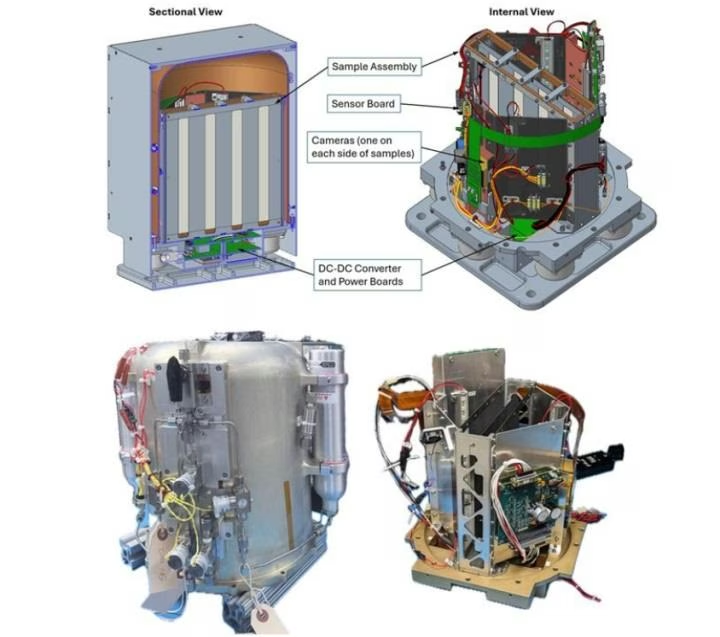
    NASA is sending up four specific solid fuel samples. Once on the lunar surface, these will be ignited inside a highly controlled, automated chamber. High-speed cameras and sensors will track the flame’s spread rate, its shape, and its overall thermal behavior over an extended period.

    The Terrifying Physics of Partial Gravity

    Here is the part that genuinely spooked me while I was researching: lunar gravity might actually make fires more dangerous than they are on Earth.

    According to the FM2 project reports and current numerical models, the precise level of gravity on the Moon might hit a terrifying “sweet spot.” It creates just enough convection to pull fresh oxygen into the fire and keep it alive, but not enough to dissipate the heat quickly. Researchers are warning that flame spread rates could actually peak in lunar gravity environments. Imagine a fire that spreads faster and burns hotter just because the gravity is perfectly wrong.

    Artemis and the Real-World Stakes

    I look at this and immediately think about the Artemis missions. We aren’t just planting flags and taking photos anymore; we are actively designing habitats and next-generation spacesuits for long-term stays.

    For decades, NASA has relied on the NASA-STD-6001B standard for testing material flammability. The problem? Almost all of those tests were based on microgravity data or Earth-based simulations. We have been designing lunar gear with a massive gap in our knowledge. If a fire breaks out inside a lunar module, astronauts won’t have time to consult a physics textbook. They need materials engineered specifically to resist lunar-gravity combustion.

    Long-term, NASA engineers want to conduct material tests directly on the lunar surface with actual human crews present. But until we have a permanent base, these robotic, automated tests are our best line of defense.

    The Devil is in the Details

    For me, this mission is a brilliant reminder that conquering the cosmos isn’t just about massive rockets and orbital mechanics. It’s about re-learning the most basic elements of human survival. Fire kept our ancestors alive in caves, but on the Moon, it could be our biggest unseen enemy. We have to learn to tame it all over again.

    So, I have to ask you: knowing that something as simple as a spark could behave completely unpredictably, how comfortable would you feel sleeping in a pressurized lunar base? Drop your thoughts below—I really want to know if I’m the only one slightly terrified by the idea of lunar fire!

    You Might Also Like;


    Source link

    Ethereum Q1 Was Busiest Than Ever, But What is Behind This? – NFT Plazas

      0
      Ethereum Q1 Was Busiest Than Ever, But What is Behind This? – NFT Plazas


      Just recently, the Ethereum network reached a historic milestone in the first quarter of 2026 by processing 200.4 million base-layer transactions. The number marks Ethereum’s Q1 as the busiest quarter in the protocol’s history and the first time transaction volume has ever crossed the 200 million threshold, which also caps a multi-year U-shaped recovery, more than doubling the activity levels seen during the 2023 lows when quarterly transactions bottomed near 90 million.

      However, a significant gap remains between this thriving on-chain activity and the market value of the asset. Despite the record-breaking network usage, ETH price continues to struggle around the psychological $2,300 level, which creates a complex puzzle for investors who expect network growth to translate directly into price appreciation.

      Learn more: How to Mine Ethereum in 2026: What You Need to Know

      Layer-2 & Stablecoin Fuel ‘Busiest Quarter’

      The explosive growth in transaction volume primarily stems from the rapid adoption of Layer-2 (L2) scaling solutions. Protocols like Base and Arbitrum handle massive amounts of traffic off-chain and then batch these transactions down to the Ethereum mainnet for final settlement. While these separate networks allow users to interact with DeFi at lower costs, they fundamentally change how value flows through the ecosystem.

      Currently, Ethereum processes these “settlement and bridging” actions as base-layer transactions, which explains the jump from 145 million in Q4 2025 to over 200 million, a 43% quarterly increase.

      Layer-2 & Stablecoin Fuel ‘Busiest Quarter’

      Layer-2 & Stablecoin Fuel ‘Busiest Quarter’

      In addition, the stablecoin market fuels this boom. The total supply of stablecoins on Ethereum recently reached a record $180 billion, accounting for approximately 60% of the global stablecoin market. Heavy usage of these fiat-pegged tokens for payments, decentralized finance activity, and remittance flows pushes transaction counts higher even when end users never directly touch the base layer.

      But Layer-2 Are Diverting Ethereum Revenue

      However, such a shift creates a “revenue leakage” effect for ETH token holders. Even though the broader Ethereum ecosystem handles more transactions than ever, the actual demand for ETH to pay for mainnet gas remains relatively suppressed. As a result, the high network activity acts more as a stress test for scalability than a direct catalyst for a price breakout.

      Now, Ethereum earns less from the very L2 activity that drives its record-breaking statistics. Until the ecosystem finds a way to better align L2 success with mainnet value capture, the “busiest quarter” narrative may remain a technical win rather than a financial one.

      DeFi Vulnerabilities Threaten Growth

      Clearly, the massive on-chain activity invites increasingly sophisticated threats. According to DefiLlama, hackers stole over $17 billion over the past decade. Recent data indicates that 22.3% of incidents involve brute-forcing keys, while phishing attacks on multi-signature wallets account for 10% of losses. Furthermore, DeFi protocols lost over $600 million in the last 60 days alone, including the massive $290 million Kelp DAO hack in April, 2026, where an attacker drained 116,500 restaked Ether (rsETH) from a LayerZero bridge.

      As smart contract security improves, attackers shift their focus toward “operational security” and developer tooling. This trend pressures the sector because DeFi yields move closer to traditional finance rates, forcing users to question if depositing on-chain remains worth the inherent security risks.

      DeFi Vulnerabilities Threaten GrowthDeFi Vulnerabilities Threaten Growth

      DeFi Vulnerabilities Threaten Growth

      Institutions Favors Bitcoin Over Ethereum

      Interestingly, Ethereum also faces a competitive disadvantage in the eyes of institutional investors. During the recent market movements, Bitcoin significantly outperformed Ethereum, leading to a consistent decline in the ETH/BTC ratio. Up to now, major institutional players choose Bitcoin ETFs, such as Morgan Stanley’s MSBT and BlackRock’s IBIT, as their primary gateway into the digital asset space. These large-scale buyers view Bitcoin as a more established “digital gold” compared to Ethereum’s more complex “global computer” narrative.

      While retail users drive record transaction volumes through L2s and stablecoins, the “big money” remains focused on Bitcoin’s simplified investment thesis and regulatory clarity. Such an imbalance in capital flow explains why Ethereum continues to lag behind, even as its technical fundamentals reach new heights. Without a dedicated spot Ethereum ETF attracting similar levels of professional capital, the asset lacks the massive buy-side pressure required to pierce major resistance levels.

      Institutions Favors Bitcoin Over EthereumInstitutions Favors Bitcoin Over Ethereum

      Institutions Favors Bitcoin Over Ethereum

      Learn more: How Many Cryptocurrencies Are There? The Complete Guide

      Analysts Flag Automated Bot Activity

      On top of that, some analysts also warn that bot activity might inflate these record-breaking numbers. In the stablecoin sector, automated systems and bot-driven movements increasingly dominate transaction volume, which could mask the actual level of genuine human onboarding. If the 200 million figure results from artificial traffic rather than new user adoption, the “fundamental recovery” might be more fragile than it appears. Bot-driven volume often lacks the sticky, long-term economic commitment that comes with real-world utility and retail participation.

      Steady issuance and a lack of aggressive burning mean the market still has plenty of liquid supply to meet current demand levels. The Ethereum protocol’s health in the second quarter of 2026 depends on whether these high volumes hold and whether the ecosystem attracts real users who contribute to long-term economic demand. Historically, sustained on-chain expansion often precedes price recovery phases, but the current decoupling between network usage and market valuation remains a primary challenge for Ethereum’s market sentiment.

      Analysts Flag Automated Bot ActivityAnalysts Flag Automated Bot Activity

      Analysts Flag Automated Bot Activity

      Ethereum Long-Term Outlook

      Apart from the drawbacks, the massive growth in transaction volume could act as a leading indicator for the network’s long-term health. Provided that Layer-2 protocols continue to onboard millions of users, the sheer scale of the ecosystem might eventually force a re-evaluation of the asset’s underlying value.

      However, for the immediate future, Ethereum stands at a crossroads. It has successfully solved its scaling issues, but it has yet to prove that this scale directly benefits the ETH token holder in the post-Dencun environment. As other chains attempt to capture market share, Ethereum’s dominant lead in stablecoin supply ($180 billion) provides a strong defensive moat.

      The upcoming months will determine if the 200 million transaction figure marks a permanent shift into a higher activity bracket or a local peak driven by specific market conditions.


      Source link

      ‘The Secret Lives of Mormon Wives’ Resuming Production

        0
        ‘The Secret Lives of Mormon Wives’ Resuming Production


        ‘Secret Lives of Mormon Wives’
        Production Resumes After Sudden Pause

        Published
        April 21, 2026
        7:09 PM PDT
        |
        Updated
        April 21, 2026
        7:47 PM PDT

        “The Secret Lives of Mormon Wives” is set to pick cameras back up following an unexpected pause involving Taylor Frankie Paul and Dakota Mortensen, TMZ has learned.

        Production sources tell TMZ … the Hulu series is going back into production soon, after being put on pause mid March of this year — following a heated blow up between TFP and Mortensen during filming of season 5.

        Our sources were not clear on whether TFP or Mortensen will be a part of filming with the rest of the cast when cameras go back up.

        Play video content

        taylor-frankie-paul-Dakota-Mortensen-audio-art-desktop-1

        We broke the story … cameras had gone down suddenly due to a recent alleged domestic violence incident. We then learned Mortensen went to cops in West Jordan, Utah with a third allegation of domestic violence against Taylor — the alleged incident is said to have taken place in early to mid-2024.

        As we reported, police investigated the abuse claims, and their findings went to the district attorney for possible charges … however, TMZ broke the news … TFP will NOT be prosecuted for her alleged involvement.

        Play video content

        taylor-frankie-paul-baby-kal-v5-03-18-2026

        As you know … TFP pled guilty in abeyance to aggravated assault following a fight with Dakota back in 2023, which was captured on video. We published the video we obtained, and her season of “The Bachelorette” was canceled hours afterward.

        Now that TFP’s case has been cleared by authorities, the hit Hulu series is gearing up to get production back on track — with cameras poised to capture whatever drama comes next within the Mormon mom group, as it all plays out on-screen.


        Source link

        Popular Posts

        My Favorites