You can certainly tell that Halloween is approaching as more and more creepy games with pumpkins, ghouls and ghosts start to appear for your gaming enjoyment. One such game by the developer 8080 certainly has that ghostly appeal! As they have announced that not only is ‘Halloween X’ a finished game ready to be played to competition, but there’s also a new demo for you to try. A game in which you have fallen into a monster filled dungeon, and must find 3 golden keys to escape.
Although we have featured the game before just the other day ( hence the article being partly the same). Here’s the latest about the game plot from the website. “It’s halloween, your new costume looks super great and you are ready todo trick & treat !!! CANDY!!!!!! You step in front yard…. a trap door? You fell in to the dungeon… What evil is this!!! You need to find a way out of this dungeon! Somewhere is 3 golden keys that opens the doors out of the dungeon Have fun !!! “
Game details:
Kids friendly, no weaponsPick pumpkins for staminaPick candy to trow on ghostsPick keys to open doorsPortals is a random area transfer unit (there are 16 areas in total)Find 3 golden keys to escape the dungeonEnemies are ghosts and move through wallsJoystick / keyboard control
I wouldn’t call Paint by Pixel 2 a game. It’s a virtual paint by numbers kit. You have a black and white canvas filled with numbered squares. Then on the right is a bank of colored numbers. So paint the three color in the three square. There are several sizes of pictures, ranging from tiny to massive. The bigger the picture, the more colors that are used and the more intricate the design. Best of all, you cannot screw up, because you can’t paint the wrong color in the wrong square. But Paint by Pixel 2’s biggest strength is also its biggest weakness.
The game will show you where the pixels corresponding to the color are.
You see, in Paint By Pixel 2 you can select brush size. Since you can’t mess up. You just scribble the pixels and the color fills in. In fact, you can even just fill the section with the color, negating the scribbling all together. And when you get down to a few pixels missed, just click auto-solve and the remaining pixels fill in automatically. This actually a very helpful feature.
Paint by Pixel 2 is a cheap copy of paint by numbers. Because off all the short cuts you can take, there isn’t pride in a creating a beautiful image. Just scribbling until completion isn’t the point of paint by numbers. The numbers are just a guide for novice painters to paint the image. There’s none of that feeling of pride in completion here. It is for that reason I’m giving Paint By Pixel 2 a YMMV with a seven back-end score. There isn’t anything broken here, I just don’t see the point in buying this. You’re better off playing Piczle Lines 2 or a picross game. At the least those are actual puzzles.
Overall: Paint by Pixel 2 misses the point of paint by numbers and therefore just feels hollow and pointless to play.
Each week Prime Gaming, part of what you get with a subscription to Amazon Prime, add and remove various games you can claim to keep. Here’s the updated list for October 25th.
I’ll use the Steam Deck Rating from Valve ( Verified, Playable, Unsupported and Not Rated), plus the ProtonDB rating to help you decide on what to play. Compatibility may be slightly different since the games are from various stores. Some of the games might also have no ratings right now.
Here’s the current list as of 22nd October, 2024 with 59 games easily available:
New this week include: Monster Train, Pumpkin Jack, STASIS: BONE TOTEM, Morbid: The Seven Acolytes and Gargoyles Remastered.
The only one I’m still not including in this list is DOOM Eternal, as that’s via the Microsoft Store, which of course does not work on at all Steam Deck / Linux since it’s a Windows-only thing. All the games you get to keep as Prime Gaming gives you a code to redeem!
You can install games from Epic, GOG and Amazon easily via the Heroic Games Launcher.
Martin and Shirlie Kemp are no strangers to the limelight or the pressures that come with being in the public eye.
The couple have graced the entertainment industry for decades.
Now, as their son Roman Kemp forges his own path in the entertainment world, the pair have shared their concerns in a candid interview.
Martin Kemp admitted that he was initially concerned about his son Roman’s career choice. (Credit: Cover Images)
Martin and Shirlie Kemp
The Kemps have watched their youngest, Roman, climb the ranks to become a household name as a TV presenter and radio DJ.
However, his success hasn’t come without worries.
In an exclusive chat with HELLO!, Martin Kemp opened up about the initial fears he had regarding Roman’s career.
“Fame is a difficult thing to cope with full stop and you have to get your head around it,” Martin reflected.
He explained that his concerns were not just about the fame but also about the resilience and stability needed to navigate a career in entertainment.
Martin said: “It’s something that I worried about with Roman when he was younger, going into the same industry [as us]. It’s a difficult thing, but Roman’s got his feet on the ground, and I’m really happy for him.”
Shirlie Kemp also shared her views on the challenges that the younger generation faces, especially regarding social media.
“I think there’s so much pressure [on young people in the public eye] and there’s so much cruelty with social media. Everybody who’s on social media has also got their opinion about you,” Shirlie mused.
Martin and Roman Kemp appeared on Celebrity Gogglebox together. (Credit: Channel 4)
Roman Kemp news
Despite any worries, the bond between the Kemps and their son is undeniably strong.
Martin and Shirlie pride themselves on having an open and honest relationship with their children, Harley Moon and Roman.
This openness has translated into their public personas – such as their appearances on Celebrity Gogglebox and the conversations on their podcast, FFS! My dad is Martin Kemp.
Martin described the podcast as an “X-rated Gogglebox”.
Meanwhile, The One Show presenter Roman recently hit headlines when his girlfriend was spotted wearing what was thought to be an engagement ring.
Roman himself has not yet commented on the truthfulness of these claims – however – a close source seemingly confirmed the engagement to MailOnline.
“Roman has long wanted to settle down and start a family so it’s such an exciting time for them,” the source revealed.
“He’s been seeing Carmen for a few months now and feels strongly she is the one. Roman’s mum Shirlie is also over the moon and has been telling friends how excited she is for the wedding.”
Roman and production assistant Carmen Gaggero only recently made their relationship public. However, it’s been reported that they have likely been dating for several months.
Read more: Roman Kemp sparks ‘engagement’ rumours after girlfriend Carmen Gaggero spotted with ring
Are you a fan of Roman Kemp? Head to our Facebook page @EntertainmentDailyFix and let us know.
The cryptocurrency landscape is constantly evolving, and with it, the fortunes of various digital assets wax and wane. One such asset currently under the microscope is Polygon (POL), which has seen its price tumble to the lows of 2021. As investors and enthusiasts ponder its future, it becomes imperative to examine the factors contributing to this decline and assess what lies ahead for Polygon. In this article, we’ll delve into the history, current challenges, and potential future of Polygon to provide a comprehensive overview of its trajectory.
Understanding Polygon: A Brief History
Polygon, formerly known as Matic Network, has been a significant player in the cryptocurrency ecosystem, offering layer 2 scaling solutions to improve the performance of Ethereum’s decentralized applications (dApps). Since its inception, Polygon has focused on enhancing blockchain interoperability and providing faster, more cost-effective transactions. Its meteoric rise in early 2021 demonstrated its potential, drawing the attention of developers and investors alike.
The Rise of Polygon
Polygon’s initial success can be attributed to several key factors:
Scalability: Polygon’s layer 2 solutions significantly improved Ethereum’s transaction throughput.Cost-Effectiveness: Users experienced reduced gas fees, making it an attractive option for dApp developers.Strong Community: Polygon fostered a vibrant community of developers and users, further driving its adoption.
Current Market Scenario: What’s Happening with POL?
Despite its promising start, Polygon’s price has recently plummeted to its 2021 low, raising questions about its sustainability and future prospects. Multiple factors are contributing to this downturn:
Market Volatility
The cryptocurrency market is inherently volatile, with prices subject to rapid fluctuations. Polygon is no exception, and the recent broader market retracement has undoubtedly impacted its valuation. Increased regulatory scrutiny and global economic uncertainties have further exacerbated these volatile conditions.
Competitive Landscape
The rise of competitors offering alternative layer 2 solutions has intensified competition. Ethereum’s advancements, such as Ethereum 2.0, as well as the emergence of other blockchains, are challenging Polygon’s market positioning.
Technical Challenges
While Polygon has addressed Ethereum’s scalability issues, it still faces technical hurdles that need resolution. Improving network security and maintaining seamless user experiences remain critical tasks for the platform.
Investor Sentiment
The sentiment of cryptocurrency investors plays a vital role in price movements. As excitement wanes and skepticism rises, assets like Polygon experience increased selling pressure, contributing to their decline.
Assessing Polygon’s Future Prospects
Despite these challenges, Polygon has several avenues through which it can revive its fortunes and regain investor confidence.
Innovation and Development
To sustain growth, Polygon must continue to innovate and develop its technology stack. Some strategies include:
Enhancements to Infrastructure: Continued improvements in speed and efficiency will benefit users and dApp developers.Partnerships and Collaborations: Forging alliances with other blockchain projects can bolster Polygon’s ecosystem.Ecosystem Expansion: Encouraging new and existing dApp developers to build on Polygon could drive further adoption.
Engaging the Community
A committed, engaged community can be a project’s greatest asset. Polygon can capitalize on this by:
Hosting Educational Initiatives: Workshops, webinars, and hackathons can educate and empower developers and users.Community Governance: Facilitating community participation in decision-making can foster stronger ties and innovation.
Redefining the Narrative
Polygon needs to actively communicate its value proposition to the broader market. Clarifying its unique offerings and future goals can potentially restore investor interest and trust.
Conclusion: Navigating Uncertain Waters
Polygon is currently at a critical juncture, confronting both opportunities and challenges that could shape its future trajectory. As it navigates these turbulent waters, the focus must remain on innovation, community engagement, and strategic positioning. The journey ahead will not be without difficulty, but with astute management and a renewed focus, Polygon can overcome today’s obstacles and emerge as a stronger entity. For investors and users, staying informed and vigilant will be key in understanding the evolving dynamics of this ever-changing landscape.
“`
About Web3Wire Web3Wire – Information, news, press releases, events and research articles about Web3, Metaverse, Blockchain, Artificial Intelligence, Cryptocurrencies, Decentralized Finance, NFTs and Gaming. Visit Web3Wire for Web3 News and Events, Block3Wire for the latest Blockchain news and Meta3Wire to stay updated with Metaverse News.
Studio369, the developer behind the mech shooter MetalCore, has announced a move to the Solana blockchain aimed at enhancing gameplay performance and accessibility.
The migration is expected to enable faster in-game transactions and lower costs, creating a streamlined experience for new and existing players alike.
This will also integrate with Solana Labs’ GameShift platform, further supporting in-game purchases and facilitating a smoother entry for users less familiar with blockchain technology.
Source: MetalCore
Why choose Solana?
Solana was chosen for its high-throughput network, which supports rapid blockchain transactions.
This capacity will allow MetalCore players to experience faster in-game actions and interactions that require blockchain processing. Additionally, Solana’s infrastructure is designed to offer lower costs per transaction, making gameplay more cost-effective.
“We’re thrilled to bring MetalCore to Solana, leveraging its infrastructure to enhance the on-chain user experience and unlock Solana’s unique advantages,” said Matt Candler, CEO of Studio369. “Metalcore has repeatedly won best web3 game awards, and we want to bring the best infrastructure to our players so they can enjoy the game in the most convenient and frictionless way possible.”
The integration with Solana Labs’ GameShift platform will enable a consolidated in-game storefront and simplified payment options, intended to benefit both web2 and web3 users by improving transaction efficiency and overall accessibility.
The name “OpenSea” undoubtedly comes to mind when you first hear about NFTs, and for good reason! The largest NFT market in the world, OpenSea allows anybody to create, purchase, and sell non-fungible tokens. If you’ve ever been curious about what OpenSea is, how it works, or if it’s the right platform for you, you are at the right place. In this blog, we will have a solid understanding of OpenSea NFT and how to make the most of it. So, let’s dive in!
OpenSea is a massive marketplace where you can purchase, sell, and even build NFTs. Think of it as the Amazon of the NFT world. OpenSea offers the resources and infrastructure to participate in the NFT ecosystem, whether you’re a creator, a collector, or just an interested bystander. It’s similar to entering a sizable gallery, except everything is digital and entirely one hundred percent unique.
How OpenSea Works?
Now let’s examine how OpenSea functions; it’s actually not as complicated as it might sound.
1. Browse or create NFTs:
There are two options available to you: peruse the millions of NFTs in the current marketplace or start from the beginning and make your own. This covers everything, from virtual real estate to digital music and art.
2. Connect to Your Wallet:
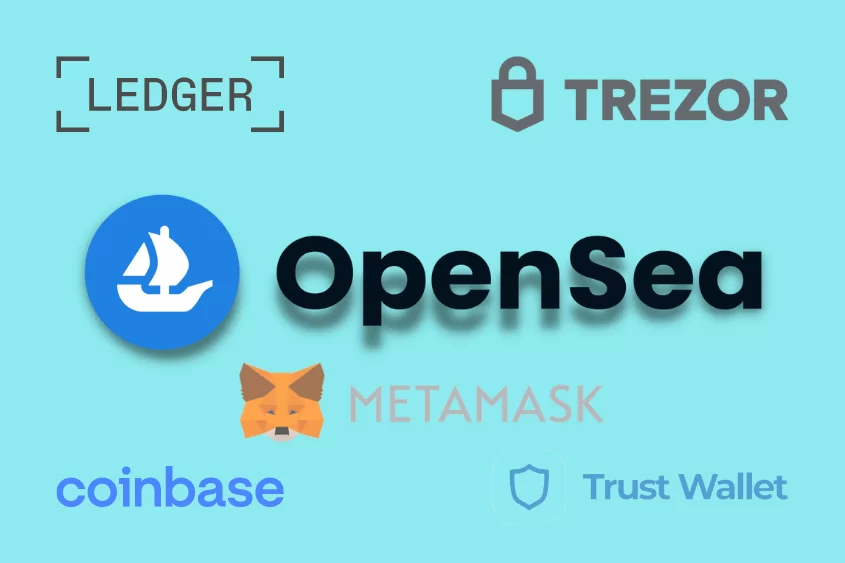
You’ll need a cryptocurrency wallet in order to begin trading or producing NFTs. Consider it to be your online bank account. Though OpenSea supports a number of them, including Coinbase Wallet and Trust Wallet, MetaMask is the most widely used. As soon as your wallet is connected, you can begin using the platform.
3. Buy or Sell NFTs:
Purchasing or selling only requires a click button. You look through NFTs, see how much they’re normally asking for Ethereum, then either make a deal or pay the asking price. Depending on their plan, sellers can either establish a fixed price or put their NFTs up for auction.
4. Gas Fees:
Oh yes, the infamous gas fees! Every time you make a transaction on the Ethereum blockchain, you’ll be paying a fee, often called “gas.”
Let’s get into some practical tips, shall we? Whether you’re looking to buy your first NFT or trying to sell one for a profit, these tricks will help you navigate the marketplace more effectively.
How to Buy NFTs in OpenSea?
Source: nftpay.xyz
1. Do Your Research:
Learn more about the project before investing your hard-earned Ethereum in it. Examine the creator, the exclusivity, and the surrounding community. The NFT’s worth may rise over time if the project is well-known.
2. Examine Transaction History:
You should look over the history of transactions for each NFT. The NFT’s value may be more volatile if it has been resold several times.
3. Establish a Budget and Follow It:
When you’re enthusiastic about a project, it’s simple to get carried away by the excitement and overpay. Determine how much you can afford to spend in advance.
How to Sell NFTs in OpenSea?
1. Build a Narrative Around Your NFT:
Uploading a file isn’t enough if you’re selling. You should write an intriguing narrative that will draw in potential customers. What distinguishes your NFT? What inspired the creation of it? These specifics are important.
2. Price sensibly:
If you’re just getting started, don’t overcharge for your NFT. In the event that demand increases later, you may always raise the price.
3. Promote:
When it comes to promoting NFT, social media is your best buddy. There are active NFT communities on platforms like Discord and Twitter, which may stimulate interest.
How to Create NFTs in OpenSea?
1. Use High-Quality Media:
Make sure your NFT is made using high-quality media, whether it be a picture, video, or song. Collectors are interested in resolution, sound quality, and presentation overall.
2. Metadata is the Key:
The Crucial Metadata Make sure your NFT’s metadata is filled out correctly. Add tags, a detailed description, and even stuff that may be unlocked, such as high-resolution files or exclusive bonuses only available to buyers.
3. Interact with Your Community:
Don’t sit back when your NFT goes live. Talk to prospective customers, respond to their inquiries, and create a community around your business.
Security Best Practices:
The NFT world is exciting but can also be risky. Scams, hacks, and phishing attempts are not uncommon, so here’s how you can protect yourself:
1. Never Give Your Seed Phrase Away:
This is the master key to your money. Anyone who finds out about this can seize control of your money.
2. Turn on Two-Factor Authentication (2FA):
Make sure that both your OpenSea account and wallet have 2FA enabled. This enhances security on top of it.
3. Watch Out for Phishing Sites:
Scammers sometimes create fake sites that look like OpenSea. Double-check URLs before entering any sensitive information.
4. Be Careful with DMs on Discord and Twitter:
Scammers frequently send direct messages purporting to have bargains or requesting your wallet information. Disregard these.
5. Store NFTs in a Cold Wallet:
If you possess precious NFTs, you should think about keeping them in a hardware wallet, also known as a cold wallet.
OpenSea Fees:
Source: 36crypto.com
Let’s talk money. OpenSea’s fee structure is pretty simple, but knowing it ahead of time will help you avoid surprises:
Platform Fee: OpenSea takes a 2.5% cut on every sale. So if you sell an NFT for $100, you’ll receive $97.50.
Creator Royalties: Some creators set a royalty fee on their NFTs, meaning that every time the NFT is resold, they receive a percentage (typically 5-10%).
How to Store NFTs Securely on OpenSea:
Source: cyberscrilla.com
You’ve bought your NFTs, now what? How do you make sure they’re stored safely?
1. Choose a trusted Wallet:
Ledger, Coinbase Wallet, and MetaMask are all trustworthy wallets. Verify that the wallet you’re using has a solid security record and positive user ratings.
2. Maintain the Security of Your Wallet:
Beyond just enabling 2FA, don’t store your private keys in easily accessible places. Consider writing them down and storing them offline.
3. Cold Storage:
Cold storage, which is effectively keeping your NFTs offline in a hardware wallet, is something to think about for high-value NFTs. Hackers will find it far more difficult to assess your valuables as a result.
Pros and Cons of OpenSea:
No platform is perfect, right? Here’s a breakdown of OpenSea’s strengths and weaknesses to help you decide if it’s the best choice for you.
Pros of Using OpenSea:
1. Largest Marketplace:
OpenSea offers a selection that is difficult to match, with millions of NFTs.
2. User-Friendly Interface:
Even for new users, OpenSea is designed to be simple to use.
3. Support for Multiple Wallets:
This feature allows you to link several kinds of wallets, giving it flexibility for various users.
4. Supports Many NFT Categories:
Encourages Numerous NFT Categories Everything from virtual land to music to art, you may discover all kinds of NFT here.
Cons of Using OpenSea:
1. High Gas prices:
OpenSea is built on the Ethereum blockchain, which is notorious for its sometimes-exorbitant gas fees.
2. Fraud & Scams:
Scams can occur in any open marketplace, including OpenSea. You must continue to exercise caution.
3. Centralization Issues:
Although OpenSea operates in the decentralized world of blockchain, the platform itself is centralized, meaning it could theoretically be censored or shut down.
The Future of OpenSea:
Now, this is where things get exciting! OpenSea is continuing to grow rapidly, but what does the future hold?
OpenSea has already included Solana and Polygon, which lowers the cost of Ethereum’s gas. In the future, we expect to see more blockchain integrations. OpenSea is always enhancing its search functions and user experience to make it simpler for consumers to locate NFTs they’ll like. It has been striving to provide creators access to more resources, such as more straightforward methods of managing royalties and promoting their work. More rules are likely to be implemented as the NFT industry develops. Platforms like OpenSea could gain stability and confidence as a result.
So there you have it, a complete guide to OpenSea and how to navigate the world’s largest NFT marketplace. Whether you’re buying, selling, or creating, OpenSea offers a comprehensive and user-friendly platform. However, like any marketplace, it has its pros and cons. High gas fees, potential security risks, and the possibility of scams are worth keeping in mind. Still, if you’re careful and smart about how you engage, OpenSea can be a game-changer in your NFT journey.
But what about you? Have you used OpenSea before, or are you planning to? What’s been your experience, or what are your thoughts on the future of the platform? Let me know in the comments below! I’m curious to hear your take on the world of OpenSea NFTs. And for more updates on the latest in the world of digital art, blockchain, and NFTs, be sure to subscribe to our newsletter, Web3 O’clock. Stay ahead of the curve!
Somnia, a high-performance Layer 1 blockchain optimized for the Ethereum Virtual Machine (EVM), has published a new litepaper outlining the major updates to the tech. The latest includes the Multistream consensus and a $10M ecosystem grant program to support mass-consumer applications.
Multistream Consensus for Large-Scale Innovation
At the heart of Somnia’s updates is the Multistream consensus, capable of 400,000 TPS with sub-second block finality. This means Somnia can support large-scale, real-time applications across industries like gaming, social media and virtual worlds.
The new litepaper details several architectural improvements that improve Somnia’s performance while maintaining decentralization. Key among these is advanced compression that allows data to transfer between nodes 20x faster than traditional blockchains. Somnia also introduces ICEdb, a custom database with 70-100 nanosecond read and write times.
Somnia’s single-thread sequential execution is different from traditional parallel processing, so performance is consistent even under high transaction density.
To support ecosystem development, Somnia has launched a $10M grant program. This will connect innovative devs with top Web3 investors, including Mirana Ventures and Spartan Capital.
The grant program is for developers working on large-scale, real-time apps and will provide the resources and funding to bring their projects to life.
Somnia has partnered with top industry players like Yuga Labs to expand NFT utility. Users can now use Kodas, Otherdeed Expanded, Bored Ape Yacht Club, and Mutant Ape Yacht Club NFTs in games and interoperable virtual experiences on-chain.
Furthermore, NFT avatars can now be used in MSquared’s virtual environments, including the official Major League Baseball (MLB) virtual ballpark and Kosmopop, which hosts K-pop concerts with TWICE.
Alongside the blockchain, Somnia has built Dream Builder, a suite of tools that help creators bring their dreams to life. Dream Builder allows users to convert 3D files into metaversal objects and build worlds and interactive experiences. As such, this should make the creative process more accessible and encourage innovation and diversity of use cases in the Somnia ecosystem.
DeFi and On-Chain Apps
Developed by Virtual Society Foundation, Somnia’s high-performance blockchain brings DeFi benefits by allowing on-chain limit order books. This combines the efficiency of centralized exchanges with the security and transparency of decentralized platforms, making Somnia a good option for gaming and social platforms.
By moving more application logic on-chain, Somnia reduces off-chain dependencies and increases transparency, security and user engagement across all apps.
Overall, the updates in Somnia’s litepaper open up new use cases for blockchain and Web3. By providing a scalable and high-performance infrastructure, Somnia is the go-to choice for developers and creators who want to build the next generation of dapps.
Editor’s note: Written with the assistance of AI – Edited and fact-checked by Jason Newey.
Jason Newey is a seasoned journalist specializing in NFTs, the Metaverse, and Web3 technologies. With a background in digital media and blockchain technology, he adeptly translates complex concepts into engaging, informative articles.
Published: October 25, 2024 at 8:11 am Updated: October 25, 2024 at 8:11 am
To improve your local-language experience, sometimes we employ an auto-translation plugin. Please note auto-translation may not be accurate, so read original article for precise information.
Texas, the foremost mining epicenter in the United States, has historically been a strategic cornerstone for Bitmain’s relentless pursuit of mining dominance. However, a stunning reversal has occurred as all of Bitmain’s air-cooling miners, particularly the prestigious Antminer S19 series, have been compelled to cease operations in Texas. The official evaluation is unequivocal: Texas’s extreme climatic conditions, characterized by soaring heat and oppressive humidity, are deemed inimical to the effective functioning of air-cooling antminers.
The maintenance predicament within the Antminer S19 series operating in Texas is stark. Units in optimal condition face a 40% repair rate, while those in suboptimal condition experience a staggering 100% repair rate. This led to the gradual withdrawal of the Antminer S19 series from Texas shelves in mid-June this year, coinciding with a notable decline in the network’s overall hash rate around June 16th.
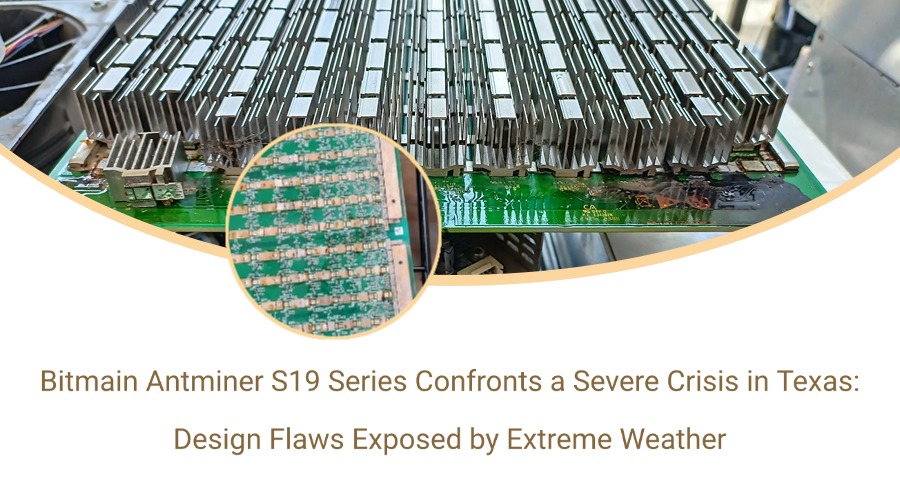
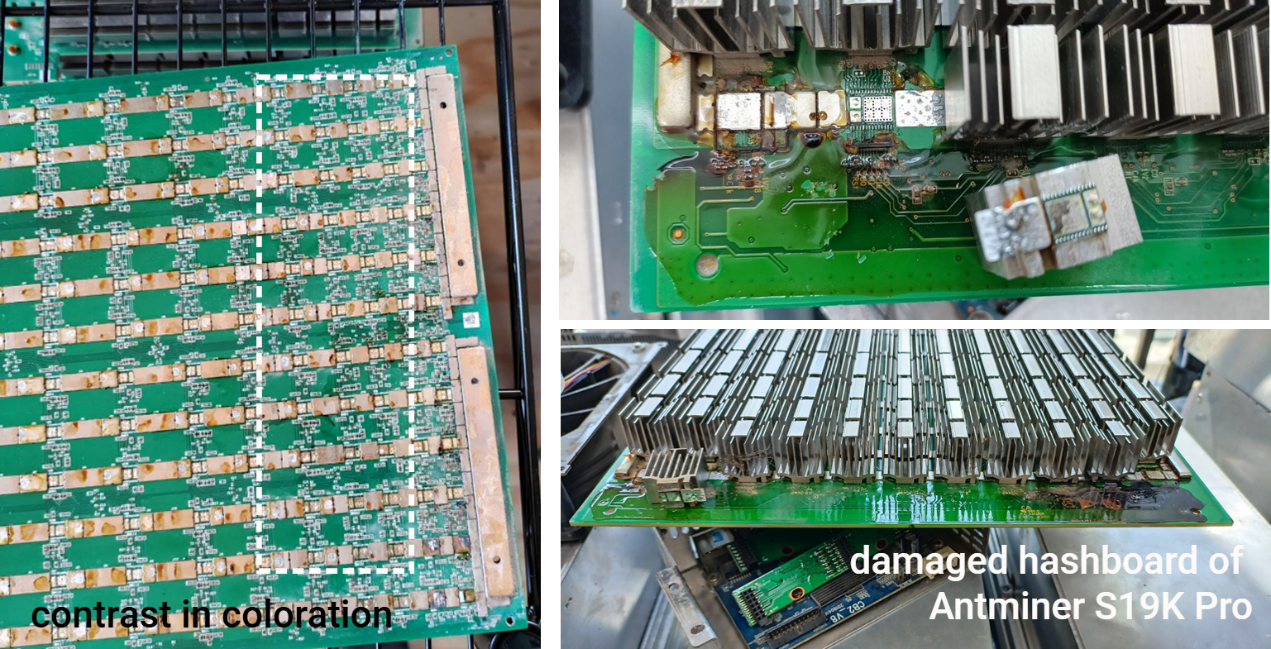
At the heart of this issue lies severe corrosion within the hashboards of the Antminer S19 series, particularly the S19K Pro model. The stark contrast in coloration between the air inlet side and the rest of the hashboard is a tangible manifestation of this corrosion, which has been exacerbated by the harsh Texas weather.
Upon closer scrutiny, it becomes evident that this predicament stems not merely from environmental factors but from the inherent design flaws of Bitmain’s miners. The continued use of compact heat sinks, while effective for thermal dissipation, has proven to be a double-edged sword under certain conditions.
The Bitmain’s Antminer S19K Pro, in particular, adopts a heat dissipation structure reminiscent of the two-sided small radiator of the Bitmain’s Antminer S17, which, under certain circumstances, has proven to be highly susceptible to damage. These circumstances include:
Firstly, Transportation Vulnerabilities:
The small radiator’s sensitivity to vibrations makes it prone to dislodgement during transit, especially under bumpy conditions or inadequate packaging.
Secondly, Rapid Temperature Fluctuations:
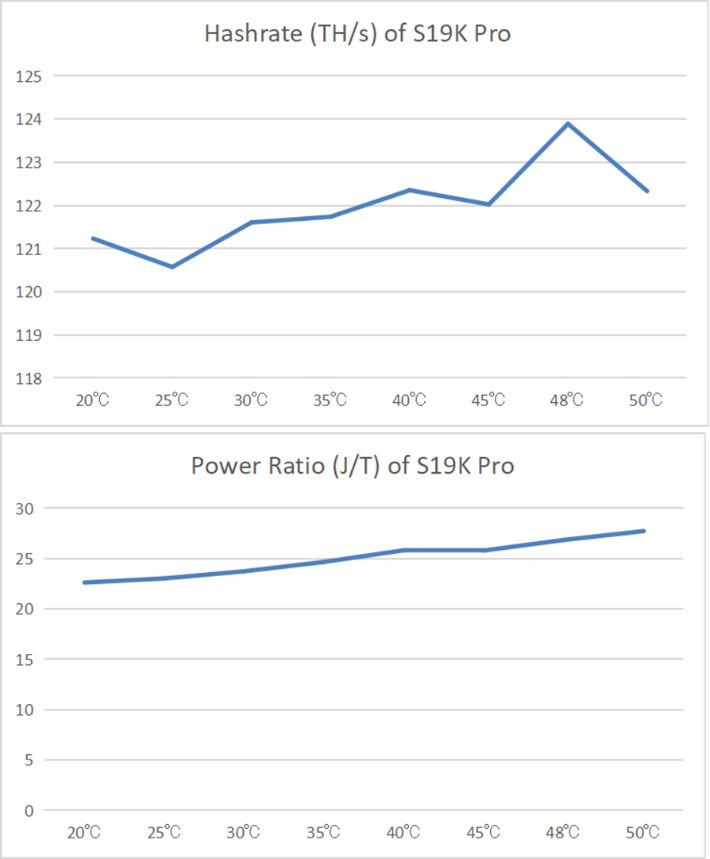
As evidenced by the Bitmain Antminer S19K Pro’s fluctuating hashrate and increased power ratio with rising ambient temperatures, its small heat capacity exacerbates the impact of rapid temperature changes. This can lead to damage even in the absence of extreme conditions.
Thirdly, Moisture-Induced Chip Cracking:
After shutdowns spanning a few days, the limited protection offered by the small radiator leaves the chip vulnerable to moisture absorption, which can cause cracking upon restart.
In conclusion, Bitmain’s Antminer S19 series has encountered a formidable challenge in Texas’s unforgiving climate, revealing the limitations of their current design approach. As the mining industry continues to evolve, it will be imperative for Bitmain and other manufacturers to adapt their designs to withstand the rigors of varying environments, ensuring reliability and longevity amidst the relentless pursuit of mining dominance.
Disclaimer
In line with the Trust Project guidelines, please note that the information provided on this page is not intended to be and should not be interpreted as legal, tax, investment, financial, or any other form of advice. It is important to only invest what you can afford to lose and to seek independent financial advice if you have any doubts. For further information, we suggest referring to the terms and conditions as well as the help and support pages provided by the issuer or advertiser. MetaversePost is committed to accurate, unbiased reporting, but market conditions are subject to change without notice.
About The Author
Gregory, a digital nomad hailing from Poland, is not only a financial analyst but also a valuable contributor to various online magazines. With a wealth of experience in the financial industry, his insights and expertise have earned him recognition in numerous publications. Utilising his spare time effectively, Gregory is currently dedicated to writing a book about cryptocurrency and blockchain.
More articles
Gregory, a digital nomad hailing from Poland, is not only a financial analyst but also a valuable contributor to various online magazines. With a wealth of experience in the financial industry, his insights and expertise have earned him recognition in numerous publications. Utilising his spare time effectively, Gregory is currently dedicated to writing a book about cryptocurrency and blockchain.
Geoff Gray, known as KytinousG, has launched Tales of the Kytin Age on Kickstarter, an immersive fantasy RPG set in Earth’s distant future. Gray has been developing the game and world for over 35 years, Tales of the Kytin Age takes players into a world where towering fungi, mutant insects, and a changed humanity populate the remnants of a lost civilization. This society faces constant threats from the immense creatures that rule the land.
The world, crafted meticulously by Gray, introduces four distinct human forms adapted to the harsh realities of a radically transformed Earth. From Neotypes to Insectiles, players can customize characters based on evolved survival traits, moving beyond traditional RPG archetypes.
Combat relies on strategic turn-based play, pitting characters against nature’s insect overlords. The game’s structure invites character-driven progression, fostering player-driven narratives set against a richly detailed lore that spans cities, kingdoms, and biomes shaped by nuclear winter and a relentless cycle of adaptation.
Gray, responsible for nearly all aspects of the project apart from the artwork by Yasen Stoilov, brings his experience in graphic arts and entomology into Tales of the Kytin Age. Backers have options for a standard gamebook or a deluxe boxed set with added resources including an adventure book, a poster map, a game screen, deluxe character sheets, and a slipcase. Following the launch, Gray plans to release more expansions, supplements, and even miniatures, giving players the tools to fully explore the Kytin Age.
The campaign for Tales of the Kytin Age runs until November 24th.



 Playable,
  Unsupported and
  Not Rated), plus the ProtonDB rating to help you decide on what to play. Compatibility may be slightly different since the games are from various stores. Some of the games might also have no ratings right now.


 Source: MetalCore