Davina McCall has opened up about the fresh fears she’s been facing months after surgery to remove a brain tumour.
Back in November, the TV star revealed she had to go in for brain surgery after doctors discovered a benign cyst that affects just three in a million people. The 57 year old’s tumour was found at a private clinic after she was offered a free health check for taking part in a menopause talk.
When she was in surgery, and in the days that followed, Davina’s partner Michael Douglas updated fans on her recovery, letting them know when she was out of intensive care.
Now, Davina has spoken about her recovery in a podcast chat…
Davina McCall will tell her brain tumour story later this week (Credit: YouTube)
Davina McCall opens up on brain tumour
Speaking on her Begin Again podcast, Davina was seen getting emotional as she opened up on her health journey in a candid sit-down interview with Steven Bartlett.
In the special episode, Davina was the one answering the questions, telling her story from her own perspective.
The short teaser clip announcing the episode showed Davina getting visibly emotional. She explained: “I felt like this thing had taken control of me. They said: ‘You have a benign cyst in your brain.’”
When Steven asked how she felt immediately after the operation, Davina admitted she didn’t “remember where I was”.
But her biggest worry was the fact her personality was changing. And she was afraid that she would lose a huge part of herself.
She said: “You realise that your personality is your short-term memory. I was like: ‘I’m still in here.’ I began again and again.”
Davina worried she would lose her personality (Credit: YouTube)
‘Completely overwhelmed’
The Masked Singer host posted the short clip on Instagram, captioning it: “This week I am swapping seats. I am completely overwhelmed with the amount of messages of love and support from every single one of you – truly!
“And of course, there was only one place I could come to tell this story. With none other than Mr Steven Bartlett! Who’s keeping my seat warm for me this week.”
She signed off the caption: “It’s time for me to Begin Again (again, again, again.)”
The new episode will be available to listen to from 8am on Thursday. But fans already know it’s going to be a tearjerker.
Flooding the comments with praise, one fan wrote: “How wonderful and inspiring. I will be watching.”
Another penned: “You are such an inspiration Davina! Thank you so much for sharing. I can’t wait to hear the full podcast.”
Read more: Davina McCall’s boyfriend shares ‘uncertainty’ over recovery from brain operation
Will you be listening to Davina McCall opening up about her brain tumour? Let us know by leaving a comment on our Facebook page @EntertainmentDailyFix. We want to hear your thoughts!
Mark Wright and Michelle Keegan revealed their baby news at the end of 2024 and, this week, Michelle has opened up in a rare interview about their relationship.
In a new chat with Grazia, the 37-year-old actress admitted she and Mark like to “step back to normal life” when they finish their high-profile jobs.
She explained: “It’s very boring and probably quite basic. But that’s how I like it.”
But just how boring and basic has their life together been? Well, here we have a look inside their 12-year-romance…
Mark and Michelle first went public at the British Soap Awards in 2013 (Credit: SplashNews.com)
2012: First meeting
At the end of 2012, Michelle and Mark met on holiday in Dubai. Reports suggest they fell in love immediately. Days after they landed back in the UK, Mark secured a date with Michelle.
The DJ has since admitted on Jamie Laing’s Private Parts podcast that he had “chased her” for quite a while after their paths crossed at showbiz parties.
2013: Confirmation of relationship
The pair began their relationship pretty much the way they’ve continued it – privately. As a result, they didn’t officially confirm they were together till almost six months after rumours they were dating started.
After months of speculation, Mark and Michelle confirmed their relationship on the 2013 British Soap Awards red carpet.
Then, in the June, Mark took it one step further by declaring his love for the actress on Twitter. He shared a collage of photobooth images with the caption: “Forever.”
Engagement and spat with ex
Just nine months after they met, Mark got down on one knee during. The proposal took place on another holiday in Dubai.
Michelle confirmed the news on Twitter: “Thank you for all the lovely messages. And yes, it’s true. Mark and I are engaged! We are so happy.”
And yes, it’s true. Mark and I are engaged!
But as the news spread, Mark’s ex Lauren Goodger, who he was with for 10 years, posted a message on Instagram.
in a thinly-veiled dig at the pair, she wrote: “I’m not going to be the girl you marry. But I will be the girl you will be thinking of 20 years from now, while you engage in polite sex with your boring wife who fakes it to make you feel better about your receding hairline.”
Mark responds
While Michelle kept quiet about Lauren’s post, Mark later took to Twitter to ask Lauren to leave them alone.
But this only fuelled the fire. Lauren wrote in her magazine column: “Frankly, it was embarrassing that those tweets were made when he was on his honeymoon and I was away with my boyfriend having an amazing holiday.”
The feud between Lauren and the couple does seem to have come to an end, however. Last month, Lauren revealed she sent his family a sweet message when their baby news was announced.
The couple have been married for almost 10 years (Credit: SplashNews.com)
2015: Mark and Michelle get married
On May 24, 2015, Mark and Michelle got married at St Mary’s Church in Bury St Edmonds. They then went on to celebrate at a reception on the grounds of the Tudor mansion Hengrave Hall in Suffolk.
The pair headed off on a two-part honeymoon. First they went to the Maldives. Then they headed to Dubai, where they met and got engaged. Soon after, they settled in his native Essex.
Split rumours and no wedding ring
In 2016, after Michelle wrapped on Our Girl, she headed to Europe to film Tina and Bobby.
As a result of their work commitments, the couple have been forced to endure a long-distance relationship – and the resulting split rumours – for years.
A so-called friend told The Sun during the filming of Tina and Bobby: “It’s been a turbulent first year [of marriage]. They have been apart much more than they have been together.”
Michelle was also spotted without her wedding ring at the time. However, the split rumours were quickly shut down as Michelle’s rep explained she removed the ring for filming and leaves it at home to keep it safe.
The pair have faced several break-up rumours over the years (Credit: SplashNews.com)
Michelle Keegan baby rumours
In 2018, Michelle told Women’s Health that she was too busy to have kids. But she added that it was definitely something they wanted. She said: “I love kids. And I want four. So hopefully in the near future.”
However, her “near future” answer wasn’t enough for some. And the star revealed she was constantly pushed to reveal when she and Mark would be starting a family.
Speaking to the Mirror, she said: “People don’t know if we are trying. They don’t know the background of what’s happening. In this day and age you shouldn’t be asking questions like that. I am asked purely because I am a woman.”
She added to Grazia this week: “Around the time we got married, I was open about the fact that I wanted to have a family but then, because we didn’t choose to have children within a certain time, there was lots of speculation.
“And we can handle that but, at one point, there was a story every week. My family was asking me about it, so I made the decision to not talk publicly about that side of my life. I’m going to be 38 this year and, as I’ve got older, I feel more confident about my boundaries.”
Mark Wright and Michelle Keegan’s gorgeous home
Luckily for us nosy parkers, though, Mark and Michelle have been open about sharing details of their stunning home renovation with fans.
Their house, in Essex, is nothing short of spectacular, with manicured gardens and an outdoor pool.
However, it’s not always as polished as it looks on the ‘Gram.
Shattering our illusions of her life of domestic bliss, Michelle told Grazia: “Honestly, when I left this morning it was upside down, a complete mess. When I get home, if Mark hasn’t cleaned it, I’ll probably have a go at him and then do it myself.”
Taking time out
Now, as they prepare to welcome their first baby, Michelle Keegan has announced her plans to take her private life with Mark Wright out of the spotlight once more.
She revealed this week that once filming wraps on Brassic, she’ll be taking time out to focus on being a new mum.
And, after years of being asked when she’ll start a family, the least she surely deserves is the space to enjoy it.
Read more: Michelle Keegan declares ‘this will be a good year’ as she enjoys pampering session
Share your thoughts on our Facebook page @EntertainmentDailyFix.
You can trust VideoGamer. Our team of gaming experts spend hours testing and reviewing the latest games, to ensure you’re reading the most comprehensive guide possible. Rest assured, all imagery and advice is unique and original. Check out how we test and review games here
Warhorse Studios’ Kingdom Come Deliverance 2 player count is already a sight to behold. Just a day after launch, the new medieval RPG has skyrocketed to massive concurrent player counts, kicking off a new era for the Czech game studio.
With almost universally glowing reviews — including our own review — Kingdom Come Deliverance 2 is expected to have long legs, just like its predecessor. As DLC is already in the works, the game’s high player count should rest easy knowing that a tonne of additional content is already on the way.
Kingdom Come Deliverance 2 player count revealed
Via SteamCharts, the player count for Kingdom Come Deliverance 2 has started off strong. On Steam alone, the game has hit a peak of 1225,730 players at the time of writing, and the game is only climbing.
🚀 Save Up to $1,200 on the Samsung Galaxy S25!
Pre-order now and save big with trade-in and Samsung credit. Limited time only!
*Includes trade-in value + $300 Samsung credit.
For comparison, the original game in the series was already a major success, but was substantially lower in peak player numbers. Across the game’s lifespan, the original game saw an all-time high of 95,863 players concurrently exploring at the same time.
Of course, these numbers are even higher once console versions of the game are taken into account. However, since Xbox and PlayStation typically don’t release peak concurrent player numbers for any title outside of their own, we shouldn’t expect to get any concrete data.
🎮 Must-Listen: Publishing Manor Lords w/ Joe Robinson 🎙️
Nevertheless, it goes to show that gaming as a medium is still continuing to grow. While publishers want new games like GTA 6 to raise prices to $100 to keep up with costs, there are more gamers than ever buying titles and higher player numbers than ever as well. Isn’t that interesting?
For more Kingdom Come Deliverance 2 coverage, read about how to haggle in the dense, realistic RPG, check out the game’s entire mission list or maybe tips and tricks to surviving the game’s harsh difficulty.
Subscribe to our newsletters!
By subscribing, you agree to our Privacy Policy and may receive occasional deal communications; you can unsubscribe anytime.
The former flame of Katie Price, Carl Woods, has drastically updated his tattoo of The Pricey.
It’s fair to say that the pair had a rather rocky relationship. Reality star Katie and car dealer Carl got together in 2020, and were on-and-off until 2023.
Proving his love for the former glamour model, during their romance, Carl got a portrait tattoo of Katie. But now, Carl has totally transformed his body art…
Katie’s ex has altered his tattoo of her (Credit: SplashNews.com)
Carl Woods updates tattoo of Katie Price
Katie and Carl decided to get each other’s profiles tattooed on their forearms just four months after dating in October 2020. They ended up splitting for the final time in late 2023.
And this week, Carl headed to All Sacred Tattoo Parlour and dramatically altered his tattoo of Katie.
Revamping the tatt, he has added horns to Katie’s head, as well as the number 666 and a spiderweb.
‘There’s not a more appropriate tattoo’
What’s more, Carl included black streaks – that appear to be tears – flowing down the model’s face from her eyes.
A source told The Sun: “Carl feels there’s not a more appropriate tattoo. She’s the Devil reincarnated as far as he’s concerned.
“He’s delighted with the way it’s turned out and, in his eyes, couldn’t have picked a better studio to get it done.”
Carl and Katie split in 2023 (Credit: Channel 4)
Katie Price and Carl Woods
Carl’s updated tattoo comes weeks after his split from Katie was caught on camera for their new IVF documentary, Katie Price: Making Babies.
Katie – who has since moved on with JJ Slater – and Carl had been together for three years before their split at the end of 2023. At the time they were looking at IVF as an option to have a baby together.
The sudden end of their relationship was acknowledged on the Channel 4 documentary Katie Price: Making Babies, which aired in January.
During the instalment, Carl admitted that “sometimes loving somebody is just not enough”.
Katie responded: “We’ve gone through all this IVF, we’ve had a failed IVF, and then he can just drop me like that. [clicks] Just drop me like that. Don’t care about my feelings.”
Read more: Katie Price sparks concern from worried fans after latest surgery: ‘Please look after yourself’
So what do you think of this story? You can leave us a comment on our Facebook page @EntertainmentDailyFix and let us know.
Published: February 04, 2025 at 12:00 pm Updated: February 04, 2025 at 8:34 am
To improve your local-language experience, sometimes we employ an auto-translation plugin. Please note auto-translation may not be accurate, so read original article for precise information.
Dogecoin, Render Token, and BlockDAG are making waves in the crypto space, but only one is setting new benchmarks. Dogecoin continues to thrive on Elon Musk’s influence and political developments, with experts forecasting a potential jump to $2.28. Render Token benefits from the surge in demand for AI-powered GPU solutions, with price projections exceeding $9.
But BlockDAG is where the real excitement lies. Having secured over $191.5M in presale, its 5% USDT Affiliate Program is drawing considerable attention, offering instant cashback for both referrers and buyers. With BDAG currently priced at $0.0248 in its 27th batch, the buzz around it is undeniable. While DOGE and RNDR are often driven by speculation, BlockDAG’s strategic growth, impressive presale numbers, and rewarding ecosystem position it as a superior choice.
Dogecoin’s Wild Ride: Could DOGE Hit $2.28 in 2025?
As of January 31, 2025, Dogecoin (DOGE) trades at around $0.3275, down slightly by 1.22% from the previous day. Investor optimism remains high thanks to key developments. Analyst Javon Marks predicts a potential 600% surge, targeting $2.28 based on historical price patterns. Adding to the buzz, President-elect Donald Trump has announced the Department of Government Efficiency (DOGE), with notable figures like Elon Musk and Vivek Ramaswamy playing pivotal roles. This move has fueled speculation, especially given the acronym’s coincidence with the popular cryptocurrency.
Analysts are closely monitoring the $0.35 resistance level, as a breakout could trigger a short squeeze, potentially sending DOGE soaring. While projections vary, the combination of influential endorsements and strategic moves makes Dogecoin a coin to watch in 2025.
Render Token’s Growth Story: Is RNDR Ready to Set New Highs in 2025?
As of January 31, 2025, Render Token (RNDR) is trading at about $5.97, marking a 2.93% uptick from the prior close. The day’s range saw highs of $6.04 and lows around $5.73.
Recent milestones have strengthened investor enthusiasm. Render Network is gaining recognition as a top decentralized GPU computing platform, supporting everything from 3D rendering to machine learning and generative AI. This recognition highlights its growing role in the tech ecosystem.
Analysts remain bullish on RNDR’s future. Some forecasts suggest it could reach between $7.95 and $9 by the end of 2025, fueled by expanding adoption and the rising need for decentralized computing solutions. While speculative, the blend of tech progress and strong market presence keeps RNDR firmly on the radar.
Earn 5% USDT Instantly with BlockDAG’s Affiliate Program
BlockDAG has revamped its Affiliate Program, now offering a 5% instant cashback in USDT (BEP-20) for both the referrer and the referred buyer. This initiative encourages community participation and rewards users for spreading the word about BlockDAG.
How It Works:
Sign Up: Connect your wallet to the BlockDAG platform to receive a unique referral link.
Share: Distribute your link with friends, family, or a broader audience to attract new participants.
Earn: Whenever someone buys BDAG tokens through your link, both you and the buyer receive 5% cashback in USDT. For example, a $1,000 token purchase would yield $50 in USDT for both parties instantly.
BlockDAG’s presale has already crossed $191.5 million, with BDAG tokens currently priced at $0.0248 in its 27th batch. Over 18 billion BDAG tokens have been sold, reflecting strong investor interest and rapid growth.
To join the Affiliate Program, simply log into the BlockDAG dashboard, connect your wallet, and generate your referral link. Sharing this link not only earns you rewards but also helps grow the BlockDAG community.
In a nutshell, BlockDAG’s Affiliate Program offers an easy way to earn while contributing to the platform’s expansion. Paired with its impressive presale performance, BlockDAG continues to make its mark in the crypto space.
Key Takeaways
While Dogecoin and Render Token thrive on speculation and niche markets, BlockDAG delivers consistent growth. With over $191.5M raised in presale and a generous 5% USDT Affiliate Program, BDAG offers more than just promises—it provides real value.
Dogecoin may target $2.28 fueled by hype, and RNDR could reach $9 amid rising AI demand, but BlockDAG’s strong fundamentals, growing adoption, and cashback incentives set it apart. In a market where substance matters, BlockDAG proves to be a smarter, more strategic long term crypto investment choice.
Presale: https://purchase.blockdag.network
Website: https://blockdag.network
Telegram: https://t.me/blockDAGnetworkOfficial
Discord: https://discord.gg/Q7BxghMVyu
Disclaimer
In line with the Trust Project guidelines, please note that the information provided on this page is not intended to be and should not be interpreted as legal, tax, investment, financial, or any other form of advice. It is important to only invest what you can afford to lose and to seek independent financial advice if you have any doubts. For further information, we suggest referring to the terms and conditions as well as the help and support pages provided by the issuer or advertiser. MetaversePost is committed to accurate, unbiased reporting, but market conditions are subject to change without notice.
About The Author
Gregory, a digital nomad hailing from Poland, is not only a financial analyst but also a valuable contributor to various online magazines. With a wealth of experience in the financial industry, his insights and expertise have earned him recognition in numerous publications. Utilising his spare time effectively, Gregory is currently dedicated to writing a book about cryptocurrency and blockchain.
More articles
Gregory, a digital nomad hailing from Poland, is not only a financial analyst but also a valuable contributor to various online magazines. With a wealth of experience in the financial industry, his insights and expertise have earned him recognition in numerous publications. Utilising his spare time effectively, Gregory is currently dedicated to writing a book about cryptocurrency and blockchain.
Bugbear and THQ Nordic have announced that the chaotic racer Wreckfest 2 is set for an Early Access release on March 20th. The first game is great fun and it’s Steam Deck Verified, hopefully the sequel will run well with Proton too.
You’re in for a smashing time on this one, as it’s full-contact racing. No shiny super cars, just lots of dented vehicles with crazy drivers. As they said: “As Early Access progresses, you’ll be able to build the banger of your dreams and transform your battered ride into a wrecking machine! New cars and other vehicles will be added as the game evolves”. A much less serious game compared to a lot of other racers and I’m all for it. This is the type of game where you can really just blow off some steam.
Check out the trailer below:
Features:
Unmatched racing experience – Brace yourself for the most phenomenal full-contact racing action with no rules, just jaw dropping moments of chaos and destruction, powered by the overhauled physics engine. Race in intense head-to-head fights on courses featuring high-speed circuits, crazy courses with obstacles & jumps, intersections and oncoming traffic, or go for demolition domination in derby mode.
– More and more tracks & arenas will be added during the Early Access phase -
Awesome & customizable cars – Forget pristine supercars: Our cars are old, dented and patched together. Each of them tells a story, and you can tell your own by customizing your ride. Over the course of early access, more and more customization options will be added to the game. They will not only unlock your creative desires, but also contain new armor and component types that support certain playstyles.
– Later during Early Access, you can also share your designs with other racers and wreckers! -
Fully revamped game modes – Launching into early access with the base game modes of Racing, Derby and multiplayer mode. During the Early Access phase, we will add a completely revamped career mode that adapts to your individual playstyle and guides you on your journey to become a true champion! For online racers there will be new skill-based matchmaking system and server queues coming as well!
Challenges – Another highlight during the Early Access phase will be special challenges, putting you behind the steering wheel of unconventional vehicles that were definitely never supposed to end up on a racetrack! Various bite-sized scenarios will keep you hooked as you battle for the highest scores.
Tournaments – Players can also look forward to tournaments that will be implemented during the Early Access phase. Here you can earn unique rewards in special events – events which test more than just your driving skills!
Mod Support – During the Early Access phase, mod support will be added so you can really mess with this game by installing various mods from the Steam Workshop.
B3 is a fresh face in the world of blockchain gaming. Built on Base—a layer-2 network on Ethereum—B3 aims to go even further by creating a “layer-3” environment explicitly designed for on-chain gaming.
This extra layer is meant to give players faster, cheaper transactions while offering game developers a more efficient platform on which to build.
Key Features & Technology
A layer-2 network typically allows faster and cheaper transactions compared to using the Ethereum mainnet directly. B3 takes this concept one step further by focusing its block space exclusively on gaming. That means speed, cost efficiency, and scalability tailored to the unique demands of interactive and often resource-intensive games. B3 stands out thanks to several core features designed to make on-chain gaming more accessible and rewarding.
Dedicated App Chains (Gamechains)
Game studios can launch their own Gamechain on B3. A Gamechain is a dedicated chain offering cheap, fast, and secure transactions specifically for gaming. This approach has already attracted over 6 million players and more than 80 games to the network, showcasing the strong demand for specialized blockchain technology in gaming.
B3 Superchain
B3 describes its broader ecosystem as a “gaming superchain.” The idea is that each Gamechain connects back to B3, allowing studios to enjoy dedicated blockspace while still benefiting from the security and reliability of Ethereum, via Base. More than five new Gamechains are set to launch soon, backed by top studios and major brands eager to explore on-chain gaming.
Basement.fun for Players
If you’re looking for a quick way to find all the action, check out basement.fun. This platform serves as the “front page” of on-chain gaming on B3. From there, you can discover which games are available, learn about upcoming titles, and dive directly into whatever interests you.
Points Programs: BP and XP
Leading up to the token launch, B3 has introduced two points programs: BP (Builder Points) and XP (Experience Points). Both reward community members who contribute to or play within the ecosystem. It’s a straightforward way to get involved early, earn some recognition, and help shape the future of Web3 gaming.
The B3 Token: Utility & Incentives
Although the B3 Token itself is not yet live, its planned utility is already generating interest.
Core Uses
Game creators will be able to use B3 to publish and launch new titles. In many blockchain ecosystems, publishing means staking or spending the native token to get your app recognized by the network. Here, staking B3 allows you to support games you believe in, while “publisher rewards” offer a return on that support.
There’s also a referral rewards system designed to reward players who introduce their friends or communities to a new B3-based Gamechain.
Exposure to New Tokens
By holding B3, you get indirect exposure to the many different tokens that might spring up as part of each Gamechain. You also benefit from any growth in the main B3 ecosystem and its infrastructure partners. Essentially, if the network sees rapid expansion, B3 holders stand to gain in various ways.
Incentivizing Growth
The goal behind B3’s token design is to make sure everyone involved has a reason to help the ecosystem grow. Developers are motivated to keep creating great content, players can earn rewards by exploring new games and bringing in friends, and publishers have an opportunity to stake B3 and gain a share in the success of the titles they support.
Setting Up B3 in Your Wallet
If you’re new to cryptocurrencies, “wallets” are simply apps or browser extensions that let you store and send tokens. B3 is an EVM-compatible chain, which means it works with wallets like Coinbase Wallet and MetaMask—both of which are user-friendly.
Step-by-Step Configuration
Open Coinbase Wallet or MetaMask and look for the “Settings” option.
Go to “Networks” and select the option to add a custom network.
Enter the B3 Mainnet information.
Roadmap & Future Outlook
B3’s upcoming milestones revolve around the official launch of its token and the continued rollout of new Gamechains. The developers have hinted at potential airdrops or public sales once the token goes live, although no firm dates have been announced yet.
Whether you’re a player or a game studio, you’ll want to keep an eye on these developments. Over the long term, B3 aims to become the top layer-3 solution for on-chain gaming worldwide.
The platform also has room to expand into other blockchain-based entertainment areas, such as NFTs and digital collectibles. Because the token has yet to launch, there’s a sense of being early in the grand scheme of things. That early-bird position could be advantageous if you believe in the future of on-chain gaming.
Editor’s note: Written with the assistance of AI – Edited and fact-checked by Jason Newey.
The Ethereum Name Service (ENS) is a cornerstone of the decentralized web, simplifying blockchain interactions by replacing complex Ethereum addresses with human-readable names. With the release of v4.12.3 of Hyperledger Web3j, an LF Decentralized Trust project, developers gain powerful new features to manage and interact with ENS, bringing significant improvements to identity management and metadata handling in decentralized applications.
What is ENS?
The Ethereum Name Service (ENS) is a decentralized naming system built on the Ethereum blockchain. It translates machine-readable identifiers like Ethereum addresses into human-readable names such as alice.eth. This simplifies interactions with the blockchain by allowing users to:
Send and receive assets using readable names instead of long hexadecimal addresses.Interact with decentralized applications (dApps) more intuitively.Access decentralized websites hosted via ENS.
ENS operates similarly to the traditional Domain Name System (DNS) but is designed for Web3. It maps ENS names to Ethereum addresses, smart contracts, IPFS content, and other types of data, making blockchain interactions more user-friendly.
Overview of Existing ENS Features in Hyperledger Web3j
Hyperledger Web3j has long supported core ENS functionality, including:
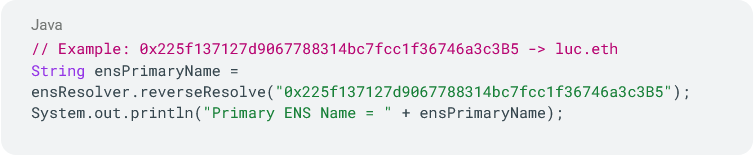
Forward Resolution: Resolve an ENS name (e.g., alice.eth) to its corresponding Ethereum address.Reverse Resolution: Retrieve the primary ENS name associated with a given Ethereum address.
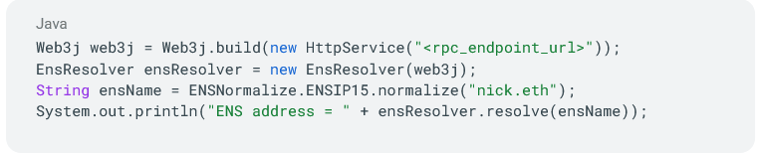
You can use ENS names anywhere you wish to transact in Web3j. In practice this means, in smart contract wrappers, when you load them, such as:
Also, when performing Ether transfers, such as using the command line tools:
What’s New in Hyperledger Web3j v4.12.3?
The latest release introduces a host of new ENS-related features that expand its capabilities:
1. Set Primary ENS Name for Any Address
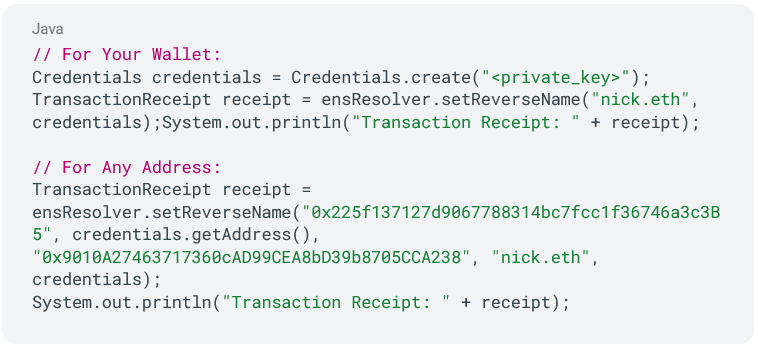
Web3j now allows developers to set the primary ENS name for any Ethereum address. This feature is vital for establishing human-readable identities within decentralized applications, enhancing user experience.
2. Manage ENS Records
ENS names can store additional metadata in the form of ENS records. Web3j v4.12.3 enables developers to:
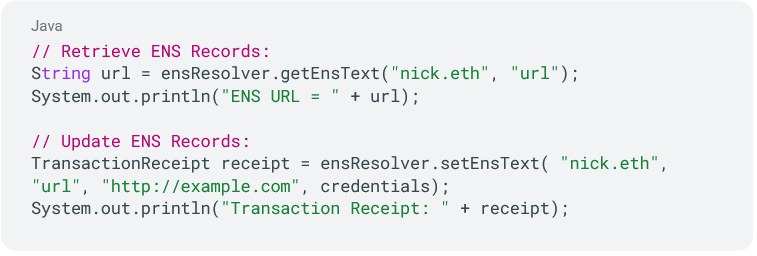
Retrieve records such as avatar, email, url, description, location, and more.Dynamically update these records to personalize or enhance ENS metadata.
3. ENS Metadata Service Integration
With integration into the ENS Metadata Service, Web3j now allows fetching detailed ENS information, including:
Registration and expiration datesAssociated metadata and recordsOwnership and resolver details.
This feature simplifies access to ENS-related data and supports rich metadata handling for dApps.
4. Extended Chain Support
Web3j has expanded ENS support to additional Ethereum networks:
This multi-chain support ensures greater flexibility for developers working in diverse blockchain environments.
Code Examples
Below are some practical examples to illustrate these new features:
1. Forward Resolution: ENS Name to Address
2. Reverse Resolution: Address to Primary ENS Name
3. Setting Primary ENS Name
4. Manage ENS Records
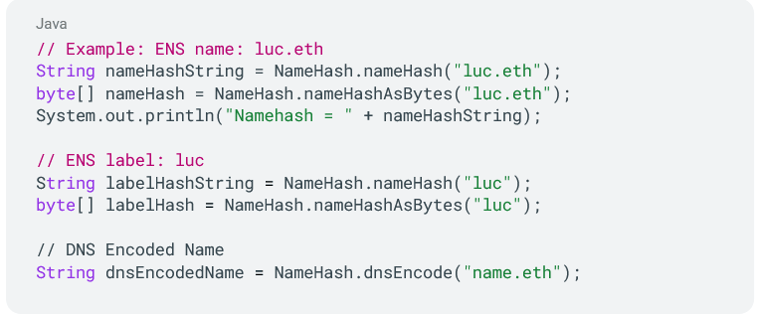
5. Get Namehash and Labelhash
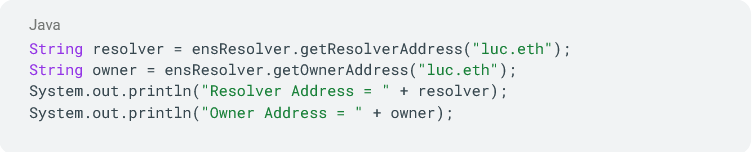
6. Retrieve Owner and Resolver Details
7. Fetch ENS Metadata
Why These Updates Matter
For Developers
Simplifies interaction with ENS, enabling advanced use cases like decentralized identity, metadata management, and personalized dApps.Enhances multi-chain flexibility, allowing developers to build on both testnets and mainnets.
For the ENS Ecosystem
Promotes greater adoption of ENS through improved tooling and user experience.Encourages dApp developers to leverage ENS for decentralized identity solutions.
If you’re interested in reviewing the implementation, you can check out the pull request on GitHub: Web3j ENS Features PR #2116
Conclusion
Hyperledger Web3j remains dedicated to supporting and advancing the Ethereum Name Service ecosystem. This release is a testament to the team’s commitment to enhancing ENS functionality.
Try out Web3j v4.12.3 today and start leveraging these powerful new ENS features. Share your feedback, suggest improvements, and help shape the future of ENS support in Web3j. You can find us here on the LF Decentralized Trust Discord or register for our community calls here.
Let’s build a more decentralized and user-friendly Web3 ecosystem together!
Published: February 04, 2025 at 7:14 am Updated: February 04, 2025 at 7:14 am
To improve your local-language experience, sometimes we employ an auto-translation plugin. Please note auto-translation may not be accurate, so read original article for precise information.
복권은 전 세계적으로 수백만 명의 플레이어를 끌어들이며, 인생을 바꿀 수 있는 당첨 기회를 제공합니다. 하지만 외국인의 참여에 대한 규정은 국가마다 다릅니다. 어떤 나라에서는 관광객과 비거주자가 티켓을 구매하고 당첨금을 받을 수 있지만, 일부 국가는 엄격한 제한을 두고 있습니다.
온라인 플랫폼의 등장으로 복권에 대한 접근성이 확대되면서 국경을 넘어 참여할 수 있는 기회가 증가했습니다. 그렇다면 외국인이 지역 복권에서 실제로 혜택을 볼 수 있을까요? 합법적인 참여를 위해서는 적격성, 세금 정책 및 온라인 대안을 이해하는 것이 필수적입니다.
한국에서 온라인 복권과 파워볼 플랫폼의 성장
한국에서는 오랫동안 복권이 인기를 끌었지만, 온라인 대체 상품이 시장을 빠르게 점령하고 있습니다. 특히 파워볼 스타일의 게임은 급격한 성장세를 보이고 있습니다. 집에서 편리하게 즐길 수 있고 24시간 내내 베팅할 수 있다는 점이 이 게임의 매력입니다.
파워볼 최상위 사이트는 플레이어들에게 안전하고 원활한 경험을 제공하며, 당첨금 지급의 투명성과 공정한 게임 방식을 보장합니다. 전통적인 복권과 달리, 이러한 플랫폼은 즉각적인 결과와 유연한 베팅 옵션을 제공할 뿐만 아니라, 다양한 결제 방법과 보너스 기능도 포함하는 경우가 많습니다.
한국 복권에 참여하고자 하는 외국인은 반드시 법적 구조를 이해해야 합니다. 관광객은 국가 복권 티켓을 구매할 수 없지만, 온라인 대안은 여전히 이용 가능합니다. 여러 플랫폼이 지리적 제한 없이 국제 플레이어에게 서비스를 제공하고 있으며, 파워볼 게임의 인기는 사용의 용이성, 모바일 호환성 및 신속한 거래 덕분에 계속해서 증가하고 있습니다. 하지만 신뢰할 수 있는 플랫폼을 선택하는 것이 중요하며, 허가받지 않은 사이트는 재정적 위험이나 법적 문제를 초래할 수 있습니다.
외국인의 복권 참여를 위한 법적 고려 사항
각국은 외국인의 국가 복권 참여 여부에 대해 다양한 법률을 가지고 있습니다. 미국과 같은 일부 국가에서는 방문객이 자유롭게 티켓을 구매하고 당첨금을 받을 수 있습니다. 하지만 당첨금은 거주 상태에 따라 다른 세율이 적용될 수 있습니다.
반면, 일부 국가는 시민권자와 영주권자 에게만 복권 참여를 허용하며, 외국인의 참여를 제한합니다. 예를 들어, 태국에서는 외국인이 국가 복권에 참여할 수 없습니다. 티켓을 구매하기 전에 이러한 규정을 이해하는 것이 법적 문제를 피하는 데 도움이 됩니다.
외국인이 복권을 구매할 수 있다고 해도, 당첨금 수령 과정에서 복잡한 절차가 있을 수 있습니다. 일부 국가는 당첨금을 직접 수령하도록 요구하며, 이로 인해 해외 거주자가 상금을 받기 어려울 수 있습니다. 또한, 거주지 기반 세금 정책으로 인해 비거주자에게 더 높은 공제가 적용될 수도 있습니다. 따라서 현지 복권에 참여하기 전에 적격성, 당첨금 청구 방법 및 법적 장벽에 대한 공식 규정을 확인하는 것이 중요합니다.
외국인을 위한 온라인 복권 대안
국가 복권에 참여할 수 없는 경우, 온라인 복권 플랫폼이 유용한 대안이 될 수 있습니다. 많은 국제 복권 웹사이트는 유로밀리언, 파워볼, 메가 밀리언과 같은 주요 복권 추첨에 대한 접근을 제공합니다. 이러한 플랫폼은 사용자가 위치에 관계없이 티켓을 구매할 수 있도록 하며, 당첨금은 직접 계좌로 입금됩니다. 하지만 보안과 공정한 플레이를 위해 허가받고 규제된 운영업체를 선택하는 것이 필수적입니다.
한국에서도 온라인 복권 플랫폼이 증가하고 있으며, 국내외 플레이어를 모두 수용하고 있습니다. 이러한 디지털 게임의 특성 덕분에 외국인도 법적 문제 없이 참여할 수 있습니다. 하지만 편리함에도 불구하고, 플레이어들은 소비자 보호 기능이 강한 검증된 플랫폼을 이용해야 합니다.
사용자 리뷰를 읽고, 공식 라이선스를 확인하며, 당첨금 지급 절차를 검증하는 것이 사기 사이트를 피하는 데 도움이 됩니다. 잘 규제된 온라인 복권 플랫폼은 접근성과 사용 편리성을 제공하여, 많은 플레이어들에게 선호되는 선택이 되고 있습니다.
외국인 복권 당첨자의 세금 고려 사항
외국인으로서 복권에 당첨되면 추가적인 세금 문제가 발생할 가능성이 큽니다. 많은 국가에서는 비거주자에게 다른 세율을 적용하여 최종 수령액에 큰 영향을 미칠 수 있습니다. 예를 들어, 미국에서는 외국인이 $600 이상의 상금을 받을 경우 30%의 연방 세금이 부과될 수 있으며, 거주자보다 더 높은 세율이 적용됩니다.
마찬가지로, 한국은 거주자와 비거주자에게 다른 세율을 적용합니다 따라서 당첨자가 실제로 받는 금액이 달라질 수 있습니다. 또한, 일부 국가는 해외에서 획득한 당첨금에 대한 세금 신고를 요구하기도 합니다. 이는 외국인 복권 당첨자가 당첨된 국가와 거주 국가에서 모두 세금을 납부해야 할 수도 있음을 의미합니다.
세금 전문가와 상담하면 이러한 의무를 명확히 하고 예상치 못한 공제를 피하는 데 도움이 됩니다. 지역 및 국제 세금 정책을 이해하면 당첨 후 실제로 받을 금액을 미리 파악할 수 있습니다. 외국 복권에 참여할 때 세금 법률을 숙지하는 것은 적격성 규정을 아는 것만큼 중요할 수 있습니다.
결론
일부 국가에서는 외국인도 지역 복권에서 혜택을 볼 수 있지만, 규정과 세금 정책은 나라마다 크게 다릅니다. 전통적인 복권에는 제한이 있을 수 있지만, 온라인 플랫폼은 보다 쉽게 접근할 수 있는 대안을 제공합니다. 신뢰할 수 있는 사이트는 특히 한국에서 안전한 게임 환경을 보장하며, 디지털 복권 플랫폼은 계속해서 성장하고 있습니다. 법적 요구 사항을 확인하고 세금 영향을 이해하는 것이 법적 또는 재정적 문제 없이 복권 기회를 최대한 활용하는 핵심 단계입니다.
Disclaimer
In line with the Trust Project guidelines, please note that the information provided on this page is not intended to be and should not be interpreted as legal, tax, investment, financial, or any other form of advice. It is important to only invest what you can afford to lose and to seek independent financial advice if you have any doubts. For further information, we suggest referring to the terms and conditions as well as the help and support pages provided by the issuer or advertiser. MetaversePost is committed to accurate, unbiased reporting, but market conditions are subject to change without notice.
About The Author
Gregory, a digital nomad hailing from Poland, is not only a financial analyst but also a valuable contributor to various online magazines. With a wealth of experience in the financial industry, his insights and expertise have earned him recognition in numerous publications. Utilising his spare time effectively, Gregory is currently dedicated to writing a book about cryptocurrency and blockchain.
More articles
Gregory, a digital nomad hailing from Poland, is not only a financial analyst but also a valuable contributor to various online magazines. With a wealth of experience in the financial industry, his insights and expertise have earned him recognition in numerous publications. Utilising his spare time effectively, Gregory is currently dedicated to writing a book about cryptocurrency and blockchain.
The next ID@Xbox Showcase is streaming on 24th February at 10am PT / 1pm ET / 6pm GMT as part of IGN Fan Fest.
There’s a big bunch of developers set to take part, but one of the few revealed highlights will be a new collaboration for addictive poker-like roguelite Balatro.
Here’s some of the studios that will be turning up with new trailers and reveals:
11 Bit
BigFan
Critical Reflex
Daedalic
Game Source Entertainment
No More Robots
Panic
Playstack
Raw Fury
Thunder Lotus
Cult Games
Team17
Curve
Akapura
Don’t Nod
There’s plenty that we might guess could appear through this showcase, with 11 Bit having released Frostpunk 2 on PC last year and might have a console port to announce, or acting as publisher to the upcoming soulslike deck builder Death Howl. Panic, meanwhile, has a bunch of games they’re publishing, including Time Flies, Blippo+ and more. Akapura also has an intriguing title they’re publishing, the 2D role playing game Cabernet, where you play as a 19th century vampire lady. That sounds like it sucks… but in a good way!
So plenty of possibilities, for what is sure to be a busy showcase!