Home Blog Page 13

Axis Robotics Raises $12M to Crowdsource Robot Training Data

0
Axis Robotics Raises M to Crowdsource Robot Training Data


Axis Robotics, a startup developing data infrastructure for Physical AI, has raised $12 million in a seed round led by Hack VC, with participation from Nomad Capital, Pi Network Ventures, 10K Ventures, and several angel investors. Announced on July 27, the investment comes amid growing demand for robot training data as robotics companies expand deployments beyond testing environments.

Axis stated it will use the capital to expand its data engine for robot training, aiming to build a pipeline for continuous data generation and improvement for Physical AI systems.

A $12M Bet on Physical AI Data

The seed round places Axis among the startups building data infrastructure for Physical AI, rather than developing robots or foundation models. Led by Hack VC with participation from Nomad Capital, Pi Network Ventures, and 10K Ventures, the deal reflects a trend of investors beginning to view robot training data as an infrastructure layer capable of scaling alongside the robotics market.

This thesis stems from a common industry challenge: Physical AI systems cannot rely solely on datasets collected just once. As robots are deployed in real-world environments, models must continuously ingest additional data from new scenarios, detect errors, and update policies to improve performance over time.

Instead of competing on hardware or foundation models, Axis aims to build the infrastructure to generate, validate, and update data for the robot training process, targeting Physical AI development teams in need of data sources that can scale with their deployments.

Inside Axis’s Data Engine

Axis’s core product is a closed-loop data engine for robot training, combining large-scale simulation, real-world egocentric data, and a human-in-the-loop post-training process.

Axis’s data engine combines three layers of data. The first is large-scale simulation to generate robot trajectories across various environments, tasks, and robot embodiments. Next is egocentric data collected from the robot’s perspective in real-world environments. Finally, the company utilizes a human-in-the-loop process to review, correct errors, and improve policies during the post-training phase.

In its year-end roadmap, Axis plans to deploy human-gated DAgger — a variant of the imitation learning method that only requires human intervention when the robot makes incorrect decisions or needs correction. The company expects this approach to help reduce the cost of generating post-training data while maintaining the quality of data for training.

According to Axis, the company’s system has processed over 200,000 verified trajectories. Previous campaigns also recorded 10,000+ valid trajectories in 3 days and 100,000 trajectories in 5 days.

The Bottleneck Holding Back Robots

Unlike language foundation models, which are trained on massive amounts of internet data, Physical AI must learn from real-world interactions — where every action is tied to objects, spaces, physical forces, and various environmental conditions.

This makes robot training data significantly harder to scale. Data is often fragmented by robot type, task, hardware, and deployment environment, while a policy that works well on one robot may not necessarily transfer to another. The gap between simulation and real-world operating conditions also continues to be a major barrier to commercial-scale robot deployment.

Consequently, many robotics companies are shifting their attention to platforms capable of continuously generating and updating data, rather than merely scaling models or hardware.

What’s Next for Axis

Following the seed round, Axis will focus on expanding both its product capabilities and operational scale. In the coming months, the company expects to deploy an egocentric data pipeline in September, expand simulation to more robot embodiments and atomic capabilities in October, and launch a large-scale post-training dataset based on human-gated DAgger by the end of the year. According to Axis, the company has collected “tens of thousands of hours” of egocentric data and is co-developing product requirements with several frontier labs.

Alongside product expansion, Axis also aims to scale its contributor network. The company stated it currently has over 100,000 contributors and aims to expand into Latin America and Eastern Europe, while increasing daily active users to 10,000. Operationally, Axis aims to generate over 500 hours of egocentric data and 50 hours of simulation data daily, while also developing the capacity to generate corrective post-training data.

On the commercial front, Axis aims to complete two to three paid pilots before the end of the year and become a preferred vendor for foundation model development companies in Q1 of next year. In the long term, the company wants to integrate its data engine directly into the training and deployment workflows of robot developers, AI model developers, and industrial operators.

Although the roadmap is fairly well-defined, Axis still needs to prove that data generated from crowdsourcing combined with simulation can improve performance during real-world robot deployment, rather than just scaling the dataset. This outcome will determine whether the company’s data infrastructure model can become a critical infrastructure layer for Physical AI as the industry transitions from initial experiments to commercial-scale deployment.


Source link

Top 10 Web3 Projects Reinventing Digital Ownership And Creator Rights | Metaverse Post

Top 10 Web3 Projects Reinventing Digital Ownership And Creator Rights | Metaverse Post


Top 10 Web3 Projects Reinventing Digital Ownership And Creator Rights

Books, software, and software as a service have been and will always be among the most valuable assets in the world for intellectual property.

Ideas are the source of innovation in almost all industries, whether it is a song, a patent, a research paper, a fashion design, a film script, or a software application. But never has it been easy to protect those rights. The time-consuming registration, high legal costs, disjointed licensing, and lack of visibility into content usage are just a few challenges that creators often encounter.

Blockchain technology is making a significant impact on that.

Developers are not only creating centralized databases and paper-based records, but they are also building platforms that register intellectual property on blockchain networks, automate licensing through smart contracts, and create transparent ownership records that can be verified anywhere in the world.

While the industry is still developing, the platforms are leading the way towards a more efficient and transparent IP system.

Here are 10 companies that are helping to make IP rights an on-chain reality.

The story has caught as much attention as any other blockchain project in terms of intellectual property.

The story is designed specifically for programmable IP, allowing creators and developers, artists and businesses to register their IP onchain and set the licensing rules through smart contracts. Instead of negotiating individual licensing for every work, creators can set up programmable permissions to control the uses of their creations, remixing, or commercialization.

AI content creators, media organizations, and creative industries have been increasingly drawn to its features, recognizing the need for more efficient systems to handle copyright and ownership in a world dominated by generative AI.

Top 10 Web3 Projects Reinventing Digital Ownership And Creator Rights

CAMP Network is about providing creators with more control over their digital creations.

Its blockchain technology enables the registration, verification, and licensing of intellectual property and the ability to construct applications directly on top of verified ownership records. The project has itself become a tool for creative economies, with digital ownership always needing to be clear between platforms.

With the rise of AI-generated content, tools that can detect plagiarism are becoming increasingly valuable.

Top 10 Web3 Projects Reinventing Digital Ownership And Creator Rights

Verisart is also one of the pioneering firms in the field of blockchain-based provenance.

The platform began as a digital art and collectibles marketplace but now extends its services to the certification of ownership, authentication of creative works, and the issuance of permanent digital certificates with blockchain technology. Verisart enables artists, galleries, brands, and collectors to generate tamper-proof records that can help to prove authenticity.

The company’s efforts underscore the potential of blockchain to go beyond cryptocurrencies to digital ownership more broadly.

Top 10 Web3 Projects Reinventing Digital Ownership And Creator Rights

Bernstein Technologies is a blend of traditional IP management and blockchain innovation.

It provides businesses with trademark, patent, copyright, and trade secret registration solutions and creates unalterable records that make verifying and licensing easier. Organizations can handle all IP portfolios from one platform and possess clear IP possession histories.

If a company has operations in various countries, blockchain records can help streamline administrative processes in different jurisdictions.

Top 10 Web3 Projects Reinventing Digital Ownership And Creator Rights

IPwe has grown to be among the more prominent names in patent digitization.

The company applies artificial intelligence combined with blockchain technology to enable businesses to tokenize patents, enhance patent discovery, and streamline patent licensing. IPwe is not just about patents as legal documents but intends to make them searchable, tradable, and more easily monetized.

Institutional interest in digital intellectual property infrastructure is reflected in its collaborations with enterprise organizations.

Top 10 Web3 Projects Reinventing Digital Ownership And Creator Rights

LegalNodes’ thinking on IP is from the legal automation perspective.

It’s designed to support startups, software enterprises, and technology businesses in handling contracts, licensing agreements, and IP documentation, as well as incorporating blockchain verification when needed. LegalNodes will simplify the legal process, enabling businesses to safeguard their valuable digital assets from their conception.

In recent years, new technologies have given rise to software being increasingly viewed as a global business, making IP management more and more critical.

Top 10 Web3 Projects Reinventing Digital Ownership And Creator Rights

Seal Storage is about preserving Digital Evidence.

This blockchain-based timestamping feature enables creators and businesses to establish the existence date of a document, design, research project, or creative work. This can be very useful in copyright cases where the date of creation is a crucial factor.

Seal Storage does not replace the traditional systems of registration; it offers an extra level of verifiable proof.

Top 10 Web3 Projects Reinventing Digital Ownership And Creator Rights

OriginStamp is a blockchain timestamping company.

The platform records in an immutable manner the digital files, making use of cryptographic hashes, which are linked to public blockchain networks. The service provides businesses, creators, journalists, and researchers with the ability to establish ownership and timeline, as well as prove authenticity, for sensitive intellectual property.

Its user-friendly quality has brought blockchain verification within the reach of everyone, irrespective of technical skills.

Top 10 Web3 Projects Reinventing Digital Ownership And Creator Rights

While Arweave is a decentralized permanent storage network, it has been proving to be a key component in the realm of IP.

Creators can securely store their creative work, legal records, research, and licensing information in perpetuity, with the ability to prove authenticity for decades. When paired with smart contracts and tokenization platforms, Arweave can provide the ability to store ownership records for the long term.

It’s a significant feature for digital creators who have concerns about the permanence of their work.

Top 10 Web3 Projects Reinventing Digital Ownership And Creator Rights

Molecule is taking the blockchain technology to scientific intellectual property.

The platform allows scientists, universities, biotech firms, and investors to tokenize scientific discoveries and biomedical research using Intellectual Property NFTs (IP-NFTs). Digital assets enable researchers to license their discoveries, fund their research, and work more effectively, while keeping the record of ownership clear.

With the development of innovative science being done collaboratively, a blockchain-based IP management may have a significant impact on commercialisation.

Top 10 Web3 Projects Reinventing Digital Ownership And Creator Rights

Intellectual Property Is Becoming Digital Infrastructure

Traditional methods of safeguarding intellectual property have been based on legal documents, centralised registers and time-consuming administrative procedures for decades.

There is a different model with blockchain. Ownership made more transparent. Programmable licensing agreement. Royalties can automatically be distributed. Researchers, artists, developers, and businesses find new ways of collaborating and have a clear record of ownership and attribution.

With the advent of generative AI, these capabilities are even more crucial. The ability to identify authorship and to establish who holds the rights to text, images, music, and software is becoming more difficult than ever as AI continues to be a major producer of such items in recent years.

Blockchain-based IP infrastructure has the potential to be a key solution to these problems, according to industry analysts. Rather than replacing current laws and regulations, these platforms operate alongside them, enabling the creation of verifiable digital documents that enhance transparency and minimize administrative complexities.

There are several companies that are contributing to the construction of that future, such as Story, CAMP Network, Verisart, Bernstein Technologies, IPwe, LegalNodes, Seal Storage, OriginStamp, Arweave, and Molecule.

According to their research, intellectual property could be one of the most impactful and useful real-world blockchain applications, not in lieu of the law, but rather by making it easier to prove, license and manage intellectual property rights in an increasingly digital economy.

Disclaimer

In line with the Trust Project guidelines, please note that the information provided on this page is not intended to be and should not be interpreted as legal, tax, investment, financial, or any other form of advice. It is important to only invest what you can afford to lose and to seek independent financial advice if you have any doubts. For further information, we suggest referring to the terms and conditions as well as the help and support pages provided by the issuer or advertiser. MetaversePost is committed to accurate, unbiased reporting, but market conditions are subject to change without notice.

About The Author


Alisa, a dedicated journalist at the MPost, specializes in crypto, AI, investments, and the expansive realm of Web3. With a keen eye for emerging trends and technologies, she delivers comprehensive coverage to inform and engage readers in the ever-evolving landscape of digital finance.

More articles


Alisa, a dedicated journalist at the MPost, specializes in crypto, AI, investments, and the expansive realm of Web3. With a keen eye for emerging trends and technologies, she delivers comprehensive coverage to inform and engage readers in the ever-evolving landscape of digital finance.


More articles


Source link

SEC Ready to Write Crypto Rules if CLARITY Act Stalls, Chair Atkins Says – NFT Plazas

0
SEC Ready to Write Crypto Rules if CLARITY Act Stalls, Chair Atkins Says – NFT Plazas


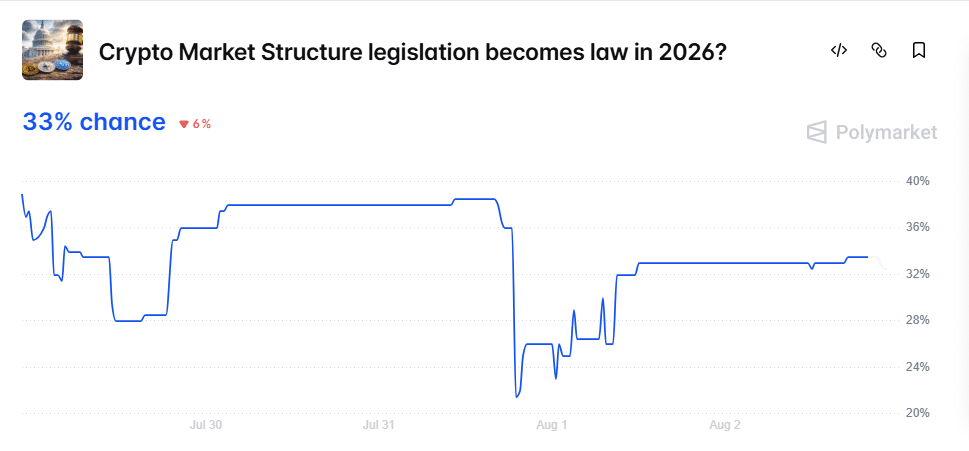
The U.S. Securities and Exchange Commission (SEC) is prepared to move ahead with its own cryptocurrency regulatory framework if Congress fails to pass the Digital Asset Market Clarity (CLARITY) Act, according to SEC Chair Paul Atkins.

Speaking with CNBC, Atkins said the agency is “ready, willing, and able“ to issue rules covering many of the same issues addressed by the landmark crypto market structure bill should lawmakers fail to deliver legislation. While emphasizing that congressional action remains the preferred outcome, Atkins signaled that the SEC has already laid much of the groundwork for a regulatory fallback.

SEC prepares a regulatory backup plan

Atkins stressed that a law passed by Congress would provide the most durable solution for the digital asset industry because legislation is far less vulnerable to policy reversals than agency rulemaking.

Statute is the way to future-proof something,” Atkins said, arguing that the crypto industry needs “the certainty of a statute” instead of a framework that could shift every time a new administration takes office.

Despite expressing confidence that Congress can still pass the CLARITY Act, Atkins confirmed the SEC is actively assisting lawmakers with technical guidance. He reiterated his support in a post on X, saying the Commission remains committed to helping Congress advance comprehensive crypto legislation.

His remarks underscore an increasingly realistic possibility that U.S. crypto regulation could initially emerge through SEC rulemaking rather than congressional legislation if political negotiations remain deadlocked.

SEC Ready to Provide Crypto Rules if Clarity Act Flounders: Chair Atkins (Source: X)

SEC Ready to Provide Crypto Rules if Clarity Act Flounders: Chair Atkins (Source: X)

CLARITY Act faces mounting obstacles in the Senate

The CLARITY Act has made significant progress over the past year but remains stuck in the Senate.

The legislation passed the U.S. House of Representatives in July 2025 by a bipartisan 294-134 vote before advancing through the Senate Banking Committee in May 2026 with a 15-9 vote. However, the bill still requires approval from the full Senate, where supporters are expected to need 60 votes to overcome procedural hurdles.

Momentum has weakened in recent weeks as Senate Democrats raised concerns over the bill’s ethics provisions governing public officials’ involvement in crypto assets.

Although revised language reportedly backed by President Donald Trump would prohibit the president, vice president, members of Congress, senior federal officials, and their spouses from issuing or sponsoring digital assets for profit until January 20, 2029, critics argue the proposal still leaves important loopholes.

Opponents note that the restrictions do not require existing crypto holdings to be divested, nor do they extend to officials’ children. Meanwhile, another unresolved issue centers on whether stablecoin issuers should be permitted to offer yield to token holders, a debate that continues to divide lawmakers.

Last week, Senate Majority Leader John Thune indicated that the CLARITY Act is unlikely to receive a floor vote before Congress begins its August recess. The Senate has since prioritized other legislative business, including a Russia sanctions package, pushing crypto market structure legislation further down the agenda.

Why the CLARITY Act matters

The legislation would establish one of the most significant overhauls of U.S. crypto regulation to date by creating a clearer division of authority between the SEC and the Commodity Futures Trading Commission (CFTC).

Under the proposal, the CFTC would receive exclusive jurisdiction over spot markets for digital commodities, moving many cryptocurrencies outside the SEC’s direct oversight while allowing the securities regulator to continue supervising tokenized securities and investment contracts.

Supporters argue that the framework would replace years of regulatory uncertainty with a consistent set of rules defining which agency oversees different categories of digital assets, reducing compliance risks for exchanges, issuers, brokers, and institutional investors.

Project Crypto becomes the SEC’s fallback

Even if Congress delays the CLARITY Act, the SEC has already begun implementing many of its core ideas through Project Crypto, Chairman Atkins’ broader regulatory initiative.

The agency’s Regulation Crypto agenda for 2026 includes proposals covering:

Registration exemptions for certain token offerings;A safe harbor framework for decentralized blockchain projects;Rules governing broker-dealer custody of digital assets;Regulatory standards for crypto trading venues; andAdditional guidance for tokenized securities and blockchain-based financial products.

Earlier this year, the SEC and CFTC also jointly introduced a new framework categorizing crypto assets into multiple groups, including digital commodities, digital collectibles, digital tools, payment stablecoins, and digital securities.

The guidance clarifies that a digital asset is not automatically a security simply because it exists on a blockchain. Instead, whether securities laws apply depends on how the asset is offered and sold, particularly if investors rely on promises of managerial efforts under the Howey investment contract test. Once those obligations have been fulfilled, a token may no longer fall under securities regulation.

Rulemaking cannot replace legislation

Despite the SEC’s readiness to proceed independently, Atkins has repeatedly acknowledged that agency rules have important limitations.

Unlike legislation enacted by Congress, SEC regulations and joint agency guidance can be revised or withdrawn by future administrations without requiring another vote from lawmakers. That means regulatory certainty achieved through rulemaking may prove temporary if political priorities change after future elections.

For that reason, Atkins continues to describe the SEC’s regulatory agenda as a bridge toward comprehensive market structure legislation rather than a permanent substitute.

Whether Congress ultimately revives the CLARITY Act after the August recess or the SEC moves ahead with its own rulemaking, the coming months are likely to determine the direction of U.S. digital asset regulation. The outcome will shape not only which federal agencies oversee the crypto industry but also how issuers, exchanges, developers, and institutional investors operate in the world’s largest financial market.


Source link

Tori Spelling Calls It Quits With ‘Beverly Hills 90210’ Rewatch Podcast

    0
    Tori Spelling Calls It Quits With ‘Beverly Hills 90210’ Rewatch Podcast


    Tori Spelling is closing the chapter on a project that allowed fans to relive one of television’s most beloved teen dramas.

    The actress has officially stepped away from the “90210MG” rewatch podcast she co-hosted with former “Beverly Hills, 90210” castmate Jennie Garth, ending a partnership that revisited behind-the-scenes memories and iconic episodes from the hit series.

    For Tori Spelling, the decision marks another turning point in a legacy closely tied to “Beverly Hills, 90210,” the cultural phenomenon that ran for 10 seasons and helped define teen television throughout the 1990s.

    ZUMAPRESS.com / MEGA

    After confirming on Instagram Live that she was leaving to pursue other projects, Tori Spelling has officially announced her exit from the “90210MG” rewatch podcast. The actress invited fans to keep supporting the podcast as Jennie Garth continues with the rest of the show.

    The departure comes while the co-hosts were recapping season eight of “Beverly Hills, 90210,” leaving two seasons of the iconic series still to cover. Although Spelling did not elaborate on her decision, she thanked listeners for their support and hinted that more projects are on the horizon.

    Her announcement also sparked speculation among fans, with some questioning why the news was shared during a livestream instead of on the podcast itself. However, neither Spelling nor Garth has suggested there was any conflict surrounding the decision.

    The Podcast Helped Keep The ‘90210’ Legacy Alive

    Tori Spelling at iHeartRadio 102.7 KIIS FM's Jingle Ball 2024 - Red Carpet
    C Flanigan/imageSPACE / MEGA

    Launched in 2020, “90210MG” reunited Tori Spelling and Jennie Garth decades after they starred together as Donna Martin and Kelly Taylor on “Beverly Hills, 90210.” The podcast quickly became a destination for longtime fans, blending episode recaps with behind-the-scenes stories from one of television’s defining teen dramas.

    Over the years, the pair revisited memorable moments from the series while sharing personal memories from the set, including stories that made headlines well beyond the show’s original run.

    One of the podcast’s most talked-about episodes featured Spelling recalling how future Oscar winner Hilary Swank was left in tears after learning she had been written off the series during its eighth season, according to Entertainment Weekly.

    With Jennie Garth now continuing the podcast alone, Spelling’s departure marks the end of an era for the rewatch series, even as the final two seasons of “Beverly Hills, 90210” remain to be explored.

    Tori Spelling Once Revealed The Hidden Insecurities Behind Donna Martin

    Tori Spelling at 2025 iHeartRadio Music Awards
    Lisa OConnor/AFF-USA.com / MEGA

    Well before she retired from the “90210MG” podcast, Tori Spelling has been open about her insecurities as a “Beverly Hills, 90210” star. Viewers found Donna Martin confident, popular, and glamorous, but the actress admitted she was not as confident about how she saw herself.

    Despite her starring role in one of the biggest shows on television, in a 2019 social media post, Spelling confessed to being “a young, really insecure teenager that never thought I was good enough. She said that she seemed like she was very confident in front of the camera, but not so sure off the camera, and that “perception is not always reality.

    TODAY reported that Spelling later said she wished she had been kinder to her younger self and hoped her experience would encourage other young people, including her daughters, to embrace who they are rather than trying to meet others’ expectations. 

    Donna Martin’s Biggest Storyline Was Years In The Making

    Tori Spelling attends the World premiere of 'Jumanji: The Next Level'
    Lumeimages / MEGA

    One of Donna Martin’s defining storylines was her decision to remain a virgin, a plot that lasted until season seven of “Beverly Hills, 90210.” While the storyline became one of the character’s trademarks, Tori Spelling admitted there came a point when she wanted Donna to move on.

    Speaking on the “90210MG” podcast in 2025, Spelling said Donna’s virginity initially felt like “a badge of honor” because the character represented something meaningful to many viewers.

    However, she eventually grew eager for the storyline to progress, explaining, “I kind of just want her to lose it. Like, what’s the next step?” She added that she was relieved when the long-running arc finally ended because it allowed the character to evolve beyond the same recurring plot.

    PEOPLE also reported that Spelling later learned the decision to keep Donna a virgin for so many years largely came from her late father, legendary producer Aaron Spelling, who believed the character should remain that way. Looking back, the actress said she had long suspected the choice was influenced by her father, even if she had never known for certain.

    Tori Spelling Continues Moving Forward Through Life’s Challenges

    Tori Spelling at the 93rd Annual Hollywood Christmas Parade Featuring Grand Marshal Luke Wilson To Support Marine Toys For Tots
    Xavier Collin/Image Press Agency/MEGA

    Stepping away from the “90210MG” podcast is only the latest change in a period of transition for Spelling. In recent months, the actress has remained in the public eye through both personal milestones and emotional moments, including paying tribute to former boyfriend Patrick Muldoon following his death.

    Spelling also drew attention after stepping out in a sheer sequined outfit, sparking mixed reactions online, with some social media users criticizing the revealing look. In contrast, others defended her right to express herself. The Blast reported that the appearance quickly became a talking point, adding to the renewed spotlight surrounding the actress.


    Source link

    MoonPay Launches PayBox, Letting ChatGPT and Claude Turn Prompts Into Crypto Payments – NFT Plazas

      0
      MoonPay Launches PayBox, Letting ChatGPT and Claude Turn Prompts Into Crypto Payments – NFT Plazas


      MoonPay has unveiled PayBox, a new AI-native payment vault that enables ChatGPT and Claude users to securely execute cryptocurrency transactions, interact with decentralized finance (DeFi) protocols, and even make real-world purchases without leaving the conversation. The company says the product is designed to transform AI assistants from tools that provide recommendations into agents capable of carrying out financial actions while keeping users in control of their funds.

      The launch marks another milestone in the growing “agentic commerce” movement, where AI can complete tasks on behalf of users instead of simply answering questions. By connecting PayBox to ChatGPT or Claude through a custom connector, users can issue natural language commands such as “Onramp $100 into PYUSD,” “Swap $100 of PYUSD to SOL,” “Bridge funds to Robinhood Chain,” or “Maximize yield using Aave.” The AI prepares the transaction, and the user authorizes it with a passkey before funds are transferred.

      Beyond crypto transactions, PayBox also enables AI assistants to book flights, reserve restaurant tables, and shop online through integrations built on x402, an open standard for agent-initiated internet payments. MoonPay says additional merchant and service integrations will be introduced over time.

      MoonPay Launches PayBox

      MoonPay Launches PayBox

      Bringing payments directly into AI conversations

      Until now, conversational AI platforms such as ChatGPT and Claude could help users analyze markets, compare investment opportunities, or explain blockchain protocols, but users still had to switch to exchanges, wallets, or payment platforms to complete every transaction.

      PayBox aims to eliminate that extra step by embedding payment functionality directly inside the AI interface. Users can trade cryptocurrencies, bridge assets across blockchains, interact with DeFi protocols, and make payments without leaving the conversation, while retaining final approval over every transaction.

      At launch, PayBox supports Solana and several Ethereum Virtual Machine (EVM)-compatible networks, including Ethereum, Base, Arbitrum, Polygon, Hyperliquid, Robinhood Chain, and Tempo, with additional blockchain support planned in future releases.

      Security built around user control

      MoonPay says security was the primary consideration in designing PayBox. Rather than storing private keys in a single location, the platform uses multi-party computation (MPC) and trusted execution environments (TEEs) to split wallet credentials across secure environments. As a result, neither MoonPay nor the AI assistant can independently access a user’s wallet or authorize transactions.

      The infrastructure is powered by Sodot, the Israeli key management company MoonPay acquired earlier this year. According to the company, Sodot secures more than $50 billion in digital assets across over 10 million crypto wallets, and its technology now underpins every PayBox vault.

      For card payments, PayBox integrates Visa’s agentic commerce protocol, allowing AI to complete purchases without exposing or storing raw card details. Every passkey authorization is limited to a single transaction, preventing approvals from being reused or replayed if compromised.

      Balancing automation with human oversight

      PayBox offers users two permission models. Always Ask requires passkey approval before every transaction, ensuring that users manually authorize every payment or crypto transfer. Alternatively, Autonomous mode allows AI to execute transactions automatically within predefined limits, such as spending caps or approved transaction types.

      MoonPay says users can modify or revoke permissions at any time, but any changes require fresh human authentication. The company argues this approach removes the tradeoff found in many AI payment solutions, where users must surrender custody of their assets to a centralized platform before automation becomes possible.

      Balancing automation with human oversightBalancing automation with human oversight

      Balancing automation with human oversight

      MoonPay expands its AI ambitions

      PayBox is the latest addition to MoonPay’s broader AI strategy. Earlier this year, the company introduced an open AI wallet standard backed by organizations including PayPal, the Ethereum Foundation, and the Solana Foundation, followed by tools that enabled cryptocurrency purchases and wallet interactions through AI assistants. PayBox extends those capabilities by allowing the entire payment workflow to occur inside the conversation.

      The company has also released a software development kit (SDK) that enables developers to integrate PayBox into their own AI applications and plans to expand support to additional AI platforms while adding more advanced DeFi features, including perpetual futures trading and liquidity management.

      MoonPay CEO Ivan Soto-Wright described conversational payments as the next evolution of digital finance.

      The card hid the cash. The phone hid the card. This is the era where money disappears into conversation,” Soto-Wright said, adding that billions of AI agents will require secure infrastructure to hold, move, and spend money safely.

      To encourage adoption, MoonPay is also offering a USDC airdrop for eligible early users, with rewards of up to 500 USDC per account based on campaign requirements and account eligibility.

      As AI assistants continue evolving beyond chatbots into autonomous digital agents, PayBox highlights how conversational interfaces may become the next gateway for cryptocurrency trading, decentralized finance, and everyday online commerce.


      Source link

      Emmerdale summer drama revealed as major female characters find themselves in peril

        0
        Emmerdale summer drama revealed as major female characters find themselves in peril


        Emmerdale’s summer spoilers are out, and the village’s women will take centre stage in the drama ahead.

        The coming weeks will see huge storylines unfold for six residents of the Dales, with Gabby, Charity, Dawn, Sarah, Serena and returning character Sadie King all finding themselves caught up in the action.

        With power struggles, dangerous decisions and explosive secrets on the horizon, this summer is shaping up to be one the village won’t forget.

        There’s peril in store for some (Credit: ITV)

        This summer will ‘change the village forever’

        While summer is already underway, the drama is far from over. With August fast approaching, things are about to heat up for some of Emmerdale’s biggest characters, with the women of Yorkshire at the heart of the chaos.

        Gabby, Charity, Dawn, Sarah, Serena and Sadie will all face major challenges as ‘new allegiances are formed’ and ‘old feuds reignited’ in a season that has been teased as one that will ‘leave the village changed forever.’

        Emmerdale producer Laura Shaw has teased: “From explosive secrets that shatter lives to dangerous new allegiances that threaten to tear the village apart, this season promises to be one of our most intense yet. The village is set for a dramatic transformation, and we can’t wait for our audience to see the peril these characters face.”

        Emmerdale's women promo serious
        Summer is a huge one for certain villagers (Credit: ITV)

        Emmerdale’s leading ladies face a summer of secrets and danger

        The village’s leading women will have a turbulent few months, with secrets, lies and impossible choices threatening to turn their worlds upside down.

        Charity wants to protect her family, sparking a dangerous web of lies. Before long, a shocking confession sends ripples through the village. Meanwhile, Sadie makes her dramatic return to the Dales with her own agenda, and it doesn’t take long before she reveals a bombshell that leaves everyone stunned.

        Dawn should be preparing for her big day, but instead finds herself trapped in the middle of a bitter feud. As tensions continue to rise, she has to make a heartbreaking choice about her future. Sarah is also under pressure as the truth about Leyla’s parentage threatens to come out, putting everything she knows at risk.

        Elsewhere, Serena’s secrets become increasingly difficult to keep hidden as her situation becomes more dangerous, leaving her to decide how far she is willing to go. Gabby is also struggling to hold everything together, but the pressure pushes her to breaking point and puts her health in serious danger. Following a shocking incident, she faces a major moral dilemma that could change several lives forever.

        One thing is clear – Emmerdale’s women won’t be having a calm summer anytime soon.


        Source link

        This Gruesome 2026 Shark Movie On Prime Video Is An Instant Streaming Hit – SlashFilm

          0
          This Gruesome 2026 Shark Movie On Prime Video Is An Instant Streaming Hit – SlashFilm


          If you find yourself hopelessly scrolling through the streaming apps this week, consider Prime Video’s latest. The streamer is offering you the chance to watch the guy from “The Summer I Turned Pretty” and the gal from the “To All the Boys” films get menaced by a massive bull shark. “The Devil’s Mouth” is a survival thriller that stars Gavin Casalegno and Lana Condor as college students who, along with their other college friends, find themselves trapped in an underground cave system with a hungry shark. It doesn’t have the best reviews, but Prime Video subscribers appear to be enjoying it.

          Shark movies are having a moment. At the same time “The Devil’s Mouth” debuted on Prime Video, horror action thriller “Above & Below” hit digital services. What’s more, both films come in the wake of “The Bay,” which followed “Deep Blue Sea” director Renny Harlin’s return to shark movies with “Deep Water.” Meanwhile, earlier this year, Netflix delivered a shark disaster flick that was everything we wanted it to be with “Thrash,” and now we have “The Devil’s Mouth.”

          The film is directed by Jeff Wadlow, who previously helmed 2013’s “Kick-Ass 2” and Blumhouse’s horror getaway reboot “Fantasy Island.” The latter didn’t go over too well with critics, and Wadlow’s latest isn’t faring much better, having earned a 38% critic score on Rotten Tomatoes. The audience score for “The Devil’s Mouth” ain’t great either at 21%. Still, a few critics actually liked it, and Prime Video users seem to be having a good time with it, having sent this specific shark movie to the top of the service’s worldwide streaming charts.

          The Devil’s Mouth is a global hit on Prime Video

          “The Devil’s Mouth” follows five college friends (played by Kathryn Newton, Lana Condor, Gavin Casalegno, Nico Hiraga, and Tommi Rose). During a vacation in Thailand, the gang sign up for a guided swim through the titular underwater cave system. Things start out well enough, with the group enjoying their yacht trip prior to diving into the caves. But it turns out a storm the week prior filled the caves with sea creatures, and while almost all of them perished, one determined bull shark survived. Probably not the best time to get trapped in the caves, then. But that’s exactly what happens.

          The shark isn’t the only threat to the group. Longstanding resentments and some toxic personalities mean the crew struggle to work together to escape the apex predator hunting them. Things only get worse as the ordeal goes on, with the group fracturing under the pressure.

          Is “The Devil’s Mouth” one of the best shark movies of all time? No. Has it won over the streaming crowds? Yes. The movie hit Prime Video on July 29, 2026, and, per FlixPatrol, immediately hit the streamer’s video charts in 50 countries around the world. At the time of writing, “The Devil’s Mouth” ranks at number three on the movie chart and number five on the overall chart, which isn’t a bad debut. But it’s also proved popular worldwide, hitting number one on the movies chart in Finland, The Netherlands, The Philippines, and Spain. Somehow, it’s even number one on the overall chart in Belgium, The Philippines, and Poland.

          The Devil’s Mouth might just be better than the reviews suggest

          Clearly, “The Devil’s Mouth” has something to it, even if that 38% RT score dwells like a ticked off bull shark just below the surface. All the same, a couple of the “top critics” on RT apparently enjoyed it. Benjamin Lee of The Guardian, for instance, gave it three stars and maintained that the toxicity of the friends in the film added “more than just body parts to the water.” The Los Angeles Times’ Mary McNamara was similarly complimentary, calling the movie “great fun to watch” and writing, “At a time when cataloging travel woes have become such a big part of the cultural conversation, it offers the ultimate escape.”

          Still, the bad reviews are pretty scathing. Jacob Oller of the AV Club criticized the “grating dialogue and doggy-paddle pace,” and The Age’s Jared Richards called it a “bland horror” that’s “ugly in all the wrong ways.” That said, those few positive reviews and the film’s streaming success suggests “The Devil’s Mouth” might be destined to become an underrated shark movie. At the very least, those still upset with the worst things Jeremiah Fisher (Gavin Casalegno) did on “The Summer I Turned Pretty” might enjoy seeing the guy pursued by a ruthless killing machine. Otherwise, the only way to know for sure whether you’ll side with the negative or positive reviews is to watch the movie for yourself on Prime Video. Alternatively, it’s not like there’s a shortage of shark movies in 2026.


          Source link

          Coinbase Misses on Q2 Earnings as Crypto Trading Activity Slows – Decrypt

          0
          Coinbase Misses on Q2 Earnings as Crypto Trading Activity Slows – Decrypt


          In brief

          Coinbase reported $1.22 billion in second-quarter revenue, and a net loss of $359 million, against an expected $1.29 billion in earnings.
          Subscription and services revenue totaled $555 million, or 48% of net revenue.
          Coinbase said its crypto trading market share reached a record 10.3% during the quarter.

          Coinbase reported $1.22 billion in second-quarter revenue on Thursday, down 14% from the previous quarter, and a net loss of $359 million.

          Coinbase shares fell sharply in after-hours trading, losing roughly 5% of its stock price, after missing on earnings estimates for the quarter. The company was expected to bring in $1.29 billion in Q2.


          According to Coinbase, total crypto spot trading volume declined more than 20% from the previous quarter as crypto asset prices fell and market volatility reached multi-year lows. Transaction revenue totaled $599 million—lower than the expected $628 million.

          Subscription and services revenue totaled $555 million, representing 48% of net revenue. Coinbase said the figure was below its previously forecast range of $565 million to $645 million because certain USDC-related commercial agreements closed later than expected and lower crypto asset prices reduced staking revenue.

          Stablecoin revenue totaled $292 million. Average USDC held across Coinbase products reached a record $20 billion during the quarter, representing more than 30% of USDC in circulation at quarter-end. Coinbase also said 88% of net revenue came from sources other than Bitcoin spot trading, compared with 45% in the second quarter of 2020.

          Coinbase said its crypto trading market share reached a record 10.3% during the quarter, its third consecutive quarter of market share gains. The company said it gained share in both spot and derivatives trading.

          In a bright spot for the company, prediction markets contracts and revenue grew 106% from the previous quarter and exceeded a $100 million quarterly annualized net revenue run rate, according to Coinbase. Average Borrow/Lend balances increased by more than $1 billion from a year earlier to $1.49 billion. The company also said the conditions for its commercial agreement with Circle to renew in August automatically had been met.

          The earnings report follows a busy second quarter for Coinbase.

          In May, the company became the first U.S. crypto exchange cleared to offer customers access to offshore crypto perpetual futures through its Deribit subsidiary. In June, Coinbase launched Coinbase for Agents, a platform that lets AI agents trade crypto, make payments and manage portfolios on users’ behalf. Later that month, the company announced plans to launch tokenized stock trading, crypto and equities options, along with new lending and rewards products.

          Coinbase ended the quarter with $8.6 billion in cash and cash equivalents and $10 billion in total available resources. During the quarter, the company repurchased 814,000 Class A shares. Year to date, it has repurchased nearly 7 million shares for $1.2 billion, leaving about $2 billion remaining under its share repurchase authorization.

          For the third quarter, Coinbase said transaction revenue totaled approximately $130 million through July 26. The company expects subscription and services revenue between $500 million and $580 million and adjusted expenses between $980 million and $1.08 billion.

          Despite the weaker-than-expected earnings report, Coinbase CEO Brian Armstrong remained optimistic about the future of the company.

          “Coinbase is no longer a bet just on the price of Bitcoin,” he said during the earnings presentation. “All of financial services are getting updated by crypto technology, whether that’s trading or payments or lending. And Coinbase is the best-positioned company in the world to power this. And of course, this next frontier is going to be agentic finance, where we’re an early leader.”

          Daily Debrief Newsletter

          Start every day with the top news stories right now, plus original features, a podcast, videos and more.


          Source link

          Uniswap Rallies 11% as UNI Reclaims Key $4 Price Level

          Uniswap Rallies 11% as UNI Reclaims Key  Price Level


          Key Highlights

          DUniswap (UNI) surged 11% in 24 hours, reclaiming the $4 level for the first time since early May.

          Large investors, including Wintermute and Cumberland-linked wallets, increased UNI buying, helping drive the price higher.

          Trading activity jumped sharply, with open interest, futures volume, and spot buying all rising as UNI targets the $4.5–$4.8 resistance zone.

          Uniswap’s native token, UNI, climbed above the $4 psychological level on Thursday for the first time since early May as buying activity increased. 

          At the time of this writing, UNI was trading for $4.40, representing an 11% surge over the last 24 hours. Trading volume rose 22% to around $368 million, while the token’s market cap increased by 11% to $2.75 billion.

          Why is Uniswap surging today?

          Whale activity appears to be one of the key drivers behind the rally. Market maker Wintermute recently moved more than $1 million worth of UNI to deposit wallets across several major crypto exchanges, including Binance, Bybit, OKX, and Gate. 

          At the time, UNI was trading near $3.70 before climbing to around $3.90 as traders reacted to the transfers and watched for a breakout above the $4 level.

          In an X post, blockchain analyst Nazoku wrote, “Within the past 2 hours, Wintermute has sent over $1m worth of $UNI to its deposit wallets across several CEXs, including Binance, Bybit, OKX, and Gate. $UNI has edged up from $3.7 to $3.9 and is now aiming to break above $4 for the first time in July.”

          Not long after that, UNI achieved exactly what many traders had been waiting for. The token climbed above $4 as another large investor entered the market. 

          According to Nazoku, a wallet linked to crypto trading firm Cumberland bought about $6.12 million worth of UNI before moving the entire amount to a wallet connected to Monetalis. 

          The transactions drew attention because they suggested continued institutional interest in UNI. Despite exchange-related transfers that are often viewed as potential selling signals, buyers continued absorbing available supply, allowing UNI to hold above the key $4 level.

          Trading activity picks up across the market 

          Data from Coinglass shows that open interest has increased by 15.66% to around $311.50 million.

          Meanwhile, future trading volume surged by 32% to roughly $493 million. This means that traders are actively trading the market, pushing the price up as they enter more positions. 

          UNI faces its next major price test 

          The chart on the daily time frame shows how the price action played out. UNI is demonstrating strong bullish momentum, printing its third consecutive green daily candle after breaking out above a recent consolidation range

          The price is rapidly approaching a key resistance zone between $4.50 and $4.80; a decisive daily close above $4.80 could pave the way toward the $6.00 target. 

          However, with the 14-day RSI entering overbought territory at 74.14, traders should monitor for potential short-term resistance or a healthy pullback toward the primary support region at $3.66. 

          Also Read: KAITO Price Soars 120% in July as Retail Buying Fuels Rally 


          Disclaimer: The information researched and reported by The Crypto Times is for informational purposes only and is not a substitute for professional financial advice. Investing in crypto assets involves significant risk due to market volatility. Always Do Your Own Research (DYOR) and consult with a qualified Financial Advisor before making any investment decisions.


          Source link

          As Ross spikes Tracy, Kate Ford’s Coronation Street future explored

            0
            As Ross spikes Tracy, Kate Ford’s Coronation Street future explored


            Coronation Street tonight (Thursday, July 30) left fans fearing for Tracy Barlow after she was rushed to hospital when Amy discovered her barely conscious at home.

            The terrifying ordeal came after Ross secretly spiked Tracy’s drink in a twisted attempt to frame Cassie for the attack.

            But, with Tracy being taken away in an ambulance, could this spell the end for Kate Ford’s time on the ITV soap?

            Tracy was found unconscious (Credit: ITV)

            Tracy rushed to hospital in Coronation Street

            After Ross threatened her earlier this week, Cassie was horrified to see Tyrone continuing to welcome his dad into his life.

            Knowing Ross was preparing for his first day working at the prison after landing the job, Cassie decided to take matters into her own hands and teach him a lesson.

            While at the Barlows’ house, she slipped some of Tyrone’s pain medication into a flask. But when she heard Ross coming downstairs after his shower, she made a quick escape, accidentally leaving both the bag and the empty medication packet behind.

            Ross spotted Cassie leaving through the back door and soon found the evidence she’d left behind.

            Rather than confront her, he hatched a cruel revenge plan. He offered Tracy a smoothie made from the flask, unknowingly giving her the drugged drink.

            When Amy got home, she found Tracy barely responsive on the sofa. Ross urged her to call an ambulance, and Tracy was rushed to hospital with Amy fearing the worst.

            Tracy in an ambulance in Coronation Street
            Will Tracy be alright? (Credit: ITV)

            Kate Ford’s Coronation Street future explored

            Coronation Street has not officially confirmed that Kate Ford is leaving the ITV soap.

            As one of the show’s most iconic characters, any permanent exit for Tracy Barlow would likely be given plenty of build-up.

            That said, soaps are never afraid to spring a huge shock. And, Tracy dying so suddenly would certainly leave viewers stunned.

            Fans will have to tune in tomorrow (Friday, July 31) to find out whether Tracy pulls through. For now, everyone will be hoping she makes a full recovery.

            Read more: Coronation Street opinion: Soap losing balance as villains dominate

            Coronation Street usually airs Monday-Friday at 8.30pm on ITV.

            What do you think about this story? Let us know by leaving a comment on our Facebook page @CoronationStreetInsider. We want to hear your thoughts!


            Source link

            Popular Posts

            My Favorites