Having brain surgery to remove a tumour late last year changed Davina McCall’s life. But her son didn’t quite appreciate how serious it was until after the fact, she has revealed.
Davina, 57, had a couple of reservations ahead of her TV comeback for the Comic Relief telethon later on tonight (March 21).
And she was understandably angry – at first – when her partner Michael pushed her to return to work. She was glad for the encouragement in the end, though.
Now we know from a new interview that her son Chester didn’t know quite how serious her brain surgery was until after she’d had it…
The TV star went in for surgery on November 15 (Credit: Begin Again with Davina McCall/YouTube)
Davina McCall reveals son’s reaction to brain tumour removal
TV presenter and national treasure in the making Davina McCall has opened up about her recovery following brain surgery.
Speaking during Brain Tumour Research’s Closer to a Cure: 15 Years of Impact gala at London’s Dorchester Hotel, she said she feels “exactly the same”.
Her partner, hairstylist Michael Douglas, was with her. Davina told Hello! magazine she had a new outlook on life, but that she felt no different in terms of her personality.
Of course her children, Holly, 23, Tilly, 21, and Chester, 18, whom she shares with ex-husband Matthew Robertson, are delighted that she’s back to her bubbly old self.
But seeing her off to the hospital may have been easier for some than others. Namely her son Chester, who said when she got home that he “didn’t know it was that serious”.
“I was quite pleased in a funny sort of way but then I also thought I hadn’t really done my job properly,” she said.
Davina added: “I didn’t want to worry him, but I hadn’t prepared him [for] if it hadn’t gone well. I felt like I’d slightly shortchanged him there. But I’m okay, so it’s great news.”
Fortunately, she’s returned to good health (Credit: Begin Again with Davina McCall/YouTube)
She’s found the return of her normal brain function ‘exhausting’
Davina McCall had a cyst between the left and right hemispheres of her brain. Now that her cognitive function has returned to normal, four months after the operation, she appreciates the symptoms she experienced before it.
“My mind had gone quiet, and now my mind’s woken up. It’s absolutely exhausting! I remember waking up going: ‘Oh my god, shut up!’ I was thinking so much.”
She was the same in every other way, she says. And she’d started meditating, so she assumed the quieting of her “brain chatter” was a sign she’d just “gone a bit more zen”.
Davina is among the stars presenting the Comic Relief telethon tonight (March 21) on BBC One at 7pm.
Read more: Davina McCall’s tears over daughter Tilly: ‘I cried all the way home’
So what do you think of this story? You can leave us a comment on our Facebook page @EntertainmentDailyFix and let us know.
Logitech has introduced the Zone 305 headset, positioned as an affordable solution designed especially for business users. But how does it stack up against higher-end models like the excellent Zone Wireless 2, and to who exactly is the Zone 305 suited for? I have written a Logitech Zone Wireless 2 in review article before, and it is quite logical to compare these two headsets together. Thank you Logitech for providing me Zone 305 for testing and honest review.
What is Logitech Zone 305?Key Specifications:Who is the Zone 305 for?My hands-on impressions: Pros and ConsPros:Cons:Logitech Zone 305 vs. Zone Wireless 2Feature Comparison Zone 305 vs Zone Wireless 2:Should You Buy the Logitech Zone 305?
What is Logitech Zone 305?
Logitech Zone 305 is a lightweight, inexpensive wireless business headset optimized specifically for daily office use, calls, and meetings and priced for mass deployment. 305 is certified for Microsoft Teams, ensuring seamless compatibility and easy integration into your Teams workflow. Logitech describes it as a practical, no-nonsense headset for hybrid or open-office scenarios, emphasizing clarity, affordability, and user-friendliness.You can manage Zone 305 with Logi Tune and with Logitech Sync as it is designed for businesses for mass deployment. I also like how much of materials is either recycled materials and overall how Logitech is keeping the sustainability in mind with both products and packaging (easy to recycle carbon).
Key Specifications:
FeatureSpecificationConnectivityWireless (Dongle required for Teams Certification & Teams-button functionalities)MicrophoneBeamforming, Noise-cancellingBattery LifeUp to 16 hours (Talk), 24 hours (Listening)ChargingUSB-CCompatibilityMicrosoft Teams certified, Zoom, Google MeetEar Cushion TypeOn-earMicrophone PositionFixed (Left side)Weight4.30 oz (122 g)Price (List)$99.99
Check detailed specs here
Who is the Zone 305 for?
Zone 305 is aimed at professionals who need a reliable, budget-friendly headset without the frills of premium features like Active Noise Cancellation (ANC). If you’re in a quiet home office or prefer simplicity over feature overload, the 305 is a good candidate. Logitech has designed 305 for organizations buying headsets in bulk, keeping budgets tight without compromising call quality.
However, if your workplace is noisy or you spend extended hours wearing your headset, this might not be your ideal choice.
My hands-on impressions: Pros and Cons
Pros:
Lightweight: Weighing less than heavier models, it doesn’t feel cumbersome initially.
Audio Quality: Despite its affordable price, audio playback is surprisingly good. Music sounds clear and enjoyable—impressive for a business-oriented headset.
Microphone Quality: The mic is excellent, featuring noise-canceling via beamforming mics, significantly reducing ambient noise for those on the other end of the call.
Microsoft Teams Certified: Seamless integration makes daily meeting setups hassle-free.
Budget-friendly: At a list price of just $99.99, the value proposition is strong.
Cons:
Slight Comfort Issues: Despite its lightweight build, Zone 305 presses firmly onto the ears. Mind you, I am not a fan of on-ear headsets as they generally aren’t comfortable when used for several hours without a break. After an hour, 305 starts to become uncomfortable and press my ears. After two hours, I need a break.
No ANC: Ambient noise can quickly become distracting. If your office is busy or noisy, this headset may not sufficiently isolate you.
Dongle Required for Teams Certification (at the moment): Returning to a dongle after experiencing dongle-free connectivity (like with the latest Zone Wireless 2 update) feels disappointing. This adds inconvenience and occupies one of my two USB-C ports. The headset can be used without a dongle, but it then loses Teams Certification and Teams-button functionalities.
Build Quality: The headset feels plasticky compared to the Zone Wireless 2, lacking that premium touch.
Volume Issue: It defaults volume to 100% on Windows 11 when initially connecting, which can be a slightly unpleasant surprise.
Fixed Microphone Position: Unlike the Zone Wireless 2, the microphone is fixed on the left side and cannot be swapped.
Zone 305 is undergoing certification for Microsoft Teams over native Bluetooth, which means it will be dongle-free soon / in the future. See this Logitech info page for details about models getting native Bluetooth support.
Logitech Zone 305 vs. Zone Wireless 2
Comparing the Zone 305 directly to my recent favorite, the Zone Wireless 2 (read more about Zone Wireless 2), highlights key trade-offs. The Wireless 2 feels superior in almost every respect—better comfort, premium build, ANC, and flexibility (e.g., microphone can be flipped from side to side). Zone Wireless 2 also recently got a fantastic dongle-free upgrade (check my post here), making it even more appealing. The advantages of Zone 305 over Wireless 2 are affordability, lighter and it has a newer Bluetooth support.
Feature Comparison Zone 305 vs Zone Wireless 2:
FeatureZone 305Zone Wireless 2ConnectivityDongle required for Teams certification ( at the moment). Bluetooth 5.3.Teams Certification over native Bluetooth, Bluetooth 5.2Microphone FlexibilityFixed (Left side only)Flip microphone to use it left or right sideActive Noise CancellationNoYesComfort (my experience)Moderate (short-term)Better (medium-term)Build QualityPlastic feelPremiumWeight4.30 oz (122 g)8.11 oz (230 g)Battery Life (Talk)Up to 16 hoursUp to 15 hours (ANC on), 18 hours (ANC off)Battery Life (Listening)Up to 24 hoursUp to 22 hours (ANC on), 40 hours (ANC off)Microsoft Teams CertifiedYes, with dongleYesList price$99.99$249.99Zone Wireless 2 “gently cushions your ears with a silicone headband and breathable materials that are soft to the touch and designed to apply pressure evenly.” Quote and picture from Logitech Wireless 2 site.
If the budget isn’t your primary concern, Zone Wireless 2 is clearly the superior headset, especially if you frequently spend long hours on calls. Having a need for mass deployment, the price is clearly on 305’s side.
Should You Buy the Logitech Zone 305?
The Zone 305 is a solid headset choice if you’re budget-conscious and don’t have too much requirements. It excels in voice, microphone quality, and simplicity. However, the lack of ANC, comfort issues during prolonged use (my personal experience, but head sizes and details vary), and the necessity of a dongle (at the moment of writing this article) may be significant downsides for some.
Overall, the Zone 305 delivers precisely what it promises: a practical, reliable, and affordable headset for mass deployment. No surprises. Keep in the mind: 305 isn’t trying to be the best headset for individuals, it wants to be the best headset for mass purchases where you are equipping your workforce with quality devices, while keeping the cost of a single device low enough and you can ensure the management and updates of these devices centrally.
Individually I would always want to pick Zone Wireless 2, but when there are budget limits it might be better to have quality headsets for all of the workforce, instead of getting a premium-quality headset for just one-third of people. But if you have the budget, and you know everyone can be more efficient with Wireless 2 (you want to make sure they have best tools available and ANC can boost their focus by reducing distracting noise) then it is a better choice for sure.
Which one would you pick? Logitech Zone 305 or Wireless 2? How about if you are getting 500 or 5000 headsets to your workforce?
Sharing is Caring! #CommunityRocks
Aiheeseen liittyy
Published by Vesa Nopanen
Vesa “Vesku” Nopanen, Principal Consultant and Microsoft MVP (M365 and AI Platform) working on Future Work at Sulava.
I work, blog and speak about Future Work : AI, Microsoft 365, Copilot, Microsoft Mesh, Metaverse, and other services & platforms in the cloud connecting digital and physical and people together.
I have about 30 years of experience in IT business on multiple industries, domains, and roles.
View all posts by Vesa Nopanen
As you might be aware (we’ve banged on about it a bit already this week) Helldivers 2 got a cowboy-themed Warbond dubbed Borderline Justice yesterday. It has no cowboy hat, because Arrowhead doesn’t reckon that such headgear fits within the Helldiver uniform restrictions.
A lot of players don’t agree with that assessement – some of them have even stormed out of the official gear saloon to pick up a mod that’ll let them team the new armours with a ten-gallon hat. Now, currently on sabbatical Helldivers 2 director and chief creative officer Johan Pilestedt has offered his own view on the situation via a twitter thread sent while he’s at GDC saying things during panels.
To see this content please enable targeting cookies.
Manage cookie settings
Having asked players for their thoughts on the Borderline Justice gear, the dev was naturally quickly asked by multiple people where the Warbond’s cowboy hat is, or whether the game will be getting one at some point down the line.
“I don’t know – haven’t heard the design convo. But I think it crossed the line of what the Helldivers are. Which I agree with,” he wrote in one reply, “I will ask the team next time I pop by the office.” Another player got a slightly different response from Pilestedt: “I agree that it would be awesome, but I think it would break the fantasy of Helldivers…people don’t wear hats on helmets.”
I don’t know – haven’t heard the design convo. But I think it crossed the line off what the Helldivers are. Which I agree with.
I will ask the team next time I pop by the office.
— Pilestedt (@Pilestedt) March 20, 2025
To see this content please enable targeting cookies.
Manage cookie settings
A number of players have been a bit exasperated by that last bit, and have been trying to remind the dev that the beret from the PH-9 Predators armour in last year’s Viper Commandos Warbond is also a hat on top of a helmet, and got past those strict uniform regs. I suppose it depends on your definition of suitably military-ish hats. Do cowboys go to war, and is a cavalry hat a different thing?
Regardless, one thing Pilestedt did suggest might be coming in the fiuture duuring that thread sounds pretty cool. “[A] perk that allows people to take sidearms as primary AND wield them akimbo…”, he wrote, “Unfortunately a bit too much work to make the animations, but maybe sometime in the future?”
Do you waltz around rocking a hat on your helmet in real life? Which helmet are you referring in your answer? Let us know below!
Published: March 21, 2025 at 12:37 pm Updated: March 21, 2025 at 12:38 pm
by Ana
Edited and fact-checked:
March 21, 2025 at 12:37 pm
To improve your local-language experience, sometimes we employ an auto-translation plugin. Please note auto-translation may not be accurate, so read original article for precise information.
In Brief
Gear.exe is revolutionizing Web3 scalability and efficiency by offering a decentralized compute network that enhances Ethereum’s performance, eliminates fragmentation, and introduces a unique reverse gas model to improve adoption.
Scaling and efficiency are major challenges in Web3, and Gear.exe is tackling them head-on. To learn more, we spoke with Luis Ramírez, Head of DevRel at Gear Foundation, about how their decentralized compute network is improving Ethereum’s performance while avoiding fragmentation.
In this interview, Luis explains how Gear.exe enables seamless scalability and discusses its unique reverse gas model. He also touches on the future of blockchain, AI, and what’s next for Gear.exe.
Can you share your journey to Web3?
I’m currently the head of the World Wide Web Foundation, and my background is primarily technical. I have been working in IT for 20 years. I started as a developer and founded my own company 10 years ago to create various products. Like almost everyone, I began in Web2 because Web3 is still relatively new.
During my journey with my company, I integrated different technologies. In 2013, I started accepting Bitcoin as payment for my development services, but nothing significant happened back then since it wasn’t the best time for Bitcoin. Later, in 2017, I began developing smart contracts on Ethereum. From that point on, I transitioned to blockchain technology.
In 2019, a Russian friend introduced me to Rust and blockchain, and later, he invited me to be part of Gear. I have now been working with Gear for three and a half years. My background is mostly focused on development, growing developer communities, and strategic initiatives across different regions where the Gear Foundation has an official presence. Currently, we have teams in the US, Mexico, Spain, India, China, and other parts of the world.
Ethereum has been facing growing challenges, such as high latency and limited computational power. How does Gear.exe address these issues? How does it compare to Layer 2 solutions?
Gear.exe is a decentralized compute network, and we focus on solving Ethereum’s computational challenges. We’re using technology already proven in Vara, such as WebAssembly, the Actor Model, and Persistent Memory. These technologies allow us to scale applications in the Web3 space securely while utilizing frameworks and programming languages like Rust.
We transferred this technology to Gear.exe to solve Ethereum’s scalability issues. However, Gear.exe is not a blockchain—it’s a decentralized compute network. This distinction is important because while Layer 2 solutions solve scalability issues, they also introduce fragmentation. Users often need to create new accounts, which fragments TVL and token balances. Gear.exe prevents this by allowing developers to interact with our network via an API while maintaining compatibility with Ethereum infrastructure.
Fragmentation of liquidity and data has been a persistent issue for Ethereum. Gear.exe claims to eliminate fragmentation. How does it achieve this while maintaining scalability?
Even though Gear.exe is not a blockchain, we use some blockchain-based technologies. For example, we validate data, but we don’t store user accounts. This means no additional user data is created, no new accounts are required, and liquidity remains entirely within Ethereum.
Our system only processes computational requests and returns the results to Ethereum within the same block. Other technologies can achieve similar results, but often in different blocks, which introduces delays. Depending on the computation required, we ensure high scalability. Our platform is compatible with WebAssembly, and smart contracts are interpreted by a WebAssembly virtual machine within our nodes. This makes our solution both fast and secure.
Gear.exe uses a reverse gas model, allowing apps to cover user fees. How does this work in practice?
In traditional Web3 applications, users interact with a frontend but need a wallet and tokens to communicate with the blockchain. This requirement can be a major barrier for adoption.
Gear.exe solves this with a reverse gas model. Instead of requiring users to hold tokens for transactions, developers can prepay transaction fees using a system called vouchers. These vouchers are stored in the smart contract, and any user interacting with the contract doesn’t have to worry about providing tokens or covering gas fees. This is a powerful feature that enhances usability and adoption.
Have you conducted performance benchmarks comparing Gear.exe-enabled dApps to traditional Ethereum or roll-up-based dApps? If so, what are the results?
Yes, absolutely. We have published videos and articles detailing our benchmarking results. We compared Gear.exe to Ethereum and Layer 2 solutions like Arbitrum, both its EVM and WebAssembly versions.
Compared to Ethereum, Gear.exe is approximately 1,000 times faster and significantly cheaper. Compared to Arbitrum, Gear.exe is about 200 times more cost-efficient. Even Arbitrum’s WebAssembly-compatible implementation—arguably the best Layer 2 option for Ethereum—cannot match our performance, as we use Rust instead of Solidity and have our own smart contract platform.
Given the ongoing challenges of high fees, network congestion, and centralization risks in Layer 2 solutions, do you believe Ethereum will remain the dominant smart contract platform, or will alternative architectures take the lead?
Other platforms like Solana are gaining traction, particularly among developers. However, many of the most well-known use cases revolve around meme coins, since Web3 users primarily focus on financial gains. While technology is crucial, user behavior also plays a key role in adoption.
That said, Ethereum still has the largest developer community. We aim to attract developers through Gear.exe while remaining blockchain-agnostic. Currently, Gear.exe is integrated with Ethereum’s Holesky testnet, but in the future, we plan to expand support for additional networks.
Gear.exe leverages WebAssembly for efficiency. Do you see WebAssembly-based execution environments becoming the industry standard for next-generation blockchain platforms?
Yes, WebAssembly has significantly improved virtual machine performance. Early smart contract platforms relied on Ethereum’s EVM, but the transition to WebAssembly started with Gavin Wood when he was developing Polkadot. Our CEO, Nikolay, was involved in that shift from EVM to WebAssembly.
Today, WebAssembly has proven itself in terms of both efficiency and security. Several blockchain platforms, including Near and some Ethereum Layer 2 solutions like Arbitrum, are adopting WebAssembly. This indicates a growing trend towards WebAssembly-based execution environments.
With the increasing overlap between blockchain and AI, do you see Ethereum’s future tied to AI-driven smart contracts and decentralized compute networks?
Absolutely. Even though Ethereum is facing internal challenges within its community, it remains the largest ecosystem for developers. The intersection of AI and blockchain is already being explored, with several solutions built on Ethereum.
Currently, AI computations are not performed directly on Ethereum due to high costs. Instead, many solutions rely on off-chain processing. With Gear.exe, decentralized AI execution becomes feasible, making AI-driven smart contracts more practical. AI agents are gaining traction, and this trend will continue growing.
Will innovations like Gear.exe’s reverse gas model be enough to make Web3 as seamless as Web2, or are bigger infrastructural changes needed?
I believe it’s not enough on its own. The reverse gas model is an important step in making Web3 more accessible, especially for Web2 developers. However, the Web3 ecosystem also needs new business models that bridge Web2 and Web3. Adoption isn’t just about infrastructure—it’s also about creating viable business incentives.
Can you share the roadmap for Gear.exe?
Currently, Gear.exe is running on the Holesky testnet. The team is working on improvements to enhance compatibility, particularly with the Vara network’s smart contracts.
Our goal is to enable seamless migration of Vara smart contracts to Gear.exe without any modifications. This is a key part of our roadmap. Once this is complete, we plan to launch Gear.exe on the mainnet in the coming months.
Before the mainnet launch, we will introduce a bridge between Gear.exe, Ethereum, and Vara, allowing seamless communication and token swaps between these networks.
Disclaimer
In line with the Trust Project guidelines, please note that the information provided on this page is not intended to be and should not be interpreted as legal, tax, investment, financial, or any other form of advice. It is important to only invest what you can afford to lose and to seek independent financial advice if you have any doubts. For further information, we suggest referring to the terms and conditions as well as the help and support pages provided by the issuer or advertiser. MetaversePost is committed to accurate, unbiased reporting, but market conditions are subject to change without notice.
About The Author
Victoria is a writer on a variety of technology topics including Web3.0, AI and cryptocurrencies. Her extensive experience allows her to write insightful articles for the wider audience.
More articles
Victoria d’Este
Victoria is a writer on a variety of technology topics including Web3.0, AI and cryptocurrencies. Her extensive experience allows her to write insightful articles for the wider audience.
Donald Trump may not leave the White House at the end of his term — so says Steve Bannon — and it triggered a fairly furious argument on our “2 Angry Men” podcast.
Harvey got into it with former Utah congressman and current FOX news contributor Jason Chaffetz and cohost Mark Geragos over Bannon’s comments on NewsNation, telling Chris Cuomo that Trump will run again in 2028 and win, despite the 22nd Amendment, which limits him to 2 terms. Cuomo pressed Bannon on how that could happen … but Bannon was evasive.
Harvey dismissed repealing the 22nd Amendment, which would take a 2/3 vote in Congress ratified by 3/4 of the states. He theorizes Trump might declare martial law, suspend the election, and say for the good of the country, he’s staying.
Play video content
NewsNation
This got Chaffetz going, who called it a “wild hypothetical,” and then went after the various judges who he says are trying to dismantle Trump’s agenda. And that started a whole other argument.
“2 Angry Men” is available wherever you get your podcasts.
Published: March 21, 2025 at 11:41 am Updated: March 21, 2025 at 11:41 am
To improve your local-language experience, sometimes we employ an auto-translation plugin. Please note auto-translation may not be accurate, so read original article for precise information.
In Brief
Mira announces unprecedented growth with 2.5 million users and two billion tokens processed daily across its ecosystem applications.
Mira, the pioneer in decentralized AI verification technology, announces unprecedented growth with 2.5 million users and two billion tokens processed daily across its ecosystem applications.
The milestone demonstrates growing market demand for AI that can operate autonomously without human oversight. Processing two billion tokens daily is equivalent to approximately half of Wikipedia’s content, generating 7.9 million images, or processing over 2,100 hours of video content per day.
“This growth confirms we’re addressing the critical barrier to AI’s transformative potential,” said Karan Sirdesai, Co-founder and CEO of Mira. “Today’s AI remains constrained by the need for human verification—we’re removing that bottleneck to enable truly autonomous intelligence capable of operating independently in high-stakes scenarios.”
Enabling the Shift from ‘Baby AI’ to Autonomous Intelligence
Current AI systems excel at generating content and solving problems, but their probabilistic nature makes them fundamentally unreliable. This creates a paradox: the more powerful AI becomes, the more human hours are required to verify its output, severely limiting AI’s potential.
Mira is addressing this challenge through decentralized verification that enables AI systems to operate autonomously in consequential domains. By transforming the verification process from a human bottleneck to a scalable, trustless system, Mira is paving the way for AI’s next evolutionary leap.
Applications Demonstrating the Vision
This vision is coming to life through several applications built on Mira’s verification infrastructure:
Klok — A multi-LLM chat application providing access to leading AI models including DeepSeek-R1, GPT-4o mini, and Llama 3.3 70B Instruct within a unified interface. Klok treats each AI model as a trustless independent node, with verification features set to roll out in coming weeks.
WikiSentry — An AI agent that autonomously fact-checks Wikipedia articles against verified sources, identifying hallucinations, biases, and misinformation—a task previously requiring extensive human oversight.
Astro — A guidance platform helping users navigate life’s important decisions through personalized, AI-powered insights that leverage verified information for reliable advice.
Amor — A supportive AI companion offering conversation and emotional connection for those seeking meaningful interaction, with verification ensuring consistent and trustworthy responses.
Public Testnet Enables Developer Innovation
Mira has today launched its Public Testnet, enabling developers, enterprises, and users to explore its blockchain-based verification network at explorer.mira.network, where all AI inferences are recorded as transparent, verifiable events. Read more here.
Strategic Partnerships Expanding the Ecosystem
Mira has integrated with leading agent frameworks including Eliza, SendAI, Arc, ZerePy, and FereAI, while establishing partnerships with blockchain networks like Monad and Plume Network. Infrastructure collaborations with io.net, Aethir, Hyperbolic, Exabits, and Spheron, along with industry partnerships with KernelDAO and Delphi Digital, further strengthen Mira’s ecosystem.
Backed by $9 million in funding from Framework, Accel, Mechanism, and Bitkraft, with angel investors including Balaji Srinivasan and Sandeep Nailwal, Mira is positioned to transform how AI systems operate at scale.
About Mira
Mira is building the foundational verification layer that enables trustless AI systems through advanced consensus mechanisms. The network combines sophisticated claim transformation and distributed verification protocols to achieve reliable AI execution at scale. By solving the fundamental challenge of error rates in AI, Mira is establishing new standards for reliability—paving the way for autonomous intelligence that can operate without human oversight, unlocking AI’s transformative potential across society.
Follow Mira on X and join their Discord for real-time updates.
Disclaimer
In line with the Trust Project guidelines, please note that the information provided on this page is not intended to be and should not be interpreted as legal, tax, investment, financial, or any other form of advice. It is important to only invest what you can afford to lose and to seek independent financial advice if you have any doubts. For further information, we suggest referring to the terms and conditions as well as the help and support pages provided by the issuer or advertiser. MetaversePost is committed to accurate, unbiased reporting, but market conditions are subject to change without notice.
About The Author
Gregory, a digital nomad hailing from Poland, is not only a financial analyst but also a valuable contributor to various online magazines. With a wealth of experience in the financial industry, his insights and expertise have earned him recognition in numerous publications. Utilising his spare time effectively, Gregory is currently dedicated to writing a book about cryptocurrency and blockchain.
More articles
Gregory, a digital nomad hailing from Poland, is not only a financial analyst but also a valuable contributor to various online magazines. With a wealth of experience in the financial industry, his insights and expertise have earned him recognition in numerous publications. Utilising his spare time effectively, Gregory is currently dedicated to writing a book about cryptocurrency and blockchain.
Trump continued to deliver pro-crypto remarks at the Blockworks Digital Asset Summit in New York. However, contrary to expectations, BTC, ETH, and XRP saw significant declines instead of a price surge.
Trump’s speech at Blockworks Digital Assets Summit
Yesterday, President Donald Trump officially spoke at the Blockworks Digital Asset Summit in New York, to cryptocurrency enthusiasts. In his remarks, Trump declared that the U.S. is poised to “dominate crypto and the next generation of financial technologies”.
Trump detailed several key initiatives his administration has undertaken to support this ambitious goal towards the crypto market. Some key moves are Trump’s executive order establishing the Strategic Bitcoin Reserve and his speech at the White House Digital Asset Summit. Further, Trump stated that this is his effort to change the Biden administration’s “regulatory war on crypto and Bitcoin.”
Source: The New York Times
Importantly, during this summit, he emphasized building the right legal framework and facilitating digital asset activities in the U.S. His work in the crypto space could revolutionize the country’s banking and payment systems and enhance privacy, safety, and security. A key element of his strategy involves leveraging dollar-backed stablecoins, which he said would reinforce and expand the global dominance of the U.S. dollar.
The crypto community is buzzing after the news
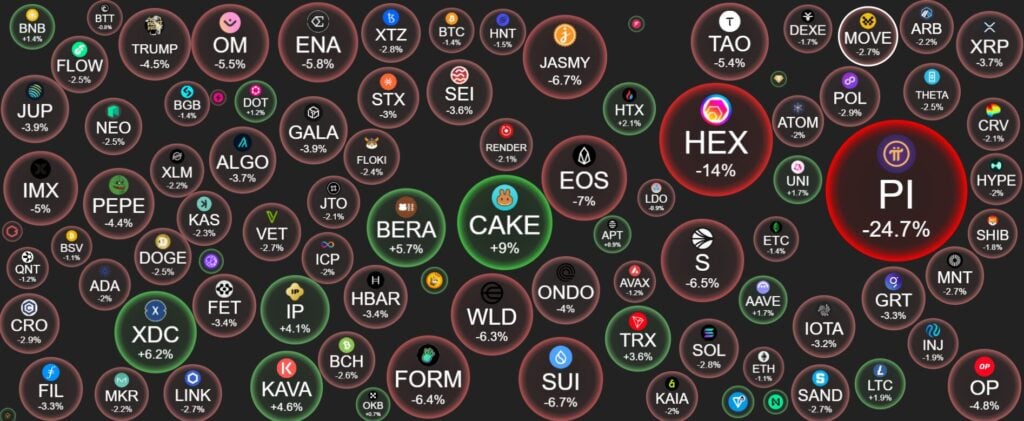
Following Trump’s latest speech, contrary to expectations, top coins like BTC BTC, ETH ETH, and XRP XRP turned red despite the seemingly positive news. BTC dropped from nearly $87K to $83K, ETH plunged below $2,000, and XRP fell 3.7%, marking a significant decline across all three top coins.
Notably, this isn’t the first time this has happened. On March 7, when Trump addressed the Strategic Reserve Fund, announcing plans to increase BTC holdings, Bitcoin’s price and market cap still dropped 5%, falling below $85,000.
Soucre: Crypto Bubbles
Since Trump took office, alongside a series of confusing tariff policies, the crypto market has remained in the red, with many top coins experiencing sharp declines.
This reflects the market’s instability and the “sell the news” mentality. It happens when investors heavily buy in anticipation of good news but sell off after announcements, causing sharp price drops. It also highlights how sensitive and reactive the crypto market is to political and macroeconomic uncertainties.
Learn more: Full recap of Trump’s Speech at Congress Today
The Ronin Network has a new feature called Liquid RON for those who hold RON tokens, proposing a more flexible approach to staking. By allowing individuals to deposit RON and receive tradeable tokens in return, Liquid RON (LRON) makes it possible to stake while keeping assets liquid. Here is a closer look at how it works and how to get started.
What Is Liquid RON?
Liquid RON is a vault system based on the ERC-4626 token standard. This standard essentially governs how “tokenized” vaults operate, allowing people to deposit one type of token and receive another token representing their stake in a larger pool.
In this particular case, individuals deposit RON into a specialized vault, and in return, they receive what are known as “Liquid RON” tokens. These newly issued tokens signify the user’s share in the Ronin Network’s validation process.
Liquid RON stakes the deposited RON and takes care of harvesting and compounding rewards without manual interference. As a result, users can reap the benefits of staking while still maintaining the freedom to move and use their tokens.
Moreover, the vault automatically harvests rewards each day, boosting its total RON balance. As a result, your Liquid RON tokens—representing your share of the vault—gain value over time.
How Does Liquid RON Work?
Deposit RON: First, users transfer RON tokens into the Liquid RON vault. This can be done through the deposit function or standard ERC-4626 methods.
Receive Liquid RON: After depositing RON, the user receives Liquid RON tokens, confirming participation in the Ronin Network’s validation process.
Stake and Harvest: Behind the scenes, the vault automatically stakes the deposited RON, then gathers and compounds rewards regularly.
Transfer and Use: With Liquid RON in hand, a user is not bound by the usual lock-up periods. These tokens remain fully transferable and can be deployed in other DeFi protocols on the Ronin Network.
The Liquid RON protocol has undergone an audit through Code4rena, ensuring its security and reliability.
Source Liquid RON
Why Liquid RON Stands Out
Liquidity: Unlike traditional staking programs that lock tokens away, Liquid RON supplies tokens that can be freely moved. If someone wants to trade or transfer them, they can do so without losing staking rewards.
Automation: The vault takes care of essential tasks like harvesting, compounding, and distributing rewards removing the hassle of constantly monitoring and manually claiming returns.
Compatibility: By embracing the ERC-4626 standard, Liquid RON can ensure smooth interaction with other DeFi platforms on the Ronin network.
Efficient Capital Use: Individuals can keep enjoying staking rewards while potentially earning more from other DeFi opportunities that accept Liquid RON tokens.
The Liquid RON vault keeps its fees straightforward. There’s a deposit fee designed to prevent people from rushing in solely to grab rewards right before they are distributed. There is also a performance fee where 6.5% goes to the treasury when the vaults claim rewards according to the Liquid RON website.
Once you have Liquid RON, there are several ways to put it to work. You can simply hold it in your Ronin wallet to earn staking rewards automatically or trade it on decentralized exchanges like Katana to convert your position into other tokens or currencies.
Another option is to participate in DeFi by providing liquidity to LRON/RON or LRON/other token pools, opening up opportunities to earn extra yield from trading fees and rewards. And if you ever want to send your tokens elsewhere, you can transfer LRON to any other wallet without waiting for the usual staking unlock period.
Getting Started With Liquid RON
Acquire RON Tokens: Before using Liquid RON, you need to have RON tokens. These can be bought on various cryptocurrency exchanges, such as Binance, Coinbase, or KuCoin.
Connect a Ronin Wallet: Once the tokens are in a wallet, the next step is to visit the Liquid RON platform and connect that wallet.
Deposit the RON: Using either the deposit command or other ERC-4626 functions, the user sends RON tokens into the vault.
Receive Liquid RON: Immediately afterward, the user will see Liquid RON tokens appear in their wallet.
Because Liquid RON tokens reflect a stake in the network, their value tends to appreciate over time. When individuals eventually redeem Liquid RON tokens, they can typically withdraw more RON than they initially deposited, assuming the vault has accrued staking rewards during that period.
Published: March 21, 2025 at 11:14 am Updated: March 21, 2025 at 11:14 am
by Ana
Edited and fact-checked:
March 21, 2025 at 11:14 am
To improve your local-language experience, sometimes we employ an auto-translation plugin. Please note auto-translation may not be accurate, so read original article for precise information.
In Brief
NVIDIA has unveiled Newton, an open-source and extensible physics engine developed in collaboration with Google DeepMind and Disney Research, aimed at enhancing robot learning and development.
Technology company NVIDIA has unveiled Newton, an open-source and extensible physics engine developed in collaboration with Google DeepMind and Disney Research, aimed at enhancing robot learning and development.
Based on NVIDIA Warp, which allows robots to learn complex tasks with improved accuracy, Newton is designed to work seamlessly with learning frameworks like MuJoCo Playground and NVIDIA Isaac Lab, an open-source platform for unified robot learning.
Physical AI models allow robots to autonomously understand, analyze, reason, and engage with their surroundings. The advancement of robotics heavily relies on accelerated computing and simulations to develop the next generation of robotic systems.
Physics is essential in robotic simulation, as it forms the basis for creating accurate virtual models that represent how robots behave and interact in real-world environments. Through these simulators, researchers and engineers are able to train, design, test, and validate control algorithms and prototypes in a secure, efficient, and cost-effective way.
Newton is designed to support the entire robotics community, allowing roboticists to freely use, distribute, and contribute to its development with research. Built on NVIDIA Warp, a CUDA-X acceleration library, it offers developers an efficient way to create GPU-accelerated, kernel-based programs for simulation, AI, robotics, and machine learning (ML). This framework provides high-performance capabilities for running physics-based simulations, utilizing the parallel processing power of NVIDIA GPUs.
A notable feature of Newton is its compatibility with Multi-Joint dynamics with Contact (MuJoCo), an established open-source physics engine used in robotics research for modeling complex dynamics and contact-rich environments. This compatibility allows developers to reuse existing models and code, reducing the time and resources required to adapt applications for different physics engines.
Additionally, Google DeepMind has introduced MuJoCo-Warp, an open-source robotics simulator accelerated by NVIDIA Warp, which delivers performance improvements, achieving more than a 70x speedup for humanoid simulations and a 100x speedup for in-hand manipulation tasks. MuJoCo-Warp will be integrated as a primary physics engine in Newton, offering developers enhanced performance and flexibility for their robotics applications.
More Key Features Of Newton: Differentiable Physics, Extensibility, And OpenUSD Integration
Furthermore, its ability to propagate gradients through simulation introduces new opportunities for robotics simulation and learning. Differentiable simulators are capable of generating forward-mode results while also calculating reverse-mode gradients of simulation outcomes, which can then be used for back-propagation to optimize system parameters.
As the field of robotics evolves, so does the complexity and variety of scenarios that need to be simulated. Newton is designed to be highly adaptable, supporting rich multiphysics simulations where robots interact with a range of materials, including food, cloth, and other deformable objects. This flexibility is enabled by custom solvers, integrators, and numerical methods. Newton also supports coupling different types of solvers, as demonstrated in the integration of a material point method (MPM) solver with rigid body dynamics for simulating interactions with sand.
Moreover, Newton leverages the OpenUSD framework, which offers a versatile data model and composition engine that aggregates the necessary data to describe robots and their environments. Custom solvers and runtimes can be specialized for specific robotic capabilities and environments. Furthermore, alongside Disney Research, Google DeepMind, Intrinsic, and NVIDIA, Newton is helping to define an OpenUSD asset structure for robotics. This structure aims to standardize robotic workflows by adopting best practices within OpenUSD, creating a unified data pipeline that provides a common language for all data sources in robotics.
Disclaimer
In line with the Trust Project guidelines, please note that the information provided on this page is not intended to be and should not be interpreted as legal, tax, investment, financial, or any other form of advice. It is important to only invest what you can afford to lose and to seek independent financial advice if you have any doubts. For further information, we suggest referring to the terms and conditions as well as the help and support pages provided by the issuer or advertiser. MetaversePost is committed to accurate, unbiased reporting, but market conditions are subject to change without notice.
About The Author
Alisa, a dedicated journalist at the MPost, specializes in cryptocurrency, zero-knowledge proofs, investments, and the expansive realm of Web3. With a keen eye for emerging trends and technologies, she delivers comprehensive coverage to inform and engage readers in the ever-evolving landscape of digital finance.
More articles
Alisa Davidson
Alisa, a dedicated journalist at the MPost, specializes in cryptocurrency, zero-knowledge proofs, investments, and the expansive realm of Web3. With a keen eye for emerging trends and technologies, she delivers comprehensive coverage to inform and engage readers in the ever-evolving landscape of digital finance.
A blockchain project generally includes crypto presales which enable investors to purchase tokens before their exchange listing. These presales provide investors with discount rates through structured pricing patterns that enable projects to secure finance for development along with promising initial investment opportunities.
The article explores new crypto presales featuring Aureal One and DexBoss, features together with advantages and their ability to transform the blockchain technology sector.
Aureal One: A Next-Generation Blockchain for Gaming
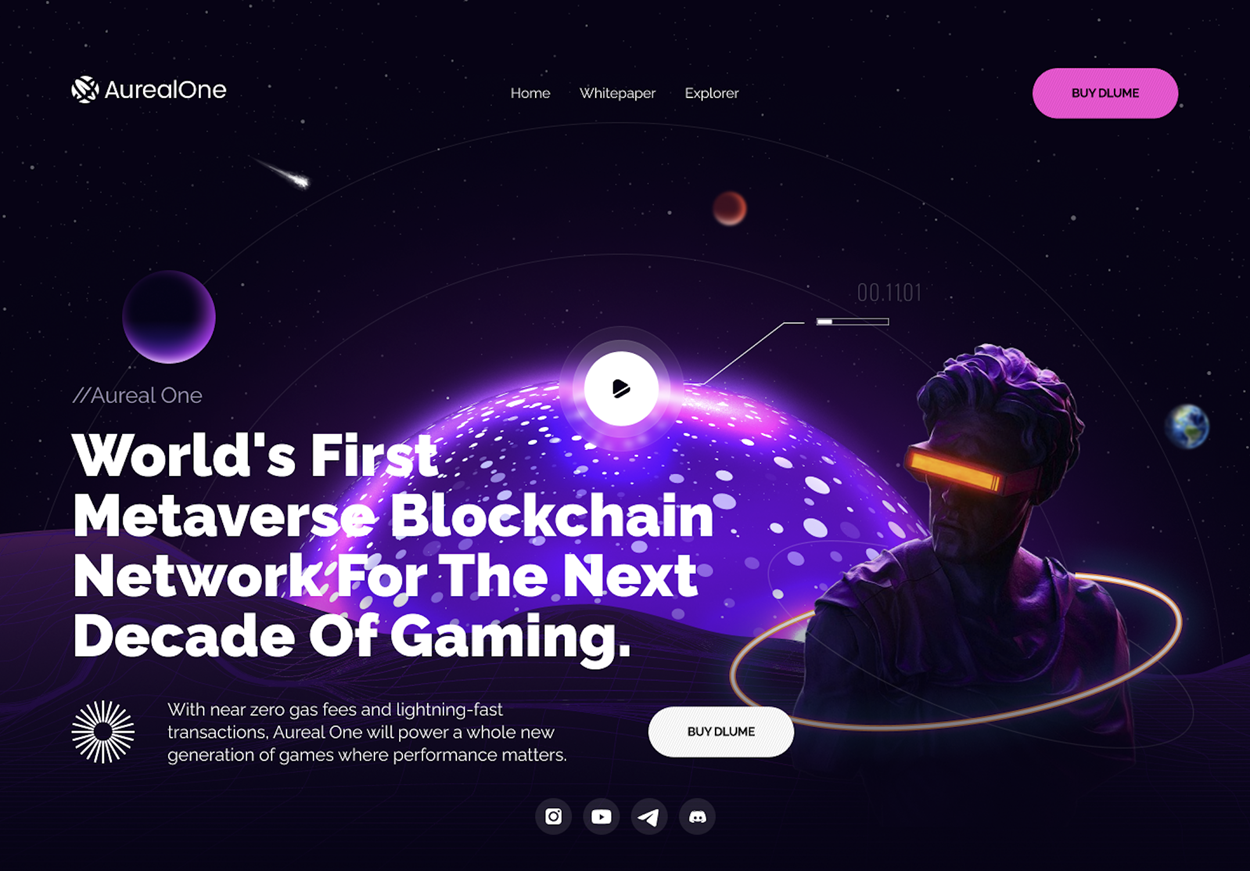
AurealOne implements advanced technologies that serve the gaming and metaverse industry through rapid transactions at low gas cost fees. Aureal One provides developers and gamers with advantageous features that enable an efficient gaming environment. Various projects created within the ecosystem make use of DLUME as their native currency since it facilitates ecosystem transactions while functioning as an in-game currency.
Click here to visit the big crypto presale – AurealOne
Scalability and Cost Efficiency
Zero-Knowledge Rollups technology represents a significant Aureal One feature because it enables the expansion of the platform without creating high transaction fees. Through this technology the platform can specifically optimize its services for gaming applications which delivers both efficient and cost-effective gaming environments to players. Clash of Tiles represents the standout gameplay found on Aureal One platform which demonstrates how this network will allow next-generation game development.
Presale Structure and Tokenomics
Users can buy BSC tokens through 21 presale rounds as Aureal One conducts its ICO. Users who adopt the blockchain platform early on will find an uncomplicated exchange process through which their tokens can be swapped for DLUME coins. During the presale period, Round 1 offers tokens priced at $0.0005 which gradually increases toward achieving $50 million in total fundraising during the last round.
Community Engagement and Governance
Holders of DLUME tokens obtain voting power as well as the opportunity to stake to earn rewards while taking part in Aureal One’s governance processes. The network’s continued development is formed by an active community that holds voting rights through DLUME staking. Users must verify the precision of their wallet addresses for the presale because once transactions execute participants cannot modify them unless they face complications while retrieving funds.
DexBoss: Bridging Traditional Finance and DeFi
The DeFi sector’s growth is limited by user difficulty, problems with liquidity and expensive costs during transactions. The DexBoss platform functions to connect traditional finance approaches with DeFi solutions through its user-friendly trading system which solves these specific issues.
Enhancing Accessibility in DeFi
DexBoss develops an interface that works well for traders of all experience levels together. Efficient trading on the platform happens through deep liquidity pools while minimizing the occurrence of slippage. The DexBoss token ($DEBO) utilizes a vital buyback along with a burning process that steadily minimizes its total availability to potentially enhance token worth over extended periods. The token performance engagement of stakeholders should lead to a strong loyal user base which promotes sustained community participation.
Tokenomics and Presale Structure
The $DEBO token exists with 1 billion total tokens and half of these tokens (50%) are reserved for the presale activities to reach $50 million. DEBO token prices will increase progressively throughout its 17-round presale starting from $0.01 at the first round until the final round reaches $0.0458. Each price level during the presale creates the possibility for substantial token gains that will happen before the listing moment.
Advanced Trading Tools and Functions
Through advanced financial instruments like margin trading liquidity farming and staking DexBoss delivers upgraded trading services to its users. Traders leverage this technology to increase their investment gains simultaneously boosting the liquidity levels of the platform. Order execution needs to deliver near real-time performance due to the high-speed changes in market conditions so users can take advantage of market movements.
Future Roadmap and Innovations
DexBoss will arrive on the market during Q4 2025 and will later introduce complex trading capabilities including derivatives along with extensive yield farming possibilities. Through its network of multiple partners, DexBoss enables smooth on/off-ramp connections for fiat currency transactions.
In Brief: Investment Opportunities in New Crypto Presales
The blockchain technology used in new crypto presales by Aureal One and DexBoss enables fundamental changes within the gaming and finance industries. The transaction costs of Aureal One remain affordably low and its gaming platform grows actively while DexBoss provides plain DeFi functionalities through user-friendly features. Both platforms emphasize developing sustainable communities through governance systems as well as long-term development growth.
The two systems have the capability to establish themselves in similar ways to Ripple (XRP) transformed international money transfers. Their ability to enable speedy transactions together with their scalable features and developed networks positions them for success in building the future of blockchain-powered gaming and DeFi. Also making it a great choice to add to your digital asset portfolio alongside established coins like Ripple.
Users need to exercise caution when making blockchain and cryptocurrency investments because risks accompany all such investments.
Designing a professional logo no longer requires a hefty budget or advanced design skills. Thanks to AI-powered logo makers, anyone can now generate...