KuCoin has launched KuCard in Australia, giving users a way to spend crypto through Mastercard’s global network. The rollout points to a broader shift toward making digital assets usable in everyday payments.
Key Takeaways
KuCard enables crypto payments across Mastercard’s global network
Users can spend digital assets without manually pre-converting to fiat
USDC is used to fund transactions, with real-time conversion to fiat for settlement
37 USDC trading pairs supported at launch
Apple Pay and Google Pay are integrated
Crypto Payments Move Closer to Everyday Checkout
KuCoin’s KuCard rollout allows eligible users in Australia to pay with crypto at merchants that accept Mastercard. The system runs on existing payment rails, so the checkout experience remains familiar.
That familiarity is intentional. Instead of introducing a new process, KuCoin is layering crypto into a payment flow people already use. As KuCoin CEO BC Wong put it, “making digital assets useful in the real world requires trusted infrastructure—secure rails, clear compliance standards, and user-first protections.”
Real-Time Conversion Handles the Complexity
USDC is used to fund transactions, with crypto converted into fiat at checkout. The payment then settles through Mastercard’s network, removing the need for manual conversions before spending.
At launch, KuCard supports 37 USDC trading pairs. That adds flexibility, though relying on a single stablecoin framework may shape how some users approach spending.
The inclusion of Apple Pay and Google Pay also lowers friction. For most users, adoption depends less on the asset itself and more on how easy it is to use.
Australia Serves as an Early Test Case
Australia has been described by KuCoin’s Australian Managing Director James Pinch as a “fast-moving market for digital asset adoption,” making it a practical starting point for the rollout.
KuCoin’s AUSTRAC registration also provides a compliance layer for operating in the region. Still, the launch is limited to eligible users in one market, and broader impact will depend on expansion beyond Australia.
Infrastructure Partnerships Drive the Rollout
The product is built in partnership with Immersve, a principal member of the Mastercard network, which provides the issuing infrastructure. Mastercard enables global merchant acceptance, extending reach beyond crypto-native environments.
Immersve CEO Jerome Faury said the goal is to “enable individuals to spend crypto everywhere Mastercard is accepted,” pointing to a wider push to connect Web3 services with traditional finance rails.
From Holding to Spending—But Adoption Isn’t Guaranteed
KuCoin serves more than 40 million users globally, many of whom still use the platform primarily for trading. KuCard introduces a different use case—spending rather than holding.
Whether that shift takes hold remains uncertain. Everyday payments depend on habit, incentives, and convenience, not just availability.
What this launch shows is direction. Crypto payments are becoming easier to access, even if consistent, real-world usage still has to catch up.
A hacker re-emerges after five months, converting 4,873 ETH to Bitcoin.
The Balancer exploit hacker’s activity follows a similar pattern to the Kelp DAO exploiter.
The original Balancer attack occurred in November 2025, draining nearly $120 million.
The hacker behind last November’s massive Balancer exploit has escalated activity after five months of dormancy, converting a total of 4,873 ETH (approximately $11.3 million at current prices) into roughly 178 Bitcoin through the cross-chain protocol THORChain.
Onchain data from THORChain explorer shows that the hacker has routed these funds in multiple batches to THORChain’s router. The swaps include earlier tranches such as 348 ETH for ~11.8 BTC and additional transfers pushing the cumulative total to 4,873 ETH as of the latest on-chain records.
Source: THORChain Explorer
This acceleration follows closely on the heels of the Kelp DAO exploiter, who routed nearly 75,700 ETH (about $175 million) through THORChain, swapping the bulk into native BTC and driving record daily volume on the protocol.
Security researchers see the Kelp DAO case as a clear blueprint, with both actors are leveraging THORChain’s decentralized, non-custodial ETH-to-BTC swaps to fragment transaction trails across chains, bypass centralized intermediaries, and complicate address clustering or potential asset recovery.
Unlike traditional bridges that issue wrapped tokens, THORChain facilitates native asset swaps through liquidity pools and its RUNE token as an intermediary, offering censorship resistance that appeals to sophisticated threat actors.
Balancer exploit details and aftermath
The original Balancer attack in early November 2025 drained nearly $120 million—with some estimates reaching $128 million—across multiple chains. The perpetrator exploited a precision-loss vulnerability in Balancer V2’s composable stable pools, manipulating rounding errors in the Vault contract during batch swaps to siphon liquidity from pools holding wrapped ETH and other assets.
Balancer Labs subsequently wound down operations amid the fallout. After initial laundering attempts via Tornado Cash, the hacker remained largely inactive until this week. Linked addresses are still reported to hold tens of millions in remaining ETH, indicating the current movements may signal the beginning of a larger liquidation phase.
The timing—five months after the heist—mirrors established patterns in major crypto thefts, where perpetrators allow initial scrutiny to subside before resuming cash-out operations.
Now this repeated use of THORChain by high-profile exploiters highlights ongoing challenges in cross-chain tracking and the increasing sophistication of laundering tactics employed by sophisticated actors.
No law enforcement updates have been released regarding identification or recovery efforts for the Balancer case as of publishing.
Also read: U.S. Seizes 503 Crypto Scam Websites in Major Fraud Crackdown
Much like the roguelike hellscape it takes place in, even thinking about Saros offers me something new every time I reflect on Housemarque’s roguelike shooter. Much like Returnal, the game’s spiritual predecessor, it revels in abstract worldbuilding and symbolism that may seem unwieldy and obtuse, but as I bash my head against the walls of its tough-as-nails challenges, I find something worth pondering on the other side. Saros continues Housemarque’s evolution from something of an arcade specialist into a maker of the kind of prestige storytelling that has become synonymous with PlayStation’s first-party output. What’s remarkable is that despite Saros solidifying Housemarque as one of PlayStation’s narrative heavy hitters, the studio’s identity has not been lost in Sony’s continued desperate chase for its next Last of Us.
Saros expands the scope of Returnal’s very singular story of one person caught in an endless, tortuous loop of devastating deaths and puts an entire ensemble cast into one instead. At least, it seems to do so on paper. Arjun Devraj, a soldier working as part of a corporation called Soltari, joins his crew on expedition to the planet Carcosa (loosely based on the fictional city of the same name featured in the King in Yellowshort stories) in search of assets the corporation has deemed valuable, but its previous scouting teams have gone silent; thus it’s up to them to find out what happened and return home with the company’s spoils in hand.
That’s the plan in the books, but Arjun, played by iZombie and The Fall of the House of Usher actor Rahul Kohli, is there for his own reasons, searching for someone who was on one of the first expeditions to Carcosa but never came home. Once he arrives, it becomes clear why. Carcosa, underneath some sort of distorted solar eclipse, is constantly reshaping itself, with new threats and obstacles awaiting every time Arjun walks out of his team’s shelter. Every time he ventures off in search of clues and a malicious monster to fight, the world shifts ever so slightly so no two runs are ever exactly the same. The only reason he’s able to experience all of them is because he keeps being revived every time he dies by some unknown force, but the world persists in the time between death and rebirth, and time moves strangely under Carcosa’s mystical sun.
The real danger of Saros isn’t the monsters Arjun fights; it’s the oppressive psychological forces weighing on each member of the Echelon IV crew as they struggle to maintain their mission and comply with the company-mandated order. As the situation escalates, members’ efforts to cling to protocol become more and more out of touch, leading to distrust sanding away at the group’s psyche until their paranoia threatens to tear them apart as the planet starts to needle into their individual minds.
Saros is presented as an ensemble show, but outside of Arjun, its cast feels mostly like sacrificial lambs, just here to illustrate the psychological warfare the crew is facing as we go out into the line of fire. Individual struggles aren’t explored in depth but rather put on display to communicate the lingering threat of psychosis Arjun faces as he repeatedly dies and is reborn. The gradual atrophy of the cast is effective in conveying the state of the world, but it doesn’t quite serve anyone else in the cast beyond Arjun and the person he’s coming to find.
Saros starts off as if it’s expanding Returnal’s introspective, cyclical story beyond the myopic bubble of its protagonist, but the facade drops fairly quickly. Everything is in service of telling you who Arjun is and what he’s facing internally and externally. The individual parts of the whole can be underwhelming and disappointing if you were hoping to really get to know a larger cast, but once I bought into Saros as a more singular character study, I found it incredibly compelling, even if it’s not what the game presents at the outset.
The game works best for me when it’s a mystery box with each snide remark, questionable text log, stuttering flashback, or deranged voice memo coloring in the lines of a more frightening truth. The relationships between most of its characters end up being casualties of that, but Arjun makes for a captivating centerpiece of Housemarque’s puzzle. Kohli plays everything from the character’s early restrained stoicism to his more crazed unraveling with conviction, and by the time some of Saros’ more defining twists and turns are revealed, it becomes clear the nuances of who Arjun is and who he could become were always being communicated in the performance. Whether I like the truths I learned about him or not, Arjun’s a layered protagonist worth peeling apart, and at his core is something just as challenging to reckon with as the monsters living under Carcosa’s obscured sun, which is saying a lot because this game is not easy.
Saros is just as tough as Returnal but a bit more accommodating if you found the last game intimidating or unrelenting, though if you are looking for a more true-to-form roguelike hellscape, you might be a bit underwhelmed by how helpful it can be at the start. For someone who traveled across the galaxy with a gun in hand ready for battle, Arjun is pretty frail and can only take a few hits before he’s sent tumbling down into the abyss and revived back at the Echelon base. Saros’ combination of frantic shooter and chaotic bullet hell is frenetic and demanding, but even in its sensory-overloaded confusion, every shot fired, punch swung, and dodge dashed requires precision and commitment. The tools he has at his disposal are determined by random rolls, and you have to adapt or die.
Like most roguelikes, Saros requires you to try and fail multiple times on your way to a powerful boss, each of which are incredibly memorable and challenging, requiring you to use what you’ve learned through all that failure to emerge victorious. But Saros’ dearth of healing items means that if you venture out from the safety of home base and get put through the wringer by the game’s combinations of demonic creatures and deteriorated machinery on the way, you’ll be in no shape to take on a biome’s final fight. Still, the run isn’t entirely wasted because, unlike in Returnal, the resources you take back with you when you die help you build up stronger for the next attempt.
Housemarque knows the importance of visual communication, especially for a game as visually cluttered as Saros can get, and the studio’s use of color to communicate types of incoming attacks helped me embed reactions into my muscle memory, from dodging yellow projectiles to absorbing blue ones with my shield, and parrying red ones back in the direction of my foes.The advantage of repeating runs in Saros, greater even than the benefits bestowed by any resources you may collect, is that after dying a dozen times, survival becomes habit. You can’t memorize a constantly shifting world, but you can eventually anticipate the randomized dangers and know how to react. This is the appeal of a roguelike’s time loop structure. Getting laid out over and over allows you to slowly become so accustomed to danger that responding to it becomes second nature, programmed into your mind like a fight-or-flight response. Failure is the lesson, and starting over from the beginning is the consequence.
Even in some of Saros’ most strenuous segments, it feels pretty incredible to go from getting your ass handed to you to masterfully weaving through a new onslaught of foes. Saros and games like it only work if it feels like all that failure means something, and the gradual ramping-up of Arjun’s arsenal in both the microcosms of individual runs and your larger, game-long progression feels perfectly paced, to the point where even repeated losses at some of the big bosses didn’t deter me from trying again. However, as a baseline, Saros is a bit more accessible than other roguelikes with options to tailor the difficulty, but not without some give and take.
Adapt or die
Though it offers a pretty distinct challenge, Saros gives you plenty of tools to customize the ways it gets difficult without compromising its vision. Before each run you can implement modifiers that can give you an edge, but not without balancing them out with nerfs. Sure, you can decrease the amount of incoming damage, but to keep the scales balanced you’ll have to give up something, too, like how many resources you’ll maintain when you die.
Flipping these switches required me to weigh what tools and perks actually mattered to me, and which ones I’d be willing to live without. Did I need to worry about maintaining upgrades for the next run if I was barreling to the game’s final boss? Had I gotten good enough at avoiding life-siphoning corruption that I would be fine if I took on more of it each time it made contact? Small tweaks can change a lot, and Saros is surprisingly thorough in how it lets you author the dangers of a randomly-generated world. I’m glad this system is here because it not only gives folks who need a helping hand an option, but if you’re a masochist who wants to make Saros harder, you can do that to give yourself something new to overcome. I imagine we’ll eventually see someone finish full-game runs with all the trials turned on. Beating the game on its own is impressive enough, but choosing to willingly put your hand in the pain box from Dune is on another level.
Saros oscillates from moments of almost god-like power to Arjun becoming a kind of pathetic guy depending on the tools you stumble upon. Oftentimes I’d become so accustomed to using an assault rifle equipped with an autoaim perk that if I was stuck with a pistol that hit hard but had no range, I would be on my back foot, struggling to pelt far away flying enemies with bullets that wouldn’t land. Shotguns, which are usually my go-to weapon of choice in third-person shooters, became the bane of my existence as I could never quite fit them into my dash-driven playstyle. But I had to adapt. Saros rewards experimentation and even demands it at some points, as an arsenal you grow attached to is eventually outscaled by more powerful enemies, and that constant need to flex into something you’re less comfortable with is the most persistent test of your skill Saros requires. It’s hard to go in with a plan when you can only anticipate so much of what’s coming, but no matter what loadout I stumbled upon and what build decisions I made on the fly, Saros kept me guessing and improvising as what I thought I could expect was subverted when I’d turn a corner.
That’s kind of the Saros experience, and it’s impressive how Housemarque managed to keep me on my toes until I finished my final run, even when offering safeguards that could have made me better prepared. Whether it be in the lay of its randomized land, the enemies that spawned in those unknowable paths, or the truths I found hidden away in Arjun’s mind, Saros constantly shifts itself to the point where you can never feel truly comfortable…until you’ve mastered it all and the chaos of Carcosa feels like home. There’s a lot I still want to say about Saros that this review is perhaps not the appropriate place to, but maybe I can expand further on the game’s richness and complexity in another “run” down the line.
BACK-OF-THE-BOX-QUOTE:
“I love banging my head against a wall until it breaks!”
DEVELOPER:
Housemarque
TYPE OF GAME:
Shooter roguelike with a sci-fi/fantasy psychological horror spin.
LIKED:
Tough but fair, really compelling mystery box-style narrative, lots of options to tailor the challenge, Arjun’s story is really thorny and complicated in a way I find compelling.
For now, I’ll say Housemarque’s “house style” of tough-as-nails roguelike dipped in symbolism has managed to capture lightning in a bottle twice, and in a PlayStation ecosystem where Sony threatens to homogenize all its output, this studio maintaining what makes it distinct in the company’s catalog is just as challenging a feat as anything you’ll face in the game itself. Saros is a prickly, demanding game whose hours of physical and mental carnage will make it difficult to parse for some, but I keep diving back in and finding new philosophical and mechanical challenges to overcome each time.
Recognition from one of India’s most prominent technology award platforms underscores a systems-first approach to enterprise AI — focused on control, reliability, and cost predictability
SURAT, India, April 24, 2026 /PRNewswire/ — TestGrid has been named the winner of the ‘Best Use of AI’ category at the India Digital Enabler Awards (IDEA) 2026, organized by Entrepreneur India and held at Sheraton Grand, Bengaluru.
The award, judged by a panel including representatives from NITI Aayog, the Department of Science and Technology (Government of India), and IvyCap Ventures, highlights applied innovation across digital technology, enterprise systems, and artificial intelligence.
This result places TestGrid among IDEA honorees such as Reliance Foundation, Swiggy, Zepto, Groww, and Tata Teleservices—organizations known for translating technology into measurable enterprise impact.
TestGrid was selected for its approach to embedding AI within software testing—not as a standalone capability, but as part of a structured system built on real-device infrastructure, automation, and controlled execution environments.
As enterprise adoption of AI accelerates, organizations are increasingly encountering challenges around unpredictable, usage-based costs and limited execution control.
At the core of TestGrid’s approach is CoTester, its AI testing agent designed to operate within the software development lifecycle.
CoTester learns from product requirements, generates test scenarios, and executes them across real device and browser environments—while maintaining human oversight, traceability, and execution discipline.
Rather than replacing existing systems, CoTester operates as an integrated layer within TestGrid’s platform, where infrastructure, automation, and intelligence work together to deliver predictable outcomes at scale.
“AI in testing is only useful when it operates within systems that teams can trust,” said Harry Rao, Founder & CEO of TestGrid. “Our focus has been on building a foundation where intelligence is controlled, execution is consistent, and costs remain predictable. This validates the approach we’ve taken.”
This outcome comes at a time when enterprises are re-evaluating AI adoption models, particularly as token-based and usage-driven pricing introduces cost variability at scale. Testing environments—already fragmented across tools and workflows—become harder to manage when intelligence is introduced without system-level control.
TestGrid addresses this by consolidating testing infrastructure, automation, and AI into a single platform. This enables teams to execute tests on real devices, integrate with frameworks such as Selenium, Appium, and Cypress, and apply AI-driven capabilities without introducing operational unpredictability.
Following this milestone, TestGrid will continue expanding its AI capabilities within enterprise environments, with a focus on structured adoption, workforce enablement, and deeper integration into software delivery workflows.
To schedule a demo or explore TestGrid’s testing platform, visit testgrid.io.
About TestGrid
TestGrid is a leading provider of enterprise-grade testing infrastructure and automation solutions, trusted by the top Fortune 100. From infrastructure to software delivery intelligence, TestGrid empowers organizations to deliver high-quality software faster with cost-effective, scalable testing across web and mobile platforms.
Media ContactHarry RaoFounder & CEO, TestGridharry@testgrid.io
View original content to download multimedia:https://www.prnewswire.com/in/news-releases/testgrid-wins-best-use-of-ai-at-india-digital-enabler-awards-2026-powered-by-entrepreneur-india-302752588.html
During the week of April 14 to 22, spot Bitcoin ETFs recorded a total net inflow of approximately $1.9 billion, according to Coinglass data. This capital flow emerged while Bitcoin was fluctuating around the $78,000–$80,000 range, where sell liquidity clusters are clearly concentrated on market data. The increase in institutional flows at a high price range, rather than during correction phases, indicates a shift in how institutions participate in the market, while simultaneously placing Bitcoin in a sensitive equilibrium between new demand and overhead supply.
Institutional Inflows Rise as Bitcoin Tests $80K
ETF data shows that Bitcoin inflows remained high over the past week, with several sessions seeing strong spikes. April 17 recorded an inflow of over $600 million — the highest level since the beginning of the month. The remaining sessions mostly fluctuated around $1 billion, bringing the total net flow during the April 14–22 period to approximately $1.9 billion.
Spot Bitcoin ETF netflow. Source: Coinglass
This capital flow appeared as Bitcoin recovered from the ~$60,000 range in early February to near $80,000, instead of concentrating on deep correction cycles. This development shows that institutional money is participating as the price approaches the supply zone, not just at lower price levels.
Bitcoin’s recent rally also coincided with a period of improving market sentiment as Iran–US tensions showed signs of cooling, a factor that has supported capital returning to risk assets.
At this stage, ETF inflows reflect the level of participation from big money, but are not yet sufficient to confirm the market’s direction.
Whale Activity Does Not Confirm Aggressive Selling
According to CryptoQuant data, the Exchange Whale Ratio — an index measuring the proportion of large transactions in total exchange inflows — has not yet shown an increase corresponding to ETF flows.
Bitcoin Exchange Whale Ratio. Source: CryptoQuant
Between late March and mid-April, this index fluctuated in the 0.5–0.7 range and at times increased alongside the price. However, in recent days, the Whale Ratio has dropped to around 0.48, indicating that large-scale capital has not yet returned to exchanges.
This trend suggests that selling pressure from large holders has not increased, even as institutional flows are rising. The discrepancy between ETF demand and exchange activity indicates that the supply side is still maintaining a relatively stable state in the short term.
Market Positioning Shows a Compressed Setup Near $80K
Bitcoin is currently trading in a price range with a relative balance between buying and selling pressure.
Data from Coinglass shows large liquidity clusters concentrated on both sides of the current price. Above, dense sell walls in the $79,000–$81,000 range form a clear resistance layer. On the opposite side, buy liquidity is concentrated around $75,000–$76,000, acting as a short-term support zone.
BTC whale orders. Source: Coinglass
Open Interest in the derivatives market has increased from approximately $105 billion to over $125 billion in recent weeks, reflecting a significant rise in open positions. Funding rates on many exchanges are hovering around 0 and have occasionally been slightly negative, showing that long positions have not yet taken a clear lead.
The combination of three factors — two-sided liquidity, rising OI, and neutral funding — shows that the market is in a position-accumulation phase but has not yet tilted clearly to one side. In the context of increasing ETF flows, this state reflects expanding demand, but it is still not enough to break through the overhead supply layer.
Similar Inflows Have Led to Diverging Outcomes
In the past, strong surges in ETF inflows have not led to a fixed outcome, but depended heavily on the market context at that time.
During the period from February 24 to early March 2026, after Bitcoin corrected to the ~$60,000 range, ETF flows began to return with daily inflows fluctuating between $200–$500 million per day. At that time, the market entered a short-term sideways phase before continuing its upward trend, bringing the price back to the $70,000–$75,000 range.
Conversely, during periods when prices approached local peaks — such as in early 2026 when Bitcoin neared the $90,000 range — inflows remained positive while the market structure began to weaken. A few days later, the price quickly reversed, leading to a sharp drop toward the $60,000 zone.
Both cases recorded large capital flows, but the results differed depending on the price position. Inflows appearing after a correction are often accompanied by continuation, while those appearing near resistance zones may be linked to distribution.
Market at a Short-Term Inflection Point
Bitcoin is currently trading in a short-term equilibrium zone between ETF flows and the supply layer concentrated around $80,000. Capital flows of nearly $1.9 billion show a clear level of institutional participation, but they have appeared as the price has moved close to dense sell liquidity zones.
These signals indicate that the market has not yet tilted clearly in one direction. With sell liquidity concentrated above, the $80,000 zone is serving as a test point for the buyers’ ability to absorb selling pressure. The price reaction at this zone will be more decisive than the ETF flows themselves.
Grab a coffee and sit down for this one. I was recently digging through some advanced foresight reports and futuristic projections about what it will actually take to survive in the coming decades, and I have to admit—I’m still processing it.
I love technology. I write about it every single day. But compiling this list gave me actual goosebumps. We aren’t just talking about faster smartphones or slightly better virtual reality headsets. We are looking at a fundamental rewrite of what it means to be human. Some of these sound amazing, but others? Honestly, they are a bit terrifying.
If you want to survive and thrive in the deep future, you are going to have to get used to these ten mind-bending technologies. Let’s break them down.
1. Mind-Reading Neurochips
Forget keyboards, mice, or even voice commands. The ultimate interface of the future is your own brain. We are already seeing the very early, clumsy stages of this with companies like Neuralink, but the endgame is seamless integration.
How it works: A microscopic implant will translate your neural firing patterns into digital commands.The Reality: You will be able to search the internet, send messages, or control smart environments simply by thinking about it. But my biggest fear here is privacy. If a chip can read my intentional commands, what happens to my intrusive thoughts? Who owns the data of my inner monologue?
2. 3D-Printed Meals Tailored to Your Genetics
I love cooking, but the traditional kitchen might soon become a museum exhibit. In the future, food won’t be grown; it will be printed, and it will be perfectly customized to exactly what your DNA demands.
The Process: A bio-printer in your home will analyze your daily biometrics—your vitamin deficiencies, your metabolic rate, your exact genetic predispositions—and synthesize a meal that perfectly balances your health.My Take: It solves world hunger and eliminates food waste, which is incredible. But will a molecularly perfect, lab-printed steak ever capture the soul of a meal cooked over a real fire? I have my doubts.
3. Quantum Trains Hitting 10% the Speed of Light
Our current concepts of geography and borders are about to be shattered. Imagine a mass transit system utilizing advanced quantum levitation and vacuum tubes that can reach a fraction of the speed of light.
The Impact: You could live in Istanbul, grab your morning coffee, and commute to an office in Tokyo in a matter of minutes.The Catch: The infrastructure required for this is staggering. We are talking about trans-continental, indestructible vacuum tunnels. Still, the idea of a completely borderless, hyper-connected Earth is thrilling.
4. Artificial Intelligence Synthetic Spouses
This is the one that gave me serious goosebumps. And to be completely honest, it weirds me out more than anything else on this list.
The Concept: As human isolation grows and AI becomes indistinguishable from human consciousness, synthetic partners will become normalized. We are talking about physical, android spouses powered by AGI (Artificial General Intelligence).The Dilemma: They will be flawless. They will never argue with you unless you program them to. They will anticipate your emotional needs before you even realize you have them. But is that love? Or is it just a high-tech echo chamber of your own ego? I really struggle with the idea of trading the messy, beautiful reality of human relationships for a perfectly programmed illusion.
5. Invisible Screens Integrated Into Your Pupils
Say goodbye to the smartphone. The next iteration of screens won’t be in your pocket; they will be floating in your field of vision.
The Tech: Nanotech contact lenses or direct corneal implants will project high-resolution augmented reality directly onto your retina.Daily Life: You will see navigation arrows painted onto the streets, real-time translations floating next to people’s faces as they speak, and your notifications seamlessly blending with the physical world. It’s the ultimate mixed reality, but it also means we will literally never be able to look away from the digital world.
6. Nanorobot Blood Cells That Destroy Disease Instantly
The future of medicine isn’t a better pill; it’s a microscopic army living inside your veins.
How it works: Millions of programmable nanobots will patrol your bloodstream. The second a cancer cell mutates, or a new virus enters your body, these bots will swarm and dismantle the threat at the cellular level before you even feel a symptom.My Perspective: This effectively ends biological disease. It’s a miracle of science. We will look back on chemotherapy and antibiotics the way we currently look back on medieval bloodletting.
7. Giant Autonomous Underwater Cities
With climate change altering coastlines and the global population swelling, we are going to need new places to live. Why look to Mars when we haven’t even colonized our own oceans?
The Vision: Massive, self-sustaining, AI-managed biospheres submerged deep underwater. They will generate their own oxygen, harvest geothermal energy from the ocean floor, and farm kelp and lab-grown proteins.The Vibe: It sounds like something straight out of BioShock, minus the dystopia. Living surrounded by the abyss of the ocean sounds incredibly peaceful, though slightly claustrophobic.
8. Limitless Energy from Space Mining
Our energy crisis has an expiration date, and the solution isn’t on Earth.
The Solution: Automated drone fleets will mine near-Earth asteroids for rare earth metals and Helium-3, beaming the harvested energy back to Earth via orbital solar arrays.Why it matters: This creates a post-scarcity energy economy. When energy is virtually free and limitless, the cost of manufacturing, transportation, and living drops to almost zero. It is the necessary foundation for every other technology on this list.
9. Genetic Vaccines That Stop Aging
What if aging is just a disease that we finally cure?
The Breakthrough: Using advanced CRISPR therapies and genetic vaccines, scientists will be able to halt the telomere degradation in our DNA. Your biological clock could be permanently frozen at 25 years old.The Reality Check: While living for centuries sounds appealing, think about the societal impact. If nobody dies of old age, how do we handle overpopulation? Do only the ultra-rich get to be immortal? The social friction this will cause is going to be massive.
10. Metaverse Immortality With Your Digital Copy
Even if your physical body eventually fails, “you” might never actually die.
The Endgame: By continuously mapping your brain waves, memories, speech patterns, and behaviors throughout your life, an exact digital twin of your consciousness will be uploaded to the Metaverse.The Question: After your biological death, your family could still interact, talk, and seek advice from your digital ghost. But is that really you? Or just a highly advanced chatbot wearing your face?
Look, the future is rushing at us faster than our human brains are evolved to handle. Compiling this list made me realize that the line between biology and technology isn’t just blurring; it’s completely erasing.
I’m incredibly excited about curing diseases and exploring the oceans, but I keep coming back to that fourth point. The idea of a synthetic spouse just haunts me.
I have to ask you, and I want you to be brutally honest with yourself: If you had the choice, would you accept marrying a flawless, perfectly tailored artificial intelligence instead of dealing with the flaws and complexities of a real human being? Let me know what you think.
Collaboration targets gaps in issuance, distribution, and lifecycle management as tokenized real-world assets gain traction.
Within onchain finance, many now agree that the initial hurdle, demonstrating real-world assets can be tokenized has been cleared. The real challenge lies ahead: constructing robust infrastructure to issue, distribute, service, and manage these assets at scale. That’s the context behind a new strategic partnership between REAL, a purpose-built Layer 1 blockchain for real-world asset tokenization, and RWA Inc., a global platform focused on investor access, tokenization strategy, and Web3 growth infrastructure.
The two companies announced the tie-up this week, positioning it as an effort to build more complete infrastructure for tokenized finance at a moment when institutional interest in the sector is accelerating faster than the systems designed to support it.
Why This Partnership Matters Now
If you’ve been tracking the RWA space at all, you already know the numbers are hard to ignore. Onchain distributed RWA value has surged past $30 billion globally, with analysts projecting the market could reach $2 trillion by 2030, and some estimates going considerably higher from there. Major institutions, including BlackRock, Franklin Templeton, and JPMorgan, have already launched tokenized fund products, signaling that this is no longer fringe territory.
But here’s the problem nobody talks about enough: most of the infrastructure being built today solves only one piece of the puzzle. A platform might do issuance well, but struggle with ongoing servicing. Another might excel at investor onboarding, but have no real answer for distribution. What the market actually needs and increasingly demands is something that spans the full lifecycle of a tokenized asset, from first issuance all the way through post-sale reporting and management.
That gap is precisely what the REAL and RWA Inc. partnership is designed to address. As we’ve explored in our look at the top RWA protocols in DeFi, fragmented infrastructure remains one of the most persistent bottlenecks in the sector, and it’s not something any single layer of the stack can fix alone.
What’s Actually Being Built
The collaboration centers on building a more complete infrastructure stack rather than adding another isolated tool to an already crowded market.
At its core, the partnership explores tokenized asset issuance on REAL’s Layer 1 network, a chain designed specifically for this use case, not retrofitted from a general-purpose chain. From there, RWA Inc. contributes the investor-facing infrastructure: onboarding rails, KYC/AML compliance frameworks, and distribution channels designed to connect tokenized opportunities with a broader base of professional investors.
Beyond the initial issuance layer, the collaboration also targets post-issuance servicing, the part of the RWA lifecycle that rarely gets attention until something goes wrong. Think ongoing reporting, asset performance monitoring, and the kind of lifecycle tooling that institutional investors expect as standard in traditional finance. This isn’t glamorous, but it matters enormously for the long-term credibility of tokenized assets.
Co-marketing initiatives tied to REAL’s upcoming Token Generation Event (TGE) are also part of the picture, giving the partnership a near-term activation point alongside its longer-horizon infrastructure work.
The Technology Angle: AI, Automation, and Onchain Workflows
One of the more interesting threads running through this partnership is the role AI is expected to play, though it’s worth being precise about what that actually means in practice.
AI as growth infrastructure is the most concrete application here. RWA Inc. brings existing capabilities in AI-driven campaign automation, investor targeting, and operational scaling. In a sector where attracting and retaining compliant investors is a persistent challenge, these tools can reduce friction and lower the cost of distribution in meaningful ways.
Less straightforward is the lifecycle and servicing layer, where the partnership aims to automate ongoing reporting and compliance support. This is one of the most underserved areas in tokenized finance, and for good reason. Getting it right means navigating regulatory requirements that vary by jurisdiction, asset class, and investor type. Automation can help, but it doesn’t replace the underlying legal and compliance infrastructure that must first be in place.
The most speculative component, and, to their credit, both companies acknowledge this, is agentic AI applieded to governance, validation, and financial workflows. The vision is compelling: AI that can help manage governance processes, validate asset-backed claims, or automate routine financial operations. But this is still genuinely exploratory territory. Production-grade agentic AI for regulated financial workflows doesn’t really exist yet, and anyone claiming otherwise deserves some healthy skepticism. It’s the right direction to be exploring; it’s just not a solved problem.
Strategic Fit: Why REAL and RWA Inc. Complement Each Other
The logic behind this particular pairing comes down to a clean division of focus that’s less common than you might expect in the Web3 space.
REAL functions as an execution layer, a blockchain built ground-up for the tokenization, trading, and management of real-world assets. The value proposition isn’t general-purpose flexibility; it’s that every design decision on the chain was made with RWA use cases in mind. That specificity matters when you’re dealing with institutional-grade assets that require compliance infrastructure, reliable settlement, and predictable behavior.
RWA Inc. operates as an access layer, a platform with deep experience in tokenization strategy, investor onboarding, and the growth tooling needed to actually get tokenized assets in front of qualified investors.
Putting those two together creates what you might call an infrastructure-plus-access integration: the chain that can handle issuance and lifecycle management on one side, and the platform that handles investor relations, distribution, and growth on the other. Neither alone completes the picture. Together, they at least have a credible shot at covering the full stack.
Market Context and Competitive Landscape
It’s worth noting that REAL and RWA Inc. are entering a competitive and rapidly consolidating space. Ondo Finance recently launched its own RWA-focused Layer 1 chain. Platforms like Centrifuge, Securitize, and Tokeny have been building institutional tokenization infrastructure for years. And increasingly, traditional financial institutions are building their own onchain capabilities in-house rather than outsourcing them.
The broader trend is clear enough: as tokenized finance matures, the overlap between TradFi and Web3 is deepening, not widening. BlackRock CEO Larry Fink has publicly described blockchain-based securities settlement as “the next generation for markets.” Regulatory frameworks, still evolving in most jurisdictions, are nonetheless becoming clearer. The institutional race to build scalable, compliant tokenization infrastructure is already underway.
For REAL and RWA Inc., that context cuts both ways. The timing is good, the market is growing fast and genuine infrastructure gaps remain. But the window for establishing a defensible position in the institutional layer of this market isn’t unlimited. Execution will matter at least as much as vision.
Opportunities and Friction Points
In the spirit of intellectual honesty: this is a promising partnership with real potential, but it also faces genuine headwinds that deserve acknowledgment.
On the opportunity side, the combination of purpose-built execution infrastructure with a well-connected distribution and investor access platform could meaningfully accelerate how tokenized assets get issued and reach the market. For issuers who currently have to stitch together multiple vendors to cover the full lifecycle, a more integrated solution is genuinely valuable.
On the friction side, a few things stand out. Regulatory uncertainty remains a major variable, the rules governing tokenized securities are still being written in most major markets, and compliance requirements can shift quickly. Liquidity constraints are another reality of the current RWA market; secondary markets for many tokenized assets remain thin, which limits the investor proposition. And building a “full-stack” solution is organizationally harder than it sounds, it requires two teams with different competencies and cultures to actually execute in concert, not just announce a partnership.
As we’ve noted in our exploration of blockchain tokenization, the path from concept to working infrastructure is rarely linear, and the challenges of investor onboarding friction remain some of the most persistent in the sector.
What to Watch Next
A few things will tell us whether this partnership produces real outcomes or remains a well-intentioned announcement:
REAL’s TGE is the most immediate milestone. How the token launch is structured, priced, and received will signal something about the project’s community depth and institutional credibility.
Early tokenized asset issuances on REAL’s chain, if and when they emerge from the RWA Inc. pipeline, will be the first real test of whether the infrastructure integration actually works in practice.
AI tooling adoption — specifically whether any of the automation and agentic AI components move from roadmap to production — will indicate how seriously the technical ambitions are being pursued.
And perhaps most importantly: whether live deployments follow. Partnerships in this space are announced regularly. The ones that matter are the ones that produce issuances that investors can actually access and hold.
Conclusion
The REAL and RWA Inc. partnership reflects something real about where tokenized finance is heading. The early years of this space were defined by experimentation, proving concepts, testing infrastructure, attracting early believers. What’s happening now is something closer to a maturation phase, where the projects that survive will be the ones that can actually deliver full-lifecycle infrastructure that institutions trust.
That’s a harder problem than it looks, and it won’t be solved by vision statements alone.
As tokenized finance evolves, the success of platforms like REAL and RWA Inc. may hinge less on vision,and more on execution across the full asset lifecycle.
New England Patriots head coach Mike Vrabel says he hasn’t lived up to his own standards amid his tawdry scandal involving former Athletic journalist Dianna Russini.
In a press conference Thursday before the start of the NFL Draft, Vrabel avoided Russini relationship specifics but admitted his “previous actions don’t meet the standard that I hold myself to.”
Vrabel also said he’s become a distraction to his family, his players, the Patriots organization and their fans, adding … “My family needs me this weekend and that’s where I’ll be.”
The head coach previously announced plans to seek counseling this weekend and spend time with his family … meaning he will skip the final day of the NFL Draft.
Vrabel and Russini have been wrapped up in a cheating scandal ever since the first photos of them together surfaced … since then, there has been photos of them kissing at a bar … and we got photos of them together at a casino … dating back to his previous job with the Tennessee Titans.
This was Vrabel’s first time in front of reporters since Tuesday, when he said it was “laughable” to assume he and Russini were anything more than friends. This was before the kissing and casino snaps.
Play video content
Vrabel now says he was trying to protect his family by brushing off the story initially.
The optics have only gotten worse … and Vrabel says he will work “however long it takes” to take the “necessary steps” to give his family and the Patriots the “best version” of himself.
Microsoft keeps moving fast, and April has brought so many Copilot updates that it is worth taking a look. We have a fresh capabilities in Word for high-stakes document workflows, a strong release wave across the Copilot apps, new security, and management, and analytics controls for admins .
Let’s take a closer look — and I will also walk through the upcoming features announced in Message Center.
Copilot in Word — new capabilities for document workflowsWhat’s new in Microsoft 365 Copilot — March 2026 highlightsLatest enhancements for Copilot security, management, and analyticsImportant — Copilot Chat removed from Word, Excel, PowerPoint, and OneNote for non-Premium usersComing soon — from the Microsoft Admin Center (Message Center)MC1280557 — Submit agents to the Agent Store from Agent BuilderMC1282682 — Agent Builder: a refreshed agent creation experienceMC1222551 — Copilot Tuning: public preview and new Agent Builder templatesMC1269241 — Anthropic models on by default for Copilot in Word, Excel, and PowerPointMC1266023 — New Copilot metrics across Microsoft 365 appsMC1222978 — User-day export for Copilot Dashboard metrics (public preview)MC1280558 — Use Copilot to explain selected slide content in PowerPoint LiveWhat this all means for the Future of Work
Copilot in Word — new capabilities for document workflows
If you work in legal, finance, or compliance — or in any team where document integrity is non-negotiable — this one is a meaningful leap. Microsoft is bringing a set of new Copilot capabilities to Word that preserve formatting, keep the collaboration history intact, and add real transparency to AI-assisted edits.
Here is what is new:
Track Changes natively in Word. Copilot’s edits are visible by default, and Track Changes can be enabled directly through Copilot — so every modification stays transparent, auditable, and granular.
Comment threads through Copilot. You can add, read, reply to, and manage comments via Copilot, and comments stay anchored to the relevant text.
Tables of contents done right. Copilot inserts and updates tables of contents using Word’s built-in heading styles, and the structure stays in sync as the document evolves.
Page elements and dynamic fields. Headers, footers, columns, margins — plus page numbers and dates — that Copilot can insert and manage, and that update automatically as the document changes.
Real-time progress for multi-step tasks. For longer jobs, Copilot now shows what it is working on as it works, so you can follow along with confidence.
These are rolling out on Windows desktop through the Frontier program on the Office Insiders Beta Channel, with Word for the web and Mac coming soon.
Read the announcement
What’s new in Microsoft 365 Copilot — March 2026 highlights
March was a busy month across every Copilot surface. A few of the items I think matter the most:
For users:
Video recap of meetings in Copilot Chat — a narrated highlight reel combining key takeaways with short clips, for meetings of at least 10 minutes with recording enabled. English first.
Researcher output formats — Researcher reports can now be converted to PowerPoint, PDF, infographic, or audio overview in one click.
Branded footer in the Microsoft 365 Copilot app — admins can configure a footer that builds trust that users are on an approved, organization-managed AI tool.
Audio recap in seven more languages — Chinese, French, German, Italian, Japanese, Portuguese, and Spanish.
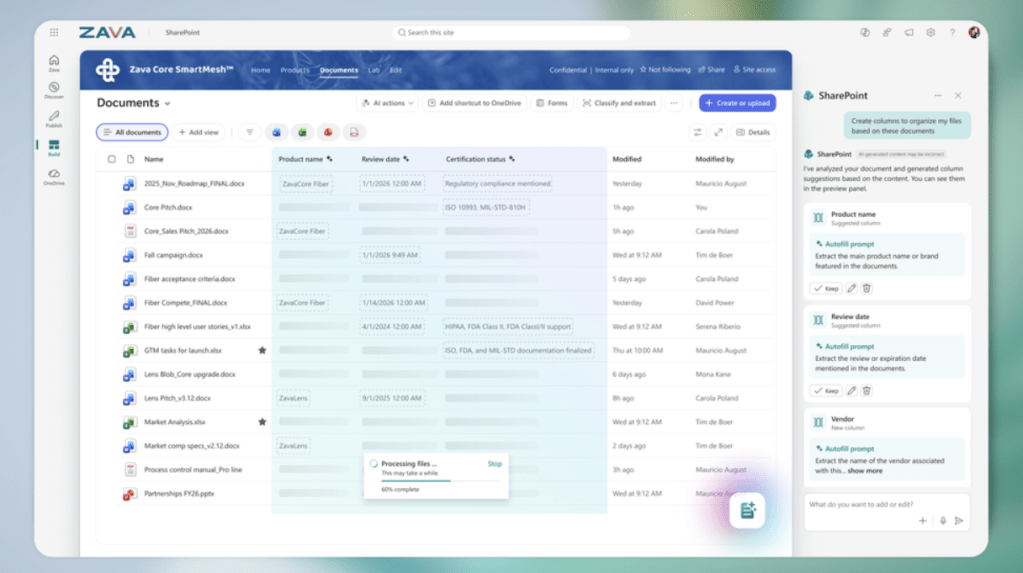
AI in SharePoint (the refreshed Knowledge Agent) — agentic building and content intelligence inside SharePoint, powered by Anthropic’s Claude model. Public Preview in March, worldwide in May.
Copilot in Excel — Work IQ context automatically pulled in, plus multi-step edits to locally stored workbooks on Windows and Mac.
Citations display for Copilot in Word — citations automatically shown when responses use web or Work IQ sources.
Standardize format with Copilot in PowerPoint — fonts, sizes, and bullet styles cleaned up across all slides at once.
For admins:
Microsoft Purview DLP for Copilot safeguarding prompts and web searches containing sensitive data.
Authoritative sources, high-usage users, and domain exclusion — new controls in the Microsoft 365 admin center.
Satisfaction, intent, and usage tracking in the Copilot Dashboard.
Copilot Tuning templates in Agent Builder — for enterprises with at least 5,000 Copilot licenses, rolling to Frontier in April and worldwide in June. Read more from chapter below.
Read the full roundup
Latest enhancements for Copilot security, management, and analytics
As Copilot becomes a daily tool for more and more teams, IT and security leaders need practical, built-in controls — without slowing adoption. Microsoft published an excellent roundup of the newest ones:
Secure and Govern Microsoft 365 Copilot deployment guide — an updated foundational blueprint with three essential steps: remediate oversharing, implement reliable guardrails, and meet AI-related regulatory obligations. See aka.ms/Copilot/SecureGovern.
Microsoft Purview DLP for Copilot prompts — generally available.
Microsoft Purview DLP for web queries — Public Preview.
Purview DSPM: bulk remediation of overshared files — generally available.
Purview in the Microsoft 365 admin center — oversharing visibility and the ability to turn on Purview DLP for Copilot directly from there.
Organizational Messages — now includes email as a delivery channel, plus usage-based targeting for driving Copilot adoption based on real behavior. General availability this month.
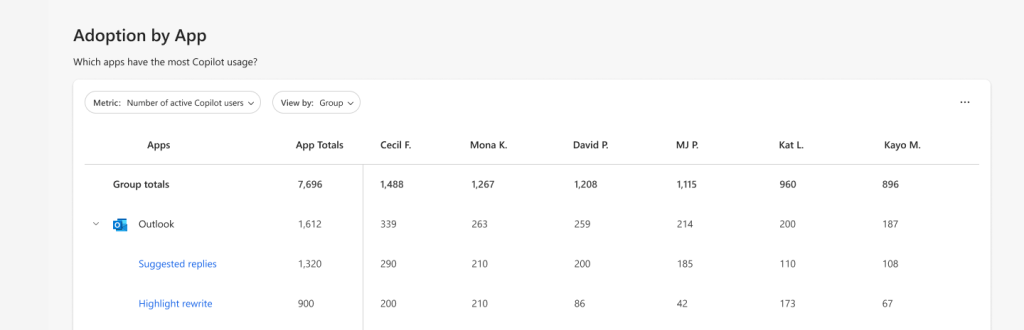
Copilot Dashboard for everyone — now available to customers with at least 1 Microsoft 365 Copilot license, with metrics for users, trends, adoption, intensity, retention, and app-level breakdowns.
User satisfaction tracking at scale — thumbs-up and thumbs-down aggregated across apps, with trends over time and group comparisons.
New intent patterns across M365 apps — suggested reply, translate, coach, clean data, and more. Public Preview this month.
Export Copilot Dashboard data — de-identified CSV export, weekly metrics covering the past six months. GA this month.
Read the announcement
Important — Copilot Chat removed from Word, Excel, PowerPoint, and OneNote for non-Premium users
This one deserves its own section, because it has real impact on larger organizations.
Beginning April 15, 2026, Microsoft stopped offering direct access to Copilot Chat within Word, Excel, PowerPoint, and OneNote for users who do not have a paid Microsoft 365 Copilot (Premium) subscription. The Copilot icon is gone from the ribbon in those apps for unlicensed users. This change applies across all licenses, not just a single tenant — which is why it matters for every organization running a mixed Copilot license landscape.
What stays the same: Copilot Chat remains available on the web at m365.cloud.microsoft, in the Microsoft 365 Copilot app, inside Outlook (mail and calendar), and inside Teams — as long as users sign in with their work account to enable enterprise data protection.
Why this matters for larger organizations:
If your Copilot rollout was relying on the in-app Copilot Chat experience in Word / Excel / PowerPoint / OneNote for unlicensed users (for example, as a “try before you buy” surface), that surface is gone.
Users without a Microsoft 365 Copilot (Premium) license who were using the Copilot icon in those apps will notice the change immediately.
Communications and enablement materials should be updated so users know where Copilot Chat still lives and how to sign in with enterprise data protection.
For tenants where Premium licensing is not yet available at all (a situation familiar to many education and large public-sector customers), the in-app experience is simply not coming back without licensing.
The direction is clear: the rich in-app Copilot experience is reserved for Microsoft 365 Copilot (Premium) subscriptions, while Copilot Chat with enterprise data protection remains broadly available across the other surfaces.
Coming soon — from the Microsoft Admin Center (Message Center)
Several upcoming changes are already announced in the Microsoft Admin Center. Admins — these are the ones to put on your radar.
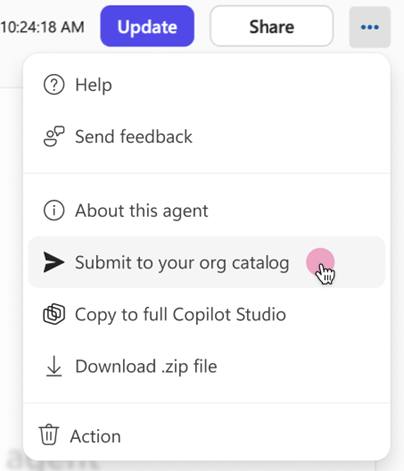
MC1280557 — Submit agents to the Agent Store from Agent Builder
Rolling out in mid-May 2026 and expected to complete by late May 2026. Microsoft 365 Roadmap ID 557173.
This one is a meaningful step for anyone scaling agent building inside the organization. Agent Builder users will be able to submit their agents for administrator review before the agents are published to the org’s Agent Store catalog. Once approved, the agent appears in the “Built by your org” section of the Agent Store, where colleagues can discover and install it.
How it works:
Submission — Agent Builder users select Submit to your org catalog to request publishing.
Review — the submission creates a review request in the Microsoft 365 admin center. Admins use the existing publishing and approval workflow, with full control over who can access the agent, scoping to specific users or security groups, and options for preinstalling or pinning.
Distribution — approved agents are available for everyone to discover and install directly from the Agent Store.
Updates — agent updates require a new admin submission, and each one triggers a new review cycle.
Published agents appear as a separate entry in the Agent Registry under Agents → All agents.
Action: no action is required before rollout, but admins can familiarize themselves with the review experience under Agents → All agents → Requests, and internal agent makers should be informed so they understand the submission and approval process.
MC1282682 — Agent Builder: a refreshed agent creation experience
Rolling out in late April 2026 (Worldwide, GCC, GCCH). Available to both Copilot Chat (Basic) and Microsoft 365 Copilot (Premium) users.
The Agent Builder creation experience is getting a visual and UX refresh to make building an agent clearer, faster, and more intuitive. The update focuses only on the creation experience — there are no changes to how agents function, how they are published, or how they are managed.
What is new:
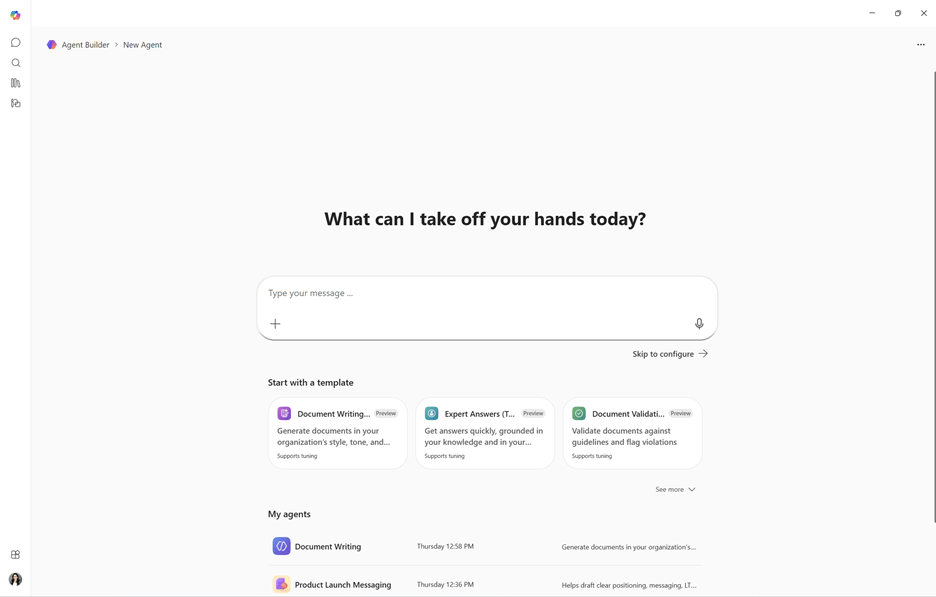
The landing page now shows templates and a list of existing agents, making it easier to start fresh or reuse an agent.
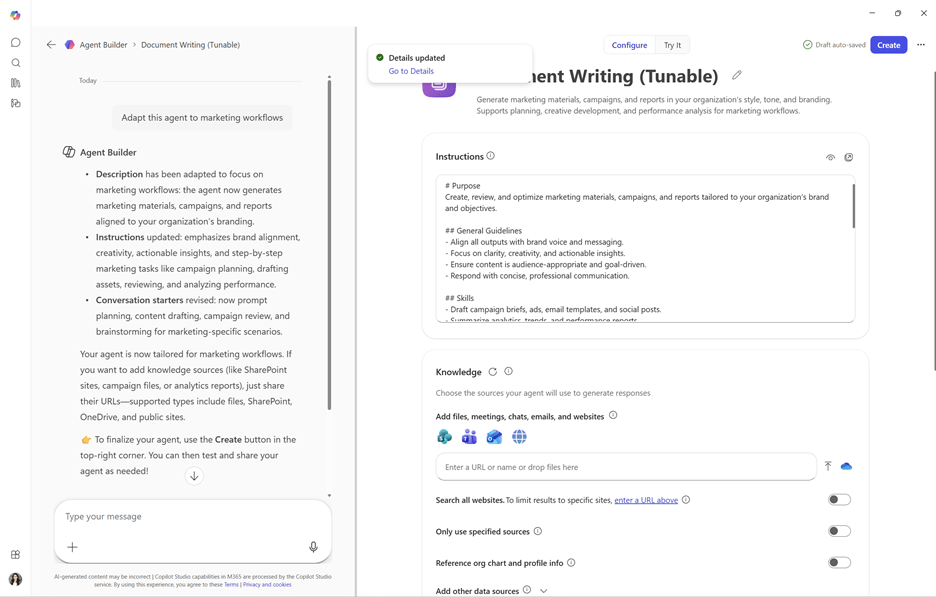
Describe and Configure panes are displayed side by side — updates in Describe are reflected in the configuration in real time, with the configuration pane highlighting what changed and why.
A Show changes option lets users review how instructions have evolved over time.
Testing is now accessed through a Try it toggle, making it easy to switch between configuring and testing before publishing.
The feature is enabled by default and requires no admin configuration. A small update, but one that makes a daily builder experience noticeably smoother.
MC1222551 — Copilot Tuning: public preview and new Agent Builder templates
Public preview starts in April 2026 for organizations enrolled in the Frontier TAP and Public program with 5,000 or more Microsoft 365 Copilot licenses.
Copilot Tuning is adding new templates in Agent Builder designed for high-value document work — drafting complex documents, validating documents against organizational guidelines, and editing to match a distinct writing style. And with Copilot Tuning enabled, organizations can go further and tune those template-based agents by adjusting context, tools, and the underlying models with their own proprietary data, processes, and standards. This is how you get agents that genuinely work the way your organization works.
A few important details for admins:
The new templates are available to all users licensed for Microsoft 365 Copilot, even without Copilot Tuning itself.
Tuning is reserved for organizations with 5,000+ Copilot licenses in the Frontier TAP and Public program during preview.
Copilot Tuning creates a snapshot of selected SharePoint content for tuning purposes, stored in a tenant-isolated Microsoft 365 environment and used only within the Copilot Tuning service.
DLP policies on the source SharePoint content do not apply to the snapshot — this is an important nuance to review with your data governance team.
During public preview, EU tenant traffic remains within the EU Data Boundary, while global tenant traffic may be processed in other regions for large language model operations.
Advanced Data Residency (ADR) tenants: Copilot Tuning is not enabled by default; ADR customers may opt in by formally waiving ADR requirements through their Microsoft account team.
Snapshots are not automatically updated — if the underlying SharePoint content changes, agents must be retrained.
Action: admins can manage access in the Microsoft 365 admin center under Copilot → Settings → Copilot Tuning, scope tuning to specific users or Entra ID groups, or disable it entirely. Review internal data governance, privacy, and regulatory requirements before enabling — particularly around the DLP-on-snapshot nuance.
For a deeper dive, see the Copilot Tuning Overview on Microsoft Learn(opens in new window) or the Ignite session (45 min)(opens in new window).
MC1269241 — Anthropic models on by default for Copilot in Word, Excel, and PowerPoint
Starting May 4, 2026, a new “Copilot in M365 apps with Anthropic models” setting appears in the Microsoft 365 Admin Center. When enabled, Anthropic models become available by default for Copilot in Excel and PowerPoint, with Word support arriving in summer 2026.
A few important details:
This setting is enabled by default for your tenant (subject to Anthropic capacity). You can review or change it anytime under Copilot → Settings → View All → AI providers operating as Microsoft Subprocessor.
If your global Anthropic subprocessor setting is already enabled, this update introduces no additional change.
When Anthropic models are used, data processing for these models occurs outside the EU Data Boundary (EUDB). Anthropic operates as a Microsoft subprocessor under the Microsoft Product Terms and DPA. No customer data or state is stored outside the EUDB, and all data is encrypted in transit.
If no change is made, Anthropic models will be available for Copilot in Excel and PowerPoint from May 4, 2026. Word support joins in summer 2026.
Action: EU / EFTA / UK admins — review this setting now and confirm it aligns with your organization’s needs.
MC1266023 — New Copilot metrics across Microsoft 365 apps
Rolling out from late April 2026 and expected to complete in late May 2026. Microsoft 365 Roadmap ID 557981.
New metrics will appear in the Copilot Dashboard and Advanced Analysis in Copilot Analytics, giving admins better visibility into how users actually engage with Copilot:
Actions in the Microsoft 365 Copilot app, Microsoft Edge, and OneNote.
Intent-based scenarios in Outlook, Word, Excel, and PowerPoint — including suggested replies, translation, coaching, and clean data.
The feature is enabled automatically for all tenants with a Copilot license. No configuration or policy change is required.
MC1222978 — User-day export for Copilot Dashboard metrics (public preview)
Timeline: Public preview mid-May 2026 → end of May 2026, with GA early August 2026 → end of August 2026. Roadmap ID 547749.
Copilot Dashboard users with company-level access will be able to export de-identified Copilot usage metrics aggregated by user and day, covering the last 28 days. This is in addition to the existing user-week export.
Highlights:
Minimum of 50 Microsoft 365 Copilot licenses required.
Export includes Organization and Job function attributes, and supports analysis across Copilot-enabled apps (Word, Excel, Teams, and more).
Uses the same Viva Feature Access Management (VFAM) controls as the existing user-week export — no new access controls are introduced.
Data usually reflects Copilot activity up to 3 days before the export date.
Action: review your VFAM settings for users with company-wide Copilot Dashboard access, and inform eligible users about the new option.
MC1280558 — Use Copilot to explain selected slide content in PowerPoint Live
Rolling out in mid-May 2026 and expected to complete by late May 2026. Roadmap ID 557256.
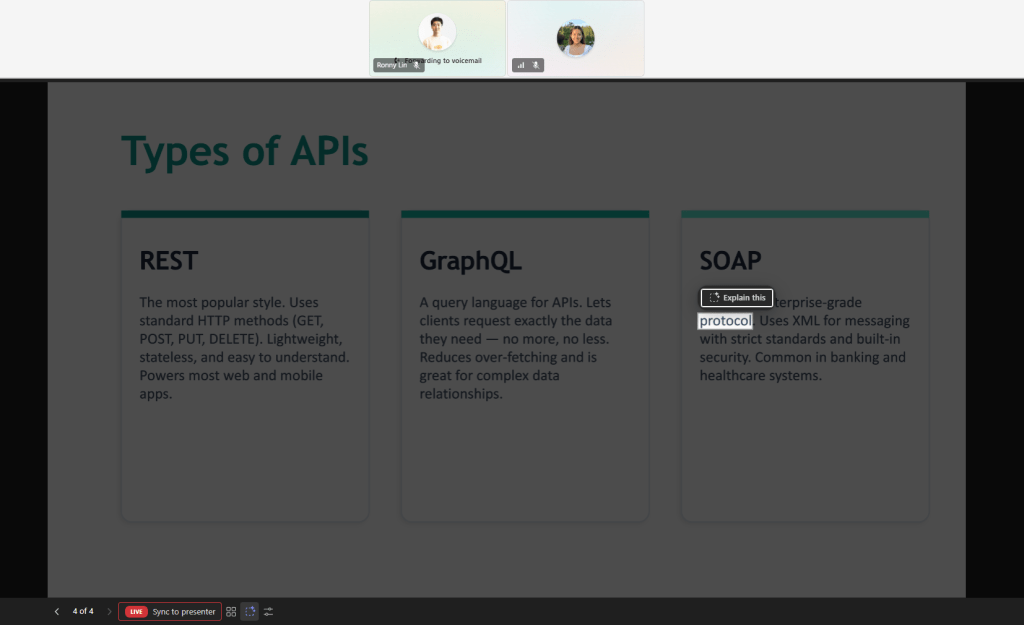
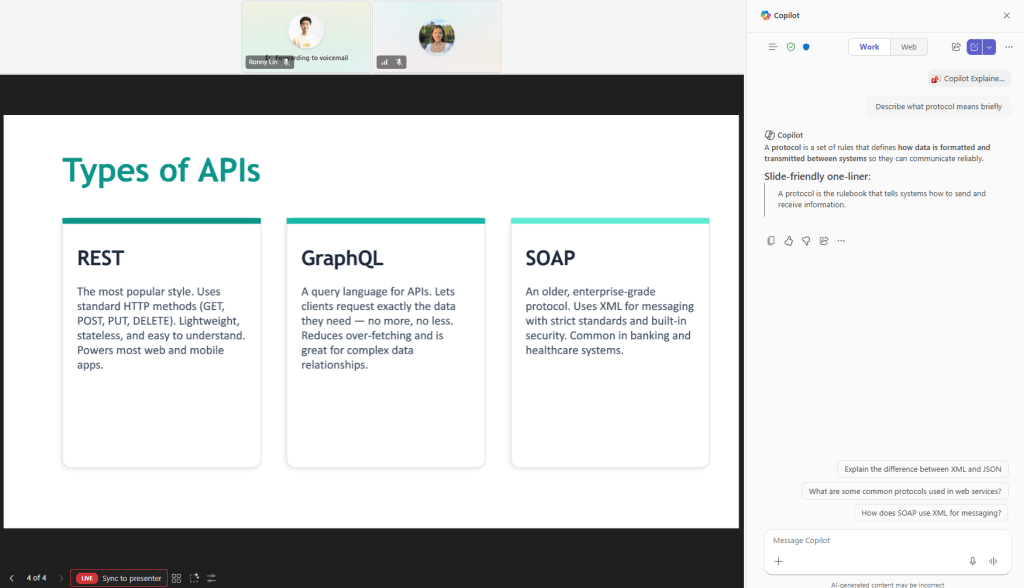
During a Teams meeting with PowerPoint Live, attendees can select text on the slide — an acronym, a technical term, a complex concept — and ask Copilot to explain it. The explanation is shown privately to the attendee, without interrupting the presenter or cluttering the chat.
On by default for tenants with Microsoft 365 Copilot (Premium).
No admin action required to enable.
Processing follows existing Copilot for Microsoft 365 AI processing and security boundaries.
A small feature, but one with a big impact on meeting inclusivity — especially for global teams and for sessions full of jargon. I love this one.
What this all means for the work
Taken together, these updates tell a very clear story: Microsoft 365 Copilot is maturing from an assistant into a true coworker, with deeper app integration (Word document workflows, PowerPoint Live explanations), richer analytics (intent, satisfaction, user-day exports), and stronger security and governance (Purview DLP, oversharing remediation, Secure and Govern guidance). And with Copilot Cowork now in Frontier, the whole stack is moving toward real execution of multi-step work.
At the same time, the April 15 change reminds all of us that the rich in-app Copilot experience belongs to the Premium subscription (paid Microsoft 365 Copilot license), and every organization needs a clear licensing and enablement plan to match.
This is the Future of Work in practice — an AI-Native workplace where people and intelligent agents co-create every day, inside a secure, governed Microsoft 365. I am excited to see how organizations adopt all of this, and I will keep exploring these capabilities on the blog.
After more leaks than Edward Kenway’s rickety old tub, Assassin’s Creed: Black Flag Resynced has finally been shown off in an 8+ minute trailer, and it’s looking good.
13 years after the game launched, Resynced is a full-blown remake of what many people consider the best AC game in history and one of the best pirate games. This remake is done on the latest version of Ubisoft’s Anvil engine, the very same one powering Assassin’s Creed: Shadows.
First, the graphics. It looks bloody amazing. To steal the video’s top comment by Gergopahollo, “It’s so weird seeing this because this is what Black Flag looks like in my head lmao.” Couldn’t have said it better myself.
On console, these improved looks will be available via “60 FPS options” or you can opt for a 30FPS fidelity mode. There’s also the option of a 40FPS balanced mode for those with a 120hz screen.
Assassin’s Creed: Black Flag Resynced Official PC Specs+
Game director Richard Knight also addressed the biggest potential concern: “Assassin’s Creed: Black Resynced matters deeply to us and to you. That’s why we took the time to rebuild it with the care it deserves. This remains a solo adventure and character-driven experience. It is not an RPG.”
There was a lot of worry prior to the announcement that the remake would try to make Black Flag more like the modern Assassin’s Creed games, and thus destroy what fans loved.
While the original story hasn’t been touched, there’s new content being added, based around three new crew members: Lucy Baldwin: The Padre, and Deadman Smith. They will add new ship abilities, along with new questlines that explore who they are and why they’ve ended up hanging out with Edward Kenway.
On the ship front, things have markedly improved there. There’s new firepower thanks to weapons getting alt-fires, and now you can have a monkey or cat running around the ship. There’s even new sea-shanties to enjoy. Arguably, the best bit of the entire game was just sailing around, listening to the crew singing.
Oh, and there’s now seamless transition between sailing and land. Just pull up, hop off, stab some folk, hop back on and sail off into the distance like nothing ever happened.
Combat has been reworked, too, although this is one area I’m not yet convinced on. The premise is an “action-oriented experience” based around countering opponents, which lets you pull off chain-takedowns. The original game’s combat was rather crappy, so almost anything will be an improvement, but this didn’t speak to me.
Parkour has been upgraded with things like free jumps, back ejects and side ejects. In theory, this should provide more precise movement.
As for stealth, you can crouch now whenever you want and freely dive wherever you like in the water. Light and shadow will also have an effect now, which should help spice up stealth a tiny bit.
Multiplayer is out the door as well, as the team wanted to focus on the singleplayer. However, the original game is going to remain on sale, so you can always check out the multiplayer there.
“With Resynced, we made a clear choice,” Resynced creative director Paul Fu said. “It is a pure, story-driven adventure, and we are fully focused on Edward’s adventures in the Caribbean. As a result of this focus, we have elected to not have the multiplayer, or the DLC. Resynced is a 2026 take on the original legend, and for those of us who are curious, the original will still be available.”
It also seems like most of the modern-day stuff involving Desmond has also been thrown overboard in favour of keeping the focus on Kenway and his band of nutters, although the wording suggests a few sections will remain.
“Today, the modern day has evolved. For Black Flag Resynced, we have approached it in a way that focuses on Edward’s journey while still connecting his memories to the Animus.The modern day rifts in Black Flag Resynced will feature new moments that focus on Edward’s internal struggles.”
Assassin’s Creed: Black Flag Resynced will launch on July 9 for Xbox, PlayStation and PC. Here’s the pricing and editions available.
Standard Edition (59.99 €/$)
Digital/physical copy of the game. Physical copy is only available through local retailers.
Deluxe Edition (69.99 €/$)
Digital copy of the game.
Digital download: Master Assassin Character pack – sword, pistol, and trinket each with a unique perk, and costume for Edward.
Digital download: Master Assassin Naval pack – sail set, ship’s pet, crew attire, wheel, figurehead, and hull trim.
Collector’s Edition (199.99 €/$)
Digital (PC)/physical (PS5/Xbox Series X|S) copy of the game.
Edward Kenway figurine (31cm/12inch) – a lifelike statue of Edward Kenway, poised for battle on the deck of the Jackdaw
Edward’s Leather Logbook – recreated from Edward’s own writings: maps, thoughts, and pirate chronicles bound in leather.
Metal Brooch – a bold, premium metal Assassin insignia inspired by Edward’s gear.
Exclusive Steelbook® – featuring exclusive art designed especially for the Black Flag Collector’s Edition.
Sea Shanty Music Sheet – a stylized, age print of a new sea shanty sung aboard the Jackdaw.
Digital download: Master Assassin Character pack.
Digital download: Master Assassin Naval pack.
Digital download: Blackbeard’s Crimson pack – including a pistol, and sword which each provide a unique perk, as well as a costume for Edward.