Cannoli is a 4-star Dessert Meal added with the A Rift in Time expansion. Players can make this meal for themselves to restore energy or gift it to villagers to increase their Friendship Level. However, this recipe is exclusive to the owners of the expansion. This guide will help you cook Cannoli in Disney Dreamlight Valley.
Required Ingredients to Make Cannoli in Disney Dreamlight Valley
Players can make a Cannoli Dessert meal with the following ingredients.
1x Wheat
1x Cheese
1x Egg
1x Vanilla
Wheat is a common grain ingredient in DDV that players can purchase from various Goofy Stalls. Goofy sells Wheat at his stall in the Peaceful Meadow (Valley) and Ancient’s Landing (Eternity Isle). It will cost you 3 Star Coins to purchase 1 Wheat from Goofy. Cheese is a dairy product that players can purchase from the Chez Remy restaurant. It will cost you 180 Star Coins. Egg is another dairy product, and you can purchase it from the Chez Remy restaurant for 220 Star Coins. Lastly, Vanilla is a sweet ingredient that grows on the ground in the wild. You can find it on the ground in the Sunlit Plateau (Valley) and Mythopia (Storybook Vale) biomes.
How to Make the Cannoli in Disney Dreamlight Valley
After gathering all the ingredients for the Cannoli, go to any Cooking Station to start making it. Go to any cooking station in the Valley/Eternity Isle and interact with it. After that, put the ingredients into the Cooking Pot individually and then select the “Start Cooking” option to cook the Cannoli Dessert Meal.
Use of Cannoli
Players can choose to eat the Cannoli to restore 1,482 Energy. Moreover, they can gift it to other villagers to increase their Friendship Level. Lastly, they can sell it to Goofy for 678 Star Coins.
A new collaboration between blockchain-based MMO Star Atlas and decentralized cloud gaming platform Shaga aims to break down hardware barriers for gamers and creators alike. The two projects are rolling out a campaign titled “Streaming With Shaga,” offering rewards of up to $100,000.
Designed to showcase how high-fidelity Web3 games like Star Atlas can run smoothly on mobile devices without a gaming PC, this event highlights a growing push to make blockchain gaming accessible to wider audiences.
Bringing Web3 Gaming to Phones and Tablets
Star Atlas, developed on the Solana blockchain and powered by Unreal Engine 5, typically requires high-performance PCs to handle its detailed graphics and complex economy. Under this new initiative, creators can broadcast gameplay from their PC to viewers’ phones or tablets via Shaga’s cloud platform—no powerful computer required on the viewer’s end. In essence, Star Atlas becomes a game anyone can try out from virtually anywhere, as long as they have a smartphone or tablet.
$100K Reward Pool and Airdrop Angle
Central to the campaign is a substantial reward pool that combines $ATLAS tokens, Star Atlas ships, and GLOB points (Shaga’s native reward currency). Participants who register and are accepted into the campaign can earn various digital assets and tokens. GLOB points, in particular, may be of special interest: they’re designed to lead to future airdrops and unlockable perks, reflecting a broader shift in Web3 gaming toward giving active community members meaningful, long-term incentives.
An upfront submission bonus sweetens the deal for creators who move quickly. The next 50 qualifying participants that post a short “Shaga in Action” clip by April 21, 2025, can secure an additional Star Atlas XS Ship—valued at around $135—and $50 in USDC. These lucky early adopters then move on to compete for the full prize pool once the official campaign starts on April 23 running through May 7.
Source: Star Atlas
How Creators Can Qualify
Interested creators need at least 100 followers on major social platforms (e.g., X, Twitch, YouTube, or TikTok). They must have streamed at least four times within the past four months. To enter, they’ll record a 30- to 60-second video demonstrating how one of their viewers uses the Shaga app on a mobile device to access Star Atlas in real-time. Once the video is ready, they must post it on X, tagging @playonshaga and including the phrase “Streaming with Shaga.”
Accepted creators gain access to all of Star Atlas’ in-game assets, enabling them to showcase everything from starships to complex market mechanics. Moreover, each approved participant is promised 100,000 GLOB points, setting the stage for future token airdrops or other unlockable rewards within Shaga’s ecosystem.
Star Atlas: Paving a Way
Star Atlas is a futuristic grand strategy game set in the year 2620, inviting players to explore deep space, conquer new territories, and develop a thriving, player-driven economy. Developed on the Solana blockchain, it delivers fast and affordable transactions, while blending stunning Unreal Engine 5 graphics with decentralized asset ownership.
In Star Atlas, spaceships, virtual land, and in-game characters function as NFTs, meaning they can be bought, sold, or traded on marketplaces like Serum DEX. Players can jump into mining, engage in epic combat, and even shape the political landscape through Decentralized Autonomous Corporations (DACs).
A dual-token system fuels every interaction: $ATLAS covers in-game transactions, while $POLIS drives governance, letting the community make critical policy decisions.
With the help of Shaga’s decentralized cloud platform, Star Atlas hopes to reach an even broader audience by streaming its high-end gaming experience to just about any device. It’s a step toward a Web3 future where top-tier games aren’t restricted by hardware requirements—opening the door for more people to explore.
Foundation EGI, a deep-tech startup born at MIT, has officially unveiled the world’s first domain-specific agentic AI platform tailored for engineering and manufacturing. This milestone is bolstered by a successful $7.6 million oversubscribed seed funding round, signaling strong confidence from leading venture firms and industrial leaders.
The round was led by a powerful syndicate of deep-tech investors including The E14 Fund, MIT’s flagship venture capital fund; Union Labs; Stata Venture Partners; Samsung Ventures; GRIDS Capital; and Henry Ford III, the industrialist and investor carrying forward the legacy of the Ford Motor Company.
Engineering and manufacturing, despite their critical roles in industrial progress, remain surprisingly analog. Unlike finance and healthcare—industries that have already seen massive transformations through AI and digitalization—engineering workflows continue to rely heavily on manual documentation, human interpretation of vague specifications, and disjointed software systems. This fragmented ecosystem contributes to nearly $8 trillion in annual inefficiencies, with delays, design flaws, and production inconsistencies hampering innovation and revenue.
Foundation EGI is tackling this inefficiency head-on by converting natural language inputs into clean, structured machine-readable code that engineering systems can immediately execute. This leap from unstructured instructions to executable workflows could accelerate design iterations, improve product quality, and streamline compliance.
From MIT Labs to Market –
Foundation EGI was co-founded by an impressive trio of deep-tech and academic leaders:
Mok Oh, Ph.D., a serial entrepreneur and former MIT researcher
Professor Wojciech Matusik, a renowned expert in AI-driven design and computer graphics
Michael Foshey, an engineering researcher specializing in intelligent manufacturing systems
The company’s foundational research stems from the 2024 MIT paper titled “Large Language Models for Design and Manufacturing,” co-authored by Matusik and Foshey. That paper laid the theoretical groundwork for developing a domain-specific AI platform capable of understanding engineering semantics far beyond the reach of general-purpose language models.
What is EGI?
EGI, short for Engineering General Intelligence, is a proprietary AI platform powered by a domain-specific large language model. This model is engineered to comprehend the precise language, logic, and structure of engineering documents, designs, and workflows. Unlike generic AI platforms that often hallucinate or misinterpret specialized jargon, EGI is trained explicitly on manufacturing and design data.
EGI’s core innovation lies in its agentic architecture. Intelligent agents embedded in the system can autonomously operate within existing engineering tools to perform tasks like:
Parsing and executing design specs
Automating compliance documentation
Generating machine code or CAD inputs from plain language
Running quality checks and simulations within design environments
This enables engineers to describe a need in plain English and have EGI turn it into structured output that software and machines can understand—drastically reducing the cycle from ideation to implementation.
Early Adoption and Use Cases –
The platform is currently in pilot testing at several Fortune 500 industrial companies, with early results showing significant reductions in design-to-manufacture timelines, fewer errors during production, and improved product-market fit due to faster iteration.
EGI integrates with industry-standard engineering tools and is accessible via a web-based interface. Engineers using EGI report measurable improvements in auditability, observability, and traceability—elements critical for regulated sectors like aerospace, automotive, and consumer electronics.
Strategic Funding for Growth –
The $7.6 million seed funding will be channeled into key growth areas:
Team Expansion: Hiring more engineers and AI researchers to enhance product capabilities.
Enterprise Scaling: Onboarding more enterprise customers and scaling pilot projects.
Tool Integration: Deepening integrations with top engineering software platforms.
Model Development: Improving the core LLM’s capabilities to handle additional verticals within manufacturing.
The company plans to extend its domain-specific intelligence beyond core manufacturing to areas like materials science, fluid dynamics, and embedded systems design.
Industry Response –
“We have high expectations from Foundation’s EGI platform. It’s clear it will help us eliminate unnecessary costs and automate disorganized processes,” said Dennis Hodges, CIO at Inteva Products, a global automotive supplier. “It will bring observability, auditability, transparency and business continuity to our engineering operations.”
“The timing and market conditions are perfect for a company like Foundation EGI,” noted Habib Haddad, founding Managing Partner at E14 Fund. “The combination of its world-class team and a pressing $8T problem in industrial manufacturing makes this a uniquely high-potential opportunity.”
At a recent TEDxMIT event, Professor Wojciech Matusik spoke on the vision behind EGI:
“Engineering general intelligence transforms natural language prompts into engineering-specific outputs using real-world physics and spatial awareness. Expect leaps and bounds in creativity, innovation, and industrial agility.”
The Road Ahead –
Foundation EGI is not just creating a product—it is defining a new category: domain-specific, agentic AI for high-stakes, real-world engineering applications. As industrial AI adoption continues to accelerate, Foundation EGI is positioning itself as a critical enabler of engineering’s long-overdue digital transformation.
With deep technical roots, a top-tier leadership team, and support from some of the world’s most influential venture capital and industrial leaders, Foundation EGI is primed to become the AI layer powering the future of engineering.
For more insights and updates on Metaverse, DeFi, Blockchain, NFT & Web3, be sure to subscribe to our newsletter. Stay informed on the latest trends and developments in the decentralized world.
Optimum, a cutting-edge Web3 infrastructure startup, has raised $11 million in a seed funding round to build what many in the industry are calling the “missing memory layer” for blockchains.
Blockchains were never meant to remember. Their architecture is designed for consensus and security—not for memory. Each transaction or smart contract interaction is stateless, existing in isolation from all others. As a result, blockchains cannot “recall” previous user actions or data unless this memory is explicitly stored on-chain—an approach that is often expensive, inefficient, and cumbersome.
But what if decentralized applications could access historical data as easily as modern apps do today? What if a DeFi protocol could recall your previous staking activity or portfolio allocations without relying on costly storage or centralized APIs? That’s the vision Optimum is chasing.
The Web3 infrastructure startup has just announced an $11 million seed funding round to build what it calls the “missing memory layer” for blockchains—a permissionless, composable system that enables seamless access to on-chain historical data across multiple ecosystems.
A Funding Round That Signals Web3’s Maturing Infrastructure Layer:
The funding round was co-led by prominent crypto-native investors including Maven 11, 1kx, and Galaxy Ventures, with additional participation from Hashed, Robot Ventures, and Inflection.xyz.
The funds will be used to expand Optimum’s core engineering team, improve its developer tooling, and roll out its data infrastructure across Ethereum, Solana, Cosmos, and other leading Layer-1 and Layer-2 blockchain ecosystems.
This funding underscores a broader trend in Web3: an increasing focus on data accessibility, developer experience, and building infrastructure that rivals the capabilities of traditional cloud platforms—without sacrificing decentralization.
Solving Blockchain’s “Amnesia Problem”:
Blockchains are phenomenal at ensuring data immutability and verification. However, when it comes to storing or retrieving large amounts of historical data, they fall short. Most decentralized apps today depend on centralized indexers like Etherscan or services like The Graph to fetch older blockchain states. This reliance introduces potential bottlenecks, limits composability, and undermines the verifiability of on-chain applications.
Optimum aims to change that by tackling what it describes as the “amnesia problem” in blockchain systems.
Its solution is a composable memory layer—a decentralized protocol that allows developers and smart contracts to instantly fetch historical blockchain data without relying on third-party APIs. This enables use cases like querying the ETH balance of an address on a specific date, analyzing MEV or sandwich attacks, or constructing personalized DeFi experiences with historical awareness.
How Optimum’s Memory Layer Works?
At the heart of Optimum’s approach is a cryptographically secure data abstraction layer that compresses and stores verifiable summaries of blockchain history across multiple networks.
It uses advanced techniques such as zero-knowledge proofs (ZKPs) and succinct data commitments to ensure that any query—past token balances, staking actions, smart contract interactions—is both fast and trustless.
This architecture allows developers to query blockchain history similarly to how they would interact with a database, but with the guarantees of on-chain validation.
To deliver real-time read/write performance, Optimum is also developing DeRAM, a next-generation memory layer that operates like RAM for the blockchain. DeRAM is intended to support near-instant access to recent blockchain states at a fraction of the cost of on-chain storage, unlocking new efficiencies for high-performance dApps.
Together, these layers aim to replicate traditional computing memory hierarchies in a decentralized environment—paving the way for more powerful and intuitive Web3 applications.
A Deep Tech Pedigree: MIT, RLNC, and the Power of Coded Data
Optimum is co-founded by Muriel Médard, a renowned professor at MIT and a pioneer in network coding. Her research in Random Linear Network Coding (RLNC) underpins much of Optimum’s architecture. RLNC transforms data into coded packets that are more resilient, composable, and efficient for distributed systems.
Her groundbreaking work in data compression and verifiable storage is now being applied to a decentralized context—turning theoretical models into practical infrastructure for Web3.
In a recently released video, Médard explained how her vision aligns with the broader Web3 mission: “If blockchains are to become the world’s computer, they need a memory system that is fast, decentralized, and accessible. That’s what Optimum is building.”
Making Web3 Feel Like Web2:
One of the biggest frictions in blockchain UX today is the lack of persistence. Smart contracts don’t remember you. Every interaction—whether it’s logging in, checking a balance, or claiming a reward—must be re-verified, restated, or reauthorized.
By introducing memory, Optimum aims to bridge that gap. With historical context built-in, smart contracts can create dynamic, personalized experiences much like apps in the Web2 world. This opens doors to improved DeFi portfolio management, richer NFT histories, cross-chain identity resolution, and much more.
Roadmap: Testnet by Q3 2025, Mainnet in Early 2026
Picture Courtesy: coingape.com
Optimum has already launched a private testnet, and plans to roll out a public testnet by Q3 2025, beginning with support for Ethereum and Solana. The mainnet launch is slated for early 2026, along with a developer SDK and a GraphQL-like query interface that will make it easy for developers to integrate Optimum’s memory layer into their dApps.
The company is also exploring decentralized incentive models to encourage node operators to contribute storage and compute to the memory network. Potential token-based rewards and reputation systems are being discussed to ensure long-term sustainability and decentralization.
Final Word: Memory Powers Intelligence in Web3
As blockchains evolve from static ledgers into dynamic, programmable platforms, memory will become the foundation for a new era of intelligent dApps. From fraud detection to custom user experiences, the ability to “remember” is what separates smart systems from simply distributed ones.
Optimum’s mission is to fill that gap—giving the blockchain world its long-overdue memory layer. And with $11 million in fresh capital and support from some of the top minds in crypto and academia, it’s poised to do just that.
This isn’t just about data infrastructure. It’s about building the foundation for a smarter, more human-centric Web3 future.
For more insights and updates on Metaverse, DeFi, Blockchain, NFT & Web3, be sure to subscribe to our newsletter. Stay informed on the latest trends and developments in the decentralized world.
Tempopo – out now on Xbox, Game Pass, PC and Play Anywhere
Get ready to find your rhythm on Xbox, PC, Game Pass and Play Anywhere with the launch of Tempopo.
Tempopo is a delightful new puzzle game from Witch Beam – the award-winning Aussie developers behind Unpacking and Assault Android Cactus.
It is available today on Game Pass, Xbox One, Xbox Series X|S, and PC, this charming adventure invites you to conduct adorable, chaotic creatures through beautiful sky islands.
Best of all for subscribers? Tempopo launches Day One onto Xbox Game Pass!
This means Game Pass members on Console, PC, and Cloud can jump straight into this musical garden puzzle at no extra cost. The game also supports Xbox Play Anywhere, meaning one digital purchase grants access on both Xbox and PC, with progress syncing between them.
Rescue the Flowers, Conduct the Tempopo
In Tempopo, disaster has struck Hana’s garden! Her magical, musical flowers have been scattered across a sky full of vibrant islands. It’s up to you to help her enlist the aid of the titular Tempopo – cute but chaotic creatures who need Hana’s conducting skills to stay on track.
You’ll guide these uncoordinated critters through each island’s puzzle, directing them to smash, block, lift, and push each other to retrieve the lost flowers. It’s a game of planning, execution, and keeping everyone on beat!
From the Talented Team Behind Unpacking & Assault Android Cactus
Developer Witch Beam has a fantastic track record. Many will know them from the BAFTA-winning, emotionally resonant narrative puzzle game Unpacking, a game we hit with a 3.5/5 score. Before that, they delivered the frantic, highly-polished twin-stick shooter Assault Android Cactus (4.5/5 score).
Tempopo showcases their versatility, shifting to a charming, music-infused puzzle experience.
Game Pass, Play Anywhere: Maximum Value
The arrival of Tempopo Day One on Game Pass is fantastic news, making this charming indie instantly accessible to millions of players. Whether you’re on Xbox consoles, PC, or streaming via the Cloud (with Game Pass Ultimate), you can start conducting the Tempopo right away.
Furthermore, the Xbox Play Anywhere support adds even more value for those who choose to purchase the game digitally. Buy it once on the Microsoft Store and own it on both your Xbox console (One or Series X|S) and your Windows PC, with all your saves and achievements travelling seamlessly with you.
Key Features
Unique Puzzle Gameplay: Conduct chaotic Tempopo to solve island puzzles.
Charming Presentation: Beautiful sky islands and adorable creatures.
Musical Integration: A world permeated with music, featuring a soundtrack by Jeff van Dyck (Assault Android Cactus, Unpacking composer).
Day One on Game Pass: Available now for subscribers on Cloud, Console, and PC.
Xbox Play Anywhere: Buy digitally once, play on Xbox & PC.
Find Your Rhythm Today
Tempopo looks set to be a delightful and unique puzzle experience, perfect for players seeking something charming and engaging. With its launch today on Xbox Game Pass and Xbox Play Anywhere support, there’s never been a better time to try it out.
Head to the Xbox Store or fire up the Game Pass app and start conducting the chaos.
We’ll have our full review ready for you very soon.
Tempopo Description
When Hana’s garden of musical flowers are scattered across a sky full of beautiful islands, she must turn to the magical Tempopo for help returning them. Chaotic and uncoordinated by nature, the Tempopo rely on Hana’s conducting skills to keep on the right track, and solve each island’s puzzle
Raydium, a leading decentralized exchange (DEX) and automated market maker (AMM) on the Solana blockchain, officially launched LaunchLab on April 16, 2025. It has positively impacted $RAY’s price and the Solana ecosystem, driving increased activity and innovation. Explore Raydium’s LaunchLab now and participate in cutting-edge projects and opportunities.
What is LaunchLab?
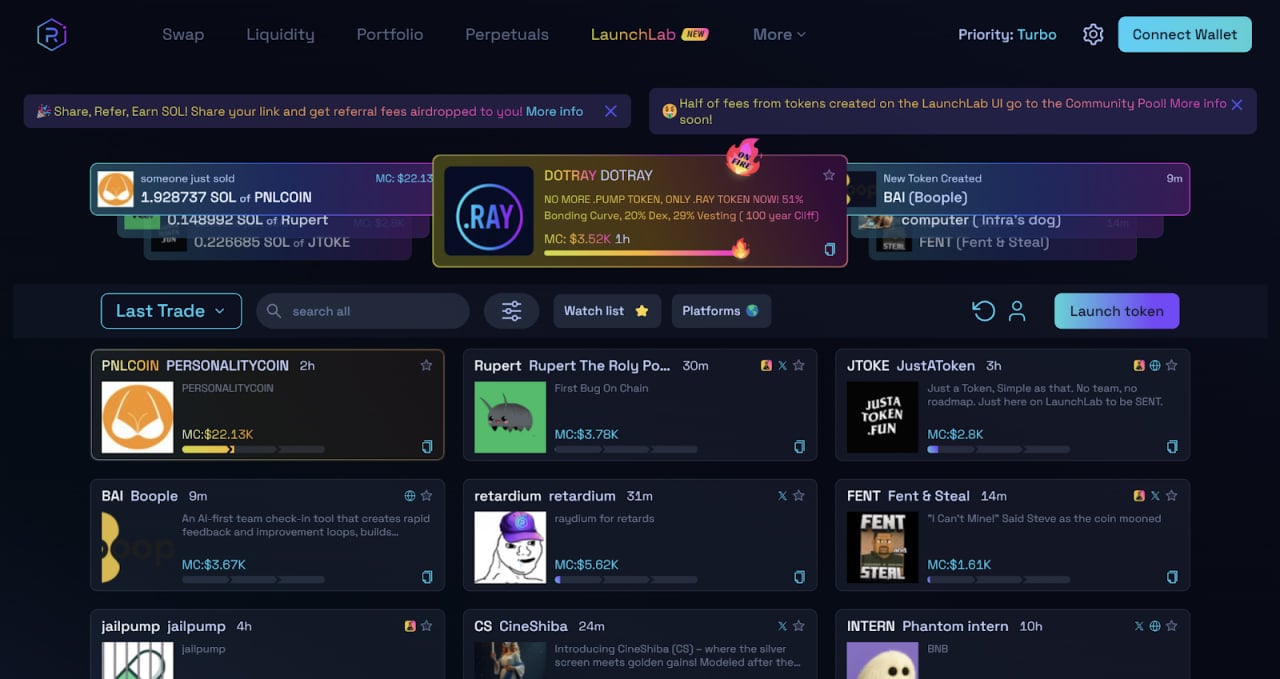
LaunchLab is a token launchpad platform designed to compete with Pump.fun, a popular Solana-based memecoin launch platform. It aims to simplify token creation and distribution for developers, creators, and the broader Solana ecosystem.
Source: LaunchLab
Raydium’s LaunchLab introduces a suite of innovative features designed to streamline and secure token launches on Solana. Creators can leverage customizable bonding curves to set token sale amounts, enabling dynamic pricing that adapts to market demand. The platform’s no-code interface offers flexibility with two modes: “JustSendIt” for quick launches with default settings and “LaunchLab” for tailored options like token supply, vesting, and distribution.
Free token launches make the platform accessible, allowing anyone to create a token, with liquidity automatically migrating to Raydium’s AMM pool upon reaching targets like 85 $SOL in JustSendIt mode.
To ensure trust, liquidity locking or burning post-migration minimizes rug pull risks. LaunchLab’s fee structure includes a 1% transaction fee, split as 50% to a community pool, 25% for $RAY buybacks, and 25% for infrastructure and operations. Additionally, token creators benefit from a post-migration fee share, claiming 10% of LP fees from AMM pool trades, incentivizing long-term project engagement.
Competitive Dynamics: LaunchLab’s Response to Pump.fun
The launch of LaunchLab is a strategic response to competitive pressures, particularly from Pump.fun, which had been a significant revenue driver for Raydium. Pump.fun announced its own AMM (PumpSwap) in March 2025, reducing its reliance on Raydium’s liquidity pools. Previously, Pump.fun tokens reaching a $69,000 market cap would migrate to Raydium for trading, contributing ~41% of Raydium’s swap fee revenue.
According to DefiLlama, PumpSwap’s debut, with over $31.7 billion in trading volume in just 10 days, increased the fierce competition with Raydium.
Moreover, with Pump.fun’s shift to PumpSwap, Raydium faced a potential loss of its revenue. LaunchLab aims to capture token launch activity and maintain Raydium’s dominance as Solana’s top DEX.
Therefore, LaunchLab aims to recapture token launch activity and reinforce Raydium’s dominance in Solana’s ecosystem. Beyond competition, it reflects Raydium’s vision to transition from a liquidity provider to a broader “ecosystem infrastructure builder,” supporting diverse, long-term projects with many key differences from Pump.fun, including:
Flexibility: LaunchLab offers advanced customization (bonding curves, vesting, fee-sharing) compared to Pump.fun’s aesthetic-only changes.Integration: LaunchLab connects directly to Raydium’s AMM, while Pump.fun now uses PumpSwap.Focus: LaunchLab supports all token types, not just memecoins, and aims for long-term project sustainability, addressing Pump.fun’s criticism for enabling pump-and-dump schemes.
LaunchLab’s Immediate Effect: $RAY and $SOL Price Surge
Source: CoinMarketCap
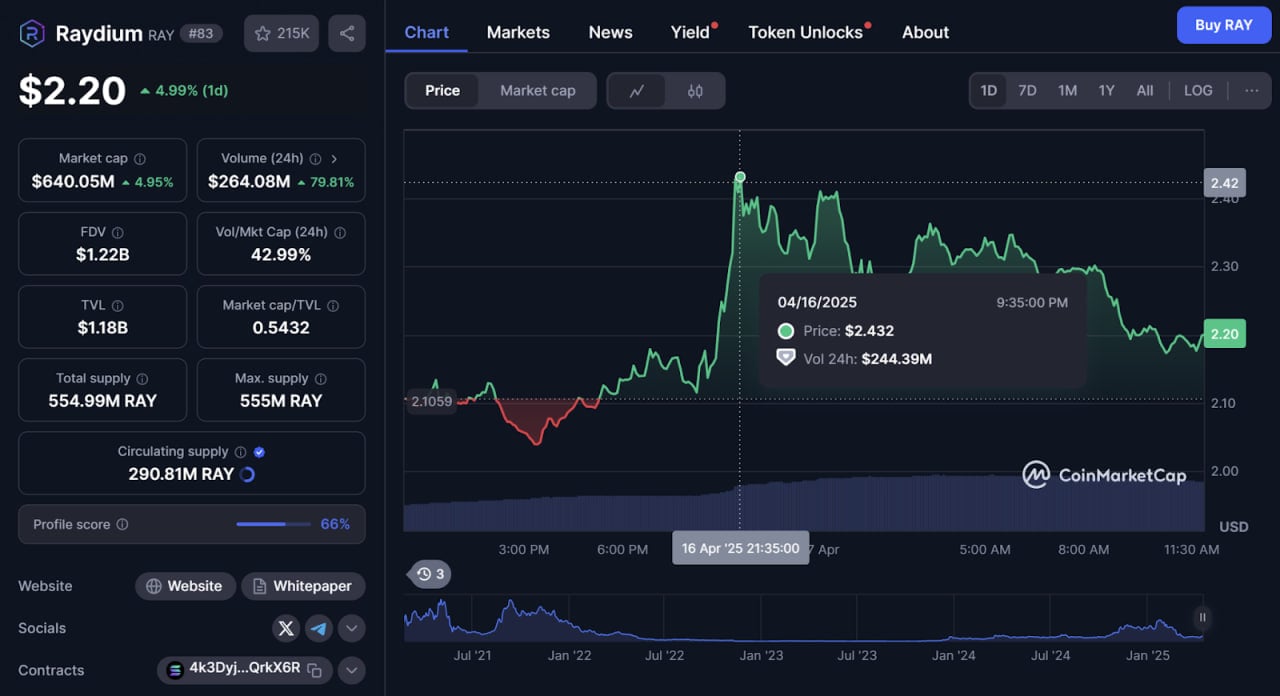
The LaunchLab announcement catalyzed a 13% spike in RAY, just over 1 hour after the news, reaching ~$2.43 with a market cap exceeding $680 million. Trading volume surged 80% to $264.08 million in 24 hours. The launch and 25% fee allocation for $RAY buybacks might support this bullish sentiment.
Learn more: Solana Price Prediction
For SOL, the direct impact is also immediate, with the price increasing 4.16% to $131 today. This spike is because of the belief in LaunchLab’s potential to drive ecosystem activity through new token launches and increased transactions, which could bolster $SOL’s value over time by enhancing Solana’s network usage.
While the initial market reaction has been positive, LaunchLab demonstrates significant potential beyond immediate price movements. Its focus on broader token types, long-term sustainability features, and direct integration with Raydium’s ecosystem positions it as a platform whose long-term impact on both Raydium and the wider Solana network is highly anticipated.
Zara McDermott and Louis Tomlinson were pictured together for the first time earlier this week, in pictures that will surely have come as a blow to her ex Sam Thompson.
The snaps came after Zara appeared to make things Instagram official with her new boyfriend Louis Tomlinson last week. She shared a picture of them at brunch, with the singer’s tattoos clearly visible in the snap.
Now, they’ve been seen in LA walking hand-in-hand. And, while Sam hasn’t broken his silence, his bestie Pete Wicks has, and he’s thrown a considerable amount of shade at the new lovebirds…
Zara split from I’m A Celebrity winner Sam Thompson last December (Credit: SplashNews)
Zara McDermott shares image of Louis Tomlinson
The couple first sparked romance rumours back in March. Fans spotted the duo enjoying a romantic meal at The Suffolk in Aldeburgh. Photos from a fellow diner swiftly made the rounds online.
While neither publicly confirmed the relationship at the time, they’ve since begun subtly sharing moments that hint at their growing connection.
Earlier this month, both Zara and Louis shared clips from the Stereophonics gig at The Wiltern in LA just minutes apart. The subtle overlap had fans buzzing.
Zara’s blossoming romance with Louis comes after her high-profile split from I’m a Celebrity winner Sam Thompson earlier this year. The former couple dated for five years.
Earlier this month, the 28-year-old documentary maker and former reality star gave fans their first real glimpse of her relationship with the One Direction heart-throb, 33.
Zara posted a seemingly innocent brunch snap from their date in Malibu, California to her Instagram Story. But eagle-eyed followers were quick to notice a very telling detail: Louis’ tattooed arm resting casually in the corner of the photo.
The image showed a table laden with blueberry pancakes and eggs benedict, with Louis’ distinctive ink peeking into view.
Louis’ cross tattoo was spotted in Zara’s Instagram Story (Credit: @zaramcdermott via Instagram)
Louis has ‘put a real smile back on her face’
“Zara has already met all the family. They can tell that she has made Louis giddy,” a friend of the singer told The Sun. “It’s the first time in a long time that they have seen him happy. They think Zara is super wholesome and health-conscious. They are happy he is with someone who shuns the party life.”
Sources close to Zara say she’s relieved that her relationship is now in the open after weeks of keeping things under wraps.
Friends told MailOnline that she’s already received the stamp of approval from Louis’ siblings – including sisters Lottie, Phoebe and Daisy Tomlinson – who all follow Zara on Instagram.
“[Louis has] put a real smile back on her face,” one insider shared.
Their subtle online interactions were first picked up by devoted One Direction fans. The fans noticed Louis had started following Zara on Instagram and liking a series of her photos. But things weren’t confirmed until photos emerged of the pair during their cosy March dinner date.
Louis’ cross tattoo was spotted in Zara’s Instagram snap (Credit: Cover Images)
First pictures of Louis and Zara together
Earlier this week (April 16), the first pictures of the pair together were revealed. In the snaps, they looked loved-up as they walked hand-in-hand during an outing in Los Angeles.
In the pictures, Zara and Louis are seen chatting, before heading to Soho Beach House, where they enjoyed a low-key late lunch by the ocean.
Zara wore light grey jogging bottoms, a black cropped vest, a leather jacket and glasses. Louis, meanwhile, wore a dark tracksuit.
One insider shared: “Louis and Zara are totally hooked on each other. They have kept everything very low key so far but their relationship is getting more serious. She is really happy and has found someone very special in Louis.”
However, while Sam hasn’t addressed Zara’s new romance, Pete Wicks most definitely has!
Sam, Zara and Pete were once inseparable (Credit: Splash News)
Pete Wicks has his say on Zara’s romance
Speaking to Olivia Attwood on Kiss FM, Pete shared: “‘I know them, I have a slight connection there and you know, I’m happy, I’m happy for them. That’s amazing.”
I’ve seen the pictures they’re walking through a car park, really romantic…
However, he then added: “I’ve seen the pictures. They’re walking through a car park, really romantic…”
Pete then told Olivia: “I’m really struggling not to say anything but it is good gossip. I might tell you some more off air.”
Read more: Sam Thompson ‘grows close’ to gorgeous new star after split from girlfriend Zara McDermott
So what do you think of this story? You can leave us a comment on our Facebook page @EntertainmentDailyFixand let us know.
As the days grow longer and the flowers bloom, GFN Thursday brings a fresh lineup of games to brighten the week.
Dive into thrilling hunts and dark fantasy adventures with the arrivals of titles like Hunt: Showdown 1896 — now available on Xbox and PC Game Pass — and Mandragora: Whispers of the Witch Tree on GeForce NOW. Whether chasing bounties in the Colorado Rockies or battling chaos in a cursed land, players will gain unforgettable experiences with these games in the cloud.
Plus, roll with the punches in Capcom’s MARVEL vs. CAPCOM Fighting Collection: Arcade Classics, part of 11 games GeForce NOW is adding to its cloud gaming library — featuring over 2,000 titles playable with GeForce RTX 4080 performance.
Spring Into Gaming Anywhere
With the arrivals of Hunt: Showdown 1896 and Mandragora: Whispers of the Witch Tree in the cloud, GeForce NOW members can take their gaming journeys anywhere, from the wild frontiers of the American West to the shadowy forests of a dark fantasy realm.
It’s the wild, wild west.
Hunt: Showdown 1896 transports players to the untamed Rockies, where danger lurks behind every pine and in every abandoned mine. PC Game Pass members — and those who own the game on Xbox — can stream the action instantly. Whether players are tracking monstrous bounties solo or teaming with friends, the game’s tense player vs. player vs. environment action and new map, Mammon’s Gulch, are ideal for springtime exploration.
Jump into the hunt from the living room, in the backyard or even on the go — no high-end PC required with GeForce NOW.
Every whisper is a warning.
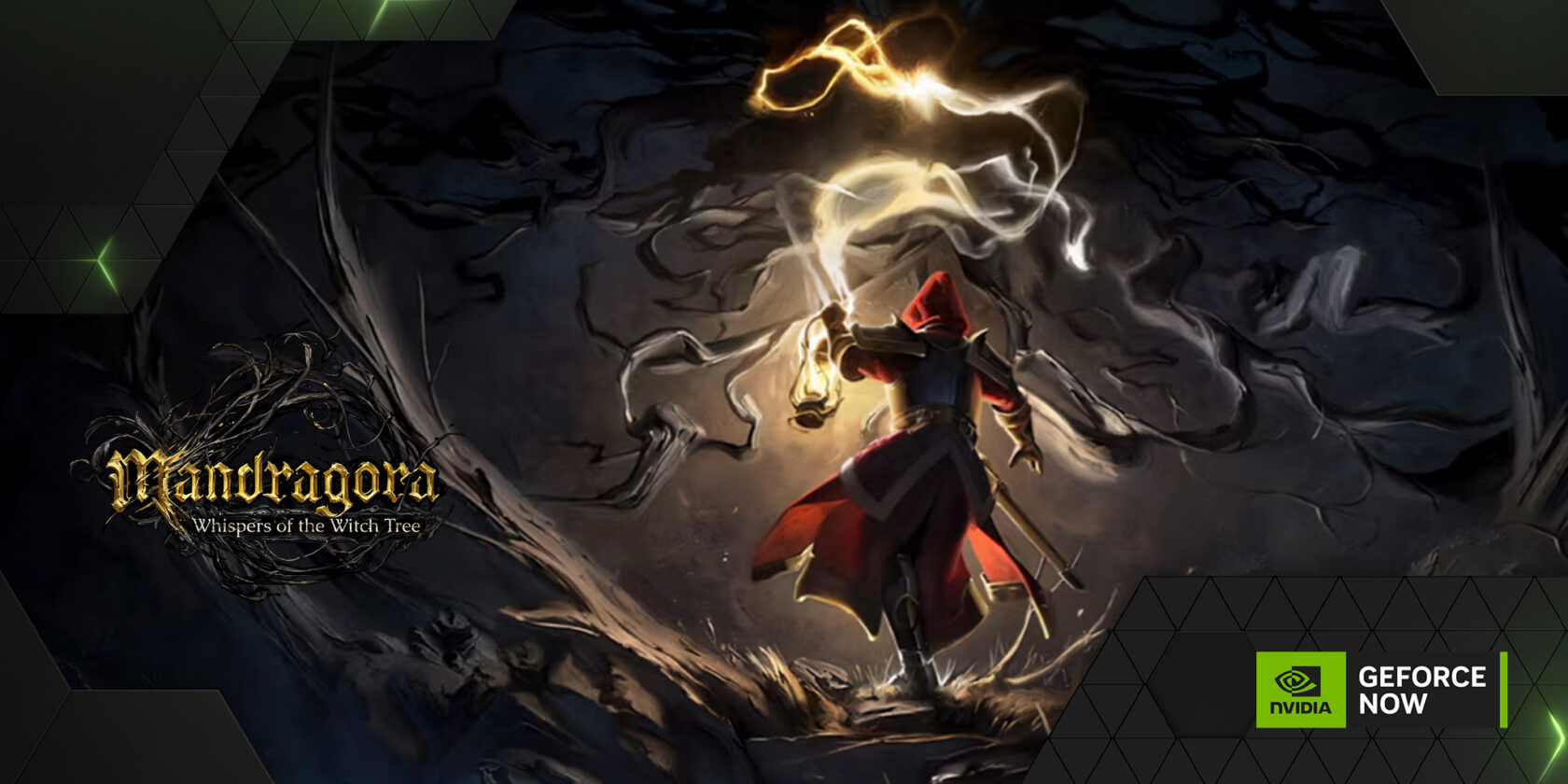
Step into a beautifully hand-painted world teetering on the edge of chaos in Mandragora: Whispers of the Witch Tree. As an Inquisitor, battle nightmarish creatures and uncover secrets beneath the budding canopies of Faelduum. With deep role-playing game mechanics and challenging combat, Mandragora is ideal for players seeking a fresh adventure this season. GeForce NOW members can continue their quest wherever spring takes them — including on their laptops, tablets and smartphones.
Time for New Games
Everyone’s shouting from the excitement of being in the cloud.
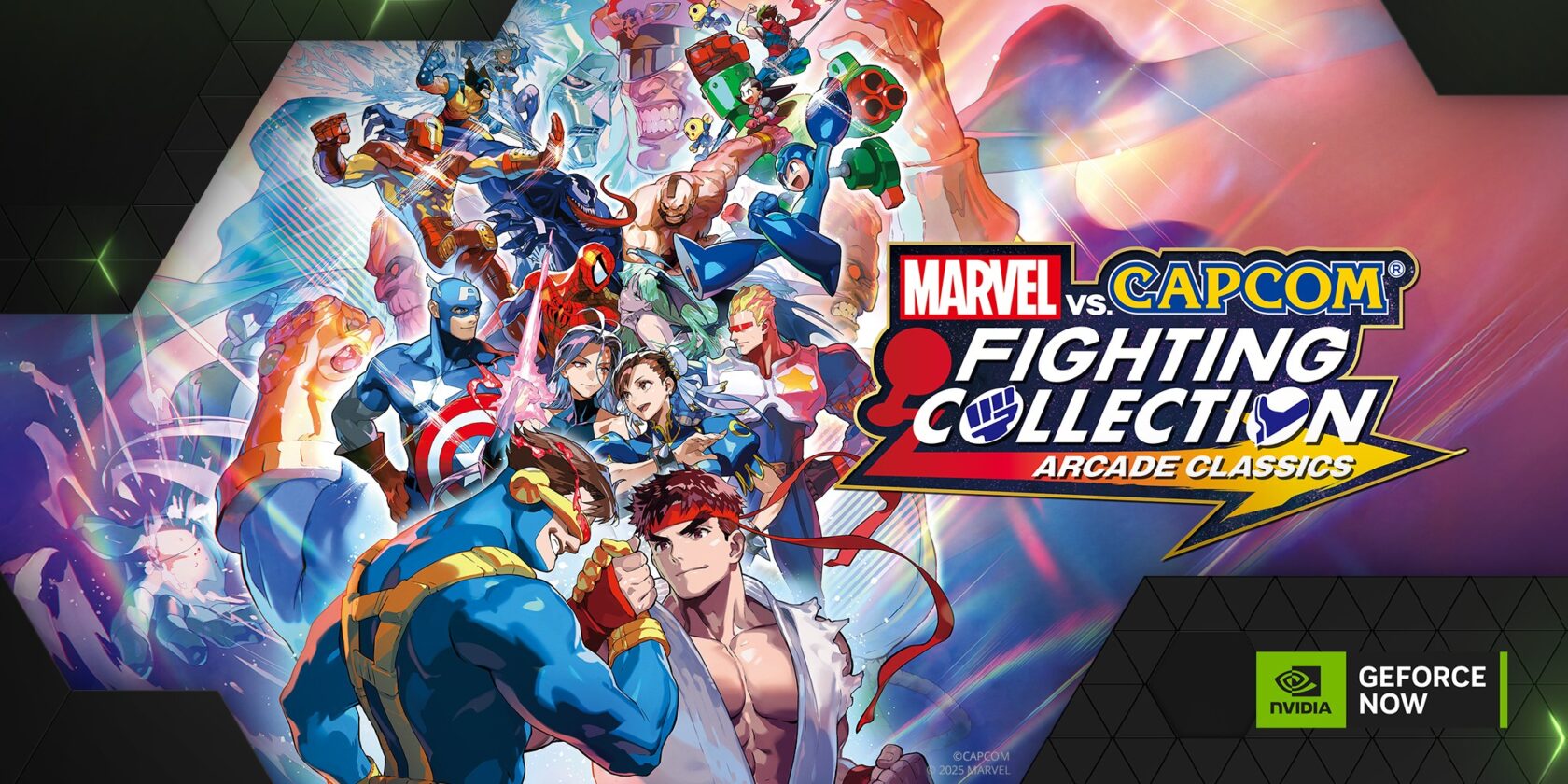
Catch MARVEL vs. CAPCOM Fighting Collection: Arcade Classics in the cloud this week. In this legendary crossover collection of arcade classics from the fan-favorite Marvel and Capcom crossover games, dive into an action-packed lineup of seven titles, including heavy hitters X-MEN vs. STREET FIGHTER and MARVEL vs. CAPCOM 2 New Age of Heroes, as well as THE PUNISHER.
Each game in the collection can be played online or in co-op mode. Whether new or returning to the series from their arcade days, players of all levels can together enjoy these timeless classics in the cloud.
Look for the following games available to stream in the cloud this week:
Forever Skies (New release on Steam, available April 14)
Night Is Coming (New release on Steam, available April 14)
Hunt: Showdown 1896 (New release on Xbox, available on PC Game Pass April 15)
Crime Scene Cleaner (New release on Xbox, available on PC Game Pass April 17)
Mandragora: Whispers of the Witch Tree (New release on Steam, available April 17)
Tempest Rising (New release on Steam, Advanced Access starts April 17)
Aimlabs (Steam)
Blue Prince (Steam, Xbox)
ContractVille (Steam)
Gedonia 2 (Steam)
MARVEL vs. CAPCOM Fighting Collection: Arcade Classics (Steam)
Path of Exile 2 (Epic Games Store)
What are you planning to play this weekend? Let us know on X or in the comments below.
When you hear “artificial intelligence,” what comes to your mind? A few years ago, the answer might have been robots, sci-fi movies, or maybe aliens. But today, thanks to tools like ChatGPT and Google Bard, AI means something entirely different.
AI has gone from futuristic fantasy to everyday reality — and not just in tech circles. You might not realize it, but artificial intelligence is already a big part of your daily life, and its presence is expanding fast.
Let’s explore what can be done with artificial intelligence — across health, finance, education, e-commerce, agriculture, and more!
What is Generative AI?
Generative AI refers to a type of artificial intelligence that can create content — including text, images, audio, and video.
These tools don’t just mimic content — they create new, original, and often interactive results!
AI in Your Pocket: Smartphones & Digital Assistants
Have you ever said, “Hey Siri” or “OK Google”?
AI powers virtual assistants like:
Siri
Google Assistant
Alexa
🎵 They play music, type your messages, check the weather, or answer your questions — all through voice recognition.
🎮 Even many video games use AI to control non-player characters (NPCs), making games more challenging and immersive.
Smart Shopping with AI: E-Commerce
When you shop online and see suggestions like:
“Customers who bought this also bought…”
That’s AI in action!
AI analyzes your behavior and offers personalized recommendations, increasing sales and improving customer experience.
AI Benefits in E-Commerce:
📈 Boosts conversions
🛍️ Personalizes shopping experiences
⏱️ Saves time for users
AI in Medicine: A Life-Saving Revolution
AI helps doctors and medical staff detect diseases early and recommend personalized treatments.
Examples of AI in Healthcare:
🧬 Analyzing MRI & X-ray scans
🧑⚕️ Supporting diagnosis
💊 Creating treatment plans
👥 Personalized medicine based on genetic data
AI isn’t replacing doctors — it’s empowering them with better tools.
AI in Finance: Smarter Decisions, Faster Results
Banks and financial institutions use AI for:
📊 Market analysis
🧠 Predictive investment strategies
🔍 Credit risk evaluation
For instance, when someone applies for a loan, AI algorithms assess their creditworthiness, income, and past behavior to provide fast, accurate decisions.
AI in Education: Personalized Learning Paths
Imagine an AI that understands how you learn and gives you custom lessons.
That’s exactly what AI-powered education tools do:
AI in education promotes accessibility, efficiency, and success!
AI in Transportation & Logistics
From autonomous vehicles to smart delivery systems, AI is reshaping mobility.
Current Uses:
🚘 Self-driving cars
🚦 AI-based traffic control
📦 Drone deliveries
Soon, AI-powered delivery robots may bring packages directly to your doorstep!
AI in Agriculture: Feeding the Future
In farming, AI is boosting productivity while saving resources.
Agricultural Applications:
🦠 Early detection of plant diseases
💧 Smart irrigation systems
🌾 Yield forecasting
🚜 Autonomous tractors & drones
This leads to sustainable farming and helps meet global food demands. 🌍
AI in Everyday Tools
Have you used Google Translate or seen your Instagram feed organized magically?
AI plays a key role here too:
🌐 Translates languages instantly (with growing accuracy)
📷 Suggests content you’ll like based on your activity
💬 Detects spam, hate speech, or inappropriate content
Even the content you see and don’t see is often determined by AI algorithms.
The Future is AI — Are You Ready?
Artificial intelligence is no longer the stuff of science fiction — it’s a core part of our modern lives. Whether it’s helping you choose a movie, manage your health, or learn a new language, AI is everywhere.
💡 Fun Fact: One day, you might have a robot friend powered by AI. Until then, exploring how AI works and how you can use it might just shape your future career.
✅ Final Thoughts: Why It Matters
So, what can be done with artificial intelligence? Just about everything. And the list keeps growing every day.
🔍 Keep exploring. 🚀 Stay curious. 💼 You could even build your own AI tools one day!
You May Also Like
Follow us on TWITTER (X) and be instantly informed about the latest developments…
MapleStory Universe has launched the Henesys Chain, a new Layer 1 blockchain network built on Avalanche and powered by AvaCloud, to provide the technical foundation for MapleStory Universe’s expansion into web3 gaming.
Designed to simplify blockchain interactions for players, the Henesys Chain introduces features such as gasless transactions and a permissioned NFT system.
Developers will also have access to new tools that allow them to create dApss tied to the MapleStory Universe ecosystem.
Source: MapleStory Universe
What is Henesys Chain?
Henesys Chain is a custom Layer 1 blockchain created specifically for MapleStory Universe, developed using Avalanche’s technology through AvaCloud. The chain is named after Henesys, the starting village familiar to many MapleStory players, and is intended to reflect the original game’s focus on community, exploration, and player-driven narratives.
The network is built with an emphasis on scalability, accessibility, and transparency with key features including gasless transactions, permissioned minting of NFTs to maintain item scarcity, and integration with Chainlink’s Verifiable Random Function (VRF) to support fair in-game mechanics.
The technical infrastructure is designed to serve as the foundation for MapleStory Universe’s evolving web3 gaming platform, prioritising both new user onboarding and long-term ecosystem stability.
Source: MapleStory Universe
What are the key features of Henesys Chain?
Henesys Chain introduces several systems aimed at improving user experience and supporting future growth.
Gasless Transactions: Players can complete blockchain transactions without paying gas fees or managing complex wallet interactions. This is achieved through meta-transaction technology provided by Bloxy and an Approve Controller system, removing common barriers for new users.Preserve and Enhance Item Value: The chain uses a permissioned model where only authorised smart contracts can mint in-game items as NFTs. This approach aims to preserve the value and scarcity of digital assets whilst using Chainlink VRF to ensure transparent and verifiable randomisation for item enhancements.Developer Tools for Synergy Apps: An upcoming Software Development Kit (SDK) will allow third-party developers to build Synergy Apps, which could include companion games, social tools, or marketplaces. These apps will extend the MapleStory IP into decentralised experiences linked directly to the Henesys Chain ecosystem.Participate-to-Own Economy: Henesys Chain supports the $NXPC token, designed as an ecosystem currency tied to item creation, enhancement, and trading. The model focuses on real economic activity within the network. $NXPC is positioned as a reflection of the ecosystem’s growth and activity, connecting gameplay, user-generated content, and digital economies.
The network’s design also includes plans for future interoperability, allowing assets to move between different games and blockchains.
Source: MapleStory Universe
What’s next for MapleStory Universe?
Following the launch of Henesys Chain, MapleStory Universe has outlined several planned updates aimed at expanding functionality and improving transparency.
These include launching a public blockchain explorer to enable players to track item ownership and review transaction histories, integrate NFT-based name reservations obtained during the “Make Special Name” community event and expand the $NXPC contribution and reward system to further encourage participation by developers and content creators. These initiatives are part of a broader roadmap focused on building MapleStory Universe into a full-scale gaming ecosystem, rather than a single game.
Future developments will prioritise sustainability, community trust, and long-term player engagement, reflecting MapleStory Universe’s intent to create a lasting and evolving web3 platform rooted in player ownership and decentralised experiences.
Cardano’s impressive 40% rise suggests the crypto market may be entering a significant altcoin season. Analysts are highlighting a lesser-known cryptocurrency that could...
















 Source: MapleStory Universe


