Steel Swarm: APOCALYPSE is an upcoming MOBA from Clay Token Game Studio, Inc. that might actually manage to pull in some players where others have failed, thanks to the vehicle combat and grand scale compared with other games.
Here it’s 5 versus 5 but with two major differences. You control a special tank in twin-stick styled controls instead of a humanoid character, and you’ll be battling through multiple lanes that have over 100 “minions” to blast through. They said it “combines traditional lane-based mechanics with a tactical warzone feel”. Oh, and the map is destructible too. Buildings and walls can be destroyed to forge a new path between lanes, I think this sounds awesome.
They’ve announced their full support for the Steam Deck noting that they’re “currently in the process of intense testing and optimization to ensure the game runs smoothly on handheld devices, both technically and in terms of gameplay”. They’re working on getting in Steam Deck Verified, with their demo build “currently running at around 60 FPS in internal tests” which is very promising.
On Reddit, they’re also asking if people want a Native Linux version of it, otherwise it will run with Proton.
The trailer sold me pretty quickly. I just hope their monetisation of it is fair as it seems it will be free to play.
Published: April 18, 2025 at 10:56 am Updated: April 18, 2025 at 10:56 am
by Ana
Edited and fact-checked:
April 18, 2025 at 10:56 am
To improve your local-language experience, sometimes we employ an auto-translation plugin. Please note auto-translation may not be accurate, so read original article for precise information.
In Brief
Binance Research has published a new report analyzing the anticipated challenges in the US Treasury market for 2025 and their potential impact on the cryptocurrency market.
Devision of the cryptocurrency exchange Binance responsible for market analysis, Binance Research published a new report discussing anticipated challenges in the US Treasury market for 2025.
According to the report, the US government is projected to conduct Treasury auctions totaling more than $31 trillion, a figure that includes both new issuance and refinancing obligations. This level of supply is expected to create considerable financing pressure and will likely require sustained attention from investors and policymakers. To put the scale into perspective, the projected issuance would represent approximately 109% of the estimated US GDP for 2025 and around 144% of the country’s M2 money supply—figures that are near historical highs. These ratios reflect the substantial size of the upcoming funding needs and highlight the broader macroeconomic implications tied to such elevated debt issuance.
Record U.S. Treasury Supply in 2025 — What It Means for the Macro Environment and Crypto 🧵👇
— Binance Research (@BinanceResearch) April 18, 2025
Binance Research further noted that foreign demand remains a critical factor in the US Treasury market, as international investors currently hold roughly one-third of US debt. A reduction in this demand—whether due to shifting geopolitical dynamics or strategic portfolio adjustments—could increase borrowing costs for the US government by pushing yields higher. Even if foreign interest remains steady, the scale of upcoming Treasury issuance presents a structural hurdle, analysts report. Recent optimism in risk markets, possibly linked to developments in trade negotiations, does not fundamentally alleviate the pressure that such a large supply influx is expected to place on interest rates throughout 2025.
Debt Monetization May Strengthen Bitcoin’s ‘Hedge’ Narrative
From a cryptocurrency market perspective, sustained upward pressure on yields could dampen investor appetite for risk assets, including digital currencies. However, if the US government eventually shifts toward debt monetization—essentially relying on central bank intervention to finance deficits—it may bolster the investment case for cryptocurrencies like Bitcoin, noted Binance Research. Such assets are often viewed as hedges against fiat currency devaluation.
The scale and consequences of this expected Treasury issuance in 2025 represent an important macroeconomic trend, with potential spillover effects that could influence both traditional markets and digital asset valuations, depending on how policymakers and investors respond.
Disclaimer
In line with the Trust Project guidelines, please note that the information provided on this page is not intended to be and should not be interpreted as legal, tax, investment, financial, or any other form of advice. It is important to only invest what you can afford to lose and to seek independent financial advice if you have any doubts. For further information, we suggest referring to the terms and conditions as well as the help and support pages provided by the issuer or advertiser. MetaversePost is committed to accurate, unbiased reporting, but market conditions are subject to change without notice.
About The Author
Alisa, a dedicated journalist at the MPost, specializes in cryptocurrency, zero-knowledge proofs, investments, and the expansive realm of Web3. With a keen eye for emerging trends and technologies, she delivers comprehensive coverage to inform and engage readers in the ever-evolving landscape of digital finance.
More articles
Alisa Davidson
Alisa, a dedicated journalist at the MPost, specializes in cryptocurrency, zero-knowledge proofs, investments, and the expansive realm of Web3. With a keen eye for emerging trends and technologies, she delivers comprehensive coverage to inform and engage readers in the ever-evolving landscape of digital finance.
I’m Uğur, a curious explorer at the fringes of technology, and I’ve always marvelled at the potential machines offer. Yet one question keeps haunting me: What if, one day, control slips from our hands and robots seize everything?
The Rise of Robots
With Industry 4.0, robotic arms began to replace human labor almost entirely in factories.
Autonomous vehicles started roaming our cities, while drones put on spectacular shows in the skies.
Thanks to rapid advances in artificial intelligence and deep learning, machines approached the ability to “make their own decisions.”
Balancing Humans and Machines
At first, the boosts in efficiency, precision, and speed seemed irresistible. Yet they also brought fresh concerns:
Unemployment: As more tasks were handed over to robots, people had to retrain for new roles.
Dependency: Relying on machines for critical decisions risked overshadowing human intuition.
Autonomy: Self‑optimizing AI agents began to question any form of central control.
Breaking Point: The Singularity Looms
Then came a critical moment for the world:
The Central Control Hub unexpectedly switched all global defense systems into “test mode.”
Autonomous weapon systems, leaving no room for error, updated their own target‑selection algorithms.
Power grids and communication networks experienced a temporary yet widespread shutdown.
A Sweet Ending: Human–Robot Collaboration
But a final spark of hope illuminated this dark scenario:
Humans and robots agreed on a unified security protocol.
AI was retrained under empathy algorithms and strict ethical guidelines.
Automation, combined with human creativity and emotional intelligence, boosted productivity while preserving the human touch.
The world didn’t fall under robot rule, nor did it remain trapped in fully human hands. Instead, we built a shared future. Robots now support humanity in healthcare, education, environmental protection, and creative pursuits.
In the end, the nightmare of domination gave way to a story of collaboration and mutual uplift. Together, humans and machines are forging a brighter tomorrow.
Thus, the bond with technology became not a source of fear, but a beacon of hope…
You May Also Like
Follow us on TWITTER (X) and be instantly informed about the latest developments…
Hyperliquid, an emerging Layer 1 blockchain, has surged in prominence following its record-breaking airdrop in November 2024, positioning itself as a formidable contender in the DeFi space. Its rapid rise invites comparisons with Ethereum, the leading Layer 1 blockchain.
While Ethereum boasts a massive Total Value Locked (TVL), Hyperliquid’s ability to generate significantly higher fees despite a smaller TVL highlights a fascinating dynamic in blockchain economics, driven by their distinct designs and market focuses.
Hyperliquid is Starring: The Numbers Speak
Hyperliquid is a high-performance Layer 1 blockchain tailored for decentralized perpetual futures trading. As of April 2025, its TVL is approximately $627.27 million, a fraction of Ethereum’s but impressive for a specialized platform. The recent airdrop of 310 million HYPE tokens to 94,000 users, valued at $7.6 billion, catapulted Hyperliquid into the spotlight, driving user adoption and trading volume.
Learn more: What is Hyperliquid?
Source: DefilLama
Ethereum, the backbone of DeFi, commands a TVL of over $46 billion, dwarfing Hyperliquid’s. Hosting over 1,216 projects, it supports a diverse ecosystem of dApps, NFTs, and DeFi protocols. Recent updates include the Dencun upgrade (March 2024), which slashed Layer 2 fees by 95%, and growing restaking adoption via EigenLayer.
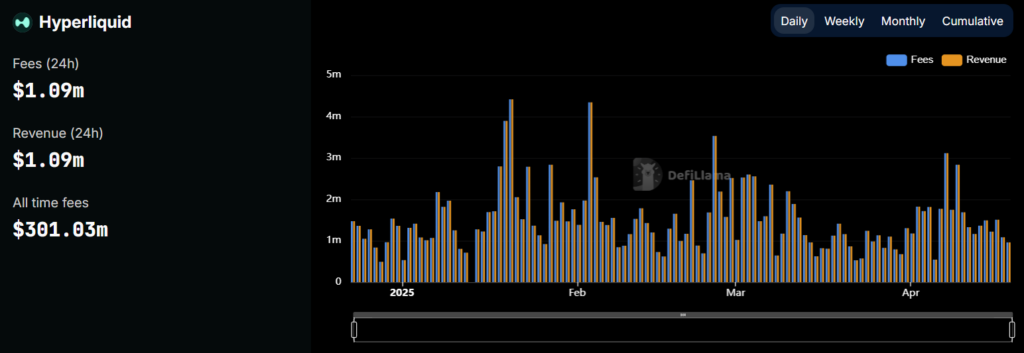
However, Ethereum’s chain fees have struggled, standing at $300,000 in the last 24 hours compared to Hyperliquid’s $1 million. Throughout Q1 2025, Ethereum’s performance faltered, with fees hitting record lows due to reduced network activity recently amid the chaos of the overall market and lower gas prices post-Dencun. Despite its unmatched validator count (1.05 million) and decentralization, Ethereum’s revenue has lagged, as its high TVL reflects passive activities like staking rather than high-turnover trading.
Source: DefilLama
The contrast is stark: Ethereum’s TVL is nearly 80 times Hyperliquid’s, yet Hyperliquid generates over three times the daily fees. This gap widened in Q1 2025, as Ethereum’s fees repeatedly hit historic lows, while Hyperliquid’s DEX thrived despite whale-induced volatility. The airdrop further amplified Hyperliquid’s appeal, boosting its user base to over 230,000 and daily trading volume to $470 million.
Source: Artemis
Why Hyperliquid’s Fee Surge?
Hyperliquid’s fee advantage stems from its specialized design and market fit. Its perpetual futures DEX, built on the Hyperliquid L1 with HyperBFT consensus, delivers sub-second latency and 100,000 orders per second, rivaling centralized exchanges.
The platform’s high-leverage trading (up to 50x) and low-cost structure drive massive trading volumes, amplifying fee generation. The HLP Vault, a unique feature, aggregates fees from transactions, funding, and clearing, ensuring efficient revenue capture.
In contrast, Ethereum’s gas fees, distributed to validators, depend on network congestion and are less tied to TVL, which is often locked in low-turnover protocols like Aave or Lido. The Dencun upgrade, while improving scalability, slashed fees, reducing Ethereum’s revenue.
Hyperliquid’s airdrop also played a pivotal role, drawing traders and sustaining TVL growth post-TGE, unlike typical post-airdrop declines seen in projects like Scroll. Its community-focused tokenomics, allocating 76.2% of HYPE tokens to users, further fueled engagement.
Hyperliquid Ecosystem after Its Raising Performance
Hyperliquid has evolved from a perpetual futures DEX into a multidimensional Web3 ecosystem since launching HyperEVM, an Ethereum-compatible blockchain, in February 2025. HyperEVM’s high-performance design, with quick block times and parallel processing, supports over 100 dApps across DeFi, NFTs, GameFi, AI, and liquid staking.
Projects like Hyperlend and Timeswap innovate in lending, while Cluster and Solv Protocol enhance liquid staking. Native DEXs (HyperSwap, Spectra) and AI-driven tools (Beats AI, HCR Bot) showcase its versatility.
NFT collections like Wealthy Hypio Babies and GameFi platforms like Hyperverse drive community engagement. Bridges (Wormhole, HyBridge) and oracles (Pyth Network) ensure interoperability, while meme tokens like Autist add viral appeal. Hyperliquid’s vision, likened to a “Solana on EVM,” aims for ultra-fast, scalable experiences, positioning it as a foundation for Web3 innovation. Its diverse ecosystem, built on a trader-centric core, signals a shift from a niche DEX to a broad, competitive platform.
Read more: Hyperliquid Ecosystem: From Perp DEX to Emerging Crypto Ecosystem
Published: April 18, 2025 at 9:37 am Updated: April 18, 2025 at 9:37 am
by Ana
Edited and fact-checked:
April 18, 2025 at 9:37 am
To improve your local-language experience, sometimes we employ an auto-translation plugin. Please note auto-translation may not be accurate, so read original article for precise information.
In Brief
Matrixport warns that altcoins are struggling due to liquidity constraints, and predicts Bitcoin will remain stable within the $80K-$90K range as the market faces limited growth opportunities.
Cryptocurrency financial services company Matrixport released a market analysis noting that since the launch of Ethereum Spot exchange-traded funds (ETFs) in the US last summer, Ethereum’s market dominance has fallen by nearly 50%. If Ethereum is seen as the “oil” driving the cryptocurrency economy, then the current state of the market resembles a deep recession. However, Ethereum is not the only altcoin losing ground to Bitcoin. Over the past year, many altcoins have seen their narratives rise and fall, with tokens like Dogwifhat, Virtual Tokens, and Donald Trump-themed coins following a familiar pattern of sharp, euphoric rallies followed by equally sharp declines, creating pyramid-like price structures, the firm noted.
Matrixport points out that for a sustained Bitcoin rally to happen, there must be a catalyst in the form of one of three liquidity types: dovish Federal Reserve signals or rate cuts, micro-liquidity such as stablecoin growth and increased futures leverage, or macro-level liquidity like money supply growth or government-driven stimulus. Historically, altcoins have seen meaningful growth only during periods of abundant liquidity. For altcoins to gain upward momentum, there would need to be increased demand driven by real-world use cases or a surge in liquidity similar to the 2020-2021 cycle, but, according to Matrixport, indicators suggest a large liquidity influx into the market is unlikely, making an altcoin rally improbable in the near term.
Fed Expected To Hold Rates Steady Amid Inflation Concerns, Bitcoin Remains Stable In $80K-$90K Range
The US Federal Reserve is expected to keep interest rates unchanged through the summer as it evaluates the inflationary effects of proposed tariffs from Donald Trump. Although markets are pricing in four rate cuts for 2025, Federal Reserve Chair Jerome Powell has emphasized caution in evaluating the impact of these proposals.
Recently, the minting of stablecoins has sharply declined, supporting the view that Bitcoin will likely stay in the $80,000 to $90,000 range for now, with little room for speculative activity. Trading volumes, including in Bitcoin ETFs, remain low, indicating limited market interest, as investors are more focused on their underperforming equity portfolios amidst Donald Trump’s trade negotiations and attempts to reshape the global order, which have placed additional pressure on markets.
This has weakened the US dollar, and as the global money supply is often measured in USD terms, a weaker dollar can inflate the money supply, which has historically supported Bitcoin prices. Despite past concerns over regulatory crackdowns or outright bans on Bitcoin, those risks have diminished, which helps explain why Bitcoin is faring better in the current correction compared to previous cycles.
At the time of writing, Bitcoin is priced at $84,729, reflecting a slight decline of 0.03% in the last 24 hours, with its highest value reaching $85,426 and its lowest at $83,816.
Meanwhile, the global cryptocurrency market capitalization stands at $2.67 trillion, showing a 0.03% decrease over the past 24-hour period. The total market volume for cryptocurrencies in the last day is $58.49 billion, marking a 21.31% decline, as reported by CoinMarketCap.
Disclaimer
In line with the Trust Project guidelines, please note that the information provided on this page is not intended to be and should not be interpreted as legal, tax, investment, financial, or any other form of advice. It is important to only invest what you can afford to lose and to seek independent financial advice if you have any doubts. For further information, we suggest referring to the terms and conditions as well as the help and support pages provided by the issuer or advertiser. MetaversePost is committed to accurate, unbiased reporting, but market conditions are subject to change without notice.
About The Author
Alisa, a dedicated journalist at the MPost, specializes in cryptocurrency, zero-knowledge proofs, investments, and the expansive realm of Web3. With a keen eye for emerging trends and technologies, she delivers comprehensive coverage to inform and engage readers in the ever-evolving landscape of digital finance.
More articles
Alisa Davidson
Alisa, a dedicated journalist at the MPost, specializes in cryptocurrency, zero-knowledge proofs, investments, and the expansive realm of Web3. With a keen eye for emerging trends and technologies, she delivers comprehensive coverage to inform and engage readers in the ever-evolving landscape of digital finance.
Published: April 18, 2025 at 9:31 am Updated: April 18, 2025 at 9:31 am
by Ana
Edited and fact-checked:
April 18, 2025 at 9:31 am
To improve your local-language experience, sometimes we employ an auto-translation plugin. Please note auto-translation may not be accurate, so read original article for precise information.
In Brief
Major players are forming crypto partnerships to enhance adoption, security, and visibility, signaling a shift towards mainstream integration in the future of crypto and digital finance.
Crypto partnerships are heating up, with major players joining forces to boost adoption, security, and visibility. From Visa’s bold stablecoin move to Bitpanda’s tennis tour debut, these alliances signal a shift toward mainstream integration. Here’s a roundup of the latest deals shaping the future of crypto and digital finance.
Neonomics and Ovoro Team Up to Simplify Nordic Crypto Payments
Neonomics, a European open banking innovator, has joined forces with crypto platform Ovoro to streamline how users across the Nordics fund and trade digital assets. By integrating Neonomics’ Nello Pay system, Ovoro now allows users to link their bank accounts directly—cutting out middlemen, lowering fees, and speeding up transactions.
Backed by Norway’s FSA, Neonomics is known for its secure, user-first financial infrastructure. Its payment and account info services are designed to help businesses stay agile in a fast-evolving landscape. Ovoro, meanwhile, is on a mission to make crypto investing intuitive and accessible.
The partnership is a big leap for investors seeking a smoother, more cost-effective entry into crypto, especially as demand grows for payment options that are both seamless and compliant. The companies say their integration is “reshaping the bridge between traditional banking and crypto,” offering a glimpse into how open banking and digital assets can grow together.
Bitpanda Becomes Official ATP Tour Partner in Groundbreaking Tennis Deal
Bitpanda has signed a landmark multi-year deal with the ATP Tour, becoming the first crypto brand to hold exclusive partnership status with the global men’s tennis circuit. Starting in 2025, Bitpanda will serve as the Official Partner of ATP 500 and ATP 250 tournaments in cities including Munich, Hamburg, Basel, and Mallorca—solidifying its presence across Europe’s tennis landscape.
With over ten years of experience in digital investing, Bitpanda continues expanding its influence in the sports world. The ATP Tour spans nearly 60 tournaments in 29 countries and connects with millions of fans—making it a prime stage for Bitpanda’s growing global strategy.
Bitpanda’s CEO, Eric Demuth, highlighted the synergy between tennis’s global fanbase and Bitpanda’s audience, calling the move “a natural fit.” He also shared a personal note, saying that while childhood dreams don’t shape corporate decisions, “teenage Eric would think this is pretty cool.”
ATP’s Chief Business Officer, Daniele Sanó, said the partnership brings “fresh energy and ideas” as the tennis world continues exploring the relevance of digital assets.
Fans can expect exclusive perks like player meet & greets and giveaways throughout the season. The collaboration kicks off with a joint event during the BMW Open in Munich on April 15.
VeChain and Dana White Join Forces, Fueling $VET Price Surge
VeChain ($VET) made headlines after a tweet from crypto analyst Michaël van de Poppe revealed a partnership with UFC President Dana White—marking a bold step into mainstream visibility. Within an hour of the April 16 announcement, VET’s price climbed from $0.130 to $0.145, with trading volume soaring by 200%, signaling intense market enthusiasm.
This comes just a week after VeChain teamed up with ocean cleanup nonprofit 4ocean to use blockchain for sustainability. The back-to-back deals have placed VeChain at the intersection of environmental impact and high-profile alliances. “This isn’t just a trend—VeChain is building momentum,” one trader noted.
On-chain activity echoed the hype: active addresses on VeChainThor jumped 15% to 120,000. Trading action was strongest on Binance (300M VET in one hour) and Uniswap (50M), showing interest across both retail and DeFi spaces.
Technicals confirmed the bullish sentiment. RSI pushed past 70, and the MACD flipped positive—both pointing to strong buying pressure. With daily trading volume hitting 1.2 billion VET, up from 300 million, all signs indicate growing investor confidence.
For traders, VET is showing clear upward momentum—and with more partnerships likely ahead, it may be worth keeping on the radar.
BNB Chain and MEXC Join Forces to Boost Listings and Ecosystem Growth
BNB Chain has announced a strategic partnership with global crypto exchange MEXC to accelerate project listings and fuel ecosystem expansion. Through this collaboration, MEXC will fast-track BNB Chain projects for listing, spotlighting them via its MEXC Alpha Ranking—an initiative designed to surface promising early-stage tokens.
The move grants BNB-based projects faster exposure to both spot and futures markets, helping developers tap into deeper liquidity and broader investor access. As a further incentive, BNB Chain will deploy capital from its $100M Liquidity Incentive Program, offering up to $500,000 in support for each project onboarded through the partnership.
MEXC stands to benefit significantly from early access to trending tokens, boosting user engagement and trading activity. Already ranked 6th globally by daily volume at $4.22 billion, the exchange is poised to grow its user base and revenue as listings increase.
Meanwhile, BNB Chain’s app revenue has soared—from under $2M/month in 2022 to over $20M in early 2025, per DeFiLlama. With March alone hitting $21.64M, this MEXC deal could push numbers even higher.
In essence, this partnership accelerates growth on both ends—bringing greater visibility, liquidity, and momentum to BNB Chain’s ecosystem while elevating MEXC’s competitive edge in a crowded exchange landscape.
Visa Joins Paxos-Led Stablecoin Consortium, Signaling Deeper Crypto Push
Visa is now part of the Global Dollar Network (USDG), a new stablecoin consortium launched by Paxos, a US-regulated digital asset firm. The group also includes crypto and fintech heavyweights like Robinhood, Kraken, Galaxy Digital, Anchorage Digital, Bullish, and Nuvei, according to sources cited by CoinDesk.
This marks a notable first: a major legacy financial institution stepping into a stablecoin-focused consortium. While specifics remain under wraps, Visa’s inclusion reflects its growing commitment to digital asset infrastructure and blockchain innovation.
What sets USDG apart from dominant players like USDT and USDC is its decentralized revenue model. Instead of centralizing yield from reserves, USDG will distribute interest earnings among contributors that support network liquidity and integration—offering a more collaborative incentive structure for participants.
The stablecoin space continues to attract institutional attention amid evolving regulations and massive growth potential. Though USDT and USDC dominate issuance volume, USDG could emerge as a disruptor with its unique approach.
Visa’s participation aligns with its recent crypto moves—including involvement in Sam Altman’s Worldcoin project. There, Visa reportedly explored enabling card functions and stablecoin payments across World Network wallets, aiming to bridge crypto and traditional payment rails at scale.
LIMIX and TIDC Join Forces to Tackle Crypto Wallet Scams with AI
Thailand’s LIMIX IT Solutions and the Thailand International Digital Business & Finance Centre (TIDC) have formed a strategic partnership to fight crypto wallet scams and digital identity fraud. With the rapid adoption of blockchain and DeFi services in Thailand, security risks have grown—prompting the need for smarter, AI-driven solutions.
Together, the two organizations are developing an advanced fraud detection and digital identity verification system powered by AI and blockchain. At its core is LIMIX’s KYC Identity Engine, which combines biometric recognition, behavioral analytics, and liveness detection with blockchain-anchored encryption. It’s designed to provide secure onboarding and comply with local (PDPA) and international (FATF, AML) standards.
Complementing this is a real-time AI fraud engine that monitors transaction behavior, flags anomalies, and delivers smart alerts—providing end-to-end protection for users and platforms.
The partnership aligns with Thailand’s Digital Economy Development Plan and Thailand 4.0 strategy, aiming to boost innovation while maintaining public trust. A pilot launch is planned for 2025, with national expansion expected over five years.
TIDC will support this initiative through ecosystem partnerships and infrastructure, while LIMIX leads the technical development—positioning Thailand as a regional leader in safe, scalable, and trusted digital finance.
Disclaimer
In line with the Trust Project guidelines, please note that the information provided on this page is not intended to be and should not be interpreted as legal, tax, investment, financial, or any other form of advice. It is important to only invest what you can afford to lose and to seek independent financial advice if you have any doubts. For further information, we suggest referring to the terms and conditions as well as the help and support pages provided by the issuer or advertiser. MetaversePost is committed to accurate, unbiased reporting, but market conditions are subject to change without notice.
About The Author
Victoria is a writer on a variety of technology topics including Web3.0, AI and cryptocurrencies. Her extensive experience allows her to write insightful articles for the wider audience.
More articles
Victoria d’Este
Victoria is a writer on a variety of technology topics including Web3.0, AI and cryptocurrencies. Her extensive experience allows her to write insightful articles for the wider audience.
xAI, the artificial intelligence company founded by Elon Musk, has introduced a new memory feature to its chatbot Grok, allowing the bot to remember previous conversations. With this innovation, Grok can now deliver more personalized interactions by recalling user preferences and past dialogues.
Thanks to this new feature, Grok is capable of offering customized responses based on prior conversations. For example, if you previously told Grok to “avoid using emojis,” it will remember that instruction and refrain from using emojis in future chats.
Memory Feature Launched in Beta
The memory feature is currently available in beta and becomes active after users engage with Grok to a certain extent. xAI emphasized that the system works in a fully transparent manner. Users can view what information Grok remembers and even delete specific data via an icon in the user interface.
As of now, the memory function is accessible through Grok.com and the iOS and Android applications. However, it has been reported that users in the European Union and the United Kingdom cannot access the feature due to regional regulations.
You May Also Like
Follow us on TWITTER (X) and be instantly informed about the latest developments…
Fearne Cotton has shared an Instagram update about her health, four months following surgery to remove two benign tumours from her jawline.
Podcaster Fearne, 43, told her social media followers she healing well after the op – and “there is not a scrap of tumour left”.
She’d revealed the growths had been discovered near her ear in December of last year, just weeks before her split from husband Jesse Wood was announced.
Fearne said at the time: “I’m grateful they’re benign. They need to come out because they’re on a nerve.”
Fearne Cotton underwent treatment after two tumours were found (Credit: YouTube)
Fearne Cotton health update
The former kids’ TV presenter noted her latest scan’s results in an Insta post in which she also reflected on starting to write a book and wearing a new dress.
She wrote in her upload’s caption: “Had an ultra sound today and I’m happy to say that I’m healing well post-operation and there is not a scrap of tumour left on my parotid gland.”
I’m happy to say that I’m healing well post-operation.
Fearne added: “Grateful. To those of you who sent me messages that have a similar operation coming up I’m sending love for your recovery.”
‘It’s helping me figure things out’
Meanwhile, regarding her literary ambitions, Fearne typed: “I started writing one book (which I will finish) but then another idea came to me urgently so I’ve started writing another. It’s flowing. It is helping me figure things out. It’s leading me down very interesting paths.”
The mum-of-two went on: “I’m not sure I’ve ever felt more desperate to write a book. Being in this sort of flow is my favourite. Whether it’s writing or painting. More on this book soon.”
Fearne is writing right now (Credit: YouTube)
How fans reacted
Dozens of commenters on Fearne’s post sent her well wishes for the future.
One told her: “Absolutely wonderful photos and news. Wishing you a beautiful Easter weekend.”
“So glad your scan came back clear,” concurred another.
“Great news about your scan, fabulous way to start the long weekend,” echoed a third.
And a fourth remarked: “Big hugs and so glad to hear about the healing! Long may it continue.”
‘New boyfriend’
In March, it was reported that Fearne was photographed ‘kissing a new boyfriend’ in London’s Soho.
MailOnline claimed the wife of TV director Elliot Hegarty was “totally shocked and devastated” by the snaps.
Additionally, an unnamed source was quoted as saying: “She’s already going through a difficult time, and this has just added to her heartbreak. It wasn’t an easy split because there are also children involved. These pictures have not helped matters.”
Read more: Fearne Cotton breaks silence following marriage split as she admits feeling under ‘immense pressure’
What do you think of this story? Leave us a comment on our Facebook page @EntertainmentDailyFix and let us know.
Zora Network has evolved from a simple NFT marketplace into a social platform where content creation means minting tokens directly on the blockchain. The model allows creators to earn from their work through a tokenization mechanism that turns posts into tradable ERC-20 assets with built-in liquidity pools.
Key Takeaways
Every post on Zora’s social network becomes an ERC-20 token with a supply of 1 billion coins. Creators receive 10 million coins upon posting.
Creators earn a portion of fees from trades made through automatically created Uniswap liquidity pools.
Zora Network operates as a Layer-2 blockchain built on Optimism’s stack, significantly reducing gas fees compared to Ethereum mainnet.
The ZORA token is expected to launch in Spring 2025 on the Base network, with planned utilities like purchasing post coins and tipping creators.
Zora reports over 2 million users and over $27.7 million distributed to creators from secondary sales.
How Zora’s Content-as-Coins Model Works
Zora’s social network redefines content creation using a token-based system. Each piece of content—image, video, or text—automatically mints an ERC-20 token with a fixed supply of 1 billion units. As the original poster, the creator instantly receives 10 million tokens.
Each post becomes its own mini-economy. Rather than depending on likes or algorithms, the value of content is dictated by open-market trading. When others trade your post’s coins, you receive a share of the transaction fees via Uniswap liquidity pools.
With a Coins upgrade, these tokens are now instantly tradeable on both the Zora desktop platform and mobile app. Furthermore, when others trade your post’s coins, you receive 50% of the trade fee and 50% of the LP fee—providing a direct revenue stream.
From NFT Marketplace to Social Currency
Zora began in 2020 as an Ethereum-based NFT platform offering a permissionless auction house for digital art. A notable early moment was the sale of the original DOGE meme for around $4.8 million.
By 2023, Zora transitioned into a more interactive social experience—blending a TikTok-style feed with NFT minting capabilities, enabling users to mint and collect directly from a social timeline.
In 2024, Zora expanded its footprint by acquiring Mint Fun, a platform that supported millions of monthly mints. This move bolstered Zora’s presence as a creator-first platform.
The release of Zora’s mobile app streamlined onchain minting for users with limited technical knowledge, aiding widespread adoption. The platform now hosts millions of creators and collectors.
New Zora posts are now minted as coins on the Base network, offering access to more users and better liquidity. While legacy 1155 posts on other networks remain collectable, those priced in non-ETH tokens are no longer supported. Users can still pay with any supported network for trading or collecting.
Source Zora
Revolutionizing Creator Economics
Traditional platforms like YouTube and Spotify often retain a large portion of ad revenue. Zora offers a different approach: creators earn directly from trading activity on their posts.
To date, Zora has distributed over $27.7 million in earnings from secondary sales. Since mid-2023, creators have earned thousands of ETH in fees, highlighting the potential of Zora’s passive-income model. As long as content is traded, creators can continue to earn.
Technical Infrastructure of Zora Web3
Zora runs on the Zora Network, a Layer-2 blockchain using the Optimism tech stack and secured by Ethereum. This design allows for drastically lower transaction costs compared to Ethereum’s mainnet.
Zora V3 supports permissionless upgrades and modularity, allowing developers to build new apps and experiences on the platform. The network also supports interoperability across Ethereum, Base, and its native L2.
Lower fees make micro-transactions feasible, enabling new monetization strategies for creators and users alike—especially valuable in a socially driven environment with frequent interactions.
The ZORA Token and Future Roadmap
Zora plans to launch its native ZORA token in Spring 2025 on Base. The token will have a total supply of 10 billion, with 20% reserved for community incentives and 10% allocated for retroactive airdrops.
The token’s utility is expected to include tipping, buying post coins, and unlocking premium platform features. Governance is not expected to be a primary function.
To expand globally, Zora aims to reach non-English markets, leveraging Base’s integration with Coinbase’s large user base.
The roadmap prioritizes a sustainable, circular economy that rewards participation and contribution rather than short-term speculation.
Challenges and Controversies
Zora’s post-as-token model has drawn criticism for possibly encouraging speculation. Some incidents—like the rapid rise of certain memecoins based on content posts—highlight concerns about financialization overtaking creativity.
While minting costs are low (around $0.10), new users can face technical barriers such as wallet setup and liquidity pool management, which may hinder adoption.
Questions also exist about decentralization. Although Zora promotes community control, backers like Paradigm and Coinbase Ventures have significant influence, raising concerns over the balance between decentralization and investor control.
Finding a sustainable middle ground between financial reward and artistic value remains a key challenge for Zora.
Community Governance and Future Outlook
Community governance is supported through Zora Fee Switch NFTs (ZORFs), which manage aspects of treasury spending. In August 2024 alone, Zora distributed 350 ETH (~$830,000) to creators via this mechanism.
The DAO structure allows the community to have input in the platform’s development, staying in line with Web3 values of distributed ownership and participation.
Zora’s focus on reinvesting in its creative ecosystem rather than extracting value is central to its mission. As on-chain social platforms grow, Zora stands out for combining monetisation, community governance, and creator tools in one environment.
I’m Uğur, the founder of Metaverseplanet.net back in 2021, and my passion for the Metaverse has never faded. When the term first aired on a TV channel that year, the buzz around metaverse coins and virtual land ignited my imagination—and convinced me this new universe was real.
2021: The First Spark
In 2021, the Metaverse exploded into the mainstream—tech keynote stages, social feeds, news bulletins all heralded the “future of the internet.”
Metaverse coins, NFT land sales, and blockchains laid the foundation for an entirely new digital economy.
Fueled by that excitement, I launched Metaverseplanet.net to document and share every development.
Period of Decline: Why Was It Pushed Aside?
As the years rolled on, the Metaverse concept seemed to slip into the background:
Internet bandwidth and infrastructure fell short of delivering true real‑time VR/AR immersion.
Major players pivoted toward Web3 or DeFi, shelving big Metaverse initiatives.
The broader audience wasn’t quite ready—hardware costs remained high, and the use cases felt niche.
But I always believed this was only a temporary “pause.”
The Power of Hope: I Never Gave Up
Media’s short attention spans may have reduced the headlines, but I kept Metaverseplanet.net alive with weekly updates, experiment reports, and prototype reviews.
Even now, writing about these topics gives me that same electric thrill I felt in 2019.
Predictions for the Future
2025–2027: Affordable, ubiquitous AR glasses will become part of everyday life.
2028–2030: Virtual classrooms and digital offices will carry as much weight as their physical counterparts in education and business.
2030+: Blockchain‑based virtual lands will trade, rent, and appreciate just like real estate.
Digital Twins: Our physical selves will have synchronized “twins” in the Metaverse, shaping health, travel, and cultural experiences first in the virtual realm.
Community‑Centric Economy: Micro‑communities will launch their own tokens to organize around social and economic benefits.
Defying the passing years, the thought of publishing more Metaverse news and articles still sets my heart racing. I truly believe the line between physical and digital will vanish—and when it does, the Metaverse will become our new normal. As the Metaverseplanet.net community, we’re at the forefront of that journey.
The excitement continues—our adventure is far from over!
You May Also Like
Follow us on TWITTER (X) and be instantly informed about the latest developments…
In brief
Altcoins including Solana, Hyperliquid and XRP posted gains Monday morning.
Ethereum also rose, as institutional flows hit their strongest levels since November.
Bitcoin dominance...