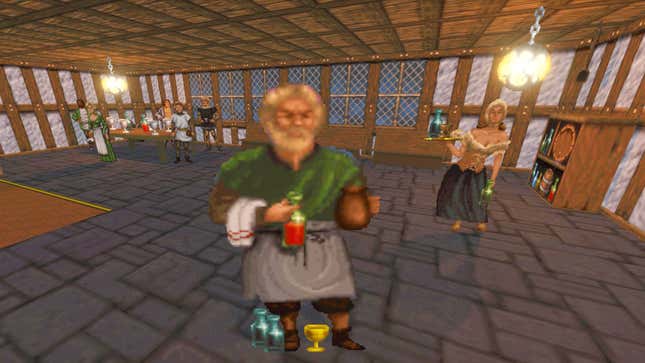
With Bethesda’s (sort of) surprise announcement of The Elder Scrolls: Oblivion Remastered, you might find that there are some out there who’d try to encourage you to play fan-made Morrowind remakes instead. Ignore those people, they’re cowards and fools. You should be playing Daggerfall right now, like any right-minded person. And with Daggerfall Unity, you can enjoy the all-time classic RPG in HD widescreen entirely for free.
Clear Your Calendar For Final Fantasy 7 Rebirth
Daggerfall Unity, a fan-made passion project that rebuilt the second Elder Scrolls game in Unity, was in development for over ten years. But last year, it was finally considered complete, the whole extraordinary endeavor made available for free. And thanks to Bethesda’s excellent decision to release the original 1996 game for free, you don’t even need to pay for the base game either.
Screenshot: Daggerfall Unity / Bethesda / Kotaku
How to install Daggerfall Unity
As with my post about Morrowind, my goal here is to provide you with an idiot-proof guide for getting Daggerfall Unity running on your computer, without needing to speak the secret arcane language of modders. Then, to just encourage you to play it. And thankfully, this one’s far easier to get running.
The very first thing you’re going to want to do is get yourself a copy of the original Daggerfall. That’s easily done—you just grab it from Steam or GOG, and as mentioned, it won’t cost you anything. (Bethesda was hosting the free version on its site for a bit, but now it just links out to Steam.)
Install that, and then head to this page to download the Unity version, the most recent being 1.1.1. As ever with these projects, there’s no “Download it here!” button at the top of the site, because that’d make life easy. Instead, you’re going to want to scroll to the bottom of the entry for 1.1.1 (just above the start of information about 1.1.0), or Ctrl-F for “dfu_windows” and then pick either the 32 or 64-bit version. If you’re not sure, then you’re safe to pick “dfu_windows_64bit-v1.1.1.zip,” the fourth one down in the list. (There’s also a version for Linux and Mac in the list.)
Download the .zip to your hard drive, and then unzip it into a folder. Open that folder and you’ll see a few files, including “DaggerfallUnity.exe.” Double-click on that, and it’ll ask you where you installed the original Daggerfall. Assuming you’re using the Steam version, you’ll find the game on the hard drive you installed it to, then “steamapps\common\The Elder Scrolls Daggerfall\DF\DAGGER.” Click OK, choose your resolution, and you’re good to go!
Having spelled this all out, I’ve just discovered that the glorious people at Daggerfall Unity have written a very clear guide themselves, which you can find here.
When you load the game, it’ll show you a bunch of basic options. But if you want to have a proper fiddle, click on “Advanced.” Here, you can do all sorts of important business, like adjust your mouse sensitivity, bump the quality up to max, and set it so it’s running in 3440×1440 on your ultrawide monitor in a way that the original developers in 1996 would not be able to conceive.
Screenshot: Daggerfall Unity / Bethesda / Kotaku
Get modding
But you won’t want to stop there. Daggerfall Unity has a built-in mod section, letting you enable or disable any you might have added. But you’ll need to get some first, so head over to the dedicated page for this version of the game on Nexus Mods. You’ll also want to have this page open, which is a superb step-by-step guide for installing mods in this game.
The first thing you’ll want to get is Daggerfall Expanded Textures. This is required for many of the other mods that’ll improve how the game looks, so is worth installing straight away.
As with most mods, the file has the extension .dfmod, and you’re going to want to put it in the rather buried “mods” folder of your main installation. So, go back to where you unzipped Daggerfall Unity, and in there, you’ll want to open “DaggerfallUnity_Data,” then “StreamingAssets,” and finally “Mods.” Put any .dfmod file you want to use in the game in this folder, so in this case, “daggerfall expanded textures.dfmod.”
Next time you launch the game, click on the “Mods” button bottom right, and you’ll see the mod in the list!
With that in place, many other mods will now work. For instance, DET-DREAM (do you see what they did there?), which overhauls a lot of the models. Taverns Redone makes pubs more pleasurable. Quest Pack 1 adds 200 new quests to the game. And Improved Interior Lighting…well, you can figure that one out.
Screenshot: Daggerfall Unity / Bethesda / Kotaku
And now get playing!
With this all done, you’re good to go. But it’s useful to know a few key details about Daggerfall that aren’t instinctive in 2025.
The first is that this is a game about going with the flow. Sometimes you’ll fail at a quest, but this doesn’t mean you need to reload and start it over—just continue on in a world where you failed at that quest. There are plenty more to find, and let your experiences define you.
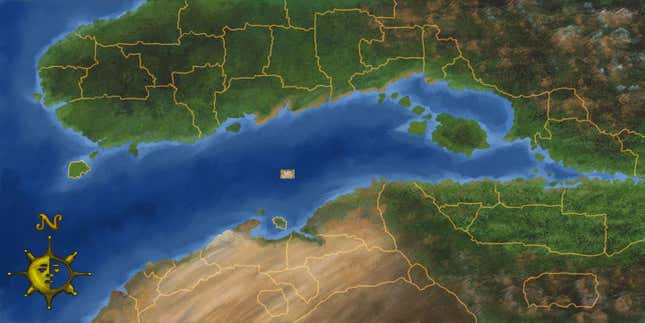
It’s also a game about vast exploration, the seemingly infinite stretches of the game procedurally generated, with a mind-boggling 15,000 cities, towns, dungeons, and villages to find and explore. The image below, created by Redditor Mister_Cranch, superimposes the entire map of Skyrim onto Daggerfall’s world. It’s that tiny brown rectangle in the middle of the sea.
Screenshot: Mister_Cranch / Bethesda
Oh, and fighting! It’s not instinctive at all, and in the 30 years since this game came out, I might not have been able to forget the door opening sound, which is branded onto the surface of my brain. I had forgotten that fighting isn’t just holding down the mouse button. (By default, the right mouse button, but you can change that.) Instead, you need to hold it down and swing the mouse around to attack. Believe me, you’ll be glad I said. (Or you can toggle it off in the options, but that’s not the spirit of things.)
On the subject, as the optional in-game tutorial will tell you, you’re not meant to be able to win every fight. The opening sequence deliberately has you encounter an imp that your weapons won’t be able to harm, leaving you only with the choice to run away. That’s important! Running away, like in life, is fine in Daggerfall. The game won’t give you XP for kills, so there’s no judgment.
So get in there. “Welcome to your new obsession,” as the tutorial concludes. It’s just a place for you to go live. There’s no big, opening calamity, nor desperate need to be somewhere by a certain time. Just a vast world for you to explore, find quests, join guilds, start fights, go to prison for years, whatever you wish to do.
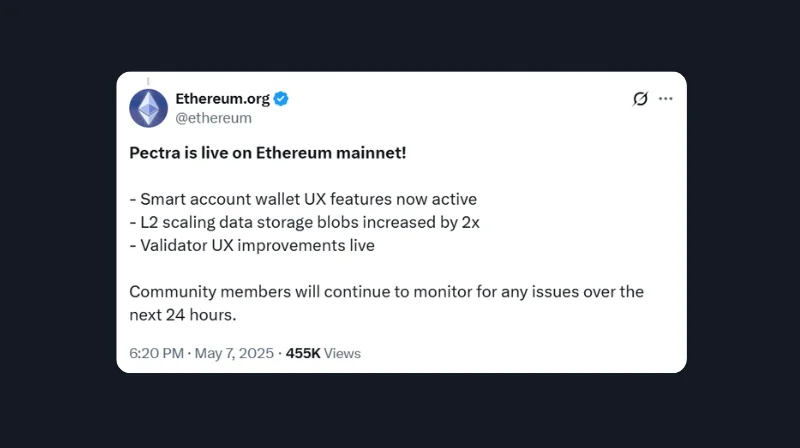
Ethereum has completed the first phase of a major software upgrade called Pectra, marking a significant change to how the network handles accounts, staking, and data processing.
The rollout comes over a year after Ethereum’s previous major update—known as Dencun—and continues the project’s shift toward improving how the blockchain scales and operates under increased demand. Pectra introduces a range of Ethereum Improvement Proposals (EIPs), including changes to how wallets function, how validators manage their stake, and how data is processed through the network.
Whilst the upgrade is largely technical, it is expected to affect a wide range of users and developers, especially those working on Layer 2 networks and decentralised applications.
Source: Ethereum
What is Pectra?
Pectra is the name given to Ethereum’s latest hard fork—a coordinated protocol update that modifies the network’s rules. The upgrade was activated on Wednesday at 06:05 ET, with network finality confirmed shortly after at 06:18 ET.
It follows the Dencun upgrade of March 2024 and represents Ethereum’s next step in improving its infrastructure for both users and developers.
The name combines “Prague” and “Electra”, referring to future roadmap goals involving both the consensus and execution layers of the network.
Source: Ethereum
What’s new with this upgrade?
Pectra includes several key changes:
Account Functionality: The update introduces EIP-7702, which allows standard user accounts to temporarily behave like smart contracts. This gives accounts more flexibility without requiring users to switch to a new address format. It is considered an early step toward full “account abstraction,” a long-term goal that would allow more programmable and user-friendly wallets.Validator Staking: EIP-7251 increases the maximum stake per validator from 32 ETH to 2,048 ETH. This is intended to reduce operational overhead for large validators and allow them to consolidate multiple positions into fewer, larger ones. It may also improve staking efficiency.Data Availability: EIP-7691 increases the number of “blobs”—a type of off-chain data package introduced in Dencun—from 3 to 6 per block. Blobs are used primarily by Layer 2 scaling solutions to lower transaction fees. The change effectively increases Ethereum’s data capacity for such networks.Other Improvements: The upgrade also includes optimisations for validator deposit handling, historical data access, cryptographic operations, and execution-layer exits.
Each of these features was proposed, tested, and reviewed before being included in the upgrade.
Source: Ethereum
What’s next for Ethereum?
Developers are now shifting their attention to the next planned upgrade, known as Fusaka. Among its goals is expanding data availability further, including support for a feature called PeerDAS—a protocol designed to improve how rollups access and distribute data.
Although Pectra increases blob capacity, developers say additional scaling improvements will be needed to keep pace with Layer 2 growth. Some believe Ethereum’s data layer will require even larger increases in capacity to avoid congestion over time.
In the meantime, Ethereum validators may need to manage higher bandwidth and storage demands as part of the trade-off for greater throughput. According to researchers, ensuring that the network remains decentralised whilst increasing performance will continue to be a major area of focus.
Fusaka is expected to address some of these concerns, though no official timeline for its deployment has been announced.
It’s Wednesday (as I write this), and PlayStation has a new studio it’d like to you to meet. Come on, don’t be shy. They won’t bite. Only execs do that. This group of devs that’s just been granted full PS studio status goes by teamLFG, and it’s working on a multiplayery game that also claims to be inspired by “frog-type games”.
All of these teases were dished out by a PS Blog post, which sees Sony Interactive Entertainment studio business group CEO Hermen Hulst introduce his newest child like a proud dad. Well, one that may well cut you out of the family will if you don’t manage to keep your head above water in the very deep and scary live service seas.
To see this content please enable targeting cookies.
Manage cookie settings
The studio goes by the name teamLFG, which stands for Team “Looking For Group”, rather than the cooler sweary alternative. It’s based in Bellvue, Washington, features a mix of newbies and vets who’ve worked on the likes of Destiny, Halo, and League of Legends, and is being spun out from Bungie.
“We are passionate about exceptional action-based gameplay, moment-to-moment game feel, and richly social virtual worlds,” it wrote, adding that its name is all about being “driven by a mission to create games where players can find friendship, community, and belonging”.
Basically, in line with PlayStation’s definitely going 100% hunk-dory so far live-service push, it’ll be working on live-servicey multiplayer games underpinned by action, with the first one being an “incubation project” that’s previously been mentioned in, well, announcements about layoffs at Bungie.
“Our first game is a team-based action game that draws inspiration from fighting games, platformers, MOBAs, life sims, and frog-type games,” teamLFG wrote of this upcoming title, “Players will inhabit a lighthearted, comedic world set in brand-new, mythic, science-fantasy universe. We can’t wait to reveal more.”
Frog-type games? Seemingly not straight-up frog games like you’d consider Frogger and Frog Detective, but Frog-type games. We have no frogging idea what that means, but consider us intrigued. Will we get a team-based hero shooter that’s somehow a bit Tekken, a bit Mario, a bit Dota 2, a bit InZOI, and in which all characters are mid-2000s viral sensation the Crazy Frog – possibly the only creature on Earth that fits the ‘frog-type’ label in my book?
Probably not, but it definitely seems like it’ll be getting some early access playtests, as teamLFG’s pretty clear about the stock it places in those and gathering player feedback here.
Do you think some kind of Crazy Frog Overwatch/Fortnite/insert other flavour of the half-decade here is what PlayStation needs, and are you keen to see what teamLFG cooks up? Let us know below.
Adam Carolla Backs Trump’s Foreign Film Tariff Bring Hollywood Back Home!!!
Published May 7, 2025 7:25 AM PDT
Play video content
TMZ.com
Adam Carolla is backing Donald Trump’s bold idea to slap a 100% tariff on films produced outside the U.S., claiming it could be the shake-up Hollywood needs to bring business back home … particularly back to L.A.
Carolla tells TMZ Los Angeles used to be the heart of movie production, but rising taxes and costs pushed projects elsewhere — and now we’re watching major films get shot in Canada, Europe, and pretty much anywhere but here.
He called out the industry’s double standards, saying Hollywood loves to preach about paying your fair share and supporting below-the-line workers … yet it’s the first to pack up and head abroad the moment local expenses rise.
Catch the clip, ’cause Carolla drives his point home … recalling how he drove his friend Bryan Cranston to the airport to travel to New Mexico to shoot “Breaking Bad,” which was meant to shoot in Riverside, California — but ended up moving thanks to sky-high costs.
Play video content
TMZ.com
For Carolla, it’s simple — if making movies in America becomes cheaper than going overseas, people will come crawling back and the industry will stay put — which is what he wants to see.
Over its three-year run, The Walking Dead: Empires built a solid player base and became a familiar name in blockchain gaming. But on July 31, 2025, that journey ends. This official announcement from Gala Games marks a turning point for the web3 community, prompting everyone from die-hard fans to casual observers to wonder what lies ahead.
Key Points
Shutdown Date: The Walking Dead: Empires will no longer be playable after July 31, 2025.
Web3 Challenges: This move reflects the larger difficulties in keeping blockchain gaming appealing over time.
NFT Investments: Some Ethereum-based NFTs for this game have fetched anywhere from a few hundred to tens of thousands of dollars.
Compensation: Gala Games vows to issue replacement NFTs for current owners.
Community Reaction: Fans are torn, worrying about how valuable these new digital assets will be.
What Was The Walking Dead NFT Game?
Built on the Ethereum blockchain, The Walking Dead: Empires was an MMORPG that wove classic gameplay—base-building, crafting, and resource management—into a Web3 framework. Players could purchase NFT characters, land parcels, and specialized gear.
Not everyone needed to invest in NFTs to play, but owners got a few extra perks. The game debuted in open beta after two years, drawing in fans of the iconic zombie franchise as well as blockchain enthusiasts curious about real digital ownership.
The title was well received for its ability to blend classic MMORPG survival mechanics with the tension and mood of The Walking Dead universe. Its combat, base-building, and progression systems were often highlighted as strengths.
Why Did Gala Games Pull the Plug?
Gala Games explained that they made this choice after a lot of thought and a fair amount of disappointment in reaching certain “ambitious goals.” In a statement shared with the public, the company said:
“This decision was not made lightly. “The Walking Dead: Empires” has been in open beta for over a year, following two years of development. From the start, we pursued ambitious goals and explored exciting possibilities for the game. While this marks the end of ‘The Walking Dead: Empires,’ we remain committed to delivering engaging experiences across the Gala ecosystem.”
Even major brands and well-known IPs can flounder in the fast-changing world of crypto and NFTs. The decision also aligns with a broader trend in the blockchain gaming industry, where companies are shifting focus from high-risk ventures to more sustainable models that prioritize long-term viability and more straightforward utility.
What Happens to Your NFTs?
If you own any Walking Dead: Empires NFTs, Gala Games has promised to make it right. Here’s what you can expect:
Equivalent NFTs: You’ll receive new tokens in other Gala Games titles, mirroring the functions of your old ones.
Redemption System: A special process is on the way to swap or redeem your existing NFTs.
Skepticism: Some players aren’t quite convinced their new assets will have the same market value or practical use.
A lot of folks also feel burned by the emotional and monetary investment they poured into the original version, especially now that its end is in sight.
Bigger Picture: The Future of Web3 Gaming
While it’s disappointing for fans of the game, this closure really underscores how delicate blockchain games can be. Projects on popular NFT marketplaces, like OpenSea, have also faced market drops or sudden strategy changes. It’s clear the industry is still figuring out which approaches resonate best with gamers.
That said, Gala Games isn’t washing its hands of Web3. In 2025, it joined forces with the White House Easter Egg Roll to launch “The Digital White House Egg Hunt Game”.
Conclusion
While the web3 space continues to wrestle with volatility and shifting player interest, studios like Gala Games remain focused on evolving their ecosystems and preserving value for their communities.
Other entertainment brands are also exploring Web3’s potential. The hit TV series Peaky Blinders is being adapted into a blockchain-based video game and broader Web3 ecosystem.
The spotlight now turns to how well Gala and other developers can fulfil their promises to players, and whether blockchain games can deliver sustainable experiences that truly resonate with mainstream audiences.
FAQ
Is the game really shutting down?
Yes. The servers are scheduled to go dark on July 31, 2025.
Will my NFTs be useless?
They won’t be supported in The Walking Dead: Empires, but Gala says it will issue new NFTs in other titles.
How do I claim replacements?
A new system is on the way; we’ll have to wait for more details.
Can I still play?
Absolutely, until the official shutdown date arrives.
Bridging Art, Technology, and Cardboard: NFTCulture’s Next Evolution
Since our inception, NFTCulture has been dedicated to covering the ever-evolving landscape of NFTs — focusing on the intersection of art, technology, and innovation. From spotlighting groundbreaking digital artists to unpacking the latest drops on platforms like SuperRare and Nifty Gateway, we’ve built a strong community around digital ownership and creative excellence.
But there’s a new frontier rising rapidly in the NFT space — blockchain-based Trading Card Games (TCGs) — and we’re excited to announce our expansion into this thrilling sector with the launch of our new platform:
Introducing Cardcore.xyz — A New Home for TCG Enthusiasts
At Cardcore.xyz, we’re diving deep into the world of NFT-powered trading card games, providing a hub for collectors, players, and creators who are passionate about the fusion of competitive strategy and on-chain ownership.
From fully on-chain TCGs like Parallel, to community-built ecosystems like Rada Quest or Kaidro, blockchain is transforming the way TCGs are designed, distributed, and played. These aren’t just collectible JPEGs — they’re playable assets with provable scarcity, dynamic utility, and metagame implications.
Why TCGs? Why Now?
The rise of NFT-native games marks a turning point. While art-based NFTs have paved the way for broader adoption, game-based NFTs are next-level in terms of engagement and community retention.
Here’s why we’re bullish:
Play-to-Own Models are reshaping incentives.
Composable game economies are allowing card assets to evolve, combine, or even “die” in battle.
On-chain gameplay and token-gated decks are introducing unprecedented transparency in competitive gaming.
TCGs naturally align with the NFT ethos — they’re collectible, strategic, and community-driven.
We see a future where digital TCGs become as revered as Magic: The Gathering or Pokémon — only this time, players truly own their cards.
What to Expect From Cardcore.xyz
We’re bringing the same quality of coverage NFTCulture is known for — now specialized for the TCG space. Here’s what’s coming:
Card Reviews & Deck Techs: Breakdowns of the most meta-defining NFT cards and how to build around them.
Game Spotlights: Deep dives into emerging NFT TCGs worth watching.
Creator Interviews: Conversations with the developers and artists behind your favorite blockchain card games.
Tournaments & Leaderboards: Competitive scene recaps and community-run events.
Strategy Guides: From beginner to elite — how to master your chosen card universe.
Whether you’re a collector, a gamer, or just NFT-curious, Cardcore.xyz will be your go-to portal for the intersection of NFTs and competitive card gaming.
Where Culture Meets Competition
This expansion isn’t just a business move — it’s a cultural evolution. NFTCulture was built on the belief that digital assets are more than just speculative tools — they’re creative vehicles for expression, identity, and ownership.
With Cardcore.xyz, we’re extending that philosophy into the strategic, collectible-rich world of TCGs. We believe these new NFT-native games will be core to the future of Web3 engagement, and we want to help tell that story, one card at a time.
Stay tuned. Shuffle your decks. And get ready to play.
TL;DR
NFTCulture is expanding into blockchain-based Trading Card Games (TCGs) with the launch of Cardcore.xyz. The new platform will cover everything from NFT card reviews and deck strategies to TCG interviews, spotlights, and competitive events. TCGs represent the next wave of NFT engagement, combining gameplay, true ownership, and culture in powerful new ways.
In the fast-moving world of cryptocurrencies, major updates can easily get lost in the noise. Having a reliable set of crypto newsletters helps investors and enthusiasts stay informed, even when daily tracking isn’t possible. These curated reports summarize the week’s or month’s top crypto news, providing both insight and convenience.
Below are seven top-tier newsletters that blend institutional-level research with independent perspectives. Whether you’re a beginner or a seasoned trader, these newsletters can sharpen your market awareness.
1. Metaverse Planet Blog – Weekly Crypto News Digest
Metaverse Planet delivers a sharp, curated look at the latest crypto news, trends, and ecosystem developments. Their blog provides weekly updates covering everything from blockchain innovations to regulatory shifts, NFT markets, and Web3 insights. With its easy-to-read format and global coverage, this is a must-have resource for anyone interested in metaverse and crypto convergence.
2. Kraken Intelligence Reports
Kraken, one of the most trusted US-based exchanges, publishes in-depth monthly reports filled with analytical insights and market commentary. These newsletters are ideal for those who want more than just headlines.
📅 Frequency: Monthly
✅ Auto-enrollment for Kraken users
🔗 https://www.kraken.com
3. Ledn.io – Bitcoin Economic Calendar
Ledn’s weekly newsletter provides macro and micro perspectives that may affect Bitcoin adoption and pricing. Its track record and survival through volatile markets make it a trusted source.
📅 Frequency: Weekly (Tuesdays)
🔗 https://www.ledn.io
4. CoinMarketCap Newsletter
The go-to source for crypto data and token rankings, CoinMarketCap shares bi-weekly updates on airdrops, project launches, and market analysis.
📅 Frequency: Twice a week (Mondays & Fridays)
🔗 https://www.coinmarketcap.com
5. TL;DR Crypto
For those with limited time, TL;DR Crypto distills the day’s biggest stories into bite-sized summaries, often with added market context and quick insights.
📅 Frequency: Daily
https://tldrcrypto.com
6. Pantera Capital Updates
An early player in the crypto space, Pantera Capital provides institutional-grade insights into blockchain investments and digital asset trends.
📅 Frequency: Monthly
🔗 https://www.panteracapital.com
7. Coinbase Bytes
Simple, trustworthy, and perfect for beginners, Coinbase Bytes delivers essential crypto news, including updates on NFTs, DeFi, and Bitcoin—all from a reliable source.
📅 Frequency: Weekly (Wednesdays)
🔗 https://www.coinbase.com
Whether you’re tracking Bitcoin price trends, exploring NFT projects, or just trying to keep up with crypto regulations, these newsletters offer the best way to stay ahead in May 2025. Make sure to add a few to your inbox and stay informed in this ever-evolving industry.
You Might Also Like;
Follow us on TWITTER (X) and be instantly informed about the latest developments…
CoinACE, the next-generation cryptocurrency trading simulator, today announced that pre-registration for its early-access program is officially live ahead of the platform’s public launch on June 1, 2025. Tailored for both novice and veteran traders, CoinACE offers a zero-risk environment where simulated gains can be converted into real ACE tokens through its pioneering “Profit-to-Mine” mechanic.
Platform Highlights
Trade BTC, ETH, and a wide range of altcoin pairs with authentic order-book depth, funding rates, and liquidation logic—without risking actual capital.
Every time a simulated position closes at a profit, the platform automatically converts your virtual PNL into ACE-token mining power. Early participants benefit from lower mining difficulty, maximizing their initial token yields.
Challenge friends or random opponents to timed trading duels, climb the leaderboard, and claim exclusive in-game and token rewards.
Share your performance on dynamic trader profiles, follow top performers, and participate in weekly challenges to showcase your skills.
“CoinACE bridges the gap between simulated practice and real-world stakes,” said Jamie Lee, Co-Founder and CEO of CoinACE. “Our mission is to empower traders to learn, compete, and earn—turning every paper trade into an opportunity to mine tokens that hold tangible value.”
Early-Access Benefits
Pre-registered users will receive:
Exclusive ACE Airdrops – Bonus tokens awarded on day one of public launch.
Priority Access to New Features – Early invitations to beta test advanced charting tools and AI-powered analytics.
Community Rewards – Entry into a referral program offering up to 50 % bonus mining power for every new trader you invite.
CoinACE’s public debut on June 1 will mark the first time traders can seamlessly transition from simulated PNL to token mining—ushering in a new era of gamified finance. With a robust trading engine built on live market data, intuitive UX, and an engaging social layer, CoinACE aims to redefine how the next generation learns and profits from crypto markets.
How to Pre-Register
Visit CoinACE pre-register today to secure your spot. Pre-registration is free and open to users worldwide. Spaces are limited—sign up now to start mining ACE tokens risk-free!
Can we move our lives into a digital universe? Questioning the course of the metaverse—which will shape our future—and the dangers it may pose is of great importance!
The metaverse (lit. “beyond‑universe”) is a network of continuously open virtual environments where many people can interact with one another and with digital objects through their own virtual representations, i.e., avatars. You can think of the metaverse as a combination of immersive virtual reality, a massively multiplayer online role‑playing game, and the web. It has three core aspects: presence, interoperability, and standardization.
Presence is the feeling of embodiment—being in the same virtual space with other individuals. This sense of presence is known to improve the quality of online interactions and is achieved through VR technologies such as head‑mounted displays.
Interoperability is the seamless travel between virtual spaces that share the same virtual assets, such as avatars and digital items.
Standardization is what makes the platforms and services within the metaverse interoperable. As with every mass‑communication technology from the printing press to messaging apps, widespread adoption of the metaverse requires common technical standards. International bodies like the Open Metaverse Interoperability Group define these standards.
The Historical Road to the Metaverse
For the past 30 years we have witnessed an extraordinary technological revolution: the construction of a man‑made, digital universe. It began in the 20th century with transistors, computers, and the internet. Commerce, communication, and social relations—all human activities—started moving from the real to the digital. For example, we no longer go to the bazaar; with a few clicks we buy what we want. We no longer wait months to contact distant friends; we talk instantly. Our music, movies, and games are now in our pockets, not in the physical world.
While we’ve been severing our ties with the physical realm, the tech revolution has pressed on: enormous strides have been made in CPUs, GPUs, data processing, machine learning, artificial intelligence, and cryptography. By the 2010s these advances opened the door to even higher‑level ideas. Blockchain technology, for instance, made it possible to process data securely without central authority. Its most popular application is cryptocurrencies, but the same tech can be applied anywhere we don’t want power centralized and where privacy matters—digital identities, government, healthcare, insurance, law, and more.
Notice the common thread: digitizing physical‑world processes and interactions. These developments were all progressing, yet how seemingly independent technologies would connect was unclear—until the concept of the metaverse emerged.
The Science‑Fiction History of the Metaverse
The metaverse is not a new concept. It was first expressed in Neal Stephenson’s 1992 dystopian sci‑fi novel Snow Crash, though the idea was popularized earlier as “cyberspace” in William Gibson’s 1984 novel Neuromancer.
In Snow Crash the term metaverse means exactly what it does today: a virtual reality where individuals can interact with each other and their surroundings in three‑dimensional physical space via various virtual technologies. Decades ago Stephenson foresaw the metaverse as the successor to the internet and described it as follows:
“[Hiro Protagonist] is not meeting real people, of course. They are all part of the moving picture his computer draws according to the specs coming down the fiber‑optic cable. People are pieces of software called avatars. [Avatars] are the audio‑visual bodies people use to communicate with each other in the Metaverse. Hiro’s avatar is now on the street, and couples getting off the monorail can see him just as he can see them. Those people—probably four teenagers on a couch in a Chicago suburb—could strike up a conversation with Hiro in Los Angeles. But they probably wouldn’t say much more to each other than they could in real life.”
Since then the metaverse has appeared in films, books, and series from Avatar to Ready Player One, Otherland, Altered Carbon, and even The Matrix. The 2018 sci‑fi film Ready Player One, based on Ernest Cline’s 2011 novel, portrays the metaverse as the heir to the internet: a young orphaned hero escapes his bleak reality by entering a wondrous virtual universe called the “OASIS” through a headset and physically interacting in three dimensions.
The Etymology of the Term “Metaverse”
Stephenson likely chose the prefix meta‑ because it has both an established meaning and a newer one taking root in computer‑science culture. In ancient Greek meta means “after” or “beyond.” Metaphysics is that which is “beyond physics.” Your metatarsal bones are beyond (after) the tarsals of the mid‑foot. Metamorphosis means taking a form beyond the current one.
The word gained a technical connotation with the emergence of Lisp programming in 1958—partly thanks to its support for metaprogramming (programs that modify themselves at runtime). Keyboards for Lisp programmers even had a Meta key.
Ten years later John Lilly applied metaprogramming to people in Programming and Metaprogramming in the Human Biocomputer—a book Timothy Leary once called “one of the three most important ideas of the 20th century.” The book argued that our environment continually “programs” us, and LSD experiments could allow us to change our own programs.
In 1979 Douglas Hofstadter’s Gödel, Escher, Bach: An Eternal Golden Braid entrenched meta’s self‑referential meaning in geek culture—meta‑game (a game about the game), meta‑learning (learning about learning), meta‑cognition (thinking about thinking), metadata (data about data), HTML meta tags (information about a web page’s content), and so on.
Thus metaverse can also be thought of as a “(digital) universe about the universe.”
Stephenson likely envisioned the metaverse as a combination of “a universe beyond our own” and meta’s self‑referential sense in geek culture. Since he first used the term in the early ’90s, the word has evolved to embrace both meanings: self‑reference and another plane of reality.
The Technological History of the Metaverse
The metaverse has begun to step out of science fiction and into tangible tech. In a July 2021 interview with The Verge, Facebook CEO Mark Zuckerberg said:
“Within the next five years I think people will see us not as a social‑media company, but as a metaverse company.”
Just three months later, at the end of October 2021, the nearly one‑trillion‑dollar firm renamed itself Meta—an attempt to escape mounting legal troubles and PR crises, but also the culmination of a strategic pivot brewing since at least 2015.
Many experts believe that in the not‑too‑distant future virtual reality will become a major part of our lives. We may spend much of our time in a vast digital universe filled with diverse virtual spaces that feel real. That universe is what we call the metaverse.
What Is the Core Logic of the Metaverse?
Put simply, the goal is to turn everything housed on today’s 2‑D internet—or anything in our lives that can be digitized—into 3‑D and move it into a shared digital universe.
During Facebook Connect 2021, Zuckerberg painted such a future.[5] Imagine watching a YouTube video today: you passively view it on a flat screen. In a “YouTube metaverse,” however, Evrim Ağacı (or any creator) would stand on a custom digital stage; you, wearing VR goggles, would be there beside us. You could interact both with us and with other viewers in real time—asking questions directly rather than typing comments. If we wished, the Q&A could even take place in a virtual café modeled after Mars.
Metaverses don’t have to replicate Earth; they can be entirely imagined worlds—other planets, Jurassic Park, the Matrix, anything. Think of the virtual backgrounds people use in Zoom calls: in a metaverse that background becomes an explorable place. Avatars can walk around, physically interact, read facial expressions, and perceive gestures.
In essence, the metaverse moves the internet off flat screens and into immersive 3‑D space. The next step—via brain‑computer interfaces like Neuralink—could enrich sensory experience (visual, auditory, olfactory, tactile) by sending signals straight to the brain.
Beyond Today’s VR: A Massive Shared Space
Compared with today’s limited VR experiences, the metaverse will unite VR and augmented reality (AR), allow avatars to move seamlessly between virtual locales, and host hundreds of millions of people simultaneously in a single, physically interactive 3‑D realm.
People could work, study, own businesses, shop, exercise, play, watch, read, attend events, socialize, build their own worlds, or join fictional universes like Star Wars. Example: friends living on different continents could gather in a shared virtual environment to collaborate or just have fun. Unlike the internet, the metaverse offers three‑dimensional physical interaction, letting distant users feel as if they are truly together.
So the metaverse is a spatial internet that can be experienced any time, anywhere, through new connections, devices, and technologies—no screens or keyboards required. Picture stepping inside Minecraft, Roblox, PUBG, or Fortnite and feeling that world as if it were real. Simply put, it is an advanced internet you inhabit rather than merely look at.
Giving Meaning to Modern Technologies
The metaverse will weave together rising tech trends and give them purpose. Cryptocurrencies could underlie its economy. As people decorate their avatars like they embellish themselves in real life, NFTs become perfect for owning digital fashion, vehicles, or accessories. As simulation power grows and the line blurs between digital and physical, what you own in the metaverse will matter as much as what you own offline—NFTs will prove that these items truly belong to you.
Virtual reality (VR) and augmented reality (AR) will be the primary technologies enabling the metaverse. With AR glasses, for instance, a tourist could walk through a city while real‑time overlays display traffic, pollution levels, or historical facts. If you can’t fully picture AR, think of apps that layer navigation arrows or Pokémon on top of the real world—the metaverse integrates that with VR and much more.
Metaverse platforms may resemble today’s online games: millions worldwide interacting in shared spaces like Fortnite or Roblox. Yet philosophically the metaverse could be even more profound. If arguments in Simulation Theory are correct, creating a digital version of our universe might be humanity’s destiny—an inevitable step for any species that reaches a certain stage of technological maturity.
The Metaverse Problem: How Realistic Is This Idea?
As you may have begun to notice, the metaverse faces both technical and philosophical hurdles.
How Far Away Are We Technologically?
Many define the metaverse as online, interactive, and delivering a near‑real sense of presence. Tech companies want to build it, yet we still lack several key capabilities.
Achieving the full potential of the metaverse will require 15–20 years—or more—of additional computing power and infrastructure.
Today’s VR industry is tiny compared with the smartphone or PC markets; catching up in experience and market size will take time.
VR and AR hardware must become stylish, inexpensive, highly sophisticated, and friction‑free. Current headsets are bulky, heavy, and run hot—uncomfortable for long sessions.
A photorealistic world that supports a few hundred simultaneous users already taxes today’s systems; hosting hundreds of millions in a hyper‑realistic environment and moderating that space is an entirely different scale, demanding decades of network upgrades.
It remains unknown whether the general public—beyond gamers—will embrace wearing such devices just to meet colleagues or friends.
These obstacles are solvable, but only if companies smell enough profit to keep pouring money into the problem. Thus the main issue is not technology per se.
How Far Away Are We Philosophically?
The deeper challenge lies in how the metaverse is being built. Our familiar reality emerged bottom‑up: simple building blocks evolved into complexity under fixed natural laws. Humanity’s push to create its first grand simulation is proceeding top‑down, led by firms such as Facebook (now Meta) that have repeatedly violated human‑rights and legal boundaries.
Early marketing speaks of “collaboration,” with artists, designers, and partners all helping shape the space. But once the puzzle pieces click, we know what happens: a small group of corporations, armed with sheer capital, will dominate the new reality. The rest of us—users and smaller creators—will be sidelined, reduced to statistics.
Metamonopoly: Who Will Own the Metaverse?
Think about the internet’s evolution. How many search engines do you actually use? How many social networks for active communication? How many major video sites? The metaverse is unlikely to escape a similar consolidation.
Companies like Meta survive on our data. We pay not with money but with time, attention, content, and personal information. They build detailed profiles and sell targeted access to advertisers. The metaverse will be no different—only far more invasive, because instead of interacting from the outside, we will live inside it.
Zuckerberg’s own demos mention that the system can track your facial expressions and gestures. Picture a pizza ad today: a five‑second clip on a webpage. Now imagine a lifelike avatar—designed to resemble someone you admire—sitting across from you in a virtual café, savoring that pizza. Political persuasion, consumer manipulation, and algorithmic steering all become exponentially more powerful.
If the coming “metaverse revolution” is left unchecked, it will likely enrich the same handful of giants. They will fund the colossal, trillion‑dollar build‑out only because it opens new markets, new patents, new consumer electronics, and, in short, new profit streams.
Who Stands to Gain from the Metaverse Revolution?
For different people the term metaverse evokes widely different visions, which makes it hard to explain to an outsider. Ultimately the metaverse will be defined by those who build and use it. Its recent surge in popularity has renewed speculation about what it might mean in practice.
Like every transformative technology, the metaverse will bring sweeping political, cultural, and social change—an effect known as technological determinism. Many experts in the tech industry say it will eventually replace today’s internet. If that happens, who builds it and how will shape the future of the economy and society at large. Meta and other giants are pouring billions into VR precisely because it opens new markets, new types of social networks, new consumer hardware, new patents—in short, new revenue.
Metaverse‑style ideas could help society organize more productively. Shared standards that unite many virtual worlds and AR layers in a single open metaverse might boost collaboration and reduce duplicated effort. Yet similar promises were made in the early days of the internet. Over time those hopes were steam‑rolled by surveillance capitalism and the dominance of firms such as Facebook.
The internet has excelled at connecting people and acting as a vast library of knowledge. But it has also privatized public spaces, filled every corner of life with ads, tethered us to a handful of mega‑corporations stronger than many nations, and enabled platforms to exploit the physical world through environmental harm.[9] The culprit is not the technology itself but the capitalist system that dictates how it is used.
Your 3‑D Digital Identity: Who Will Own It?
Deeper problems concern the worldview the metaverse will embody. One view treats us as passengers in a single, pre‑made reality; this is essentially how Facebook works—a platform that exists independently of any one user. An alternative, found in many Indigenous cultures, says we create reality through our actions and rituals, connecting people, land, life, and spirit into a living whole.
The danger is that a corporate‑run metaverse could impose a single‑reality monopoly, leaving no room for multiple ways of being. On social media we already see this: algorithms funnel us into a narrow band of predefined “reactions,” shaping experience by manipulation. Games like PUBG offer boundless creativity—yet only within rules set by the developer. A universal metaverse would shift far more of our lives into a virtual arena controlled by one or a few companies, with even heavier doses of advertising, data extraction, and behavioral limits.
Questioning the Metaverse’s Trajectory Is Not Tech Paranoia
We are not anti‑technology. Evrim Ağacı has long embraced innovations such as blockchain. But when corporate interests clash with the well‑being of our audience, it is our duty to warn. The current system is expert at exploiting human biological and psychological vulnerabilities; a metaverse left unregulated could damage social bonds even worse than social media, widen generational gaps, deepen polarization, and super‑charge consumer manipulation.
Identity‑driven consumption already rules the physical world. Nobody buys a Ferrari because they must travel faster from A to B; they buy it as a status symbol. Apple, Tesla, Gucci, Starbucks—all sell identity as much as product. Social‑Identity Theory shows how easily humans split into groups. Companies hook this need to boost sales; you think you’re buying an item, but you’re really buying membership.
Handing control of that identity market to a metaverse monopoly would be perilous. This isn’t just the old internet you observe; it’s a space you inhabit with a full digital body. We must shape it from the start around reason, science, and human values, not seductive hype.
Tim Berners‑Lee feels “heartbroken” over what the web became; Robert Oppenheimer famously quoted the Bhagavad Gita—“Now I am become Death”—upon seeing the A‑bomb. If we fail to plan wisely today, we may stare at our new creation with similar dread.
Practical concerns loom as well:
We already struggle to block harassment online—how will we handle abuse when avatars can touch us?
Can firms that leak survey data protect full‑body motion files?
In a metaverse Moon colony, which nation’s laws apply to assault?
Will Africa and the Global South enjoy equal access, or be locked out?
Are our brains, biologies, and societies remotely ready for such immersion?
Conclusion
There are many questions, and if you don’t ask them—or engage in the process—someone else will ask and answer for you. Remember: companies racing to build the metaverse have already influenced elections, enabled genocidal coordination in Myanmar, ignored human‑trafficking on their platforms, worsened teenage mental health, and spread deadly misinformation about vaccines. Those who claim “no one will own the metaverse” have literally renamed themselves Meta.
A richly sensory connection between people and universe is a wonderful idea. The metaverse itself is a wonderful idea. But if we erect our beyond‑universe atop a neoliberal capitalist system, we risk birthing a monster that deepens inequality in unprecedented ways.
The future is not yet written; it depends on the standards, governance, and ethical constraints we insist on now.
You Might Also Like;
Follow us on TWITTER (X) and be instantly informed about the latest developments…
Google has introduced the updated version of its flagship AI model, called Gemini 2.5 Pro Preview, just ahead of the highly anticipated I/O developer conference taking place in the coming weeks. The full reveal of this new version is expected during the annual event.
The enhanced model is available to developers through the Gemini API, Vertex AI, and AI Studio platforms. Despite its improvements, it remains priced the same as the current Gemini 2.5 Pro model. Google has also integrated the updated model into its Gemini chatbot applications for both web and mobile devices.
What’s New in Gemini 2.5 Pro Preview?
According to Google, this special I/O edition offers major advancements in building interactive web applications. The model has been significantly enhanced in areas like code conversion, code editing, and UI/UX design. It aims to solve many recurring issues faced by developers, making the development process smoother and more efficient.
Gemini 2.5 Pro Preview also claimed the top spot on Google’s WebDev Arena Leaderboard. Additionally, it scored an impressive 84.8% in VideoMME, a benchmark that evaluates video comprehension capabilities.
While further details about the model are currently limited, Google is expected to unveil more insights during the I/O developer conference on May 20–21.
You Might Also Like;
Follow us on TWITTER (X) and be instantly informed about the latest developments…




 Source: Ethereum