


A Masterpiece of Puzzling and Pastoral Peace
One of my favourite board games is Carcassonne, rightly regarded as a classic. Seeing the world you and your opponents create unfold before your very eyes is a simple delight every time it is played. Whisper it, but I have played it solo before just to create a beautiful landscape without opponents interfering with my creation.
But now, I don’t need to, as I have Dorfromantik. Which, ironically, now also has a physical board game version of the videogame. It is a game that allows me to place hexagonal (the best shape) tiles and create even more stunning landscapes, giving out copious amounts of dopamine hits and chill vibes. And without anyone else trying to disturb my grand plans.

The Art of Tile Placement
Dorfromantik’s gameplay cannot really be sugar-coated to sound more exotic. You really are just placing tiles onto a blank canvas, one-by-one to become part of a bigger something. But it is also something far more than that too.
A quick tutorial introduces you to the concept of “tile placement”. But it introduces you to all the various things to take note of, and also awards you with a new tile the first time you complete it. Well worth doing.
Worlds of Wonder
Dorfromantik has a variety of modes to choose from: Classic, Creative, Quick, Hard, Monthly and Custom. Those names should be pretty self-explanatory.
Classic mode should be where you spend most of your time. You are given a starting tile, and a stack of 40 tiles to begin with. And with that, you are pretty much left to your own devices. You can place tiles pretty much anywhere you wish, but your aim should really be to make sure that stack of 40 tiles is getting constantly replenished by completing missions.
Challenges and Rewards
All modes boil down to the same gameplay, just with different rulesets. But even with all these, I have rarely had to divert away from Classic mode. Even when I have run out of tiles and that map is finished, my first thought is always to start another one up as quickly as possible. Its open-ended nature might seem shallow on paper. But even after a few tiles in a new game, things can feel different from any previous game, with a new world taking up that is unique to what came before.
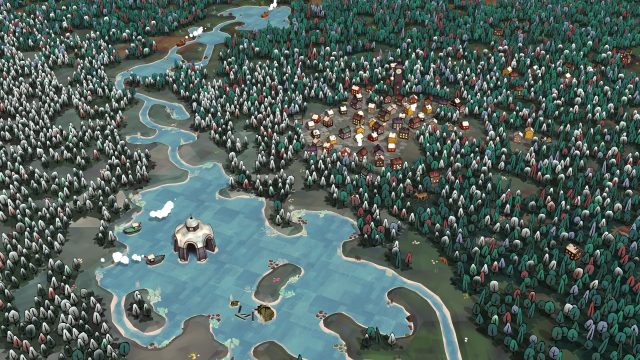
Tiles can contain a variety of elements; houses, trees, fields, railways, water and a few more unique tiles. Placing these alongside edges with common elements not only looks pretty but awards more points. Add to this that certain tiles come with a number above them that indicates that particular element needs X amount all joined together to complete a mission, and you can quickly see that Dorfromantik can get quite strategic.
From Lavender Fields to Lighted Towns: Evolving Biomes
Strategic, yet beautiful. As your world expands with each tile you can see and admire your hard work. The missions only help you create a more serene place too; that lush green forest feels like it has appeared naturally over time, right next to a town visibly growing as the river expands too.
There are also in-game challenges that reward you with new tiles, biomes and, generally, more beautiful things to add to your world. I can now add beaver dens and deers to my rivers and forests respectively, and sometimes I find myself just watching these tiles for a period of time. Add to this the soundtrack and sounds such as birdsong and the gentle chugging of a boat going past and you can easily be whisked off to a zen-like feeling that is unlike anything I have experienced from a game.
Creative Canvas
As you progress, new biomes will be unlocked too. From pink-tinged fields of lavender, to houses lit up in the night sky, each new biome can be layered on top. Scrolling across your map will also show the gradual change between biomes, but individual ones can also be turned off if they are not to your liking. Same too if you wanted to create a world of just one biome; it is yours to create how you want.
This is doubly so in Creative mode, as it gives you additional options to create your own unique world. Want the world to be filled with canals and waterways? You can. Or don’t particularly like how the fields look in-game? Remove them altogether.
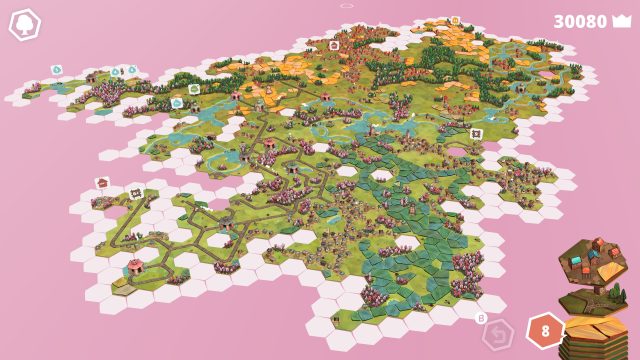
I chose fields in particular for that example because they feel like the weakest element of Dorfromantik. There is a gorgeous aesthetic to even the standard biome, but the fields just feel inferior to every other element, looking more like gaudy hexagons of gold plating than an actual field.
But I digress, because I am struggling to find any real fault with Dorfromantik.
A Glorious Puzzler That’s Both Challenging and Chill
Call it cosy, call it chill, but Dorfromantik is something truly special. It’s a game that is able to be both challenging and relaxing. It does the latter through beautiful visuals and a sublime soundtrack, but builds the challenge with a bit of depth and strategy. And also to resist the temptation to just keep playing until the real-life birdsong starts outside your window…
Important Links
Sit Back and Relax – Dorfromantik Launches on Xbox and PlayStation – https://www.thexboxhub.com/sit-back-and-relax-dorfromantik-launches-on-xbox-and-playstation/
Buy Dorfromantik on Xbox – https://www.xbox.com/en-gb/games/store/dorfromantik/9pb1lxv5xtf3


