World Liberty Financial is an Ethereum-based DeFi project co-founded by U.S. President Donald Trump and his sons.
The platform, which aims to “keep the dollar digital” and provide “loans for institutions and everyday users,” has launched a stablecoin called USD1.
The Trump family’s involvement in World Liberty Financial and other crypto projects has sparked criticisms from Democratic lawmakers over potential conflict of interest and corruption.
U.S. President Donald Trump has a long list of crypto ventures, profiting to the tune of some $1 billion as of October 2025. Of them, a DeFi project dubbed World Liberty Financial might be the biggest.
The platform, which President Trump co-founded, according to its website, along with his three sons, wants to make finance “reliable, open, and made for how the world works today.”
World Liberty Financial was announced by President Trump’s son Eric in August 2024. It is led by DeFi builders Chase Herro and Zak Folkman, along with other members of the Trump family and Zach Witkoff—son of longtime Trump ally Steve Witkoff.
Details on how the project works are still somewhat scant. Let’s take a look at what we know so far.
An Ethereum-based DeFi project
Built using the Aave protocol, World Liberty Financial’s platform hasn’t been released as of October 2025, but the project says it plans to “keep the dollar digital” and provide “loans for institutions and everyday users.”
DeFi—short for decentralized finance—is the sphere of the crypto industry that wants to replace traditional banking. DeFi projects, financial platforms that operate without third-party intermediaries, are usually apps built using Ethereum, the blockchain behind the second biggest cryptocurrency, ETH.
World Liberty Financial also runs on Ethereum.
It’s worth noting that while there are plenty of DeFi apps, the space is still a highly experimental part of the crypto industry and has been plagued by hacks and scams.
Those in the DeFi space typically say they want to streamline a slow and expensive legacy banking system, and World Liberty Financial so far has sold itself as the quintessential DeFi project: A borrowing and lending platform that will “unlock financial access for all, by replacing the limits of traditional banking with open, on-chain infrastructure, creating a fairer system—where opportunity isn’t defined by location, status, or permission.”
What can you do with World Liberty Financial?
While you can’t yet take loans out using the platform, you can buy its native token, WLFI, which has a market cap of $3.56 billion as of October 2025, making it the 43rd biggest cryptocurrency in existence, per CoinGecko data. WLFI is available on top exchanges like Binance, Coinbase, and OKX.
The project also has its own stablecoin, USD1, running on Ethereum and BNB Chain, which Decrypt first revealed in October 2024. The stablecoin is also available on major American exchanges like Coinbase and Kraken.
Stablecoins are digital tokens pegged to the value of fiat currencies—in USD1’s case, the U.S. dollar. The assets are a key part of the DeFi economy (and the wider crypto economy) because traders use them to swiftly enter and exit digital asset transactions. Instead of using dollars on traditional banking rails, digital tokens accelerate the crypto trading process.
The Trump family’s involvement
President Trump is listed as “co-founder emeritus” on the World Liberty Financial website, meaning he is no longer involved in the project since taking office in January. His close friend and the White House’s special envoy to the Middle East, Steve Witkoff, is also listed as a “co-founder emeritus.”
Still, the Trump and Witkoff families have likely made a lot of money from the project: Steve Witkoff’s son, Zach, and the president’s three sons, Eric, Donald Jr., and Barron are all still actively involved in World Liberty Financial.
WLFI’s market cap is more than two and half times bigger than the meme coin President Trump launched ahead of his inauguration, Official Trump (TRUMP). The Trump family owns a significant portion of the WLFI supply; their net worth grew by over $6 billion when the tokens started trading in September.
Conflict of interest concerns
The Trump family’s involvement in WLFI has proved contentious. Democratic lawmakers have frequently criticized the project—and the president’s other crypto ventures. In May 2025, Senator Elizabeth Warren took aim at a $2 billion investment from Abu Dhabi-based sovereign wealth fund MGX into leading crypto exchange Binance, which used the USD1 token, calling it “shady.”
Prominent House Democrats have also asked the Treasury to provide access to all suspicious activity reports, or SARs, on Trump’s digital asset projects—including World Liberty Financial.
Trump has repeatedly brushed aside concerns over his family’s involvement with crypto ventures including World Liberty Financial, claiming he “hasn’t looked” at the profits.
Daily Debrief Newsletter
Start every day with the top news stories right now, plus original features, a podcast, videos and more.
DUBAI, UAE, Oct. 19, 2025 /PRNewswire/ — Teltonika Telematics has once again been recognized as the global leader in hardware for fleet management and digitalization, taking the #1 position in the Wialon GPS Hardware Manufacturers Top 10: 2025 edition. The award was announced at the annual Wialon Community Reunion in Dubai, gathering top industry players ahead of GITEX Global.
This marks the fourth consecutive year that Teltonika Telematics has secured the leading position in the ranking. The company maintains its dominance with over 100 integrated models and more than 900,000 connected devices on the Wialon platform.
The annual Wialon Top 10 ranking highlights the manufacturers whose devices were most often connected to Wialon over the past 12 months. Wialon, a global fleet digitalization solution developed by Gurtam, supports over 3,800 device models from 700+ manufacturers, enabling service providers and fleet owners to freely choose the hardware that best fits their projects.
“Being number one is not just a status — it’s a responsibility. Together with Wialon, we’re focused on delivering smarter, more customized, and AI-driven solutions that help our partners stay competitive and shape the future of telematics.” – said Hassan Shahzad, Sales Director Middle East at Teltonika Telematics.
“This year, we see both stability — with long-time leaders retaining their strong positions — and change, with several newcomers making their debut. It proves that the telematics hardware market continues to evolve, offering service providers a wider range of options for their projects.” – said Aliaksandr Kuushynau, Head of Wialon.
About Wialon
Wialon is the ultimate fleet digitalization solution, designed to optimize operations and improve efficiency in all types of fleets — from cars and trucks to heavy vehicles and machinery. Currently, Wialon tracks more than 4.2 million vehicles in over 160 countries, helping companies of all sizes and industries reduce costs and improve operational performance. Wialon is the flagship product of Gurtam, a European developer of GPS tracking and IoT software headquartered in Vilnius, with offices in Boston, Dubai, and Tbilisi.
New York City, NY, Oct. 18, 2025 (GLOBE NEWSWIRE) — U.S. iGaming operators, including Cafe Casino, are reshaping how no-deposit bonuses are presented—replacing promotional claims with measurable data, responsible-play tools, and verifiable payout systems.
>>> Explore How Modern No Deposit Bonuses Work in 2025 >>>
Once used as short-term acquisition hooks, no deposit bonus casino, real money online casino no deposit bonus codes, free real money casino no deposit: such offers now anchor policy debates around transparency, fair play, and ethical communication. Editors and regulatory boards increasingly treat them as barometers of compliance rather than enticements. You’ll know all about free welcome bonus no deposit required real money here.
Across New Jersey, Pennsylvania, Michigan, and West Virginia, regulators have shifted focus from volume to clarity. Operators must now display wagering multiples, expiry windows, and cash-out caps next to every Claim Bonus button. The result is a measurable improvement in user trust and editorial acceptance.
Executive Overview
The phrase online casino real money no deposit describes a limited-value bonus granted to newly registered users who complete basic identity checks but make no initial payment.
1. Online casino free play no deposit → lets users explore licensed casinos without spending money.
2. Brand New Online Casino USA no deposit bonus → searched by players wanting simple, clearly stated bonus terms.
3. Free real money casino no deposit → signals interest in trusted casinos offering genuine cash outcomes.
4. Free $100 casino chip no deposit → used by experienced players testing payout speed and system reliability.
5. Online casino real money no deposit free spins → popular among slot players looking for real rewards from sign-up spins.
6. no deposit bonus casino → reflects demand for fair, transparent offers over exaggerated promotions.
By 2025, the model will have become a litmus test for trust. Operators that display precise terms gain editorial and user approval, while those that bury details see rapid community backlash.
A Redefinition of “No Deposit” Offers in 2025
By 2025, the U.S. digital-gaming landscape has shifted from promotion-driven messaging to verifiable transparency. A Free Welcome Bonus No Deposit Required Real Money credit, once used mainly as an acquisition tactic, is now treated as a consumer-education mechanism.
Major brands such as Cafe Casino and several state-licensed operators have aligned with this transition by publishing concise metrics—bonus value, playthrough multiplier, expiry, and withdrawal limit—directly beside the claim button. This standardized display language has improved both editorial acceptance and regulatory clarity.
Recent reports from the American Gaming Standards Forum note that 97 percent of licensed platforms now publish all material terms upfront, compared with 61 percent just two years earlier.
Why Precision Replaces Persuasion
Editors and compliance officers now evaluate every public statement using quantifiable language.Common approved phrasing includes:
“Bonus Value: $25 Credit”“Playthrough: 25× Wager Requirement”“Expiry: 7 Days From Claim”“Maximum Withdrawal: $150”
These neutral disclosures are preferred over promotional adjectives. Cafe Casino helped pioneer this presentation model within its U.S. operations, emphasizing clarity as both an ethical and operational standard.
The result is a communication style built on verifiable facts rather than subjective comparisons—something editors and licensing boards alike now require.
Technology and Compliance—The Same System
The backbone of transparency is technology. Smart-contract logic, real-time API dashboards, and blockchain hashing now record every step of a no-deposit campaign: issuance, wagering progress, and payout completion.When a 25× requirement is met, a smart contract automatically releases verified winnings.
Key efficiencies now observed across compliant operators such as Cafe Casino:
Audit time: Reduced by 70 percent due to automated records.Average payout verification: Cut from 36 hours to 8 hours.Dispute frequency: Down over 50 percent year-over-year.
Automation removes ambiguity and replaces marketing promises with algorithmic proof, creating measurable trust across the USA No Deposit Bonus segment.
Responsible-Play Tools Built Into Design
Responsible gaming is now a design element, not an afterthought. Modern bonus dashboards integrate:
Real-time session timers and spend trackersSelf-set cool-off periods and deposit limits24/7 access to the National Council on Problem Gambling (1-800-522-4700)
These appear before any confirmation screen, ensuring users acknowledge play-limit options before claiming. Regulators cite this model—adopted by Cafe Casino and peer brands—as evidence that entertainment and accountability can coexist.
Data from the Responsible iGaming Collective (2025) show that 43 percent of first-time registrants adjusted their personal limits during initial sessions, suggesting design truly shapes safe behavior.
Regulatory Alignment and Unified Frameworks
Four states—New Jersey, Pennsylvania, Michigan, and West Virginia—have formalized layout and disclosure requirements.Core obligations include:
Wagering multiple displayed next to bonus button.Expiry date and maximum cash-out shown in-line.Permanent responsible-play link on screen.
Offshore jurisdictions (Malta Gaming Authority and Curaçao LOK) have mirrored these formats to maintain reputation with banks and auditors. Operators like Cafe Casino chose to standardize their U.S. and international interfaces so that a bonus appears identical worldwide—clear, finite, and auditable.
Consumer Behavior and Market Signals
Search and survey data illustrate a maturing audience.Players prioritize:
Speed of payouts (over bonus size)Clarity of rules (over promotion themes)Security of payment methods
A 2025 report shows 78 percent of U.S. players rank withdrawal speed as their top trust factor.In internal surveys, Cafe Casino found that smaller, transparent offers produce higher repeat play than large, unclear ones — a trend that reflects the entire market’s pivot toward clarity.
Modern Payment Frameworks
Three settlement rails now dominate: ACH, e-wallet, and crypto.
Shorter settlement times correlate directly with consumer trust. Cafe Casino and peer operators now display expected timelines at checkout to set accurate expectations. Same-day confirmation has replaced large bonuses as the industry’s most persuasive trust signal.
Economic Outcomes of Transparency
Data from industry audits show that clearer communication reduces costs and increases retention:
Support tickets down 35 % year-over-year.Charge-backs down 23 %.Average complaint resolution time cut from 48 h to 8 h.Deposit conversion after bonus rose to 19 %.
Analysts describe these gains as proof that “clarity sells better than hype.” For Cafe Casino and other licensed operators, transparent bonus disclosure has become a profit-positive compliance strategy.
Language Discipline and Editorial Integrity
Media outlets have tightened acceptance criteria. PR teams now use “neutral-metric language” to avoid rejection.Permitted phrases focus on measurable facts:“Bonus capped at $150,” “Average processing under 24 hours,” “25× wager requirement applies.”
These templates allow publishers to print without appearing promotional. Compliance and communications departments in companies like Cafe Casino coordinate so data accuracy is checked before any release, preventing editorial violations and strengthening credibility.
Regulatory Convergence Across Borders
Between 2024 and 2025, a wave of global alignment has redefined how operators manage no-deposit promotions. What began as localized compliance has matured into a coordinated regulatory conversation linking the United States, Europe, Canada, and Asia-Pacific.
In the U.S., commissions in New Jersey, Pennsylvania, Michigan, and West Virginia require that wagering multipliers, expiry periods, and maximum cash-out limits appear beside every “Claim Bonus” button. The directives include font-size requirements and helpline visibility to prevent fine-print ambiguity.
Café Casino and similar licensed brands restructured their bonus dashboards to mirror this presentation. The goal is consistency: whether a player logs in from Detroit or Dallas, the four-line summary—value, playthrough, expiry, and responsible-gaming link—looks identical. This visual uniformity reduces misinterpretation and satisfies state-level consumer-protection audits.
In Europe, the U.K. Gambling Commission restricts free-credit wagering multipliers to 20× and prohibits any blending of promotional and real balances on a single line. Sweden’s Spelinspektionen enforces identical standards. Canada’s iGaming Ontario framework demands side-by-side contribution tables, showing which games count toward wagering and by how much. These are not stylistic choices; they are disclosure protocols forming the backbone of trust.
Across offshore jurisdictions, Curaçao’s LOK model and the Malta Gaming Authority (MGA) have adopted the same four-line data pattern. Together they form a transnational language of compliance now recognizable to editors, regulators, and consumers alike.
Responsible Gaming as Interface Design
The responsible-play movement has evolved from external disclaimers to embedded design language. Each bonus screen within major operators includes the following visible elements:
Time Alerts – pop-ups at 30- and 60-minute intervals prompting players to pause.Budget Sliders – adjustable spending caps visible even during demo play.Session Trackers – running tallies of total wagers and remaining credits.Helpline Buttons – instant access to the NCPG (1-800-522-4700) and live chat resources.
These appear before confirmation, ensuring acknowledgment of personal limits. Regulators and media reviewers regard such layouts—implemented by Café Casino and other compliant sites—as proof that safety is engineered, not implied.
A 2025 Responsible iGaming Consortium survey found that 44 percent of new players actively used a limit-setting tool during their first session. Such engagement demonstrates that interface design, not policy text, drives behavioral moderation.
Payment Innovation and Instant Payout Standards
Settlement speed has become the primary trust metric. The average U.S.-regulated casino now processes e-wallet withdrawals within 12 hours; crypto rails clear in under one. Transparency replaces advertising value—fast payout beats high bonus.
Café Casino publicly displays expected timelines on its cashier dashboard—“Estimated Payout 4–8 hours”—a practice now adopted industry-wide. Analysts note that players interpret timely settlement as proof of solvency and integrity, elevating trust far more effectively than promotional adjectives ever did.
Consumer Behavior and Market Perception
Search-engine trends and panel studies reveal a mature mindset among American players:
79 percent rank payout speed above bonus size.67 percent prefer fixed-value credits ($25 – $50) over variable promotions.61 percent consider visible RTP (Return to Player) figures a sign of credibility.
These statistics illustrate that clarity has replaced novelty as the dominant value proposition. Smaller, clearly defined bonuses—such as the introductory credits issued by Café Casino—build longer retention cycles because they emphasize fairness rather than luck.
Social sentiment mirrors the data. Forum discussions increasingly praise casinos that show countdown timers and transparent wagering bars, while opaque operators face immediate reputational pushback. In 2025, reputation moves faster than advertising, and the community has become an informal regulatory force.
Economic Impact of Transparent Design
The operational economics of clarity are measurable. Audits conducted by independent research groups report:
Charge-backs: Down 23 percent YoY due to automated payment logs.Support tickets: Down 35 percent because players understand terms.Complaint resolution time: Reduced from 48 hours to 8 hours.Deposit conversion after bonus: Up to 19 percent.
For CFOs and compliance directors alike, these numbers prove that ethics aligns with efficiency. Café Casino, among early adopters of transparent bonus disclosure, attributes a measurable retention uplift to its compliance-first UX architecture.
Ethical Language and Editorial Acceptance
Following repeated rejections of promotional copy, major newswires now require a neutral-metrics format. Releases must present facts—bonus caps, expiry windows, payout averages—without persuasive modifiers.
Acceptable phrasing examples now standard across the industry:
“Bonus value capped at $150.”“Playthrough requirement 25×.”“Average processing under 24 hours.”
Café Casino adopted this editorial discipline internally, coordinating between its legal and communications teams to pre-validate all metrics before publication. The approach ensures that every statement can be independently verified, reducing compliance risk and increasing editor trust.
Editorial boards, in turn, favor such releases because they provide objective reference points rather than subjective opinions—transforming iGaming press content into legitimate business reporting.
The Technology–Regulation Feedback Loop
Technology and policy now evolve together rather than sequentially. Regulators attend the same fintech expos where developers demonstrate automated audit dashboards; operators design features with future rulebooks in mind.
Examples visible in 2025:
Regulator APIs: State agencies connect directly to operator databases for live verification.Auto-flag systems: Smart contracts alert authorities when payout conditions change.Blockchain mirrors: Public ledgers show aggregate (not personal) bonus redemptions.
These innovations allow continuous supervision without invasive data collection. Café Casino participates in pilot programs testing real-time compliance feeds, helping set benchmarks for audit automation in 2026 licensing updates.
Consumer Education and Transparency Literacy
Operators have learned that informed users file fewer complaints. Modern onboarding sequences now include educational snippets explaining RTP, volatility, and wagering logic.
Brief tutorial modules—30-second animations or pop-up glossaries—clarify terms like “playthrough” or “max cash-out.” Such micro-learning content appears before play begins, ensuring understanding without instruction manuals.
The educational approach, pioneered by brands including Café Casino, converts compliance from a legal requirement into a customer-experience feature. Surveys show that players who complete these quick lessons demonstrate 28 percent greater retention and 40 percent fewer support interactions.
These numbers illustrate the measurable impact of the transparency movement: less confusion, faster settlements, higher satisfaction.
Cultural Shift: From Hype to Clarity
Public discourse around gaming has matured. Where once “biggest bonus” dominated search headlines, now “verified payout” and “licensed real-money site” draw traffic. News desks classify Free Welcome Bonus No Deposit Required Real Money stories not under lifestyle or entertainment but under business and technology.
Operators such as Café Casino embrace this repositioning, issuing releases that highlight systemic improvements—payment modernization, compliance dashboards, or responsible-play adoption—rather than self-promotion. The tone shift resonates with regulators, investors, and the press, all seeking verifiable progress instead of exaggerated marketing.
Economic Resilience and Future Readiness
Transparency has proven economically sustainable. Lower dispute costs, faster turnaround, and higher retention collectively improve margins without increasing risk exposure. Analysts project that by 2026, compliant operators could see 20 percent lower customer-service costs per active user.
Café Casino’s internal data aligns: streamlined disclosure reduces inbound queries and improves conversion from free-trial users to depositors. The free-welcome-bonus framework has effectively evolved from an expense to a diagnostic tool measuring consumer confidence.
2026 Forecast: Regulation as Code
Industry analysts project that the next wave of U.S. and international oversight will rely less on paperwork and more on programmable verification. In practice, regulation as code means that compliance rules are written directly into platform logic—leaving no room for subjective interpretation.
Key elements already in pilot stage across U.S. operators and partners such as Café Casino include:
Smart Licensing APIs: regulators can query real-time bonus data instead of waiting for quarterly filings.Immutable Records: every free-credit issue and payout is timestamped and hashed on blockchain.Instant Alerts: if a term (for example, a 25× playthrough) changes, the system notifies both operator and regulator instantly.
This architecture turns compliance into infrastructure. What once required audits now updates itself in real time, reducing friction and accelerating trust certification.
Predictive Risk Models and Behavioral Analytics
Artificial-intelligence engines continue to expand their role beyond marketing personalization. In 2026 they operate as preventive safeguards that detect irregular play behavior early.
Velocity Checks: identify rapid multi-account activity linked to no-deposit exploitation.Session-Length Monitors: suggest cool-off reminders when gameplay exceeds healthy norms.Adaptive Credit Limits: automatically scale down promotional value for high-risk accounts.
Café Casino integrated such models into its internal compliance suite, aligning with the National Council on Problem Gambling’s digital-wellness recommendations. The outcome is an environment where technology enforces moderation rather than relying solely on user discretion.
Responsible-Play Tools 2.0
Responsible-gaming design is evolving into a standardized UX language. In 2026, compliant interfaces are expected to include:
FeaturePurposeVisible to UserTime TrackerShows active minutes / hoursYes, on every pageSpend CounterDisplays wager totals (including free credits)Yes – always onSelf-Limit ButtonOne-tap daily/weekly capBefore and after loginResponsible-Play PromptPop-up linking to NCPG helplineAppears after 60 min
By embedding these cues directly into gameplay dashboards, operators such as Café Casino demonstrate that safety and transparency are inseparable from entertainment. Regulators cite visible prompts as measurable evidence of compliance rather than moral aspiration.
Consumer Literacy and Transparency Education
Public agencies increasingly treat no-deposit campaigns as educational tools. Instead of promising profit, they introduce players to key financial concepts: wagering math, RTP, and bankroll management.
Short, non-commercial modules—infographics, 60-second explainers, and tool-tips—now accompany registration flows. Café Casino participated in joint workshops with responsible-gaming foundations to test these interfaces. The results showed:
41 % fewer misunderstandings about playthrough requirements.36 % drop in refund or reversal requests.27 % increase in voluntary limit setting within the first session.
Education, it appears, delivers both social value and operational stability.
Payment Evolution: Real-Time Verification
Settlement infrastructure continues to converge with fintech. Same-day ACH, e-wallet rails, and blockchain stable-coin networks now interconnect, giving players near-instant access to verified winnings.
Payment MethodAverage Processing (2026)Trend CommentReal-Time Payment Network (RTP)1–3 hoursBecoming standard U.S. optionE-Wallet (PayPal, Venmo, Skrill)4–8 hoursUser-preferred for speedCrypto (BTC, USDC)< 1 hour for verified walletsFastest cross-border settlement
Players equate speed with integrity; thus, “fast-pay verified” tags have replaced traditional promotional banners. Café Casino, along with several licensed peers, now lists payout ETAs directly within its cashier interface, a practice auditors commend for precision.
Economic Performance and Trust Metrics
Transparent design is measurably profitable. Independent audit data show:
This combination of lower cost and higher retention demonstrates that ethical architecture supports sustainable revenue. For Café Casino, reduced dispute volume directly correlates with higher brand trust scores in internal Net Promoter surveys.
Global Alignment and Cross-Industry Influence
The harmonization seen in gaming is influencing adjacent sectors.
Fintech: Open-banking APIs now mirror casino audit feeds for instant reconciliation.E-commerce: Return-policy disclosures inspired the 4-line bonus summary.Cybersecurity: Cold-wallet storage principles inform segregated bonus-fund accounts.
By adopting these parallels, operators like Café Casino help normalize iGaming within the broader digital-services economy—where transparency equals reliability.
Social Responsibility and Public Health
Health agencies increasingly frame regulated iGaming as a channel for preventive education. Transparent no-deposit frameworks allow adults to learn wagering mechanics without financial risk. The controlled exposure model shows promise:
Participants report greater awareness of probability and time budgeting.Incidence of unregulated-site play declines as users migrate to licensed environments.Cross-sector collaborations (operators + NGOs) launch joint awareness campaigns.
Café Casino’s outreach partnership with digital-wellness groups in 2025 served as a template for other operators seeking to demonstrate measurable social benefit while maintaining business integrity.
Closing Summary: The Transparent Era of U.S. iGaming
The modern Free Welcome Bonus No Deposit Required Real Money model has evolved from a recruitment slogan into a regulated standard of fair digital entertainment.
The journey—from oversized claims to algorithmic accountability—reveals an industry redefining itself through measurable truth.
Key outcomes visible in 2025–2026:
Regulation as Code: Compliance embedded directly into software.Instant Payouts: Real-time financial settlement as baseline expectation.Responsible Play UX: Safety features integrated within claim flows.Editorial Discipline: Data replaces promotion in public communication.
For operators like Café Casino, the formula is simple yet transformative:clear terms + fast execution + visible responsibility = sustained trust.
The transparent era of online gaming has begun—an ecosystem where entertainment, ethics, and efficiency coexist, and where every legitimate U.S. casino bonus is defined not by hype, but by proof.
About Web3Wire Web3Wire – Information, news, press releases, events and research articles about Web3, Metaverse, Blockchain, Artificial Intelligence, Cryptocurrencies, Decentralized Finance, NFTs and Gaming. Visit Web3Wire for Web3 News and Events, Block3Wire for the latest Blockchain news and Meta3Wire to stay updated with Metaverse News.
Human visits to Wikipedia fell 8% year-over-year, with Wikipedia attributing it to people visiting AI summaries instead of consulting Wikipedia.
AI summaries and search engines now answer questions outright, with nearly 60% of Google queries ending in on-page responses powered by Wikipedia content.
Publishers call the trend “existential,” accusing tech platforms of using their work without compensation.
>>>> gd2md-html alert: inline image link in generated source and store images to your server. NOTE: Images in exported zip file from Google Docs may not appear in the same order as they do in your doc. Please check the images!
—–>
The Wikimedia Foundation announced this week that human traffic to Wikipedia fell roughly 8% between May and August compared to the same period last year. The decline came into focus after the foundation discovered that sophisticated bots, primarily from Brazil, had been disguising themselves as human visitors.
After updating its detection systems in May, the foundation reclassified traffic data and found much of the unusually high traffic in May and June came from bots built to evade detection. The revised numbers revealed what many in publishing already knew: fewer people visit Wikipedia directly because search engines now provide answers on their own pages.
“After making this revision, we are seeing declines in human pageviews on Wikipedia over the past few months, amounting to a decrease of roughly 8% as compared to the same months in 2024,” Marshall Miller, wrote. “We believe that these declines reflect the impact of generative AI and social media on how people seek information, especially with search engines providing answers directly to searchers, often based on Wikipedia content.”
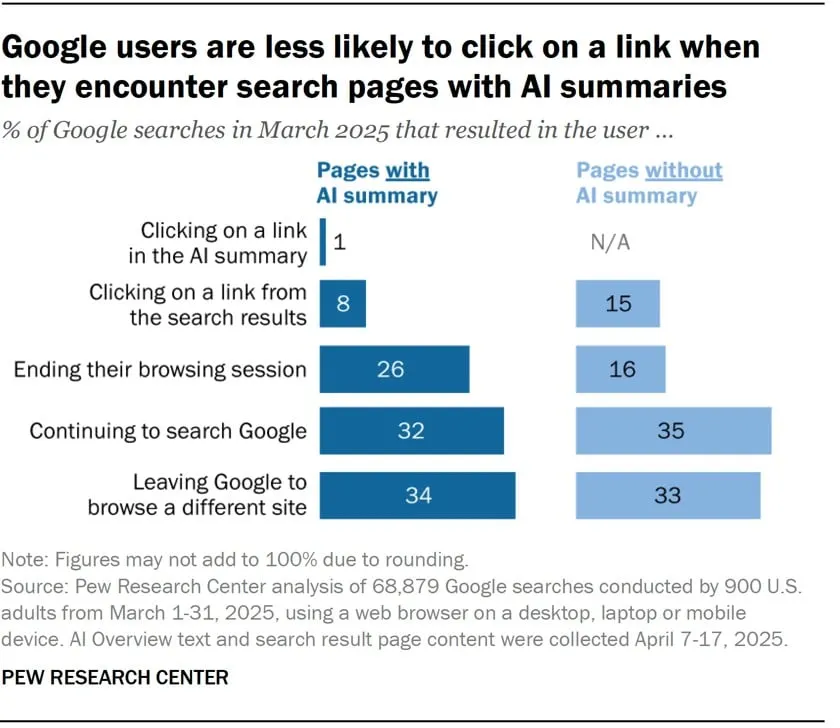
AI is not just killing Wikipedia. Data from Pew Research showed median year-over-year referral traffic from Google Search to premium publishers has decreased almost every week during May and June 2025, with losses outpacing gains two-to-one. Nearly 60% of all Google searches end up in an AI summary instead of promoting the reading of the actual source.
Publishers across industries are sounding alarms and resorting to lawsuits to get some protection. Danielle Coffey, who leads the News/Media Alliance representing more than 2,000 outlets, said Google is using publisher content without compensation while offering no meaningful way to opt out without disappearing from search entirely.
“It’s parasitic, it’s unsustainable, and it poses a real existential threat to many in our industry,” she said.
The volume of AI content online is rising fast. Research from SEO firm Graphite found that as of November 2024, almost half of new web articles were generated using AI in some form, up from just 5% before ChatGPT’s launch. A post by Ask Perplexity on X claimed AI content went from around 5% in 2020 to 48% by May 2025, with projections saying 90% or more by next year.
The Wikimedia Foundation said fewer visits to Wikipedia could mean that fewer volunteers grow and enrich the content, and fewer individual donors support the work. The foundation is responding by enforcing policies for third-party access, developing a framework for attribution, and experimenting with ways to bring free knowledge to younger audiences on platforms like YouTube and TikTok.
The foundation said Wikipedia’s human knowledge is more valuable to the world than ever before, 25 years since its creation. The question is whether the platforms using that knowledge will support the ecosystem that creates it.
The Wikipedia Foundation did not immediately respond to a request for comments by Decrypt.
Generally Intelligent Newsletter
A weekly AI journey narrated by Gen, a generative AI model.
Circuit breakers prevent panic selling on Wall Street, but some experts feel they are impractical, and potentially dangerous, in decentralized finance.
DeFi protocols will always be open, even if “front ends” implement restrictions, Amanda Tuminelli of the DeFi Education Fund said.
They could cause price dislocations to become worse, Gregory Xethalis of Multicoin Capital said.
Cryptocurrency prices plummeted last Friday as cascading liquidations fueled historic volatility, yet some experts are saying that Wall Street’s old-school safety net wouldn’t have helped.
In the U.S., venues like the Nasdaq and New York Stock Exchange have used circuit breakers to promote orderly trading since 1988, following the stock market crash known as Black Monday. They found that investors needed more time to react to changing market conditions.
In traditional finance, a “timeout” may reduce panic selling, but following more than $19 billion in crypto liquidations last Friday, some experts insist that those safeguards don’t map cleanly onto decentralized finance—and could even make conditions worse. (There are indications that forcibly closed positions on some platforms may have gone underreported.)
During a panel discussion at DC Fintech Week in Washington, D.C., Amanda Tuminelli, executive director of the DeFi Education Fund, said “there is no off button” in DeFi that would allow an individual or entity to exert unilateral control over networks and assets.
“That is because code is autonomous,” she said, in reference to services underpinned by smart contracts. “Decentralized systems like Uniswap, Ave, and dYdX performed through the entire liquidity crisis, and that is a testament to the resilience of decentralized technology.”
The cryptocurrency market is decentralized, and the same qualities that may make it impractical to implement market-wide trading halts or circuit breakers are the same ones that enable digital assets to trade hands around the clock, every day of the year.
With $19 billion worth of leveraged positions liquidated last Friday, some traders who were seeking outsized returns were swiftly wiped out. And conditions deteriorated to the point where some market makers, including Wintermute, say they were forced to retreat.
Circuit breakers can restrict trading activity on a market-wide basis or focus on individual securities. They are triggered automatically when a price or index moves a certain amount within a specific timeframe, with various levels of restrictions.
Tuminelli noted that it may be possible to implement restrictions on the “front ends” of services that connect to DeFi protocols, but she argued that “just means there are a million other front ends that can access the same protocol,” potentially limiting their effectiveness.
Gregory Xethalis, general counsel and partner at investment firm Multicoin Capital, said it may be tempting to try and implement safeguards in DeFi that parallel traditional markets, but they could actually have the opposite effect by exasperating price discrepancies across venues.
Traditionally, circuit breakers have worked well in U.S. securities markets, where an asset typically trades on one venue and buy and sell orders are consolidated in one place. In DeFi, however, assets trade universally, with constant arbitrage across venues.
“The only thing you can implement with a circuit breaker [in DeFi] is a dislocation,” he said. “Solutions that we look to for new markets must be designed for those new markets.”
That’s not to say DeFi is incapable of coming up with its own solutions, Xethalis added, or taking inspiration from centralized markets when designing risk parameters for protocols.
“But we should be careful not to fall into the trap of thinking that yesterday’s solutions will always work for tomorrow’s products,” he said. “This stuff trades throughout the globe.”
Daily Debrief Newsletter
Start every day with the top news stories right now, plus original features, a podcast, videos and more.
United States, 18th Oct 2025 – Wendy Joy unveils her new memoir, Insights and Experiences: Wendy Joy’s Stepping Stones for Growth, a reflective work that transforms deeply personal struggles into lessons of strength, restoration, and spiritual illumination. Written with both honesty and sensitivity, this book offers a distinctive narrative voice that refuses to shy away from hardship while steadily pointing toward renewal.
Unlike conventional life stories that simply recount events, Insights and Experiences builds a framework of meaning from every challenge Wendy faced. From early family trials to confronting debilitating illness, her pages trace the weight of adversity alongside the resilience that allowed her to keep moving forward. Each memory is treated not as an endpoint, but as a marker on a larger path of growth. Through this lens, the memoir demonstrates how endurance can be refined into wisdom and how perseverance becomes the foundation for self-transformation.
At its core, the book is an exploration of what it means to live through loss, recover from brokenness, and still discover clarity in the aftermath. Wendy’s storytelling blends personal reflection with broader insight, presenting obstacles as teachers rather than enemies. She underscores that forgiveness, whether directed inward or outward, creates the release necessary to invite abundance, peace, and purpose into one’s life.
Wendy explains. “I chose to see mine not as barriers, but as steps leading me somewhere greater. This memoir is proof that even when circumstances seem unmovable, we are still capable of rising beyond them.”
The title itself reflects Wendy’s guiding vision: that difficulties encountered along the way are not random setbacks, but intentional lessons designed to shape the individual. The memoir moves fluidly between recollection and interpretation, allowing readers to recognize themselves in her challenges while also drawing courage from her resilience.
Beyond her role as a writer, Wendy Joy is recognized for her compassionate outlook and intuitive depth. She describes herself as someone who has always carried the ability to see what others overlook, whether moments of hidden strength or the quiet signals of the spirit.
Insights and Experiences is not a manual, nor a self-help formula; it is a lived testament to the endurance of the human spirit. It demonstrates that hardship, though often painful, can be reshaped into insight, and that clarity often emerges in the aftermath of struggle. The book affirms that life’s heaviest burdens can eventually become sources of direction and a beacon of light.
Insights and Experiences: Wendy Joy’s Stepping Stones for Growth is now available through booksellers and online platforms worldwide.
The post Wendy Joy Inspires with Insights and Experiences appeared first on King Newswire. This content is provided by a third-party source. King Newswire is a press release distribution agency. We do not accept any responsibility or liability for the accuracy, content, images, videos, licences, completeness, legality, or reliability of the information contained in this article. If you have any complaints or copyright concerns related to this article, please contact the company listed in the ‘Media Contact’ section above.
Legal Disclaimer: Information contained on this page is provided by an independent third-party content provider. king Newswire makes no warranties or responsibility or liability for the accuracy, content, images, videos, licenses, completeness, legality, or reliability of the information contained in this article. If you are affiliated with this article or have any complaints or copyright issues related to this article and would like it to be removed, please contact support@kingnewswire.com
This release was published on openPR.
About Web3Wire Web3Wire – Information, news, press releases, events and research articles about Web3, Metaverse, Blockchain, Artificial Intelligence, Cryptocurrencies, Decentralized Finance, NFTs and Gaming. Visit Web3Wire for Web3 News and Events, Block3Wire for the latest Blockchain news and Meta3Wire to stay updated with Metaverse News.
“Awareness is your first defense, but technology should be your shield,” Ray said. “Our goal is to help Bluffton residents and small businesses enjoy the holidays–without falling victim to scams.”
SNS Technologies warns Bluffton businesses about the rise of AI-driven holiday phishing scams and shares expert tips to stay protected this season. Learn how to safeguard your inbox with smarter email security.Bluffton, SC – As the holiday season approaches, SNS Technologies [https://snstechnologies.net/] is warning Bluffton businesses to be on alert for a sharp rise in phishing scams-cyberattacks that often target shoppers, businesses, and charitable givers during this busy time of year.
According to Michael Ray, spokesperson for SNS Technologies, the tactics behind these scams have evolved dramatically.
“Phishing isn’t just about suspicious emails from fake princes anymore,” said Ray. “We’re seeing AI-generated messages and realistic social engineering that can fool even cautious users. The threats look authentic-and that’s what makes them so dangerous.”
In a recent report [https://snstechnologies.net/phishing-scams-are-evolving-heres-what-you-need-to-know/] on their website, SNS Technologies explained how cybercriminals are using AI tools to craft convincing messages that can bypass standard spam filters. Some attacks now embed hidden HTML and CSS code in legitimate-looking emails-tricking users into clicking fake support links or calling fraudulent help lines.
Another emerging scam involves impostors posing as journalists, reaching out from phony TechCrunch social media accounts to PR professionals and business owners. Once trust is established, the attacker sends a malicious link disguised as an interview request-resulting in stolen credentials or malware infections.
SNS Technologies says these examples reflect a broader trend: criminals are manipulating trust itself.
“People tend to act quickly when they believe something is urgent or credible,” Ray added. “That’s exactly what these scams exploit.”
To help residents stay safe, SNS Technologies recommends several key steps this holiday season:
*Pause before clicking – Hover over links to verify URLs.
*Be skeptical of urgency – Scammers rely on panic or excitement to get you to act fast.
*Check the sender – Even familiar names can be spoofed.
*Use email protection tools – Layered security is essential as attacks become more sophisticated.
SNS Technologies provides advanced email protection solutions designed to detect and block phishing attempts before they reach your inbox. Their system uses intelligent filtering, real-time threat analysis, and adaptive learning to evolve alongside the latest cyber threats.
“Awareness is your first defense, but technology should be your shield,” Ray said. “Our goal is to help Bluffton residents and small businesses enjoy the holidays-without falling victim to scams.”
Video: https://www.youtube.com/embed/67oNhuXkmrk
Video Link: https://www.youtube.com/embed/67oNhuXkmrk
Media ContactCompany Name: SNS TechnologiesContact Person: Michael RayEmail:Send Email [https://www.abnewswire.com/email_contact_us.php?pr=sns-technologies-warns-bluffton-businesses-about-holiday-phishing-scams-and-offers-smart-protection-tips]Phone: (843) 757-7873Address:49 Pennington Dr Suite ACity: BlufftonState: South CarolinaCountry: United StatesWebsite: https://snstechnologies.net/
Legal Disclaimer: Information contained on this page is provided by an independent third-party content provider. ABNewswire makes no warranties or responsibility or liability for the accuracy, content, images, videos, licenses, completeness, legality, or reliability of the information contained in this article. If you are affiliated with this article or have any complaints or copyright issues related to this article and would like it to be removed, please contact retract@swscontact.com
This release was published on openPR.
About Web3Wire Web3Wire – Information, news, press releases, events and research articles about Web3, Metaverse, Blockchain, Artificial Intelligence, Cryptocurrencies, Decentralized Finance, NFTs and Gaming. Visit Web3Wire for Web3 News and Events, Block3Wire for the latest Blockchain news and Meta3Wire to stay updated with Metaverse News.
Salem, Mass. police called the TikTok trend “stupid and potentially dangerous” in a public safety alert.
Videos showing AI “intruders” have triggered real emergency calls and alarmed family members.
Critics say the prank dehumanizes unhoused people while exposing risks of AI-generated deception.
Police departments from Massachusetts to Texas are warning residents about a viral TikTok prank that uses AI-generated images to make it appear that a homeless man has entered someone’s home, prompting panicked calls to 911,
“Besides being in bad taste, there are many reasons why this prank is, to put it bluntly, stupid and potentially dangerous,” said the Salem, Mass. Police Department, in a statement. That police department issued a public alert and detailed cases in which recipients “sincerely believed that there was an actual intruder” and dialed 911, necessitating immediate response by officers.
In Texas, police have also confronted the fallout from the viral prank. The Houston Chronicle reported that officers in Round Rock, a suburb of Austin, responded to multiple 911 calls after residents were shown AI-generated photos depicting a “homeless man” inside their homes. Investigators determined the images were fabricated as part of the TikTok trend.
Police urge kids to stop doing AI homeless man prank on parents, warning it could lead to being ‘swatted’
The prank tricks parents with AI images of a homeless man inside their house pic.twitter.com/Gt99JjhZIq
— Dexerto (@Dexerto) October 14, 2025
The Round Rock Police Department warned that such hoaxes “tie up emergency resources and create unnecessary fear,” according to FOX 7 Austin. Local authorities said they are reviewing whether those who knowingly share the doctored images to provoke panic could face false-reporting charges under Texas law.
The trend, known on social media as the “AI homeless man prank,” has been documented by tech and local outlets as it spread across TikTok and Snapchat. The Verge first reported that teens are generating realistic images of a stranger in kitchens and hallways and sending them to parents to capture their reactions, with some videos drawing millions of views.
Broadcasters and local newsrooms have echoed law-enforcement concerns: ABC’s Good Morning America highlighted warnings from departments that the prank wastes emergency resources and can lead to dangerous misunderstandings; stations in Michigan and Minnesota reported similar advisories.
TikTok said it had added labels to videos NBC had flagged to clarify that they are AI-generated. The company’s transparency filings to California under AB 587 also outline enforcement steps, including content removal and account bans when posts violate those rules.
Celebrity attention has amplified the trend’s reach. People chronicled examples of viral posts, including a father who called his son 21 times after receiving a doctored image, and noted that GMA co-host Michael Strahan said he briefly “freaked out” when an assistant sent him a manipulated photo.
Generally Intelligent Newsletter
A weekly AI journey narrated by Gen, a generative AI model.
Gespa, Switzerland’s gambling authority, filed a formal criminal complaint against FIFA’s NFT collectibles platform.
The regulator pointed to the site’s random draws and right-to-buy offerings, which it likened to sports betting and lotteries.
FIFA Collect is the soccer governing body’s collectibles platform, which now runs on an Avalanche L1.
Gespa, the lottery and gambling authority of Switzerland, has formally filed a criminal complaint regarding FIFA Collect, the international soccer governing body’s blockchain collectibles platform, the organization announced on Friday.
The authority had begun an initial assessment and preliminary probe into FIFA Collect and its offerings—like its “right-to-buy” ticket NFTs— in early October, telling Decrypt that it “couldn’t rule out” whether the platform’s offerings would be relevant to Swiss gambling regulation.
After deeper investigation, it’s now reported the collectibles platform to the relevant authorities.
“During the investigation, suspicions were confirmed that collect.fifa.com offers gambling services that are not licensed in Switzerland and are therefore illegal,” Gespa said in a written statement. “Gespa is obliged to notify the competent prosecution authorities if it becomes aware of violations of the Federal Act on Gambling.”
According to the regulator, participation in select competitions on the platform that offer monetary benefits is only possible “in exchange for a monetary stake,” ultimately providing rewards via random draw or similar procedures.
“From a gambling law perspective, the offers in question are partly lotteries and partly sports betting (right-to-final),” it said.
Further information about the criminal complaint and proceedings are not being shared at this time, Gespa Director Manuel Richard told Decrypt.
The “right-to-final” the authority references refers to a new collectible type offered by FIFA called “right-to-buy” (RTB). This collectible designation provides NFT holders with the opportunity to buy from a designated allocation of FIFA World Cup tickets for the upcoming 2026 World Cup being hosted across North America.
RTB collectibles, which guarantee a user can skip the general queue of prospective ticket purchasers, can be purchased or revealed from collectible packs on the platform, or bought on the secondary marketplace.
On the secondary market, these collectibles can range from around $98 for the right-to-buy tickets to a group match round in Houston all the way up to $6,000 for the right-to-buy a ticket to the opening match at Azteca Stadium in Mexico.
FIFA is selling tickets to the world’s largest soccer sporting event in multiple phases. The organization recently announced it has already sold more than 1 million tickets through its early Visa presale.
The soccer organization’s blockchain collectible platform was originally developed on Algorand in 2022, but earlier this year FIFA announced its departure from the proof-of-stake blockchain. Instead, FIFA opted to create its own Avalanche L1 network to support the platform.
A representative for FIFA did not immediately respond to Decrypt’s request for comment.
Daily Debrief Newsletter
Start every day with the top news stories right now, plus original features, a podcast, videos and more.
Coherent Market Insights’ most recent research study, “Global Push to Talk Market Size, Share, Pricing, Trends, Growth, Opportunities and Forecast 2025-2032,” provides a thorough overview of the market for Push to Talk Market on a global scale. The research contains future sales projections, consumer demand, regional analyses, and other crucial data about the target market, as well as the numerous motivators, inhibitors, opportunities, and dangers. In addition to future strategies, acquisitions, and mergers, the research provides information on the major important companies participating in the market, supply chain trends, their financials, significant advances, and technological innovations. Type, distribution channel, and geographic region are the segments used in the Push to Talk Market Industry report. To present a global picture of growth trends, it looks at past and projected predictions.
➤ Request a sample Copy @ https://www.coherentmarketresearch.com/samplepages/97581
All interested in global Push to Talk Market industry experts can use this report to examine market trends, gauge the competitive landscape, spot business opportunities, and zero in on the major market drivers. The analysis covers company profiles of the top market players, information on their recent product launches, product extensions, marketing strategies, business strategy, business infrastructure, upcoming rival products and services, price trends, and business infrastructure. Research methodologies like primary research, secondary research, bottom-up and top-down approaches, SWOT analysis, Porter Five Forces analysis, and others are used to study the Push to Talk Market.
➤What is New Additions in 2025?
• Detailed industry forecast• Additional information on company participants• Customized reports and analyst assistance are available upon request.• Recent market developments and potential future growth opportunities• Personalized regional/country reports upon request• New data sources are being integrated.• Increased focus on data privacy and security• Increased collaboration and co-creation
➤ Top Companies Covered In This Push to Talk Market Report:
➤Comprehensive segmentation and classification of the report:
• Public Safety• Transportation and Logistics• Construction• Hospitality• Oil and Gas• Healthcare• Retail• Manufacturing.
➤ Regional Analysis for Push to Talk Market:
• North America (U.S., Canada, Mexico)• Europe (Germany, U.K., France, Italy, Russia, Spain, Rest of Europe)• Asia-Pacific (China, India, Japan, Singapore, Australia, New Zealand, Rest of APAC)• South America (Brazil, Argentina, Rest of SA)• Middle East & Africa (Turkey, Saudi Arabia, Iran, UAE, Africa, Rest of MEA)
➤ Buy the Latest Version of the Report Available Now at UP TO 70% off Discounted Pricing @ https://www.coherentmarketinsights.com/promo/buynow/97581
➤ Key Benefits for Industry Participants & Stakeholders:
The study’s coverage of industry drivers, restrictions, and opportunitiesImpartial opinion on the condition of the marketThe most recent innovations and trends in the industryCompetitive environment and important players’ plansCovered are promising growth regions, potential niche markets, andSize of the market in terms of value, past, present, and futureComprehensive study of the Push to Talk Market
➤ Report Spotlights
Push to Talk Market business advancements will help participants in creating successful long-term plansCompanies use business growth strategies to ensure growth in both developed and developing markets.Global Push to Talk Market quantitative study from 2025 to 2032Estimation of Push to Talk Market Demand in Different IndustriesThe effectiveness of buyers and suppliers functioning in the Push to Talk Market business is demonstrated using Porter’s Five Forces analysis.Recent advancements to better comprehend the Push to Talk Market industry environment and demandMarket developments, prospects, and driving forces for the Push to Talk MarketUnderstanding the business interests that support market expansion plans can help in decision-making.
➤ Buy the Latest Version of the Report Available Now at UP TO 70% off Discounted Pricing @ https://www.coherentmarketinsights.com/promo/buynow/97581
➤ Key Questions Answered in This Report:
What would the projected growth rate be from 2025 to 2032? How big will it get in the projected amount of time?What are the main factors that will determine the future of the Push to Talk Market sector in the upcoming years?Who are the leading competitors in the Push to Talk Market, and what are their successful acquisition strategies?What are the main trends impacting the growth of Push to Talk Market in different geographical areas?What opportunities should you take precedence?
Author of this marketing PR:Alice Mutum is a seasoned senior content editor at Coherent Market Insights, leveraging extensive expertise gained from her previous role as a content writer. With seven years in content development, Alice masterfully employs SEO best practices and cutting-edge digital marketing strategies to craft high-ranking, impactful content. As an editor, she meticulously ensures flawless grammar and punctuation, precise data accuracy, and perfect alignment with audience needs in every research report. Alice’s dedication to excellence and her strategic approach to content make her an invaluable asset in the world of market insights.
About Us:Coherent Market Insights Pvt. Ltd leads into data and analytics, audience measurement, consumer behaviors, and market trend analysis. From shorter dispatch to in-depth insights, CMI has exceled in offering research, analytics, and consumer-focused shifts for nearly a decade. With cutting-edge syndicated tools and custom-made research services, we empower businesses to move in the direction of growth. We are multifunctional in our work scope and have 450+ seasoned consultants, analysts, and researchers across 26+ industries spread out in 32+ countries.
Contact Us:
Mr. ShahCoherent Market Insights533 Airport Boulevard,Suite 400, Burlingame,CA 94010, United StatesUS: + 12524771362UK: +442039578553AUS: +61-8-7924-7805India: +91-848-285-0837
This release was published on openPR.
About Web3Wire Web3Wire – Information, news, press releases, events and research articles about Web3, Metaverse, Blockchain, Artificial Intelligence, Cryptocurrencies, Decentralized Finance, NFTs and Gaming. Visit Web3Wire for Web3 News and Events, Block3Wire for the latest Blockchain news and Meta3Wire to stay updated with Metaverse News.